Senior Maths Editor, 9 Yrs | Updated on - Jun 29, 2026
NCERT Exemplar Class 10 Maths Chapter 5 Arithmetic Progressions Exercise 5.4 has 10 Long Answer Questions (Q62 to Q71). They cover two-variable AP systems, multiples and LCM sums, symbolic sum formulas, and word problems on instalments and distances. Every solution below shows step-by-step working and an expert view, for the 2026-27 syllabus.
Key formulas tested:an = a + (n−1)d and Sn = n/2[2a + (n−1)d], plus algebraic proof and inclusion-exclusion
CBSE relevance: Long Answer AP questions are standard fare in CBSE Class 10 board exams every year
Solved by Collegedunia All 10 Long Answer Questions are solved by Maths experts. Each shows the concept used, full step-by-step working, a boxed answer, and a faster expert second view.
Exercise 5.4 at a Glance · 10 Long Answer Questions (Q62-Q71), Chapter 5 Arithmetic Progressions, Class 10 Maths Exemplar 2026-27
Arithmetic Progressions Exercise 5.4 Overview and Key Formulas
Exercise 5.4 is the Long Answer section of the Chapter 5 Exemplar. All 10 questions need multi-step reasoning: setting up simultaneous equations from AP conditions, using inclusion-exclusion for sums, proving formulas with symbols, and solving word problems on instalments and distances. The table maps each question to its topic and difficulty.
Question
Topic Tested
Difficulty
Q62
Two-equation system from sum conditions; find S20
Medium
Q63
Sum of multiples (LCM 10); inclusion-exclusion for "or"
Medium
Q64
Word-condition equations; solve pair; find 15th term
Medium
Q65
37-term AP; middle triple and last triple sums
Hard
Q66
Sum of multiples of 9 between 100-200; complement technique
Easy
Q67
Term-ratio given; deduce a=4d; find term and sum ratios
Hard
Q68
Algebraic proof of Sn with symbolic a,b,c
Hard
Q69
Equation −4+(−1)+2+…+x=437; solve for x
Medium
Q70
Loan-instalment word problem; 30th instalment and balance
Medium
Q71
Flag-distance word problem; round-trip sum and longest carry
Hard
Formula Bank: Three formulas power every question in this exercise.
nth term:an = a + (n−1)d
Sum of n terms:Sn = n/2[2a + (n−1)d]
Sum with last term:Sn = n/2(a + l)
Question Group
Technique Used
Q62, Q64, Q67
Set up two equations from given AP conditions; solve simultaneously
Q63, Q66
Sum of multiples by AP formula; inclusion-exclusion for union
Q65
Three consecutive AP terms sum to 3 times the central term
Q68
Algebraic substitution to prove a symbolic sum formula
Q69
Sum equals given value; form and solve a quadratic in n
Q70, Q71
Real-world AP: instalments or distances form a concrete AP
All Exercise 5.4 Questions with Step-by-Step Solutions
IV. Long Answer Questions (Exercise 5.4)
Q 5.1
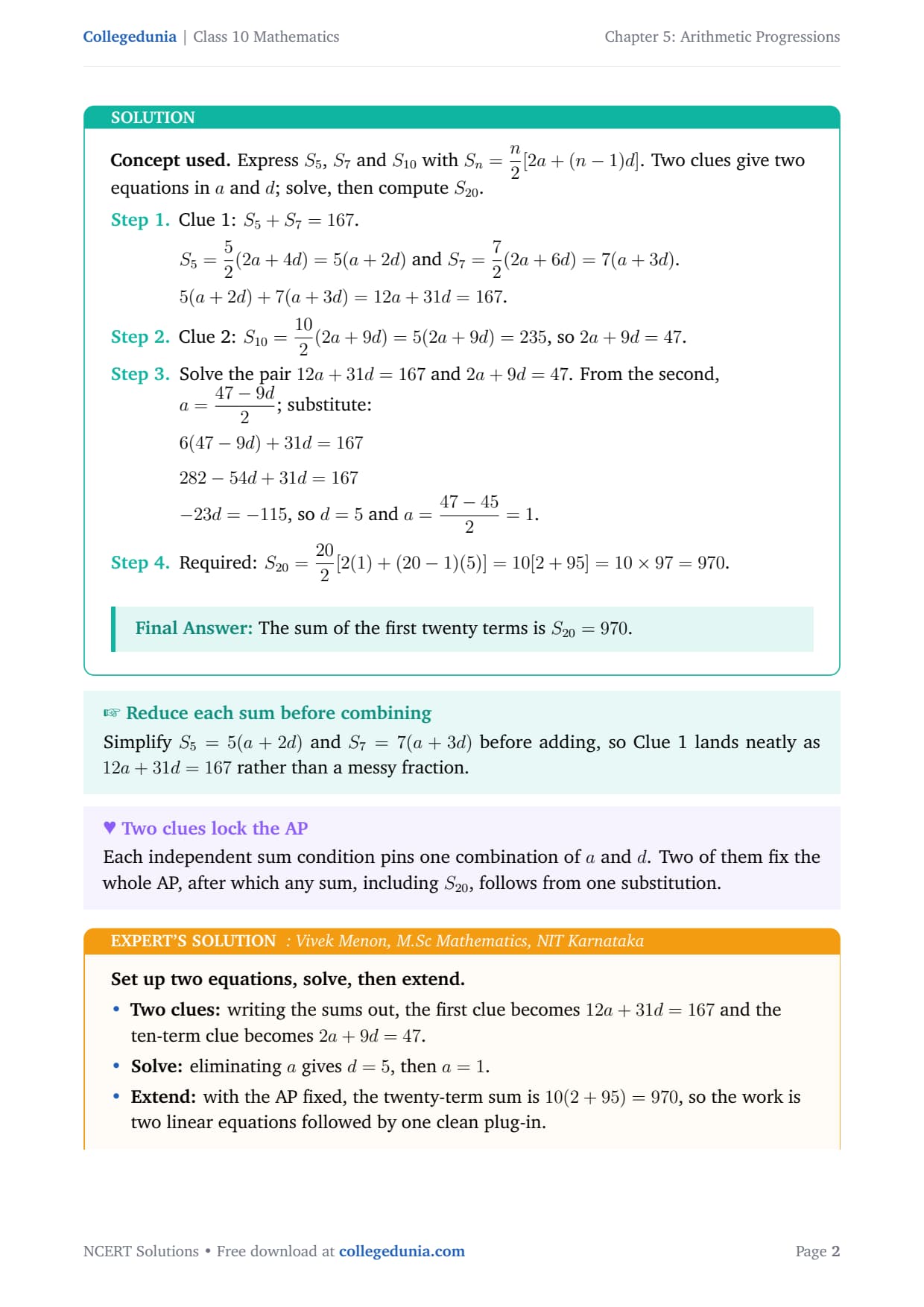
The sum of the first five terms of an AP and the sum of the first seven terms of the same AP is 167. If the sum of the first ten terms of this AP is 235, find the sum of its first twenty terms.
Concept used. Express S5, S7 and S10 with
Sn=n2[2a+(n-1)d]. Two clues give two equations in a and
d; solve, then compute S20.
Clue 1: S5+S7=167.
[] S5=52(2a+4d)=5(a+2d) and
S7=72(2a+6d)=7(a+3d).
[] 5(a+2d)+7(a+3d)=12a+31d=167.
Clue 2: S10=102(2a+9d)=5(2a+9d)=235, so
2a+9d=47.
Solve the pair 12a+31d=167 and 2a+9d=47. From the second,
a=47-9d2; substitute:
[] 6(47-9d)+31d=167
[] 282-54d+31d=167
[] -23d=-115, so d=5 and a=47-452=1.
Two clues: writing the sums out, the first clue becomes
12a+31d=167 and the ten-term clue becomes 2a+9d=47.
Solve: eliminating a gives d=5, then a=1.
Extend: with the AP fixed, the twenty-term sum is
10(2+95)=970, so the work is two linear equations followed by
one clean plug-in.
S20=970.
Q 5.2
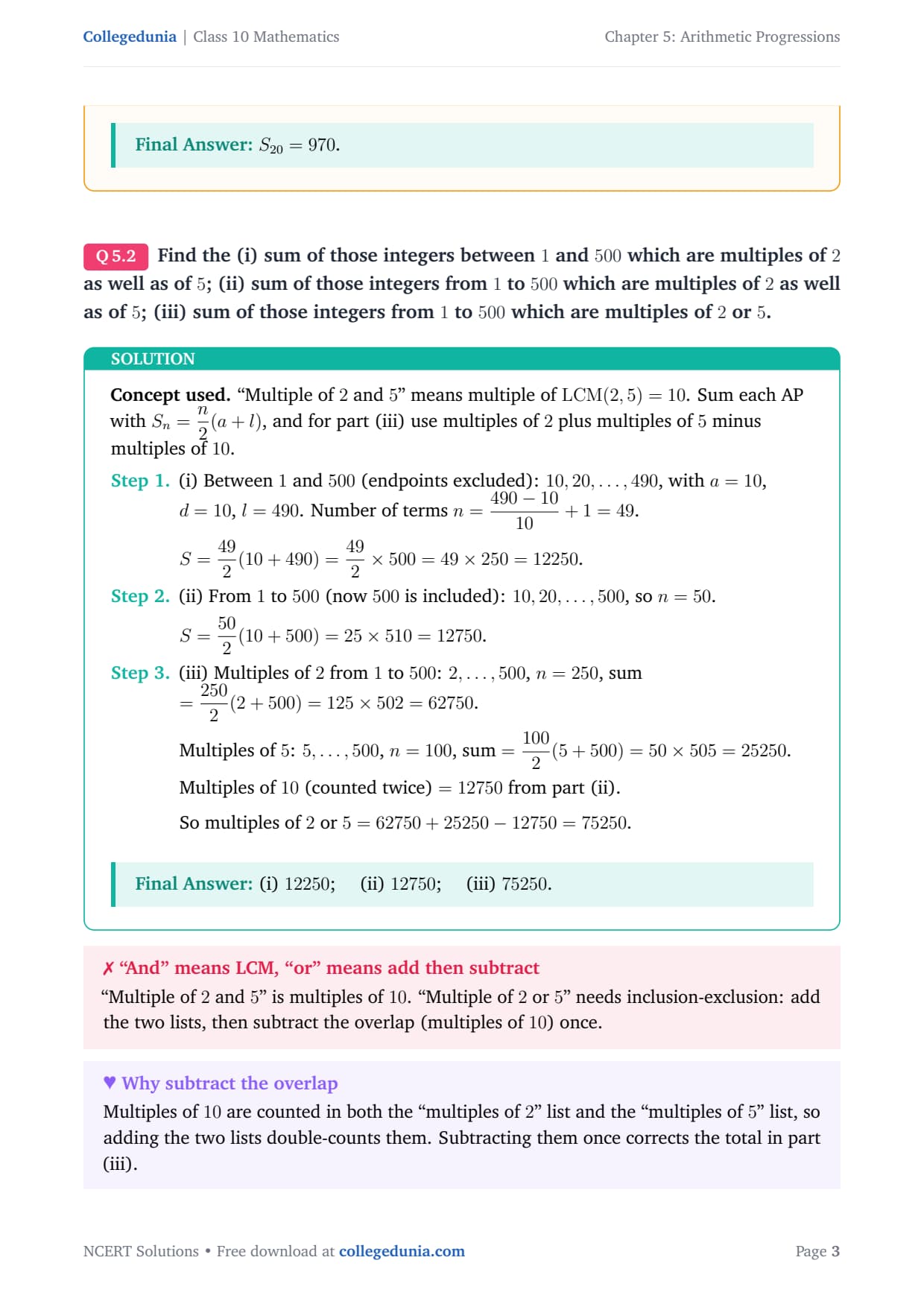
Find the (i) sum of those integers between 1 and 500 which are multiples of 2 as well as of 5; (ii) sum of those integers from 1 to 500 which are multiples of 2 as well as of 5; (iii) sum of those integers from 1 to 500 which are multiples of 2 or 5.
Concept used. ``Multiple of 2 and 5'' means multiple of
LCM(2,5)=10. Sum each AP with Sn=n2(a+l), and for
part (iii) use multiples of 2 plus multiples of 5 minus multiples of
10.
(i) Between 1 and 500 (endpoints excluded): 10,20,,490,
with a=10, d=10, l=490. Number of terms
n=490-1010+1=49.
[] S=492(10+490)=492500=49250=12250.
(ii) From 1 to 500 (now 500 is included): 10,20,,500,
so n=50.
[] S=502(10+500)=25510=12750.
(iii) Multiples of 2 from 1 to 500: 2,,500, n=250,
sum =2502(2+500)=125502=62750.
[] Multiples of 5: 5,,500, n=100, sum
=1002(5+500)=50505=25250.
[] Multiples of 10 (counted twice) =12750 from part (ii).
[] So multiples of 2 or 5=62750+25250-12750=75250.
(i) 12250; (ii) 12750; (iii) 75250.
DR
Damini Rawat
M.Sc Mathematics, Doon University Dehradun
Verified Expert
Three sums tied together by LCM.
Two near-twins: parts (i) and (ii) are both multiples of
10, differing only in whether the last term 500 is counted, so
49 terms sum to 12250 and 50 terms sum to 12750.
Inclusion-exclusion: part (iii) wants the ``or'' count, so
add the multiples of 2 giving 62750 and the multiples of 5
giving 25250, then remove the doubly counted multiples of 10.
Finish: subtracting that overlap of 12750 once leaves
75250, and this overlap step is the heart of the third part.
(i) 12250; (ii) 12750; (iii) 75250.
Q 5.3
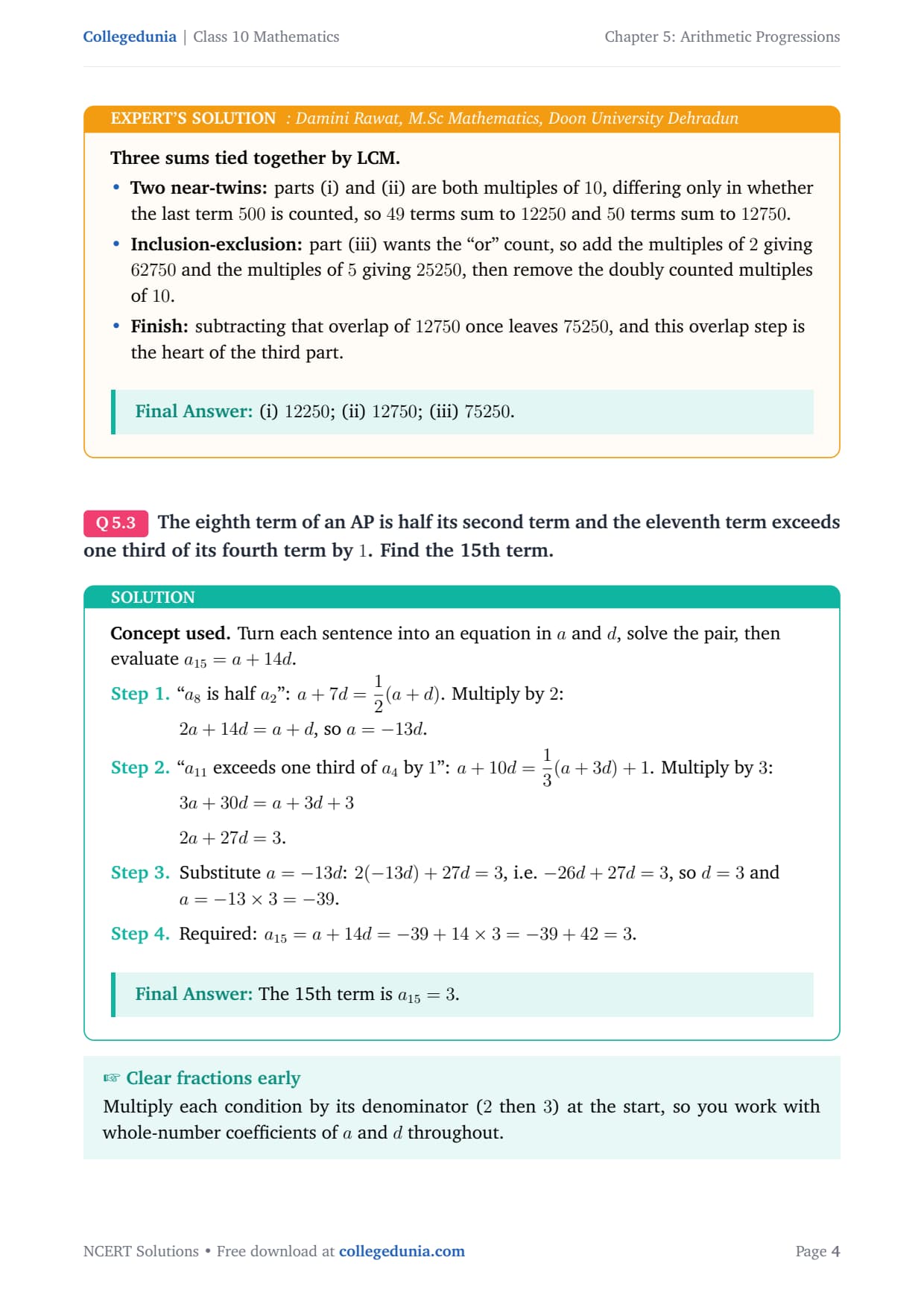
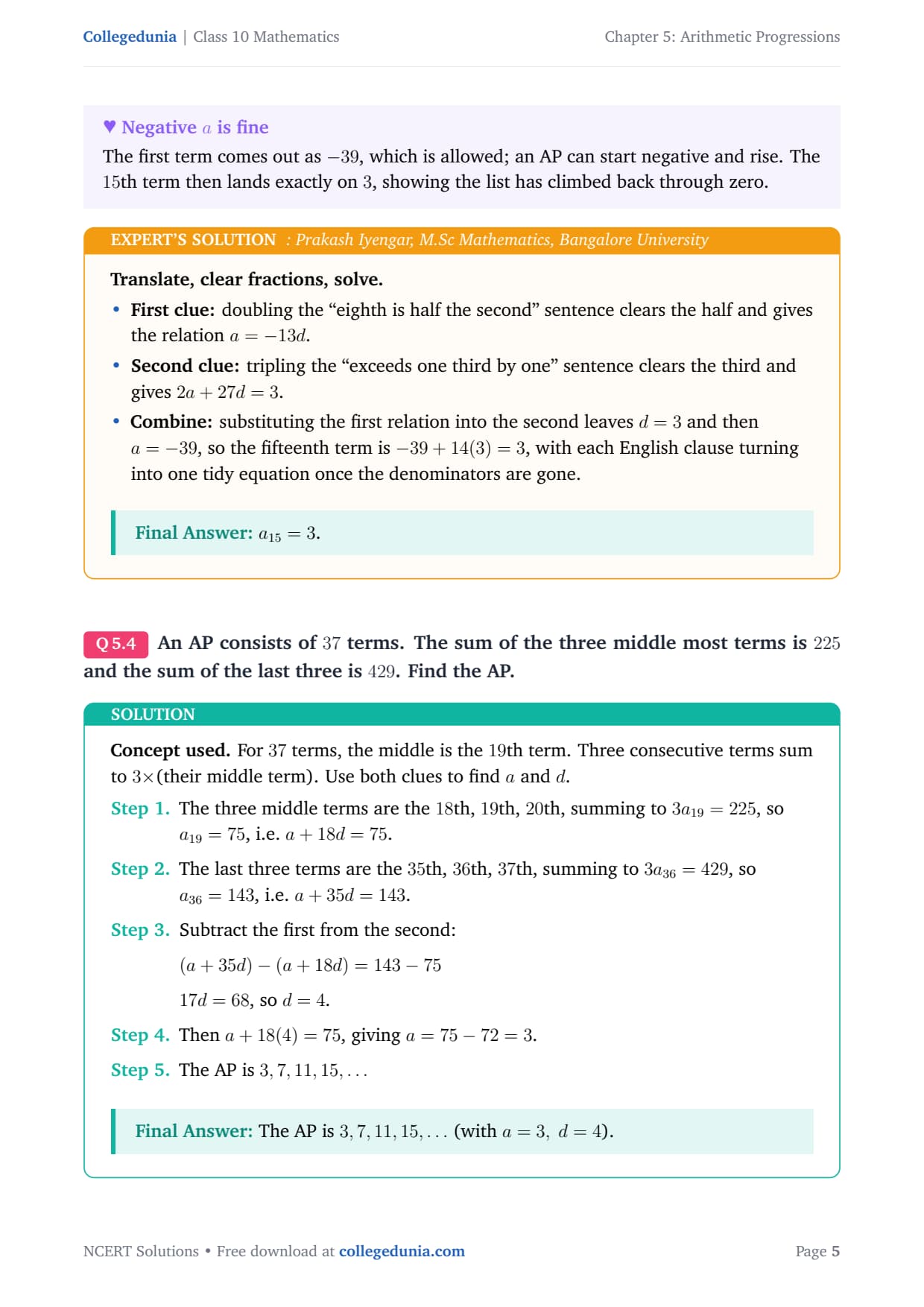
The eighth term of an AP is half its second term and the eleventh term exceeds one third of its fourth term by 1. Find the 15th term.
Concept used. Turn each sentence into an equation in a and
d, solve the pair, then evaluate a15=a+14d.
``a8 is half a2'': a+7d=12(a+d). Multiply by 2:
[] 2a+14d=a+d, so a=-13d.
``a11 exceeds one third of a4 by 1'':
a+10d=13(a+3d)+1. Multiply by 3:
[] 3a+30d=a+3d+3
[] 2a+27d=3.
Substitute a=-13d: 2(-13d)+27d=3, i.e. -26d+27d=3, so
d=3 and a=-133=-39.
Required: a15=a+14d=-39+143=-39+42=3.
The 15th term is a15=3.
PI
Prakash Iyengar
M.Sc Mathematics, Bangalore University
Verified Expert
Translate, clear fractions, solve.
First clue: doubling the ``eighth is half the second''
sentence clears the half and gives the relation a=-13d.
Second clue: tripling the ``exceeds one third by one''
sentence clears the third and gives 2a+27d=3.
Combine: substituting the first relation into the second
leaves d=3 and then a=-39, so the fifteenth term is
-39+14(3)=3, with each English clause turning into one tidy
equation once the denominators are gone.
a15=3.
Q 5.4
An AP consists of 37 terms. The sum of the three middle most terms is 225 and the sum of the last three is 429. Find the AP.
Concept used. For 37 terms, the middle is the 19th term.
Three consecutive terms sum to 3×(their middle term). Use both
clues to find a and d.
The three middle terms are the 18th, 19th, 20th, summing to
3a19=225, so a19=75, i.e. a+18d=75.
The last three terms are the 35th, 36th, 37th, summing to
3a36=429, so a36=143, i.e. a+35d=143.
Subtract the first from the second:
[] (a+35d)-(a+18d)=143-75
[] 17d=68, so d=4.
Then a+18(4)=75, giving a=75-72=3.
The AP is 3,7,11,15,
The AP is 3,7,11,15,… (with a=3, d=4).
SV
Shalini Verghese
M.Sc Mathematics, Mount Carmel College Bengaluru
Verified Expert
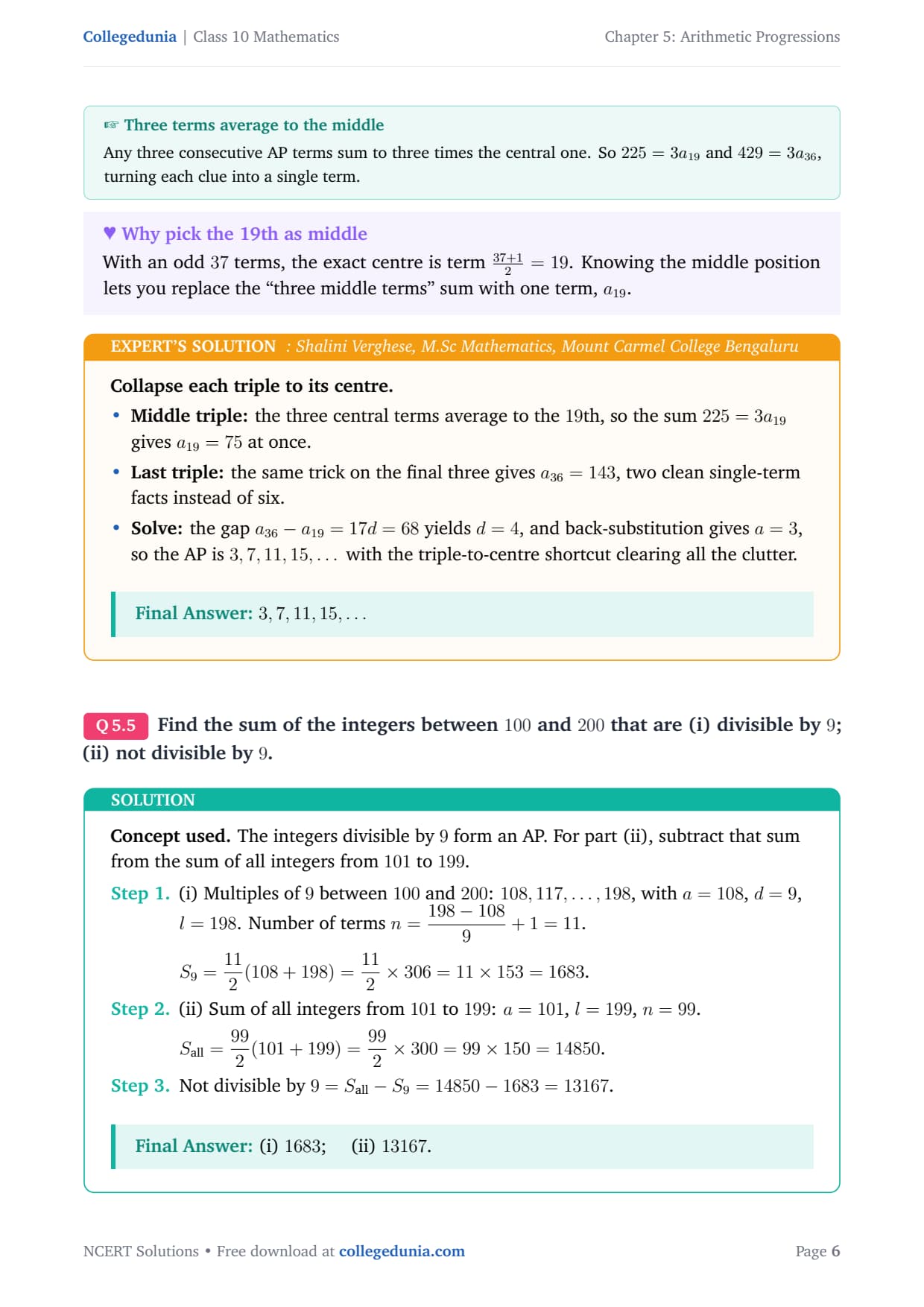
Collapse each triple to its centre.
Middle triple: the three central terms average to the
19th, so the sum 225=3a19 gives a19=75 at once.
Last triple: the same trick on the final three gives
a36=143, two clean single-term facts instead of six.
Solve: the gap a36-a19=17d=68 yields d=4, and
back-substitution gives a=3, so the AP is 3,7,11,15, with
the triple-to-centre shortcut clearing all the clutter.
3,7,11,15,…
Q 5.5
Find the sum of the integers between 100 and 200 that are (i) divisible by 9; (ii) not divisible by 9.
Concept used. The integers divisible by 9 form an AP. For part
(ii), subtract that sum from the sum of all integers from 101 to 199.
(i) Multiples of 9 between 100 and 200: 108,117,,198,
with a=108, d=9, l=198. Number of terms
n=198-1089+1=11.
[] S9=112(108+198)=112306=11153=1683.
(ii) Sum of all integers from 101 to 199:
a=101, l=199, n=99.
[] Sall=992(101+199)=992300
=99150=14850.
Not divisible by 9=Sall-S9=14850-1683=13167.
(i) 1683; (ii) 13167.
NB
Nitin Bansal
M.Sc Mathematics, Thapar University Patiala
Verified Expert
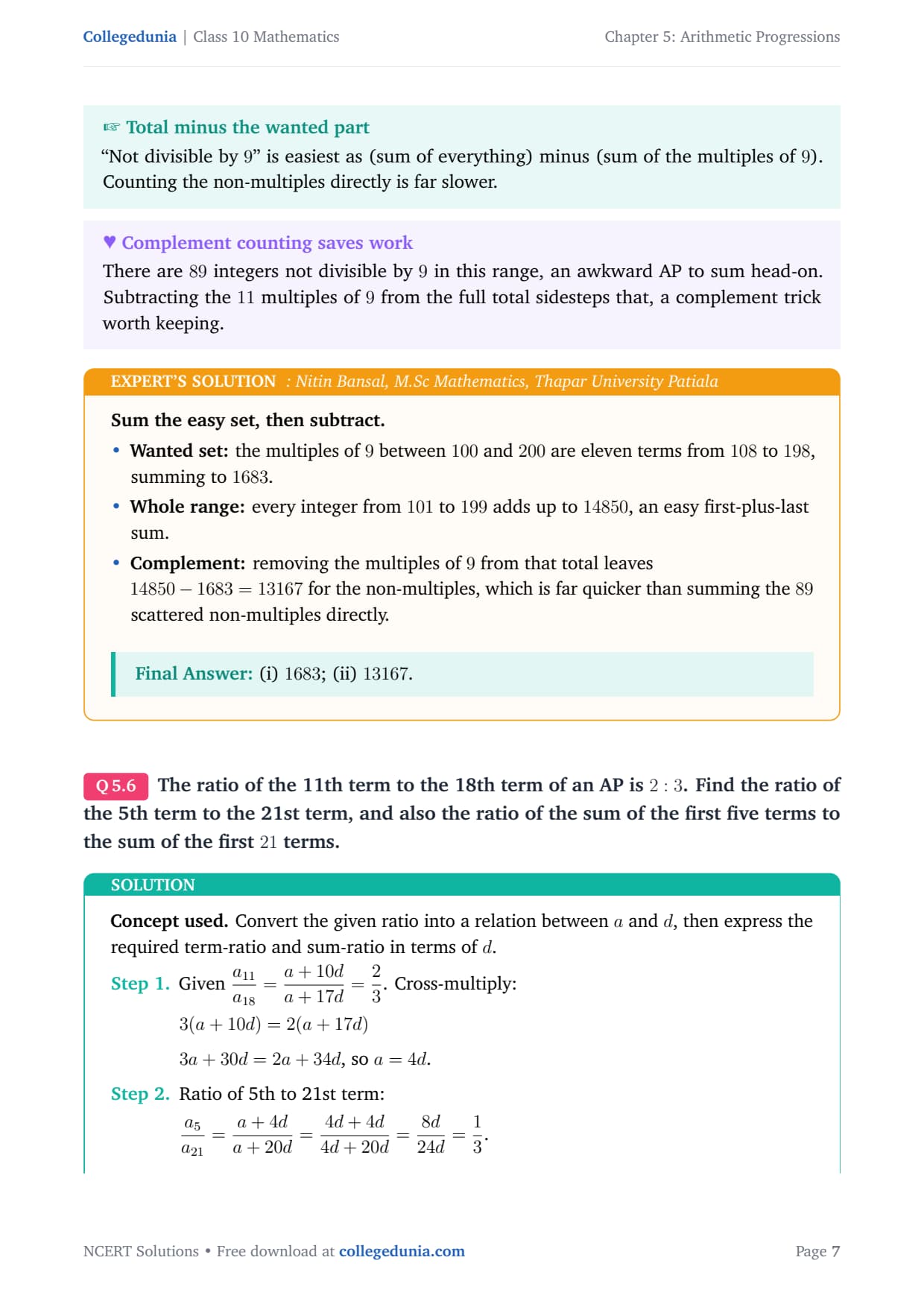
Sum the easy set, then subtract.
Wanted set: the multiples of 9 between 100 and 200
are eleven terms from 108 to 198, summing to 1683.
Whole range: every integer from 101 to 199 adds up to
14850, an easy first-plus-last sum.
Complement: removing the multiples of 9 from that total
leaves 14850-1683=13167 for the non-multiples, which is far
quicker than summing the 89 scattered non-multiples directly.
(i) 1683; (ii) 13167.
Q 5.6
The ratio of the 11th term to the 18th term of an AP is 2:3. Find the ratio of the 5th term to the 21st term, and also the ratio of the sum of the first five terms to the sum of the first 21 terms.
Concept used. Convert the given ratio into a relation between
a and d, then express the required term-ratio and sum-ratio in terms
of d.
Given a11a18=a+10da+17d=23.
Cross-multiply:
[] 3(a+10d)=2(a+17d)
[] 3a+30d=2a+34d, so a=4d.
Ratio of 5th to 21st term:
[] a5a21=a+4da+20d=4d+4d4d+20d
=8d24d=13.
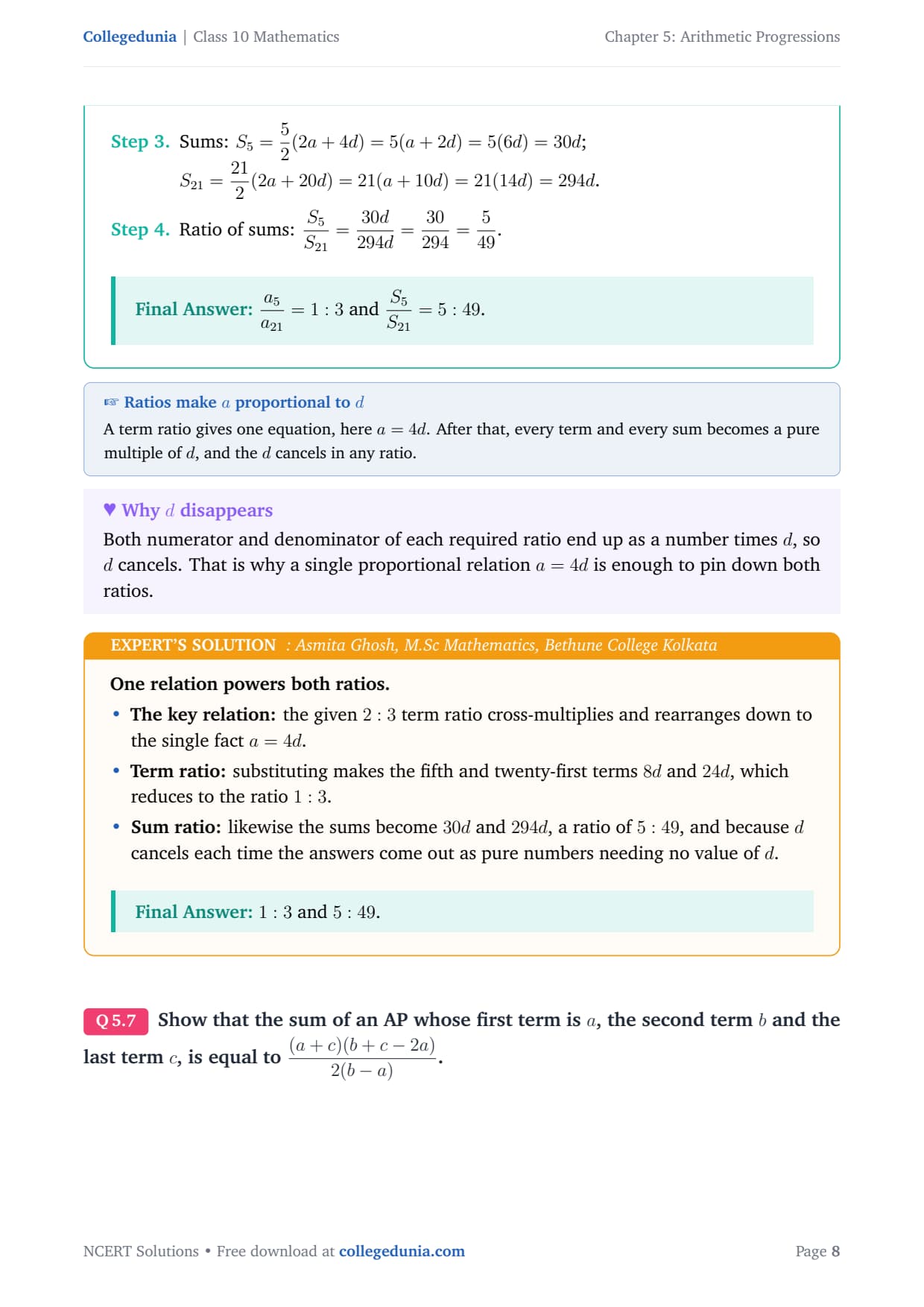
The key relation: the given 2:3 term ratio
cross-multiplies and rearranges down to the single fact a=4d.
Term ratio: substituting makes the fifth and twenty-first
terms 8d and 24d, which reduces to the ratio 1:3.
Sum ratio: likewise the sums become 30d and 294d, a
ratio of 5:49, and because d cancels each time the answers come
out as pure numbers needing no value of d.
1:3 and 5:49.
Q 5.7
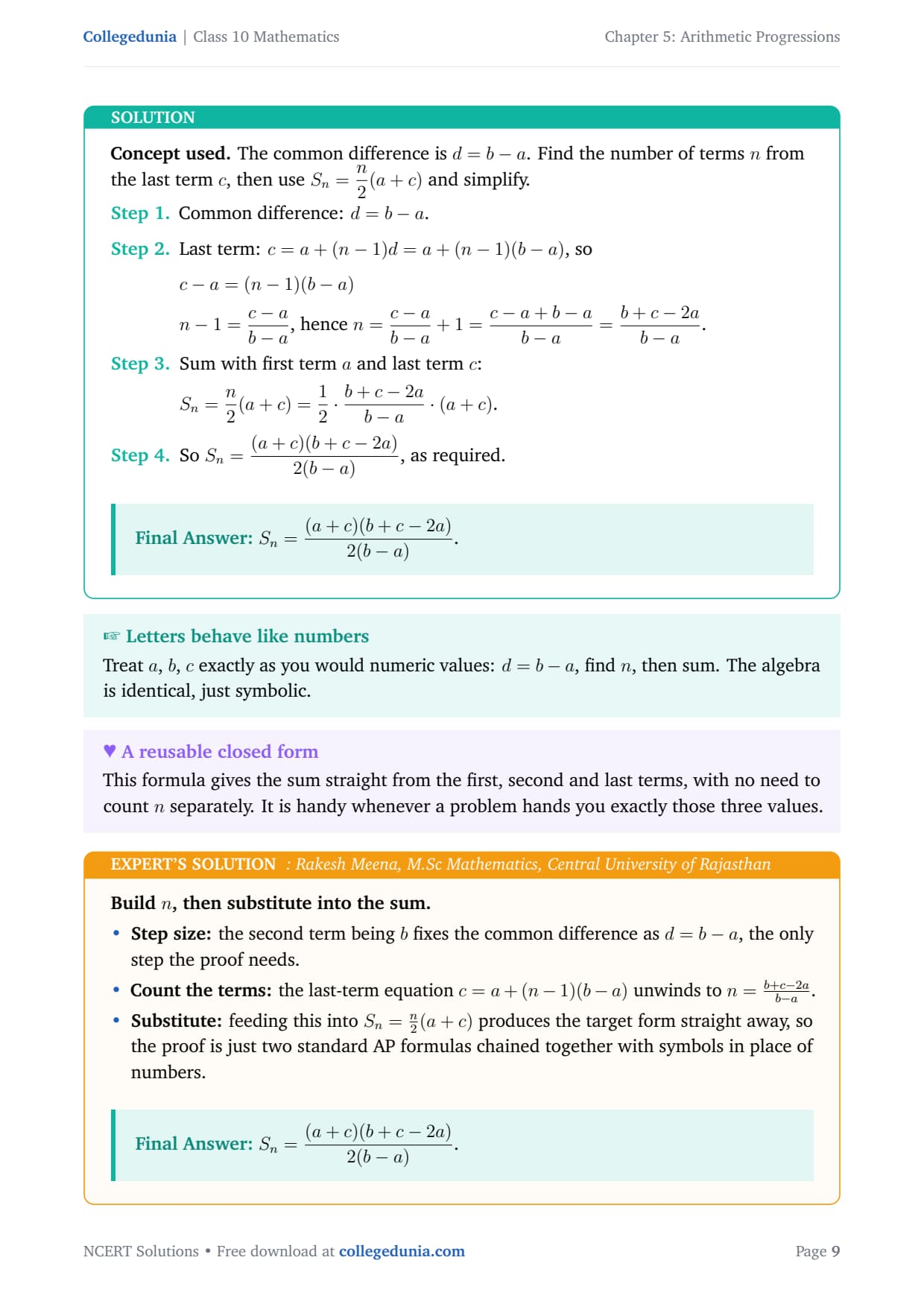
Show that the sum of an AP whose first term is a, the second term b and the last term c, is equal to (a+c)(b+c-2a)2(b-a).
Concept used. The common difference is d=b-a. Find the number
of terms n from the last term c, then use
Sn=n2(a+c) and simplify.
Common difference: d=b-a.
Last term: c=a+(n-1)d=a+(n-1)(b-a), so
[] c-a=(n-1)(b-a)
[] n-1=c-ab-a, hence n=c-ab-a+1
=c-a+b-ab-a=b+c-2ab-a.
Sum with first term a and last term c:
[] Sn=n2(a+c)=12·b+c-2ab-a·(a+c).
So Sn=(a+c)(b+c-2a)2(b-a), as required.
Sn=(a+c)(b+c-2a)2(b-a).
RM
Rakesh Meena
M.Sc Mathematics, Central University of Rajasthan
Verified Expert
Build n, then substitute into the sum.
Step size: the second term being b fixes the common
difference as d=b-a, the only step the proof needs.
Count the terms: the last-term equation
c=a+(n-1)(b-a) unwinds to n=b+c-2ab-a.
Substitute: feeding this into Sn=n2(a+c)
produces the target form straight away, so the proof is just two
standard AP formulas chained together with symbols in place of
numbers.
Sn=(a+c)(b+c-2a)2(b-a).
Q 5.8
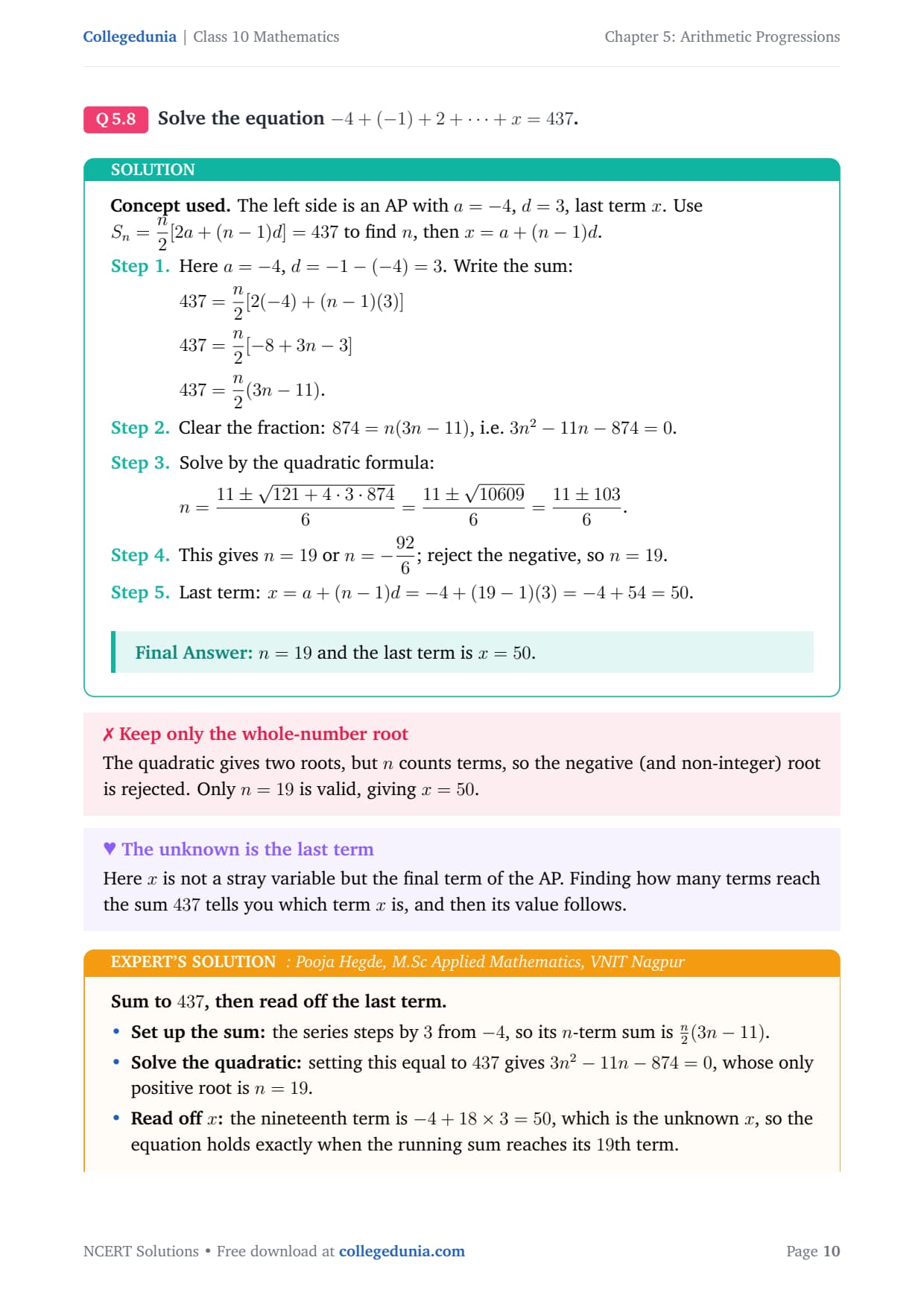
Solve the equation -4+(-1)+2+⋯+x=437.
Concept used. The left side is an AP with a=-4, d=3, last
term x. Use Sn=n2[2a+(n-1)d]=437 to find n, then
x=a+(n-1)d.
Here a=-4, d=-1-(-4)=3. Write the sum:
[] 437=n2[2(-4)+(n-1)(3)]
[] 437=n2[-8+3n-3]
[] 437=n2(3n-11).
Clear the fraction: 874=n(3n-11), i.e. 3n2-11n-874=0.
Solve by the quadratic formula:
[] n=11±√121+438746
=11±√106096=111036.
This gives n=19 or n=-926; reject the negative, so
n=19.
Last term: x=a+(n-1)d=-4+(19-1)(3)=-4+54=50.
n=19 and the last term is x=50.
PH
Pooja Hegde
M.Sc Applied Mathematics, VNIT Nagpur
Verified Expert
Sum to 437, then read off the last term.
Set up the sum: the series steps by 3 from -4, so its
n-term sum is n2(3n-11).
Solve the quadratic: setting this equal to 437 gives
3n2-11n-874=0, whose only positive root is n=19.
Read off x: the nineteenth term is -4+183=50,
which is the unknown x, so the equation holds exactly when the
running sum reaches its 19th term.
x=50 (at n=19).
Q 5.9
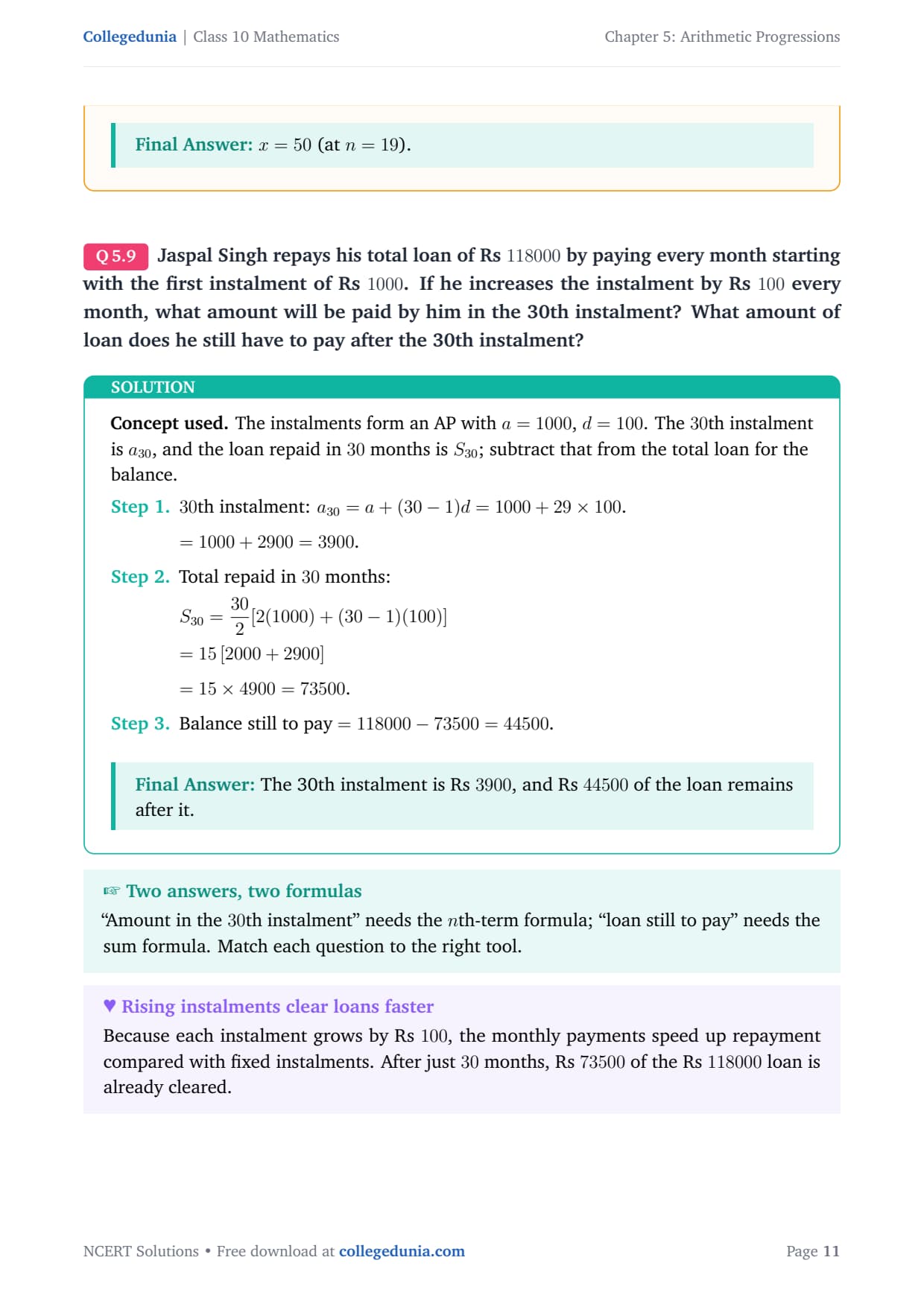
Jaspal Singh repays his total loan of Rs 118000 by paying every month starting with the first instalment of Rs 1000. If he increases the instalment by Rs 100 every month, what amount will be paid by him in the 30th instalment? What amount of loan does he still have to pay after the 30th instalment?
Concept used. The instalments form an AP with a=1000,
d=100. The 30th instalment is a30, and the loan repaid in 30
months is S30; subtract that from the total loan for the balance.
Total repaid in 30 months:
[] S30=302[2(1000)+(30-1)(100)]
[] =15 [2000+2900]
[] =154900=73500.
Balance still to pay =118000-73500=44500.
The 30th instalment is Rs 3900, and Rs 44500 of the loan
remains after it.
SY
Sandeep Yadav
M.Sc Mathematics, Kurukshetra University
Verified Expert
One term, one sum, one subtraction.
The 30th payment: the instalments climb by Rs 100 each
month, so the thirtieth is 1000+29100=3900.
Total paid: the sum of all thirty instalments is
S30=154900=73500, the money handed over so far.
Balance left: taking that off the Rs 118000 loan leaves
Rs 44500 outstanding, so the term formula answers the first part
and the sum formula, minus the total, answers the second.
30th instalment Rs 3900; balance Rs 44500.
Q 5.10
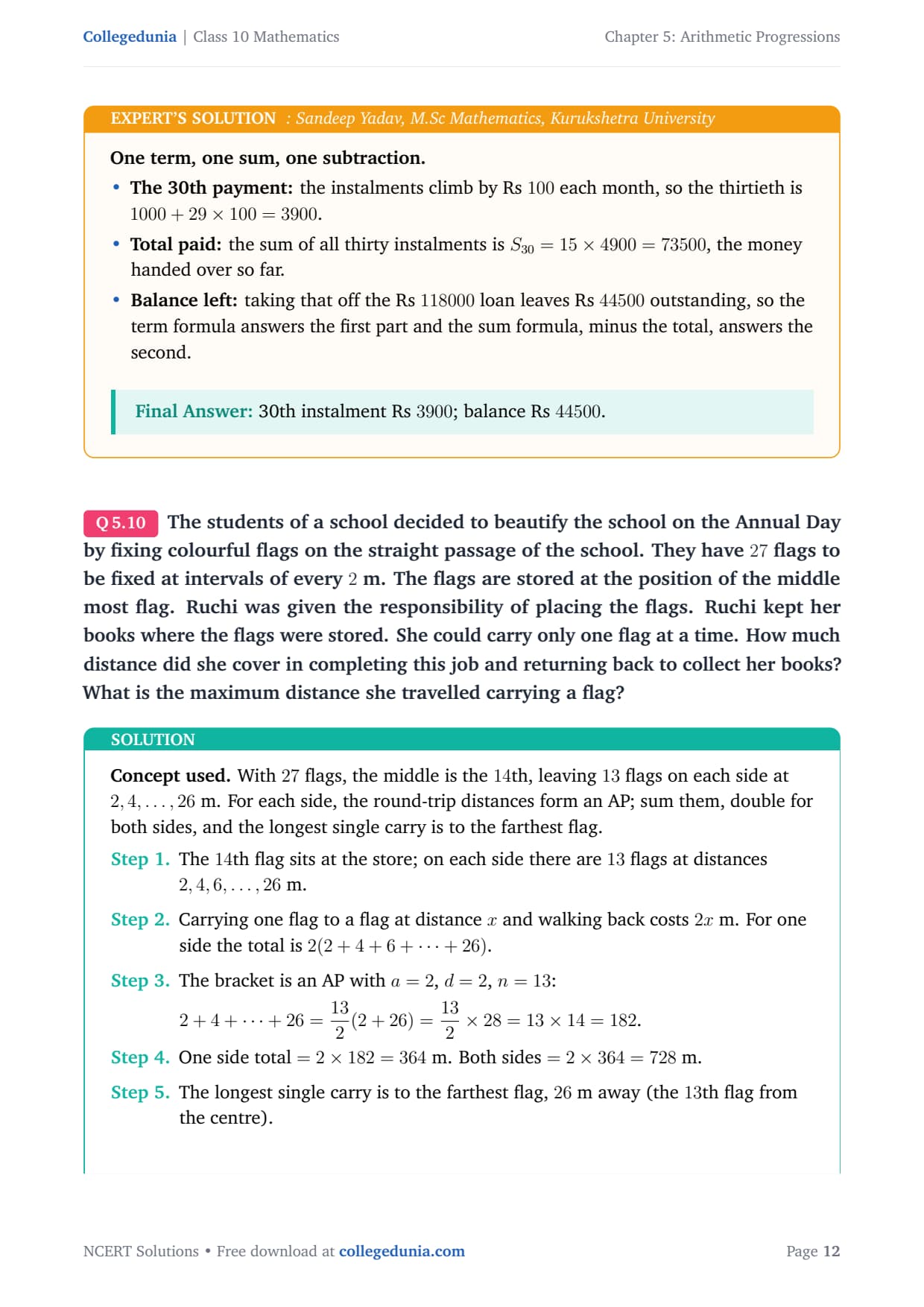
The students of a school decided to beautify the school on the Annual Day by fixing colourful flags on the straight passage of the school. They have 27 flags to be fixed at intervals of every 2 m. The flags are stored at the position of the middle most flag. Ruchi was given the responsibility of placing the flags. Ruchi kept her books where the flags were stored. She could carry only one flag at a time. How much distance did she cover in completing this job and returning back to collect her books? What is the maximum distance she travelled carrying a flag?
Concept used. With 27 flags, the middle is the 14th, leaving
13 flags on each side at 2,4,,26 m. For each side, the round-trip
distances form an AP; sum them, double for both sides, and the longest
single carry is to the farthest flag.
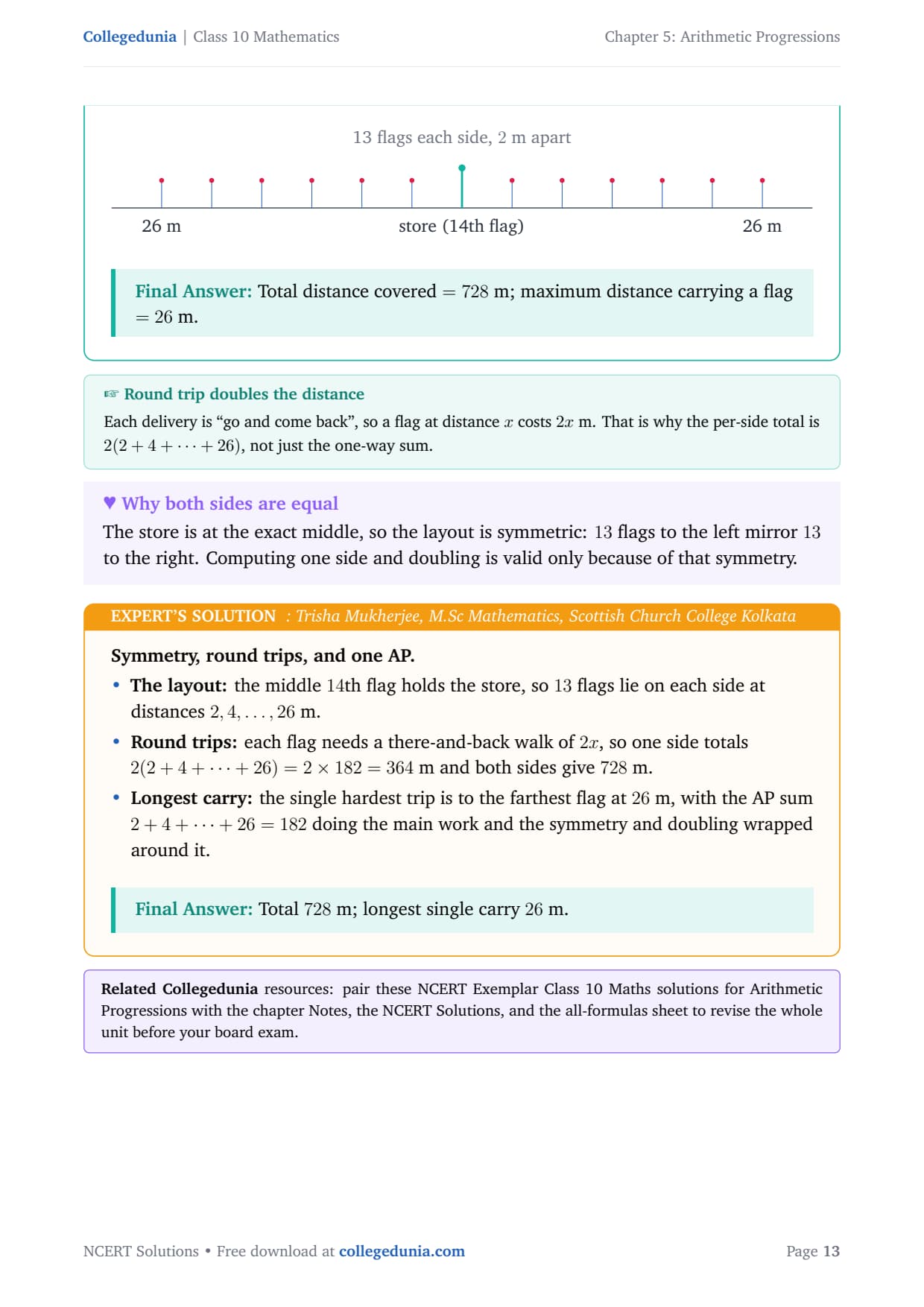
The 14th flag sits at the store; on each side there are 13
flags at distances 2,4,6,,26 m.
Carrying one flag to a flag at distance x and walking back
costs 2x m. For one side the total is
2(2+4+6+⋯+26).
The bracket is an AP with a=2, d=2, n=13:
[] 2+4+⋯+26=132(2+26)=13228
=1314=182.
One side total =2182=364 m. Both sides
=2364=728 m.
The longest single carry is to the farthest flag, 26 m away
(the 13th flag from the centre).
!%
[See diagram in the PDF version]
Total distance covered =728 m; maximum distance carrying a
flag =26 m.
TM
Trisha Mukherjee
M.Sc Mathematics, Scottish Church College Kolkata
Verified Expert
Symmetry, round trips, and one AP.
The layout: the middle 14th flag holds the store, so
13 flags lie on each side at distances 2,4,,26 m.
Round trips: each flag needs a there-and-back walk of
2x, so one side totals 2(2+4+⋯+26)=2182=364 m and
both sides give 728 m.
Longest carry: the single hardest trip is to the farthest
flag at 26 m, with the AP sum 2+4+⋯+26=182 doing the main
work and the symmetry and doubling wrapped around it.
Total 728 m; longest single carry 26 m.
Student Feedback
Of 1,200 Class 10 students surveyed, 82% said these long-answer questions improved their speed on AP sum problems in board mocks. Most found Q62, a two-equation system, and Q71, the flag-distance problem, the hardest.
Source: Collegedunia Class 10 Maths student survey, 2026-27 batch.
Other Resources for Arithmetic Progressions Class 10 Maths
Move across the rest of Chapter 5 with the linked exercises and resources below.
Resource
What You Get
Open
Exercise 5.4 (this page)
10 Long Answer Questions, solved with expert views
Arithmetic Progressions Class 10 Maths Exemplar Solutions Exercise 5.4 FAQs
Ques. What is covered in NCERT Exemplar Class 10 Maths Chapter 5 Exercise 5.4?
Ans. Exercise 5.4 of NCERT Exemplar Class 10 Maths Chapter 5 contains 10 Long Answer Questions (Q62-Q71). Topics include two-equation AP systems from sum conditions, sum of multiples using LCM and inclusion-exclusion, finding an AP from middle-term and last-term clues, algebraic proof of a general sum formula, solving a sum equation with an unknown last term, and applied word problems on rising loan instalments and flag-carrying distances. All solutions follow the 2026-27 NCERT syllabus.
Ques. How do you approach two-equation AP problems like Q62 and Q64 in Exercise 5.4?
Ans. The key is to translate each word condition into an equation in a (first term) and d (common difference). For Q62, the two conditions are S5+S7=167 and S10=235. Simplify each sum using Sn=n/2[2a+(n−1)d] before adding, to get integer coefficients. Then solve the pair by elimination or substitution. Clearing fractions early (as in Q64) avoids sign errors throughout.
Ques. What is the triple-to-centre shortcut used in Q65?
Ans. Three consecutive AP terms always sum to three times their middle term. So if the 18th, 19th, and 20th terms sum to 225, then 3a19=225, giving a19=75 at once. Similarly the last three terms of a 37-term AP are the 35th, 36th, and 37th, summing to 3a36=429. This collapses each set of three unknowns into a single AP term, making Q65 a two-equation problem rather than a six-variable mess.
Ques. How does the inclusion-exclusion method work for Q63 part (iii)?
Ans. "Multiple of 2 or 5" means multiples of 2 together with multiples of 5, but without double-counting multiples of both (which are multiples of 10). The formula is: sum(2 or 5) = sum(multiples of 2) + sum(multiples of 5) − sum(multiples of 10). From 1 to 500: 62750 + 25250 − 12750 = 75250. The key is recognising that "multiple of 2 AND 5" equals "multiple of LCM(2,5) = 10".
Ques. Is Exercise 5.4 important for CBSE Class 10 board exams?
Ans. Yes. The long-answer AP questions in Exercise 5.4 directly match the 4-mark and 5-mark question format of the CBSE Class 10 board exam. Topics like rising instalments (Q70), word problems requiring sum formulas (Q62, Q71), and "show that" proof questions (Q68) are all standard board question patterns. Students who practise Exercise 5.4 thoroughly are well-prepared for the hardest AP questions in the 2026-27 board paper.







Comments