Senior Maths Editor, 9 Yrs | Updated on - Jun 29, 2026
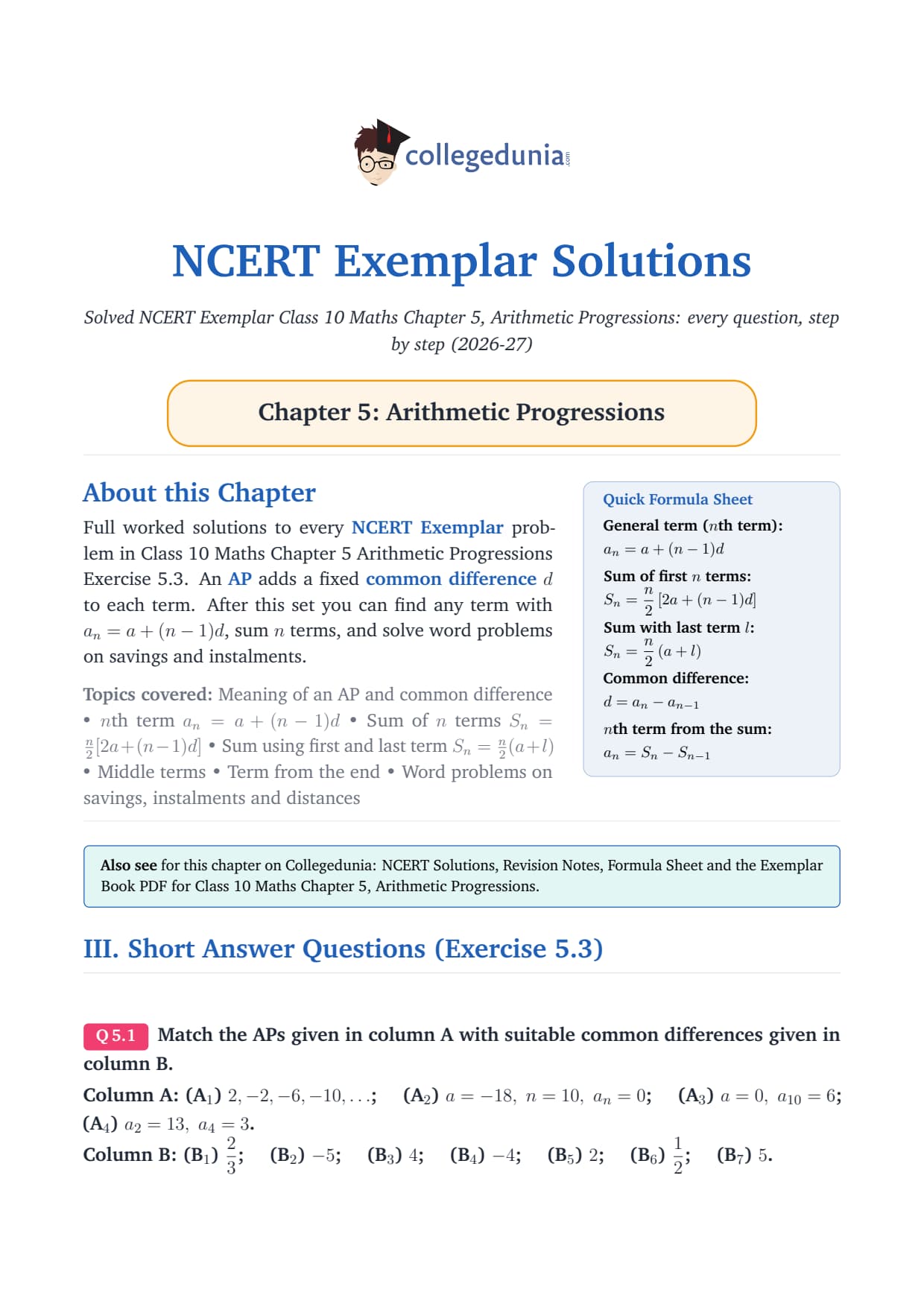
Exercise 5.3 is the Short Answer set in NCERT Exemplar Class 10 Maths Chapter 5, Arithmetic Progressions. Its 35 questions (Q27 to Q61) test the nth term formula, the sum formulas, word problems, and number-pattern APs. All are common board topics.
Exercise type: Short Answer Questions (Q27-Q61), 35 questions
Key topics: nth term, sum of terms, AP from sum formula, word problems on savings and number patterns
CBSE Class 10 Weightage: Arithmetic Progressions carries about 8 marks in the board exam
Below you get every Exercise 5.3 solution, with step-by-step working and board tips.
These solutions are written by subject experts, mapped to the 2026-27 rationalised NCERT, and refined against the last five years of CBSE board papers.
Solved by Collegedunia: Every question in Exercise 5.3 is solved step-by-step by verified Maths experts with Concept, Given, Step-by-step working, and Final Answer.
Exercise 5.3 is the largest set in the Chapter 5 Exemplar. It brings together the tools from the earlier exercises and applies them in more varied settings. Here is what makes it stand out.
Matching problems: Q27 asks students to match APs with their common differences, which trains them to compute d quickly from different types of data.
Verification questions: Q28 and Q49 ask students to prove a sequence is an AP before finding further terms or sums.
Sum formula applications: Questions from Q46 onwards are sum-heavy, including finding Sn from paired conditions and algebraic sum formulas.
Word problems: Q60 (Kanika's piggy bank) and Q61 (Yasmeen's monthly savings) are real-world AP problems that CBSE boards repeat regularly.
Double-answer question: Q58 gives a sum equation with two valid values of n and asks students to explain why.
Quick count: Exercise 5.3 has 35 questions (Q27-Q61). Most are Short Answer type worth 2-3 marks each in CBSE Class 10 Maths boards.
Question Range
Type
Core Skill Tested
CBSE Frequency
Q27
Matching
Find d from various data forms
Moderate
Q28-Q30
Verification + Construction
Confirm AP, write first terms, find missing values
High
Q31-Q36
Nth Term Problems
Build AP from term conditions, test membership
Very High
Q37-Q39
Algebraic APs
Three consecutive AP terms, split sums, triangle angles
High
Q40-Q45
Term Finding
Common term, position from end, first negative term, counting
High
Q46-Q56
Sum Problems
Sum from endpoints, sum of last terms, algebraic sums
Key Arithmetic Progressions Formulas Used in Exercise 5.3
Every question in Exercise 5.3 uses one or more of the core AP formulas. Knowing which formula to reach for is half the battle in the CBSE exam. Here are the five formulas that cover all 35 questions in this exercise.
Formula Name
Expression
When to Use in Ex 5.3
Nth Term (General Term)
an = a + (n - 1)d
Finding any specific term, checking membership (Q36, Q43)
Sum of First n Terms
Sn = n2[2a + (n - 1)d]
Sum problems (Q47, Q48, Q51, Q53, Q54)
Sum Using First and Last Term
Sn = n2(a + l)
When both endpoints are known (Q46, Q48, Q56)
Common Difference from Positions
d = an - an - 1
Matching exercise Q27, fixing AP from two known terms
Nth Term from Sum
an = Sn - Sn-1
Recovering the AP when only Sn is given (Q50, Q51)
Quick Tip: For questions that give a term difference like "Q31: difference of 8th and 13th term is 20", always write a13 - a8 = 5d first. The a cancels, giving you d directly without a simultaneous equation.
How to Approach Arithmetic Progressions Exercise 5.3 Questions
Students lose marks in Exercise 5.3 not for missing the formulas, but for picking the wrong one or misreading the problem. Here is a practical approach for the main question types.
Term condition problems (Q31-Q35): Translate each English clue into one equation in a and d. If one clue gives a term difference, write it first to find d alone. Then substitute back to find a.
Membership test (Q36, Q43): Set an equal to the given value. Solve for n. If n is a positive integer, the value belongs to the AP. A fraction means it does not.
Three terms in AP (Q37-Q39): Always represent three consecutive AP terms as a - d, a, a + d. This makes the sum 3a and simplifies the algebra greatly.
Sum given, find n (Q58): Set up the sum formula equation and bring it to a quadratic in n. Both positive integer roots are valid answers; explain why two answers exist.
Word problems (Q60, Q61): Identify whether it is a term problem or a sum problem. Savings that accumulate are always a sum. A single month's saving is a term.
Watch Out: In Q34, "the 7th term is 24 less than the 11th term" means a11 - a7 = 24, NOT the other way. Reversing this sign gives a negative d and the wrong AP.
Remember: For odd number of terms, the sum equals n times the middle term. In Q55, the middle term of 11 terms is the 6th term, so S11 = 11 × 30 = 330.
All Exercise 5.3 Questions with Step-by-Step Solutions
III. Short Answer Questions (Exercise 5.3)
Q 5.1
Match the APs given in column A with suitable common differences given in column B. [2pt]
Column A: (A1) 2,-2,-6,-10,…; (A2) a=-18, n=10, an=0; (A3) a=0, a10=6; (A4) a2=13, a4=3. [2pt]
Column B: (B1) 23; (B2) -5; (B3) 4; (B4) -4; (B5) 2; (B6) 12; (B7) 5.
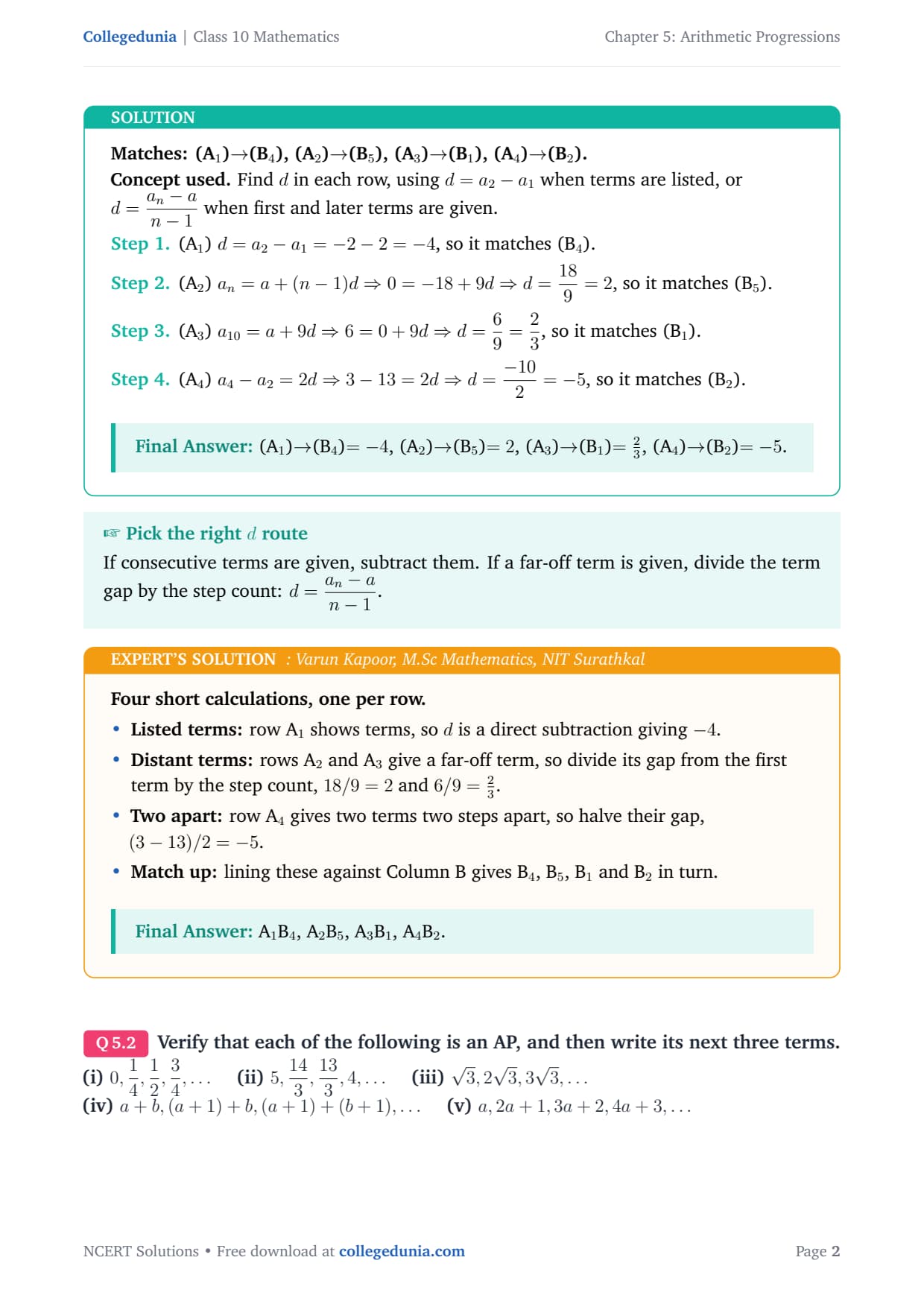
Listed terms: row A1 shows terms, so d is a direct
subtraction giving -4.
Distant terms: rows A2 and A3 give a far-off term,
so divide its gap from the first term by the step count,
18/9=2 and 6/9=23.
Two apart: row A4 gives two terms two steps apart, so
halve their gap, (3-13)/2=-5.
Match up: lining these against Column B gives B4,
B5, B1 and B2 in turn.
A1B4, A2B5, A3B1, A4B2.
Q 5.2
Verify that each of the following is an AP, and then write its next three terms.
(i) 0,14,12,34,… (ii) 5,143,133,4,… (iii) √3,2√3,3√3,…
(iv) a+b,(a+1)+b,(a+1)+(b+1),… (v) a,2a+1,3a+2,4a+3,…
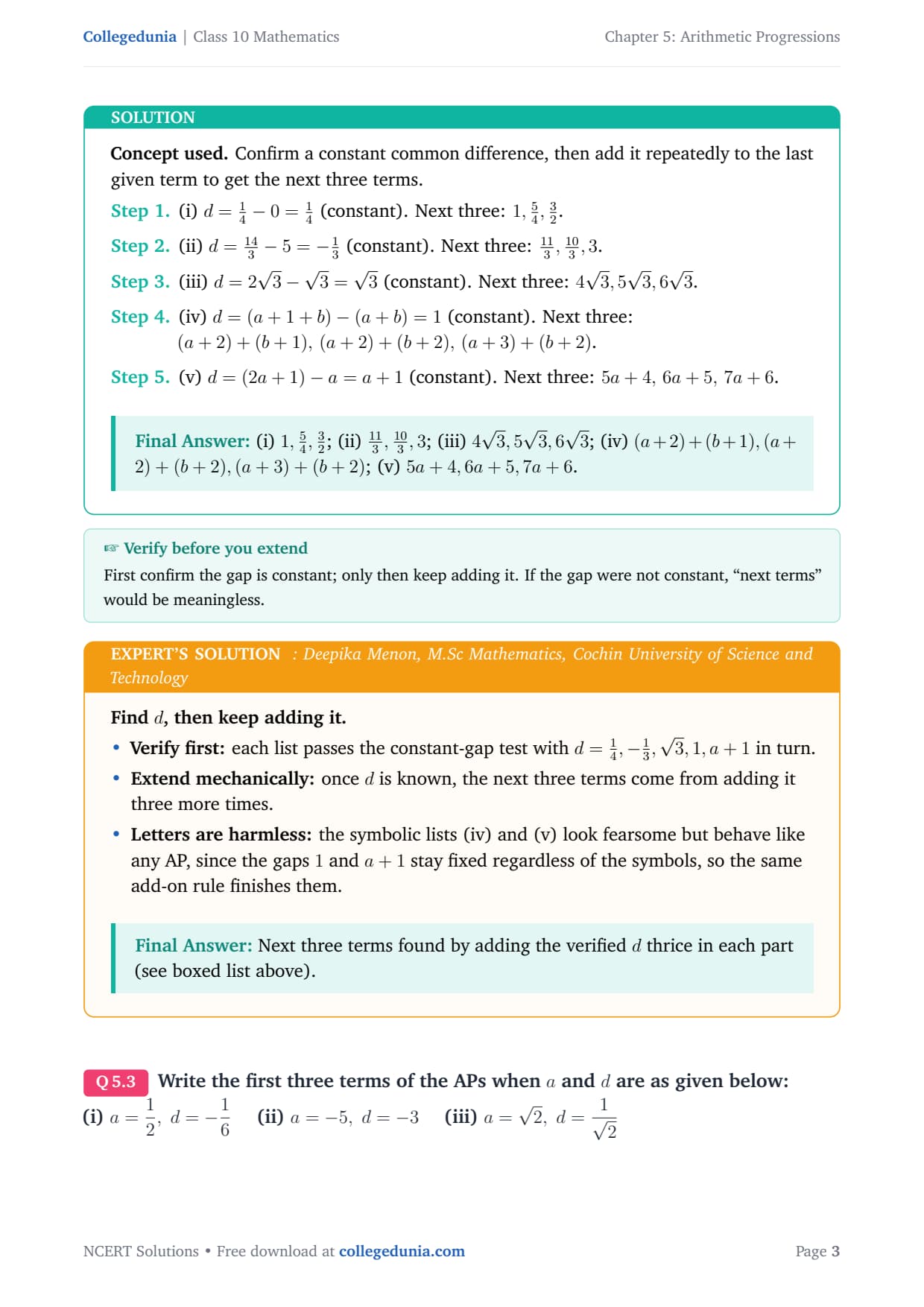
Concept used. Confirm a constant common difference, then add it
repeatedly to the last given term to get the next three terms.
(i) d=14-0=14 (constant). Next three:
1,54,32.
(ii) d=143-5=-13 (constant). Next three:
113,103,3.
(iii) d=23-3=3 (constant). Next three:
43,53,63.
(iv) d=(a+1+b)-(a+b)=1 (constant). Next three:
(a+2)+(b+1), (a+2)+(b+2), (a+3)+(b+2).
(v) d=(2a+1)-a=a+1 (constant). Next three:
5a+4, 6a+5, 7a+6.
(i) 1,54,32; (ii) 113,103,3;
(iii) 43,53,63; (iv) (a+2)+(b+1),(a+2)+(b+2),(a+3)+(b+2);
(v) 5a+4,6a+5,7a+6.
DM
Deepika Menon
M.Sc Mathematics, Cochin University of Science and Technology
Verified Expert
Find d, then keep adding it.
Verify first: each list passes the constant-gap test with
d=14,-13,3,1,a+1 in turn.
Extend mechanically: once d is known, the next three
terms come from adding it three more times.
Letters are harmless: the symbolic lists (iv) and (v)
look fearsome but behave like any AP, since the gaps 1 and a+1
stay fixed regardless of the symbols, so the same add-on rule
finishes them.
Next three terms found by adding the verified d thrice in
each part (see boxed list above).
Q 5.3
Write the first three terms of the APs when a and d are as given below:
(i) a=12, d=-16 (ii) a=-5, d=-3 (iii) a=√2, d=1√2
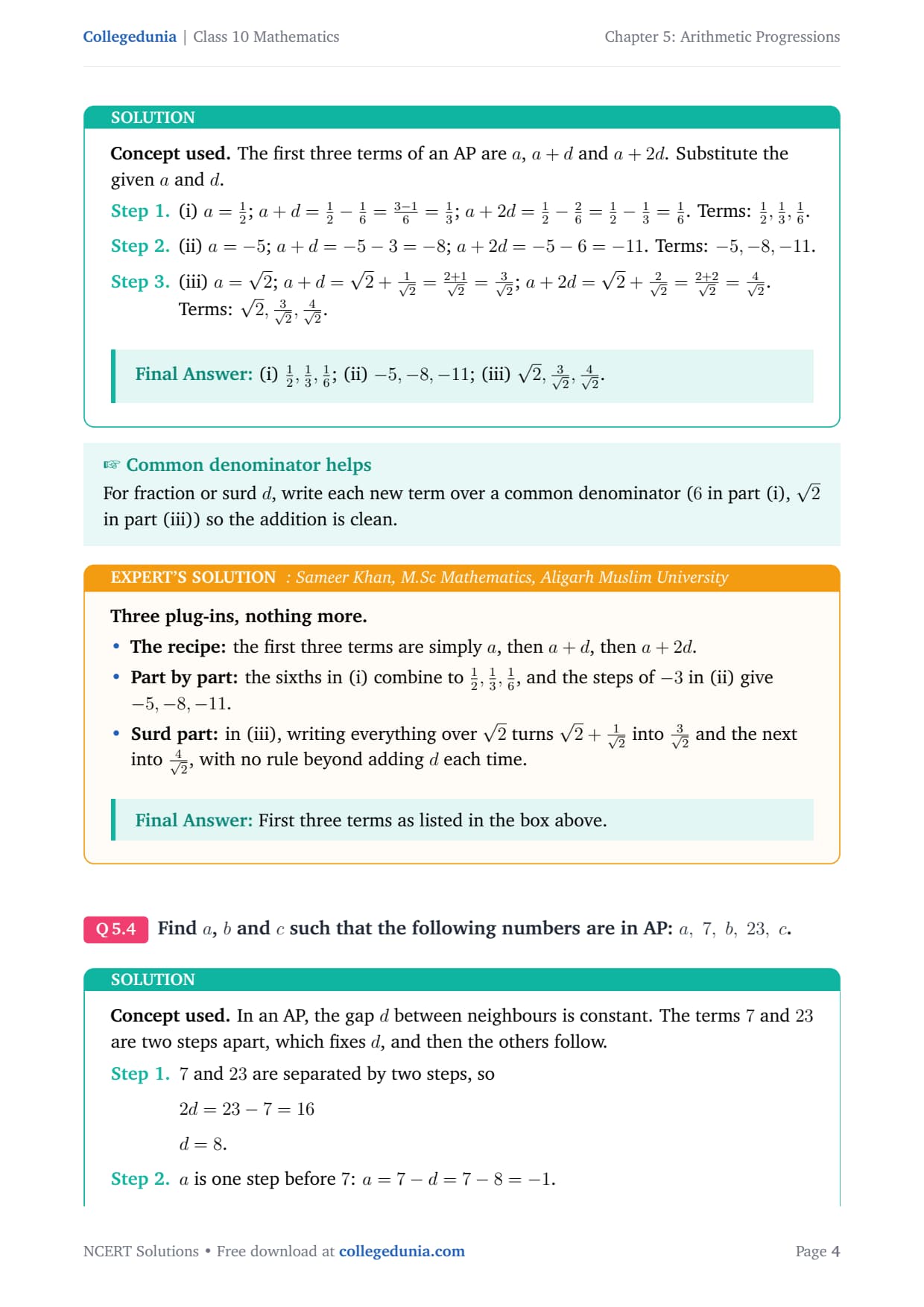
Concept used. The first three terms of an AP are a, a+d and
a+2d. Substitute the given a and d.
The recipe: the first three terms are simply a, then
a+d, then a+2d.
Part by part: the sixths in (i) combine to
12,13,16, and the steps of -3 in (ii) give
-5,-8,-11.
Surd part: in (iii), writing everything over 2
turns 2+12 into 32 and the
next into 42, with no rule beyond adding d each
time.
First three terms as listed in the box above.
Q 5.4
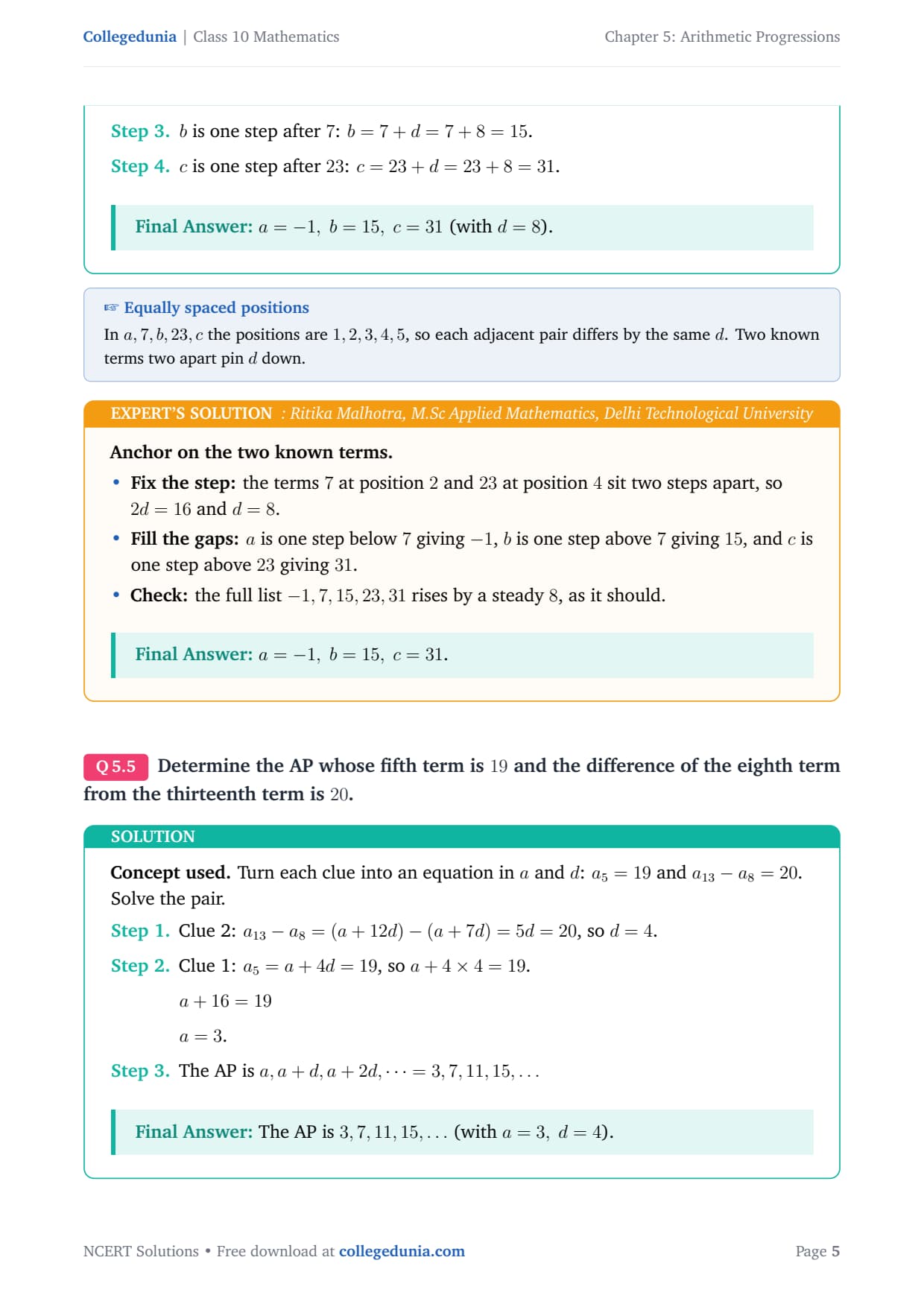
Find a, b and c such that the following numbers are in AP: a, 7, b, 23, c.
Concept used. In an AP, the gap d between neighbours is
constant. The terms 7 and 23 are two steps apart, which fixes d,
and then the others follow.
7 and 23 are separated by two steps, so
[] 2d=23-7=16
[] d=8.
a is one step before 7: a=7-d=7-8=-1.
b is one step after 7: b=7+d=7+8=15.
c is one step after 23: c=23+d=23+8=31.
a=-1, b=15, c=31 (with d=8).
RM
Ritika Malhotra
M.Sc Applied Mathematics, Delhi Technological University
Verified Expert
Anchor on the two known terms.
Fix the step: the terms 7 at position 2 and 23 at
position 4 sit two steps apart, so 2d=16 and d=8.
Fill the gaps:a is one step below 7 giving -1, b
is one step above 7 giving 15, and c is one step above 23
giving 31.
Check: the full list -1,7,15,23,31 rises by a steady
8, as it should.
a=-1, b=15, c=31.
Q 5.5
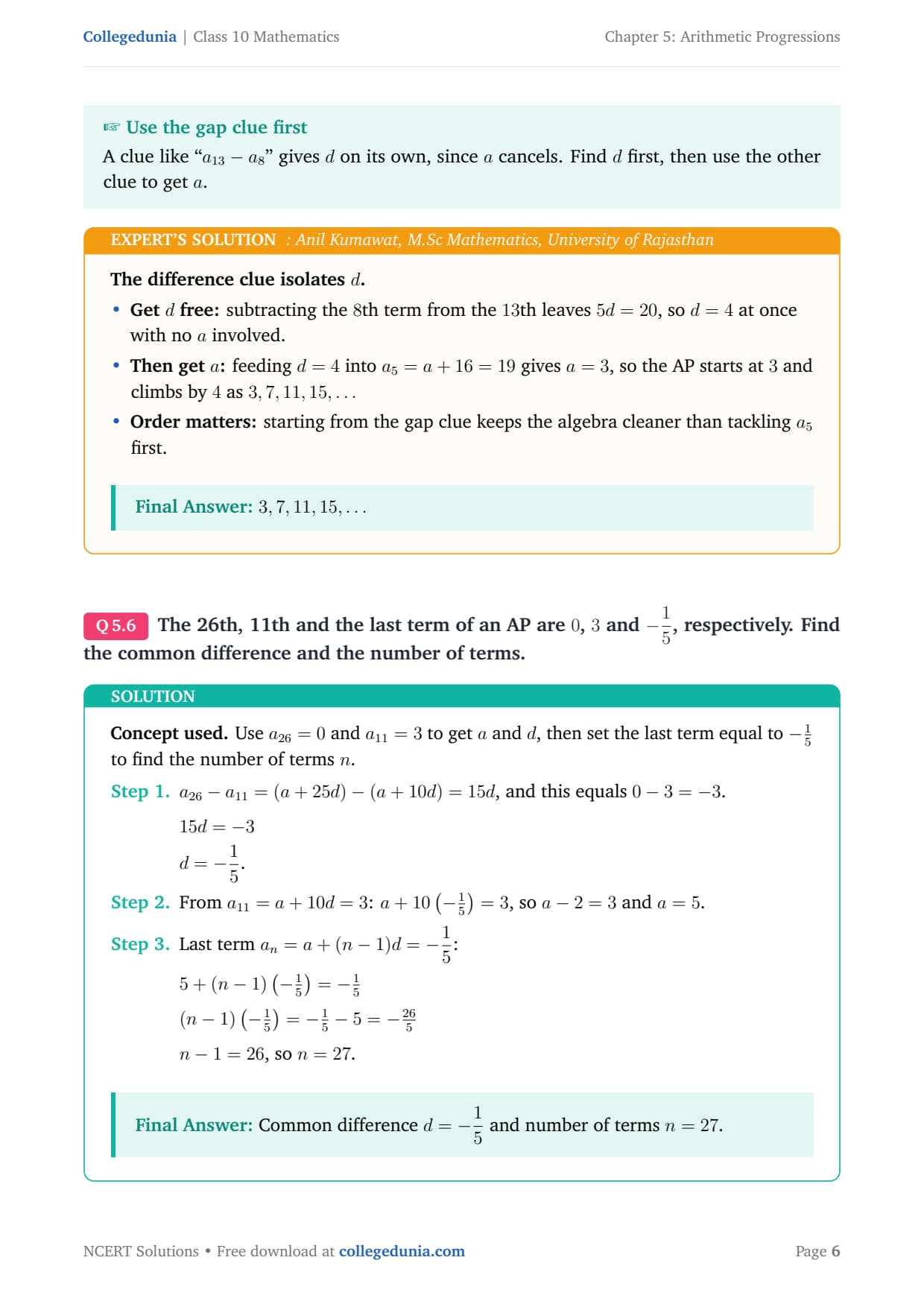
Determine the AP whose fifth term is 19 and the difference of the eighth term from the thirteenth term is 20.
Concept used. Turn each clue into an equation in a and d:
a5=19 and a13-a8=20. Solve the pair.
Clue 2: a13-a8=(a+12d)-(a+7d)=5d=20, so d=4.
Clue 1: a5=a+4d=19, so a+44=19.
[] a+16=19
[] a=3.
The AP is a,a+d,a+2d,=3,7,11,15,
The AP is 3,7,11,15,… (with a=3, d=4).
AK
Anil Kumawat
M.Sc Mathematics, University of Rajasthan
Verified Expert
The difference clue isolates d.
Get d free: subtracting the 8th term from the 13th
leaves 5d=20, so d=4 at once with no a involved.
Then get a: feeding d=4 into a5=a+16=19 gives
a=3, so the AP starts at 3 and climbs by 4 as
3,7,11,15,
Order matters: starting from the gap clue keeps the
algebra cleaner than tackling a5 first.
3,7,11,15,…
Q 5.6
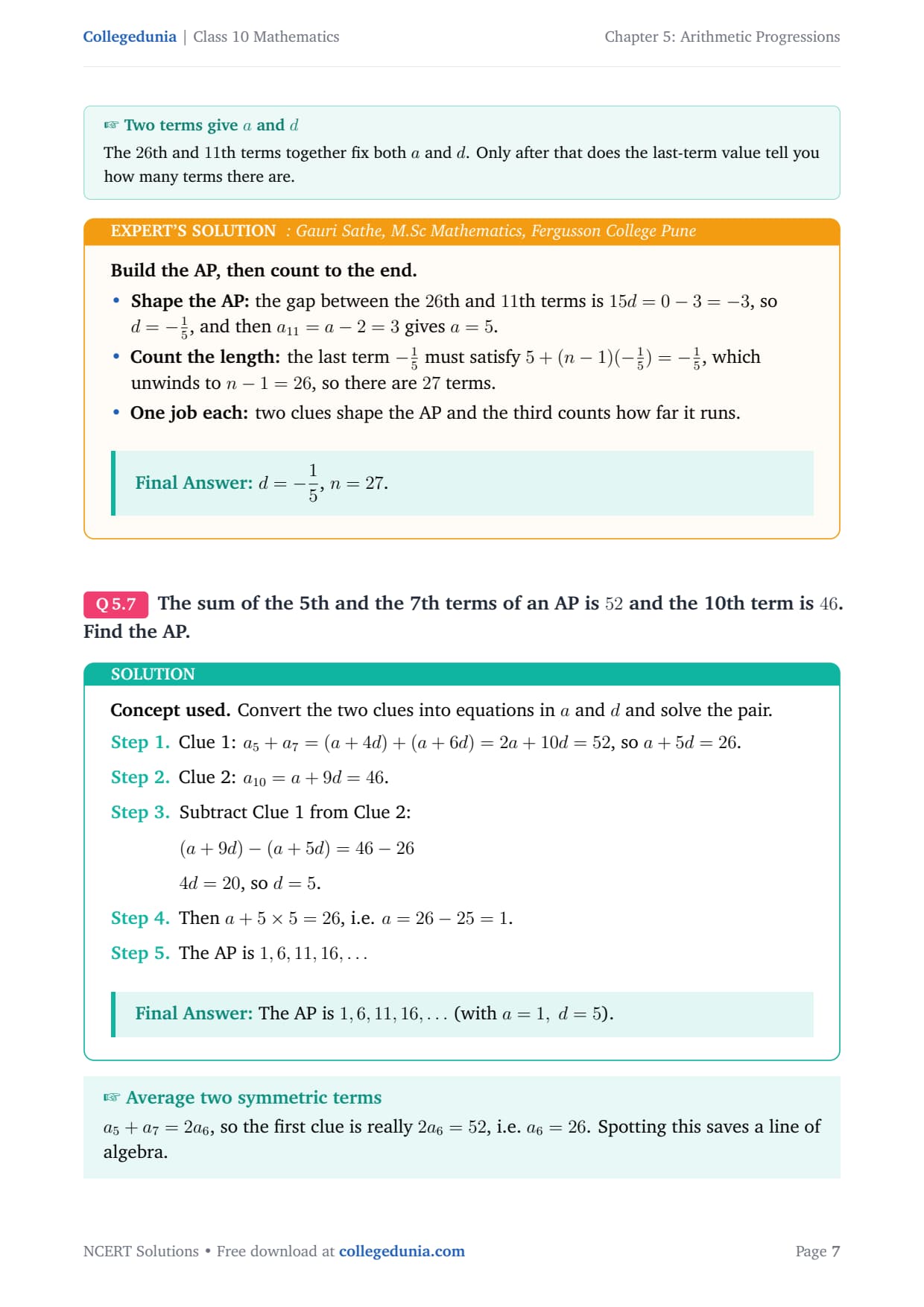
The 26th, 11th and the last term of an AP are 0, 3 and -15, respectively. Find the common difference and the number of terms.
Concept used. Use a26=0 and a11=3 to get a and d,
then set the last term equal to -15 to find the number of terms
n.
a26-a11=(a+25d)-(a+10d)=15d, and this equals 0-3=-3.
[] 15d=-3
[] d=-15.
From a11=a+10d=3: a+10(-15)=3, so
a-2=3 and a=5.
Last term an=a+(n-1)d=-15:
[] 5+(n-1)(-15)=-15
[] (n-1)(-15)=-15-5=-265
[] n-1=26, so n=27.
Common difference d=-15 and number of terms n=27.
GS
Gauri Sathe
M.Sc Mathematics, Fergusson College Pune
Verified Expert
Build the AP, then count to the end.
Shape the AP: the gap between the 26th and 11th terms
is 15d=0-3=-3, so d=-15, and then a11=a-2=3 gives
a=5.
Count the length: the last term -15 must satisfy
5+(n-1)(-15)=-15, which unwinds to n-1=26, so
there are 27 terms.
One job each: two clues shape the AP and the third counts
how far it runs.
d=-15, n=27.
Q 5.7
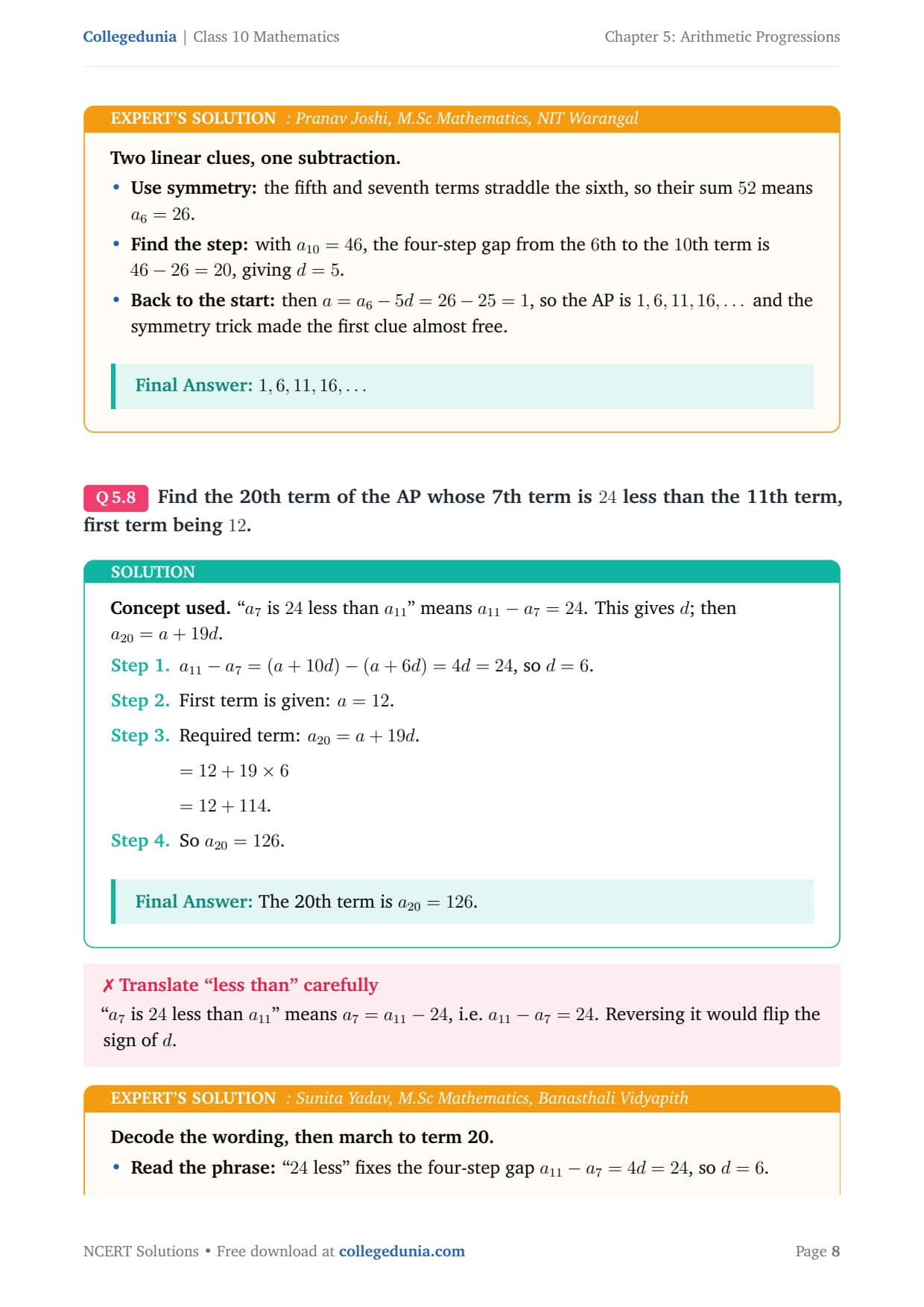
The sum of the 5th and the 7th terms of an AP is 52 and the 10th term is 46. Find the AP.
Concept used. Convert the two clues into equations in a and
d and solve the pair.
Clue 1: a5+a7=(a+4d)+(a+6d)=2a+10d=52, so a+5d=26.
Clue 2: a10=a+9d=46.
Subtract Clue 1 from Clue 2:
[] (a+9d)-(a+5d)=46-26
[] 4d=20, so d=5.
Then a+55=26, i.e. a=26-25=1.
The AP is 1,6,11,16,
The AP is 1,6,11,16,… (with a=1, d=5).
PJ
Pranav Joshi
M.Sc Mathematics, NIT Warangal
Verified Expert
Two linear clues, one subtraction.
Use symmetry: the fifth and seventh terms straddle the
sixth, so their sum 52 means a6=26.
Find the step: with a10=46, the four-step gap from
the 6th to the 10th term is 46-26=20, giving d=5.
Back to the start: then a=a6-5d=26-25=1, so the AP is
1,6,11,16, and the symmetry trick made the first clue
almost free.
1,6,11,16,…
Q 5.8
Find the 20th term of the AP whose 7th term is 24 less than the 11th term, first term being 12.
Concept used. ``a7 is 24 less than a11'' means
a11-a7=24. This gives d; then a20=a+19d.
a11-a7=(a+10d)-(a+6d)=4d=24, so d=6.
First term is given: a=12.
Required term: a20=a+19d.
[] =12+196
[] =12+114.
So a20=126.
The 20th term is a20=126.
SY
Sunita Yadav
M.Sc Mathematics, Banasthali Vidyapith
Verified Expert
Decode the wording, then march to term 20.
Read the phrase: ``24 less'' fixes the four-step gap
a11-a7=4d=24, so d=6.
March forward: starting from the given a=12 and adding
19 steps of 6 gives 12+114=126.
The only trap: the wording is the hard part, but once it
is read as a positive gap of 24 over four steps the arithmetic
is straightforward.
a20=126.
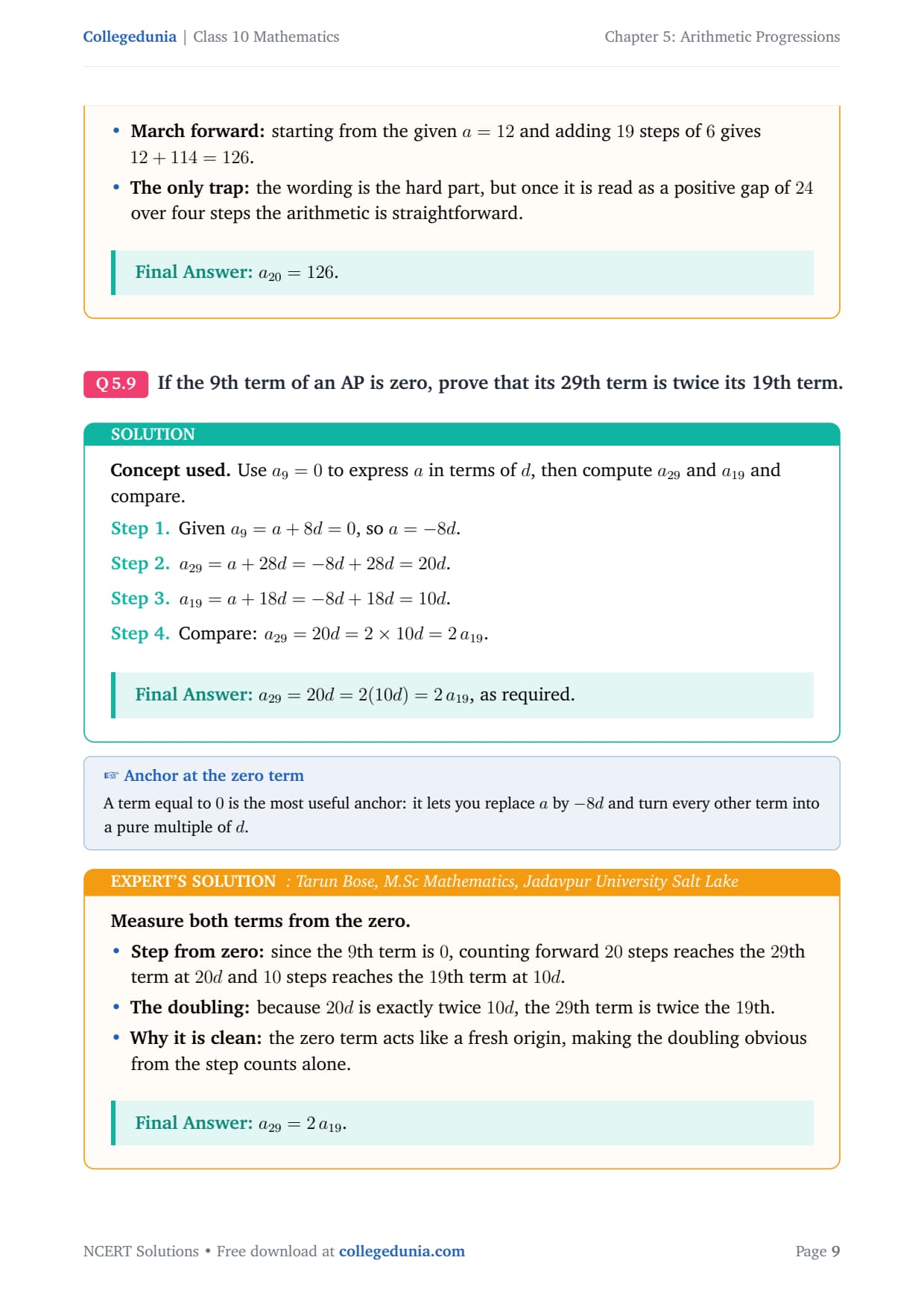
Q 5.9
If the 9th term of an AP is zero, prove that its 29th term is twice its 19th term.
Concept used. Use a9=0 to express a in terms of d, then
compute a29 and a19 and compare.
Given a9=a+8d=0, so a=-8d.
a29=a+28d=-8d+28d=20d.
a19=a+18d=-8d+18d=10d.
Compare: a29=20d=210d=2 a19.
a29=20d=2(10d)=2 a19, as required.
TB
Tarun Bose
M.Sc Mathematics, Jadavpur University Salt Lake
Verified Expert
Measure both terms from the zero.
Step from zero: since the 9th term is 0, counting
forward 20 steps reaches the 29th term at 20d and 10 steps
reaches the 19th term at 10d.
The doubling: because 20d is exactly twice 10d, the
29th term is twice the 19th.
Why it is clean: the zero term acts like a fresh origin,
making the doubling obvious from the step counts alone.
a29=2 a19.
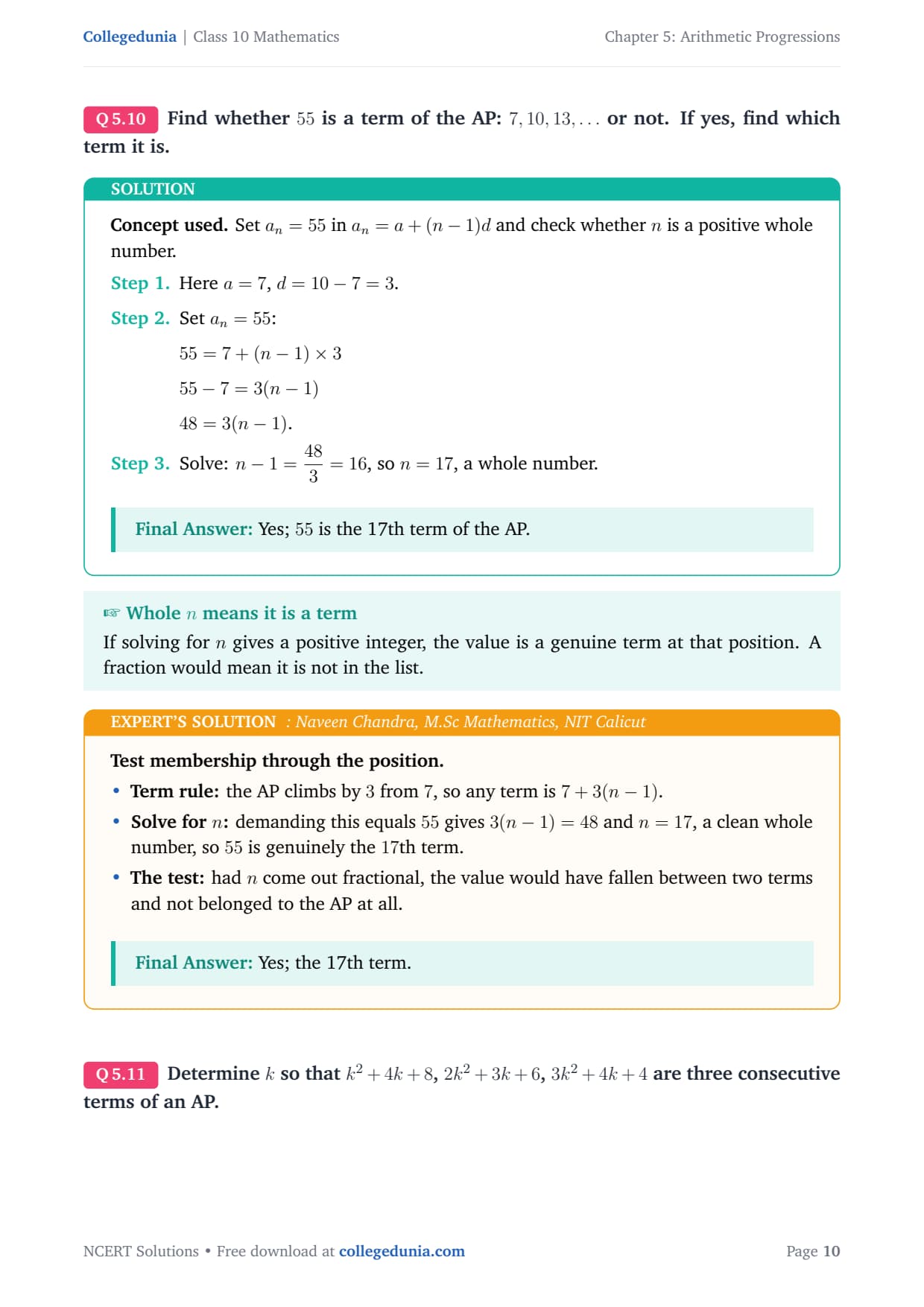
Q 5.10
Find whether 55 is a term of the AP: 7,10,13,… or not. If yes, find which term it is.
Concept used. Set an=55 in an=a+(n-1)d and check whether
n is a positive whole number.
Here a=7, d=10-7=3.
Set an=55:
[] 55=7+(n-1)3
[] 55-7=3(n-1)
[] 48=3(n-1).
Solve: n-1=483=16, so n=17, a whole number.
Yes; 55 is the 17th term of the AP.
NC
Naveen Chandra
M.Sc Mathematics, NIT Calicut
Verified Expert
Test membership through the position.
Term rule: the AP climbs by 3 from 7, so any term is
7+3(n-1).
Solve for n: demanding this equals 55 gives
3(n-1)=48 and n=17, a clean whole number, so 55 is genuinely
the 17th term.
The test: had n come out fractional, the value would
have fallen between two terms and not belonged to the AP at all.
Yes; the 17th term.
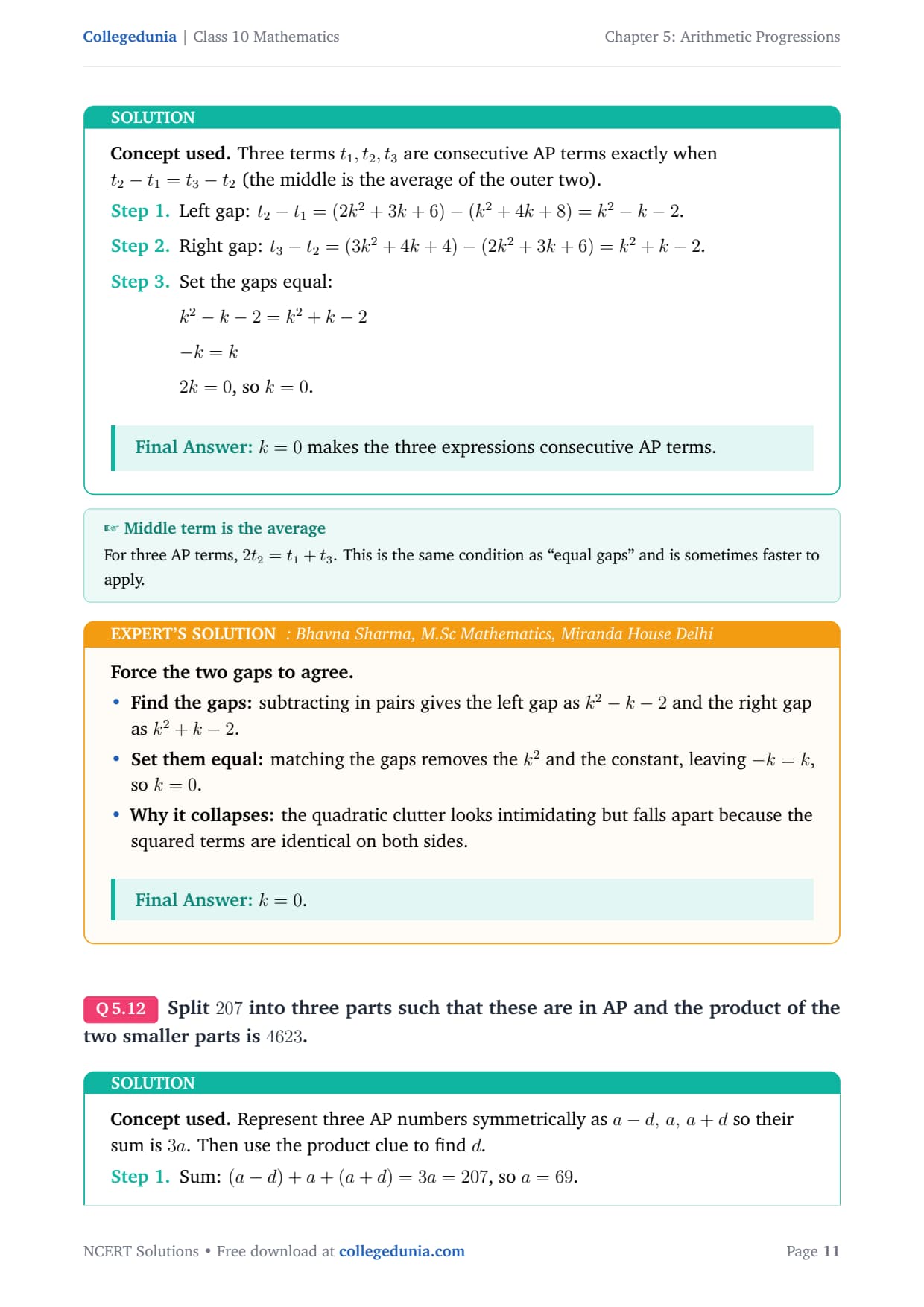
Q 5.11
Determine k so that k2+4k+8, 2k2+3k+6, 3k2+4k+4 are three consecutive terms of an AP.
Concept used. Three terms t1,t2,t3 are consecutive AP terms
exactly when t2-t1=t3-t2 (the middle is the average of the outer
two).
Left gap: t2-t1=(2k2+3k+6)-(k2+4k+8)=k2-k-2.
Right gap: t3-t2=(3k2+4k+4)-(2k2+3k+6)=k2+k-2.
Set the gaps equal:
[] k2-k-2=k2+k-2
[] -k=k
[] 2k=0, so k=0.
k=0 makes the three expressions consecutive AP terms.
BS
Bhavna Sharma
M.Sc Mathematics, Miranda House Delhi
Verified Expert
Force the two gaps to agree.
Find the gaps: subtracting in pairs gives the left gap as
k2-k-2 and the right gap as k2+k-2.
Set them equal: matching the gaps removes the k2 and
the constant, leaving -k=k, so k=0.
Why it collapses: the quadratic clutter looks
intimidating but falls apart because the squared terms are
identical on both sides.
k=0.
Q 5.12
Split 207 into three parts such that these are in AP and the product of the two smaller parts is 4623.
Concept used. Represent three AP numbers symmetrically as
a-d, a, a+d so their sum is 3a. Then use the product clue to find
d.
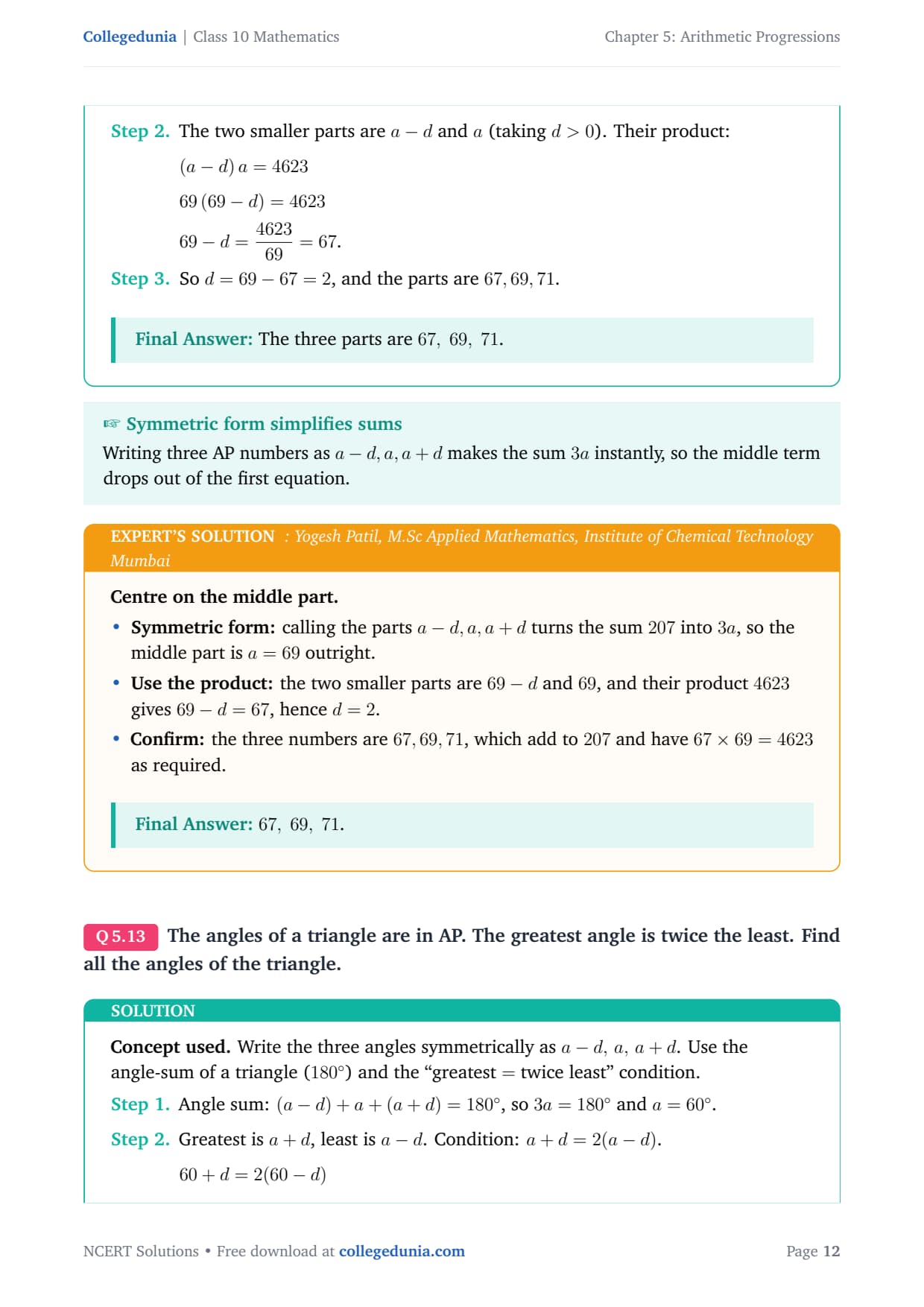
Sum: (a-d)+a+(a+d)=3a=207, so a=69.
The two smaller parts are a-d and a (taking d>0). Their
product:
[] (a-d) a=4623
[] 69 (69-d)=4623
[] 69-d=462369=67.
So d=69-67=2, and the parts are 67,69,71.
The three parts are 67, 69, 71.
YP
Yogesh Patil
M.Sc Applied Mathematics, Institute of Chemical Technology Mumbai
Verified Expert
Centre on the middle part.
Symmetric form: calling the parts a-d,a,a+d turns the
sum 207 into 3a, so the middle part is a=69 outright.
Use the product: the two smaller parts are 69-d and
69, and their product 4623 gives 69-d=67, hence d=2.
Confirm: the three numbers are 67,69,71, which add to
207 and have 6769=4623 as required.
67, 69, 71.
Q 5.13
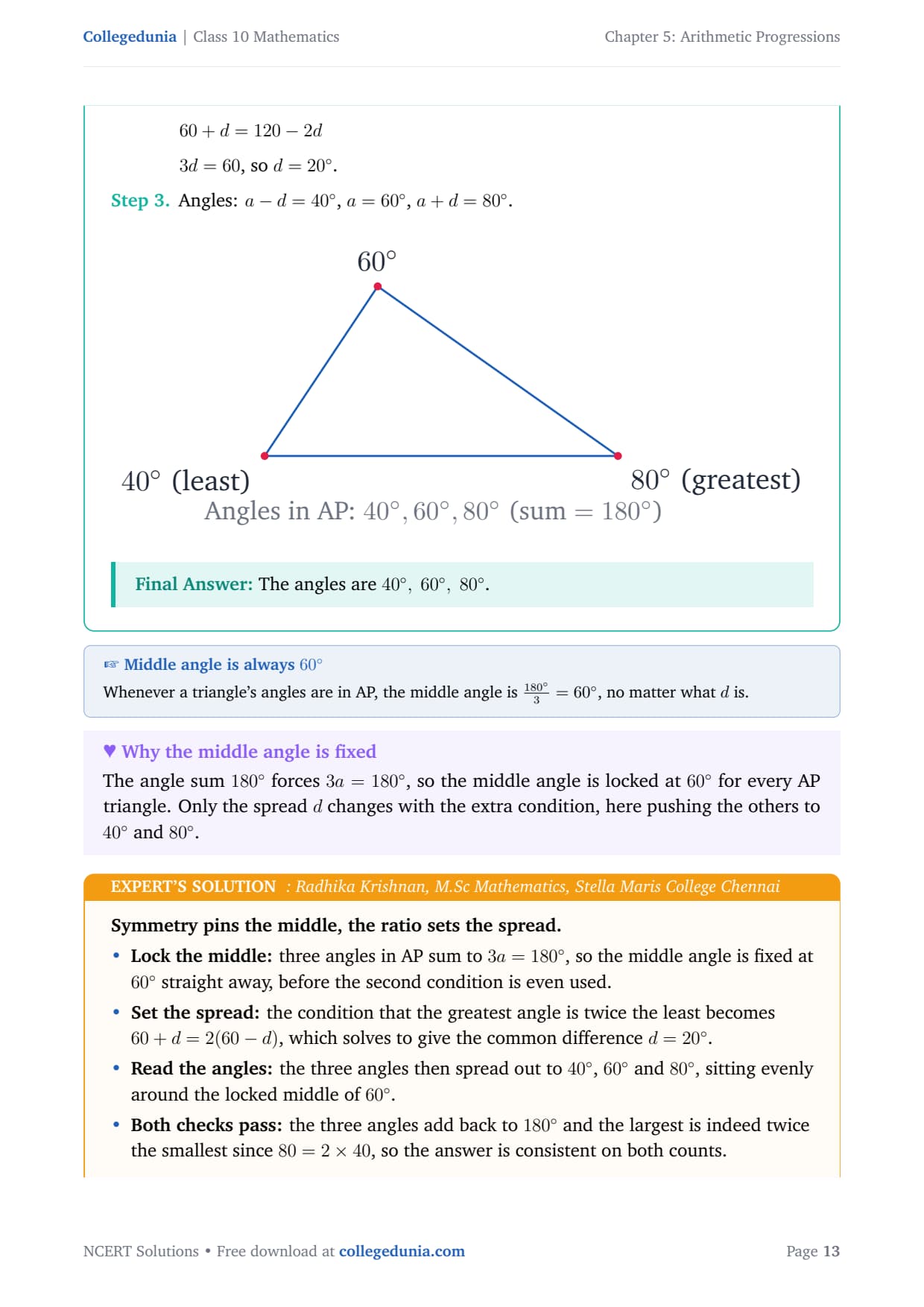
The angles of a triangle are in AP. The greatest angle is twice the least. Find all the angles of the triangle.
Concept used. Write the three angles symmetrically as
a-d, a, a+d. Use the angle-sum of a triangle (180∘) and the
``greatest = twice least'' condition.
Angle sum: (a-d)+a+(a+d)=180∘, so 3a=180∘ and
a=60∘.
Greatest is a+d, least is a-d. Condition: a+d=2(a-d).
[] 60+d=2(60-d)
[] 60+d=120-2d
[] 3d=60, so d=20∘.
Angles: a-d=40∘, a=60∘, a+d=80∘.
!%
[See diagram in the PDF version]
The angles are 40∘, 60∘, 80∘.
RK
Radhika Krishnan
M.Sc Mathematics, Stella Maris College Chennai
Verified Expert
Symmetry pins the middle, the ratio sets the spread.
Lock the middle: three angles in AP sum to
3a=180∘, so the middle angle is fixed at 60∘
straight away, before the second condition is even used.
Set the spread: the condition that the greatest angle is
twice the least becomes 60+d=2(60-d), which solves to give the
common difference d=20∘.
Read the angles: the three angles then spread out to
40∘, 60∘ and 80∘, sitting evenly around the
locked middle of 60∘.
Both checks pass: the three angles add back to
180∘ and the largest is indeed twice the smallest since
80=240, so the answer is consistent on both counts.
40∘, 60∘, 80∘.
Q 5.14
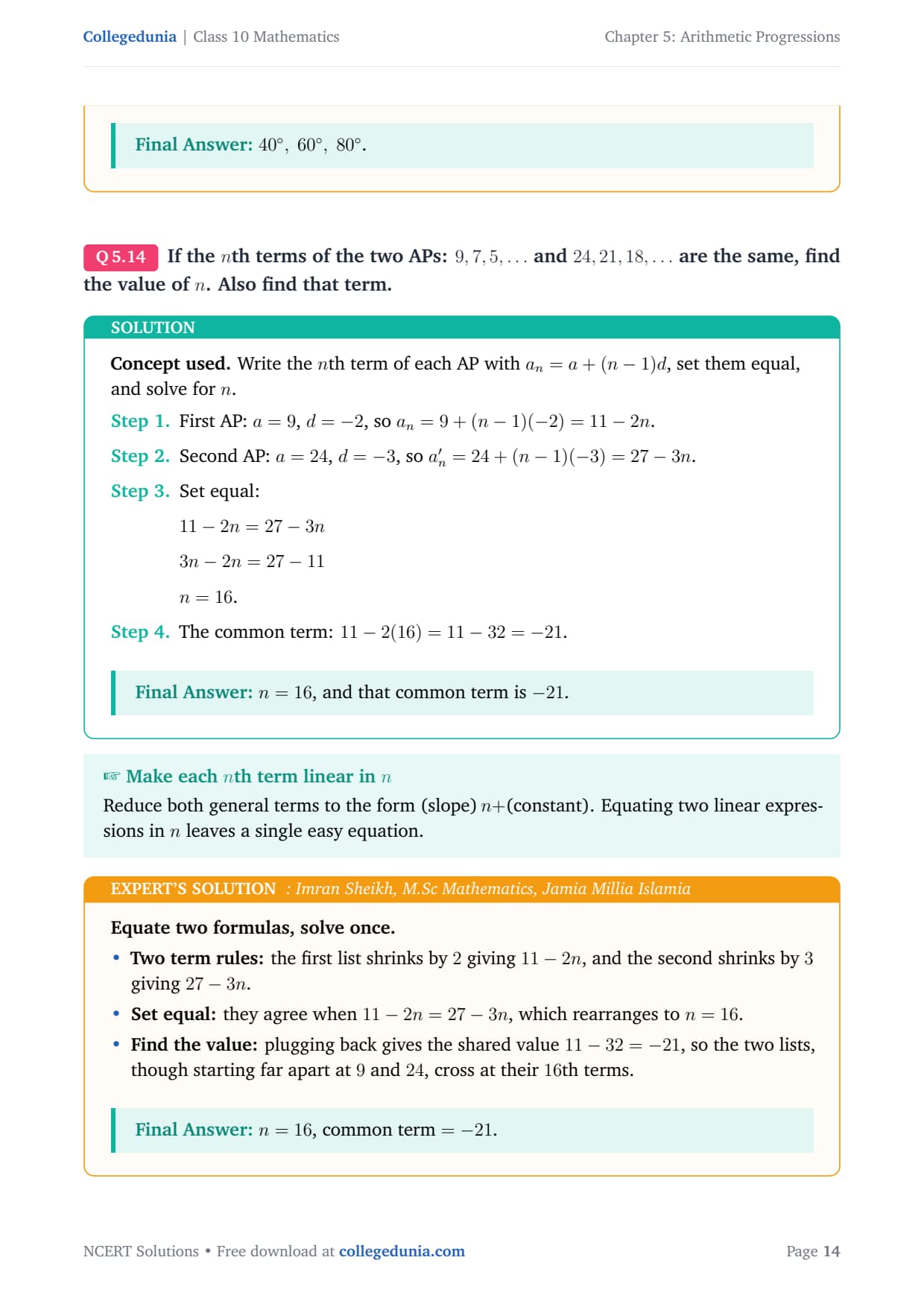
If the nth terms of the two APs: 9,7,5,… and 24,21,18,… are the same, find the value of n. Also find that term.
Concept used. Write the nth term of each AP with
an=a+(n-1)d, set them equal, and solve for n.
First AP: a=9, d=-2, so an=9+(n-1)(-2)=11-2n.
Second AP: a=24, d=-3, so an'=24+(n-1)(-3)=27-3n.
Set equal:
[] 11-2n=27-3n
[] 3n-2n=27-11
[] n=16.
The common term: 11-2(16)=11-32=-21.
n=16, and that common term is -21.
IS
Imran Sheikh
M.Sc Mathematics, Jamia Millia Islamia
Verified Expert
Equate two formulas, solve once.
Two term rules: the first list shrinks by 2 giving
11-2n, and the second shrinks by 3 giving 27-3n.
Set equal: they agree when 11-2n=27-3n, which
rearranges to n=16.
Find the value: plugging back gives the shared value
11-32=-21, so the two lists, though starting far apart at 9
and 24, cross at their 16th terms.
n=16, common term =-21.
Q 5.15
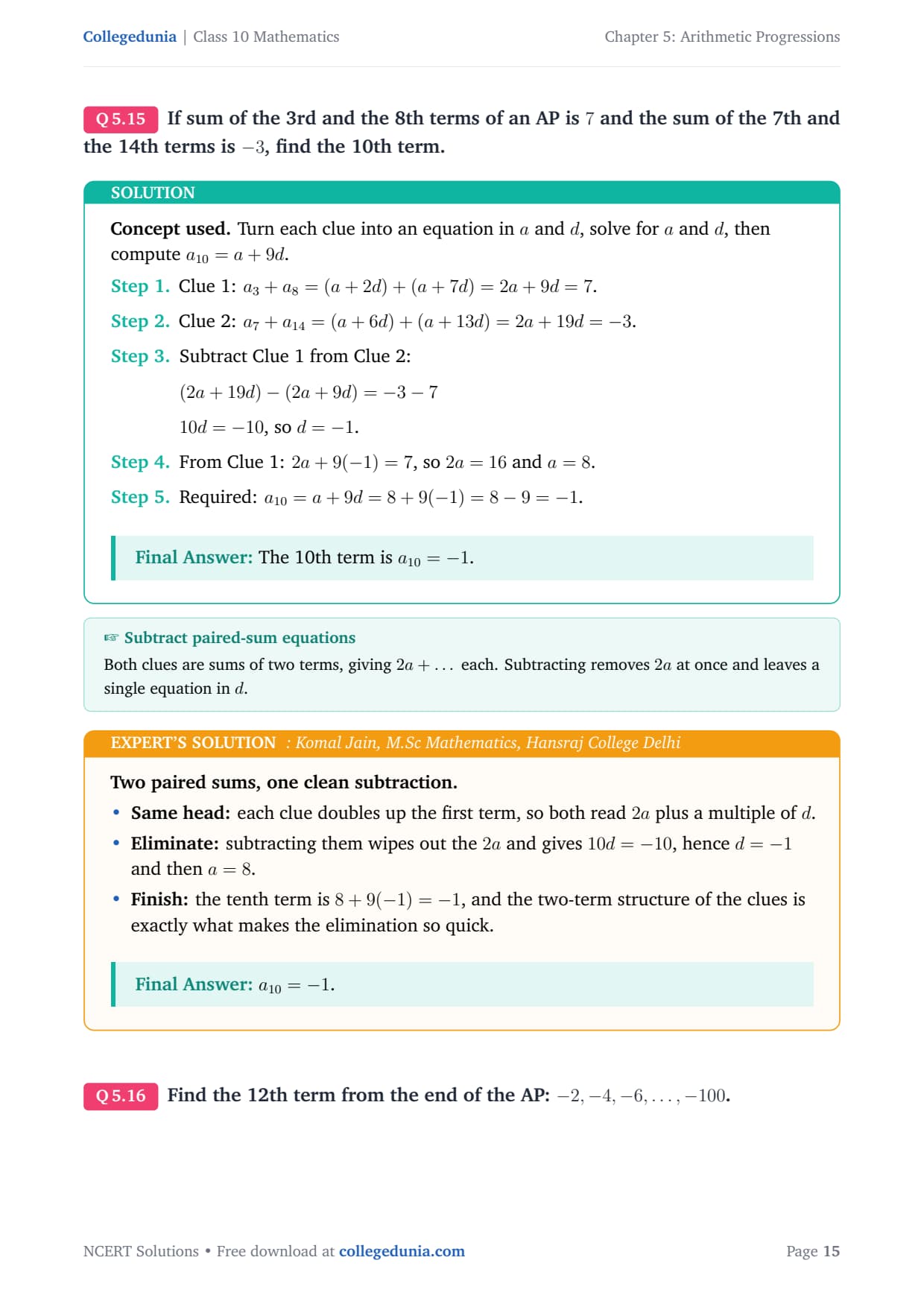
If sum of the 3rd and the 8th terms of an AP is 7 and the sum of the 7th and the 14th terms is -3, find the 10th term.
Concept used. Turn each clue into an equation in a and d,
solve for a and d, then compute a10=a+9d.
Clue 1: a3+a8=(a+2d)+(a+7d)=2a+9d=7.
Clue 2: a7+a14=(a+6d)+(a+13d)=2a+19d=-3.
Subtract Clue 1 from Clue 2:
[] (2a+19d)-(2a+9d)=-3-7
[] 10d=-10, so d=-1.
From Clue 1: 2a+9(-1)=7, so 2a=16 and a=8.
Required: a10=a+9d=8+9(-1)=8-9=-1.
The 10th term is a10=-1.
KJ
Komal Jain
M.Sc Mathematics, Hansraj College Delhi
Verified Expert
Two paired sums, one clean subtraction.
Same head: each clue doubles up the first term, so both
read 2a plus a multiple of d.
Eliminate: subtracting them wipes out the 2a and gives
10d=-10, hence d=-1 and then a=8.
Finish: the tenth term is 8+9(-1)=-1, and the two-term
structure of the clues is exactly what makes the elimination so
quick.
a10=-1.
Q 5.16
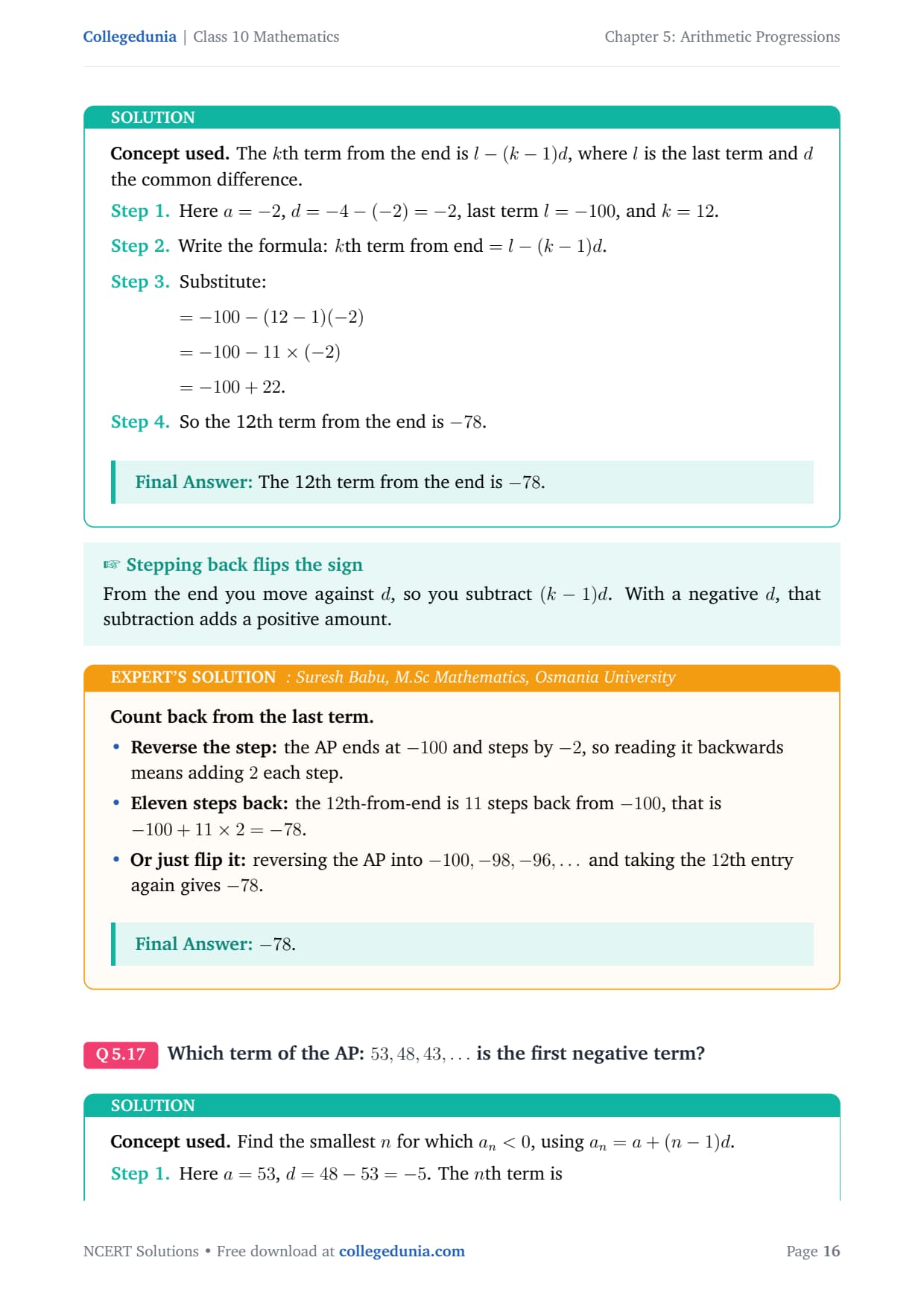
Find the 12th term from the end of the AP: -2,-4,-6,…,-100.
Concept used. The kth term from the end is l-(k-1)d, where
l is the last term and d the common difference.
Here a=-2, d=-4-(-2)=-2, last term l=-100, and k=12.
Reverse the step: the AP ends at -100 and steps by
-2, so reading it backwards means adding 2 each step.
Eleven steps back: the 12th-from-end is 11 steps back
from -100, that is -100+112=-78.
Or just flip it: reversing the AP into
-100,-98,-96, and taking the 12th entry again gives
-78.
-78.
Q 5.17
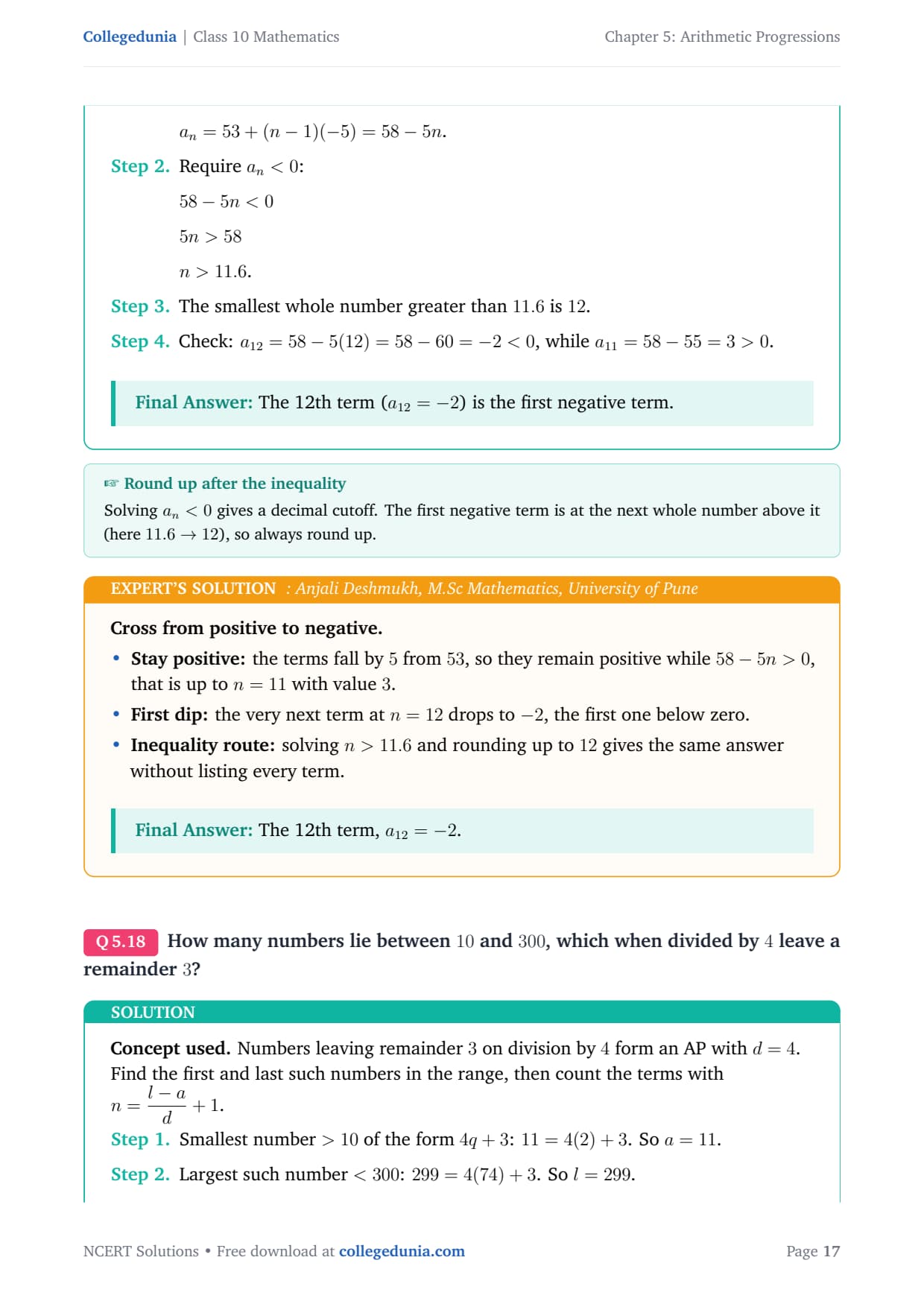
Which term of the AP: 53,48,43,… is the first negative term?
Concept used. Find the smallest n for which an<0, using
an=a+(n-1)d.
Here a=53, d=48-53=-5. The nth term is
an=53+(n-1)(-5)=58-5n.
Require an<0:
[] 58-5n<0
[] 5n>58
[] n>11.6.
The smallest whole number greater than 11.6 is 12.
Check: a12=58-5(12)=58-60=-2<0, while
a11=58-55=3>0.
The 12th term (a12=-2) is the first negative term.
AD
Anjali Deshmukh
M.Sc Mathematics, University of Pune
Verified Expert
Cross from positive to negative.
Stay positive: the terms fall by 5 from 53, so they
remain positive while 58-5n>0, that is up to n=11 with value
3.
First dip: the very next term at n=12 drops to -2,
the first one below zero.
Inequality route: solving n>11.6 and rounding up to
12 gives the same answer without listing every term.
The 12th term, a12=-2.
Q 5.18
How many numbers lie between 10 and 300, which when divided by 4 leave a remainder 3?
Concept used. Numbers leaving remainder 3 on division by 4
form an AP with d=4. Find the first and last such numbers in the range,
then count the terms with n=l-ad+1.
Smallest number >10 of the form 4q+3: 11=4(2)+3. So a=11.
Largest such number <300: 299=4(74)+3. So l=299.
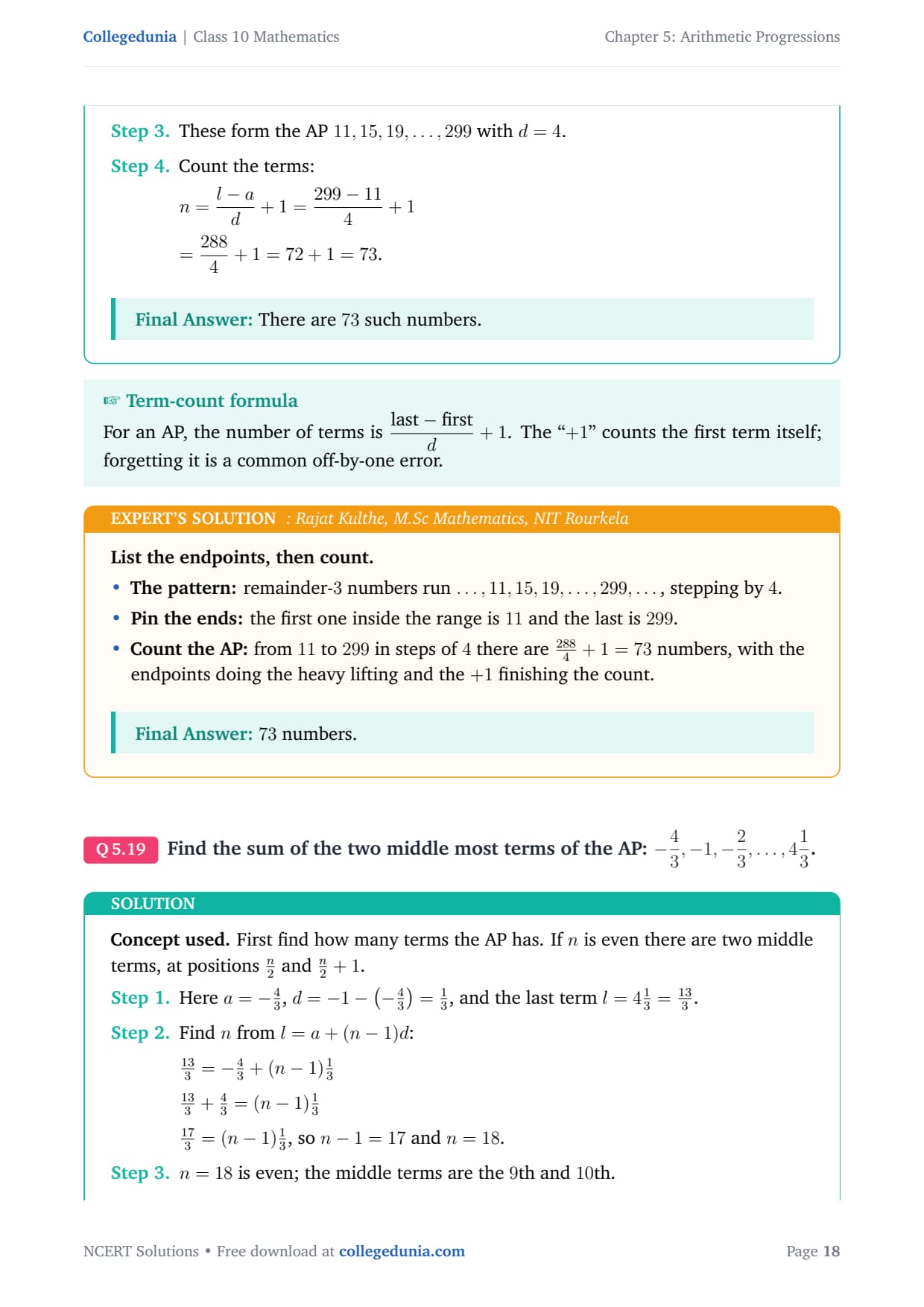
These form the AP 11,15,19,,299 with d=4.
Count the terms:
[] n=l-ad+1=299-114+1
[] =2884+1=72+1=73.
There are 73 such numbers.
RK
Rajat Kulthe
M.Sc Mathematics, NIT Rourkela
Verified Expert
List the endpoints, then count.
The pattern: remainder-3 numbers run
,11,15,19,,299,, stepping by 4.
Pin the ends: the first one inside the range is 11 and
the last is 299.
Count the AP: from 11 to 299 in steps of 4 there
are 2884+1=73 numbers, with the endpoints doing the
heavy lifting and the +1 finishing the count.
73 numbers.
Q 5.19
Find the sum of the two middle most terms of the AP: -43,-1,-23,…,413.
Concept used. First find how many terms the AP has. If n is
even there are two middle terms, at positions n2 and
n2+1.
Here a=-43, d=-1-(-43)=13, and
the last term l=413=133.
Find n from l=a+(n-1)d:
[] 133=-43+(n-1)13
[] 133+43=(n-1)13
[] 173=(n-1)13, so n-1=17 and n=18.
n=18 is even; the middle terms are the 9th and 10th.
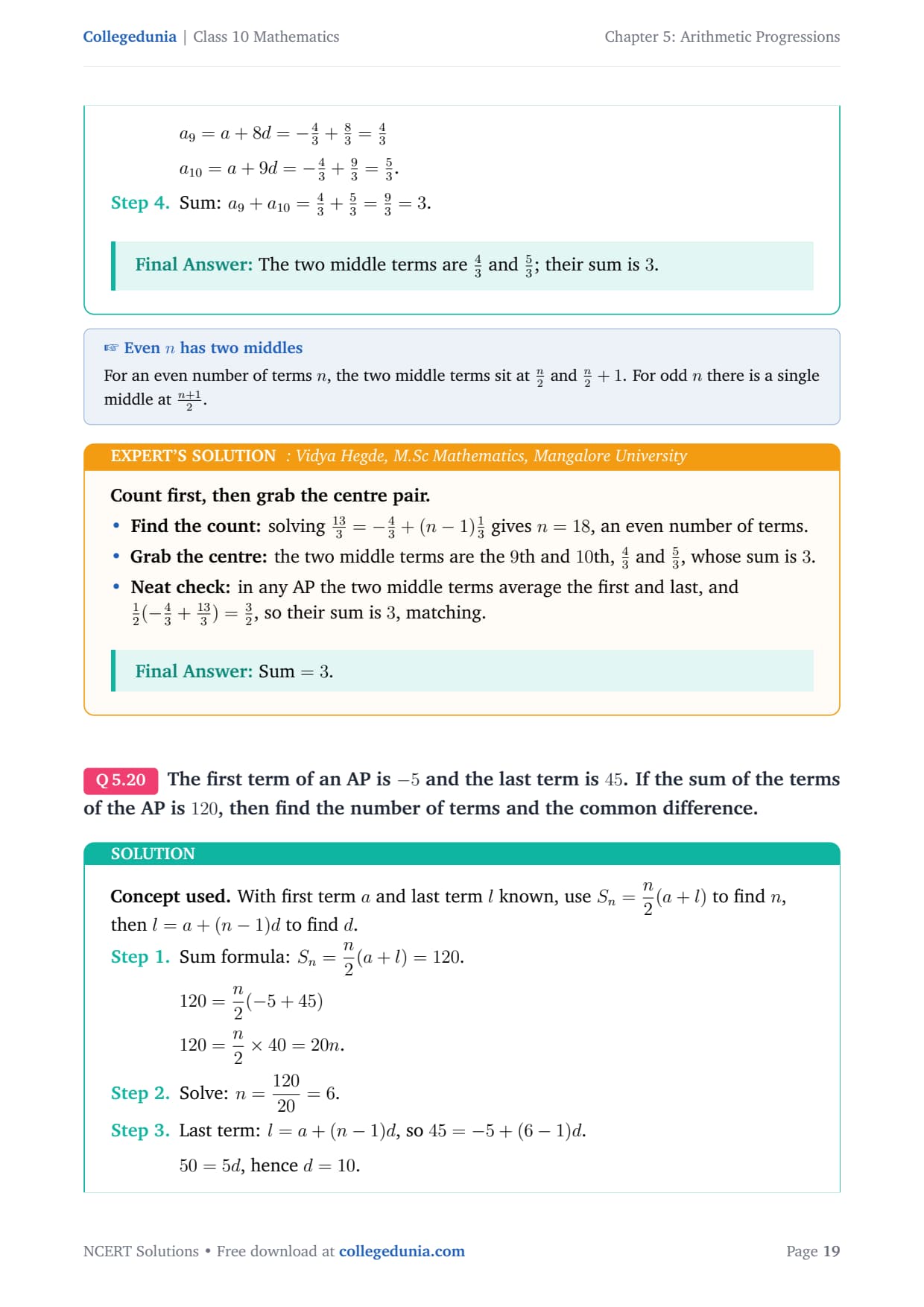
[] a9=a+8d=-43+83=43
[] a10=a+9d=-43+93=53.
Sum: a9+a10=43+53=93=3.
The two middle terms are 43 and 53; their sum is
3.
VH
Vidya Hegde
M.Sc Mathematics, Mangalore University
Verified Expert
Count first, then grab the centre pair.
Find the count: solving
133=-43+(n-1)13 gives n=18, an even
number of terms.
Grab the centre: the two middle terms are the 9th and
10th, 43 and 53, whose sum is 3.
Neat check: in any AP the two middle terms average the
first and last, and 12(-43+133)=32,
so their sum is 3, matching.
Sum =3.
Q 5.20
The first term of an AP is -5 and the last term is 45. If the sum of the terms of the AP is 120, then find the number of terms and the common difference.
Concept used. With first term a and last term l known, use
Sn=n2(a+l) to find n, then l=a+(n-1)d to find d.
Sum formula: Sn=n2(a+l)=120.
[] 120=n2(-5+45)
[] 120=n240=20n.
Solve: n=12020=6.
Last term: l=a+(n-1)d, so 45=-5+(6-1)d.
[] 50=5d, hence d=10.
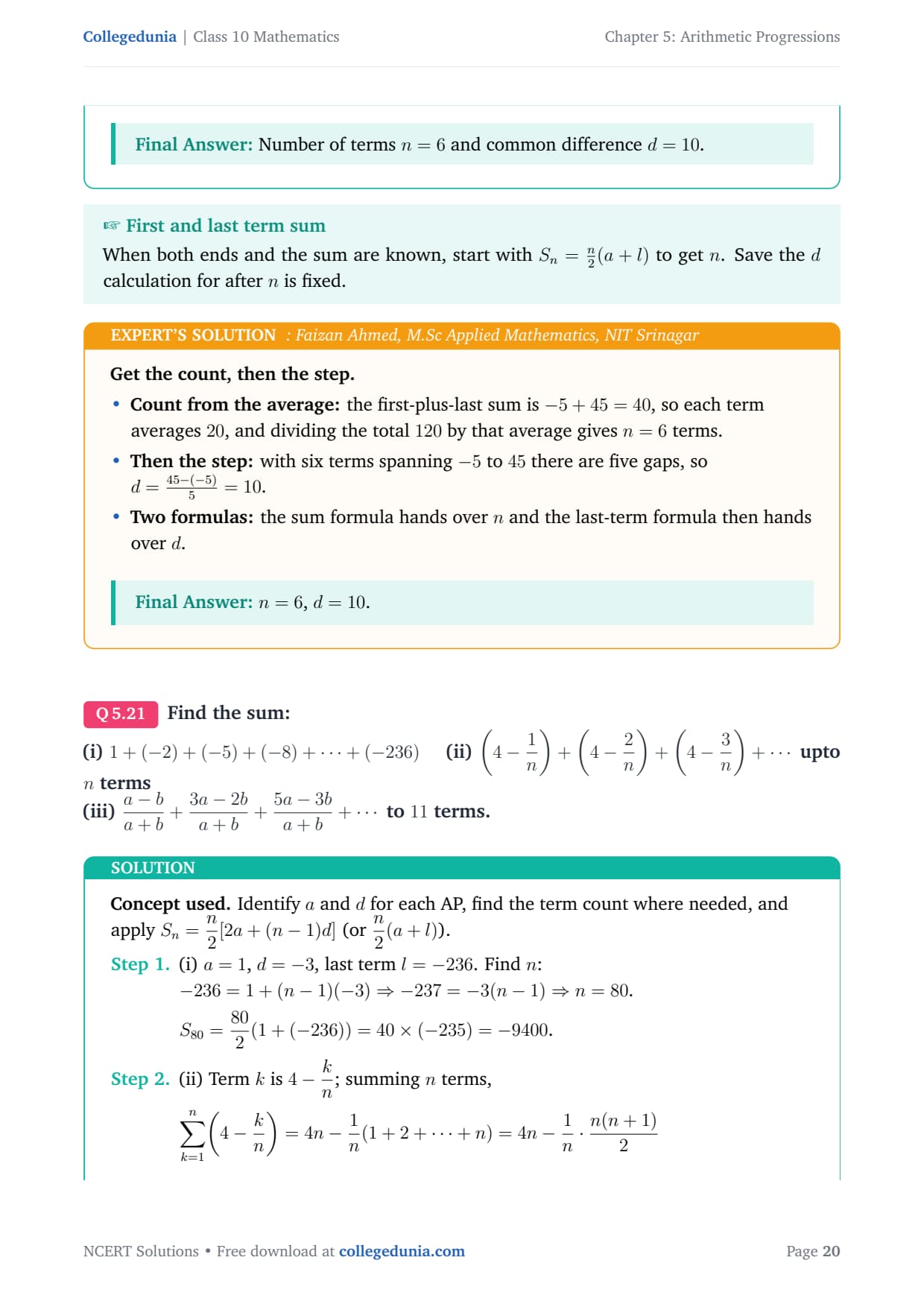
Number of terms n=6 and common difference d=10.
FA
Faizan Ahmed
M.Sc Applied Mathematics, NIT Srinagar
Verified Expert
Get the count, then the step.
Count from the average: the first-plus-last sum is
-5+45=40, so each term averages 20, and dividing the total
120 by that average gives n=6 terms.
Then the step: with six terms spanning -5 to 45 there
are five gaps, so d=45-(-5)5=10.
Two formulas: the sum formula hands over n and the
last-term formula then hands over d.
n=6, d=10.
Q 5.21
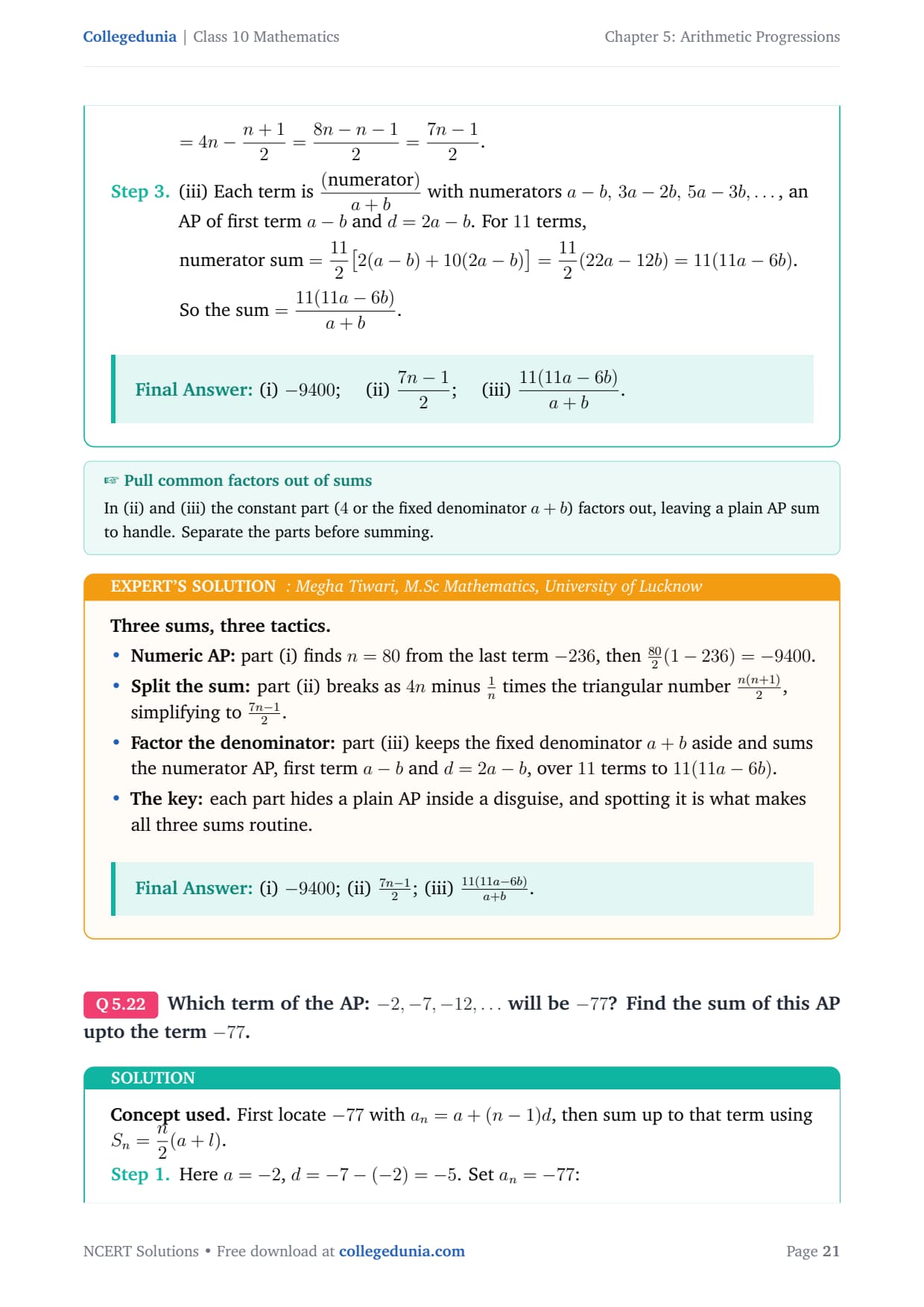
Find the sum:
(i) 1+(-2)+(-5)+(-8)+⋯+(-236) (ii) (4-1n)+(4-2n)+(4-3n)+⋯ upto n terms
(iii) a-ba+b+3a-2ba+b+5a-3ba+b+⋯ to 11 terms.
Concept used. Identify a and d for each AP, find the term
count where needed, and apply Sn=n2[2a+(n-1)d] (or
n2(a+l)).
(i) a=1, d=-3, last term l=-236. Find n:
-236=1+(n-1)(-3)⇒ -237=-3(n-1)⇒ n=80.
[] S80=802(1+(-236))=40×(-235)=-9400.
(ii) Term k is 4-kn; summing n terms,
[] k=1n(4-kn)=4n-1n(1+2+⋯+n)=4n-1n·n(n+1)2
[] =4n-n+12=8n-n-12=7n-12.
(iii) Each term is (numerator)a+b with
numerators a-b, 3a-2b, 5a-3b,, an AP of first term
a-b and d=2a-b. For 11 terms,
[] numerator sum =112[2(a-b)+10(2a-b)]
=112(22a-12b)=11(11a-6b).
[] So the sum =11(11a-6b)a+b.
(i) -9400; (ii) 7n-12;
(iii) 11(11a-6b)a+b.
MT
Megha Tiwari
M.Sc Mathematics, University of Lucknow
Verified Expert
Three sums, three tactics.
Numeric AP: part (i) finds n=80 from the last term
-236, then 802(1-236)=-9400.
Split the sum: part (ii) breaks as 4n minus 1n
times the triangular number n(n+1)2, simplifying to
7n-12.
Factor the denominator: part (iii) keeps the fixed
denominator a+b aside and sums the numerator AP, first term
a-b and d=2a-b, over 11 terms to 11(11a-6b).
The key: each part hides a plain AP inside a disguise,
and spotting it is what makes all three sums routine.
(i) -9400; (ii) 7n-12; (iii)
11(11a-6b)a+b.
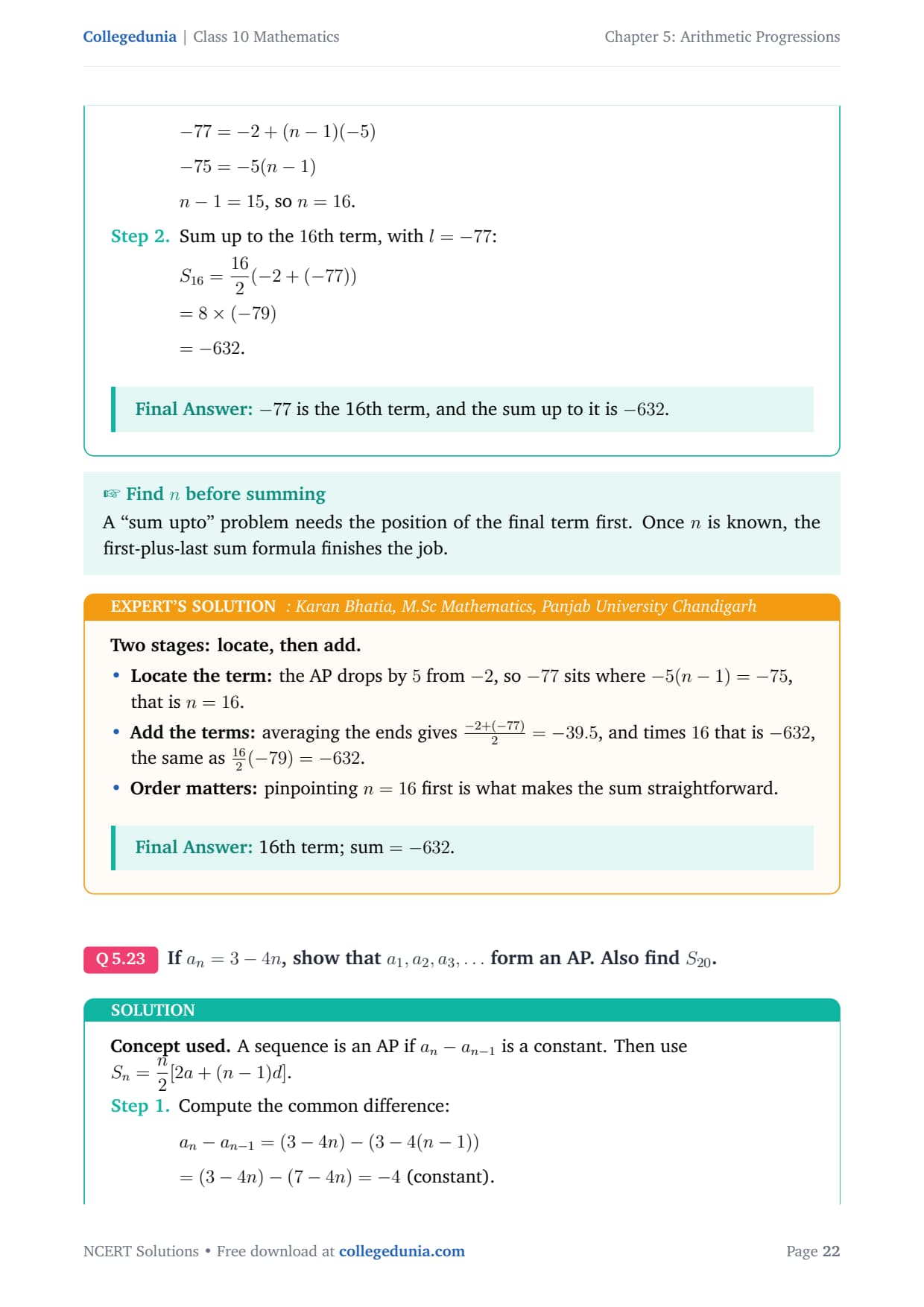
Q 5.22
Which term of the AP: -2,-7,-12,… will be -77? Find the sum of this AP upto the term -77.
Concept used. First locate -77 with an=a+(n-1)d, then sum
up to that term using Sn=n2(a+l).
Here a=-2, d=-7-(-2)=-5. Set an=-77:
[] -77=-2+(n-1)(-5)
[] -75=-5(n-1)
[] n-1=15, so n=16.
Sum up to the 16th term, with l=-77:
[] S16=162(-2+(-77))
[] =8×(-79)
[] =-632.
-77 is the 16th term, and the sum up to it is -632.
KB
Karan Bhatia
M.Sc Mathematics, Panjab University Chandigarh
Verified Expert
Two stages: locate, then add.
Locate the term: the AP drops by 5 from -2, so -77
sits where -5(n-1)=-75, that is n=16.
Add the terms: averaging the ends gives
-2+(-77)2=-39.5, and times 16 that is -632, the
same as 162(-79)=-632.
Order matters: pinpointing n=16 first is what makes the
sum straightforward.
16th term; sum =-632.
Q 5.23
If an=3-4n, show that a1,a2,a3,… form an AP. Also find S20.
Concept used. A sequence is an AP if an-an-1 is a constant.
Then use Sn=n2[2a+(n-1)d].
Compute the common difference:
[] an-an-1=(3-4n)-(3-4(n-1))
[] =(3-4n)-(7-4n)=-4 (constant).
Since the difference is the constant -4, the sequence is an AP
with a1=3-4=-1 and d=-4.
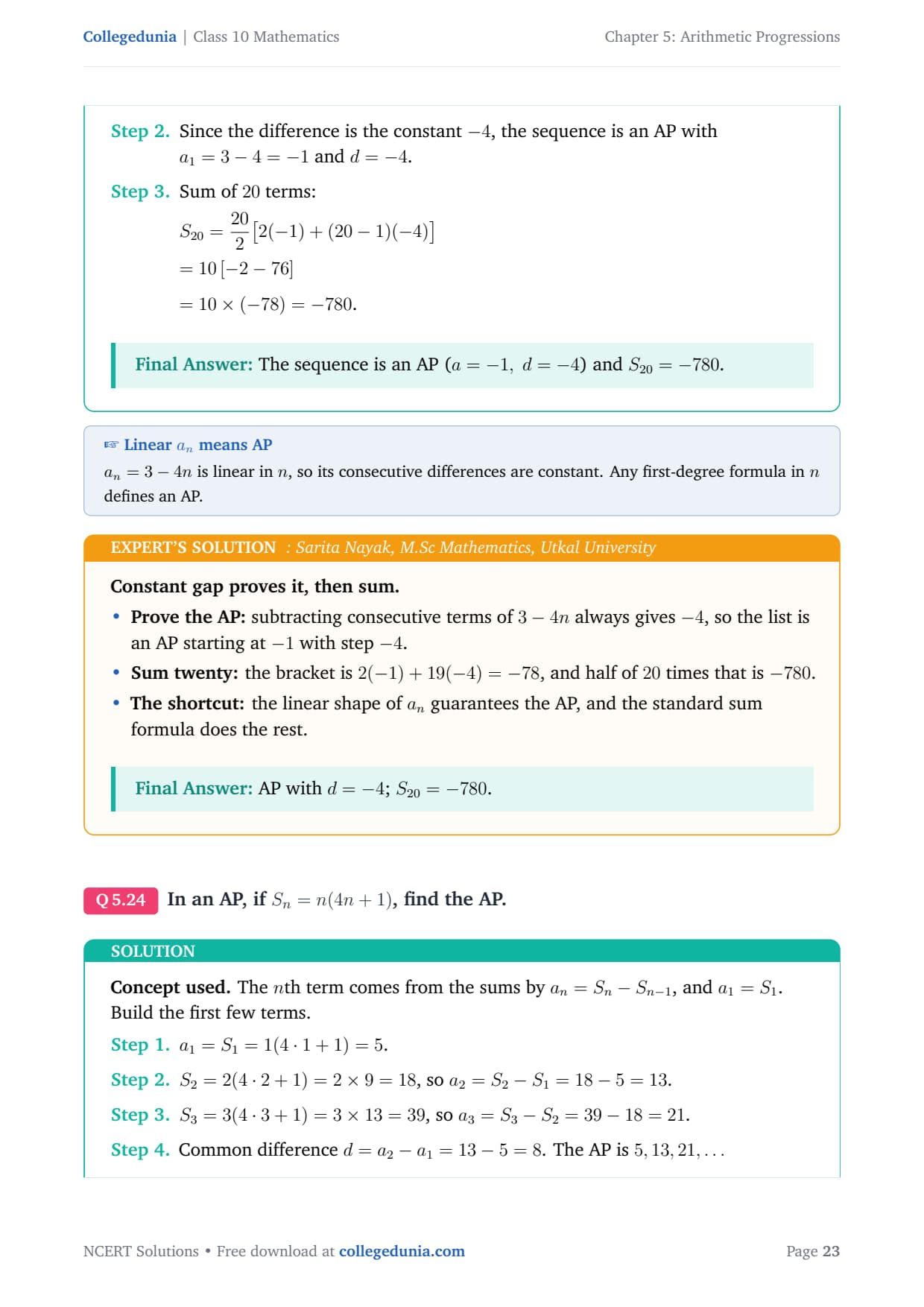
Sum of 20 terms:
[] S20=202[2(-1)+(20-1)(-4)]
[] =10 [-2-76]
[] =10×(-78)=-780.
The sequence is an AP (a=-1, d=-4) and S20=-780.
SN
Sarita Nayak
M.Sc Mathematics, Utkal University
Verified Expert
Constant gap proves it, then sum.
Prove the AP: subtracting consecutive terms of 3-4n
always gives -4, so the list is an AP starting at -1 with step
-4.
Sum twenty: the bracket is 2(-1)+19(-4)=-78, and half
of 20 times that is -780.
The shortcut: the linear shape of an guarantees the
AP, and the standard sum formula does the rest.
AP with d=-4; S20=-780.
Q 5.24
In an AP, if Sn=n(4n+1), find the AP.
Concept used. The nth term comes from the sums by
an=Sn-Sn-1, and a1=S1. Build the first few terms.
a1=S1=1(41+1)=5.
S2=2(42+1)=29=18, so a2=S2-S1=18-5=13.
S3=3(43+1)=313=39, so a3=S3-S2=39-18=21.
Common difference d=a2-a1=13-5=8. The AP is
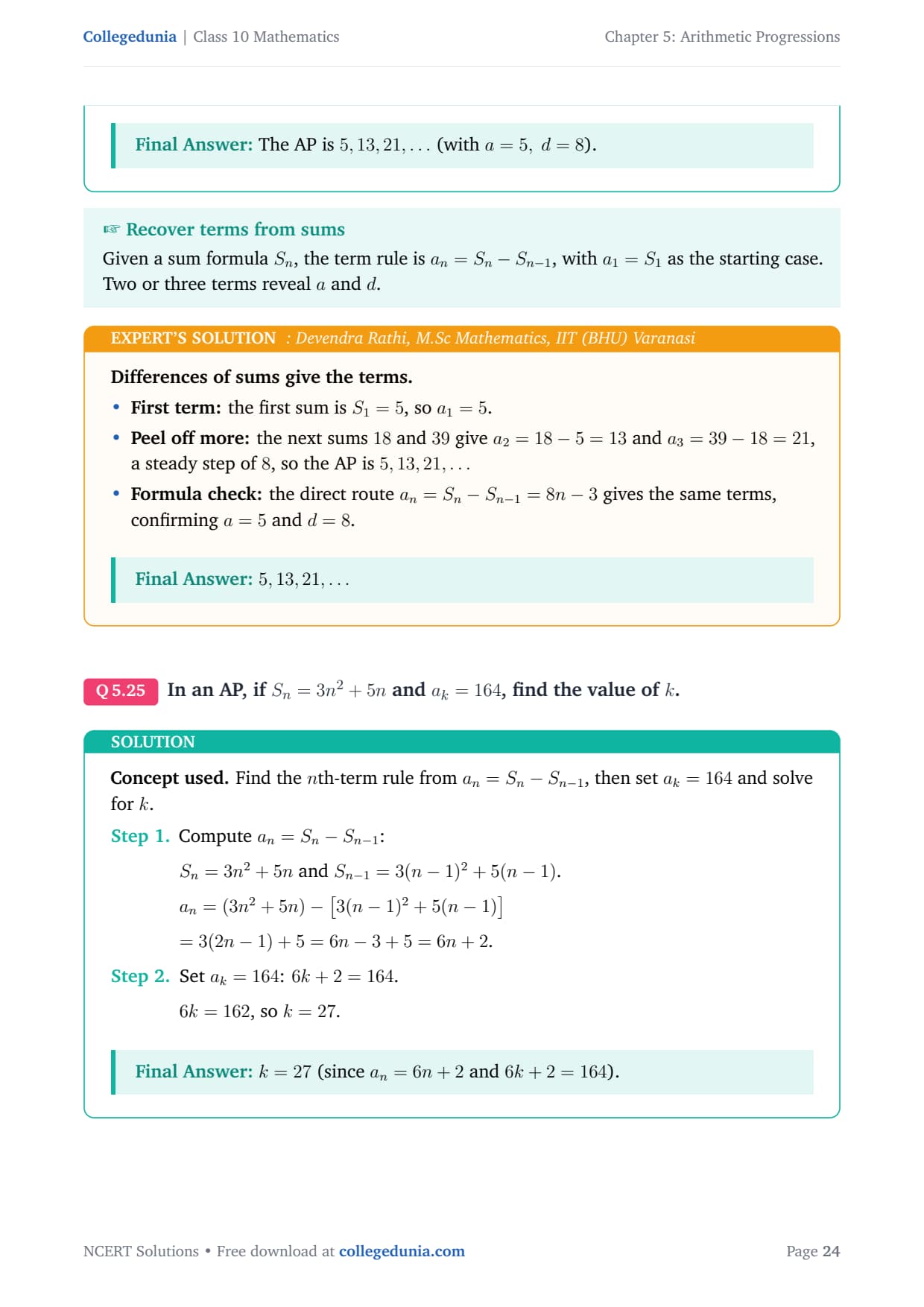
5,13,21,
The AP is 5,13,21,… (with a=5, d=8).
DR
Devendra Rathi
M.Sc Mathematics, IIT (BHU) Varanasi
Verified Expert
Differences of sums give the terms.
First term: the first sum is S1=5, so a1=5.
Peel off more: the next sums 18 and 39 give
a2=18-5=13 and a3=39-18=21, a steady step of 8, so the AP
is 5,13,21,
Formula check: the direct route an=Sn-Sn-1=8n-3
gives the same terms, confirming a=5 and d=8.
5,13,21,…
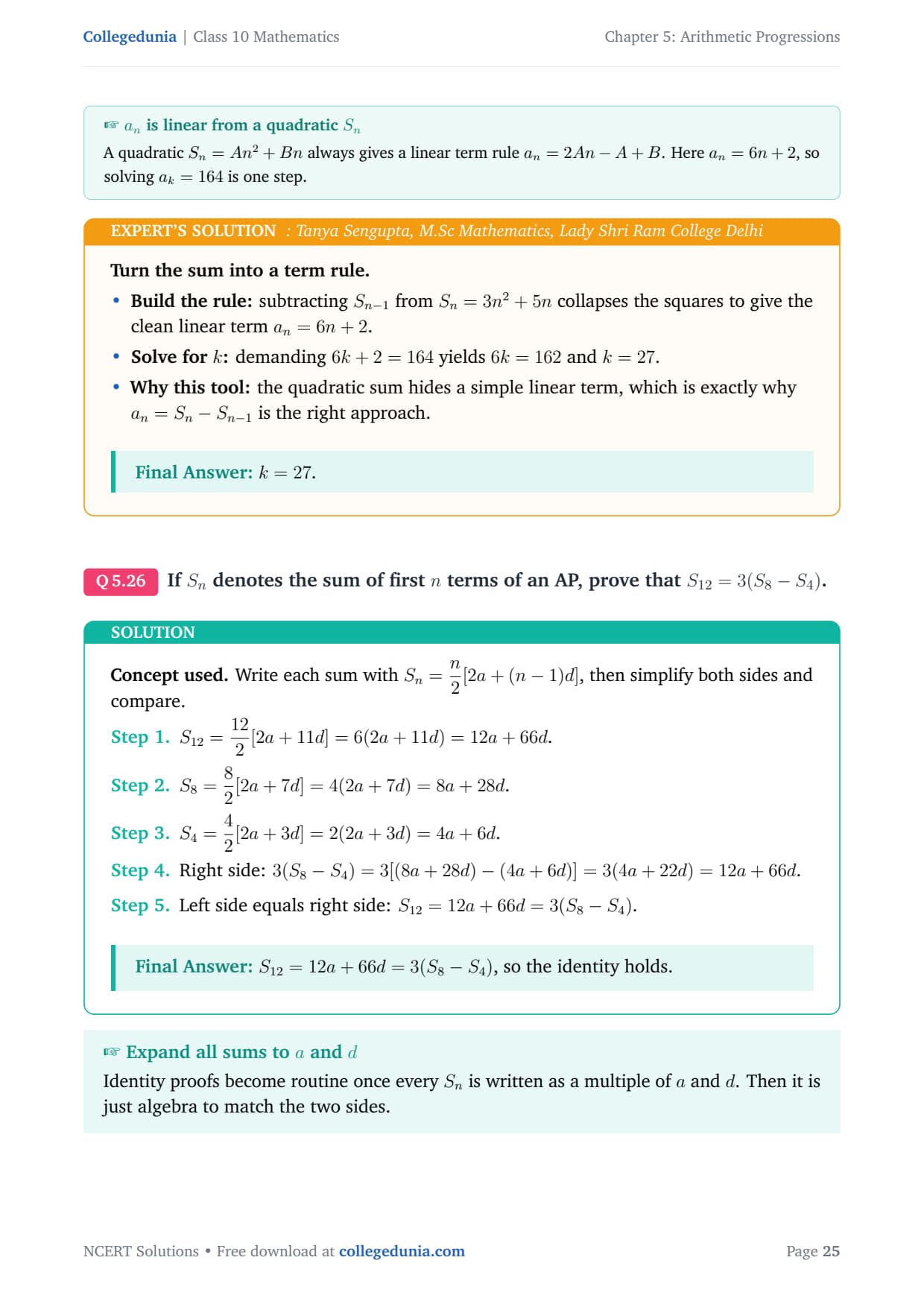
Q 5.25
In an AP, if Sn=3n2+5n and ak=164, find the value of k.
Concept used. Find the nth-term rule from an=Sn-Sn-1,
then set ak=164 and solve for k.
Compute an=Sn-Sn-1:
[] Sn=3n2+5n and Sn-1=3(n-1)2+5(n-1).
[] an=(3n2+5n)-[3(n-1)2+5(n-1)]
[] =3(2n-1)+5=6n-3+5=6n+2.
Set ak=164: 6k+2=164.
[] 6k=162, so k=27.
k=27 (since an=6n+2 and 6k+2=164).
TS
Tanya Sengupta
M.Sc Mathematics, Lady Shri Ram College Delhi
Verified Expert
Turn the sum into a term rule.
Build the rule: subtracting Sn-1 from Sn=3n2+5n
collapses the squares to give the clean linear term an=6n+2.
Solve for k: demanding 6k+2=164 yields 6k=162 and
k=27.
Why this tool: the quadratic sum hides a simple linear
term, which is exactly why an=Sn-Sn-1 is the right
approach.
k=27.
Q 5.26
If Sn denotes the sum of first n terms of an AP, prove that S12=3(S8-S4).
Concept used. Write each sum with Sn=n2[2a+(n-1)d],
then simplify both sides and compare.
S12=122[2a+11d]=6(2a+11d)=12a+66d.
S8=82[2a+7d]=4(2a+7d)=8a+28d.
S4=42[2a+3d]=2(2a+3d)=4a+6d.
Right side: 3(S8-S4)=3[(8a+28d)-(4a+6d)]=3(4a+22d)=12a+66d.
Left side equals right side: S12=12a+66d=3(S8-S4).
S12=12a+66d=3(S8-S4), so the identity holds.
HP
Hemant Pawar
M.Sc Mathematics, Shivaji University Kolhapur
Verified Expert
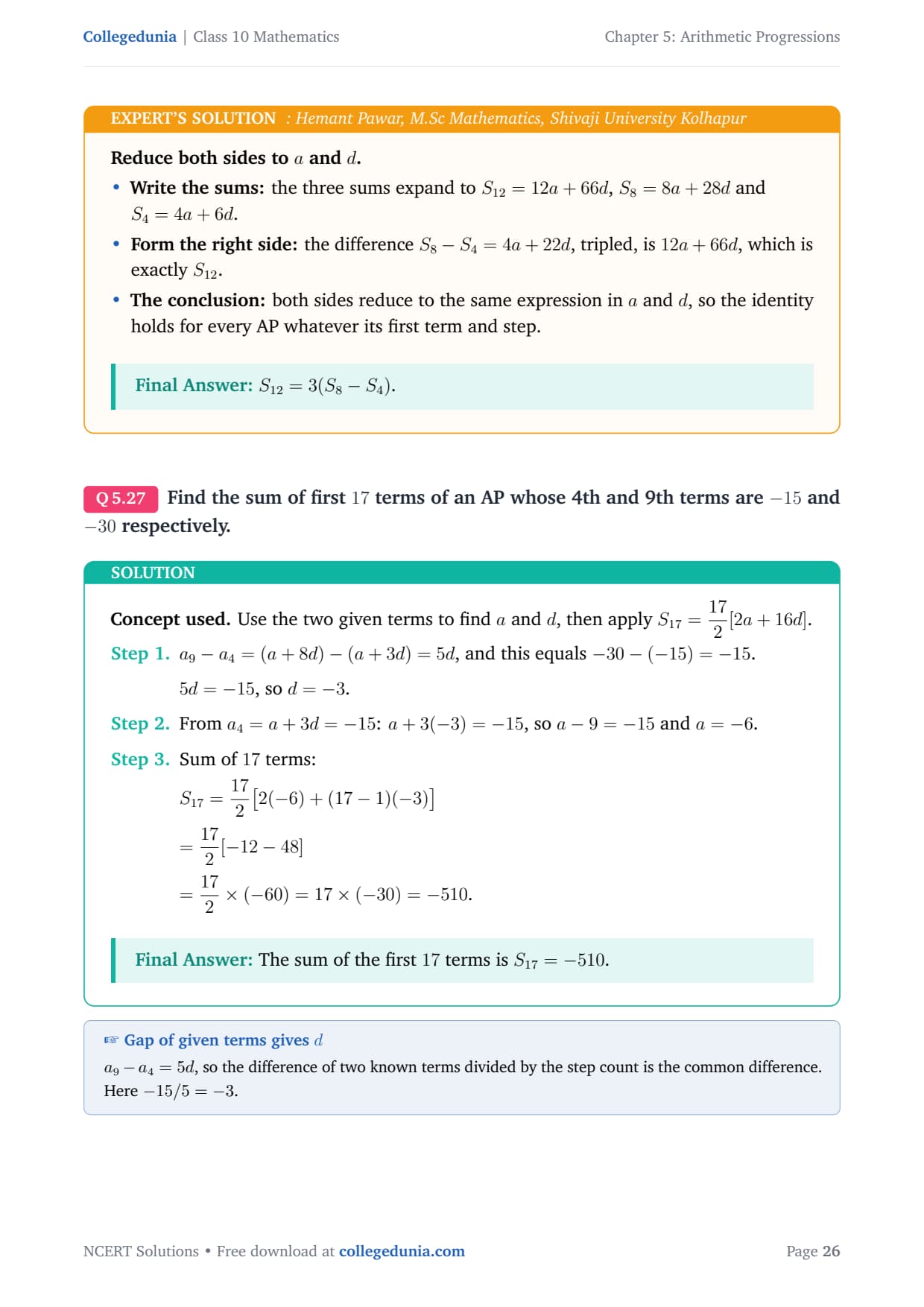
Reduce both sides to a and d.
Write the sums: the three sums expand to
S12=12a+66d, S8=8a+28d and S4=4a+6d.
Form the right side: the difference S8-S4=4a+22d,
tripled, is 12a+66d, which is exactly S12.
The conclusion: both sides reduce to the same expression
in a and d, so the identity holds for every AP whatever its
first term and step.
S12=3(S8-S4).
Q 5.27
Find the sum of first 17 terms of an AP whose 4th and 9th terms are -15 and -30 respectively.
Concept used. Use the two given terms to find a and d, then
apply S17=172[2a+16d].
a9-a4=(a+8d)-(a+3d)=5d, and this equals -30-(-15)=-15.
[] 5d=-15, so d=-3.
From a4=a+3d=-15: a+3(-3)=-15, so a-9=-15 and a=-6.
Sum of 17 terms:
[] S17=172[2(-6)+(17-1)(-3)]
[] =172[-12-48]
[] =172×(-60)=17×(-30)=-510.
The sum of the first 17 terms is S17=-510.
NK
Neha Kulshrestha
M.Sc Applied Mathematics, MNNIT Allahabad
Verified Expert
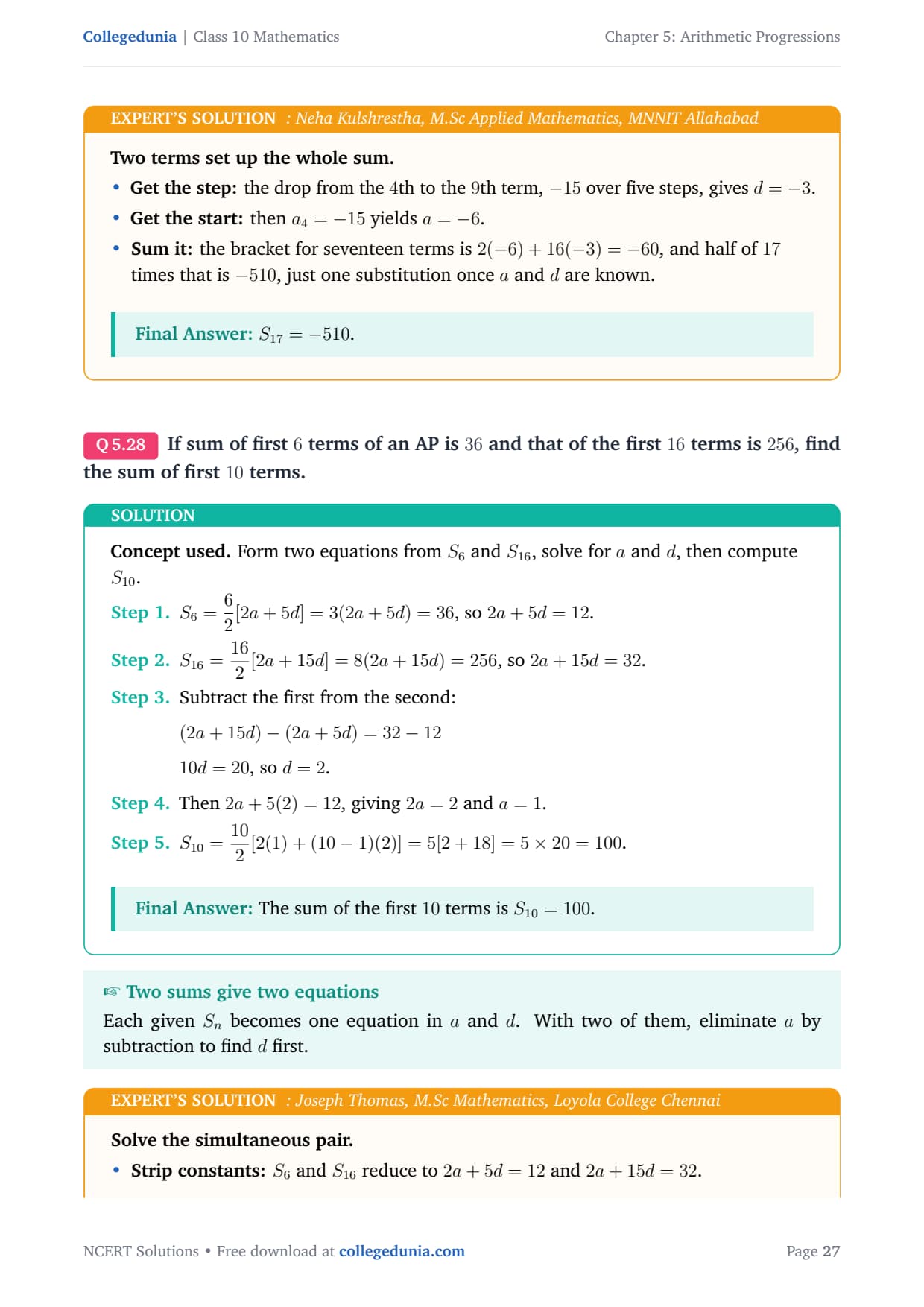
Two terms set up the whole sum.
Get the step: the drop from the 4th to the 9th term,
-15 over five steps, gives d=-3.
Get the start: then a4=-15 yields a=-6.
Sum it: the bracket for seventeen terms is
2(-6)+16(-3)=-60, and half of 17 times that is -510, just
one substitution once a and d are known.
S17=-510.
Q 5.28
If sum of first 6 terms of an AP is 36 and that of the first 16 terms is 256, find the sum of first 10 terms.
Concept used. Form two equations from S6 and S16, solve
for a and d, then compute S10.
S6=62[2a+5d]=3(2a+5d)=36, so 2a+5d=12.
S16=162[2a+15d]=8(2a+15d)=256, so 2a+15d=32.
Subtract the first from the second:
[] (2a+15d)-(2a+5d)=32-12
[] 10d=20, so d=2.
Then 2a+5(2)=12, giving 2a=2 and a=1.
S10=102[2(1)+(10-1)(2)]=5[2+18]=520=100.
The sum of the first 10 terms is S10=100.
JT
Joseph Thomas
M.Sc Mathematics, Loyola College Chennai
Verified Expert
Solve the simultaneous pair.
Strip constants:S6 and S16 reduce to
2a+5d=12 and 2a+15d=32.
Eliminate: subtracting kills the 2a and leaves
10d=20, so d=2 and a=1.
Finish: the ten-term sum is then 5(2+18)=100, and
forcing each sum into the same 2a-plus form is what makes the
elimination immediate.
S10=100.
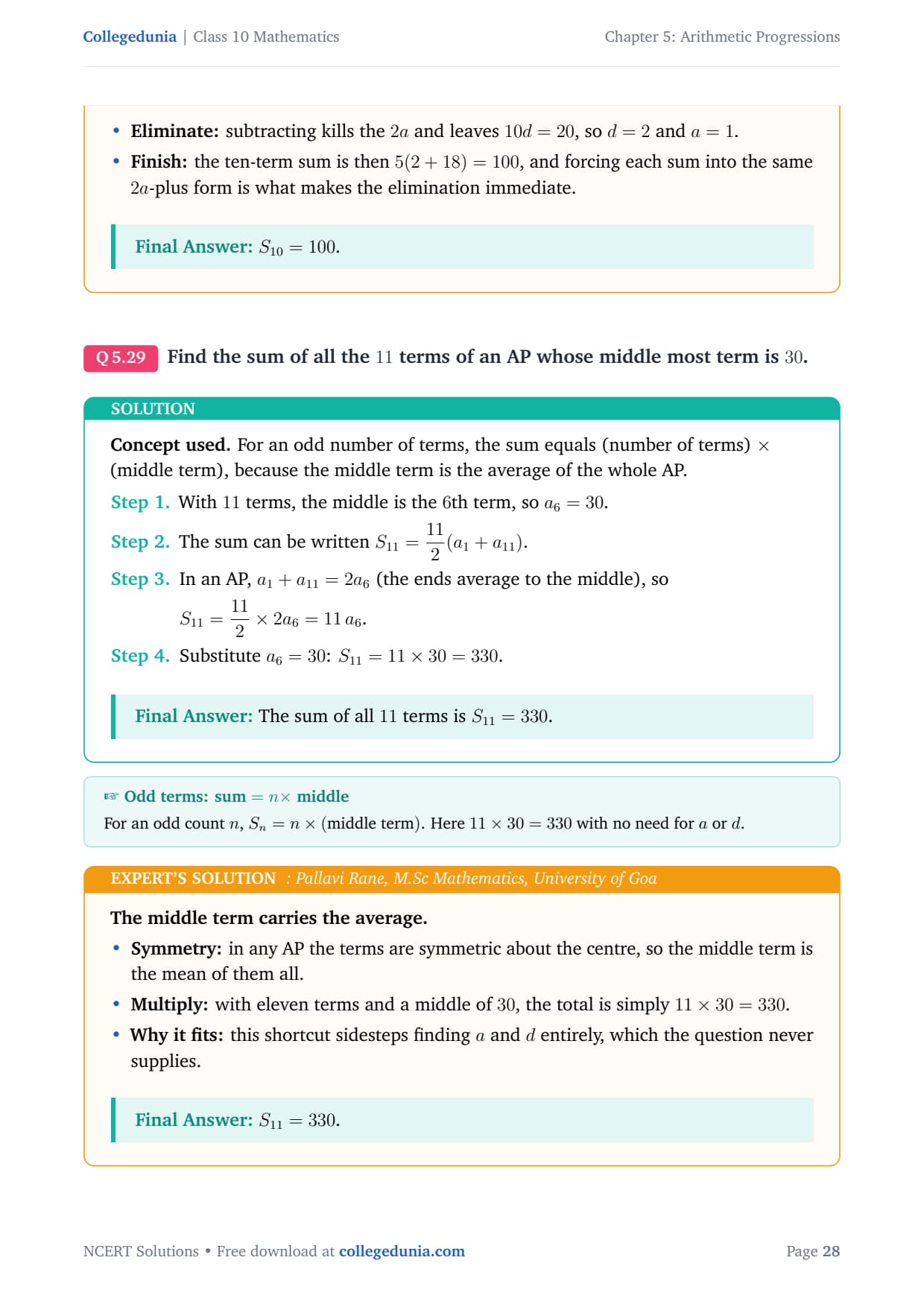
Q 5.29
Find the sum of all the 11 terms of an AP whose middle most term is 30.
Concept used. For an odd number of terms, the sum equals (number
of terms) × (middle term), because the middle term is the average
of the whole AP.
With 11 terms, the middle is the 6th term, so a6=30.
The sum can be written S11=112(a1+a11).
In an AP, a1+a11=2a6 (the ends average to the middle), so
[] S11=112× 2a6=11 a6.
Substitute a6=30: S11=1130=330.
The sum of all 11 terms is S11=330.
PR
Pallavi Rane
M.Sc Mathematics, University of Goa
Verified Expert
The middle term carries the average.
Symmetry: in any AP the terms are symmetric about the
centre, so the middle term is the mean of them all.
Multiply: with eleven terms and a middle of 30, the
total is simply 1130=330.
Why it fits: this shortcut sidesteps finding a and d
entirely, which the question never supplies.
S11=330.
Q 5.30
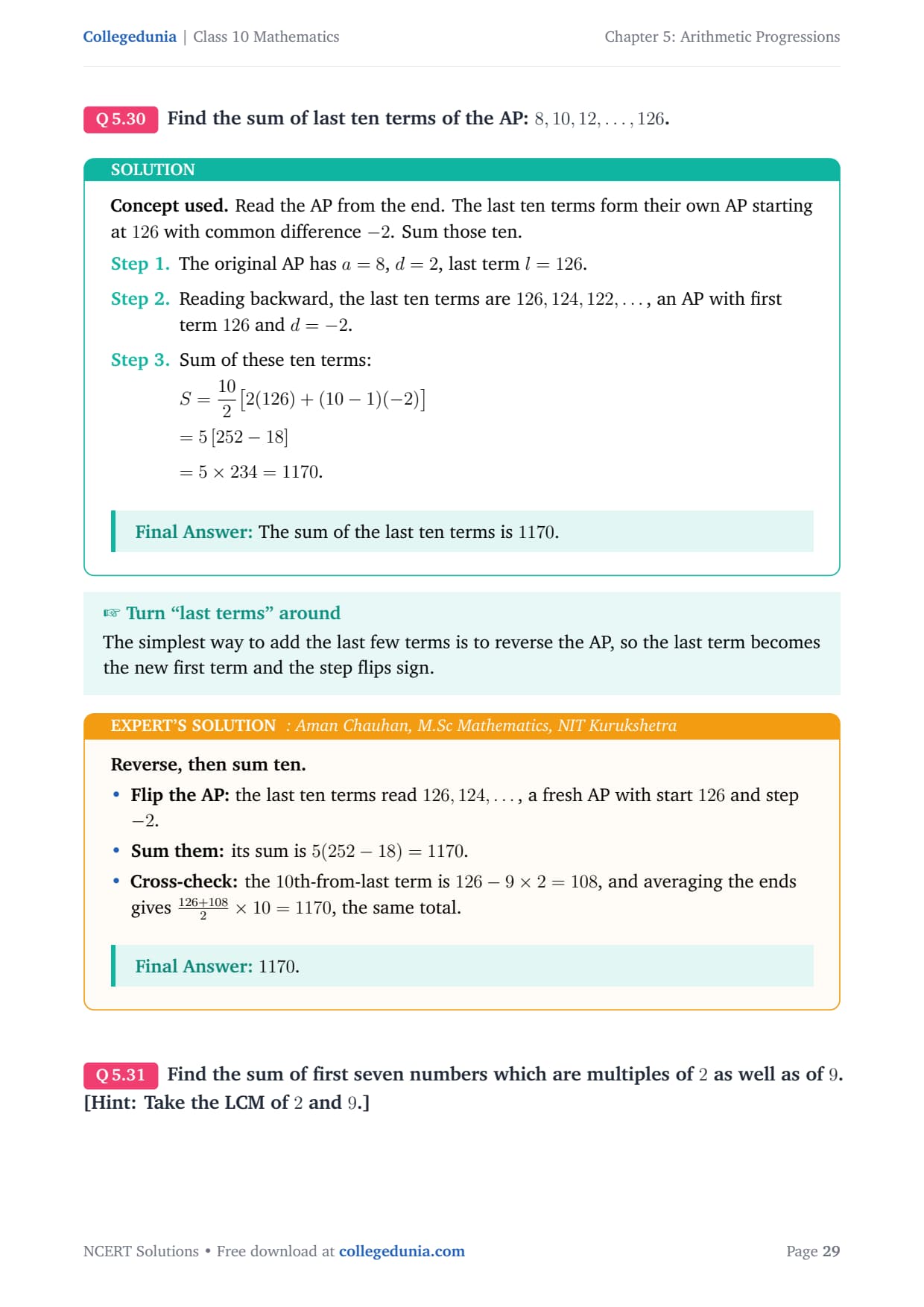
Find the sum of last ten terms of the AP: 8,10,12,…,126.
Concept used. Read the AP from the end. The last ten terms form
their own AP starting at 126 with common difference -2. Sum those ten.
The original AP has a=8, d=2, last term l=126.
Reading backward, the last ten terms are 126,124,122,,
an AP with first term 126 and d=-2.
Sum of these ten terms:
[] S=102[2(126)+(10-1)(-2)]
[] =5 [252-18]
[] =5234=1170.
The sum of the last ten terms is 1170.
AC
Aman Chauhan
M.Sc Mathematics, NIT Kurukshetra
Verified Expert
Reverse, then sum ten.
Flip the AP: the last ten terms read 126,124,, a
fresh AP with start 126 and step -2.
Sum them: its sum is 5(252-18)=1170.
Cross-check: the 10th-from-last term is
126-92=108, and averaging the ends gives
126+108210=1170, the same total.
1170.
Q 5.31
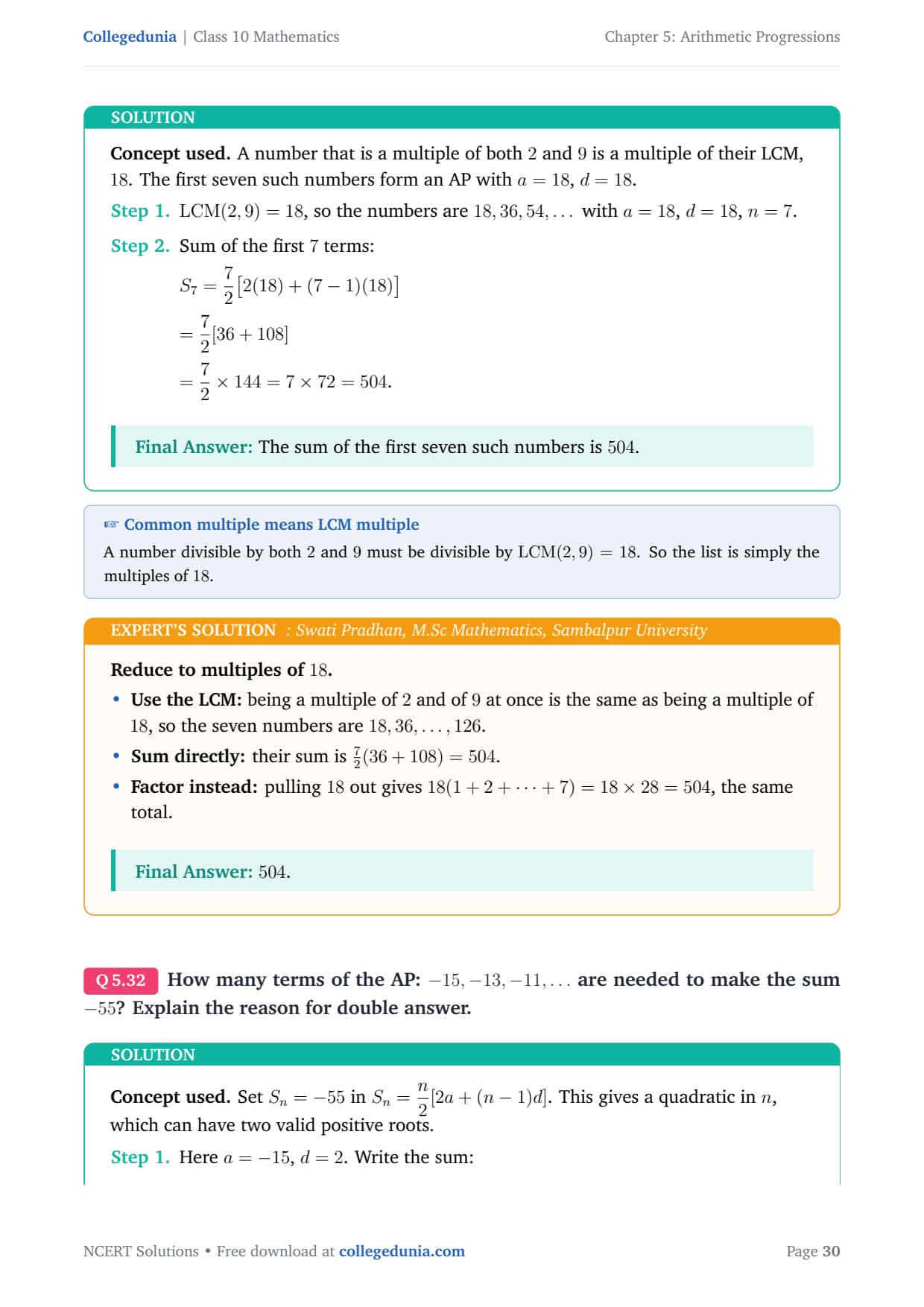
Find the sum of first seven numbers which are multiples of 2 as well as of 9. [Hint: Take the LCM of 2 and 9.]
Concept used. A number that is a multiple of both 2 and 9 is
a multiple of their LCM, 18. The first seven such numbers form an AP
with a=18, d=18.
LCM(2,9)=18, so the numbers are 18,36,54, with
a=18, d=18, n=7.
Sum of the first 7 terms:
[] S7=72[2(18)+(7-1)(18)]
[] =72[36+108]
[] =72144=772=504.
The sum of the first seven such numbers is 504.
SP
Swati Pradhan
M.Sc Mathematics, Sambalpur University
Verified Expert
Reduce to multiples of 18.
Use the LCM: being a multiple of 2 and of 9 at once
is the same as being a multiple of 18, so the seven numbers are
18,36,,126.
Sum directly: their sum is 72(36+108)=504.
Factor instead: pulling 18 out gives
18(1+2+⋯+7)=1828=504, the same total.
504.
Q 5.32
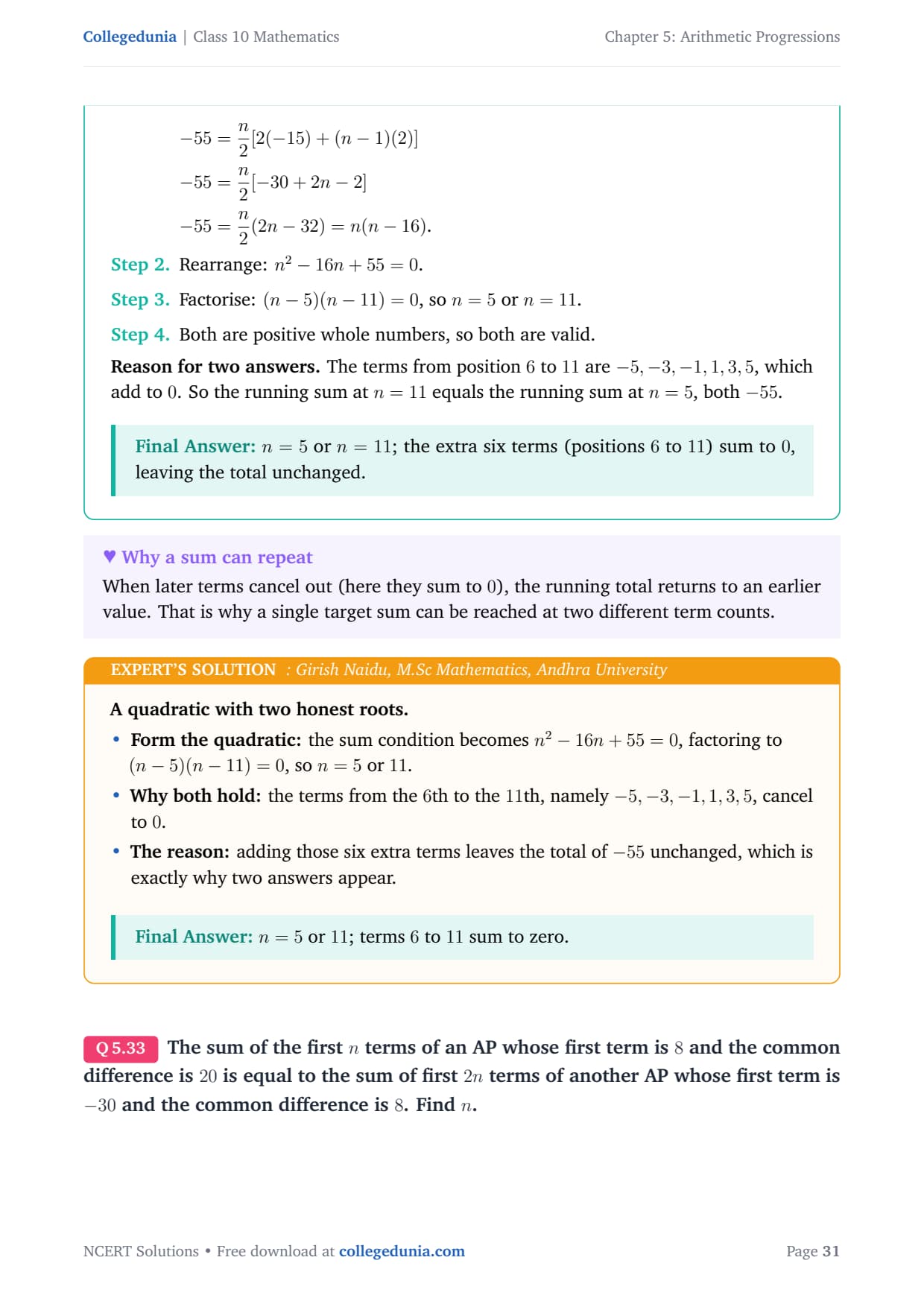
How many terms of the AP: -15,-13,-11,… are needed to make the sum -55? Explain the reason for double answer.
Concept used. Set Sn=-55 in Sn=n2[2a+(n-1)d].
This gives a quadratic in n, which can have two valid positive roots.
Here a=-15, d=2. Write the sum:
[] -55=n2[2(-15)+(n-1)(2)]
[] -55=n2[-30+2n-2]
[] -55=n2(2n-32)=n(n-16).
Rearrange: n2-16n+55=0.
Factorise: (n-5)(n-11)=0, so n=5 or n=11.
Both are positive whole numbers, so both are valid.
Reason for two answers. The terms from position 6 to 11 are
-5,-3,-1,1,3,5, which add to 0. So the running sum at n=11 equals
the running sum at n=5, both -55.
n=5 or n=11; the extra six terms (positions 6 to 11)
sum to 0, leaving the total unchanged.
GN
Girish Naidu
M.Sc Mathematics, Andhra University
Verified Expert
A quadratic with two honest roots.
Form the quadratic: the sum condition becomes
n2-16n+55=0, factoring to (n-5)(n-11)=0, so n=5 or 11.
Why both hold: the terms from the 6th to the 11th,
namely -5,-3,-1,1,3,5, cancel to 0.
The reason: adding those six extra terms leaves the total
of -55 unchanged, which is exactly why two answers appear.
n=5 or 11; terms 6 to 11 sum to zero.
Q 5.33
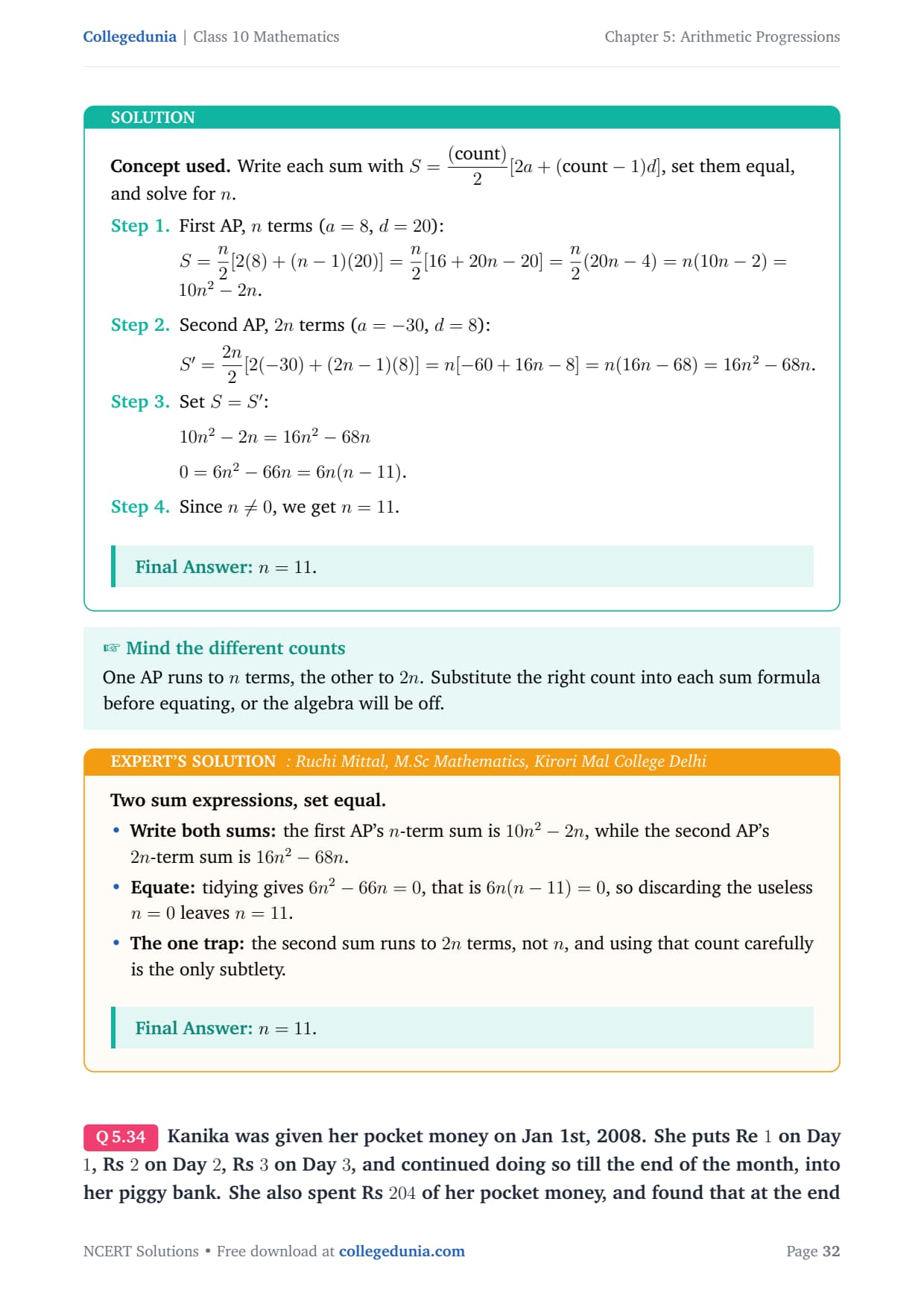
The sum of the first n terms of an AP whose first term is 8 and the common difference is 20 is equal to the sum of first 2n terms of another AP whose first term is -30 and the common difference is 8. Find n.
Concept used. Write each sum with
S=(count)2[2a+(count-1)d], set them equal, and
solve for n.
First AP, n terms (a=8, d=20):
[] S=n2[2(8)+(n-1)(20)]=n2[16+20n-20]
=n2(20n-4)=n(10n-2)=10n2-2n.
Second AP, 2n terms (a=-30, d=8):
[] S'=2n2[2(-30)+(2n-1)(8)]=n[-60+16n-8]
=n(16n-68)=16n2-68n.
Set S=S':
[] 10n2-2n=16n2-68n
[] 0=6n2-66n=6n(n-11).
Since n0, we get n=11.
n=11.
RM
Ruchi Mittal
M.Sc Mathematics, Kirori Mal College Delhi
Verified Expert
Two sum expressions, set equal.
Write both sums: the first AP's n-term sum is
10n2-2n, while the second AP's 2n-term sum is 16n2-68n.
Equate: tidying gives 6n2-66n=0, that is
6n(n-11)=0, so discarding the useless n=0 leaves n=11.
The one trap: the second sum runs to 2n terms, not n,
and using that count carefully is the only subtlety.
n=11.
Q 5.34
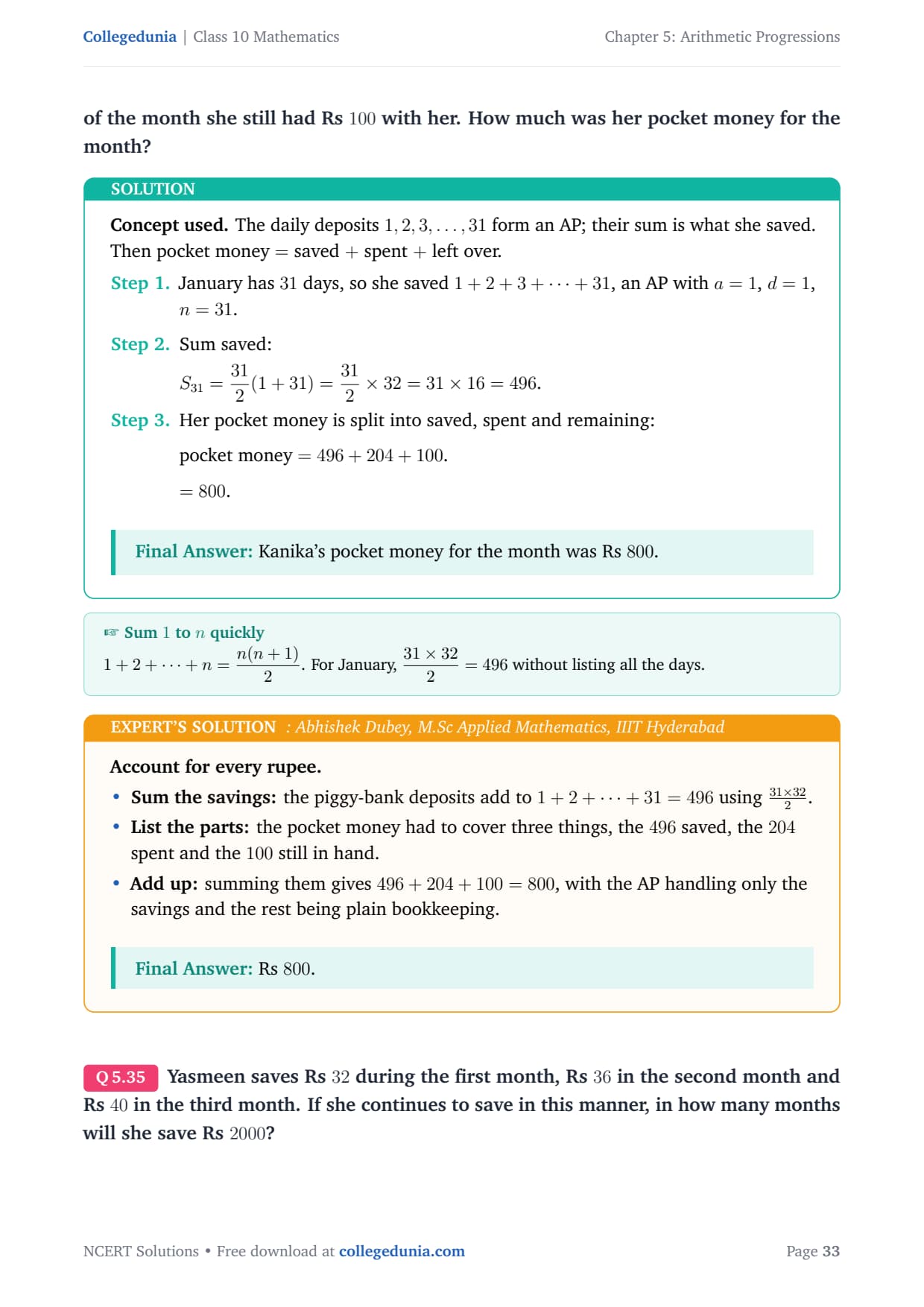
Kanika was given her pocket money on Jan 1st, 2008. She puts Re 1 on Day 1, Rs 2 on Day 2, Rs 3 on Day 3, and continued doing so till the end of the month, into her piggy bank. She also spent Rs 204 of her pocket money, and found that at the end of the month she still had Rs 100 with her. How much was her pocket money for the month?
Concept used. The daily deposits 1,2,3,,31 form an AP;
their sum is what she saved. Then pocket money = saved + spent +
left over.
January has 31 days, so she saved
1+2+3+⋯+31, an AP with a=1, d=1, n=31.
Sum saved:
[] S31=312(1+31)=31232=3116=496.
Her pocket money is split into saved, spent and remaining:
[] pocket money =496+204+100.
[] =800.
Kanika's pocket money for the month was Rs 800.
AD
Abhishek Dubey
M.Sc Applied Mathematics, IIIT Hyderabad
Verified Expert
Account for every rupee.
Sum the savings: the piggy-bank deposits add to
1+2+⋯+31=496 using 31322.
List the parts: the pocket money had to cover three
things, the 496 saved, the 204 spent and the 100 still in
hand.
Add up: summing them gives 496+204+100=800, with the AP
handling only the savings and the rest being plain bookkeeping.
Rs 800.
Q 5.35
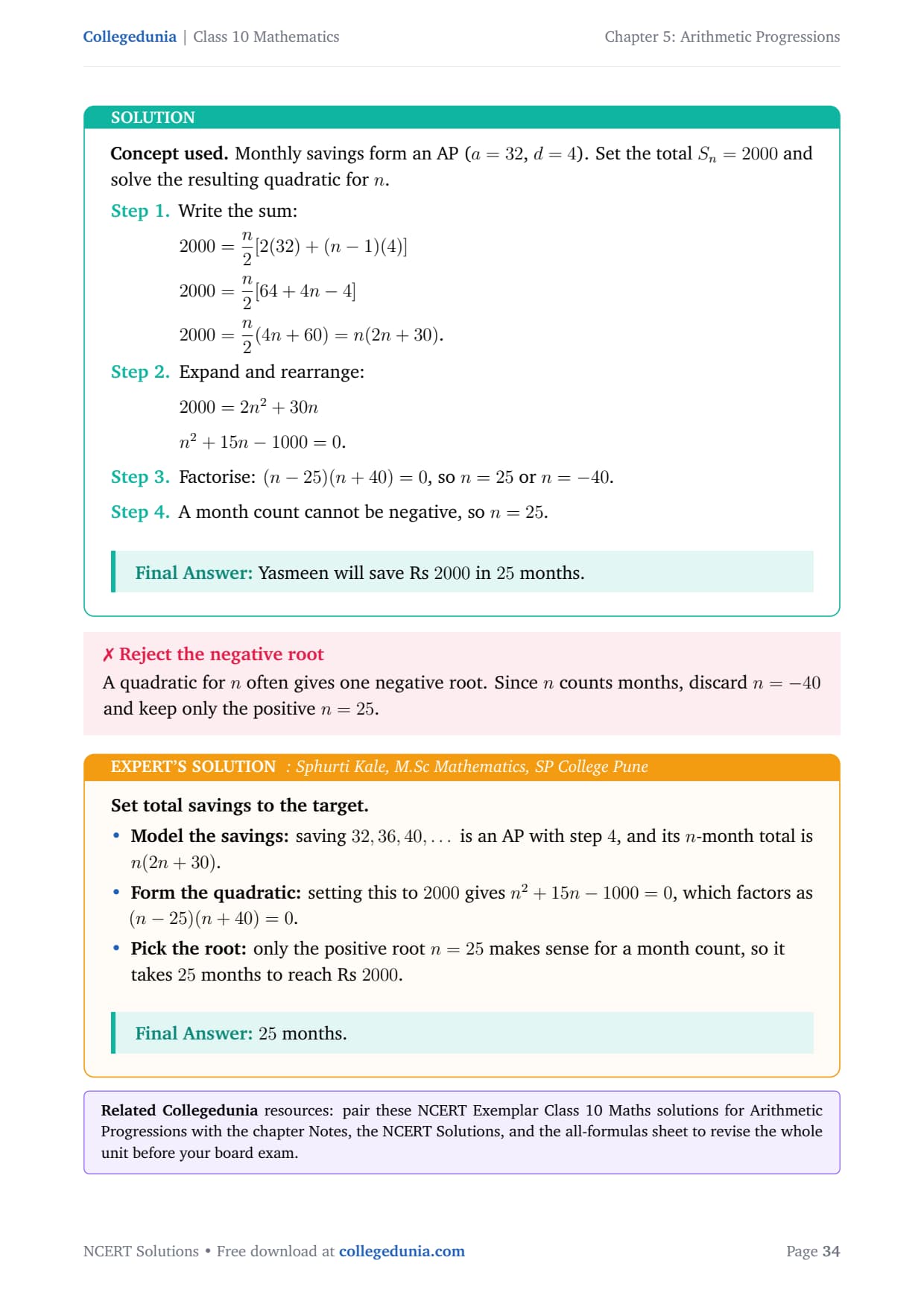
Yasmeen saves Rs 32 during the first month, Rs 36 in the second month and Rs 40 in the third month. If she continues to save in this manner, in how many months will she save Rs 2000?
Concept used. Monthly savings form an AP (a=32, d=4). Set the
total Sn=2000 and solve the resulting quadratic for n.
Write the sum:
[] 2000=n2[2(32)+(n-1)(4)]
[] 2000=n2[64+4n-4]
[] 2000=n2(4n+60)=n(2n+30).
Expand and rearrange:
[] 2000=2n2+30n
[] n2+15n-1000=0.
Factorise: (n-25)(n+40)=0, so n=25 or n=-40.
A month count cannot be negative, so n=25.
Yasmeen will save Rs 2000 in 25 months.
SK
Sphurti Kale
M.Sc Mathematics, SP College Pune
Verified Expert
Set total savings to the target.
Model the savings: saving 32,36,40, is an AP with
step 4, and its n-month total is n(2n+30).
Form the quadratic: setting this to 2000 gives
n2+15n-1000=0, which factors as (n-25)(n+40)=0.
Pick the root: only the positive root n=25 makes sense
for a month count, so it takes 25 months to reach Rs 2000.
25 months.
Other Arithmetic Progressions Exercises (Class 10 Maths)
Move across the rest of Chapter 5 with the linked exercises and resources below.
Over 2,400 students have used these Exercise 5.3 Exemplar Solutions for CBSE Class 10 board revision. 94% rated them helpful for understanding word problems and AP sum techniques.
Source: Collegedunia Class 10 Maths student survey, 2026-27 session.
Other Resources for This Chapter
Pair this with the other Class 10 Maths resources for Arithmetic Progressions, all linked below.
NCERT Exemplar Class 10 Maths Chapter 5 Exercise 5.3 FAQs
Ques. What topics does Exercise 5.3 of NCERT Exemplar Class 10 Maths Chapter 5 cover?
Ans. Exercise 5.3 covers Short Answer Questions on Arithmetic Progressions. Topics include finding the nth term from various conditions, testing whether a value belongs to an AP, the symmetric form of three AP terms, sum formulas, the double-answer quadratic, and word problems on savings and number patterns. It runs from Q27 to Q61 with 35 questions.
Ques. How many questions are in Exercise 5.3 of Class 10 Maths Exemplar?
Ans. Exercise 5.3 has 35 questions numbered Q27 to Q61. These are Short Answer Questions and are worth 2-3 marks each in the CBSE Class 10 board exam format. The exercise is the largest among the four exercises in Chapter 5 Exemplar.
Ques. Which formula is most used in Exercise 5.3 of Arithmetic Progressions Exemplar?
Ans. The two most used formulas in Exercise 5.3 are: (1) the nth term formula an = a + (n-1)d, which appears in almost every term-finding question, and (2) the sum formula Sn = (n/2)[2a + (n-1)d], which is used in every sum question from Q46 onwards. The recover-term formula an = Sn - Sn-1 is needed for Q50 and Q51.
Ques. Why does Q58 in Exercise 5.3 have two answers?
Ans. Q58 asks how many terms of the AP -15, -13, -11,... are needed to give a sum of -55. The sum equation becomes a quadratic that gives n = 5 or n = 11. Both are valid because the six terms from the 6th to the 11th position (-5, -3, -1, 1, 3, 5) add up to zero. Adding zero to the sum does not change it, so both 5 terms and 11 terms give the same total of -55.
Ques. Are Exercise 5.3 questions important for CBSE Class 10 board exams?
Ans. Yes. Questions from Exercise 5.3 type, especially word problems on savings (Q60-Q61 type), finding the AP from sum conditions, and the quadratic sum problems, appear regularly in CBSE Class 10 board exams. Arithmetic Progressions carries around 8 marks in the board paper, and at least one 2-3 mark question is usually from the Exemplar-level difficulty that Exercise 5.3 represents.







Comments