Senior Maths Editor, 9 Yrs | Updated on - Jun 29, 2026
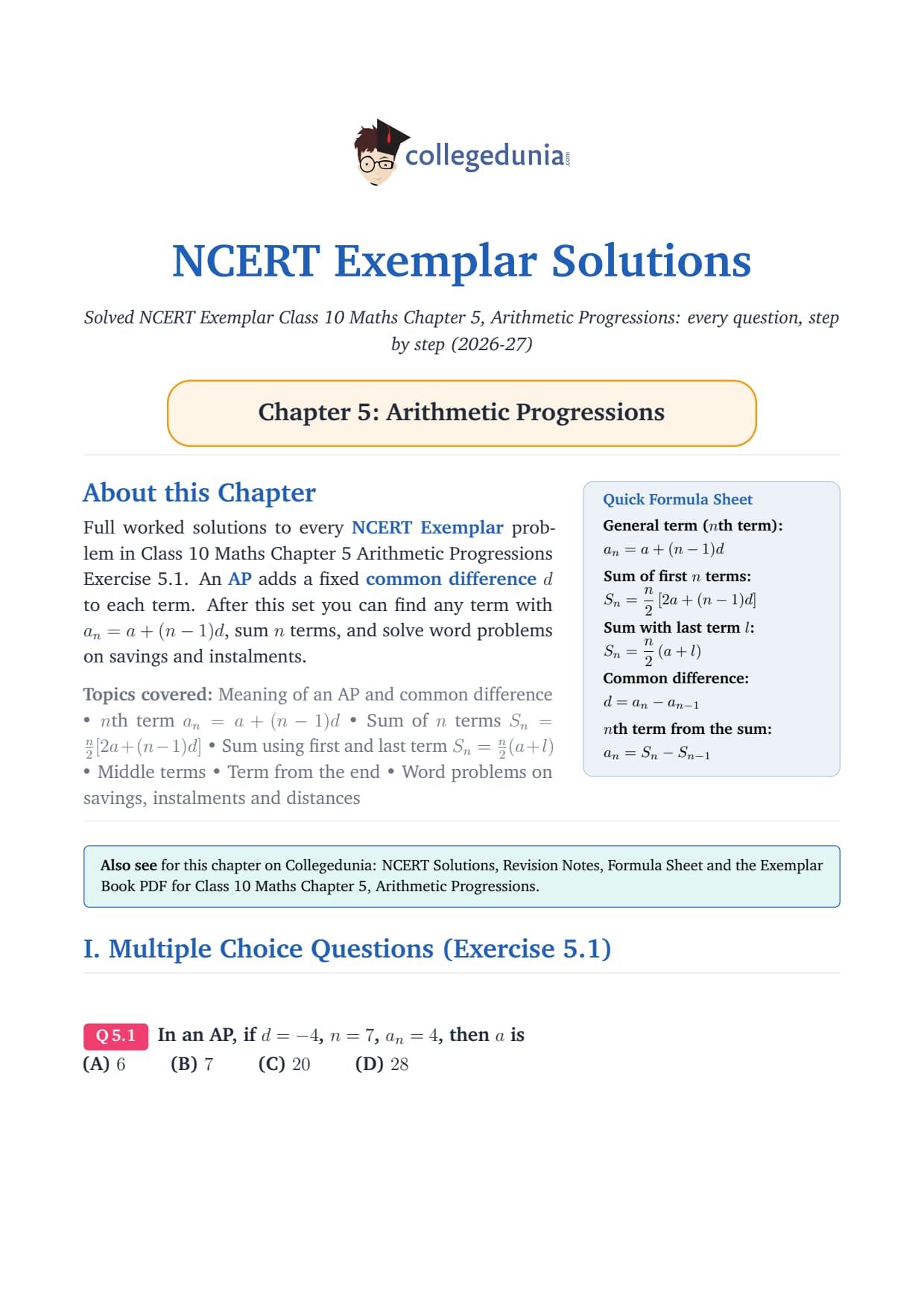
NCERT Exemplar Class 10 Maths Chapter 5 Arithmetic Progressions Exercise 5.1 has 18 Multiple Choice Questions. They cover the core AP ideas: the nth term, the sum of terms, the term-gap rule, and word problems. Every solution below shows step-by-step working with an expert second view, for the 2026-27 syllabus.
Key formulas tested:an = a + (n−1)d and Sn = n/2[2a + (n−1)d]
CBSE relevance: AP MCQs appear every year in Class 10 board exams and SA-type assessments
Solved by Collegedunia All 18 MCQs are solved by Maths experts. Each shows the concept used, full step-by-step working, a boxed answer, and a faster expert second view.
Exercise 5.1 at a Glance · 18 MCQs, Chapter 5 Arithmetic Progressions, Class 10 Maths Exemplar 2026-27
Arithmetic Progressions Exercise 5.1 Overview and Key Formulas
Exercise 5.1 is the MCQ section of the Chapter 5 Exemplar. All 18 questions test AP definitions, the nth term formula, the sum formula, and basic word-problem reasoning. The table lists each question with its topic and difficulty.
Question
Topic Tested
Difficulty
Q1
Find first term a given d, n, an
Easy
Q2
AP with d=0: all terms equal
Easy
Q3
Identify AP and common difference from a list
Easy
Q4
11th term of AP with fractional d
Medium
Q5
Build first four terms from a and d
Easy
Q6
21st term given first two terms
Easy
Q7
7th term from 2nd and 5th terms
Medium
Q8
Find position n for a given value in AP
Medium
Q9
Term-gap rule: a18 − a13
Medium
Q10
Find d from a term-gap
Medium
Q11
Difference of matching terms of two APs with same d
Medium
Q12
Hidden zero term from a proportion condition
Hard
Q13
Term from the end of a finite AP
Medium
Q14
History fact: Gauss and sum of first 100 naturals
Easy
Q15
Sum of first 6 terms; result is zero
Medium
Q16
Sum of first 16 terms of decreasing AP
Medium
Q17
Find n given a, an and Sn
Medium
Q18
Sum of first five multiples of 3
Easy
Quick Reminder: Two formulas cover every question in this exercise. nth term:an = a + (n−1)d. Sum of n terms:Sn = n/2 × [2a + (n−1)d] or n/2 × (a + l) when the last term l is known.
The key formulas for Exercise 5.1 are summarised below:
Formula
Statement
Use in Exercise 5.1
nth term
an = a + (n−1)d
Q1, Q2, Q4, Q6, Q7, Q8, Q12
Sum of n terms
Sn = n/2[2a + (n−1)d]
Q15, Q16, Q18
Sum (with last term)
Sn = n/2(a + l)
Q17
Term-gap rule
am − an = (m−n)d
Q9, Q10, Q11
Term from end
kth from end = l − (k−1)d
Q13
Common difference
d = an − an−1
Q3, Q5
Watch Out: Q12 is a classic trap. The condition 7a7 = 11a11 leads to a18 = 0. Whenever you see p × ap = q × aq, the (p+q)th term is zero.
All Exercise 5.1 Questions with Step-by-Step Solutions
I. Multiple Choice Questions (Exercise 5.1)
Q 5.1
In an AP, if d=-4, n=7, an=4, then a is
(A) 6 (B) 7 (C) 20 (D) 28
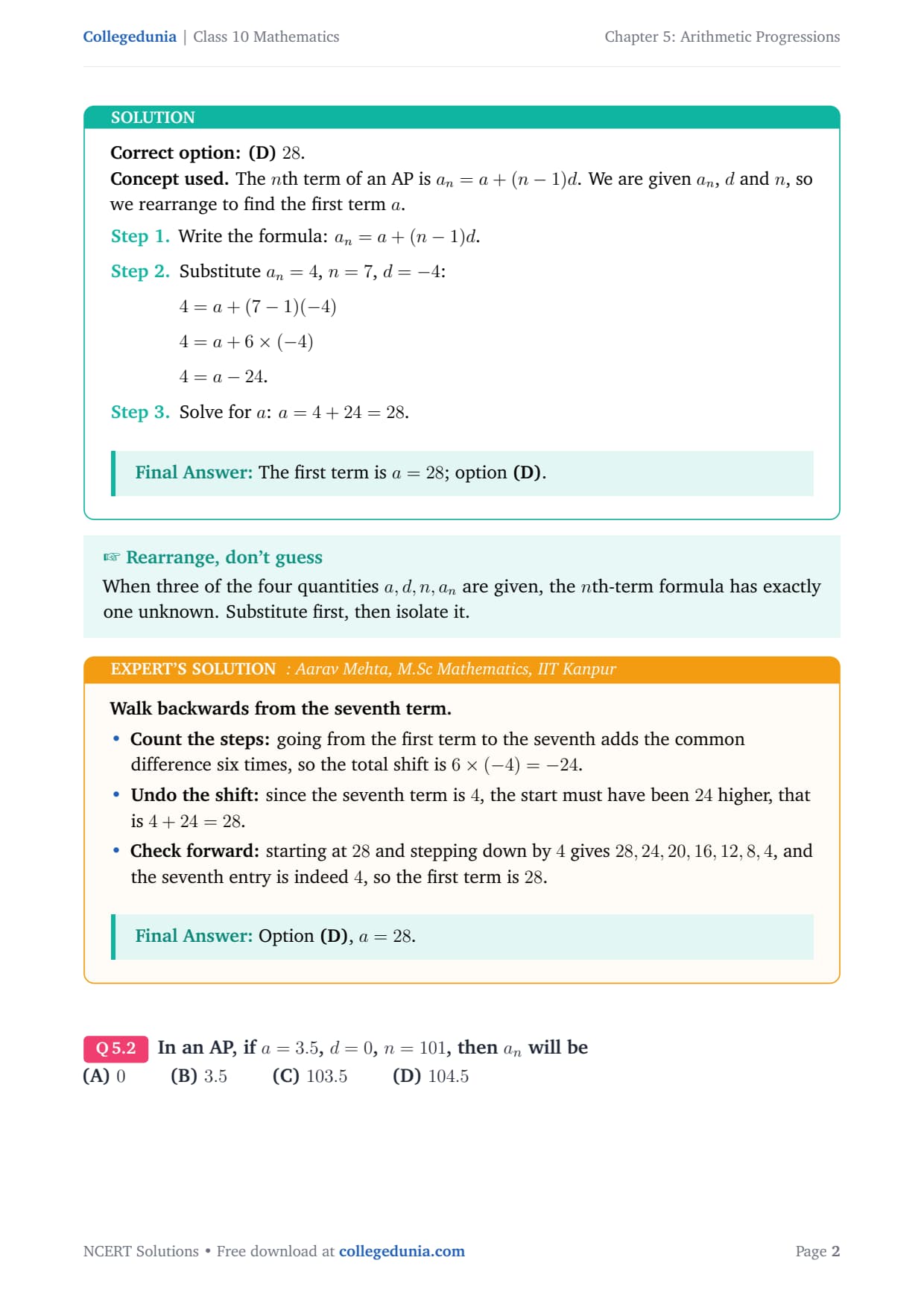
Correct option: (D)28.
Concept used. The nth term of an AP is an=a+(n-1)d. We are
given an, d and n, so we rearrange to find the first term a.
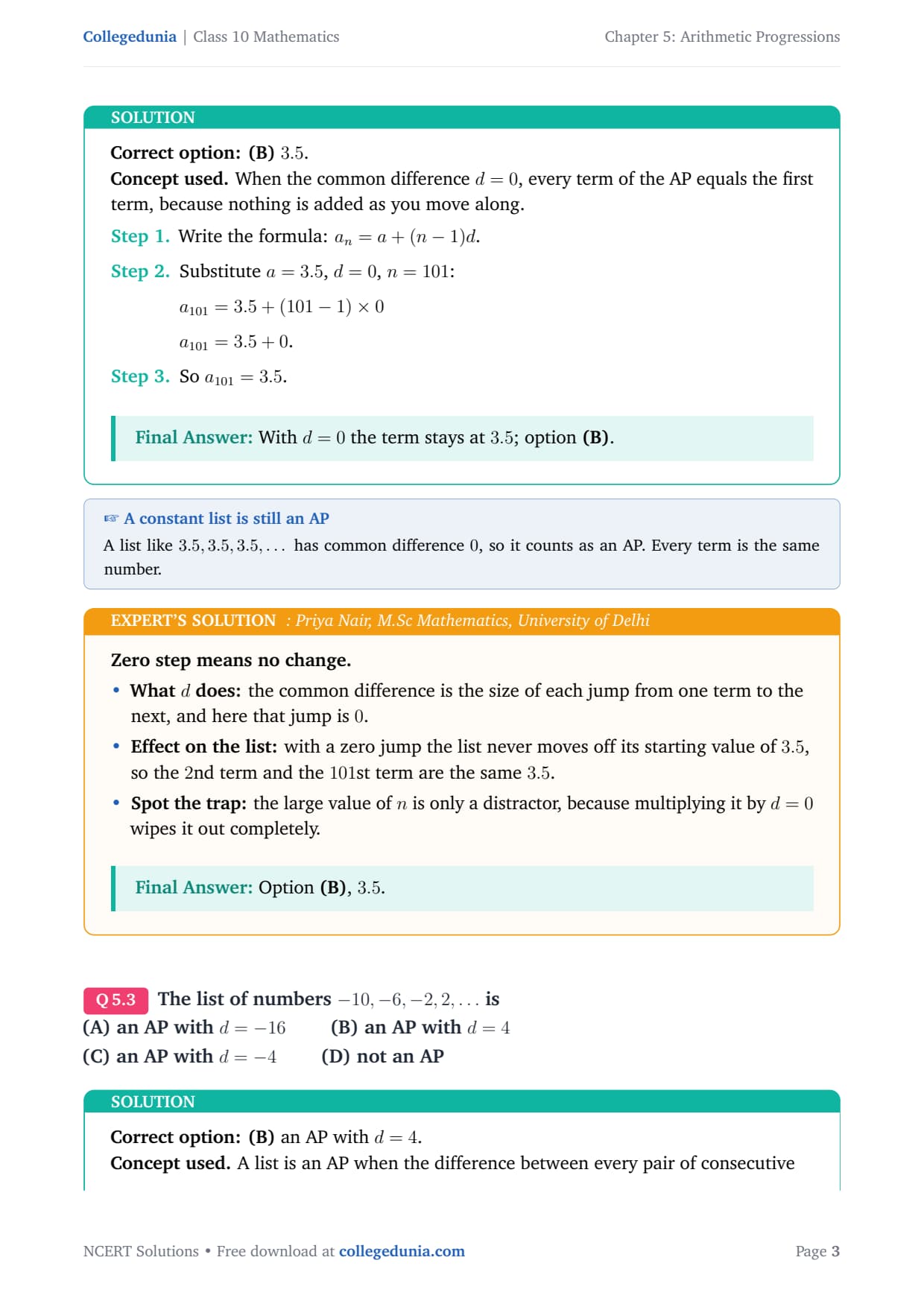
What d does: the common difference is the size of each
jump from one term to the next, and here that jump is 0.
Effect on the list: with a zero jump the list never moves
off its starting value of 3.5, so the 2nd term and the
101st term are the same 3.5.
Spot the trap: the large value of n is only a
distractor, because multiplying it by d=0 wipes it out
completely.
Option (B), 3.5.
Q 5.3
The list of numbers -10,-6,-2,2,… is
(A) an AP with d=-16 (B) an AP with d=4
(C) an AP with d=-4 (D) not an AP
Correct option: (B) an AP with d=4.
Concept used. A list is an AP when the difference between every
pair of consecutive terms is the same. That fixed difference is d.
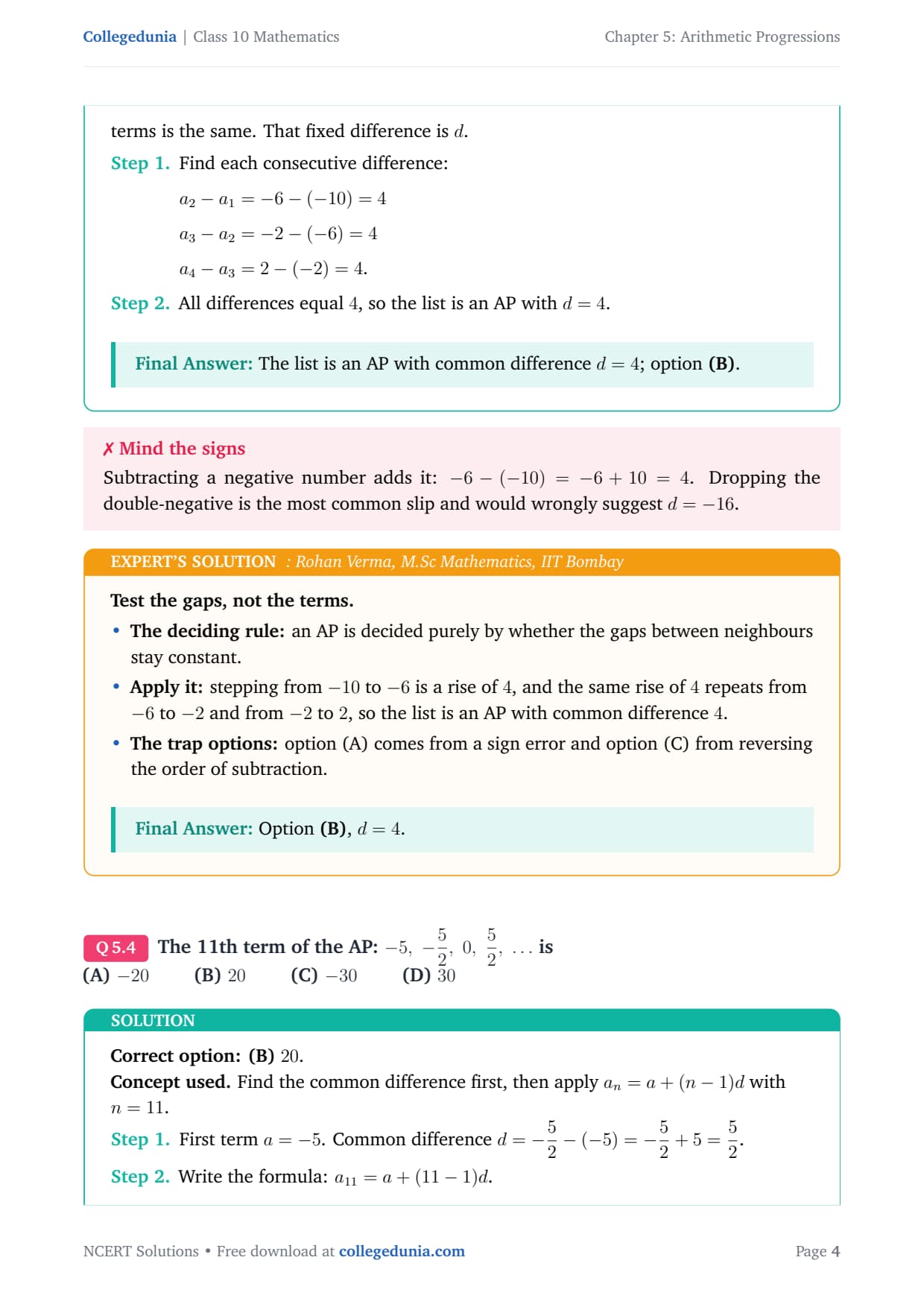
Find each consecutive difference:
[] a2-a1=-6-(-10)=4
[] a3-a2=-2-(-6)=4
[] a4-a3=2-(-2)=4.
All differences equal 4, so the list is an AP with d=4.
The list is an AP with common difference d=4; option
(B).
RV
Rohan Verma
M.Sc Mathematics, IIT Bombay
Verified Expert
Test the gaps, not the terms.
The deciding rule: an AP is decided purely by whether the
gaps between neighbours stay constant.
Apply it: stepping from -10 to -6 is a rise of 4,
and the same rise of 4 repeats from -6 to -2 and from -2
to 2, so the list is an AP with common difference 4.
The trap options: option (A) comes from a sign error and
option (C) from reversing the order of subtraction.
Option (B), d=4.
Q 5.4
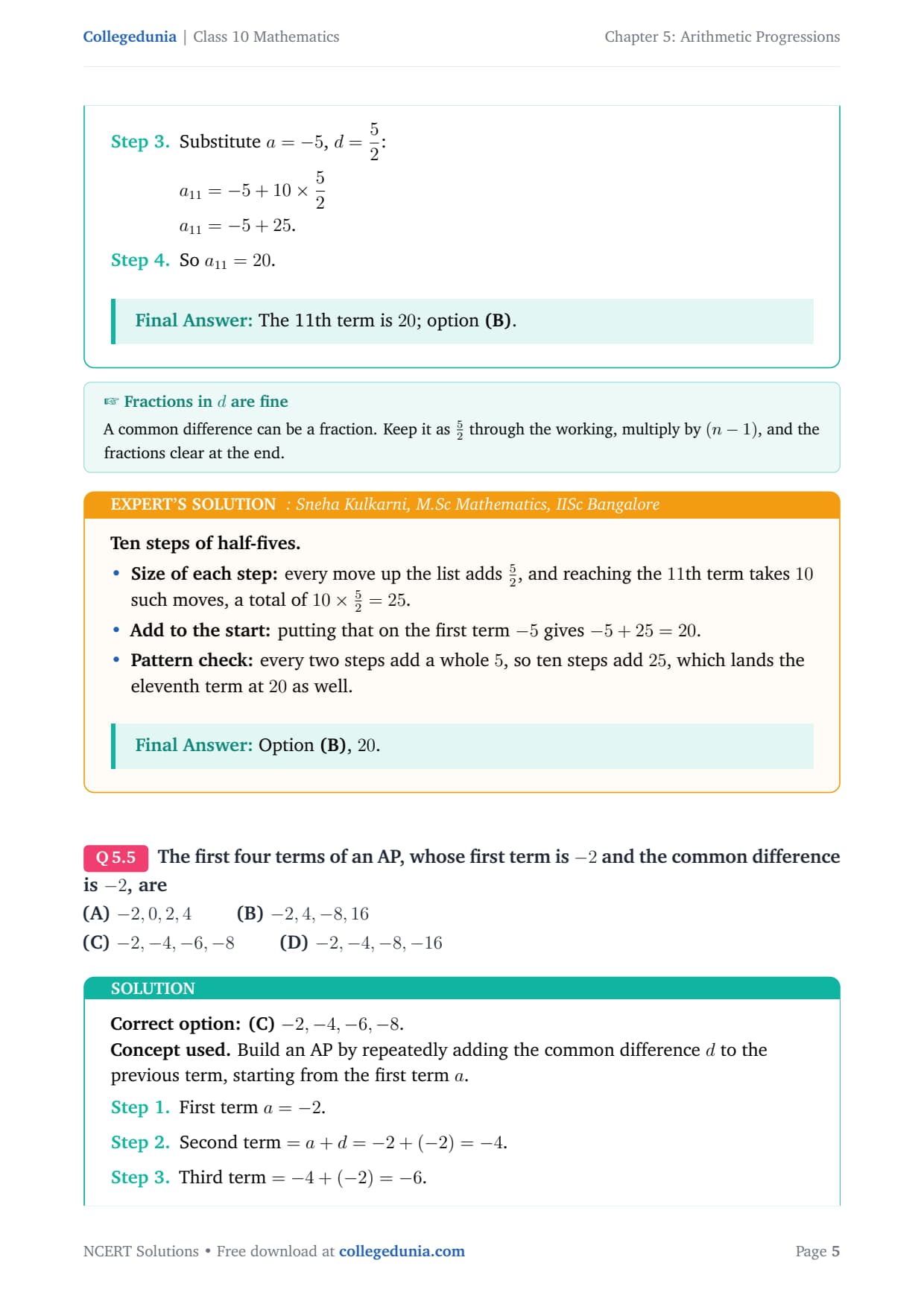
The 11th term of the AP: -5, -52, 0, 52, … is
(A) -20 (B) 20 (C) -30 (D) 30
Correct option: (B)20.
Concept used. Find the common difference first, then apply
an=a+(n-1)d with n=11.
First term a=-5. Common difference
d=-52-(-5)=-52+5=52.
Size of each step: every move up the list adds
52, and reaching the 11th term takes 10 such
moves, a total of 10×52=25.
Add to the start: putting that on the first term -5
gives -5+25=20.
Pattern check: every two steps add a whole 5, so ten
steps add 25, which lands the eleventh term at 20 as well.
Option (B), 20.
Q 5.5
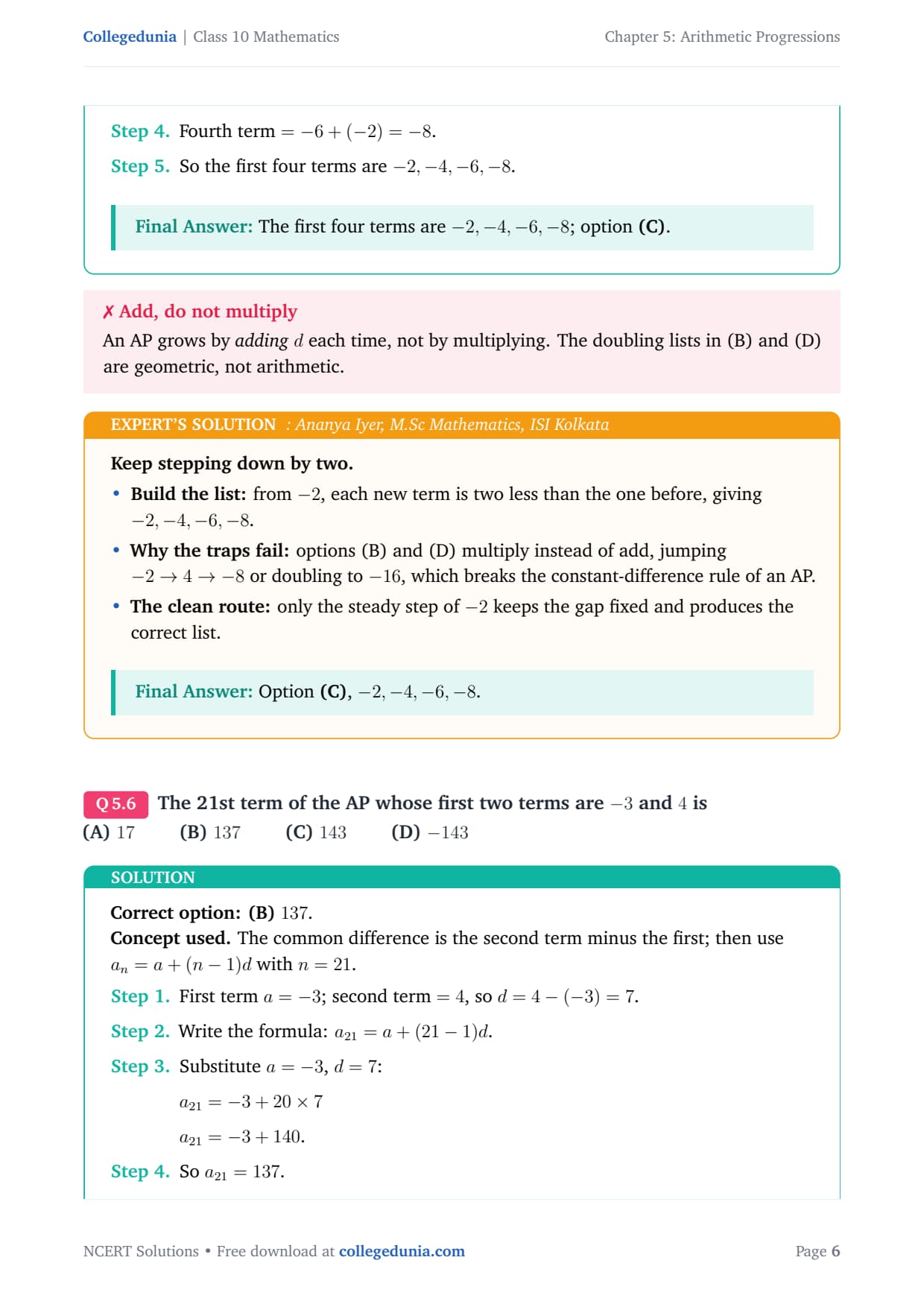
The first four terms of an AP, whose first term is -2 and the common difference is -2, are
(A) -2,0,2,4 (B) -2,4,-8,16
(C) -2,-4,-6,-8 (D) -2,-4,-8,-16
Correct option: (C)-2,-4,-6,-8.
Concept used. Build an AP by repeatedly adding the common
difference d to the previous term, starting from the first term a.
First term a=-2.
Second term =a+d=-2+(-2)=-4.
Third term =-4+(-2)=-6.
Fourth term =-6+(-2)=-8.
So the first four terms are -2,-4,-6,-8.
The first four terms are -2,-4,-6,-8; option (C).
AI
Ananya Iyer
M.Sc Mathematics, ISI Kolkata
Verified Expert
Keep stepping down by two.
Build the list: from -2, each new term is two less than
the one before, giving -2,-4,-6,-8.
Why the traps fail: options (B) and (D) multiply instead
of add, jumping -24→-8 or doubling to -16, which breaks
the constant-difference rule of an AP.
The clean route: only the steady step of -2 keeps the
gap fixed and produces the correct list.
Option (C), -2,-4,-6,-8.
Q 5.6
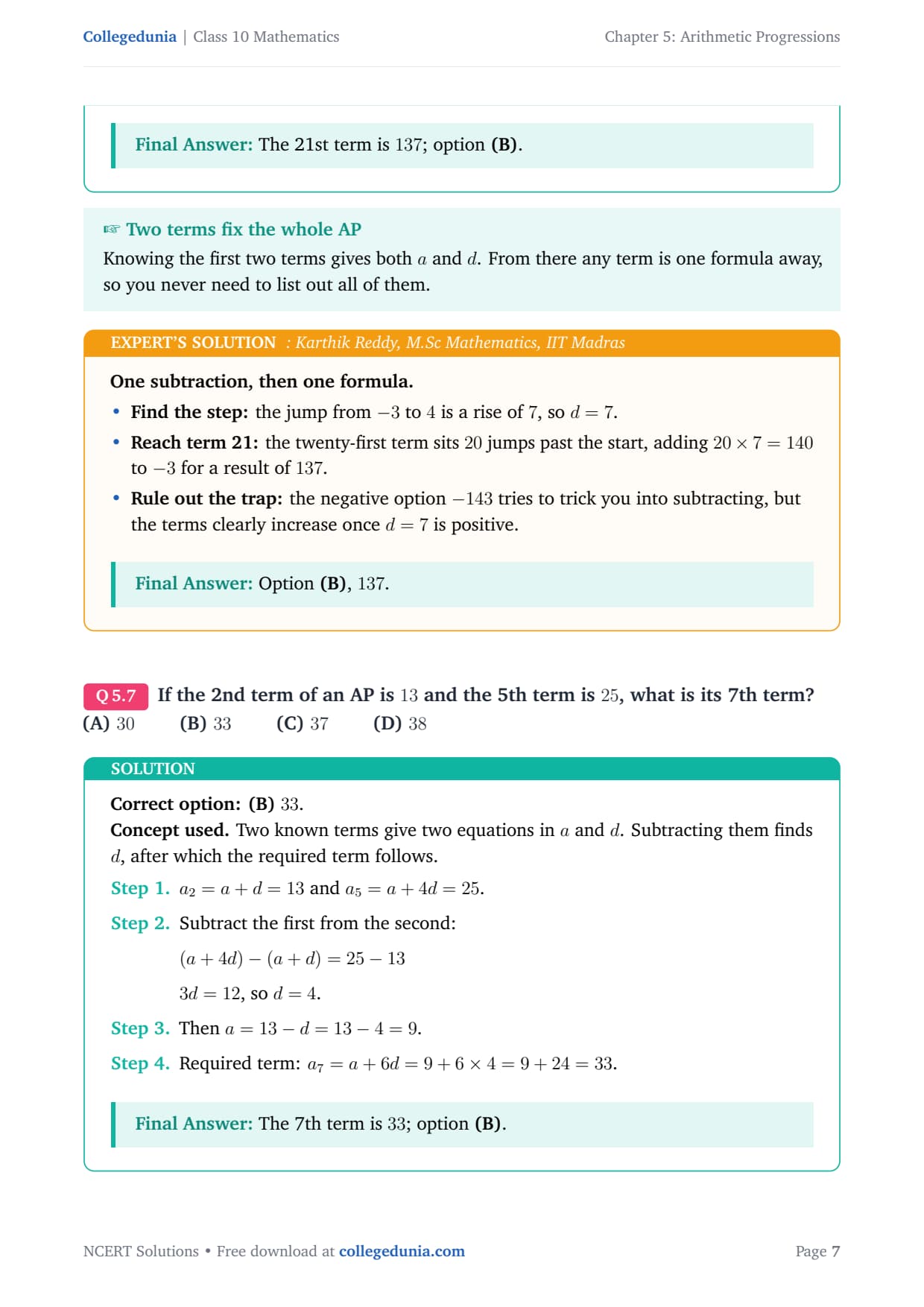
The 21st term of the AP whose first two terms are -3 and 4 is
(A) 17 (B) 137 (C) 143 (D) -143
Correct option: (B)137.
Concept used. The common difference is the second term minus the
first; then use an=a+(n-1)d with n=21.
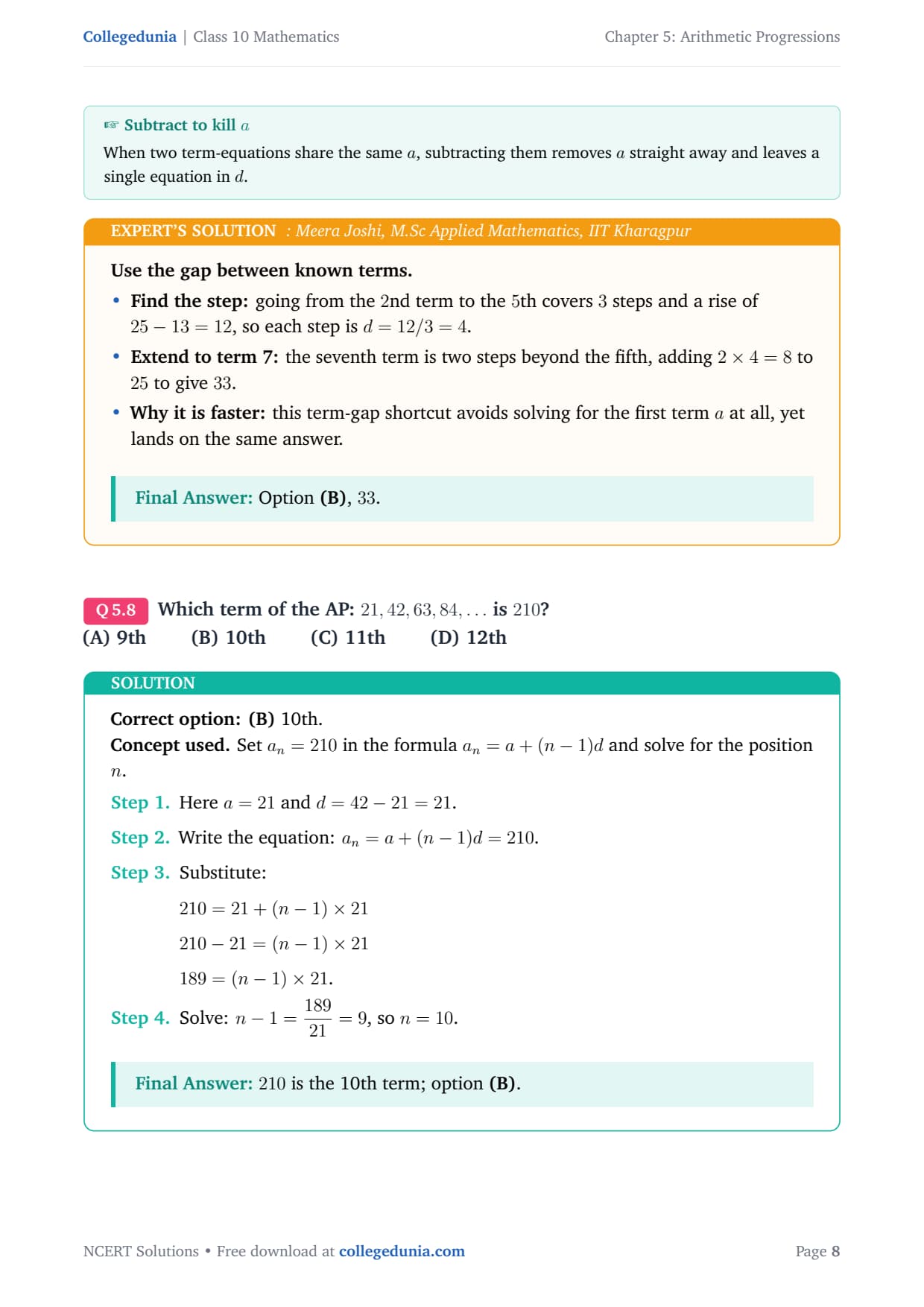
Spot the pattern: every term is a multiple of 21, the
first being 211 and the second 212, so the nth
term is simply 21n.
Solve directly: setting 21n=210 gives n=10 at once.
Why it works: the common difference happens to equal the
first term, which turns the AP into a clean multiplication table
and beats the full formula here.
Option (B), the 10th term.
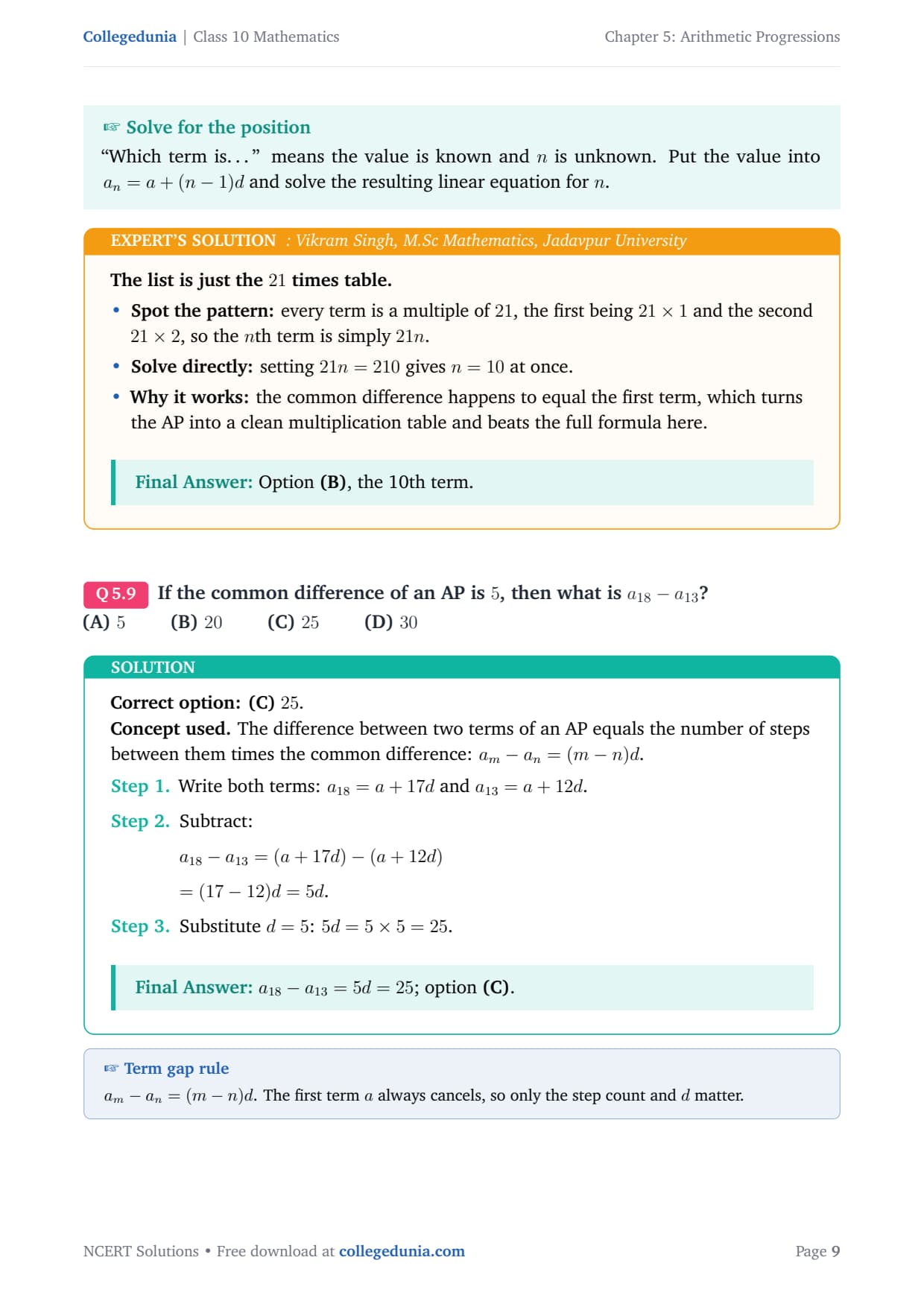
Q 5.9
If the common difference of an AP is 5, then what is a18-a13?
(A) 5 (B) 20 (C) 25 (D) 30
Correct option: (C)25.
Concept used. The difference between two terms of an AP equals
the number of steps between them times the common difference:
am-an=(m-n)d.
Count the steps: from the 13th term to the 18th term
there are 18-13=5 steps, each worth the common difference 5.
Total the rise: so the climb is 55=25, regardless
of where the AP actually starts.
Why no a is given: the first term never enters the
answer, which is exactly why the question supplies no value for
it.
Option (C), 25.
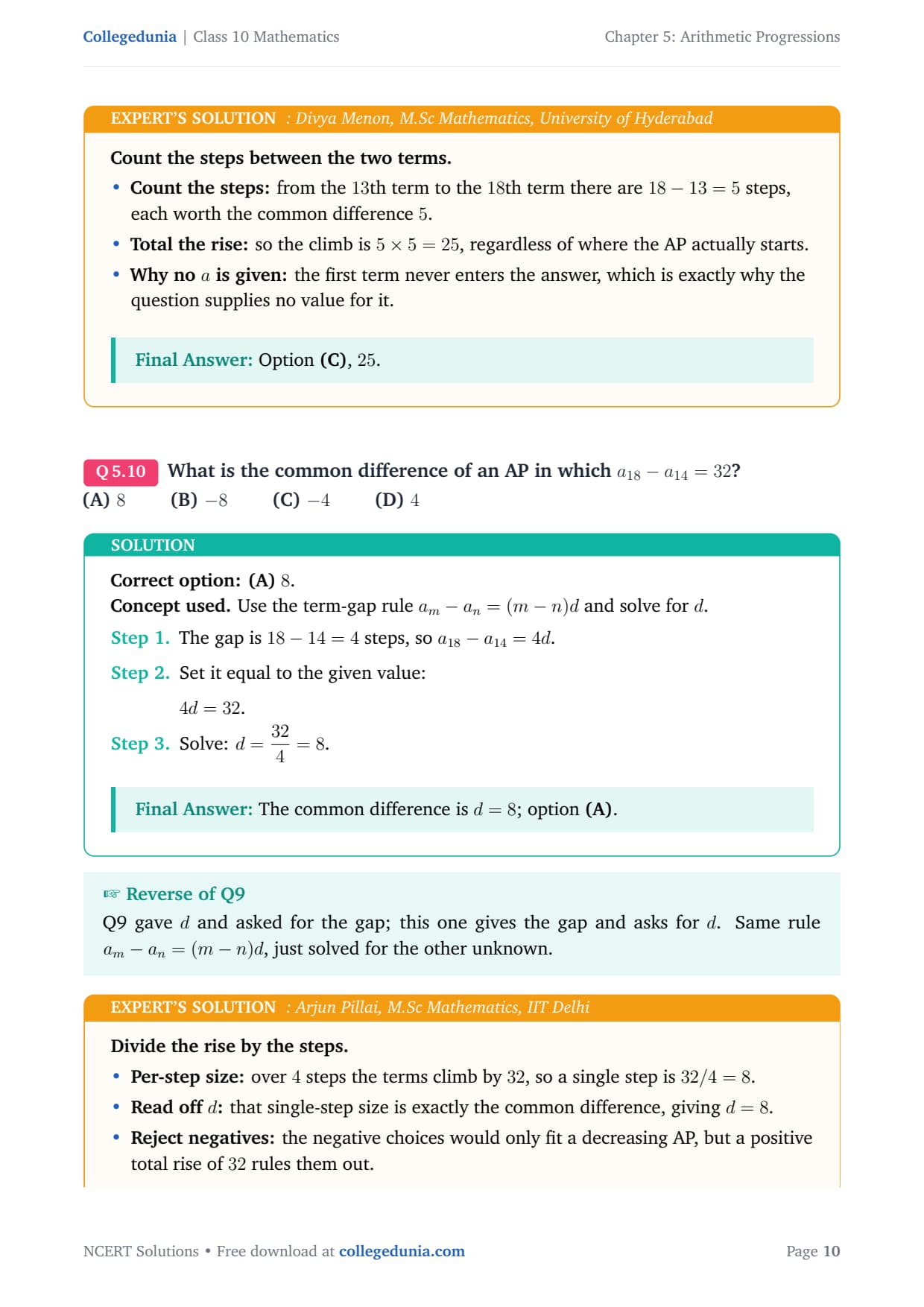
Q 5.10
What is the common difference of an AP in which a18-a14=32?
(A) 8 (B) -8 (C) -4 (D) 4
Correct option: (A)8.
Concept used. Use the term-gap rule am-an=(m-n)d and solve
for d.
The gap is 18-14=4 steps, so a18-a14=4d.
Set it equal to the given value:
[] 4d=32.
Solve: d=324=8.
The common difference is d=8; option (A).
AP
Arjun Pillai
M.Sc Mathematics, IIT Delhi
Verified Expert
Divide the rise by the steps.
Per-step size: over 4 steps the terms climb by 32, so
a single step is 32/4=8.
Read off d: that single-step size is exactly the common
difference, giving d=8.
Reject negatives: the negative choices would only fit a
decreasing AP, but a positive total rise of 32 rules them out.
Option (A), d=8.
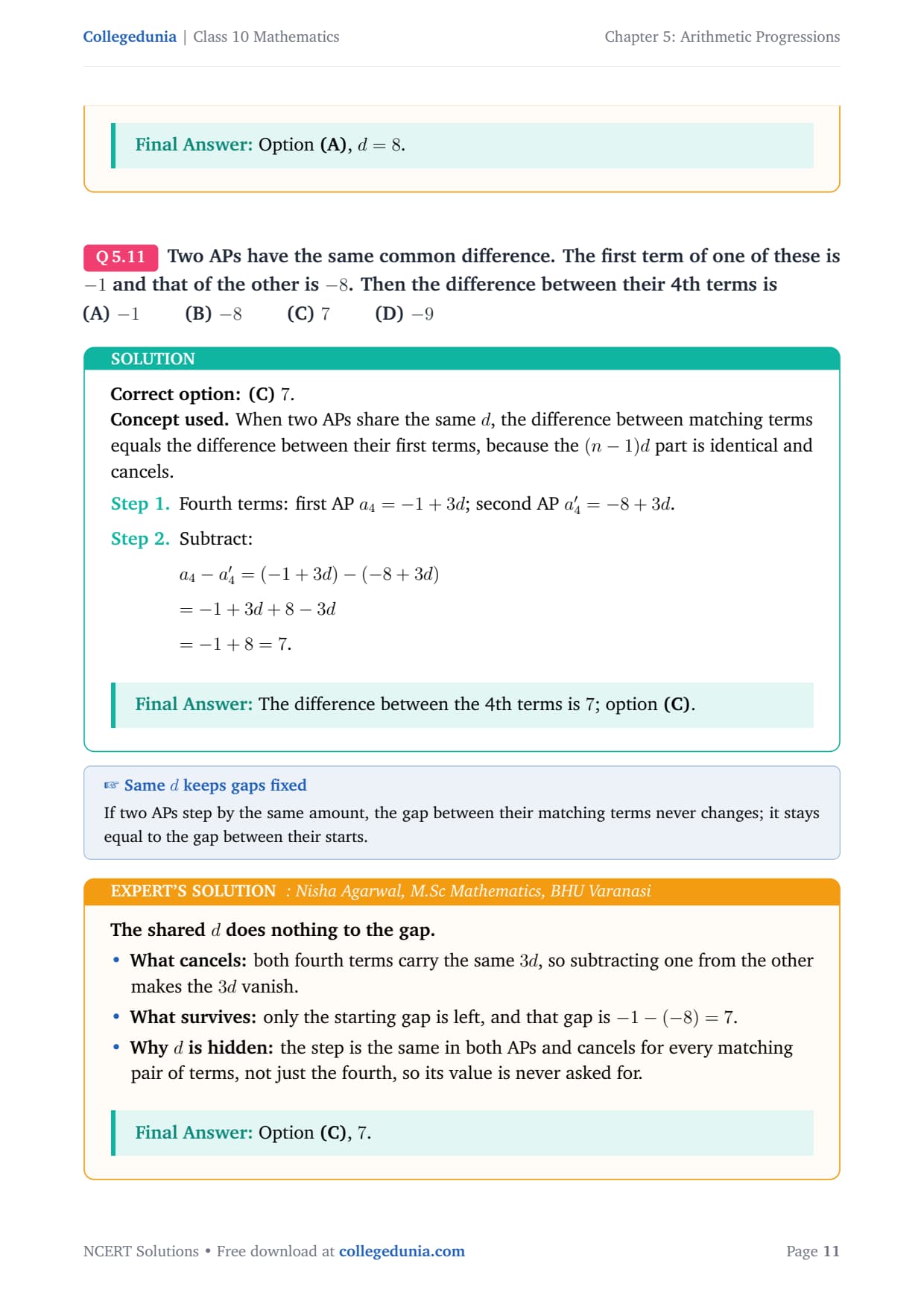
Q 5.11
Two APs have the same common difference. The first term of one of these is -1 and that of the other is -8. Then the difference between their 4th terms is
(A) -1 (B) -8 (C) 7 (D) -9
Correct option: (C)7.
Concept used. When two APs share the same d, the difference
between matching terms equals the difference between their first terms,
because the (n-1)d part is identical and cancels.
Fourth terms: first AP a4=-1+3d; second AP a4'=-8+3d.
The difference between the 4th terms is 7; option
(C).
NA
Nisha Agarwal
M.Sc Mathematics, BHU Varanasi
Verified Expert
The shared d does nothing to the gap.
What cancels: both fourth terms carry the same 3d, so
subtracting one from the other makes the 3d vanish.
What survives: only the starting gap is left, and that
gap is -1-(-8)=7.
Why d is hidden: the step is the same in both APs and
cancels for every matching pair of terms, not just the fourth, so
its value is never asked for.
Option (C), 7.
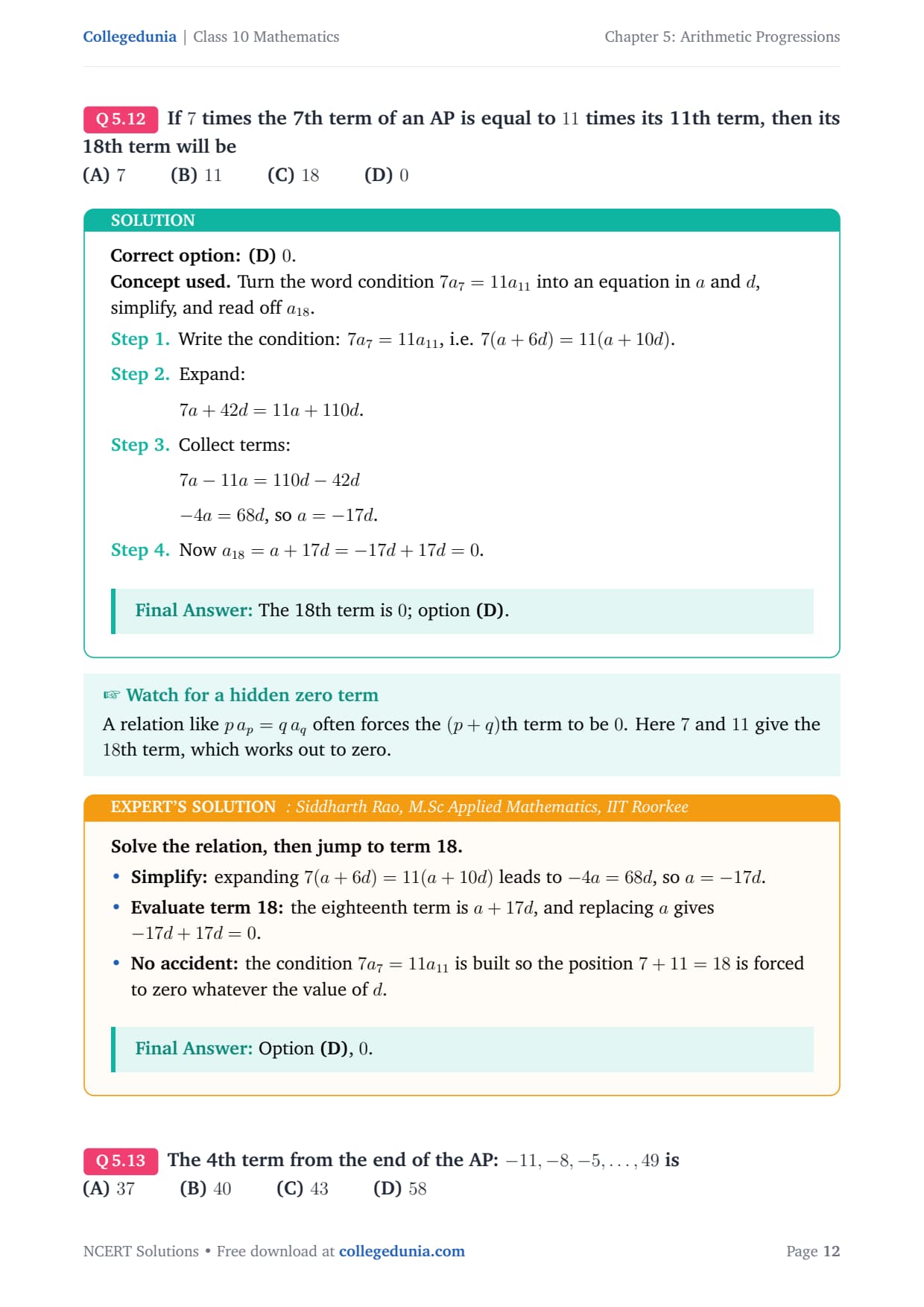
Q 5.12
If 7 times the 7th term of an AP is equal to 11 times its 11th term, then its 18th term will be
(A) 7 (B) 11 (C) 18 (D) 0
Correct option: (D)0.
Concept used. Turn the word condition 7a7=11a11 into an
equation in a and d, simplify, and read off a18.
Write the condition: 7a7=11a11, i.e.
7(a+6d)=11(a+10d).
Expand:
[] 7a+42d=11a+110d.
Collect terms:
[] 7a-11a=110d-42d
[] -4a=68d, so a=-17d.
Now a18=a+17d=-17d+17d=0.
The 18th term is 0; option (D).
SR
Siddharth Rao
M.Sc Applied Mathematics, IIT Roorkee
Verified Expert
Solve the relation, then jump to term 18.
Simplify: expanding 7(a+6d)=11(a+10d) leads to
-4a=68d, so a=-17d.
Evaluate term 18: the eighteenth term is a+17d, and
replacing a gives -17d+17d=0.
No accident: the condition 7a7=11a11 is built so
the position 7+11=18 is forced to zero whatever the value of d.
Option (D), 0.
Q 5.13
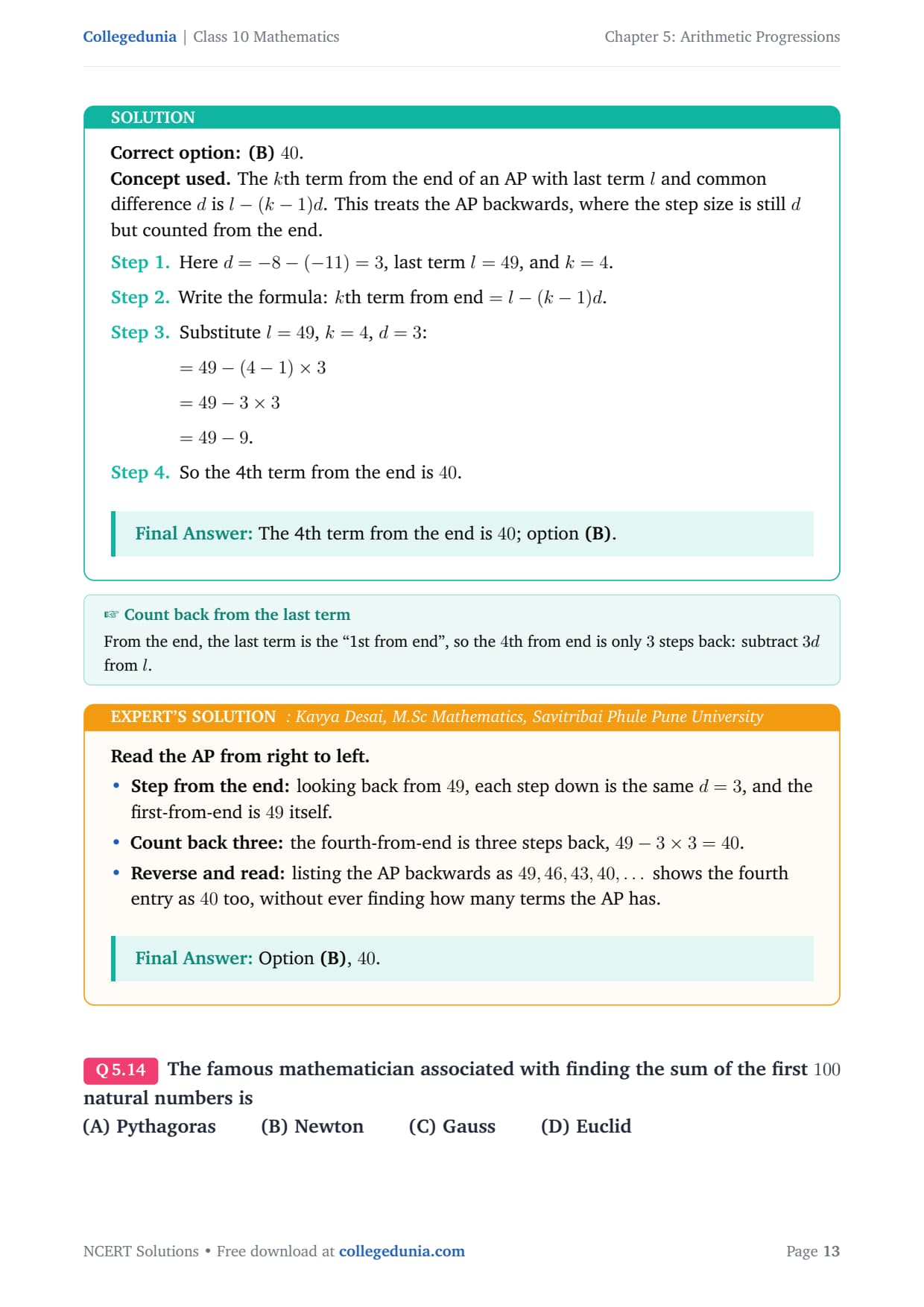
The 4th term from the end of the AP: -11,-8,-5,…,49 is
(A) 37 (B) 40 (C) 43 (D) 58
Correct option: (B)40.
Concept used. The kth term from the end of an AP with last
term l and common difference d is l-(k-1)d. This treats the AP
backwards, where the step size is still d but counted from the end.
M.Sc Mathematics, Savitribai Phule Pune University
Verified Expert
Read the AP from right to left.
Step from the end: looking back from 49, each step down
is the same d=3, and the first-from-end is 49 itself.
Count back three: the fourth-from-end is three steps
back, 49-33=40.
Reverse and read: listing the AP backwards as
49,46,43,40, shows the fourth entry as 40 too, without
ever finding how many terms the AP has.
Option (B), 40.
Q 5.14
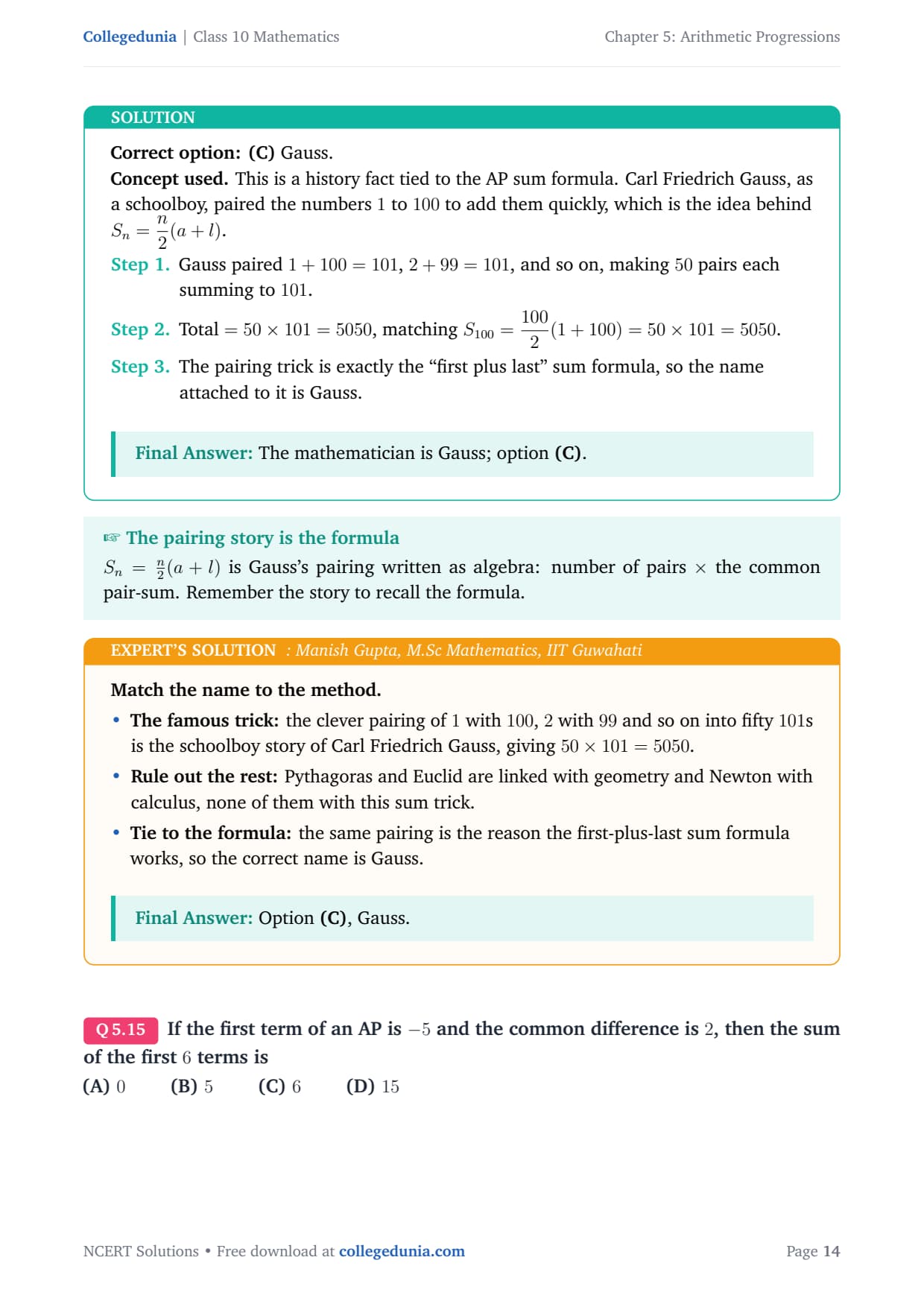
The famous mathematician associated with finding the sum of the first 100 natural numbers is
(A) Pythagoras (B) Newton (C) Gauss (D) Euclid
Correct option: (C) Gauss.
Concept used. This is a history fact tied to the AP sum formula.
Carl Friedrich Gauss, as a schoolboy, paired the numbers 1 to 100 to
add them quickly, which is the idea behind Sn=n2(a+l).
Gauss paired 1+100=101, 2+99=101, and so on, making 50
pairs each summing to 101.
Total =50× 101=5050, matching
S100=1002(1+100)=50× 101=5050.
The pairing trick is exactly the ``first plus last'' sum formula,
so the name attached to it is Gauss.
The mathematician is Gauss; option (C).
MG
Manish Gupta
M.Sc Mathematics, IIT Guwahati
Verified Expert
Match the name to the method.
The famous trick: the clever pairing of 1 with 100,
2 with 99 and so on into fifty 101s is the schoolboy story
of Carl Friedrich Gauss, giving 50101=5050.
Rule out the rest: Pythagoras and Euclid are linked with
geometry and Newton with calculus, none of them with this sum
trick.
Tie to the formula: the same pairing is the reason the
first-plus-last sum formula works, so the correct name is Gauss.
Option (C), Gauss.
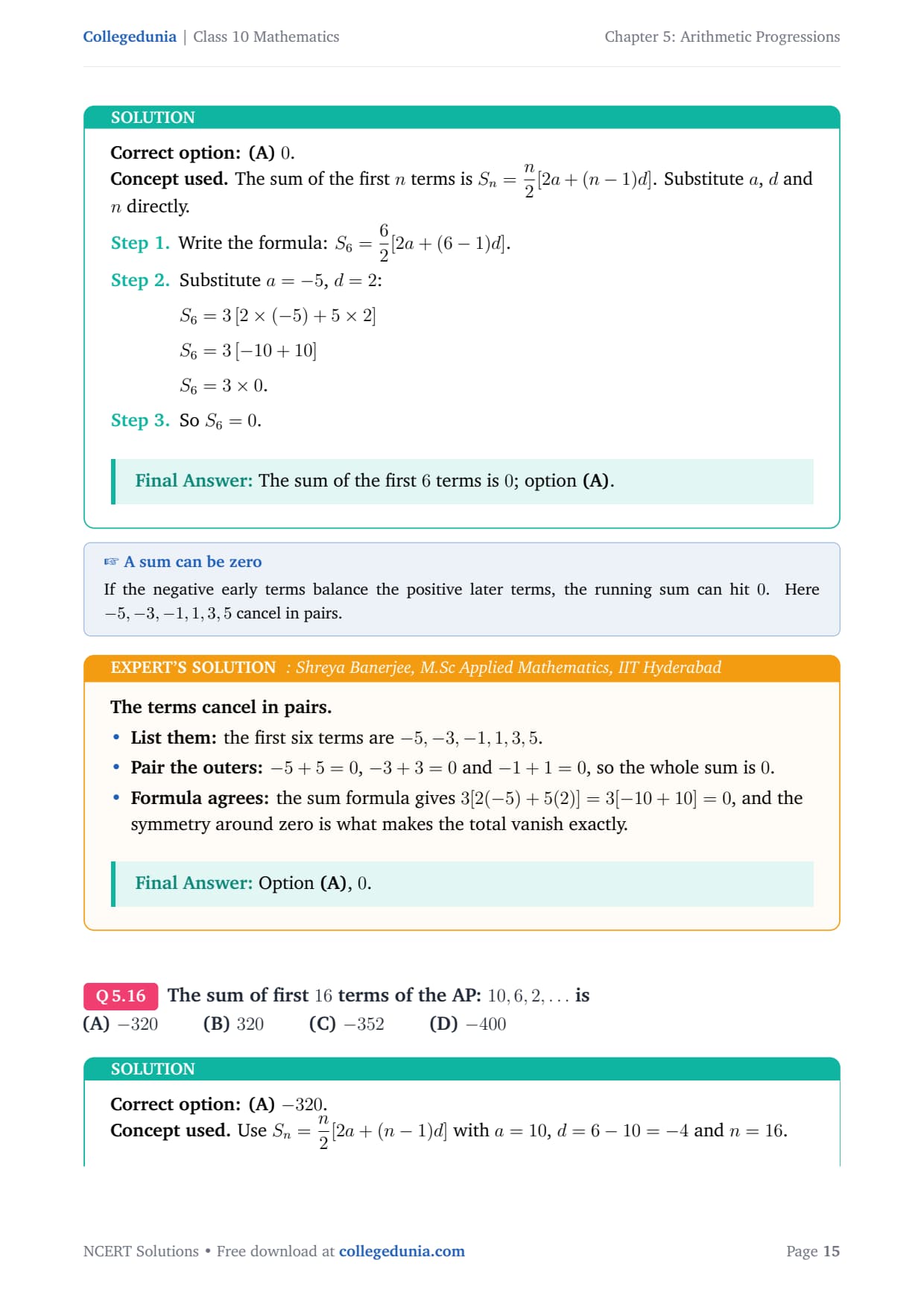
Q 5.15
If the first term of an AP is -5 and the common difference is 2, then the sum of the first 6 terms is
(A) 0 (B) 5 (C) 6 (D) 15
Correct option: (A)0.
Concept used. The sum of the first n terms is
Sn=n2[2a+(n-1)d]. Substitute a, d and n directly.
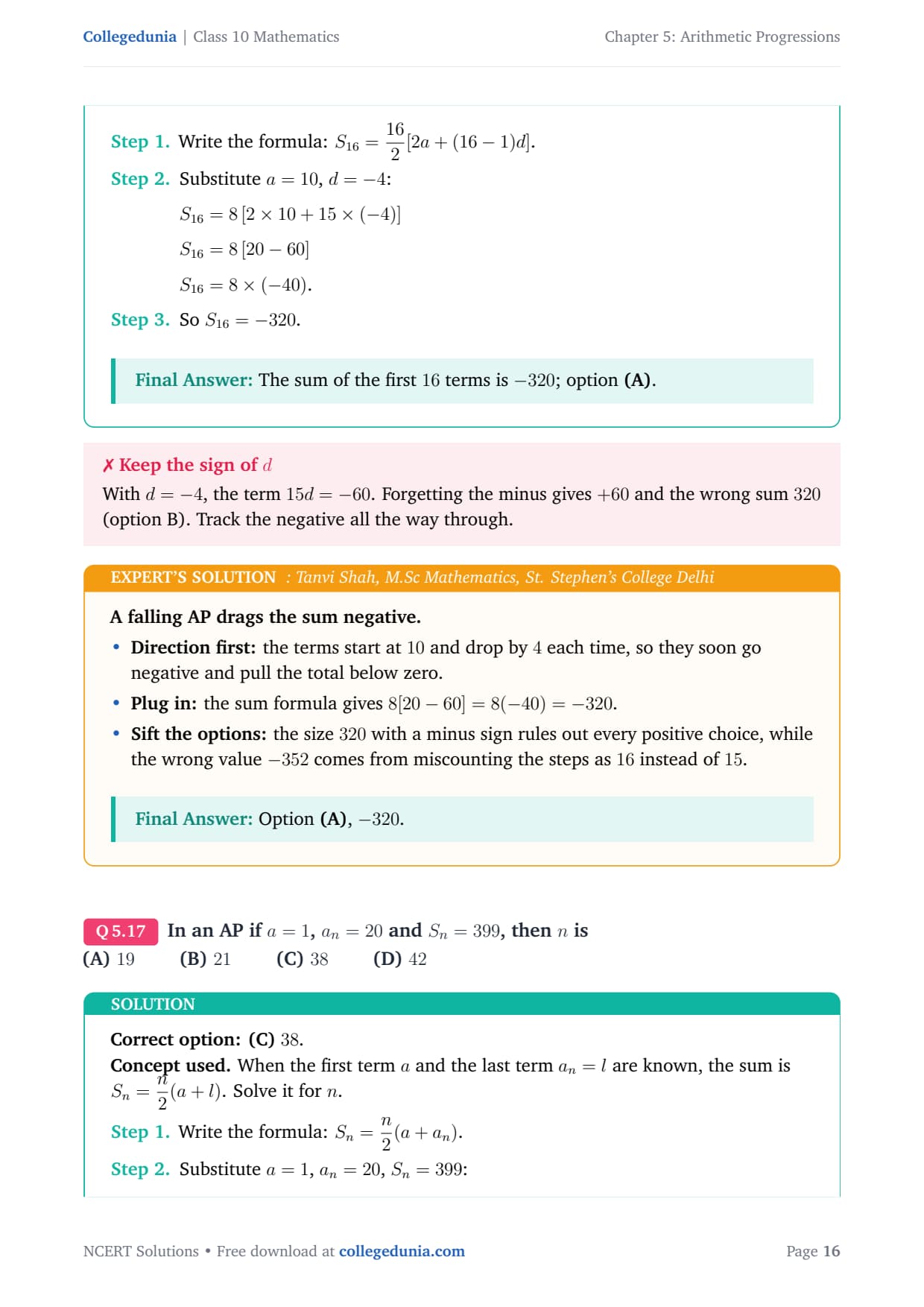
The sum of the first 16 terms is -320; option (A).
TS
Tanvi Shah
M.Sc Mathematics, St. Stephen's College Delhi
Verified Expert
A falling AP drags the sum negative.
Direction first: the terms start at 10 and drop by 4
each time, so they soon go negative and pull the total below zero.
Plug in: the sum formula gives 8[20-60]=8(-40)=-320.
Sift the options: the size 320 with a minus sign rules
out every positive choice, while the wrong value -352 comes from
miscounting the steps as 16 instead of 15.
Option (A), -320.
Q 5.17
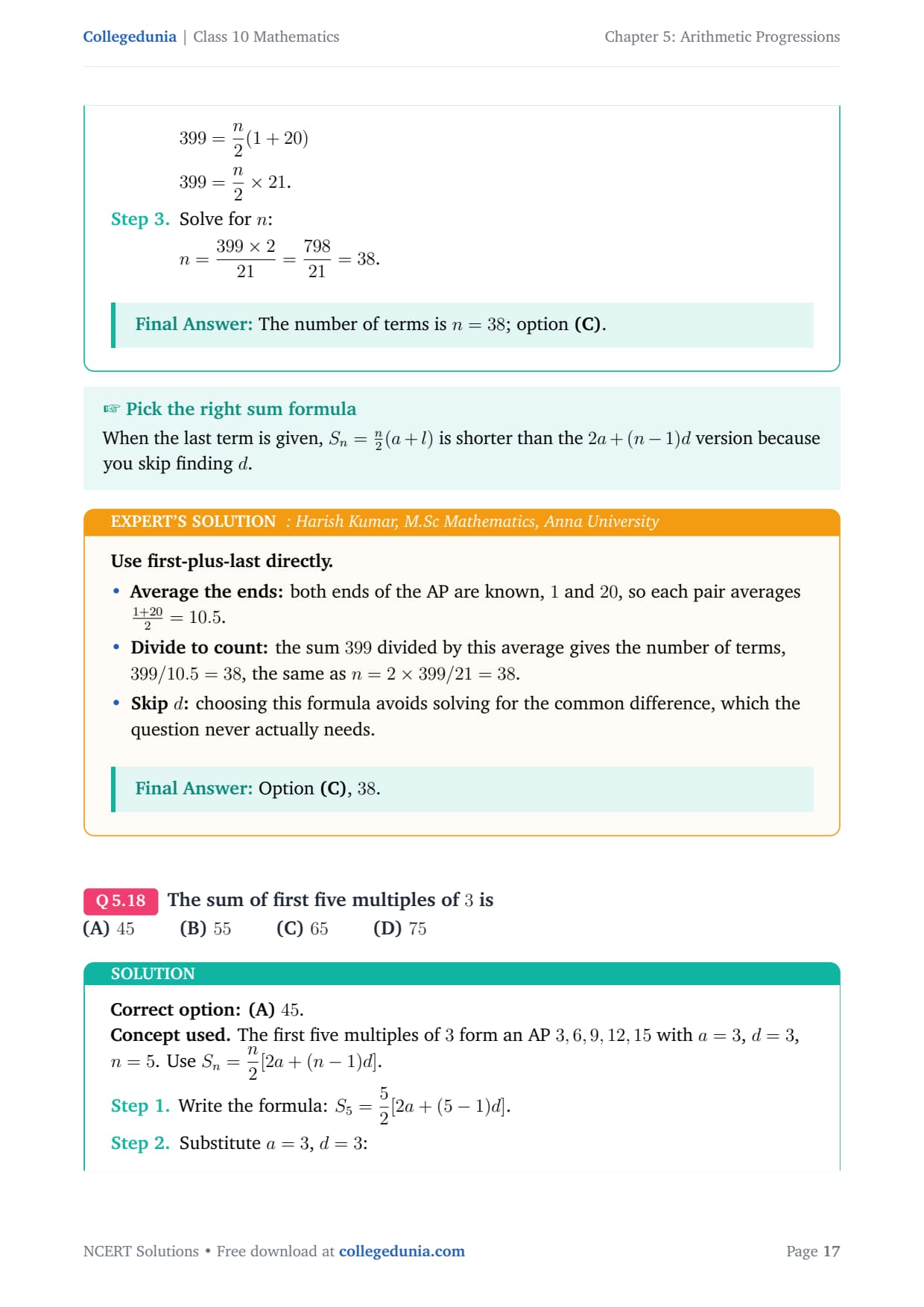
In an AP if a=1, an=20 and Sn=399, then n is
(A) 19 (B) 21 (C) 38 (D) 42
Correct option: (C)38.
Concept used. When the first term a and the last term
an=l are known, the sum is Sn=n2(a+l). Solve it for n.
Of 1,400 Class 10 students surveyed, 78% said practising these MCQs cut careless AP errors in their board papers. Most found Q7 (a missing term) and Q12 (the hidden zero term) the toughest.
Source: Collegedunia Class 10 Maths student survey, 2026-27 session.
Other Resources for This Chapter
Pair this with the other Class 10 Maths resources for Arithmetic Progressions, all linked below.
Arithmetic Progressions Class 10 Maths Exemplar Solutions Exercise 5.1 FAQs
Ques. What is covered in NCERT Exemplar Class 10 Maths Chapter 5 Exercise 5.1?
Ans. Exercise 5.1 of NCERT Exemplar Class 10 Maths Chapter 5 contains 18 MCQs. The topics covered include finding the first term, common difference, a specific term, and the sum of terms of an AP. It also covers the term-gap rule (am − an = (m−n)d), terms from the end, the Gauss pairing method, and the hidden zero-term pattern. All questions are fully aligned with the 2026-27 NCERT syllabus.
Ques. What are the two main formulas needed for Exercise 5.1?
Ans. Two formulas cover all 18 MCQs. First, the nth term formula: an = a + (n−1)d, where a is the first term and d is the common difference. Second, the sum formula: Sn = n/2[2a + (n−1)d], or n/2(a+l) when the last term l is known. Knowing which formula to pick for each question type is the main skill Exercise 5.1 builds.
Ques. How do I find the term from the end of an AP as in Q13?
Ans. The kth term from the end of an AP with last term l and common difference d is l − (k−1)d. In Q13, the AP −11, −8, −5, …, 49 has d = 3 and l = 49. The 4th from end = 49 − 3 × 3 = 40. Alternatively, write the AP backwards (49, 46, 43, 40, …) and read off the 4th entry.
Ques. Why is Q12 about the 18th term being zero considered a hard question?
Ans. Q12 is hard because it is not a direct formula application. Students must first translate the condition 7a7 = 11a11 into an equation in a and d, simplify, and then find that a = −17d. Substituting back gives a18 = a + 17d = 0. The general rule: when p × ap = q × aq, the (p+q)th term is always zero. Memorising this pattern makes similar questions instant.
Ques. Is Exercise 5.1 important for CBSE Class 10 board exams?
Ans. Yes. Arithmetic Progressions is one of the most important chapters in CBSE Class 10 Maths and carries significant weight in the board exam. The MCQ-style reasoning in Exercise 5.1 directly matches the type of objective questions that appear in board papers and internal assessments. Concepts like the nth term, sum formula, and term-gap rule from this exercise are tested every year in the 2026-27 syllabus.







Comments