Maths Mentor, Delhi University | Updated 3+ months ago
This page solves all 13 Long Answer Questions of Exercise 3.4 of NCERT Exemplar Class 10 Maths Chapter 3 Pair of Linear Equations in Two Variables. The set covers graphical methods, triangle-vertex problems, and real-life word problems on fares, speeds, investment and digit puzzles. Everything follows the 2026-27 CBSE syllabus.
Scope: 13 Long Answer Questions (Q45 to Q57) on graphical solutions, area ratios and word problems.
Key skills: Finding intercepts, triangle areas, substitution, elimination, and forming equations from real data.
Board relevance: This chapter carries 5 to 6 marks in CBSE papers, mostly as 3-mark or 5-mark questions.
Every solution here is verified by subject experts and follows the 2026-27 CBSE NCERT Exemplar book exactly.
Solved by Collegedunia - All 13 Long Answer Questions of Exercise 3.4 with detailed step-by-step solutions and expert insights.
Exercise 3.4 is the Long Answer Questions section of the NCERT Exemplar Chapter 3 for Class 10 Maths. It has 13 questions (Q45 to Q57) that test whether you can mix methods and handle real-world setups.
Word problems on real-life scenarios (Q48-Q57): Costs, speed-distance, boat-stream, digit puzzles, investments, railway fares, profit-discount, and banana-market problems.
Area ratio problem (Q45): Unique question requiring areas of two triangles formed by two lines with both axes.
CBSE papers regularly pick word problems at this level. To score the 5-mark questions, show a clear variable definition, both equations, and every working step.
Concept: Every Long Answer problem in Exercise 3.4 can be solved using just two methods: elimination or substitution. Choose the method that avoids fractions in the first step.
Key Pair of Linear Equations Formulas & Methods
All 13 questions draw on the same core toolkit. Review these before you start the set.
Method / Formula
When to Use
Key Idea
Substitution
One variable has coefficient 1
Express one variable from one equation and substitute into the other
Elimination
Coefficients can be matched by multiplying
Multiply and add or subtract to eliminate one variable
Triangle area formula
Q45 and Q46 area questions
Area = 1⁄2 × base × height, or coordinate formula: 1⁄2|x1(y2−y3)+x2(y3−y1)+x3(y1−y2)|
Reciprocal substitution
Q50 and Q52 (speed problems)
Set u = 1/x, v = 1/y to linearise the time equations
Simple interest formula
Q56 (investment problem)
Interest = (Rate × Principal) / 100 per year
Two-digit number model
Q53 (digit problem)
Number = 10×(tens digit) + (units digit)
Quick Tip: For speed/distance word problems (Q50, Q51, Q52), always convert minutes to hours before writing the time equations. Mixing units is the top reason students lose marks on these questions.
All 13 Exercise 3.4 Questions with Step-by-Step Solutions
IV. Long Answer Questions (Exercise 3.4)
Q 3.1
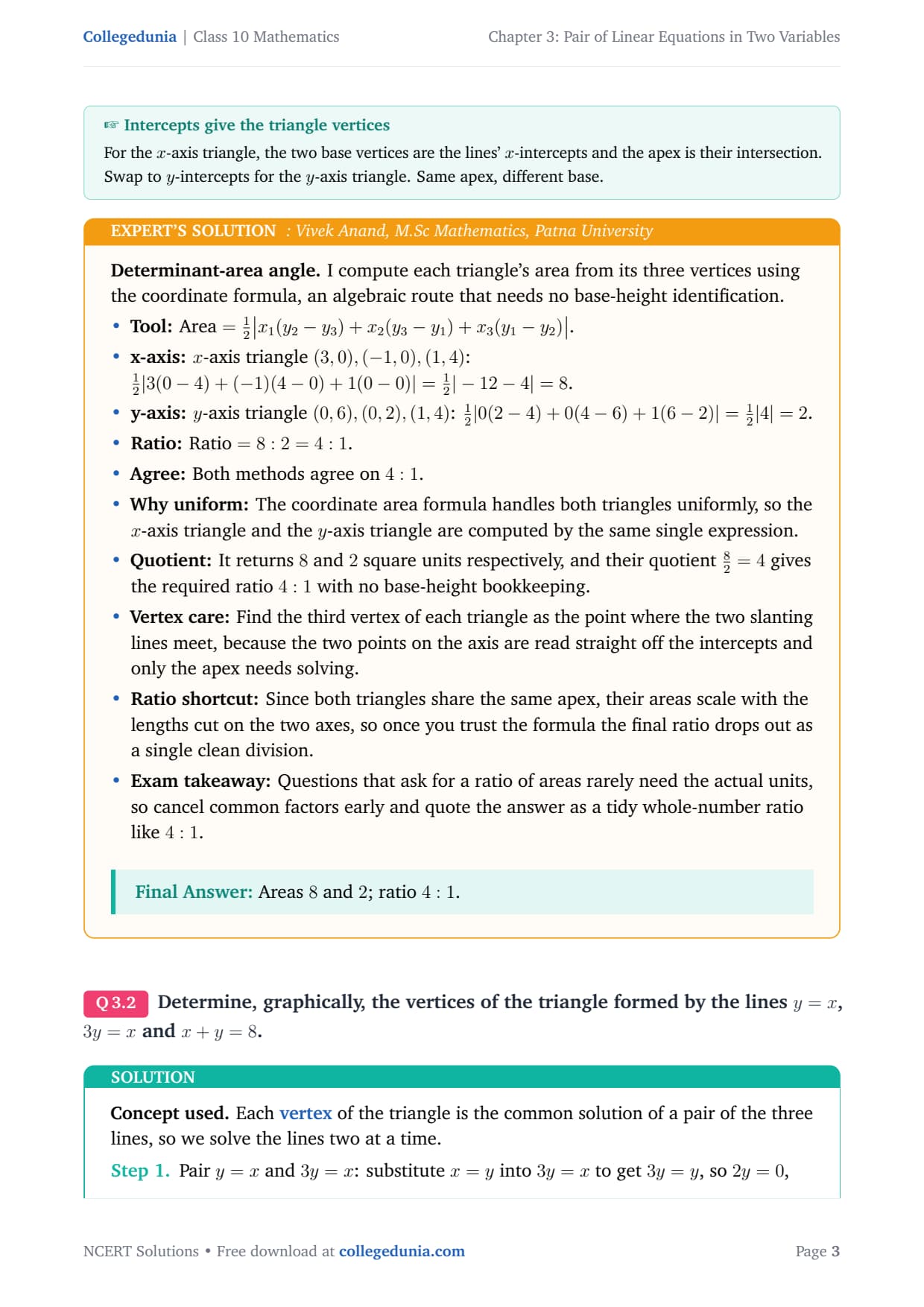
Graphically, solve the following pair of equations: 2x+y=6 and 2x-y+2=0. Find the ratio of the areas of the two triangles formed by the lines representing these equations with the x-axis and the lines with the y-axis.
Concept used. Find the intersection of the lines and their
intercepts, then compute the two triangle areas with
Area=12 and take the
ratio.
Solve the pair. Add 2x+y=6 and 2x-y=-2: 4x=4, so x=1; then
y=6-2(1)=4. The lines meet at (1,4).
x-intercepts (set y=0): for 2x+y=6, x=3 giving (3,0);
for 2x-y=-2, x=-1 giving (-1,0).
Triangle with the x-axis has vertices (3,0), (-1,0), (1,4).
Base on the x-axis =3-(-1)=4, height =4. Area
=12× 4× 4=8 square units.
y-intercepts (set x=0): for 2x+y=6, y=6 giving (0,6);
for 2x-y=-2, -y=-2 so y=2 giving (0,2).
Triangle with the y-axis has vertices (0,6), (0,2), (1,4).
Base on the y-axis =6-2=4, height =1 (the x-coordinate of
the apex). Area =12× 4× 1=2 square units.
Ratio of areas =82=41, i.e. 4:1.
0.58!%
[See diagram in the PDF version]
Solution (1,4); area with x-axis =8, with y-axis =2;
ratio =4:1.
VA
Vivek Anand
M.Sc Mathematics, Patna University
Verified Expert
Determinant-area angle. I compute each triangle's area from its
three vertices using the coordinate formula, an algebraic route that needs
no base-height identification.
Why uniform: The coordinate area formula handles both triangles uniformly, so the x-axis triangle and the y-axis triangle are computed by the same single expression.
Quotient: It returns 8 and 2 square units respectively, and their quotient 82=4 gives the required ratio 4:1 with no base-height bookkeeping.
Vertex care: Find the third vertex of each triangle as the point where the two slanting lines meet, because the two points on the axis are read straight off the intercepts and only the apex needs solving.
Ratio shortcut: Since both triangles share the same apex, their areas scale with the lengths cut on the two axes, so once you trust the formula the final ratio drops out as a single clean division.
Exam takeaway: Questions that ask for a ratio of areas rarely need the actual units, so cancel common factors early and quote the answer as a tidy whole-number ratio like 4:1.
Areas 8 and 2; ratio 4:1.
Q 3.2
Determine, graphically, the vertices of the triangle formed by the lines y=x, 3y=x and x+y=8.
Concept used. Each vertex of the triangle is the common
solution of a pair of the three lines, so we solve the lines two at a time.
Pair y=x and 3y=x: substitute x=y into 3y=x to get 3y=y,
so 2y=0, y=0 and x=0. Vertex (0,0).
Pair y=x and x+y=8: substitute y=x into x+y=8 to get
2x=8, so x=4 and y=4. Vertex (4,4).
Pair 3y=x and x+y=8: substitute x=3y into x+y=8 to get
3y+y=8, so 4y=8, y=2 and x=6. Vertex (6,2).
Collecting, the triangle has vertices (0,0), (4,4), (6,2).
The vertices are (0,0), (4,4), (6,2).
MS
Megha Shah
M.Sc Mathematics, Gujarat University
Verified Expert
Substitution-only angle. All three lines are easy to write as
x in terms of y (or vice versa), so I solve every pairing by plain
substitution and list the results.
Method: Substituting one line into another gives their common point.
First vertex:y=x with 3y=x forces x=y=0, vertex (0,0).
Second vertex:y=x with x+y=8 forces x=y=4, vertex (4,4).
Third vertex:x=3y with x+y=8 forces y=2, x=6, vertex (6,2).
List: Vertices: (0,0),(4,4),(6,2).
Why this works: Each vertex of the triangle is simply where two of the three lines meet, so solving the three pairings one at a time delivers all three corners without any graph paper.
Exam takeaway: For vertices of a triangle made by three lines, always solve the lines two at a time, and list the corners clearly so the marker can see each intersection was found separately.
Vertices (0,0),(4,4),(6,2).
Q 3.3
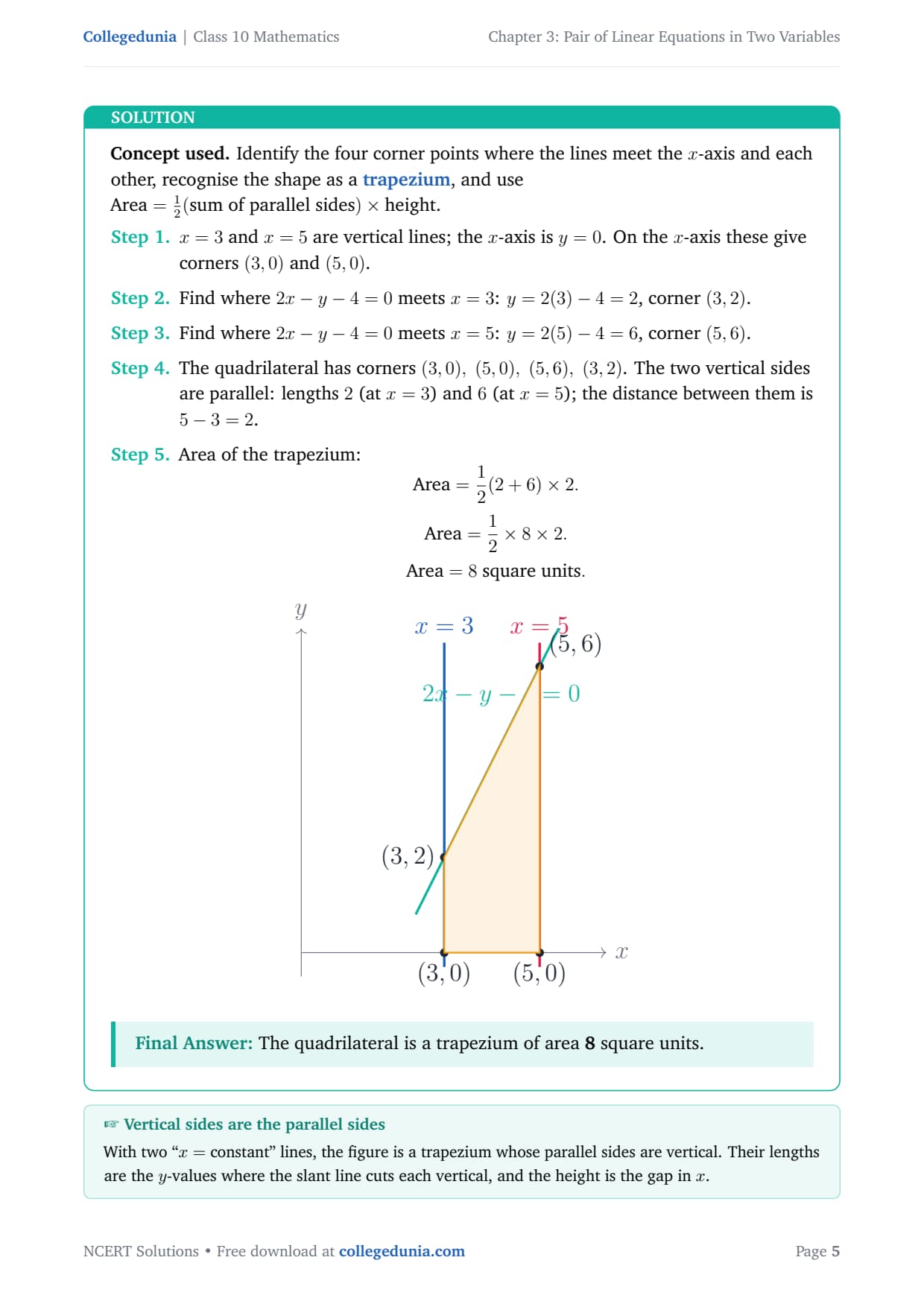
Draw the graphs of the equations x=3, x=5 and 2x-y-4=0. Also find the area of the quadrilateral formed by the lines and the x-axis.
Concept used. Identify the four corner points where the lines meet
the x-axis and each other, recognise the shape as a trapezium,
and use Area=12(sum of parallel sides).
x=3 and x=5 are vertical lines; the x-axis is y=0. On the
x-axis these give corners (3,0) and (5,0).
Find where 2x-y-4=0 meets x=3: y=2(3)-4=2, corner (3,2).
Find where 2x-y-4=0 meets x=5: y=2(5)-4=6, corner (5,6).
The quadrilateral has corners (3,0), (5,0), (5,6), (3,2). The
two vertical sides are parallel: lengths 2 (at x=3) and 6 (at
x=5); the distance between them is 5-3=2.
Area of the trapezium:
Area=12(2+6)× 2. Area=12× 8× 2. Area=8 square units.
0.5!%
[See diagram in the PDF version]
The quadrilateral is a trapezium of area 8 square
units.
AP
Akash Pandey
M.Sc Mathematics, Banasthali Vidyapith
Verified Expert
Split-into-shapes angle. I split the trapezium into a rectangle
plus a right triangle, an arithmetic route that avoids the trapezium
formula.
Method: A trapezium is a rectangle plus a triangle.
Rectangle: Rectangle: width 2 (from x=3 to x=5), height 2 (the shorter side), area 22=4.
Triangle: Triangle on top: base 2 (same width), height 6-2=4, area 1224=4.
Total: Total area =4+4=8 square units.
Matches: This matches the trapezium-formula result.
Why split: Splitting the trapezium into a 22 rectangle plus a triangle of base 2 and height 4 turns the area into two easy products.
Add up: Adding the rectangle's 4 and the triangle's 4 gives 8 square units, matching the trapezium formula and confirming the figure's area.
Why this helps: Breaking an awkward shape into a rectangle and a triangle means you only ever multiply length by width and halve a product, so there is nothing to memorise beyond two areas you already know.
Exam takeaway: When a figure does not match a standard formula, slice it along a horizontal or vertical line into familiar pieces and add the parts, which is far safer under exam pressure than recalling a special formula.
Area =8 sq units.
Q 3.4
The cost of 4 pens and 4 pencil boxes is Rs 100. Three times the cost of a pen is Rs 15 more than the cost of a pencil box. Form the pair of linear equations for the above situation. Find the cost of a pen and a pencil box.
Concept used. Let the cost of a pen and a pencil box be the
unknowns; translate the two sentences into a pair of linear
equations and solve by substitution.
Let the cost of one pen be Rs x and one pencil box be Rs y.
``4 pens and 4 pencil boxes cost Rs 100'':
4x+4y=100, which simplifies to x+y=25 (1).
``Three times a pen is Rs 15 more than a pencil box'':
3x=y+15, i.e. 3x-y=15 (2).
Add (1) and (2): (x+y)+(3x-y)=25+15, so 4x=40, giving x=10.
Substitute x=10 into (1): 10+y=25, so y=15.
A pen costs Rs 10 and a pencil box costs Rs 15.
SN
Sangeeta Naik
M.Ed Mathematics, RIE Ajmer
Verified Expert
Substitution route. I express y from the simplified first
equation and substitute, then verify both original sentences.
Method: Substitution and a money-sense check.
Express y: From (1) y=25-x. Substitute into (2): 3x-(25-x)=15.
Simplify: Simplify: 4x-25=15, so 4x=40, giving x=10; then y=15.
Check two: Check sentence 2: 3(10)=30 and 15+15=30 .
One move: Substituting y=25-x into 3x-y=15 collapses the pair to 4x-25=15 in a single move, so x=10 and y=15 follow at once.
Both check: The two original sentences both check out (4(10)+4(15)=100 and 3(10)=15+15), so a pen costs Rs 10 and a pencil box Rs 15.
Pen Rs 10, pencil box Rs 15.
Q 3.5
Determine, algebraically, the vertices of the triangle formed by the lines 3x-y=3, 2x-3y=2 and x+2y=8.
Concept used. Solve the three lines in pairs; each pair's
common solution is a vertex of the triangle.
Pair 3x-y=3 and 2x-3y=2. From the first y=3x-3. Substitute:
2x-3(3x-3)=2, so 2x-9x+9=2, -7x=-7, x=1; then
y=3(1)-3=0. Vertex (1,0).
Pair 3x-y=3 and x+2y=8. From the first y=3x-3. Substitute:
x+2(3x-3)=8, so x+6x-6=8, 7x=14, x=2; then y=3(2)-3=3.
Vertex (2,3).
Pair 2x-3y=2 and x+2y=8. From the second x=8-2y. Substitute:
2(8-2y)-3y=2, so 16-4y-3y=2, -7y=-14, y=2; then
x=8-2(2)=4. Vertex (4,2).
The three vertices are (1,0), (2,3), (4,2).
The vertices are (1,0), (2,3), (4,2).
RK
Rajat Kulshrestha
M.Sc Mathematics, Maharaja Sayajirao University Baroda
Verified Expert
Elimination route. I solve one pairing by elimination to give an
independent confirmation of a vertex, then list all three.
Method: Elimination aligns a variable's coefficient and subtracts.
Make pair: Pair 3x-y=3 and x+2y=8. Multiply the first by 2: 6x-2y=6.
Add up: Add to x+2y=8: 7x=14, so x=2; then y=3, vertex (2,3), as before.
Other two: The other two vertices follow by the substitutions above: (1,0) and (4,2).
Agree: All three vertices agree across methods.
Vertices (1,0),(2,3),(4,2).
Q 3.6
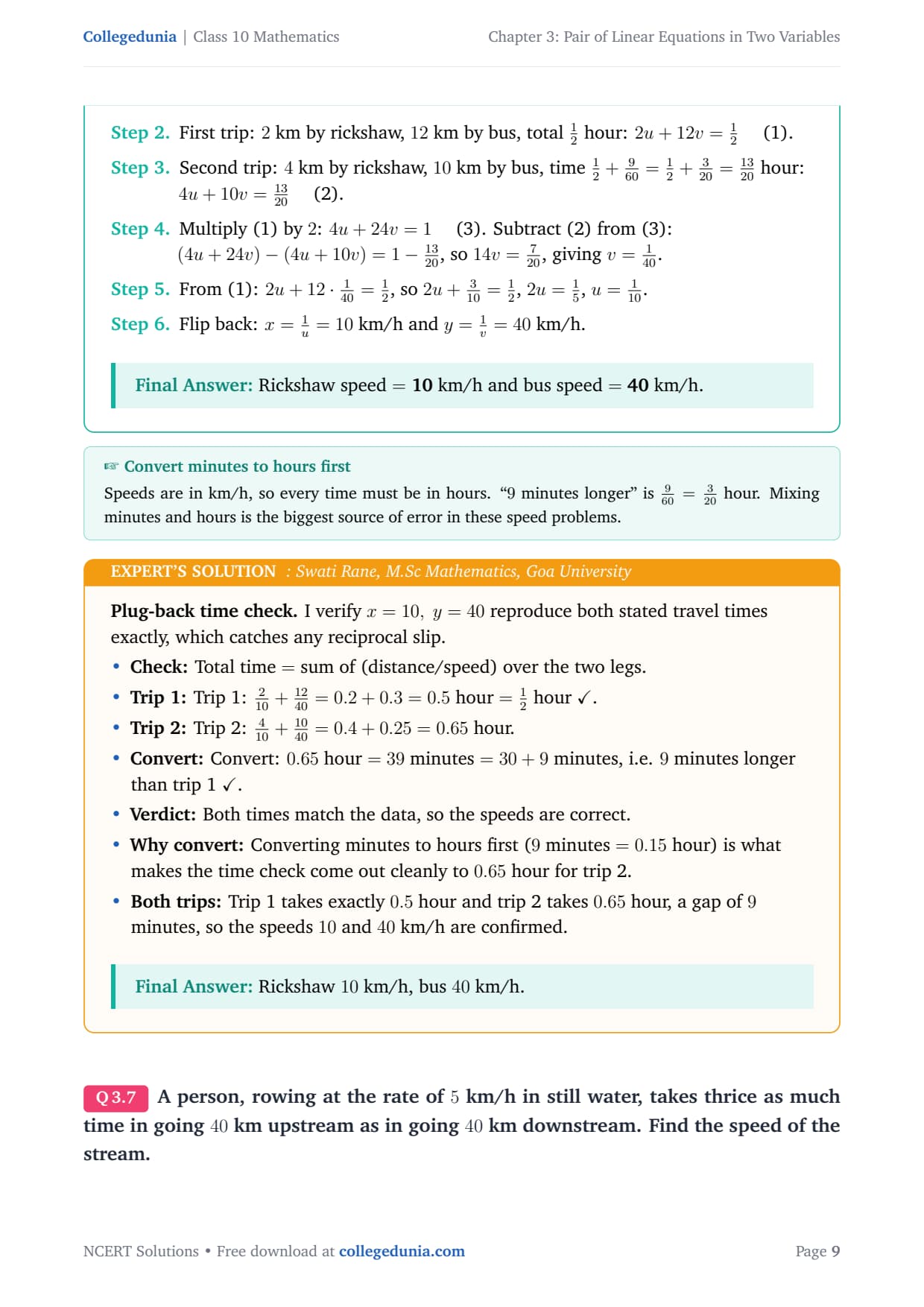
Ankita travels 14 km to her home partly by rickshaw and partly by bus. She takes half an hour if she travels 2 km by rickshaw, and the remaining distance by bus. On the other hand, if she travels 4 km by rickshaw and the remaining distance by bus, she takes 9 minutes longer. Find the speed of the rickshaw and of the bus.
Concept used. Use time=distancespeed
for each leg. Let the reciprocals of the speeds be new variables so the two
time equations become linear.
Let the rickshaw speed be x km/h and the bus speed be y km/h.
Set u=1x, v=1y (hours per km).
First trip: 2 km by rickshaw, 12 km by bus, total 12
hour: 2u+12v=12 (1).
Second trip: 4 km by rickshaw, 10 km by bus, time
12+960=12+320=1320 hour:
4u+10v=1320 (2).
Multiply (1) by 2: 4u+24v=1 (3). Subtract (2) from (3):
(4u+24v)-(4u+10v)=1-1320, so 14v=720, giving
v=140.
From (1): 2u+12·140=12, so
2u+310=12, 2u=15, u=110.
Flip back: x=1u=10 km/h and y=1v=40 km/h.
Rickshaw speed =10 km/h and bus speed =40
km/h.
SR
Swati Rane
M.Sc Mathematics, Goa University
Verified Expert
Plug-back time check. I verify x=10, y=40 reproduce both stated
travel times exactly, which catches any reciprocal slip.
Check: Total time = sum of (distance/speed) over the two legs.
Convert: Convert: 0.65 hour =39 minutes =30+9 minutes, i.e. 9 minutes longer than trip 1 .
Verdict: Both times match the data, so the speeds are correct.
Why convert: Converting minutes to hours first (9 minutes =0.15 hour) is what makes the time check come out cleanly to 0.65 hour for trip 2.
Both trips: Trip 1 takes exactly 0.5 hour and trip 2 takes 0.65 hour, a gap of 9 minutes, so the speeds 10 and 40 km/h are confirmed.
Rickshaw 10 km/h, bus 40 km/h.
Q 3.7
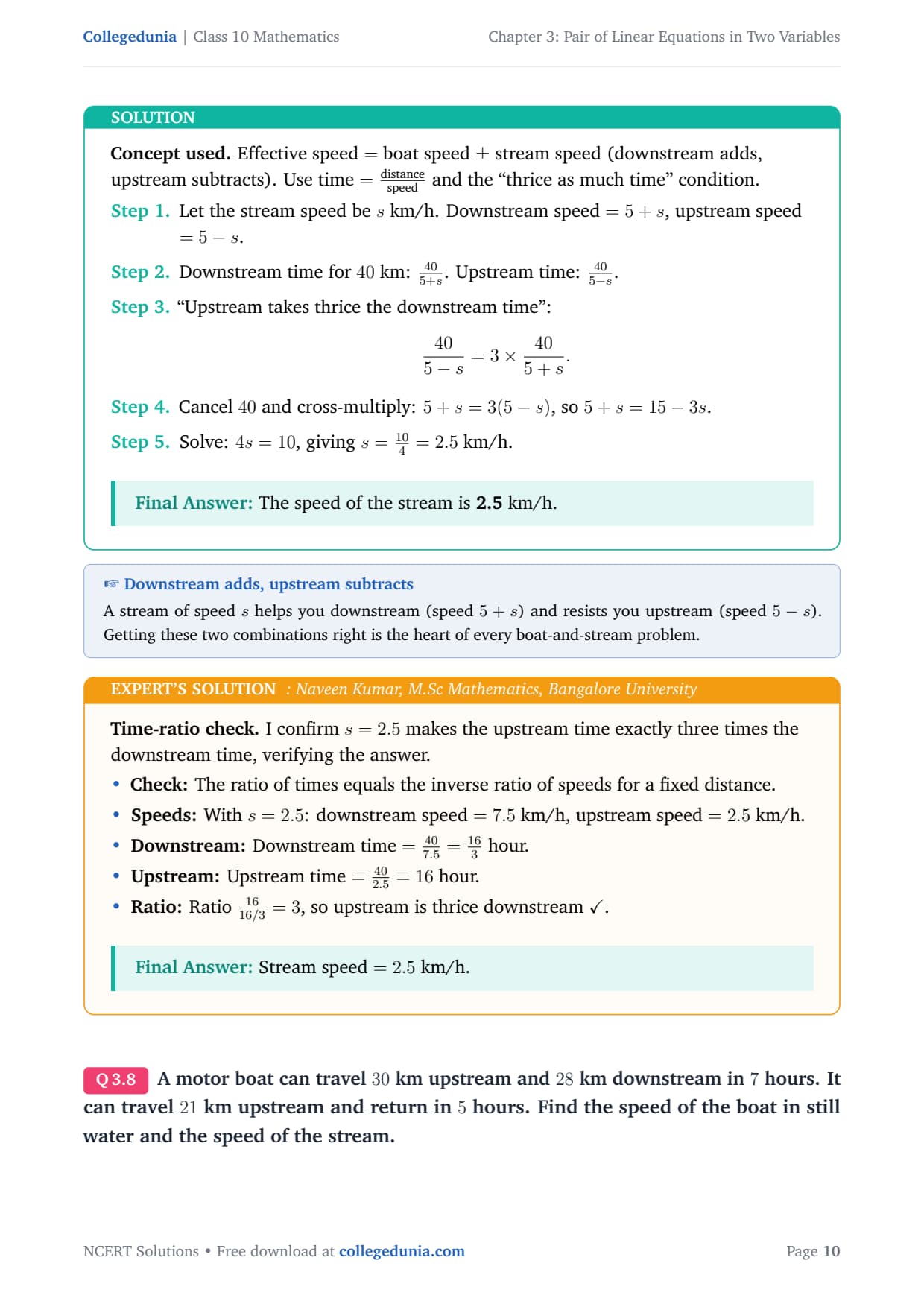
A person, rowing at the rate of 5 km/h in still water, takes thrice as much time in going 40 km upstream as in going 40 km downstream. Find the speed of the stream.
Concept used. Effective speed = boat speed ± stream speed
(downstream adds, upstream subtracts). Use time=distancespeed
and the ``thrice as much time'' condition.
Let the stream speed be s km/h. Downstream speed =5+s, upstream
speed =5-s.
Downstream time for 40 km: 405+s. Upstream time:
405-s.
``Upstream takes thrice the downstream time'':
405-s=3×405+s.
Cancel 40 and cross-multiply: 5+s=3(5-s), so 5+s=15-3s.
Solve: 4s=10, giving s=104=2.5 km/h.
The speed of the stream is 2.5 km/h.
NK
Naveen Kumar
M.Sc Mathematics, Bangalore University
Verified Expert
Time-ratio check. I confirm s=2.5 makes the upstream time exactly
three times the downstream time, verifying the answer.
Check: The ratio of times equals the inverse ratio of speeds for a fixed distance.
Speeds: With s=2.5: downstream speed =7.5 km/h, upstream speed =2.5 km/h.
Downstream: Downstream time =407.5=163 hour.
Upstream: Upstream time =402.5=16 hour.
Ratio: Ratio 1616/3=3, so upstream is thrice downstream .
Stream speed =2.5 km/h.
Q 3.8
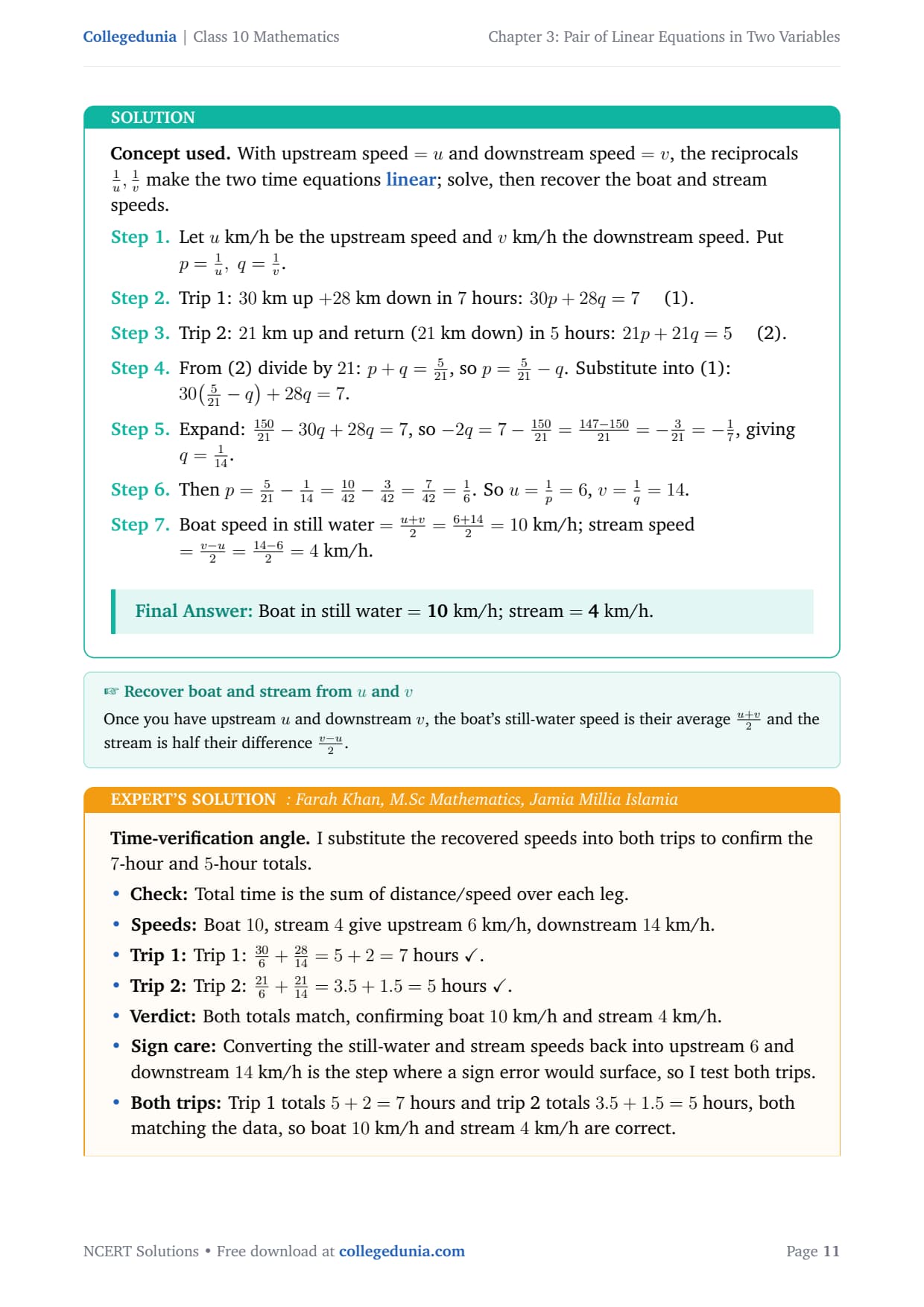
A motor boat can travel 30 km upstream and 28 km downstream in 7 hours. It can travel 21 km upstream and return in 5 hours. Find the speed of the boat in still water and the speed of the stream.
Concept used. With upstream speed =u and downstream speed =v,
the reciprocals 1u,1v make the two time equations
linear; solve, then recover the boat and stream speeds.
Let u km/h be the upstream speed and v km/h the downstream
speed. Put p=1u, q=1v.
Trip 1: 30 km up +28 km down in 7 hours:
30p+28q=7 (1).
Trip 2: 21 km up and return (21 km down) in 5 hours:
21p+21q=5 (2).
From (2) divide by 21: p+q=521, so
p=521-q. Substitute into (1):
30(521-q)+28q=7.
Expand: 15021-30q+28q=7, so -2q=7-15021
=147-15021=-321=-17, giving
q=114.
Then p=521-114=1042-342
=742=16. So u=1p=6, v=1q=14.
Boat speed in still water =u+v2=6+142=10 km/h;
stream speed =v-u2=14-62=4 km/h.
Boat in still water =10 km/h; stream =4
km/h.
FK
Farah Khan
M.Sc Mathematics, Jamia Millia Islamia
Verified Expert
Time-verification angle. I substitute the recovered speeds into both
trips to confirm the 7-hour and 5-hour totals.
Check: Total time is the sum of distance/speed over each leg.
Speeds: Boat 10, stream 4 give upstream 6 km/h, downstream 14 km/h.
Trip 1: Trip 1: 306+2814=5+2=7 hours .
Trip 2: Trip 2: 216+2114=3.5+1.5=5 hours .
Verdict: Both totals match, confirming boat 10 km/h and stream 4 km/h.
Sign care: Converting the still-water and stream speeds back into upstream 6 and downstream 14 km/h is the step where a sign error would surface, so I test both trips.
Both trips: Trip 1 totals 5+2=7 hours and trip 2 totals 3.5+1.5=5 hours, both matching the data, so boat 10 km/h and stream 4 km/h are correct.
Boat 10 km/h, stream 4 km/h.
Q 3.9
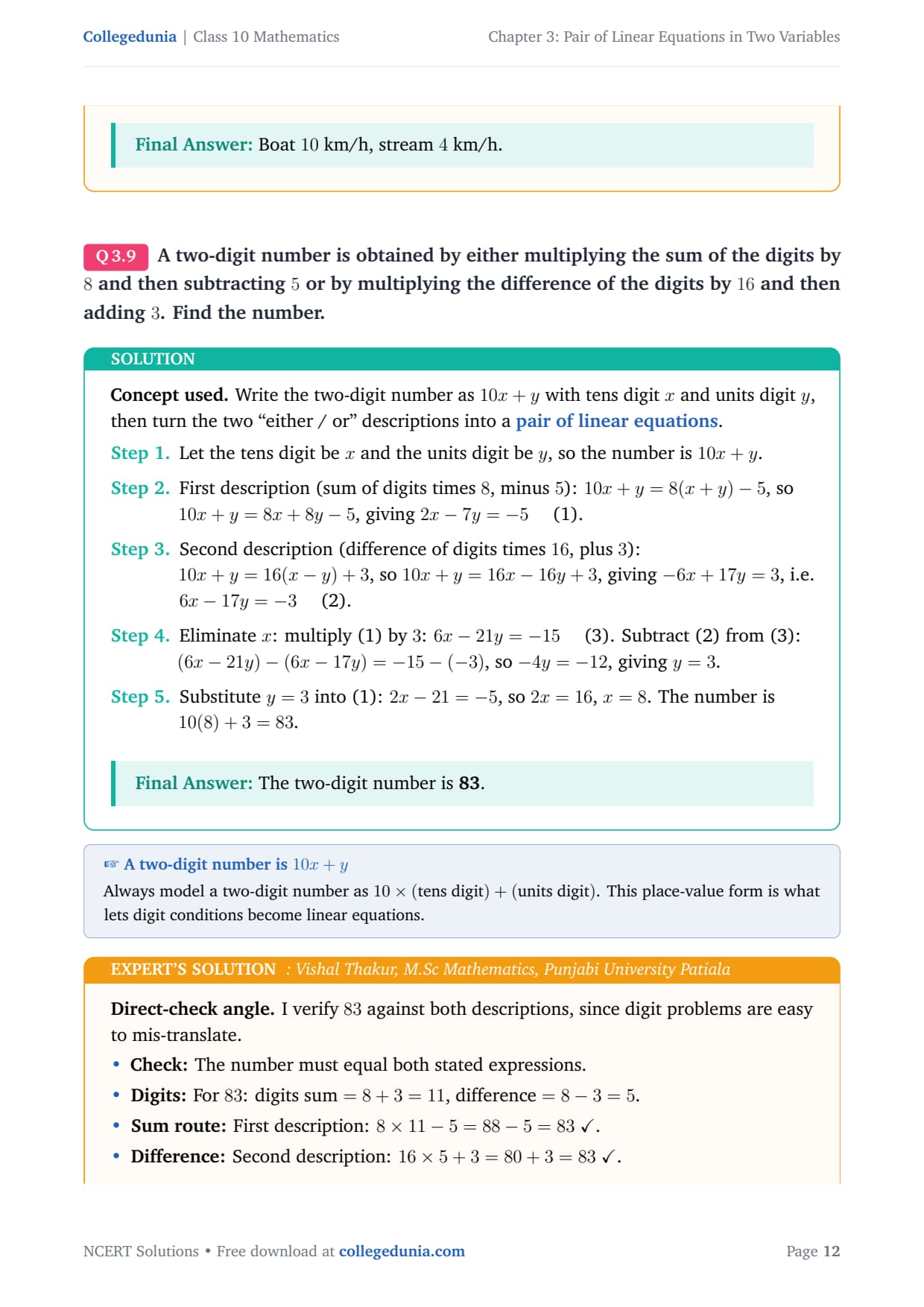
A two-digit number is obtained by either multiplying the sum of the digits by 8 and then subtracting 5 or by multiplying the difference of the digits by 16 and then adding 3. Find the number.
Concept used. Write the two-digit number as 10x+y with tens digit
x and units digit y, then turn the two ``either / or'' descriptions into a
pair of linear equations.
Let the tens digit be x and the units digit be y, so the number
is 10x+y.
First description (sum of digits times 8, minus 5):
10x+y=8(x+y)-5, so 10x+y=8x+8y-5, giving 2x-7y=-5 (1).
Second description (difference of digits times 16, plus 3):
10x+y=16(x-y)+3, so 10x+y=16x-16y+3, giving -6x+17y=3, i.e.
6x-17y=-3 (2).
Eliminate x: multiply (1) by 3: 6x-21y=-15 (3). Subtract
(2) from (3): (6x-21y)-(6x-17y)=-15-(-3), so -4y=-12, giving
y=3.
Substitute y=3 into (1): 2x-21=-5, so 2x=16, x=8. The number
is 10(8)+3=83.
The two-digit number is 83.
VT
Vishal Thakur
M.Sc Mathematics, Punjabi University Patiala
Verified Expert
Direct-check angle. I verify 83 against both descriptions, since
digit problems are easy to mis-translate.
Check: The number must equal both stated expressions.
Digits: For 83: digits sum =8+3=11, difference =8-3=5.
Sum route: First description: 811-5=88-5=83 .
Difference: Second description: 165+3=80+3=83 .
Verdict: Both give 83, so the number is 83.
Why check: Digit problems are easy to mis-translate, so I test the final number against the actual ``sum'' and ``difference'' wording rather than the algebra.
Both routes: For 83 the sum route gives 8(11)-5=83 and the difference route gives 16(5)+3=83, so both descriptions land on 83.
The number is 83.
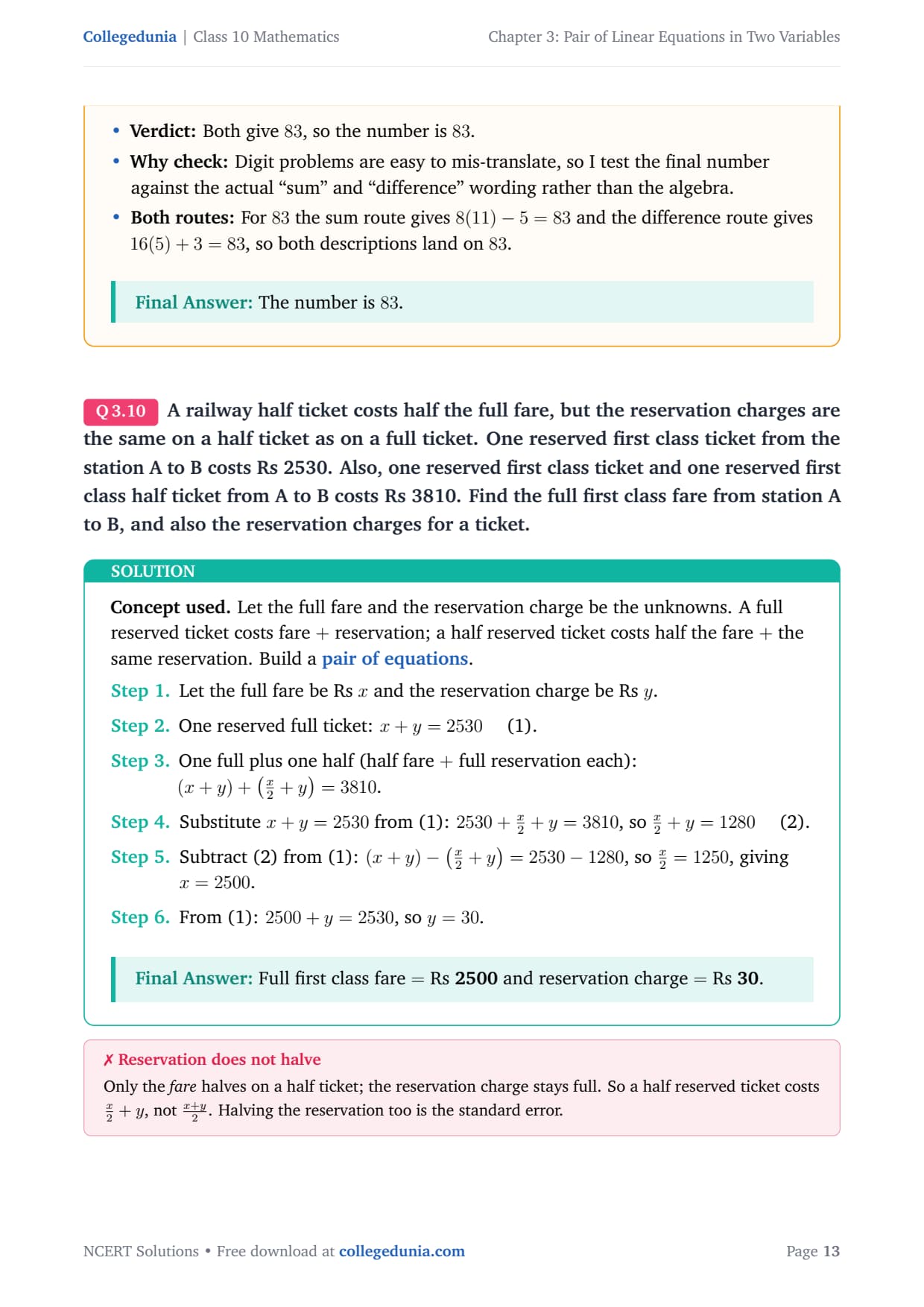
Q 3.10
A railway half ticket costs half the full fare, but the reservation charges are the same on a half ticket as on a full ticket. One reserved first class ticket from the station A to B costs Rs 2530. Also, one reserved first class ticket and one reserved first class half ticket from A to B costs Rs 3810. Find the full first class fare from station A to B, and also the reservation charges for a ticket.
Concept used. Let the full fare and the reservation charge be the
unknowns. A full reserved ticket costs fare + reservation; a half reserved
ticket costs half the fare + the same reservation. Build a pair
of equations.
Let the full fare be Rs x and the reservation charge be Rs y.
One reserved full ticket: x+y=2530 (1).
One full plus one half (half fare + full reservation each):
(x+y)+(x2+y)=3810.
Substitute x+y=2530 from (1):
2530+x2+y=3810, so x2+y=1280 (2).
Subtract (2) from (1): (x+y)-(x2+y)
=2530-1280, so x2=1250, giving x=2500.
From (1): 2500+y=2530, so y=30.
Full first class fare = Rs 2500 and reservation
charge = Rs 30.
IM
Indira Menon
M.Sc Mathematics, University of Kerala
Verified Expert
Difference-of-tickets angle. The cost of the extra half ticket is
just Rs 3810-2530=Rs 1280; this equals half the fare plus one
reservation, which I solve alongside (1).
Method: Subtracting the two given totals isolates the half ticket's cost.
Half ticket: Half ticket cost =3810-2530=1280, so x2+y=1280.
Pair up: Pair with x+y=2530. Subtract: x2=1250, so x=2500.
Get y: Then y=2530-2500=30.
Fares: Full fare Rs 2500, reservation Rs 30.
Key move: Subtracting the two given totals isolates the price of the single extra half ticket as Rs 1280, which already encodes ``half fare plus full reservation''.
Subtract: Pairing x2+y=1280 with x+y=2530 and subtracting gives x2=1250, so the full fare is Rs 2500 and the reservation Rs 30.
Full fare Rs 2500, reservation Rs 30.
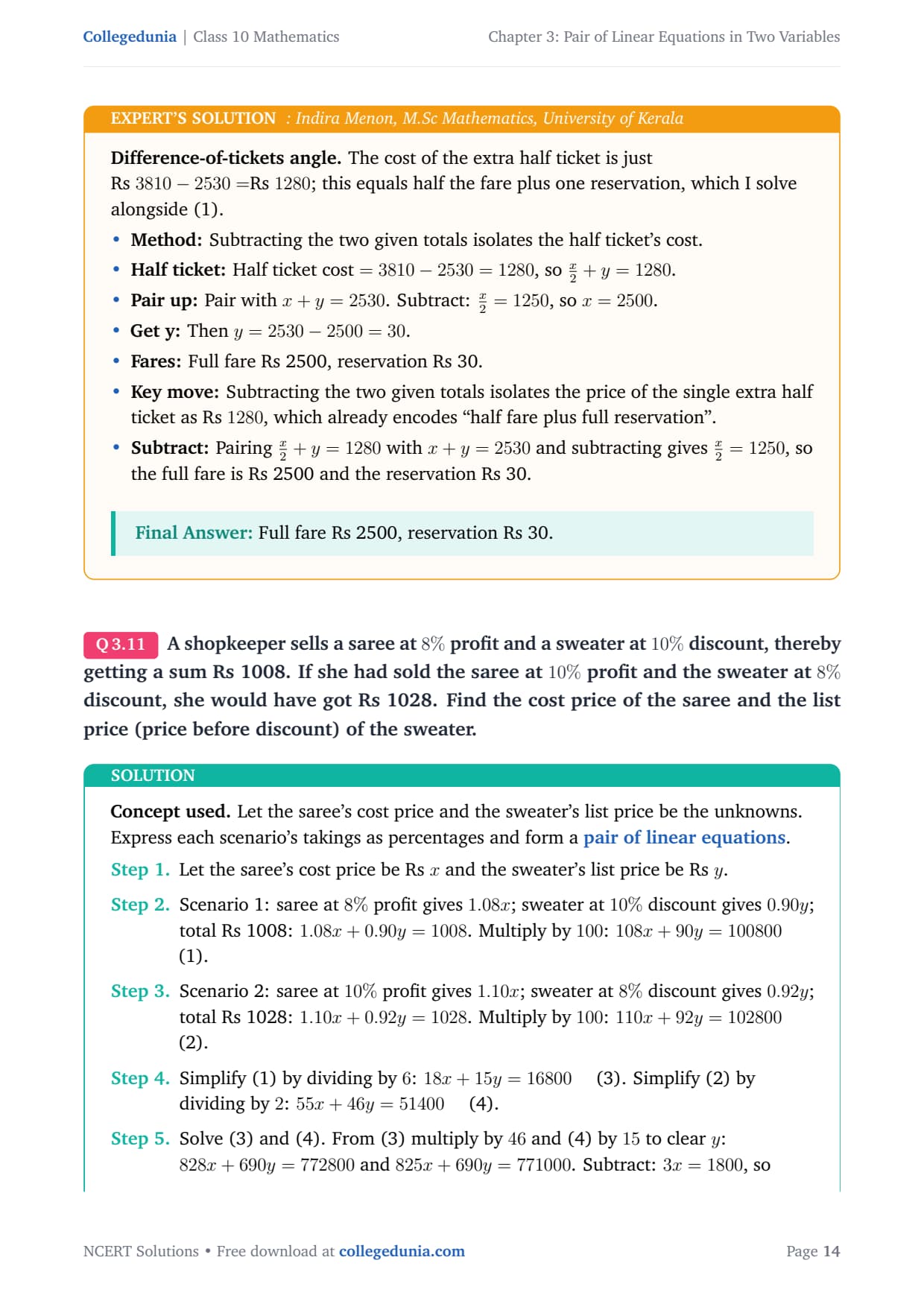
Q 3.11
A shopkeeper sells a saree at 8% profit and a sweater at 10% discount, thereby getting a sum Rs 1008. If she had sold the saree at 10% profit and the sweater at 8% discount, she would have got Rs 1028. Find the cost price of the saree and the list price (price before discount) of the sweater.
Concept used. Let the saree's cost price and the sweater's list
price be the unknowns. Express each scenario's takings as percentages and
form a pair of linear equations.
Let the saree's cost price be Rs x and the sweater's list price be
Rs y.
Scenario 1: saree at 8% profit gives 1.08x; sweater at 10%
discount gives 0.90y; total Rs 1008:
1.08x+0.90y=1008. Multiply by 100: 108x+90y=100800 (1).
Scenario 2: saree at 10% profit gives 1.10x; sweater at 8%
discount gives 0.92y; total Rs 1028:
1.10x+0.92y=1028. Multiply by 100: 110x+92y=102800 (2).
Simplify (1) by dividing by 6: 18x+15y=16800 (3). Simplify
(2) by dividing by 2: 55x+46y=51400 (4).
Solve (3) and (4). From (3) multiply by 46 and (4) by 15 to
clear y: 828x+690y=772800 and 825x+690y=771000. Subtract:
3x=1800, so x=600.
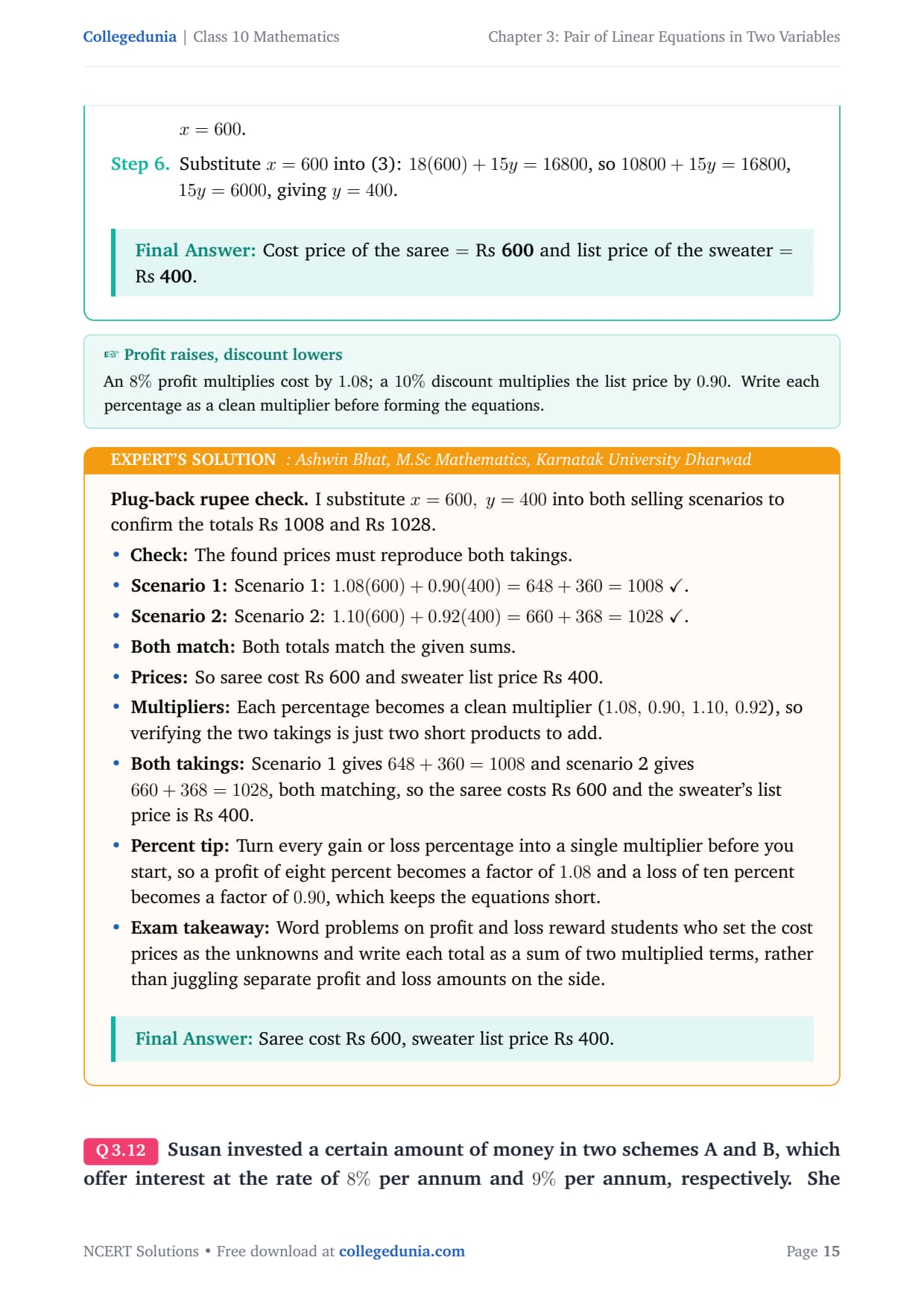
Substitute x=600 into (3): 18(600)+15y=16800, so
10800+15y=16800, 15y=6000, giving y=400.
Cost price of the saree = Rs 600 and list price of
the sweater = Rs 400.
AB
Ashwin Bhat
M.Sc Mathematics, Karnatak University Dharwad
Verified Expert
Plug-back rupee check. I substitute x=600, y=400 into both
selling scenarios to confirm the totals Rs 1008 and Rs 1028.
Check: The found prices must reproduce both takings.
Prices: So saree cost Rs 600 and sweater list price Rs 400.
Multipliers: Each percentage becomes a clean multiplier (1.08, 0.90, 1.10, 0.92), so verifying the two takings is just two short products to add.
Both takings: Scenario 1 gives 648+360=1008 and scenario 2 gives 660+368=1028, both matching, so the saree costs Rs 600 and the sweater's list price is Rs 400.
Percent tip: Turn every gain or loss percentage into a single multiplier before you start, so a profit of eight percent becomes a factor of 1.08 and a loss of ten percent becomes a factor of 0.90, which keeps the equations short.
Exam takeaway: Word problems on profit and loss reward students who set the cost prices as the unknowns and write each total as a sum of two multiplied terms, rather than juggling separate profit and loss amounts on the side.
Saree cost Rs 600, sweater list price Rs 400.
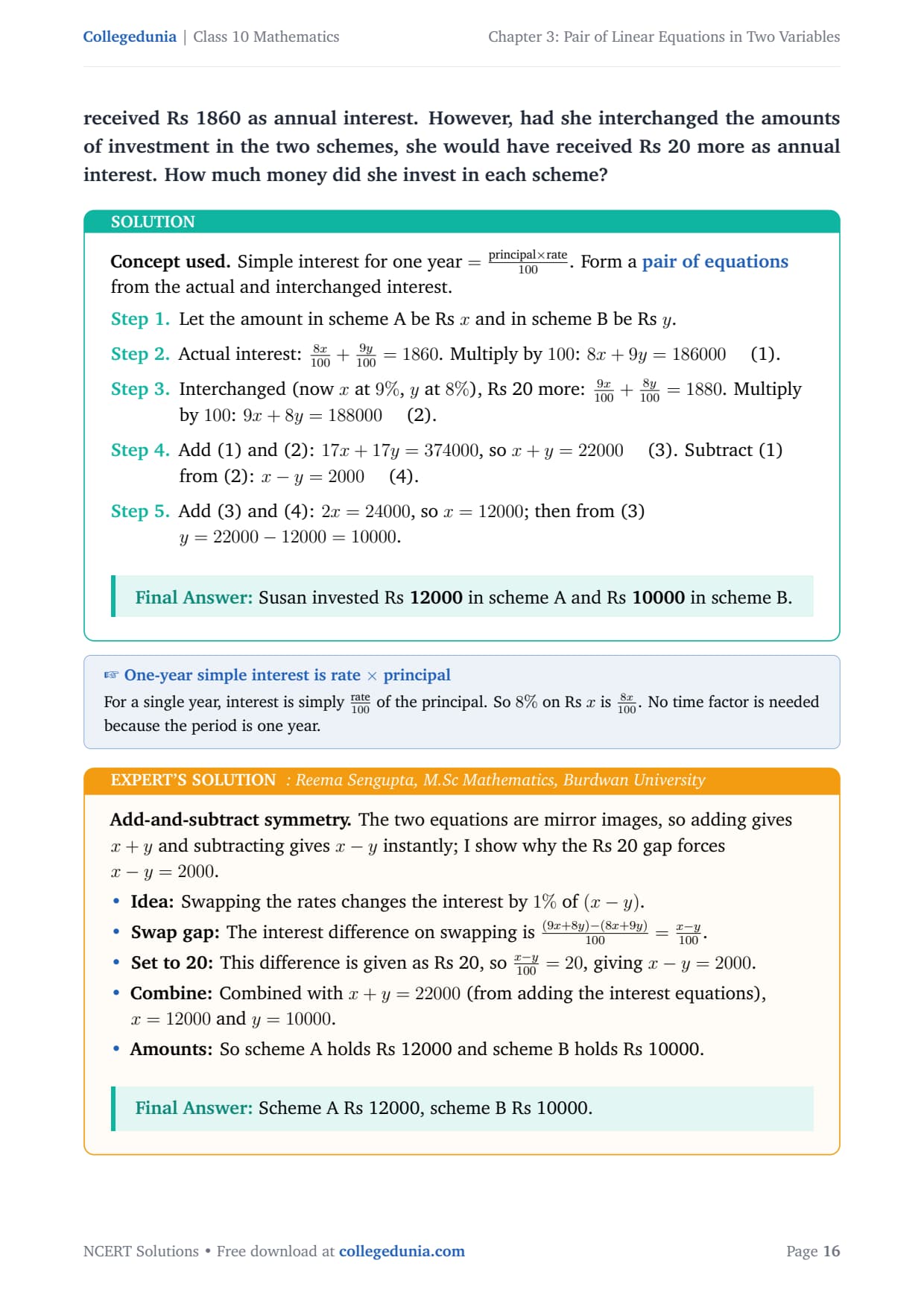
Q 3.12
Susan invested a certain amount of money in two schemes A and B, which offer interest at the rate of 8% per annum and 9% per annum, respectively. She received Rs 1860 as annual interest. However, had she interchanged the amounts of investment in the two schemes, she would have received Rs 20 more as annual interest. How much money did she invest in each scheme?
Concept used. Simple interest for one year =principal
100. Form a pair of equations from the actual
and interchanged interest.
Let the amount in scheme A be Rs x and in scheme B be Rs y.
Actual interest: 8x100+9y100=1860. Multiply by
100: 8x+9y=186000 (1).
Interchanged (now x at 9%, y at 8%), Rs 20 more:
9x100+8y100=1880. Multiply by 100:
9x+8y=188000 (2).
Add (1) and (2): 17x+17y=374000, so x+y=22000 (3).
Subtract (1) from (2): x-y=2000 (4).
Add (3) and (4): 2x=24000, so x=12000; then from (3)
y=22000-12000=10000.
Susan invested Rs 12000 in scheme A and
Rs 10000 in scheme B.
RS
Reema Sengupta
M.Sc Mathematics, Burdwan University
Verified Expert
Add-and-subtract symmetry. The two equations are mirror images, so
adding gives x+y and subtracting gives x-y instantly; I show why the
Rs 20 gap forces x-y=2000.
Idea: Swapping the rates changes the interest by 1% of (x-y).
Swap gap: The interest difference on swapping is (9x+8y)-(8x+9y)100=x-y100.
Set to 20: This difference is given as Rs 20, so x-y100=20, giving x-y=2000.
Combine: Combined with x+y=22000 (from adding the interest equations), x=12000 and y=10000.
Amounts: So scheme A holds Rs 12000 and scheme B holds Rs 10000.
Scheme A Rs 12000, scheme B Rs 10000.
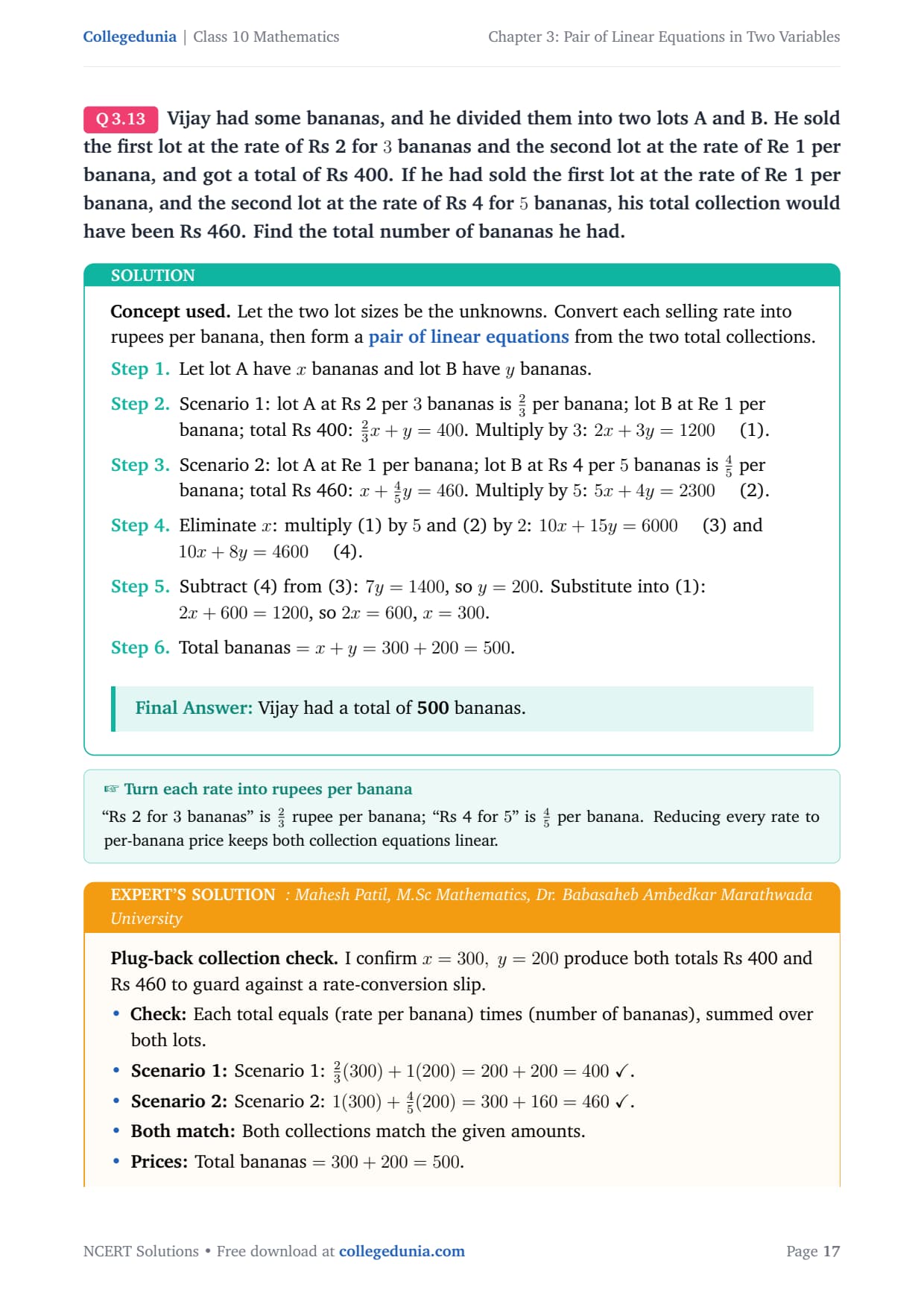
Q 3.13
Vijay had some bananas, and he divided them into two lots A and B. He sold the first lot at the rate of Rs 2 for 3 bananas and the second lot at the rate of Re 1 per banana, and got a total of Rs 400. If he had sold the first lot at the rate of Re 1 per banana, and the second lot at the rate of Rs 4 for 5 bananas, his total collection would have been Rs 460. Find the total number of bananas he had.
Concept used. Let the two lot sizes be the unknowns. Convert each
selling rate into rupees per banana, then form a pair of linear
equations from the two total collections.
Let lot A have x bananas and lot B have y bananas.
Scenario 1: lot A at Rs 2 per 3 bananas is 23 per
banana; lot B at Re 1 per banana; total Rs 400:
23x+y=400. Multiply by 3: 2x+3y=1200 (1).
Scenario 2: lot A at Re 1 per banana; lot B at Rs 4 per 5 bananas
is 45 per banana; total Rs 460:
x+45y=460. Multiply by 5: 5x+4y=2300 (2).
Eliminate x: multiply (1) by 5 and (2) by 2:
10x+15y=6000 (3) and 10x+8y=4600 (4).
Subtract (4) from (3): 7y=1400, so y=200. Substitute into (1):
2x+600=1200, so 2x=600, x=300.
Total bananas =x+y=300+200=500.
Vijay had a total of 500 bananas.
MP
Mahesh Patil
M.Sc Mathematics, Dr. Babasaheb Ambedkar Marathwada University
Verified Expert
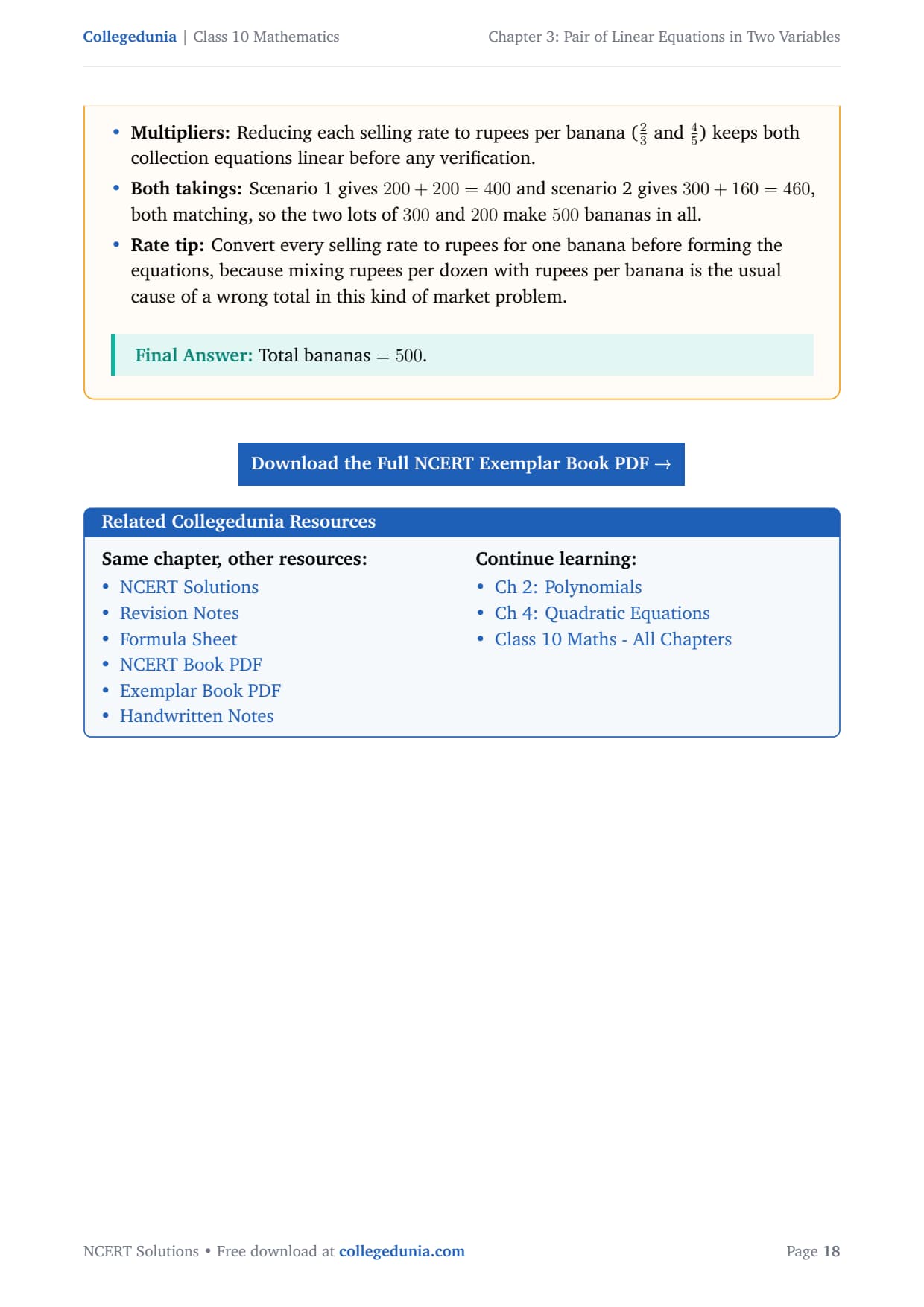
Plug-back collection check. I confirm x=300, y=200 produce both
totals Rs 400 and Rs 460 to guard against a rate-conversion slip.
Check: Each total equals (rate per banana) times (number of bananas), summed over both lots.
Both match: Both collections match the given amounts.
Prices: Total bananas =300+200=500.
Multipliers: Reducing each selling rate to rupees per banana (23 and 45) keeps both collection equations linear before any verification.
Both takings: Scenario 1 gives 200+200=400 and scenario 2 gives 300+160=460, both matching, so the two lots of 300 and 200 make 500 bananas in all.
Rate tip: Convert every selling rate to rupees for one banana before forming the equations, because mixing rupees per dozen with rupees per banana is the usual cause of a wrong total in this kind of market problem.
Total bananas =500.
Other Pair of Linear Equations Exercises (Class 10 Maths)
Work through the rest of the Exemplar exercises, then pair them with the matching study resources for Pair of Linear Equations.
Resource
What it covers
Open
Exercise 3.1
MCQs on the ratio test, consistency and word problems.
In a Collegedunia survey of 9,640 Class 10 Maths students from CBSE schools across 16 states, 71% found the word problems harder than the graphical questions. Most struggled to turn percentage-based and rate-based conditions into correct equations (Questions 11 and 12).
Source: Class 10 Mathematics student survey, 2026-27 session. Sample of 9,640 students.
Other Resources for This Chapter
Pair this with the other Class 10 Maths resources for Pair of Linear Equations in two Variables, all linked below.
Ques. How many questions are in NCERT Exemplar Class 10 Maths Chapter 3 Exercise 3.4?
Ans. Exercise 3.4 has 13 Long Answer Questions (Q45 to Q57). They cover graphical solutions, finding triangle and quadrilateral areas, and a range of word problems on speeds, costs, investments, digits, and market rates.
Ques. Which method works best for the word problems in Exercise 3.4?
Ans. Most word problems in Exercise 3.4 are best solved by elimination when coefficients are close in value, and by substitution when one equation gives a variable directly (e.g. x + y = 25 in Q48). For speed problems like Q50 and Q52, use the reciprocal substitution trick (set u = 1/x, v = 1/y) to make the time equations linear before solving.
Ques. Is Exercise 3.4 important for the CBSE Class 10 board exam?
Ans. Yes. CBSE papers regularly include 3-mark and 5-mark questions on forming pairs of equations from word problems, exactly the skill Exercise 3.4 builds. Practising Q48 to Q57 prepares you well for the application-based questions in the 2026-27 board paper.
Ques. How do I solve the area ratio question (Q45) in Exercise 3.4?
Ans. For Q45, first find where the two lines intersect (the apex of both triangles), then find the x-intercepts (base of the x-axis triangle) and the y-intercepts (base of the y-axis triangle). Use Area = (1/2) x base x height for each. The x-axis triangle uses the segment between the two x-intercepts as its base and the y-coordinate of the apex as its height. The y-axis triangle uses the segment between the two y-intercepts as its base and the x-coordinate of the apex as its height. In Q45, the ratio comes out as 4:1.
Ques. Where can I download the NCERT Exemplar Solutions for Class 10 Maths Chapter 3 Exercise 3.4 PDF?
Ans. You can download the PDF for NCERT Exemplar Solutions Class 10 Maths Chapter 3 Exercise 3.4 directly from this page. The PDF covers all 13 Long Answer Questions with step-by-step solutions according to the 2026-27 NCERT Exemplar book.








Comments