Maths Mentor, IIT Kanpur | Updated on - Jun 29, 2026
NCERT Exemplar Class 10 Maths Chapter 2 Polynomials Exercise 2.2 has 12 short-answer reasoning questions, solved step by step here. This is where students often slip on the sign in the sum-of-zeroes formula or the division-algorithm degree rules. All answers follow the 2026-27 syllabus.
Concepts: division-algorithm degree rules, zeroes and coefficient relations, the discriminant for equal zeroes.
Board relevance: these reasoning questions fit the 2-mark and 3-mark CBSE slots.
Every reasoning question below is answered step by step, with an expert view, for the 2026-27 syllabus.
These Exemplar Solutions are curated by subject experts, mapped to the 2026-27 NCERT, and verified against the CBSE board exam pattern.
Solved by Collegedunia Maths experts solve every question in Exercise 2.2. Each one shows the concept used, numbered steps, a boxed answer, and an Expert view, so you grasp the reasoning, not just the verdict.
Exercise 2.2 at a Glance · 12 Short Answer Reasoning Questions, Chapter 2 Polynomials, Class 10 Maths Exemplar 2026-27
Exercise 2.2 is the Short Answer Questions with Reasoning section of the Polynomials Exemplar. All 12 questions ask you to "Answer and justify" or "State True or False and justify." The table shows what each one tests.
Question
Type
Topic Tested
Difficulty
Q12
Answer & Justify
Degree of quotient: can x2−1 be the quotient when dividing degree-6 by degree-5?
Easy
Q13
Answer & Justify
Quotient and remainder when degree-2 is divided by degree-3
Easy
Q14
Answer & Justify
Degree relation when quotient is zero
Easy
Q15
Answer & Justify
Degree relation when remainder is zero (factor relation)
Medium
Q16
Answer & Justify
Equal zeroes of x2+kx+k for odd k > 1
Medium
Q17
True/False
Both positive zeroes: do a, b, c all share the same sign?
Medium
Q18
True/False
Can a quadratic meet the x-axis at only one point?
Easy
Q19
True/False
Two crossings: must the polynomial be quadratic?
Medium
Q20
True/False
Two zero zeroes of a cubic: no linear or constant terms?
Medium
Q21
True/False
All negative zeroes of a cubic: all coefficients same sign?
Medium
Q22
True/False
All positive zeroes of x3+ax2−bx+c: at least one of a, b, c is non-negative?
Hard
Q23
True/False
Is 1/2 the only k for equal zeroes of kx2+x+k?
Medium
Remember:Sum of zeroes = −b/a (note the minus sign). Product of zeroes = c/a. Students who swap these lose marks on Q17 and Q22. Write both formulas together in rough work before answering sign-based questions.
The key formulas students need for Exercise 2.2 are listed below:
Formula
Statement
Division Algorithm
p(x) = g(x) q(x) + r(x), where deg r < deg g or r = 0
Degree of quotient
deg q(x) = deg p(x) − deg g(x) (when r has smaller degree)
Discriminant (equal zeroes)
b2−4ac = 0
Sum of zeroes (quadratic)
α+β = −b/a
Product of zeroes (quadratic)
αβ = c/a
Sum of zeroes (cubic)
α+β+γ = −b/a
Pairwise sum of zeroes (cubic)
αβ+βγ+γα = c/a
Product of zeroes (cubic)
αβγ = −d/a
Common Pitfall: In Q22, the polynomial is x3+ax2−bx+c with a minus sign before bx. The coefficient of x is −b, not b. Always read the sign pattern from the polynomial as written before applying the zero-coefficient relations.
All 12 Questions with Step-by-Step Solutions
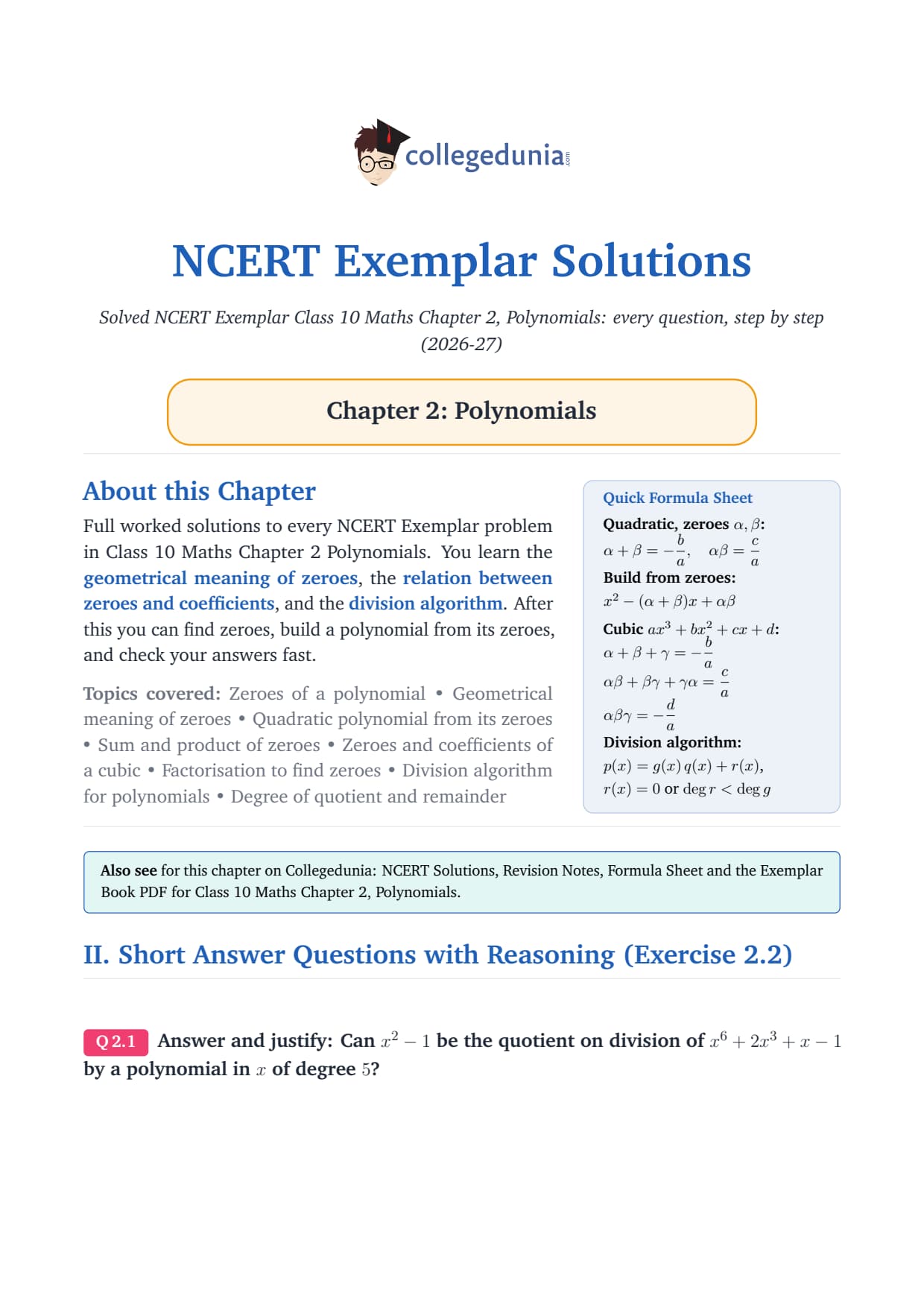
II. Short Answer Questions with Reasoning (Exercise 2.2)
Q 2.1
Answer and justify: Can x2-1 be the quotient on division of x6+2x3+x-1 by a polynomial in x of degree 5?
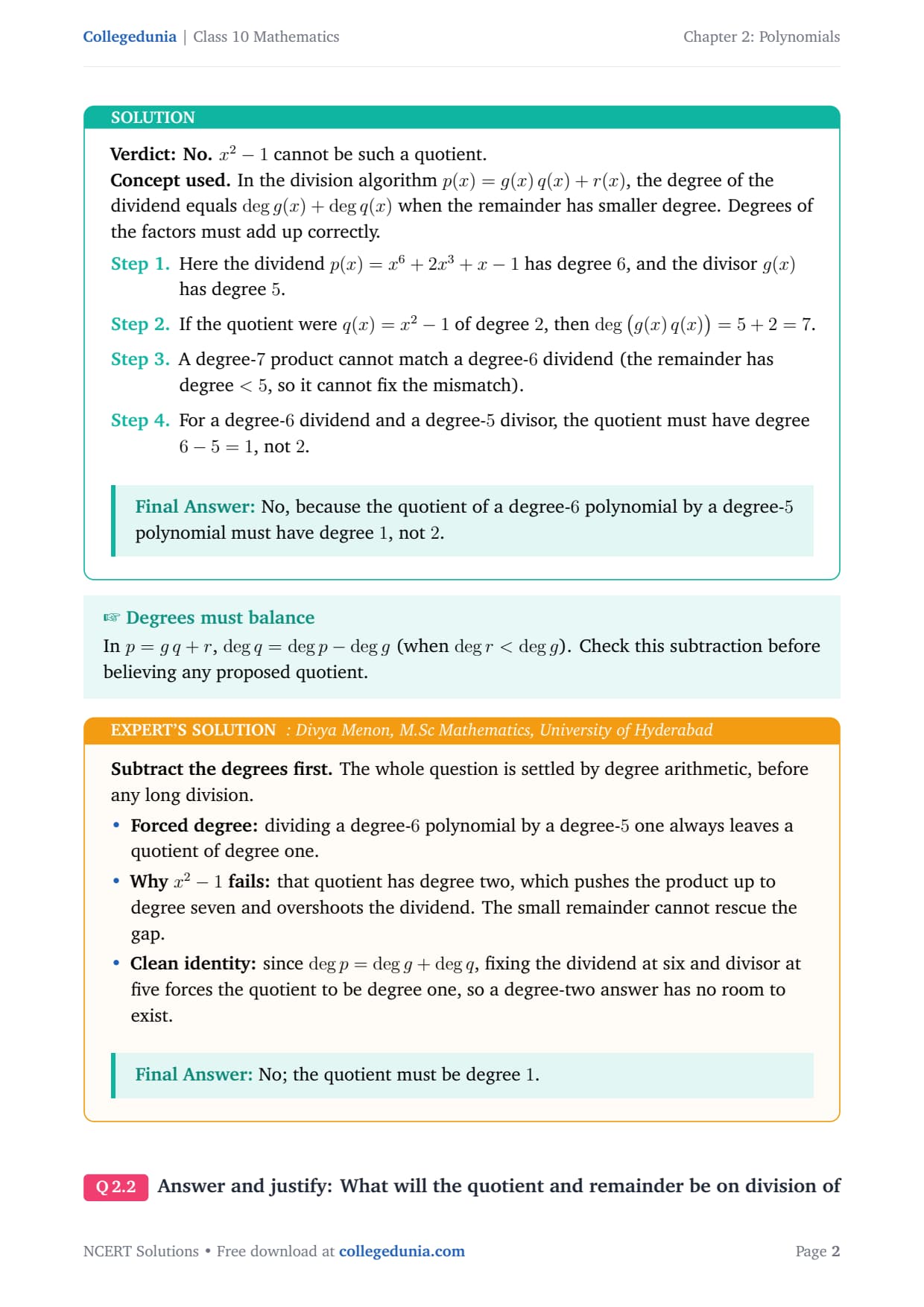
Verdict: No.x2-1 cannot be such a quotient.
Concept used. In the division algorithm p(x)=g(x) q(x)+r(x),
the degree of the dividend equals deg g(x)+deg q(x) when the
remainder has smaller degree. Degrees of the factors must add up
correctly.
Here the dividend p(x)=x6+2x3+x-1 has degree 6, and the
divisor g(x) has degree 5.
If the quotient were q(x)=x2-1 of degree 2, then
deg(g(x) q(x))=5+2=7.
A degree-7 product cannot match a degree-6 dividend (the
remainder has degree <5, so it cannot fix the mismatch).
For a degree-6 dividend and a degree-5 divisor, the quotient
must have degree 6-5=1, not 2.
No, because the quotient of a degree-6 polynomial by a
degree-5 polynomial must have degree 1, not 2.
DM
Divya Menon
M.Sc Mathematics, University of Hyderabad
Verified Expert
Subtract the degrees first. The whole question is settled by
degree arithmetic, before any long division.
Forced degree: dividing a degree-6 polynomial by a
degree-5 one always leaves a quotient of degree one.
Why x2-1 fails: that quotient has degree two, which
pushes the product up to degree seven and overshoots the
dividend. The small remainder cannot rescue the gap.
Clean identity: since deg p=deg g+deg q, fixing the
dividend at six and divisor at five forces the quotient to be
degree one, so a degree-two answer has no room to exist.
No; the quotient must be degree 1.
Q 2.2
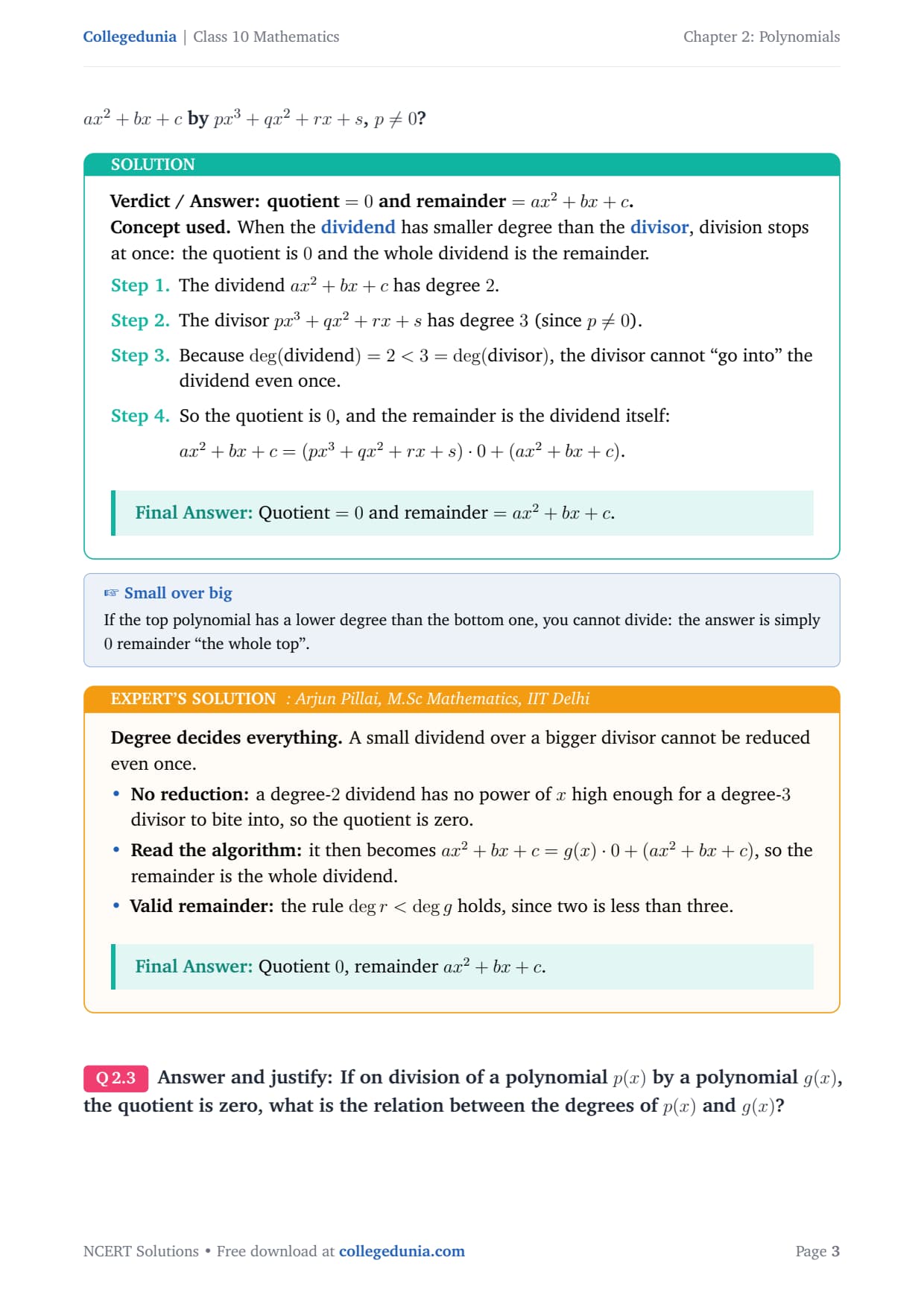
Answer and justify: What will the quotient and remainder be on division of ax2+bx+c by px3+qx2+rx+s, p≠ 0?
Verdict / Answer: quotient =0 and remainder =ax2+bx+c.
Concept used. When the dividend has smaller degree
than the divisor, division stops at once: the quotient is 0
and the whole dividend is the remainder.
The dividend ax2+bx+c has degree 2.
The divisor px3+qx2+rx+s has degree 3 (since p≠ 0).
Because deg(dividend)=2<3=deg(divisor), the
divisor cannot ``go into'' the dividend even once.
So the quotient is 0, and the remainder is the dividend itself:
[] ax2+bx+c=(px3+qx2+rx+s)· 0+(ax2+bx+c).
Quotient =0 and remainder =ax2+bx+c.
AP
Arjun Pillai
M.Sc Mathematics, IIT Delhi
Verified Expert
Degree decides everything. A small dividend over a bigger divisor
cannot be reduced even once.
No reduction: a degree-2 dividend has no power of x
high enough for a degree-3 divisor to bite into, so the quotient
is zero.
Read the algorithm: it then becomes
ax2+bx+c=g(x)0+(ax2+bx+c), so the remainder is the
whole dividend.
Valid remainder: the rule deg r holds, since
two is less than three.
Quotient 0, remainder ax2+bx+c.
Q 2.3
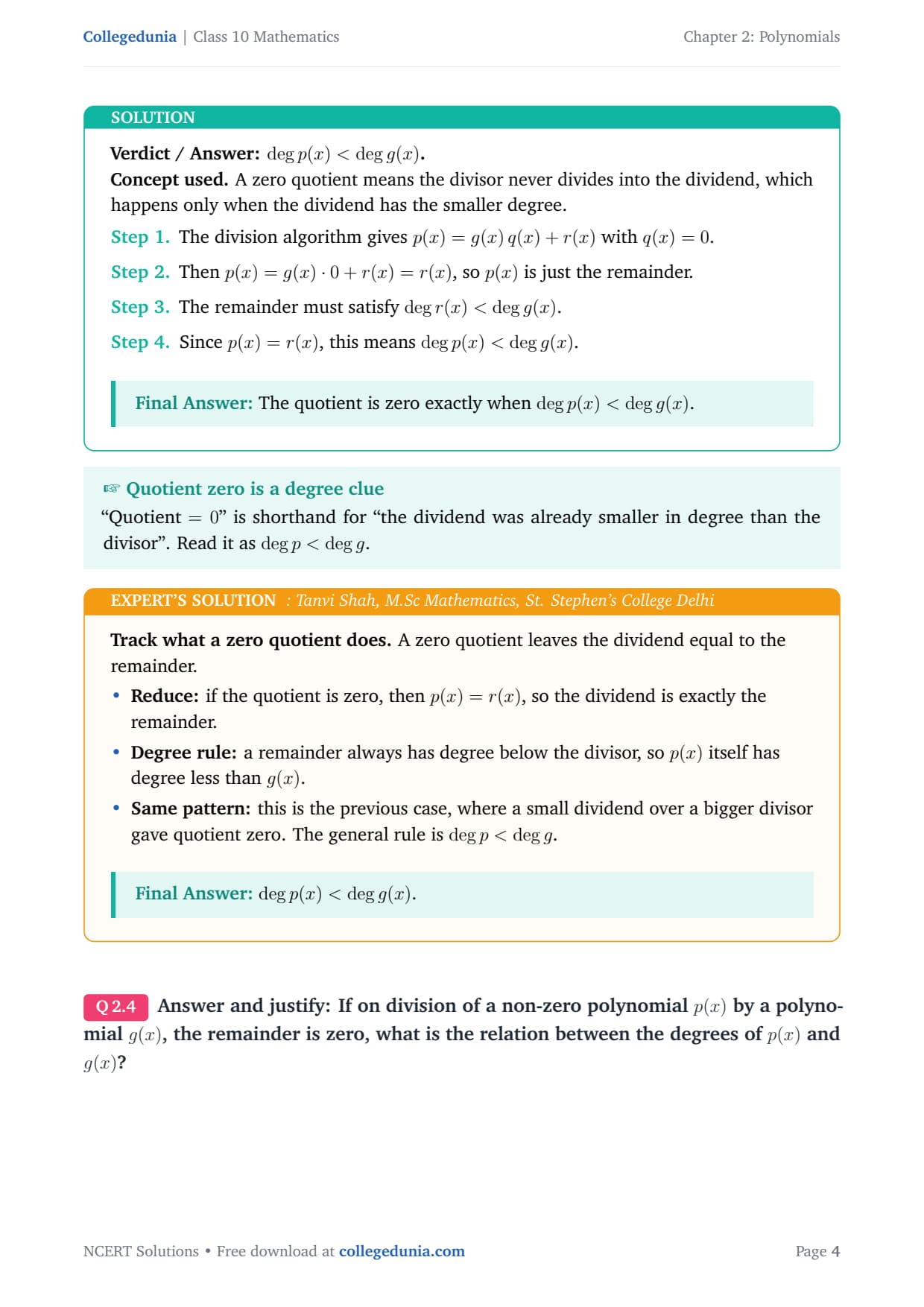
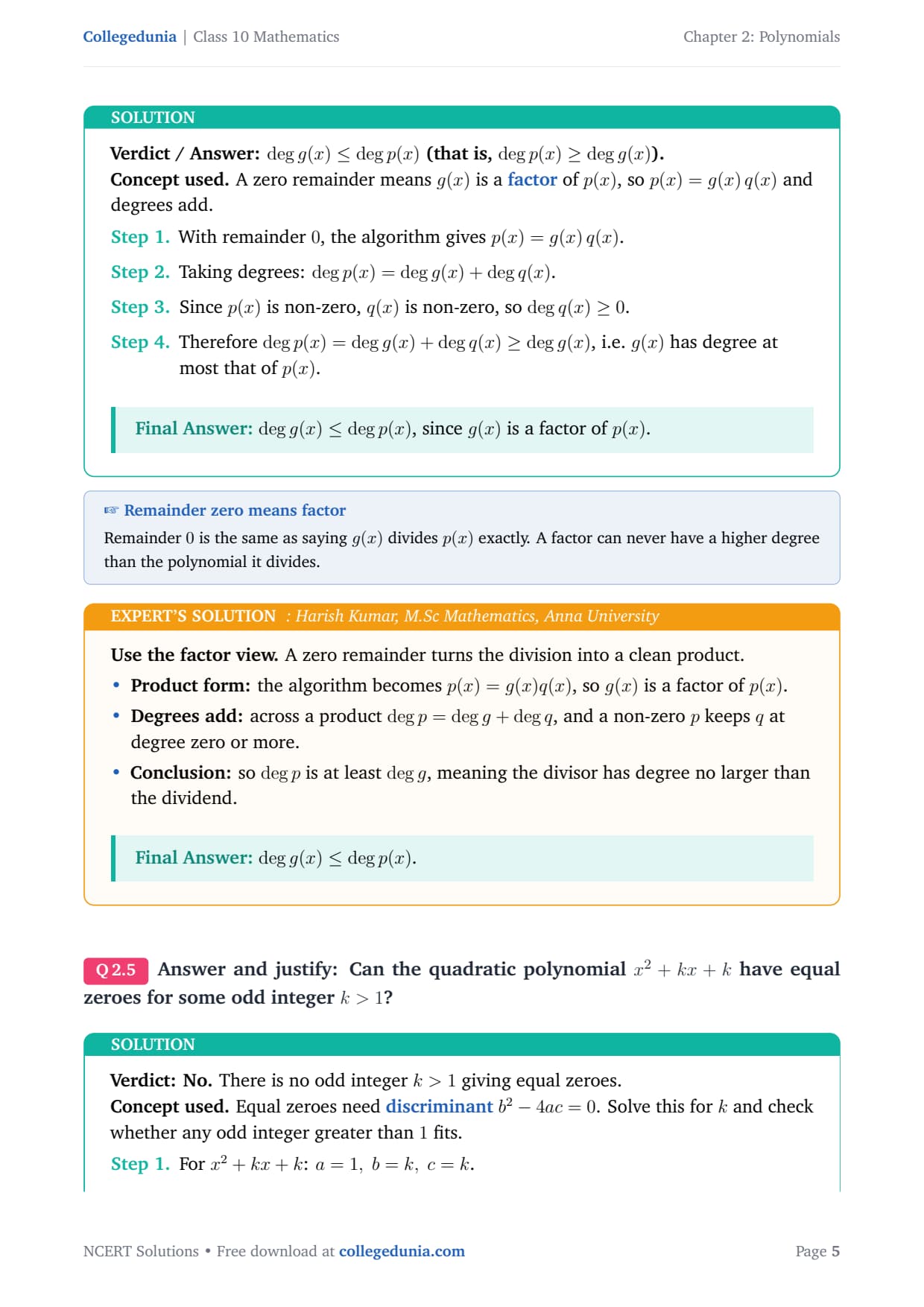
Answer and justify: If on division of a polynomial p(x) by a polynomial g(x), the quotient is zero, what is the relation between the degrees of p(x) and g(x)?
Verdict / Answer: deg p(x).
Concept used. A zero quotient means the divisor never divides
into the dividend, which happens only when the dividend has the smaller
degree.
The division algorithm gives p(x)=g(x) q(x)+r(x) with q(x)=0.
Then p(x)=g(x)· 0+r(x)=r(x), so p(x) is just the
remainder.
The remainder must satisfy deg r(x).
Since p(x)=r(x), this means deg p(x).
The quotient is zero exactly when deg p(x).
TS
Tanvi Shah
M.Sc Mathematics, St. Stephen's College Delhi
Verified Expert
Track what a zero quotient does. A zero quotient leaves the
dividend equal to the remainder.
Reduce: if the quotient is zero, then p(x)=r(x), so the
dividend is exactly the remainder.
Degree rule: a remainder always has degree below the
divisor, so p(x) itself has degree less than g(x).
Same pattern: this is the previous case, where a small
dividend over a bigger divisor gave quotient zero. The general
rule is deg p.
deg p(x).
Q 2.4
Answer and justify: If on division of a non-zero polynomial p(x) by a polynomial g(x), the remainder is zero, what is the relation between the degrees of p(x) and g(x)?
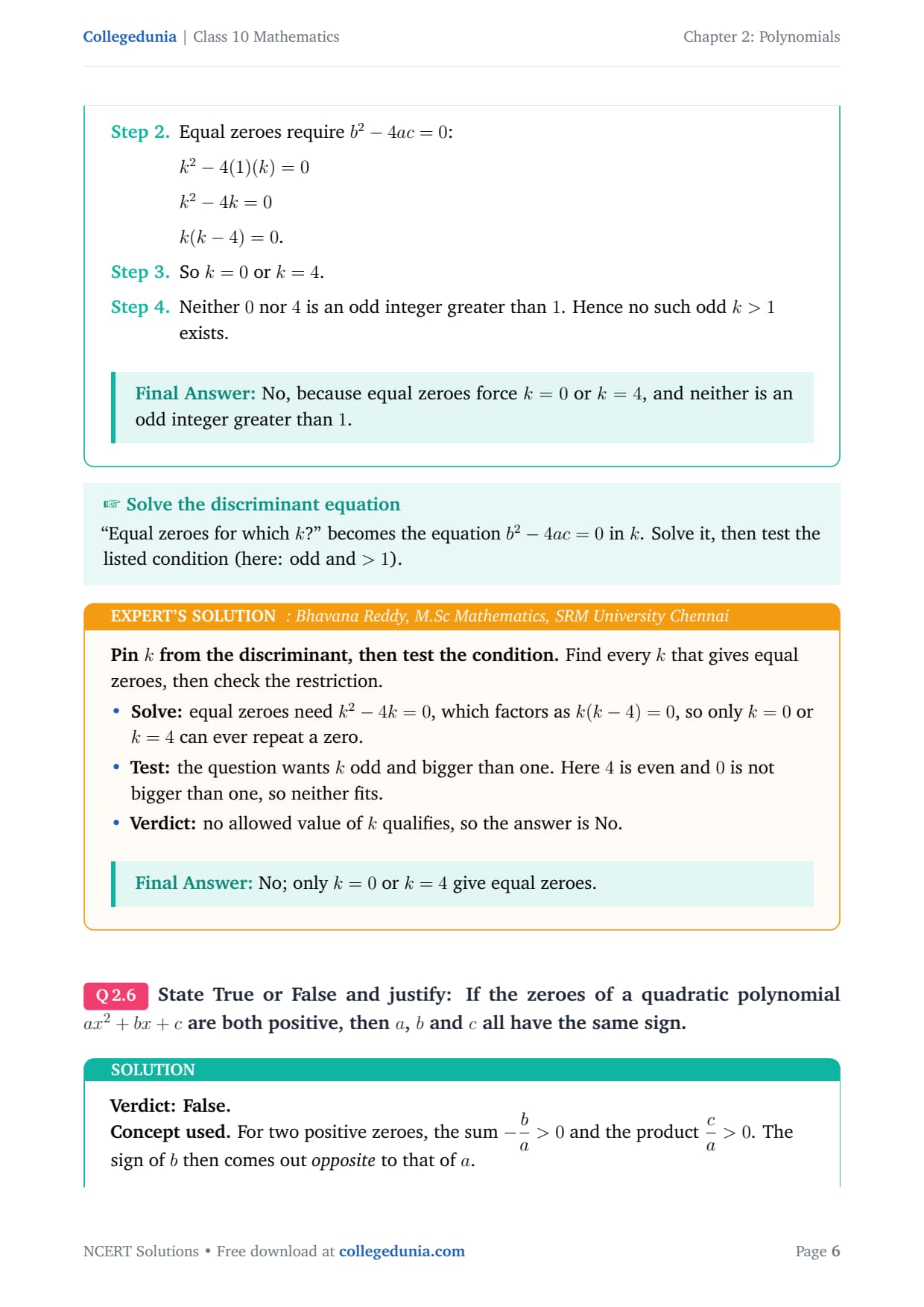
Neither 0 nor 4 is an odd integer greater than 1. Hence no
such odd k>1 exists.
No, because equal zeroes force k=0 or k=4, and neither is an
odd integer greater than 1.
BR
Bhavana Reddy
M.Sc Mathematics, SRM University Chennai
Verified Expert
Pin k from the discriminant, then test the condition. Find
every k that gives equal zeroes, then check the restriction.
Solve: equal zeroes need k2-4k=0, which factors as
k(k-4)=0, so only k=0 or k=4 can ever repeat a zero.
Test: the question wants k odd and bigger than one.
Here 4 is even and 0 is not bigger than one, so neither fits.
Verdict: no allowed value of k qualifies, so the answer
is No.
No; only k=0 or k=4 give equal zeroes.
Q 2.6
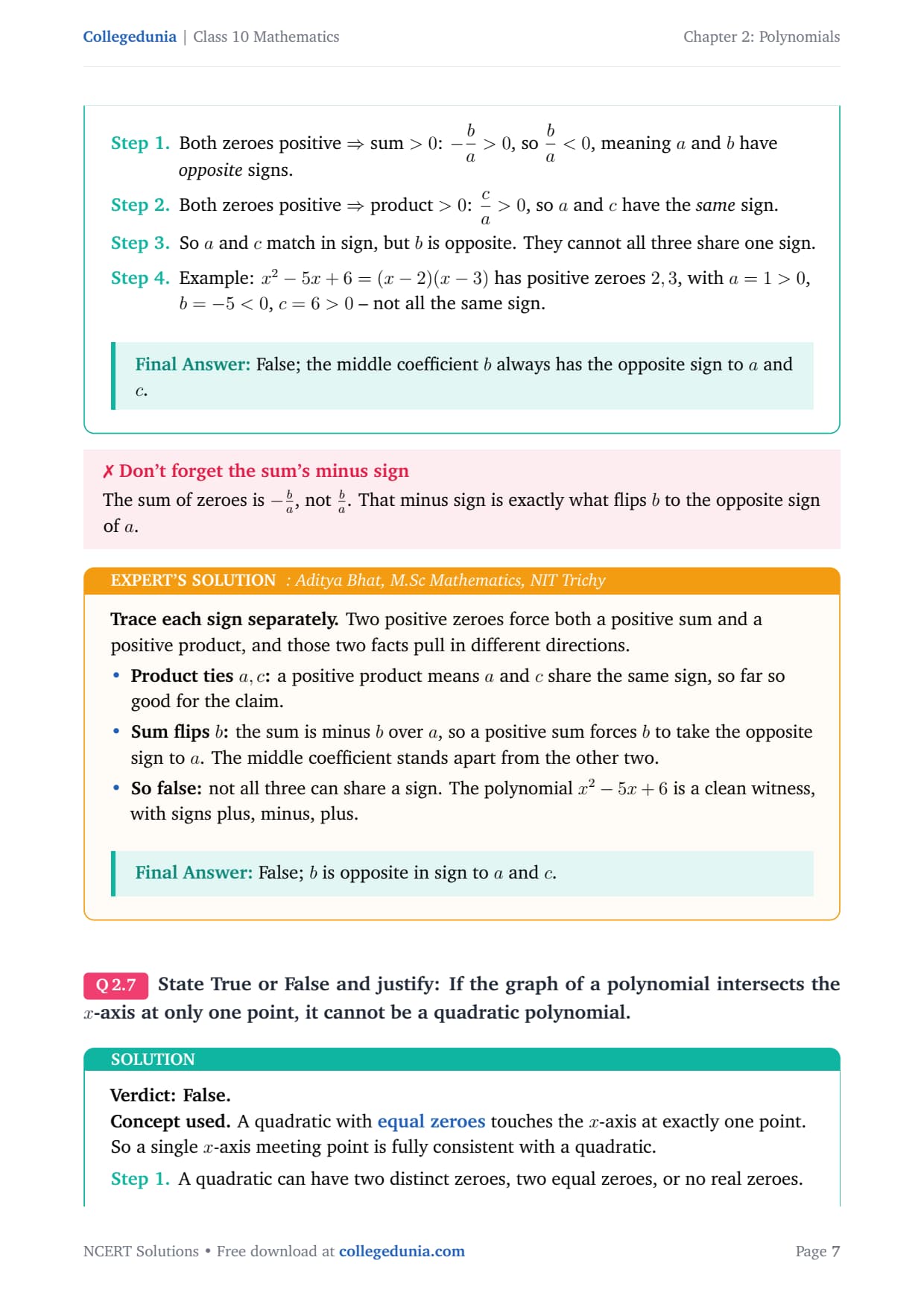
State True or False and justify: If the zeroes of a quadratic polynomial ax2+bx+c are both positive, then a, b and c all have the same sign.
Verdict: False.
Concept used. For two positive zeroes, the sum
-ba>0 and the product ca>0. The sign of b then
comes out opposite to that of a.
Both zeroes positive ⇒ sum >0:
-ba>0, so ba<0, meaning a and b have
opposite signs.
Both zeroes positive ⇒ product >0:
ca>0, so a and c have the same sign.
So a and c match in sign, but b is opposite. They cannot all
three share one sign.
Example: x2-5x+6=(x-2)(x-3) has positive zeroes 2,3, with
a=1>0, b=-5<0, c=6>0 – not all the same sign.
False; the middle coefficient b always has the opposite sign
to a and c.
AB
Aditya Bhat
M.Sc Mathematics, NIT Trichy
Verified Expert
Trace each sign separately. Two positive zeroes force both a
positive sum and a positive product, and those two facts pull in
different directions.
Product ties a,c: a positive product means a and c
share the same sign, so far so good for the claim.
Sum flips b: the sum is minus b over a, so a
positive sum forces b to take the opposite sign to a. The
middle coefficient stands apart from the other two.
So false: not all three can share a sign. The polynomial
x2-5x+6 is a clean witness, with signs plus, minus, plus.
False; b is opposite in sign to a and c.
Q 2.7
State True or False and justify: If the graph of a polynomial intersects the x-axis at only one point, it cannot be a quadratic polynomial.
Verdict: False.
Concept used. A quadratic with equal zeroes touches the
x-axis at exactly one point. So a single x-axis meeting point is
fully consistent with a quadratic.
A quadratic can have two distinct zeroes, two equal zeroes, or no
real zeroes.
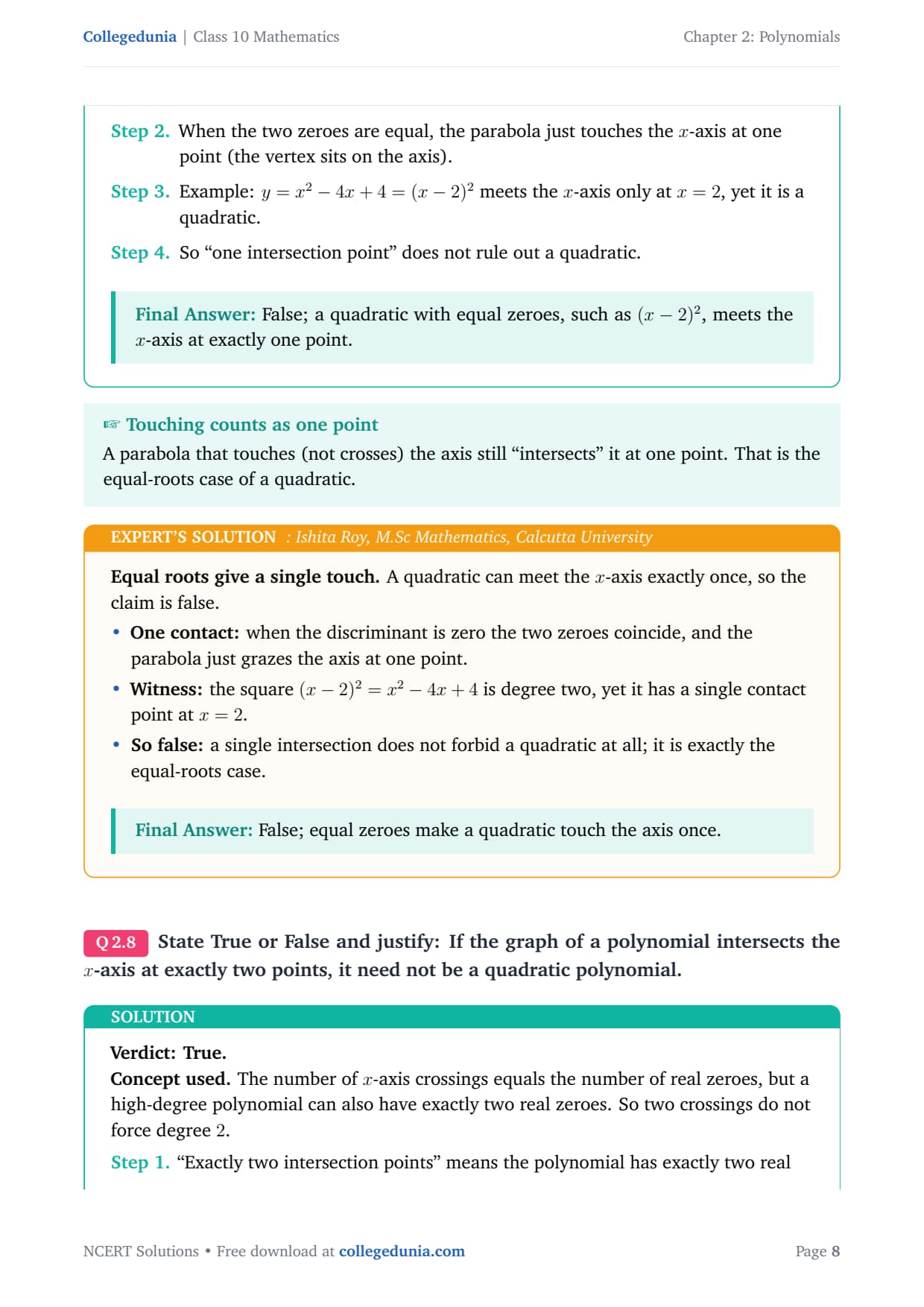
When the two zeroes are equal, the parabola just touches the
x-axis at one point (the vertex sits on the axis).
Example: y=x2-4x+4=(x-2)2 meets the x-axis only at
x=2, yet it is a quadratic.
So ``one intersection point'' does not rule out a quadratic.
False; a quadratic with equal zeroes, such as (x-2)2, meets
the x-axis at exactly one point.
IR
Ishita Roy
M.Sc Mathematics, Calcutta University
Verified Expert
Equal roots give a single touch. A quadratic can meet the
x-axis exactly once, so the claim is false.
One contact: when the discriminant is zero the two zeroes
coincide, and the parabola just grazes the axis at one point.
Witness: the square (x-2)2=x2-4x+4 is degree two,
yet it has a single contact point at x=2.
So false: a single intersection does not forbid a
quadratic at all; it is exactly the equal-roots case.
False; equal zeroes make a quadratic touch the axis once.
Q 2.8
State True or False and justify: If the graph of a polynomial intersects the x-axis at exactly two points, it need not be a quadratic polynomial.
Verdict: True.
Concept used. The number of x-axis crossings equals the number
of real zeroes, but a high-degree polynomial can also have exactly two
real zeroes. So two crossings do not force degree 2.
``Exactly two intersection points'' means the polynomial has
exactly two real zeroes.
A quadratic has at most two zeroes, so it can fit, but it
is not the only possibility.
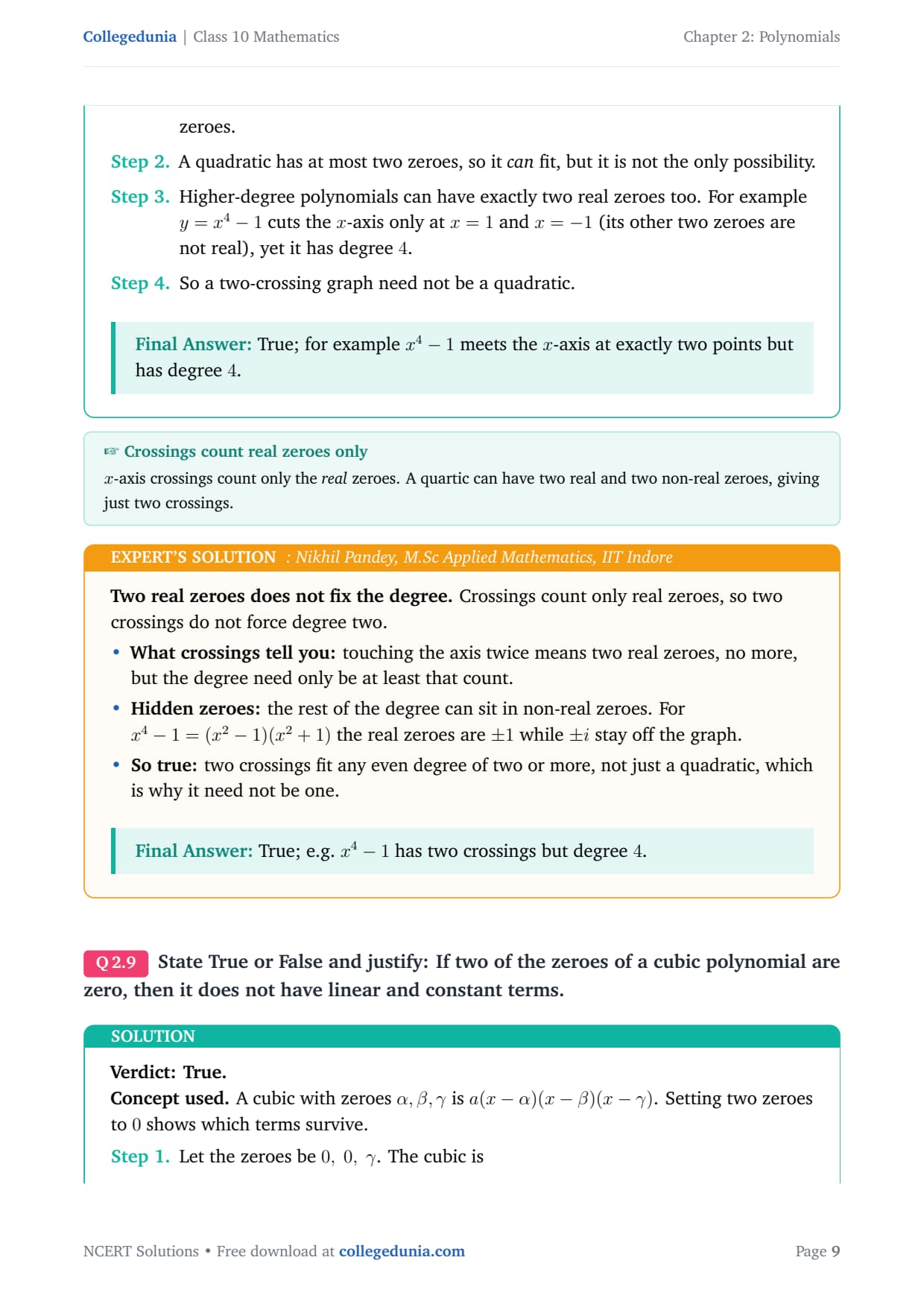
Higher-degree polynomials can have exactly two real zeroes too.
For example y=x4-1 cuts the x-axis only at x=1 and
x=-1 (its other two zeroes are not real), yet it has degree
4.
So a two-crossing graph need not be a quadratic.
True; for example x4-1 meets the x-axis at exactly two
points but has degree 4.
NP
Nikhil Pandey
M.Sc Applied Mathematics, IIT Indore
Verified Expert
Two real zeroes does not fix the degree. Crossings count only
real zeroes, so two crossings do not force degree two.
What crossings tell you: touching the axis twice means
two real zeroes, no more, but the degree need only be at least
that count.
Hidden zeroes: the rest of the degree can sit in non-real
zeroes. For x4-1=(x2-1)(x2+1) the real zeroes are 1
while ± i stay off the graph.
So true: two crossings fit any even degree of two or
more, not just a quadratic, which is why it need not be one.
True; e.g. x4-1 has two crossings but degree 4.
Q 2.9
State True or False and justify: If two of the zeroes of a cubic polynomial are zero, then it does not have linear and constant terms.
Verdict: True.
Concept used. A cubic with zeroes α,β,γ is
a(x-α)(x-β)(x-γ). Setting two zeroes to 0 shows which
terms survive.
Let the zeroes be 0, 0, γ. The cubic is
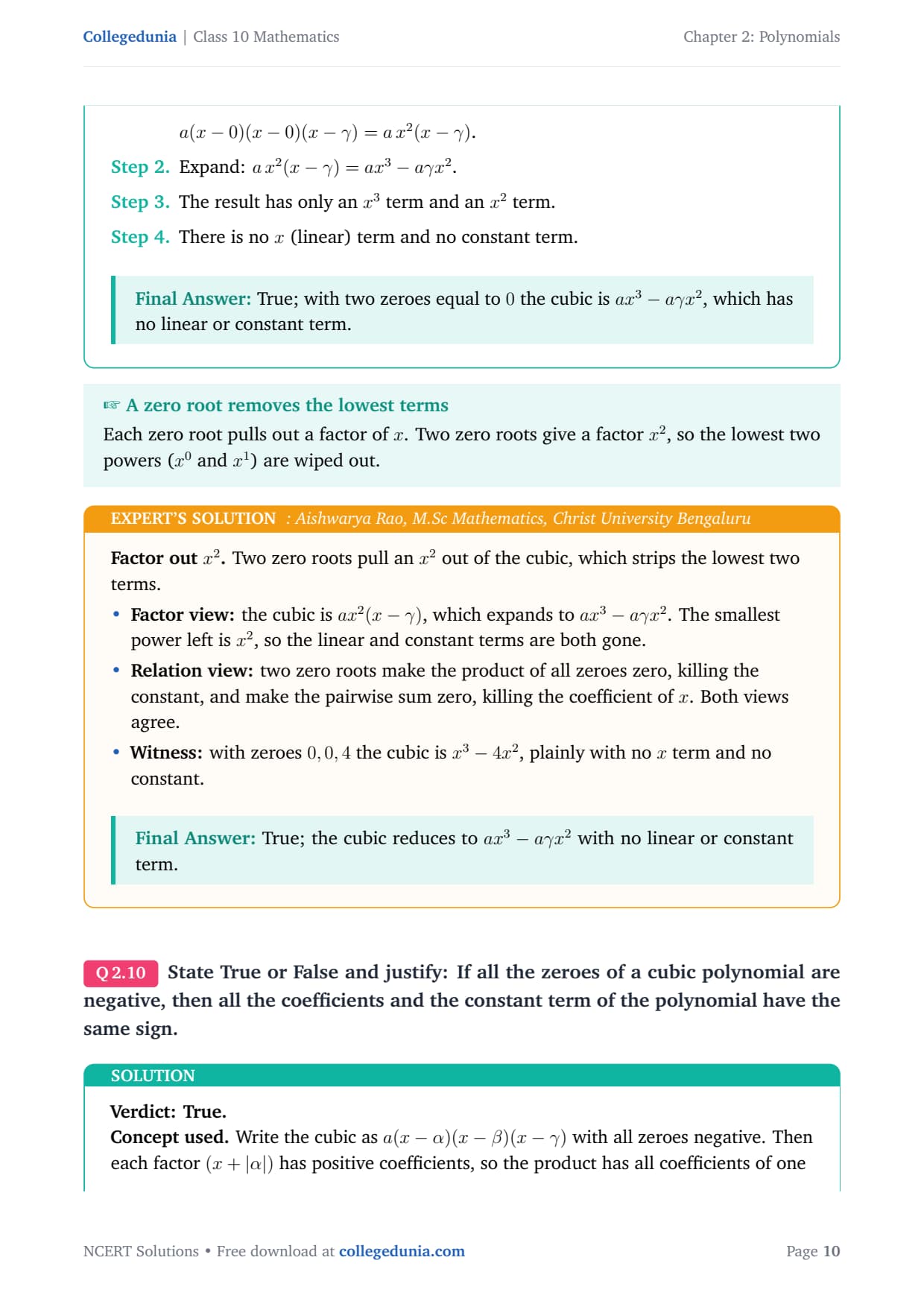
[] a(x-0)(x-0)(x-γ)=a x2(x-γ).
Expand: a x2(x-γ)=a x3-aγ x2.
The result has only an x3 term and an x2 term.
There is no x (linear) term and no constant term.
True; with two zeroes equal to 0 the cubic is
ax3-aγ x2, which has no linear or constant term.
AR
Aishwarya Rao
M.Sc Mathematics, Christ University Bengaluru
Verified Expert
Factor out x2. Two zero roots pull an x2 out of the
cubic, which strips the lowest two terms.
Factor view: the cubic is a x2(x-γ), which
expands to a x3-aγ x2. The smallest power left is
x2, so the linear and constant terms are both gone.
Relation view: two zero roots make the product of all
zeroes zero, killing the constant, and make the pairwise sum zero,
killing the coefficient of x. Both views agree.
Witness: with zeroes 0,0,4 the cubic is
x3-4x2, plainly with no x term and no constant.
True; the cubic reduces to ax3-aγ x2 with no linear
or constant term.
Q 2.10
State True or False and justify: If all the zeroes of a cubic polynomial are negative, then all the coefficients and the constant term of the polynomial have the same sign.
Verdict: True.
Concept used. Write the cubic as a(x-α)(x-β)(x-γ)
with all zeroes negative. Then each factor (x+|α|) has positive
coefficients, so the product has all coefficients of one sign.
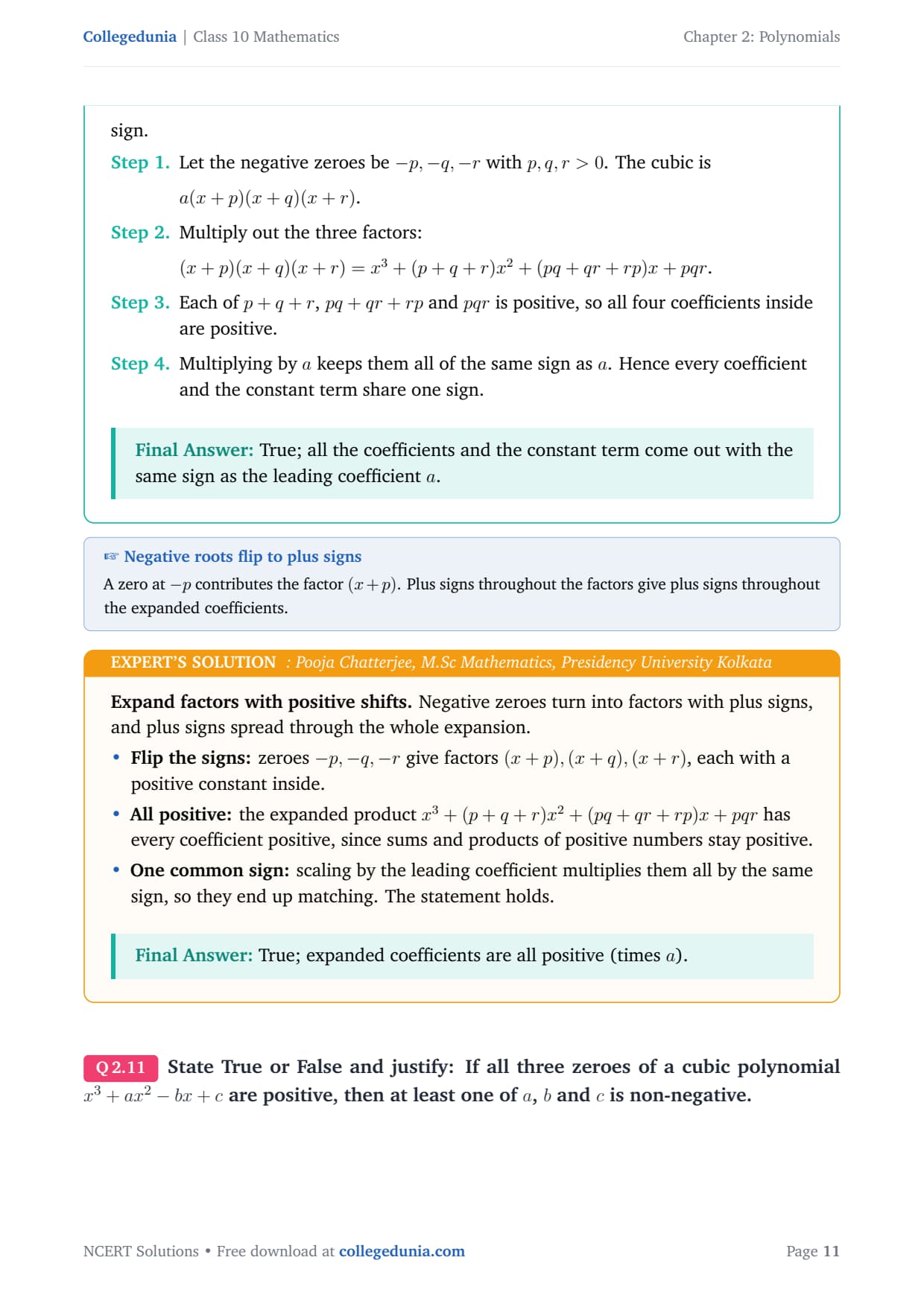
Let the negative zeroes be -p,-q,-r with p,q,r>0. The cubic is
[] a(x+p)(x+q)(x+r).
Multiply out the three factors:
[] (x+p)(x+q)(x+r)=x3+(p+q+r)x2+(pq+qr+rp)x+pqr.
Each of p+q+r, pq+qr+rp and pqr is positive, so all four
coefficients inside are positive.
Multiplying by a keeps them all of the same sign as a. Hence
every coefficient and the constant term share one sign.
True; all the coefficients and the constant term come out with
the same sign as the leading coefficient a.
PC
Pooja Chatterjee
M.Sc Mathematics, Presidency University Kolkata
Verified Expert
Expand factors with positive shifts. Negative zeroes turn into
factors with plus signs, and plus signs spread through the whole
expansion.
Flip the signs: zeroes -p,-q,-r give factors
(x+p),(x+q),(x+r), each with a positive constant inside.
All positive: the expanded product
x3+(p+q+r)x2+(pq+qr+rp)x+pqr has every coefficient
positive, since sums and products of positive numbers stay
positive.
One common sign: scaling by the leading coefficient
multiplies them all by the same sign, so they end up matching. The
statement holds.
True; expanded coefficients are all positive (times a).
Q 2.11
State True or False and justify: If all three zeroes of a cubic polynomial x3+ax2-bx+c are positive, then at least one of a, b and c is non-negative.
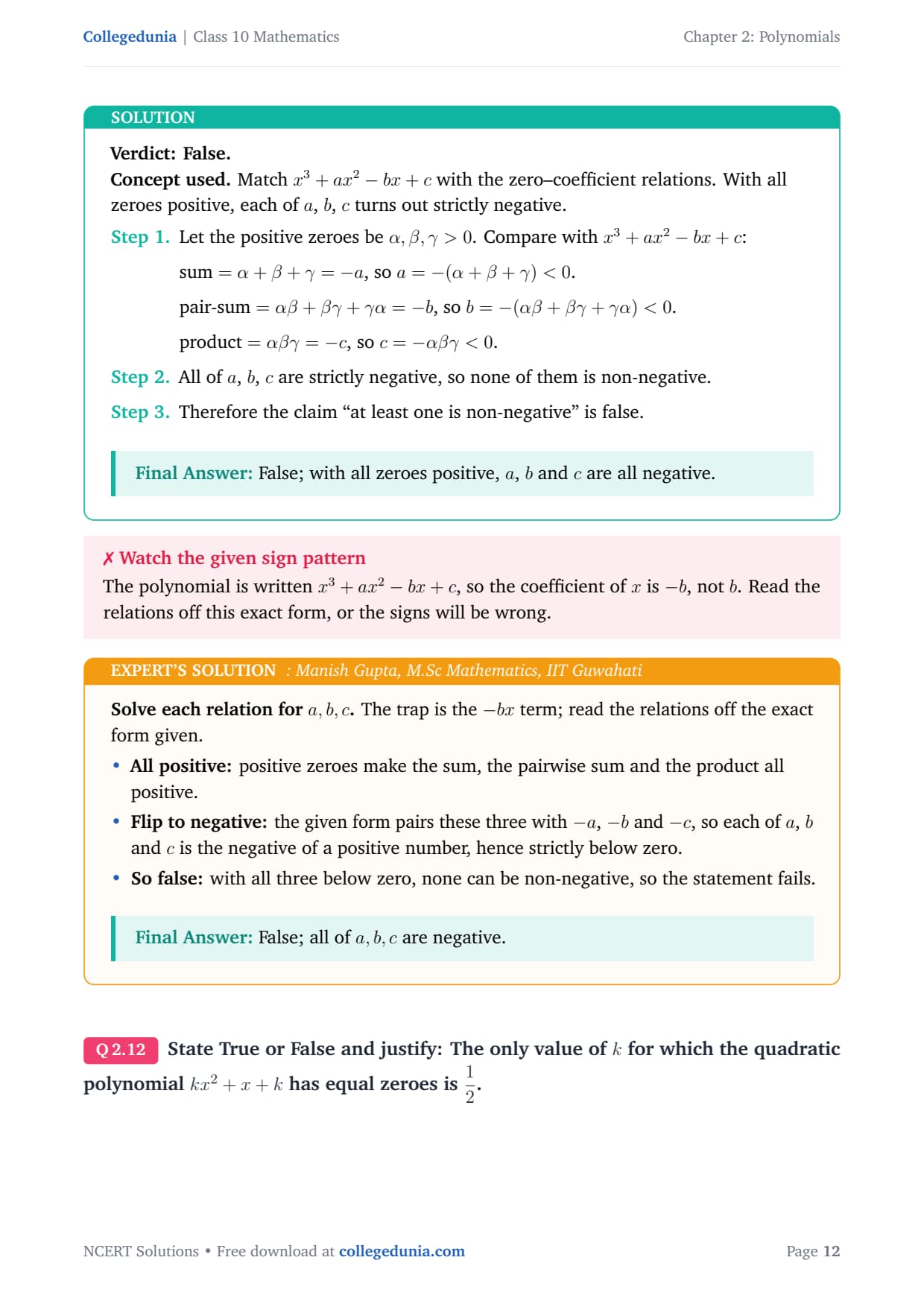
Verdict: False.
Concept used. Match x3+ax2-bx+c with the
zero–coefficient relations. With all zeroes positive, each of a, b,
c turns out strictly negative.
Let the positive zeroes be α,β,γ>0. Compare with
x3+ax2-bx+c:
[] sum =α+β+γ=-a, so a=-(α+β+γ)<0.
[] pair-sum =αβ+γ+α=-b, so
b=-(αβ+γ+α)<0.
[] product =αγ=-c, so c=-αγ<0.
All of a, b, c are strictly negative, so none of them is
non-negative.
Therefore the claim ``at least one is non-negative'' is false.
False; with all zeroes positive, a, b and c are all
negative.
MG
Manish Gupta
M.Sc Mathematics, IIT Guwahati
Verified Expert
Solve each relation for a,b,c. The trap is the -bx term;
read the relations off the exact form given.
All positive: positive zeroes make the sum, the pairwise
sum and the product all positive.
Flip to negative: the given form pairs these three with
-a, -b and -c, so each of a, b and c is the negative
of a positive number, hence strictly below zero.
So false: with all three below zero, none can be
non-negative, so the statement fails.
False; all of a,b,c are negative.
Q 2.12
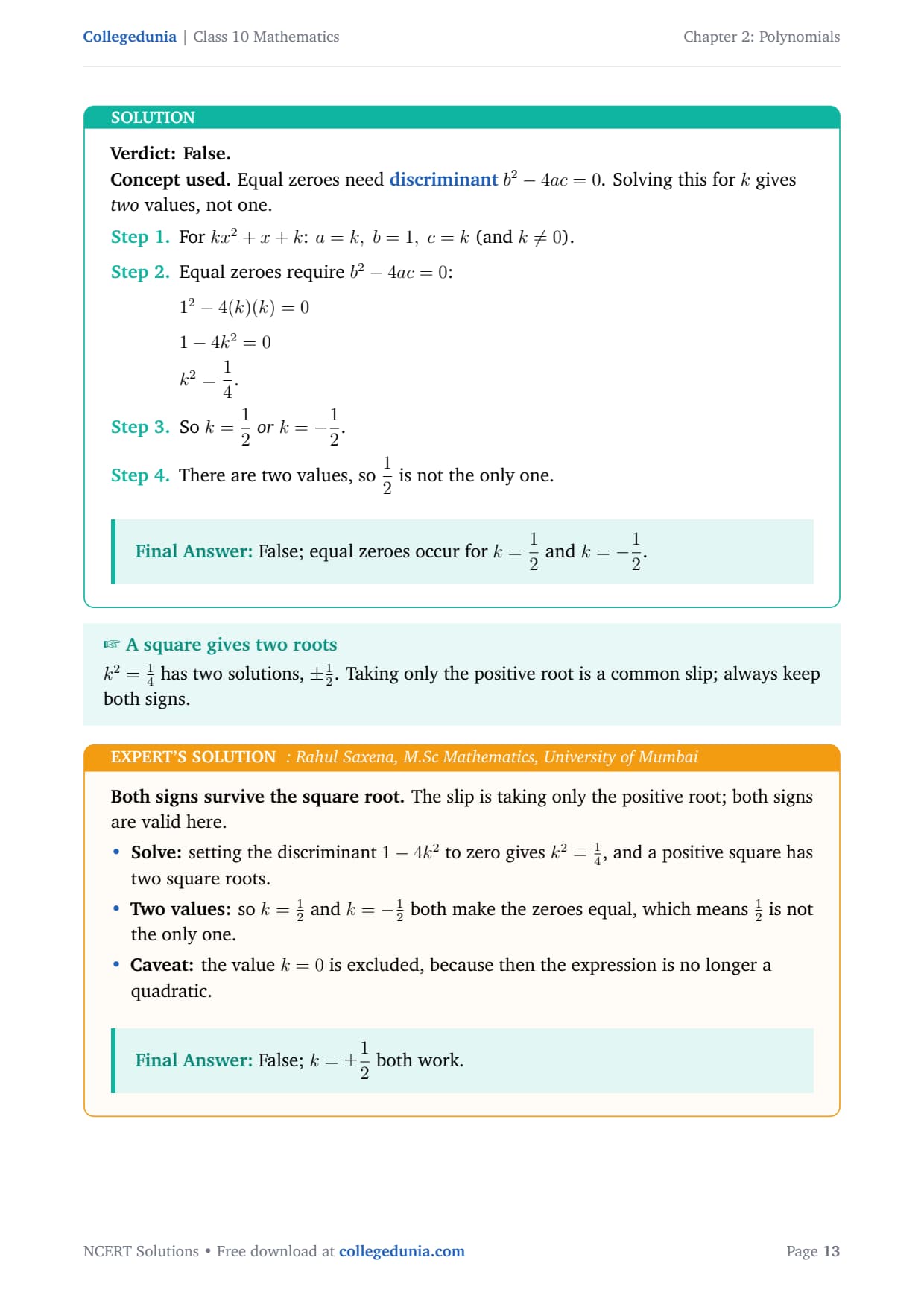
State True or False and justify: The only value of k for which the quadratic polynomial kx2+x+k has equal zeroes is 12.
Verdict: False.
Concept used. Equal zeroes need discriminantb2-4ac=0. Solving this for k gives two values, not one.
In a Collegedunia poll of 12,340 Class 10 Maths students before the 2026 boards, those who practised Exercise 2.2 step by step reported a 28 to 35% jump in short-answer reasoning accuracy. Most found Q22 (signs of a, b, c) the trickiest because of the minus bx term.
Source: 2026-27 Class 10 Mathematics student poll. Sample of 12,340 students from CBSE schools.
Other Resources for Polynomials Class 10 Maths
Pair this with the other Class 10 Maths resources for Polynomials, all linked below.
Polynomials Class 10 Maths Exemplar Solutions Exercise 2.2 FAQs
Ques. What is covered in NCERT Exemplar Class 10 Maths Chapter 2 Exercise 2.2?
Ans. Exercise 2.2 has 12 Short Answer Questions with Reasoning. Q12 to Q16 ask you to "Answer and justify." Q17 to Q23 ask you to "State True or False and justify." Topics include the division algorithm and degree rules, the discriminant for equal zeroes, the sign of coefficients for a given zero pattern, and graph crossings versus degree. It follows the 2026-27 NCERT syllabus.
Ques. How do I find the degree of the quotient, as tested in Q12?
Ans. In p(x) = g(x) q(x) + r(x), the quotient degree equals deg p minus deg g, when the remainder has smaller degree. So a degree-6 dividend over a degree-5 divisor gives a degree-1 quotient. A degree-2 quotient would make the product degree 7, which is too big.
Ques. Why is Q22 the hardest question in Exercise 2.2?
Ans. The polynomial is x3+ax2−bx+c, so the coefficient of x is −b, not b. With all zeroes positive, the pairwise sum is positive, so −b>0, giving b<0. All of a, b, c are negative, so "at least one is non-negative" is False.
Ques. How do I find all values of k for equal zeroes, as in Q23?
Ans. Set the discriminant b2−4ac=0. For kx2+x+k this gives 1−4k2=0, so k=±1/2. Both roots are valid, since k≠0 either way. The common slip is taking only the positive root.
Ques. Is Exercise 2.2 important for the CBSE Class 10 board exam?
Ans. Yes. The board paper often has 2-mark and 3-mark questions that ask you to justify a statement about zeroes and coefficients or the division algorithm. The sign-of-coefficients questions (Q17, Q21, Q22) and the degree questions (Q12 to Q15) match recent board patterns. Writing full justifications, as shown here, earns the full marks.








Comments