




The Ecosystem NCERT chapter for Class 12 Biology covers how producers, consumers and decomposers interact with the abiotic environment across productivity, energy flow, decomposition, nutrient cycling and ecological succession. It is a core read for CBSE Boards, NEET and CUET students. Download the verified 2026-27 NCERT Book PDF for Chapter 12 from this page.
- CBSE Weightage: 5-7 marks (commonly clubbed with Organisms & Populations and Biodiversity in the Ecology unit).
- NEET Weightage: 2-3 questions consistently across recent NEET papers from the Ecology and Environment unit.
- CUET Weightage: 3-4 MCQs typically appear in the Biology domain section.
About NCERT Class 12 Biology Chapter 12 Ecosystem Book PDF
Chapter 12 of the Class 12 Biology textbook runs across roughly 14 pages and is part of Unit X, Ecology and Environment. The chapter moves from ecosystem structure through productivity and decomposition to energy flow, ecological pyramids, succession, biogeochemical cycles and ecosystem services.
The official NCERT PDF preserves the original figure numbering (Fig. 14.1 to Fig. 14.10, retained in the 2026-27 reprint despite the Chapter 12 renumbering), the in-chapter "Do you know?" boxes and the chapter-end exercises that frequently reappear in board papers. The Collegedunia NCERT Book PDF mirrors the ncert.nic.in version with no edits to text or diagrams.
What is Inside the Ecosystem NCERT Book Chapter
The chapter has eight teaching sub-sections. Each section links a process to the key number that drives it, which is the format NEET and CUET examiners use in MCQ stems.
| Section | Topic | Key Concepts |
|---|---|---|
| 14.1 | Ecosystem: Structure and Function | Biotic + abiotic components, pond as model ecosystem, vertical stratification |
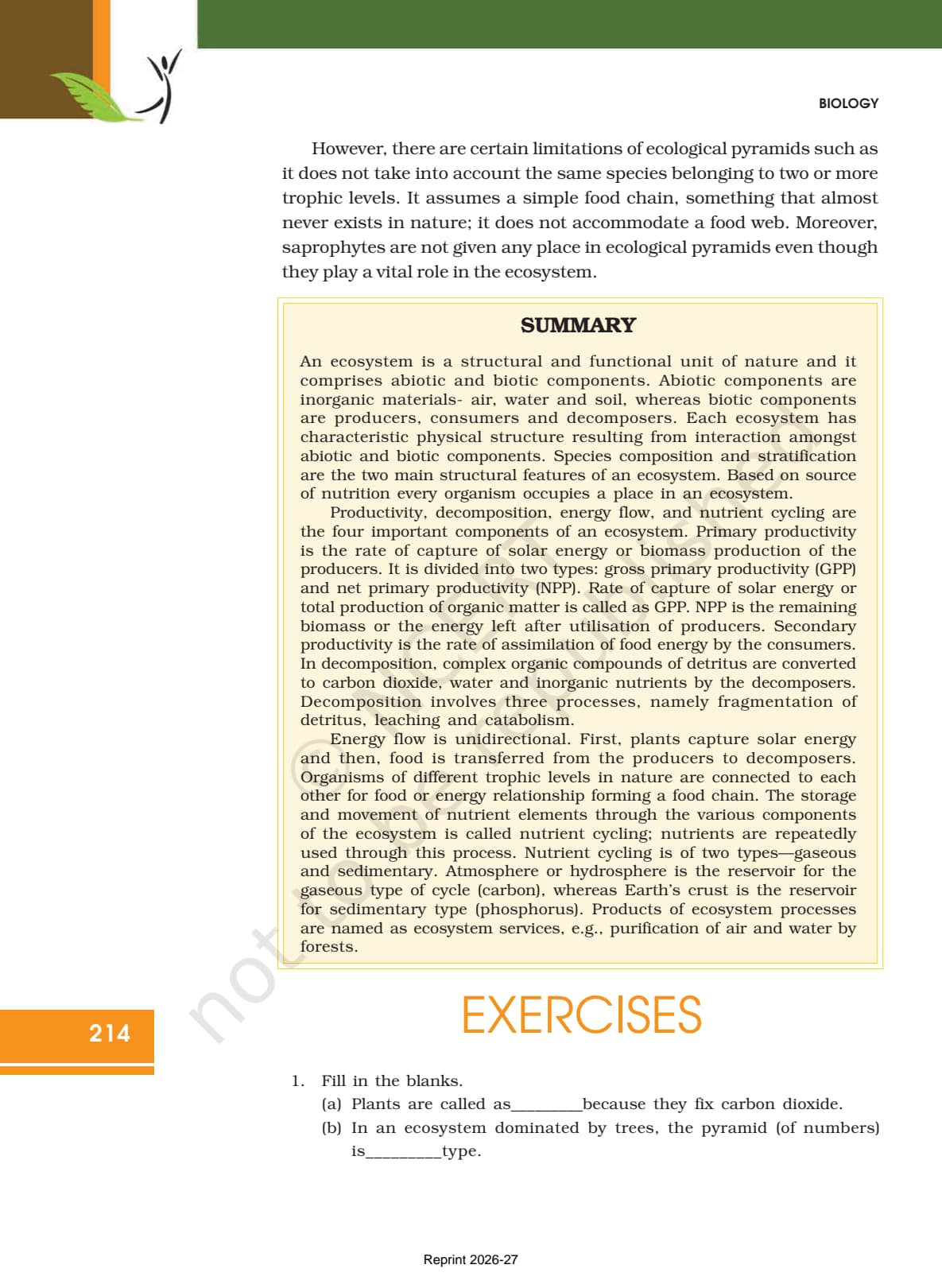
| 14.2 | Productivity | GPP, NPP = GPP − R, standing crop, biosphere NPP (~170 billion tonnes) |
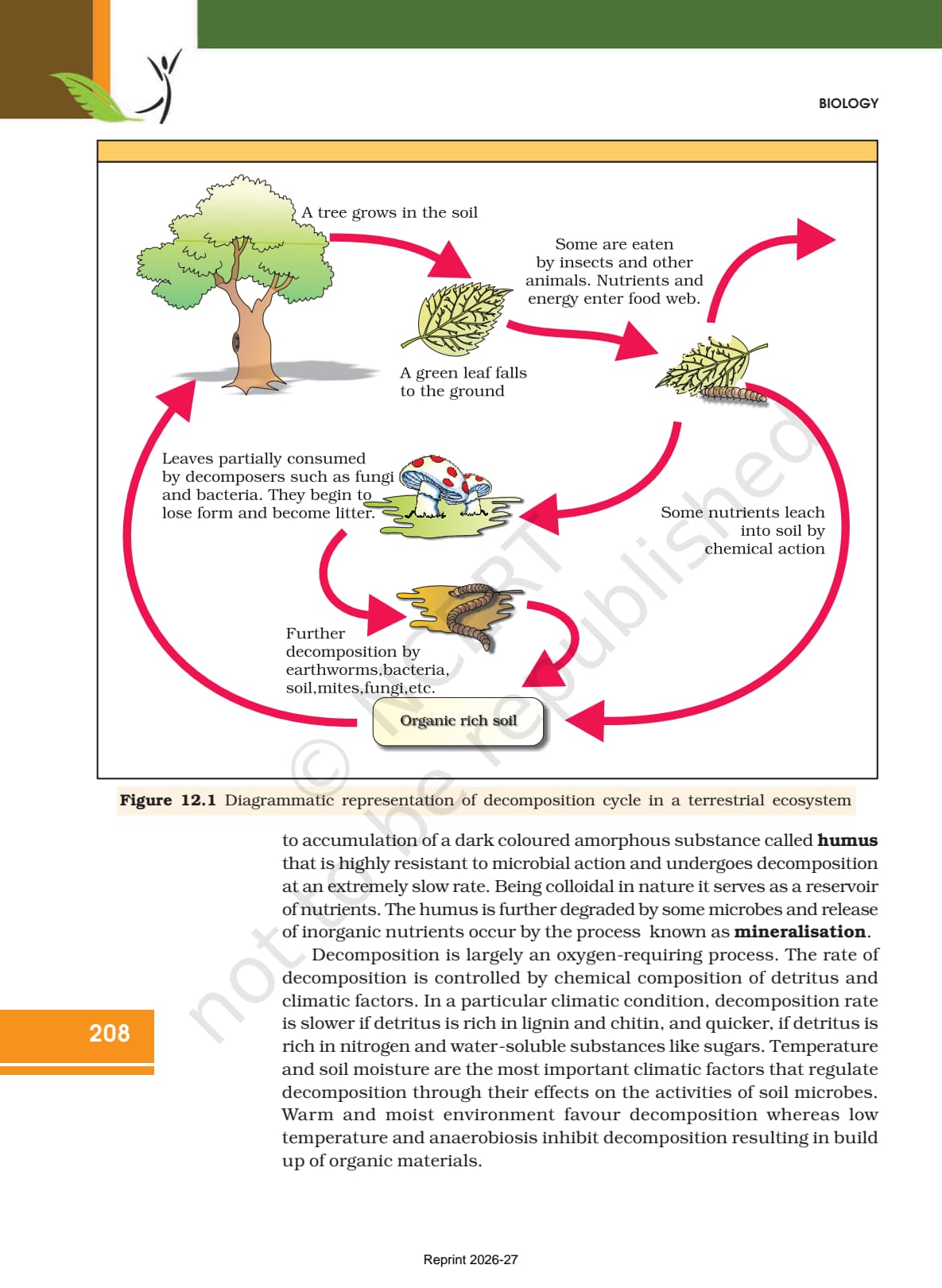
| 14.3 | Decomposition | Fragmentation, leaching, catabolism, humification, mineralisation; rate factors |
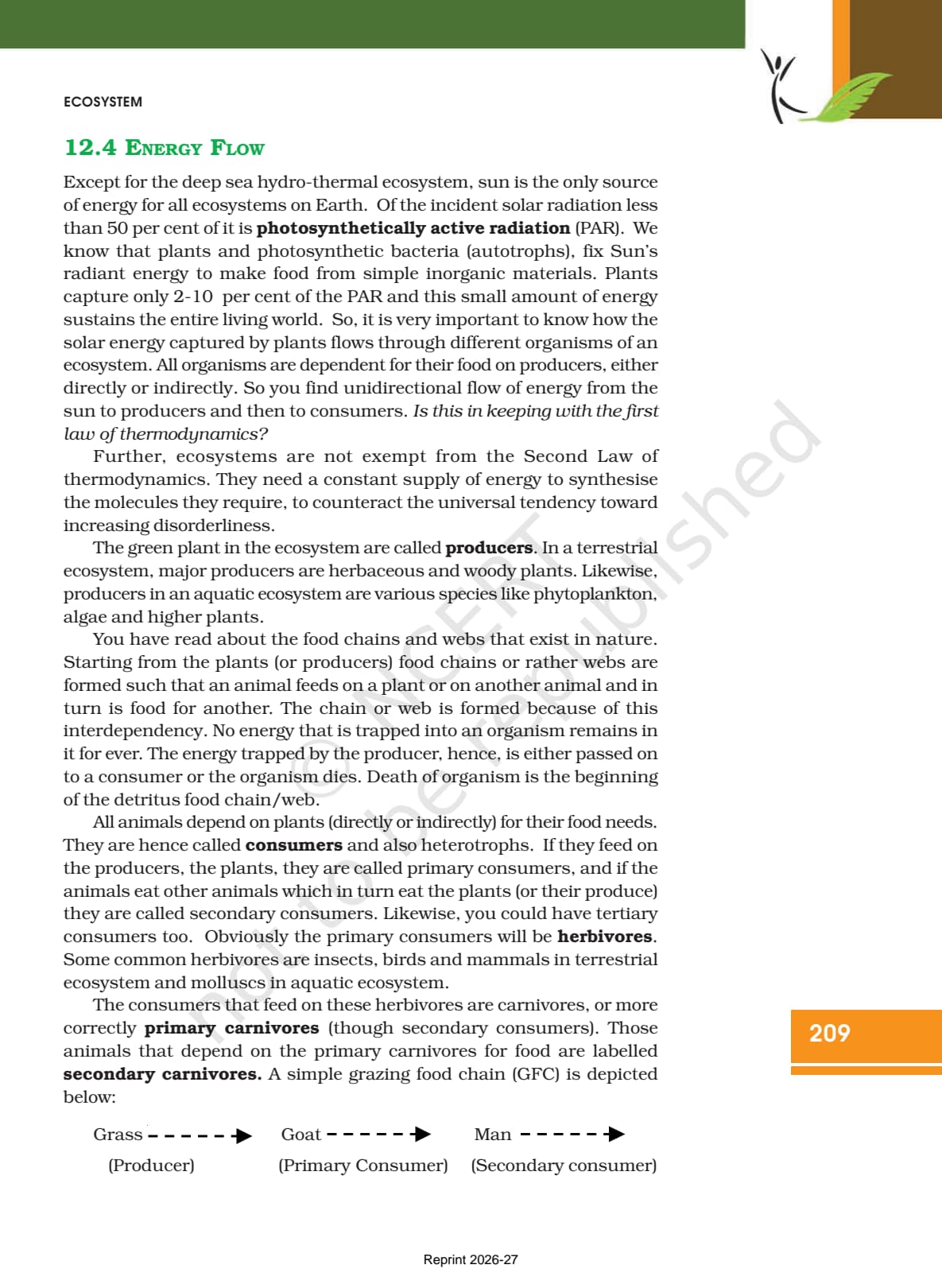
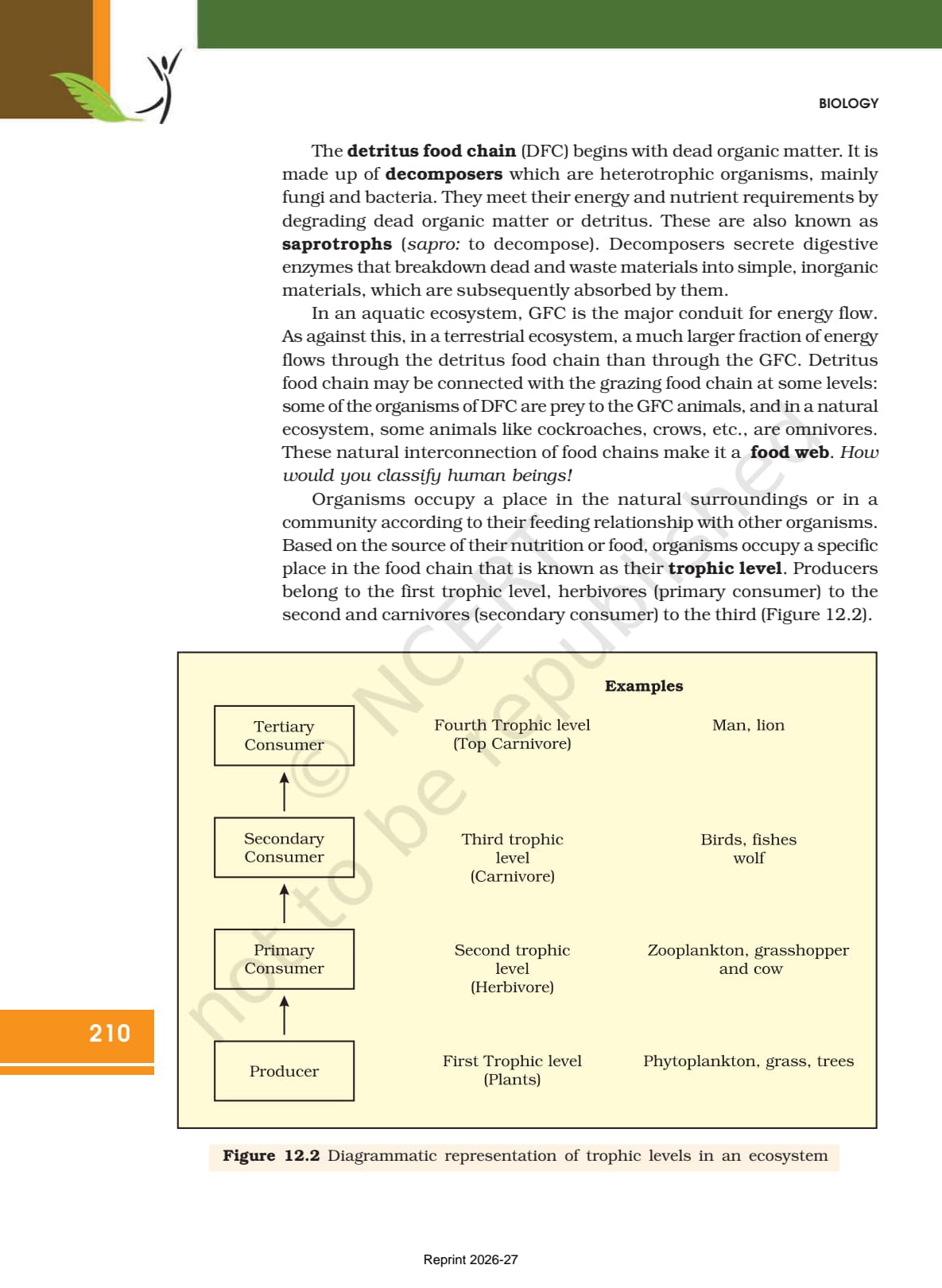
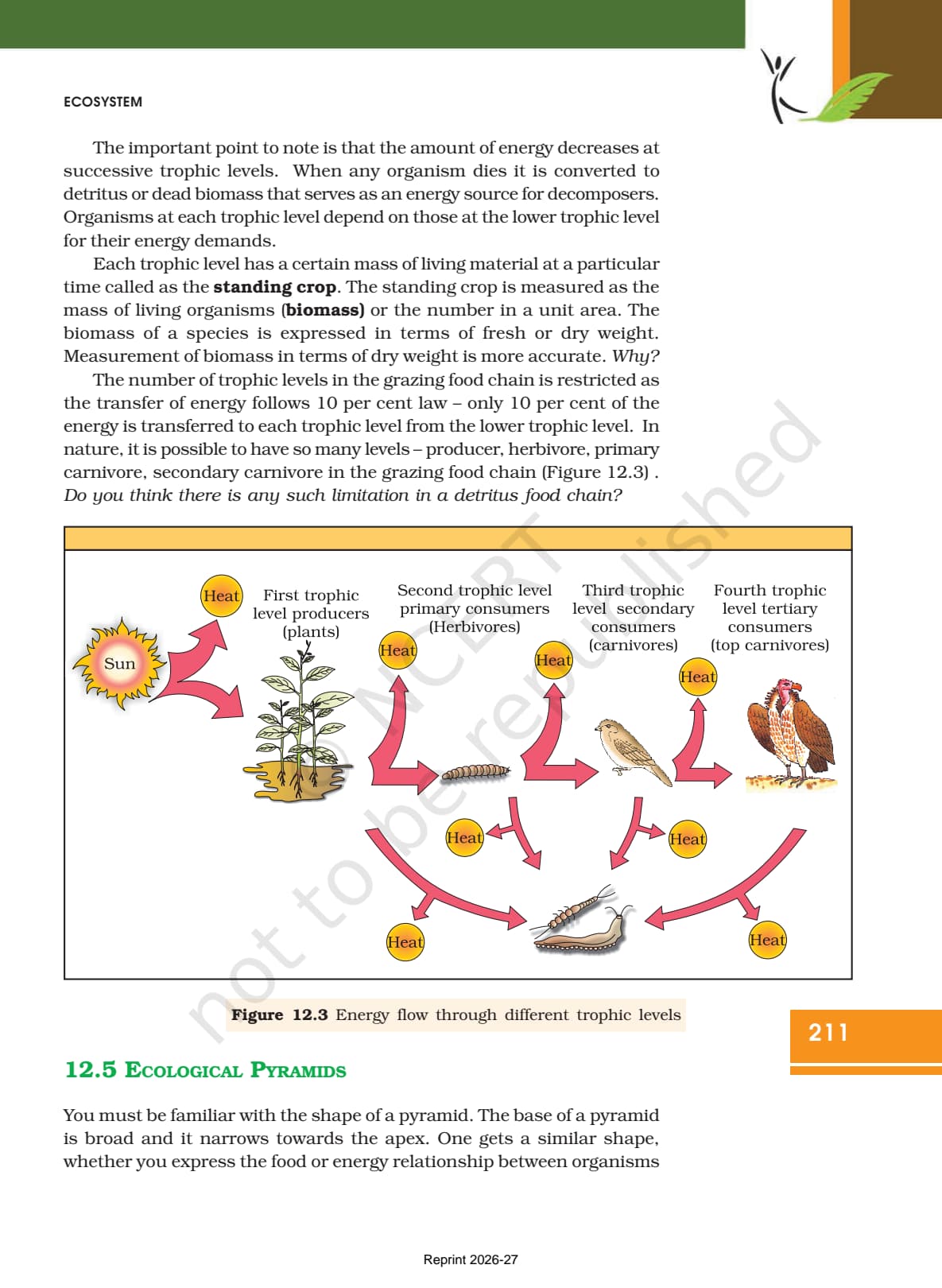
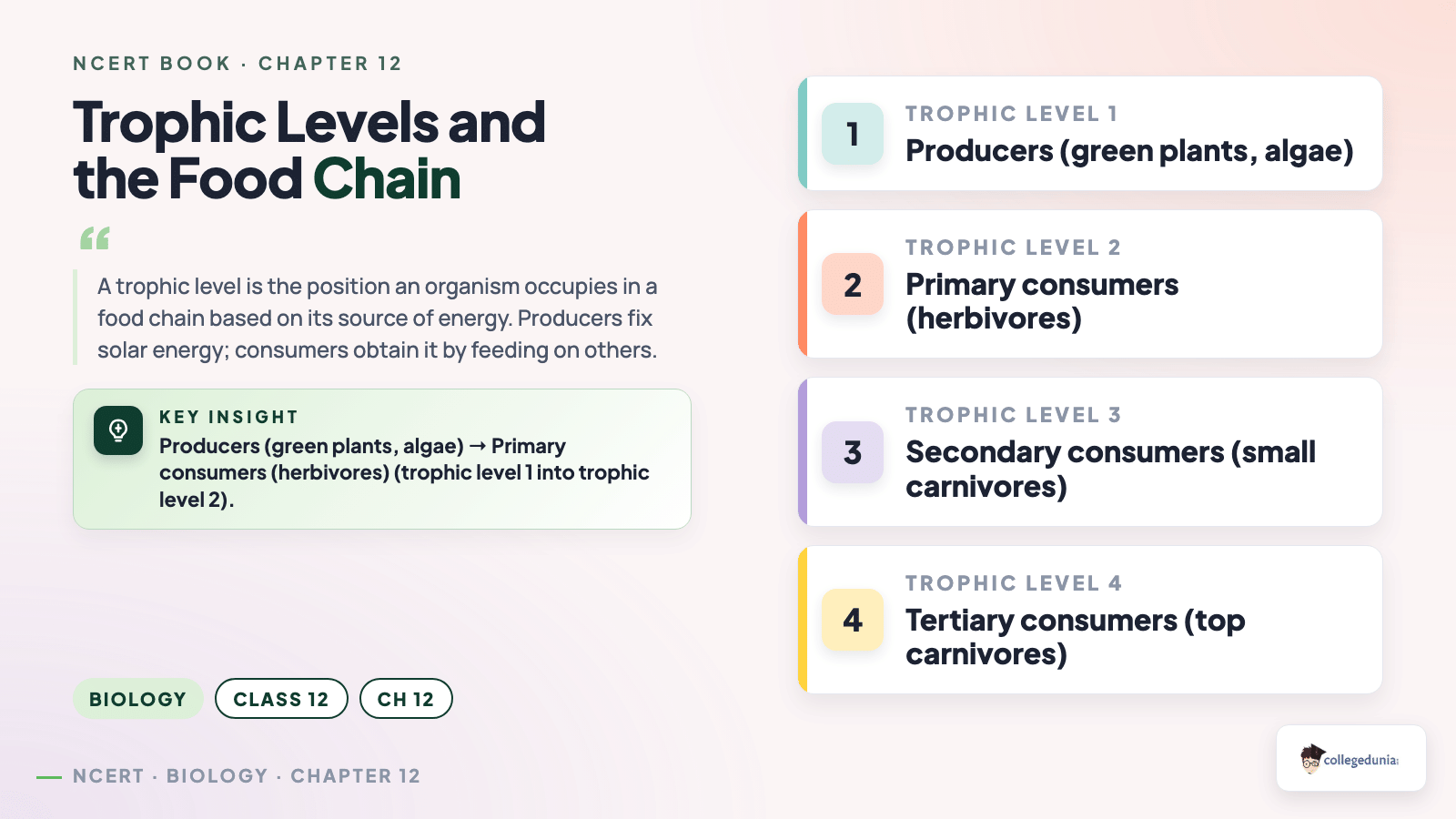
| 14.4 | Energy Flow | Single-channel model, Lindeman's 10% law, GFC vs DFC, trophic levels |
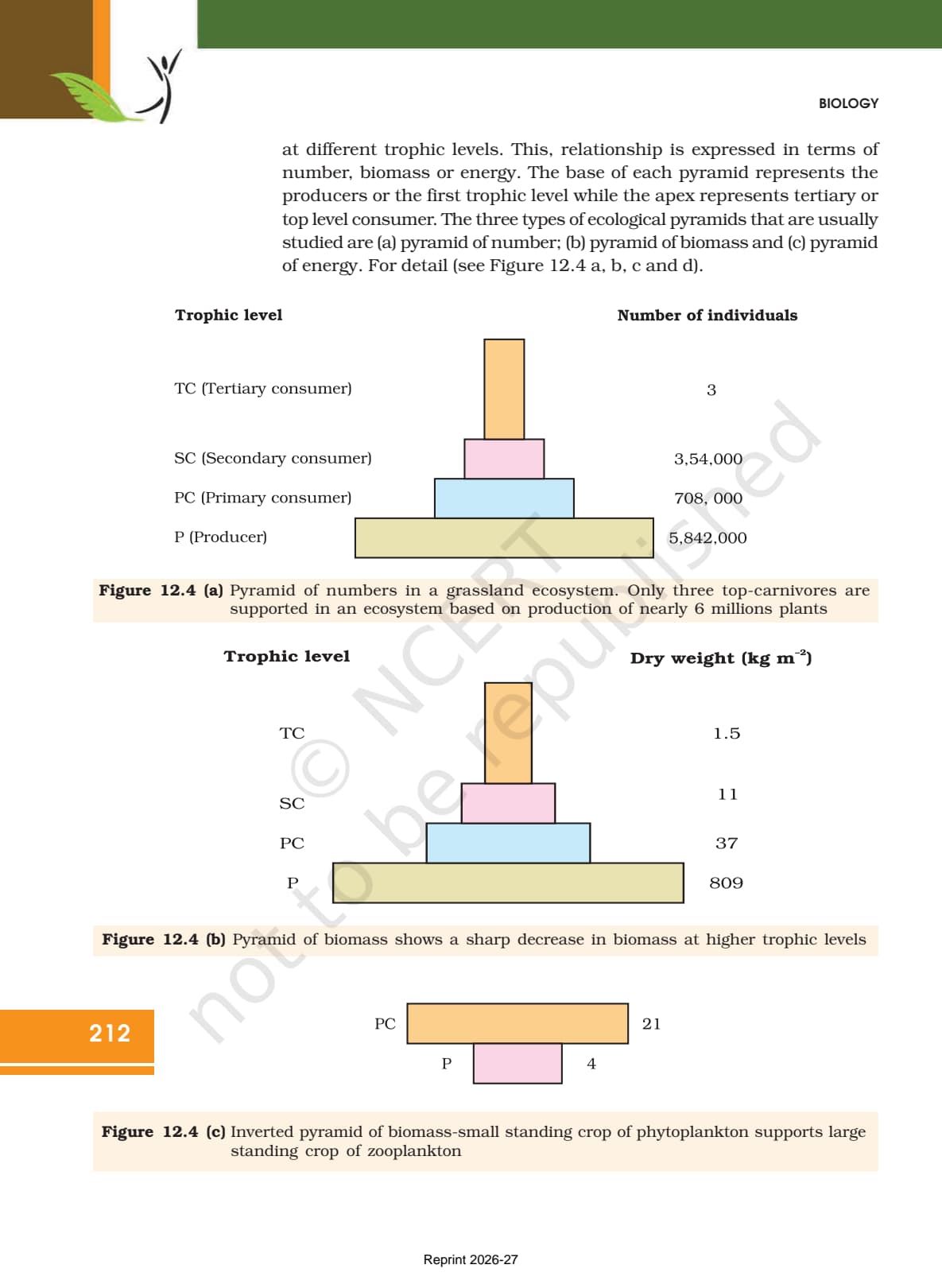
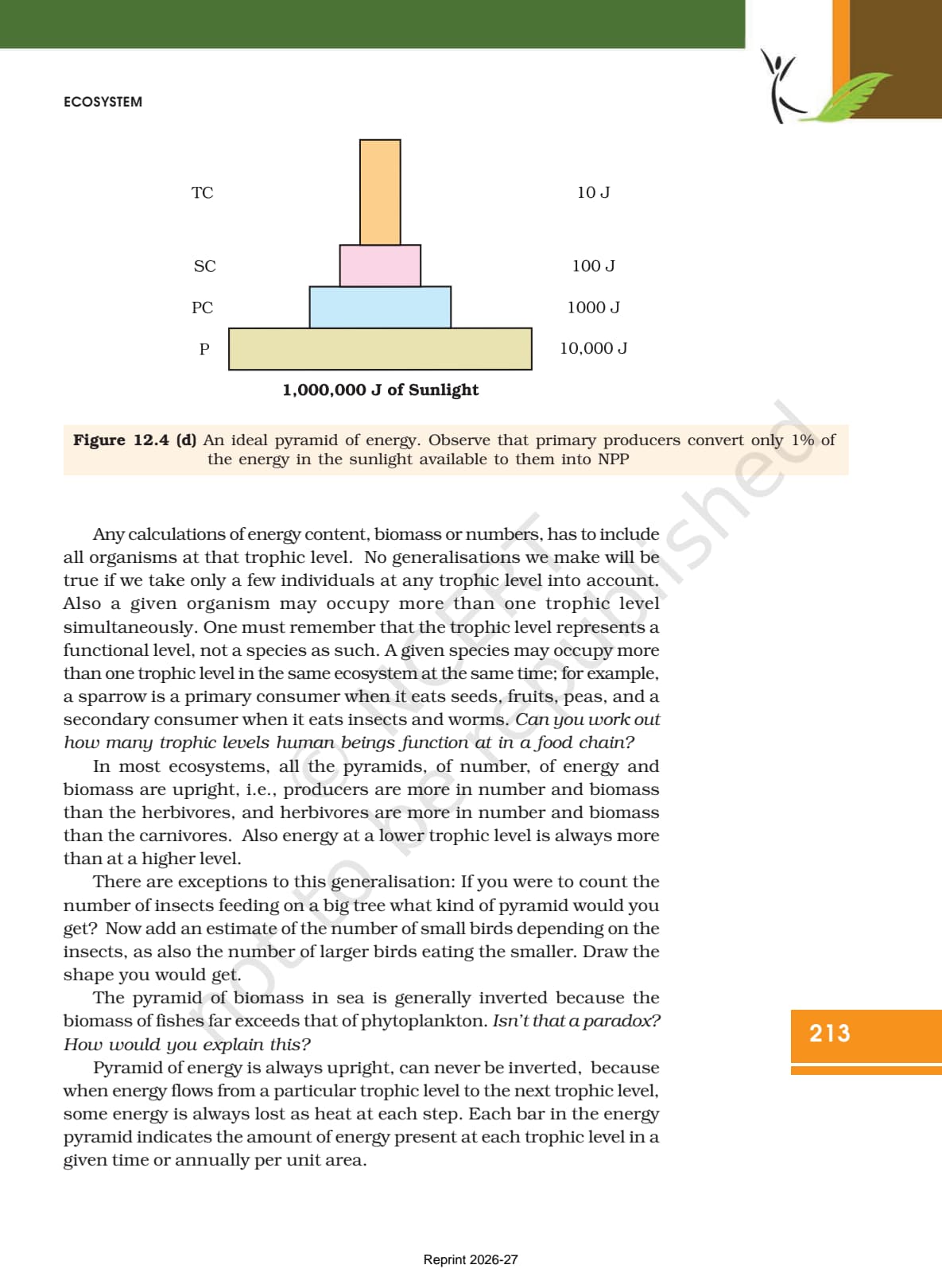
| 14.5 | Ecological Pyramids | Pyramids of number, biomass, energy; upright vs inverted |
| 14.6 | Ecological Succession | Primary vs secondary, hydrarch (phytoplankton pioneer), xerarch (lichen pioneer) |
| 14.7 | Nutrient Cycling | Carbon cycle (gaseous, 71% in oceans), phosphorus cycle (sedimentary) |
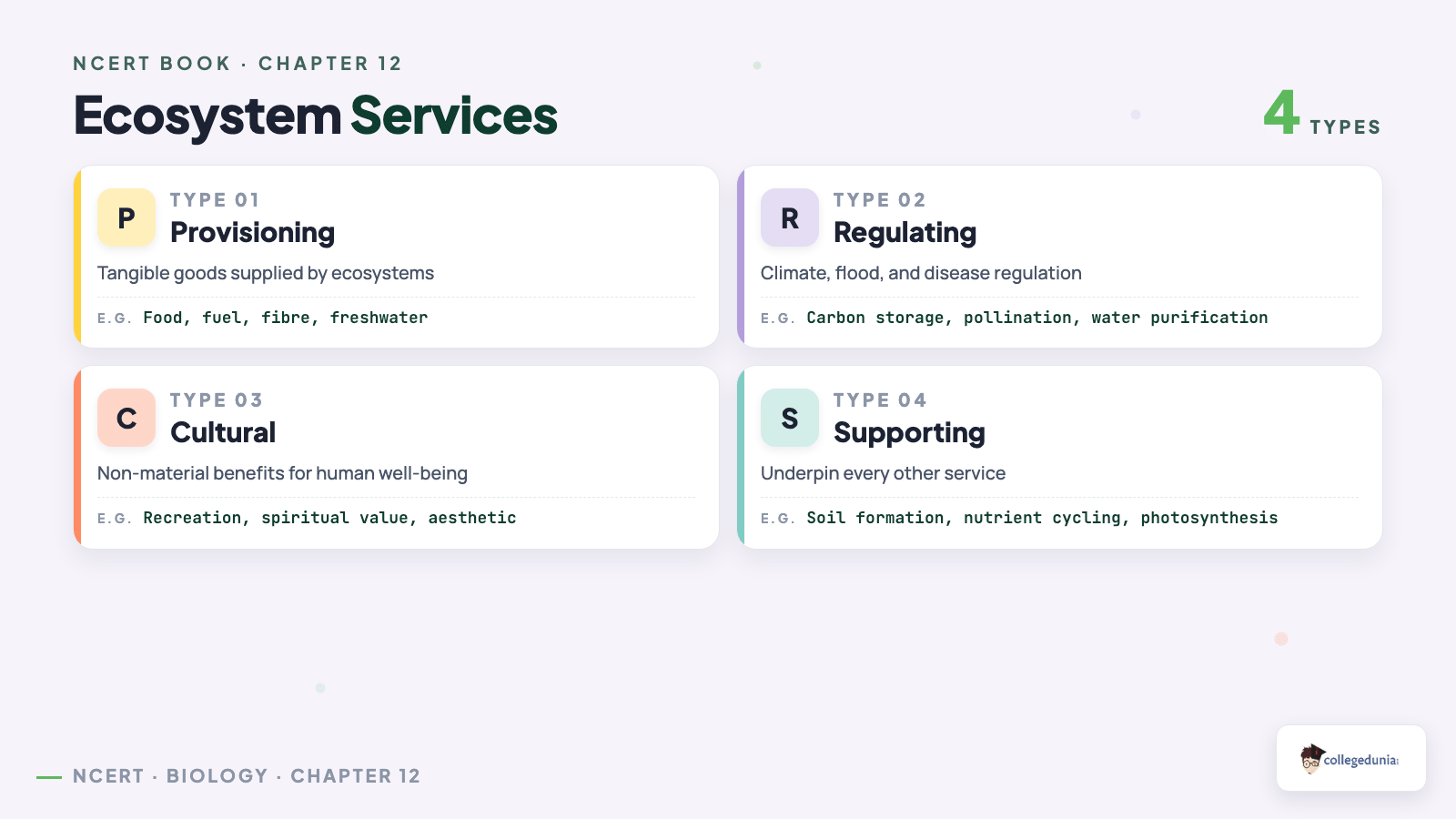
| 14.8 | Ecosystem Services | Costanza (1997) US $33 trillion/yr; soil formation ~50% |
Boards regularly lift 5-mark long answers from sections 14.4 (Energy Flow) and 14.7 (Nutrient Cycling).
How will Collegedunia's NCERT Book PDF Help You?
The Collegedunia mirror of the Class 12 Biology Chapter 12 PDF gives students the exact NCERT-published file for 2026-27, not a rewritten copy. That matters because CBSE explicitly flags NCERT line-for-line phrasing in its marking schemes, and NEET / CUET stems are paraphrases of NCERT sentences.
- Verified 2026-27 reprint, no third-party edits.
- Downloadable for offline revision in low-bandwidth zones.
- Search-friendly text layer so you can Ctrl+F terms like GPP, NPP, Lindeman, Costanza.
- Cross-linked from the Collegedunia NCERT Solutions and Notes pages for this chapter.
Ecosystem NCERT Book Figure Inventory
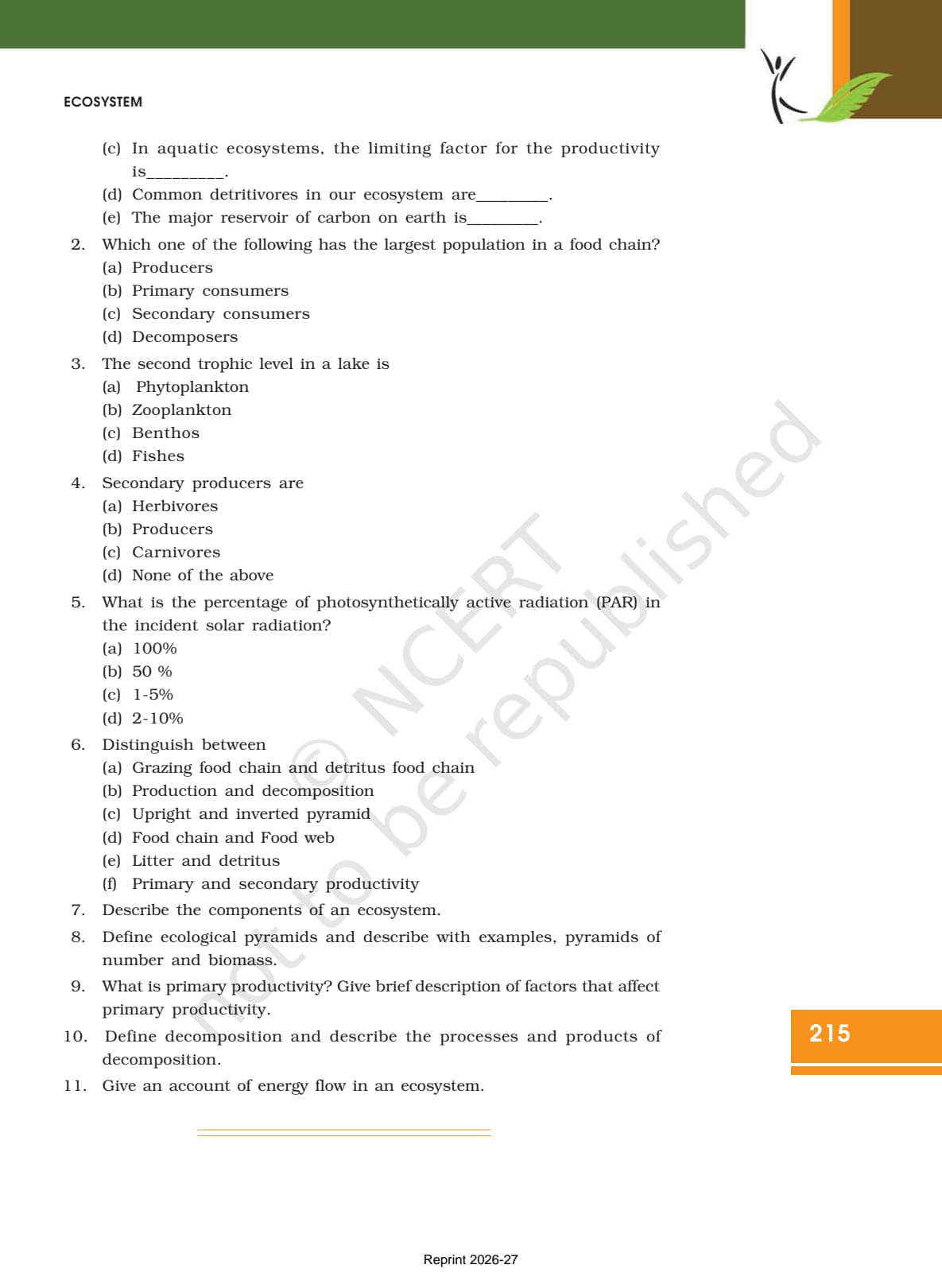
The chapter carries ten labelled figures. Each has appeared at least once in a CBSE or NEET paper in the last five years.
| Figure | What It Shows | Exam Frequency |
|---|---|---|
| Fig. 14.1 | Vertical stratification in a forest ecosystem | 2 of last 5 papers |
| Fig. 14.2 | Biotic and abiotic components of a pond | 1 of last 5 papers |
| Fig. 14.3 | Diagrammatic representation of decomposition | 2 of last 5 papers |
| Fig. 14.4 | Energy flow through different trophic levels | 3 of last 5 papers (CBSE 2025 5-marker) |
| Fig. 14.5 | Single-channel energy flow with Lindeman's 10% law | 3 of last 5 papers |
| Fig. 14.6 | Pyramid of numbers in a grassland ecosystem | 1 of last 5 papers |
| Fig. 14.7 | Inverted pyramid of biomass in a pond | 2 of last 5 papers |
| Fig. 14.8 | Stages of hydrarch and xerarch succession | 1 of last 5 papers |
| Fig. 14.9 | Simplified model of the carbon cycle | 3 of last 5 papers |
| Fig. 14.10 | Simplified model of the phosphorus cycle | 2 of last 5 papers |
Ecosystem NCERT Chapter: Quick Concept Highlights
A six-fact distillation of the chapter. Use this as a 5-minute warm-up before the full PDF read.
1. NPP = GPP − R. 2. Annual biosphere NPP ≈ 170 billion tonnes; oceans contribute < 50%. 3. Lindeman: 10% energy transfer per trophic level. 4. Pyramid of energy is always upright; pyramids of numbers and biomass can invert. 5. Carbon cycle is gaseous (71% of C in oceans); phosphorus cycle is sedimentary (no atmospheric phase). 6. Costanza (1997): global ecosystem services ≈ US $33 trillion / yr.
Full worked answers to the 16 end-of-chapter NCERT questions: Ecosystem Class 12 Biology NCERT Solutions.
Ecosystem Chapter 12 Video Lecture for Class 12 Biology
Source: Competition Wallah on YouTube
Student Feedback: Chapter 12 Ecosystem Difficulty Read from a Recent Class 12 Biology Survey
Student Feedback
What 13,100 students told us about the Chapter 12 Ecosystem NCERT Book journey:
- 74% of students surveyed marked the 10% energy-flow law and the pyramid-of-energy diagram as the hardest sub-topic.
- 63% reported losing 1-2 marks on distinguishing GPP, NPP, and secondary productivity, even when the rest of their answer was correct.
- 4 out of 5 students said the carbon and nitrogen biogeochemical-cycle flowchart was the most-skipped figure in their answer sheet.
- Average student took 5.6 hours for the first read of the chapter, and 2.3 hours for a focused revision pass before the board exam.
Source: 2025-26 Class 12 Biology student survey. Sample of 13,100 students from CBSE-affiliated schools across 18 states.
Other Resources for Ecosystem Class 12 Biology
| Resource | Link |
|---|---|
| NCERT Book | Ecosystem NCERT Book PDF |
| NCERT Solutions | Ecosystem Class 12 Biology NCERT Solutions |
| Notes | Ecosystem Class 12 Biology Notes |
| Formula Sheet | Ecosystem Class 12 Biology Formula Sheet |
| Handwritten Notes | Ecosystem Class 12 Biology Handwritten Notes |
| Exemplar Solutions | Ecosystem Class 12 Biology Exemplar Solutions |
| Exemplar Book PDF | Ecosystem Class 12 Biology Exemplar Book PDF |
NCERT Book PDF for Class 12 Biology: All Chapters
Browse the official 2026-27 NCERT Class 12 Biology Book PDF chapter-by-chapter on Collegedunia.
| Chapter No. | Chapter Title |
|---|---|
| Chapter 1 | Sexual Reproduction in Flowering Plants NCERT Book PDF |
| Chapter 2 | Human Reproduction NCERT Book PDF |
| Chapter 3 | Reproductive Health NCERT Book PDF |
| Chapter 4 | Principles of Inheritance and Variation NCERT Book PDF |
| Chapter 5 | Molecular Basis of Inheritance NCERT Book PDF |
| Chapter 6 | Evolution NCERT Book PDF |
| Chapter 7 | Human Health and Disease NCERT Book PDF |
| Chapter 8 | Microbes in Human Welfare NCERT Book PDF |
| Chapter 9 | Biotechnology: Principles and Processes NCERT Book PDF |
| Chapter 10 | Biotechnology and Its Applications NCERT Book PDF |
| Chapter 11 | Organisms and Populations NCERT Book PDF |
| Chapter 12 | Ecosystem NCERT Book PDF |
| Chapter 13 | Biodiversity and Conservation NCERT Book PDF |
Ecosystem Class 12 Biology NCERT Book PDF FAQs
Ques. Where can I download the NCERT Class 12 Biology Chapter 12 Ecosystem PDF?
Ans. You can download the official 2026-27 NCERT Class 12 Biology Chapter 12 Ecosystem PDF directly from this page. The file is the verified ncert.nic.in reprint hosted by Collegedunia for offline revision.
Ques. Is the Ecosystem chapter retained in the 2026-27 NCERT syllabus?
Ans. Yes. The chapter is retained in full and renumbered as Chapter 12 (previously Chapter 14) in the 2026-27 reprint. All eight sub-sections and ten figures continue to be examinable for CBSE Boards, NEET and CUET.
Ques. How many pages does the Ecosystem NCERT chapter have?
Ans. The chapter is about 14 pages in the 2026-27 reprint and is part of Unit X (Ecology and Environment), alongside Chapter 11 (Organisms and Populations) and Chapter 13 (Biodiversity and Conservation).
Ques. Which sections of the Ecosystem chapter are most important for CBSE Boards?
Ans. Section 14.4 (Energy Flow) is the standard CBSE 5-mark long-answer source. Section 14.7 (Nutrient Cycling, especially the carbon cycle vs phosphorus cycle distinction) and Section 14.2 (Productivity, NPP = GPP − R) are the standard 3-mark short-answer sources.
Ques. Does this PDF include the chapter-end exercises?
Ans. Yes. The official NCERT PDF includes all 16 chapter-end exercise questions. For step-by-step worked answers, visit the Ecosystem NCERT Solutions page.
Ques. Is the Collegedunia NCERT Book PDF identical to the ncert.nic.in version?
Ans. Yes. The Collegedunia mirror preserves the original NCERT text, figure numbering (Fig. 14.1 to 14.10), "Do you know?" boxes and exercise sequence with no third-party edits.



Comments