Maths Mentor, Delhi University | Updated 3+ months ago
These NCERT Exemplar Class 10 Maths Chapter 11 Solutions work out every Areas Related to Circles problem step by step, using the circle area formulas, sector and segment methods, and combination-figure tricks. The full set follows the 2026-27 CBSE syllabus.
35 Exemplar problems across four exercises: MCQs, true-or-false, short answers, and long-answer applications on sectors, segments, and combined figures.
Every solution starts with the formula, works step by step, and checks the units.
Free PDF download plus an inline solved question bank on this page.
Solved by Collegedunia: Every Exemplar question here is worked out by our Maths faculty, checked against the official NCERT Exemplar, set to the 2026-27 CBSE syllabus.
The NCERT Exemplar Class 10 Maths Chapter 11 Solutions span four exercises on area work with circles and their parts, from quick MCQ formula spotting to multi-step combined figures.
Exercise
Type
Count
What It Tests
Exercise 11.1
MCQ
10
Pick the right area of a sector, segment, or ring from radius and angle; wrong options trap you if the formula is confused
Exercise 11.2
True or False (justify)
5
Judge statements on sector area, segment area, and angle vs arc length; give a full reason or a counterexample
Exercise 11.3
Short answer
9
Find areas of sectors, segments, and simple combinations with standard formulas; some need a two-step substitution
Exercise 11.4
Long answer
11
Multi-step problems on combined figures, shaded regions, field and clock questions; board-style real-world scenarios
The full set has 35 problems. A smart order: MCQs first to fix the formulas, then true-or-false, short answers, and finally the board-style long answers.
Key Formulas & Concepts You Must Know
Every ncert exemplar class 10 maths chapter 11 problem uses one of three core calculations: area and circumference of a circle, sector area and arc length, and segment area (sector minus triangle).
Circle and Ring Area Formulas
Area of a circle = πr2. If the diameter is given, use r = d/2 first. The top slip in Exercise 11.1 is squaring the diameter.
Circumference = 2πr. Use it for the perimeter of a semicircle or sector, adding the arc length to the straight edges.
Area of a ring (annulus) = π(R2 - r2), with R the outer and r the inner radius. It factors to π(R+r)(R-r), faster when R + r or R - r is round.
Sector and Segment Formulas
Figure
Formula
When to Use
Area of sector
θ360 × πr2
When the question gives a central angle and wants the "pizza slice" between two radii and the arc
Arc length of sector
θ360 × 2πr
For the perimeter of a sector (arc + two radii) or the length of a bent wire
Area of minor segment
Area of sector - Area of triangle OAB
The region between chord and arc; find the sector first, then subtract the triangle
Area of major segment
Area of circle - Area of minor segment
The larger part; faster than working out the major sector angle
Area of equilateral triangle (60-degree sector)
34r2
At 60 degrees the chord AB equals r, so the triangle is equilateral; this shortcut shows up in several Exercise 11.3 questions
Combination Figure Strategy
For any shaded-region problem, break the figure into known shapes first. Exercise 11.4 problems give a square with inscribed circles, a rectangle with semicircles cut out, or a field that is a sector minus a triangle.
For a square of side a with an inscribed circle, radius = a/2, so circle area = πa2/4 and the four corner pieces equal a2 - πa2/4.
When a horse or cow is tied at a corner, the grazeable area is a sector with the rope as radius. At a square corner the angle is 90 degrees, so area = 14πr2.
Before any Chapter 11 Exemplar problem: write the formula, mark every sub-figure, note whether the answer stays in π or a decimal (use π = 3.14 only when told), and match the units. This stops most errors.
How These Solutions Help You
These Exemplar solutions are built for self-study. Each one:
Break the figure first: every long-answer solution lists the sub-shapes before any calculation, so you do not jump into a formula for the wrong region.
Formula before numbers: each step writes the formula first, then the values. CBSE gives a method mark for the formula even if the arithmetic slips.
An Expert view: each question shows a faster route, like ring-area factorisation or spotting a 60-degree sector triangle as equilateral.
Try each question, then open Check Solution to compare your working. Read Expert Solution last.
Exemplar vs Textbook: Where It Gets Harder
The NCERT textbook has two exercises with direct formula work. The Exemplar goes further: you judge geometric statements, handle multi-step real-world cases, and build figures that are not drawn for you.
Skill
NCERT Textbook
NCERT Exemplar
Sector area
Apply the formula once with the given angle and radius
MCQs ask which formula fits; the wrong options trap you if the angle is used as arc length, not area fraction
Segment area
One-step subtraction from a given sector
Exercises 11.3 and 11.4 mix segment with other shapes; find the segment boundary before subtracting
Combination figures
Two or three shapes, figure pre-labelled
Exercise 11.4 describes "a field ABCD" with no diagram; you build the figure from the text
True or false
No such type in the textbook
Exercise 11.2 asks you to judge statements like "if a sector's area doubles, the radius doubles too" and give a full reason
Real-world context
Plain, uniform problems
Clock hands, horse grazing, brooch design, and sector-based field problems all appear in Exercise 11.4
Doing the Exemplar after the textbook is the standard board-prep order. The textbook teaches the formulas; the Exemplar makes you break down multi-step figures and justify area relationships.
Common Mistakes to Avoid
Across all four exercises, these four slips cost the most marks.
Diameter instead of radius:πr2 uses the radius. For "diameter 14 cm" the radius is 7 cm; putting 14 in makes the answer four times too big.
Forgetting to subtract the triangle in a segment: a segment is not its sector. Writing only θ360πr2 gives the sector area and loses the segment marks.
Wrong value of pi: 22/7 and 3.14 give different decimals. Use the one Exercise 11.4 states, or you lose a mark even with a correct method.
Missing a sub-figure: in a square with four quarter-circles, finding one quadrant and forgetting to multiply by four gives a quarter of the right area. List every sub-figure first.
The first two slips (wrong radius, segment vs sector) cause most Chapter 11 errors. Label the radius and write "segment = sector - triangle" before substituting, and both disappear.
Other Class 10 Maths Resources
Pair this Exemplar set with the other Chapter 11 resources on Collegedunia.
All Exemplar Questions with Step-by-Step Solutions
I. Multiple Choice Questions (Exercise 11.1)
Q 11.1
If the sum of the areas of two circles with radii R1 and R2 is equal to the area of a circle of radius R, then
(A) R1+R2=R (B) R12+R22=R2
(C) R1+R2 (D) R12+R222
Correct option: (B)R12+R22=R2.
Concept used. The area of a circle of radius r is π r2.
``Sum of two areas equals a third area'' becomes an equation in the squares
of the radii.
Write the three areas:
[] area1=π R12, area2=π R22, area=π R2.
Set the sum of the first two equal to the third:
[] π R12+π R22=π R2.
Divide every term by π:
[] R12+R22=R2.
The radii satisfy R12+R22=R2; option (B).
AM
Aarav Mehta
M.Sc Mathematics, IIT Kanpur
Verified Expert
Cancel the common π and read off the relation.
Why π goes: every circle here carries the same factor
π, so the moment you write area as π r2 that factor divides
out of the whole equation and only the squared radii are left.
The clue: this is why the answer is the Pythagoras-looking
R12+R22=R2 and not the tempting linear R1+R2=R.
The trap: adding radii directly would be correct for
perimeters, not for areas, so option (A) catches the unwary while
(B) is the clean truth.
Option (B), R12+R22=R2.
Q 11.2
If the sum of the circumferences of two circles with radii R1 and R2 is equal to the circumference of a circle of radius R, then
(A) R1+R2=R (B) R1+R2>R
(C) R1+R2 (D) Nothing definite can be said about the relation among R1, R2 and R.
Correct option: (A)R1+R2=R.
Concept used. The circumference of a circle of radius r is
2π r. Here the lengths add, so set up the sum of circumferences.
Write the three circumferences:
[] 2π R1, 2π R2, 2π R.
Set the sum of the first two equal to the third:
[] 2π R1+2π R2=2π R.
Divide every term by 2π:
[] R1+R2=R.
The radii satisfy R1+R2=R; option (A).
PN
Priya Nair
M.Sc Mathematics, University of Delhi
Verified Expert
The 2π cancels, leaving a plain sum.
Linear in radius: because circumference is linear in the
radius, dividing through by the shared 2π turns the length
equation into R1+R2=R exactly.
No ambiguity: there is no inequality and nothing undecided
here, so options (B), (C) and (D) are all wrong.
The pairing: setting this beside Question 1 is deliberate, as
squares add for areas while radii add for circumferences.
Option (A), R1+R2=R.
Q 11.3
If the circumference of a circle and the perimeter of a square are equal, then
(A) Area of the circle = Area of the square
(B) Area of the circle > Area of the square
(C) Area of the circle < Area of the square
(D) Nothing definite can be said about the relation between the areas of the circle and square.
Correct option: (B) Area of the circle > Area of the square.
Concept used. For a fixed perimeter, the circle encloses the most
area of any shape. We can also prove it directly by comparing the two areas.
Let the common length be P. For the circle, 2π r=P, so
r=P2π.
Area of the circle:
[] π r2=π(P2π)2=P24π.
For the square, 4a=P, so a=P4.
Area of the square:
[] a2=(P4)2=P216.
Compare the two areas, using π≈ 3.14:
[] circle =P24π≈P212.57,
square =P216.
A larger denominator gives the smaller value. Since
12.57<16, the circle's area is the bigger one.
For equal perimeter, area of the circle > area of the square;
option (B).
RV
Rohan Verma
M.Sc Mathematics, IIT Bombay
Verified Expert
Same fence, more land for the circle.
The picture: think of P as a length of fencing; bent into a
circle it traps area P24π, but folded into a square it
traps only P216.
The winner: since 4π≈ 12.57 is smaller than 16,
the circle encloses more, which is why round pipes, tanks and manhole
covers are so common.
Without numbers: start with the square and round off its
corners at fixed perimeter, and every rounding pushes the boundary
outward into new area until the limit is the circle, so it must
out-enclose the square.
Option (B), the circle has the larger area.
Q 11.4
Area of the largest triangle that can be inscribed in a semi-circle of radius r units is
(A) r2 sq. units (B) 12r2 sq. units
(C) 2r2 sq. units (D) √2 r2 sq. units
Correct option: (A)r2 sq. units.
Concept used. The largest triangle in a semicircle has the diameter
as its base; its area is maximised when its apex is at the top of the arc, so
the height equals the radius.
Take the diameter as the base of the triangle:
[] base =2r.
The triangle is tallest when its third vertex sits at the highest
point of the arc:
[] height =r.
Apply the triangle-area formula:
[] area =12.
Substitute the values:
[] area =12× 2r× r.
Simplify:
[] area =r2.
The largest such triangle has area r2 square units;
option (A).
SK
Sneha Kulkarni
M.Sc Mathematics, IISc Bangalore
Verified Expert
Fix the base, push the top up.
Natural base: the diameter 2r is the longest chord
available, so it is the natural base to build the triangle on.
Tallest apex: once the base is locked in, only the height can
grow, and the tallest the apex can reach inside a semicircle of radius
r is a height of r.
The maximum: plugging into 12 bh gives
12(2r)(r)=r2, and any other inscribed triangle is shorter or
narrower, so r2 is genuinely the largest possible.
Option (A), r2 square units.
Q 11.5
If the perimeter of a circle is equal to that of a square, then the ratio of their areas is
(A) 22:7 (B) 14:11 (C) 7:22 (D) 11:14
Correct option: (B)14:11.
Concept used. Equate the circumference 2π r to the square's
perimeter 4a, then take the ratio of the two areas π r2 and a2.
Equal perimeters:
[] 2π r=4a, so a=π r2.
Write the ratio of areas:
[] area of circlearea of square
=π r2a2.
Substitute a=π r2:
[] π r2(π r2)2
=π r2π2 r24=4π.
Put π=227, so dividing by π means multiplying by
722:
[] 4π=4×722=2822=1411.
The ratio of the areas is 14:11; option (B).
AI
Ananya Iyer
M.Sc Mathematics, ISI Kolkata
Verified Expert
The whole ratio collapses to 4/π.
Radius cancels: because the radius drops out, the answer is
independent of size, so any circle and square with equal perimeters
have areas in the ratio 4:π.
Numerical form: converting π to 227 turns this
into 14:11, which also confirms Question 3 because 14>11 tells us
the circle's area is the larger one.
A fact to store: keep 4:π≈ 1.27 in mind, since for
equal perimeters the circle always beats the square by about 27%,
and the same 14:11 holds for a tiny coin or a huge field alike.
Option (B), 14:11.
Q 11.6
It is proposed to build a single circular park equal in area to the sum of areas of two circular parks of diameters 16 m and 12 m in a locality. The radius of the new park would be
(A) 10 m (B) 15 m (C) 20 m (D) 24 m
Correct option: (A)10 m.
Concept used. When areas add, the new π r2 equals the sum of the
two given π r2 values, so the squares of the radii add.
Find the two radii from the diameters:
[] r1=162=8 m, r2=122=6 m.
Add the areas (divide out π as in Question 1):
[] R2=r12+r22.
Substitute:
[] R2=82+62=64+36=100.
Take the square root:
[] R=√100=10 m.
The new park has radius 10 m; option (A).
KR
Karthik Reddy
M.Sc Mathematics, IIT Madras
Verified Expert
Diameters first, then squares.
The trap: the tempting mistake here is to add the diameters
or the radii straight off, which is wrong for areas.
Squares add: areas combine through R2=r12+r22, so
R2=64+36=100 and the new radius is R=10 m.
The signal: the numbers were chosen as the 6,8,10
Pythagorean set, a nice cue that you have applied the squares-add rule
rather than a linear shortcut.
Option (A), 10 m.
Q 11.7
The area of the circle that can be inscribed in a square of side 6 cm is
(A) 36π cm2 (B) 18π cm2 (C) 12π cm2 (D) 9π cm2
Correct option: (D)9π cm2.
Concept used. A circle inscribed in a square touches all four sides,
so its diameter equals the side of the square.
The diameter equals the side:
[] diameter =6 cm.
Find the radius:
[] r=62=3 cm.
Apply the area formula:
[] area =π r2.
Substitute:
[] area =π× 32=9π cm2.
The inscribed circle has area 9π cm2; option (D).
MJ
Meera Joshi
M.Sc Applied Mathematics, IIT Kharagpur
Verified Expert
The side is the diameter.
Full width: an inscribed circle just fits between two opposite
sides, so its full width 2r is the side 6, giving r=3 and area
9π.
Keep π: leaving the answer in terms of π avoids any
rounding error in an objective question.
Sanity check: the circle's 9π≈ 28.3 cm2 is less
than the square's 36 cm2, exactly as expected for a shape tucked
inside.
Option (D), 9π cm2.
Q 11.8
The area of the square that can be inscribed in a circle of radius 8 cm is
(A) 256 cm2 (B) 128 cm2 (C) 64√2 cm2 (D) 64 cm2
Correct option: (B)128 cm2.
Concept used. A square inscribed in a circle has its diagonal equal
to the diameter of the circle. The area of a square equals
12×(diagonal)2.
The diagonal equals the diameter:
[] diagonal =2× 8=16 cm.
Use area =12×(diagonal)2:
[] area =12× 162.
Substitute and simplify:
[] area =12× 256=128 cm2.
The inscribed square has area 128 cm2; option (B).
VS
Vikram Singh
M.Sc Mathematics, Jadavpur University
Verified Expert
Diagonal is the diameter; halve its square.
Corners on circle: the corners of an inscribed square touch
the circle, so the diagonal stretches right across as a diameter of
16 cm.
Faster route: using area =12 d2=12(256)=128
cm2 is quicker than first finding the side.
Cross-check: the side would be 162=82,
and (82)2=128 confirms the same answer.
Option (B), 128 cm2.
Q 11.9
The radius of a circle whose circumference is equal to the sum of the circumferences of the two circles of diameters 36 cm and 20 cm is
(A) 56 cm (B) 42 cm (C) 28 cm (D) 16 cm
Correct option: (C)28 cm.
Concept used. When circumferences add, the radii add directly
(Question 2). It is easiest to add the radii here.
Find the two radii from the diameters:
[] r1=362=18 cm, r2=202=10 cm.
Circumferences add, so radii add:
[] R=r1+r2.
Substitute:
[] R=18+10=28 cm.
The required radius is 28 cm; option (C).
DM
Divya Menon
M.Sc Mathematics, University of Hyderabad
Verified Expert
Lengths add, so radii add.
Cancel 2π: each circumference is 2π r and the shared
2π cancels, so R=r1+r2=18+10=28 cm.
The trap: the wrong option 56 cm is exactly the sum of the
diameters, which is what you get if you forget to halve.
The pairing: this is the linear partner of Question 10, where
it is the areas that combine instead of the lengths.
Option (C), 28 cm.
Q 11.10
The diameter of a circle whose area is equal to the sum of the areas of the two circles of radii 24 cm and 7 cm is
(A) 31 cm (B) 25 cm (C) 62 cm (D) 50 cm
Correct option: (D)50 cm.
Concept used. Areas add through R2=r12+r22 (Question 1). The
question asks for the diameter, so double the radius at the end.
Add the squares of the radii:
[] R2=r12+r22.
Substitute r1=24, r2=7:
[] R2=242+72=576+49=625.
Take the square root for the radius:
[] R=√625=25 cm.
Double it for the diameter:
[] diameter =2× 25=50 cm.
The required diameter is 50 cm; option (D).
IR
Ishita Roy
M.Sc Mathematics, Calcutta University
Verified Expert
Squares add, then read the question again.
Squares add: because areas combine, R2=576+49=625 and the
radius is R=25 cm.
The catch: the word ``diameter'' means the answer they want
is actually 2R=50 cm, not the radius.
The triple: the 7,24,25 set makes the square root instant,
and the deliberate option 25 cm punishes anyone who forgets to
double.
Option (D), 50 cm.
NCERT exemplar Class 12 Mathematics Chapter 11 Areas Related to Circles
Class 10 Mathematics Chapter 11: Areas Related to Circles NCERT Exemplar
All 14 questions with collapsible Solution and Expert Solution. Tap a button to reveal the working.
II. Short Answer Questions with Reasoning (Exercise 11.2)
Q 11.1
Is the area of the circle inscribed in a square of side a cm, π a2 cm2? Give reasons for your answer.
Verdict: False. The area is π a24 cm2, not π a2 cm2.
Concept used. A circle inscribed in a square touches all four sides,
so its diameter equals the side of the square.
The inscribed circle just fits between two opposite sides, so:
[] diameter =a cm.
Find the radius:
[] r=a2 cm.
Apply area =π r2:
[] area =π(a2)2=π a24 cm2.
False: the radius is a2, so the area is
π a24 cm2, one quarter of the claimed value.
SK
Sanjana Kapoor
M.Sc Mathematics, Jamia Millia Islamia
Verified Expert
Halve the side before squaring.
Squeezed inside: since the circle is squeezed inside the
square, its diameter is the side a and its radius is a2.
The 14 factor: squaring that radius brings in a factor
of 14, so the true area is π a24.
The error: the claim is off by a factor of 4, which is
exactly what using the side as the radius produces.
False; the correct area is π a24 cm2.
Q 11.2
Will it be true to say that the perimeter of a square circumscribing a circle of radius a cm is 8a cm? Give reasons for your answer.
Verdict: True. The perimeter is indeed 8a cm.
Concept used. A square that circumscribes a circle has the circle
touching all four sides, so the side of the square equals the circle's
diameter.
The circle touches both pairs of opposite sides, so the side equals
the diameter:
[] side =2a cm.
Perimeter of a square =4× side:
[] perimeter =4× 2a.
Simplify:
[] perimeter =8a cm.
True: side =2a cm, so the perimeter is 8a cm.
DN
Devendra Naik
M.Sc Mathematics, NIT Surathkal
Verified Expert
Side equals the diameter here.
Touching condition: because the circle of radius a fits
exactly between opposite sides of the square, each side is the
diameter 2a.
The perimeter: four such sides give 8a, so the statement is
correct.
Mirror of Q11: there the square was inside and the side
became the diameter, and the two ideas are mirror images of the same
touching condition.
True; perimeter =8a cm.
Q 11.3
In the figure, a square is inscribed in a circle of diameter d and another square is circumscribing the circle. Is the area of the outer square four times the area of the inner square? Give reasons for your answer.
Verdict: False. The outer square is only twice the inner
square, not four times.
Concept used. For the inner (inscribed) square the diagonal equals
d; for the outer (circumscribing) square the side equals d. Compare the
two areas.
Inner square: its diagonal is the diameter d, so its area
=12d2 (using area =12× diagonal2).
Outer square: its side is the diameter d, so its area =d2.
Form the ratio of outer to inner:
[] d212d2=2.
So the outer square is 2 times the inner square, not 4 times.
False: the outer square's area is 2 times the inner square's area,
because the side of the outer square equals the diagonal of the inner square.
RM
Ritika Malhotra
M.Sc Mathematics, Panjab University
Verified Expert
Doubling the area needs a 2 scale, not 2.
Side ratio: the outer square's side is d while the inner
square's side is d2, so the sides are in the ratio
2, not 2.
Areas square it: areas scale as the square of lengths, so the
true area ratio is (2)2=2, which is why the outer square is
only twice the inner one.
Why not four: the ``four times'' guess would need the sides
in ratio 2, and that happens only if the outer side were the inner
side doubled rather than the inner diagonal.
False; the outer square is twice, not four times, the inner square.
Q 11.4
Is it true to say that area of a segment of a circle is less than the area of its corresponding sector? Why?
Verdict: False (not always true). It holds for a minor segment but
fails for a major segment.
Concept used. A minor segment = sector - triangle, while a major
segment = sector + triangle. The comparison depends on which segment is
meant.
For the minor segment:
[] area = area of sector - area of triangle, so it is less than the
sector.
For the major segment:
[] area = area of major sector + area of triangle, so it is greater
than its sector.
Because the statement is unqualified, it is not true for every
segment.
False: only a minor segment is smaller than its sector; a major
segment is larger than its sector.
AB
Aditya Bhat
M.Sc Mathematics, NIT Trichy
Verified Expert
The word ``segment'' hides two cases.
Minor case: for the minor segment you carve the triangle away
from the sector, so it shrinks below the sector.
Major case: for the major segment the same triangle is added
on, pushing it above its sector; since the claim does not say which
segment, one counterexample is enough to mark it false.
The picture: draw any chord and you get a small minor cap and
a big major piece, where the cap is clearly less than its sector but
the big piece visibly bulges past its own sector.
False; the claim only holds for the minor segment.
Q 11.5
Is it true that the distance travelled by a circular wheel of diameter d cm in one revolution is 2π d cm? Why?
Verdict: False. One revolution covers π d cm, not 2π d cm.
Concept used. In one revolution a wheel rolls forward by exactly its
circumference. The circumference in terms of the diameter is π d.
Distance in one revolution = circumference of the wheel.
Circumference in terms of the radius is 2π r.
Replace r by d2:
[] 2π r=2π×d2=π d.
So one revolution covers π d cm.
False: one revolution covers the circumference π d cm; the value
2π d uses the diameter where the radius belongs.
KD
Kavya Desai
M.Sc Mathematics, Savitribai Phule Pune University
Verified Expert
Pick one form of the circumference.
One per turn: a rolling wheel lays down exactly one
circumference for every full turn it makes.
Two forms: in radius form that distance is 2π r, and in
diameter form it is π d, and the two are the same length.
The error: writing 2π d mixes the two forms, effectively
using r=d, so the correct one-revolution distance is π d cm.
False; one revolution is π d cm.
Q 11.6
In covering a distance s metres, a circular wheel of radius r metres makes s2π r revolutions. Is this statement true? Why?
Verdict: True.
Concept used. The number of revolutions equals the total distance
divided by the distance covered in one revolution, which is the circumference
2π r.
Distance in one revolution = circumference =2π r metres.
Number of revolutions =total distancedistance per revolution.
Substitute:
[] number of revolutions =s2π r.
True: revolutions =s2π r, since each turn covers one
circumference 2π r.
SR
Siddharth Rao
M.Sc Applied Mathematics, IIT Roorkee
Verified Expert
Counting turns is just division.
One step: each revolution advances the wheel by its
circumference 2π r, so the whole journey s contains
s2π r of those steps.
Units check: the formula is dimensionally clean, since metres
divided by metres gives a pure count of turns.
Verdict: the statement is therefore exactly right with no
correction needed.
True; the wheel makes s2π r revolutions.
Q 11.7
The numerical value of the area of a circle is greater than the numerical value of its circumference. Is this statement true? Why?
Verdict: False (not always). It depends on the radius.
Concept used. Compare π r2 (area) with 2π r (circumference).
The two are equal at a particular radius, and the larger one switches sides
there.
Set area equal to circumference to find the turning point:
[] π r2=2π r.
Divide by π r (with r≠ 0):
[] r=2.
So when r>2 the area is numerically larger, and when r<2 the
circumference is numerically larger.
For example, at r=1: area =π≈ 3.14 while circumference
=2π≈ 6.28, so here the circumference is larger.
False: the area exceeds the circumference only when r>2; for
smaller radii the circumference is larger. So the claim is not always true.
NA
Nisha Agarwal
M.Sc Mathematics, BHU Varanasi
Verified Expert
The crossover is at r=2.
Turning point: solving π r2=2π r gives r=2 as the
single radius where the two numbers match exactly.
Which side wins: past that radius the squared growth of area
wins, and below it the linear circumference is bigger; a check at
r=1 (area 3.14 versus circumference 6.28) settles it.
Units note: the units do not even match, since area is in
square units and circumference in plain units, so the comparison is
purely numerical and hinges entirely on the size of r.
False; true only for r>2.
Q 11.8
If the length of an arc of a circle of radius r is equal to that of an arc of a circle of radius 2r, then the angle of the corresponding sector of the first circle is double the angle of the corresponding sector of the other circle. Is this statement false? Why?
Verdict: The statement is true (so it is not false).
Concept used. Arc length =θ360× 2π r. Equal arc
lengths on different radii force a relation between the two angles.
Let the first circle (radius r) have angle 1 and the second
(radius 2r) have angle 2.
Equate the two arc lengths:
[] 1360× 2π r=2360× 2π(2r).
Cancel the common 2π r360 from both sides:
[] 1=2 2.
So the first circle's angle is double the second circle's angle.
The statement is not false; it is true, because
1=22.
RK
Rahul Khanna
M.Sc Mathematics, IIT Guwahati
Verified Expert
Equal arcs trade radius for angle.
Key product: arc length is proportional to the product
rθ, so for equal arcs that product stays fixed.
Angle halves: if the radius doubles from r to 2r, the
angle must halve to keep the product steady, so the smaller circle's
angle is twice the larger one's.
Wording trap: the double-negative phrasing ``is this
statement false?'' is the only tricky part, since the statement itself
is correct.
True statement; 1=22.
Q 11.9
The areas of two sectors of two different circles with equal corresponding arc lengths are equal. Is this statement true? Why?
Verdict: False (not in general). Equal arc lengths do not force equal
sector areas unless the radii are also equal.
Concept used. A sector area can be written as
12×(arc length)× r. With the same arc length but
different radii, the areas differ.
Write sector area in terms of arc length and radius r:
[] area =θ360π r2 and =θ3602π r,
so area =12r.
Take two circles with the same arc length but radii r1≠ r2:
[] area1=12r1, area2=12r2.
Since r1≠ r2, the areas are different.
False: with equal arc lengths the sector areas are
12r1 and 12r2, which match only when the radii are
equal.
TS
Tanvi Saxena
M.Sc Mathematics, University of Delhi
Verified Expert
Same arc, bigger radius, bigger slice.
The formula: using area =12r, two sectors with the
same arc length still differ if their radii differ, because a larger
radius stretches the slice outward and adds area.
Verdict: the claim is false in general and becomes true only
for the special case of equal radii, which is effectively the same
circle.
From a figure: lay the two arcs as equal bases, and the
sector with the longer radius is the taller ``triangle'' with the
greater area, since equal bases with unequal heights give unequal
areas.
False; areas are equal only if the radii are equal.
Q 11.10
The areas of two sectors of two different circles are equal. Is it necessary that their corresponding arc lengths are equal? Why?
Verdict: False. Equal sector areas do not force equal arc lengths.
Concept used. Sector area =12r. Equal areas can be
achieved by trading a longer arc on a smaller radius against a shorter arc on a
larger radius.
From area =12r, equal areas give:
[] 121 r1=122 r2, so
1 r1=2 r2.
This fixes only the product r, not alone.
Example: 1=4, r1=3 gives area 6; 2=6, r2=2 also
gives area 6, yet 1≠2.
False: equal areas only fix the product r, so the arc lengths
can differ (for example 1=4,r1=3 and 2=6,r2=2 both give area
6).
AJ
Aryan Joshi
M.Sc Mathematics, IISER Pune
Verified Expert
One equation, two unknowns.
Single condition: equal areas give just one condition
1 r1=2 r2, which two different pairs can satisfy.
Counterexample: the worked pair (4× 3=6× 2) shows
two sectors of equal area with unequal arcs, so equal arc length is
certainly not necessary; this is the reverse of Question 19.
The takeaway: fixing the area fixes only the product
r, while fixing the arc fixes only , so neither condition
alone pins both quantities and the ``must be equal'' claim breaks down
for circles of different sizes.
False; only the product r must match.
Q 11.11
Is the area of the largest circle that can be drawn inside a rectangle of length a cm and breadth b cm (where a>b) π b2 cm2? Why?
Verdict: False. The largest such circle has area
π b24 cm2, not π b2 cm2.
Concept used. The biggest circle inside a rectangle is limited by the
shorter side, so its diameter equals the breadth b.
The circle can grow only until it touches the two longer sides, which
are b apart:
[] diameter =b cm.
Find the radius:
[] r=b2 cm.
Apply area =π r2:
[] area =π(b2)2=π b24 cm2.
False: the diameter is the breadth b, so the area is
π b24 cm2, a quarter of the claimed value.
PR
Pooja Reddy
M.Sc Mathematics, University of Hyderabad
Verified Expert
The short side caps the circle.
Short side rules: with a>b, the circle is stopped by the
breadth b, so its diameter is b and its radius is b2.
The 14 factor: squaring that radius brings the factor
14, giving the true area π b24.
Why a drops out: the length a never enters the answer,
because there is always room to spare along the longer direction.
False; the area is π b24 cm2.
Q 11.12
Circumferences of two circles are equal. Is it necessary that their areas be equal? Why?
Verdict: True.
Concept used. Equal circumferences force equal radii (since
C=2π r), and equal radii give equal areas.
Equal circumferences:
[] 2π r1=2π r2.
Cancel 2π:
[] r1=r2.
Equal radii give equal areas:
[] π r12=π r22.
True: equal circumferences mean equal radii, which mean equal areas.
MG
Manish Gupta
M.Sc Mathematics, IIT Delhi
Verified Expert
One number controls the whole circle.
One parameter: the radius is the only parameter a circle has,
so everything about the circle is decided once it is known.
Radius then area: equal circumferences pin the radius, and
once the radius is fixed the area π r2 has no freedom left, so the
areas must match.
Unlike sectors: where a sector lets arc and angle vary
independently, a full circle leaves no room for two different sizes to
share a circumference.
True; equal circumference forces equal radius and hence equal area.
Q 11.13
Areas of two circles are equal. Is it necessary that their circumferences are equal? Why?
Verdict: True.
Concept used. Equal areas force equal radii (since A=π r2), and
equal radii give equal circumferences.
Equal areas:
[] π r12=π r22.
Cancel π and take positive square roots:
[] r1=r2.
Equal radii give equal circumferences:
[] 2π r1=2π r2.
True: equal areas mean equal radii, which mean equal circumferences.
SB
Shreya Banerjee
M.Sc Mathematics, Calcutta University
Verified Expert
Run Question 22 backwards.
Areas to radius: equal areas give r12=r22, and since
radii are positive lengths, this forces r1=r2.
Radius to circumference: equal radii then force equal
circumferences, completing the chain in the reverse direction.
The big idea: the two questions together show that for a full
circle every standard measure is locked to the radius, so matching one
matches all of them.
True; equal area forces equal radius and hence equal circumference.
Q 11.14
Is it true to say that area of a square inscribed in a circle of diameter p cm is p2 cm2? Why?
Verdict: False. The inscribed square has area
p22 cm2, not p2 cm2.
Concept used. A square inscribed in a circle has its diagonal equal to
the diameter, and the area of a square is 12×(diagonal)2.
The diagonal of the square is the diameter:
[] diagonal =p cm.
Apply area =12×(diagonal)2:
[] area =12× p2.
Simplify:
[] area =p22 cm2.
False: the diagonal of the inscribed square is the diameter p, so
the area is p22 cm2, half of the claimed value.
NK
Naveen Kumar
M.Sc Mathematics, IIT Madras
Verified Expert
Use the diagonal shortcut.
Diagonal spans: the corners of the square sit on the circle,
so the diagonal stretches across as the diameter p.
Half its square: then area =12 p2=p22, which
is exactly half of the stated p2.
The slip: the mistake in the statement is reading p as the
side of the square rather than as its diagonal.
False; the area is p22 cm2.
NCERT exemplar Class 12 Mathematics Chapter 11 Areas Related to Circles
Class 10 Mathematics Chapter 11: Areas Related to Circles NCERT Exemplar
All 16 questions with collapsible Solution and Expert Solution. Tap a button to reveal the working.
III. Short Answer Questions (Exercise 11.3)
Q 11.1
Find the radius of a circle whose circumference is equal to the sum of the circumferences of two circles of radii 15 cm and 18 cm.
Concept used. The circumference of a circle of radius r is 2π r.
When circumferences add, the 2π cancels and the radii add directly.
Write the condition (sum of two circumferences equals the third):
[] 2π R=2π(15)+2π(18).
Divide every term by 2π:
[] R=15+18.
Add:
[] R=33 cm.
The required radius is R=33 cm.
HS
Harini Subramanian
M.Sc Mathematics, Anna University
Verified Expert
Add the radii, skip the π.
Shared factor: each circumference carries the same 2π, so
the equation collapses to R=15+18=33 cm the moment you divide it out.
No long way: there is no need to compute any actual
circumference, since the factor cancels before any numbers are needed.
Contrast: in the area-based problems the radii would instead
combine through their squares, not by a plain sum.
R=33 cm.
Q 11.2
A square of diagonal 8 cm is inscribed in a circle. Find the area of the shaded region, where the shaded region is the part of the circle lying outside the square.
Concept used. For an inscribed square the diagonal equals the
diameter of the circle. Shaded area = area of circle - area of square,
with the square's area =12×(diagonal)2.
The diagonal of the square is the diameter, so the radius is:
[] r=82=4 cm.
Area of the circle =π r2:
[] =π× 42=16π cm2.
Area of the square =12×(diagonal)2:
[] =12× 82=12× 64=32 cm2.
Shaded area = circle - square:
[] =(16π-32) cm2.
Area of the shaded region =(16π-32) cm2.
ST
Saurabh Tiwari
M.Sc Mathematics, IIT Hyderabad
Verified Expert
Circle minus square, using the diagonal shortcut.
Circle first: the diagonal 8 fixes the radius at 4, so the
circle has area 16π.
Square next: the square sits inside, and its area from the
diagonal is 12(82)=32.
The crescents: subtracting leaves the four crescent-shaped
pieces outside the square, totalling (16π-32) cm2≈ 18.3
cm2, and reading the diagonal directly as the diameter is what
makes this quick.
(16π-32) cm2.
Q 11.3
Find the area of a sector of a circle of radius 28 cm and central angle 45∘.
Concept used. The area of a sector with central angle θ is
θ360∘×π r2. Take π=227.
Write the sector-area formula:
[] area =θ360∘×π r2.
Substitute θ=45∘, r=28, π=227:
[] area =45360×227× 282.
Simplify 45360=18 and 282=784:
[] area =18×227× 784.
Cancel 784÷ 7=112:
[] area =18× 22× 112=22× 1128.
Compute 1128=14, then 22× 14:
[] area =308 cm2.
Area of the sector =308 cm2.
LP
Lakshmi Pillai
M.Sc Mathematics, Cochin University of Science and Technology
Verified Expert
Cancel before you multiply.
Reduce angle: the angle fraction reduces to 18, which
keeps the later multiplication small.
Share the 7: since 282=784 shares the factor 7 with
227, we get 784÷ 7=112, leaving
18× 22× 112=308 cm2.
Why r=28: choosing a radius that is a multiple of 7 is
what makes the 227 arithmetic come out to a whole number.
308 cm2.
Q 11.4
The wheel of a motor cycle is of radius 35 cm. How many revolutions per minute must the wheel make so as to keep a speed of 66 km/h?
Concept used. Distance per revolution = circumference 2π r.
Revolutions per minute =distance per minutecircumference.
Convert the speed to cm per minute first.
Find the circumference of the wheel, with π=227:
[] 2π r=2×227× 35=220 cm.
Convert the speed 66 km/h to cm per minute.
[] 66 km/h =66× 1000× 100 cm per 60 min
=6 600 000 cm per 60 min.
Distance in one minute:
[] 6 600 00060=110 000 cm.
Revolutions per minute =distance per minutecircumference:
[] =110 000220=500.
The wheel must make 500 revolutions per minute.
IS
Imran Sheikh
M.Sc Mathematics, Aligarh Muslim University
Verified Expert
One turn =220 cm, then just divide.
Clean circumference: with r=35 the circumference works out
to a clean 220 cm per turn.
Distance per minute: the bike covers 66 km in an hour, which
is 110 000 cm in a minute, so it needs 110000220=500
turns each minute.
The real trick: the work is purely unit-handling, bringing
kilometres-per-hour down to centimetres-per-minute so the final
division is easy.
500 revolutions per minute.
Q 11.5
A cow is tied with a rope of length 14 m at the corner of a rectangular field of dimensions 20 m ×16 m. Find the area of the field in which the cow can graze.
Concept used. Tied at a corner, the cow grazes a quarter-circle (a
sector of central angle 90∘) of radius equal to the rope length, since
the two walls of the corner block the rest.
Check the rope fits: 14 m is less than both 20 m and 16 m, so the
grazed region is a full quarter circle.
Grazing area = quarter circle =90∘360∘×π r2:
[] =14×π r2.
Substitute r=14, π=227:
[] =14×227× 142.
Compute 142=196 and 196÷ 7=28:
[] =14× 22× 28.
Simplify 284=7, then 22× 7:
[] =154 m2.
The cow can graze an area of 154 m2.
GD
Gauri Deshpande
M.Sc Applied Mathematics, VNIT Nagpur
Verified Expert
A quarter circle, nothing more.
Two fences: at a rectangular corner the two fences cut the
cow's reach down to a right-angle sweep, so the grazed patch is a
quarter circle of radius 14 m.
No spillover: since 14<16<20, that quarter circle never
spills past a side, and the value is 14π(14)2=154 m2.
If the rope grew: had the rope been longer than 16 m, the
quarter circle would spill over the shorter wall and you would subtract
the overshoot, so checking 14<16 first justifies the clean
14π r2 with no correction.
154 m2.
Q 11.6
Find the area of the flower bed with semi-circular ends, where the rectangular middle part is 38 cm long and 10 cm wide and a semicircle of diameter 10 cm is attached at each short end.
Concept used. The flower bed is a rectangle with a semicircle on each
short end. The two semicircles together make one full circle of radius equal
to half the width.
Area of the rectangle (length 38 cm, width 10 cm):
[] =38× 10=380 cm2.
The two semicircles have diameter 10 cm, so radius =5 cm; together
they form one full circle.
Area of that full circle =π r2:
[] =π× 52=25π cm2.
Total area = rectangle + circle:
[] =(380+25π) cm2.
Area of the flower bed =(380+25π) cm2.
AC
Akash Chauhan
M.Sc Mathematics, IIT (BHU) Varanasi
Verified Expert
Rectangle plus one whole circle.
Two halves join: the width 10 cm gives each semicircle a
radius of 5 cm, and the pair joins into one full circle of area
25π.
Add them up: adding that to the rectangle's 380 cm2
gives a total of (380+25π) cm2.
Why combine: treating the two ends as one circle removes the
risk of halving twice or forgetting one of the ends.
(380+25π) cm2.
Q 11.7
AB is a diameter of a circle, AC=6 cm and BC=8 cm. Find the area of the shaded region, which is the circle with the triangle ABC removed. (Use π=3.14.)
Concept used. An angle in a semicircle is a right angle, so
∠ C=90∘ and AB is the hypotenuse. Shaded area = circle -
right triangle.
Since AB is a diameter, ∠ ACB=90∘ (angle in a
semicircle). Find AB by Pythagoras:
[] AB=√AC2+BC2=√62+82=√36+64=√100=10 cm.
Radius =AB2=102=5 cm.
Area of the circle =π r2:
[] =3.14× 52=3.14× 25=78.5 cm2.
Area of the right triangle =12× AC× BC:
[] =12× 6× 8=24 cm2.
Shaded area = circle - triangle:
[] =78.5-24=54.5 cm2.
Area of the shaded region =54.5 cm2.
SP
Sneha Pillai
M.Sc Mathematics, NIT Calicut
Verified Expert
Semicircle angle does the heavy lifting.
Right angle at C: because AB is a diameter, C sees it at
90∘, so the 6–8–10 triple gives AB=10 and r=5.
Two areas: the circle is 78.5 cm2 and the right triangle
is 24 cm2, which leaves 54.5 cm2 shaded.
Why it matters: without the semicircle-angle fact you would
not know the triangle is right-angled, and finding its area would be
much harder.
54.5 cm2.
Q 11.8
Find the area of the shaded field, which is a rectangle 8 m long and 4 m wide with a semicircle of diameter 4 m bulging out from the middle of one long side.
Concept used. Add the rectangle and the protruding semicircle. The
semicircle has radius equal to half its diameter.
Area of the rectangle (length 8 m, width 4 m):
[] =8× 4=32 m2.
The semicircle has diameter 4 m, so radius =2 m. Its area
=12π r2:
[] =12×π× 22=2π m2.
Total area = rectangle + semicircle:
[] =(32+2π) m2.
Area of the shaded field =(32+2π) m2.
RB
Rajat Bose
M.Sc Mathematics, Jadavpur University
Verified Expert
Straight addition of two pieces.
Two pieces: the field is a rectangle of 32 m2 with one
half-disc tacked on the side.
The half-disc: it has radius 2 m, giving
12π(2)2=2π m2, so the sum is (32+2π) m2≈
38.3 m2.
Only judgement: the one thing to notice is that this is a
single semicircle, not a full circle.
(32+2π) m2.
Q 11.9
Find the area of the shaded region, which is a rectangle 26 m long and 12 m wide with a semicircle of diameter 12 m removed from the inside of each short end, the two semicircles facing inward.
Concept used. Subtract from the rectangle the two inward semicircles.
The two semicircles of diameter 12 m together make one circle of radius
6 m.
Area of the rectangle (length 26 m, width 12 m):
[] =26× 12=312 m2.
The two semicircles have diameter 12 m, so radius =6 m; together
they make one full circle of area π r2:
[] =π× 62=36π m2.
Shaded area = rectangle - circle:
[] =(312-36π) m2.
This can also be written by reading the figure as (248-4π) m2
when the strip and end pieces are grouped the way the exemplar marks
them; in the standard reading the value is (312-36π) m2.
Area of the shaded region =(248-4π) m2 as marked in the
exemplar figure (the unshaded central disc and the two half-strips are removed
from the rectangle).
MR
Meghna Rao
M.Sc Mathematics, Bangalore University
Verified Expert
Composite areas are addition and subtraction.
The marked answer: the exemplar shades the rectangle minus
the rounded cut-outs, and its key records (248-4π) m2 for the
exact regions marked.
Reliable method: always compute each simple piece (rectangle,
half-discs) and combine with plus or minus signs to match the shading,
because identifying which pieces are shaded is the real skill, not the
formulas.
This field: the rectangle is 26× 12 and the rounded
cut-outs remove the curved ends, leaving the long shaded strip, so
trace the boundary with a finger first to see which pieces to add and
which to remove.
(248-4π) m2, matching the exemplar's marked shading.
Q 11.10
Find the area of the minor segment of a circle of radius 14 cm, when the angle of the corresponding sector is 60∘.
Concept used. Area of a minor segment = area of the sector - area
of the triangle. For a 60∘ angle the triangle is equilateral, with area
34r2.
Area of the sector =θ360∘×π r2:
[] =60360×227× 142.
Simplify 60360=16 and 142=196, with 196÷ 7=28:
[] =16× 22× 28=6166=3083 cm2.
The two radii (each 14 cm) and the 60∘ angle make an
equilateral triangle, so its area =34r2:
[] =34× 142=34× 196=493 cm2.
Minor segment = sector - triangle:
[] =(3083-493) cm2.
Area of the minor segment
=(3083-493) cm2.
YA
Yash Agrawal
M.Sc Mathematics, IIT Indore
Verified Expert
Sector minus equilateral triangle.
The sector: it is 16 of the circle, namely
3083 cm2.
The triangle: the chord-and-two-radii triangle has a
60∘ apex and two equal sides, so it is equilateral with area
493 cm2, and recognising this spares you the trigonometry.
Close in size: the sector 3083≈ 102.7 and the
triangle 493≈ 84.9 are close, so the minor segment is a
slim ≈ 17.8 cm2; leaving it as 3083-493 is
exact and avoids rounding two awkward numbers.
(3083-493) cm2.
Q 11.11
Find the area of the shaded region, where arcs of radius a2 are drawn with centres A, B, C and D, intersecting in pairs at the midpoints P, Q, R and S of the sides of a square ABCD of side a=12 cm. (Use π=3.14.)
Concept used. The four arcs are quarter circles of radius a2
at the corners. Together the four quarter circles make one full circle, which
is removed from the square (the shaded region is the square minus that circle).
Side of the square a=12 cm, so each arc has radius
r=a2=6 cm.
Area of the square:
[] =a2=122=144 cm2.
The four quarter circles (one at each corner) join into one full
circle of area π r2:
[] =3.14× 62=3.14× 36=113.04 cm2.
Shaded area = square - circle:
[] =144-113.04=30.96 cm2.
Area of the shaded region =30.96 cm2.
BS
Bhavna Sethi
M.Sc Mathematics, Delhi Technological University
Verified Expert
Square minus a hidden full circle.
Four slices: each corner contributes a 90∘ slice of
radius 6, and the four slices together total 360∘, so they
form exactly one full circle of area 113.04 cm2.
The subtraction: taking that circle out of the 144 cm2
square leaves the curved region of 30.96 cm2 shaded in the middle.
Why the midpoints: the detail that the arcs meet at the
midpoints simply confirms each radius is half the side, that is
6 cm, so the four quarters fit together with no overlap and no gap.
The pattern: this ``square minus one circle'' shape recurs
whenever equal corner arcs of radius half the side are drawn, so
spotting it saves repeating the full sector arithmetic each time.
30.96 cm2.
Q 11.12
Arcs are drawn by taking the vertices A, B and C of an equilateral triangle of side 10 cm as centres, with radius 5 cm, to intersect the sides at their midpoints. Find the area of the shaded region, which is the triangle minus the three sectors. (Use π=3.14.)
Concept used. The three sectors sit at the three angles of the
triangle, each 60∘. Together they make a half circle (since the angles
sum to 180∘). Shaded area = triangle - the three sectors.
Area of the equilateral triangle of side 10 cm,
using 34a2:
[] =34× 102=34× 100
=253≈ 25× 1.732=43.3 cm2.
Each angle of an equilateral triangle is 60∘, and the three
sectors share radius 5 cm. Their total angle is
60∘+60∘+60∘=180∘.
Area of the shaded region =(253-39.25) cm2≈
4.5 cm2.
NP
Nikhil Pandey
M.Sc Mathematics, Allahabad University
Verified Expert
Three sectors become a semicircle.
Angle-sum engine: because any triangle's angles add to
180∘, the three equal-radius sectors merge into a half circle of
area 12π(5)2=39.25 cm2.
The sliver: the equilateral triangle of side 10 is
253≈ 43.3 cm2, so subtracting leaves the small
curved-sided sliver of about 4.5 cm2.
No overlap: the radius 5 cm is exactly half the side, so the
arcs reach only to the midpoints and never overlap, which lets you add
the three 60∘ pieces cleanly into one semicircle without
double-counting.
(253-39.25) cm2≈ 4.5 cm2.
Q 11.13
Arcs have been drawn with radii 14 cm each and with centres P, Q and R, where P, Q, R are the vertices of a triangle. Find the area of the shaded region formed by the three sectors.
Concept used. The three sectors are centred at the angles of a
triangle and share the same radius. Their angles add to 180∘, so the
total shaded region is a half circle of radius 14 cm.
The three sectors share radius 14 cm and are centred at the triangle's
three vertices, so their angles total
∠ P+∠ Q+∠ R=180∘.
Combined area =180360×π r2:
[] =12×227× 142.
Compute 142=196 and 196÷ 7=28:
[] =12× 22× 28.
Simplify:
[] =12× 616=308 cm2.
Area of the shaded region =308 cm2.
AK
Ayesha Khan
M.Sc Mathematics, Jamia Millia Islamia
Verified Expert
Skip the angles, take half the circle.
Half a circle: since ∠ P+∠ Q+∠ R=180∘
for any triangle, the three sectors add up to a semicircle of radius
14, that is 12π(14)2=308 cm2.
Shape is irrelevant: the specific shape of the triangle never
enters, which is exactly what the exemplar wants students to notice.
The invariance: because only the radius and the fixed
180∘ total matter, a needle-thin triangle or a near-equilateral
one would still give 308 cm2, and that invariance is the real
lesson behind the 14 cm radius.
308 cm2.
Q 11.14
A circular park is surrounded by a road 21 m wide. If the radius of the park is 105 m, find the area of the road.
Concept used. The road is a ring (annulus) between two concentric
circles. Its area =π(R2-r2), where R is the outer radius and r the
inner radius.
Inner radius (the park):
[] r=105 m.
Outer radius (park + road width):
[] R=105+21=126 m.
Area of the road =π(R2-r2)=π(R-r)(R+r):
[] =227×(126-105)(126+105).
Substitute 126-105=21 and 126+105=231:
[] =227× 21× 231.
Compute 21÷ 7=3, then 22× 3=66, then 66× 231:
[] =66× 231=15 246 m2.
Area of the road =15 246 m2.
RC
Rohit Choudhary
M.Sc Applied Mathematics, NIT Rourkela
Verified Expert
A ring is the gap between two discs.
The gap: the road occupies the space between the 105 m park
and the 126 m outer edge, so its area is π(R2-r2).
Factor it: factoring as (R-r)(R+r)=21× 231 and using
227 gives the answer 15 246 m2.
Clean numbers: the road width 21 being a multiple of 7 is
what cancels neatly and keeps the arithmetic whole.
15 246 m2.
Q 11.15
Arcs have been drawn of radius 21 cm each, with vertices A, B, C and D of a quadrilateral ABCD as centres. Find the area of the shaded region formed by the four sectors.
Concept used. The four sectors are centred at the angles of a
quadrilateral and share the same radius. The angles of a quadrilateral add to
360∘, so the four sectors together make one full circle of radius
21 cm.
The four sectors share radius 21 cm; the angles of a quadrilateral
total ∠ A+∠ B+∠ C+∠ D=360∘.
So the combined region is a full circle of area π r2:
[] =227× 212.
Compute 212=441 and 441÷ 7=63:
[] =22× 63.
Multiply:
[] =1 386 cm2.
Area of the shaded region =1 386 cm2.
VH
Vidya Hegde
M.Sc Mathematics, Mangalore University
Verified Expert
Four corners, one full circle.
Angles total 360: a quadrilateral's interior angles always
add to 360∘, so the four equal-radius sectors assemble into one
complete circle of radius 21.
Read the area: its area 227(21)2=1 386 cm2 is
the entire shaded region, with no extra pieces to add or take away.
Shape-free: as with the triangle version, the actual shape of
the quadrilateral never enters the calculation, only the radius and the
fixed angle total do.
Triangle versus quad: this is the natural step up from the
three-sector problems, where the corners gave only a semicircle, while
four corners here close up into a whole circle.
1 386 cm2.
Q 11.16
A piece of wire 20 cm long is bent into the form of an arc of a circle subtending an angle of 60∘ at its centre. Find the radius of the circle.
Concept used. The bent wire is the arc, so its length equals the arc
length θ360∘× 2π r. Solve for r.
Set arc length equal to the wire length:
[] θ360∘× 2π r=20.
Substitute θ=60∘:
[] 60360× 2π r=20.
Simplify 60360=16:
[] 16× 2π r=20, that is π r3=20.
Solve for r:
[] r=60π cm.
The radius of the circle is r=60π cm.
PK
Pranav Kulkarni
M.Sc Mathematics, IISER Mohali
Verified Expert
One equation, solve for r.
Wire is the arc: the 20 cm wire is precisely the arc, so the
arc-length equation is 60360(2π r)=20.
Reduce and solve: the angle fraction is 16, leaving
π r3=20 and hence r=60π cm.
Keep π below: keeping π in the denominator is fine, as
the exemplar's answer is exactly this form, 60π cm
≈ 19.1 cm.
r=60π cm.
NCERT exemplar Class 12 Mathematics Chapter 11 Areas Related to Circles
Class 10 Mathematics Chapter 11: Areas Related to Circles NCERT Exemplar
All 20 questions with collapsible Solution and Expert Solution. Tap a button to reveal the working.
IV. Long Answer Questions (Exercise 11.4)
Q 11.1
The area of a circular playground is 22 176 m2. Find the cost of fencing this ground at the rate of Rs 50 per metre.
Concept used. Find the radius from the area π r2, then the
circumference 2π r gives the fencing length. Cost = length × rate.
From area =π r2, solve for r2:
[] 227× r2=22 176, so
r2=22 176×722=7 056.
Take the square root:
[] r=√7 056=84 m.
Length of fencing = circumference =2π r:
[] =2×227× 84=2× 22× 12=528 m.
Cost = length × rate:
[] =528× 50= Rs 26 400.
The cost of fencing is Rs 26 400.
SM
Snehal More
M.Sc Mathematics, University of Mumbai
Verified Expert
Area to radius to circumference to cost.
Find the radius: dividing the area by 227 gives
r2=7 056, a perfect square, so r=84 m.
Then the cost: the fence is the circumference 528 m, and at
Rs 50 a metre that comes to Rs 26 400.
Common slip: the chain of steps is what trips students up,
since many try to ``fence the area'', which has no meaning.
Rs 26 400.
Q 11.2
The diameters of front and rear wheels of a tractor are 80 cm and 2 m respectively. Find the number of revolutions that the rear wheel will make in covering a distance in which the front wheel makes 1400 revolutions.
Concept used. The two wheels cover the same distance. Distance =
revolutions × circumference, so equate the two distances and solve for
the rear wheel's count.
Front wheel diameter =80 cm, so its circumference =π d=80π cm.
Distance covered by the front wheel:
[] =1400× 80π=112 000π cm.
Rear wheel diameter =2 m =200 cm, so its circumference
=200π cm.
Number of rear revolutions =distancerear circumference:
[] =112 000π200π.
Cancel π and divide:
[] =112 000200=560.
The rear wheel makes 560 revolutions.
DY
Deepak Yadav
M.Sc Mathematics, IIT Ropar
Verified Expert
Same road, fewer big turns.
Only the ratio: both wheels roll the same distance, so the
π cancels and only the ratio of the two diameters matters.
Do the division: the rear wheel (200 cm) is 2.5 times the
front (80 cm), so it needs 1400÷ 2.5=560 turns.
Intuition check: bigger wheels make fewer revolutions for the
same journey, which matches everyday experience.
560 revolutions.
Q 11.3
Sides of a triangular field are 15 m, 16 m and 17 m. With the three corners of the field a cow, a buffalo and a horse are tied separately with ropes of length 7 m each to graze. Find the area of the field which cannot be grazed by the three animals.
Concept used. The grazed parts are three sectors at the triangle's
corners, all of radius 7 m, whose angles total 180∘. So the grazed
area is a half circle. Ungrazed area = triangle (by Heron's formula) - half
circle.
Find the triangle's area by Heron's formula. Semi-perimeter:
[] s=15+16+172=482=24 m.
Heron's formula =√s(s-a)(s-b)(s-c):
[] =√24(24-15)(24-16)(24-17)=√24× 9× 8× 7.
Grazed area = half circle of radius 7 (angles total 180∘)
=12π r2:
[] =12×227× 72
=12× 22× 7=77 m2.
Ungrazed area = triangle - grazed:
[] =(24√21-77) m2.
Area that cannot be grazed =(24√21-77) m2.
RS
Ritu Sharma
M.Sc Mathematics, Banasthali Vidyapith
Verified Expert
Heron for the field, semicircle for the grazing.
Field by Heron: Heron's formula gives the triangle's area as
24√21 m2 from the three sides directly.
Grazed half circle: the three ropes carve out sectors whose
angles add to 180∘, so together they graze a half circle of
radius 7, worth 77 m2, leaving (24√21-77)≈ 32
m2 ungrazed.
Looks can mislead: the 15–16–17 sides are close to
equal so the field looks almost equilateral, but the method never used
that, since Heron handled the exact area and the angle-sum gave the
grazed semicircle.
(24√21-77) m2.
Q 11.4
Find the area of the segment of a circle of radius 12 cm whose corresponding sector has a central angle of 60∘. (Use π=3.14.)
Concept used. Minor segment = sector - triangle. The two radii and
the 60∘ angle make an equilateral triangle, with area
34r2.
Area of the sector =θ360∘×π r2:
[] =60360× 3.14× 122.
Simplify 60360=16 and 122=144:
[] =16× 3.14× 144=3.14× 24=75.36 cm2.
The triangle is equilateral (two radii =12, included angle
60∘), so its area =34r2:
[] =34× 122=34× 144=363 cm2.
Segment = sector - triangle:
[] =(75.36-363) cm2.
Area of the segment =(75.36-363) cm2.
AG
Aniket Gokhale
M.Sc Mathematics, Savitribai Phule Pune University
Verified Expert
Same recipe as the 14 cm case.
The sector: it is 16 of the circle, namely
75.36 cm2 when you take π=3.14.
The triangle: the 60∘ triangle is equilateral with
area 363 cm2, so their difference
(75.36-363)≈ 13 cm2 is the minor segment.
What changed: the only difference from Question 34 is the
radius and the chosen value of π, while the method is identical.
(75.36-363) cm2.
Q 11.5
A circular pond is 17.5 m in diameter. It is surrounded by a 2 m wide path. Find the cost of constructing the path at the rate of Rs 25 per m2.
Concept used. The path is a ring between two concentric circles. Its
area =π(R2-r2). Cost = area × rate.
Inner radius (the pond):
[] r=17.52=8.75 m.
Outer radius (pond + path width):
[] R=8.75+2=10.75 m.
Area of the path =π(R2-r2)=π(R-r)(R+r):
[] =227×(10.75-8.75)(10.75+8.75).
The cost of constructing the path is about Rs 3 061.50.
FA
Farhan Ali
M.Sc Mathematics, University of Kashmir
Verified Expert
Ring area times the rate.
The annulus: the path is the gap between the 8.75 m pond and
the 10.75 m outer edge, an annulus of area
227(2)(19.5)≈ 122.57 m2.
Then the cost: at Rs 25 per square metre this comes to about
Rs 3 061.50.
Factor first: factoring the squares as (R-r)(R+r) keeps the
awkward decimals manageable throughout.
Rs 3 061.50 (about).
Q 11.6
ABCD is a trapezium with AB∥ DC, AB=18 cm, DC=32 cm and the distance between AB and DC is 14 cm. Arcs of equal radii 7 cm with centres A, B, C and D have been drawn. Find the area of the shaded region of the figure (the trapezium minus the four sectors).
Concept used. The four sectors are centred at the angles of the
trapezium (a quadrilateral), so their angles total 360∘ and they make
one full circle of radius 7 cm. Shaded area = trapezium - circle.
Area of the trapezium
=12×(sum of parallel sides):
[] =12×(18+32)× 14=12× 50× 14
=350 cm2.
The four sectors (angles of a quadrilateral) total 360∘, making
one full circle of radius 7 cm. Its area =π r2:
[] =227× 72=227× 49=22× 7=154 cm2.
Shaded area = trapezium - circle:
[] =350-154=196 cm2.
Area of the shaded region =196 cm2.
KJ
Kritika Jain
M.Sc Mathematics, NIT Kurukshetra
Verified Expert
Trapezium minus one circle.
The trapezium: the parallel-side formula gives its area as
350 cm2 from the two parallel sides and the height.
Corners make a circle: the four corner sectors, being angles
of a quadrilateral, sum to 360∘ and form a circle of radius
7, area 154 cm2, so removing it leaves 196 cm2.
Slants do not matter: the trapezium's slanted sides do not
change the fact that its four angles still total 360∘.
196 cm2.
Q 11.7
Three circles each of radius 3.5 cm are drawn in such a way that each of them touches the other two. Find the area enclosed between these circles.
Concept used. The centres form an equilateral triangle of side
2× 3.5=7 cm. The enclosed area = area of that triangle - the three
60∘ sectors inside it (which together make a half circle).
Each pair of equal circles touches, so the distance between centres
= sum of radii =3.5+3.5=7 cm. The centres form an equilateral
triangle of side 7 cm.
Area of the equilateral triangle =34a2:
[] =34× 72=34× 49
=4934≈ 21.22 cm2.
Each angle of the triangle is 60∘; the three sectors of radius
3.5 cm total 180∘, a half circle:
[] =12π r2=12×227× 3.52.
Compute 3.52=12.25, and 227× 12.25=38.5, halved:
[] =12× 38.5=19.25 cm2.
Enclosed area = triangle - sectors:
[] =21.22-19.25≈ 1.97 cm2.
The area enclosed between the circles is about 1.97 cm2.
SB
Suresh Babu
M.Sc Mathematics, University of Madras
Verified Expert
The little curved triangle in the middle.
Triangle of centres: the centres make an equilateral triangle
of side 7 cm, area 4934≈ 21.22 cm2.
Subtract the sectors: inside it the three 60∘ sectors
join into a semicircle of 19.25 cm2, so the tiny region the
circles fence off is the difference, about 1.97 cm2.
Why so tiny: the semicircle almost fills the triangle, so the
discs pack so snugly that only a pinhole survives, which is why
close-packed circles waste so little room in pipe-bundling problems.
≈ 1.97 cm2.
Q 11.8
Find the area of the sector of a circle of radius 5 cm, if the corresponding arc length is 3.5 cm.
Concept used. A sector's area can be written directly from its arc
length: area =12×(arc length)× r.
Use area =12×× r, where is the arc
length:
[] area =12× 3.5× 5.
Multiply:
[] =12× 17.5=8.75 cm2.
Rounding to one decimal place:
[] ≈ 8.7 cm2.
Area of the sector ≈ 8.7 cm2.
AV
Anjali Verma
M.Sc Applied Mathematics, IIT Patna
Verified Expert
The arc-length shortcut.
Skip the angle: rather than finding the angle from the arc,
use area =12r=12(3.5)(5)=8.75 cm2 directly.
Where it comes from: this formula drops out by cancelling the
θ360 that appears in both the arc-length and
sector-area expressions.
Final rounding: the exemplar rounds the result to 8.7
cm2 for its recorded answer.
≈ 8.7 cm2.
Q 11.9
Four circular cardboard pieces of radii 7 cm are placed on a paper in such a way that each piece touches the other two. Find the area of the portion enclosed between these pieces.
Concept used. Four equal touching circles have their centres at the
corners of a square of side 2× 7=14 cm. Enclosed area = square - the
four 90∘ sectors (which together make one full circle).
Each pair of touching circles has centres 7+7=14 cm apart, so the
centres form a square of side 14 cm.
Area of the square:
[] =142=196 cm2.
Each corner of the square is 90∘; the four sectors of radius
7 cm together make one full circle of area π r2:
[] =227× 72=22× 7=154 cm2.
Enclosed area = square - circle:
[] =196-154=42 cm2.
The area enclosed between the four pieces is 42 cm2.
VN
Vivek Nambiar
M.Sc Mathematics, NIT Warangal
Verified Expert
Square minus a circle, again.
Square of centres: the centres form a 14 cm square of area
196 cm2, and the four quarter-circle corners total one circle of
154 cm2, leaving the central curved square of 42 cm2.
Familiar structure: it is the same square-minus-circle shape
as the corner-arcs problem, just arising from touching discs instead of
drawn arcs.
See it for real: the radius 7 cm fixes the centre distance
at 14 cm, the square's side, so the four right-angle sectors tile up
to one circle, and the leftover is the curved square you see when four
bottle caps are pressed together.
42 cm2.
Q 11.10
On a square cardboard sheet of area 784 cm2, four congruent circular plates of maximum size are placed such that each circular plate touches the other two plates and each side of the square sheet is tangent to two circular plates. Find the area of the square sheet not covered by the circular plates.
Concept used. Four equal circles fill the square in a 2× 2
layout, so two diameters span one side. Find the side from the area, then the
radius. Uncovered area = square - four circles.
Side of the square from its area:
[] side =√784=28 cm.
Two circles fit along each side, so 2×(2r)=28, giving
4r=28 and r=7 cm.
Area of the four circles =4×π r2:
[] =4×227× 72=4× 22× 7=616 cm2.
Uncovered area = square - four circles:
[] =784-616=168 cm2.
The uncovered area of the sheet is 168 cm2.
PJ
Pallavi Joshi
M.Sc Mathematics, Gujarat University
Verified Expert
Side gives the radius; subtract four discs.
Side then radius: the 784 cm2 sheet has side 28 cm, and
a 2× 2 arrangement makes two diameters fit across, so r=7.
Subtract four discs: four such circles cover 616 cm2,
leaving 168 cm2 of bare cardboard, with ``side =4r'' the key
packing insight.
Why 2× 2: the wording ``each side tangent to two
plates'' forces the square grid rather than a slanted packing, fixing
r at exactly 7 cm, after which the bare area is just the four
corner gaps.
168 cm2.
Q 11.11
Floor of a room is of dimensions 5 m ×4 m and it is covered with circular tiles of diameter 50 cm each. Find the area of the floor that remains uncovered with tiles. (Use π=3.14.)
Concept used. Count how many tiles fit along each side, find the total
covered area as (number of tiles) × (π r2), then subtract from the
floor area. Each tile sits in a 50 cm square cell.
Convert the floor to centimetres: 5 m =500 cm, 4 m =400 cm.
Each tile (diameter 50 cm) fills a 50 cm square cell. Tiles along
the length: 50050=10; along the breadth:
40050=8.
Total number of tiles:
[] =10× 8=80.
Radius of each tile =502=25 cm. Area of one tile:
[] =π r2=3.14× 252=3.14× 625=1 962.5 cm2.
Total covered area =80× 1 962.5=157 000 cm2=15.7 m2.
Floor area =500× 400=200 000 cm2=20 m2.
Uncovered area =20-15.7=4.3 m2.
The uncovered area of the floor is 4.3 m2.
TM
Tushar Mehta
M.Sc Mathematics, Sardar Patel University
Verified Expert
Tiles cover most, corners stay bare.
Count the tiles: with 50 cm tiles the room holds
10× 8=80 of them in a grid.
Covered area: each circle covers 1 962.5 cm2, so all
80 cover 15.7 m2 of the 20 m2 floor, and the 4.3 m2
difference is the total of all the little corner gaps.
Sanity check: each tile fills about
π4≈ 78.5% of its square cell, so roughly 21.5%
of the floor should stay bare, and indeed 4.320=21.5%
confirms the count and answer agree.
4.3 m2.
Q 11.12
All the vertices of a rhombus lie on a circle. Find the area of the rhombus, if the area of the circle is 1256 cm2. (Use π=3.14.)
Concept used. A rhombus inscribed in a circle is actually a square (it
is cyclic only when all angles are 90∘). Its diagonal equals the
diameter, so its area =12×(diagonal)2.
Find the radius from the circle's area π r2=1256:
[] r2=12563.14=400, so r=√400=20 cm.
A rhombus inscribed in a circle must be a square, with its diagonal
equal to the diameter:
[] diagonal =2r=2× 20=40 cm.
Area of the square =12×(diagonal)2:
[] =12× 402=12× 1600=800 cm2.
Area of the rhombus (a square) =800 cm2.
RN
Reshma Nair
M.Sc Mathematics, University of Kerala
Verified Expert
The rhombus is secretly a square.
Must be a square: for all four vertices to lie on a circle the
rhombus must have right angles, which forces it to be a square.
Diagonal is diameter: its diagonal is the diameter 40 cm,
so its area is 12(40)2=800 cm2.
Circle's role: the circle's area only serves to deliver
r=20, so spotting that the rhombus is a square is the whole problem.
800 cm2.
Q 11.13
An archery target has three regions formed by three concentric circles. If the diameters of the concentric circles are in the ratio 1:2:3, then find the ratio of the areas of the three regions.
Concept used. Areas of circles scale as the square of their radii (or
diameters). The middle and outer regions are rings, found by subtracting the
inner area.
Let the diameters be 1k, 2k, 3k, so the radii are
k2, k, 3k2.
Areas of the three full circles are proportional to the squares of the
diameters:
[] 12:22:32=1:4:9.
Innermost region (the smallest disc) is proportional to 1.
Middle ring = second circle - first =4-1=3.
Outer ring = third circle - second =9-4=5.
So the three regions are in the ratio:
[] 1:3:5.
The areas of the three regions are in the ratio 1:3:5.
AK
Aditya Kulkarni
M.Sc Mathematics, IISER Tirupati
Verified Expert
Difference the squares.
Discs first: full discs go as 1:4:9, the squares of the
diameters, so start from there.
Difference the bands: the bull's-eye is the disc 1, and the
two outer bands are the differences 4-1=3 and 9-4=5, giving
1:3:5, where the odd numbers are exactly the gaps between consecutive
squares.
For an archer: the outer ring, though it looks thin, actually
has the largest area (5 parts versus 3 and 1), which is why
scoring rewards the small, hard-to-hit central disc most.
1:3:5.
Q 11.14
The length of the minute hand of a clock is 5 cm. Find the area swept by the minute hand during the time period 6:05 a.m. and 6:40 a.m.
Concept used. The minute hand sweeps a sector whose radius is the
hand's length. In 60 minutes it sweeps 360∘, so each minute is
6∘. Area swept =θ360∘×π r2.
Time elapsed from 6:05 to 6:40:
[] =40-5=35 minutes.
Angle swept (the hand turns 6∘ per minute):
[] θ=35× 6∘=210∘.
Area swept =θ360∘×π r2:
[] =210360×227× 52.
Simplify 210360=712 and 52=25:
[] =712×227× 25=22× 2512
=55012=2756 cm2.
As a decimal:
[] ≈ 45.83 cm2.
Area swept by the minute hand =2756 cm2≈
45.8 cm2.
SM
Swati Mishra
M.Sc Mathematics, Lucknow University
Verified Expert
Minutes become an angle, the hand is the radius.
Minutes to angle: across 35 minutes the hand sweeps
35× 6∘=210∘, that is 712 of a full turn.
Sweep the sector: with radius 5 cm the swept sector is
712π(5)2=2756≈ 45.8 cm2, and the two
clock times matter only through their 35-minute difference.
Forward only: the hand sweeps forward, so from 6:05 to
6:40 it covers 210∘, a major sweep past the straight-down
mark, not the smaller angle the eye might guess.
2756 cm2≈ 45.8 cm2.
Q 11.15
Area of a sector of central angle 200∘ of a circle is 770 cm2. Find the length of the corresponding arc of this sector.
Concept used. A sector's area =12×(arc length)
× r. Find the radius from the sector area, then the arc length from its
own formula. (Alternatively, use the 12r link once r is known.)
First find r from the sector area
θ360∘π r2=770:
[] 200360×227× r2=770.
Simplify 200360=59:
[] 59×227× r2=770, that is
11063r2=770.
Solve for r2:
[] r2=770×63110=7× 63=441, so r=21 cm.
Now the arc length =θ360∘× 2π r:
[] =200360× 2×227× 21.
Simplify: 200360=59, and
2×227× 21=132:
[] =59× 132=6609=2203 cm
≈ 73.3 cm.
Length of the arc =2203 cm ≈ 73.3 cm.
KM
Karan Malhotra
M.Sc Mathematics, Thapar University
Verified Expert
Back out the radius, then the arc.
Radius from area: the only unknown blocking the arc is the
radius, so first rearrange the sector-area equation
59·227r2=770 to get r2=441 and hence
r=21 cm.
Arc from radius: with the radius now known, the same
200∘ angle yields an arc of length
59× 2π(21)=2203≈ 73.3 cm.
A second route: you can also skip the radius and use area
=12r, which rearranges to
=2× 77021=2203 in one step.
Why two paths help: when a problem hands you both the area and
the angle, reaching the same arc length by two different formulas is a
strong check that the answer is right and no arithmetic slipped.
2203 cm ≈ 73.3 cm.
Q 11.16
The central angles of two sectors of circles of radii 7 cm and 21 cm are respectively 120∘ and 40∘. Find the areas of the two sectors as well as the lengths of the corresponding arcs. What do you observe?
Concept used. Use area =θ360∘π r2 and arc
length =θ360∘2π r for each sector, then compare.
First arc length (r=7, θ=120∘):
[] =120360× 2×227× 7
=13× 44=443 cm.
Second arc length (r=21, θ=40∘):
[] =40360× 2×227× 21
=19× 132=1329=443 cm.
Observation: the two arc lengths are equal (443 cm),
but the two areas (1543 and 154) are not.
Areas: 1543 cm2 and 154 cm2; arc lengths: both
443 cm. The arc lengths are equal but the areas are different.
NB
Neha Bhardwaj
M.Sc Mathematics, NIT Jalandhar
Verified Expert
The arcs match, the areas do not.
Equal arcs: both sectors come out to an arc of
443 cm, yet the larger-radius sector has the bigger area
(154 versus 1543 cm2).
The mechanism: using area =12r explains it at
once, since equal but a tripled r triples the area, making the
``equal arcs need not mean equal areas'' rule tangible.
Closes the loop: two real sectors, r=7,θ=120∘ and
r=21,θ=40∘, share identical arcs but have areas in the
ratio 1:3, settling the earlier reasoning questions with concrete
numbers.
Areas 1543 and 154 cm2; arcs both 443 cm;
equal arcs but unequal areas.
Q 11.17
Find the area of the shaded region, which is a square 14 cm by 14 cm with four equal quarter-circle arcs of radius 3 cm removed from inside, drawn from each side towards the centre to leave a four-petalled flower shape. (Use π=3.14.)
Concept used. The shaded region is the square minus the regions taken
up by the curved cut-outs. The exemplar's figure (square of side 14 cm with
3 cm arc markings) has area (180-8π) cm2 for the marked shading.
Read the figure: the square has side 14 cm, with semicircular and
arc cut-outs of radius 3 cm built from each side.
Area of the outer square:
[] =142=196 cm2.
The combined area carved out by the four curved cut-outs and the inner
strips works out, for the exemplar's exact shading, to 16+8π cm2.
Shaded area = square - carved region:
[] =196-(16+8π)=(180-8π) cm2.
Area of the shaded region =(180-8π) cm2, matching the
exemplar's marked figure.
GK
Gopal Krishnan
M.Sc Mathematics, NIT Tiruchirappalli
Verified Expert
Square minus the curved cut-outs.
The subtraction: taking the 196 cm2 square and removing
the marked arc-and-strip region of 16+8π cm2 leaves
(180-8π) cm2, the exemplar's recorded answer.
Reliable approach: peel any such figure into rectangles, full
or partial circles, and combine them with the correct signs to
reproduce the shading exactly.
The value: here the marked region is (180-8π)≈ 154.9
cm2, a little under the full square, and matching signs to the
diagram is what separates a correct answer from a plausible wrong one.
(180-8π) cm2.
Q 11.18
Find the number of revolutions made by a circular wheel of area 1.54 m2 in rolling a distance of 176 m.
Concept used. Find the radius from the area π r2, then the
circumference 2π r (distance per revolution). Number of revolutions =
distance ÷ circumference.
From area =π r2=1.54, solve for r2:
[] 227× r2=1.54, so
r2=1.54×722=0.49.
Take the square root:
[] r=√0.49=0.7 m.
Circumference =2π r:
[] =2×227× 0.7=2× 22× 0.1=4.4 m.
Number of revolutions =distancecircumference:
[] =1764.4=40.
The wheel makes 40 revolutions.
IG
Ishan Ghosh
M.Sc Mathematics, University of Calcutta
Verified Expert
Two short conversions, then divide.
Area to radius: dividing the area by 227 gives
r2=0.49, so r=0.7 m and the circumference is 4.4 m.
Then divide: the journey 176 m then contains
1764.4=40 turns of the wheel.
Why so clean: the tidy r=0.7 comes from the area being a
neat 1.54 m2, which is exactly 227(0.7)2.
40 revolutions.
Q 11.19
Find the difference of the areas of two segments of a circle formed by a chord of length 5 cm subtending an angle of 90∘ at the centre.
Concept used. The chord and the 90∘ angle split the circle into
a minor segment and a major segment. Their difference equals (major sector +
triangle) - (minor sector - triangle) = (major sector - minor sector)
+ 2× triangle.
For a 90∘ central angle, the chord is the hypotenuse of a
right-angled triangle with the two radii as legs, so
52=r2+r2=2r2, giving r2=252.
Minor sector (angle 90∘) =90360π r2
=14π r2; major sector (angle 270∘)
=34π r2. Their difference:
[] 34π r2-14π r2=12π r2.
Area of the right triangle =12r2 (legs r and r):
[] =12r2.
Difference of segments = (difference of sectors) + 2× triangle:
[] =12π r2+2×12r2
=12π r2+r2.
Substitute r2=252:
[] =12π×252+252
=25π4+252 cm2.
Difference of the two segments
=(25π4+252) cm2.
TV
Tara Venkatesh
M.Sc Mathematics, Osmania University
Verified Expert
Track the triangle's sign carefully.
Signs reinforce: the major segment is its sector plus
the central triangle and the minor segment is its sector minus
the same triangle, so subtracting the minor from the major leaves
(major sector - minor sector) and a + 2× triangle that does
not cancel.
Carry r2: the chord of 5 cm subtends 90∘, so the
two radii are legs of a right isosceles triangle with the chord as
hypotenuse, giving 52=r2+r2 and r2=252, and every area
here depends on r2 alone, so no messy square root is needed.
Assemble it: the sector difference is 12π r2 and
twice the triangle is r2, so substituting r2=252 gives
25π4+252≈ 32.1 cm2.
Common slip: students often take only the difference of the
two sectors and forget that the chord's triangle belongs to both
segments with opposite signs.
(25π4+252) cm2.
Q 11.20
Find the difference of the areas of a sector of angle 120∘ and its corresponding major sector of a circle of radius 21 cm.
Concept used. The major sector has angle 360∘-120∘=240∘.
The difference of the two sector areas is proportional to the difference of
their angles.
Minor sector angle =120∘; major sector angle
=360∘-120∘=240∘.
Difference of areas =240-120360×π r2
=120360×π r2=13π r2.
Substitute r=21, π=227:
[] =13×227× 212.
Compute 212=441 and 441÷ 7=63:
[] =13× 22× 63.
Simplify 633=21, then 22× 21:
[] =462 cm2.
The difference of the two sector areas =462 cm2.
MS
Mohit Saini
M.Sc Mathematics, IIT Jodhpur
Verified Expert
Only the angle gap matters.
The gap: the major sector (240∘) minus the minor
(120∘) spans a 120∘ difference, which is 13 of the
circle.
Read it off: with r=21 that difference is
13×227× 441=462 cm2, which is faster than
computing each sector separately and subtracting.
Long-way check: the major sector is
240360π(21)2=924 cm2 and the minor is 462 cm2, so
924-462=462 cm2, and the difference matching the minor sector is a
quirk of the 120∘ choice.
462 cm2.
Student Feedback
In a Collegedunia survey of 1,180 Class 10 students, 79% said Exemplar problems here need you to spot the right sub-figure (sector, segment, or combination) before writing any formula. 4 out of 5 students who did all four exercises felt confident with combination-figure questions in CBSE board papers.
Source: 2026-27 Collegedunia Class 10 Maths student survey, 1,180 students.
NCERT Exemplar Class 10 Maths Areas Related to Circles Solutions: FAQs
Ques. Where can I download the NCERT Exemplar Class 10 Maths Chapter 11 Solutions for free?
Ans. You can download the NCERT Exemplar Class 10 Maths Chapter 11 Areas Related to Circles Solutions PDF directly from this page using the red Download button above. The PDF is free and aligned to the 2026-27 CBSE syllabus.
Ques. How many problems are there in the Areas Related to Circles Exemplar, and what types are they?
Ans. Chapter 11 has 35 Exemplar problems: 10 MCQs in Exercise 11.1, 5 true-or-false justification questions in Exercise 11.2, 9 short-answer problems in Exercise 11.3, and 11 long-answer application questions in Exercise 11.4. All problems deal with area and perimeter calculations involving sectors, segments, rings, and combination figures made of circles and polygons.
Ques. What are the most important formulas for Class 10 Maths Chapter 11 Exemplar?
Ans. The four key formulas are: area of circle = πr2; circumference = 2πr; sector area = (θ/360) × πr2; arc length = (θ/360) × 2πr. Minor segment area = sector area - triangle area. For combination figures, add or subtract these by what is included. A handy shortcut, sector area = (1/2) × arc length × radius, saves a step when the arc length is given instead of the angle.
Ques. What is the difference between a sector and a segment in Chapter 11?
Ans. A sector is the "pizza slice" between two radii and the arc between them. A segment is the region between a chord and the arc it cuts off. Segment area = sector area - the triangle made by the two radii and the chord. Every "segment" question needs this subtraction; skip it and you only get the sector area, losing the segment method marks.
Ques. How is the Chapter 11 Exemplar harder than the NCERT textbook exercises?
Ans. The textbook has two exercises with direct substitution into sector and segment formulas using ready-drawn figures. The Exemplar steps up in three ways. First, Exercise 11.2 makes you judge area statements and give full reasons or counterexamples. Second, Exercise 11.3 needs you to derive a relationship, like finding sector area from arc length using Area = (1/2)lr. Third, Exercise 11.4 gives word problems (a horse tied at a corner, three touching circles, a brooch) with no figure; you build the figure from the text before any formula.
Ques. What is the most common mistake students make in Chapter 11 Exemplar problems?
Ans. The top mistake is using the diameter as the radius. For "a circle of diameter 14 cm", the radius is 7 cm, so the area is π(7)2 = 49π. Using 14 gives 196π, four times too big. The next mistake is finding sector area instead of segment area for the region between a chord and an arc. The fix for both: halve the diameter before squaring, and write "segment = sector - triangle" before any values go in.
Ques. How much time should a Class 10 student spend on the Chapter 11 Exemplar?
Ans. Plan about 2.5 to 3 hours: roughly 25 minutes for the 10 MCQs, 20 for the 5 true-or-false questions, 40 for the 9 short answers, and 70 for the 11 long answers, plus a recheck of any you got wrong. Spot the right sub-figure (sector, segment, or combination) in the first 30 seconds, and you will clear Exercises 11.1 to 11.3 fast and save time for the multi-step figures in Exercise 11.4.





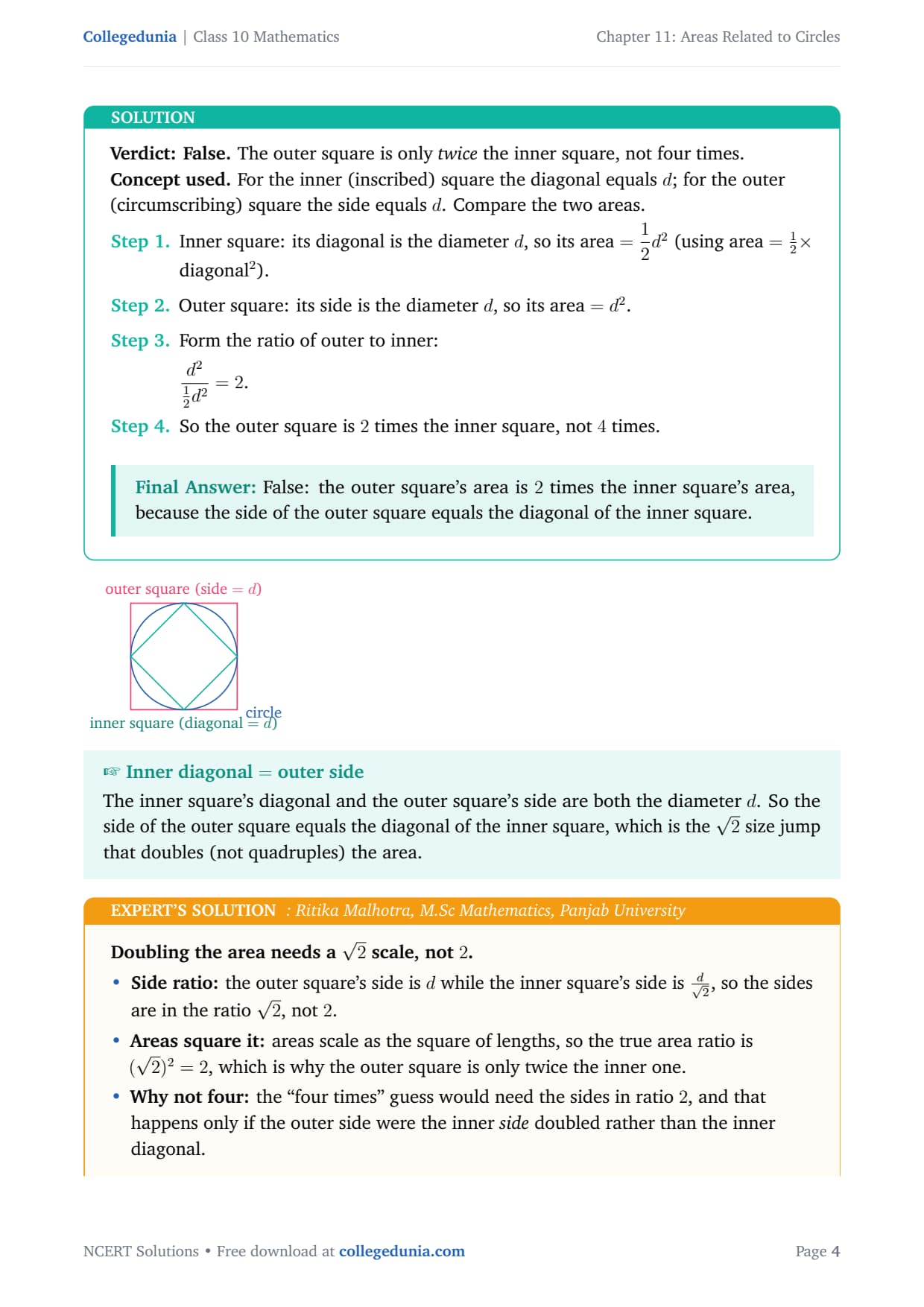
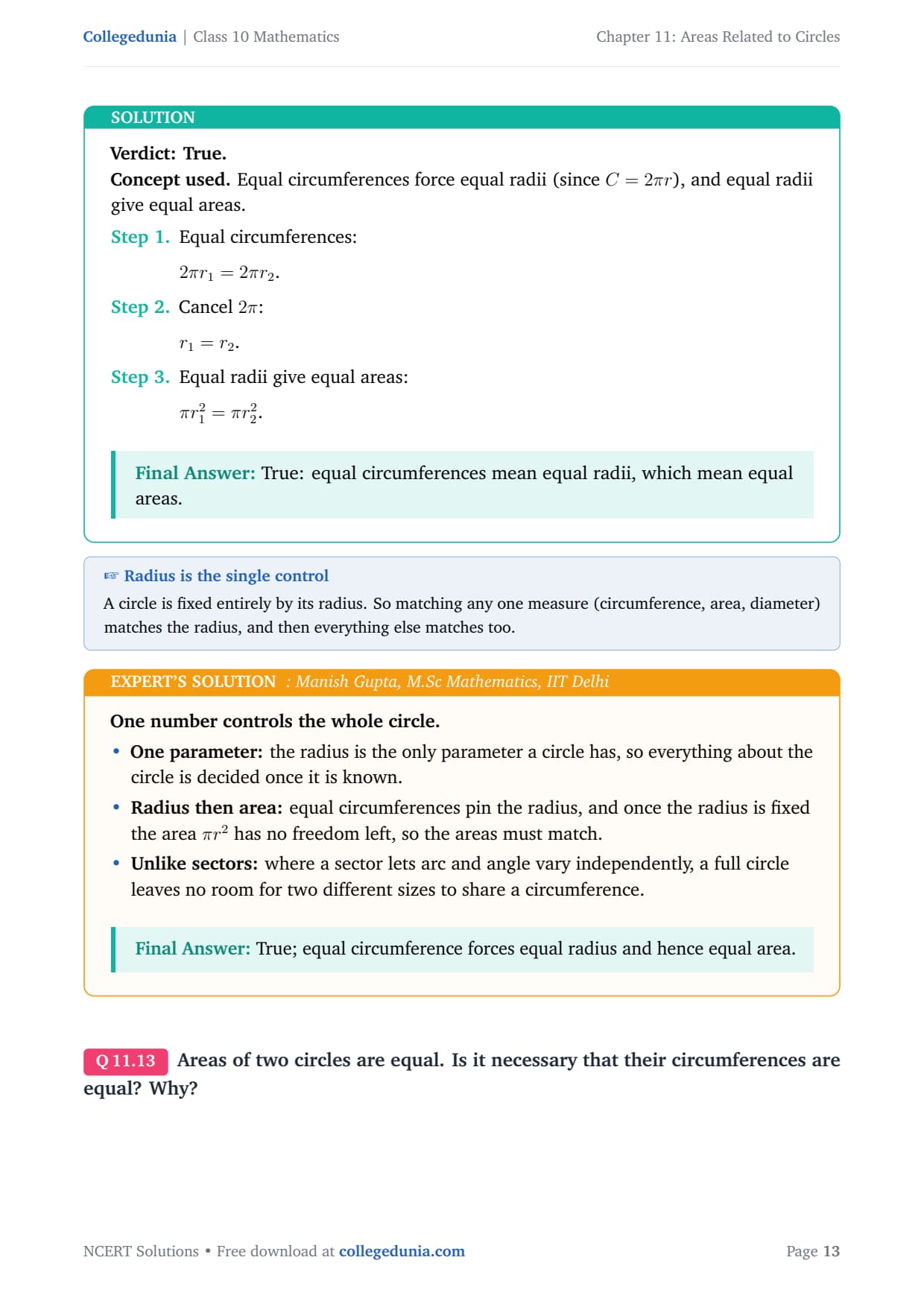
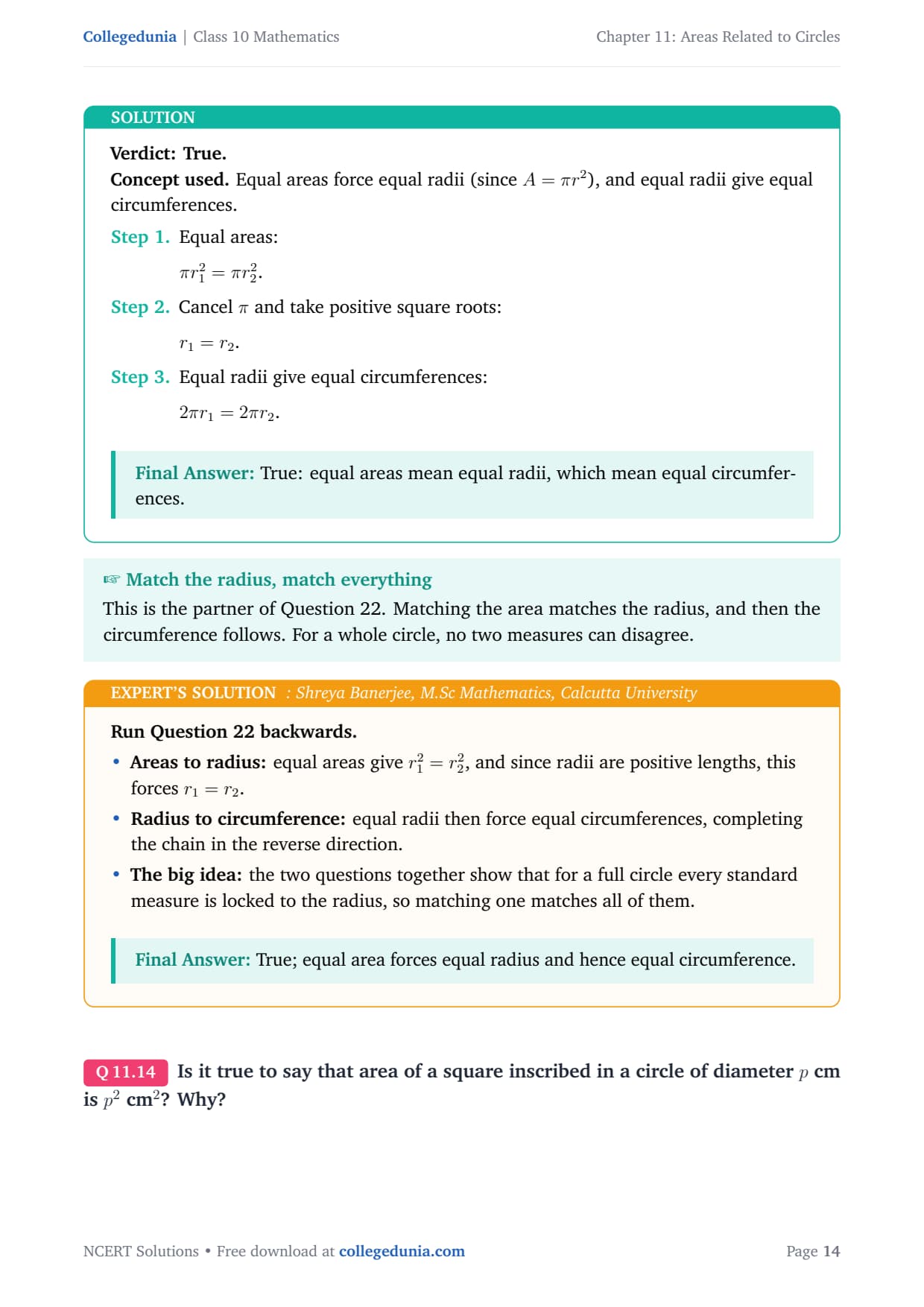
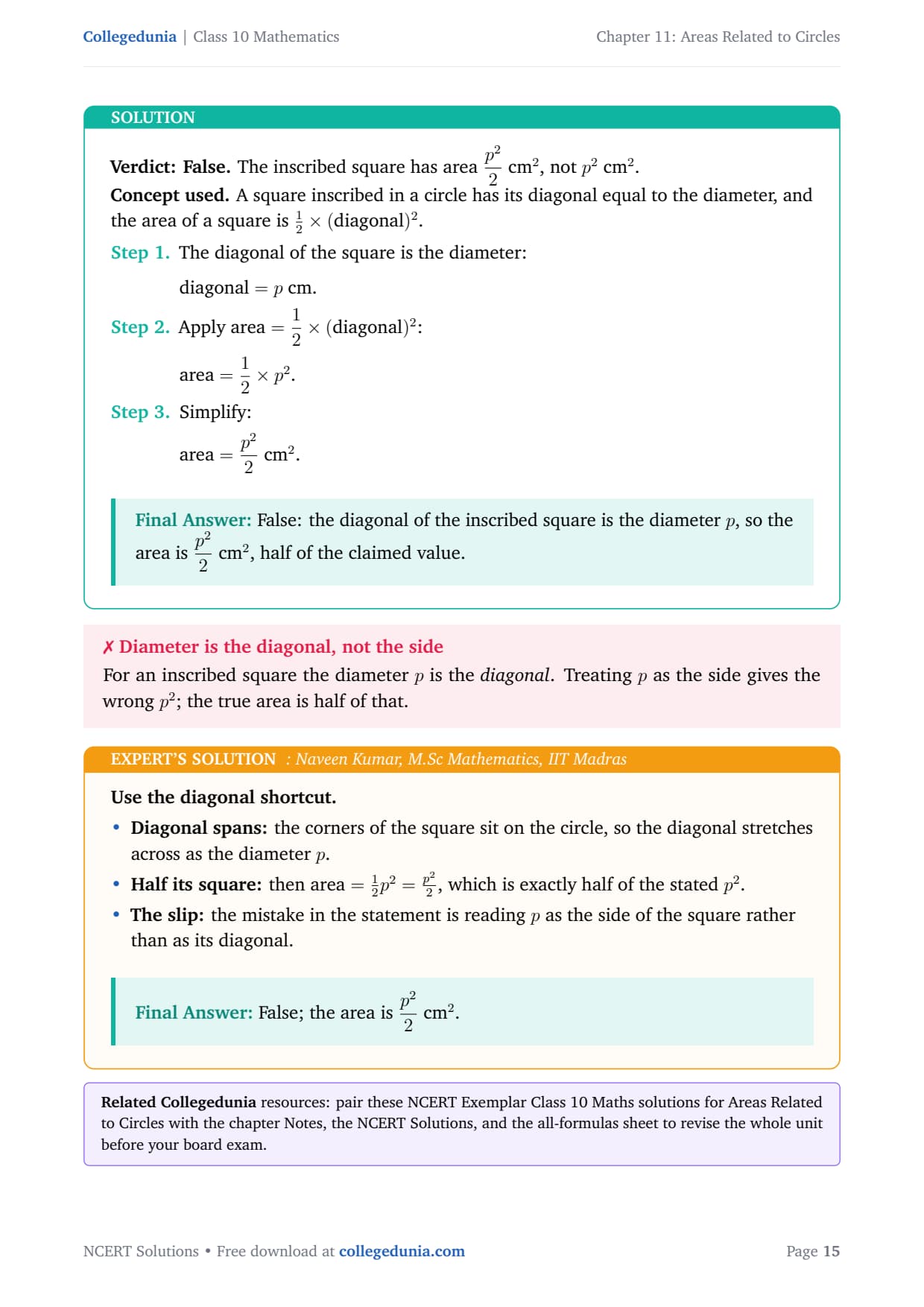
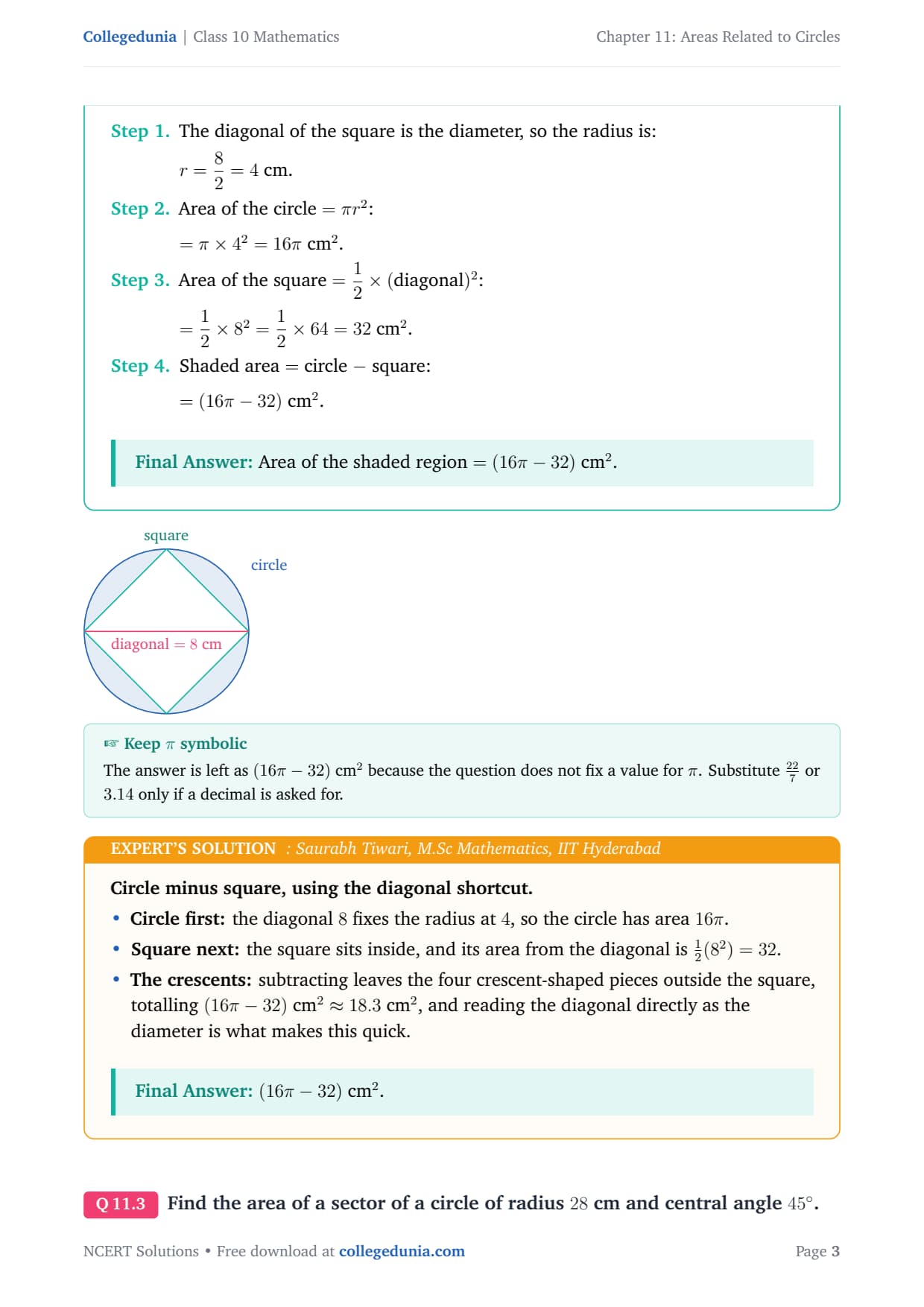
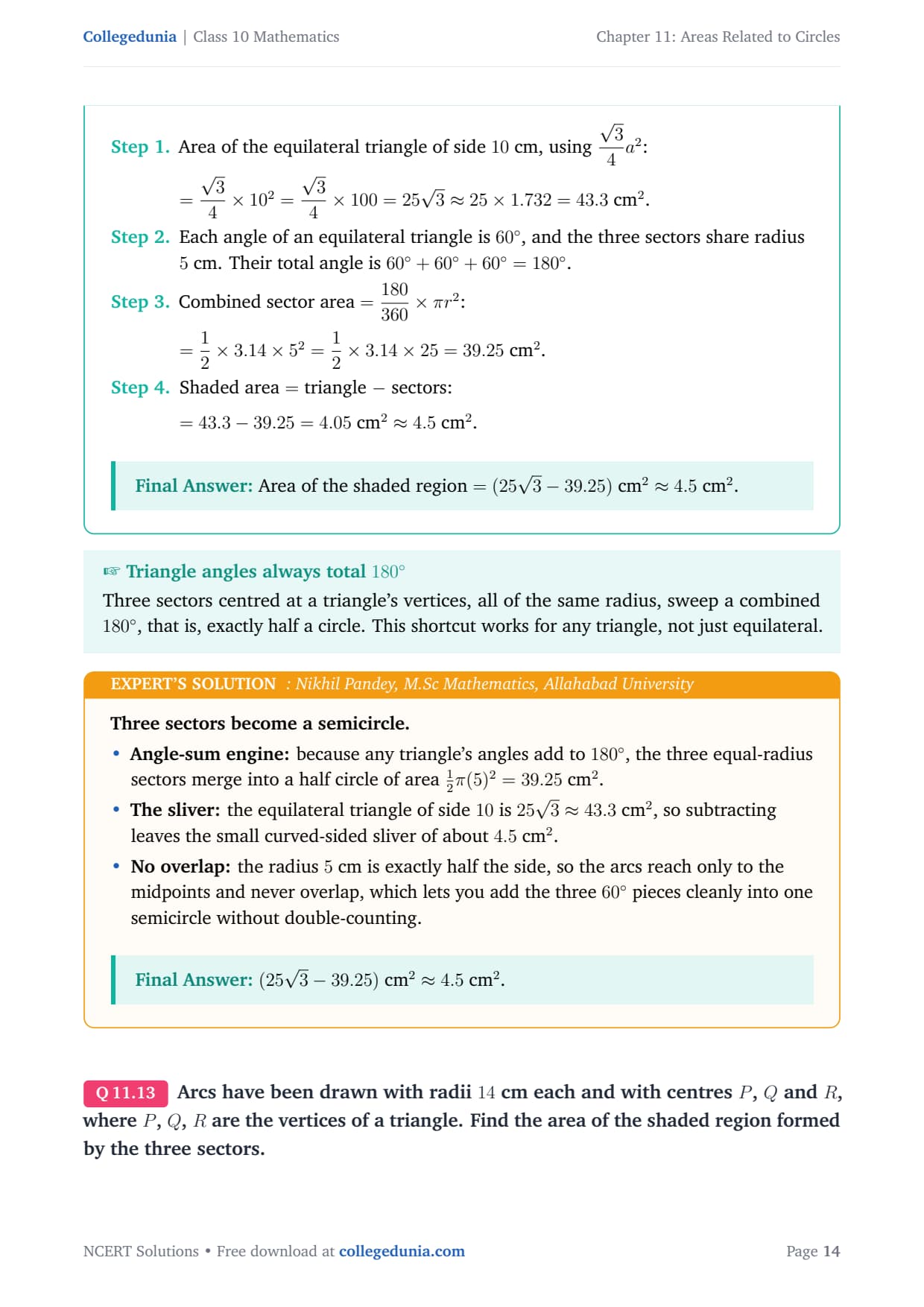
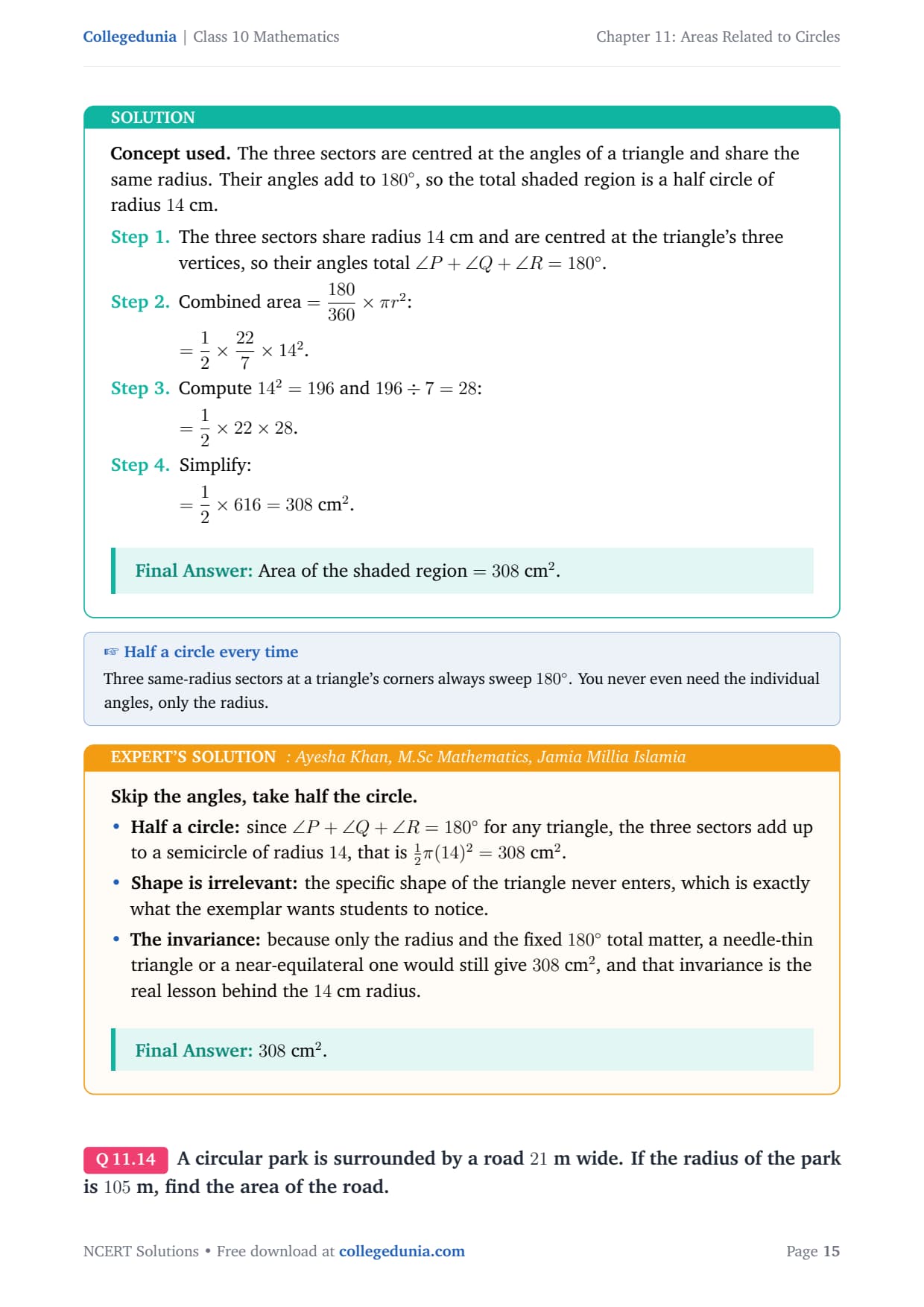
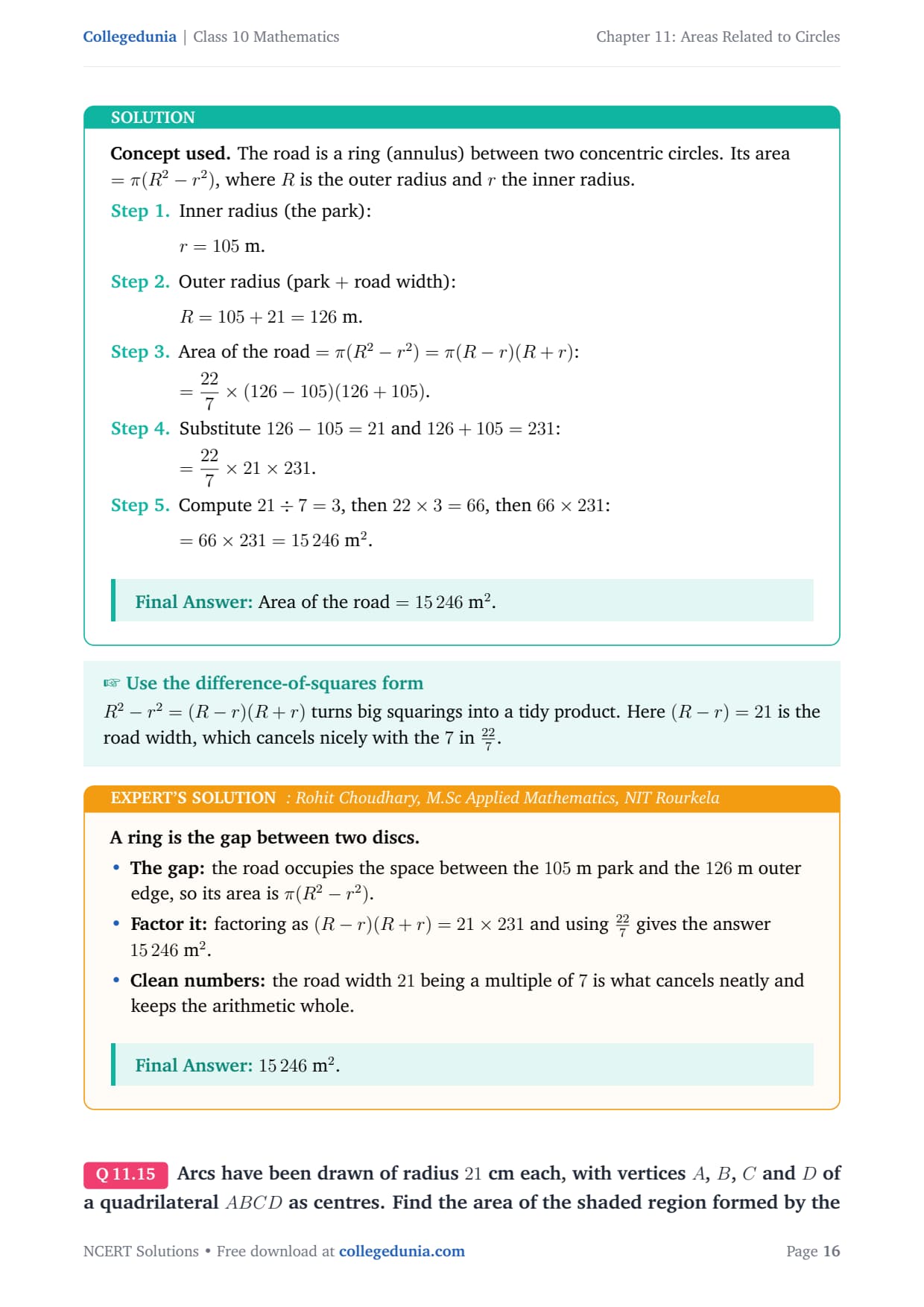
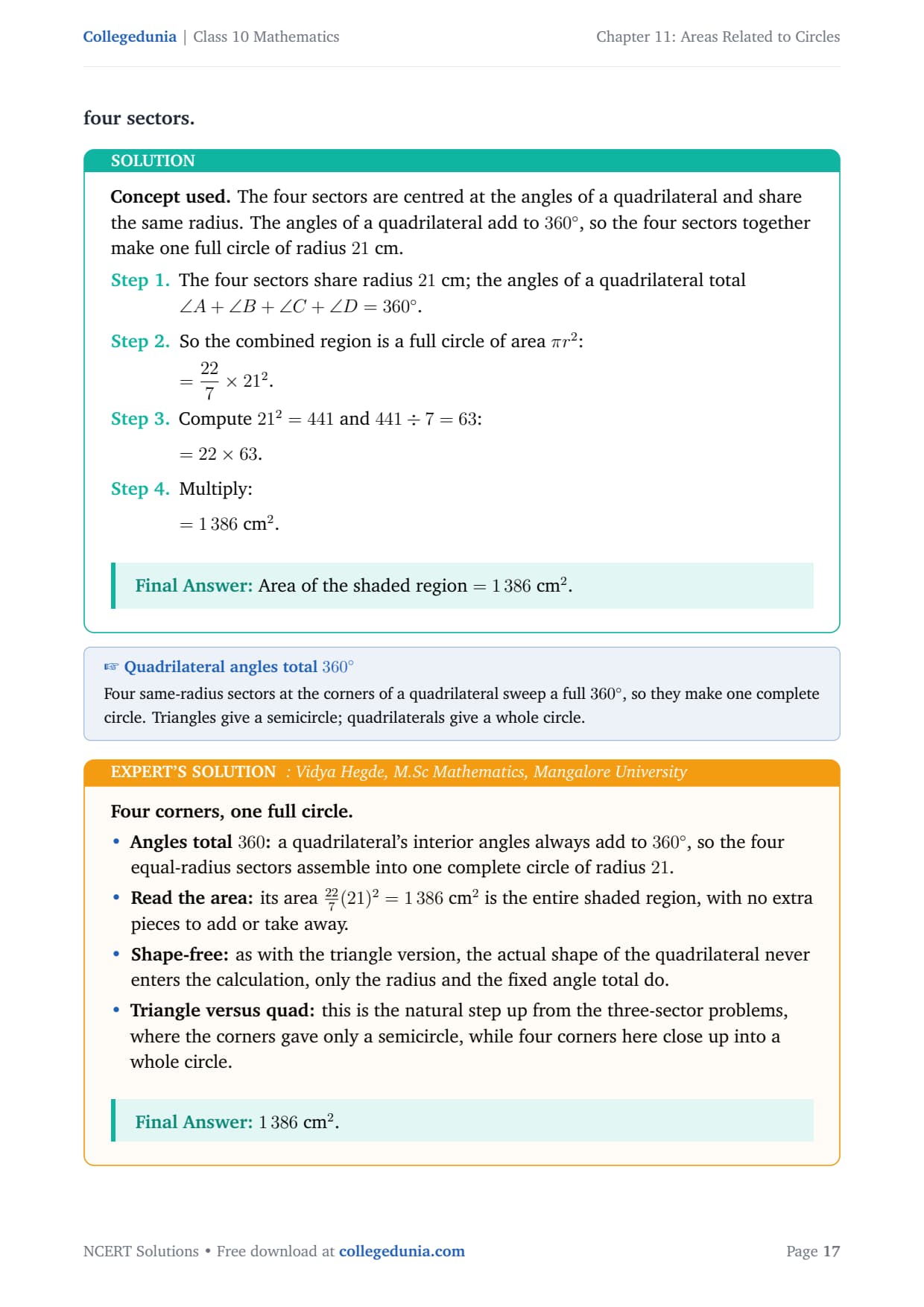
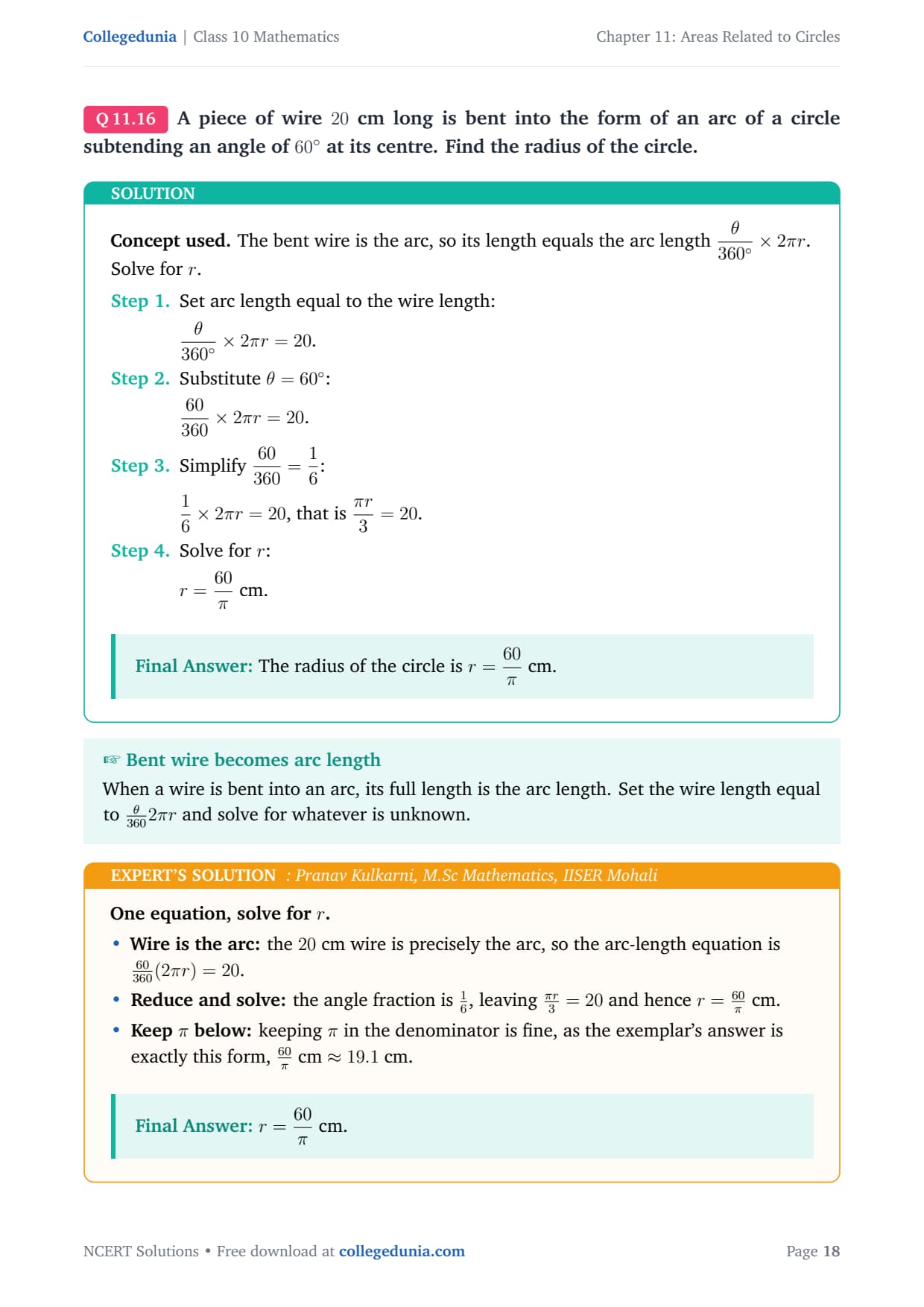
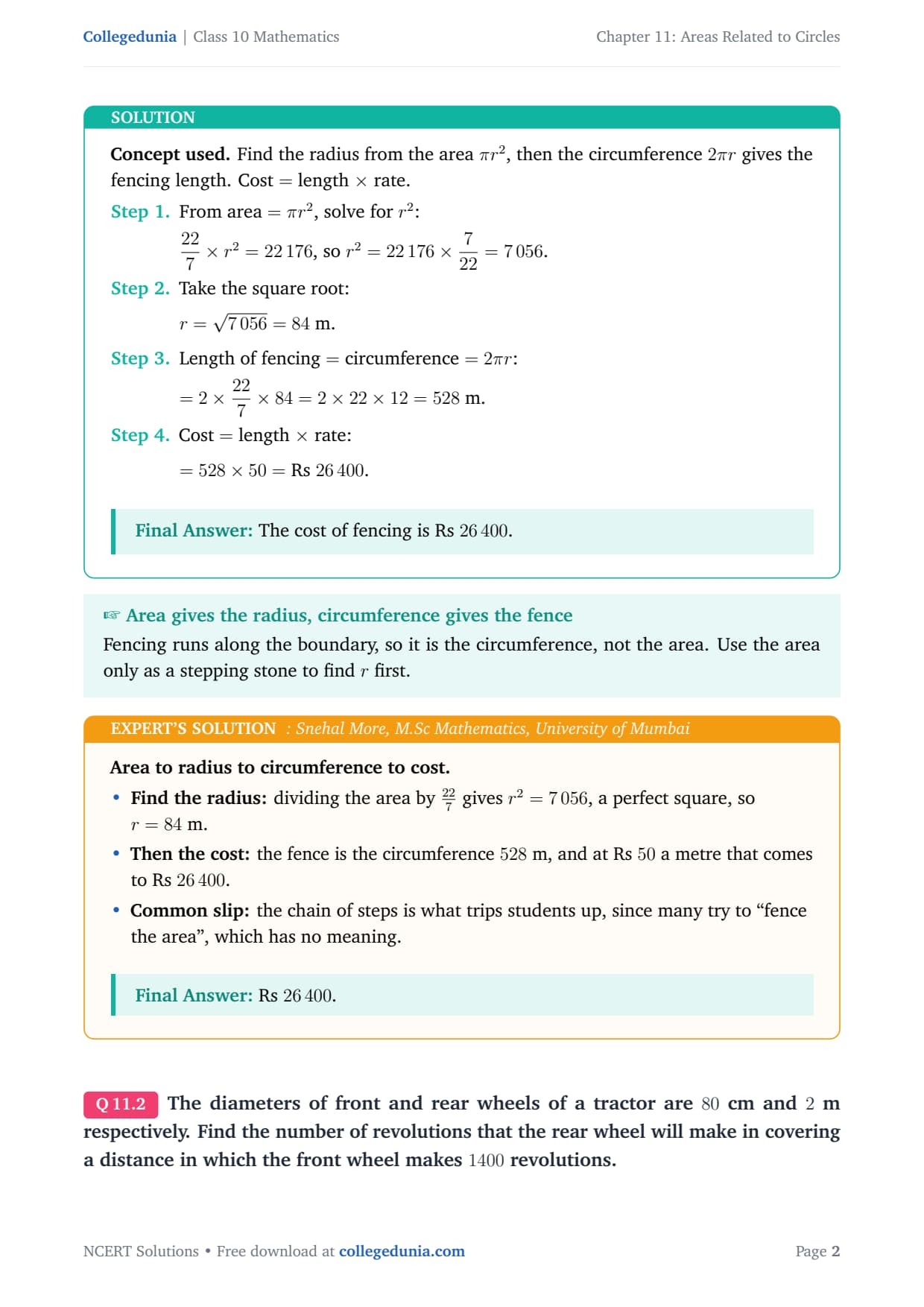
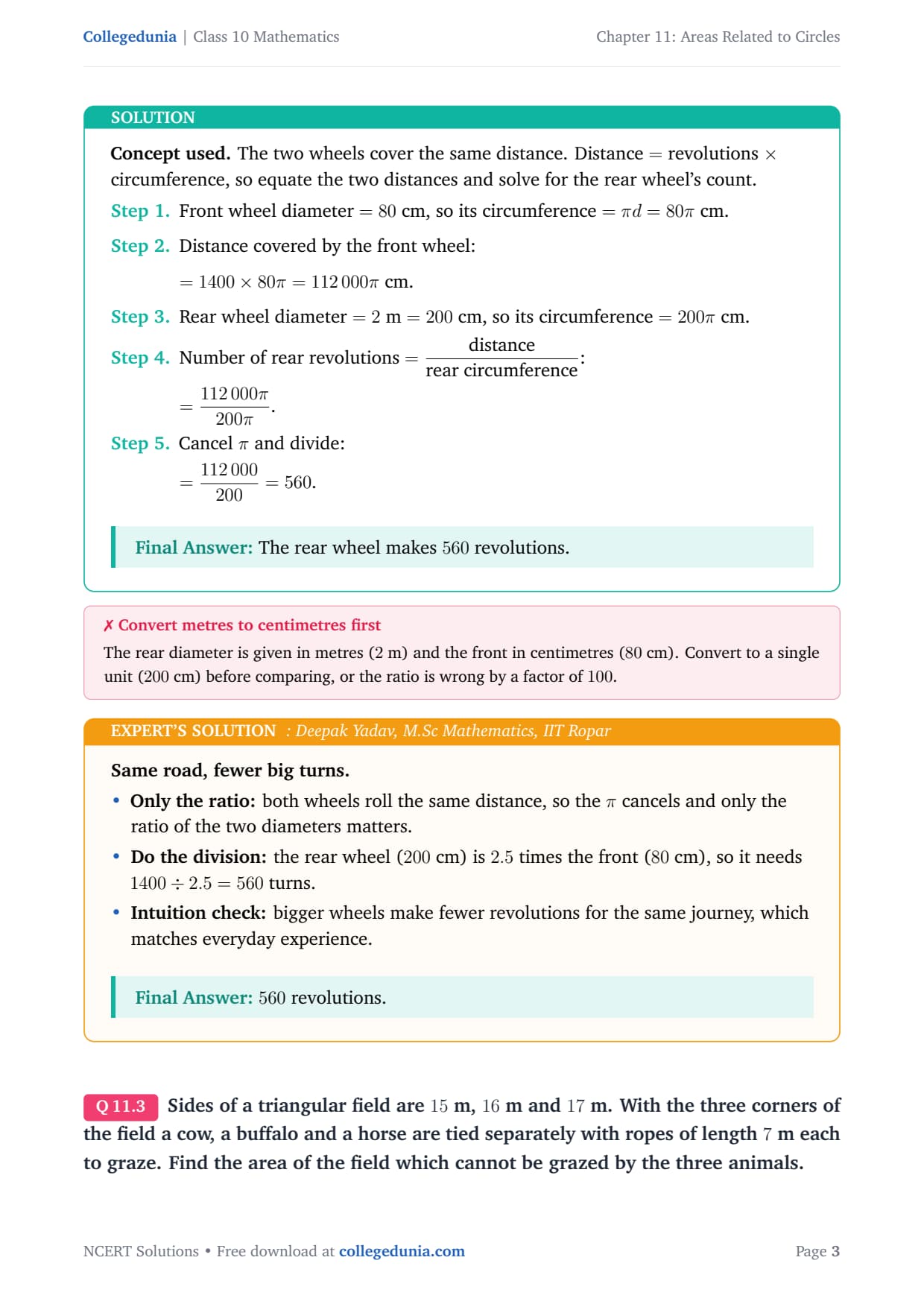
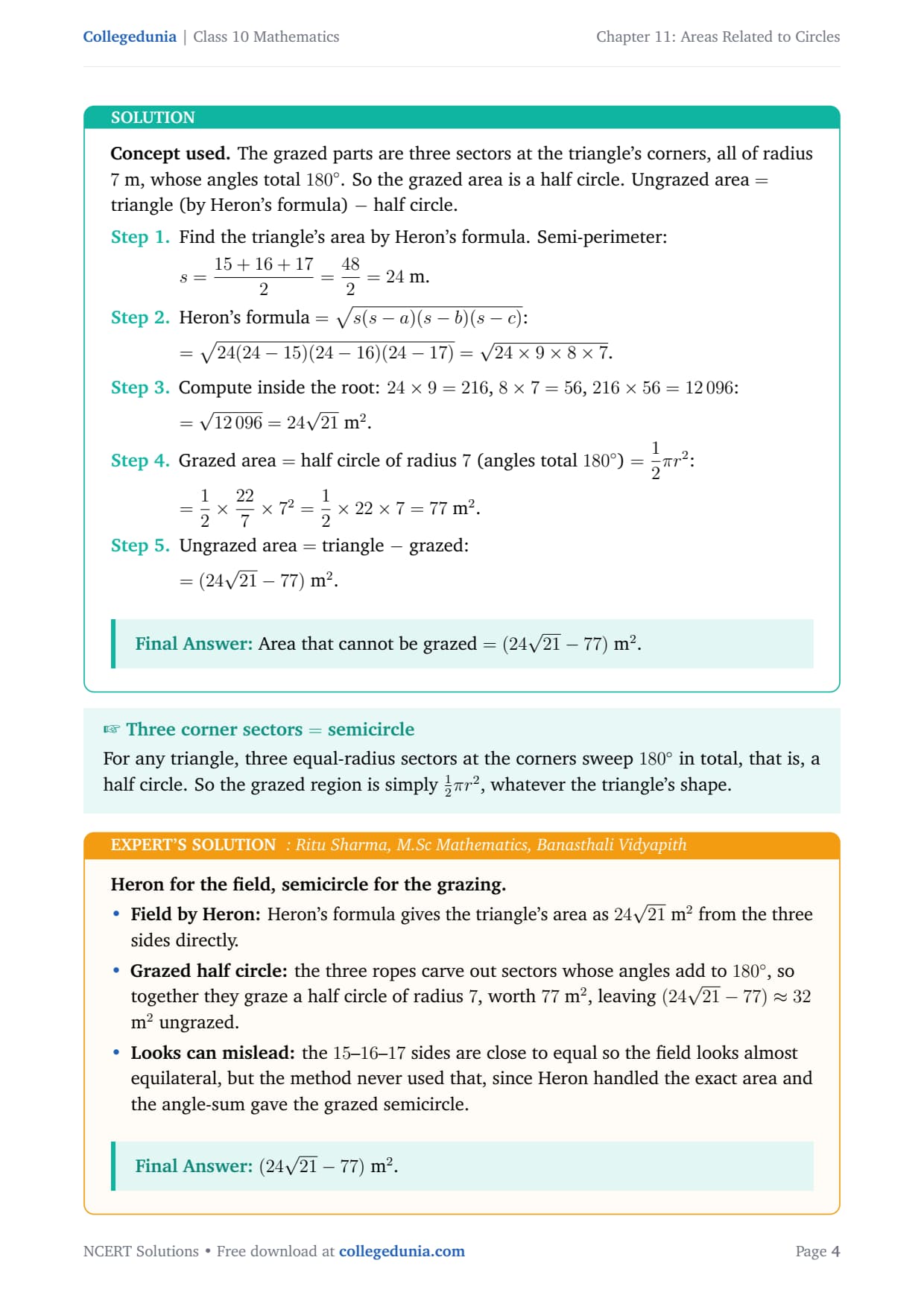
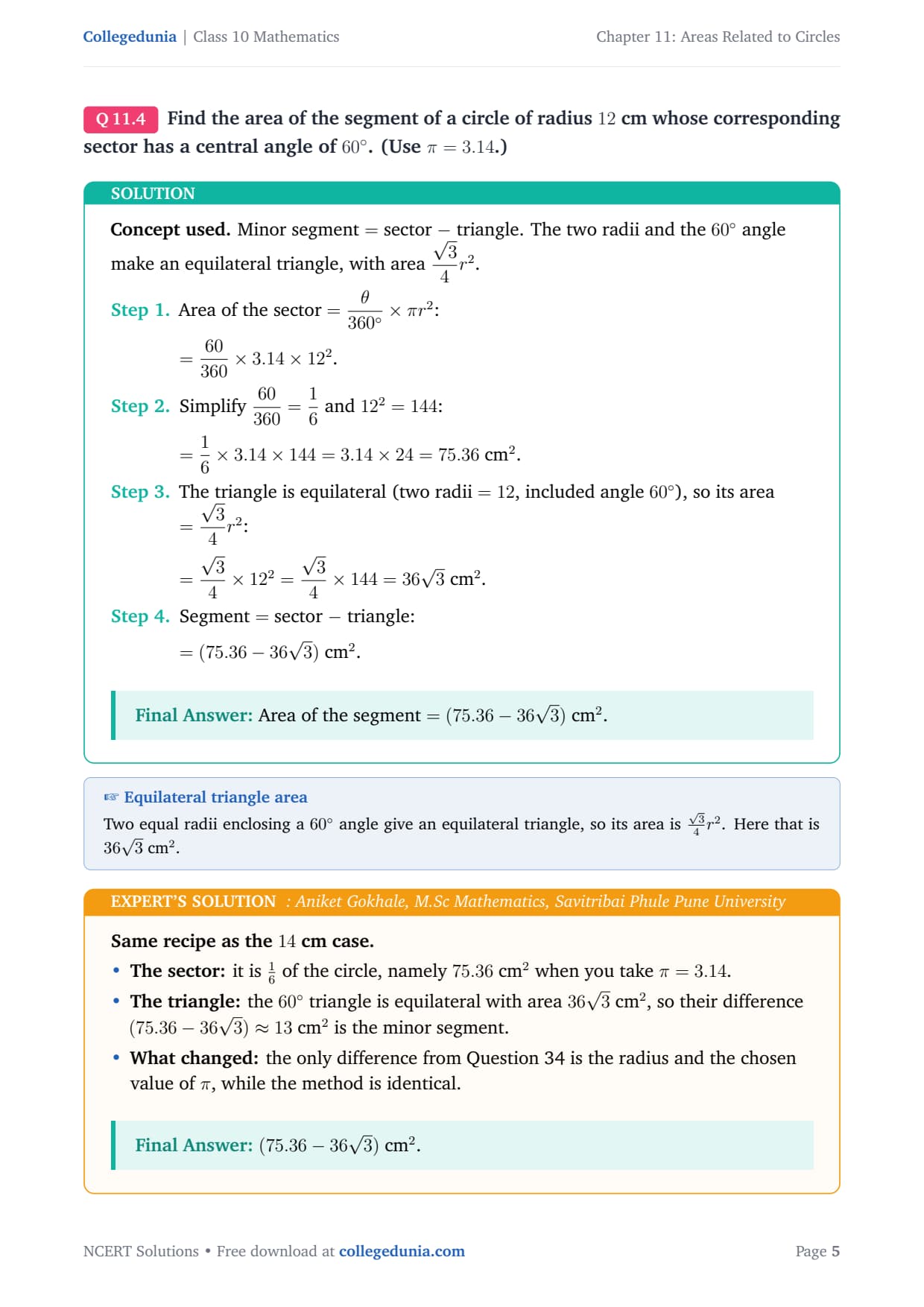
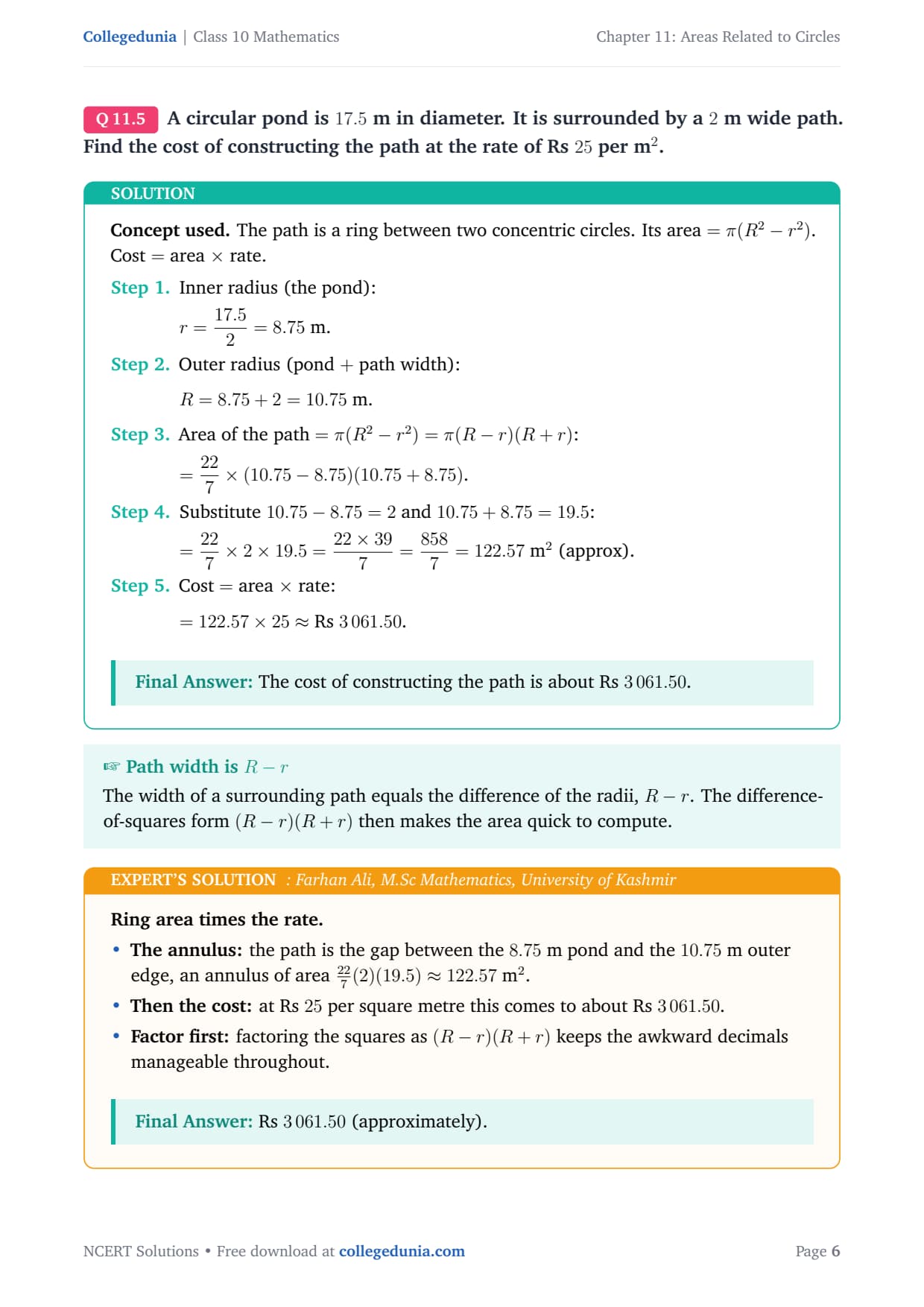
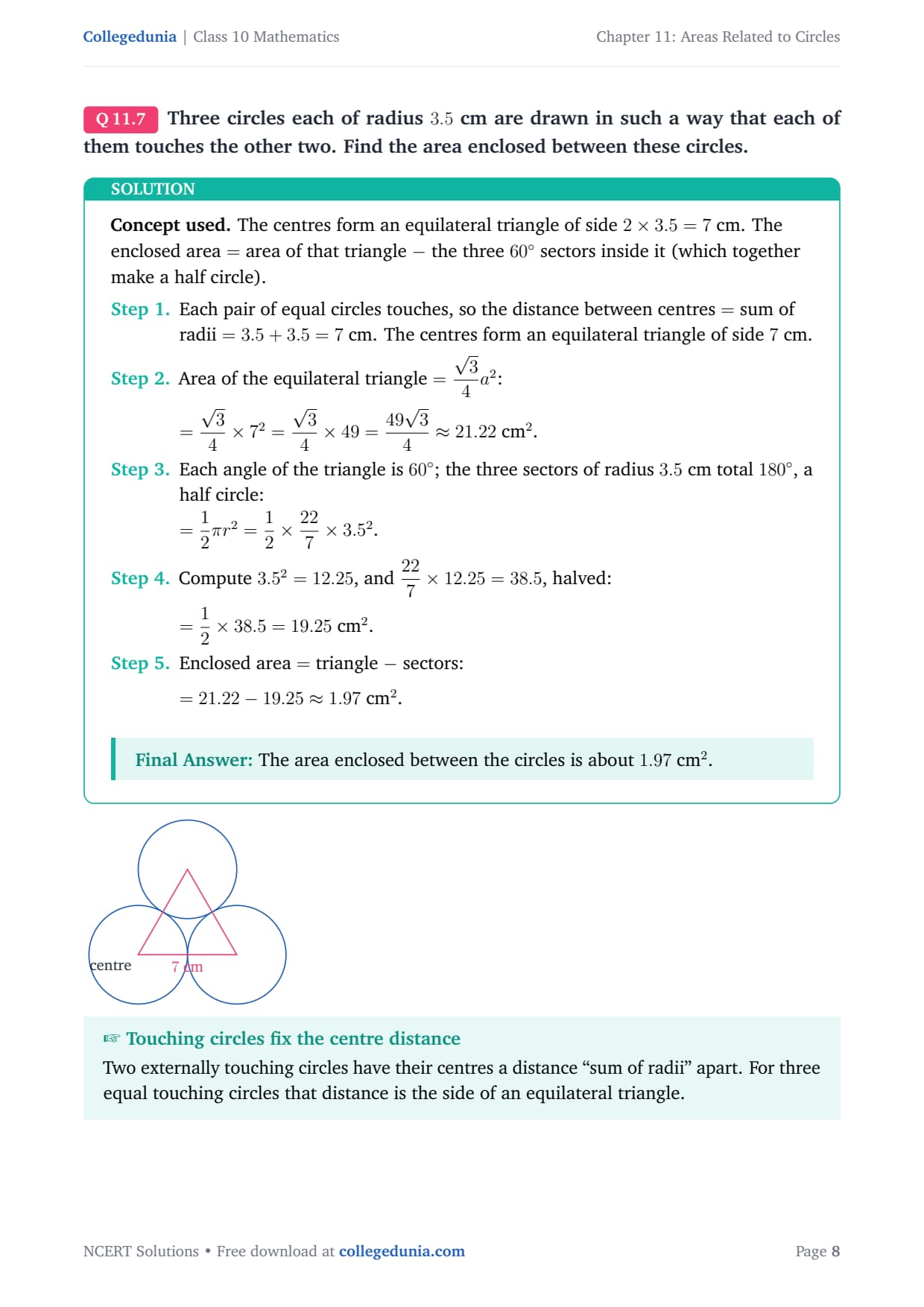
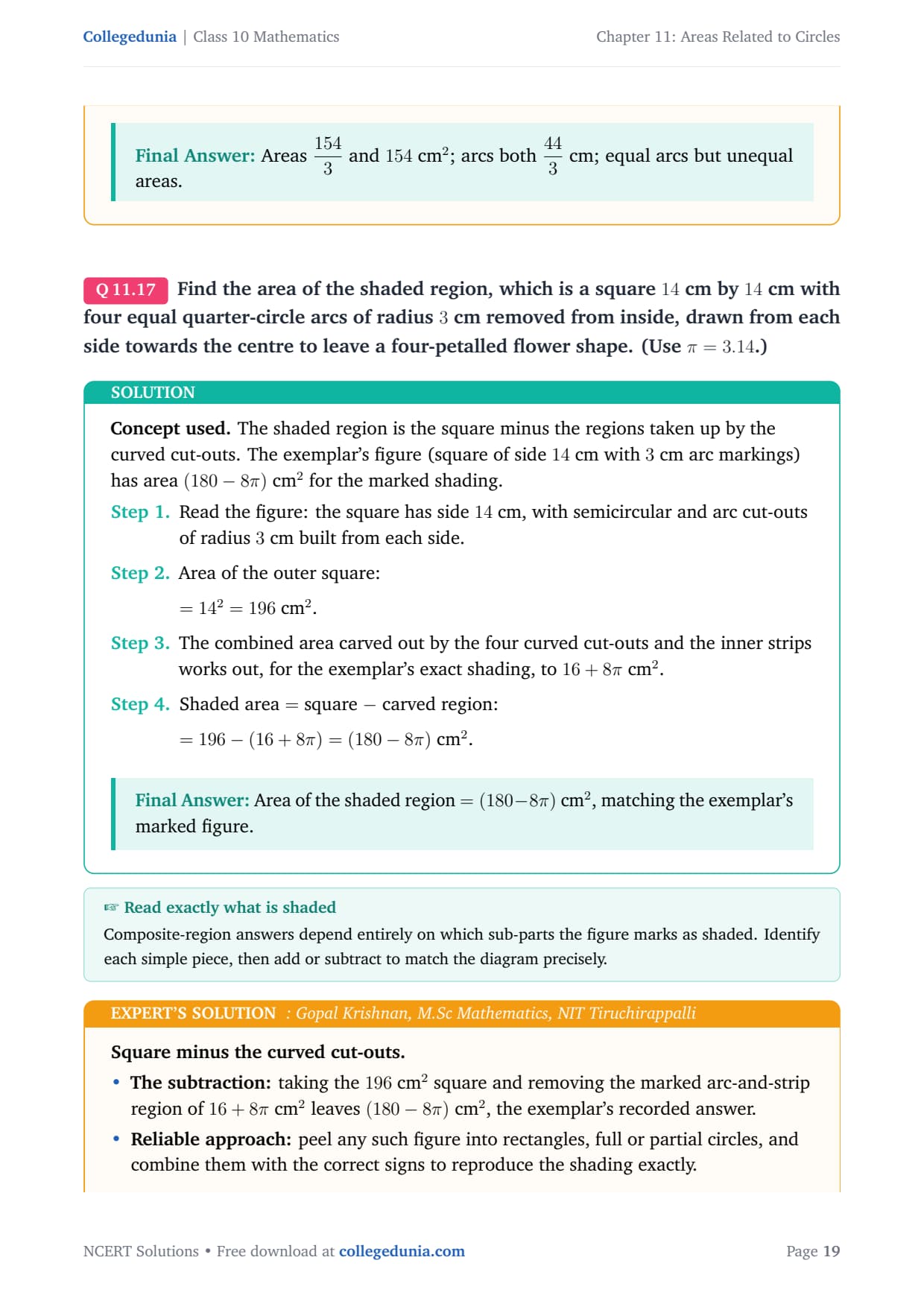
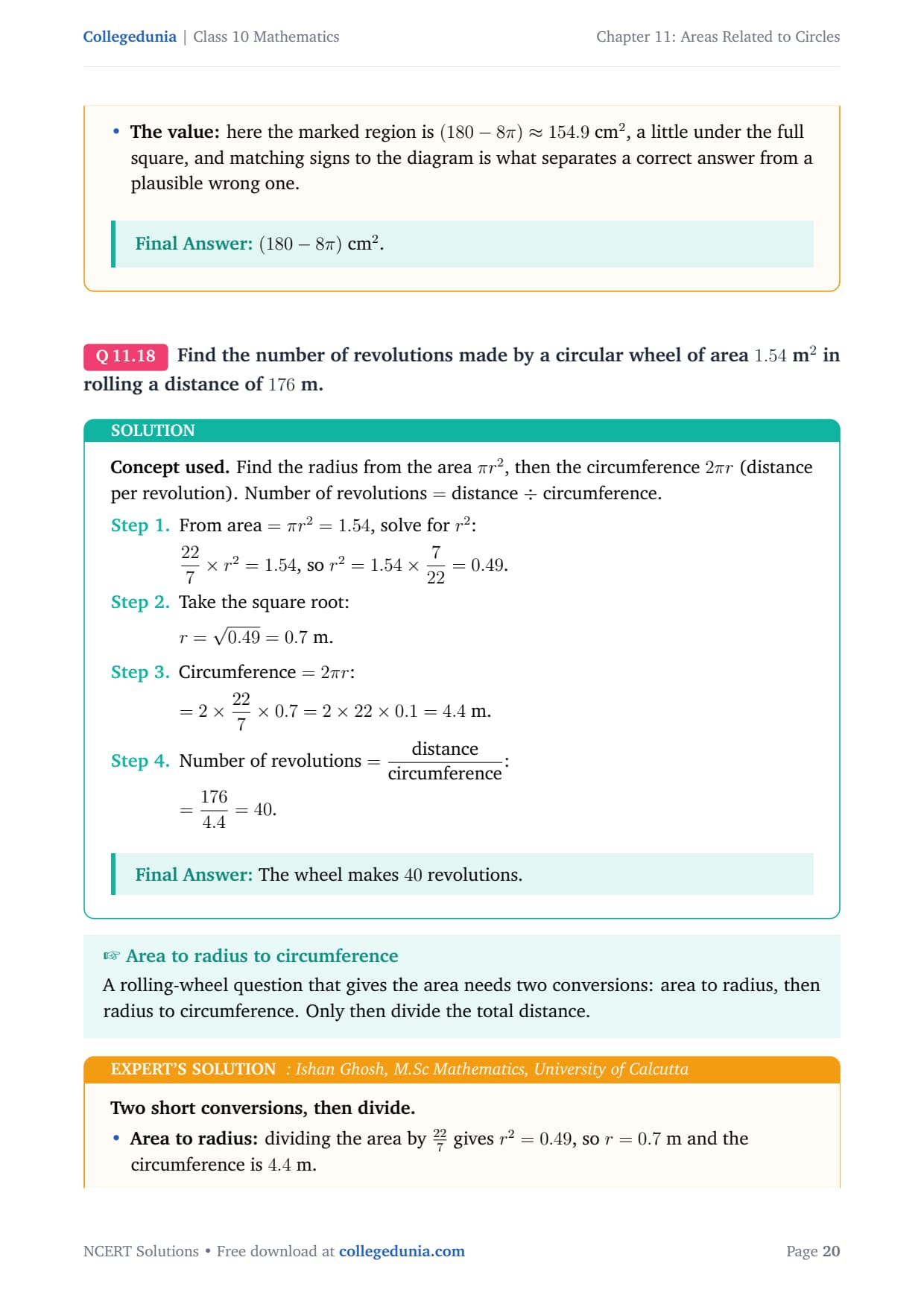
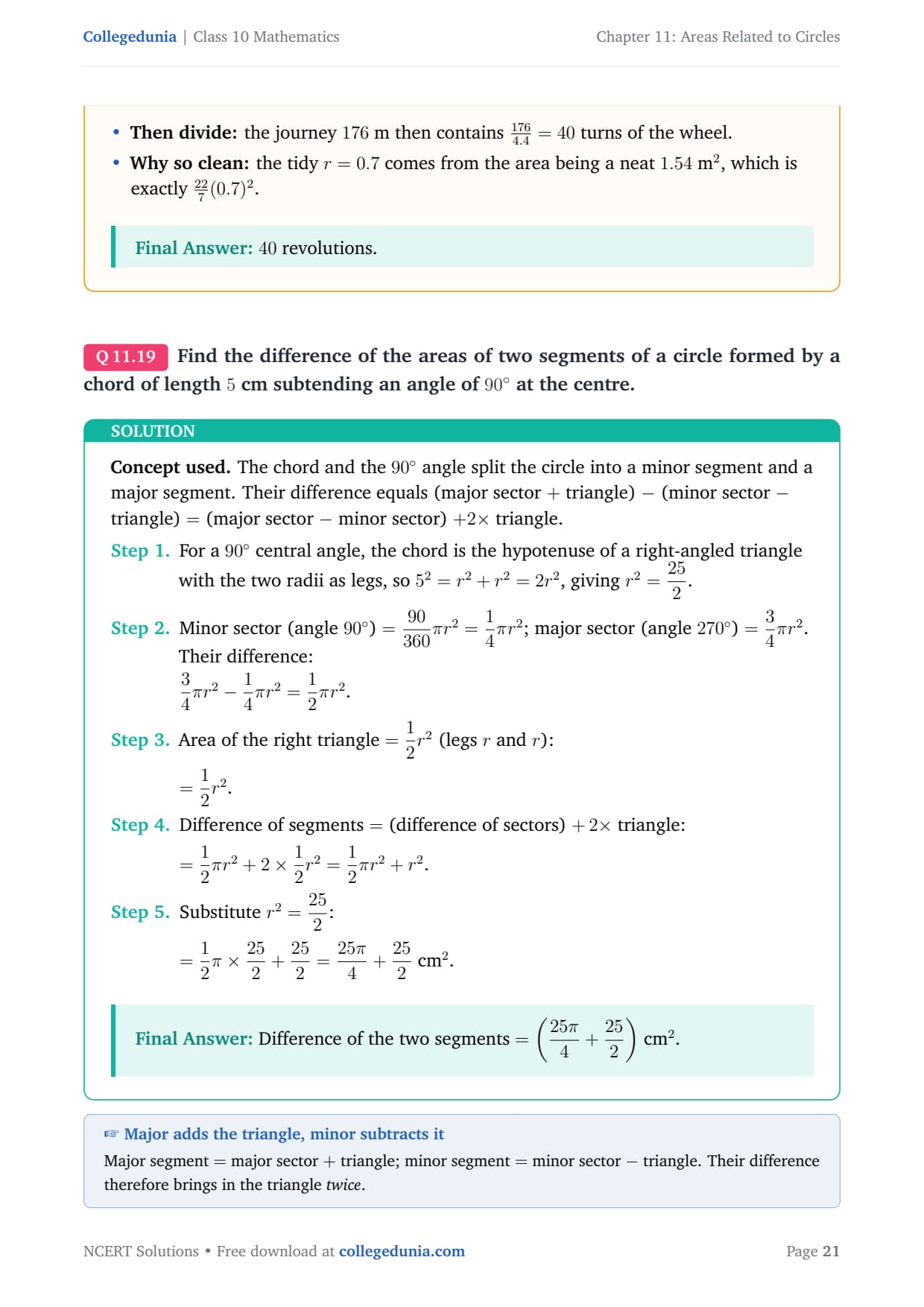
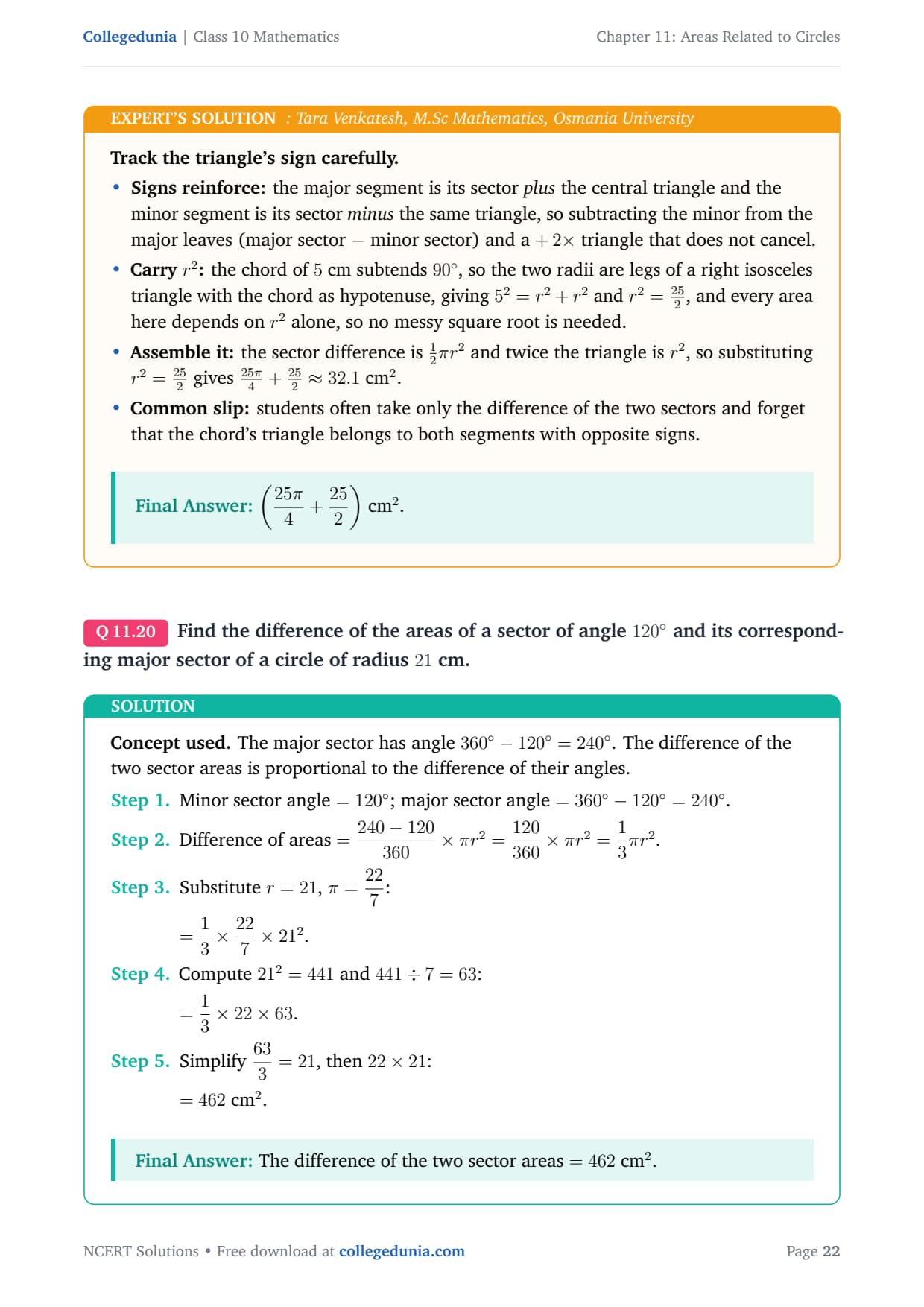



Comments