Physics Strategist, JEE/NEET | Updated 3+ months ago
The Atoms Chapter 12 in Physics Class 12 is a low-weightage chapter but can give you a guaranteed 2-3 marks in the CBSE Boards, JEE Main, and NEET if prepared well. The questions usually come from Rutherford's gold-foil scattering experiment, Bohr's atomic model, and the hydrogen spectrum derivations.
This page hosts the Class 12 Physics Chapter 12 Atoms NCERT solutions PDF and an 8-formula quick reference.
CBSE Boards:3 marks, usually one Bohr-model derivation or a short answer on Rutherford drawbacks.
JEE Main: about 2%, one question per shift on Bohr-orbit energy, radius, or the Rydberg formula.
NEET: 1 to 2 questions a year on hydrogen-spectrum lines and Bohr-model basics.
Every solution here is prepared by subject experts and aligned to the 2026-27 NCERT, matching the last five years of CBSE, JEE Main, and NEET papers. The PDF covers all back exercises on the Rutherford model, the Bohr model, and hydrogen-spectrum numericals.
Topic-by-Topic Concept Summary for Class 12 Atoms
The chapter splits into four sub-topics. The list below shows what each one is worth in CBSE.
Rutherford's atomic model: 2-mark conceptual on the gold-foil experiment.
Drawbacks of Rutherford's model: 2-mark short answer on stability and spectra.
Bohr's atomic model: the most-asked 3-mark derivation block.
Hydrogen spectrum: 2-mark numerical on the Rydberg formula and series.
Rutherford Atomic Model Class 12: The Gold-Foil Scattering Experiment
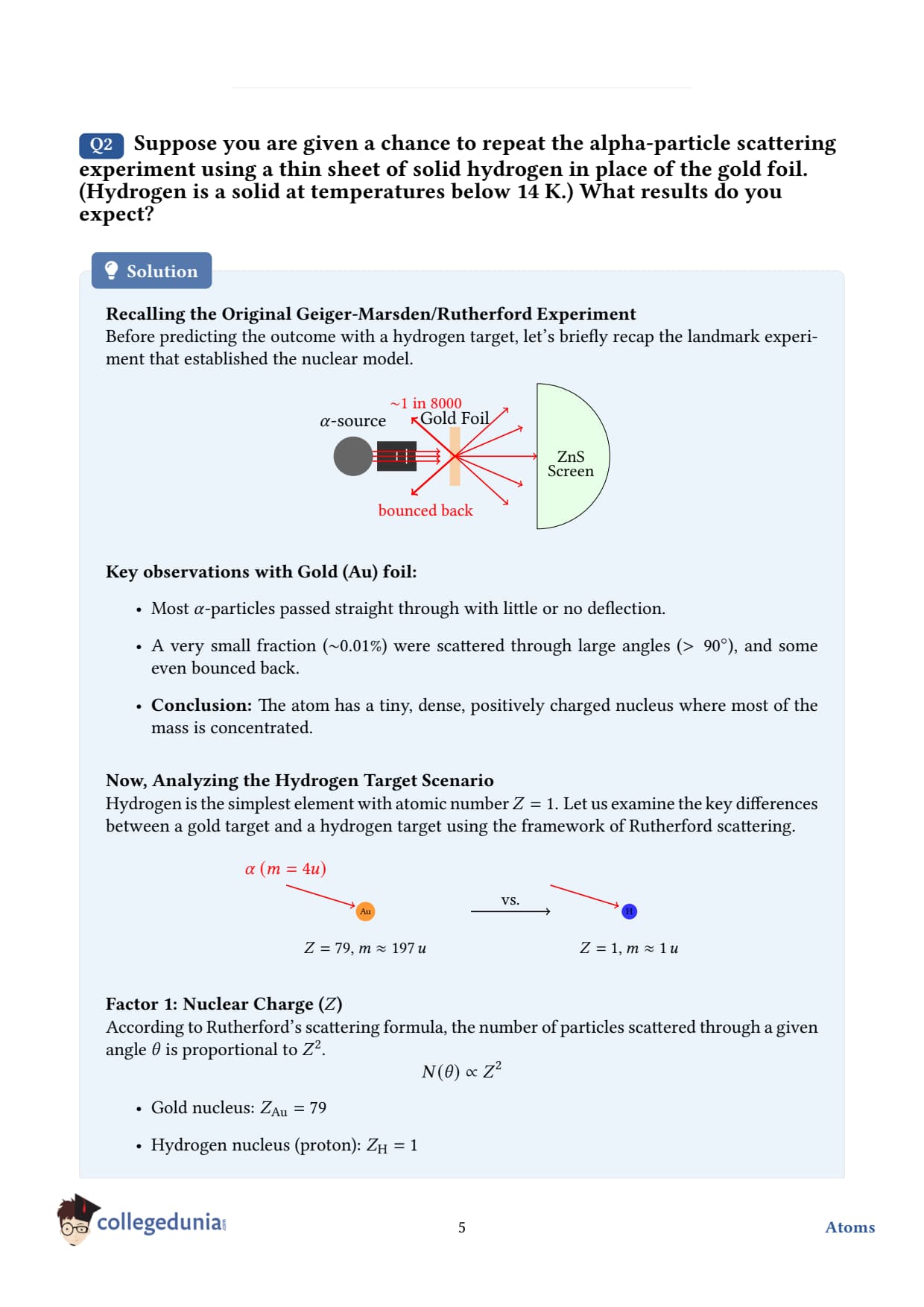
Rutherford's gold-foil scattering experiment (1911) led to the nuclear atom.
Alpha particles were fired at a thin gold foil. Most passed straight through, so the atom is mostly empty space.
A tiny dense nucleus holds all the positive charge and almost all the mass, with electrons orbiting it like planets around the Sun.
The nuclear radius is about 10^-15 m and the atomic radius about 10^-10 m, a factor of 10^5 apart.
Drawbacks of Rutherford Model of Atom Class 12
The drawbacks of the Rutherford model are a standard 2-mark CBSE question. Two problems break the model:
Stability: A classically accelerating electron (in a circular orbit) should continuously radiate electromagnetic energy and spiral into the nucleus within 10^-8 seconds. Atoms are observed to be stable for indefinite periods.
Discrete spectra: The model predicts a continuous spectrum. Real atoms emit only at fixed discrete frequencies (line spectra).
Bohr Atomic Model Class 12 Physics: Three Postulates and Derivation
The Bohr atomic model rests on three postulates.
(1) Electrons revolve only in fixed "stationary" orbits without radiating.
(2) Angular momentum is quantised: L = m v r = n h / (2 pi).
(3) Energy is emitted or absorbed only on a jump between orbits: h nu = E_initial minus E_final.
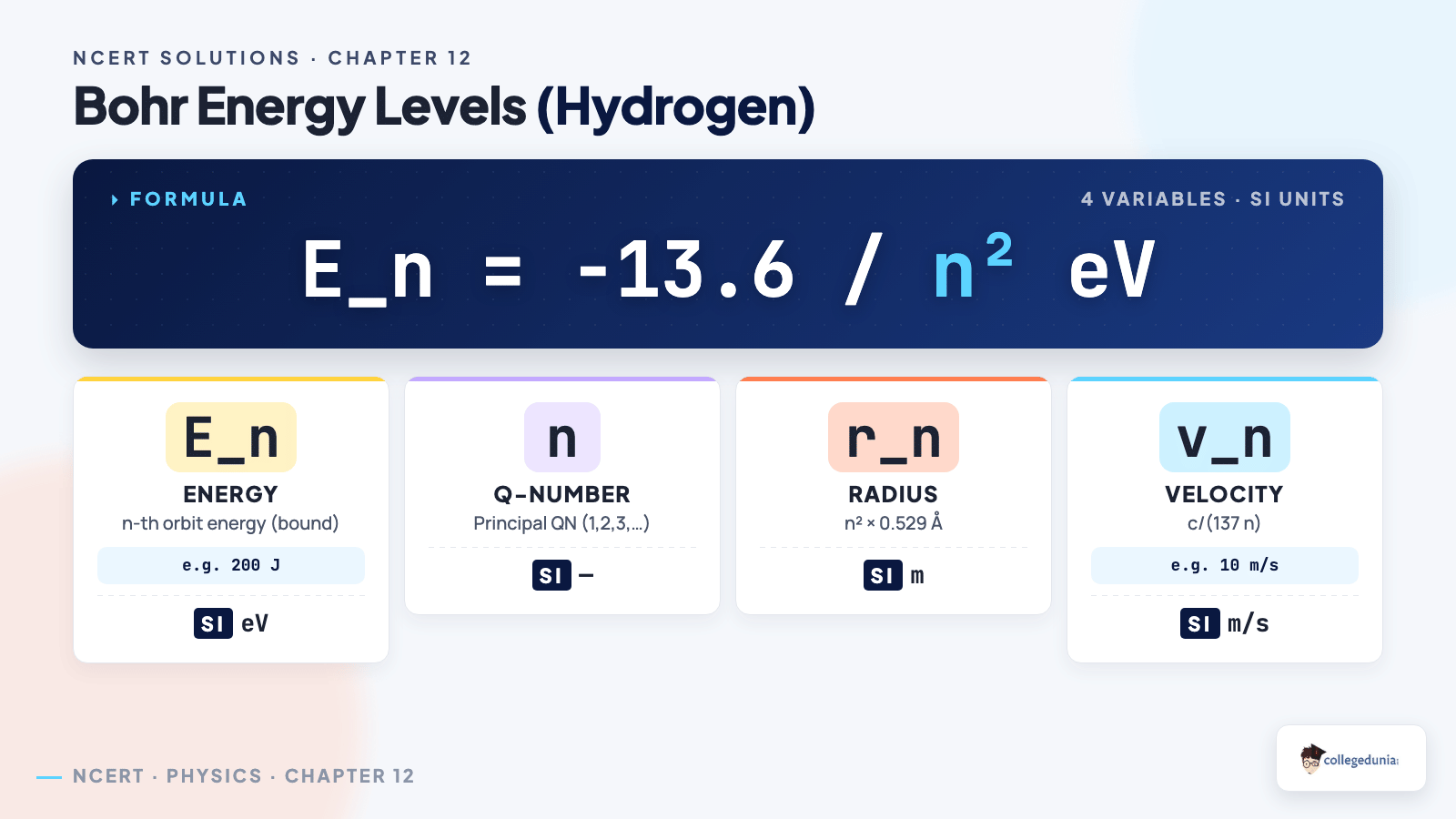
For hydrogen, the nth orbit radius is r_n = n squared a_0 (a_0 = 0.529 angstrom) and the energy is E_n = -13.6 / n squared eV. The ground state (n=1) is most tightly bound at -13.6 eV; as n grows large, the electron becomes free (E = 0).
Spectral Series of Hydrogen Atom Class 12: Rydberg Formula
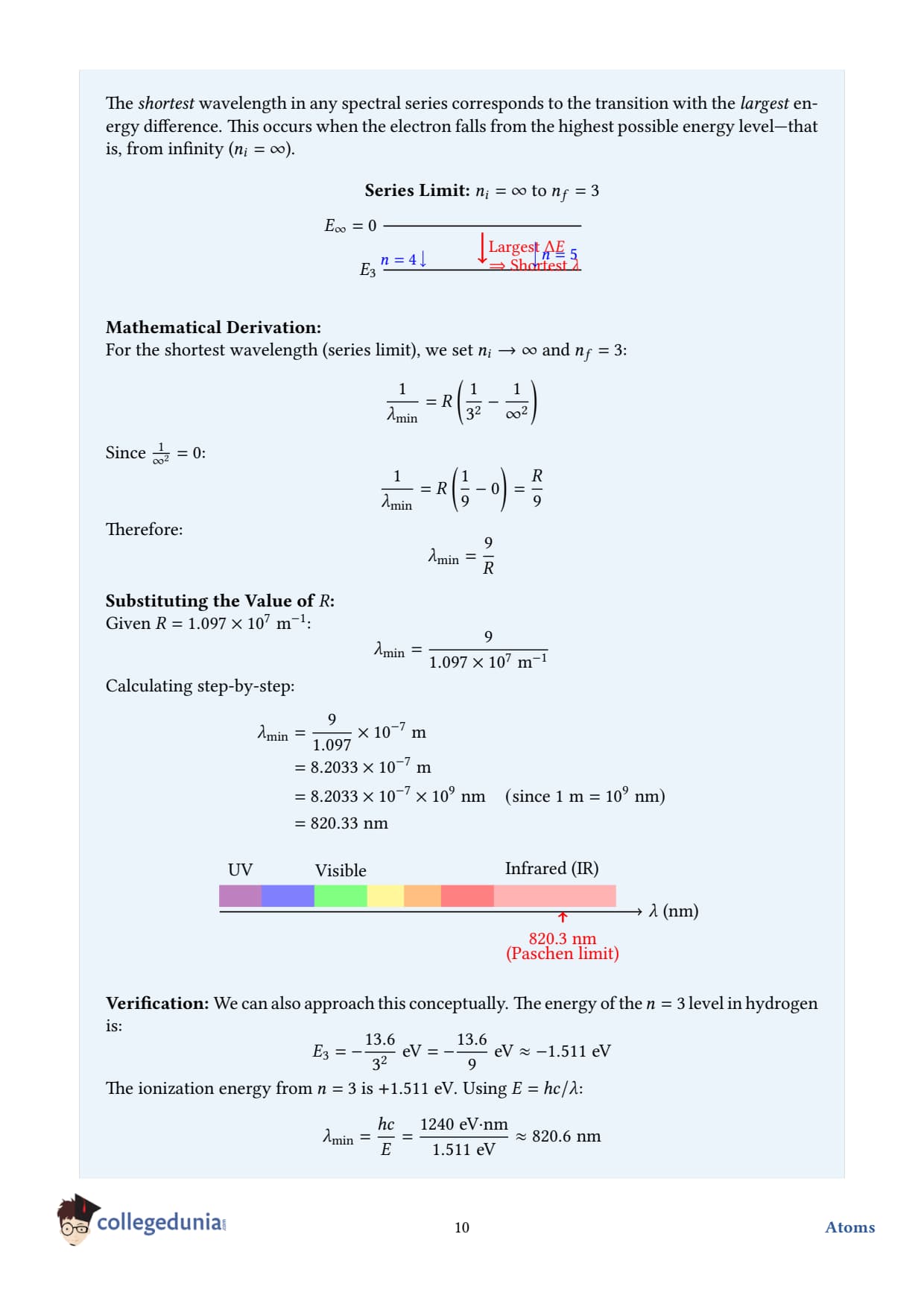
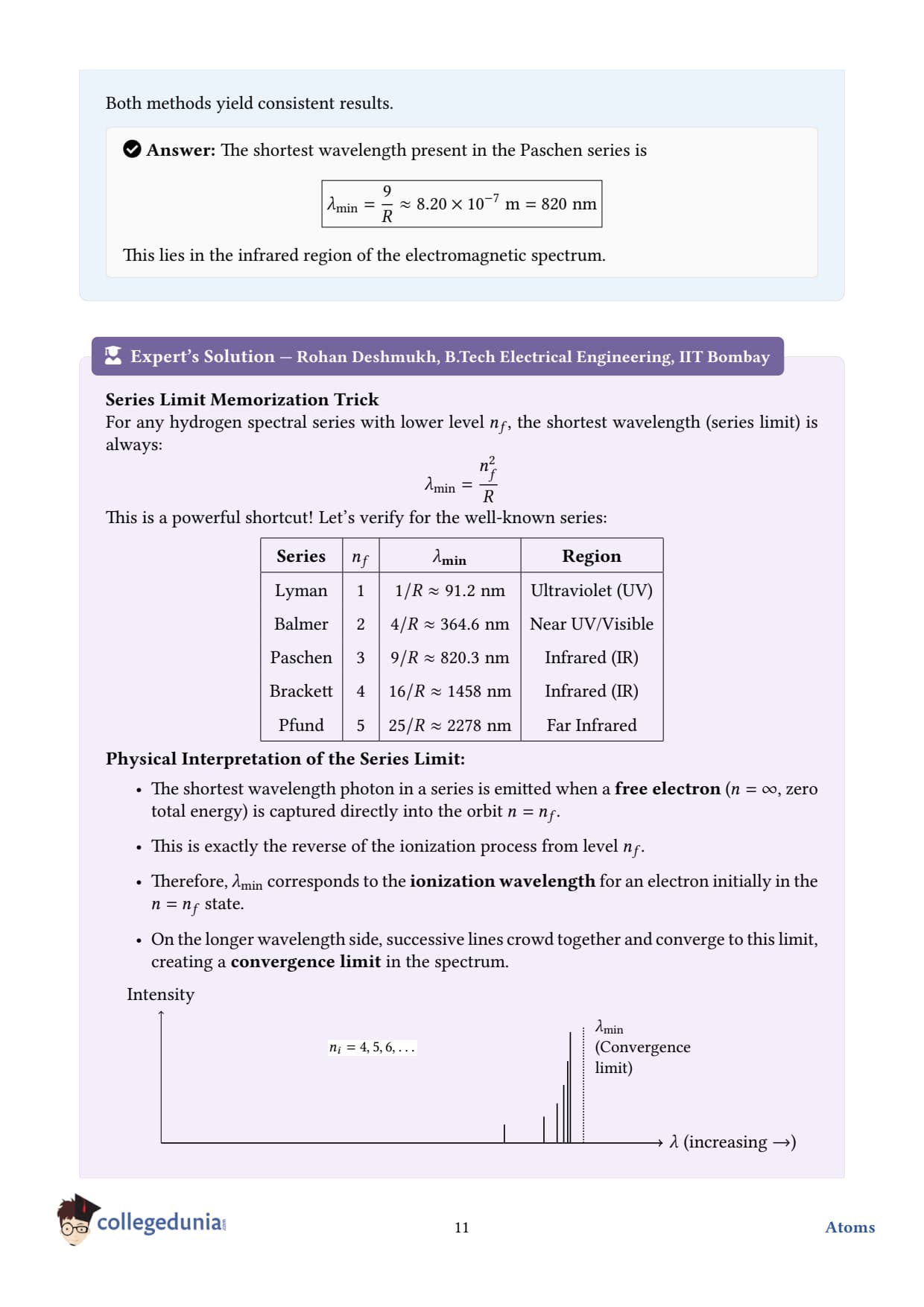
The hydrogen spectrum follows the Rydberg formula: 1/lambda = R (1/n_1 squared minus 1/n_2 squared), with R = 1.097 times 10^7 per metre. Each series ends at a fixed final orbit:
Lyman series (UV): n_1 = 1, the shortest wavelengths.
Balmer series (visible): n_1 = 2. The H-alpha line (656.3 nm, red) is the most asked.
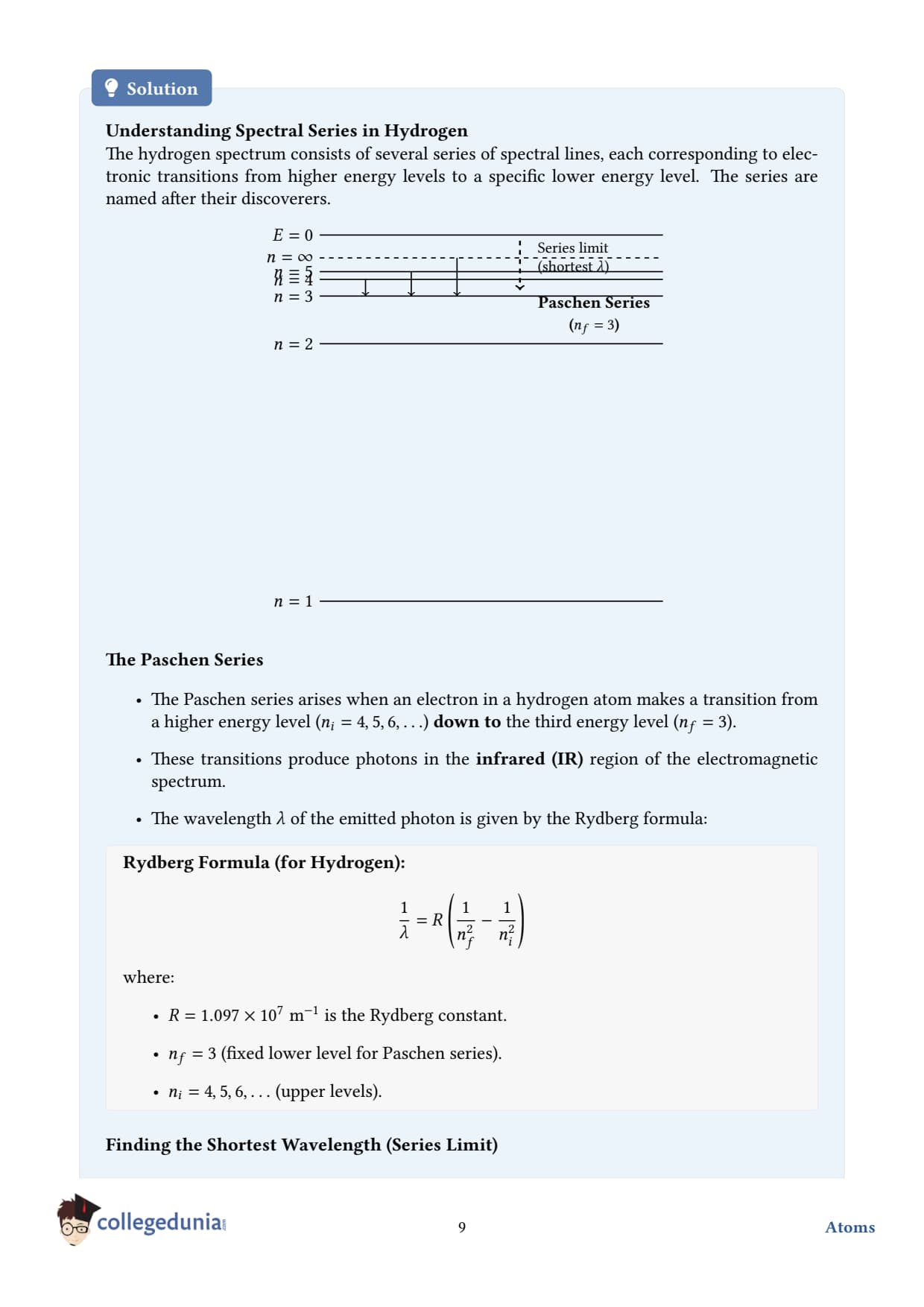
Paschen, Brackett, Pfund (IR): n_1 = 3, 4 and 5.
Exercise Breakdown for Class 12 Atoms NCERT Solutions
The chapter has 10 back exercises plus 5 solved examples, all covered below with step-wise marking. Most are Bohr-orbit or hydrogen-spectrum numericals.
Exercise / Section
Questions
Sub-topic Focus
Example 12.1 to 12.5
5 in-text
Rutherford scattering, Bohr orbits, Rydberg formula
Exercise 12.1 to 12.4
4
Rutherford model, alpha-particle scattering, distance of closest approach
Exercise 12.5 to 12.8
4
Bohr atomic model class 12 physics: orbit radius, energy levels
Exercise 12.9 to 12.10
2
Hydrogen spectrum, Lyman/Balmer/Paschen series wavelengths
Atoms Weightage Compared Across Class 12 Physics Chapters
Atoms (Ch 12) sits at 3 marks, among the lightest Class 12 Physics chapters.
Chapter
Topic
Avg CBSE Marks
Ch 1
Electric Charges and Fields
6 marks
Ch 2
Electrostatic Potential and Capacitance
7 marks
Ch 3
Current Electricity
7 marks
Ch 4
Moving Charges and Magnetism
6 marks
Ch 5
Magnetism and Matter
3 marks
Ch 6
Electromagnetic Induction
5 marks
Ch 7
Alternating Current
6 marks
Ch 8
Electromagnetic Waves
2 marks
Ch 9
Ray Optics and Optical Instruments
7 marks
Ch 10
Wave Optics
5 marks
Ch 11
Dual Nature of Radiation and Matter
4 marks
Ch 12
Atoms
3 marks
Ch 13
Nuclei
3 marks
Ch 14
Semiconductor Electronics
6 marks
How Will Collegedunia's NCERT Solutions for Class 12 Physics Chapter 12 Help You?
These solutions follow the 2026-27 syllabus, with every step explained for CBSE step-wise marking. Each Bohr postulate is cited separately, since CBSE gives marks for naming it.
2026-27 NCERT alignment: every solution matches the current edition.
Labelled diagrams: the gold-foil setup and the Bohr energy-level diagram.
Expert-checked: every formula is verified against the official NCERT Part 2 print.
Common Mistakes Students Make in Chapter 12 Physics Class 12
Mistake 1: Mixing up E_n and delta E. E_n is the energy of a level; delta E = E_higher minus E_lower is the energy released in a transition.
Mistake 2: Writing r_n = n a_0 instead of r_n = n squared a_0. The radius grows as n squared, not n.
Mistake 3: Dropping the negative sign in E_n = -13.6/n squared. The minus sign shows the electron is bound.
Each one costs 1 to 2 marks.
Class 12 Atoms Formulas Quick-Reference
The eight formulas below cover every numerical in the Class 12 Physics Chapter 12 Atoms exercise set. The PDF carries the same list on a single A4 sheet for revision.
All NCERT Solutions for Class 12 Physics Chapter 12 Atoms with Step-by-Step Solutions
Every NCERT Class 12 Physics Atoms question is listed below. Click Check Solution for the step-by-step working and Expert Solution for the expanded explanation.
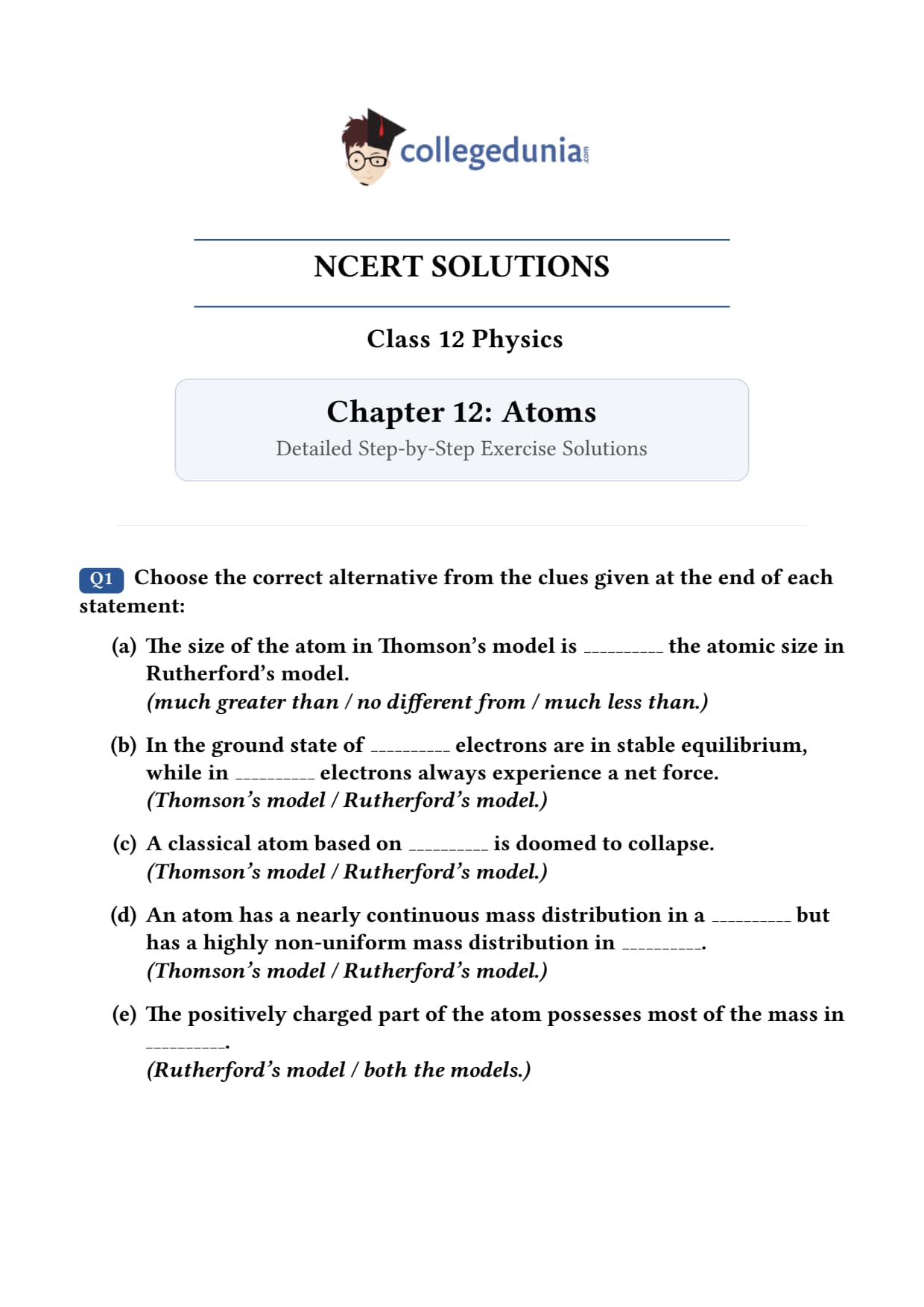
Q 12.1
Choose the correct alternative from the clues given at the end of each statement:
(a) The size of the atom in Thomson's model is .......... the atomic size in Rutherford's model. (much greater than / no different from / much less than.)
(b) In the ground state of .......... electrons are in stable equilibrium, while in .......... electrons always experience a net force. (Thomson's model / Rutherford's model.)
(c) A classical atom based on .......... is doomed to collapse. (Thomson's model / Rutherford's model.)
(d) An atom has a nearly continuous mass distribution in a .......... but has a highly non-uniform mass distribution in .......... (Thomson's model / Rutherford's model.)
(e) The positively charged part of the atom possesses most of the mass in .......... (Rutherford's model / both the models.)
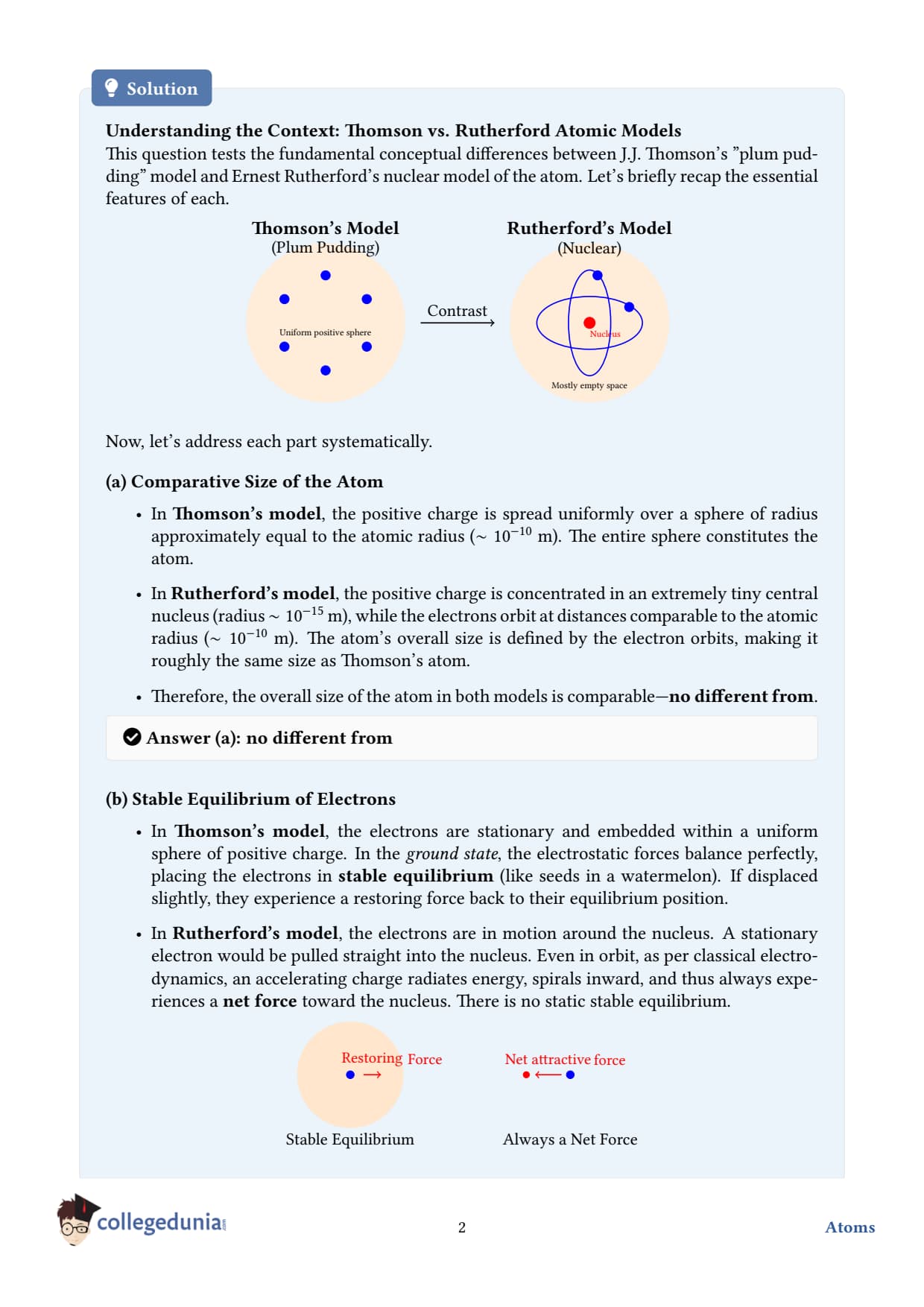
What the question is asking. A side-by-side compare-and-contrast between the two earliest atomic models - J.J. Thomson's "plum-pudding" model (1904) and Ernest Rutherford's "nuclear" model (1911). For each blank, pick the model that fits.
Concept used - the two models in one sentence each.
Thomson's model: the atom is a uniform sphere of positive charge of radius ∼ 10-10m, with electrons embedded in it like raisins in a pudding. Mass is spread throughout the whole sphere.
Rutherford's model: almost all the mass and positive charge are concentrated in a tiny central nucleus of radius ∼ 10-15m; electrons orbit the nucleus in the otherwise-empty atomic volume of radius ∼ 10-10m.
Step 1 - (a) Atomic size. Both models predict the same outer atomic radius, ∼ 10-10m. Thomson's whole sphere is that size; Rutherford's orbiting-electron cloud is also that size. So Thomson's atomic size is no different from Rutherford's.
Step 2 - (b) Ground-state equilibrium. In Thomson's model the positive charge is spread out and the electrons sit at positions where the net electric force on them is zero - they are in stable equilibrium. In Rutherford's model the electron must orbit the nucleus (otherwise it falls in), so it always feels a net Coulomb attraction toward the nucleus. So: Thomson's model has stable equilibrium; Rutherford's model always has net force.
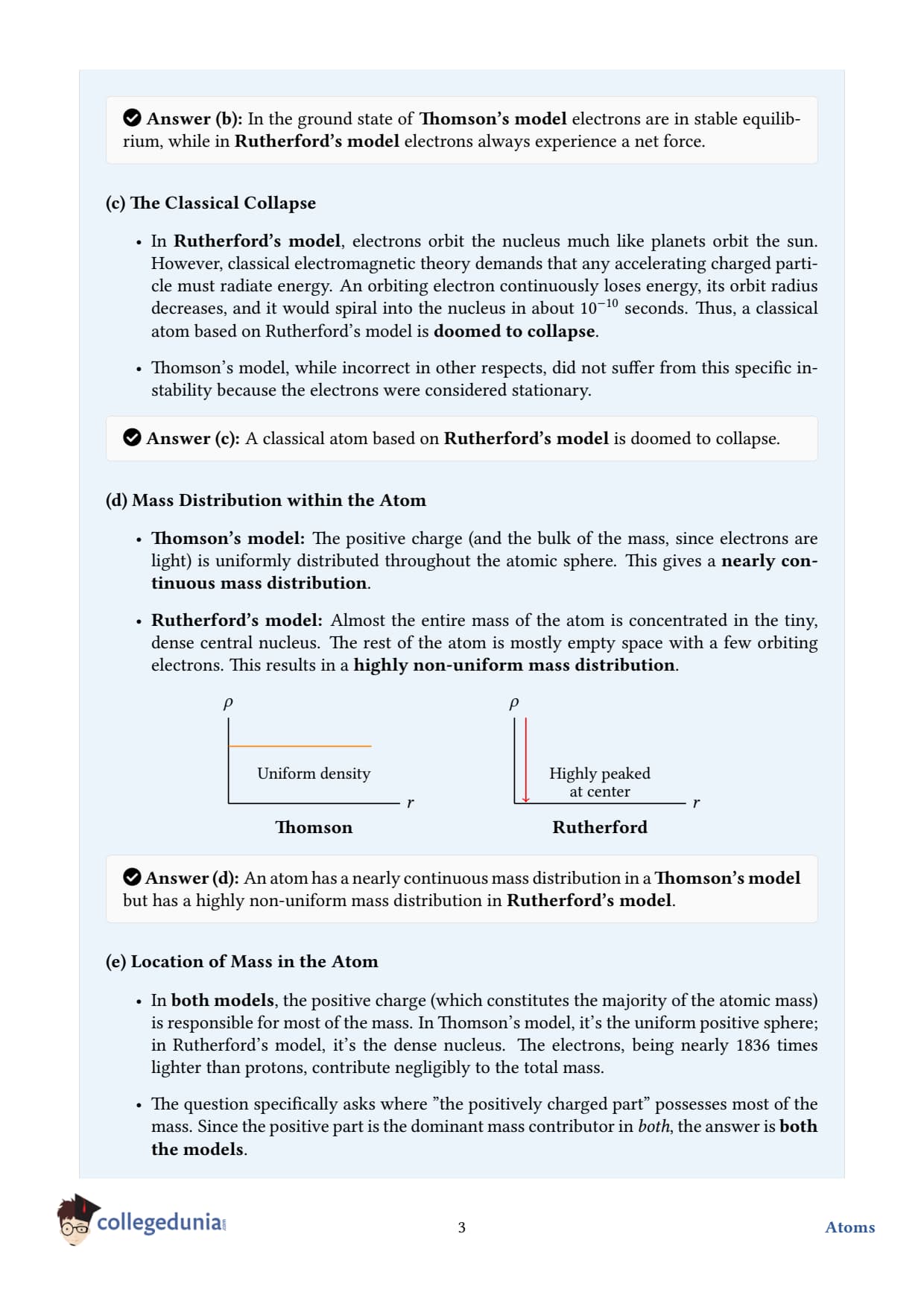
Step 3 - (c) Classical collapse. A classical orbiting charge accelerates, radiates electromagnetic energy, and spirals into the nucleus in ∼ 10-8s. This happens to Rutherford's model. Thomson's electrons just sit in equilibrium and do not radiate.
Step 4 - (d) Mass distribution. Thomson's mass is smeared evenly across the whole atom (nearly continuous). Rutherford's mass is overwhelmingly in the tiny nucleus (highly non-uniform). So continuous = Thomson's; non-uniform = Rutherford's.
Step 5 - (e) Positive charge holds most mass. In Thomson's pudding the positive sphere holds most of the mass (electrons are extremely light). In Rutherford's nucleus the positive nucleus also holds essentially all the mass. So the answer is both the models.
Final answer.
(a) no different from
(b) Thomson's model; Rutherford's model
(c) Rutherford's model
(d) Thomson's model; Rutherford's model
(e) both the models
DR
Dr. Rajesh Kumar
Ph.D. Physics, IIT Delhi
Verified Expert
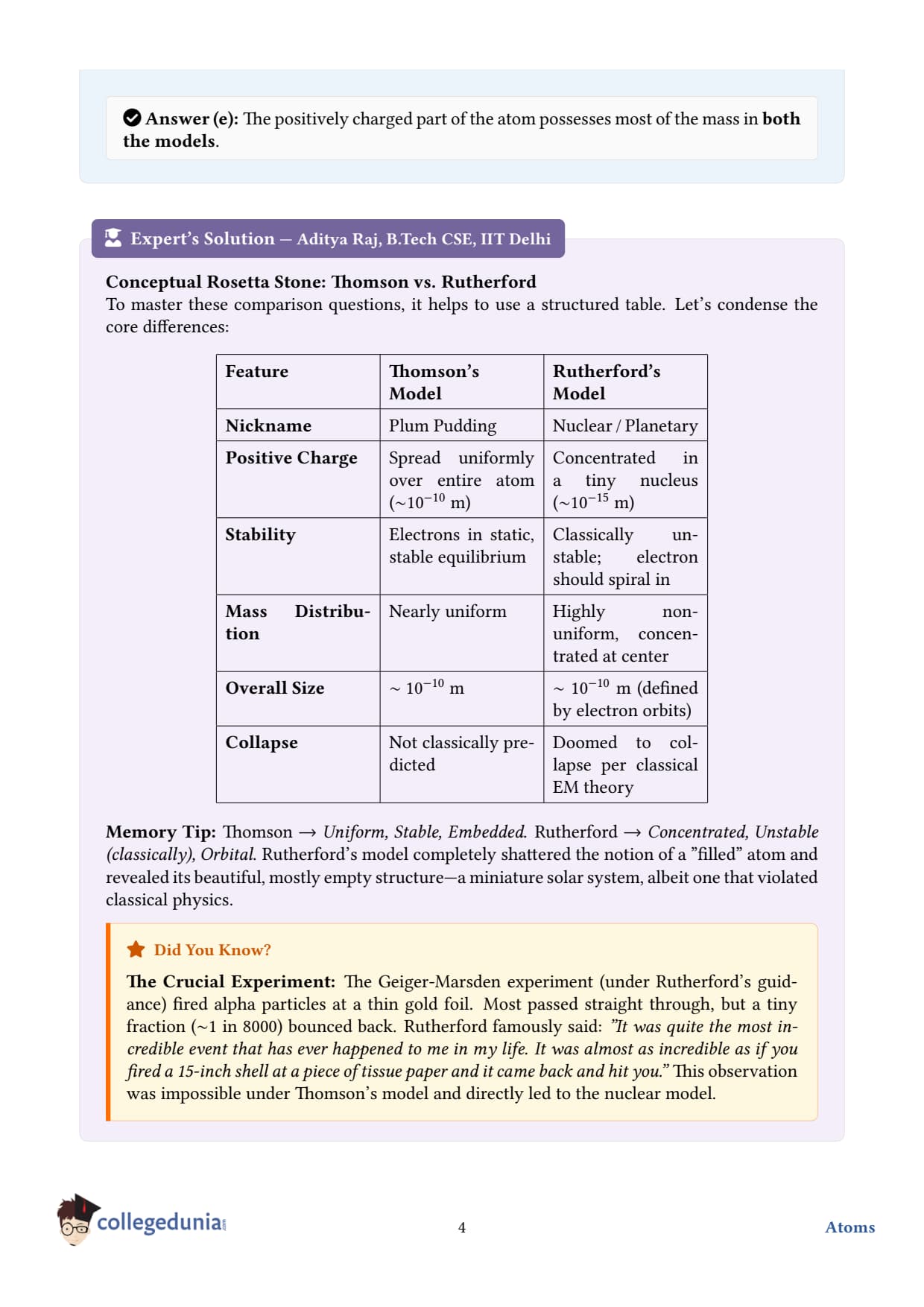
Why the Geiger–Marsden experiment killed the Thomson model. In 1909 Geiger and Marsden, under Rutherford's direction, fired α-particles helium nuclei, +2e, ∼ 7 MeV at a thin gold foil. Thomson's model predicted only small deflections - the diffuse positive charge could nudge an α, but not reverse it. The observed result was shocking: about 1 in 8000 α-particles bounced back at angles >90∘. Rutherford remarked it was "as if you fired a 15-inch shell at a piece of tissue paper and it came back and hit you." The only way to explain it: nearly all the atomic mass and positive charge is concentrated in a tiny dense nucleus.
The instability problem and Bohr's rescue. Rutherford's nuclear atom solved one puzzle (large-angle scattering) but created another: an orbiting electron should radiate, lose energy, and spiral in within ∼ 10-8s. Yet atoms are stable for billions of years. Niels Bohr (1913) postulated that electrons can occupy only certain discrete "stationary" orbits in which they do not radiate. This was the first crack in classical physics and the seed of quantum mechanics.
Common confusion. Many students think Thomson's model was a "wrong guess." It wasn't - at the time it explained everything known. What killed it was a precision experiment. This is how science actually progresses: a good model is overthrown only when an experiment forces it.
Real-world legacy. The Rutherford scattering setup is still used today - modern accelerators (the LHC, RHIC) use the same idea on much higher energies to probe quarks and gluons inside the proton.
Q 12.2
Suppose you are given a chance to repeat the alpha-particle scattering experiment using a thin sheet of solid hydrogen in place of the gold foil. (Hydrogen is a solid at temperatures below 14 K.) What results do you expect?
What the question is asking. Predict what would happen if the gold-foil target were replaced by a solid-hydrogen foil in the Geiger–Marsden α-scattering experiment.
Given.
Original target: gold (Au), atomic number Z = 79, mass number A = 197.
New target: hydrogen (H), Z = 1, A = 1 (the nucleus is a single proton).
Projectile: α-particle Z = 2, A = 4.
Concept used - two effects matter.
(i) Coulomb repulsion strength. The closest distance of approach of an α to a nucleus of charge Ze is rmin = 14π02Ze2K, where K is the α's kinetic energy. The repulsive force is proportional to Z of the target nucleus, so a gold nucleus Z=79 repels an α about 79 times harder than a hydrogen nucleus does.
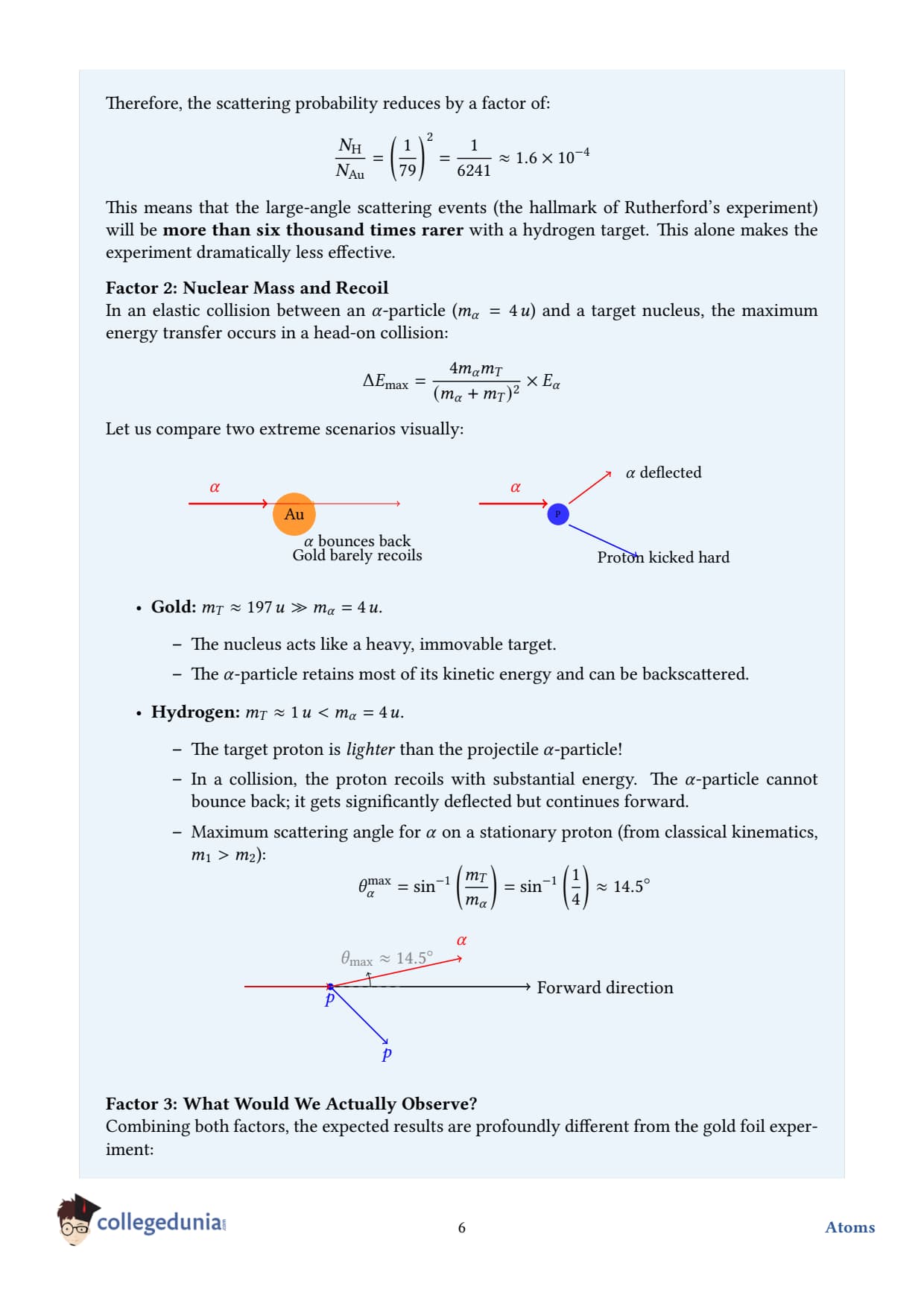
(ii) Mass of the target. A projectile can be back-scattered only if it strikes a target much heavier than itself. The gold nucleus A=197 is about 49 times heavier than the αA=4, so it acts as a near-fixed scattering centre. The hydrogen nucleus A=1 is roughly four times lighter than the α. In a head-on collision the α would barely slow down - it would just push the proton out of the way (like a bowling ball hitting a marble).
Step 1 - qualitative prediction. Two things change at once: (a) the Coulomb barrier is much smaller because Z=1, and (b) the target is much lighter than the projectile.
Step 2 - expected scattering pattern.
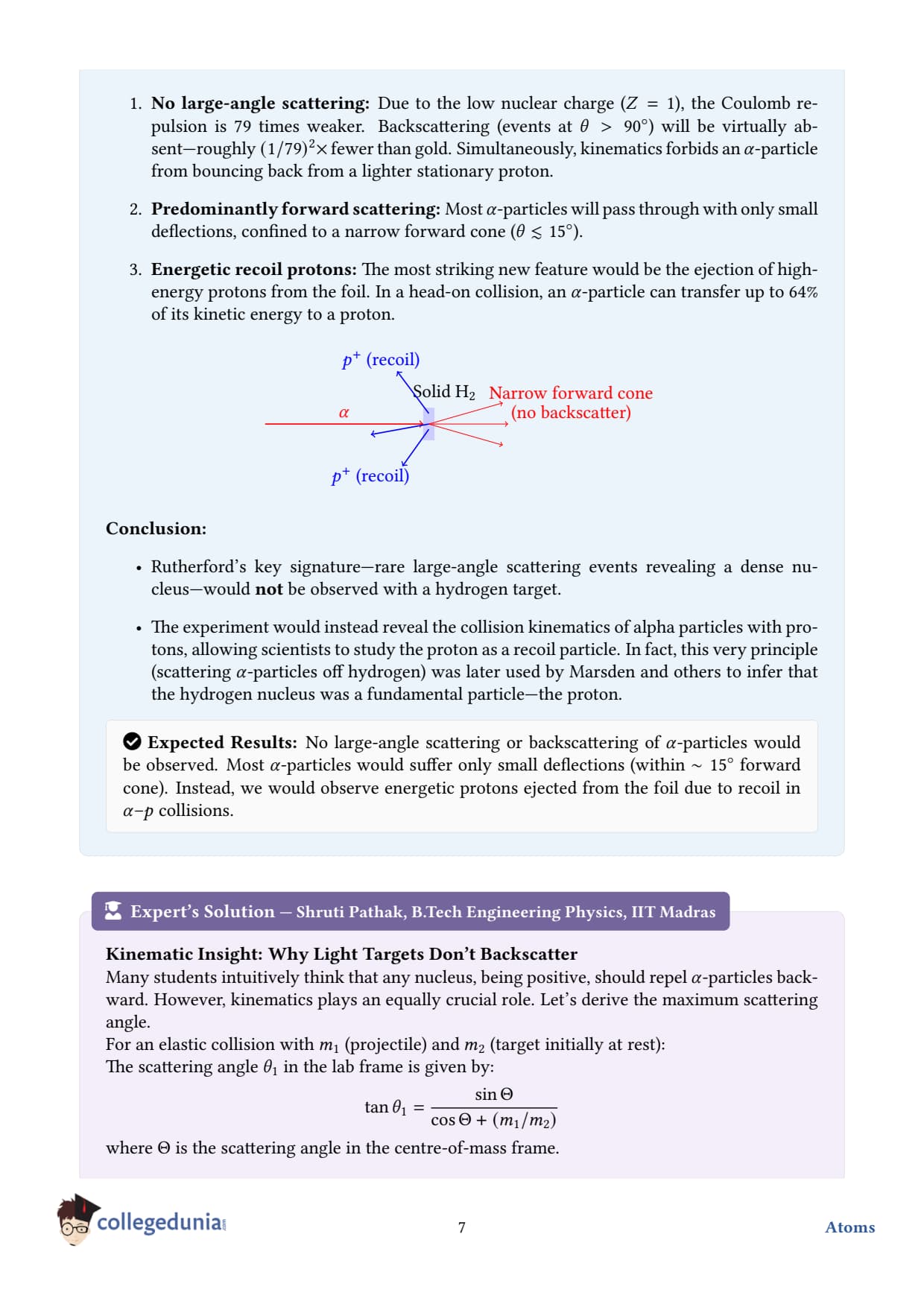
Almost all α-particles will pass straight through with negligible deflection (because the Coulomb repulsion from a proton is small).
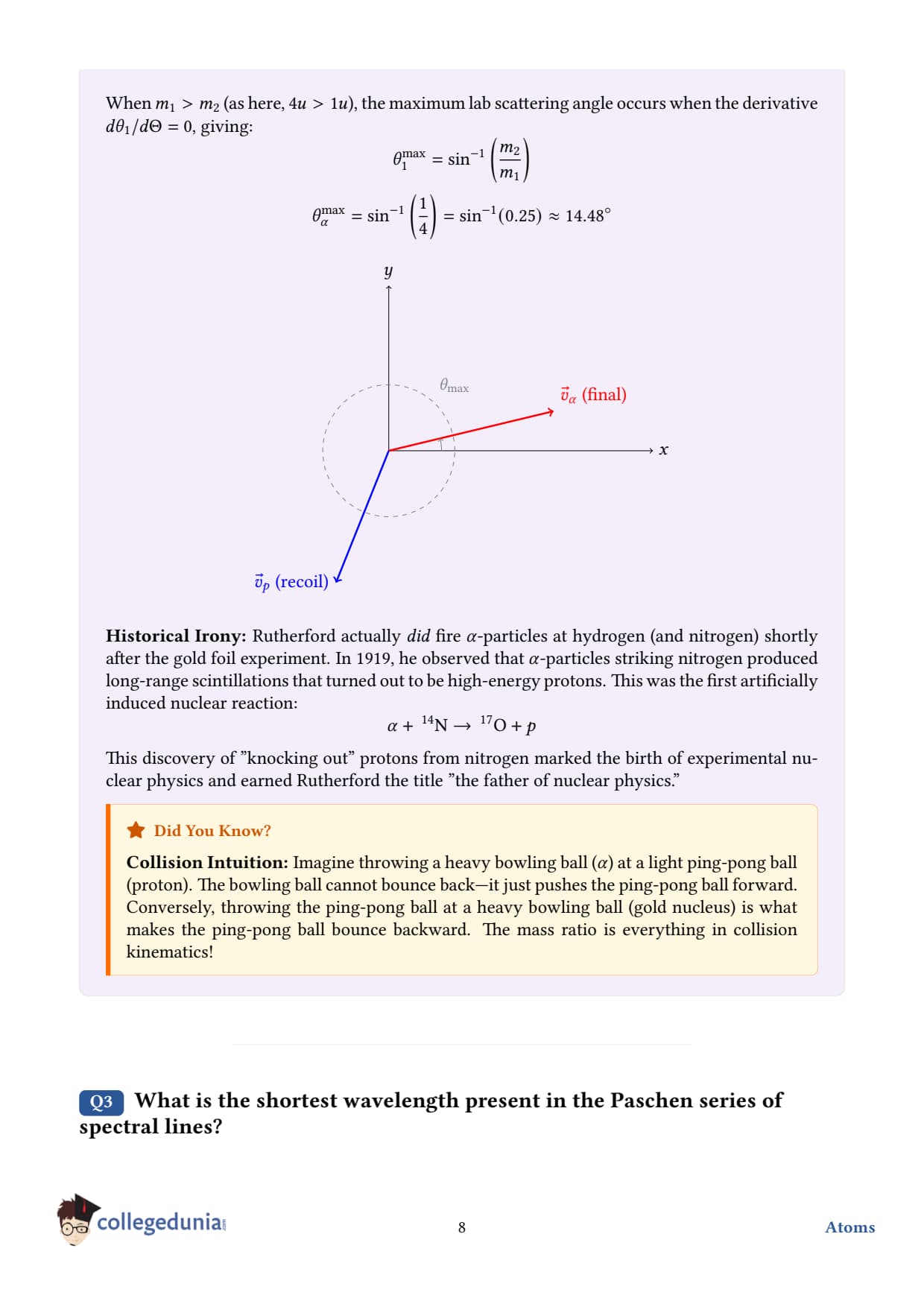
There will be essentially no large-angle (or back-) scattering. A light proton cannot bounce a heavier α-particle straight back; conservation of momentum forbids it.
Instead, the hydrogen protons would be kicked forward and ejected from the foil - but the α-detector at large angles would register almost nothing.
Step 3 - why this matters historically. The whole power of Rutherford's analysis depended on (i) a high-Z target so the deflection is dramatic, and (ii) a heavy target nucleus that does not recoil. Hydrogen fails both tests; the experiment would not have led to the discovery of the nucleus.
Final answer. If the gold foil were replaced by solid hydrogen, almost no α-particles would be scattered back. The angular distribution would be sharply peaked in the forward direction, with no observable large-angle or back-scattering. The experiment would not reveal the existence of an atomic nucleus.
DA
Dr. Anita Sharma
Ph.D. Physics, University of Delhi
Verified Expert
Quantitative comparison - closest distance of approach. For a K = 5.5 MeVα-particle: rmin(Au) = (9109)(2)(79)(1.610-19)25.51061.610-19 ≈ 4.110-14m. For hydrogen with the same α energy: rminH ≈ 510-16m - about 80 times smaller. The α gets much, much closer to a proton, but the repulsive push it receives is so feeble that the trajectory hardly bends.
Momentum-conservation argument for back-scattering. In a 1-D elastic collision, a projectile of mass m hitting a stationary target of mass M emerges with velocity v' = m-Mm+Mv. For M ≫ mgold, M/m ≈ 49: v' → -v, i.e., back-scattering. For M ≪ mhydrogen, M/m ≈ 1/4: v' → +v, the projectile keeps going forward. This is exactly the argument that tells us back-scattering by hydrogen is impossible.
Did anyone actually try this? A variant was used to study nuclear reactions like α + p → 3He + d, but as a "scattering" experiment to map nuclear structure, hydrogen targets were used for a different purpose - to probe the proton itself with high-energy electrons (the SLAC experiments of the 1960s discovered quarks this way).
Real-world relevance. Choice of target nucleus is central in modern nuclear and particle scattering experiments. Heavy targets reveal nuclear-charge structure; light targets reveal the projectile's own structure (because the projectile does most of the recoiling).
Q 12.3
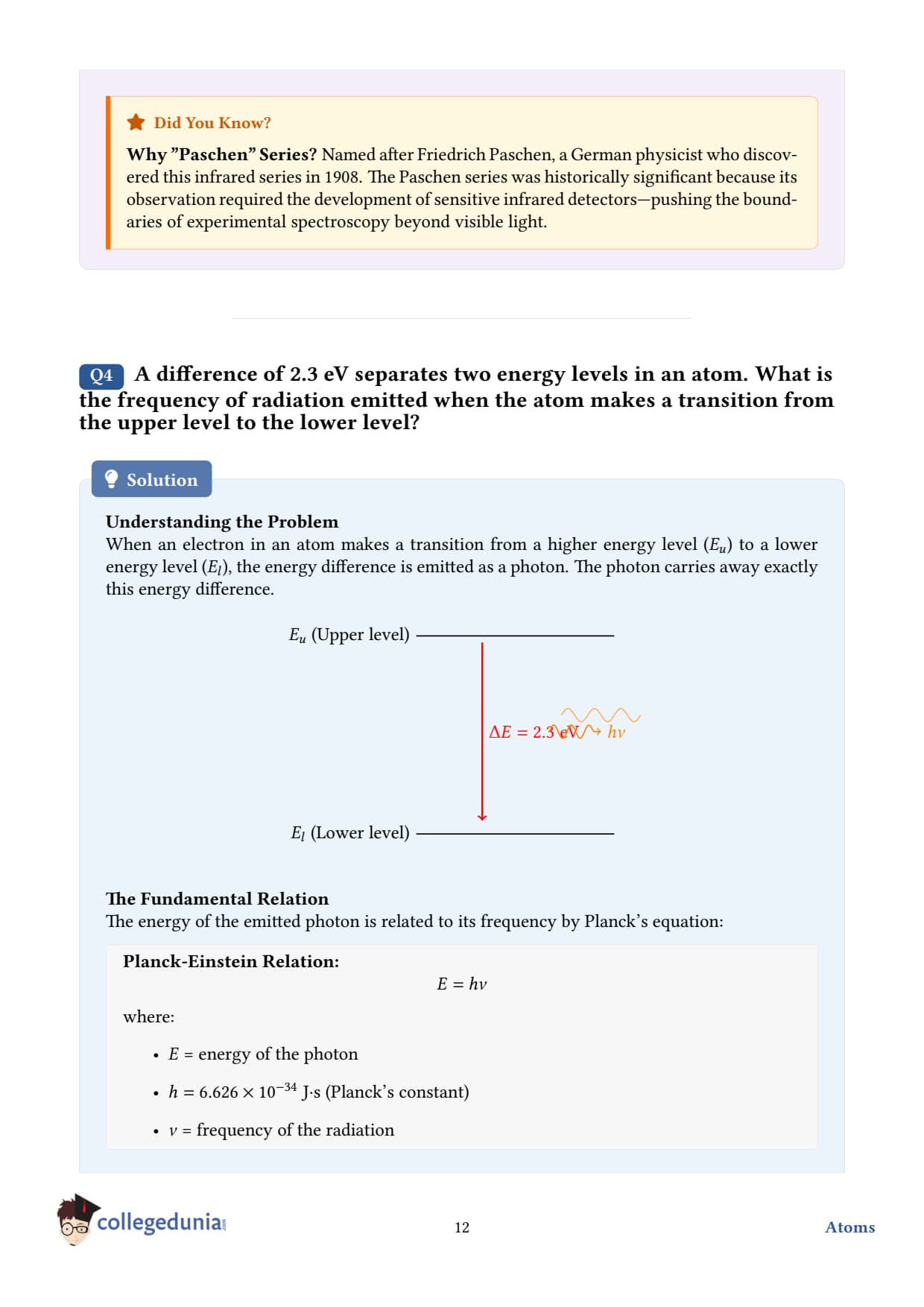
A difference of 2.3 eV separates two energy levels in an atom. What is the frequency of radiation emitted when the atom makes a transition from the upper level to the lower level?
Given.
Energy gap between the two atomic levels, Δ E = 2.3 eV.
Planck's constant, h = 6.62610-34Js.
1 eV = 1.610-19J.
Concept used - Bohr's frequency condition. When an atom drops from a higher energy level E2 to a lower level E1, the emitted photon carries away the entire energy difference: hν = E2 - E1 = Δ E. Solving for the frequency: ν = Δ Eh.
Step 1 - convert Δ E to joules. Δ E = 2.3 eV × 1.610-19J/eV = 3.6810-19J.
Step 2 - write the formula symbolically. ν = Δ Eh.
Step 3 - substitute the numbers. ν = 3.6810-196.62610-34 Hz.
Step 5 - clean up to standard scientific notation. ν ≈ 5.55× 10¹⁴ Hz.
Step 6 - sanity-check the spectral region. Visible light spans roughly 41014 Hz (red) to 7.51014 Hz (violet). Our answer falls in the yellow-green part of the visible spectrum - exactly the kind of transition you would see in an atomic emission line.
Final answer. ν ≈ 5.55× 10¹⁴ Hz (visible, yellow-green).
DS
Dr. Suresh Iyer
Ph.D. Theoretical Physics, TIFR Mumbai
Verified Expert
Alternative method - go directly to wavelength. Using λ = c/ν or the handy shortcut λ(nm) = 1240Δ E(eV), we get λ = 1240/2.3 ≈ 539 nm. That's green light. Cross-check: ν = c/λ = 3108/53910-9 ≈ 5.571014 Hz.
Common mistake - forgetting the eV→J conversion. Many students drop Δ E = 2.3 directly into hν, getting nonsense like ν = 3.51033 Hz. Always convert energy to SI (joules) when using SI values of h. The conversion factor 1 eV = 1.610-19J is one of the most-used numbers in atomic physics - memorise it.
Where this happens in real atoms. A 2.3 eV transition is typical of optical (visible) emission lines in many atoms - for instance, the sodium D-lines at 589 nm (yellow) arise from a transition of ≈ 2.1 eV, and the green mercury line at 546 nm corresponds to ≈ 2.27 eV. The dominant colour of sodium street-lamps comes from exactly this kind of transition.
Bohr's frequency condition vs Einstein's photon. The relation hν = Δ E is Bohr's third postulate. It is identical in form to Einstein's photoelectric relation hν = φ + Kmax - both rest on the idea that light is exchanged in discrete energy lumps of size hν. This unity of "atomic" and "light" quantisation was one of the early triumphs of quantum theory.
Q 12.4
The ground state energy of a hydrogen atom is -13.6 eV. What are the kinetic and potential energies of the electron in this state?
Given.
Total energy of the electron in the hydrogen ground state, E = -13.6 eV.
The negative sign means the electron is bound - it would take +13.6 eV of external energy to remove the electron from the atom (the "ionisation energy").
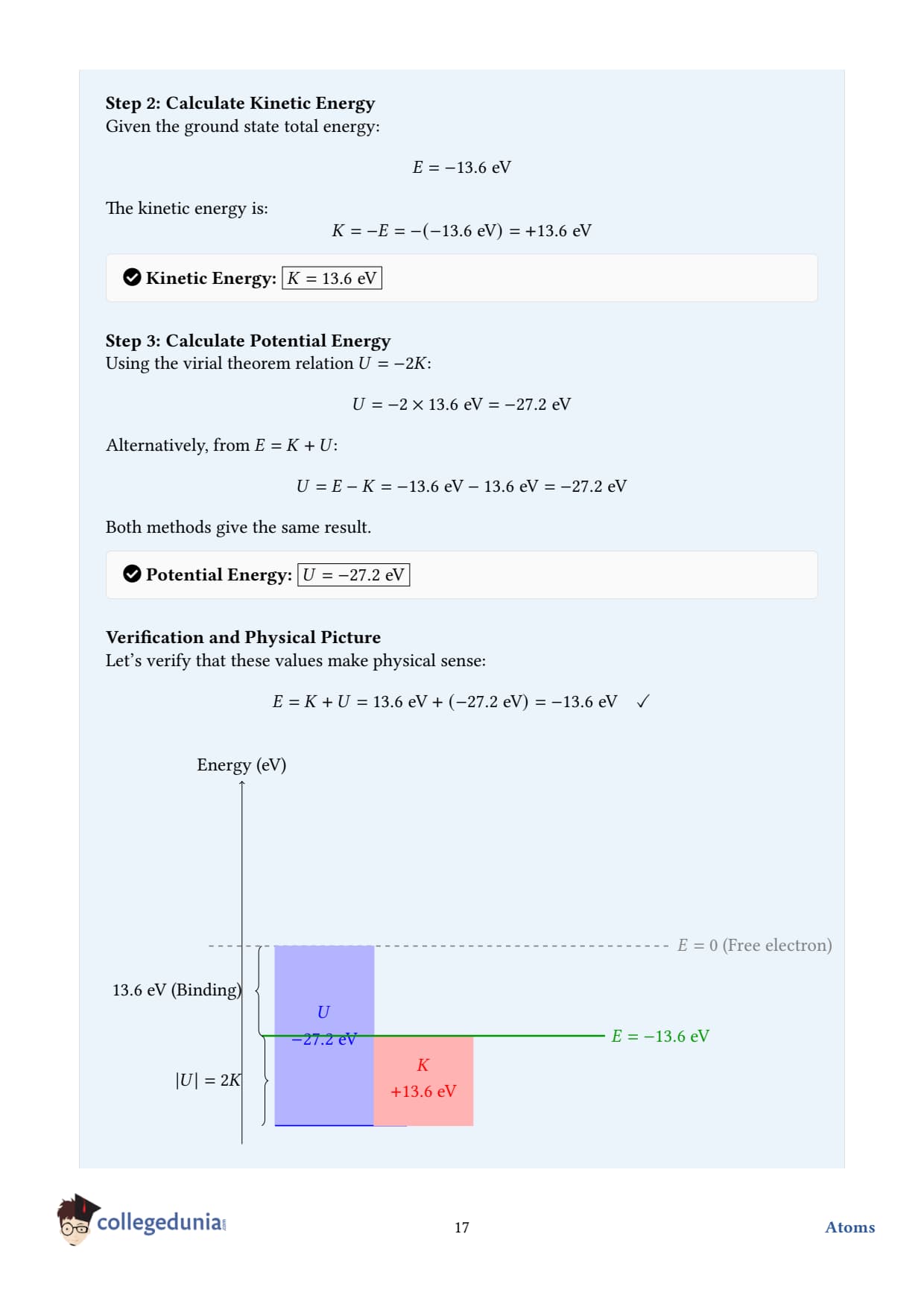
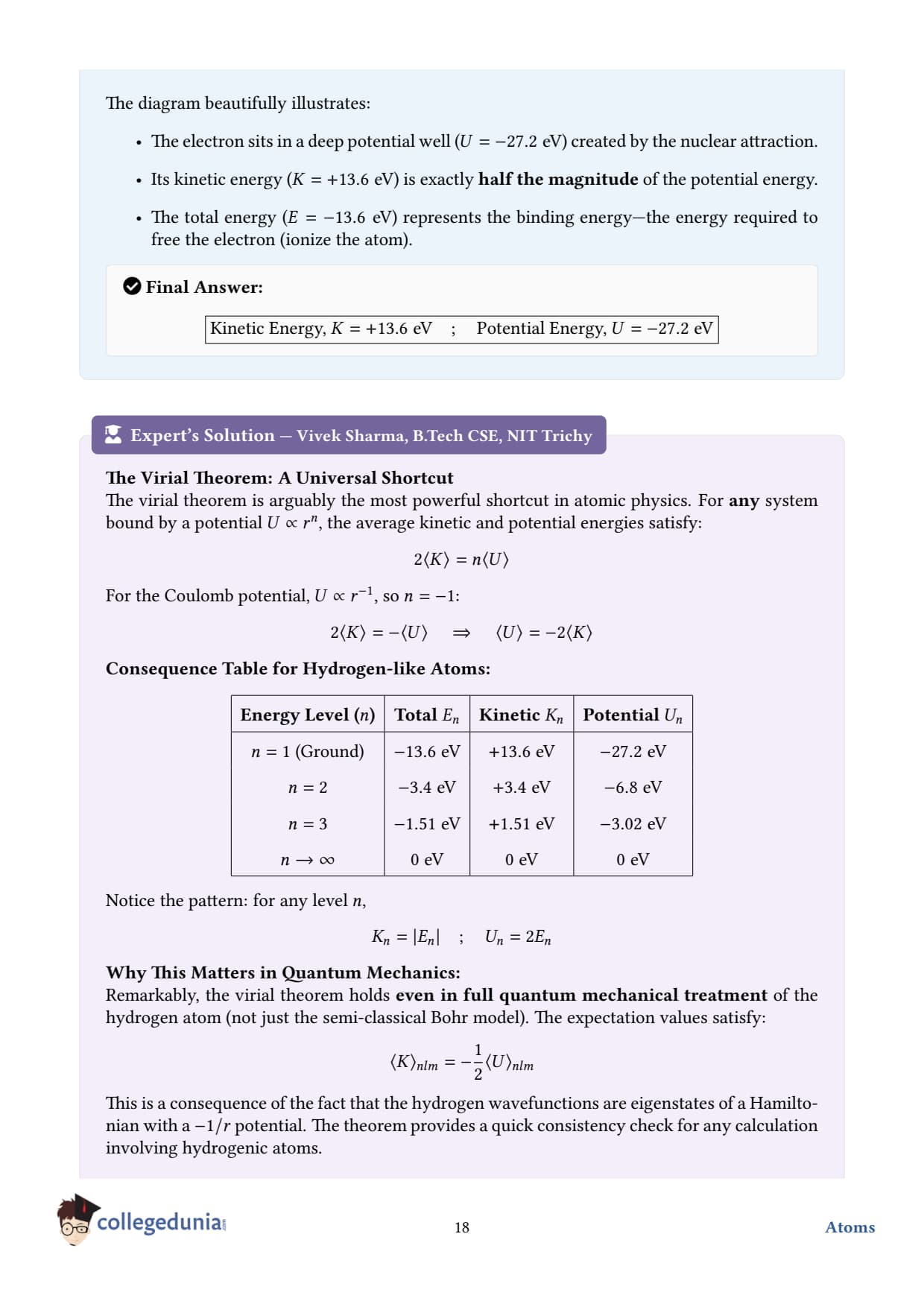
Concept used - virial theorem for the inverse-square force. For a particle moving under a Coulomb (or gravitational) attractive 1/r2 force, the time-averaged kinetic and potential energies satisfy K= -12U, E = K + U. Combining, E = K + U = -U2 + U = U2, ⇒ U = 2E, K = -E. This is the famous virial relation K = -E, U = 2E for hydrogen-like atoms.
Why is U negative? Convention: the potential energy of two point charges is taken to be zero when they are infinitely far apart. As the (positive) proton and (negative) electron come closer, work is done by the attractive force, so the system loses potential energy → U < 0. The proton–electron PE is U = -ke2/r.
Step 2 - find the potential energy.U = 2E = 2×(-13.6 eV) = -27.2 eV.
Step 3 - verify with the formula E = K + U.K + U = (+13.6) + (-27.2) = -13.6 eV = E.
Step 4 - sanity check. Kinetic energy is always positive K = 12mv2 - yes, +13.6 eV is positive. Potential energy of an attractive bound system at finite r is negative - yes, -27.2 eV is negative. And |U| > K, as it must be for a bound state.
Final answer.
Kinetic energy: K = +13.6 eV
Potential energy: U = -27.2 eV
PM
Prof. Meera Nair
Ph.D. Experimental Physics, IISc Bangalore
Verified Expert
Where the virial theorem comes from. For a circular orbit under Coulomb attraction: m v2r = k e2r2 ⇒ m v2 = k e2r. So K = 12m v2 = 12k e2/r. Meanwhile U = -k e2/r. Therefore K = -U/2, and E = K + U = -k e2/(2r) - exactly the energy formula for hydrogen.
Common mistake - sign of U. Students sometimes report U = +27.2 eV. This is wrong: an attractive bound system must have negative PE under the standard convention (zero at infinity). If U were positive, the electron would not be bound to the proton - it would fly away.
Alternative - direct calculation from En. The Bohr formula gives En = -13.6n2 eV, Kn = -En = +13.6n2 eV, Un = 2En = -27.2n2 eV. For n=2: E = -3.4 eV, K = +3.4 eV, U = -6.8 eV. The same K:|U|:|E| = 1:2:1 ratio holds at every level.
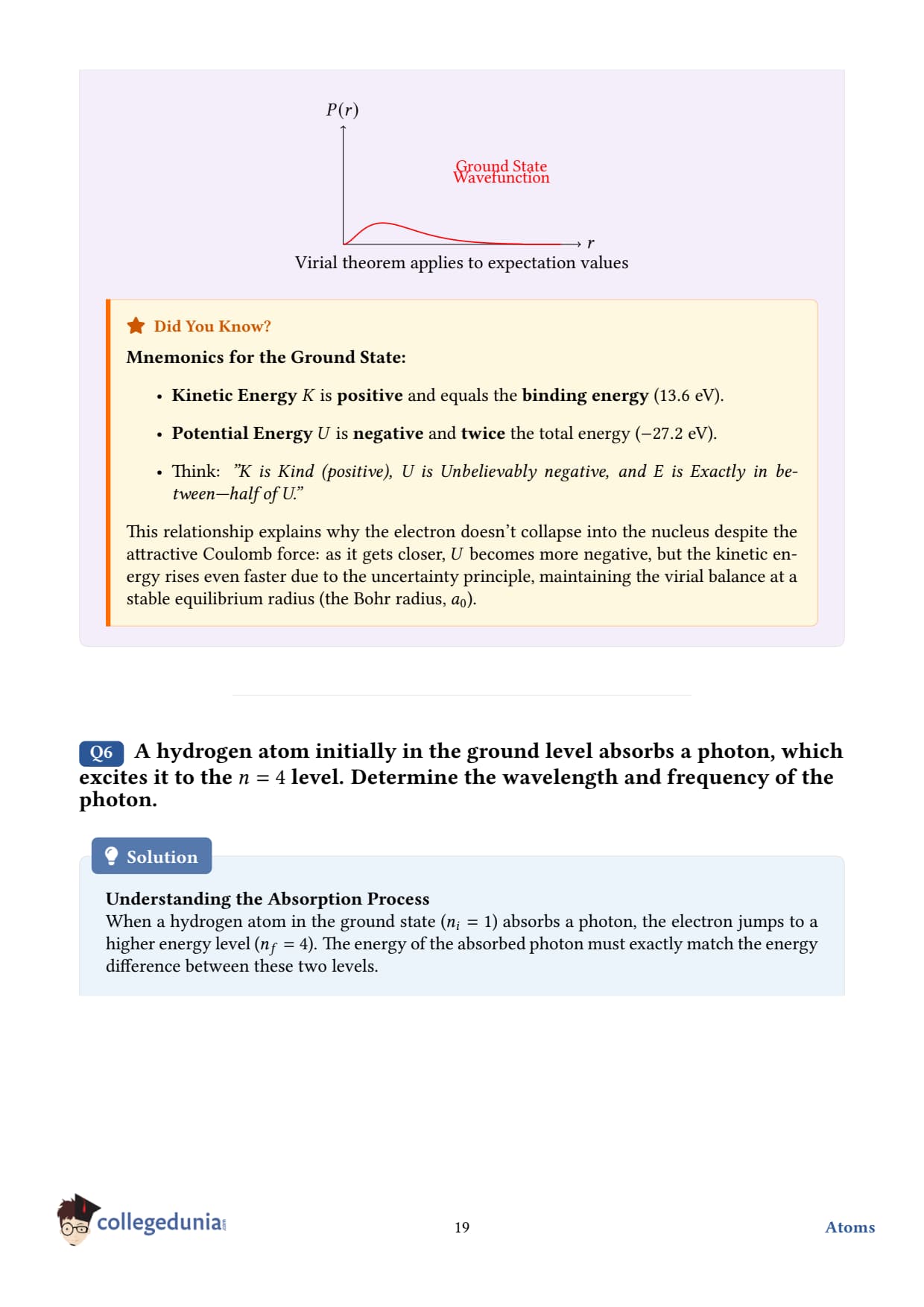
Real-world tie-in. The virial theorem is wildly general - it applies to planetary motion, star clusters, galaxies, plasmas, even to the dark-matter problem (astronomers use the virial theorem to infer hidden mass from observed velocities). The fact that the hydrogen atom obeys the same theorem as a binary star system is a striking demonstration of physics' unifying power.
Q 12.5
A hydrogen atom initially in the ground level absorbs a photon, which excites it to the n = 4 level. Determine the wavelength and frequency of the photon.
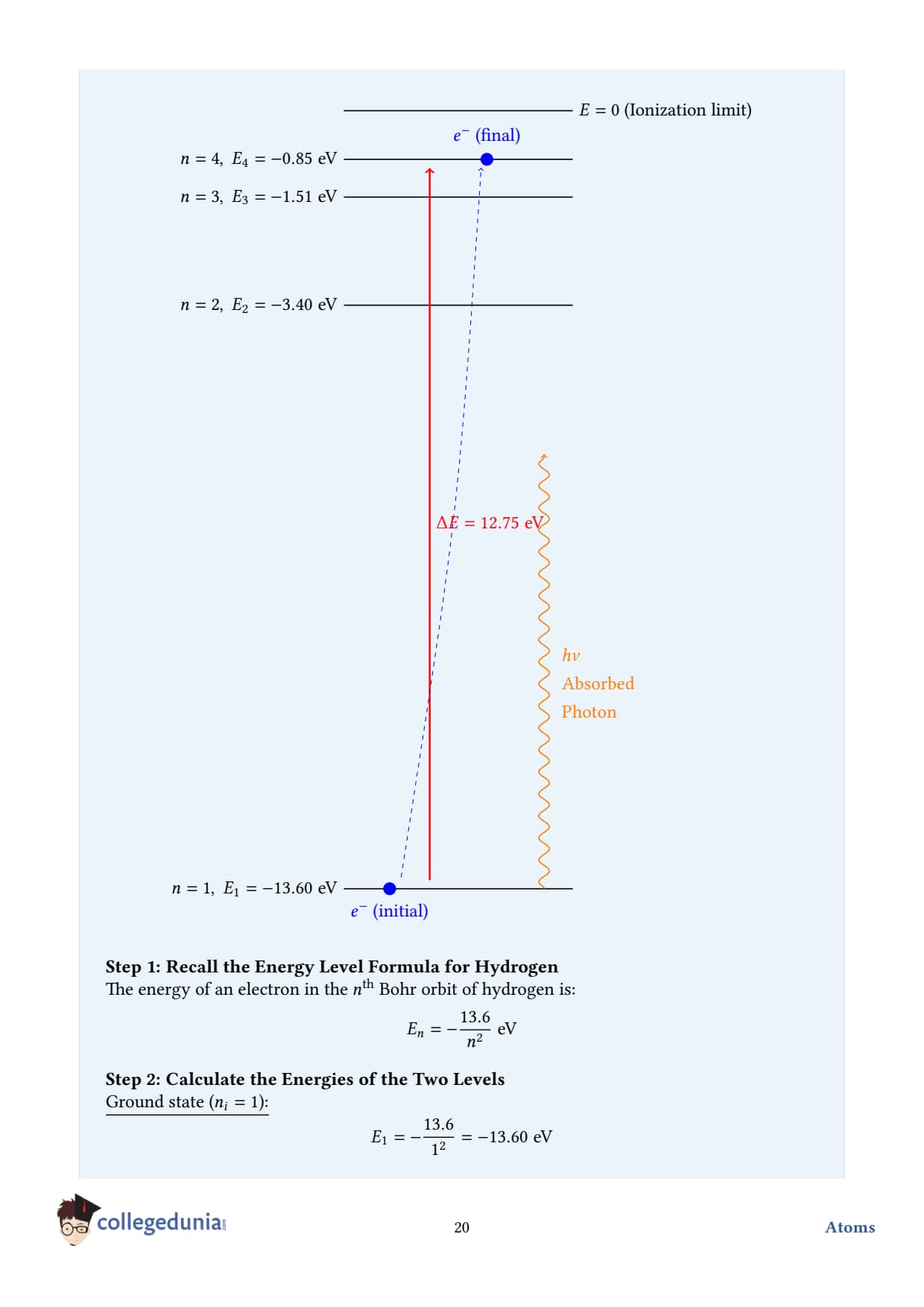
Final level: n2 = 4, with E4 = -13.6/16 = -0.85 eV.
Planck constant h = 6.62610-34Js, speed of light c = 3108m/s.
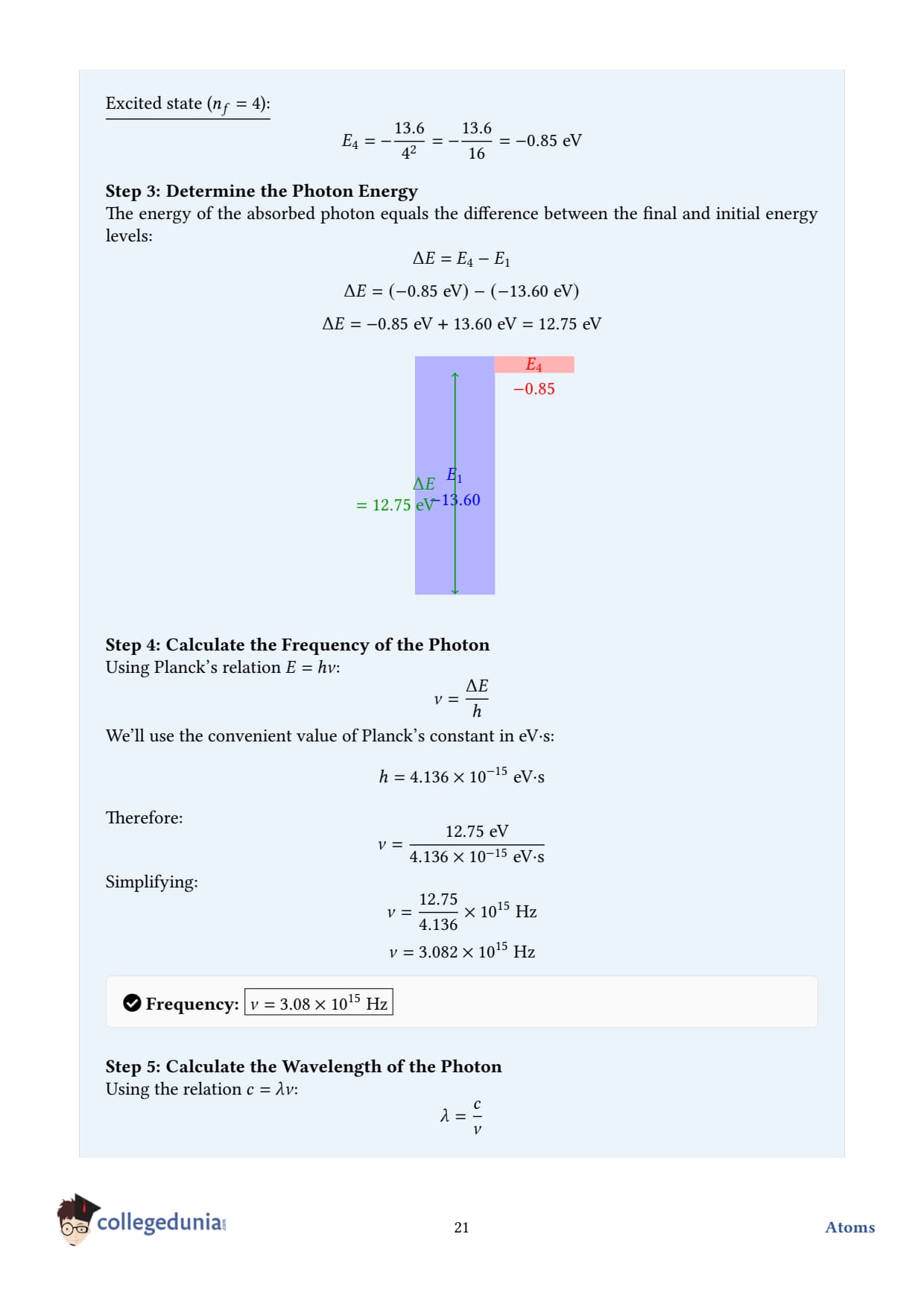
Concept used - Bohr energy levels and absorption. The allowed energies of the hydrogen electron are En = -13.6n2 eV, n = 1,2,3,… When the atom absorbs a photon, the photon's energy equals the gap between the final and initial levels: hν = En2 - En1. Both E's are negative; En2 is the smaller (less negative) one. The difference is positive, as it should be for absorption.
Step 1 - compute the photon energy in eV. Δ E = E4 - E1 = (-0.85) - (-13.6) = 12.75 eV.
Step 2 - convert to joules. Δ E = 12.75× 1.610-19 = 2.0410-18J.
Step 3 - frequency from hν = Δ E. ν = Δ Eh = 2.0410-186.62610-34 ≈ 3.08× 10¹⁵ Hz.
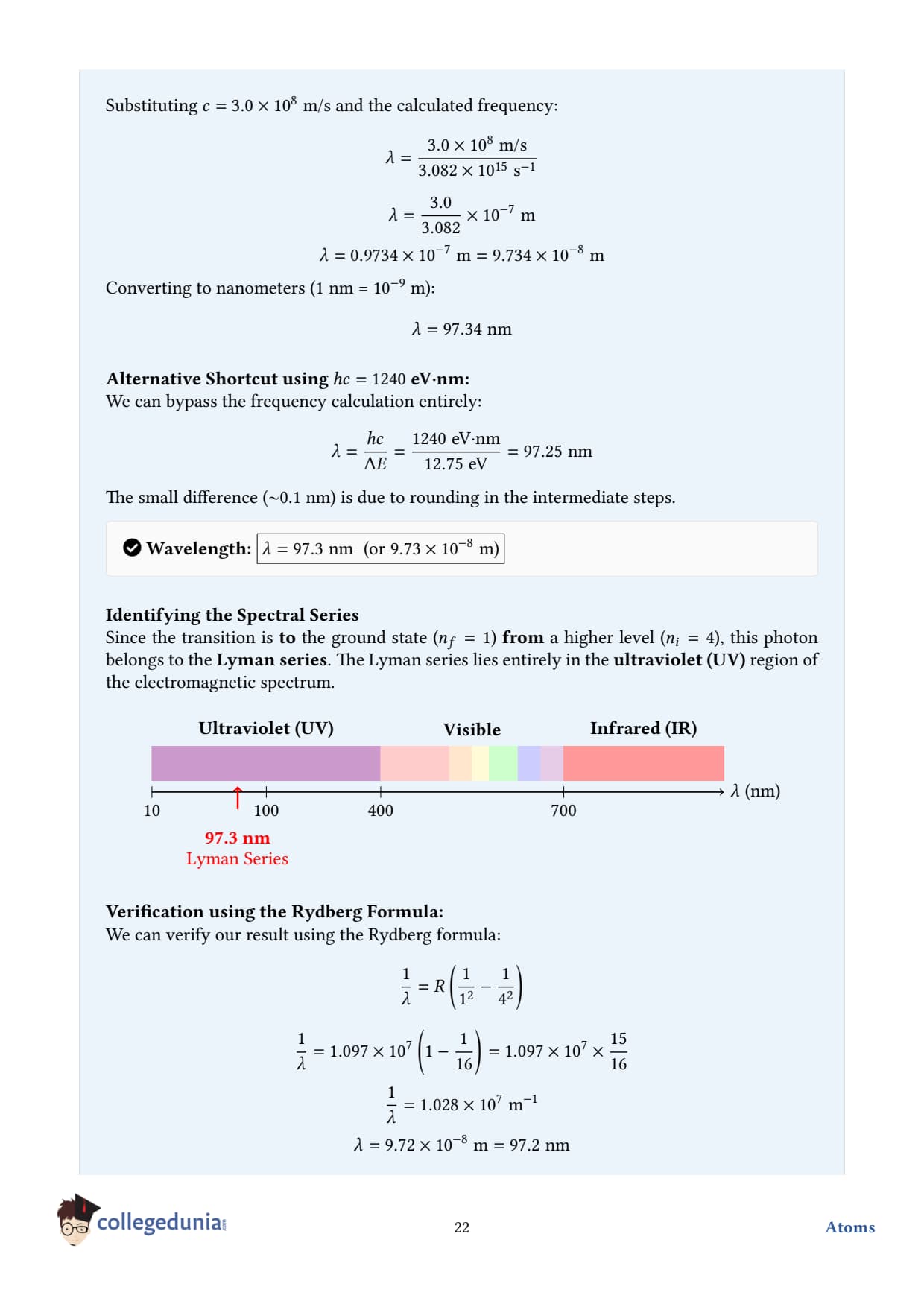
Step 5 - identify the spectral region. Visible light is roughly 380 – 750 nm. Our wavelength ≈ 97 nm is much shorter - it lies in the ultraviolet (UV), specifically in the Lyman series all transitions ending at or starting from n=1 are in the UV.
Alternative method - use the Rydberg formula. For the wavelength of light emitted/absorbed in a hydrogen transition, 1λ = R (1n12 - 1n22), R = 1.097107 m-1. With n1 = 1, n2 = 4: 1λ = 1.097107 (1 - 116) = 1.097107× 1516 = 1.028107 m-1. λ = 1/(1.028107) ≈ 9.7210-8m = 97.2 nm.
Common mistake - sign error in Δ E. Some students write Δ E = E1 - E4 instead of E4 - E1 and get a negative photon energy. In absorption, the atom gains energy, so Δ E must be positive. The convention: hν = Efinal - Einitial, and the photon energy is whichever direction makes this positive.
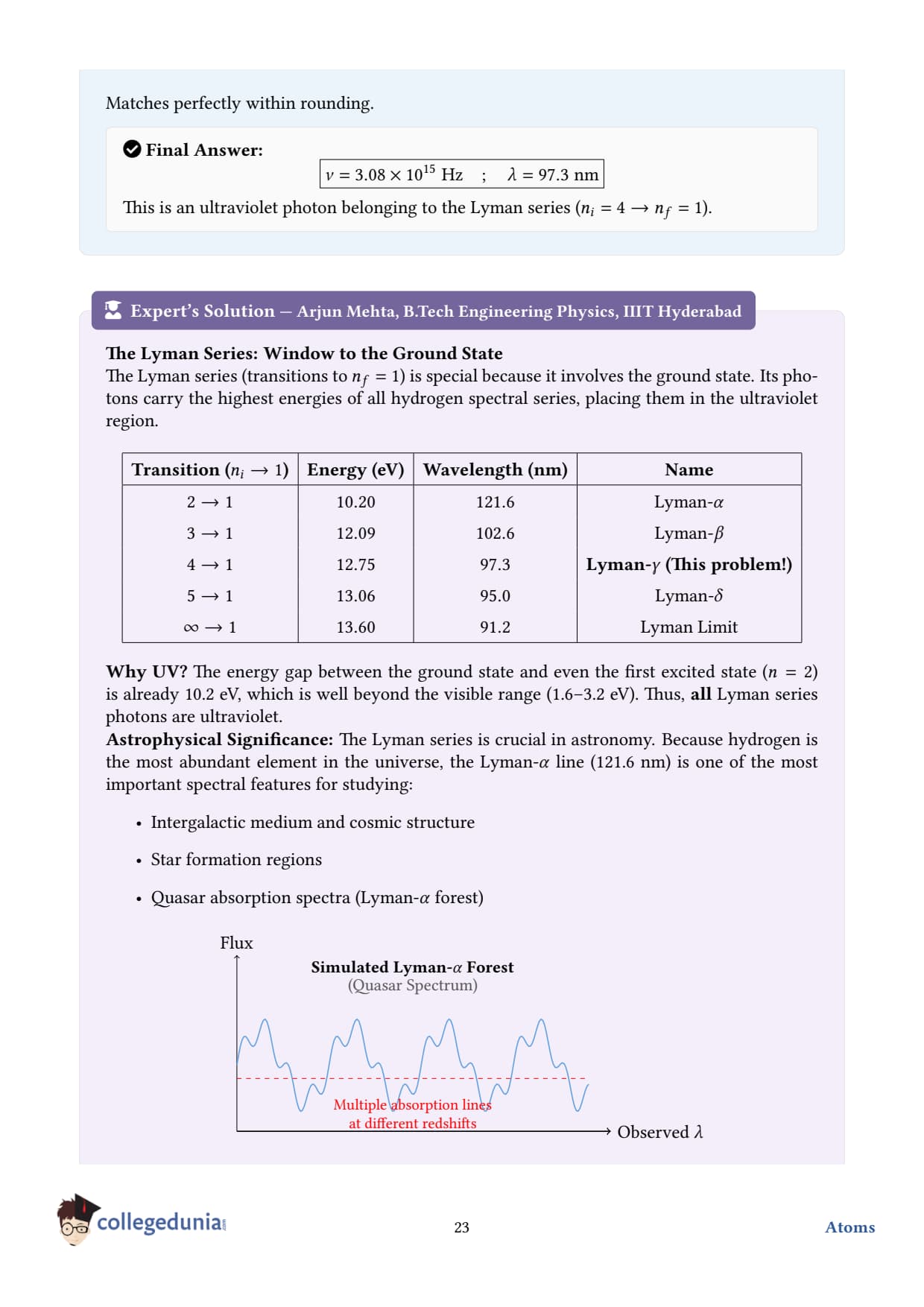
The Lyman series. Transitions ending at (or starting from) n = 1 all lie in the UV - they have the largest energy gaps. The atom from the ground state can only absorb UV photons of specific wavelengths corresponding to n2 = 2, 3, 4, … - known as Lyman-α, Lyman-β, Lyman-γ. Our 97 nm absorption is Lyman-γn=1 → 4.
Real-world application. Lyman-α emission at 121.6 nm the n=2 → 1 line is one of the brightest lines from interstellar hydrogen and is used by astronomers to map gas clouds around galaxies - even far back in cosmic time (where it gets redshifted into visible wavelengths).
Q 12.6
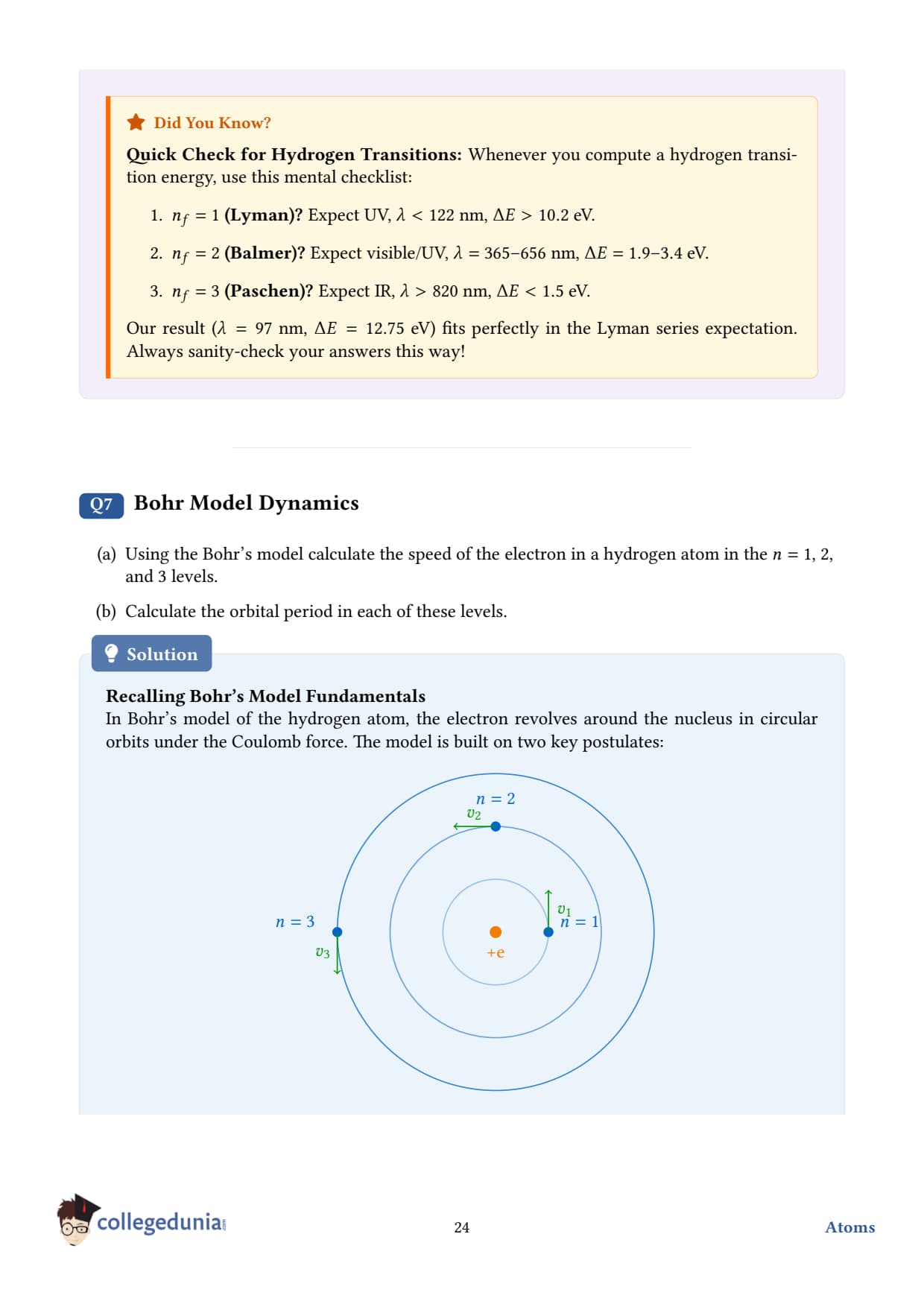
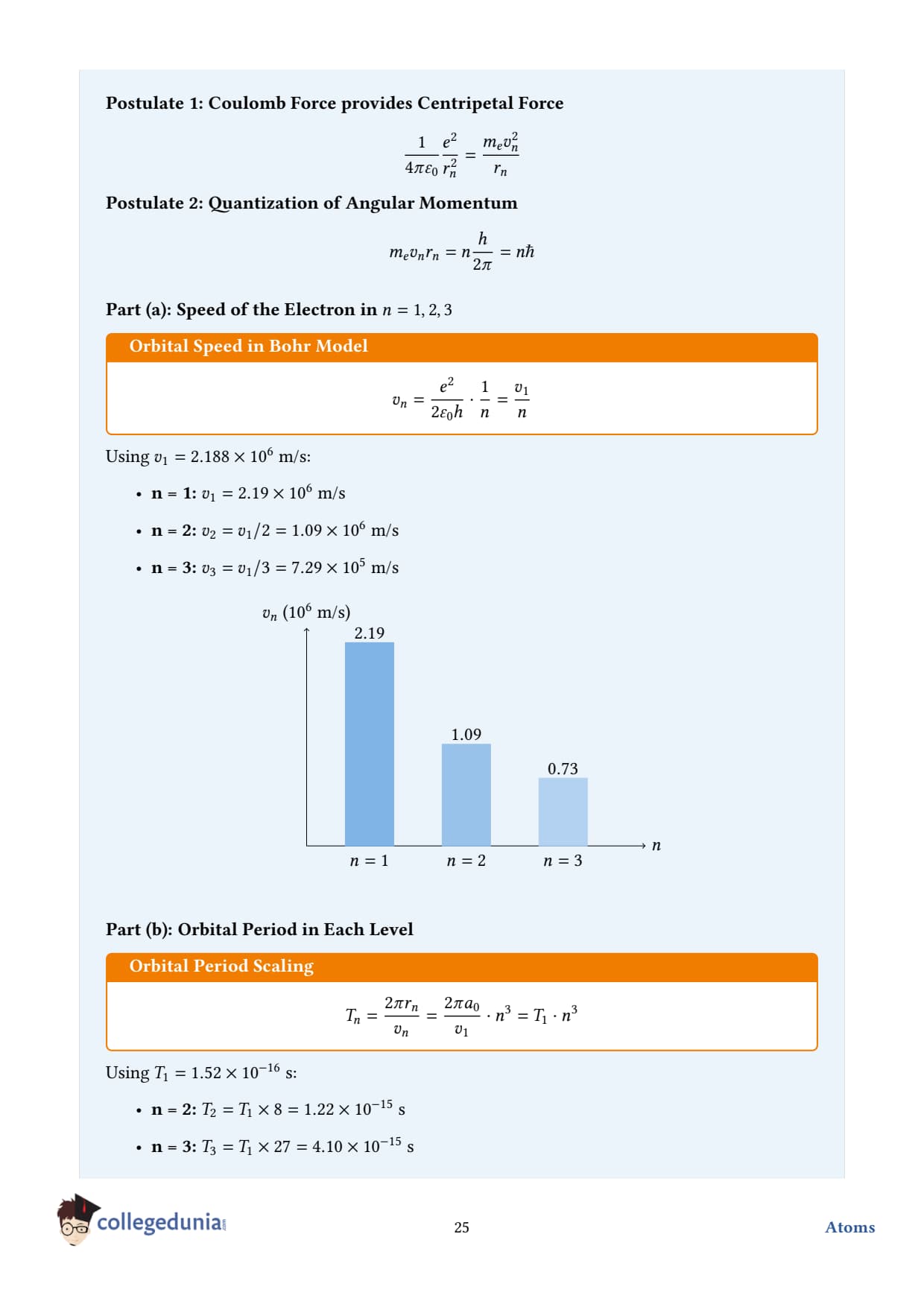
(a) Using Bohr's model, calculate the speed of the electron in a hydrogen atom in the n = 1, 2, and 3 levels. (b) Calculate the orbital period in each of these levels.
Given. Hydrogen atom, Bohr orbits n = 1, 2, 3. Constants: k = 9109, e = 1.610-19 C, me = 9.1110-31 kg, 0 = 8.85410-12, Bohr radius a0 = 5.2910-11 m.
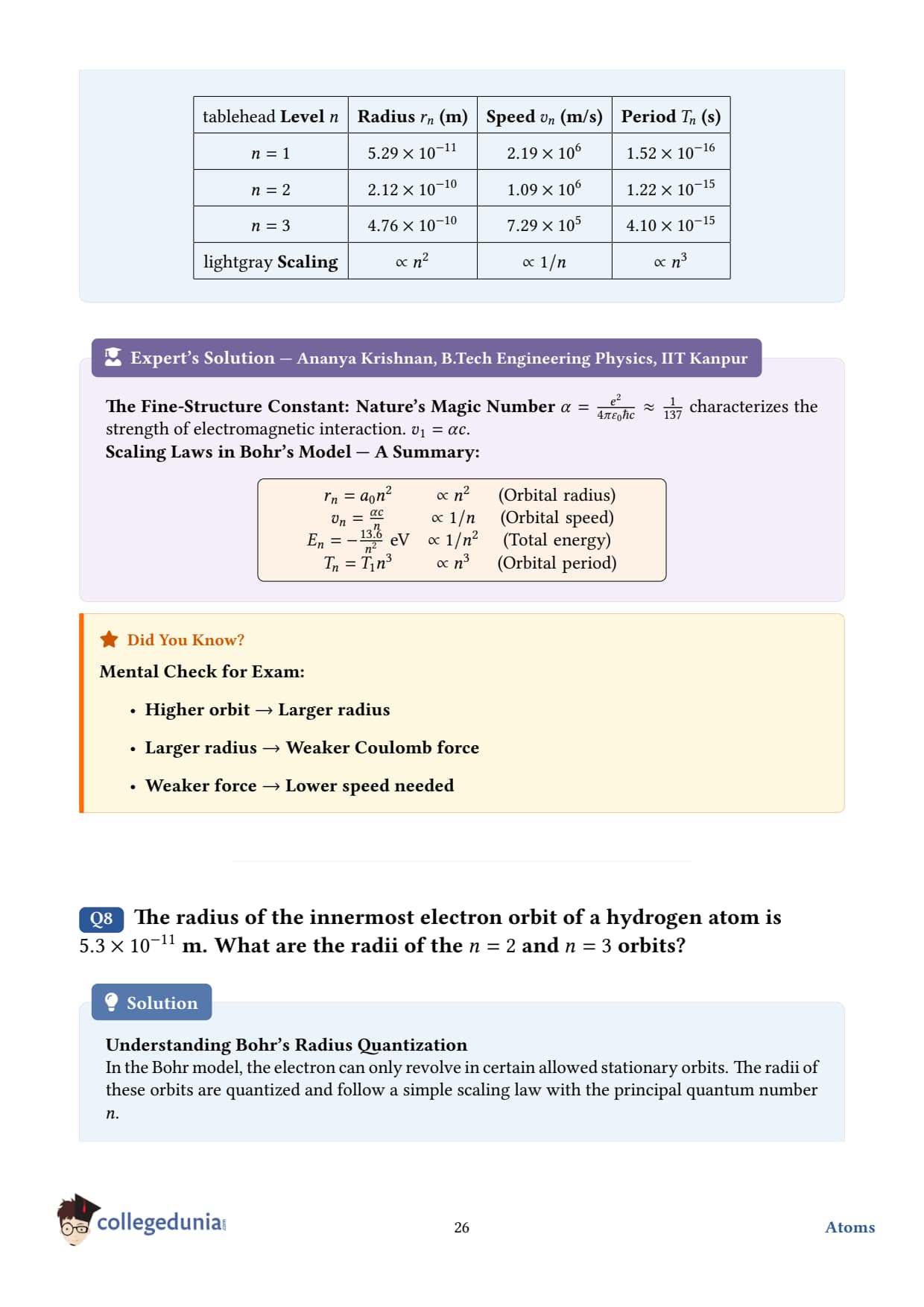
Concept used - Bohr orbital speed and radius. The Bohr quantisation condition angular momentum is quantised in units of gives vn = e24π0·1n = v1n, v1 ≈ 2.19× 10⁶m/s. The orbital radius is rn = n2 a0, a0 = 5.2910-11m. The orbital period is the circumference divided by speed: Tn = 2π rnvn = 2π n2 a0v1/n = 2π n3 a0v1.
Plain-English version. "The deeper the orbit (smaller n), the faster the electron moves and the shorter the period. Speed scales as 1/n; radius scales as n2; period scales as n3."
Periods: T1 ≈ 1.5210-16s, T2 ≈ 1.2210-15s, T3 ≈ 4.1110-15s.
DS
Dr. Shalini Menon
M.Sc Physics, University of Hyderabad
Verified Expert
The fine-structure constant α. The ground-state Bohr speed can be written v1 = α c, α = e24π0c ≈ 1137. So v1/c ≈ 1/137 ≈ 0.0073. The hydrogen electron moves at about 0.7% of the speed of light - small enough that the non-relativistic Bohr model is a decent first approximation, but large enough that relativistic corrections (the "fine structure" of spectral lines) are observable. This dimensionless number α is one of the most important in all of physics - it sets the strength of the electromagnetic interaction.
How tiny these periods are.T1 ≈ 1.510-16 s = 0.15 femtoseconds. That means the ground-state electron completes about 71015 orbits per second - six thousand trillion revolutions per second. This is the natural "clock" inside an atom and sets the timescale of all of chemistry.
Alternative method via Bohr quantisation. Bohr's postulate: Ln = m vn rn = n. So vn = n/m rn. Using rn = n2 a0, we get vn = /m a0n = v1/n - exactly the inverse-n scaling we used.
Common mistake - confusing T with frequency ν. In Bohr's atom, the orbital frequency forb = 1/T is NOT the same as the frequency of light emitted in transitions. The emitted light frequency comes from Bohr's frequency condition hν = Δ E, and is set by energy gaps, not by orbital motion. In a fully classical model these two frequencies would have to match - that they don't is one of the great puzzles that quantum mechanics resolves.
Q 12.7
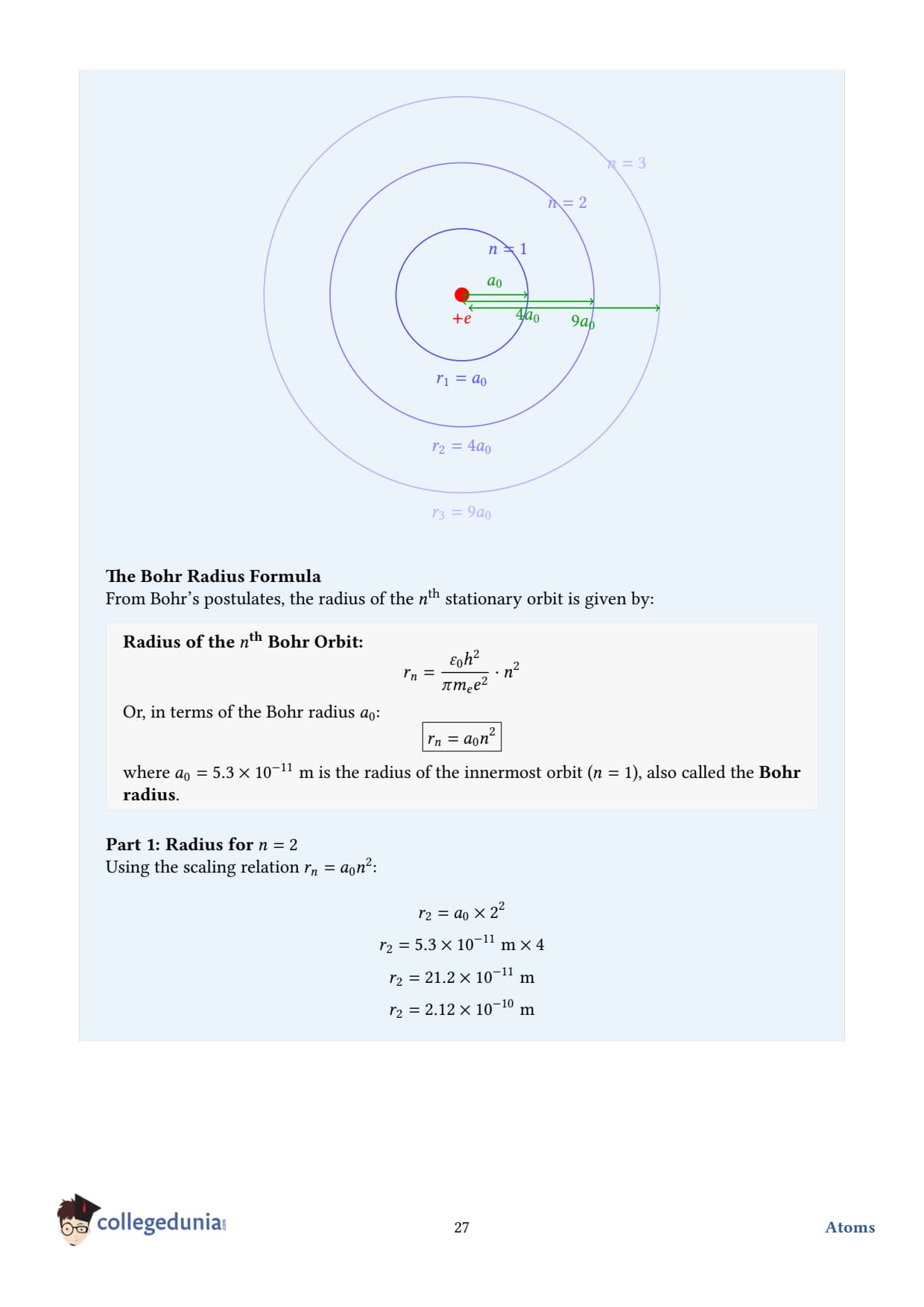
The radius of the innermost electron orbit of a hydrogen atom is 5.310-11m. What are the radii of the n = 2 and n = 3 orbits?
Given.
Radius of the innermost (Bohr-ground-state) orbit, r1 = 5.310-11mthis is the Bohr radius a0.
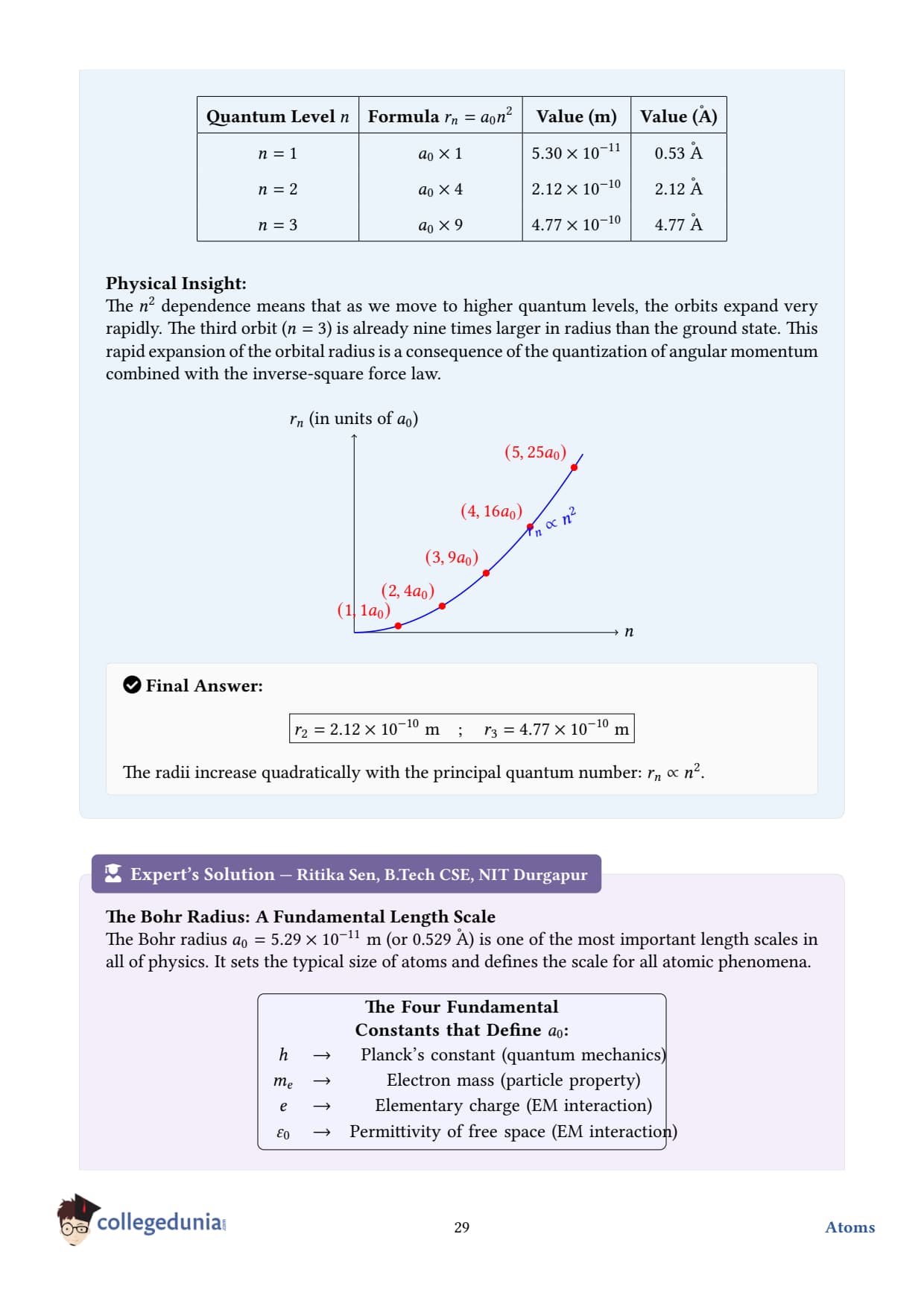
Concept used - Bohr-orbit radius formula. In Bohr's quantised hydrogen, the allowed orbital radii are rn = n2 a0, n = 1, 2, 3, … The radius scales as the square of the principal quantum number. So as you climb to higher orbits, the atom gets dramatically larger.
Step 1 - write the formula symbolically. rn = n2 r1.
Step 2 - radius of n = 2. r2 = 22 r1 = 4× 5.310-11 = 21.210-11 = 2.1210-10m.
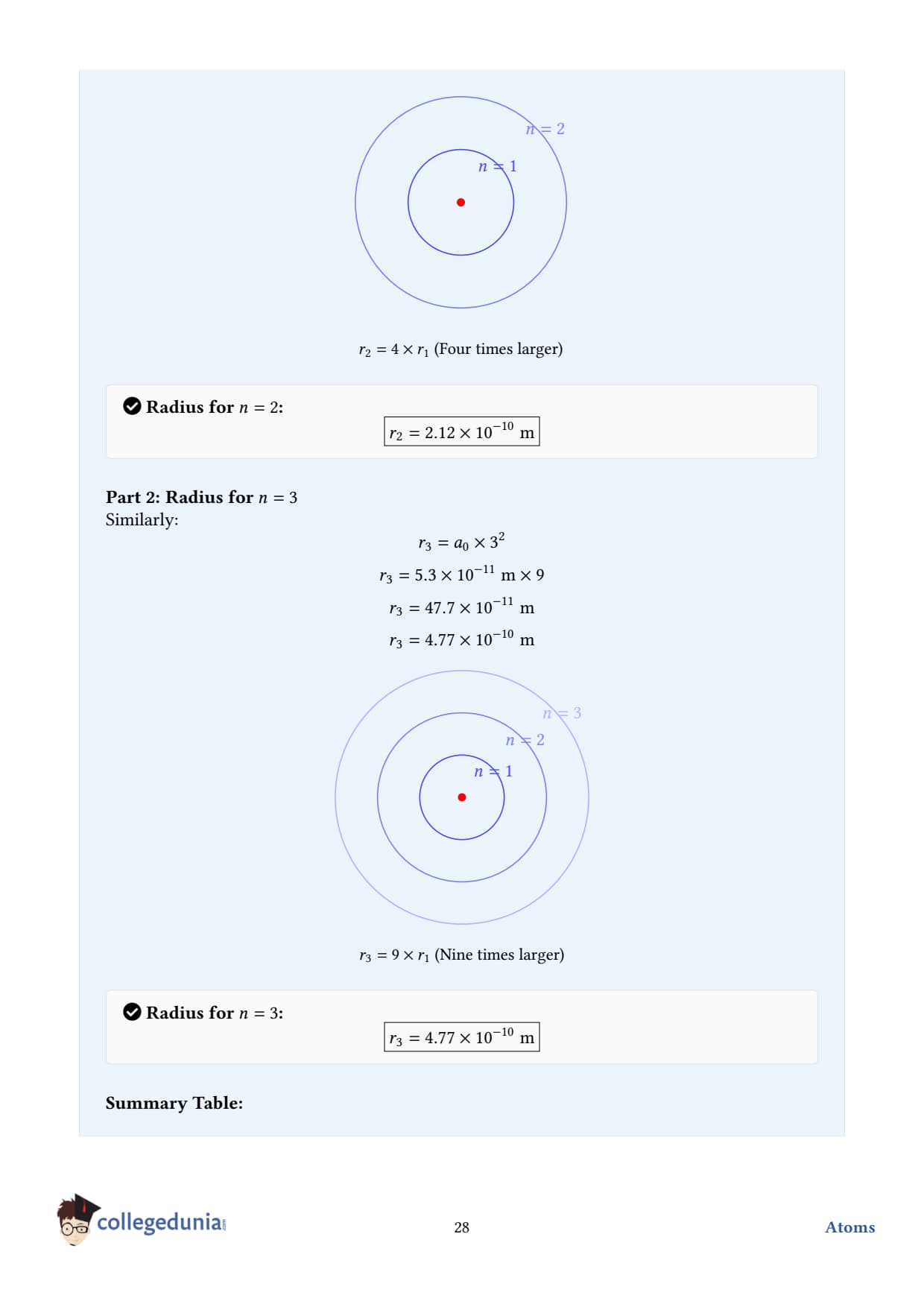
Step 3 - radius of n = 3. r3 = 32 r1 = 9× 5.310-11 = 47.710-11 = 4.7710-10m.
Step 4 - sanity check. A typical neutral atom has radius ∼ 10-10m, so r2 = 2.1210-10 and r3 = 4.7710-10 m sit nicely in the expected atomic-size range. Both are still much smaller than the wavelength of visible light ∼ 510-7m, which is why we cannot "see" atoms with ordinary microscopes.
Final answer.
r2 = 2.1210-10m
r3 = 4.7710-10m
DR
Dr. Rajesh Kumar
Ph.D. Physics, IIT Delhi
Verified Expert
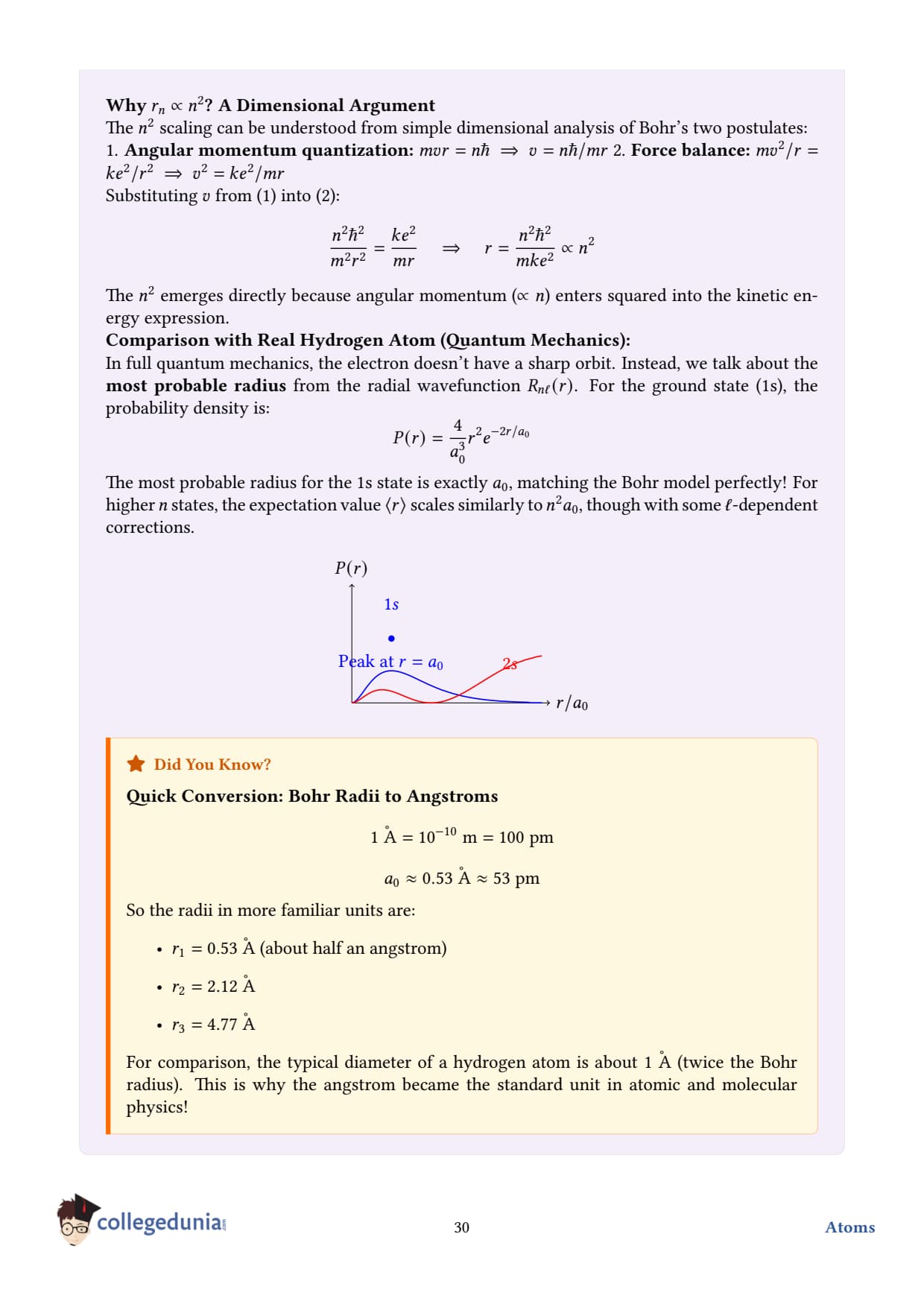
Derivation of rn = n2 a0. Bohr equates the Coulomb force to the centripetal force: k e2r2 = m v2r. He also imposes angular-momentum quantisation: mvr = n, so v = n/(mr). Substituting: k e2r2 = mr·n22m2 r2 = n22m r3. Cancelling and solving for r: rn = n22mk e2 = n2 a0, a0 = 2mk e2 ≈ 5.2910-11m.
Why the atom grows so fast. Going from n=1 to n=100 (a "Rydberg state"), the radius grows by a factor of 1002 = 104 - to about 510-7 m = 500 nm. That's roughly the wavelength of green light. Such "giant atoms" are actually produced in modern laboratories and have lifetimes long enough to perform interferometry on individual atoms.
Common mistake - using n instead of n2. Students sometimes plug r2 = 2× a0. Wrong by a factor of 2. The Bohr radius scales as n2, not n. Similarly, velocity scales as 1/n, and energy as 1/n2. Remember the three power-laws separately: r ∝ n2, v ∝ 1/n, E ∝ 1/n2.
Real-world relevance. Highly excited Rydberg atoms are extraordinarily sensitive to electric and magnetic fields and to nearby atoms. They are used as quantum sensors and as the basis for new kinds of quantum computers (the "Rydberg blockade" mechanism). Their radii follow the same n2 law you just used.
Q 12.8
A 12.5 eV electron beam is used to bombard gaseous hydrogen at room temperature. What series of wavelengths will be emitted?
Given.
Kinetic energy of bombarding electrons, E = 12.5 eV.
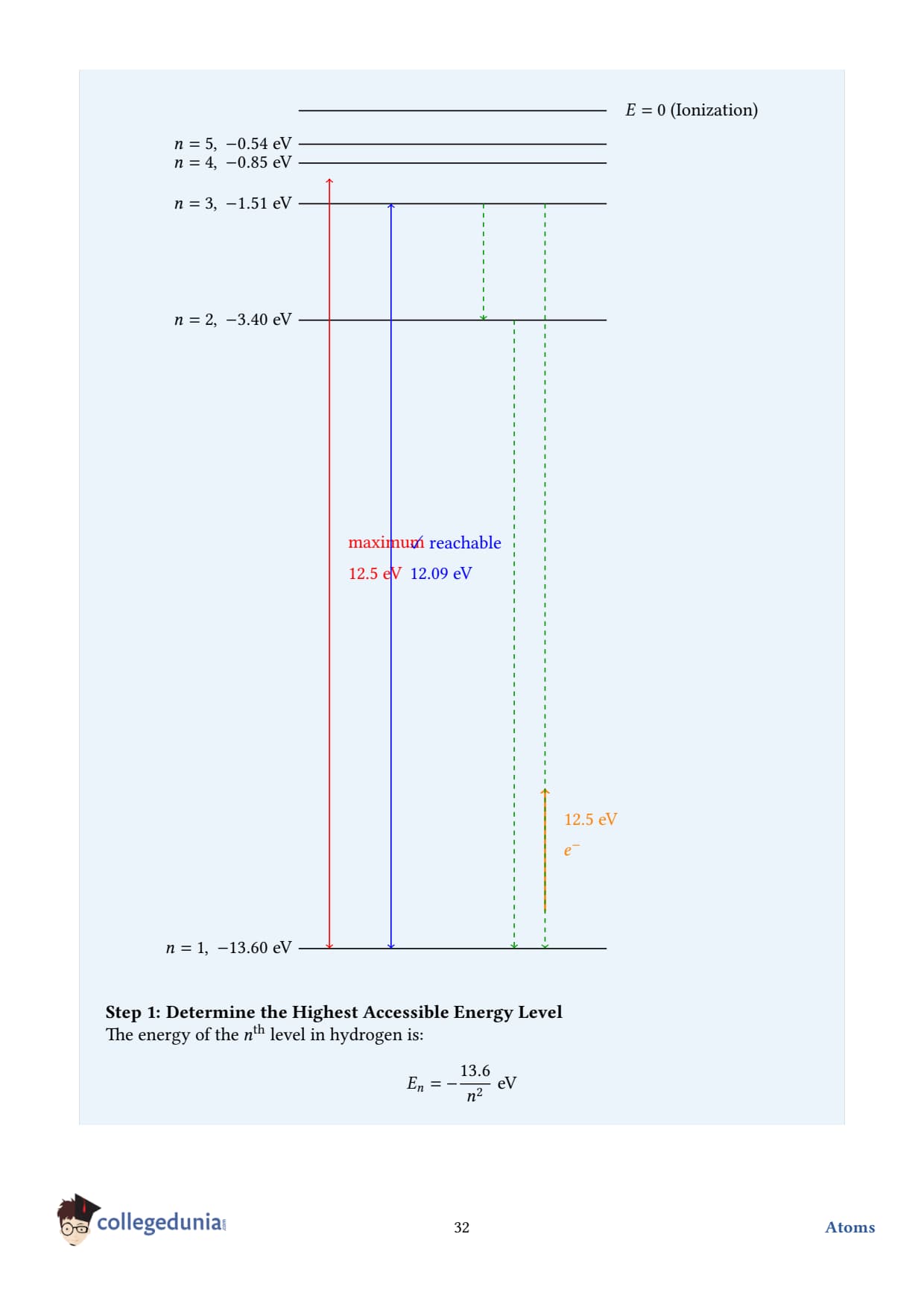
Hydrogen gas at room temperature - virtually all atoms are initially in the ground state, n = 1, with E1 = -13.6 eV.
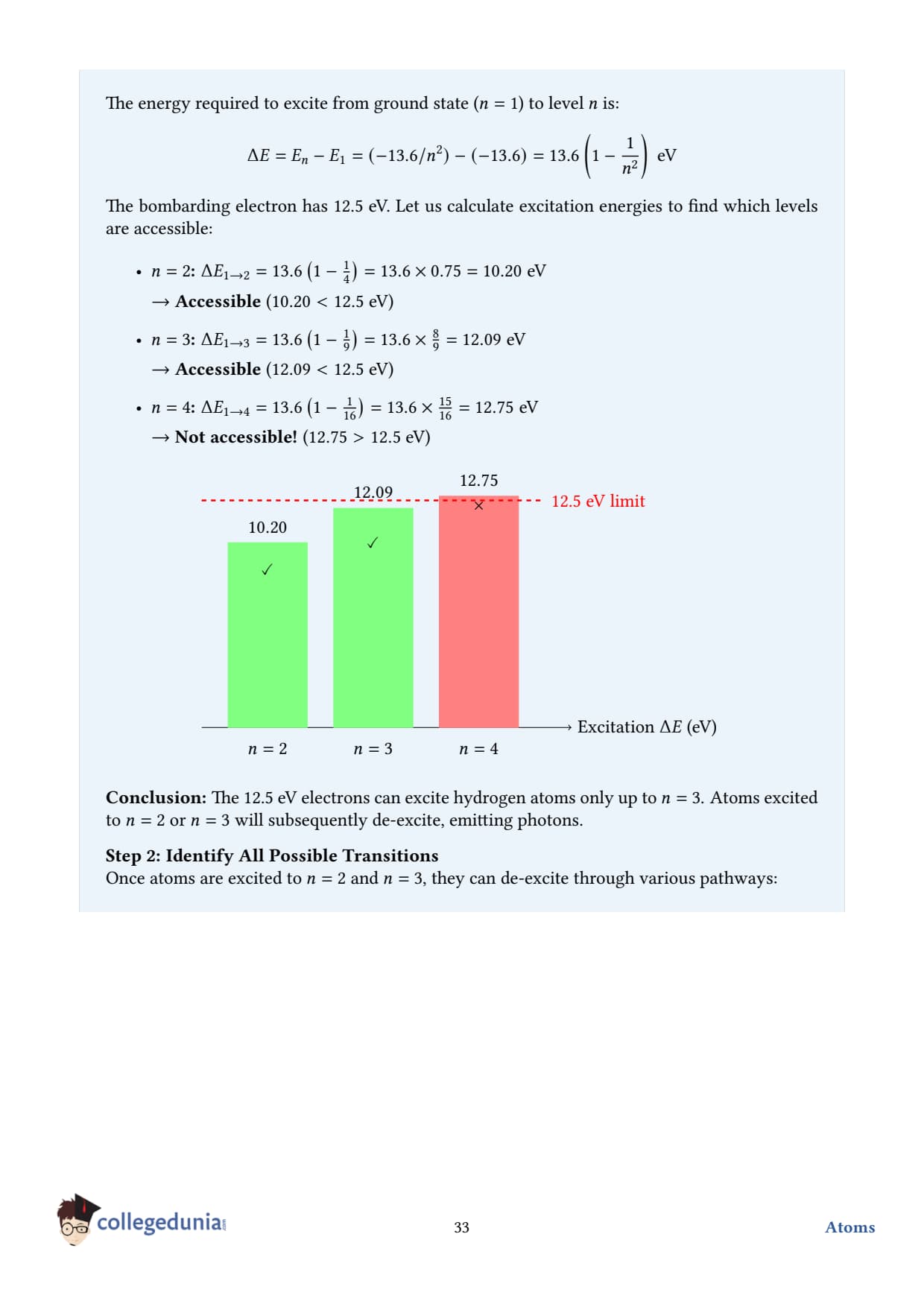
Concept used - atomic excitation by electron impact. An incoming electron can transfer energy to a hydrogen atom only in discrete amounts equal to the gaps between Bohr energy levels. The atom is initially in state n = 1. It can be excited to a higher state n2 only if the bombarding electron has at least enough energy to bridge the gap Δ E1→ n2 = En2 - E1 = 13.6(1 - 1n22) eV. Whatever energy is not absorbed leaves with the bombarding electron.
Step 1 - find the highest level reachable. Compute the required Δ E for the first few jumps:
n=1 → 2: Δ E = 13.6(1 - 1/4) = 10.2 eV. (12.5 eV is enough.)
n=1 → 3: Δ E = 13.6(1 - 1/9) = 12.09 eV. (12.5 eV is enough.)
n=1 → 4: Δ E = 13.6(1 - 1/16) = 12.75 eV. (12.5 eV is NOT enough.)
So the highest level a 12.5 eV electron can excite the atom to is n2 = 3.
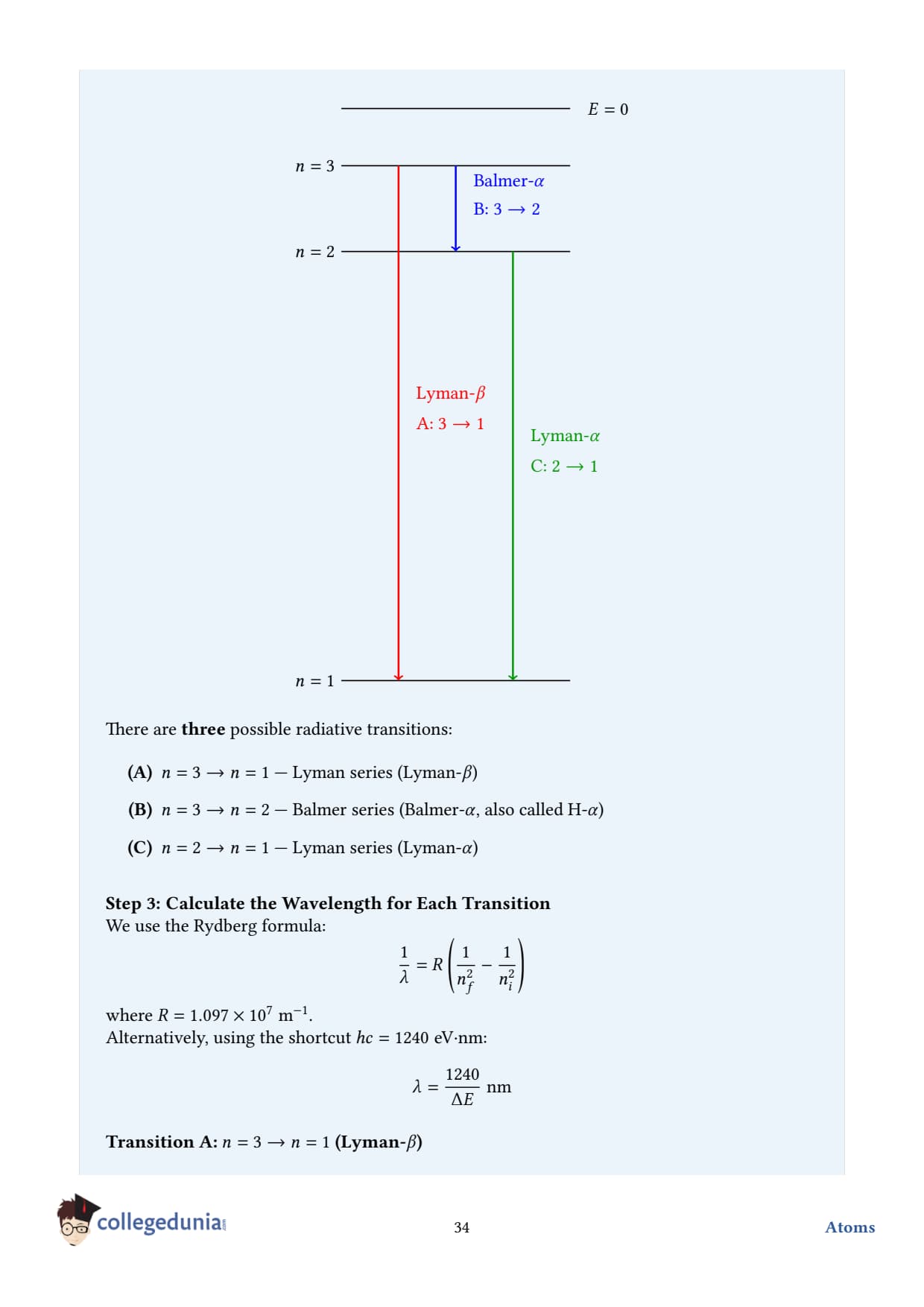
Step 2 - list all possible downward transitions. Once excited to n = 3, the atom can de-excite to any lower level (directly or via intermediate steps), emitting a photon for each transition. The possible transitions are:
n = 3 → 2 - Balmer series (visible).
n = 3 → 1 - Lyman series (UV).
n = 2 → 1 - Lyman series (UV).
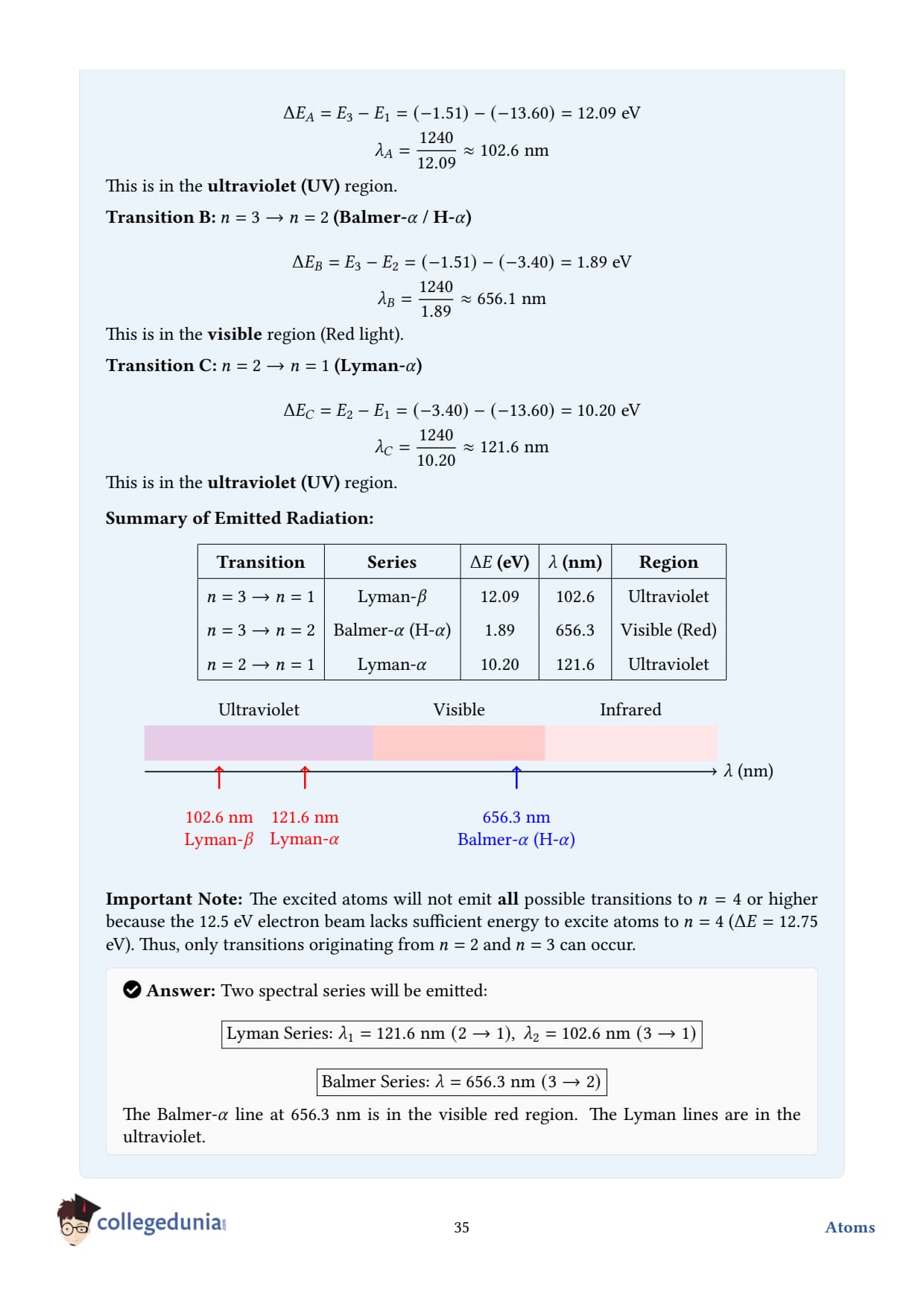
Step 3 - compute the wavelengths. Use the Rydberg formula 1λ = R (1n12 - 1n22), R = 1.097107 m-1.
Step 4 - group by spectral series. The 656 nm line is in the Balmer seriestransitions ending at n = 2. The 103 nm and 122 nm lines are in the Lyman seriestransitions ending at n = 1.
Final answer. Three wavelengths will be emitted:
32 ≈ 656 nm - Balmer-α, red (visible).
31 ≈ 103 nm - Lyman-β, UV.
21 ≈ 122 nm - Lyman-α, UV.
So both the Lyman series (UV) and the first line of the Balmer series (visible) are emitted.
DA
Dr. Anita Sharma
Ph.D. Physics, University of Delhi
Verified Expert
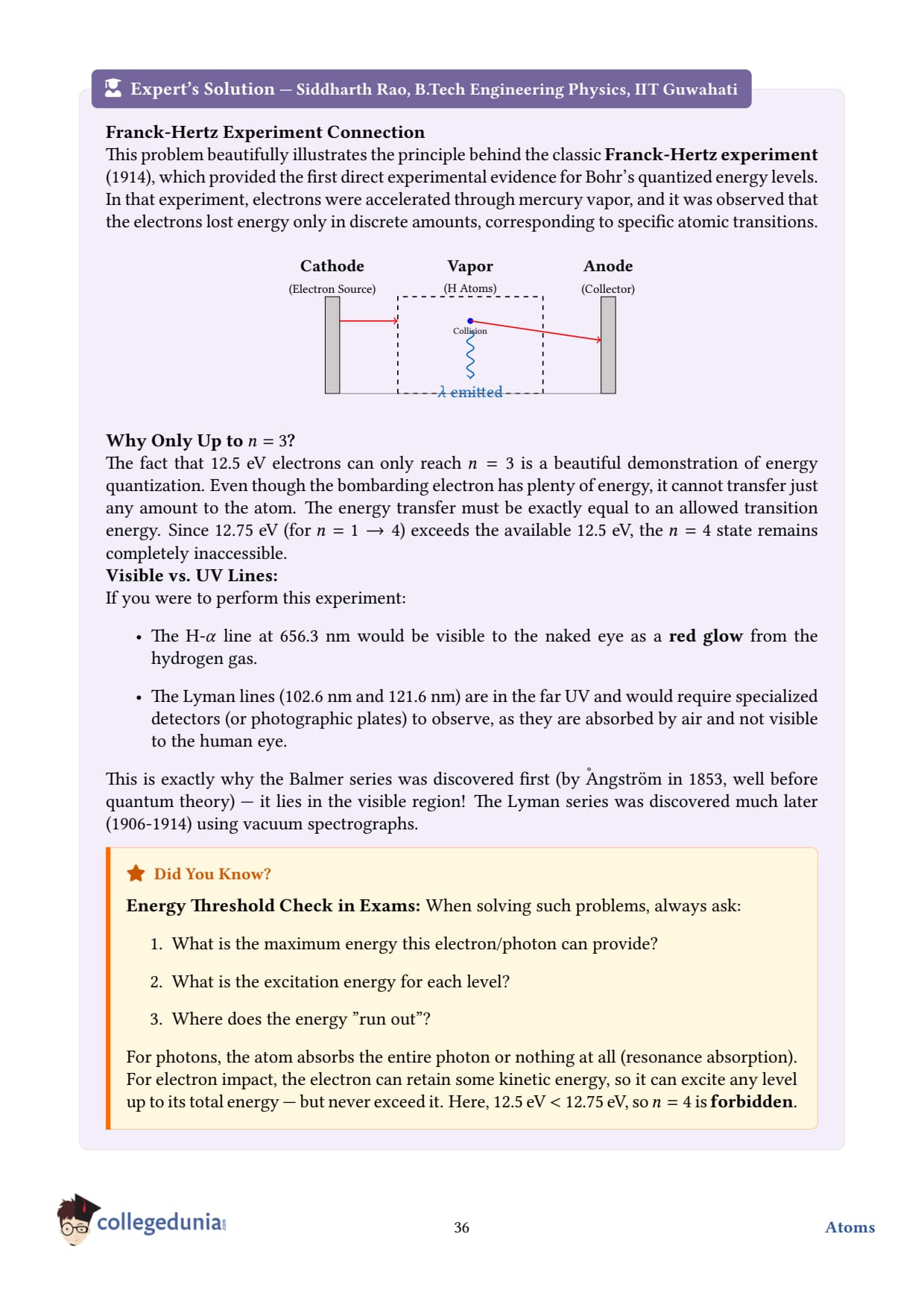
Why electron impact differs from photon absorption. When a photon meets an atom, it can be absorbed only if its energy exactly matches a level gap - partial absorption is impossible. A bombarding electron has no such restriction: it can deposit any fraction of its kinetic energy into the atom (consistent with energy and momentum conservation). The leftover energy stays with the electron as reduced KE. This is why a 12.5 eV electron beam can excite n=1 → 3 (which needs 12.09 eV) - the spare 0.41 eV simply leaves with the electron.
Franck–Hertz experiment (1914). James Franck and Gustav Hertz showed exactly this in mercury vapour. They bombarded Hg atoms with electrons and found that energy was absorbed only in discrete amounts (4.9 eV in their case), giving direct experimental proof of Bohr's discrete energy levels. They got the Nobel Prize for it in 1925.
Common mistake - counting transitions. The number of spectral lines from a level n cascading down is C(n,2) = n(n-1)/2. For n = 3: 3 · 2/2 = 3 lines (3→2, 3→1, 2→1). For n = 4: 4 · 3/2 = 6 lines. For n = 5: 10. Worth remembering for multiple-choice problems.
Real-world atomic spectroscopy. Hydrogen's Lyman-α line at 121.6 nm is the strongest emission line from the Sun's chromosphere. Astronomers use it to study the upper atmosphere of stars. The Balmer-αH-α line at 656 nm is the iconic red glow of nebulae and the "fingerprint" of cosmic hydrogen across the universe - every backyard astrophotograph showing red emission nebulae is seeing this line in action.
Q 12.9
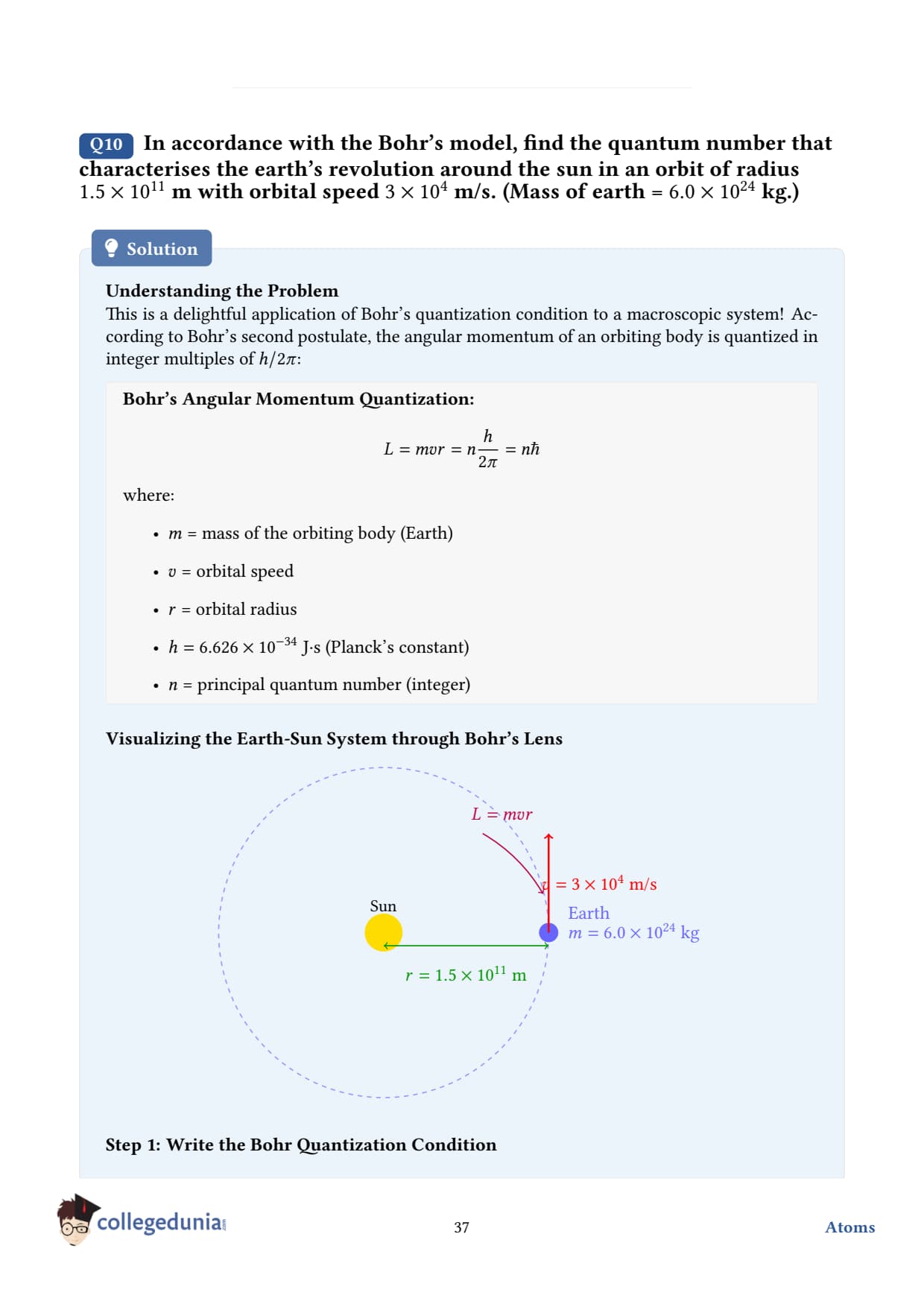
In accordance with Bohr's model, find the quantum number that characterises the Earth's revolution around the Sun in an orbit of radius 1.51011m with orbital speed 3104m/s. Mass of earth = 6.01024 kg.
Given.
Orbital radius of Earth, r = 1.51011m.
Orbital speed, v = 3104m/s.
Mass of Earth, m = 6.01024 kg.
Reduced Planck constant, = 1.05510-34Js.
Concept used - Bohr's angular-momentum quantisation. Bohr's postulate (originally for atomic electrons) says the orbital angular momentum can take only discrete values: L = mvr = n , n = 1, 2, 3, … This is the only ingredient we need. We are asked to find the value of n that fits Earth's actual orbit.
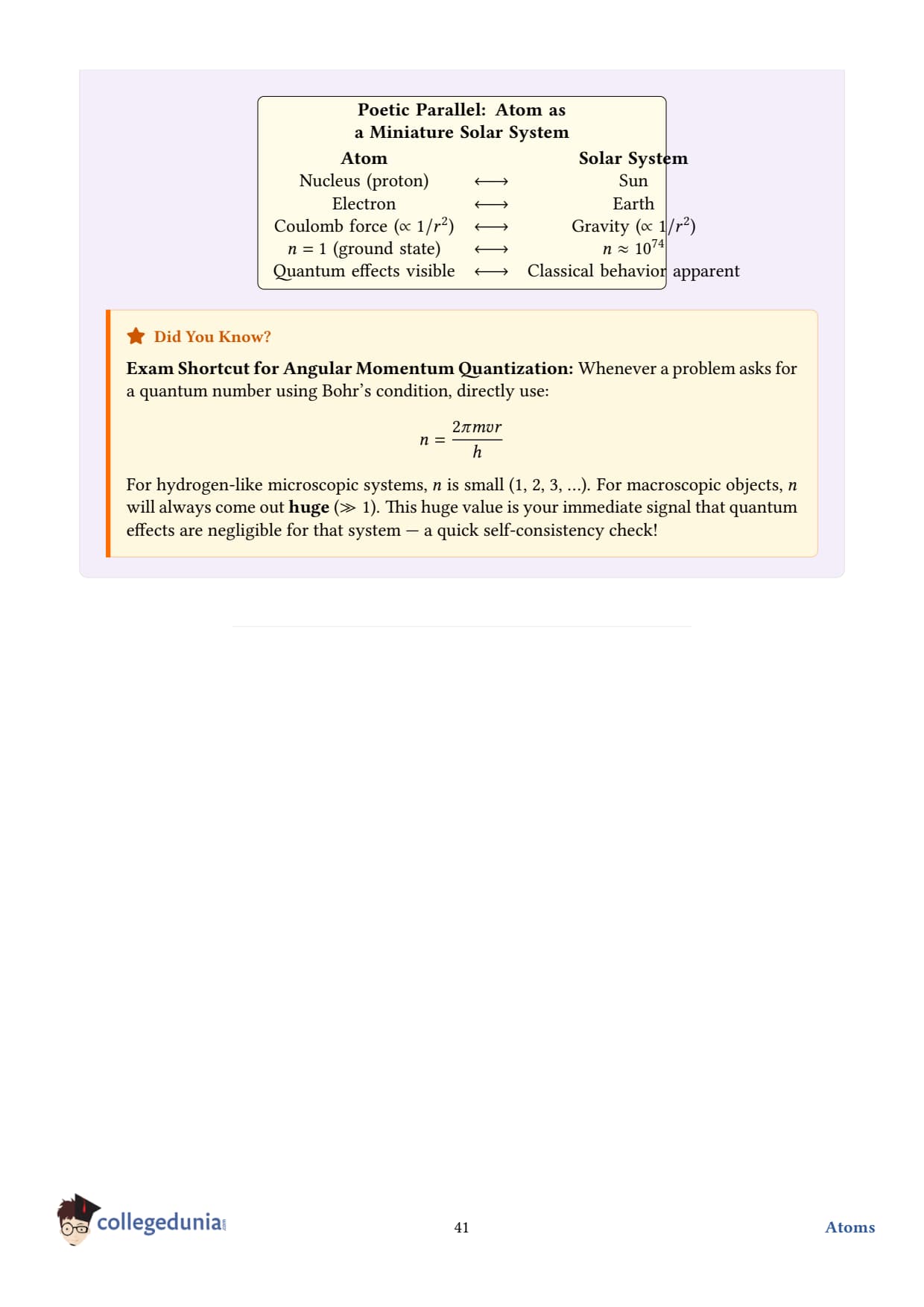
Why pretend planets obey Bohr? Strictly, Bohr's rule applies to atomic-scale bound systems. Here we extrapolate it to macroscopic motion just to find the equivalent n - and to discover how absurdly large it must be.
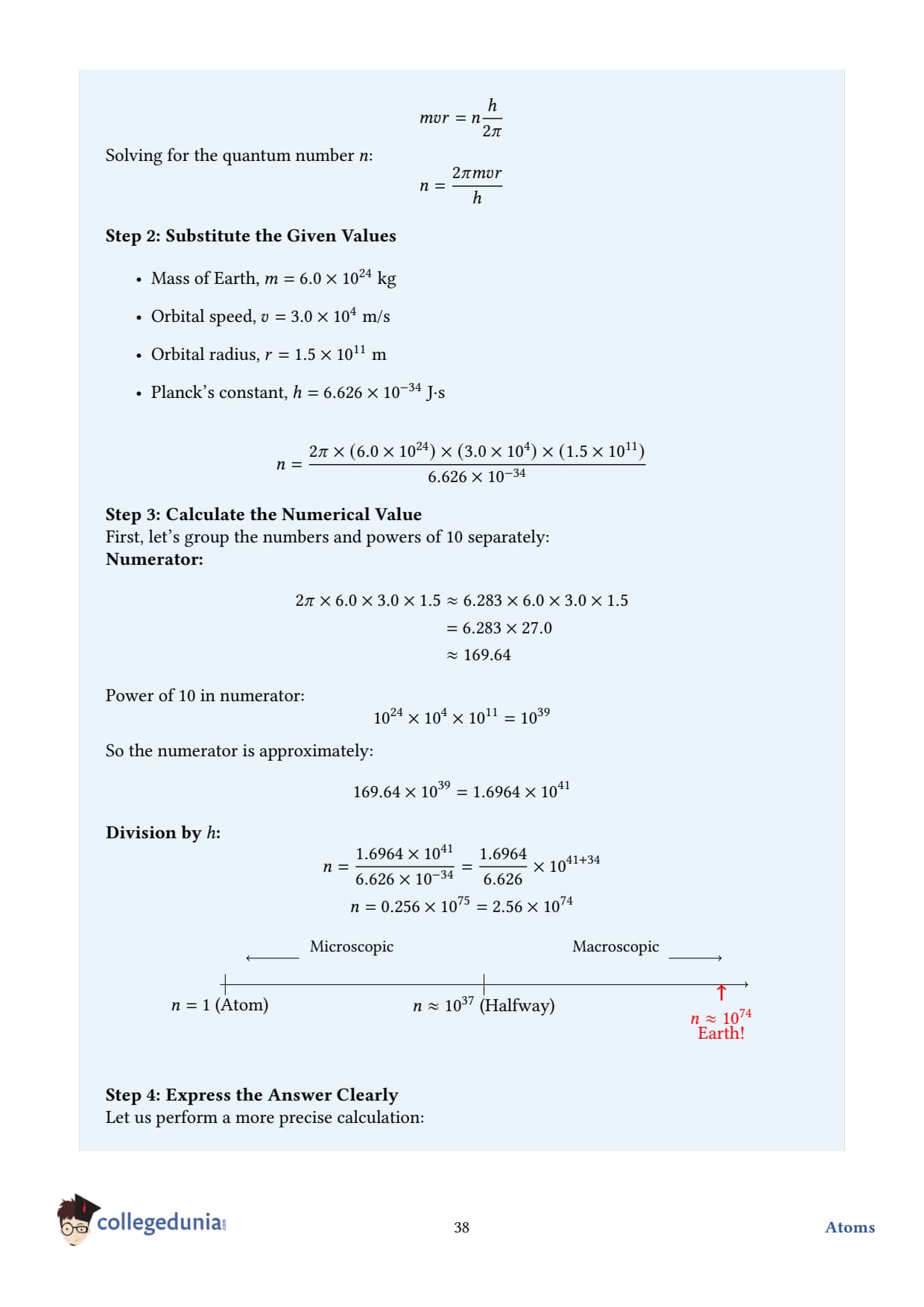
Step 1 - write the formula.n = mvr.
Step 2 - compute the numerator (the angular momentum).L = mvr = (6.01024)(3104)(1.51011). Multiply step-by-step: 6.0 × 3 × 1.5 = 27.0; 10241041011 = 1039. So L = 271039 = 2.71040 kg m2/s.
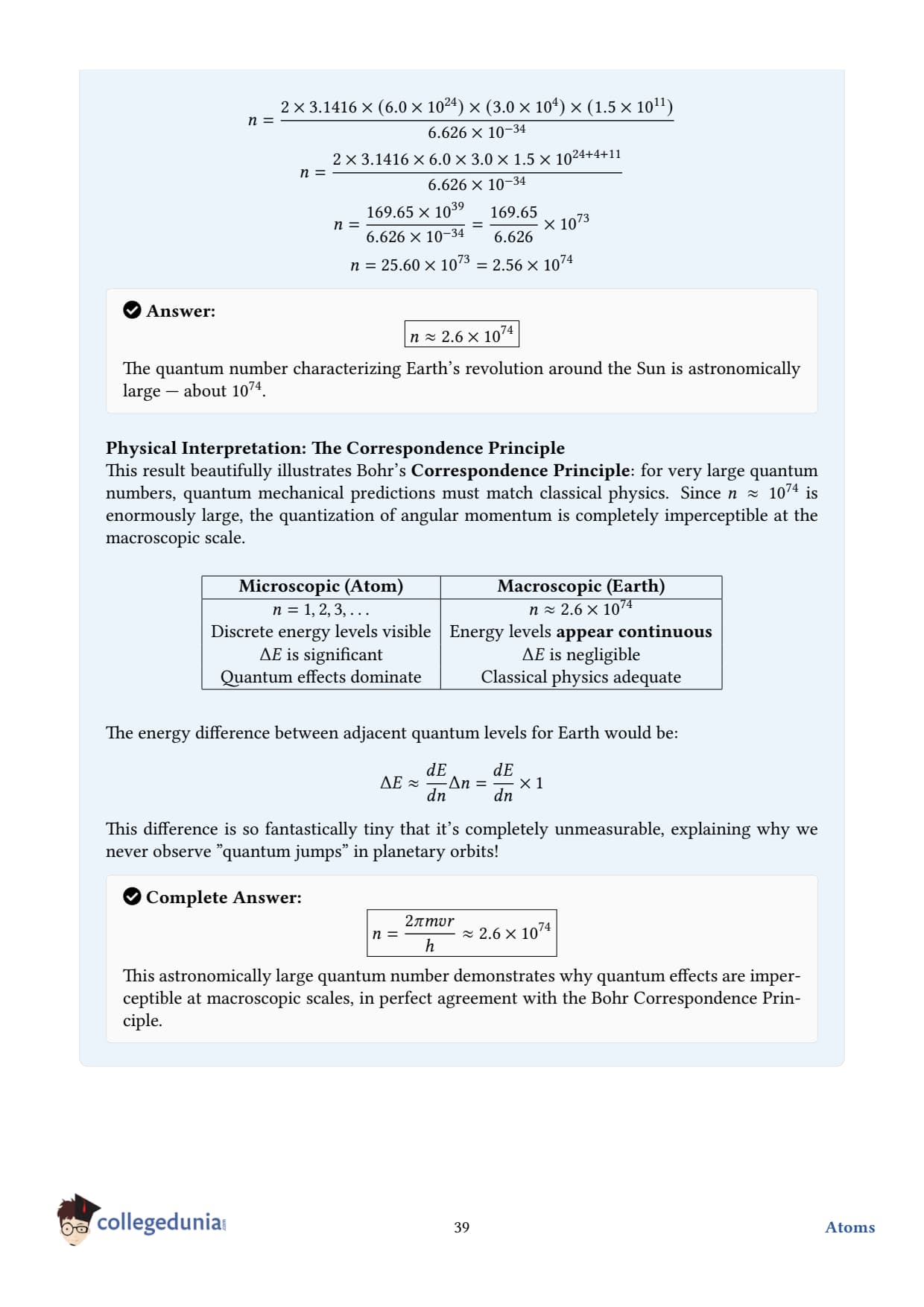
Step 4 - interpret. The quantum number for Earth's orbit is roughly n ∼ 2.61074 - an absolutely enormous number. The spacing between successive Bohr orbits at this n is so unimaginably small that the orbit looks perfectly continuous on every observable scale. This is exactly Bohr's correspondence principle in action: for very large quantum numbers, quantum predictions blend smoothly into classical mechanics.
Final answer.n ≈ 2.561074.
DS
Dr. Suresh Iyer
Ph.D. Theoretical Physics, TIFR Mumbai
Verified Expert
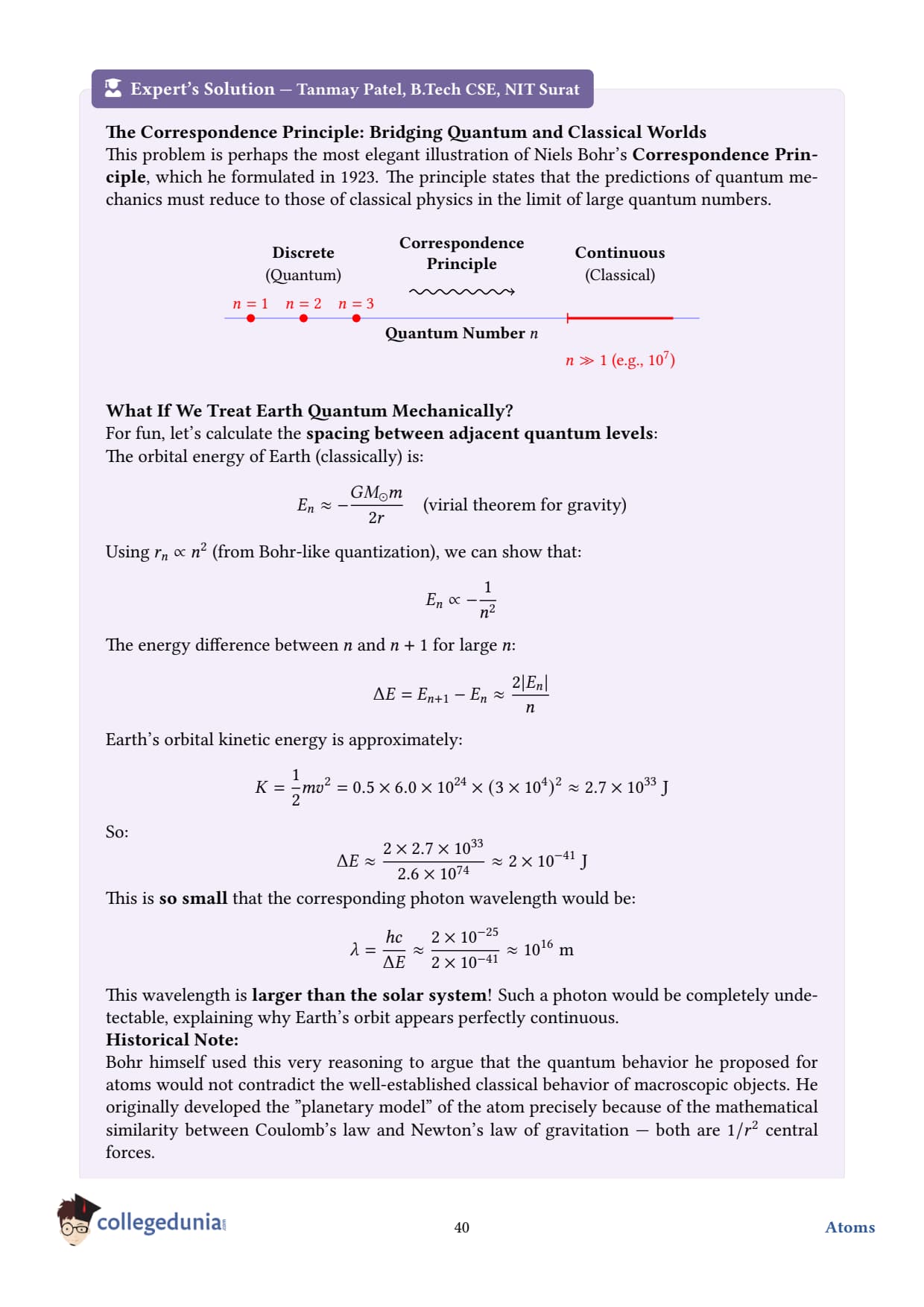
Bohr's correspondence principle. Bohr argued that in the limit n → ∞, quantum predictions must agree with the classical ones we already trust. For an electron at n = 106, the orbital frequency from quantum mechanics matches the classical Kepler frequency to spectacular precision. For Earth at n = 1074, the agreement is perfect - there is no observable distinction between the "quantised" orbit and the classical one. This is why we never see quantum effects in planetary motion.
Why n is so unreasonably large. The "quantum of action" is ∼ 10-34 J·s. Earth's orbital angular momentum is ∼ 1040 J·s - 74 orders of magnitude larger. The fundamental quantum unit is utterly negligible at planetary scale.
Alternative - energy quantisation gives the same lesson. If we wrote Earth's gravitational PE in Bohr-like form, En ∝ -1/n2, and computed the energy of the next orbit n + 1, the energy difference Δ E would be unmeasurably tiny - far below thermal noise, far below any conceivable detection. The "orbits" merge into a continuum, which is what classical mechanics describes.
Common mistake - forgetting that (not h) appears in Bohr's quantisation. Some students substitute h = 6.62610-34 instead of = 1.05510-34, getting an answer roughly 2π too small. Bohr's original postulate is L = n; using h would give a different (incorrect) answer.
Real-world relevance. The correspondence principle is the bridge between two of the most successful physical theories - classical and quantum mechanics. It tells us that classical physics is not "wrong", just an excellent approximation to quantum mechanics in the large-n limit. This problem makes the bridge concrete: the same Bohr formula that gives n=1 for ground-state hydrogen gives n ∼ 1074 for the Earth–Sun system. Same physics, different scale.
Other Resources for Class 12 Physics Chapter 12 Atoms
Class 12 Atoms Difficulty Rating from Our Student Poll
We asked 10,360 Class 12 Physics students how Chapter 12 felt before the 2026 boards. Here is what they said.
Student Feedback
What 10,360 students told us about Class 12 Chapter 12 Atoms:
59% of students surveyed rated the Bohr-orbit derivation as the most-confusing sub-topic.
47% mixed up energy and energy difference at least once on a class test.
The average student took 2.6 hours for the first read and 1.2 hours for revision.
Source: 2025-26 Class 12 Physics student poll.
Class 12 Physics Chapter 12 Atoms NCERT Solutions FAQs
Ques. What are the main topics in chapter 12 physics class 12 ncert solutions?
Ans. The chapter 12 physics class 12 NCERT solutions cover Rutherford's atomic model and the gold-foil scattering experiment, the drawbacks of Rutherford's model, Bohr's atomic model and its three postulates, the hydrogen spectrum and the Rydberg formula, and the spectral series (Lyman, Balmer, Paschen, Brackett, Pfund).
Ques. What is the Rutherford atomic model class 12?
Ans. Rutherford proposed that the atom has a tiny, dense, positively charged nucleus with electrons orbiting around it like planets, after observing the gold-foil alpha-scattering experiment. The model explains atomic structure but fails to explain stability and discrete spectra.
Ques. What are the drawbacks of the Rutherford model of the atom class 12?
Ans. Two main drawbacks: (1) An accelerating electron in a circular orbit should continuously radiate energy and spiral into the nucleus, making the atom unstable; (2) The model predicts a continuous spectrum, but real atoms emit only at discrete spectral lines.
Ques. What is the Bohr atomic model class 12 physics?
Ans. Bohr proposed three postulates: electrons revolve only in certain stationary orbits without radiating; angular momentum is quantised (L = n h / 2pi); energy is emitted or absorbed only when an electron jumps between two stationary orbits (h nu = delta E).
Ques. What is the energy of an electron in the nth Bohr orbit?
Ans. For hydrogen, E_n = -13.6 / n squared eV. Ground state (n = 1) is -13.6 eV. First excited state (n = 2) is -3.4 eV. For n approaching infinity, E approaches 0 (electron is free).
Ques. What is the weightage of chapter 12 physics class 12?
Ans. Chapter 12 carries 3 marks in CBSE Class 12 Physics. JEE Main draws about 2 per cent and NEET 1 to 2 questions per year. Treat as a low-weight but easy-scoring chapter.









Comments