




ISC Class 12 English (Paper 2) Question Paper 2026 is available for download here. Council For The Indian School Certificate Examinations (CISCE) conducted ISC Class 12 English exam on February 13, 2026 from 2 PM to 5 PM. ISC Class 12 English (Paper 2) is divided into two sections: Sec. The Theory paper will have a total of 80 Marks while Project Work is of 20 Marks.
ISC Class 12 English (Paper 2) Question Paper 2026
| ISC Class 12 English (Paper 2) Question Paper 2026 | Download PDF | Check Solutions |

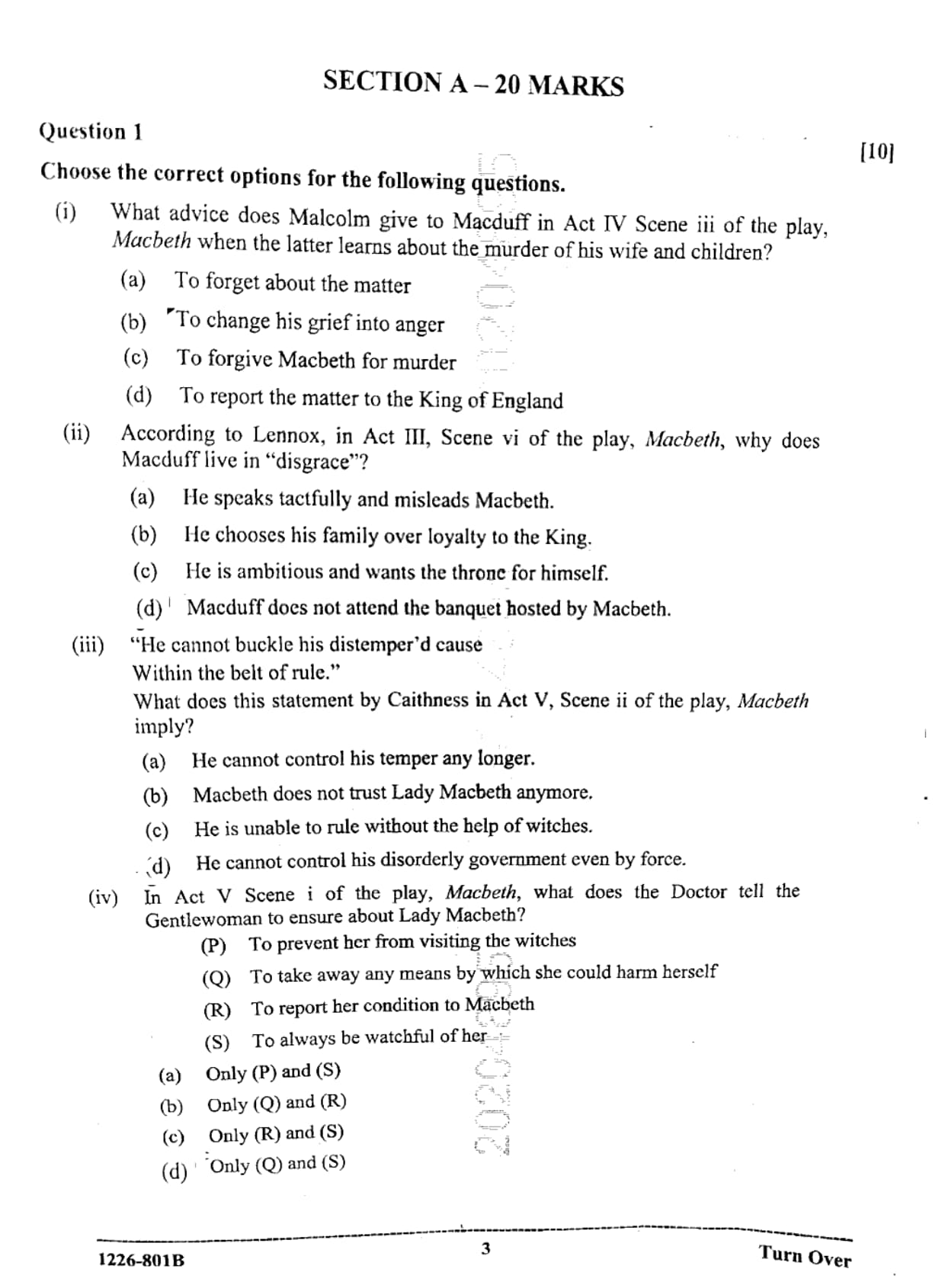


Choose the correct options for the following questions.
What advice does Malcolm give to Macduff in Act IV Scene iii of the play, Macbeth when the latter learns about the murder of his wife and children?
View Solution
Concept:
- In Shakespeare’s tragedy Macbeth, Malcolm acts as a source of moral and martial strength for Macduff.
- When personal catastrophe strikes, Malcolm directs intense sorrow toward military resolution against the tyrant.
Step 1: Identify the dramatic context of the news
Ross arrives in England to inform Macduff that his castle has been ambushed and his wife and children ruthlessly murdered.
Macduff is completely overcome by deep grief, pulling his hat over his brow and weeping in agony.
Step 2: Examine Malcolm’s reaction and explicit advice
Malcolm immediately urges Macduff not to succumb to paralyzed sorrow but to harness his emotions for retribution.
He explicitly advises: “Be this the whetstone of your sword: let grief / Convert to anger; blunt not the heart, enrage it.”
Malcolm counsels him to transform his overwhelming grief into righteous vengeance on the battlefield.
According to Lennox, in Act III, Scene vi of the play, Macbeth, why does Macduff live in “disgrace”?
View Solution
Concept:
- In Act III Scene vi, Lennox speaks with another Lord using biting sarcasm to expose Macbeth’s murderous tyranny.
- An open refusal to attend royal ceremonies was treated by Macbeth as treasonous defiance.
Step 1: Analyze Lennox’s conversation
Lennox reviews the recent mysterious deaths of King Duncan and Banquo, ironically praising Macbeth’s convenient grief.
He then turns his attention to the Thanes who have fallen out of favor with the newly crowned tyrant.
Step 2: Identify the exact cause of Macduff’s disgrace
Lennox explains Macduff’s dangerous political standing directly in his speech.
He states: “...and ’cause he fail’d / His presence at the tyrant’s feast, I hear / Macduff lives in disgrace.”
Macduff’s failure to attend the ceremonial state banquet hosted by Macbeth is the direct cause of his fall from favor.
“He cannot buckle his distemper’d cause Within the belt of rule.” What does this statement by Caithness in Act V, Scene ii of the play, Macbeth imply?
View Solution
Concept:
- Shakespeare uses clothing and medical imagery to represent illegitimate authority and political chaos.
- “Distemper’d” signifies a diseased, swollen, and morally corrupt condition.
Step 1: Examine the metaphorical imagery
Caithness compares Macbeth’s rule to a diseased, swollen body that has grown completely out of proportion.
The “belt of rule” represents the boundaries of legitimate, disciplined, and lawful governance.
Step 2: Deduce the thematic meaning
The metaphor indicates that Scotland under Macbeth has descended into uncontrollable anarchy.
Macbeth’s tyranny has become so chaotic and unstable that he can no longer hold his collapsing regime together, even through brute military force.
In Act V Scene i of the play, Macbeth, what does the Doctor tell the Gentlewoman to ensure about Lady Macbeth?
(P) To prevent her from visiting the witches
(Q) To take away any means by which she could harm herself
(R) To report her condition to Macbeth
(S) To always be watchful of her
View Solution
Concept:
- In the famous sleepwalking scene, Lady Macbeth’s repressed guilt breaks through her psychological defenses.
- The Doctor recognizes that her illness is a moral and spiritual affliction requiring vigilance against self-destruction.
Step 1: Recall the Doctor’s diagnostic instructions
After observing Lady Macbeth repeatedly washing her hands and reliving the murders, the Doctor realizes she is in suicidal despair.
He states: “Look after her; / Remove from her the means of all annoyance, / And still keep eyes upon her.”
Step 2: Match the textual directives with the statements
In Elizabethan English, “annoyance” refers to self-inflicted injury, corresponding to statement (Q).
“Keep eyes upon her” means to maintain constant observation and vigilance over her, corresponding to statement (S).
Therefore, the Doctor specifically instructs the Gentlewoman to ensure (Q) and (S).
Read the two statements from the short story, There Will Come Soft Rains, and choose the correct option from the ones given below. Statement I: “...the solvent spread on the linoleum, licking, eating, under the kitchen door, while the voices took it up in chorus: “Fire! fire! fire!”” Statement II: ‘While scurrying water rats squeaked from the walls, pistolled their water, and ran for more. And the wall sprays let down showers of mechanical rain.’
View Solution
Concept:
- Ray Bradbury’s story portrays a fully automated smart home that continues its algorithmic functions after humanity’s extinction.
- Every automated process in the house operates strictly on a cause-and-effect mechanism.
Step 1: Analyze the cause described in Statement I
A falling tree bough crashes into the kitchen, knocking cleaning solvent over the hot stove, igniting an uncontrollable blaze.
The house’s audio sensors detect the heat and flame, announcing the emergency: “Fire! fire! fire!”
Step 2: Analyze the effect described in Statement II
The detection of the blaze immediately triggers the automated emergency defense system.
Mechanical cleaning rats and wall sprinklers emerge to spray water in a desperate effort to extinguish the fire.
Thus, Statement I (the outbreak of the fire) serves as the direct cause and reason for Statement II (the defensive release of water).
In the short story Indigo, what is Aniruddha’s reaction to the untimely visit by Uncle Mohit?
View Solution
Concept:
- Satyajit Ray’s protagonist Aniruddha Bose is portrayed as an educated, refined, and respectful young man.
- Cultured social norms require treating elder relatives with patience and courtesy regardless of inconveniences.
Step 1: Establish the timing of Uncle Mohit’s visit
Uncle Mohit arrives unannounced late in the evening just as Aniruddha is packing his bags for a holiday drive to Dumka.
The sudden visit interrupts Aniruddha’s schedule and departure preparations.
Step 2: Analyze Aniruddha’s response to his guest
Despite the inconvenience, Aniruddha does not display irritation or impatience.
He receives Uncle Mohit warmly, offers him refreshments, listens attentively, and answers his inquiries with genuine politeness.
He treats his visitor with traditional decorum and courtesy before continuing his journey.
Which one of the following BEST explains the reason for the efforts made by Grandpa to impress Martin’s friends in the short story, The Medicine Bag?
View Solution
Concept:
- The narrative centers on the conflict between Martin’s modern peer anxiety and authentic Native American traditions.
- Grandpa Joe possesses deep sensitivity and understands the social pressures faced by his great-grandson.
Step 1: Identify Martin’s internal conflict
Martin had bragged to his friends about having an authentic Indian grandfather, painting an exaggerated picture based on TV westerns.
When Grandpa arrives tired, frail, and dressed in simple clothes, Martin experiences intense fear of peer ridicule.
Step 2: Evaluate Grandpa’s selfless motivation
Grandpa senses the boy’s acute embarrassment and hesitation to introduce his friends.
To protect Martin’s dignity among his peers, Grandpa dresses in his ceremonial shirt, feather, and moccasins.
He presents himself as an impressive, dignified elder strictly to ensure that Martin is not humiliated in front of his friends.
What is the tone of the poet in the phrase ‘raven black’ in the poem, Telephone Conversation?
View Solution
Concept:
- Wole Soyinka uses irony and satire to expose the irrational cruelty of racial prejudice.
- The speaker responds to vulgar discrimination by adopting mock-scientific precision and sharp wit.
Step 1: Examine the conversational context
The white landlady demands clarification on the speaker’s exact skin color, asking: “HOW DARK?... ARE YOU LIGHT OR VERY DARK?”
Her intrusive questioning strips the interaction of human dignity, reducing the speaker to a color gradient.
Step 2: Analyze the tone of the speaker’s description
The speaker turns her absurd fixation into an intellectual game, defining his skin as “West African sepia” and his hair as “raven black.”
By abandoning expected deference and playfully mocking her racial obsession, his tone becomes biting, satirical, and intentionally impolite.
Which of the following companions of Death are mentioned in the poem, Death Be Not Proud?
View Solution
Concept:
- In Holy Sonnet X, John Donne deconstructs the conventional terror associated with Death.
- Donne personifies Death not as an omnipotent ruler, but as a humiliated servant trapped in foul company.
Step 1: Examine the relevant lines in Holy Sonnet X
Donne challenges Death’s supposed sovereignty in lines 9 and 10 of the poem.
He directly addresses Death, challenging its power and pride: “Thou art slave to fate, chance, kings, and desperate men...”
Step 2: Identify Death’s specific companions
Donne continues by naming the vile associates that accompany Death: “And dost with poison, war, and sickness dwell...”
The three companions explicitly designated by the poet are poison, war, and sickness.
Which one of the following characteristics of the ‘river’ differentiates it from ‘small towns’ in the poem, Small Towns and the River?
View Solution
Concept:
- Mamang Dai establishes an antithesis between the mortality of human communities and the immortality of nature.
- Small towns represent anxiety and physical transience, whereas the river embodies eternity.
Step 1: Analyze the portrayal of the small towns
The small towns in the poem are burdened by the constant presence of mortality and decay.
They remain static under the dread of summer heat, constantly mourning the passing of lives.
Step 2: Contrast with the defining characteristic of the river
Unlike the mortal towns, the river is animated with an immortal soul: “The river has a soul. / In the summer it cuts through the land / like a torrent of grief.”
Its continuous, ever-flowing journey toward the sea symbolizes uninterrupted permanence, setting it apart from the finite existence of towns.
Complete the following sentences by providing a reason for each in brief. Do not write the question.
In Act III Scene iv of the play, Macbeth, Macbeth says “The table’s full” because...
View Solution
Concept:
- In the banquet scene, Shakespeare externalizes Macbeth’s psychological guilt as visual hallucinations.
- Macbeth’s troubled conscience projects the gory apparition of the newly murdered Banquo into his reserved place.
Step 1: Examine the dramatic setting of the banquet
Macbeth hosts a coronation feast for the Scottish Thanes to consolidate his political authority and celebrate his kingship.
When Lennox and the other Lords cordially invite him to take his royal seat among them, Macbeth looks at the table.
Step 2: Explain why Macbeth perceives the table as full
He sees the bloodstained ghost of Banquo occupying the chair designated specifically for the king.
Because the ghost is invisible to everyone else in the banquet hall, the Thanes perceive the chair as empty.
Macbeth’s guilt makes the place appear physically occupied, prompting his panicked exclamation that the table is full.
In Act IV Scene iii of the play, Macbeth, Malcolm tells Macduff that he has none of the “king becoming graces” because...
View Solution
Concept:
- Malcolm must exercise extreme caution to protect himself against Macbeth’s espionage and deceit.
- He uses psychological testing through self-defamation to verify whether Macduff is an honest patriot or an assassin.
Step 1: Identify the nature of Malcolm’s suspicion
Macbeth had repeatedly sent deceptive agents to lure Malcolm back to Scotland to have him eliminated.
When Macduff suddenly arrives at the English court offering his allegiance, Malcolm suspects he might be another secret agent.
Step 2: Explain the motive behind Malcolm’s false confessions
Malcolm invents monstrous vices and falsely claims to lack all kingly virtues, such as justice, verity, and temperance, as a loyalty test.
He wants to observe whether Macduff desires personal power at any cost or genuinely cares for the moral salvation of Scotland.
Only when Macduff weeps in despair for Scotland does Malcolm recognize his integrity and revoke his fabricated claims.
In Act V Scene v of the play, Macbeth, Macbeth is upset at the advancement of English troops because...
View Solution
Concept:
- Macbeth bases his sense of security entirely on the supernatural prophecies uttered by the Weird Sisters.
- The literal realization of these seemingly impossible conditions shatters his belief in his invulnerability.
Step 1: Detail the report delivered by the sentry
A messenger arrives in high distress to inform Macbeth that while standing watch on the hill, he saw Birnam Wood begin to move.
Malcolm had commanded every soldier in the English army to cut down a bough from Birnam Wood to conceal their true numbers.
Step 2: Analyze why this advancement terrifies Macbeth
The sight of the moving boughs directly fulfills the third apparition’s prophecy: “Macbeth shall never vanquish’d be until / Great Birnam wood to high Dunsinane hill / Shall come against him.”
Macbeth realizes that the witches were deceptive equivocators who lured him into false confidence, meaning his military downfall is imminent.
In Act V Scene vii of the play, Macbeth, Macbeth does not want to fight Young Siward because...
View Solution
Concept:
- Even as his castle falls, Macbeth clings to the prophecy that no man born of woman has the power to harm him.
- His reluctance to fight the youth arises from overconfidence in his perceived invulnerability.
Step 1: Examine the encounter between Macbeth and Young Siward
Young Siward challenges Macbeth on the battlefield, demanding to know his name and condemning him as an abhorred tyrant.
Macbeth warns the young warrior that hearing his name will inspire dread and cautions him against engaging in battle.
Step 2: State the reason for his dismissive attitude
Macbeth considers the fight pointless because Young Siward is an ordinary youth who was naturally “born of woman.”
Firmly believing the apparition’s pledge that swords cannot wound him when wielded by anyone born of woman, Macbeth considers Young Siward’s death an inevitability.
In the short story, Atithi, Annapurna assumed that Tarapada’s mother did not love him because...
View Solution
Concept:
- In Rabindranath Tagore’s Atithi, conventional domestic expectations clash with an innate, nomadic desire for freedom.
- Annapurna interprets Tarapada’s detachment through the lens of traditional maternal bonds.
Step 1: Observe Tarapada’s habit of running away
Tarapada repeatedly abandons his home, relatives, and village to wander freely with acrobats, musicians, and travelers.
He exhibits no sorrow, emotional grief, or longing for his ancestral home and maternal care.
Step 2: Explain Annapurna’s maternal assumption
Annapurna cannot fathom how an affectionate home could fail to anchor a young child.
She assumes that no mother could have shown him genuine tenderness, concluding that neglect and coldness drove him away from his family.
In the short story, The Medicine Bag, Grandpa hid money in his boots because...
View Solution
Concept:
- Grandpa Joe undertakes his final journey away from the Lakota reservation with quiet dignity and self-reliance.
- He is determined not to impose any financial burden on his family for his eventual burial.
Step 1: Identify the risks of his cross-country journey
Grandpa traveled hundreds of miles on public buses across unfamiliar towns to reach Martin’s home in Iowa.
Traveling alone as an elderly, vulnerable man, he needed a secure place to protect his life savings from theft.
Step 2: Explain the ultimate purpose of the money
He concealed the money safely inside his boots so that it would remain protected throughout his long travels.
He intended to use these savings to pay for his own funeral and burial expenses, ensuring he would not be an economic burden to his daughter and her family.
In the short story, The Cookie Lady, Bubber felt exhausted on his way back home after his meetings with Mrs. Drew because...
View Solution
Concept:
- Philip K. Dick presents Mrs. Drew as a parasitical figure who sustains herself on the youth of others.
- Her homemade cookies act as bait to lure Bubber so she can drain his youthful life force.
Step 1: Describe the interaction during their meetings
During his afternoon visits, Bubber innocently reads comic books and eats sweet cookies beside Mrs. Drew.
Mrs. Drew touches him, gazes intently into his eyes, and hungrily draws the vitality out of his young body.
Step 2: Identify the physiological cause of his exhaustion
As Mrs. Drew absorbs his vitality to smooth her wrinkles and regain her youth, she depletes Bubber’s life energy.
This drain leaves Bubber physically depleted, stiff, aged, and exhausted on his walk back home.
In the poem, Small Towns and the River, the poet says that ‘The dead are placed pointing west’ because...
View Solution
Concept:
- Mamang Dai draws upon the ancestral beliefs and funeral rites of the indigenous Adi community of Arunachal Pradesh.
- Traditional tribal customs align physical orientation with the spiritual path of the soul into the afterlife.
Step 1: Examine the cultural symbolism of the west
In tribal cosmology, the setting of the sun in the west represents the natural conclusion of earthly existence and the gateway to eternity.
Westward alignment is a sacred practice observed during traditional burials.
Step 2: Explain the spiritual purpose of the placement
The dead are positioned pointing west so that their spirits may follow the setting sun into the land of the ancestors.
This orientation ensures that the departed soul travels directly into the afterlife and finds peace without becoming lost in the world of the living.
In the poem, Tithonus, Tithonus says one should not disobey the laws of nature because...
View Solution
Concept:
- Tennyson’s dramatic monologue reflects on the consequences of seeking to transcend mortal human boundaries.
- Disobeying natural laws invites suffering that cannot be reversed.
Step 1: Describe the granting and consequence of Tithonus’s wish
Tithonus asked Aurora for immortality, seeking to live forever like the gods, but failed to ask for eternal youth.
While Aurora remains youthful, the natural processes of age wither Tithonus into a decrepit shadow.
Step 2: Articulate the lesson regarding the laws of nature
He warns that mortal desires should never exceed mortal limits, as violating the natural cycle leads to eternal misery.
Mortality is a gift that releases humanity from decay; defying this law traps him in endless decrepitude with no possibility of release through death.
In the poem, Telephone Conversation, the speaker describes the landlady as ‘Lipstick coated, long gold-rolled / Cigarette-holder pipped’ because...
View Solution
Concept:
- Wole Soyinka uses sensory characterization over the telephone to critique social elitism and prejudice.
- The landlady’s aristocratic voice reveals a superficial veneer of sophistication masking deep-seated racial bigotry.
Step 1: Analyze the speaker’s deductions from her voice
Although speaking across a telephone line, the speaker hears her polished, upper-class British accent and polite, condescending cadence.
Her voice conveys luxury, social privilege, and high societal standing.
Step 2: Explain why this imagery is used
The speaker visualizes her with lipstick and a long cigarette holder to emphasize her manufactured vanity and elite status.
This vivid description highlights the irony that despite her outward refinement, she remains narrow-minded and racially prejudiced.
How do the repeated appearances of Banquo’s Ghost impact the Banquet and Macbeth in Act III, Scene iv of the play?
Incorporate the following details and write your answer in a short paragraph of 100 - 150 words.
\(\bullet\) Repeated appearances of Banquo’s Ghost
\(\bullet\) Impact of its appearances on the Banquet and Macbeth
View Solution
Concept:
- In Act III Scene iv of Shakespeare’s Macbeth, the royal feast marks the formal collapse of Macbeth’s moral and political stability.
- The spectral manifestation of Banquo represents Macbeth’s inner guilt, which fractures his royal facade and disrupts the established social order.
Step 1: Describe the repeated appearances of Banquo’s Ghost
During the state banquet, the Ghost of Banquo appears twice, entering silently to occupy Macbeth’s designated royal seat.
The first appearance happens immediately after Macbeth hypocritically laments Banquo’s absence, stating he misses his noble friend.
The second entrance takes place when Macbeth attempts to regain his composure and raises a royal toast in Banquo’s honor.
Each entrance triggers violent terror, causing Macbeth to speak directly to the empty chair and betray his complicity in the murder.
Step 2: Analyze the impact on the Banquet
The feast was arranged to demonstrate social order, hospitality, and royal legitimacy before the Scottish nobility.
The ghost’s sudden appearances completely demolish this decorum, throwing the gathering into confusion and panic.
Lady Macbeth attempts to conceal his breakdown by dismissing it as a momentary childhood infirmity.
However, Macbeth’s escalating screams force her to dismiss the Thanes without regard to their formal ranks: “Stand not upon the order of your going, / But go at once.”
Step 3: Analyze the impact on Macbeth
Macbeth’s public breakdown destroys his aura of sovereign power and exposes his mental instability to the Thanes.
He realizes that blood will have blood and that his crimes cannot remain buried in secrecy.
Fearing conspiracy, he decides to place paid spies in every nobleman’s household and resolve to seek out the Weird Sisters again.
Referring to Act V of the play, Macbeth, describe the final confrontation between Macbeth and Macduff.
Incorporate the following details and write your answer in a short paragraph of 100 - 150 words.
\(\bullet\) Macbeth’s unwillingness to kill Macduff
\(\bullet\) Macduff’s revelations and its consequences
View Solution
Concept:
- The climactic confrontation between Macbeth and Macduff in Act V Scene viii fulfills the moral order of Shakespearean tragedy.
- The tragic hero’s reliance on equivocal supernatural prophecies is exposed, leading to his final reckoning.
Step 1: Explain Macbeth’s initial reluctance to engage Macduff
When Macduff corners Macbeth upon the battlefield, Macbeth initially refuses to fight him.
He admits that his conscience carries an intolerable weight from the slaughter of Macduff’s innocent family: “Of all men else I have avoided thee: / But get thee back; my soul is too much charged / With blood of thine already.”
Furthermore, Macbeth remains confident in his supernatural immunity, warning Macduff that his life is protected by a charm that cannot yield to one of woman born.
Step 2: Detail Macduff’s shocking revelation
Macduff shatters Macbeth’s false sense of security by disclosing the secret of his birth.
He commands Macbeth to despair of his charm and reveals that he was “from his mother’s womb / Untimely ripp’d” via Caesarean delivery.
This revelation fulfills the prophecy of the bloody child and reveals the deceptive nature of the witches’ promises.
Step 3: Describe the final consequences of the duel
Macbeth curses the deceitful witches for deceiving him with ambiguous words.
Although he briefly hesitates to fight, he refuses to surrender, yield to Malcolm, or endure public humiliation as a caged tyrant.
Regaining his warrior spirit, he raises his shield and fights to the death.
Macduff slays Macbeth, severs his head, and delivers it to Malcolm, restoring the legitimate royal lineage to the Scottish throne.
How do the actions and mental states of Macbeth and Lady Macbeth reveal their inner guilt? Answer in about 200 - 250 words by referring to the Acts studied.
View Solution
Concept:
- In Macbeth, guilt is presented as an internal poison that destroys peace of mind, sanity, and sleep.
- Macbeth’s guilt manifests outwardly as increasing tyranny and paranoia, while Lady Macbeth’s guilt turns inward as psychological disintegration.
Step 1: Examine the manifestation of guilt in Macbeth across the Acts
Macbeth’s guilt begins before the murder of Duncan with the hallucination of the bloodstained dagger.
Immediately following the assassination in Act II, he experiences auditory hallucinations, believing he heard a voice cry: “Sleep no more! Macbeth does murder sleep.”
He recognizes the irreversible nature of his crime, lamenting that all of Neptune’s ocean cannot wash the blood clean from his hands.
To silence his inner conscience, his guilt mutates into tyrannical paranoia in Act III.
He arranges the murder of Banquo and Fleance to secure his throne, only for his guilt to project Banquo’s ghost during the royal banquet.
By Act IV and Act V, continuous bloodshed desensitizes his emotions, leaving him isolated and emotionally hollowed out.
Step 2: Examine the manifestation of guilt in Lady Macbeth across the Acts
In contrast, Lady Macbeth initially represses her feminine instincts, calling upon demonic spirits to make her ruthless.
After the murder, she downplays Macbeth’s terror with the claim that a little water easily cleanses their deed.
However, her suppressed moral sense returns to haunt her subconscious mind.
In Act V Scene i, her guilt breaks through in the sleepwalking scene, where she obsessively rubs her hands to remove imaginary bloodstains.
Her tormented lament, “Here’s the smell of the blood still: all the perfumes of Arabia will not sweeten this little hand,” echoes Macbeth’s earlier ocean metaphor.
Step 3: Compare their psychological resolution
While Macbeth meets his end in battle, Lady Macbeth collapses under the weight of her conscience.
Her mental agony leads to complete madness, culminating in her suicide offstage.
Together, their fates illustrate Shakespeare’s theme that crimes against nature destroy the human conscience from within.
Discuss how Macbeth’s repeated visits to the three witches show his inability to take correct decisions and leads to his subsequent downfall.
Write your answer in 200 - 250 words by referring to the Acts studied.
View Solution
Concept:
- Macbeth substitutes moral reasoning, sound counsel, and military prudence with supernatural prophecies.
- The Weird Sisters exploit his ambition and insecurity, using ambiguous statements that cloud his judgment.
Step 1: Analyze the initial encounter in Act I
Macbeth’s dependence on the supernatural begins on the blasted heath when the witches hail him as Thane of Cawdor and King hereafter.
Instead of rejecting the predictions as Banquo prudently does, Macbeth yields to their suggestion and contemplates murder.
His belief in the prophecies impairs his judgment, causing him to abandon moral principles and murder King Duncan.
Step 2: Analyze Macbeth’s deliberate second visit in Act IV
By Act IV Scene i, Macbeth has become insecure and seeks out the Weird Sisters of his own free will.
He demands answers regardless of the destruction of nature, shouting: “Answer me to what I ask you.”
The witches conjure three deceptive apparitions tailored to inflate his pride and sense of safety.
The first warns him of Macduff, the second assures him that no man born of woman can harm him, and the third claims he will never be defeated until Birnam Wood moves to Dunsinane.
Step 3: Trace how these prophecies cause his fatal decisions and downfall
Lulled into a false sense of security, Macbeth ceases to make sound strategic choices.
He gives in to cruelty, ordering the massacre of Macduff’s wife, children, and servants, which alienates his remaining supporters.
He ignores the growing rebellion and relies blindly on the promise that he cannot be harmed by any woman-born man.
When Birnam Wood advances under Malcolm’s leafy camouflage and Macduff reveals his Caesarean birth, Macbeth realizes too late that the witches spoke with double meanings.
His reliance on supernatural guidance over moral wisdom leads directly to his isolation, defeat, and death.
Why does Tarapada repeatedly leave his home and go on various adventures in the short story, Atithi? Why does he choose to stay with Motilal Babu and his family?
Incorporate the following details and write your answer in a short paragraph of 100 - 150 words.
\(\bullet\) Motivation behind Tarapada’s repeated departure
\(\bullet\) Reasons for his stay with Motilal Babu
View Solution
Concept:
- Rabindranath Tagore’s Atithi explores the contrast between the freedom of nature and the domestic bonds of society.
- Tarapada embodies an untamable wanderer who refuses to be tied down by social or familial expectations.
Step 1: Explain the motivation behind Tarapada’s repeated departures
Tarapada leaves his village repeatedly not out of anger or poverty, but due to an innate, unquenchable wanderlust.
He is drawn to the open river, the changing seasons, traveling theatrical troupes, and rural fairs.
The routines of a conventional domestic life feel like a restrictive cage to his free spirit.
He travels without material possessions, forming brief friendships before moving on whenever an attachment threatens his autonomy.
Step 2: Analyze why he stays with Motilal Babu’s family
Tarapada joins Motilal Babu on his houseboat because the journey along the river allows him to be close to nature.
Motilal Babu treats him with respect, while Annapurna shows him genuine motherly care.
He enjoys the opportunity to study Sanskrit, read literature, play music, and interact with the local boatmen.
He stays because he feels unconstrained and free to come and go as he pleases.
However, when Motilal Babu and Annapurna plan to arrange his marriage to their daughter Charushashi, he realizes domestic life will bind him.
True to his identity as a perpetual guest, he slips away into the night to preserve his freedom.
Discuss the contents of the notebook that Aniruddha finds in the Dak Bungalow in the short story, Indigo. What do the contents reveal about the British planter?
Incorporate the following details and write your answer in a short paragraph of 100 - 150 words.
\(\bullet\) Contents of the notebook
\(\bullet\) Characteristics of the British planter
View Solution
Concept:
- Satyajit Ray’s Indigo blends historical realism with supernatural horror.
- The diary found in the Dak Bungalow serves as a narrative device that connects colonial-era atrocities with a modern-day haunting.
Step 1: Detail the contents of the notebook
Stranded at the old Dak Bungalow in Dumka, Aniruddha Bose finds an old, leather-bound diary dated 1860 in an old wardrobe.
The diary was kept by Eric Wood, an English indigo planter during the period of colonial exploitation.
The entries document the day-to-day operations of the indigo plantation and the harsh exploitation of the native ryots.
The diary also records the planter’s bout of malaria, the death of his faithful hound Rex from snakebite, and the rebellion of local peasants during the Indigo Revolt.
Step 2: Examine the characteristics of the British planter
The diary reveals Eric Wood as an arrogant, merciless, and authoritarian colonizer.
He views the Indian peasants as subhumans who must be kept in check with whips and physical violence.
Despite his cruel demeanor, the entries also expose his growing isolation, paranoia, and mental deterioration.
Surrounded by rebellious peasants and suffering from fever, he is driven to despair and ultimately ends his own life with a gunshot.
How do Bubber’s meetings with Mrs. Drew eventually lead to his tragic end in the short story, The Cookie Lady? Do you think his parents could have prevented the tragedy? Give reasons for your answer in about 200 - 250 words.
View Solution
Concept:
- Philip K. Dick presents a dark, modern gothic tale highlighting parental neglect and predatory exploitation.
- Mrs. Drew acts as a psychic vampire, using freshly baked cookies to drain a child’s vitality to restore her own lost youth.
Step 1: Trace Bubber’s meetings with Mrs. Drew
Bubber Surle, an eight-year-old boy, stops by the home of the elderly, lonely Mrs. Drew every day after school.
Lured by warm chocolate-chip cookies and comic books, he spends hours sitting close to her in her dimly lit parlor.
Unbeknownst to the boy, Mrs. Drew hungrily absorbs his youthful vitality during each visit.
As she absorbs his energy, her wrinkles smooth out, her hair turns from grey to brown, and her frail body grows vigorous.
In contrast, Bubber feels increasingly exhausted, cold, and frail, struggling even to walk home.
Step 2: Describe the final tragic outcome
During their final encounter, Mrs. Drew drains the remaining life force from Bubber.
She transforms completely into a radiant young woman, while Bubber’s body is hollowed out of all moisture and vitality.
As he leaves her house and steps into the afternoon wind, his depleted body turns into dry husks and blown-away leaves, completely disintegrating into nothingness.
Step 3: Evaluate parental negligence and how the tragedy could have been prevented
Bubber’s parents could have prevented this tragedy had they shown genuine interest in their son’s daily well-being.
His parents were detached, self-absorbed, and oblivious to the clear warning signs of his physical deterioration.
Bubber repeatedly returned home pale, exhausted, and barely able to climb the stairs, yet his parents dismissed his exhaustion as laziness.
Instead of investigating where he spent his afternoons or questioning his regular visits to an eccentric neighbor, they treated Mrs. Drew as a convenient babysitter.
Their lack of protective instincts and emotional disconnection left Bubber entirely unprotected against Mrs. Drew’s predatory hunger.
In the short story, The Medicine Bag, the author addresses the themes of cultural identity and generational differences. Discuss the statement in 200 - 250 words by making relevant references to the story.
View Solution
Concept:
- Virginia Driving Hawk Sneve explores the intersection between authentic Native American heritage and modern adolescent assimilation.
- The passing of the ancestral medicine bag bridges the generational divide between a modernized youth and his traditional great-grandfather.
Step 1: Analyze the theme of cultural identity and adolescent insecurity
The narrator, Martin, boasts to his suburban friends about his Lakota Sioux heritage, presenting an idealized, cinematic picture of warriors and chiefs.
However, when his great-grandfather, Grandpa Joe, arrives unexpectedly from the Rosebud Reservation, Martin is consumed with embarrassment.
Grandpa is frail, covered in travel dust, dresses in ordinary clothes, and faints on the street from exhaustion.
Martin fears his friends will mock his authentic grandfather because the reality clashes with his Hollywood-style exaggerations.
This tension highlights Martin’s struggle between fitting in with white suburban culture and honoring his indigenous ancestry.
Step 2: Examine the generational divide and Grandpa’s empathy
Generational differences are evident in how the grandfather and grandson view their cultural heritage.
To Martin, cultural symbols are conversational novelties to impress friends.
To Grandpa, traditions carry sacred spiritual responsibilities that demand respect and discipline.
Grandpa understands Martin’s inner conflict and resolves it with dignity.
He dresses in his formal tribal regalia and recounts authentic Sioux legends to Martin’s friends, earning their admiration and easing Martin’s fears.
Step 3: Detail the resolution through the medicine bag
The resolution occurs when Grandpa formally passes down the medicine bag, an heirloom containing sacred iron, pebbles, and sage from his ancestor Iron Shell’s vision quest.
Initially reluctant to wear the leather pouch, Martin is moved by the family history and accepts the sacred responsibility.
Following Grandpa’s peaceful passing, Martin travels to the reservation to place fresh prairie sage into the bag, embracing his heritage with pride.
How does the poet challenge Death in the poem, Death Be Not Proud?
Write your answer in a short paragraph of 100 - 150 words incorporating the following details.
\(\bullet\) Reason for negating Death
\(\bullet\) Any two instances of challenging Death
View Solution
Concept:
- John Donne’s Holy Sonnet X uses metaphysical conceits and Christian theology to dismantle the perceived power of Death.
- The speaker argues that Death is not an invincible conqueror, but a powerless transition to eternal life.
Step 1: Explain the theological reason for negating Death
Donne rejects Death’s frightening reputation, asserting that it is neither mighty nor dreadful.
Under Christian doctrine, the soul is immortal, and physical death is merely a temporary sleep of the body.
Because the soul awakens into eternal salvation, Death lacks the power to truly kill: “Poor Death, nor yet canst thou kill me.”
Step 2: Provide two specific instances of challenging Death
First, Donne diminishes Death by comparing it to everyday rest and sleep, which bring pleasure and restoration.
He points out that simple drugs like poppies or charms induce more peaceful rest than Death’s grim strike.
Second, he reduces Death to a lowly servant by calling it a “slave to fate, chance, kings, and desperate men,” noting that it is forced to dwell with “poison, war, and sickness.”
The poem ends with the famous metaphysical paradox: “One short sleep past, we wake eternally / And death shall be no more; Death, thou shalt die.”
How does a boon become a curse for Tithonus in the poem, Tithonus?
Answer in 100 - 150 words incorporating the following details.
\(\bullet\) Boon of immortality
\(\bullet\)Implications of the boon on his life
View Solution
Concept:
- Alfred Lord Tennyson uses the classical Greek myth of Tithonus to explore the tragedy of defying natural boundaries.
- Immortality separated from eternal youth becomes a torturous form of living decay.
Step 1: Describe the granting of the boon of immortality
Tithonus was the mortal lover of Aurora, the goddess of Dawn.
Proud of his youthful beauty, he begged Aurora to grant him immortality so they could be together forever.
Aurora granted his request, but neither of them remembered to ask for eternal youth alongside endless life.
Step 2: Explain how the boon becomes an unbearable curse
While Aurora remains radiant and youthful with each dawn, the Hours steadily age and wither Tithonus.
He becomes an emaciated, decrepit shadow trapped in a deteriorating body: “A white-hair’d shadow roaming like a dream.”
Unlike other mortals who find release in death, Tithonus cannot die, rest, or return to the earth.
His endless life becomes a painful prison, leading him to beg Aurora to take back her gift and let him return to the grave.
The poem, Beethoven, illustrates Beethoven’s determination and his ability to adapt himself to circumstances to create divine music.
Justify the statement with close references to the poem, in about 200 - 250 words.
View Solution
Concept:
- Shane Koyczan celebrates the artistic resilience of Ludwig van Beethoven in his biographical poem Beethoven.
- The poem portrays physical disability not as an end to art, but as a challenge transformed through sheer determination.
Step 1: Illustrate Beethoven’s determination in facing adversity
The poem emphasizes the profound tragedy of a musician gradually losing his hearing, the primary sense of his art.
Beethoven refuses to let silence end his work.
The poet traces this determination to his difficult childhood, where his abusive father forced him to practice at the piano through harsh discipline.
This strict upbringing instilled in Beethoven an stubborn willpower and an refusal to give up in the face of despair.
When deafness overcomes him, he responds with creative resistance rather than defeat.
Step 2: Explain his creative adaptation to his deafness
Beethoven invents non-traditional methods to feel sound when he can no longer hear it.
He saws the legs off his piano to place the instrument directly on the wooden floorboards.
By pressing his ear and cheek against the floor, he senses the vibrations through his bones and nerves.
He channels internal rhythms, his heartbeat, and emotional memory to compose music without audible sound.
In doing so, he translates complete silence into complex musical arrangements.
Step 3: Describe the creation of his masterpiece
Through this adaptation, Beethoven composes his monumental Ninth Symphony.
The poem describes him conducting the orchestra with intense physical commitment, leading the musicians through music he cannot hear.
When the performance ends, a soloist turns him around to witness the audience’s standing ovation and tearful applause.
His journey demonstrates that determination and creative adaptation can transcend physical limitations to produce enduring art.
What do you infer about the speaker in the poem, Telephone Conversation? Do you feel that the landlady and the speaker could have come to a mutual understanding? Give reasons for your answer in 200 - 250 words.
View Solution
Concept:
- Wole Soyinka’s poem Telephone Conversation critiques the everyday, institutionalized racism of post-colonial Britain.
- The poem contrasts the educated African speaker’s intellectual refinement with the white landlady’s superficial racial prejudice.
Step 1: Infer the character and mindset of the speaker
The speaker is an educated, articulate, polite, and self-aware African student or professional seeking an apartment.
Aware of British racial prejudice, he attempts to prevent an awkward in-person encounter by being upfront: “Madam... I am African.”
He possesses a sharp wit, intellect, and emotional self-control.
When the landlady crudely questions how dark he is, he refuses to be degraded or lose his temper.
Instead, he adopts scientific terms and biting irony, describing his complexion as “West African sepia” and “brunette.”
His composure and wit highlight his intellectual dignity over the landlady’s prejudice.
Step 2: Evaluate whether a mutual understanding was possible
The landlady and the speaker could not have reached a mutual understanding because of the nature of her prejudice.
Her bias is rooted in systemic discrimination and social conditioning, which view race as a marker of inferiority.
She shows no interest in his manners, character, education, or ability to pay rent.
Her cold, repetitive demand—“ARE YOU LIGHT OR VERY DARK?”—reduces a human being to a paint sample.
Step 3: Analyze the breakdown of communication
A mutual understanding requires empathy and mutual respect, which the landlady refuses to provide.
When the speaker playfully invites her to “see for yourself” before she hangs up, she abruptly ends the call.
Her refusal to engage confirms that racial prejudice is irrational and closes off the possibility of genuine dialogue.



Comments