




ICSE Board has conducted the Class 12 Economics Board Exam 2026 on March 23, 2026. ICSE Class 12 Economics Question Paper with Solution PDF is available here for download.
The ICSE Board Class 12 Economics paper covered key topics from microeconomics, macroeconomics, and Indian economic development. Students should focus on understanding economic theories, analyzing graphs and data, and applying concepts to real-life situations. The exam is marked out of 100, with 80 marks for the theory paper and 20 for internal assessment.
ICSE Board Class 12, 2026 Economics Question Paper with Solution PDF
| ICSE Board Class 12 Economics Question Paper 2026 | Download PDF | Check Solution |
A firm produces either a homogeneous or a differentiated product in:
View Solution
Concept:
Market structures are classified on the basis of number of firms, nature of product and degree of competition. One of the most important distinguishing features is whether the product is homogeneous or differentiated.
Detailed Explanation:
In monopolistic competition, a large number of firms produce goods that are similar but not identical. These products are differentiated on the basis of brand name, quality, design, packaging, and advertising. Even though products may serve the same purpose, each firm tries to create a distinct identity.
Perfect Competition: Only homogeneous products, no differentiation.
Monopoly: Single seller with a unique product.
Oligopoly: Few firms, products may be homogeneous or differentiated.
Monopolistic Competition: Many firms + product differentiation.
Thus, the defining feature of monopolistic competition is the presence of differentiated products.
Step 1: Identify keyword.
The phrase “differentiated product” is crucial.
Step 2: Compare all options carefully.
Step 3: Conclusion.
Correct answer is (D) Monopolistic competition. Quick Tip: \textbf{Quick Concept Booster:}
Many firms + differentiated products = Monopolistic Competition Same product + no difference = Perfect Competition One firm = Monopoly \textbf{Memory Trick:} If branding matters, it is monopolistic competition.
Demand curve for a commodity will be negatively sloped but steeper when demand rises by 15% due to a fall in its price from Rs.~40 to:
View Solution
Concept:
The slope of a demand curve indicates the degree of responsiveness of quantity demanded to a change in price, which is measured by price elasticity of demand.
A steeper demand curve represents inelastic demand, where the percentage change in quantity demanded is less than the percentage change in price.
Detailed Calculation:
\[ Change in Price = \frac{40 - 32}{40} \times 100 = 20% \]
\[ Change in Quantity Demanded = 15% \]
Analysis:
Since 15% \(<\) 20%, demand is inelastic.
Inelastic demand results in a steeper demand curve.
Among all options, Rs.~32 shows the maximum fall in price.
Step 1: Identify requirement.
We need a steeper (inelastic) demand curve.
Step 2: Compare percentage changes.
Step 3: Conclusion.
Correct answer is (D) Rs.~32. Quick Tip: \textbf{Elasticity Rule:}
If \(%\Delta Q < %\Delta P\) → \textbf{Inelastic Demand} Inelastic Demand → \textbf{Steep Demand Curve} Bigger price fall → More likely to be inelastic in such MCQs \textbf{Exam Hack:} Always compare percentages, not absolute values.
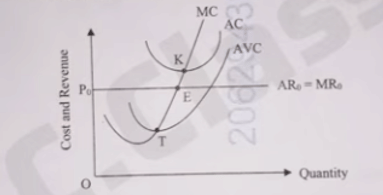
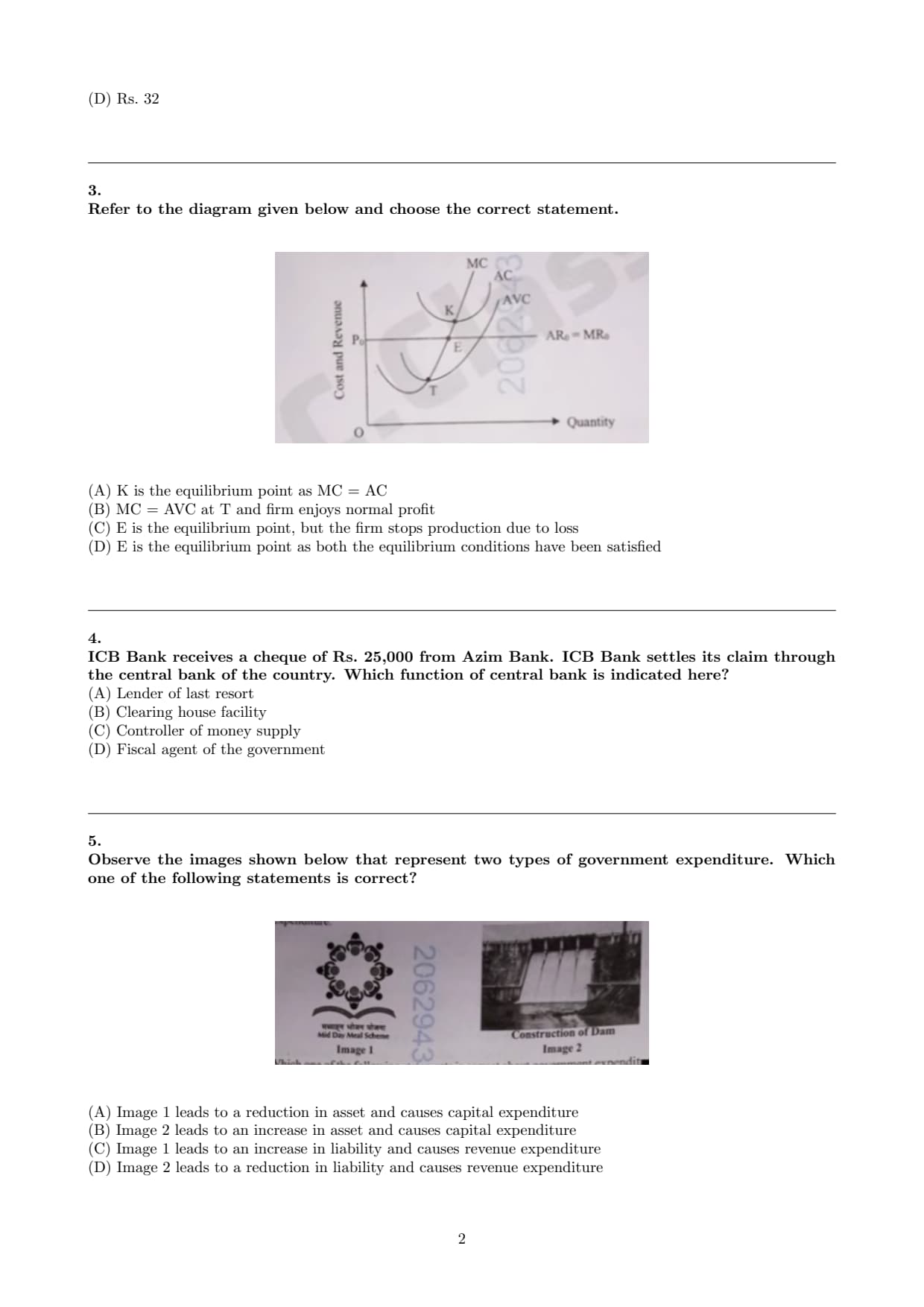
Refer to the diagram given below and choose the correct statement.
View Solution
Concept:
A firm achieves equilibrium when it maximizes profit or minimizes loss. This occurs when two essential conditions are satisfied:
Marginal Cost (MC) = Marginal Revenue (MR)
MC curve cuts MR curve from below
Detailed Explanation:
In the given diagram:
Point E is where MC = MR.
At this point, MC is rising and cuts MR from below.
Hence, both equilibrium conditions are satisfied.
Other points:
K: Does not satisfy equilibrium condition.
T: Represents minimum AVC, not equilibrium.
Step 1: Recall equilibrium conditions.
Step 2: Identify correct point on graph.
Step 3: Conclusion.
Correct answer is (D). Quick Tip: \textbf{Golden Rule of Firm Equilibrium:}
MC = MR is necessary condition MC cutting MR from below is sufficient condition \textbf{Exam Insight:} Always check BOTH conditions — not just equality.
ICB Bank receives a cheque of Rs.~25{},000 from Azim Bank. ICB Bank settles its claim through the central bank of the country. Which function of central bank is indicated here?
View Solution
Concept:
The central bank performs several important functions to ensure smooth functioning of the banking system. One such function is acting as a clearing house.
Detailed Explanation:
A clearing house is a mechanism through which inter-bank payments are settled without the physical transfer of cash.
When a cheque drawn on one bank is deposited in another bank, the payment needs to be settled.
Instead of exchanging cash directly, banks use the central bank as an intermediary.
The central bank adjusts accounts of the concerned banks.
This system reduces transaction costs, increases efficiency, and ensures quick settlement of payments.
Step 1: Understand the situation.
Cheque between two banks.
Step 2: Identify role of central bank.
Acts as settlement authority.
Step 3: Conclusion.
Correct answer is (B). Quick Tip: \textbf{Quick Concept Booster:}
Bank-to-bank payments = Clearing House Emergency loans to banks = Lender of Last Resort Controlling liquidity = Money Supply Control \textbf{Exam Trick:} If cheque settlement is mentioned → always Clearing House.
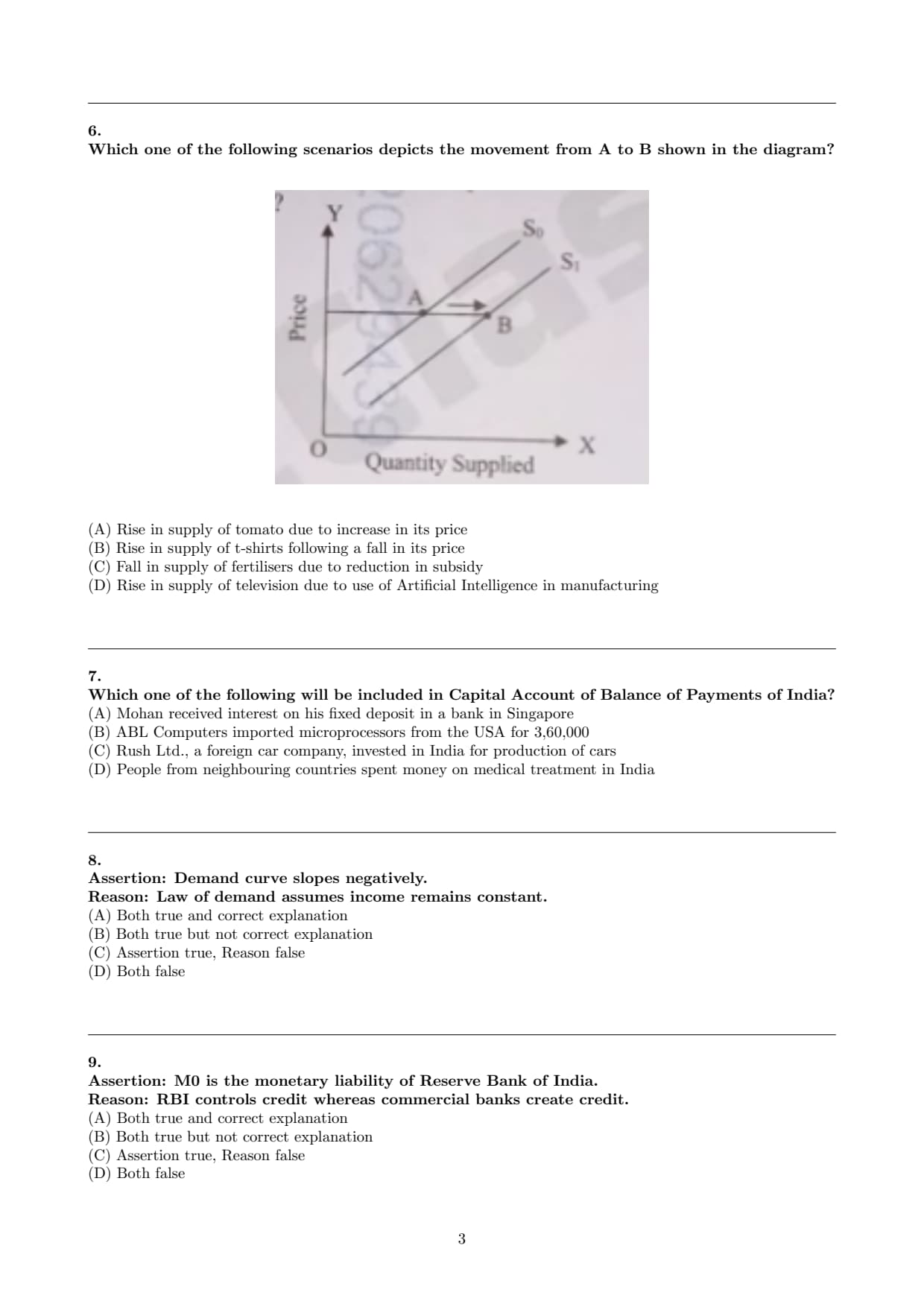
Observe the images shown below that represent two types of government expenditure. Which one of the following statements is correct?

View Solution
Concept:
Government expenditure is classified into revenue expenditure and capital expenditure.
Detailed Explanation:
Capital expenditure leads to creation of assets or reduction of liabilities.
Construction of infrastructure such as dams increases productive capacity.
It results in long-term benefits and economic growth.
Image 2 (construction of dam) clearly represents capital expenditure because:
It creates a physical asset.
It contributes to future production.
It enhances economic development.
Step 1: Identify nature of expenditure.
Step 2: Check asset creation.
Step 3: Conclusion.
Correct answer is (B). Quick Tip: \textbf{Capital vs Revenue:}
Asset creation = Capital Expenditure No asset creation = Revenue Expenditure \textbf{Shortcut:} Infrastructure projects = Always Capital.
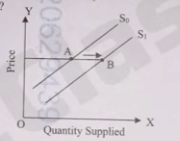
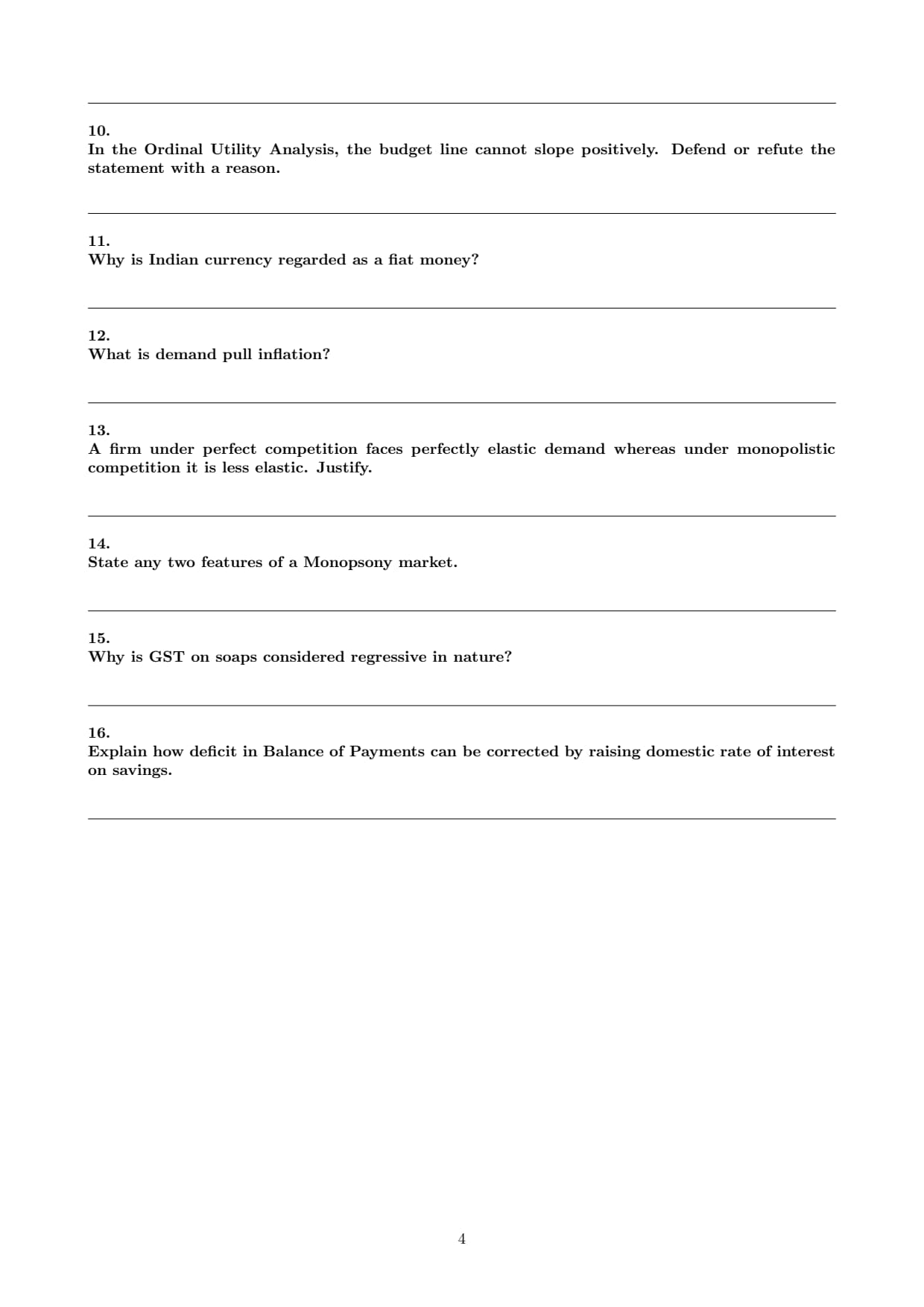
Which one of the following scenarios depicts the movement from A to B shown in the diagram?
View Solution
Concept:
Movement from A to B in the diagram represents a rightward shift in supply curve, which indicates an increase in supply.
Detailed Explanation:
Increase in supply occurs due to non-price factors.
Technological advancement reduces cost of production.
This leads to higher output at same price.
Analysis of Options:
(A) Movement along curve, not shift.
(B) Incorrect relationship.
(C) Decrease in supply.
(D) Technological improvement → increase in supply.
Step 1: Identify shift direction.
Step 2: Check cause of shift.
Step 3: Conclusion.
Correct answer is (D). Quick Tip: \textbf{Supply Rule:}
Movement along curve = Price change Shift of curve = Non-price factors Technology ↑ → Supply ↑ \textbf{Exam Hack:} If diagram shifts right → think “increase in supply”.
Which one of the following will be included in Capital Account of Balance of Payments of India?
View Solution
Concept:
Balance of Payments consists of two accounts:
Current Account
Capital Account
Detailed Explanation:
Capital account records transactions related to investment and capital flows.
Foreign Direct Investment (FDI) is a major component.
Investment by foreign companies increases capital inflow.
Analysis:
(A) Income → Current account
(B) Import → Current account
(C) Foreign investment → Capital account
(D) Services → Current account
Step 1: Identify transaction type.
Step 2: Check account classification.
Step 3: Conclusion.
Correct answer is (C). Quick Tip: \textbf{BoP Rule:}
Investment = Capital Account Goods/Services = Current Account \textbf{Memory Trick:} Capital Account = Capital flows (FDI, loans).
Assertion: Demand curve slopes negatively.
Reason: Law of demand assumes income remains constant.
View Solution
Concept:
Assertion-Reason questions test conceptual clarity and logical connection.
Detailed Explanation:
Demand curve slopes downward due to inverse relation between price and quantity.
This is explained by law of diminishing marginal utility, substitution effect, etc.
The assumption of constant income is part of ceteris paribus conditions.
However, constant income does not directly explain the negative slope.
Step 1: Check Assertion.
True.
Step 2: Check Reason.
Also true.
Step 3: Check link.
Not correct explanation.
Step 4: Conclusion.
Correct answer is (B). Quick Tip: \textbf{Assertion-Reason Trick:}
Both true + correct link → A Both true + wrong link → B One false → C/D \textbf{Exam Hack:} Always check explanation link carefully.
Assertion: M0 is the monetary liability of Reserve Bank of India.
Reason: RBI controls credit whereas commercial banks create credit.
View Solution
Concept:
M0 (also called reserve money) includes currency in circulation and bankers' deposits with RBI, which are liabilities of the central bank.
Detailed Explanation:
Assertion is true because M0 represents monetary liabilities of RBI.
Reason is also true as RBI regulates credit, while commercial banks create credit.
However, the reason does not explain why M0 is a liability.
Step 1: Check Assertion. True.
Step 2: Check Reason. True.
Step 3: Check link. Not explanatory.
Conclusion: Correct answer is (B). Quick Tip: \textbf{Monetary Terms:}
M0 = RBI liability Credit creation = Commercial banks \textbf{Exam Trick:} True statements ≠ correct explanation always.
In the Ordinal Utility Analysis, the budget line cannot slope positively. Defend or refute the statement with a reason.
View Solution
Concept:
The budget line represents combinations of two goods that a consumer can purchase with given income and prices.
Detailed Explanation:
Budget line slope depends on price ratio.
Normally, it slopes downward because more of one good means less of the other.
A positive slope would imply both goods increase simultaneously, which is not possible under a fixed income constraint.
Thus, the statement is incorrect.
Step 1: Understand budget constraint.
Step 2: Check slope logic.
Step 3: Conclusion.
Statement is refuted. Quick Tip: \textbf{Budget Line Rule:}
Always slopes downward because of trade-off between goods.
Why is Indian currency regarded as a fiat money?
View Solution
Concept:
Fiat money is currency declared legal tender by the government but not backed by a physical commodity like gold.
Detailed Explanation:
Indian currency is issued by RBI under authority of government.
It is not convertible into gold or silver.
Its value is based on trust and legal acceptance.
Thus, Indian currency is fiat money.
Step 1: Define fiat money.
Step 2: Relate to India.
Step 3: Conclusion. Quick Tip: Fiat money = Value by government order, not by intrinsic value.
What is demand pull inflation?
View Solution
Concept:
Demand pull inflation occurs when aggregate demand exceeds aggregate supply.
Detailed Explanation:
Excess demand leads to rise in prices.
Occurs during economic growth phases.
Often caused by increased income, government spending, or investment.
Conclusion: It is inflation caused by excess demand. Quick Tip: Demand > Supply → Prices rise → Demand Pull Inflation
A firm under perfect competition faces perfectly elastic demand whereas under monopolistic competition it is less elastic. Justify.
View Solution
Concept:
Demand elasticity depends on availability of substitutes.
Detailed Explanation:
In perfect competition, firms sell identical products → perfectly elastic demand.
In monopolistic competition, products are differentiated → less elastic demand.
Conclusion: Hence justified. Quick Tip: Perfect competition → Perfectly elastic demand
Monopolistic competition → Less elastic demand
State any two features of a Monopsony market.
View Solution
Concept:
Monopsony is a market with a single buyer.
Features:
Only one buyer dominates the market.
Buyer has control over price. Quick Tip: Monopsony = Single buyer market (opposite of monopoly).
Why is GST on soaps considered regressive in nature?
View Solution
Concept:
A regressive tax takes a larger percentage of income from low-income groups.
Explanation:
Soap is a necessity.
Same tax rate applies to all.
Poor people spend larger share of income on such goods.
Conclusion: Hence regressive. Quick Tip: Same tax + different income → Burden higher on poor → Regressive tax
Explain how deficit in Balance of Payments can be corrected by raising domestic rate of interest on savings.
View Solution
Concept:
Balance of Payments deficit occurs when outflows exceed inflows.
Detailed Explanation:
Higher interest rates attract foreign capital.
This increases capital inflow.
Increased inflow helps reduce deficit.
Conclusion: Thus, BoP deficit can be corrected. Quick Tip: Higher interest rate → Foreign investment ↑ → BoP deficit ↓



Comments