


.jpg?h=35&w=35&mode=stretch)
Study Abroad Content Specialist
US work visa allows the citizens of foreign countries to work in the USA for a specific period of time. This work visa can be classified into immigrant and non-immigrant visa based on the status of the beneficiary. The USA has been attracting talented individuals since ages with its robust economy and numerous work opportunities. However, legally working in USA requires obtaining the correct work visa as the country has very strict laws and orders.
If the duration of stay in USA is for a fixed period, you can apply for a temporary employment visa. The eligibility criteria for each type of US work visa depends on the categories, and specific qualifications. To avail a non-immigrant visa in USA, most of the Indian employees require an approved petition. The petition should be filed by your prospective employer on behalf of you.
Also Check: Post Study Work Visa in USA
Here are some of the common US work visa types for Indians:
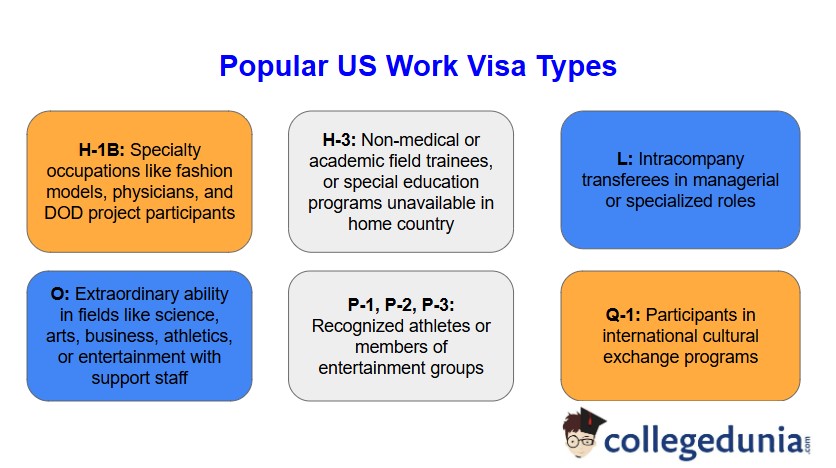
Non-Immigrant Temporary Work Visa in USA
Non-immigrant visas are temporary and allow foreign nationals to work in the USA for a specific duration, often tied to a job offer or assignment. Below are the most common categories for non-immigrant work visas.
H Visa in USA
The various types of H-visa in USA and their respective characteristics are provided below:
H-1B Visa
The H-1B visa is for professionals in specialized fields such as IT, engineering, finance, and academia.
- Eligibility Criteria:
- Requires a USA job offer in a field that requires specialized skills.
- Applicant must have a bachelor’s degree or higher, or equivalent experience.
- The employer must prove a shortage of qualified USA workers for the role.
- Duration: Up to 3 years, with possible extensions.
H-3 Visa
H-3 visa is for individuals seeking training in specific fields (excluding medical), intending to use the training outside the USA.
- Duration: Up to 2 years.
L Visa in USA
The L-visa is provided to individuals who are moving to the US branch of the company where they already work. Here are the various types of L-visa in USA.
L-1A Visa
The L-1A visa is for executives or managers transferring within the same company to a USA branch.
- Eligibility Criteria: Must have worked at the same employer abroad for at least one year in a managerial or executive role.
- Duration: Up to 3 years.
L-1B Visa
Employees with specialized knowledge transferring within the same company can avail the L-1B visa.
- Description: For employees with specialized knowledge transferring within the same company.
- Duration: Up to 1 year, with possible extensions.
A list of the other non-immigrant work visa types in USA is provided below:
| Visa Type | Description | Eligibility | Duration |
|---|---|---|---|
| I Visa | For foreign journalists and media representatives | Employment with a foreign media outlet | Indefinite as long as employed by the same media company |
| O Visa | For individuals with exceptional abilities or achievements | Proof of extraordinary ability in arts, sciences, education, business, or athletics | Duration based on specific event or project |
| P Visa | For athletes, artists, and entertainers | Significant achievements in the field | Duration varies with event |
| R Visa | For religious workers | Affiliation with a USA-based religious organization | Up to five years |
Immigrant USA Work Visas
Immigrant visas (Permanent Residency), or employment-based green cards, allow individuals to work permanently in the USA Each year, approximately 140,000 employment-based immigrant visas are issued to qualified candidates. Below are the five main categories of employment-based visas.
Check out the employment-based visa categories in USA:
| Preference | Description | Eligibility Requirements | Labor Certification |
|---|---|---|---|
| EB-1 | First preference for individuals with extraordinary ability (scientists, researchers, artists, executives) | Proof of extraordinary ability; advanced academic qualifications for professors/researchers | Not required |
| EB-2 | Second preference for professionals with advanced degrees or exceptional abilities | Advanced degree, 10 years of experience, or national interest work | Required, except for national interest category |
| EB-3 | Third preference for skilled workers, professionals, and other workers | Bachelor's degree or equivalent; skilled or unskilled workers with job offers | Required |
| EB-4 | Fourth preference for special immigrants (religious workers, foreign employees of USA gov’t agencies) | Specific criteria as defined by USA law | Not required |
| EB-5 | Fifth preference for immigrant investors | Minimum investment of 1.8 million USD (or 900,000 USD in targeted areas) | Not required |
US Work Visa Application Steps
The step-by-step application process for US Work Visa is provided below:
Step 1. Identify the Right Visa Category:
-
Review the eligibility requirements and benefits of each visa type.
-
Choose the visa category that aligns with your career and educational background.
Step 2. Secure a Job Offer:
-
Most non-immigrant visas, such as H-1B, L-1, and H-2, require an offer from a USA employer.
- Employers must often submit a petition to the USA Citizenship and Immigration Services (USCIS) on behalf of the applicant.
Step 3. File the Required Forms:
-
Complete and submit Form I-129 (for non-immigrant visas) or Form I-140 (for immigrant visas).
- For immigrant visas, the employer may need to submit ETA Form 9089 for labor certification.
Step 4. Attend a Visa Interview:
-
After your petition is approved, schedule and attend a visa interview at a USA embassy or consulate in your home country.
- Be prepared to answer questions regarding your employment, qualifications, and intentions in the USA
Step 5. Receive Your Visa:
-
If your visa is approved, the USA consulate will issue it, allowing you to enter the USA and begin work.
- For non-immigrant visas, ensure compliance with all terms to maintain lawful status.
Points to Remember for US Work Visa Applicants
Here are some of the pointers to remember while selecting the correct US work visa type for yourself:
- H-1B Quota and Competition: With a high demand for H-1B visas, applications often exceed the annual limit, leading to a lottery system.
- STEM OPT Extension: Indian students on an F-1 visa with a STEM course in USA may apply for a 24-month OPT extension, increasing their chances for an H-1B sponsorship.
- Path to Green Card: Many non-immigrant visa holders transition to immigrant visas through employer sponsorship, especially those on H-1B and L-1 visas.
- Family Visas: Spouses and dependent children of visa holders can apply for dependent visas, such as H-4 (for H-1B dependents) or L-2 (for L-1 dependents), allowing them to live and, in some cases, work in the USA
Tips for US Work Visa Applicants
To be eligible for a US work visa, you need to perfectly satisfy all the eligibility criteria. Here are some tips to enhance your US work visa application process and reduce chances of rejection:
- Plan Ahead: Visa processes can be lengthy; begin applications early to avoid delays.
- Focus on High-Demand Sectors: Fields such as IT, healthcare, engineering, and finance are among those most likely to sponsor visas.
- Explore STEM Options: If you have a STEM degree, consider the STEM OPT extension as a strategic advantage.
- Consult an Immigration Expert: Navigating USA work visas can be complex. Consulting an expert can provide clarity and ensure that you meet all requirements.
Also Check: Appealing OPT Denial in USA
The US work visa for Indian students and professionals are very specific to the skills and job role. You should prepare way ahead of your visa application to minimize the possibilities of error while selecting a suitable work visa. With a clear strategy, the right documents, and preparation, you can enhance your chances of obtaining the best suited work visa according to your professional aspiration.
FAQs
Ques. What is the difference between a non-immigrant and immigrant work visa in USA?
Ans. A non-immigrant USA work visa allows foreign nationals to work in the USA temporarily, usually tied to a specific job or employer. Examples include H-1B, L-1, and O visas. An immigrant visa, or employment-based green card, provides permanent residency and allows individuals to work in the USA indefinitely. The primary types of employment-based green cards are EB-1, EB-2, and EB-5.
Ques. Who is eligible to apply for an H-1B visa?
Ans. To qualify for an H-1B visa, applicants need a job offer in a specialized field like IT, finance, or engineering. They must have a bachelor's degree or equivalent experience, and the employer must demonstrate a shortage of qualified USA workers. H-1B visas are valid for up to three years and can be extended.
Ques. What is the EB-5 visa, and how does it work?
Ans. The EB-5 visa is designed for immigrant investors. To qualify, applicants must invest at least $1.8 million (or $900,000 in targeted areas) in a new business that creates at least 10 full-time jobs for USA workers. Successful EB-5 applicants receive a green card, granting them and their immediate family members permanent residency in the USA
Ques. How can Indian students on an F-1 visa transition to an H-1B visa?
Ans. Indian students on an F-1 visa can apply for Optional Practical Training (OPT) to work in the USA after graduation. If they have a STEM degree, they may be eligible for a 24-month OPT extension. During this period, students can seek H-1B sponsorship from an employer, which could allow them to stay in the USA long-term if selected.
Ques. Can family members accompany an applicant on a US work visa?
Ans. Yes, family members (spouses and dependent children) of certain visa holders can accompany them to the USA For example, dependents of H-1B visa holders can apply for an H-4 visa, and dependents of L-1 visa holders can apply for an L-2 visa, which may allow the spouse to work.



Comments