



Study Abroad Content Specialist | Updated On - Jul 13, 2026
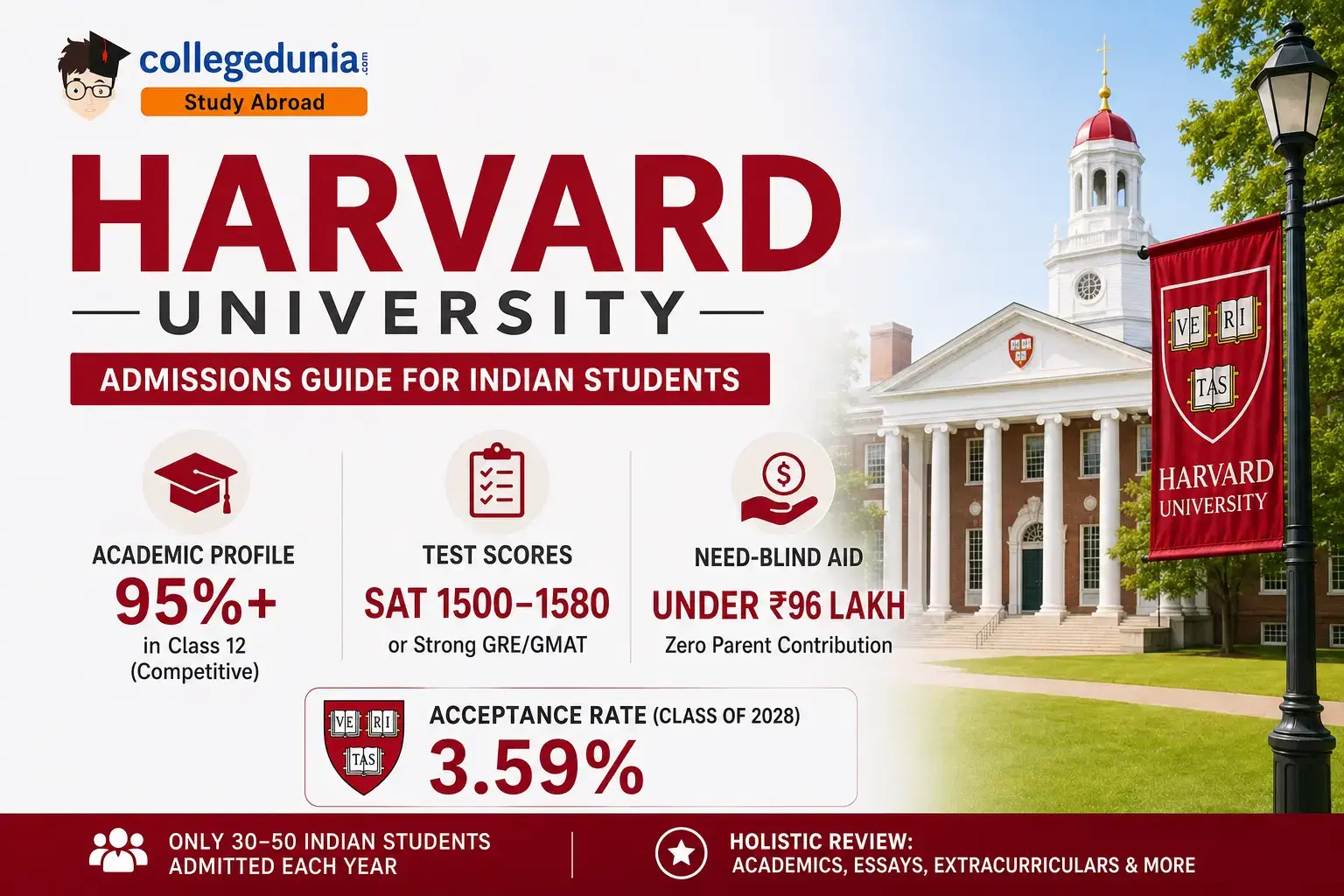
To get into Harvard University from India, students need 95%+ in Class 12, a 1500 to 1580 SAT (or a strong GRE for graduate programs), and one distinctive extracurricular spike backed by measurable impact. Competitive Indian applicants typically present Class XII scores above 95%, although Harvard has no minimum percentage requirement and admissions are holistic. Harvard does not publish country-wise undergraduate admissions data. Independent estimates suggest roughly 30 to 50 Indian undergraduates are admitted annually. Aid is need-based, need-blind for admission and identical for Indians and Americans, so the sticker price rarely matches the actual bill for a family that qualifies.
Key Takeaways:
- Spike over spread: Harvard picks depth in one clear area over ten mid-tier extracurriculars.
- Aid rewrites the price tag: families earning under INR 96 lakh a year pay zero parent contribution, on identical terms for Indian applicants.
- Essays sink most Indian applications: resume-style essays that list achievements get filtered out early in the reading committee.
- Graduate admits work differently: for HBS, HKS or SEAS, work impact, research output and recommenders outweigh test scores.
Read More: Ivy League Universities in USA
Harvard sees more Indian applications every year than seats in most IITs, yet fewer than 50 Indians clear the undergraduate bar annually. The filter is rarely a score. It is what sits between the transcript and the person on the page.
The gap between a Harvard offer and a rejection letter is the gap between a checklist application and a coherent story, and it can be closed on a 12 to 18 month runway built the right way.
Quick Facts on Harvard for Indian Applicants
| Parameter | Detail |
|---|---|
| Undergraduate acceptance rate (Fall 2024) | 3.64% |
| International acceptance rate (Fall 2024) | 1.93% |
| Indian undergraduates admitted per year | 30 to 50 from 2,000 to 3,000 applications |
| Indian students currently on campus | Over 545 |
| SAT middle 50% range | 1500 to 1580 |
| Undergraduate tuition (2026-27) | USD 62,226 (around INR 59.6 lakh) |
| Total billed cost of attendance | USD 91,634 to 100,134 (around INR 87 to 96 lakh) |
| Restrictive Early Action deadline | November 1 |
| Regular Decision deadline | January 1 |
| Zero parent contribution threshold | Family income under USD 100,000 (around INR 96 lakh) |
- Harvard Admission Requirements for Indians
- Standardized Tests Needed for Harvard
- Harvard Essays and Extracurriculars Guide
- Harvard Application Deadlines from India
- Harvard Fees and Financial Aid Explained
- Harvard Scholarships and Education Loans
- F-1 Visa Steps for Harvard Admits
- Realistic Odds of Getting Into Harvard
Harvard Admission Requirements for Indians
Harvard does not publish a fixed GPA or percentage cut-off, but admitted Indian students typically carry 95%+ in Class 12 for undergraduate programs and a 3.7+ GPA for graduate programs. The admissions committee reads every file holistically, weighing academics, standardised tests, essays, recommendations, extracurriculars, and personal qualities in one combined judgement.
For undergraduate applicants from India, the profile that clears the first reading round usually looks like this:
- Class 10 and Class 12 board results in the top 1 to 2% from CBSE, ICSE or state boards, with no drop across the transcript.
- Strong performance in five core academic subjects through the last two years of school, including at least one advanced math or science.
- Consistent evidence of intellectual engagement outside the syllabus, such as research papers, olympiad medals, published writing or original projects.
- Two teacher references, ideally from teachers who taught the applicant in the final two years and can speak to specific work.
The Harvard admissions page confirms that all applicants are considered in the same pool regardless of citizenship, with no country quotas at any stage. That equality cuts both ways: an Indian applicant is not judged against a smaller Indian bucket, but against every top student globally, which is why the international acceptance rate lands closer to 2 to 3% than the headline 3.59%.
For graduate applicants, the picture shifts. Programs at Harvard Griffin GSAS, Harvard SEAS, Harvard Kennedy School and Harvard Business School put more weight on undergraduate GPA (3.7+ typical), research or work impact, letters from professors or managers, and a statement of purpose that shows a clear research or career trajectory. Test scores matter, but they rank below fit and evidence of doing the actual work.
Standardized Tests Needed for Harvard
Harvard requires the SAT or ACT for all first-year applicants and the GRE or GMAT for most graduate programs; TOEFL, IELTS and Duolingo are optional for undergraduates and required by some graduate programs. Score expectations are the same for every applicant, Indian or American.
The score bands that actually move an application forward for Indian candidates:
| Test | Middle 50% or Competitive Range | Notes for Indian applicants |
|---|---|---|
| SAT (Digital) | 1500 to 1580 | Offered around 7 to 8 times a year in India. Digital SAT changes format, not evaluation. |
| ACT | 34 to 36 | Alternative to SAT, weighted identically. |
| GRE (graduate) | 325+ (163V/165Q typical) | Required by most Griffin GSAS and SEAS programs. |
| GMAT (HBS MBA) | Median 740 (Focus Edition 685) | HBS accepts GMAT or GRE; no floor, but under 700 hurts. |
| TOEFL iBT | 110+ typical | Optional for undergrad, required by many graduate programs. |
| IELTS Academic | 7.5+ typical | Accepted in place of TOEFL by most Harvard schools. |
Source: Harvard College Admissions, Harvard Business School MBA class profile and Harvard SEAS graduate admissions pages, 2026-27 cycle. See the full Harvard SAT scores breakdown by percentile for section-wise data.
Indian applicants often plan the Digital SAT test dates and registration around Class 11 summer and early Class 12, so scores are ready before the November 1 Restrictive Early Action deadline. Graduate applicants targeting Fall 2027 should have GRE scores or GMAT scores in hand by August 2026, since ETS and GMAC score reporting typically takes 10 to 21 days to reach universities.
Key Insight: Harvard has been public that a strong test score is a positive signal but a low one is rarely disqualifying by itself. Every score is read alongside the school and district context, which is why a 1520 from a CBSE school in a tier-2 city can outperform a 1560 from a top international school in the same reading round.
For English proficiency, applicants whose medium of instruction has been English through school can submit a school certificate stating that, though a TOEFL score of 110+ is still the safer play for any program that lists it as required.
Harvard Essays and Extracurriculars Guide
Harvard rejects most high-scoring Indian applications on essays and extracurriculars, not academics. The reading committee looks for one clear area of excellence, evidence of impact that outsiders can verify and a personal essay that shows how the applicant thinks, not what the applicant has done.
The Common Application requires one main personal essay of 650 words. Harvard adds five short-answer supplement prompts in the 2026-27 cycle, each capped at around 150 words, covering intellectual curiosity, extracurricular contribution, life experiences, future direction, and roommate context. What separates strong Indian essays from the pile:
- A specific moment, not a summary: a scene the applicant lived through, written with concrete detail, beats any list of awards.
- A thesis about the self: the essay answers what the applicant values and why, using the moment as evidence.
- Voice that sounds human: polished but recognisably the student, not a template.
- No world-changing openers: phrases like "I want to change the world" are the fastest way to close a reader’s attention.
Extracurriculars follow the same logic. A national finalist in the International Chemistry Olympiad, a first-authored paper in a reviewed journal, a start-up with real users and revenue, a state-level sportsperson, a documented social project with measurable outcomes: each of these is one legible spike. Ten club memberships without a single measurable outcome read as filler.
What Harvard Actually Rewards?
- Depth over breadth: two to three activities pursued for four to six years with visible progression.
- Leadership with evidence: team you built, event you ran, outcome you produced, numbers that back the claim.
- Original work: research, writing, code, art or organising that exists in a form a stranger can see and verify.
What Harvard Does Not Reward?
- Long lists of MUN certificates without a leadership role.
- Coaching-institute-drafted essays with polished language and generic content.
- Volunteer work described in general terms with no outcome.
- Recommendations that praise the student without a single specific example.
Two teacher recommendations and one counsellor report round out the file. Indian applicants should ask teachers who have actually seen extended work, not just delivered lectures, and share a working document with them that includes context on the specific projects the letter should mention. That single step lifts most Indian LORs from generic to distinctive.
Also read: Required documents for applying to US universities?
Harvard Application Deadlines from India
Harvard undergraduates apply through either Restrictive Early Action by November 1 or Regular Decision by January 1, with decisions in mid-December and late March respectively. Graduate schools set their own calendars, ranging from HBS Round 1 in early September to Griffin GSAS deadlines in mid-December.
The end-to-end timeline for Indian applicants targeting a Fall 2027 intake:
| Window | Action for Indian applicants |
|---|---|
| 18 months out (Jan-Mar 2026) | Lock target program. Start SAT/GRE prep. Identify one to two extracurricular spikes to double down on. |
| 12 months out (May-Jul 2026) | Sit the first SAT or GRE attempt. Draft the Common App personal essay. Line up teacher recommenders. |
| 6 months out (Aug-Sep 2026) | Finalise test scores. Complete Common App profile. Write Harvard supplement essays. |
| Restrictive Early Action deadline | November 1, 2026. REA decisions by mid-December 2026. |
| Regular Decision deadline | January 1, 2027. RD decisions late March 2027. |
| CSS Profile and IDOC financial documents | By the same deadline as the application; late aid files delay the aid letter. |
| Reply deadline for admits | May 1, 2027. |
If a student targets REA, then all test scores must be reported by end of November. That means the last useful SAT sitting is the October attempt, not December. Graduate applicants should verify each program’s cycle on the school’s official site, since HBS operates three rounds (September, January and April) while most Griffin GSAS PhDs run one single December deadline.
Indian applicants planning around the Fall intake in USA calendar should also budget six to eight weeks for CSS Profile documentation, IDOC uploads and I-20 processing after admit, which adds up quickly against a May reply deadline. Visit the application deadlines for US universities page for more details.
Key Insight: Restrictive Early Action carries a historically higher acceptance rate than Regular Decision at Harvard, but the pool is stronger and the REA pool competes for a smaller share of seats. Applying REA is only worth it if the application is genuinely ready by November 1. A rushed REA is worse than a polished RD.
Harvard Fees and Financial Aid Explained
Harvard’s 2026-27 published cost of attendance for undergraduates is USD 91,634 to 100,134 (around INR 87.72 lakh to 95.86 lakh), but 55% of students receive need-based aid and 25% pay nothing. International students, including Indians, get financial aid on exactly the same basis as Americans.
The full undergraduate cost break-up for 2026-27, before aid:
| Cost head | USD (2026-27) | INR (approx.) |
|---|---|---|
| Tuition | 62,226 | 59.57 lakh |
| Student services fee | 6,216 | 5.95 lakh |
| Housing | 14,250 | 13.64 lakh |
| Food | 8,942 | 8.56 lakh |
| Health insurance | 4,954 | 4.74 lakh |
| Total billed | 91,634 | 87.72 lakh |
| Total with books, travel and personal expenses | 95,134 to 100,134 | 91.07 to 95.86 lakh |
Conversion rate: USD-INR rate of INR 95.73 as of July 13, 2026. Rates fluctuate; check the current rate before financial planning.
The way aid actually works for Indian families:
- Under USD 100,000 (around INR 96 lakh) annual family income: expected parent contribution is zero. Tuition, housing, food, and health insurance are covered.
- USD 100,000 to 200,000 (around INR 96 lakh to 1.91 crore): aid covers at least full tuition, plus additional grants depending on assets and family size.
- Above USD 200,000 (around INR 1.91 crore): aid remains available on a case-by-case reading of assets and circumstances.
If a family earns under INR 96 lakh a year with modest assets, then the effective cost of a Harvard undergraduate degree drops to a small student contribution from term-time and summer work. That means the sticker cost above should not be the number that drives an accept-or-decline decision for most middle-class Indian families.
Graduate programs run on different economics. HBS lists a total 2026-27 MBA cost of attendance of USD 130,318 (around INR 1.25 crore) for a single student. HBS aid is need-based and averages USD 23,000 to 46,000 per year for the roughly 50% of students who receive it. SEAS master’s programs in Computational Science and Data Science quote total annual costs of USD 96,602 to 101,042 (around INR 92.5 lakh to 96.7 lakh), with fellowships available program by program.
Harvard Scholarships and Education Loans
Harvard’s own scholarships are need-based, grant-only, and integrated into the admissions decision; Indian students do not file a separate scholarship application. External scholarships and Indian education loans fill the gap for families that fall outside the Harvard aid band or need funding for professional programs.
The main funding routes Indian applicants combine:
- Harvard need-based grant: automatic once CSS Profile and IDOC documents are filed. The average international aid package sits around USD 53,000 to 68,700 (around INR 50.7 lakh to 65.8 lakh) per year.
- Fulbright-Nehru Master’s Fellowship: Indian nationals with at least three years of full-time work experience, funded by the United States-India Educational Foundation. Stacks with Harvard aid.
- Inlaks Shivdasani Foundation Scholarship: up to USD 100,000 for postgraduate study at select universities, including Harvard, for Indian nationals under 30.
- Aga Khan Foundation International Scholarship: 50% grant, 50% loan for postgraduate study, open to Indian nationals from specific communities.
- Tata Scholarships (via partner Ivies) and JN Tata Endowment loans: useful for Indian graduate students at Harvard.
A wider list of options is available in the scholarships for Indian students in USA archive.
For families outside the aid band or graduate students without full funding, Indian education loans cover the remainder. Named lenders and current market terms:
| Lender | Loan type | Typical terms |
|---|---|---|
| SBI Global Ed-Vantage | Secured, requires collateral | Up to INR 1.5 crore, floating interest linked to EBLR. |
| HDFC Credila | Secured and unsecured | Up to INR 1 crore unsecured for Ivy admits with strong co-applicant. |
| Avanse | Unsecured up to a cap | Faster processing, higher rate than banks. |
| PNB Udaan | Secured | Public sector rates, longer processing time. |
| Prodigy Finance | Unsecured, no co-signer | USD-denominated, priced off SOFR; suited to graduate STEM and MBA admits. |
| MPOWER Financing | Unsecured, no co-signer | USD-denominated, program-list restricted; Harvard included. |
Source: lender websites and public rate cards, verified July 2026. The full breakdown of comparative rates and eligibility sits in the education loans for USA guide.
Key Insight: Add a 5 to 8% currency-depreciation buffer to any USD-denominated cost when planning across a four-year undergraduate degree. A dollar that costs INR 95.73 in July 2026 may cost INR 100 to 103 by the time later-year fees fall due, which materially changes the loan sizing calculation.
For MBA admits, the Harvard financial aid office layers HBS need-based scholarships on top of Fulbright or external awards. If a family qualifies for both, then the HBS scholarship reduces to keep the total package aligned with demonstrated need. That means chasing every external award beyond need may not increase net funding at Harvard for undergraduates, though it always helps for professional programs like MBA in USA at other schools.
F-1 Visa Steps for Harvard Admits
An Indian admitted to Harvard needs an F-1 student visa, issued by a US consulate after Harvard’s International Office generates a Form I-20. The end-to-end process takes six to ten weeks from admission letter to visa stamp and needs to fit inside the May-to-August window before the fall term starts.
The step-by-step process for an Indian admit:
- Accept the offer and submit financial certification to Harvard by the deadline in the admission letter.
- Wait for Form I-20 from the Harvard International Office (HIO), which typically takes up to 10 days after Harvard receives the financial documents.
- Pay the I-901 SEVIS fee of USD 350 (around INR 33,500) at fmjfee.com using the SEVIS number from the I-20.
- File the DS-160 non-immigrant visa application on the US Department of State portal and pay the MRV fee of USD 185 (around INR 17,700).
- Book a visa interview slot at the US consulate in Mumbai, Chennai, Kolkata, Hyderabad or the embassy in New Delhi.
- Attend the interview with Form I-20, DS-160 confirmation, SEVIS receipt, passport, financial documents, academic transcripts, and admission letter.
- Enter the US no more than 30 days before the program start date on Form I-20, and register arrival with the HIO within 30 days of the start date.
Realistic Odds of Getting Into Harvard from India
The honest odds of an Indian undergraduate admit to Harvard sit at 1 to 3%, and the odds for graduate programs vary widely by school (HBS at around 11%, HKS mid-teens, Griffin GSAS PhDs often under 5%). A well-built application does not turn a 3% pool into a 30% pool, but it does move an applicant from the bottom half of the reading committee’s pile to the top quintile.
What genuinely improves an Indian applicant’s odds:
- One authentic spike that a stranger can verify without knowing the applicant.
- Essays written by the student, not a coaching institute template.
- Recommenders who know specific work, briefed with a shared context document.
- Applied in Restrictive Early Action only if the file is genuinely ready by November 1.
- Financial aid file complete on time since delays here can cost admits their seat.
What does not move the needle:
- Adding a tenth extracurricular in senior year.
- Retaking an SAT to move from 1520 to 1540.
- Long service trips were organized the summer before applying.
- Coaching-drafted essays that all read the same way.
Key Insight: Indian applicants who cross the line into Harvard almost always share one trait: a 12 to 18 month runway they used to build one clear story, not a six-week sprint they used to write four essays. Time is the underrated variable.
The realistic ROI question also deserves an honest answer. Harvard’s need-based aid makes the undergraduate degree affordable for most middle-class Indian families that get in, and starting salaries for US-based Harvard graduates sit well above the average for a first job in India. But the value of a Harvard degree lies less in the salary and more in the professional network, faculty access and choice-set of career paths afterwards. For students choosing between Harvard and a top Indian option, the trade-off is not academic quality alone; it is where the student wants their next ten years to happen.
Also Check:
Getting into Harvard from India is not a lottery, but the odds treat every applicant that way if the file is generic. The Indians who cross the line usually decided by early Class 11 to build one deep story, kept their academics inside the top 1 to 2%, sat the SAT or GRE twice at most, wrote essays that read like the person they are and filed a financial aid packet that landed on time. The rest of the process, from I-20 to F-1 stamp, is administrative once the acceptance letter arrives. Treat the 18 months before the deadline as the actual admissions process, and Harvard becomes a realistic target instead of a moonshot.
Frequently Asked Questions
Ques. What percentage do Indian students need to get into Harvard University from India?
Ans. Harvard does not publish a minimum percentage cut-off, but admitted Indian students typically carry 95% or higher in Class 12 boards for undergraduate programs. Class 10 marks matter too, and any dip across the transcript weakens the file. For graduate programs, a bachelor’s GPA of 3.7+ on 4.0 is the working benchmark. Every file is read holistically alongside test scores, essays and extracurriculars, so a 96% with a strong spike beats a 99% without one.
Ques. Can I apply to Harvard directly after Class 12 from India?
Ans. Yes. Harvard College welcomes first-year applicants straight from Class 12 in India, with no gap-year requirement. Applications go through the Common Application with Harvard supplement essays, and the same November 1 (Restrictive Early Action) or January 1 (Regular Decision) deadlines apply. Applicants who already hold a bachelor’s degree from any university cannot apply to Harvard College and must apply to a graduate school at Harvard instead.
Ques. What SAT score is needed for Harvard from India?
Ans. Competitive Indian applicants typically score in the SAT middle 50% range of 1500 to 1580. There is no published minimum, but scores below 1400 rarely convert without a rare-profile extracurricular record. Harvard evaluates the Digital SAT identically to the older paper format. See the section-wise Harvard SAT percentile breakdown for reading, writing and math benchmarks before setting a target score.
Ques. Does Harvard require GRE or GMAT for Indian graduate applicants?
Ans. Most Harvard graduate programs require the GRE or GMAT, though policies vary by school. Harvard Business School accepts either, with a class median around GMAT 740 or GRE 163V/165Q. Harvard Graduate School of Education does not require the GRE for its master’s programs. Harvard SEAS and Griffin GSAS generally expect the GRE. Check the specific program page before ruling a test in or out.
Ques. How much does Harvard cost for Indian students in INR?
Ans. Harvard’s 2026-27 undergraduate cost of attendance is USD 95,134 to 100,134, which works out to around INR 91 lakh to 96 lakh a year at the July 2026 exchange rate of INR 95.73 per dollar. Harvard Business School’s total MBA cost of attendance sits at USD 130,318 (around INR 1.25 crore) a year for a single student. Actual out-of-pocket cost drops sharply once financial aid is applied.
Ques. Do Indian students get financial aid at Harvard?
Ans. Yes, on identical terms to American students. Harvard meets 100% of demonstrated financial need for admitted international students, and 55% of the student body receives need-based grants. Families earning under USD 100,000 (around INR 96 lakh) a year have an expected parent contribution of zero. Aid is grant-based and does not need to be repaid. Applications file through the CSS Profile and IDOC upload alongside admission.
Ques. Is Harvard need-blind for Indian applicants?
Ans. Yes. Harvard is need-blind for all applicants, including Indians. The admissions committee makes its decision without seeing the financial aid application, meaning ability to pay does not affect the admit decision. Harvard is one of a small group of US universities that extends this policy to international students, alongside Yale, Princeton and MIT.
Ques. When should Indian students start their Harvard application?
Ans. The realistic runway is 12 to 18 months before the deadline. That means starting in early Class 11 for a November 1 REA deadline in Class 12. Test prep, extracurricular deepening, essay drafting and recommender briefings all need this window. A six-week sprint at the end of Class 12 almost never produces a competitive file for Harvard.
Ques. How many Indian students get into Harvard each year?
Ans. Harvard admits approximately 30 to 50 Indian undergraduate students per year from an applicant pool of 2,000 to 3,000. The current campus population includes over 545 Indian students across undergraduate, graduate and professional programs. Numbers are not fixed by quota; every applicant is considered in one common pool regardless of nationality.
Ques. What visa do Indian students need for Harvard?
Ans. Indian admits need the F-1 student visa, issued after the Harvard International Office generates Form I-20. The process runs through the DS-160 application, the USD 350 SEVIS fee, the USD 185 visa application fee and an interview at the US consulate in India. Total timeline is typically six to ten weeks from admit to visa stamp, and admits can enter the US up to 30 days before the program start date on the I-20.



Comments