



Study Abroad Expert | Updated On - Sep 28, 2026
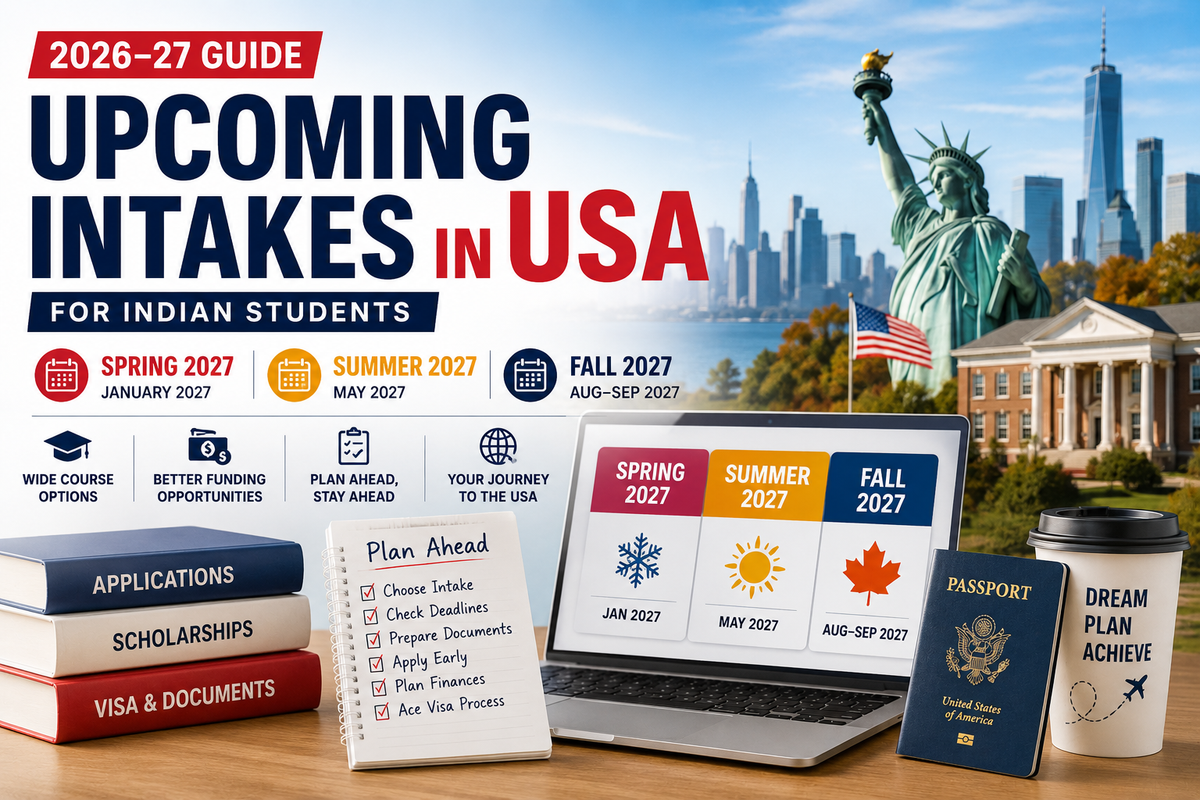
The upcoming intakes in USA for Indian students are Spring 2027 in January, Summer 2027 in May and Fall 2027 in August or September. Fall is the main intake with the widest course choice. Spring is the second window for those who miss Fall deadlines.
- Fall intake stays the safest pick for scholarships, assistantships and full course lists.
- Spring intake works when your test scores or documents slip past Fall cut-offs.
- Summer intake is narrow. Only some programs, mostly bridge or short courses, run in May.
- Pick your intake first, then work back six to nine months to plan tests, essays and visa slots.
Check the full step-by-step guide to studying in USA for Indian students
Most Indian applicants aim for Fall because it lines up with the Indian academic calendar. Missing Fall does not end your plan. It just shifts the game to Spring or a gap-year prep cycle. Picking the right upcoming intake decides your visa timeline, your funding odds and your first job window in the US.
Quick Facts on USA Intakes 2026-27
| Parameter | Detail |
|---|---|
| Number of intakes | Three: Fall, Spring, Summer |
| Fall 2027 classes start | August to September 2027 |
| Spring 2027 classes start | January 2027 |
| Summer 2027 classes start | May 2027 |
| Typical Fall application window | September 2026 to March 2027 |
| Typical Spring application window | June to October 2026 |
| F-1 visa application fee | USD 185 (INR 16,400) |
| SEVIS I-901 fee | USD 350 (INR 31,000) |
| Average tuition range (Master’s) | USD 25,000 to 80,000 per year |
- What are the upcoming intakes in USA?
- Fall 2027 intake dates and deadlines
- Spring 2027 intake for Indian students
- Summer 2027 intake and its limits
- Which USA intake works best for you
- Application timeline for upcoming intakes
- Documents needed for USA intake applications
- Test scores accepted for USA intakes
- Cost of studying across USA intakes
- Common mistakes with USA intake choice
What Are the Upcoming Intakes in USA?
USA universities run three intakes each year: Fall, Spring and Summer. Fall is the biggest by course count and student volume. Spring is smaller but still strong. Summer is the narrowest and mostly limited to short or bridge courses.
Each intake has its own application window. For Indian students planning the next cycle, the three upcoming ones are Spring 2027, Summer 2027 and Fall 2027.
- Fall intake: Classes start in August or September. Application windows open around September of the prior year.
- Spring intake: Classes start in January. Applications close between August and October of the prior year.
- Summer intake: Classes start in May. Limited to select programs and departments.
The main intake for Indian students has always been Fall. Most Master’s programs, PhD funding cycles and undergraduate cohorts start then. If you want the widest choice of universities and scholarships, aim here first.
Key Insight: Not every university offers all three intakes. Confirm the intake calendar on the official department page before you plan your test dates.
Read More: the ranked list of top universities in USA for Indian students
Fall 2027 Intake Dates and Deadlines
Fall 2027 classes at most US universities start between mid-August and early September 2027. Application deadlines fall across a wide window, from November 2026 for early rounds to March 2027 for later rounds.
Ivy League universities and top public research schools tend to close earlier. State universities and rolling-admission schools close later.
Typical Fall 2027 deadline pattern
| Deadline type | Typical window | Universities to watch |
|---|---|---|
| Early Action / Early Decision (undergraduate) | November 1 to November 15, 2026 | Ivy League, Stanford, MIT |
| Round 1 (Master’s) | December 1, 2026 to January 15, 2027 | Most top-40 grad schools |
| Round 2 (Master’s) | February to March 2027 | Mid-tier and state schools |
| Regular decision (undergraduate) | January 1 to January 15, 2027 | Most private universities |
| Rolling admissions | Open until seats fill | Many state schools |
Fall is the strongest intake for scholarship money. Graduate assistantships (teaching or research jobs that waive tuition and pay a stipend) are almost always tied to Fall enrolment.
If X applies to a top-20 Master’s program, then X should target a December 2026 submission. That leaves time for financial documents and a February visa slot.
Spring 2027 Intake for Indian Students
Spring 2027 classes start in January 2027, with application deadlines usually between August and October 2026. For someone reading this in September 2026, Spring 2027 is the closest upcoming intake. Some university windows may still be open.
Spring is smaller than Fall in three ways. Fewer programs open. Fewer scholarships run. Fewer classmates join with you.
- What Spring gives you: A second window if Fall deadlines slipped past you.
- What Spring gives you: A shorter wait if your GRE or IELTS just got ready.
- What Spring does not cover: Most PhD funding cycles. Many top-tier Master’s tracks.
- What Spring does not cover: Full assistantship pools. These reset in Fall.
Popular Spring 2027 programs include general MS in Computer Science, Data Science, Business Analytics and select MBA cohorts. Some engineering and public health programs also run Spring cohorts.
Key Insight: Do not treat Spring as a weak backup. Many students who miss Fall use Spring to build one more semester of work experience or retake the GRE.
The visa slot pressure is also lower for Spring. Consulate wait times in India tend to ease between October and December, compared to the May-July Fall rush.
Summer 2027 Intake and Its Limits
Summer 2027 classes start in May 2027 and are the smallest intake of the year. Only some universities and departments open in Summer. Most are bridge terms, short certificates or English-language preparation courses.
Summer intake makes sense for a narrow set of goals. It does not fit most Indian applicants aiming for a full Master’s or Bachelor’s degree.
Who should target Summer intake
- Students joining a language-prep program before Fall.
- Applicants to short certificate or diploma courses.
- Transfer students filling credits between semesters.
- Some MBA cohorts with a Summer start (rare).
Application windows for Summer 2027 typically close between November 2026 and February 2027. Visa slots for Summer intake in India can be limited, since fewer students apply.
Which USA Intake Works Best For You
Fall 2027 is the default best pick for most Indian students planning a full degree. Spring 2027 is the strong second choice if Fall timing does not work. Summer 2027 is a niche pick for short courses only.
The right intake depends on when you are ready, not on the intake name alone. If your test scores, financial documents and Statement of Purpose are all ready by December 2026, aim for Fall 2027.
How to decide in one look
| Your situation | Best intake | Why |
|---|---|---|
| Test scores ready, docs ready by Dec 2026 | Fall 2027 | Full course list and scholarships |
| Test scores ready now, docs ready by Oct 2026 | Spring 2027 | Closest window, less crowded |
| Still preparing GRE or TOEFL | Fall 2027 | More prep time, better shot |
| Only need a short certificate | Summer 2027 | Narrow but suited |
| Missed Fall 2026, want to start soon | Spring 2027 | Six-month faster start than Fall 2027 |
If you value scholarship access, choose Fall. If you value time and want to skip a year of prep, choose Spring. The trade-off with Spring is fewer funding options, not a weaker education.
Application Timeline for Upcoming Intakes
Plan for a full 12-month runway before your target intake start date. The most common mistake is starting the process three months before the deadline. That leaves no room for test retakes, essay drafts or visa delays.
Ideal timeline for Fall 2027 intake
- September to November 2026: Shortlist universities. Book GRE and TOEFL or IELTS.
- December 2026 to January 2027: Take tests. Draft your Statement of Purpose and recommendation requests.
- December 2026 to March 2027: Submit applications by each university’s deadline.
- March to May 2027: Receive admits. Compare offers and financial packages.
- May to June 2027: Confirm your seat. Get your I-20 form from the university.
- June to July 2027: Pay SEVIS fee. Book F-1 visa slot at the US consulate.
- August 2027: Fly to the US. Attend orientation.
For Spring 2027 intake, shift this timeline back by six months. Test scores should be ready by July 2026 and applications submitted by September to October 2026.
Key Insight: The F-1 visa slot in Delhi, Mumbai, Chennai, Kolkata or Hyderabad is often the tightest link in the chain. Book as soon as your I-20 arrives.
Read More: the full F-1 student visa process for Indian applicants
Documents Needed for USA Intake Applications
You need academic transcripts, English proficiency scores, standardised test scores, a Statement of Purpose, recommendation letters and financial proof. The list stays broadly the same across Fall, Spring and Summer intakes.
- Academic transcripts: Class 10, Class 12 and degree marksheets. Both semester-wise and consolidated.
- English test score: TOEFL or IELTS, sometimes Duolingo.
- Standardised test score: GRE for most Master’s, GMAT for MBA, SAT or ACT for undergraduate.
- Statement of Purpose (SOP): A 1 to 2 page essay explaining your goals.
- Letters of Recommendation (LoR): Usually two or three, from professors or managers.
- Resume: A one-page academic and work resume.
- Financial proof: Bank statements or a loan letter covering the first year.
- Passport copy: Valid for at least six months past your program end date.
Some programs ask for a portfolio (design, architecture), writing samples (humanities, PhD) or a video interview (business schools). Check each department page.
Test Scores Accepted for USA Intakes
Most Indian applicants need one English test (TOEFL or IELTS) and one standardised test (GRE, GMAT or SAT). Score cut-offs vary by university and program.
| Test | Typical score target | Used for |
|---|---|---|
| TOEFL iBT | 90 to 110 | English proof, most programs |
| IELTS Academic | 6.5 to 7.5 | English proof, most programs |
| Duolingo English Test | 110 to 130 | Some universities accept this now |
| GRE General | 310 to 330 | Most Master’s, some PhD |
| GMAT | 650 to 730 | MBA and business Master’s |
| SAT | 1300 to 1500 | Undergraduate applications |
Score targets rise for the top 20 schools. For MIT, Stanford or Berkeley Computer Science, GRE scores near 330 and TOEFL near 110 are common. Some universities have gone test-optional since 2020; confirm the current policy on each program page.
Key Insight: Book your GRE or TOEFL at least 60 days before your first university deadline. That gives you one retake if the first score falls short.
Cost of Studying Across USA Intakes
Tuition for a full-time Master’s in USA ranges from USD 25,000 to 80,000 per year (around INR 22 lakh to 71 lakh). Public state universities cost less. Private Ivy League and top-tier private universities cost more. Intake choice does not change tuition.
Typical annual cost for a Master’s in USA
| Cost item | USD per year | INR per year (approx) |
|---|---|---|
| Tuition (state university) | USD 25,000 to 40,000 | INR 22 lakh to 35 lakh |
| Tuition (private / Ivy) | USD 55,000 to 80,000 | INR 49 lakh to 71 lakh |
| Living costs (rent, food, transport) | USD 12,000 to 22,000 | INR 11 lakh to 19 lakh |
| Health insurance | USD 1,500 to 3,500 | INR 1.3 lakh to 3.1 lakh |
| Books, fees, one-time setup | USD 2,000 to 4,000 | INR 1.8 lakh to 3.5 lakh |
Conversions based on a USD-INR rate of INR 88.50 as of September 24, 2026 (approximate). Rates fluctuate; check the current rate before financial planning.
Add a 5 to 8% currency buffer on top. The rupee has weakened against the dollar over most of the last decade. Source: Reserve Bank of India historical FX data.
Indian students often fund studies with a mix of family savings, education loans from HDFC Credila, Avanse, SBI Global Ed-Vantage or Prodigy Finance, plus university scholarships or teaching or research assistantships.
Check the complete list of scholarships in USA for Indian students
Common Mistakes with USA Intake Choice
The biggest mistake is picking Spring intake just to save one year, without checking if your target program offers Spring at all. Some programs only open in Fall. A Spring plan for those becomes a Fall plan by default.
- Assuming every university runs three intakes. Many run only Fall.
- Applying to Fall 2027 in February 2027, missing Round 1 scholarship deadlines.
- Ignoring visa slot availability when picking an intake month.
- Skipping the departmental page and trusting a general university calendar.
- Not factoring in a 3 to 6 month gap for the F-1 visa timeline after admit.
If Fall does not fit your test-prep schedule, then Spring is a real option. That means one fewer semester of prep pressure but also fewer scholarships.
Also Check:
| GRE Exam Guide | TOEFL Exam Guide | STEM OPT in USA |
| Education Loan for USA | SOP for USA Applications | Cost of Living in USA |
The upcoming intakes in USA give Indian students three real paths into a US degree. Fall 2027 remains the strongest for scholarships and full course choice. Spring 2027 works well for those close to the September 2026 window. Summer 2027 stays a narrow, niche pick. Pick your intake based on when your test scores and documents will really be ready, not on the intake name alone. Book the visa slot early and start the shortlist now.
FAQs
Ques. Which are the upcoming intakes in USA for Indian students?
Ans. The upcoming intakes in USA are Spring 2027 (January), Summer 2027 (May) and Fall 2027 (August or September). Fall is the largest intake by far. Most Master’s, PhD and undergraduate applicants aim for Fall. Spring is the second option if Fall deadlines have passed. Summer is limited to short courses and bridge programs.
Ques. Which USA intake is best for Indian students?
Ans. Fall intake is the best for most Indian students. It offers the widest course choice, the most scholarships and the largest graduate assistantship pool. Spring is a solid backup if your test scores are ready late. Summer only suits short certificate or English-preparation courses.
Ques. When do Fall 2027 applications close in USA?
Ans. Fall 2027 application deadlines run from November 2026 to March 2027. Ivy League and top-20 Master’s programs close by December 2026 or January 2027. Mid-tier and state schools close by February or March 2027. Rolling-admission schools stay open until seats fill up.
Ques. Can I apply for Spring 2027 intake in USA now?
Ans. Yes, some universities still have Spring 2027 windows open in September 2026. Deadlines usually fall between August and October 2026. Check the department page for exact dates. If you have your GRE, TOEFL or IELTS scores ready and your Statement of Purpose is in draft, you can still apply.
Ques. How long does the F-1 visa process take after getting an admit?
Ans. Plan for three to six months after your admit letter. You need to receive the I-20 form, pay the SEVIS fee of USD 350 and book a visa slot. Consulate wait times in India can push your appointment date by 60 to 120 days during the May to July peak. Start early.
Ques. Is Spring intake in USA weaker than Fall intake?
Ans. No, the degree you earn is the same. Spring is smaller, not weaker. Fewer courses open in Spring and scholarship pools are smaller. But your classes, professors and final degree carry the same weight. Many students who miss Fall pick Spring and finish on time.
Ques. What is the total cost of studying in USA per year for a Master’s?
Ans. The total annual cost ranges from USD 40,000 to 100,000, which is around INR 35 lakh to 88 lakh. Tuition covers the biggest chunk. Add living costs, health insurance, books and one-time setup fees. State universities cost less. Ivy League and top private universities cost more.
Ques. Do all USA universities offer Spring intake?
Ans. No, only some do. Every US university offers Fall. Many offer Spring but not for every program. Some competitive programs like top-tier MBAs, most PhDs and some Ivy League Master’s tracks only open in Fall. Confirm on the department page before you plan around Spring.
Ques. Which tests do I need for upcoming intakes in USA?
Ans. You need one English test and often one standardised test. Common English tests are TOEFL, IELTS or Duolingo. Common standardised tests are GRE for Master’s, GMAT for MBA and SAT or ACT for undergraduate. Some universities are test-optional now. Check each program page.
Ques. Is Summer 2027 intake open for Master’s programs?
Ans. Rarely. Summer 2027 is limited to short courses, bridge terms and some MBA cohorts. Full Master’s degrees usually do not start in Summer. If you want a full MS or MBA, plan for Fall 2027 or Spring 2027 instead. Confirm any Summer offering directly with the university.
Ques. When should I start preparing for Fall 2027 intake?
Ans. Start now, in September 2026. That gives you a full 12-month runway. Book GRE and TOEFL by December 2026. Draft your Statement of Purpose by January 2027. Submit applications by February or March 2027. Book your F-1 visa slot as soon as the I-20 arrives in May or June 2027.
Ques. Can I switch from Spring intake to Fall intake after applying?
Ans. Yes, at most universities you can. Contact the admissions office in writing and request an intake change. Approval depends on program capacity for the new intake. Some universities let you defer an admit by one semester. Others require a fresh application for the new intake.



Comments