



Study Abroad Content Specialist | Updated On - Jun 8, 2026
How to get admission in MIT USA after 12th from India? Getting admission in MIT USA after 12th from India is one of the most competitive academic goals in the world. For the Class of 2029, MIT received 29,281 applications and admitted only 1,334 students, resulting an overall acceptance rate of 4.6%. Among international applicants, 6,926 applied and only 136 were admitted - an international acceptance rate of under 2%. As of 2025-26, approximately 261 Indian students are enrolled across all MIT programs.
MIT does not have country-specific quotas or caps. Indian students compete in the same global pool as applicants from every other country. High Class 12 board scores are expected but are only the starting point. MIT evaluates every applicant holisticall, looking at how you think, what you build, how you collaborate and what drives your intellectual curiosity. Check out the admissions requirements for Indian students at MIT.
This guide covers everything an Indian student needs to know to apply to MIT after Class 12 - from official requirements and deadlines sourced directly from MIT's admissions portal, to a year-wise preparation roadmap, essay prompts, financial aid details and the real reasons Indian applicants get rejected despite strong scores.
Also read: Study in USA after 12th in India in 2026
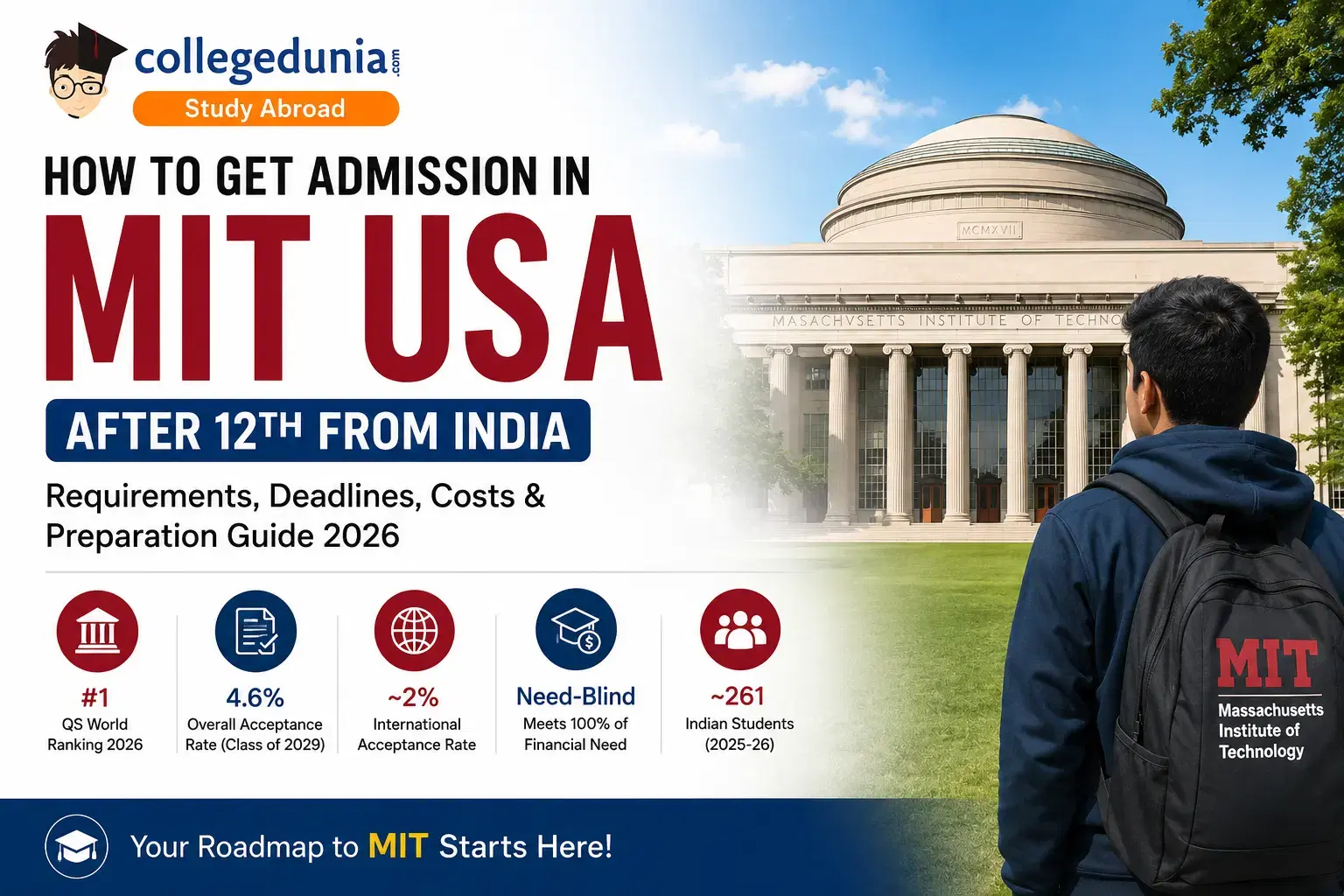
- MIT at a Glance: Key Facts for Indian Students
- MIT Admission Requirements After 12th for Indian Students
2.2 SAT and ACT Score Requirements
2.3 English Proficiency Test Requirements (Official MIT Scores)
- MIT Application Deadlines 2026 for Indian Students
- MIT Essay Prompts 2025-26: What Indian Students Must Write
- MIT Cost of Attendance 2026-27 for Indian Students
5.1 MIT Financial Aid for Indian Students
- How to Prepare for MIT After 12th: Year-Wise Roadmap for Indian Students
- What MIT Looks for in Indian Applicants: Beyond Board Marks
7.1 Academic Profile MIT Expects from Indian Students
7.2 Extracurricular Profile MIT Values
- Why Indian Students Get Rejected by MIT Despite High Scores
- Documents Required for MIT Application from India
- FAQs: How to Get Admission in MIT USA After 12th from India
MIT at a Glance: Key Facts for Indian Students
Before starting your MIT application, understand the scale of competition and what MIT actually looks for. The table below summarizes the most important facts about MIT for Indian students applying after Class 12.
| Parameter | Details |
|---|---|
| Full Name | Massachusetts Institute of Technology |
| Location | Cambridge, Massachusetts, USA |
| QS World Ranking 2026 | #1 globally |
| Overall Acceptance Rate (Class of 2029) | 4.6% (1,334 admitted out of 29,281 applicants) |
| International Acceptance Rate | ~2% (136 admitted out of 6,926 international applicants) |
| Indian Students Enrolled (2025-26) | ~261 across all programs |
| Application Mode | MIT Admissions Portal (apply.mitadmissions.org) |
| Application Rounds | Early Action (EA) - November 1; Regular Action (RA) - January 5 |
| Required Tests | SAT or ACT (mandatory); English proficiency test (strongly recommended for Indian students) |
| Total Cost of Attendance 2026-27 | USD 92,760 per year (~INR 77.5 lakh) before financial aid |
| Financial Aid | Need-blind; meets 100% of demonstrated financial need for all admitted students including Indians |
| Median Net Price Paid (2024-25) | USD 10,268 (~INR 8.6 lakh) per year for students receiving need-based MIT Scholarship |
| MIT Philosophy | Mens et Manus - Mind and Hand; values both theoretical knowledge and practical application |
Conversion note: 1 USD = INR 95.61 (as of June 8, 2026). All INR figures are approximate and subject to exchange rate fluctuations.
MIT Admission Requirements After 12th for Indian Students
MIT's undergraduate admission requirements are the same for all international applicants, including Indian students. There are no India-specific requirements or separate evaluation criteria. The following requirements are sourced directly from MIT's official admissions portal.
Mandatory Requirements
| Requirement | Details | Notes for Indian Students |
|---|---|---|
| SAT or ACT | Mandatory for all first-year applicants | JEE scores are NOT accepted. SAT or ACT is compulsory regardless of JEE rank |
| High School Transcript | Class 9 to 12 grades; submitted via Secondary School Report (SSR) | CBSE, ICSE and State Board transcripts are accepted. MIT counsellors are trained to evaluate Indian board systems |
| Two Teacher Recommendations | One from a Maths or Science teacher; one from a Humanities, Social Science or Language teacher | Recommendations must explain how you think and engage academically - not just confirm your marks |
| MIT Essays | 5 short-answer essays (100-200 words each) plus one open-ended additional information box | Essays are the most important differentiator for Indian applicants with similar academic profiles |
| Activities List | Maximum 4 activities - choose the four that mean the most to you | MIT only gives space for 4 activities. Depth and impact matter more than quantity |
| English Proficiency Test | Strongly recommended for non-native English speakers who have used English for fewer than 5 years | Most Indian students studying in English-medium schools may not need this, but submitting scores strengthens the application |
SAT and ACT Score Requirements
MIT does not publish a minimum SAT or ACT cutoff score. Scores are evaluated within the context of each applicant's background and opportunities. However, the official admissions statistics for the Class of 2029 show the middle 50% score range of admitted students.
| Test | Middle 50% Range (Class of 2029) | Strategic Target for Indian Students |
|---|---|---|
| SAT Math | 780 – 800 | 800 - near-perfect SAT Math is practically expected for STEM applicants |
| SAT Evidence-Based Reading and Writing | 740 – 780 | 740+ is competitive; 760+ is strong |
| SAT Composite | 1520 – 1580 | 1550+ is the realistic target for Indian applicants |
| ACT Composite | 34 – 36 | 35-36 is the target range |
| ACT Math | 34 – 36 | 36 is ideal for STEM applicants |
| ACT Reading | 33 – 36 | 34+ is competitive |
Important for Indian students: MIT accepts superscoring - if you take the SAT or ACT multiple times, MIT considers the highest score achieved in each section across all sittings. You can self-report scores on the application; official score submission is only required upon enrollment.
English Proficiency Test Requirements (Official MIT Scores)
Source: MIT Admissions official tests and scores page (mitadmissions.org/apply/firstyear/tests-scores/)
| Test | Minimum Score | Recommended Score |
|---|---|---|
| TOEFL iBT | 90 | 100 |
| IELTS Academic | 7.0 | 7.5 |
| PTE Academic | 65 | 70 |
| Duolingo English Test (DET) | 120 | 125 |
| Cambridge English (C1 Advanced / C2 Proficiency) | 185 | 190 |
Note for Indian students: MIT strongly recommends submitting an English proficiency test score if you have been using English for fewer than 5 years or do not speak English at home or in school. Most Indian students from English-medium CBSE or ICSE schools are not required to submit these scores, but doing so can strengthen your application.
Also check: Required documents to apply to US universities
MIT Application Deadlines 2026 for Indian Students
MIT offers two application rounds for first-year (undergraduate) applicants - Early Action (EA) and Regular Action (RA). Both rounds offer full consideration for admission and financial aid. The deadlines below are sourced directly from MIT's official admissions portal.
| Deadline / Event | Early Action (EA) | Regular Action (RA) |
|---|---|---|
| Application Deadline | November 1 | January 5 |
| Teacher Recommendations Due | November 1 | January 5 |
| Secondary School Report (SSR) Due | November 1 | January 5 |
| SAT/ACT Test Deadline | November testing date | December testing date (January dates also accepted for English proficiency tests) |
| Financial Aid Documents Due | February 15 | February 15 |
| February Updates Form | Mid-February | Mid-February |
| Admission Decision Released | Mid-December | Mid-March |
| Enrollment Decision Deadline | May 1 | May 1 |
EA vs RA - which should Indian students choose? Early Action is non-binding - you are not committed to attend if admitted. Applying EA gives you a decision in mid-December, which allows more time to plan finances, visa and travel. However, EA requires all materials - including SAT/ACT scores - to be ready by November 1. If your scores or application materials are not ready by October, Regular Action is the better choice.
Note: MIT allows you to apply only once per entry year. You cannot apply EA and RA in the same year.
Read more: US universities application deadlines 2026
MIT Essay Prompts: What Indian Students Must Write?
MIT's essays are the most critical differentiator for Indian applicants who have similar academic profiles. Unlike most US universities that use the Common App essay, MIT has its own application with five short-answer questions. Each response should be approximately 100-200 words. The prompts below are the official 2025-26 MIT essay questions.
| Essay Prompt | What MIT Is Looking For | Tips for Indian Students |
|---|---|---|
| 1. What field of study appeals to you the most right now? Tell us more about why this field of study at MIT appeals to you. | Academic direction and genuine interest in a specific field | Be specific about MIT - mention a lab, professor, program, or research area. Avoid generic answers like "MIT is the best university" |
| 2. We know you lead a busy life, full of activities, many of which are required of you. Tell us about something you do simply for the pleasure of it. | Authentic personality and interests beyond academics | This is not about impressive activities. Write about something genuinely personal - a hobby, a habit, a passion that reveals who you are |
| 3. While some reach their goals following well-trodden paths, others blaze their own trails achieving the unexpected. In what ways have you done something different than what was expected in your educational journey? | Independent thinking and willingness to go beyond the expected path | Indian students often follow a standard CBSE/JEE path. Highlight any moment where you chose a different approach - a project, a subject, a decision that was unconventional |
| 4. MIT brings people with diverse backgrounds together to collaborate. Describe one way you have collaborated with others to learn from them, with them, or contribute to your community together. | Collaborative spirit and community contribution | Focus on a specific collaboration - a team project, a community initiative, or a group research effort. Show what you contributed and what you learned |
| 5. How did you manage a situation or challenge that you didn't expect? What did you learn from it? | Resilience, self-awareness and ability to learn from difficulty | Be honest and specific. MIT values students who reflect genuinely on challenges - not those who present a polished, problem-free narrative |
MIT's own advice on essays: "The strongest essays are those that only you could have written." MIT explicitly states that if you are spending too much time strategizing about what makes you "look best" rather than writing honest answers, you are doing it wrong. Avoid templates and AI-generated language.
There is also one final open-ended additional information text box where you can share anything else you think MIT should know about you.
Must read: MIT Acceptance Rate
MIT Cost of Attendance 2026-27 for Indian Students
The total cost of attendance at MIT for 2026-27 is USD 92,760 (INR 88.69 Lakhs) per year before financial aid. The breakdown below shows exactly what this cost covers.
| Expense | Annual Cost (USD) | Annual Cost (INR approx.) | Notes |
|---|---|---|---|
| Tuition | USD 66,720 | ~INR 55.7 lakh | Covers faculty, staff, health services and academic spaces |
| Student Life Fee | USD 420 | ~INR 35,000 | Funds student clubs and organisations |
| Housing | USD 14,090 | ~INR 11.8 lakh | All first-year students are required to live on campus |
| Food | USD 8,104 | ~INR 6.8 lakh | Based on most expensive meal plan (21 meals per week) |
| Books and Course Materials | USD 930 | ~INR 77,700 | Estimated cost for books, supplies and equipment |
| Personal Expenses | USD 2,496 | ~INR 2.1 lakh | Clothes, laundry and other personal bills |
| Total (before financial aid) | USD 92,760 | ~INR 77.5 lakh | Travel allowance is additional and varies by home location |
MIT Financial Aid for Indian Students
MIT is need-blind for all applicants, including international students, and meets 100% of demonstrated financial need for every admitted student. This means MIT does not consider your family's financial situation when making the admission decision - and if you are admitted, MIT will cover whatever your family cannot afford.
- The median net price actually paid by an undergraduate receiving a need-based MIT Scholarship was USD 10,268 (~INR 8.6 lakh) per year in 2024-25
- Families earning under USD 100,000 (~INR 83.5 lakh) per year often have a zero parent contribution
- Families earning under USD 200,000 (~INR 1.67 crore) per year are typically tuition-free
- Financial aid documents must be submitted by February 15 for both EA and RA applicants
- MIT scholarship is a grant - it does not need to be repaid
Read more: MIT Scholarships for Indian students in 2026
How to Prepare for MIT After 12th: Year-Wise Roadmap for Indian Students
Getting into MIT requires preparation that starts well before Class 12. The roadmap below is designed specifically for Indian students in CBSE, ICSE or State Board schools who are targeting MIT undergraduate admission.
| Stage | Key Actions | MIT-Specific Goals |
|---|---|---|
| Class 9-10 | Build strong foundation in Maths and Science; explore genuine interests; start reading beyond the syllabus | Identify one or two areas of deep interest (coding, robotics, biology, mathematics); participate in school-level competitions; develop a reading habit in your area of interest |
| Class 10 (End of Year) | Score well in Class 10 boards; begin SAT preparation; explore Olympiad participation | Start Khan Academy SAT prep (free, recommended by MIT); register for Science or Maths Olympiads; identify extracurricular activities you want to pursue seriously |
| Class 11 (First Half) | Choose PCM with strong focus on advanced Maths and Physics; begin serious SAT preparation | Take first SAT attempt by end of Class 11; aim for 1500+ in first attempt; start a meaningful project (coding, research, community initiative); participate in national-level competitions |
| Class 11 (Second Half) | Retake SAT if needed; build extracurricular depth; start researching MIT programmes and faculty | Target SAT 1550+ by end of Class 11; identify MIT labs or research areas that align with your interests; begin drafting early essay ideas; approach teachers for recommendation letters |
| Class 12 (June-August) | Finalise SAT/ACT scores; begin MIT application; write and refine essays | Complete all SAT/ACT attempts by October; request teacher recommendations by August; draft all 5 MIT essays; prepare activities list (choose your best 4) |
| Class 12 (September-October) | Finalise and review complete application; submit Early Action by November 1 | Have essays reviewed by a trusted mentor (not a template service); submit SSR through school counsellor; self-report test scores on application portal |
| Class 12 (November-January) | EA applicants await decision (mid-December); RA applicants submit by January 5 | Submit financial aid documents by February 15; submit February Updates Form with mid-year grades; prepare for potential interview if invited |
| After Admission (March-May) | Receive decision (mid-March for RA); confirm enrollment by May 1; apply for F-1 student visa | Accept offer by May 1; apply for USA F-1 student visa; arrange housing (first-year students must live on campus); plan travel to Cambridge, Massachusetts |
Read more: Application Timeline for US universities
What MIT Looks for in Indian Applicants Beyond Board Marks
MIT's philosophy of "Mens et Manus" - Mind and Hand - means the institute looks for students who combine strong theoretical knowledge with practical application. For Indian students, where 95%+ board scores are common among applicants, academic marks are only the baseline. The following factors genuinely differentiate successful Indian applicants.
Academic Profile MIT Expects from Indian Students
- 90-95%+ consistency across Class 10 and Class 12 boards is common among admitted students
- 96-98%+ in PCM (Physics, Chemistry, Mathematics) strengthens competitiveness for STEM programmes
- Most admitted students fall in the top 1-2% of their school or cohort
- MIT counsellors are trained to understand CBSE, ICSE and State Board systems - they do not convert your grades to the American system
- If AP or IB courses are unavailable at your school, MIT evaluates how well you maximised academic rigour within your own curriculum
Extracurricular Profile MIT Values
MIT prioritizes depth over quantity. You only have space for 4 activities on the MIT application. Choose the four where you had the most genuine impact - not the ones that look most impressive on paper.
Why Indian Students Get Rejected by MIT Despite High Scores?
Many Indian students with 95%+ in Class 12 and SAT scores above 1500 are rejected by MIT every year. Understanding the real reasons for rejection helps you build a stronger application from the start.
| Rejection Reason | What MIT Actually Wants? |
|---|---|
| High marks without depth - strong Class 12 scores but no evidence of learning beyond the syllabus | Advanced coursework, self-study, research or projects that go beyond the CBSE or ICSE curriculum |
| Shallow extracurricular profile - many short-term activities or certificates with no sustained commitment | 3-4 long-term commitments with clear impact and genuine personal investment |
| Generic or templated essays - essays that sound polished but lack personal insight or authentic voice | Essays that only you could have written - specific, honest and reflective of how you actually think |
| No clear intellectual direction - applicants who cannot explain what genuinely excites them or why they want to study at MIT specifically | A clear academic or intellectual "spike" - one or two areas where you have gone unusually deep |
| JEE preparation as the only differentiator - treating JEE rank as equivalent to MIT-level achievement | MIT does not consider JEE scores. JEE preparation helps with SAT Math but does not replace the need for research, projects and original thinking |
| Weak teacher recommendations - generic letters that confirm marks but do not reveal how the student thinks or engages | Recommendations from teachers who know you well and can describe your intellectual curiosity, initiative and collaborative spirit with specific examples |
| No hands-on work - strong theoretical knowledge but no evidence of building, experimenting or applying knowledge practically | MIT's "Mens et Manus" philosophy requires evidence of practical application - projects, experiments, tools or initiatives you have actually built |
Key insight from Reddit: "MIT only accepts a handful of super extraordinary students from India. MIT AOs are very much aware of the intellectual capabilities required to qualify." The bar is not just academic excellence - it is demonstrated intellectual originality and hands-on achievement.
Documents Required for MIT Application from India
The MIT application is submitted entirely online through the MIT Admissions Portal (apply.mitadmissions.org). The following documents are required for Indian students applying after Class 12.
| Document | Details | Submitted By |
|---|---|---|
| Secondary School Report (SSR) | Includes your high school transcript (Class 9-12 grades); submitted by your school counsellor or principal | School counsellor |
| High School Transcript | Official Class 10 and Class 11 marksheets; Class 12 predicted grades if final results not yet available | School counsellor via SSR |
| SAT or ACT Scores | Self-reported on application; official scores verified upon enrollment; MIT accepts superscores | Applicant (self-reported) |
| Two Teacher Recommendations | One from a Maths or Science teacher; one from a Humanities or Language teacher | Teachers (submitted directly through portal) |
| MIT Essays | Five short-answer responses (100-200 words each) plus one open-ended additional information box | Applicant |
| Activities List | Maximum four activities - choose the most impactful, not the most impressive-sounding | Applicant |
| English Proficiency Test Scores | TOEFL, IELTS, PTE, DET or Cambridge - strongly recommended for non-native English speakers; self-reported on application | Applicant (self-reported) |
| Financial Aid Documents (if applying for aid) | CSS Profile; parents' income tax returns (ITR); bank statements; due by February 15 | Applicant and family |
| Optional: Creative Portfolio | Available via SlideRoom for researchers, performing artists, visual artists and makers; not required for most applicants | Applicant (optional) |
Note for Indian students: MIT does not require you to officially send SAT, ACT or English proficiency test scores as part of your application. You self-report scores on the application form. MIT verifies these scores upon enrollment. You can update your test scores in the application portal even after submitting your main application.
Read more: How to Write a Statement of Purpose for USA Universities | Documents Required for US universities
Getting into MIT from India is exceptionally challenging, but it is achievable for students who combine academic excellence with intellectual curiosity, meaningful projects, and genuine impact beyond the classroom. Strong board marks and test scores are important, but MIT ultimately looks for students who think independently, solve real problems, and demonstrate a passion for learning.
FAQs
Ques. Can Indian students get admission in MIT after Class 12?
Ans. Yes. Indian students can apply to MIT directly after Class 12 (CBSE, ICSE or State Board). MIT accepts applications from students in their final year of secondary school. You apply at the beginning of Class 12 - final Class 12 results are only required after admission. MIT does not have country-specific quotas. Indian students compete in the same global pool as all other international applicants. For the Class of 2029, 136 international students were admitted out of 6,926 international applicants - an acceptance rate of under 2%.
Ques. Does MIT accept JEE scores for admission?
Ans. No. MIT does not accept JEE Main or JEE Advanced scores for undergraduate admission. Indian students must submit SAT or ACT scores - this is mandatory for all first-year applicants including international students. JEE preparation can help with SAT Math (since both test advanced mathematics), but JEE rank has no formal role in MIT admissions. The middle 50% SAT Math score range for the Class of 2029 was 780-800, meaning near-perfect SAT Math is practically expected for STEM applicants.
Ques. What SAT score is required for MIT for Indian students?
Ans. MIT does not publish a minimum SAT cutoff. However, the official middle 50% score range for the Class of 2029 shows that admitted students scored SAT Math: 780-800 and SAT ERW: 740-780, giving a composite range of approximately 1520-1580. For Indian students targeting STEM programmes, an SAT Math score of 800 is practically expected. MIT applies superscoring - if you take the SAT multiple times, MIT considers the highest score from each section across all sittings.
Ques. What is the MIT application deadline for Indian students?
Ans. MIT has two application rounds. Early Action (EA) deadline is November 1 - decisions are released in mid-December. Regular Action (RA) deadline is January 5 - decisions are released in mid-March. Both rounds offer full consideration for admission and financial aid. MIT's Early Action is non-binding - you are not required to enrol if admitted. Financial aid documents for both rounds are due by February 15. The enrollment decision deadline for all admitted students is May 1.
Ques. What is the total fee for MIT for Indian students?
Ans. The total cost of attendance at MIT for 2026-27 is USD 92,760 per year (approximately INR 77.5 lakh) before financial aid. This includes tuition (USD 66,720), housing (USD 14,090), food (USD 8,104), student life fee (USD 420), books (USD 930) and personal expenses (USD 2,496). However, MIT is need-blind and meets 100% of demonstrated financial need. The median net price actually paid by students receiving need-based MIT Scholarship was USD 10,268 (~INR 8.6 lakh) per year in 2024-25. INR conversion: 1 USD = approximately INR 83.5 (June 2026).
Ques. Does MIT give scholarships to Indian students?
Ans. Yes. MIT is need-blind for all applicants including Indian students and meets 100% of demonstrated financial need for every admitted student. MIT scholarships are grants - they do not need to be repaid. Families earning under USD 100,000 (~INR 83.5 lakh) per year often have a zero parent contribution. Families earning under USD 200,000 (~INR 1.67 crore) per year are typically tuition-free. Most PhD students receive full tuition coverage plus a monthly stipend. Financial aid documents must be submitted by February 15.
Ques. What percentage is required in Class 12 for MIT admission?
Ans. MIT does not publish a minimum Class 12 percentage requirement. However, most admitted Indian students have 90-95%+ consistency across Class 10 and Class 12, with many scoring 96-98%+ in PCM (Physics, Chemistry, Mathematics). MIT counsellors are trained to evaluate Indian board systems (CBSE, ICSE, State Boards) and do not convert your percentage to an American GPA. Importantly, high marks alone are not sufficient - MIT looks for intellectual depth, hands-on projects, Olympiad achievements and original thinking beyond the syllabus.
Ques. What are the MIT essay prompts for 2025-26?
Ans. The official MIT essay prompts for the 2025-26 application cycle are: (1) What field of study appeals to you most and why at MIT specifically? (2) Tell us about something you do simply for the pleasure of it. (3) In what ways have you done something different than what was expected in your educational journey? (4) Describe one way you have collaborated with others to learn from them or contribute to your community. (5) How did you manage an unexpected challenge and what did you learn from it? Each response should be approximately 100-200 words. MIT advises: write essays that only you could have written - be honest, specific and authentic.
Ques. How many Indian students are at MIT?
Ans. As of the 2025-26 academic year, approximately 261 Indian students are enrolled across all MIT programmes (undergraduate and postgraduate combined). For the Class of 2029, MIT admitted 136 international students out of 6,926 international applicants - an international acceptance rate of under 2%. MIT does not publish country-specific admission data, so the exact number of Indian students admitted each year is not publicly available. There are no country quotas - Indian students compete in the same global pool as all other international applicants.
Ques. Is IELTS required for MIT admission from India?
Ans. IELTS is not mandatory for MIT admission. MIT strongly recommends an English proficiency test score for non-native English speakers who have been using English for fewer than 5 years or do not speak English at home or in school. Most Indian students from English-medium CBSE or ICSE schools are not required to submit IELTS scores. However, submitting a strong score can strengthen your application. If you do submit IELTS, the minimum score is 7.0 and the recommended score is 7.5. MIT also accepts TOEFL (minimum 90, recommended 100), PTE (minimum 65, recommended 70) and Duolingo English Test (minimum 120, recommended 125).



Comments