


.png?h=35&w=35&mode=stretch)
Study Abroad Content Specialist
The U.S. student visa (F-1) is the gateway for thousands of Indian students seeking to pursue higher education in one of the world's most prestigious academic environments. However, securing the visa is not always straightforward. In 2023, the U.S. Department of State reported a 36% rejection rate for student visa applicants, with 253,355 rejections recorded that year. Despite this, Indian students made up 29% of all U.S. student visa issuances, the highest among any nationality. Therefore it’s crucial to know the common reasons for F-1 visa rejection and tips for avoiding common mistakes, and also how to successfully prepare for the interview.
Also Check: US Student Visa Requirements
Common US Student Visa Rejection Reasons
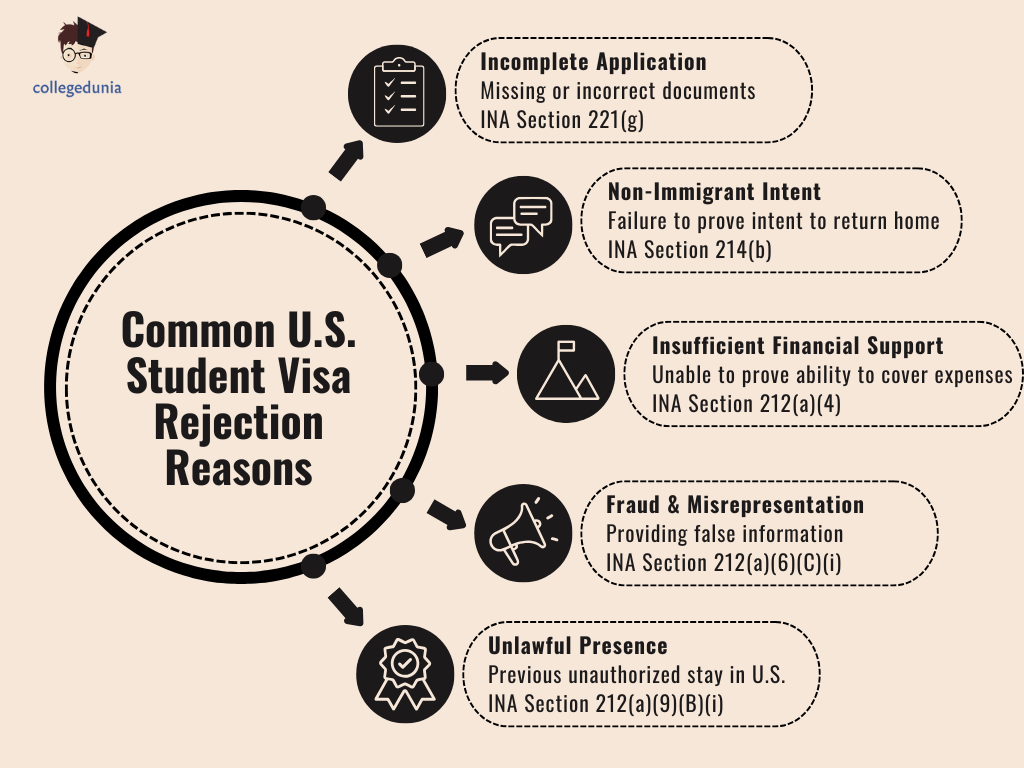
If you are preparing for a U.S. student visa interview, understanding the common reasons for visa rejection is crucial for improving your chances of success. Here are the top five reasons for rejection and how to avoid them:
Incomplete Application or Missing Documents (INA Section 221(g))
One of the most frequent causes for visa denials is incomplete applications or missing documents. Your application must be complete, with all necessary forms and supporting documentation, including your passport, I-20 form, SEVIS fee receipt, and academic transcripts.
| Tip: Before submitting your application, double-check all documents. Make sure you have a valid passport, completed DS-160 form, I-20 form, SEVIS fee receipt, and recent passport-sized photographs. If any documents are missing, be prepared to provide them promptly. |
| USA Student Guides | ||
|---|---|---|
| High-Paying Jobs in USA | H1-B Visa | Post-Study Work Visa in USA |
| Part-time Jobs in USA | OPT vs CPT | Popular Job Sectors in the USA |
Failure to Demonstrate Non-Immigrant Intent (INA Section 214(b))
The most common reason for visa denial is failure to demonstrate non-immigrant intent. The U.S. government needs to be convinced that you intend to return to your home country after completing your studies. If you fail to provide sufficient ties to India, the consular officer may assume that you plan to stay in the U.S. permanently.
| Tip:Emphasize your strong ties to India. This could include family relationships, property ownership, job offers, or any other connections that would motivate you to return home after graduation. Avoid suggesting that you want to stay in the U.S. after your studies. |
Insufficient Financial Support (INA Section 212(a)(4))
Failure to provide adequate proof of financial support is another common reason for visa rejection. You must demonstrate the ability to cover your tuition fees and living expenses for the duration of your program. U.S. consuls are especially diligent in reviewing financial documents to prevent fraud or misrepresentation.
Also Check: Cost of Studying in USA
| Tip:Ensure that you have verifiable proof of funds for the first year of your studies. This can include bank statements, affidavits of support, sponsorship letters, or scholarship details. If a parent is sponsoring your education, they must also show proof of income, such as employment letters or tax returns. Be honest and clear about your financial situation. |
Fraud and Misrepresentation (INA Section 212(a)(6)(C)(i))
If the consular officer suspects fraud or misrepresentation in your application or during the interview, your visa will be denied. This includes providing false information or documents to receive a visa or enter the U.S.
Also Check: Documents Required to Study in USA
| Tip:Always provide accurate and honest information. If you have ever been involved in fraudulent activities or have made mistakes on your application, disclose them upfront. The consular officer will appreciate your honesty, and it will help avoid further complications. |
Unlawful Presence in the U.S. (INA Section 212(a)(9)(B)(i))
If you have previously stayed in the U.S. unlawfully, or overstayed your visa, it will lead to a visa denial. Depending on how long you stayed beyond your authorized period, you could be banned from reapplying for up to 10 years.
Other Reasons for U.S. Student Visa Rejection
While the above reasons are the most common, other factors may lead to visa denial:
- Visa denial in the past: If your visa was previously denied, you need to address the reason for the previous rejection and prove how the situation has changed.
- Poor academic performance: If your GPA or academic history is not strong enough, it may raise concerns.
- Weak English proficiency: If you fail to prove your English language skills through tests like TOEFL or IELTS, it can affect your visa approval.
- Poor visa interview performance: Nervousness, inconsistent answers, or vague responses during the interview can lead to rejection.
- Poorly prepared Statement of Purpose (SOP): A vague or unclear SOP for USA may result in doubts about your intentions and goals.

Reapply After US Student Visa Rejection
If your visa application is rejected, don’t lose hope. You can reapply, but here are the key points to keep in mind:
- Pay the visa fee again: Reapplication requires a new visa application fee, which is non-refundable.
- Present a stronger case: If you were rejected due to non-immigrant intent, you should present evidence of significant changes in your situation, such as improved financial documentation or clearer career goals.
- Ensure all documents are updated: Ensure that all supporting documents are accurate and up to date. You may also need to explain how your circumstances have changed since the previous rejection.
| Tip:Consult with an immigration expert or counselor to understand why your previous application was rejected and how you can address the issues before reapplying. |
Tips to Avoid US Student Visa Rejection
Follow these key strategies to enhance your chances of success in the F-1 visa application process:
- Apply Early: Submit your visa application well before the semester starts. Late applications or submissions during peak seasons may increase the chances of rejection.
- Verify Your Documents: Double-check all required documents, including academic records, financial documents, and standardized test scores (TOEFL/IELTS).
- Demonstrate English Proficiency: Ensure that your TOEFL or IELTS scores meet the university's requirements. Prepare thoroughly for the English proficiency test.
- Prepare for the Interview: Be confident, honest, and concise in your responses. Prepare to explain why you chose your specific program and university, and how it aligns with your career goals.
- Prove Non-Immigrant Intent: Show that you have strong ties to India, such as family, property, and a job awaiting you. Demonstrating these ties will reassure the consular officer that you intend to return to India after your studies.
Also check: Study in USA
The U.S. student visa interview can be daunting, but by understanding the reasons for rejection and preparing your application carefully, you can significantly improve your chances of success. Focus on demonstrating your non-immigrant intent, provide strong financial evidence, and be clear about your study goals and career plans in India. With confidence, thorough preparation, and the right documentation, you can secure your F-1 visa and embark on your academic journey in the U.S.
Frequently Asked Questions (FAQs)
Ques. Why was my U.S. student visa rejected under Section 214(b), and how do I fix it?
Ans. Section 214(b) means you didn’t convince the officer of your intent to return home. Focus on showing strong ties to India—like family, a job, or property—and clearly explain your future plans after graduation.
Ques. How do I avoid getting my U.S. visa rejected for financial reasons?
Ans. Make sure your funds are genuine and well-documented. Show recent bank statements, explain large deposits if any, and be clear about who is sponsoring your studies and how they earn.
Ques. What if I don’t know an answer during my U.S. visa interview?
Ans. It’s okay! Don’t guess or give vague responses. Be honest and politely say, “I’m sorry, I don’t know that at the moment, but I can get back to you if needed.” Honesty builds trust.
Ques: Does changing my university or program after a visa rejection hurt my chances?
Ans. Not necessarily. If you change, explain why the new university or program is a better fit for your goals. Your answer should show thoughtfulness and clarity in your decision.
Ques. Can I reapply for a U.S. visa immediately after rejection?
Ans. Yes, but only if something has changed—like better financial proof, improved interview prep, or stronger documentation. If nothing’s different, waiting to reapply won’t help.



Comments