


.png?h=35&w=35&mode=stretch)
Study Abroad Content Specialist
Optional Practical Training (OPT) offers F-1 international students in the U.S. a pathway to gain practical work experience in their field of study. While OPT is a critical step for many students aiming for long-term employment, it is not always approved. Each year, thousands of applications are rejected or denied due to procedural or eligibility issues, potentially leaving students in a challenging position regarding their legal status in the country. It’s crucial to get a heads-up onto common reasons behind OPT application issues, differences between rejections and denials, and practical steps to take after a denial, with a focus on maintaining your legal status and pursuing employment pathways.
| Type of OPT | Eligibility | Duration | Extension for STEM |
|---|---|---|---|
| Pre-completion OPT | Before completion of studies | Up to 12 months | Not applicable |
| Post-completion OPT | After completion of studies | Up to 12 months | Up to 24 additional months |
| STEM OPT Extension | For STEM degree holders only | Additional 24 months | Only once per degree |
Understanding OPT Rejections and Denials
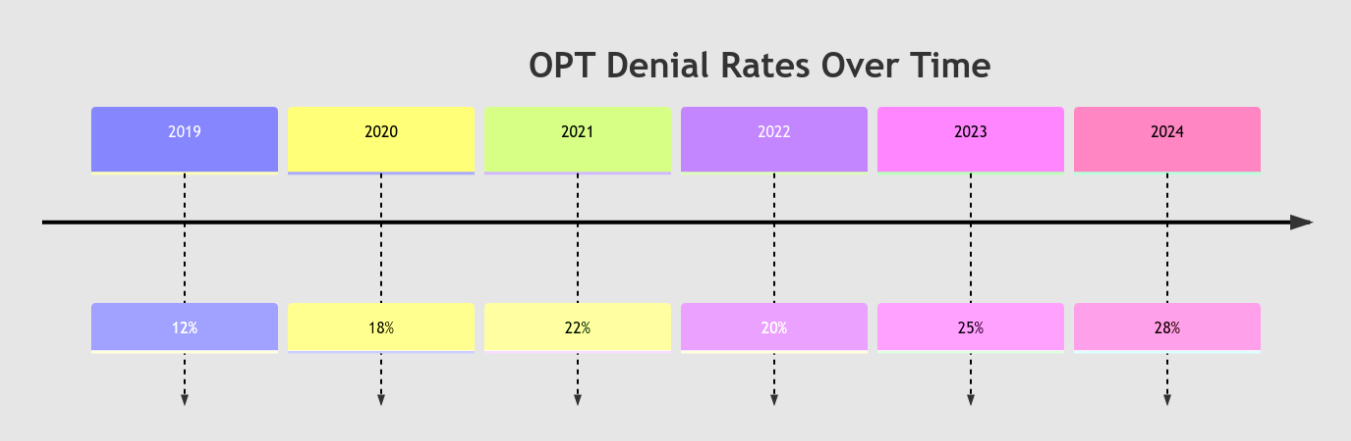
While these terms are often used interchangeably, they signify different issues:
- OPT Rejection: Occurs due to technical errors, such as missing documents, an incomplete I-765 form, or using an outdated form. The U.S. Citizenship and Immigration Services (USCIS) does not process payments for rejected applications, and students can often refile with corrections.
- OPT Denial: Involves a deeper review by USCIS and usually relates to eligibility issues, such as missing the 30-day submission rule or previous misuse of F-1 visa status. Denials can be more complex to address, often limiting the options for refiling.
| Rejection Reasons | Denial Reasons |
|---|---|
| Missing documents or incomplete I-765 form | Violating the "30-day rule" |
| Incorrect filing fee | Previous OPT approval at the same degree level |
| Using an outdated version of the I-765 form | Using over 12 months of full-time Curricular Practical Training (CPT) |
| Incorrect submission timeframe | Termination of F-1 status or SEVIS record issues |
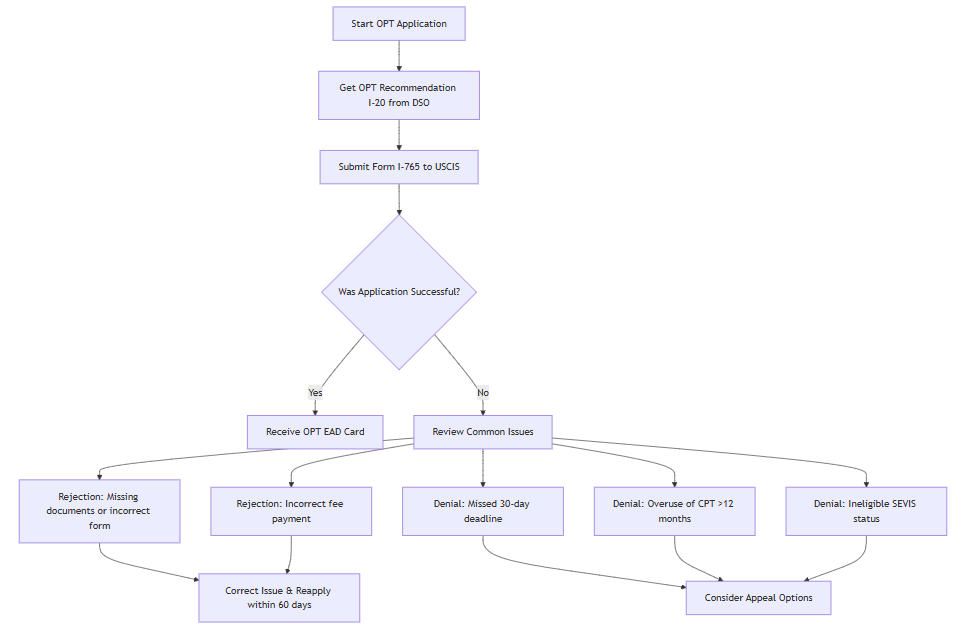
Common Reasons for OPT Application Issues
- Failure to Adhere to the 30-Day Rule
OPT applications must be submitted within 30 days of receiving the I-20 recommendation from the International Student Office. Missing this deadline can lead to automatic rejection.
- Incorrect or Incomplete Documentation
Common documentation issues include missing a signed I-765 form, incorrect information on the I-20, and using outdated forms. Students are advised to thoroughly review documents and consult their Designated School Official (DSO) before submission.
- Full-Time CPT Overuse
Accumulating 12 months of full-time CPT disqualifies students from OPT eligibility at the same degree level. This rule applies even if CPT was used part-time or across different institutions.
- SEVIS Termination
If a student's SEVIS ID is terminated, such as due to a leave of absence, the eligibility period for F-1 status resets. Students who graduate before accumulating one full academic year under a new SEVIS ID are typically ineligible for OPT.
- Failure to Maintain F-1 Status
If students do not maintain their F-1 status, either by taking unauthorized work or not adhering to study requirements, USCIS may deny the OPT application.
Also Check: OPT vs CPT
Options After an OPT Denial
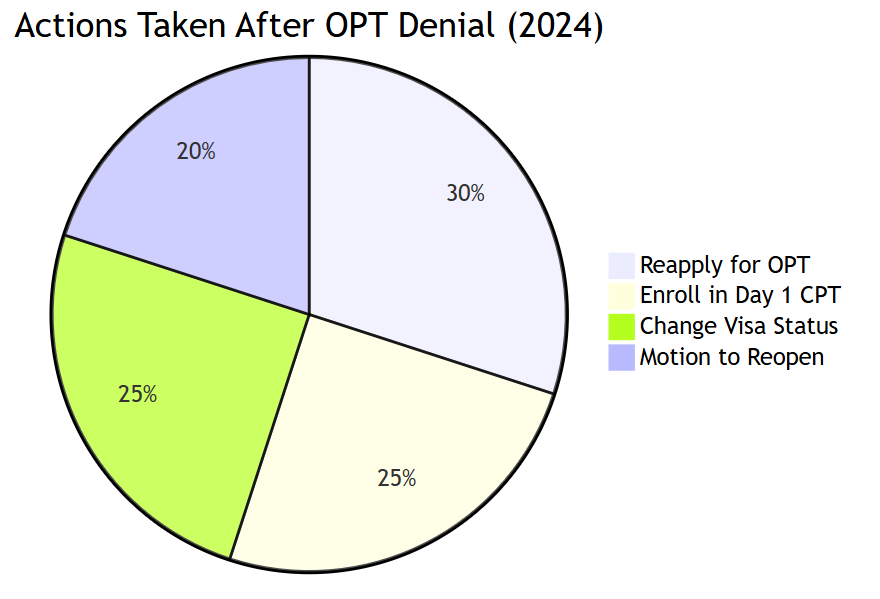
If your OPT application is denied, there are several pathways to consider:
- Reapply for OPT
Students whose applications are rejected for technical errors may reapply, provided they are still within the eligible application window. It is essential to address all prior mistakes and consult with the DSO to obtain a new I-20.
- File a Motion to USCIS
Students who believe their denial was incorrect can file a Motion to Reopen or Reconsider (Form I-290B). This approach requires presenting new evidence (Motion to Reopen) or showing that USCIS made an error in processing (Motion to Reconsider). Professional legal assistance is advisable due to the complex nature of this process.
- Consider Enrolling in a Day 1 CPT Program
Enrolling in a graduate program with Day 1 CPT can help students maintain F-1 status while gaining work experience. Ensure that the chosen institution is accredited and offers legitimate CPT programs. Misuse of CPT can lead to further immigration issues.
| Option | Key Requirements | Advantages | Challenges |
|---|---|---|---|
| Reapply for OPT | Correct previous errors and submit new I-20 | Simple if within eligibility timeframe | Dependent on new eligibility |
| File a Motion to USCIS | Present new evidence or appeal on USCIS error | Potential for overturning denial | Legal fees and procedural complexity |
| Enroll in Day 1 CPT Program | Enroll in accredited CPT program to maintain F-1 status | Maintains legal status and work experience | CPT misuse can cause immigration issues |
- Convert to Another Visa or Status
Students with OPT denial may consider switching to another visa type, such as an L-1, H-4, or F-2, if eligible. These options allow them to stay in the U.S. legally, though some have work restrictions.
- L-1 Visa: Suitable for those with multinational employer sponsorship.
- B-2 Visa: Temporary solution but does not permit work.
- Dependent Visas (F-2, H-4): If married to an H-1B visa holder, the H-4 visa allows for work authorization under certain conditions.
Also Check:
Strategies to Minimize OPT Application Rejection or Denial
- Check Documentation Thoroughly: Missing or outdated documents are common issues. Always use the latest I-765 form version and ensure fee accuracy.
- Consult with Your DSO: Your DSO can guide you in navigating the OPT application process, ensuring compliance with requirements.
- Time Your Application Carefully: Submit within the specified period (90 days before and 60 days after your program end date) to avoid unnecessary rejections or denials.
- Avoid Overuse of Full-Time CPT: Limit full-time CPT to less than 12 months to preserve OPT eligibility.
Navigating the OPT application process can be complex and, at times, discouraging if faced with rejections or denials. However, understanding the distinct reasons for OPT issues, following application best practices, and exploring alternative pathways can help maintain your legal status and open doors to employment opportunities in the United States. While each option has its challenges, a well-informed approach combined with timely actions can help overcome hurdles in the path to a successful OPT experience.
FAQs
Ques. Can I work while I wait for my OPT denial appeal or refiling to be processed?
Ans. No, students are not authorized to work while waiting for an OPT appeal or reapplication decision. Engaging in employment without valid OPT approval could negatively impact future visa applications.
Ques. Is it possible to change my status from F-1 to H-1B after an OPT denial?
Ans. If an employer is willing to sponsor you, you may transition to an H-1B visa. However, you must leave the U.S. and wait until the H-1B process completes before re-entering.
Ques. What are my options if my OPT denial results in a lapse of my F-1 status?
Ans. You can re-enroll in another program or switch to a different visa, such as F-2 (if married to another F-1 visa holder) or H-4 (if married to an H-1B holder). Consulting an immigration attorney can help determine the best course.
Ques. How can I ensure my documents are complete and avoid an OPT rejection in the future?
Ans. Working closely with your university’s Designated School Official (DSO) and conducting a thorough document review before submission can help avoid errors. Attend workshops and consult with other students who have successfully obtained OPT.
Ques. Can I file a motion to reopen my OPT application after I leave the U.S.?
Ans. Generally, you must be in the U.S. to file a motion to reopen your OPT application. If you must leave due to your status, consult with an immigration lawyer to understand your options.
Ques. How does the OPT denial impact future U.S. visa applications for Indian students?
Ans. While an OPT denial itself doesn’t directly affect future visa eligibility, working without authorization or overstaying after denial can cause issues. It's critical to take timely action to avoid any potential negative marks on your immigration record.



Comments