



Education Journalist | Study Abroad Lead | Updated On - Aug 24, 2026
The UCAS application deadline for 2027 entry is 13 January 2027 at 6pm UK time. This is the equal consideration deadline for most undergraduate courses. Oxford, Cambridge, medicine, dentistry and veterinary courses close earlier, on 15 October 2026. Applications can be submitted from 1 September 2026. The 2027 cycle fee is GBP 34.50 (around INR 4,500) for up to 5 courses.
- The equal consideration rule means every on-time application gets the same review, whether sent in September or January.
- School internal deadlines land earlier than UCAS dates. Plan around your school, not UCAS.
- Missing a deadline changes your route, not your chances. Extra and Clearing stay open for months after.
Check the full UCAS application guide before you start your form
UCAS confirmed that international undergraduate acceptances rose only 2% in the 2026 cycle even as applications surged. Seats for popular courses are tightening, so on-time applications matter more than before.
Knowing each UCAS date lets you plan your tests, personal statement and visa backwards from results day.
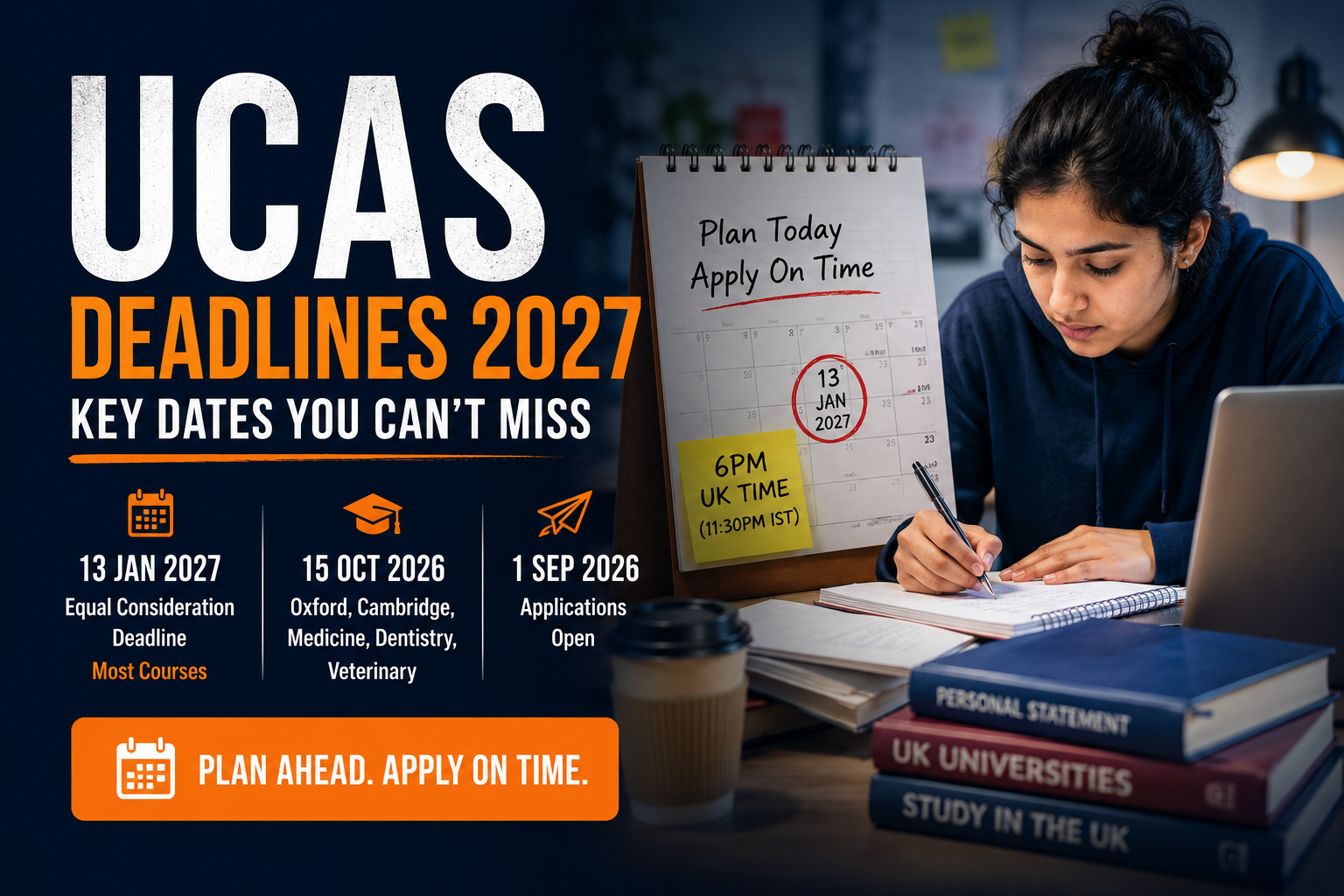
Quick Facts on UCAS Application Deadline 2027
| Parameter | Detail |
|---|---|
| Main deadline (equal consideration) | 13 January 2027, 6pm UK time |
| Oxford, Cambridge, medicine, dentistry, veterinary | 15 October 2026, 6pm UK time |
| Submissions open | 1 September 2026 |
| Last main-cycle date | 30 June 2027, 6pm UK time |
| UCAS Extra window | 25 February to early July 2027 |
| Clearing 2027 | Early July to around 19 October 2027 |
| Application fee (2027 cycle) | GBP 34.50 (around INR 4,500) for up to 5 choices |
- UCAS Application Deadline 2027: All Key Dates
- UCAS Deadline for Oxford, Cambridge and Medicine
- What the 13 January Equal Consideration Deadline Means
- UCAS Deadlines Still Open for 2026 Entry
- UCAS Application Deadline for Indian Students
- What Happens If You Miss the UCAS Deadline?
- UCAS Application Fee and Choices for 2027
- How to Stay Ahead of UCAS Deadlines
- FAQs on UCAS Application Deadline
UCAS Application Deadline 2027: All Key Dates
The 2027 UCAS cycle opened in May 2026 and runs until Clearing closes in October 2027. You apply through UCAS (Universities and Colleges Admissions Service) for undergraduate courses at UK universities. One application covers up to 5 course choices at any UK university offering bachelor programs.
| Date | Event |
|---|---|
| 13 May 2026 | Applications opened. You can register and start filling the form |
| 1 September 2026 | Completed applications can be submitted to UCAS |
| 1 October 2026, 6pm UK time | Deadline for most conservatoire music courses |
| 15 October 2026, 6pm UK time | Deadline for Oxford, Cambridge, medicine, dentistry and veterinary courses |
| 13 January 2027, 6pm UK time | Equal consideration deadline for most other undergraduate courses |
| 25 February 2027 | UCAS Extra opens for students with no offers |
| 30 June 2027, 6pm UK time | Last date in the main cycle. Later applications go to Clearing |
| Early July 2027 | UCAS Extra closes and Clearing opens |
| Around 19 October 2027 | Clearing closes. Final date to add a Clearing choice |
All dates come from official UCAS information. Every deadline is 6pm UK time, which is 11:30pm IST on the same day. UCAS Extra and Clearing dates late in the cycle are indicative until UCAS confirms them.
Read More: September 2027 intake in the UK and full admission timelines
UCAS Deadline for Oxford, Cambridge and Medicine
The UCAS deadline for Oxford, Cambridge, medicine, dentistry and veterinary courses is 15 October 2026 at 6pm UK time. This applies to every course at University of Oxford and Cambridge. It also covers most medicine, dentistry and veterinary courses at any UK university.
This early date exists because these courses run extra selection steps. Interviews, admissions tests and work-experience checks all happen between October and January.
If a 15 October course is your target, your real timeline starts a year earlier:
- Admissions tests like the UCAT are registered for and taken in the summer of 2026.
- Some Oxford and Cambridge courses need the TARA, TMUA or ESAT test, with separate registration dates.
- Medicine applications need work experience and references ready before the school year starts.
If you apply to one 15 October course and four regular courses, only that one choice must meet the October date. The other four follow the January deadline. You can add later choices after submitting, up to 5 in total.
Key Insight: Test requirements change every cycle. UCL added the TARA test for Mechanical Engineering and dropped tests from 5 other courses for 2027 entry. Check each course page for the current cycle before you plan.
Check which UCL courses changed their admissions tests for 2027
What the 13 January Equal Consideration Deadline Means
Every application received by 6pm UK time on 13 January 2027 must be considered equally by universities. A form submitted in September and one submitted on deadline day get the same review. Universities cannot favour early applicants for on-time applications. Source: UCAS.
After 13 January, the rules change. UCAS still forwards applications until 30 June 2027. But universities only look at late applications if seats remain after on-time applicants are processed. Popular courses at Russell Group universities often fill from the on-time pool alone.
What equal consideration gives you:
- Guaranteed review of your application at all 5 choices.
- The same offer standards as every other on-time applicant.
What it does not cover:
- It does not guarantee an offer or an interview.
- It does not apply to courses with the 15 October deadline.
If you submit early, you often hear back sooner. That means more time to meet offer conditions and sort your visa. Early submission does not raise your odds of an offer, but it lowers your admin risk.
UCAS Deadlines Still Open for 2026 Entry
You can still apply for a September 2026 start until late September 2026 through Clearing. The main 2026 cycle closed on 30 June 2026. Everything now runs through Clearing, where universities list courses with unfilled seats.
| Date | 2026 Entry Event |
|---|---|
| Now until 24 September 2026 | Final window to submit a 2026 entry application |
| Around 19 October 2026 | Clearing 2026 closes. Last date to add a Clearing choice |
Clearing 2026 is active for Indian students right now. Universities like Southampton and Birmingham opened dedicated Clearing hotlines for international applicants in August 2026. Some universities even keep scholarships open for Clearing entrants.
If you hold Indian board results and want a 2026 start, act within days, not weeks. You contact universities directly, get a verbal offer, then add the choice in your UCAS Hub.
Check Southampton's Clearing 2026 cutoffs for CBSE and ISC students
UCAS Application Deadline for Indian Students
Indian students follow the same UCAS deadlines as UK students. There is no separate international date. The 15 October and 13 January cutoffs apply whether you apply from Delhi or from London.
The difference is everything that comes after the offer. Your real deadline chain runs backwards from your course start:
- You need an unconditional offer, then a CAS (Confirmation of Acceptance for Studies, the university's visa sponsorship document).
- You can apply for the UK Student visa no more than 3 months before your course starts. Source: UKVI.
- Your visa funds must sit in the bank for 28 consecutive days before you apply.
- Add time for IELTS or another accepted English test if your offer needs one.
If you apply by 13 January, then offers usually arrive by May. That means a calm summer for CAS, funds and visa. If you apply in June, the same steps compress into 8 weeks. That is workable but risky.
Most UK universities keep international admissions open past January because international seats rarely fill that early. Applying in March or April for a September 2027 start is routine. It is still second best to an on-time application.
Key Insight: The 6pm cutoff is not a safety net. Details checks, payment confirmation and reference approval must all clear before submission, so aim to submit at least 2 weeks early.
Read More: UK student visa checklist, processing time and fee requirements
What Happens If You Miss the UCAS Deadline?
Missing the UCAS deadline does not end your UK plans. Your application shifts to a different track. Which track depends on when you apply and whether you hold offers.
UCAS Extra
UCAS Extra opens on 25 February 2027. It is for students who used all 5 choices and hold no offers. You add one new course at a time from those with seats left. If that course declines you, you pick another. Extra runs until early July 2027 at no extra fee.
UCAS Clearing
Clearing opens in early July 2027 and runs until around 19 October 2027. Universities publish every course that still has vacancies. You call universities directly, get an informal offer, then add the Clearing choice in your UCAS Hub. Anyone can use Clearing, including students who never applied in the main cycle.
Clearing is faster but more competitive than the main cycle. Seats go to whoever confirms first with the right grades.
If Every UCAS Route Has Closed
Some universities accept late direct applications outside UCAS. Policies vary by institution, so contact admissions teams directly. The realistic alternative is applying early in the next cycle, which opens each May.
The "If X, then Y" rule of thumb: if you miss 13 January 2027, then apply anyway before 30 June. That means universities with open seats can still consider you months before Clearing pressure starts.
UCAS Application Fee and Choices for 2027
The UCAS application fee for the 2027 cycle is GBP 34.50 (around INR 4,500). One fee covers up to 5 course choices, or 6 for conservatoires. It also covers UCAS Extra and Clearing, so there is no second payment later. Source: UCAS. The fee rose from GBP 28.95 (around INR 3,780) in the 2026 cycle.
The personal statement format also changed from 2026 entry onwards. The single essay was replaced by 3 set questions: why this course, how your studies prepared you, and what you have done outside education. The limit stays 4,000 characters, with at least 350 characters per answer. A strong personal statement still decides borderline offers.
Conversions based on a GBP-INR rate of INR 130.57 as of August 24, 2026. Rates fluctuate; check the current rate before financial planning.
How to Stay Ahead of UCAS Deadlines
Submitting days before each UCAS deadline protects you from last-minute failures. Payment errors, reference delays and site load on deadline day catch out students every cycle.
- Mark every date now. Put 15 October 2026, 13 January 2027 and 30 June 2027 in your phone with week-early reminders.
- Follow your school's internal deadline. Schools need time to check forms and attach references. Their date beats the UCAS date.
- Brief your referee early. Your form cannot be submitted without the reference attached.
- Draft your 3 statement answers in autumn. Leave the last month for edits, not first drafts.
- Check your UCAS Hub weekly after submitting for offers and interview requests.
- Keep copies of everything you submit for visa and scholarship paperwork later.
Funding runs on the same calendar. Many UK scholarships close between January and April, so an on-time UCAS application keeps every scholarship window open. Students planning loans should compare lenders like HDFC Credila, Avanse and SBI Global Ed-Vantage early. Keep a 5 to 8% currency buffer in your budget for rupee movement.
Also Check:
| Russell Group Admissions for Indian Students | UK University Application Deadlines: UG and PG | Student Guide to Study in the UK |
| University of Cambridge | Education Loan Options | Study Abroad Exams |
The UCAS application deadline decides how your whole UK plan unfolds. For 2027 entry, 15 October 2026 and 13 January 2027 are the two dates that matter most. Submitting on time gives you equal consideration and a relaxed visa timeline. Missing a date still leaves Extra, Clearing and direct routes open. Start early, follow your school's internal date and check the official UCAS calendar each month.
FAQs on UCAS Application Deadline
Ques. What is the UCAS application deadline for 2027 entry?
Ans. 13 January 2027 at 6pm UK time for most undergraduate courses. This is the equal consideration deadline. Oxford, Cambridge, medicine, dentistry and veterinary courses close on 15 October 2026.
Ques. When can I submit my UCAS application for 2027 entry?
Ans. From 1 September 2026. The form opened for filling on 13 May 2026. You can complete every section early and submit the day the window opens.
Ques. Is the UCAS deadline the same for Indian and international students?
Ans. Yes. International students follow the same dates as UK students. Apply early anyway. You need extra months for your CAS, visa funds and the UK Student visa after an offer.
Ques. What time is the UCAS deadline in Indian time?
Ans. Every UCAS deadline is 6pm UK time, which is 11:30pm IST on the same day. Do not treat it as an end-of-day cutoff. References and payment must clear before submission.
Ques. What happens if I miss the 13 January 2027 deadline?
Ans. You can still apply until 30 June 2027. Universities then consider you only if seats remain. After 30 June, all applications go through Clearing.
Ques. How much is the UCAS application fee for 2027?
Ans. GBP 34.50 (around INR 4,500) for up to 5 course choices. The single fee also covers UCAS Extra and Clearing, so there are no further UCAS charges in the cycle.
Ques. How many courses can I apply to through UCAS?
Ans. Up to 5 courses in one application, or 6 for conservatoires. Universities cannot see your other choices. Each decides on your application independently.
Ques. When does UCAS Extra open for 2027 entry?
Ans. 25 February 2027. Extra is for applicants who used all 5 choices and hold no offers. You add one new course at a time until early July 2027.
Ques. When does Clearing open and close for 2027 entry?
Ans. Clearing opens in early July 2027 and closes around 19 October 2027. Universities list courses with open seats. You contact them directly and add a Clearing choice after a verbal offer.
Ques. Can I still apply for 2026 entry now?
Ans. Yes, through Clearing until 24 September 2026 for new applications. Clearing 2026 closes around 19 October 2026. Several UK universities are running live Clearing hotlines for Indian students.
Ques. Do UK master's courses follow UCAS deadlines?
Ans. No. Master's applications go directly to each university, not through UCAS. Most run rolling admissions, though popular courses and scholarships close much earlier than expected.
Ques. Has the UCAS personal statement changed for 2027 entry?
Ans. Yes. Since 2026 entry, the single essay is replaced by 3 set questions. The total limit is 4,000 characters, with a minimum of 350 characters per answer.



Comments