




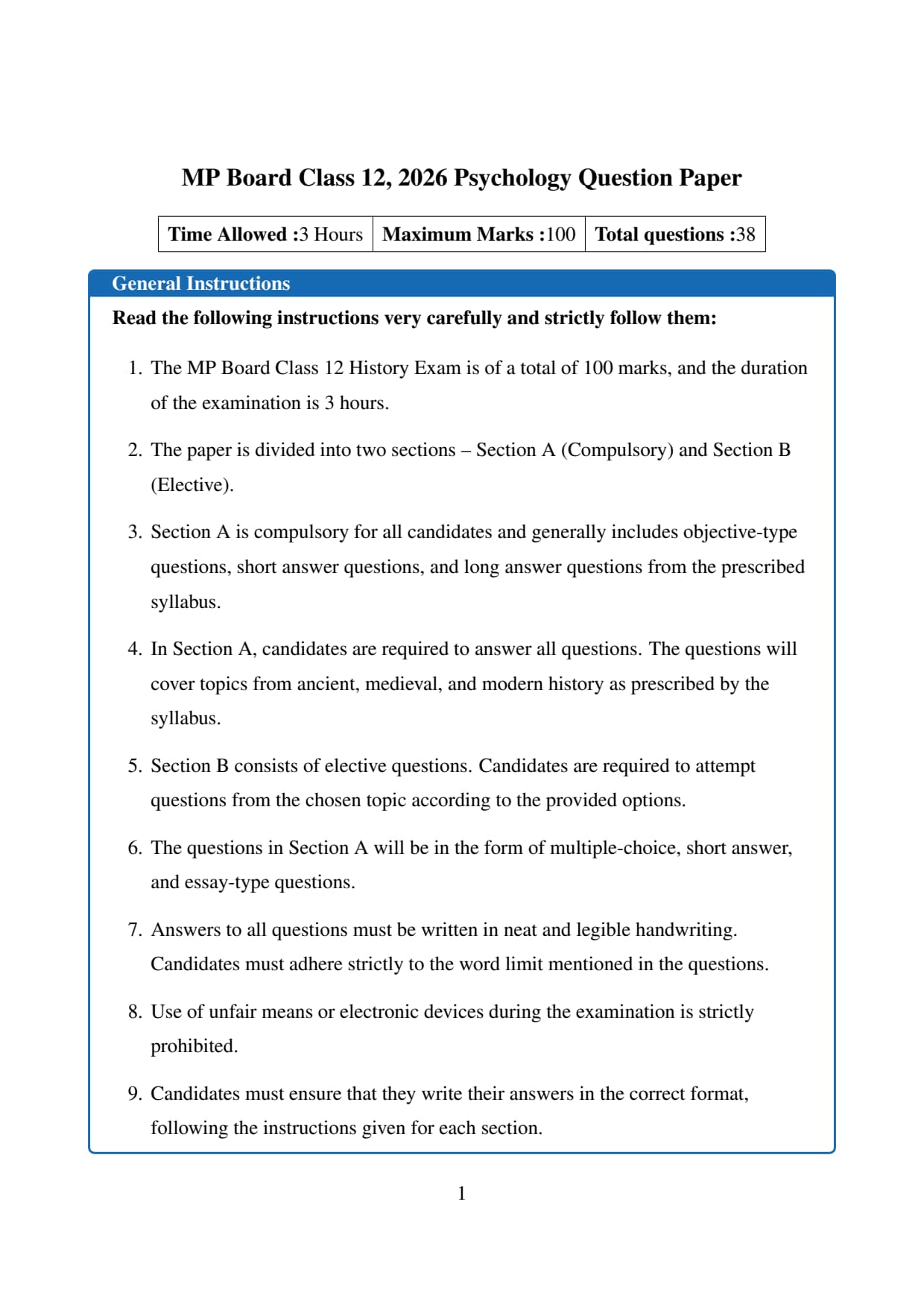
MP Board is conducting the Class 12 Psychology Board Exam 2026 on February 19, 2026. Class 12 Psychology Question Paper with Solution PDF is available here for download.
The official question paper of MP Board Class 12 Psychology Board Exam 2026 is provided below. Students can download the official paper in PDF format for reference.
MP Board Class 12, 2026 Psychology Question Paper with Solution PDF
| MP Board Class 12 Psychology Question Paper 2026 |  Download Download |
Check Solutions |

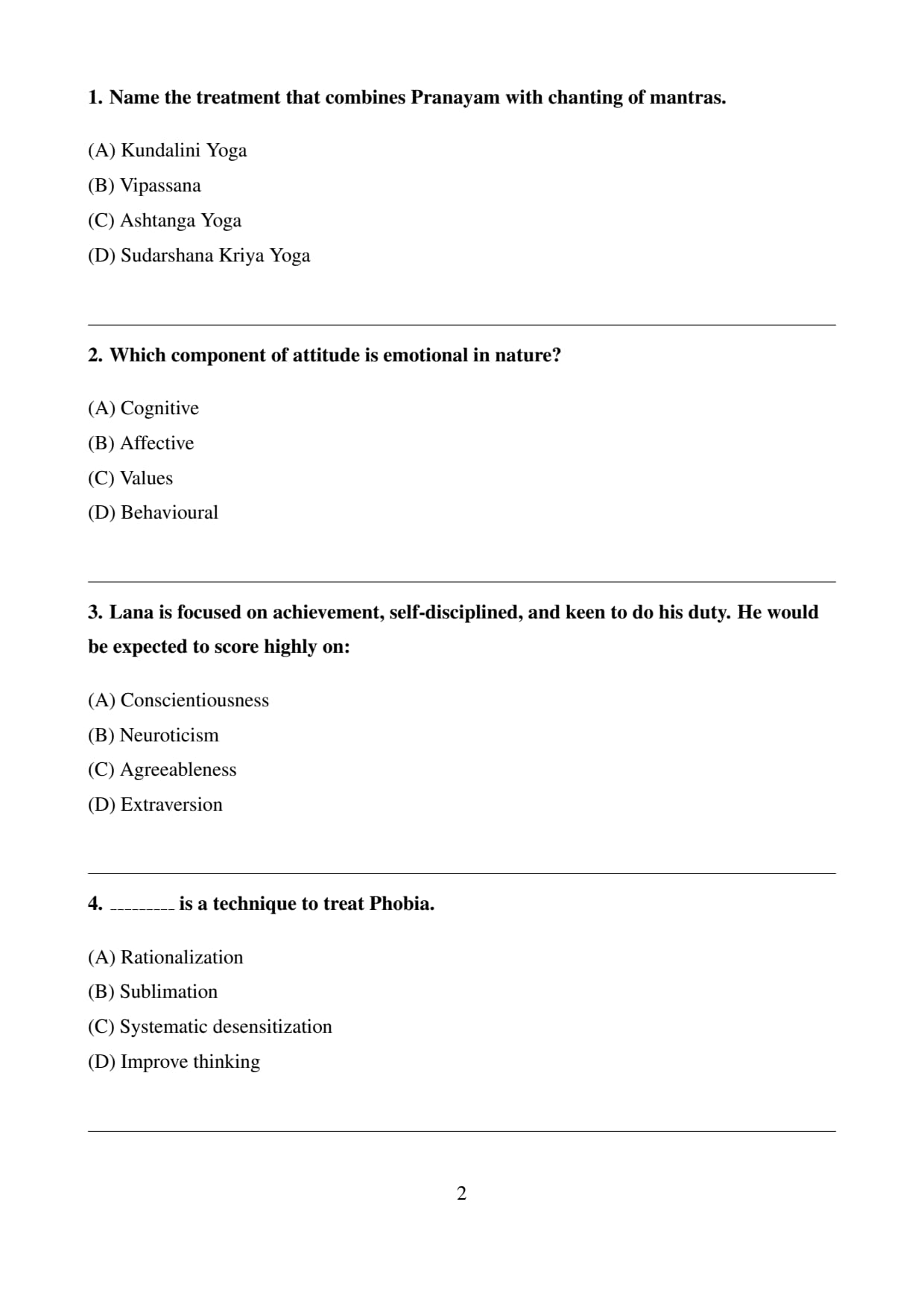
Name the treatment that combines Pranayam with chanting of mantras.
View Solution
Sudarshana Kriya Yoga is a spiritual practice that combines breathing techniques (Pranayama) with the chanting of mantras to harmonize the body and mind. It focuses on the use of breath to facilitate deep relaxation, mental clarity, and emotional well-being. This practice is often associated with reducing stress and promoting inner peace.
Step 1: Analyze the options.
(A) Kundalini Yoga: While Kundalini Yoga involves energy activation through breath control and chanting, it is not specifically focused on Pranayama combined with chanting mantras in the way Sudarshana Kriya does.
(B) Vipassana: Vipassana is a form of meditation focused on mindfulness and self-awareness. It does not involve Pranayama or chanting of mantras.
(C) Ashtanga Yoga: Ashtanga Yoga is a rigorous style of yoga focusing on a series of postures and breathing techniques, but it does not combine Pranayama with chanting mantras in the same way.
(D) Sudarshana Kriya Yoga: This is the correct practice, known for combining Pranayama with chanting mantras for spiritual and emotional healing.
Step 2: Conclusion.
The correct answer is Sudarshana Kriya Yoga, as it integrates Pranayama and chanting of mantras.
Final Answer: \[ \boxed{(D) \, Sudarshana Kriya Yoga} \] Quick Tip: Sudarshana Kriya Yoga is beneficial for reducing stress and improving emotional well-being through controlled breathing and the chanting of mantras.
Which component of attitude is emotional in nature?
View Solution
The emotional aspect of attitude is referred to as the Affective component. It involves the feelings or emotions a person has towards an object, person, or idea. The affective component influences how one feels about a particular object, whether it is positive or negative, and this emotional response is a key part of attitude formation.
Step 1: Analyze the options.
(A) Cognitive: The cognitive component of attitude refers to the beliefs or thoughts that people hold about an object or subject, not the emotional aspect.
(B) Affective: This is the correct answer. The affective component is the emotional or feeling-based aspect of attitude.
(C) Values: Values are deeply held beliefs, but they are not strictly emotional in nature. Values shape attitudes but are not the same as the affective component.
(D) Behavioural: The behavioral component refers to the way a person acts or behaves toward an object or idea, not the emotional aspect.
Step 2: Conclusion.
The emotional aspect of attitude is best described by the affective component, making (B) the correct answer.
Final Answer: \[ \boxed{(B) \, Affective} \] Quick Tip: The affective component of attitude involves emotional reactions such as likes or dislikes, which are often the strongest components in attitude formation.
Lana is focused on achievement, self-disciplined, and keen to do his duty. He would be expected to score highly on:
View Solution
Lana’s traits of being focused on achievement, self-disciplined, and keen to do his duty align with the personality trait of Conscientiousness. Conscientiousness is one of the Big Five personality traits, which refers to being diligent, careful, and goal-oriented. People who score highly in conscientiousness are often organized, reliable, and efficient in completing tasks.
Step 1: Analyze the options.
(A) Conscientiousness: This is the correct trait that aligns with Lana’s description, indicating high levels of self-discipline and duty.
(B) Neuroticism: This trait involves emotional instability and anxiety, which does not match Lana’s focus on self-discipline and achievement.
(C) Agreeableness: This trait is more related to being cooperative and compassionate, but it is not directly linked to Lana’s focus on achievement and discipline.
(D) Extraversion: This trait relates to being outgoing and energetic, but it is not as closely aligned with Lana’s described behavior.
Step 2: Conclusion.
Based on Lana's described characteristics of being focused on achievement and self-discipline, the correct answer is (A) Conscientiousness.
Final Answer: \[ \boxed{(A) \, Conscientiousness} \] Quick Tip: Conscientiousness is associated with traits like organization, self-discipline, and a strong sense of duty, which makes it the correct answer for Lana's description.
_________ is a technique to treat Phobia.
View Solution
Systematic desensitization is a psychological technique used to treat phobias by gradually exposing the individual to the feared object or situation in a controlled and systematic manner. The goal is to help the person become less sensitive to the fear over time. This technique is based on the principle of classical conditioning.
Step 1: Analyze the options.
(A) Rationalization: This is a defense mechanism where a person justifies their behaviors or feelings with logical explanations, but it is not a treatment for phobias.
(B) Sublimation: This is another defense mechanism where socially unacceptable impulses are transformed into socially acceptable behaviors, but it is not specifically used to treat phobias.
(C) Systematic desensitization: This is the correct technique used to treat phobias, involving gradual exposure to the fear.
(D) Improve thinking: This is a vague term and is not a specific psychological technique used to treat phobias.
Step 2: Conclusion.
Systematic desensitization is the correct technique for treating phobias, as it involves gradual and controlled exposure to the feared stimulus.
Final Answer: \[ \boxed{(C) \, Systematic desensitization} \] Quick Tip: Systematic desensitization is a behavioral therapy technique that helps reduce phobia-related anxiety through gradual exposure.
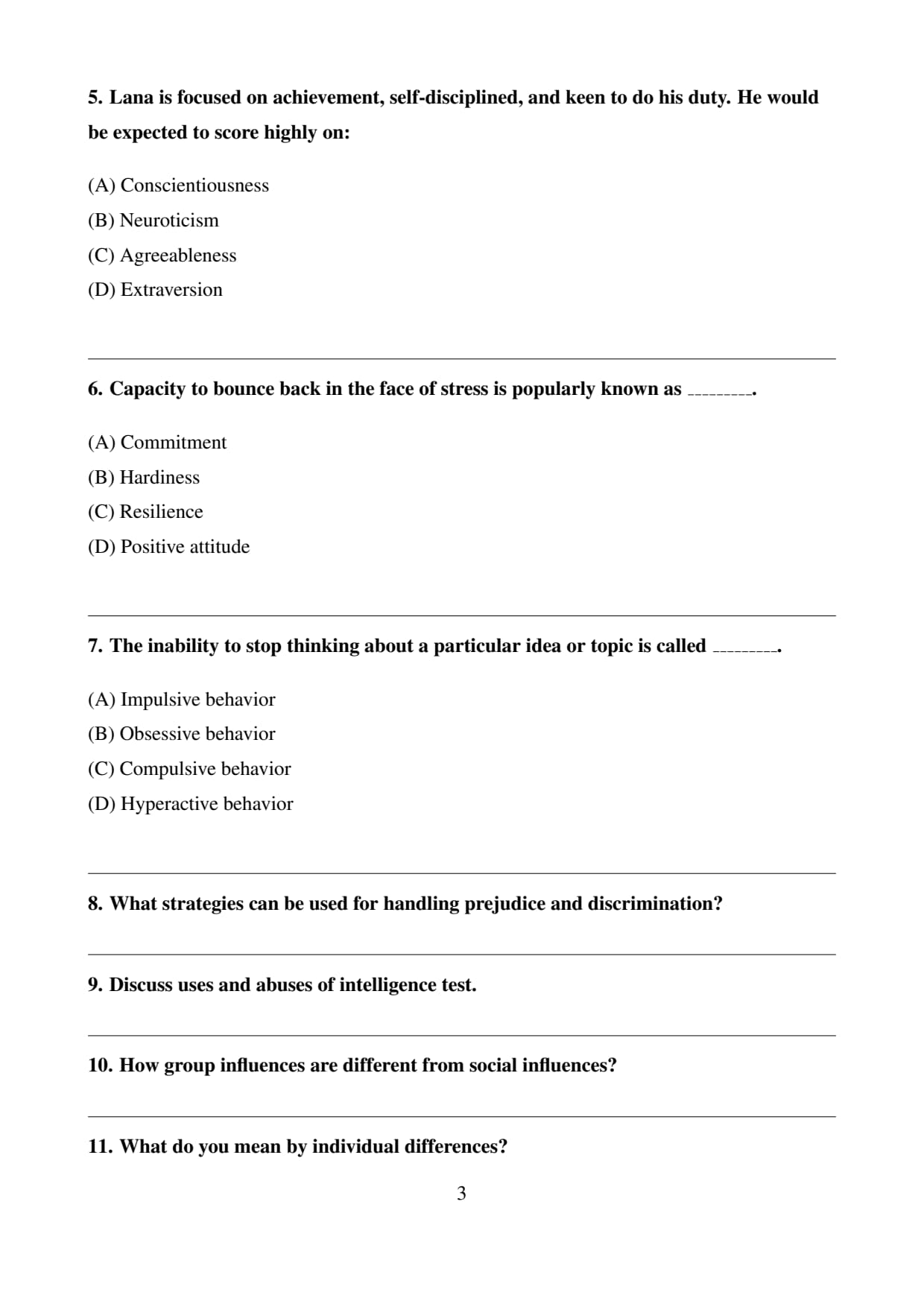
Lana is focused on achievement, self-disciplined, and keen to do his duty. He would be expected to score highly on:
View Solution
Lana’s traits of being focused on achievement, self-disciplined, and keen to do his duty align with the personality trait of Conscientiousness. Conscientiousness is one of the Big Five personality traits, referring to being diligent, organized, and goal-oriented. Individuals who score high in conscientiousness are typically reliable, disciplined, and motivated.
Step 1: Analyze the options.
(A) Conscientiousness: This is the correct option because Lana exhibits behaviors related to achievement, discipline, and responsibility, all of which are core characteristics of conscientiousness.
(B) Neuroticism: Neuroticism involves emotional instability, anxiety, and moodiness, which does not align with Lana's described traits.
(C) Agreeableness: Agreeableness refers to being cooperative, empathetic, and helpful. While it is an important trait, it is not the most relevant to Lana's focus on achievement and self-discipline.
(D) Extraversion: Extraversion is characterized by sociability, enthusiasm, and assertiveness, which is not directly related to Lana's described traits.
Step 2: Conclusion.
Conscientiousness best describes Lana’s personality traits, making (A) the correct answer.
Final Answer: \[ \boxed{(A) \, Conscientiousness} \] Quick Tip: Conscientiousness is associated with a focus on achievement, self-discipline, and a strong sense of duty, making it the key trait for individuals like Lana.
Capacity to bounce back in the face of stress is popularly known as _________.
View Solution
The ability to bounce back from stress, adversity, or difficult situations is referred to as Resilience. Resilience involves adaptability and the mental strength to recover from setbacks. It is an essential characteristic for overcoming challenges and maintaining psychological well-being.
Step 1: Analyze the options.
(A) Commitment: While commitment is important for perseverance, it refers more to dedication to a task or goal rather than the ability to recover from stress.
(B) Hardiness: Hardiness refers to a personality trait that includes a strong sense of commitment, control, and challenge, but it is not as commonly associated with the ability to bounce back from stress in general terms.
(C) Resilience: This is the correct term that refers to the capacity to recover and bounce back from stress and adversity.
(D) Positive attitude: Having a positive attitude helps in many situations, but it is not as specific as resilience when it comes to overcoming stress and adversity.
Step 2: Conclusion.
Resilience is the most accurate term for describing the ability to bounce back in the face of stress, making (C) the correct answer.
Final Answer: \[ \boxed{(C) \, Resilience} \] Quick Tip: Resilience is the key to overcoming challenges and setbacks, helping individuals recover and continue to thrive after difficult situations.
The inability to stop thinking about a particular idea or topic is called _________.
View Solution
The inability to stop thinking about a particular idea or topic is referred to as Obsessive behavior. Obsessive thoughts are persistent and intrusive, often leading to anxiety or discomfort. People experiencing obsessive behavior may feel compelled to repeatedly focus on a specific idea, unable to divert their attention. This is a key feature of Obsessive-Compulsive Disorder (OCD).
Step 1: Analyze the options.
(A) Impulsive behavior: Impulsivity refers to acting without forethought or planning, which is not about obsessive thinking.
(B) Obsessive behavior: This is the correct term for the inability to stop thinking about a particular idea or topic. It involves intrusive thoughts.
(C) Compulsive behavior: Compulsive behavior refers to repetitive actions or rituals that a person feels driven to perform, often as a response to obsessive thoughts. While related, it refers to behavior, not thinking.
(D) Hyperactive behavior: Hyperactivity refers to excessive activity or energy levels, which is not related to thinking patterns or obsession.
Step 2: Conclusion.
Obsessive behavior is the most accurate term for the condition described, making (B) the correct answer.
Final Answer: \[ \boxed{(B) \, Obsessive behavior} \] Quick Tip: Obsessive thoughts are persistent and repetitive, and they often lead to compulsive actions. It is important to recognize them as part of conditions like OCD.
What strategies can be used for handling prejudice and discrimination?
View Solution
There are several strategies that can be used to handle prejudice and discrimination effectively. Some of the key strategies include:
1. Education and Awareness: Educating individuals about prejudice, stereotypes, and discrimination can be highly effective in reducing biased behavior. Awareness programs that promote empathy and understanding can encourage people to reflect on their own biases and challenge prejudiced views.
2. Open Dialogue and Communication: Encouraging open dialogue about discrimination and prejudice can help create an environment where people feel comfortable discussing these sensitive topics. Open communication helps individuals understand each other’s experiences and perspectives, leading to greater tolerance.
3. Legal and Policy Interventions: Government regulations and policies play an essential role in curbing discrimination in various sectors like employment, education, and healthcare. These laws protect individuals from discrimination based on race, gender, sexual orientation, and other factors.
4. Promoting Diversity and Inclusion: Fostering an environment that celebrates diversity and inclusion helps people appreciate different backgrounds, beliefs, and experiences. Organizations can promote diversity through hiring practices, team-building exercises, and inclusive leadership.
Quick Tip: Strategies such as education, open communication, and promoting diversity can significantly reduce prejudice and discrimination in society.
Discuss uses and abuses of intelligence test.
View Solution
Intelligence tests have been widely used for various purposes, but their misuse has also led to controversy. Here’s a discussion of both the uses and abuses of intelligence tests:
Uses of Intelligence Tests:
Intelligence tests are often used to assess an individual's cognitive abilities. Some of the main uses include:
1. Educational Placement: Intelligence tests are commonly used in educational settings to determine a student’s cognitive ability, which can help in placing them in appropriate educational programs or identifying areas where they may need extra support.
2. Career Counseling: Some intelligence tests are used to guide individuals in choosing careers that match their cognitive strengths and weaknesses, helping them make informed decisions about their professional lives.
3. Psychological Evaluation: These tests are useful for diagnosing intellectual disabilities or determining cognitive impairment in individuals, which helps in providing the necessary medical and psychological support.
Abuses of Intelligence Tests:
While intelligence tests have legitimate uses, they can also be abused in several ways:
1. Cultural Bias: Many intelligence tests have been criticized for cultural bias, as they often reflect the values, knowledge, and experiences of specific social or cultural groups. This can lead to unfairly low scores for individuals from different cultural backgrounds.
2. Overemphasis on IQ: Intelligence tests often place too much emphasis on IQ as the sole measure of a person’s worth or potential, overlooking other important aspects such as emotional intelligence, creativity, or practical skills.
3. Discrimination: In some cases, intelligence tests have been used to justify discrimination by categorizing certain groups as less intelligent, reinforcing negative stereotypes and perpetuating inequality.
Quick Tip: While intelligence tests are valuable tools, it is essential to be aware of their limitations and potential for misuse, especially regarding cultural biases.
How group influences are different from social influences?
View Solution
Step 1: Understanding Group Influence.
Group influence refers to the impact that a specific group of individuals has on the behaviors, thoughts, or attitudes of a person. It is most commonly seen in situations where individuals conform to group norms or standards in order to fit in. Examples of group influences include peer pressure, group norms, and conformity. The primary characteristic of group influence is its direct interaction between an individual and the group. This interaction can sometimes be coercive (e.g., peer pressure) or voluntary (e.g., fitting into the group's way of thinking). In the case of group influence, an individual’s behavior or thoughts are shaped directly by the dynamics of the group, and the individual may experience a sense of belonging by conforming to the group’s expectations.
Step 2: Understanding Social Influence.
Social influence, on the other hand, is a broader concept that encompasses the ways in which society at large shapes an individual's beliefs, behaviors, and attitudes. Unlike group influence, social influence can occur without the individual being part of a specific group. Social influence can include the impact of societal norms, media, culture, laws, and even historical events. For example, societal expectations regarding gender roles or the media’s portrayal of beauty standards represent social influences that impact an individual's perceptions or actions. These influences can be indirect, such as the cultural values propagated through mass media or educational systems, and may not always involve a direct interaction with a specific group.
Step 3: Key Differences.
The key distinction between group influence and social influence is that group influence is typically more direct, coming from the immediate social context of a person (such as friends or coworkers), while social influence is more general and can affect people from society at large. Social influences are often more subtle and pervasive, as they shape behavior through cultural and societal norms, and are present even in the absence of close group interaction. On the other hand, group influence involves direct pressure or encouragement from a group that leads an individual to adopt particular behaviors or attitudes.
Quick Tip: Group influence is often direct and involves conformity within a specific group, while social influence is broader and affects behavior through societal norms, media, and culture.
What do you mean by individual differences?
View Solution
Step 1: Defining Individual Differences.
Individual differences refer to the psychological and physical variations that exist between people. These differences can manifest in various areas, such as personality traits, cognitive abilities, emotional responses, learning styles, intelligence, and even the ways in which individuals perceive and react to their environments. Each person’s unique combination of characteristics creates a distinctive personal identity, and these differences are what make human behavior and thought patterns incredibly diverse.
Step 2: Factors Influencing Individual Differences.
The formation of individual differences is influenced by both genetic and environmental factors. Genetically, a person’s inherited traits, such as temperament, cognitive abilities, and even predispositions to certain mental health conditions, play a significant role in shaping their individuality. Environmental factors include upbringing, educational experiences, social interactions, culture, and life experiences. For example, a child raised in a nurturing environment with access to quality education is likely to develop different cognitive and emotional skills compared to a child raised in a more stressful or deprived setting. The interplay of these factors leads to the development of each person’s unique personality and abilities.
Step 3: The Role of Individual Differences in Psychology and Education.
Understanding individual differences is crucial in various fields, especially in psychology and education. In psychology, recognizing these differences helps in diagnosing mental health conditions, understanding behavior, and formulating personalized treatment plans. In education, it enables educators to recognize that students learn in different ways and at different rates, which is why individualized or differentiated instruction is important for maximizing each student’s potential. Educational practices that take individual differences into account, such as using different teaching methods or offering personalized learning experiences, are more likely to help students succeed.
Step 4: Implications of Individual Differences.
Individual differences have far-reaching implications for how people are treated in society. They influence how we interact with others, how we are perceived, and how we function within various social contexts. In workplaces, for example, recognizing individual differences can lead to more effective teamwork and leadership by acknowledging each person’s strengths and weaknesses. In broader societal contexts, understanding these differences can promote tolerance and acceptance, helping to reduce prejudice and discrimination.
Quick Tip: Individual differences are essential in psychology and education as they help to tailor approaches to learning, therapy, and social interaction, ensuring more personalized and effective outcomes.
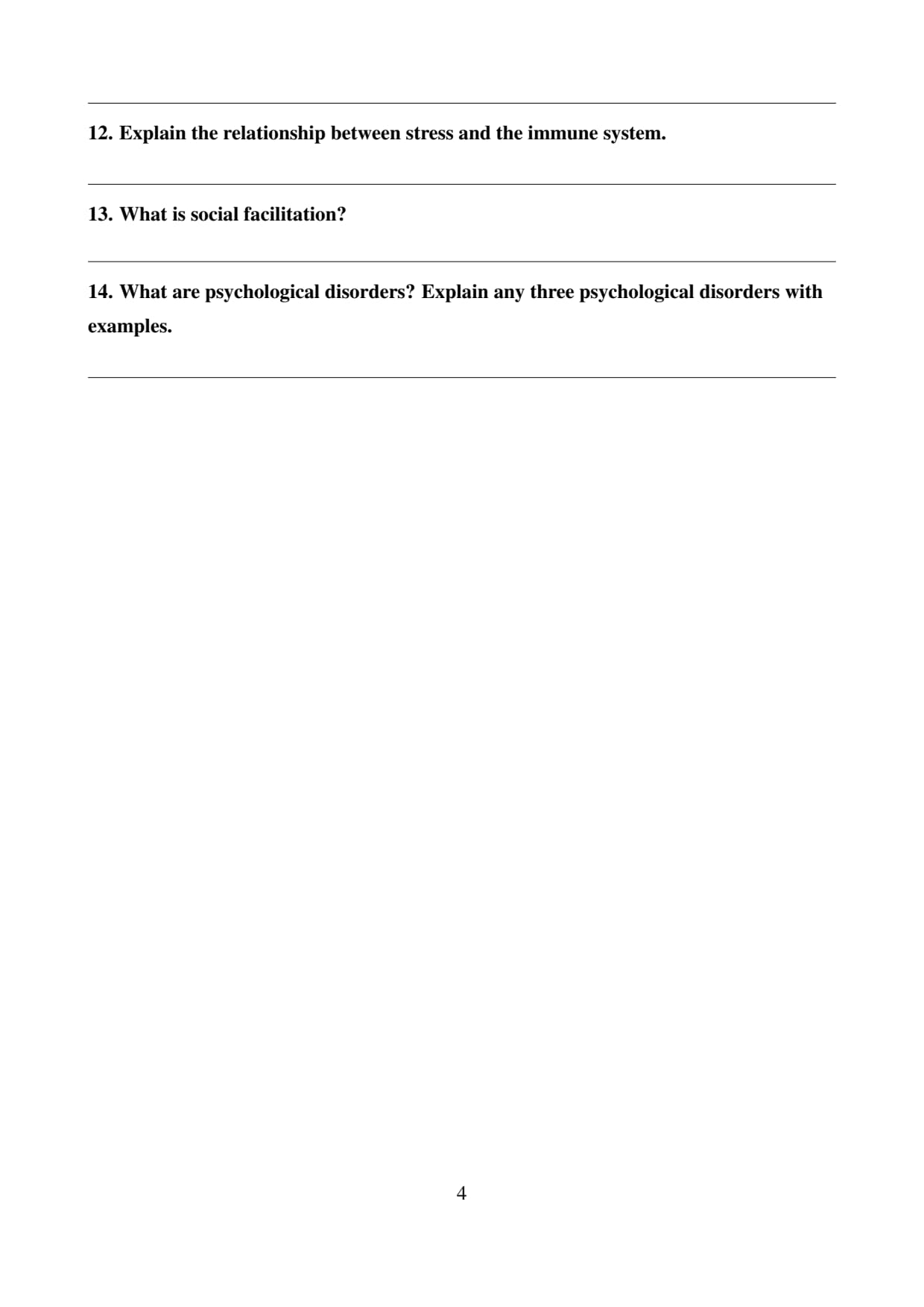
Explain the relationship between stress and the immune system.
View Solution
Step 1: Understanding Stress and its Types.
Stress is a physiological and psychological response to demanding situations or events. It can be acute (short-term) or chronic (long-term). Acute stress is typically experienced in response to immediate challenges, while chronic stress results from prolonged exposure to stressors. Both types of stress have varying effects on the body, particularly the immune system.
Step 2: The Immune System’s Role.
The immune system is responsible for protecting the body against harmful invaders like viruses, bacteria, and other pathogens. It consists of a network of cells, tissues, and organs that work together to defend the body. Key components of the immune system include white blood cells (e.g., T-cells and B-cells), antibodies, and the lymphatic system.
Step 3: Stress and the Immune System.
When the body experiences stress, the hypothalamic-pituitary-adrenal (HPA) axis is activated, triggering the release of hormones like cortisol and adrenaline. Cortisol is a stress hormone that, in the short term, can help the body cope with stress by increasing glucose production, enhancing alertness, and suppressing inflammation. However, chronic stress leads to prolonged elevated levels of cortisol, which can suppress immune function by lowering the production of white blood cells, impairing the ability to fight off infections, and inhibiting the normal response of the immune system to pathogens.
Chronic stress has been linked to increased vulnerability to infections, slower wound healing, and greater susceptibility to autoimmune diseases. Additionally, stress-induced inflammation can contribute to the development of chronic conditions such as cardiovascular disease, diabetes, and cancer.
Step 4: Conclusion.
In summary, while acute stress can sometimes enhance the immune response as part of the body’s "fight or flight" reaction, chronic stress weakens the immune system, making the body more susceptible to illness and disease. It is essential to manage stress effectively to maintain a healthy immune system.
Quick Tip: Chronic stress can suppress immune function, making the body more vulnerable to infections and diseases. It is important to manage stress to protect the immune system.
What is social facilitation?
View Solution
Step 1: Defining Social Facilitation.
Social facilitation refers to the phenomenon where individuals perform tasks better or more efficiently when they are in the presence of others. This effect has been observed across a wide range of activities, from physical tasks to cognitive ones. Social facilitation is often seen in activities where the individual is already familiar or skilled with the task.
Step 2: Theories Behind Social Facilitation.
There are two primary theories that explain social facilitation: the drive theory and the evaluation apprehension theory.
1. Drive Theory: This theory, proposed by Robert Zajonc, suggests that the presence of others increases an individual's physiological arousal, which in turn enhances the performance of well-practiced or easy tasks. The arousal increases motivation and energy, leading to better performance in familiar or simple tasks. However, for complex or unfamiliar tasks, increased arousal can impair performance.
2. Evaluation Apprehension Theory: This theory suggests that the presence of others causes individuals to feel evaluated or judged, which can lead to enhanced performance when the task is something the individual is skilled at. The anxiety of being watched can boost motivation and performance but may have a negative effect when the task is unfamiliar or difficult.
Step 3: Examples of Social Facilitation.
Some common examples of social facilitation include athletes performing better during a game due to the presence of spectators, students working more efficiently in a study group, or musicians playing more effectively in front of an audience. These examples show how the presence of others can have a motivating and stimulating effect on performance.
Step 4: Conclusion.
In conclusion, social facilitation occurs when the presence of others enhances the performance of an individual, particularly in tasks that are well-practiced. However, the effect can be negative for tasks that are unfamiliar or require complex thinking, as increased arousal can lead to anxiety and decreased performance.
Quick Tip: Social facilitation can enhance performance in tasks that are simple or well-practiced but can hinder performance in complex tasks due to increased anxiety.
What are psychological disorders? Explain any three psychological disorders with examples.
View Solution
Step 1: Defining Psychological Disorders.
Psychological disorders, also known as mental disorders, are conditions characterized by a significant disturbance in an individual's thoughts, emotions, or behaviors. These disturbances cause distress or impairment in various aspects of life, such as work, relationships, and daily functioning. Psychological disorders are diagnosed using established criteria, such as those found in the Diagnostic and Statistical Manual of Mental Disorders (DSM-5). These disorders can range from mild to severe and can affect individuals in different ways.
Step 2: Types of Psychological Disorders.
There are several categories of psychological disorders, including mood disorders, anxiety disorders, personality disorders, and psychotic disorders. Let’s discuss three common psychological disorders with examples.
1. Depression (Mood Disorder):
Depression is a mood disorder that involves persistent feelings of sadness, hopelessness, and a lack of interest in activities that were once enjoyable. People with depression may experience changes in appetite, sleep disturbances, and difficulty concentrating. It can also lead to physical symptoms such as fatigue or aches. An example of depression is Major Depressive Disorder (MDD), where individuals may have recurring episodes of deep sadness that last for weeks or months.
2. Generalized Anxiety Disorder (GAD):
GAD is an anxiety disorder characterized by excessive, uncontrollable worry about various aspects of life, such as work, health, or social interactions. Individuals with GAD often experience physical symptoms like restlessness, fatigue, muscle tension, and sleep problems. This worry is disproportionate to the actual situation. For example, a person with GAD may worry excessively about a minor issue like being late for an appointment, even when there is no real reason for concern.
3. Schizophrenia (Psychotic Disorder):
Schizophrenia is a serious psychotic disorder characterized by a distorted perception of reality. Symptoms can include hallucinations (e.g., hearing voices or seeing things that are not present), delusions (false beliefs), and disorganized thinking. People with schizophrenia may also have difficulty with speech, memory, and concentration. An example of schizophrenia is a person who might believe they are being persecuted by others or that they have special powers, despite evidence to the contrary.
Step 3: Conclusion.
In conclusion, psychological disorders are a group of conditions that affect an individual's thoughts, emotions, and behaviors. They can interfere with daily functioning and cause distress. Depression, generalized anxiety disorder, and schizophrenia are just a few examples of the many types of psychological disorders that exist. Early diagnosis and treatment, including therapy and medication, can help individuals manage symptoms and lead fulfilling lives.
Quick Tip: Psychological disorders are diverse, and each disorder can have unique symptoms and effects on individuals. Early intervention can significantly improve the outcome for those affected.



Comments