




MP Board is conducting the Class 12 History Board Exam 2026 on February 18, 2026. Class 12 History Question Paper with Solution PDF is available here for download.
The official question paper of MP Board Class 12 History Board Exam 2026 is provided below. Students can download the official paper in PDF format for reference.
MP Board Class 12, 2026 History Question Paper with Solution PDF (Memory Based)
| Class 12, 2026 History Question Paper |  Download Download |
Check Solutions |
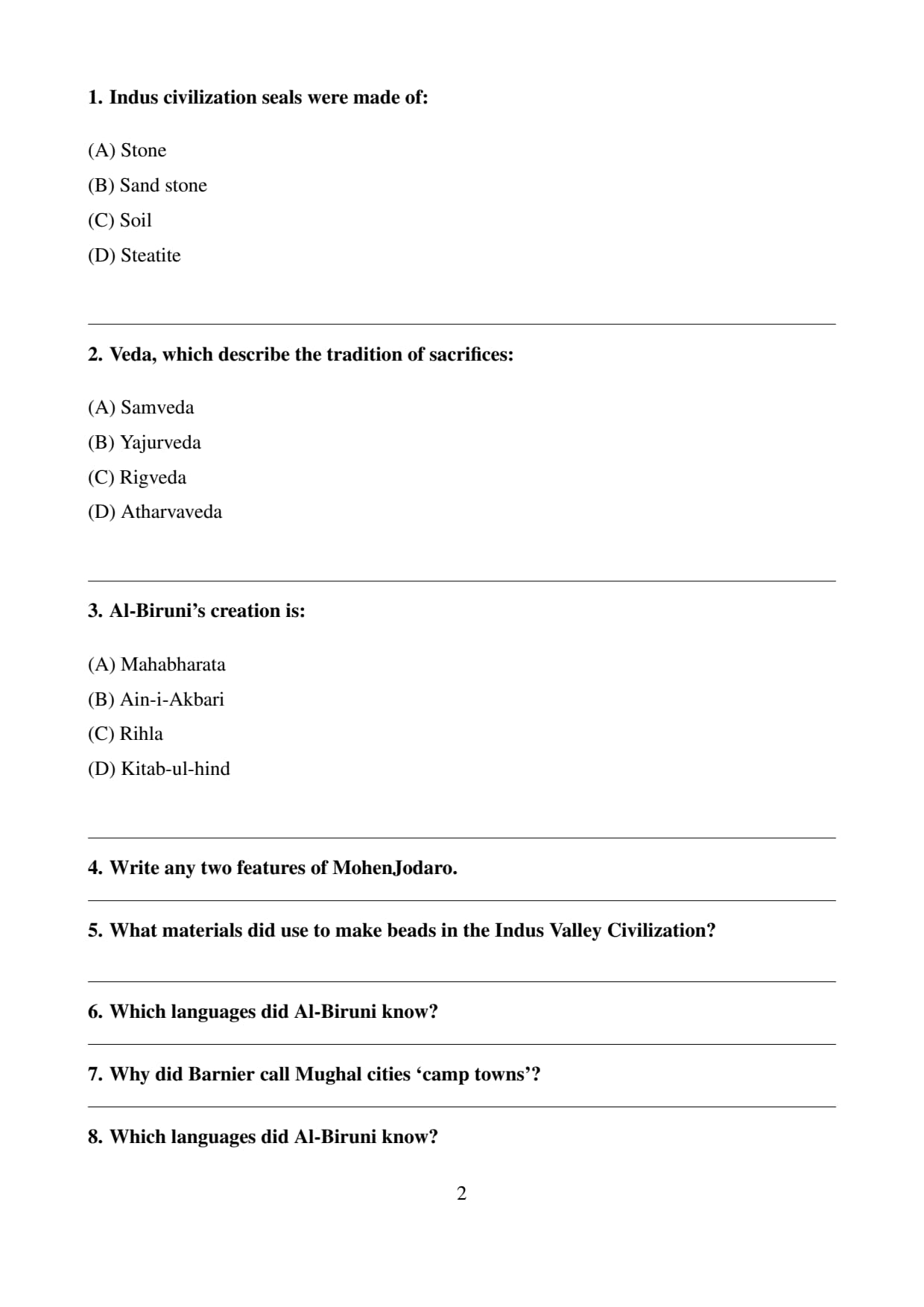
Indus civilization seals were made of:
View Solution
Indus civilization seals were made primarily of Steatite, a fine-grained variety of soapstone, which was widely used for creating seals due to its softness and ease of carving. These seals were essential in the administration and trade of the Indus Valley Civilization, often used for stamping and marking goods.
Step 1: Analyze the options.
- (A) Stone: While seals could be made from various stones, it is not the most common material used for Indus civilization seals.
- (B) Sandstone: This was used in some other artifacts but not the main material for the seals.
- (C) Soil: This is not a suitable material for creating durable seals.
- (D) Steatite: This was the primary material for Indus seals, known for its softness and ability to hold fine detail.
Step 2: Conclusion.
The seals from the Indus Valley Civilization were predominantly made of Steatite. Hence, the correct answer is (D).
Final Answer: \[ \boxed{(D) \, Steatite} \] Quick Tip: Indus seals are typically made of Steatite due to its ability to hold fine carvings and inscriptions, which were vital for trade and administration in the civilization.
Veda, which describe the tradition of sacrifices:
View Solution
The Yajurveda is the Veda that primarily deals with the traditions and rituals of sacrifices. It is a collection of hymns and verses used in the performance of sacrifices and rituals.
Step 1: Analyze the options.
- (A) Samveda: The Samveda focuses on the musical chanting and melodies of hymns, not on sacrifices.
- (B) Yajurveda: This Veda contains instructions for performing rituals, sacrifices, and ceremonies, making it the correct answer.
- (C) Rigveda: The Rigveda is a collection of hymns and praises to the gods but does not focus on sacrifices as much as the Yajurveda.
- (D) Atharvaveda: The Atharvaveda contains hymns for everyday life and healing but does not primarily focus on sacrifices.
Step 2: Conclusion.
The correct answer is (B) Yajurveda, as it specifically describes the tradition of sacrifices in its content.
Final Answer: \[ \boxed{(B) \, Yajurveda} \] Quick Tip: The Yajurveda is associated with the rituals and sacrifices in Vedic tradition, whereas the other Vedas focus on hymns, melodies, and daily life.
Al-Biruni’s creation is:
View Solution
Al-Biruni's famous work is Kitab-ul-hind, which is a comprehensive study of the Indian subcontinent, its culture, religion, philosophy, and science. It is a critical text in understanding the history of India from a foreign perspective.
Step 1: Analyze the options.
- (A) Mahabharata: This is an ancient Indian epic, but it is not the work of Al-Biruni.
- (B) Ain-i-Akbari: This work is attributed to Abu’l-Fazl, not Al-Biruni.
- (C) Rihla: This is the travelogue by Ibn Battuta, not Al-Biruni.
- (D) Kitab-ul-hind: This is the correct answer as it is Al-Biruni's creation, focusing on India’s culture and traditions.
Step 2: Conclusion.
The correct answer is (D) Kitab-ul-hind, as it is the renowned work of Al-Biruni about India.
Final Answer: \[ \boxed{(D) \, Kitab-ul-hind} \] Quick Tip: Al-Biruni's Kitab-ul-hind is one of the most important historical texts about ancient India written by a foreign scholar.
Write any two features of MohenJodaro.
View Solution
The Indus Valley Civilization, especially MohenJodaro, is known for its advanced urban planning and distinctive features. Two important features of MohenJodaro are:
1. Urban Planning: The city of MohenJodaro was meticulously planned with a grid-like street layout, featuring wide main roads and narrow lanes. The streets were arranged in such a way that they formed a right angle, which reflects the advanced planning of the civilization. Additionally, the drainage system in the city was highly sophisticated. Wastewater from houses was carried through well-built drains that flowed into larger drainage channels. This indicates a high level of sanitation awareness and engineering expertise.
2. The Great Bath: One of the most prominent features of MohenJodaro is the Great Bath, an elaborate structure that was likely used for religious or ritualistic purposes. It was a large pool measuring about 12 meters by 7 meters, with steps leading down to it. The pool was made watertight using bitumen and was surrounded by a verandah. The presence of the Great Bath suggests the significance of water rituals and the advanced construction skills of the Indus Valley people. Quick Tip: The Great Bath and the organized urban planning with drainage systems are key features that reflect the advanced engineering skills of MohenJodaro's inhabitants.
What materials did use to make beads in the Indus Valley Civilization?
View Solution
In the Indus Valley Civilization, bead-making was a significant craft, and the people used a variety of materials to make these decorative objects. The main materials used for bead-making include:
1. Semi-precious Stones: The most common materials used for bead-making were semi-precious stones, including carnelian, agate, lapis lazuli, and turquoise. These stones were cut, polished, and shaped into beads. The skillful cutting and polishing of these stones indicate the high level of craftsmanship. The trade of semi-precious stones is also evident from the presence of these materials in regions far from the Indus Valley, suggesting that these beads were a valuable commodity.
2. Glass: Glass was another important material used to create beads in the Indus Valley Civilization. The people of the Indus Valley had the ability to manufacture glass, and the beads made from this material were colorful and varied in shape. This innovation in bead-making further demonstrates the advanced knowledge the people had of materials and their ability to work with complex substances.
3. Terracotta and Metals: In addition to stones and glass, beads were also made from terracotta (baked clay) and metals like copper and bronze. Terracotta beads were simpler in design but were still widely used, while metal beads were more intricate and may have been used by the elite or for ceremonial purposes. The use of copper and bronze highlights the metallurgical skills of the Indus Valley people. Quick Tip: The use of materials such as semi-precious stones, glass, terracotta, and metals for bead-making demonstrates the advanced skills of the Indus Valley craftsmen.
Which languages did Al-Biruni know?
View Solution
Al-Biruni was a renowned scholar and polymath of the medieval Islamic world. He was proficient in several languages, which enabled him to conduct his studies across various fields such as mathematics, astronomy, history, and philosophy. The languages Al-Biruni knew include:
1. Arabic: Al-Biruni's native language was Arabic, and he wrote most of his works in Arabic.
2. Persian: Al-Biruni also knew Persian, a language widely used in scholarly circles during his time.
3. Sanskrit: He was proficient in Sanskrit, which allowed him to study Indian texts and philosophy. His work, "Kitab al-Hind" (The Book of India), is a significant contribution to the understanding of Indian culture and science.
4. Greek: Al-Biruni was familiar with Greek, enabling him to read classical Greek texts, particularly those of Aristotle and Ptolemy. Quick Tip: Al-Biruni's knowledge of multiple languages helped him bridge the gap between different cultures and contribute to the fields of science, history, and philosophy.
Why did Barnier call Mughal cities ‘camp towns’?
View Solution
Barnier, a French traveller who visited India during the Mughal period, referred to Mughal cities as "camp towns" due to the following reasons:
1. Transitory Nature: Barnier observed that many Mughal cities, especially the imperial ones, had a transient and temporary character. The Mughal emperors often moved their courts and administrative centers from one place to another, creating a sense of impermanence in these cities.
2. Military Presence: Mughal cities, particularly those under the emperor's control, had a strong military presence, and the layout of these cities often resembled a camp in its organization. The forts, markets, and living quarters were organized with military precision, resembling the structure of a military camp.
3. Encampment of the Mughal Army: The Mughal Empire's military influence in the city planning was visible, and the emperor's army would often encamp in various locations, adding to the temporary nature of these cities. Quick Tip: Barnier’s term ‘camp towns’ refers to the temporary, militarized nature of Mughal cities, which were often designed to serve the needs of a mobile, military-based society.
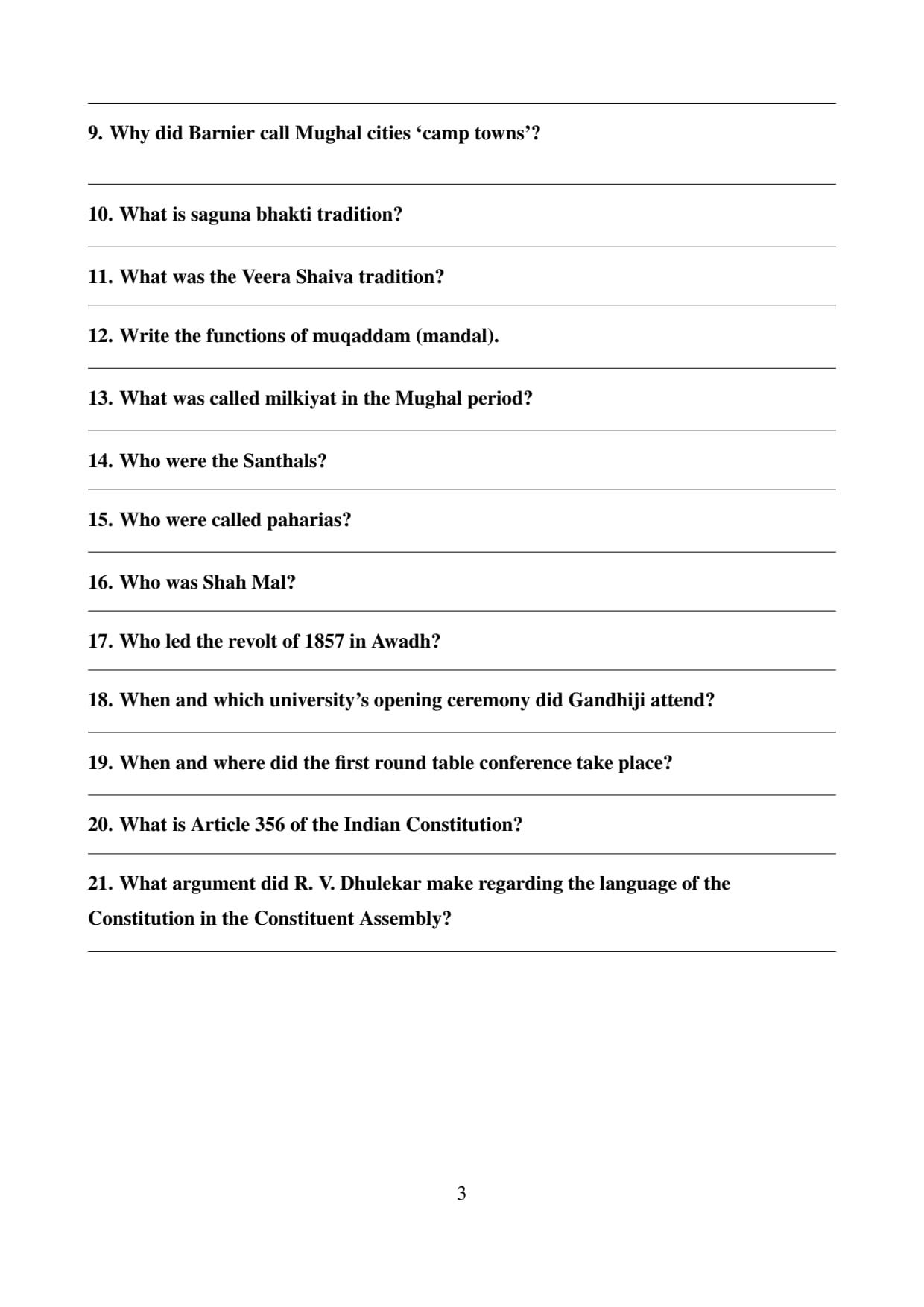
Which languages did Al-Biruni know?
View Solution
Al-Biruni was a renowned scholar and polymath of the medieval Islamic world. He was proficient in several languages, which enabled him to conduct his studies across various fields such as mathematics, astronomy, history, and philosophy. The languages Al-Biruni knew include:
1. Arabic: Al-Biruni's native language was Arabic, and he wrote most of his works in Arabic.
2. Persian: Al-Biruni also knew Persian, a language widely used in scholarly circles during his time.
3. Sanskrit: He was proficient in Sanskrit, which allowed him to study Indian texts and philosophy. His work, "Kitab al-Hind" (The Book of India), is a significant contribution to the understanding of Indian culture and science.
4. Greek: Al-Biruni was familiar with Greek, enabling him to read classical Greek texts, particularly those of Aristotle and Ptolemy. Quick Tip: Al-Biruni's knowledge of multiple languages helped him bridge the gap between different cultures and contribute to the fields of science, history, and philosophy.
Why did Barnier call Mughal cities ‘camp towns’?
View Solution
Barnier, a French traveller who visited India during the Mughal period, referred to Mughal cities as "camp towns" due to the following reasons:
1. Transitory Nature: Barnier observed that many Mughal cities, especially the imperial ones, had a transient and temporary character. The Mughal emperors often moved their courts and administrative centers from one place to another, creating a sense of impermanence in these cities.
2. Military Presence: Mughal cities, particularly those under the emperor's control, had a strong military presence, and the layout of these cities often resembled a camp in its organization. The forts, markets, and living quarters were organized with military precision, resembling the structure of a military camp.
3. Encampment of the Mughal Army: The Mughal Empire's military influence in the city planning was visible, and the emperor's army would often encamp in various locations, adding to the temporary nature of these cities. Quick Tip: Barnier’s term ‘camp towns’ refers to the temporary, militarized nature of Mughal cities, which were often designed to serve the needs of a mobile, military-based society.
What is saguna bhakti tradition?
View Solution
The **Saguna Bhakti tradition** is a form of devotional worship in Hinduism where devotees focus their worship on a personal god with specific attributes or qualities. In this tradition, God is perceived in forms that can be seen, touched, and prayed to, which is in contrast to the **Nirguna Bhakti** tradition, where God is viewed as formless and beyond human comprehension.
Key characteristics of the Saguna Bhakti tradition include:
1. Personal Deity: The devotees focus on a personal form of God such as Lord Vishnu, Shiva, or Devi, which is represented through idols, images, or natural phenomena.
2. Emotional Worship: Devotees express deep emotions through songs, prayers, and rituals, creating a personal and intimate relationship with the deity.
3. Rituals and Offerings: The tradition emphasizes the importance of performing rituals and making offerings such as flowers, food, and incense to the deity. Quick Tip: In Saguna Bhakti, God is worshipped through attributes and forms, making the relationship between the devotee and deity more personal and accessible.
What was the Veera Shaiva tradition?
View Solution
The **Veera Shaiva tradition**, also known as **Lingayatism**, emerged as a reformist movement within the Shaiva sect of Hinduism in the 12th century CE, led by the saint **Basava**. This tradition is known for its distinct practices and beliefs that set it apart from other Shaiva sects.
Key aspects of the Veera Shaiva tradition include:
1. Worship of the Lingam: The central symbol of the Veera Shaiva tradition is the **Lingam**, a representation of Lord Shiva. Devotees wear a small stone or metal lingam, known as the **Ishtalinga**, around their necks as a symbol of their faith.
2. Rejection of Rituals and Caste System: Veera Shaivism emphasized individual devotion to Lord Shiva and rejected the traditional caste system and elaborate rituals prevalent in orthodox Hinduism.
3. Focus on Inner Devotion and Meditation: The tradition emphasized **self-realization** and the internal worship of Lord Shiva, rather than performing external rituals. The goal was to achieve spiritual enlightenment through **inner devotion** and **meditation**. Quick Tip: The Veera Shaiva tradition emphasizes personal devotion to Lord Shiva, rejecting ritualism and the caste system, while focusing on self-realization through meditation.
Write the functions of muqaddam (mandal).
View Solution
The **Muqaddam** (also called **Mandal**) was a local administrator in the Mughal Empire, particularly in rural areas. Their primary duties involved maintaining law and order, collecting revenue, and ensuring the smooth functioning of the local administration. The key functions of a Muqaddam included:
1. Revenue Collection: The Muqaddam played an essential role in collecting land revenue from the peasants on behalf of the Mughal rulers. They were responsible for ensuring the correct amount of taxes was paid.
2. Law and Order Maintenance: They helped maintain law and order in their designated areas by resolving disputes among villagers and preventing any form of unrest.
3. Military Recruitment: Muqaddams were also responsible for organizing military recruits in case of an emergency or war. They provided soldiers from the local area to support the Mughal military.
4. Local Administration: They acted as intermediaries between the government and the people, ensuring that royal decrees were implemented and the villagers followed the prescribed rules and regulations. Quick Tip: The Muqaddam played a crucial role in both administration and military organization within the Mughal rural structure.
What was called milkiyat in the Mughal period?
View Solution
In the Mughal period, the term **Milkiyat** referred to private property or land ownership that was given to individuals, typically landowners or nobles. This land was considered the personal property of the owner, unlike state-owned land. The key points regarding **Milkiyat** include:
1. Private Land Ownership: Milkiyat was the land that belonged to private individuals and was usually granted by the emperor or the ruling authority. These individuals were responsible for managing, cultivating, and utilizing the land for their personal benefit.
2. Grant by the Emperor: The Mughal emperor would grant land to nobles, military officials, and courtiers in exchange for loyalty or service. This land was known as Milkiyat.
3. Inheritance: Milkiyat land was usually inherited by the heirs of the landowner, which allowed the ownership of land to remain within a family for generations. Quick Tip: Milkiyat referred to private land ownership in the Mughal Empire, which was granted by the emperor and could be inherited by heirs.
Who were the Santhals?
View Solution
The **Santhals** are an indigenous tribal community in India, primarily found in the states of Jharkhand, West Bengal, Bihar, Odisha, and Assam. They are one of the largest tribal groups in India and have a rich cultural and historical background. Their key characteristics include:
1. Language: The Santhals speak **Santali**, an Austroasiatic language, and their script is called the **Ol Chiki script**.
2. Religion: Traditionally, the Santhals follow **Sarnaism**, a nature-worshipping religion. They venerate nature spirits, ancestors, and various gods and goddesses. In recent times, many have adopted Christianity, while others practice Hinduism.
3. Social Organization: The Santhals have a clan-based social structure and are known for their strong community ties. Their society is organized into several clans, and they follow a collective decision-making process in local matters.
4. Economy: The Santhals are traditionally farmers, growing crops such as rice, maize, and vegetables. They also engage in hunting, fishing, and gathering forest products for their livelihood. Quick Tip: The Santhals are a prominent tribal group in India known for their distinct language, culture, and traditional practices.
Who were called paharias?
View Solution
The term **Paharias** refers to the tribal communities living in the hilly and mountainous regions of the **Chotanagpur Plateau** and surrounding areas, including parts of Bihar, Jharkhand, and West Bengal. They are called "Paharias" because of their habitat in the **hills (Pahad)**. The key characteristics of the Paharias include:
1. Geography: Paharias traditionally reside in the hilly and forested regions of the Chotanagpur Plateau, which provides them with an environment suited to their lifestyle of agriculture, hunting, and gathering.
2. Social Structure: The Paharias have a simple social organization, and their communities are often isolated from other groups. They traditionally have their own customs and systems of governance, led by local elders.
3. Economy: They are primarily engaged in **subsistence farming** and depend on the cultivation of crops such as rice, maize, and millet. They also engage in hunting, gathering forest products, and livestock farming.
4. Interaction with Other Communities: Historically, the Paharias were semi-nomadic, but over time they have adopted more settled lifestyles. They have been involved in various historical movements, particularly the resistance against British colonial rule. Quick Tip: The Paharias are known for their hilly, forested habitat and traditional subsistence farming practices. They are an important tribal group in the Chotanagpur region.
Who was Shah Mal?
View Solution
**Shah Mal** was a prominent leader during the **1857 revolt (Indian Rebellion of 1857)**, especially in the region of **Awadh**. He was known for his role in organizing the peasants and local forces against British rule. Key details about Shah Mal include:
1. Role in the Rebellion: Shah Mal played a crucial role in the **revolt of 1857** in Awadh by leading the local resistance against British forces. His leadership was vital in coordinating the efforts of the peasantry and other local groups in the region.
2. Peasant Leadership: He was recognized for his ability to mobilize the common people, especially the peasants, to fight against the British authorities. His efforts were part of the larger anti-colonial struggle that spread across North India during the rebellion.
3. Legacy: Although Shah Mal's role in the rebellion was largely overshadowed by other leaders, he is remembered for his significant contributions to the resistance in the Awadh region. Quick Tip: Shah Mal was a key leader in the 1857 revolt in Awadh, organizing peasants and locals in the fight against British rule.
Who led the revolt of 1857 in Awadh?
View Solution
The **1857 revolt** in **Awadh** (also known as the **Indian Rebellion of 1857**) was one of the most significant uprisings against British colonial rule. The revolt in Awadh was primarily led by **Begum Hazrat Mahal**, the wife of the exiled Nawab Wajid Ali Shah. Key details about her leadership include:
1. Leadership Role: **Begum Hazrat Mahal** took charge after the British forces exiled her husband, the Nawab of Awadh, to Kolkata. She played a vital role in rallying the people of Awadh to resist British rule.
2. Military Strategy: She led the rebellion with remarkable military strategy, holding the fort at **Lucknow** and organizing the local forces against the British.
3. Symbol of Resistance: Begum Hazrat Mahal became a symbol of resistance for the people of Awadh and is remembered for her courage and leadership during the rebellion. Although the British eventually suppressed the rebellion, her leadership was a crucial part of the 1857 uprising. Quick Tip: Begum Hazrat Mahal was one of the prominent leaders of the 1857 revolt in Awadh, playing a significant role in leading the resistance against British forces.
When and which university's opening ceremony did Gandhiji attend?
View Solution
Gandhiji, also known as Mahatma Gandhi, attended the opening ceremony of the **Banaras Hindu University (BHU)**. This was a significant event in Indian history, marking the establishment of a prestigious educational institution in the country. Key details include:
1. Date and Event: Gandhiji attended the opening ceremony of the Banaras Hindu University on **February 6, 1916**.
2. Significance: The establishment of BHU was an important milestone in the development of modern education in India. Gandhiji's participation in the event symbolized his support for educational reforms and his involvement in national movements for progress and unity. Quick Tip: Mahatma Gandhi attended the opening ceremony of Banaras Hindu University on February 6, 1916, emphasizing the importance of education in India's struggle for independence.
When and where did the first round table conference take place?
View Solution
The **First Round Table Conference** was an important event in the history of India's struggle for independence. It was a series of meetings between the British government and Indian political leaders to discuss constitutional reforms. Key details include:
1. Date and Location: The **First Round Table Conference** took place in **London**, starting on **November 12, 1930**.
2. Significance: The conference was convened by the British government, but it was boycotted by Mahatma Gandhi and the Indian National Congress, as they were protesting the British decision to imprison many of their leaders. Despite this, several Indian leaders and representatives attended the conference to discuss constitutional reforms and the future of India.
3. Impact on Indian Politics: Although the first conference did not lead to immediate results, it marked a critical step in India's constitutional development and was part of the larger movement toward self-rule. Quick Tip: The First Round Table Conference in London in 1930 was an important political meeting, though it did not result in significant progress toward Indian self-rule.
What is Article 356 of the Indian Constitution?
View Solution
**Article 356** of the Indian Constitution deals with the **provisions regarding the imposition of President's Rule** in a state in case of failure of constitutional machinery. It is often referred to as the **President's Rule**. Key aspects of Article 356 include:
1. Failure of Constitutional Machinery: Article 356 allows the President of India to take over the governance of a state if the President believes that the government of the state cannot function according to the provisions of the Constitution. This usually happens when there is a breakdown of law and order or a failure to comply with constitutional provisions.
2. Imposition of Central Rule: When Article 356 is invoked, the central government takes control of the state's administration, and the state legislature is either dissolved or suspended. The President can rule the state directly through the central government.
3. Duration and Revocation: President's Rule under Article 356 can last for six months at a time and can be extended for up to three years with the approval of Parliament. However, the rule can also be revoked earlier if the situation improves. Quick Tip: Article 356 empowers the President to impose central rule in a state where the constitutional machinery has failed, essentially taking over the state's administration.
What argument did R. V. Dhulekar make regarding the language of the Constitution in the Constituent Assembly?
View Solution
**R. V. Dhulekar**, a member of the **Constituent Assembly of India**, was known for his arguments on the language to be used in the Indian Constitution. His key argument was:
1. Use of Hindi: Dhulekar strongly advocated for the inclusion of **Hindi** as the national language of India, arguing that it was the language of the masses and would foster unity among the people of India. He believed that a common language would help bridge the cultural and regional diversities of the country.
2. Opposition to English: Dhulekar also argued against the continued use of **English** in official documents and in the Constituent Assembly proceedings. He felt that English, though important for communication in certain areas, should not be the medium for the Constitution as it would alienate the common people who were not familiar with it.
3. Emphasis on National Identity: His arguments were rooted in the idea of building a national identity, where the Constitution would reflect the linguistic diversity of India and represent the culture and aspirations of the Indian people. Quick Tip: R. V. Dhulekar advocated for the use of Hindi as the national language in the Indian Constitution, emphasizing the need for a language that would unite the diverse regions of India.



Comments