




MP Board is conducting the Class 12 Business Studies Board Exam 2026 on February 18, 2026. Class 12 Business Studies Question Paper with Solution PDF is available here for download.
The official question paper of MP Board Class 12 Business Studies Board Exam 2026 is provided below. Students can download the official paper in PDF format for reference.
MP Board Class 12 2026 Business Studies Question Paper with Solution PDF
| MP Board Class 12 2026 Business Studies Question Paper with Solution PDF | Download PDF | Check Solutions |
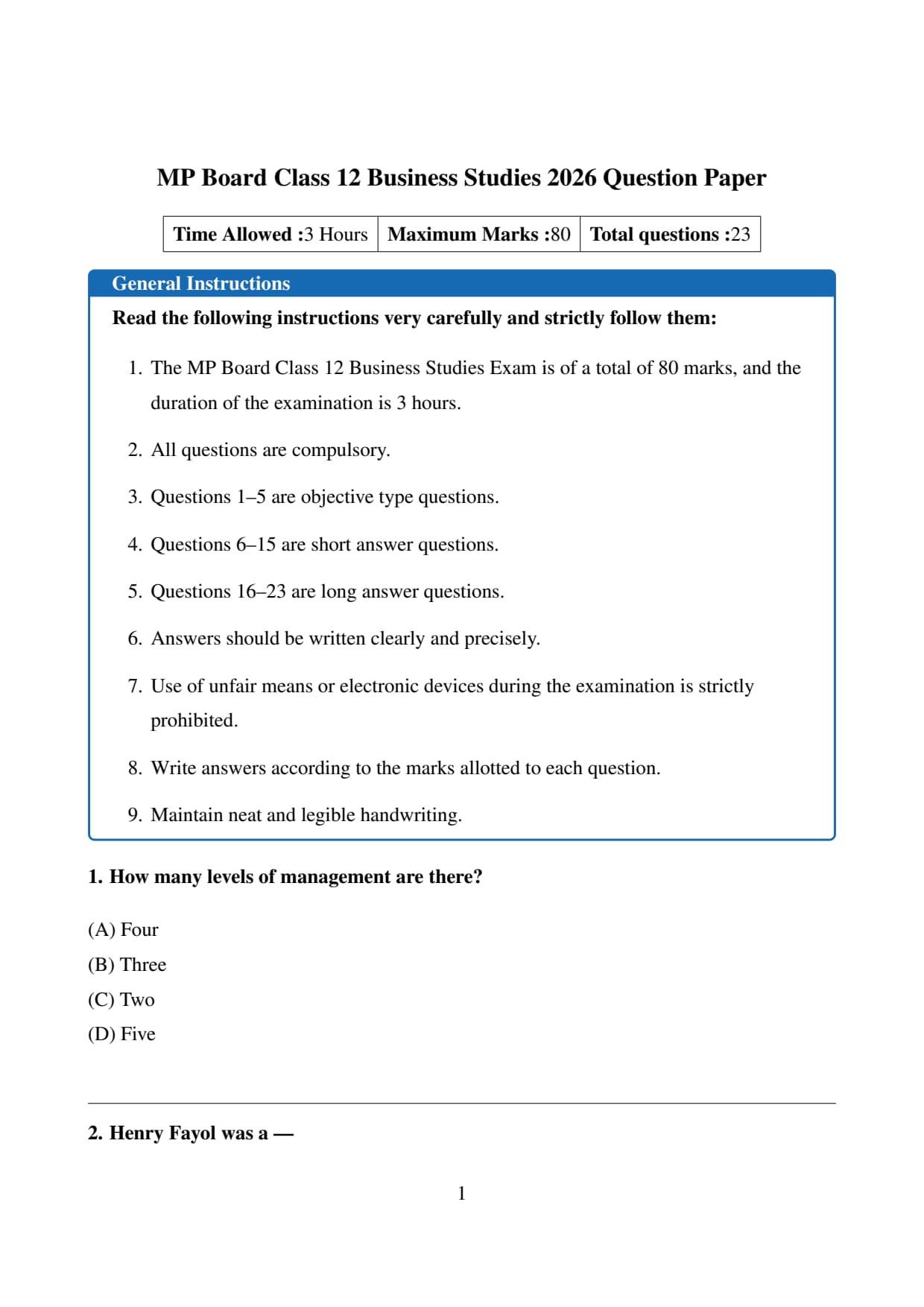
How many levels of management are there?
View Solution
Management is generally divided into three levels — top level, middle level, and lower level management. These levels ensure proper planning, coordination, and supervision within the organization.
Step 1: Analyze the options.
- (A) Four: Incorrect classification.
- (B) Three: Correct — standard management levels.
- (C) Two: Incomplete classification.
- (D) Five: Not recognized in management theory.
Step 2: Conclusion.
Hence, the correct answer is (B).
Final Answer: \[ \boxed{(B) \, Three} \] Quick Tip: Top level plans, middle level coordinates, and lower level supervises execution of work.
Henry Fayol was a —
View Solution
Henry Fayol was a French mining engineer who developed administrative management theory and proposed fourteen principles of management.
Step 1: Analyze the options.
- (A) Social Scientist: Incorrect.
- (B) Mining Engineer: Correct.
- (C) Accountant: Incorrect.
- (D) Production Engineer: Incorrect.
Step 2: Conclusion.
Therefore, option (B) is correct.
Final Answer: \[ \boxed{(B) \, Mining Engineer} \] Quick Tip: Henry Fayol is known as the Father of Administrative Management.
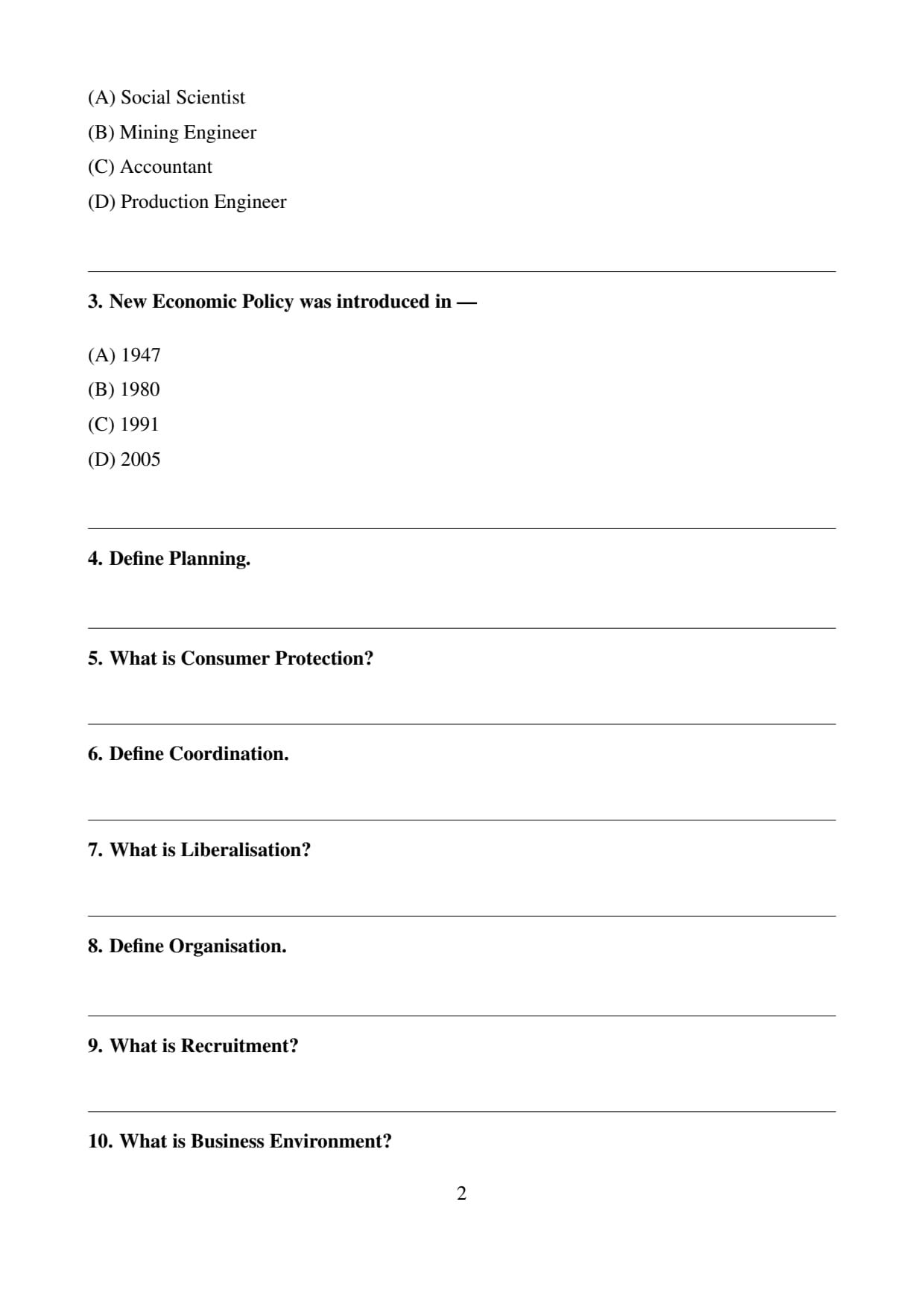
New Economic Policy was introduced in —
View Solution
India introduced the New Economic Policy in 1991 to overcome economic crisis. It emphasized liberalisation, privatisation, and globalisation to promote economic growth.
Step 1: Analyze the options.
- (A) 1947: Year of independence.
- (B) 1980: Incorrect.
- (C) 1991: Correct year.
- (D) 2005: Incorrect.
Step 2: Conclusion.
Hence, option (C) is correct.
Final Answer: \[ \boxed{(C) \, 1991} \] Quick Tip: The 1991 reforms opened the Indian economy to global competition.
Define Planning.
View Solution
Planning is the process of deciding in advance what to do, how to do it, when to do it, and who will do it. It provides direction to all organizational activities and reduces uncertainty about the future. Quick Tip: Planning is the primary function of management and forms the basis for all other functions.
What is Consumer Protection?
View Solution
Consumer protection refers to safeguarding consumers against unfair trade practices, defective goods, and exploitation by sellers. It ensures that consumers receive quality products, proper information, and legal remedies when their rights are violated. Quick Tip: Consumer Protection Act protects rights such as safety, information, choice, and redressal.
Define Coordination.
View Solution
Coordination is the process of integrating and harmonizing the activities of different individuals and departments so that organizational objectives are achieved efficiently. It ensures unity of action and prevents conflicts or duplication of work. Quick Tip: Coordination is called the essence of management because it binds all managerial functions together.
What is Liberalisation?
View Solution
Liberalisation refers to the removal or relaxation of government restrictions and controls on business activities. It allows private enterprises greater freedom to operate, promotes competition, and encourages economic growth. Quick Tip: Liberalisation was a key component of India’s 1991 economic reforms.
Define Organisation.
View Solution
Organisation is the process of arranging tasks, resources, and authority in a structured manner so that objectives can be achieved efficiently. It defines roles, responsibilities, and relationships among employees. Quick Tip: A sound organisational structure improves efficiency and coordination.
What is Recruitment?
View Solution
Recruitment is the process of searching for and attracting qualified candidates to apply for jobs in an organization. It ensures that the organization has a pool of suitable applicants for selection. Quick Tip: Recruitment is a positive process because it increases the number of applicants.
What is Business Environment?
View Solution
Business environment consists of all external factors such as economic, social, political, technological, and legal forces that influence business operations and decision-making. Quick Tip: A favourable environment promotes growth, while an unfavourable one creates challenges.
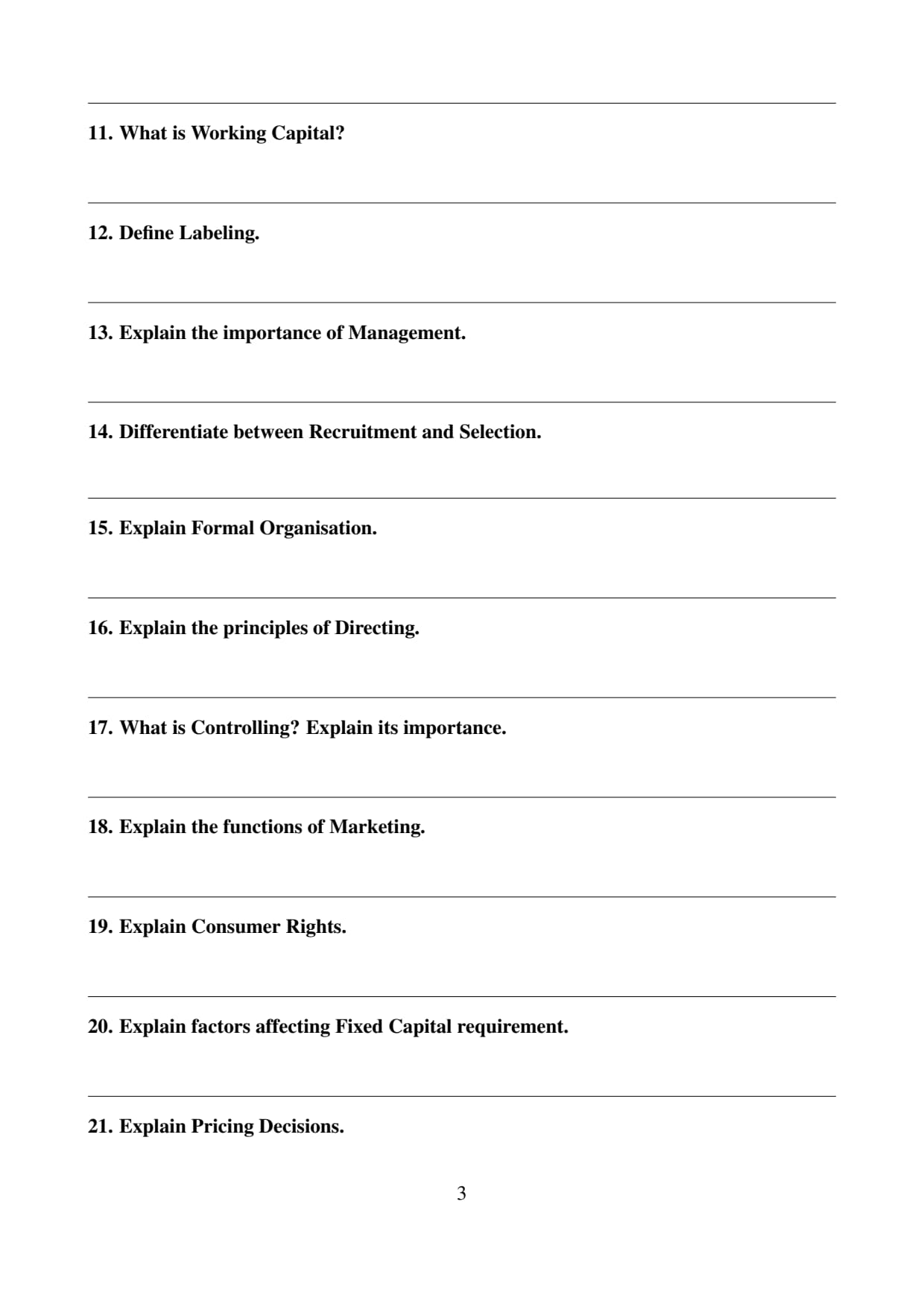
What is Working Capital?
View Solution
Working capital refers to the funds required for day-to-day operations of a business. It is the difference between current assets and current liabilities and ensures smooth functioning of business activities. Quick Tip: Adequate working capital ensures liquidity and operational efficiency.
Define Labeling.
View Solution
Labeling refers to providing detailed information about a product on its package, such as brand name, ingredients, usage instructions, manufacturing date, and price. It helps consumers make informed decisions. Quick Tip: Labeling protects consumers by ensuring transparency.
Explain the importance of Management.
View Solution
Management is important because it helps in achieving organizational goals efficiently by coordinating human and material resources. It ensures optimum utilization of resources, improves productivity, maintains discipline, and facilitates growth and stability of the organization. Quick Tip: Effective management converts resources into results.
Differentiate between Recruitment and Selection.
View Solution
Recruitment is the process of attracting potential candidates to apply for jobs, whereas selection involves choosing the most suitable candidate from the applicants. Recruitment is a positive process, while selection is a negative process as it eliminates unsuitable candidates. Quick Tip: Recruitment builds the applicant pool; selection picks the best candidate.
Explain Formal Organisation.
View Solution
A formal organisation is a deliberately created structure of roles and authority relationships designed to achieve organizational objectives. It is based on rules, procedures, and official communication channels. Quick Tip: Formal organisation ensures discipline and accountability.
Explain the principles of Directing.
View Solution
Directing involves guiding, supervising, and motivating employees to achieve organizational objectives. Important principles include unity of command, effective communication, leadership, and motivation, which ensure efficient performance of employees. Quick Tip: Directing activates all other managerial functions.
What is Controlling? Explain its importance.
View Solution
Controlling is the process of comparing actual performance with planned standards and taking corrective action if deviations occur. It ensures that organizational activities are carried out according to plans and objectives. Quick Tip: Controlling closes the management cycle by ensuring plans are achieved.
Explain the functions of Marketing.
View Solution
Marketing functions include product planning, pricing, promotion, and distribution. These functions aim to satisfy customer needs while ensuring profitability for the organization. Quick Tip: Marketing focuses on customer satisfaction and value creation.
Explain Consumer Rights.
View Solution
Consumer rights include the right to safety, right to information, right to choice, right to be heard, right to redressal, and right to consumer education. These rights protect consumers from exploitation. Quick Tip: Awareness of rights empowers consumers.
Explain factors affecting Fixed Capital requirement.
View Solution
Fixed capital requirements depend on nature of business, scale of operations, technology used, and growth prospects. Capital-intensive industries require more fixed capital than service industries. Quick Tip: Fixed capital refers to long-term investment in assets like land, buildings, and machinery.
Explain Pricing Decisions.
View Solution
Pricing decisions depend on cost of production, demand, competition, and government policies. Proper pricing ensures profitability while remaining attractive to customers. Quick Tip: Price is the only element of marketing mix that generates revenue.
Explain functions of Management.
View Solution
The main functions of management are planning, organizing, staffing, directing, and controlling. These functions are interrelated and help achieve organizational objectives efficiently. Quick Tip: Management functions together ensure effective organizational performance.
Explain the importance of Consumer Protection.
View Solution
Consumer protection is important to safeguard buyers from exploitation, ensure availability of quality goods, promote fair trade practices, and maintain confidence in the market system. It also compels businesses to act responsibly. Quick Tip: Consumer protection promotes ethical business practices.



Comments