



IIT JAM 2025 Physics (PH) scheduled for today, February 2, 2025, in Shift 2, between 2:30 PM and 5:30 PM is now concluded. The initial reaction of candidates is that the exam was moderate difficulty level, containing a mix of conceptual and numerical problems.
The questions will be from the following topics: Mechanics, Electrodynamics, Thermodynamics, and Modern Physics, and will comprise 60 questions: 30 MCQs, 10 MSQs, and 20 NATs, which are worth a total of 100 marks, and the negative marking is only for the MCQs.
Also, Check: IIT JAM 2025 Question Paper
IIT JAM 2025 Physics(PH) Question Paper with Answer Key PDFs
| IIT JAM 2025 Physics (PH) Question Paper with Answer Key PDFs | Download PDF | Check Solutions |

IIT JAM 2025 Physics(PH):Expected Difficulty Level
Consider a volume V enclosed by a closed surface S having unit surface normal \(\hat{n}\). For \(\mathbf{r} = x\hat{i} + y\hat{j} + z\hat{k}\), the value of the surface integral \(\frac{1}{9} \oint_{S} \mathbf{r} \cdot \hat{n} \,dS\) is
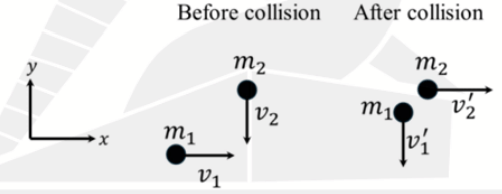
Two point-particles having masses \(m_1\) and \(m_2\) approach each other in perpendicular directions with speeds \(v_1\) and \(v_2\), respectively, as shown in the figure below. After an elastic collision, they move away from each other in perpendicular directions with speeds \(v'_1\) and \(v'_2\), respectively.
The ratio \(\frac{v'_1}{v_1}\) is
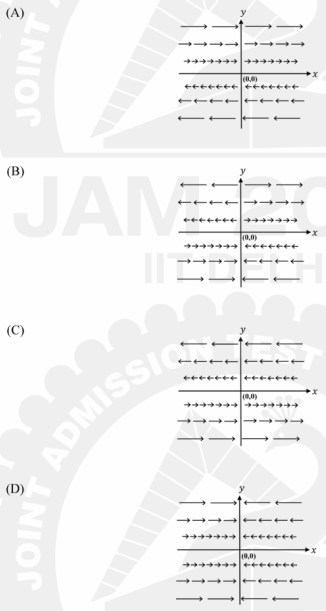
Which one of the following figures represents the vector field \(\mathbf{A} = y\hat{i}\)?
(\(\hat{i}\) is the unit vector along the x-direction)
Two parallel light rays 1 and 2 are incident from air on a system consisting of media P, Q, and air, as shown in the figure below. The incident angle is 45°. Ray 1 passes through medium P, air and medium Q and ray passes through media P and Q before leaving the system. After passing through the system, the angular deviation (in radians) between the two rays is
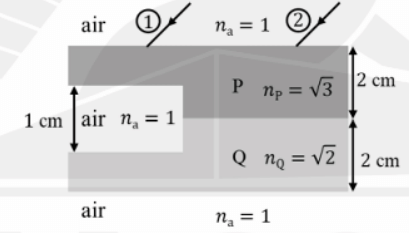
The dimensions of the media and their refractive indices (\(n_a, n_P\) and \(n_Q\)) are shown in the figure
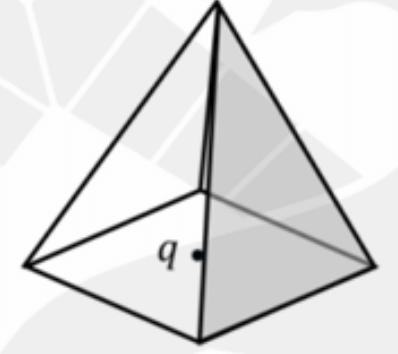
A charge q is placed at the centre of the base of a square pyramid. The net outward electric flux across each of the slanted faces is
(Consider permittivity as \(\epsilon_0\))
Consider a parallel plate capacitor (distance between the plates d, and permittivity \(\epsilon_0\)) as shown in the figure below. The space charge density between the plates varies as \(\rho(x) = \rho_0 e^{-x}\). Voltage \(V = 0\) both at \(x = 0\) and \(x = d\). The voltage \(V(x)\) at point P between the plates is
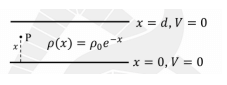
\(\rho_0\) is a constant of appropriate dimensions
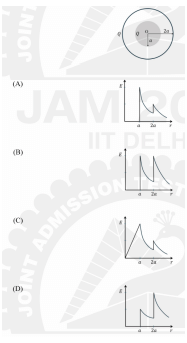
Consider a metal sphere enclosed concentrically within a spherical shell. The inner sphere of radius a carries charge Q. The outer shell of radius 2a also has charge Q. The variation of the magnitude E of the electric field as a function of distance r from the center O is
Consider radioactive decays \(A \to B\) with half-life \((T_{1/2})_A\), and \(B \to C\) with half-life \((T_{1/2})_B\). At any time t, the number of nuclides of B is given by
\( (N_B)_t = \frac{\lambda_A}{\lambda_B - \lambda_A}(N_A)_0 (e^{-\lambda_A t} - e^{-\lambda_B t}) \),
where \((N_A)_0\) is the number of nuclides of A at \(t = 0\). The decay constants of A and B are \(\lambda_A\) and \(\lambda_B\), respectively.
If \((T_{1/2})_B < (T_{1/2})_A\), then the ratio \(\frac{(N_B)_t}{(N_A)_t}\) at time \(t \gg (T_{1/2})_A\) is
\((N_A)_t\) is the number of nuclides of A at time t
For a non-relativistic free particle, the ratio of phase velocity to group velocity is
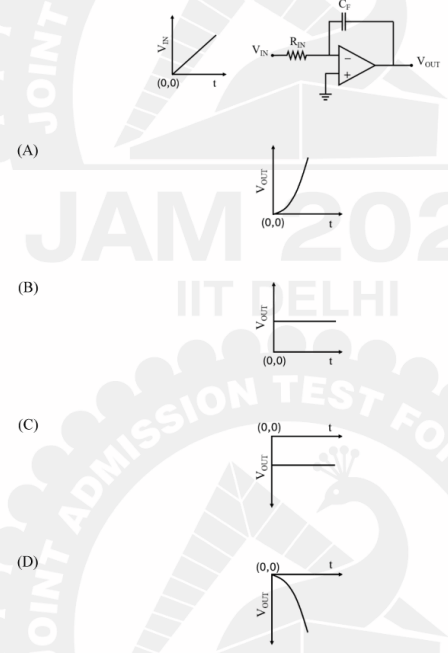
If the input voltage waveform \(V_{IN}\) is a ramp function (as shown in the \(V_{IN} - t\) plot below), then the output wave form (\(V_{OUT}\)) for the given circuit diagram having an ideal operational amplifier (Op-Amp) is
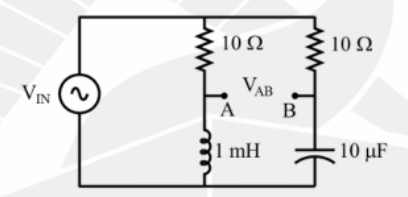
In the circuit given below, the frequency of the input voltage \(V_{IN}\) is \(\omega = 10^4\) rad/s. The output voltage \(V_{AB}\) leads \(V_{IN}\) by
Given a function \(f(x, y) = \frac{x}{a}e^y + \frac{y}{b}e^x\), where \(x = at\) and \(y = bt\) (a and b are non-zero constants), the value of \(\frac{df}{dt}\) at \(t = 0\) is
If the system of linear equations
x + my + az = 0
2x + ay + mz = 0
ax + 2y - z = 0
with m and a as non-zero constants, admits a non-trivial solution, then which one of the following conditions is correct?
If \(\left(\frac{1-i}{1+i}\right)^{n/2} = -1\), where \(i = \sqrt{-1}\), one possible value of n is
In Cartesian coordinates, consider the functions \(u(x, y) = \frac{1}{2}(x^2 - y^2)\) and \(v(x,y) = xy\). If \((r, \theta)\) are the polar coordinates, the Jacobian determinant \(|\frac{\partial(u,v)}{\partial(r,\theta)}|\) is
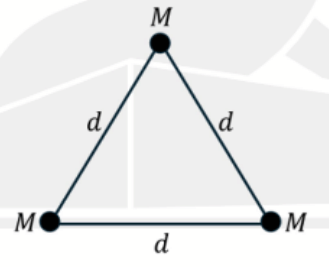
Three particles of equal mass M, interacting via gravity, lie on the vertices of an equilateral triangle of side d, as shown in the figure below. The whole system is rotating with an angular velocity \(\omega\) about an axis perpendicular to the plane of the system and passing through the center of mass. The value of \(\omega\), for which the distance between the masses remains d, is
(G is the universal gravitational constant)
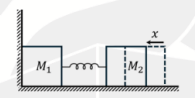
Two masses, \(M_1\) and \(M_2\), are connected through a massless spring of spring constant k, as shown in the figure below. The mass \(M_1\) is at rest against a rigid wall. Both \(M_1\) and \(M_2\) are on a frictionless surface. The mass \(M_2\) is pushed towards \(M_1\) by a distance x from its equilibrium position and then released. After \(M_1\) leaves the wall, the speed of the center of mass of the composite system is
One end of a long chain is lifted vertically from flat ground to a height H with constant speed v by a force of magnitude F. Assume that the length of the chain is greater than H and that it has a uniform mass per unit length \(\rho\). The magnitude of the force F at height H is
(g is the acceleration due to gravity)
For a two-slit Fraunhofer diffraction, each slit is 0.1 mm wide and separation between the two slits is 0.8 mm. The total number of interference minima between the first diffraction minima on both sides of the central maxima is
Consider the superposition of two orthogonal simple harmonic motions \(y_1 = a \cos 2\omega t\) and \(y_2 = b \cos(\omega t + \phi)\). If \(\phi = \pi\), the resultant motion will represent
(a, b and \(\omega\) are constants with appropriate dimensions)
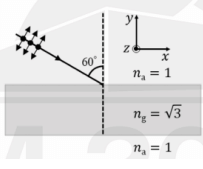
An unpolarized light ray passing through air (refractive index \(n_a = 1\)) is incident on a glass slab (refractive index \(n_g = \sqrt{3}\)) at an angle of 60°, as shown in the figure below. The amplitude of the in-plane (x-y) electric field component of the incident light is 4 V/m and amplitude of the out of plane (z) electric field component is 3 V/m. After passing through the glass slab, the electric field amplitude (in V/m) of the light is
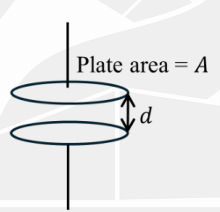
Consider a slowly charging parallel plate capacitor (distance between the plates is d) having circular plates each with an area A, as shown in the figure below. An electric field of magnitude \(E = E_0\sin(\omega t)\) exists between the plates while charging. The associated magnitude of the magnetic field B at the periphery (outer edge) of the capacitor is
(Neglect fringe effects)
A surface current density \(\mathbf{K} = ae^{-y}\) exists on a thin strip of width b, as shown in the figure below. The associated surface current is
(a is a constant of appropriate dimensions)
For an electromagnetic wave, consider an electric field \(E = E_0e^{-i[a(x+y)-\omega t]}\hat{k}\). The corresponding magnetic field \(B\) is (\(E_0, a, \omega\) are constants of appropriate dimensions and c is the speed of light)
Consider Maxwell's relation \( \left(\frac{\partial S}{\partial V}\right)_T = \left(\frac{\partial P}{\partial T}\right)_V \). The equation of state of a thermodynamic system is given as \( P = \frac{AT}{\sqrt{V}} + \frac{BT^3}{V} \), where A and B are constants of appropriate dimensions. Then \( \left(\frac{\partial C_V}{\partial V}\right)_T \) of the system varies with temperature as (\(C_V\) is the heat capacity at constant volume)
Consider a relativistic particle of rest mass 2m moving with a speed v along the x direction. It collides with another relativistic particle of rest mass m moving with the same speed but in the opposite direction. These two particles coalesce to form one particle whose rest mass M is
(\(\beta = \frac{v}{c}\), where c is the speed of light)
A particle of mass m is subjected to a potential V(x). If its wavefunction is given by
\(\psi(x,t) = \alpha x^2 e^{-\beta x} e^{i\gamma t/\hbar}, x > 0\)
\(\psi(x,t) = 0, x \le 0\),
then V(x) is (\(\alpha\), \(\beta\) and \(\gamma\) are constants of appropriate dimensions)
Two non-relativistic particles with masses \(m_1\) and \(m_2\) move with momenta \(\mathbf{p}_1\) and \(\mathbf{p}_2\), respectively, in an inertial frame S. In another inertial frame S', moving with a constant speed with respect to S, the same particles are observed to have momenta \(\mathbf{p'}_1\) and \(\mathbf{p'}_2\), respectively.
Galilean invariance implies that
The binding energy B(A,Z) of an atomic nucleus of mass number A, atomic number Z, and number of neutrons N = A-Z, can be expressed as \[ B(A,Z) = a_1 A - a_2 A^{2/3} - a_3 \frac{Z^2}{A^{1/3}} - a_4 \frac{(A-2Z)^2}{A} \]
where \(a_1, a_2, a_3\), and \(a_4\) are constants of appropriate dimensions.
Let \(B(A, Z')\) be the binding energy of a mirror nucleus (which has the same A, but the number of protons and neutrons are interchanged).
Then, at constant A, \([B(A,Z) - B(A,Z')]\) is
A magnetic field is given by \(\mathbf{B} = \nabla \times \mathbf{A}\) where \(\mathbf{A}\) is the magnetic vector potential. If \(\mathbf{A} = (ax^2 + by^2)\hat{i}\), the corresponding current density \(\mathbf{J}\) is
(a and b are non-zero constants)
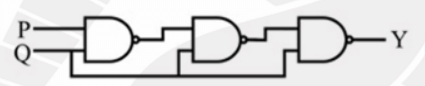
In the logic circuit shown below, for which of the following combination(s) of inputs P and Q, the output Y will be 0?
Two particles of masses \(m_1\) and \(m_2\), interacting via gravity, rotate in circular orbits about their common center of mass with the same angular velocity \(\omega\).
For masses \(m_1\) and \(m_2\), respectively,
\(r_1\) and \(r_2\) are the constant distances from the center of mass,
\(L_1\) and \(L_2\) are the magnitudes of the angular momenta about the center of mass, and
\(K_1\) and \(K_2\) are the kinetic energies.
Which of the following is(are) correct?
(G is the universal gravitational constant)
Which of these cubic lattice plane pairs is(are) perpendicular to each other?
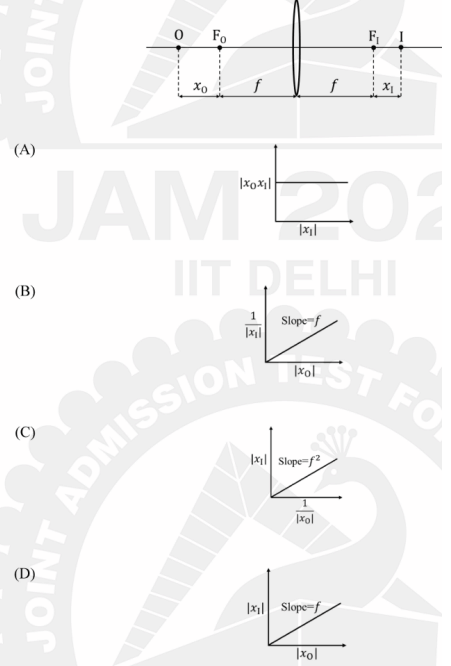
For a thin convex lens of focal length f, the image of an object at O is formed at I, as shown in the figure below. The distances of object and image from the two focal points (\(F_O\) and \(F_I\)) are \(x_O\) and \(x_I\), respectively. Which of the following graphs correctly represent(s) the variation of the quantities shown in the figure?
Identify which of the following wave functions describe(s) travelling wave(s).
(\(A_0, B_0, a\), and \(b\) are positive constants of appropriate dimensions)
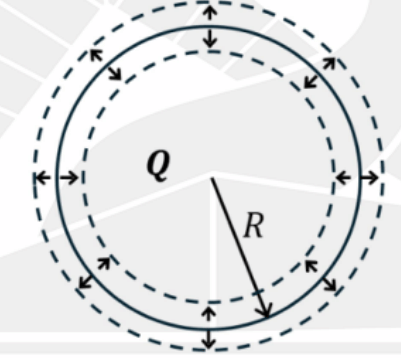
A spherical ball having a uniformly distributed charge Q and radius R pulsates with frequency \(\omega\) such that the radius changes by \(\pm 10%\), as shown in the figure below. Which of the following is(are) correct?
Which of the following relations is(are) valid for linear dielectrics?
\(E\) = Electric field, \(P\) = Polarization, \(D\) = Electric displacement, \(\epsilon_0\) = Permittivity of free space, \(\epsilon\) = Dielectric permittivity, \(\chi_e\) = Electric susceptibility, \(\rho_f\) = Free charge density, \(\rho_b\) = Bound charge density
Three gaseous systems, \(G_1, G_2\), and \(G_3\) with pressure and volume (\(P_1, V_1\)), (\(P_2, V_2\)), and (\(P_3, V_3\)), respectively, are such that
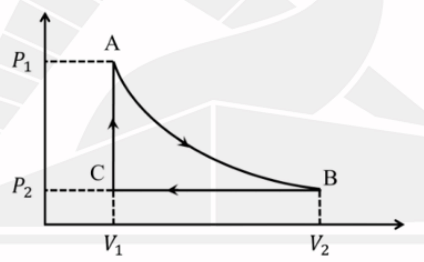
An ideal mono-atomic gas is expanded adiabatically from A to B. It is then compressed in an isobaric process from B to C. Finally, the pressure is increased in an isochoric process from C to A. The cyclic process is shown in the figure below. For this system, which of the following is(are) correct?
For a body centered cubic (bcc) system, the x-ray diffraction peaks are observed for the following \(h^2+k^2+l^2\) value(s)
Two solid cylinders of the same density are found to have the same moment of inertia about their respective principal axes. The length of the second cylinder is 16 times that of the first cylinder. If the radius of the first cylinder is 4 cm, the radius of the second cylinder is __________ cm. (in integer)
The shortest distance between an object and its real image formed by a thin convex lens of focal length 20 cm is __________ cm. (in integer)
Consider two media 1 and 2 having permittivities \(\epsilon_0\) and \(\epsilon_2 (= 2\epsilon_0)\), respectively. The interface between the two media aligns with the x-y plane. An electric field \(\mathbf{E}_1 = 4\hat{i} - 5\hat{j} - \hat{k}\) exists in medium 1. The magnitude of the displacement vector \(\mathbf{D}_2\) in medium 2 is __________ \(\epsilon_0\). (up to two decimal places)
G1 and G2 are two ideal gases at temperatures \(T_1\) and \(T_2\), respectively. The molecular weight of the constituents of G1 is half that of G2. If the average speeds of the molecules of both gases are equal, then assuming Maxwell-Boltzmann distributions for the molecular speeds, the ratio \(\frac{T_2}{T_1}\) is __________.
An ideal p-n junction diode (ideality factor \(\eta = 1\)) is operating in forward bias at room temperature (thermal energy = 26 meV). If the diode current is 26 mA for an applied bias of 1.0 V, the dynamic resistance (\(r_{ac}\)) is __________ \(\Omega\). (up to two decimal places)
In a two-level atomic system, the excited state is 0.2 eV above the ground state. Considering the Maxwell-Boltzmann distribution, the temperature at which 2% of the atoms will be in the excited state is __________ K. (up to two decimal places)
(Boltzmann constant \(k_B = 8.62 \times 10^{-5}\) eV/K)
Neutrons of energy 8 MeV are incident on a potential step of height 48 MeV. As they penetrate the classically forbidden region, the distance at which the probability density of finding neutrons decreases by a factor of 100 is __________ fm. (up to two decimal places)
(Take \(\hbar c = 200\) MeV fm, and the rest mass energy of neutron = 1 GeV.)
At a particular temperature T, Planck's energy density of black body radiation in terms of frequency is \(\rho_T(\nu) = 8 \times 10^{-18} J/m^3 Hz^{-1}\) at \(\nu = 3 \times 10^{14}\) Hz. Then Planck's energy density \(\rho_T(\lambda)\) at the corresponding wavelength (\(\lambda\)) has the value __________ \(\times 10^2 J/m^4\). (in integer)
[Speed of light \(c = 3 \times 10^8\) m/s]
(Note: The unit for \(\rho_T(\nu)\) in the original problem was given as J/m³, which is dimensionally incorrect for a spectral density. The correct unit J/(m³·Hz) or J·s/m³ is used here for the solution.)
The ratio of the density of atoms between the (111) and (110) planes in a simple cubic (sc) lattice is __________. (up to two decimal places)
The packing fraction for a two-dimensional hexagonal lattice having sides 2r with atoms of radii r placed at each vertex and at the center is __________. (up to two decimal places)
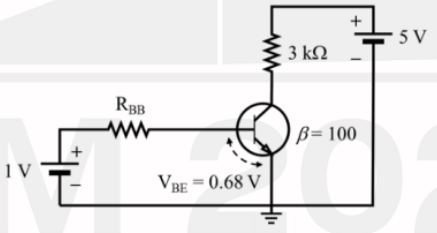
A NPN bipolar junction transistor (BJT) is connected in common emitter (CE) configuration as shown in the circuit diagram below. The amplifier is operating in the saturation regime. The collector-emitter saturation voltage (\(V_{CE,sat}\)) is 0.2 V. The current gain \(\beta = 100\). The maximum value of base resistance \(R_{BB}\) is __________ k\(\Omega\). (in integer)
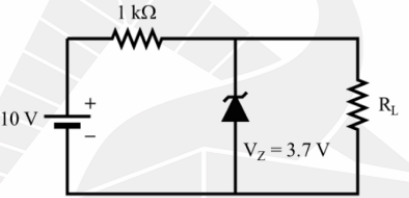
For a Zener diode as shown in the circuit diagram below, the Zener voltage \(V_Z\) is 3.7 V. For a load resistance (\(R_L\)) of 1 k\(\Omega\), a current \(I_1\) flows through the load. If \(R_L\) is decreased to 500 \(\Omega\), the current changes to \(I_2\). The ratio \(\frac{I_2}{I_1}\) is __________. (up to two decimal places)
One kg of water at 27\(^\circ\)C is brought in contact with a heat reservoir kept at 37\(^\circ\)C. Upon reaching thermal equilibrium, this mass of water is brought in contact with another heat reservoir kept at 47\(^\circ\)C. The final temperature of water is 47\(^\circ\)C. The change in entropy of the whole system in this entire process is __________ cal/K. (up to two decimal places)
Take specific heat at constant pressure of water as 1 cal/(g K)
Consider a vector \(\mathbf{F} = \frac{1}{\pi}[-\sin y \hat{i} + x(1 - \cos y)\hat{j}]\). The value of the integral \(\oint \mathbf{F} \cdot d\mathbf{r}\) over a circle \(x^2 + y^2 = 1\) evaluated in the anti-clockwise direction is __________. (in integer)
A particle is moving with a constant angular velocity 2 rad/s in an orbit on a plane. The radial distance of the particle from the origin at time t is given by \(r = r_0 e^{2\beta t}\) where \(r_0\) and \(\beta\) are positive constants. The radial component of the acceleration vanishes for \(\beta = \) __________ rad/s. (in integer)
A planet rotates in an elliptical orbit with a star situated at one of the foci. The distance from the center of the ellipse to any foci is half of the semi-major axis. The ratio of the speed of the planet when it is nearest (perihelion) to the star to that at the farthest (aphelion) is __________. (in integer)
A light beam given by \(\mathbf{E}(z, t) = E_{01} \sin(kz - \omega t)\hat{i} + E_{02} \sin(kz - \omega t + \frac{\pi}{6})\hat{j}\) passes through an ideal linear polarizer whose transmission axis is tilted by 60\(^\circ\) from x-axis (in x-y plane). If \(E_{01} = 4\) V/m and \(E_{02} = 2\) V/m, the electric field amplitude of the emerging light beam from the polarizer is __________ V/m. (up to two decimal places)
A wedge-shaped thin film is formed using soap-water solution. The refractive index of the film is 1.25. At near normal incidence, when the film is illuminated by a monochromatic light of wavelength 600 nm, 10 interference fringes per cm are observed. The wedge angle (in radians) is __________ \(\times 10^{-5}\). (in integer)
In an orthorhombic crystal, the lattice constants are 3.0 ˚A, 3.2 ˚A, and 4.0 ˚A. The distance \(d_{101}\) between the successive (101) planes is __________ ˚A. (up to one decimal place)
Consider a chamber at room temperature (27 \(^\circ\)C) filled with a gas having a molecular diameter of 0.35 nm. The pressure (in Pascal) to which the chamber needs to be evacuated so that the molecules have a mean free path of 1 km is __________ \(\times 10^{-5}\) Pa. (up to two decimal places)
(Boltzmann constant \(k_B = 1.38 \times 10^{-23}\) J/K)



Comments