



The IIT JAM 2025 Geology exam which was conducted today, February 2, 2025, in shift 1 from 9:30 AM to 12:30 PM is now over and the IIT JAM 2025 Chemistry (CY) Question Paper with Answer Key PDF is available for download.
The Geology exam was exactly as expected with 60 questions containing negative marks only for MCQs. Initial feedback indicated that the exam was of moderate difficulty level, with a fair cut of both types of questions distributed equally across all sections, and students considered the exam to be as expected with many persons declaring that the difficulty level was right for the most.
Also, Check: IIT JAM 2025 Question Paper
IIT JAM 2024 Geology (GG) Question Paper with Answer Key PDFs
| IIT JAM 2024 Geology (GG) Question Paper with Answer Key PDFs | Download PDF | Check Solutions |

IIT JAM 2025 Geology (GG) Question Paper with Solutions
The density contrast across which one of the following transitions in the Earth is maximum?
Which one of the following is NOT an ultramafic rock?
The longitude of the person’s position at a place 3 hours ahead of UTC (Prime Meridian) is
Which one of the following does NOT have a polymorph?
Which one of the following CORRECTLY describes the footwall block relative to the hanging wall of a planar normal fault?
Which one of the following minerals has a characteristic pale yellow streak?
Which of the following is a fluorite deposit?
According to Dunham’s classification, which one of the following limestones is grain-supported and contains mud?
Which one of the following vertebrate fauna is a Proboscidea?
Which one of the following is an undifferentiated meteorite?
Which one of the following is the CORRECT sequence of igneous rocks with increasing SiO2 content?
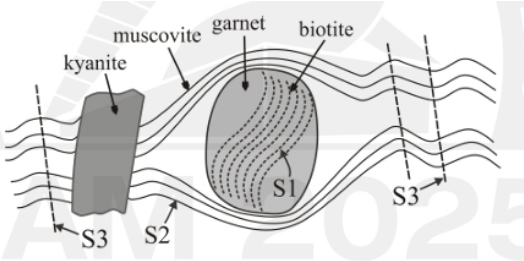
The schematic diagram given below shows textual relationship among garnet, muscovite, biotite and kyanite in a metapelite. Biotite defines S1 foliation and muscovite defines S2 and S3 foliations. S1, S2, and S3 fabrics were developed during distinct deformation events D1, D2, and D3, respectively. Which one of the following represents the pre-D3 mineral assemblage?
Which one of the following characteristic mineral assemblages represents eclogite facies metamorphism of a pelitic protolith?
Which one of the following drainage patterns is formed by stream paths that follow circular segments?
A mineral displays magenta interference colour (retardation, \( \Delta m = 550 \, nm \)) under crossed polarized light. If an accessory plate adds retardation of 100 nm, the interference colour observed is:
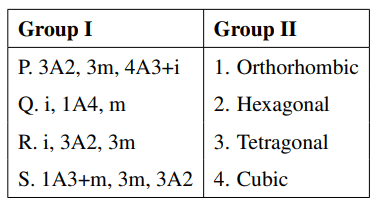
Match the symmetry elements in Group I with the corresponding crystal system in Group II.
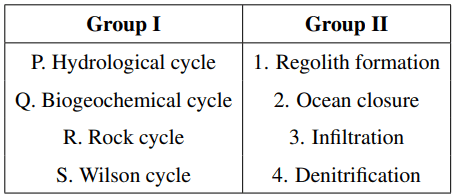
Match the cycles in Group I with the corresponding processes in Group II.
Which one of the following is the oldest volcanics?
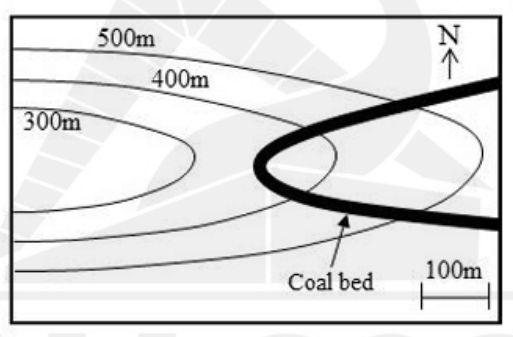
The following map shows an outcrop of a coal bed that intersects the elevation contours. Which one of the following statements is CORRECT?
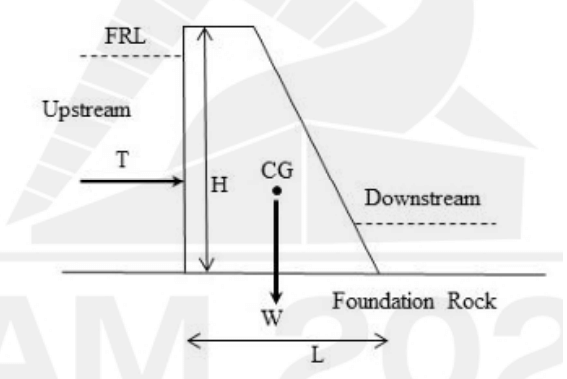
Refer the dam section shown below. Which one of the following conditions represents the most stable state of the dam against rotation about its center of gravity?
Which one of the following is related to porphyry Cu-Mo deposit?
Which one of the following statements is CORRECT for coal?
Which one of the following sedimentary structures is formed by rapid release of water?
Which one of the following represents the CORRECT combination of stratigraphic unit with its corresponding age?
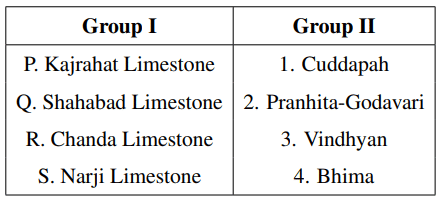
Match the stratigraphic units in Group I with their corresponding basins in Group II.
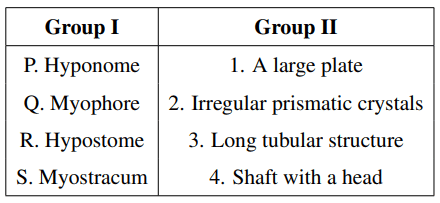
Match the morphological features in Group I with their corresponding descriptions given in Group II.
Which one of the following is a Paleozoic flora?
Which one of the following lithospheric plates has the least length of convergent boundary?
Which one of the following elements in the Earth is a chalcophile and shows siderophilic behavior?
Which one of the following set of landforms results dominantly due to erosion?
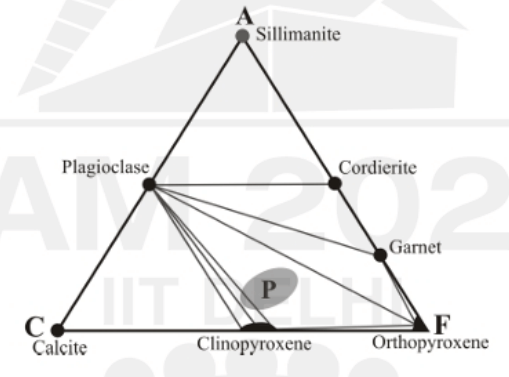
The shaded region (P) in the given ACF diagram represents the compositional range of mafic rocks that have undergone granulite facies metamorphism. Which of the following equilibrium mineral assemblages is/are identified in these mafic rocks?
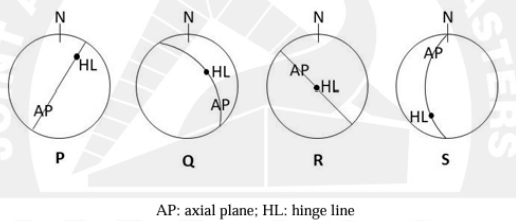
Which of the following stereographic projections represent(s) an upright plunging fold?
Which of the following property/properties of a mineral indicate(s) uniaxial negative optic sign?
Which of the following statements related to stratigraphy is/are CORRECT?
Which of following combinations of sedimentary environments and their features is/are CORRECTLY matched?
Which of the following is/are characteristic feature(s) of Brachiopods?
Which of the following characteristics of fossils is/are necessary for biostratigraphic applications?
Moon is considered to have been formed due to high temperature condensation of post-collisional ejected material. Which of the following statement(s) related to its mantle composition as compared to CI carbonaceous chondrite is/are CORRECT?
Which of the following statement(s) related to ore-forming processes is/are CORRECT?
Which of the following landforms is/are weathering dominated?
A metapelite is composed of muscovite + quartz + K-feldspar + kyanite mineral assemblage. If the muscovite and K-feldspar show solid solution between 'Na' and 'K' end-members, the minimum number of components that defines this metapelitic assemblage is ............. (In integer)
The mineral formula of orthopyroxene calculated on 6 Oxygen atom basis is (Mg1.2Fe0.8)Si2O6. The weight percentage of MgO in the chemical composition of orthopyroxene is ............. (Round off to one decimal place)
A grain has a size of 36 mm when observed under a magnification of 125 times. The actual size of the grain in µm is ............. (In integer)
Radiogenic atoms of \(^{40}K\) have a half-life of \(1.25 \times 10^9\) years. The percentage of \(^{40}K\) atoms left after six half-lives will be .............. (Round off to two decimal places)
For a \(2/m\) pyroxene, the extinction angle between the vibration direction and crystallographic axis, X ⊥ c, is 36°. Then the angle Y ⊥ b in degrees will be ............. (In integer)
A kimberlite pipe has a bulk density of 2.5 g/cc and contains diamond of grade 100 carat/metric ton. If the pipe contains only 1-carat diamond crystals, then the number of diamond crystals per cubic meter in the pipe is .................. (In integer)
Consider the present volume of the Earth’s continental crust as \(7.5 \times 10^{18}\) m³. If continental crust formation started 3.0 Ga ago, then the average rate of continental crustal growth is ............. km³ yr⁻¹. (Round off to one decimal place)
The Throw of a fault is 4 m and the Heave is 3 m. The Dip separation of the fault, in meters, is ............... (In integer)
A Rb–Sr isochron plot of cogenetic volcanic rocks yielded a slope of 0.003. The eruption age of these rocks is ............... Ma. (Round off to one decimal place)
The apparent dip amount of a limestone bed in the direction 010° is 30°. If the bed strikes 320°, the value of true dip amount in degrees is ............. (Round off to nearest integer)
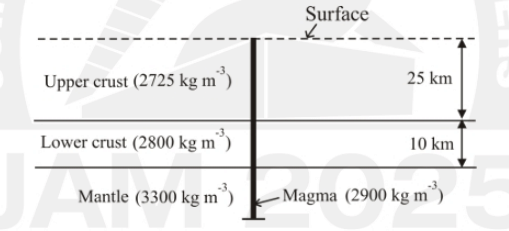
A magma having density of 2900 kg m\(^-3\) just reaches the surface through a two-layered crust as shown in the figure below. Assuming isostatic equilibrium, its depth of melting is .......... km. (Round off to one decimal place)
The cation exchange equilibrium reaction between end-member components of orthopyroxene and ilmenite is given below:
\[ MgSiO_3 + FeTiO_3 = FeSiO_3 + MgTiO_3 \]
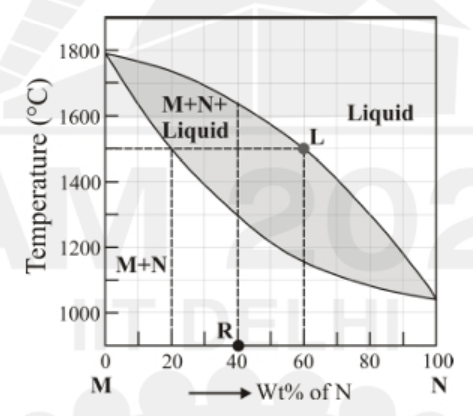
The isobaric temperature-composition (T–X) phase diagram given below shows the phase relation between components M and N. The equilibrium melting undergone by the rock R to generate the liquid of composition L is .............. % (In integer)
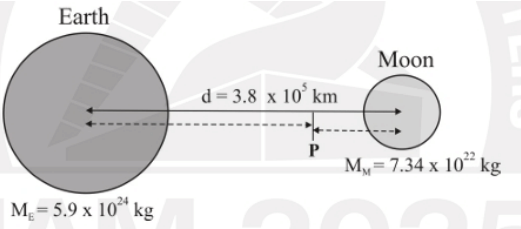
A satellite launching vehicle is carrying a lander for Moon mapping. As shown in the figure below, P is the position where the gravitational forces exerted by Earth and Moon on the vehicle balance out. The distance \( P \) from the center of the Earth is ........... \( \times 10^5 \) km. (Round off to two decimal places)
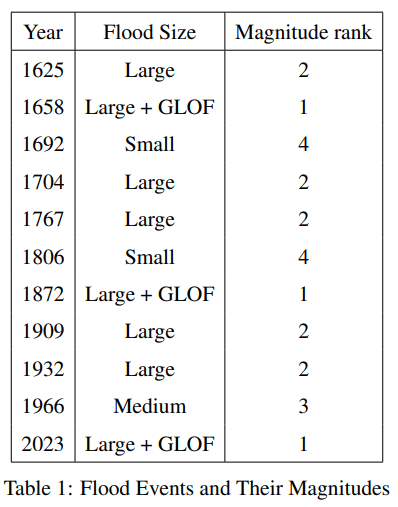
The data tabulated below are for flooding events in the last 400 years. The probability of a large flood accompanied by a glacial lake outburst flood (GLOF) in 2025 is ........... \(\times 10^{-3}\). (Round off to one decimal place)
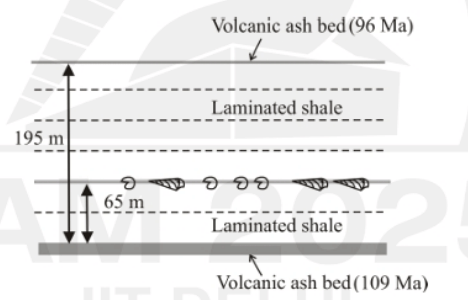
A well-developed succession of laminated shale is bound by two volcanic ash beds that were precisely dated as shown in the schematic diagram given below. Assuming a constant sedimentation rate, the age of the fossiliferous limestone bed 65 m above the basal volcanic ash bed is ............ Ma. (Round off to nearest integer)
Pumping and extraction of groundwater from an unconfined aquifer resulted in a uniform drop of water table by 40 m over an area of 1 km². If the porosity of the aquifer is 35% and specific retention is 15%, the volume of water (in m³) pumped out from the affected area is __________ \(\times 10^6\) m³. (In integer)
A Cu deposit of 198 tons with average grade of 1.5% Cu contains 60% chalcopyrite, 30% bornite and 10% gangue. The maximum amount of Cu that can be extracted from chalcopyrite is .......... tons. (Round off to two decimal places)
The orientations of two planar limbs of an overturned anticline are 045°/72°SE and 225°/37°SE. The interlimb angle of the fold in degrees is ........... (In integer)
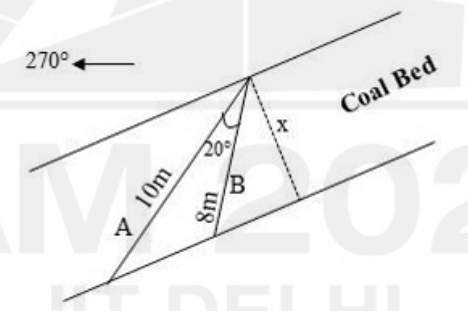
Two boreholes A and B, both inclined towards 270°, penetrate a dipping coal bed at the same point and pass through it entirely in the sub-surface as shown in the figure below. The bed dips towards 270°. The thickness of the coal bed, measured along the borehole A is 10 m and along borehole B is 8 m. The angle between the two boreholes is 20°. The orthogonal thickness \( x \) of the coal bed is ........ m. (Round off to one decimal place)



Comments