



IIT JAM 2025 Biotechnology (BT) Exam scheduled for today, February 2, 2025, in Shift 2, between 2:30 PM and 5:30 PM has now been concluded. The IIT JAM 2025 Biotechnology Question Paper and the Answer Key is available for download .
Approximately 15,000 candidates are expected to appear for IIT JAM 2025 in Biotechnology (BT), which consists of 60 questions divided into 30 MCQs, 10 MSQs, and 20 NATs carrying a total of 100 marks, but negative marking only in MCQs.
Also, Check: IIT JAM 2025 Question Paper
IIT JAM 2025 Biotechnology(BT) Question Paper with Answer Key PDFs
| IIT JAM 2025 Biotechnology(BT) Question Paper with Answer Key PDFs | Download PDF | Check Solutions |
IIT JAM 2025 Biotechnology (BT): Expected Difficulty Level
The porphyrin ring (tetrapyrrole structure) is NOT found in functional
If
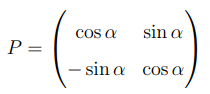
and \(P + P^T = I\), the value of \(\alpha \; (0 \leq \alpha \leq \pi/2)\) is
After how many cycles of polymerase chain reaction (PCR), the amplified product of required length is generated for the first time from a chromosomal DNA template?
In humans, Down syndrome is caused by
Which one of the following hormones is produced by the adrenal gland?
What is the ploidy level of a sporophyte in angiosperms?
The standard free energy change (\(\Delta G^0\)) of the binding reaction between different sweet molecules and a common sweet taste receptor are given. Which amongst these molecules is the sweetest at the same molar concentration?
The correct order of electronegativity of the given elements is
Which of the following terrestrial biomes has the highest animal diversity?
An electric circuit with a resistor of constant resistance ‘R’ is maintained at a constant voltage ‘V’. Based on Ohm’s law, if the current ‘I’ through the circuit is doubled, the power ‘P’ dissipated across the resistor is
Sequence comparison of which of the following genes is used as a measure of evolutionary divergence across bacterial species?
Which of the following activities is NOT possessed by the human immunodeficiency virus-1 reverse transcriptase?
Bacterial cloning vectors and bacterial expression vectors are differentiated by the presence of
The final stage of peptidoglycan (PG) biosynthesis is marked by PG cross-link formation and remodeling. Which of the following enzymes does NOT take part in these processes?
The first evidence of ‘gene transfer’ was demonstrated in 1928 by
Which of the following statements about eukaryotic asymmetric cell division is NOT correct?
Which of the following represents the CORRECT order of events in the eukaryotic cell cycle?
The receptors for gamma amino butyric acid (GABA) in humans are
Which of the following cell types is infected by the human immunodeficiency virus-1?
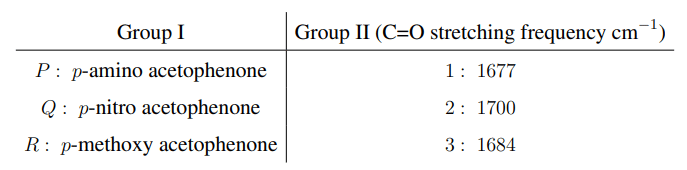
The IR stretching frequency of the carbonyl (C=O) group of a typical saturated ketone is 1715 cm\(^{-1}\). The IR stretching frequencies for the carbonyl groups present in three different acetophenone derivatives are given. Match the molecules in Group I with their corresponding frequencies in Group II.
Two charges \(10 \times 10^{-8}\,C\) and \(-6 \times 10^{-8}\,C\) are located 16 cm apart. The point(s) on the line joining the two charges, where the net electric potential is zero, will be
[Take the potential at infinity to be zero]
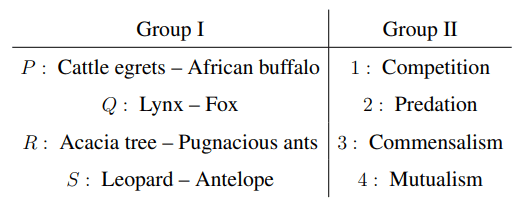
Match the pair of organisms in Group I with their community interaction pattern in Group II.
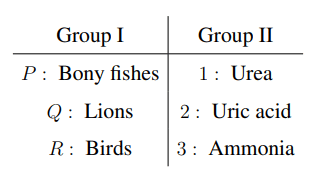
Match the animals in Group I with the major form of excreted nitrogen metabolite in Group II.
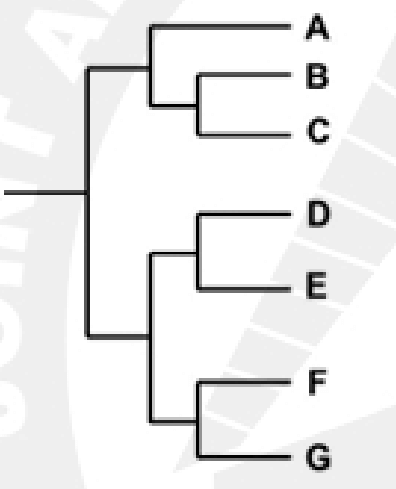
Identify the taxa that constitute a paraphyletic group in the given phylogenetic tree.
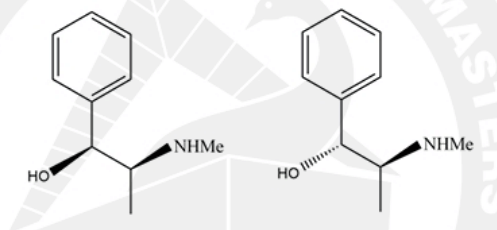
Which of the following is the CORRECT combination of a synthetic auxin and a synthetic cytokinin?
Mechanism of antibacterial action of polymyxins relies on the
The 5' cap of eukaryotic mRNAs contains
Which one of the following statements is CORRECT about Agrobacterium tumefaciens-mediated plant transformation?
Which of the following conditions is CORRECT for free expansion of an ideal gas under adiabatic condition? (q = heat, \(\Delta T = \) temperature difference, w = work)
Four alkyl halides, MeBr, EtBr, iPrBr, and tBuBr, undergo S\(_N\)2 reactions in the presence of hydroxide ion to yield the corresponding alcohols and the halide ion. The CORRECT order of the alkyl halides based on the rates of reactions is
Which of the following statement(s) is/are CORRECT about Deinococcus radiodurans?
Which of the following statement(s) is/are CORRECT about 'stringent response' in bacteria?
The method(s) used to detect a DNA fragment of 150 base pairs is/are
The component(s) of the apoptosome is/are
Which of the following statement(s) is/are CORRECT for lac repressor expressed from the lacI gene?
Which of the following condition(s) lead(s) to reduced affinity of \(O_2\) for human hemoglobin?
Which of the following metabolite(s) accumulate(s) in the blood of a human adult consuming a ketogenic diet?
In ‘Futile Cycle’ chemical energy is dissipated as heat due to two opposite biochemical reactions. Which of the following biochemical reaction(s) is/are a part of ‘Futile Cycle’?
Which of the following statement(s) is/are CORRECT in the classical ‘ABC model’ for genetic control of flower development?
Free energy change for transport of an uncharged solute across a membrane against a \(1 \times 10^3\) fold concentration gradient at 25°C is ............... kJ mol\(^{-1}\). (rounded off to 2 decimals) \[ R = 8.315 \, J mol^{-1} \, K^{-1} \]
A forest has four different tree species (A, B, C, and D) and their numbers are: \( A = 60 \); \( B = 20 \); \( C = 10 \); and \( D = 10 \).
The Shannon biodiversity index of the trees in this forest is ................... (rounded off to 2 decimals)
In a plant species, the genotype \( DDEE \) is crossed with the genotype \( ddee \); and the F1 is test crossed. Considering that the two genes are linked and 20 map unit (cM) apart in the chromosome, the percentage (%) of the test cross progeny with the genotype \( ddee \) is ........................ (answer in integer)
In a farm animal breeding programme, the animal with the dominant A phenotype, the recessive b phenotype, the dominant D phenotype, and the recessive e phenotype are commercially important. The inheritance of these traits follows Mendelian laws. From the tetra-hybrid cross of two genotypes AaBbDdEe and AaBbDdEe, the expected frequency of offspring that will show all the above-mentioned desired phenotypes is ................... (rounded off to 3 decimals)
The wavelength of a photon emitted during a transition from \( n = 3 \) to \( n = 2 \) state in the H atom is .............. nm. (answer in integer).
The limit of the function \( \lim_{x \to 2} \frac{2x^2 + 2x - 12}{x^2 - 4} \) is .............. (rounded off to 1 decimal)
A candle is placed 18 cm in front of a concave mirror to generate a real, inverted and doubly magnified image. The radius of curvature of the concave mirror is ................ cm. (answer in integer)
\( E^\circ \) value of a Daniell cell \( Zn | Zn^{2+} \, (aq) || Cu^{2+} \, (aq) | Cu \) is ............ V. (rounded off to 2 decimals)
A population of bacterial cells grows from 10,000 to 100,000,000 cells in 6 hours. The generation time of the bacterial population is ........... min. (rounded off to 2 decimals)
In a sampling expedition near a peninsula, 180 dolphins from a large population of dolphins were captured and marked by tagging their dorsal fins. The tagged dolphins were then allowed to join back into the population. In a subsequent expedition, 42 dolphins were photographed from the same large population. Among these, 7 dolphins contained the tags. Assuming that the population size remains the same and that tags were not lost, the estimated population size of dolphins in the peninsula is ........... (answer in integer)
The area bounded by the curve \( y = \sin x \) and the x-axis between \( x = 0 \) and \( x = \frac{3\pi}{2} \) is ............. sq. units. (answer in integer)
The number of 7 letter words (with or without meaning) starting with the letter B that can be formed using the letters of the word BIOLOGY is .............. (answer in integer)
Three particles A, B, C with masses of 100 g, 200 g, and 300 g, respectively, are placed at the vertices of an equilateral triangular structure with a side length of 2 m. A is placed at the \( (0, 0) \) position and B is placed at \( (2, 0) \) position in a Cartesian coordinate system. Assume that \( \triangle ABC \) lies parallel to the base. The distance between the center of mass and the position of the particle A is ........... m. (rounded off to 2 decimals)
An insect weighing 5 g takes off vertically for a distance of 100 cm with a speed of 4 m s\(^{-1}\) by using its hind legs. Ignoring the resistance due to air, the magnitude of the average net force exerted by the hind legs during the take-off is ............ N. (rounded off to 3 decimals)
A buffer solution is composed of 0.1 M acetic acid and 0.15 M sodium acetate. The change in pH of 1 L buffer solution upon addition of 50 mL of 1.0 M NaOH is ............... (rounded off to 2 decimals)
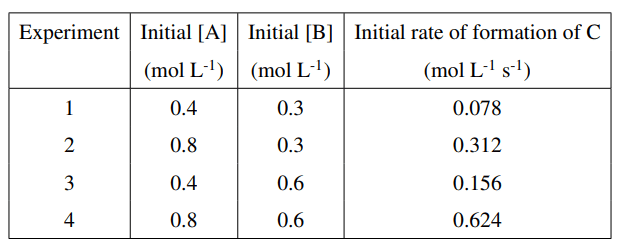
In a reaction \( A + B \to C \), the initial rate of formation of C at 25°C was measured for different initial concentrations of A and B as given. The overall order of the reaction with respect to both A and B is ................. (answer in integer)
A cDNA was synthesized from the mRNA of a eukaryotic gene. After cloning and sequence analysis, the double-stranded cDNA of 614 bp revealed 125 bp 5'-UTR and 120 bp 3'-UTR. The number of amino acids present in the polypeptide encoded by this gene is ............... (answer in integer)
A rare genetic disorder resulting from homozygosity for a recessive allele (\( r \)) occurs in 2 out of every 10,000 individuals in a population. Assuming that (i) the disorder is not lethal, (ii) the disorder does not impact reproductive success, (iii) no new mutations are introduced in the population, and (iv) the population follows Hardy-Weinberg equilibrium, the percentage (%) of the carriers in the population that pass the \( r \) allele to offspring is .......... (rounded off to 1 decimal)
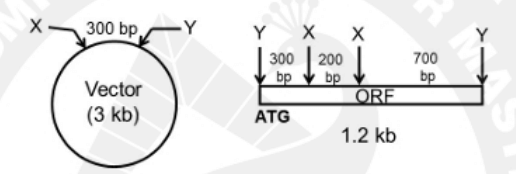
The vector, shown in the figure, has promoter and RBS sequences in the 300 bp region between the restriction sites for enzymes X and Y. There are no other sites for X and Y in the vector. The promoter is directed towards the Y site. The insert containing only an ORF provides 3 fragments after digestion with both enzymes X and Y. The ORF is cloned in the correct orientation in the vector using the single restriction enzyme Y. The size of the largest fragment of the recombinant plasmid expressing the ORF upon digestion with enzyme X is ........... bp. (answer in integer)
The length of the edge of a variable cube is increasing at the rate of 25 cm s\(^{-1}\). If the initial length of the edge of the cube is 10 cm, the rate of increase of the surface area of the cube is .............. cm\(^2\) s\(^{-1}\). (answer in integer)



Comments