



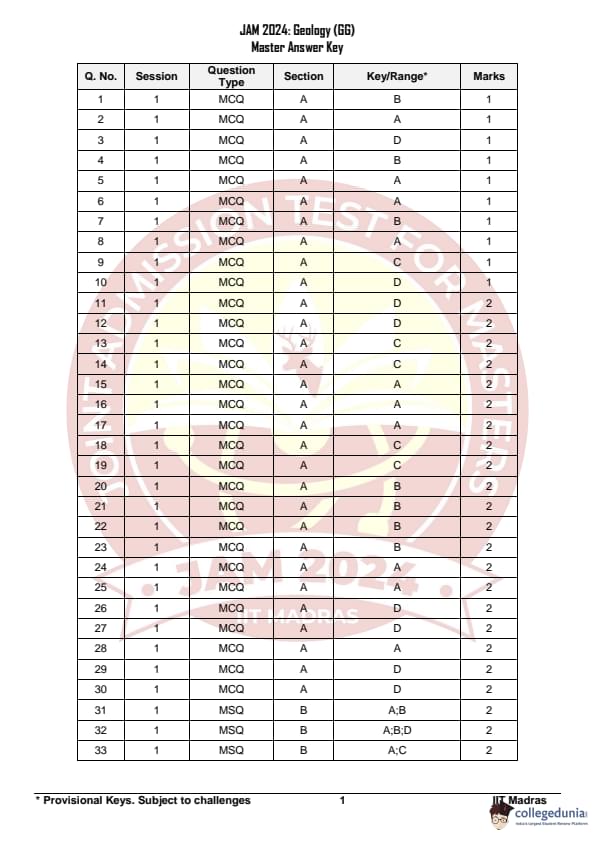
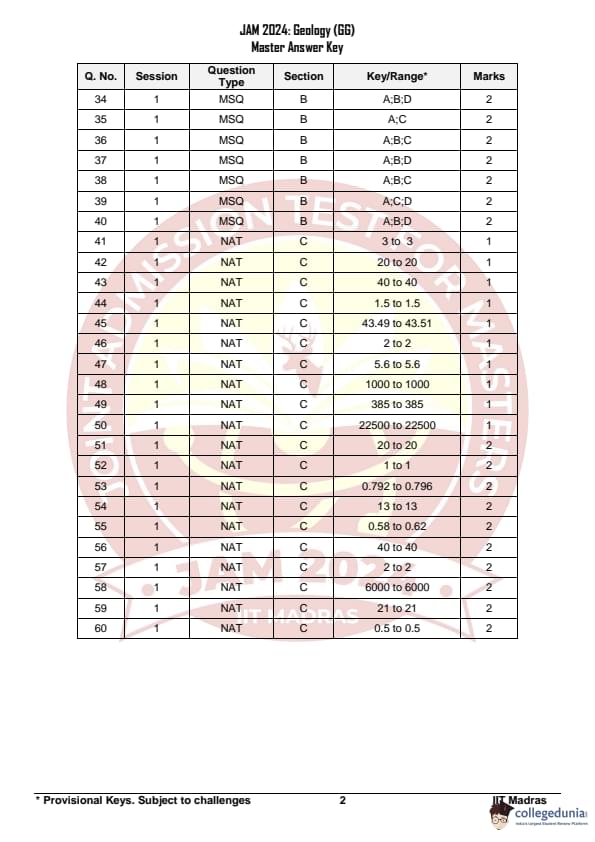
IIT JAM 2024 Geology (GG) Question Paper with Answer Key pdf is available for download. IIT JAM 2024 GG exam was conducted by IIT Madras in shift 1 on February 11, 2024. In terms of difficulty level, IIT JAM 2024 Geology (GG) paper was of easy to moderate level. IIT JAM 2024 question paper for GG comprised a total of 60 questions.
IIT JAM 2024 Geology (GG) Question Paper with Answer Key PDFs
| IIT JAM 2024 Geology Question Paper PDF |  Download Download |
Check Solutions |
IIT JAM 2024 Geology (GG) Question Paper with Solution
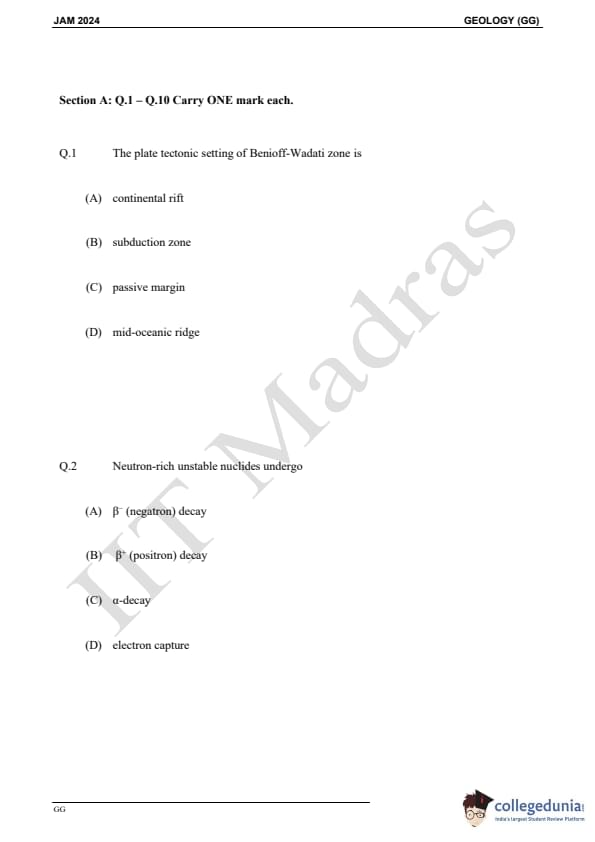
Question 1:
The plate tectonic setting of Benioff-Wadati zone is:
- (A) Continental rift
- (B) Subduction zone
- (C) Passive margin
- (D) Mid-oceanic ridge
Question 2:
Neutron-rich unstable nuclides undergo:
- (A) Beta-minus (negatron) decay
- (B) Beta-plus (positron) decay
- (C) Alpha-decay
- (D) Electron capture
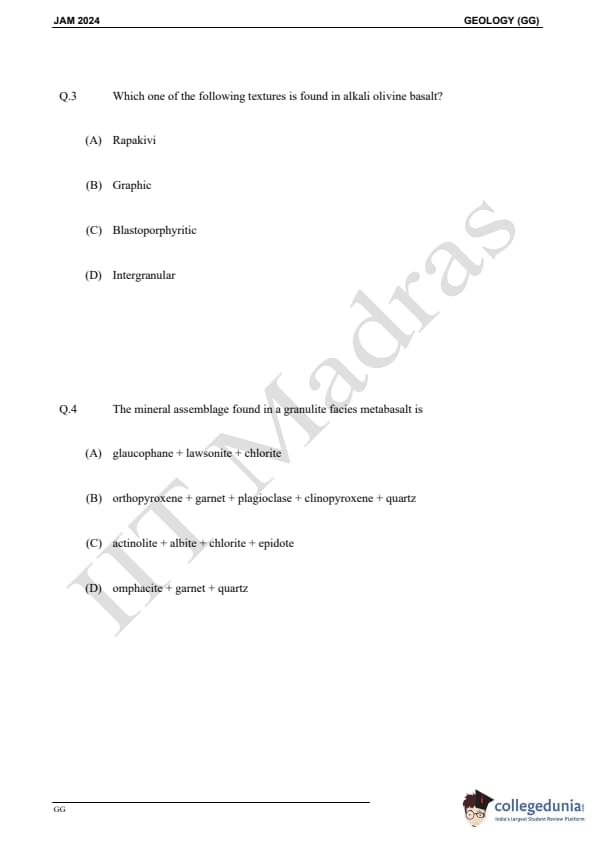
Question 3:
Which one of the following textures is found in alkali olivine basalt?
- (A) Rapakivi
- (B) Graphic
- (C) Blastoporphyritic
- (D) Intergranular
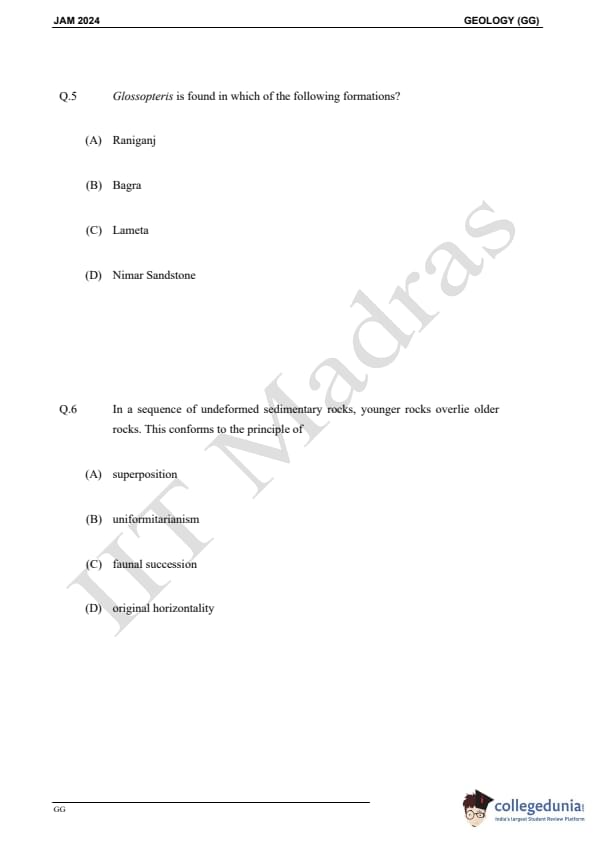
Question 6:
In a sequence of undeformed sedimentary rocks, younger rocks overlie older rocks. This conforms to the principle of
Question 11:
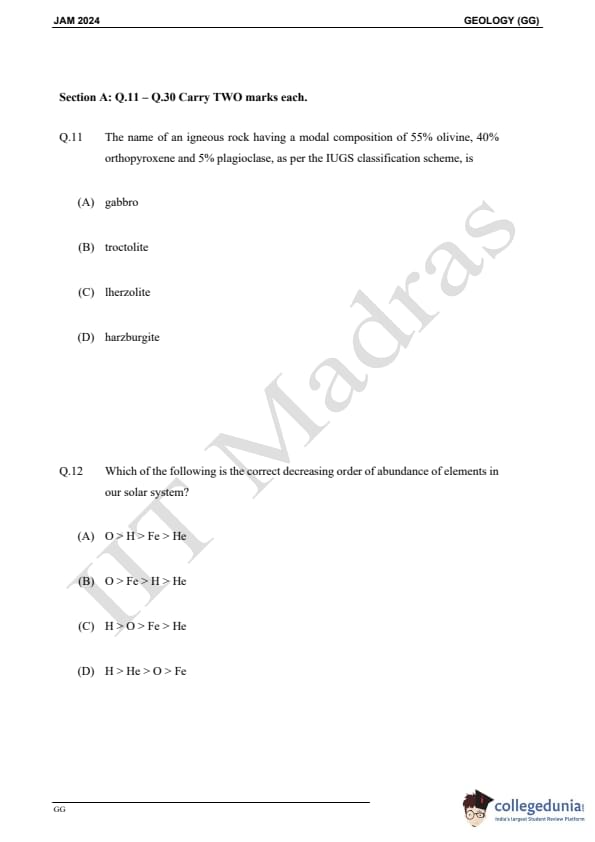
The name of an igneous rock having a modal composition of 55% olivine, 40% orthopyroxene, and 5% plagioclase, as per the IUGS classification scheme, is
Question 12:
Which of the following is the correct decreasing order of abundance of elements in our solar system?
Question 13:
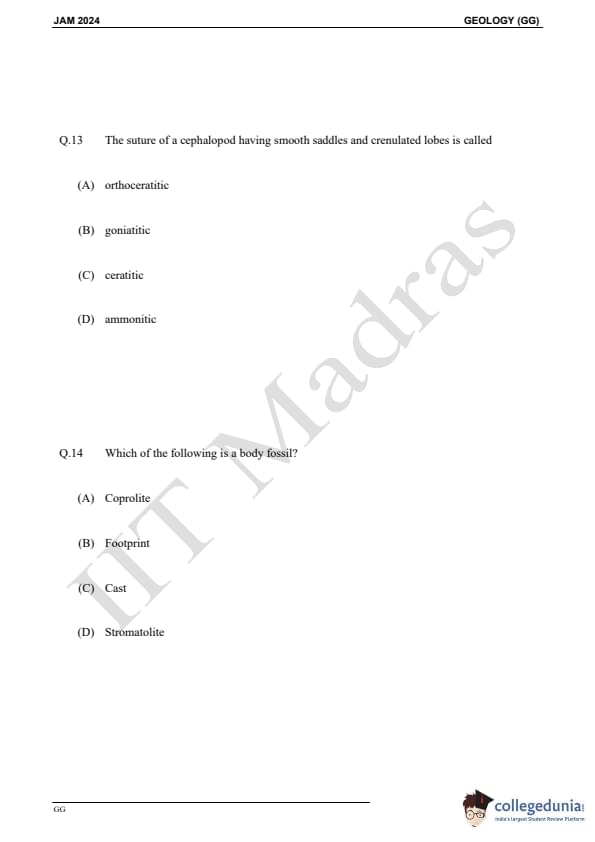
The suture of a cephalopod having smooth saddles and crenulated lobes is called
Question 15:
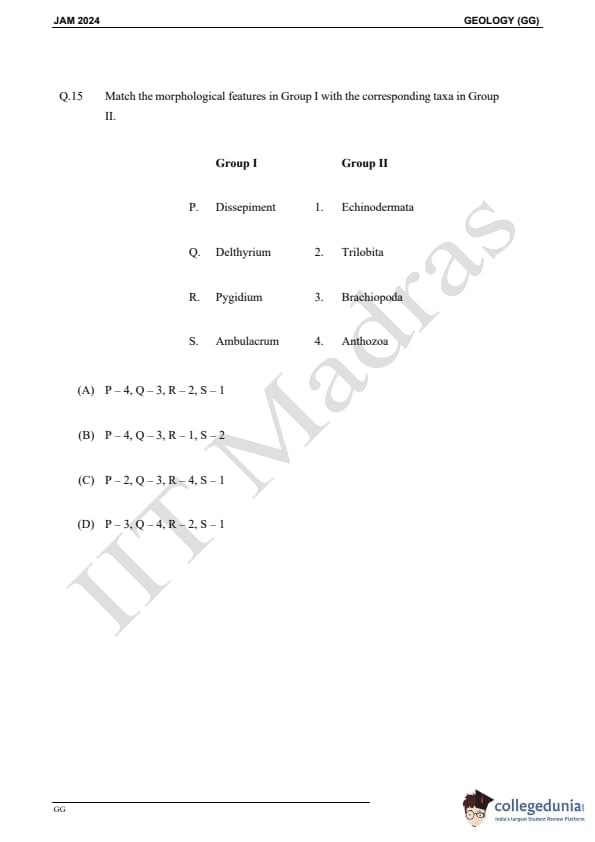
Match the morphological features in Group I with the corresponding taxa in Group II.
Group I Group II
P. Dissepiment 1. Echinodermata
Q. Delthyrium 2. Trilobita
R. Pygidium 3. Brachiopoda
S. Ambulacrum 4. Anthozoa
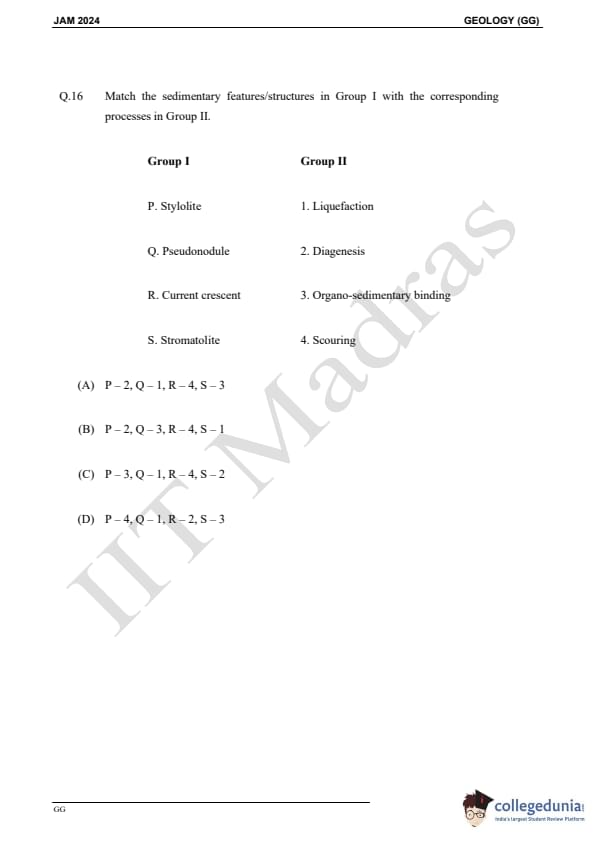
Question 16:
Match the sedimentary features/structures in Group I with the corresponding processes in Group II.
Group I Group II
P. Stylolite 1. Liquefaction
Q. Pseudonodule 2. Diagenesis
R. Current crescent 3. Organo-sedimentary binding
S. Stromatolite 4. Scouring
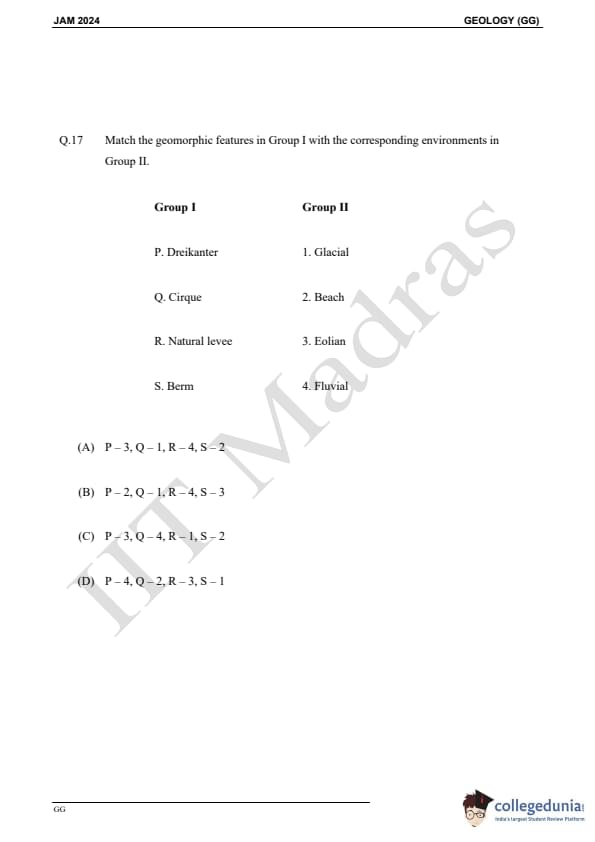
Question 17:
Match the geomorphic features in Group I with the corresponding environments in Group II.
Group I Group II
P. Dreikanter 1. Glacial
Q. Cirque 2. Beach
R. Natural levee 3. Eolian
S. Berm 4. Fluvial
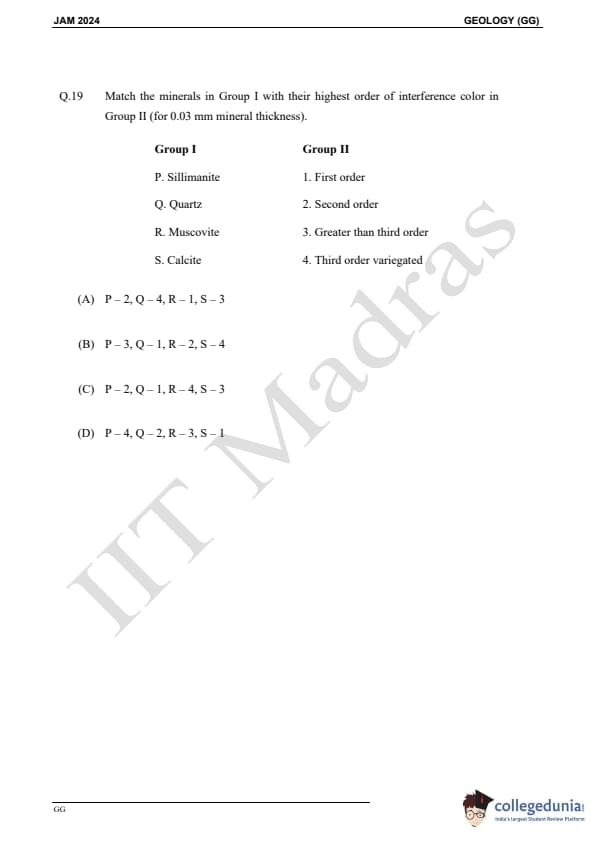
Question 19:
Match the minerals in Group I with their highest order of interference color in Group II (for 0.03 mm mineral thickness).
Question 20:
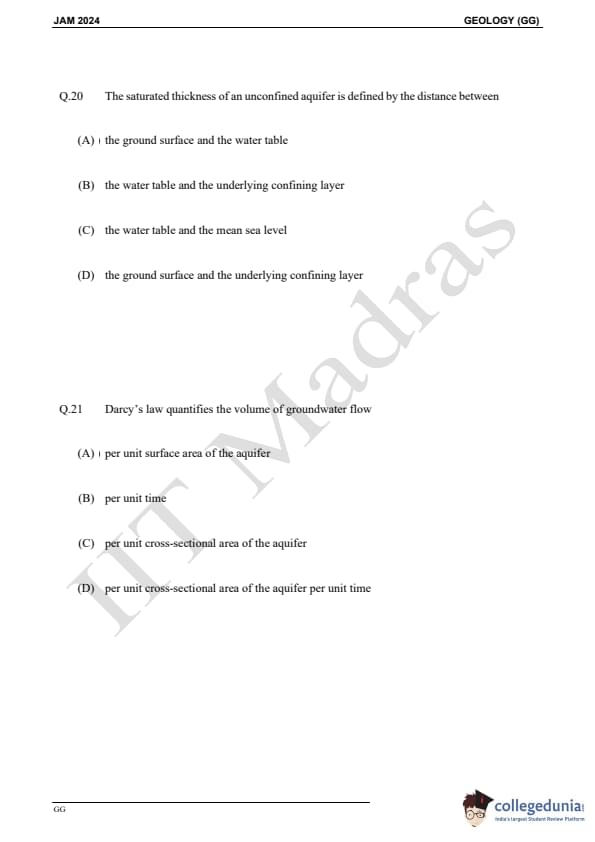
The saturated thickness of an unconfined aquifer is defined by the distance between:
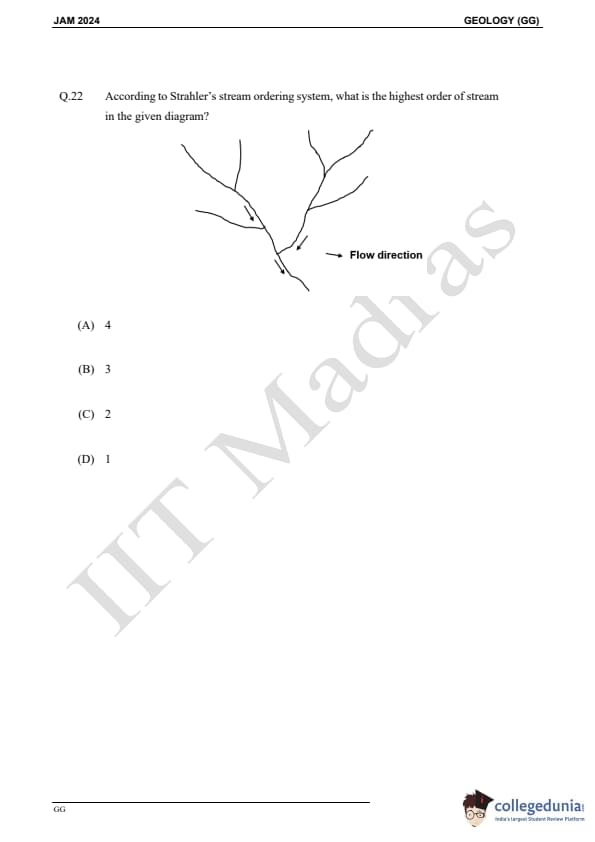
Question 22:
According to Strahler’s stream ordering system, what is the highest order of stream in the given diagram?

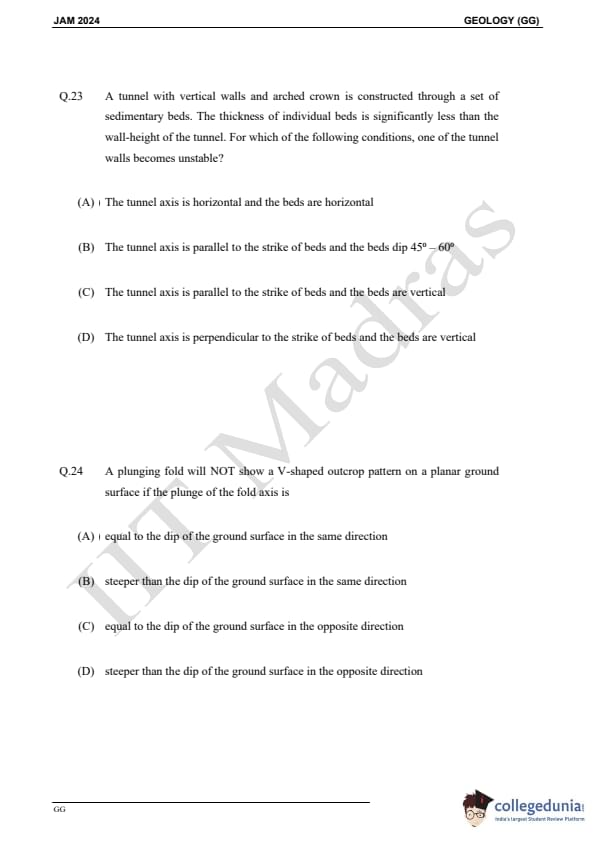
Question 23:
A tunnel with vertical walls and arched crown is constructed through a set of sedimentary beds. The thickness of individual beds is significantly less than the wall-height of the tunnel. For which of the following conditions, one of the tunnel walls becomes unstable?
Question 24:
A plunging fold will NOT show a V-shaped outcrop pattern on a planar ground surface if the plunge of the fold axis is:
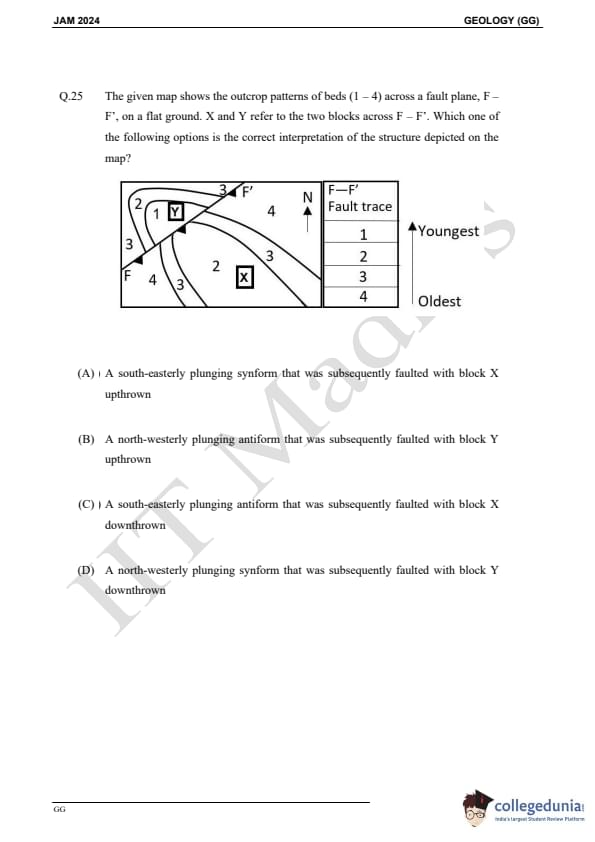
Question 25:
The given map shows the outcrop patterns of beds (1 - 4) across a fault plane, F – F’, on a flat ground. X and Y refer to the two blocks across F – F’. Which one of the following options is the correct interpretation of the structure depicted on the map?

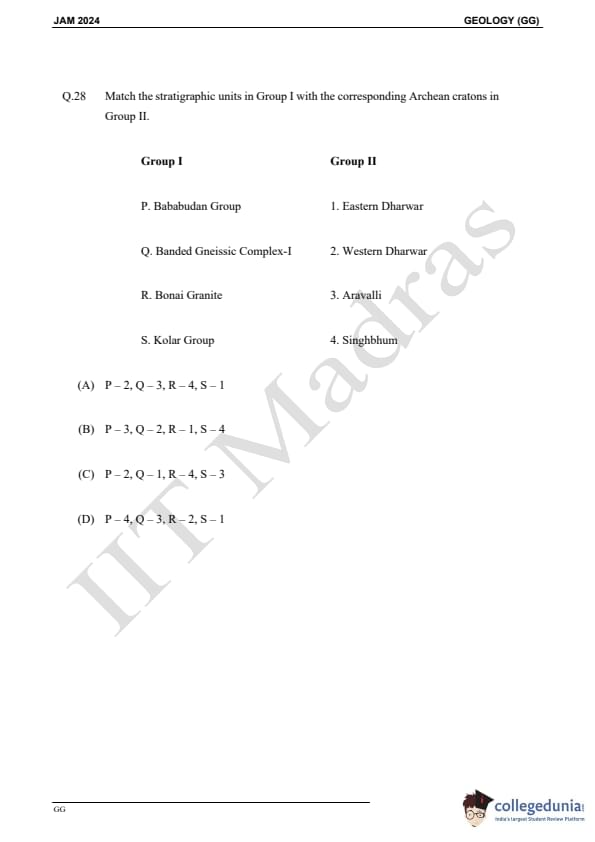
Question 28:
Match the stratigraphic units in Group I with the corresponding Archean cratons in Group II.
| Group I: | Group II: |
| P. Bababudan Group | 1. Eastern Dharwar |
| Q. Banded Gneissic Complex-I | 2. Western Dharwar |
| R. Bonai Granite | 3. Aravalli |
| S. Kolar Group | 4. Singhbhum |
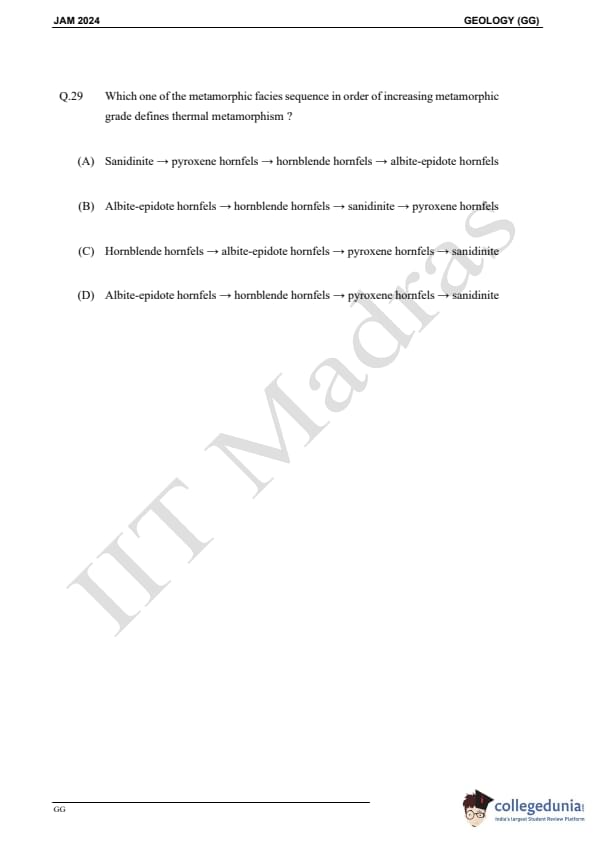
Question 29:
Which one of the metamorphic facies sequence in order of increasing metamorphic grade defines thermal metamorphism?
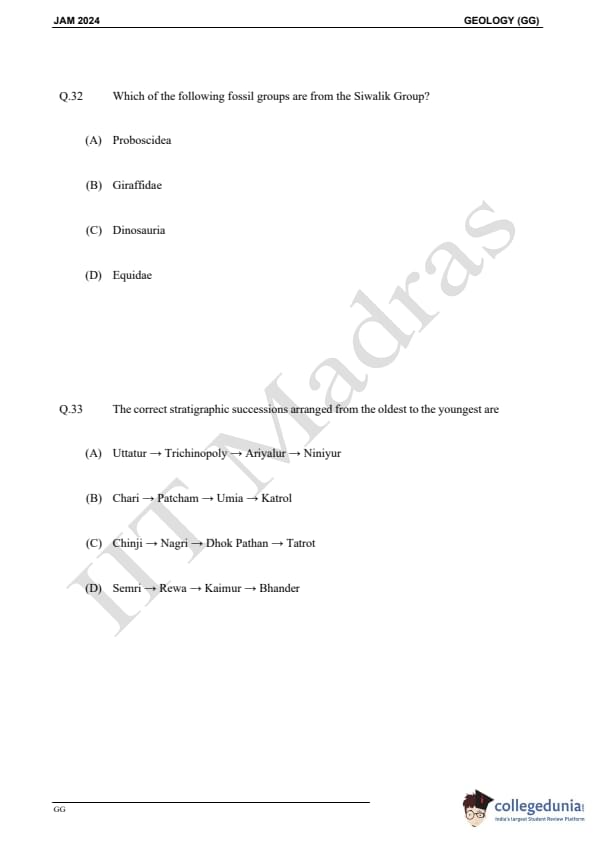
Question 33:
The correct stratigraphic successions arranged from the oldest to the youngest are:
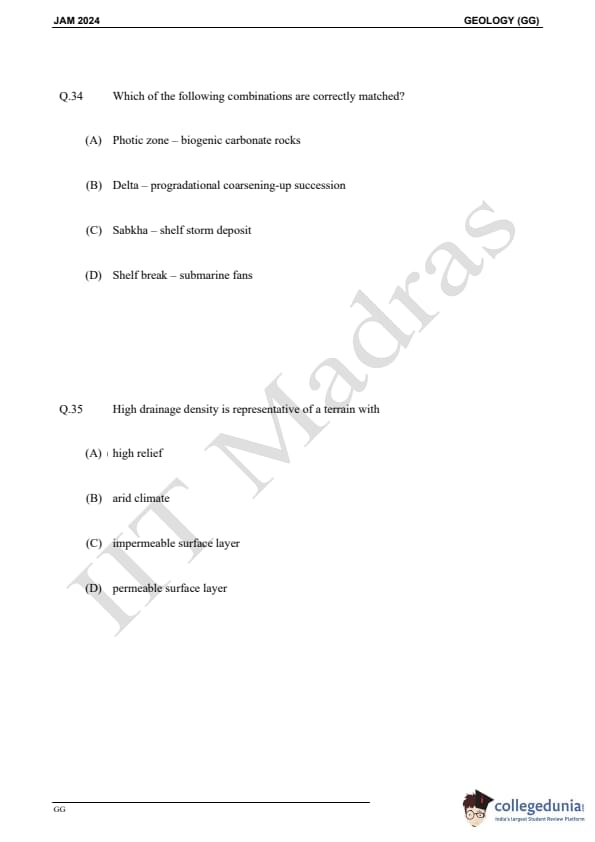
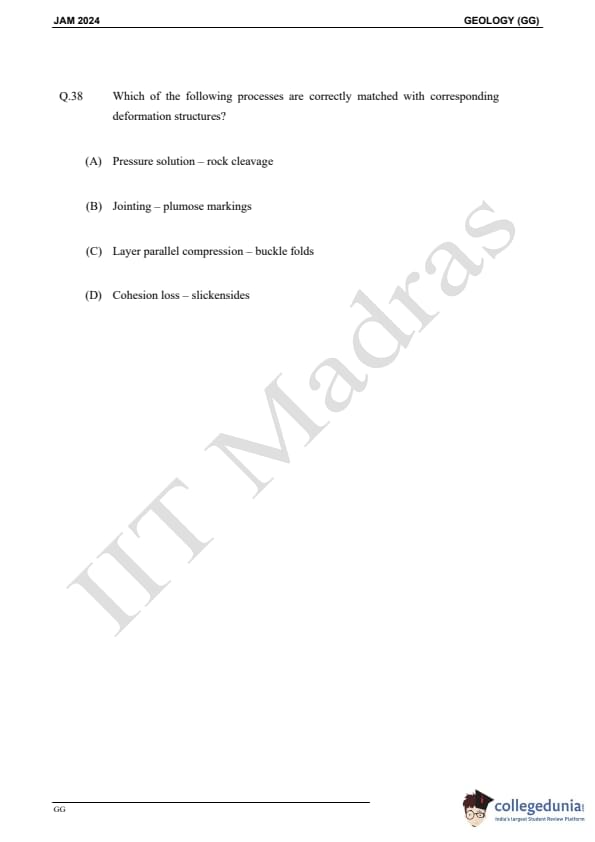
Question 38:
Which of the following processes are correctly matched with corresponding deformation structures?
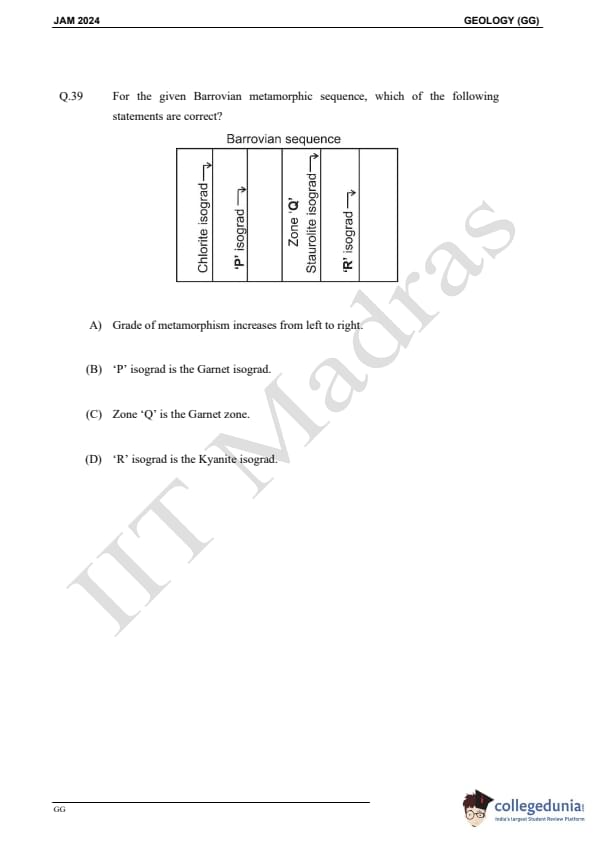
Question 39:
For the given Barrovian metamorphic sequence, which of the following statements are correct?
Question 41:
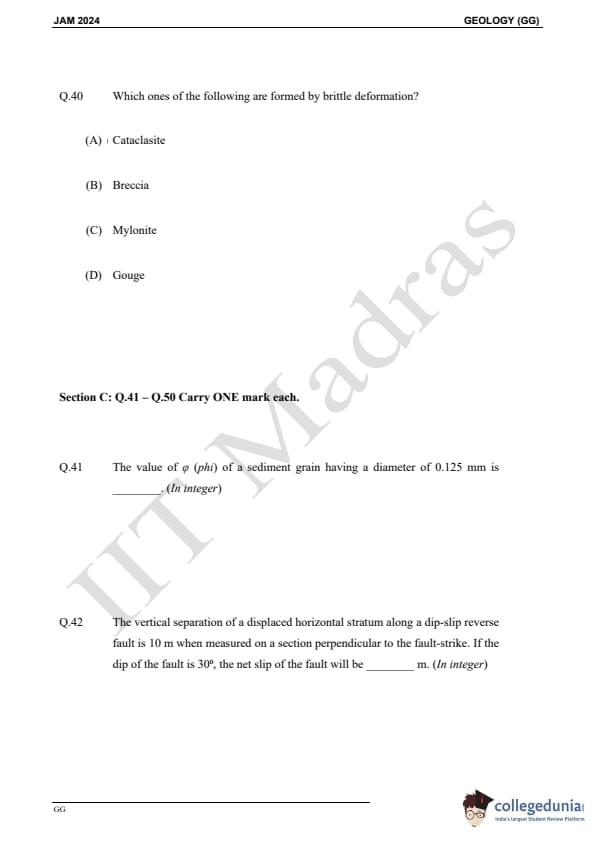
The value of φ (phi) of a sediment grain having a diameter of 0.125 mm is ______ (In integer).
Question 42:
The vertical separation of a displaced horizontal stratum along a dip-slip reverse fault is 10 m when measured on a section perpendicular to the fault-strike. If the dip of the fault is 30°, the net slip of the fault will be ______ m (In integer).
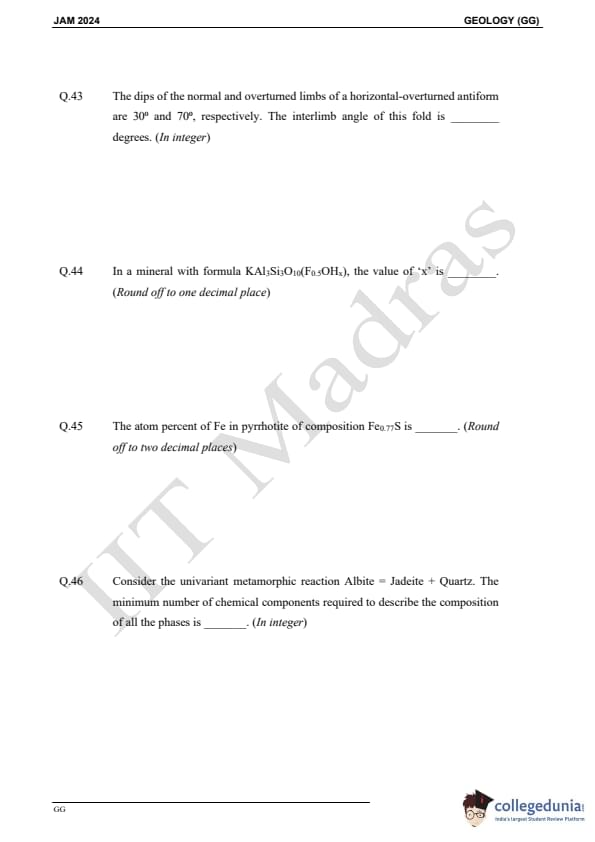
Question 43:
The dips of the normal and overturned limbs of a horizontal-overturned antiform are 30° and 70°, respectively. The interlimb angle of this fold is ______ degrees (In integer).
Question 44:
In a mineral with formula KAl3Si3O10(F0.5OHx), the value of ‘x’ is ______. (Round off to one decimal place)
Question 46:
Consider the univariant metamorphic reaction Albite = Jadeite + Quartz. The minimum number of chemical components required to describe the composition of all the phases is ______.
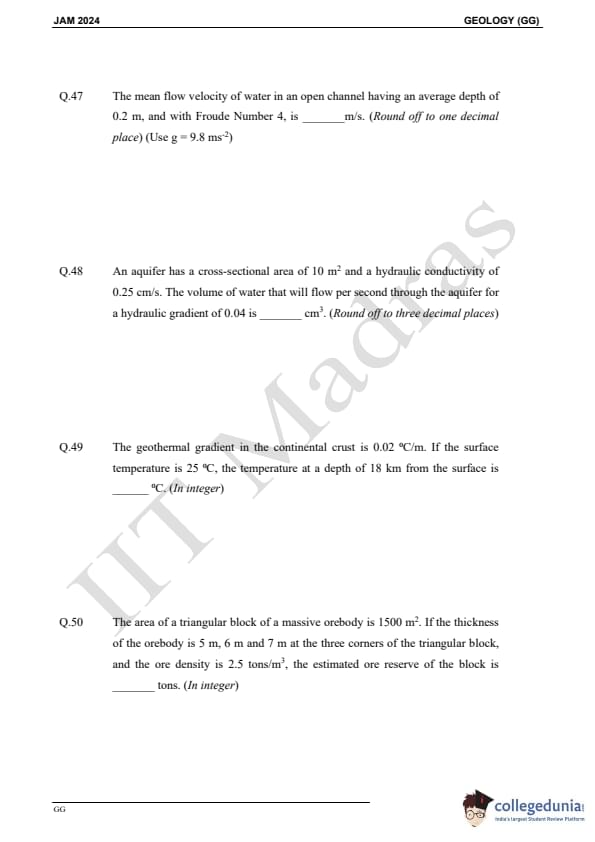
Question 47:
The mean flow velocity of water in an open channel having an average depth of 0.2 m, and with Froude Number 4, is ______ m/s. (Round off to one decimal place; Use g = 9.8 m/s²)
Question 48:
An aquifer has a cross-sectional area of 10 m² and a hydraulic conductivity of 0.25 cm/s. The volume of water that will flow per second through the aquifer for a hydraulic gradient of 0.04 is ______ cm³. (Round off to three decimal places)
Question 49:
The geothermal gradient in the continental crust is 0.02°C/m. If the surface temperature is 25°C, the temperature at a depth of 18 km from the surface is ______°C. (In integer)
Question 50:
The area of a triangular block of a massive orebody is 1500 m². If the thickness of the orebody is 5 m, 6 m, and 7 m at the three corners of the triangular block, and the ore density is 2.5 tons/m³, the estimated ore reserve of the block is ______ tons. (In integer)
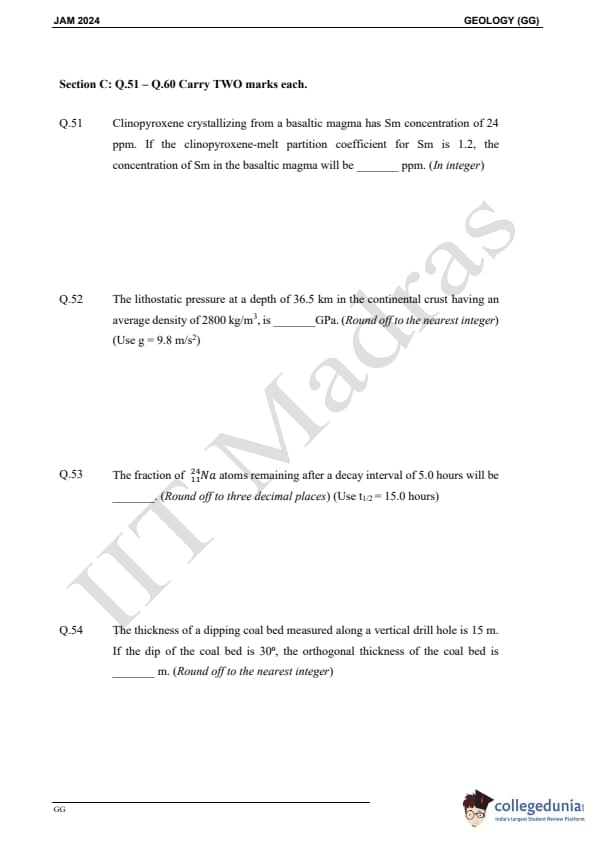
Question 51:
Clinopyroxene crystallizing from a basaltic magma has Sm concentration of 24 ppm. If the clinopyroxene-melt partition coefficient for Sm is 1.2, the concentration of Sm in the basaltic magma will be ______ ppm.
Question 52:
The lithostatic pressure at a depth of 36.5 km in the continental crust having an average density of 2800 kg/m³, is ______ GPa.
Question 53:
The fraction of 24⁄11 Na atoms remaining after a decay interval of 5.0 hours will be ______. (Round off to three decimal places) (Use t1/2 ) = 15.0 hours)
Question 54:
The thickness of a dipping coal bed measured along a vertical drill hole is 15 m. If the dip of the coal bed is 30°, the orthogonal thickness of the coal bed is ______ m.
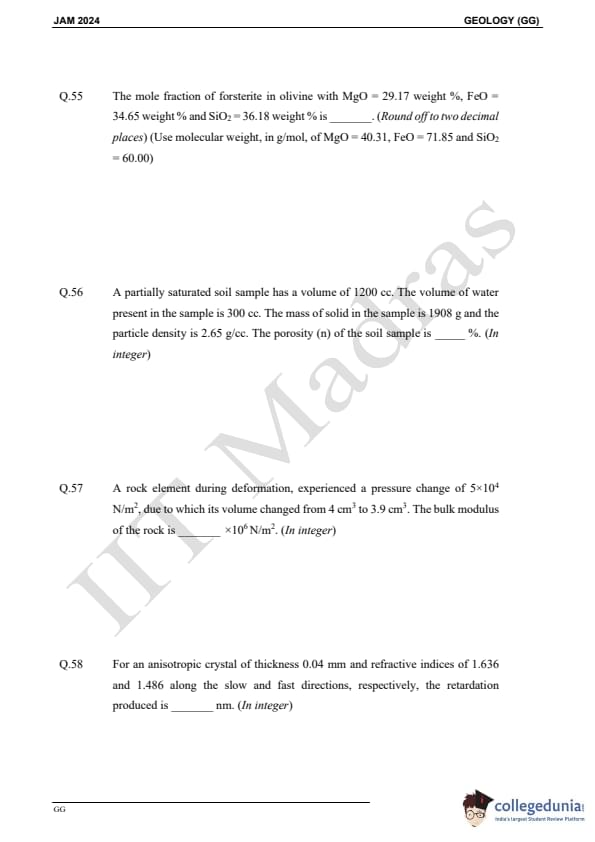
Question 55:
The mole fraction of forsterite in olivine with MgO = 29.17 weight%, FeO = 34.65 weight%, and SiO₂ = 36.18 weight% is ______. (Round off to two decimal places; use molecular weights: MgO = 40.31, FeO = 71.85, SiO₂ = 60.00)
Question 56:
A partially saturated soil sample has a volume of 1200 cc. The volume of water present in the sample is 300 cc. The mass of solid in the sample is 1908 g and the particle density is 2.65 g/cc. The porosity (n) of the soil sample is ______ %.
Question 57:
A rock element during deformation experienced a pressure change of 50,000 N/m², due to which its volume changed from 4 cm³ to 3.9 cm³. The bulk modulus of the rock is ______ × 10⁶ N/m².
Question 58:
For an anisotropic crystal of thickness 0.04 mm and refractive indices of 1.636 and 1.486 along the slow and fast directions, respectively, the retardation produced is ______ mm.
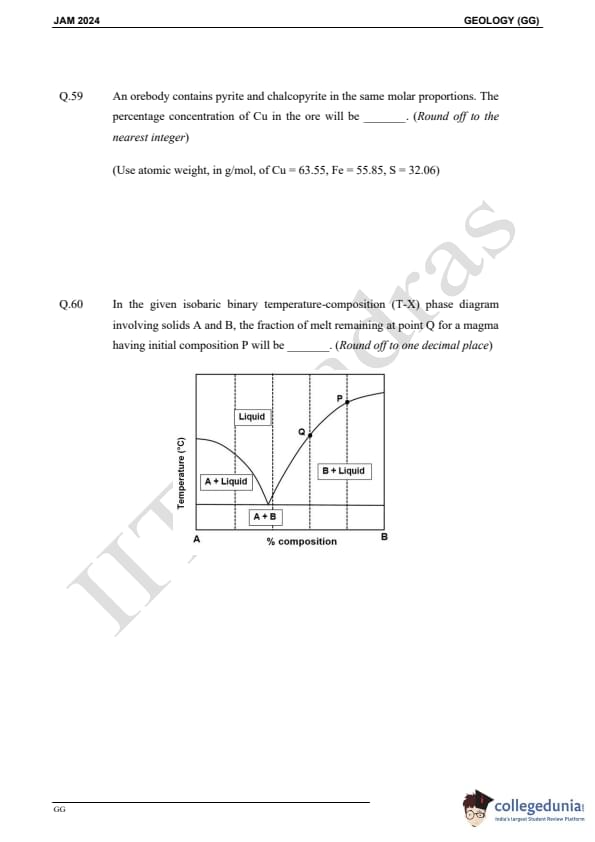
Question 59:
An orebody contains pyrite and chalcopyrite in the same molar proportions. The percentage concentration of Cu in the ore will be ______ %.
Question 60:
In the given isobaric binary temperature-composition (T-X) phase diagram involving solids A and B, the fraction of melt remaining at point Q for a magma having initial composition P will be ______.
IIT JAM Previous Year Question Papers
| IIT JAM 2023 Question Papers | IIT JAM 2022 Question Papers | IIT JAM 2021 Question Papers |
| IIT JAM 2020 Question Papers | IIT JAM 2019 Question Papers | IIT JAM 2018 Question Papers |



Comments