



IIT JAM 2022 Geology (GG) Question Paper with Answer Key pdf is available for download. The exam was conducted by IIT Roorkee on February 13, 2022. In terms of difficulty level, IIT JAM Geology (GG) was of Moderate level. The question paper comprised a total of 60 questions.
IIT JAM 2022 Geology (GG) Question Paper with Answer Key PDFs
| IIT JAM 2022 Geology (GG) Question Paper with Answer Key pdf | Download PDF | Check Solutions |
Which one of the following is a geochronologic unit?
Which one of the following must have thickness less than 1 cm?
Which one of the following organisms became extinct during the Cretaceous-Tertiary mass extinction event?
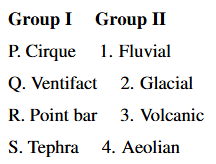
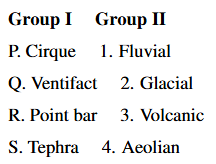
Match the geomorphic features in Group I with the related processes in Group II.
Which one of the given textural features results from exsolution?
In the holosymmetric class of the Cubic System, how many more faces does the {110} form have compared to the {111} form?
Which one of the following seismic waves involves compression and rarefaction (but not rotation) of the material it passes through?
Realgar and orpiment are both minerals of arsenic (As) and have the same chemical composition. Which one of the following properties can be used to distinguish between the two minerals in hand specimen?
Buckle folds result from
Sandstone beds above a magmatic body are domal in shape, while the beds below are horizontal. The magmatic body is
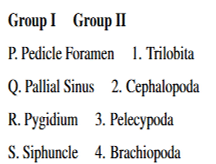
Match the morphological features in Group I with the corresponding fossil groups in Group II.
The Triassic-Jurassic boundary lies within which one of the following stratigraphic units?
Which one is the correct order of stability of the minerals (arranged from the most stable to the least stable) during chemical weathering?
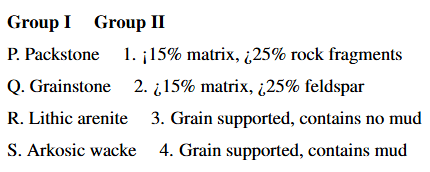
Match the following sedimentary rocks in Group I with their compositions in Group II.
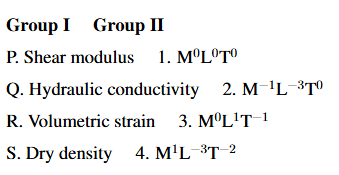
Match the parameters in Group I with their corresponding dimensions in Group II.
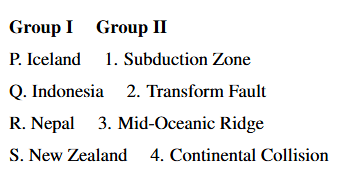
Match the countries in Group I with the plate tectonic features in Group II that cause seismic activity in them.
Which one of the magnitude scales given below DOES NOT saturate while estimating the size of earthquakes?
What is the minimum number of forms that an actual crystal must contain in Class 1 (Pedial) of the Triclinic System?
The apparent dip of a plane is measured to be 45° towards NE. The true dip of the plane is
A horizontal upright fold will have a
The displacement of the bed shown in the figure below is caused by a single movement along fault XYZ. Of the options given below, which fault-type can explain the observed displacement?

In the AFM diagram below, W, X, Y, and Z represent four pelitic assemblages. Which combinations of assemblages contain the same mineral phases in equilibrium in the staurolite zone?

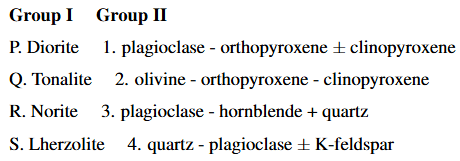
Match the rock types in Group I with their characteristic mineral assemblages in Group II.
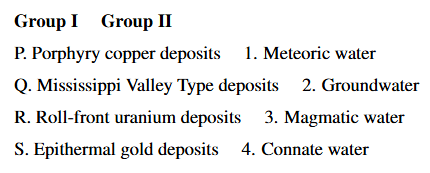
Match the mineral deposit types in Group I with the water types in Group II considered dominantly responsible for their origin.
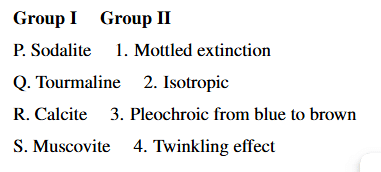
Match the minerals in Group I with their optical properties in Group II.
The contact between the Talchir Formation and the underlying Precambrian basement is
Increased diversity of siphonate bivalves occurred in response to
An index fossil should have
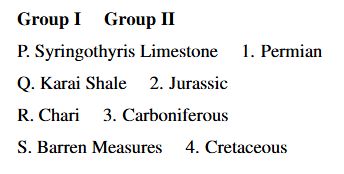
Match the formations in Group I with corresponding stratigraphic periods in Group II.
Which one of the given statements is correct?
Which of the following structures form in marine environment?
Identify the correct stratigraphic successions ordered from oldest to youngest.
Which of the following stratigraphic units contain coal seams?
Which of the following statements are CORRECT?
Which of the following genera are stem fossils?
Which of the following statements are correct?
The acceleration due to gravity on the Earth's surface depends on
A metamorphosed basaltic assemblage can include the minerals
Which of the following pairs represent correct plutonic – volcanic equivalents?
Based on the given stereographic projection, the fold can be classified as

The Ripple Symmetry Index (RSI) for the given hypothetical asymmetric ripple is .......... (Round off to one decimal place)

Within a fourth-order drainage basin, the total lengths of the 1st, 2nd, 3rd, and 4th order streams are 10.5 km, 7.5 km, 5.5 km, and 1.5 km, respectively. If the drainage density of the basin is 0.5 km\(^{-1}\), the basin area is ..... km\(^2\).
A soil has a void ratio of 0.5. The total porosity of the soil is ........... (Round off to two decimal places)
The average unit weight of the uppermost part of the crust is 25000 N/m\(^3\). The vertical stress at a depth of 1 km would be __________ MPa. (In integer)
The radius of the Earth's circular orbit round the Sun is \(149 \times 10^6\) km. The Earth takes 365 days to orbit the Sun. The tangential velocity of the Earth is __________ km/hour. (π = 3.14) (Round off to one decimal place)
A borehole inclined at \(60^\circ\) to the horizontal pierces a vertical basaltic dyke of uniform thickness. If the length of the basaltic drill core along the core axis is 12 m, the thickness of the dyke is __________ m. (In integer)
A P-ray arrives at the mantle-core boundary at an angle \(25^\circ\) with respect to the normal. At what angle to the normal does it enter the core? (P-wave velocity in the lower mantle is 13.7 km/s and outer core is 8.1 km/s) (Round off to two decimal places)
The mass of the Earth is 80 times that of the Moon while the radius of the Earth is four times that of the Moon. The surface gravity of the Earth is ......... times that of the Moon? (In integer)
A hypothetical rock contains the assemblage kyanite, sillimanite, and quartz. The variance (degree of freedom) of the assemblage is .......... (In integer)
The cut-off grade of copper is 0.45 wt%. A mine has 1 million tonne of waste with a grade of 0.25 wt%. The mine also has stock of high-grade ore with a grade of 1.8 wt%. How much of this high-grade ore (in million tonne) must be blended with the waste to sell the blended ore at a grade of 0.5 wt%? (Round off to three decimal places)
The maximum and minimum principal stresses in a zone of active normal faulting are 28 MPa and 8 MPa, respectively. The fault plane strikes N30°E and dips 60° towards SE. Considering Anderson's theory of faulting, the normal stress on the fault plane is ............ MPa. (In integer)
A granite block starts sliding on a slope (inclination of 30° with the horizontal) under the effect of gravity only, along the true direction of inclination of the slope and hits the ground in 4 seconds. Considering zero friction and zero cohesion during sliding, the vertical height of the point (with respect to the ground) from where the block was dislodged is ......... m. (g = 10 m/s\(^2\))
A cylindrical soil sample is encased in an open-ended inclined tube with a diameter of 100 mm. There is a constant supply of water from the upper end of the sample and the outflow from the other end is collected in a beaker. The average amount of water collected is 1000 mm\(^3\) every 10 seconds. The average outflow velocity is ...... mm/sec. (\(\pi = 3.14\)) (Round off to three decimal places)
Using Airy's hypothesis, calculate the thickness of the root beneath a 4 km high mountain in isostatic equilibrium with a 40 km thick continental crust of density 2800 kg/m\(^3\) and a mantle of density 3300 kg/m\(^3\). Express your answer in km. (Round off to one decimal place)
Given atomic weights of Cu, Fe, and S as 63.55, 55.85, 32.10, respectively, find out the weight of copper (in gram) metal in an ore (no associated gangue) of 1 kg weight constituting of bornite, chalcopyrite and chalcocite present in weight fractions of 0.4, 0.4 and 0.2, respectively. (Round off to one decimal place)
An ore body defined by a 300 m \(\times\) 300 m area is shown in the figure in which the drill hole locations on equally spaced square grid are marked (numbers 1–16). The average thickness of the ore body at the 4 interior points is 10.8 m, at the 4 corners is 11.0 m and at the remaining 8 boundary locations is 10.5 m, respectively. The corresponding average grades are 1.5, 1.9 and 1.8 wt% respectively. Calculate the average grade (in wt%) of the full ore body using the Included Area Method. (Round off to two decimal places).

The \(^{87}\)Sr/\(^{86}\)Sr ratio of a 1000 Ma granite was measured as 0.8001. If its \(^{87}\)Rb/\(^{86}\)Sr ratio is 2.499, what was the Sr isotopic ratio of the source at the time of derivation of the granite? (Decay constant of \(^{87}\)Rb = \(1.39 \times 10^{-11}\) yr\(^{-1}\)) (Round off to three decimal places)
The coefficients of permeability of two aquifers - 1 and 2, are 60 m/day and 40 m/day, respectively. Their saturated thicknesses are 30 m and 15 m, respectively. Assuming steady state Darcian flow, the transmissivity of aquifer 1 is __________ times that of aquifer 2. (In integer)
Assume that \(^{218}\)Po, with a half-life of 138 days, is in secular equilibrium with \(^{238}\)U whose half-life is \(4.5 \times 10^9\) years. How many grams of \(^{218}\)Po will be present for each gram of \(^{238}\)U in the mineral? Express your answer in logarithm (to the base 10). (Round off to two decimal places)
The figure below is an isobaric binary temperature-composition (T-X) plot. What amount (in %) of the equilibrium melting of rock R will generate a melt of composition L? (Round off to one decimal place)

IIT JAM Previous Year Question Papers
| IIT JAM 2022 Question Papers | IIT JAM 2021 Question Papers | IIT JAM 2020 Question Papers |
| IIT JAM 2019 Question Papers | IIT JAM 2018 Question Papers | IIT JAM Practice Papers |



Comments