



IIT JAM 2020 Geology (GG) Question paper with answer key pdf conducted on February 9 in Afternoon Session 2:30 PM to 5:30 PM is available for download. The exam was successfully organized by IIT Kanpur. The question paper comprised a total of 60 questions divided among 3 sections.
IIT JAM 2020 Geology (GG) Question Paper with Answer Key PDFs Afternoon Session
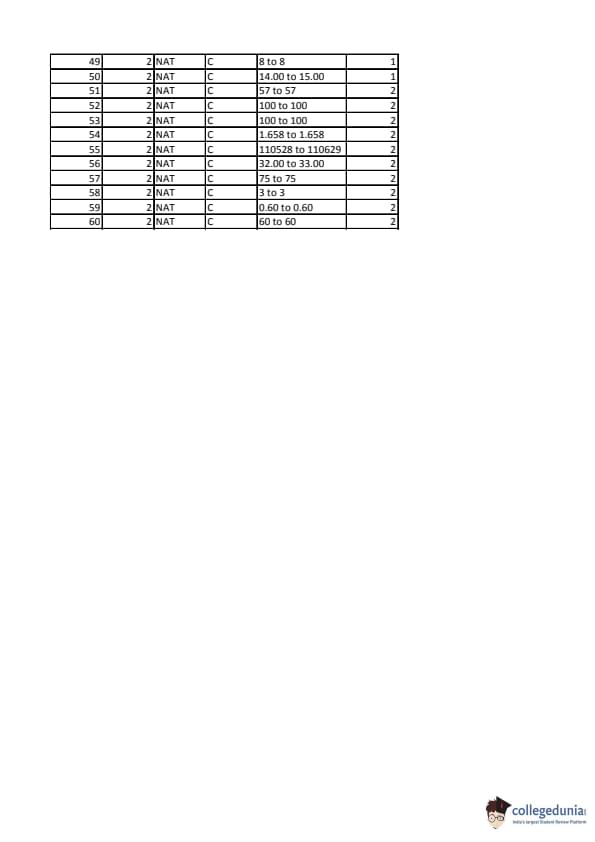
| IIT JAM 2020 Geology (GG) Question paper with answer key PDF | Download PDF | Check Solutions |
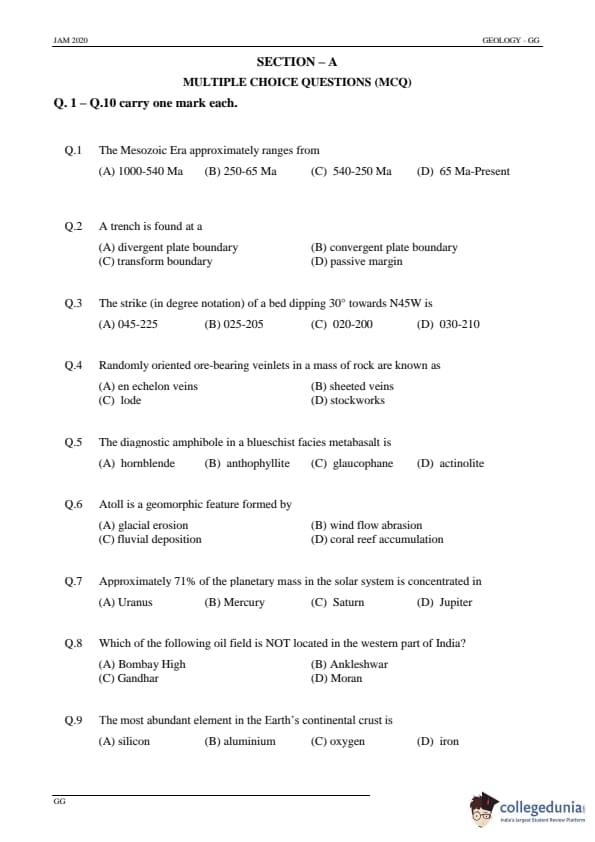
The Mesozoic Era approximately ranges from
View Solution
Step 1: Understanding the Mesozoic Era.
The Mesozoic Era is a well-known geologic period that lasted from approximately 250 million years ago (Ma) to 65 million years ago. It is known as the "Age of Dinosaurs."
Step 2: Analyzing the options.
(A) 1000-540 Ma: This is incorrect, as this time range falls before the Mesozoic Era.
(B) 250-65 Ma: Correct — This is the actual range of the Mesozoic Era.
(C) 540-250 Ma: This refers to the preceding Paleozoic Era.
(D) 65 Ma-Present: This range refers to the Cenozoic Era, which started after the Mesozoic Era.
Step 3: Conclusion.
The correct answer is (B) 250-65 Ma, as this is the time span of the Mesozoic Era.
Quick Tip: The Mesozoic Era spans from 250 to 65 million years ago, and it is characterized by the dominance of dinosaurs.
A trench is found at a
View Solution
Step 1: Understanding Plate Boundaries.
A trench is typically formed at a convergent plate boundary, where two tectonic plates move toward each other, resulting in subduction.
Step 2: Analyzing the options.
(A) divergent plate boundary: Trenches do not form at divergent boundaries; these boundaries are characterized by the moving apart of tectonic plates.
(B) convergent plate boundary: Correct — Trenches are formed where one plate is subducted beneath another at a convergent boundary.
(C) transform boundary: Transform boundaries involve horizontal movement of plates and do not create trenches.
(D) passive margin: Passive margins are typically stable regions where no major tectonic activity, like trench formation, occurs.
Step 3: Conclusion.
The correct answer is (B) convergent plate boundary, where trenches are commonly found due to subduction zones.
Quick Tip: Trenches are deep, narrow depressions in the ocean floor that are typically found at convergent plate boundaries, where one plate is subducted beneath another.
The strike (in degree notation) of a bed dipping 30° towards N45W is
View Solution
Step 1: Understanding the Strike and Dip.
The strike is the direction of the horizontal line formed by the intersection of a bedding plane with a horizontal plane. The dip is the angle at which the bed inclines relative to the horizontal. The strike is measured perpendicular to the dip direction.
Step 2: Analyzing the options.
The dip is 30° towards N45W, meaning the strike should be at a right angle to this, which would be along the direction of 045°. Therefore, the strike is 045-225.
Step 3: Conclusion.
The correct answer is (A) 045-225, which correctly reflects the strike direction for a bed dipping 30° towards N45W.
Quick Tip: For strike and dip notation, remember that the strike is always perpendicular to the dip direction.
Randomly oriented ore-bearing veinlets in a mass of rock are known as
View Solution
Step 1: Understanding Ore Vein Terminology.
Stockworks are networks of veins or veinlets that are randomly oriented and crosscut a rock mass. They typically represent zones of mineralization.
Step 2: Analyzing the options.
(A) en echelon veins: These veins are parallel and offset, forming a stepped pattern, not random.
(B) sheeted veins: These veins are parallel and closely spaced, typically oriented in the same direction.
(C) lode: A lode refers to a rich mineral deposit or vein, not a network of randomly oriented veins.
(D) stockworks: Correct — A stockwork is a network of veins, often mineralized, that crosscut each other in a random orientation.
Step 3: Conclusion.
The correct answer is (D) stockworks, as these represent a network of randomly oriented ore-bearing veinlets.
Quick Tip: Stockworks are networks of intersecting veins or veinlets, commonly found in ore deposits.
The diagnostic amphibole in a blueschist facies metabasalt is
View Solution
Step 1: Understanding Blueschist Facies.
Blueschist facies is a high-pressure, low-temperature metamorphic facies characterized by the presence of minerals like glaucophane, actinolite, and hornblende. Hornblende is often a diagnostic mineral in blueschist facies metabasalt.
Step 2: Analyzing the options.
(A) hornblende: Correct — Hornblende is commonly found in blueschist facies and is a diagnostic amphibole in metabasalt.
(B) anthophyllite: This is a magnesium-rich amphibole, but it is not typical in blueschist facies.
(C) glaucochane: This is a mineral associated with blueschist but not typically an amphibole.
(D) actinolite: Actinolite is a green amphibole but is less diagnostic of blueschist facies compared to hornblende.
Step 3: Conclusion.
The correct answer is (A) hornblende, which is a diagnostic amphibole found in blueschist facies metabasalt.
Quick Tip: Blueschist facies is characterized by minerals like hornblende and glaucophane, which form under high-pressure, low-temperature conditions.
Atoll is a geomorphic feature formed by
View Solution
Step 1: Understanding an Atoll.
An atoll is a ring-shaped coral reef, island, or series of islets that encircle a lagoon. It forms through coral growth on submerged volcanic islands. The growth of coral reefs in shallow, tropical seas eventually creates these unique features.
Step 2: Analyzing the options.
(A) glacial erosion: This is incorrect, as atolls are not formed by glaciers but by coral reef accumulation.
(B) wind flow abrasion: Wind erosion can shape certain landforms but does not form atolls.
(C) fluvial deposition: This refers to river deposition, which is unrelated to the formation of coral reefs.
(D) coral reef accumulation: Correct — Atolls are formed by the accumulation of coral reefs around submerged islands.
Step 3: Conclusion.
The correct answer is (D) coral reef accumulation, as atolls form through the growth of coral reefs around a lagoon.
Quick Tip: Atolls are ring-shaped coral reefs that form around submerged islands and grow into rings with a central lagoon.
Approximately 71% of the planetary mass in the solar system is concentrated in
View Solution
Step 1: Understanding planetary mass.
Jupiter, the largest planet in our solar system, contains more than 70% of the total planetary mass, which includes the mass of all the planets combined. It is a gas giant, primarily made of hydrogen and helium.
Step 2: Analyzing the options.
(A) Uranus: Uranus is a large planet but does not have nearly the mass of Jupiter.
(B) Mercury: Mercury is a small planet, and its mass is only a tiny fraction of the total planetary mass in the solar system.
(C) Saturn: Saturn is also a gas giant, but it has less mass than Jupiter.
(D) Jupiter: Correct — Jupiter holds the majority of the solar system's planetary mass.
Step 3: Conclusion.
The correct answer is (D) Jupiter, which contains approximately 71% of the solar system's planetary mass.
Quick Tip: Jupiter is the largest planet in our solar system, and its mass accounts for a significant portion of the total planetary mass.
Which of the following oil fields is NOT located in the western part of India?
View Solution
Step 1: Identifying oil fields in India.
Bombay High, Ankleshwar, and Gandhar are major oil fields located in the western part of India, mainly in Gujarat and Maharashtra. However, Moran is an oil field located in the northeastern part of India, in Assam.
Step 2: Analyzing the options.
(A) Bombay High: This is a major oil field off the coast of Mumbai, located in the western part of India.
(B) Ankleshwar: Ankleshwar is a significant oil field located in Gujarat, which is part of western India.
(C) Gandhar: Gandhar is another important oil field in Gujarat.
(D) Moran: Correct — Moran is located in Assam, which is in the northeastern part of India.
Step 3: Conclusion.
The correct answer is (D) Moran, which is located in the northeastern part of India, not the western part.
Quick Tip: Familiarize yourself with the locations of major oil fields in India. Bombay High, Ankleshwar, and Gandhar are in the western region, while Moran is in the northeast.
The most abundant element in the Earth’s continental crust is
View Solution
Step 1: Understanding the composition of Earth's crust.
The Earth's continental crust is primarily composed of oxygen (about 46% by weight), followed by silicon (about 28%). These two elements combine to form the most common minerals in the crust, such as feldspar and quartz.
Step 2: Analyzing the options.
(A) silicon: Silicon is abundant in the Earth's crust but is less abundant than oxygen.
(B) aluminium: Aluminium is present in the crust but is less abundant than silicon and oxygen.
(C) oxygen: Correct — Oxygen is the most abundant element in the Earth's continental crust.
(D) iron: Iron is more abundant in the Earth's core, not the continental crust.
Step 3: Conclusion.
The correct answer is (C) oxygen, as it is the most abundant element in the Earth's continental crust.
Quick Tip: Oxygen is the most abundant element in the Earth's continental crust, followed by silicon. These two elements combine to form the majority of Earth's minerals.
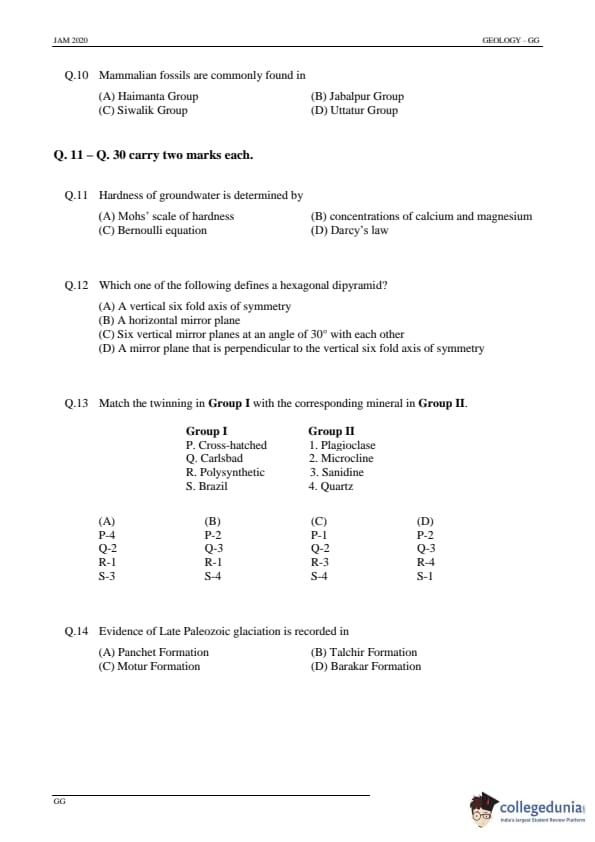
Mammalian fossils are commonly found in
View Solution
Step 1: Understanding the Siwalik Group.
The Siwalik Group is a series of sedimentary rock formations in the northern part of India and Nepal. It is rich in fossils, especially mammalian fossils, and is known for its significant contribution to the study of prehistoric life.
Step 2: Analyzing the options.
(A) Haimanta Group: This group is not well-known for mammalian fossils.
(B) Jabalpur Group: This group is mainly known for its fossilized plants.
(C) Siwalik Group: Correct — The Siwalik Group is famous for its rich mammalian fossil deposits.
(D) Uttar Group: This group is not a major source of mammalian fossils.
Step 3: Conclusion.
The correct answer is (C) Siwalik Group, which is known for its rich mammalian fossil deposits.
Quick Tip: The Siwalik Group is one of the most important fossil-bearing formations in India, particularly known for its mammalian fossils.
Hardness of groundwater is determined by
View Solution
Step 1: Understanding groundwater hardness.
Groundwater hardness is determined by the concentration of calcium and magnesium ions dissolved in the water. These ions are the primary contributors to the hardness of water.
Step 2: Analyzing the options.
(A) Mohs' scale of hardness: This scale is used to measure the hardness of minerals, not groundwater.
(B) concentrations of calcium and magnesium: Correct — The hardness of groundwater is typically due to the concentration of these two minerals.
(C) Bernoulli equation: The Bernoulli equation is used to describe the flow of fluids and is not related to water hardness.
(D) Darcy’s law: Darcy's law is used to describe the flow of water through porous media, not the hardness of water.
Step 3: Conclusion.
The correct answer is (B) concentrations of calcium and magnesium, as they directly contribute to the hardness of groundwater.
Quick Tip: Groundwater hardness is mainly caused by the presence of calcium and magnesium ions.
Which one of the following defines a hexagonal dipyramid?
View Solution
Step 1: Understanding a hexagonal dipyramid.
A hexagonal dipyramid is a type of polyhedron that has six triangular faces and a vertical six-fold axis of symmetry. It can be visualized as two pyramids joined at their bases, with the symmetry axis passing vertically through the center.
Step 2: Analyzing the options.
(A) A vertical six fold axis of symmetry: Correct — This defines the symmetry of a hexagonal dipyramid.
(B) A horizontal mirror plane: This does not describe a hexagonal dipyramid.
(C) Six vertical mirror planes at an angle of 30° with each other: This option does not describe the symmetry of a hexagonal dipyramid.
(D) A mirror plane that is perpendicular to the vertical six fold axis of symmetry: This is not the defining characteristic of a hexagonal dipyramid.
Step 3: Conclusion.
The correct answer is (A) A vertical six fold axis of symmetry, as this is the key characteristic of a hexagonal dipyramid.
Quick Tip: A hexagonal dipyramid has six faces and a vertical six-fold axis of symmetry.
Match the twinning in Group I with the corresponding mineral in Group II.
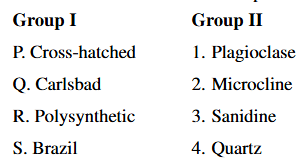
View Solution
Step 1: Understanding twinning in minerals.
Twinning is a common crystallographic phenomenon where two or more crystals share a symmetrical relationship. In this case, we need to match the twinning types with the corresponding minerals.
Step 2: Analyzing the options.
P. Cross-hatched: Cross-hatched twinning is characteristic of Plagioclase (1).
Q. Carlsbad: Carlsbad twinning is typical in Microcline (2).
R. Polysynthetic: Polysynthetic twinning is a characteristic of Sanidine (3).
S. Brazil: Brazil twinning is most common in Quartz (4).
Step 3: Conclusion.
The correct answer is (C) P-1, Q-2, R-3, S-4, matching the twinning to the correct minerals.
Quick Tip: Familiarize yourself with the types of twinning and their characteristic minerals for better identification.
Evidence of Late Paleozoic glaciation is recorded in
View Solution
Step 1: Understanding Late Paleozoic glaciation.
Late Paleozoic glaciation is evidence of glaciers that existed during the late Carboniferous to early Permian periods. This glaciation left geological evidence in the form of glacial deposits and striations.
Step 2: Analyzing the options.
(A) Panchet Formation: This formation does not record evidence of Late Paleozoic glaciation.
(B) Talchir Formation: Correct — The Talchir Formation, located in India, contains evidence of Late Paleozoic glaciation.
(C) Motur Formation: This formation does not contain evidence of glaciation.
(D) Barakar Formation: This formation is associated with other types of sedimentary deposits, not glaciation.
Step 3: Conclusion.
The correct answer is (B) Talchir Formation, which records evidence of Late Paleozoic glaciation.
Quick Tip: The Talchir Formation in India is well-known for containing glacial evidence from the Late Paleozoic era.
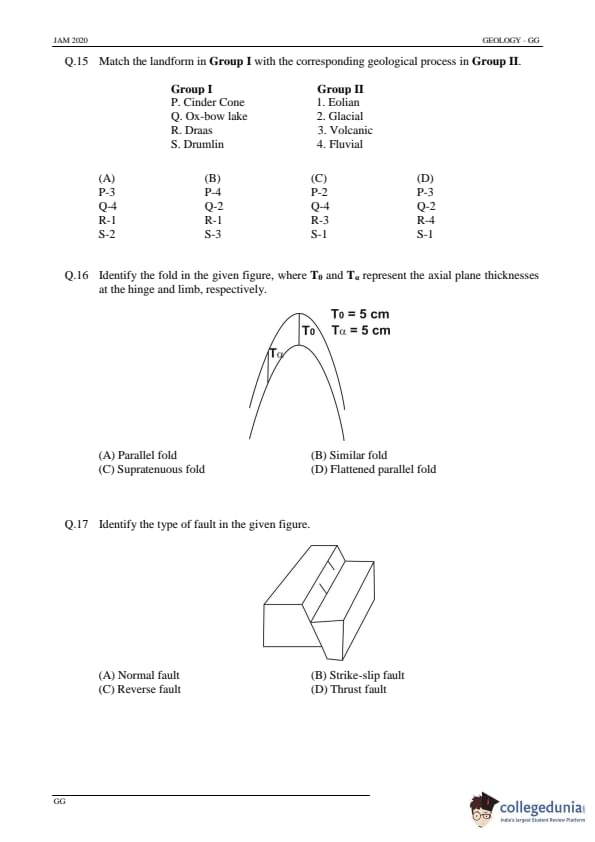
Match the landform in Group I with the corresponding geological process in Group II.
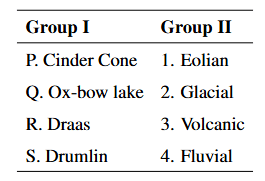
View Solution
Step 1: Understanding the landforms and processes.
- A Cinder Cone is a volcanic landform formed from pyroclastic material, so it corresponds to Volcanic.
- An Ox-bow lake is a meander cut-off by the river, formed by fluvial processes.
- Draas are glacial landforms formed by ice action, so it corresponds to Glacial.
- A Drumlin is an elongated hill formed by glacial ice, so it corresponds to Eolian.
Step 2: Analyzing the options.
(A) P-3, Q-4, R-1, S-2: Correct — Cinder Cone is volcanic, Ox-bow lake is fluvial, Draas are glacial, and Drumlin is Eolian.
(B) P-4, Q-2, R-3, S-1: Incorrect.
(C) P-2, Q-1, R-3, S-4: Incorrect.
(D) P-3, Q-2, R-4, S-1: Incorrect.
Step 3: Conclusion.
The correct answer is (A) P-3, Q-4, R-1, S-2.
Quick Tip: Understanding the geological processes associated with different landforms is crucial in geology. Cinder cones form due to volcanic activity, while Ox-bow lakes are formed by fluvial processes.
Identify the fold in the given figure, where T₀ and Tα represent the axial plane thicknesses at the hinge and limb, respectively.

View Solution
Step 1: Understanding the fold.
The figure represents a fold where the axial plane thickness (T₀) at the hinge is compared with that at the limb (Tα). A "similar fold" indicates that the layers on either side of the fold have a similar geometry.
Step 2: Analyzing the options.
(A) Parallel fold: This option is incorrect, as it does not match the description of the given fold.
(B) Similar fold: Correct — Similar folds show similar geometry in the hinge and limb, as represented by T₀ and Tα in the diagram.
(C) Supratenous fold: This term does not describe the type of fold shown in the figure.
(D) Flattened parallel fold: This is not applicable to the fold shown in the figure.
Step 3: Conclusion.
The correct answer is (B) Similar fold, as the geometry of the fold is consistent with this classification.
Quick Tip: In structural geology, a similar fold has a similar geometry along the hinge and limbs, unlike parallel folds or other types.
Identify the type of fault in the given figure.

View Solution
Step 1: Understanding fault types.
Faults are fractures in the Earth's crust where displacement occurs. In a strike-slip fault, the displacement is horizontal, and the blocks slide past each other.
Step 2: Analyzing the options.
(A) Normal fault: This type of fault involves vertical displacement where the hanging wall moves downward relative to the footwall, which is not shown in the figure.
(B) Strike-slip fault: Correct — In a strike-slip fault, the fault line displaces horizontally, which is visible in the figure.
(C) Reverse fault: In a reverse fault, the hanging wall moves up relative to the footwall, which does not match the figure.
(D) Thrust fault: Thrust faults are a type of reverse fault with low-angle faults, which is not applicable here.
Step 3: Conclusion.
The correct answer is (B) Strike-slip fault, as this fault involves horizontal displacement.
Quick Tip: In a strike-slip fault, the displacement is horizontal. If the blocks slide past each other without vertical movement, it's a strike-slip fault.
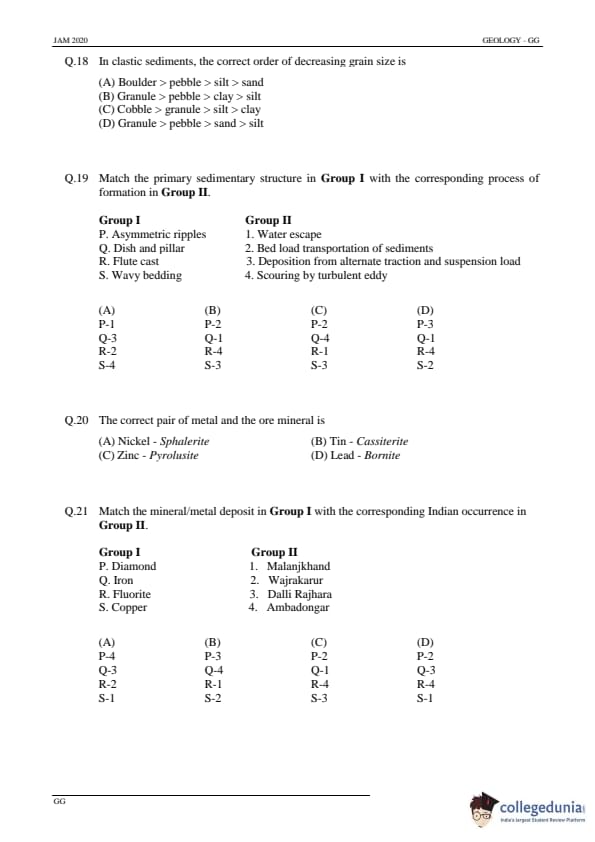
In clastic sediments, the correct order of decreasing grain size is
View Solution
Step 1: Understanding grain size in clastic sediments.
In clastic sediments, the grain size is ranked from the largest to the smallest particles. The correct order of decreasing grain size typically starts with granules, followed by pebbles, then sand, and finally silt.
Step 2: Analyzing the options.
(A) Boulder > pebble > silt > sand: Incorrect, as sand is larger than silt.
(B) Granule > pebble > clay > silt: Incorrect, as clay is finer than silt.
(C) Cobble > granule > silt > clay: Incorrect, as silt is larger than clay.
(D) Granule > pebble > sand > silt: Correct — This is the correct order of grain size in clastic sediments.
Step 3: Conclusion.
The correct answer is (D) Granule > pebble > sand > silt, which is the proper order from largest to smallest grain size.
Quick Tip: When classifying clastic sediments, remember that granule and pebble are coarser than sand, and sand is coarser than silt.
Match the primary sedimentary structure in Group I with the corresponding process of formation in Group II.
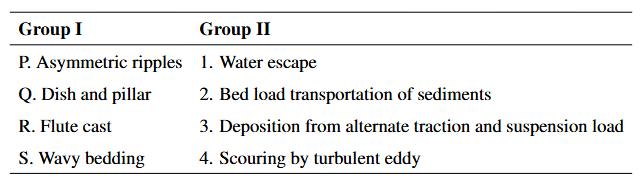
View Solution
Step 1: Understanding sedimentary structures.
- Asymmetric ripples are formed by the movement of water in a unidirectional flow, typically formed by scouring from a turbulent eddy.
- Dish and pillar structures are related to the transportation of sediments and bed load movement.
- Flute casts are formed by scouring processes, where a turbulent flow of water erodes the sediment.
- Wavy bedding typically results from deposition in an environment where sediment is alternately deposited from traction and suspension loads.
Step 2: Analyzing the options.
(A) P-1, Q-2, R-3, S-4: Correct — This option correctly matches the structures with their formation processes.
(B) P-2, Q-3, R-1, S-4: Incorrect.
(C) P-1, Q-4, R-3, S-2: Incorrect.
(D) P-2, Q-4, R-1, S-3: Incorrect.
Step 3: Conclusion.
The correct answer is (A) P-1, Q-2, R-3, S-4, as it properly matches the sedimentary structures with their corresponding processes.
Quick Tip: Sedimentary structures such as ripples, bedding, and flute casts are key indicators of past environmental conditions and sediment transport mechanisms.
The correct pair of metal and the ore mineral is
View Solution
Step 1: Identifying ore minerals.
- Cassiterite is the main ore mineral of tin, containing tin in its oxidized form.
- Sphalerite is the primary ore mineral of zinc, not nickel.
- Pyrolusite is the ore mineral of manganese, not zinc.
- Bornite is an ore mineral for copper, not lead.
Step 2: Analyzing the options.
(A) Nickel - Sphalerite: Incorrect, as Sphalerite is the ore mineral of zinc, not nickel.
(B) Tin - Cassiterite: Correct — Cassiterite is the principal ore of tin.
(C) Zinc - Pyrolusite: Incorrect, as Pyrolusite is the ore of manganese.
(D) Lead - Bornite: Incorrect, as Bornite is the ore of copper.
Step 3: Conclusion.
The correct answer is (B) Tin - Cassiterite, as Cassiterite is the primary ore of tin.
Quick Tip: Cassiterite is the most important ore of tin, while Sphalerite is the ore for zinc. Always associate the metal with its respective ore.
Match the mineral/metal deposit in Group I with the corresponding Indian occurrence in Group II.
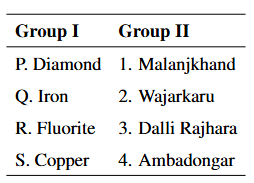
View Solution
Step 1: Identifying the mineral deposits and their locations in India.
- Diamond is found in the Ambadongar region.
- Iron is primarily found in the Dalli Rajhara region.
- Fluorite is found in the Malanjkhand region.
- Copper is found in the Wajarkaru region.
Step 2: Analyzing the options.
(A) P-4, Q-3, R-2, S-1: Correct — This matches the minerals and their respective Indian occurrences.
(B) P-3, Q-4, R-1, S-2: Incorrect.
(C) P-2, Q-1, R-4, S-3: Incorrect.
(D) P-2, Q-3, R-4, S-1: Incorrect.
Step 3: Conclusion.
The correct answer is (A) P-4, Q-3, R-2, S-1, matching the minerals to their respective Indian occurrences.
Quick Tip: Always associate the correct mineral with its known geographic location to ensure accurate identification.
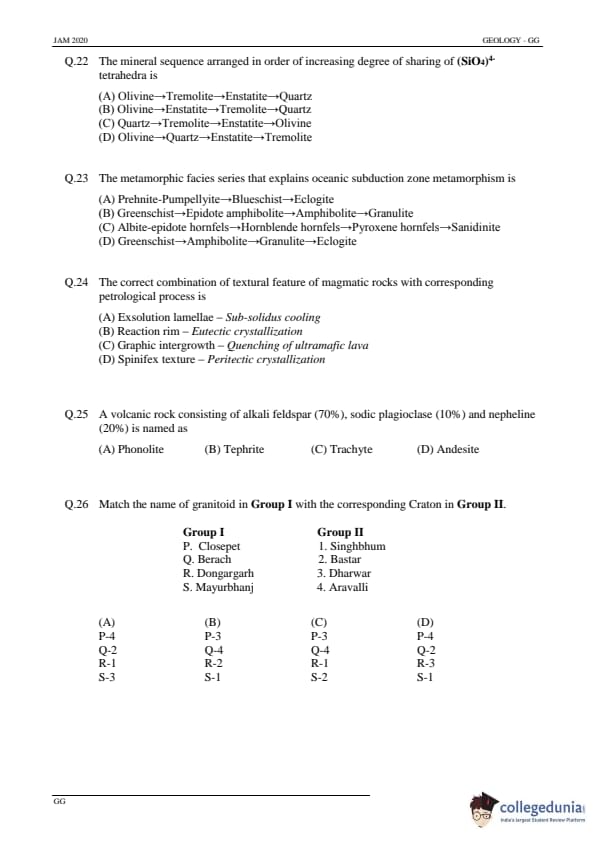
The mineral sequence arranged in order of increasing degree of sharing of (SiO₄)⁴⁻ tetrahedra is
View Solution
Step 1: Understanding the mineral sequence.
The order of increasing degree of sharing of (SiO₄)⁴⁻ tetrahedra refers to how the silicate tetrahedra are linked in minerals. In this context, minerals like Olivine have isolated tetrahedra, while minerals like Quartz have fully linked tetrahedra.
Step 2: Analyzing the options.
(A) Olivine → Tremolite → Enstatite → Quartz: This is incorrect, as the sequence of increasing tetrahedral sharing is not followed correctly.
(B) Olivine → Enstatite → Tremolite → Quartz: Correct — This sequence correctly reflects the increasing degree of tetrahedral sharing, from isolated in Olivine to fully linked in Quartz.
(C) Quartz → Tremolite → Enstatite → Olivine: Incorrect, as Quartz should be at the end.
(D) Olivine → Quartz → Enstatite → Tremolite: Incorrect, as Quartz should be at the end in terms of tetrahedral sharing.
Step 3: Conclusion.
The correct answer is (B) Olivine → Enstatite → Tremolite → Quartz.
Quick Tip: When ordering minerals based on the degree of tetrahedral sharing, remember that minerals with isolated tetrahedra are at the start, and minerals with fully linked tetrahedra are at the end.
The metamorphic facies series that explains oceanic subduction zone metamorphism is
View Solution
Step 1: Understanding metamorphic facies series.
The Prehnite-Pumpellyite to Blueschist to Eclogite facies series represents the progressive metamorphism of rocks in oceanic subduction zones, where the pressure and temperature increase with depth.
Step 2: Analyzing the options.
(A) Prehnite-Pumpellyite → Blueschist → Eclogite: Correct — This is the typical sequence of metamorphism in an oceanic subduction zone, where blueschist forms at high pressure but relatively low temperature, and eclogite forms at higher pressures.
(B) Greenschist → Epidote amphibolite → Amphibolite → Granulite: This sequence is more characteristic of regional metamorphism at moderate pressures and temperatures.
(C) Albite-epidote hornfels → Hornblende hornfels → Pyroxene hornfels → Sanidinite: This sequence relates to contact metamorphism, not subduction zones.
(D) Greenschist → Amphibolite → Granulite → Eclogite: Incorrect, as this does not follow the typical sequence for oceanic subduction zones.
Step 3: Conclusion.
The correct answer is (A) Prehnite-Pumpellyite → Blueschist → Eclogite.
Quick Tip: In oceanic subduction zones, the typical metamorphic facies series progresses from Prehnite-Pumpellyite to Blueschist to Eclogite.
The correct combination of textural feature of magmatic rocks with corresponding petrological process is
View Solution
Step 1: Understanding the textures and processes.
Exsolution lamellae form when minerals separate at lower temperatures in magmatic rocks, a process known as sub-solidus cooling. This process typically occurs after the initial solidification of the magma.
Step 2: Analyzing the options.
(A) Exsolution lamellae → Sub-solidus cooling: Correct — Exsolution lamellae form during sub-solidus cooling, as minerals separate during cooling.
(B) Reaction rim → Eutectic crystallization: Reaction rims form due to reactions between different minerals, not related to eutectic crystallization.
(C) Graphic intergrowth → Quenching of ultramafic lava: Graphic intergrowths occur in certain types of igneous rocks, but they are not directly linked to quenching.
(D) Spinifex texture → Peritectic crystallization: Spinifex texture is related to rapid cooling of ultramafic lava, not peritectic crystallization.
Step 3: Conclusion.
The correct answer is (A) Exsolution lamellae → Sub-solidus cooling.
Quick Tip: Exsolution lamellae are typically formed during sub-solidus cooling in magmatic rocks, a process that occurs after the magma has solidified.
A volcanic rock consisting of alkali feldspar (70%), sodic plagioclase (10%) and nepheline (20%) is named as
View Solution
Step 1: Understanding the composition of volcanic rocks.
Phonolite is a volcanic rock with a composition rich in alkali feldspar and nepheline. It typically contains more than 60% alkali feldspar and a substantial amount of nepheline.
Step 2: Analyzing the options.
(A) Phonolite: Correct — Phonolite is characterized by a composition of alkali feldspar and nepheline, as described.
(B) Tephrite: Tephrite is a basaltic rock that contains a higher proportion of plagioclase than phonolite.
(C) Trachyte: Trachyte is similar to phonolite but contains less nepheline.
(D) Andesite: Andesite is an intermediate volcanic rock, not matching the given composition.
Step 3: Conclusion.
The correct answer is (A) Phonolite.
Quick Tip: Phonolite is a volcanic rock rich in alkali feldspar and nepheline, often found in alkaline volcanic regions.
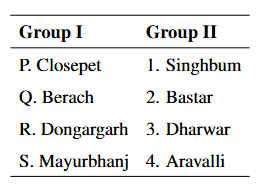
Match the name of granitoid in Group I with the corresponding Craton in Group II.
View Solution
Step 1: Identifying the granitoids and their corresponding cratons.
- Closepet is located in the Aravalli craton.
- Berach is located in the Dharwar craton.
- Dongargarh is located in the Singhbum craton.
- Mayurbhanj is located in the Bastar craton.
Step 2: Analyzing the options.
(A) P-4, Q-2, R-1, S-3: Correct — This matches the granitoids to their corresponding cratons.
(B) P-3, Q-4, R-2, S-1: Incorrect.
(C) P-3, Q-4, R-1, S-2: Incorrect.
(D) P-4, Q-3, R-2, S-1: Incorrect.
Step 3: Conclusion.
The correct answer is (A) P-4, Q-2, R-1, S-3, matching the granitoids to their respective cratons.
Quick Tip: When matching granitoids with cratons, it is essential to know the geological distribution of granitoid bodies in specific cratons.
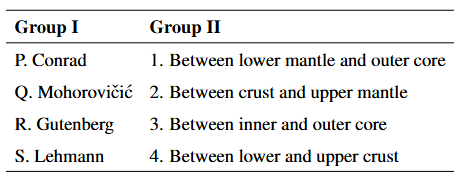
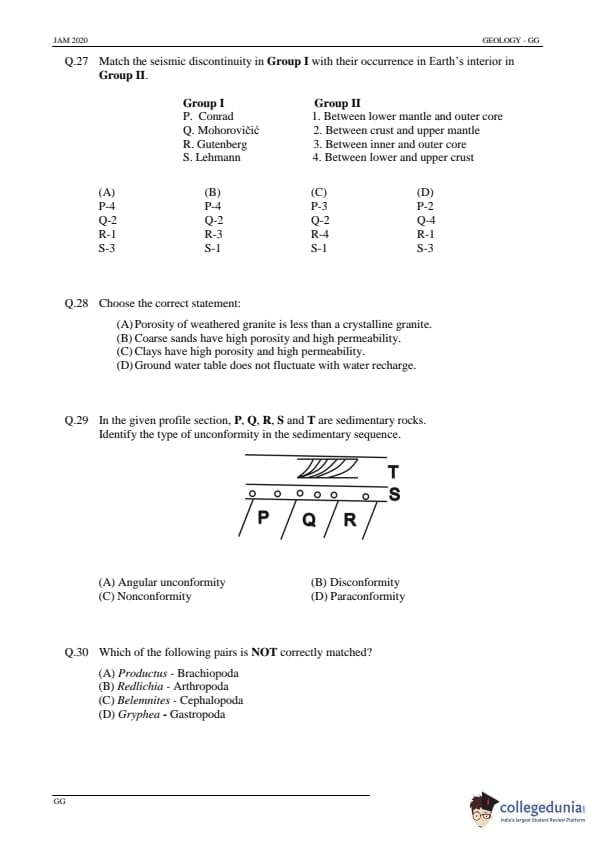
Match the seismic discontinuity in Group I with their occurrence in Earth’s interior in Group II.
View Solution
Step 1: Identifying the seismic discontinuities and their occurrences.
- The Conrad discontinuity is located between the lower and upper crust.
- The Mohorovičić (Moho) discontinuity is located between the crust and upper mantle.
- The Gutenberg discontinuity is located between the lower mantle and outer core.
- The Lehmann discontinuity is located between the inner and outer core.
Step 2: Analyzing the options.
(A) P-4, Q-2, R-1, S-3: Correct — This matches the seismic discontinuities with their corresponding locations in the Earth's interior.
(B) P-4, Q-2, R-3, S-1: Incorrect.
(C) P-3, Q-2, R-4, S-1: Incorrect.
(D) P-2, Q-4, R-1, S-3: Incorrect.
Step 3: Conclusion.
The correct answer is (A) P-4, Q-2, R-1, S-3, matching the seismic discontinuities with their corresponding positions in Earth's interior.
Quick Tip: When identifying seismic discontinuities, remember that the Mohorovičić is between the crust and upper mantle, while the Conrad is between the crust layers, and the Gutenberg and Lehmann correspond to the core-mantle boundaries.
Choose the correct statement:
View Solution
Step 1: Understanding the statements.
- (A) Weathered granite generally has higher porosity than crystalline granite, making this statement incorrect.
- (B) Coarse sands do indeed have high porosity and high permeability because they allow water to flow through more easily.
- (C) Clays have high porosity, but their permeability is low due to the fine particles, making this statement incorrect.
- (D) Groundwater table fluctuates with water recharge, so this statement is incorrect.
Step 2: Conclusion.
The correct answer is (B) Coarse sands have high porosity and high permeability.
Quick Tip: Coarse sands are good aquifers because they allow both water storage (high porosity) and movement (high permeability).
In the given profile section, P, Q, R, S, and T are sedimentary rocks. Identify the type of unconformity in the sedimentary sequence.

View Solution
Step 1: Understanding the types of unconformities.
- Angular unconformity occurs when sedimentary layers are deposited on top of tilted or folded layers, showing a clear angular discordance.
- Disconformity is a gap in the geological record between parallel layers of sedimentary rock.
- Nonconformity occurs when sedimentary layers are deposited over older, metamorphic or igneous rocks.
- Paraconformity is a subtle type of unconformity where layers are parallel, but there is a time gap.
Step 2: Analyzing the given profile.
The diagram clearly shows layers of rock that are tilted, with new layers deposited on top. This is a classic example of angular unconformity.
Step 3: Conclusion.
The correct answer is (A) Angular unconformity.
Quick Tip: Angular unconformity is characterized by tilted or folded older rock layers with new layers deposited on top at a different angle.
Which of the following pairs is NOT correctly matched?
View Solution
Step 1: Understanding the classification of organisms.
- (A) Productus is a genus of brachiopods, so this is correctly matched.
- (B) Redlichia is an extinct genus of trilobites, classified under Arthropoda, so this is correctly matched.
- (C) Belemnites are cephalopods, so this is correctly matched.
- (D) Gryphea is an extinct genus of oysters, classified under Mollusca (Bivalvia), not Gastropoda, so this is incorrectly matched.
Step 2: Conclusion.
The correct answer is (D) Gryphea - Gastropoda, as Gryphea is a bivalve, not a gastropod.
Quick Tip: When matching organisms, be sure to know their correct taxonomic classification (e.g., Gryphea is a bivalve, not a gastropod).
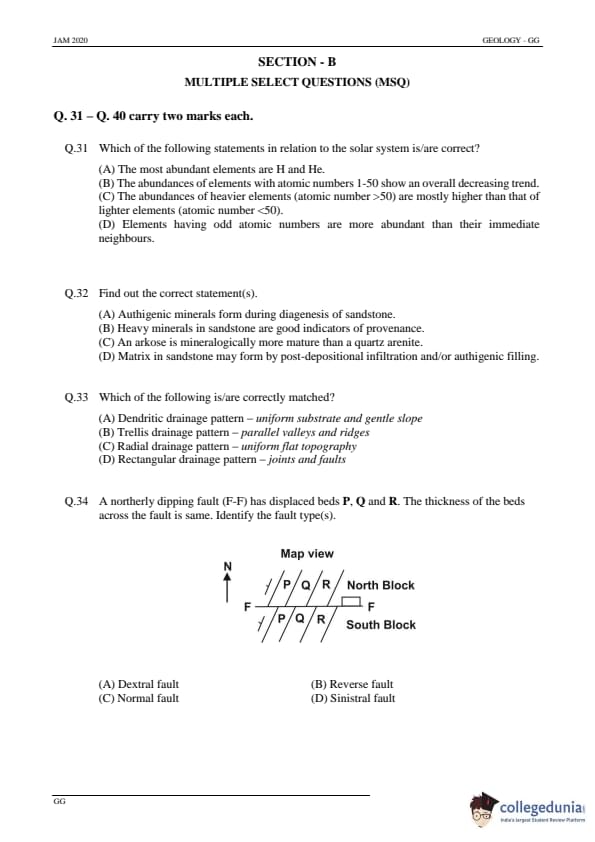
Which of the following statements in relation to the solar system is/are correct?
View Solution
Step 1: Understanding the solar system's elemental composition.
Hydrogen (H) and Helium (He) are the most abundant elements in the universe, particularly in stars and the solar system. These two elements account for the majority of the universe's baryonic mass.
Step 2: Analyzing the options.
(A) The most abundant elements are H and He: Correct — Hydrogen and helium are the two most abundant elements in the solar system.
(B) The abundances of elements with atomic numbers 1-50 show an overall decreasing trend: Incorrect — While many elements show a decreasing trend, there are exceptions such as oxygen, carbon, and nitrogen.
(C) The abundances of heavier elements (atomic number >50) are mostly higher than that of lighter elements (atomic number <50): Incorrect — Lighter elements like H and He are more abundant than heavier elements.
(D) Elements having odd atomic numbers are more abundant than their immediate neighbours: Incorrect — This is not generally true, as abundance depends on various nuclear processes, not just atomic number parity.
Step 3: Conclusion.
The correct answer is (A) The most abundant elements are H and He.
Quick Tip: Hydrogen and helium dominate the solar system, and heavier elements are relatively less abundant.
Find out the correct statement(s).
View Solution
Step 1: Analyzing the statements.
- (A) Authigenic minerals do indeed form during the diagenesis process, but this is not universally true for all sandstones.
- (B) Heavy minerals are excellent indicators of provenance in sandstone, as their presence and composition can help identify the source rock.
- (C) An arkose is a more immature rock than quartz arenite, as it contains a higher percentage of feldspar.
- (D) Matrix in sandstone can form by post-depositional processes, but this is not the defining feature of all sandstones.
Step 2: Conclusion.
The correct answer is (B) Heavy minerals in sandstone are good indicators of provenance.
Quick Tip: When studying sandstone, the presence of heavy minerals can provide significant clues about the source area and the depositional environment.
Which of the following is/are correctly matched?
View Solution
Step 1: Understanding drainage patterns.
- (A) Dendritic drainage forms in areas with a relatively uniform substrate and gentle slope, so this is correct.
- (B) Trellis drainage occurs where valleys and ridges are parallel to the flow, usually in areas of folded topography, so this is correct.
- (C) Radial drainage typically forms from central points, like volcanic cones, rather than from flat topography.
- (D) Rectangular drainage forms in areas with a network of joints and faults, so this is correct.
Step 2: Conclusion.
The correct answer is (B) Trellis drainage pattern → parallel valleys and ridges.
Quick Tip: Drainage patterns provide valuable insight into the underlying geology, such as fold structures or fault systems.
A northerly dipping fault (F-F) has displaced beds P, Q and R. The thickness of the beds across the fault is same. Identify the fault type(s).

View Solution
Step 1: Identifying the fault type.
A normal fault occurs when the hanging wall moves downward relative to the footwall, often in response to extensional stress. The displacement of beds across a normal fault results in the stretching of the crust.
Step 2: Analyzing the options.
(A) Dextral fault: Dextral faults involve horizontal motion of the blocks, but not necessarily vertical displacement.
(B) Reverse fault: Reverse faults involve the hanging wall moving upwards, typically caused by compressional stress.
(C) Normal fault: Correct — A normal fault is consistent with the described displacement, where the hanging wall moves down.
(D) Sinistral fault: Sinistral faults are characterized by left-lateral motion, but they don't necessarily fit the description provided.
Step 3: Conclusion.
The correct answer is (C) Normal fault.
Quick Tip: Normal faults are common in regions experiencing extensional tectonic forces, where the crust is being pulled apart.
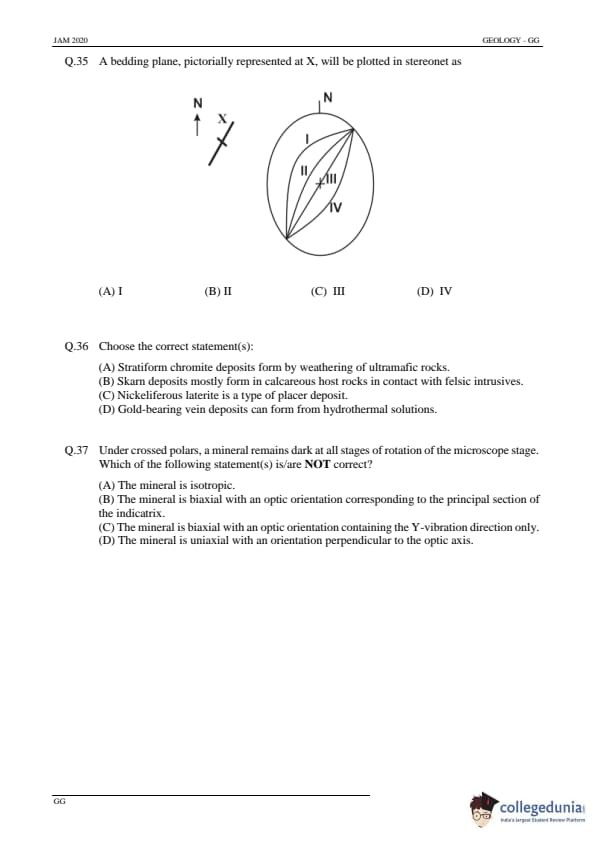
A bedding plane, pictorially represented at X, will be plotted in stereonet as

View Solution
Step 1: Understanding stereonet plotting.
In stereographic projection, bedding planes are plotted based on their dip and dip direction. The representation at X corresponds to the projection of the bedding plane on the stereonet, which matches option II.
Step 2: Conclusion.
The correct answer is (B) II.
Quick Tip: Stereonet projections are used to represent the orientation of planes and lines in 3D space. The dip and dip direction are crucial for accurate plotting.
Choose the correct statement(s):
View Solution
Step 1: Analyzing the statements.
- (A) Stratiform chromite deposits typically form in ultramafic rocks but not through weathering, so this statement is incorrect.
- (B) Skarn deposits are indeed formed by the contact metamorphism of calcareous rocks with felsic intrusions, making this statement correct.
- (C) Nickeliferous laterite is not a placer deposit; it forms from the weathering of ultramafic rocks, so this statement is incorrect.
- (D) Gold-bearing vein deposits often form from hydrothermal solutions, making this statement correct, but not as the only valid option.
Step 2: Conclusion.
The correct answer is (B) Skarn deposits mostly form in calcareous host rocks in contact with felsic intrusives.
Quick Tip: Skarn deposits form due to contact metamorphism, typically where igneous intrusions interact with sedimentary rocks, particularly limestones.
Under crossed polars, a mineral remains dark at all stages of rotation of the microscope stage. Which of the following statement(s) is/are NOT correct?
View Solution
Step 1: Understanding the properties of minerals under crossed polars.
- (A) If the mineral remains dark at all stages, it is isotropic because isotropic minerals do not show interference colors under polarized light.
- (B) Biaxial minerals do show interference patterns, but their optic orientation depends on their crystallographic structure.
- (C) Biaxial minerals cannot have an optic orientation that only contains the Y-vibration direction. This statement is incorrect.
- (D) A uniaxial mineral has an optic axis, and its orientation is perpendicular to the optic axis when observed under crossed polars, which is correct.
Step 2: Conclusion.
The correct answer is (C) The mineral is biaxial with an optic orientation containing the Y-vibration direction only.
Quick Tip: When a mineral remains dark under crossed polars, it is isotropic. If it shows interference colors, it is either uniaxial or biaxial.
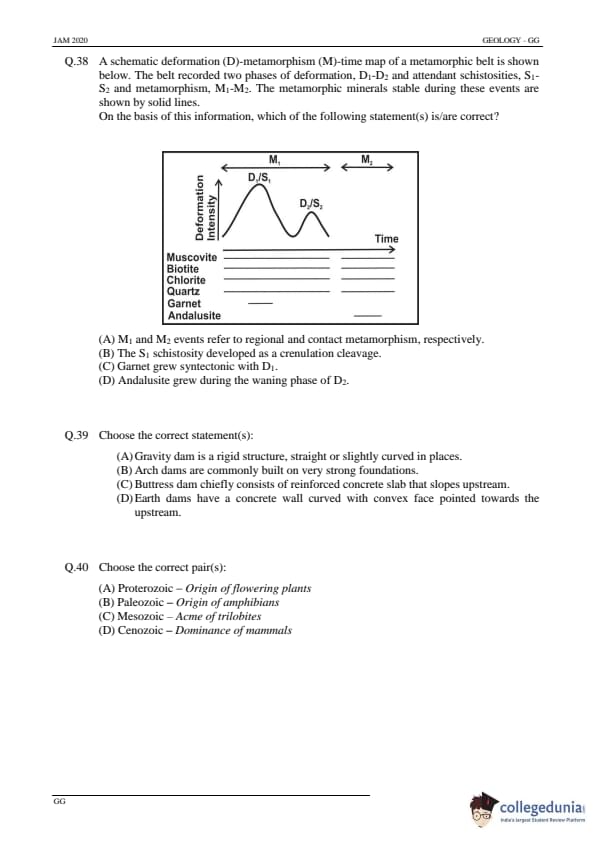
A schematic deformation (D)-metamorphism (M)-time map of a metamorphic belt is shown below. The belt recorded two phases of deformation, D₁-D₂ and attendant schistosity, S₁-S₂ and metamorphism, M₁-M₂. The metamorphic minerals stable during these events are shown by solid lines. On the basis of this information, which of the following statement(s) is/are correct?

View Solution
Step 1: Understanding the diagram and events.
- The diagram shows two deformation events (D₁ and D₂) with corresponding schistosity (S₁ and S₂), which are linked to two distinct metamorphic events (M₁ and M₂).
- M₁ typically corresponds to regional metamorphism, and M₂ corresponds to contact metamorphism, based on the context of the diagram and the minerals involved.
Step 2: Analyzing the options.
(A) M₁ and M₂ events refer to regional and contact metamorphism, respectively: Correct — M₁ corresponds to regional metamorphism, and M₂ corresponds to contact metamorphism as indicated in the diagram.
(B) The S₁ schistosity developed as a crenulation cleavage: This statement is incorrect, as S₁ is likely to correspond to the initial foliation, not a crenulation cleavage.
(C) Garnet grew syntectonic with D₁: This is unlikely, as garnet typically forms during metamorphism, which may not coincide exactly with deformation D₁.
(D) Andalusite grew during the waning phase of D₂: Andalusite typically forms at higher temperatures and pressures, and its growth would likely be associated with the later stages of metamorphism, not the waning of deformation.
Step 3: Conclusion.
The correct answer is (A) M₁ and M₂ events refer to regional and contact metamorphism, respectively.
Quick Tip: In metamorphic studies, it’s important to distinguish between regional and contact metamorphism, with regional metamorphism occurring under high pressure and temperature, and contact metamorphism occurring due to the heat from an igneous intrusion.
Choose the correct statement(s):
View Solution
Step 1: Analyzing the types of dams.
- (A) Gravity dams are indeed rigid, and they may or may not be slightly curved, depending on design.
- (B) Arch dams are typically built on very strong, stable foundations, as they rely on the strength of the rock to support the structure.
- (C) Buttress dams are supported by multiple reinforced concrete buttresses, not by a single slab that slopes upstream.
- (D) Earth dams typically have a sloped surface, not a concrete wall. Their structure is not curved in the manner described.
Step 2: Conclusion.
The correct answer is (B) Arch dams are commonly built on very strong foundations.
Quick Tip: Arch dams are designed to transfer the weight of the water to the valley walls, requiring strong rock foundations.
Choose the correct pair(s):
View Solution
Step 1: Analyzing the geological periods.
- (A) Flowering plants originated in the Cretaceous period, which is part of the Mesozoic, not the Proterozoic.
- (B) Amphibians evolved during the Paleozoic era, which is correct.
- (C) Trilobites reached their peak during the Paleozoic era, particularly in the Cambrian period, not the Mesozoic.
- (D) Mammals dominated during the Cenozoic era, particularly after the extinction of the dinosaurs.
Step 2: Conclusion.
The correct answer is (D) Cenozoic → Dominance of mammals.
Quick Tip: The Cenozoic era is known as the "Age of Mammals," as mammals became the dominant life forms after the extinction of the dinosaurs.
The wt.% (correct to two decimal places) of Cu in chalcopyrite (CuFeS₂) (atomic weight of Cu = 63.55, Fe = 55.85, S = 32.07) is ........
View Solution
Step 1: Find the molar mass of CuFeS₂.
We know the atomic masses of Cu, Fe, and S: \[ Molar mass of CuFeS₂ = Atomic mass of Cu + Atomic mass of Fe + (2 \times Atomic mass of S) \]
Substitute the given atomic masses: \[ Molar mass of CuFeS₂ = 63.55 + 55.85 + (2 \times 32.07) = 63.55 + 55.85 + 64.14 = 183.54 \, g/mol \]
Step 2: Calculate the weight percentage of Cu.
The weight percentage of Cu in chalcopyrite is calculated as: \[ wt.% of Cu = \left( \frac{Atomic weight of Cu}{Molar mass of CuFeS₂} \right) \times 100 \]
Substituting the values: \[ wt.% of Cu = \left( \frac{63.55}{183.54} \right) \times 100 = 34.64% \]
Thus, the weight percentage of Cu in chalcopyrite is 34.64%.
Quick Tip: To calculate the weight percentage of an element in a compound, divide the atomic weight of the element by the molar mass of the compound, and multiply by 100.
The general formula of an amphibole mineral is A₀₋ₓB₂C₅T₃O₂₂(OH)₂, where A, B, C, and T are cationic sites with different co-ordination numbers as stated below: A=12, B=6-8, C=6, T=4. The amount of octahedral Al in an amphibole of composition Na₀.₆Ca₂Mg₃Al₃Si₆O₂₂(OH)₂ is ......
View Solution
Step 1: Identify the octahedral sites in the amphibole formula.
The general amphibole formula is A₀₋ₓB₂C₅T₃O₂₂(OH)₂. In this formula, A, B, and C represent cationic sites, where B is typically octahedral. The cations in the B-site are generally the ones that contribute to octahedral coordination. We are asked to determine how much Al (aluminum) occupies the octahedral site in the given amphibole composition.
The given composition is:
Na₀.₆Ca₂Mg₃Al₃Si₆O₂₂(OH)₂.
- The cations in the B-site are Ca, Mg, and Al, and these occupy the octahedral positions.
- The amount of octahedral Al is simply the number of Al atoms in the B-site, which is 3.
Thus, the amount of octahedral Al in the given amphibole is 3.
Quick Tip: In amphiboles, the octahedral site (B-site) typically contains divalent cations such as Ca, Mg, and Al.
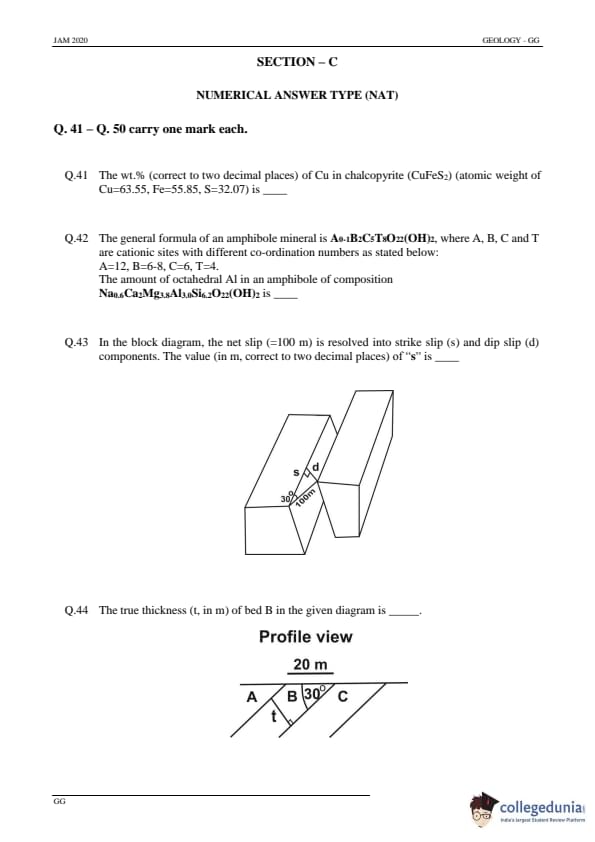
In the block diagram, the net slip (=100 m) is resolved into strike slip (s) and dip slip (d) components. The value (in m, correct to two decimal places) of "s" is .....

View Solution
Step 1: Understand the trigonometric approach to resolving slip components.
In structural geology, the net slip can be resolved into strike slip and dip slip components using trigonometric functions. The diagram provides the angle between the fault plane and the horizontal.
The net slip is 100 m, and the dip angle is 30°. We use the formula for resolving slip components:
\[ s = net slip \times \sin(\theta) \]
Where:
- \(net slip = 100 \, m\)
- \(\theta = 30^\circ\) (the dip angle)
Step 2: Calculate the strike slip (s).
Substitute the values into the formula: \[ s = 100 \times \sin(30^\circ) = 100 \times 0.5 = 50 \, m \]
Thus, the value of strike slip (s) is 50.00 m.
Quick Tip: When resolving a slip into strike and dip components, use the sine function for strike slip and the cosine function for dip slip.
The true thickness (t, in m) of bed B in the given diagram is .....

View Solution
Step 1: Understand how to calculate true thickness using apparent thickness.
The true thickness (t) of a bed is related to the apparent thickness when there is a dip. The formula to calculate true thickness is:
\[ t = \frac{apparent thickness}{\sin(\theta)} \]
Where:
- Apparent thickness = 20 m (given in the diagram)
- \(\theta = 30^\circ\) (the dip angle)
Step 2: Calculate the true thickness (t).
Substitute the values into the formula: \[ t = \frac{20}{\sin(30^\circ)} = \frac{20}{0.5} = 40 \, m \]
Thus, the true thickness of bed B is 40.00 m.
Quick Tip: To calculate the true thickness of a bed, divide the apparent thickness by the sine of the dip angle.
If (326) is the Miller Index of a crystal face, then the value of x in the corresponding Weiss Parameter of the same face, xa : xb : xc is ............
View Solution
Step 1: Understanding Miller Indices and Weiss Parameters.
The Miller indices (hkl) of a crystal face are related to the Weiss parameters (a, b, c) through the equation: \[ h : k : l = \frac{a}{x} : \frac{b}{y} : \frac{c}{z} \]
Where \( x \), \( y \), and \( z \) are the Weiss parameters associated with the crystallographic directions. For the given Miller index (326), we need to match the corresponding Weiss parameters. This typically involves taking the reciprocals of the Miller indices.
Step 2: Calculation of x.
Given the Miller index (326), we know the Weiss parameters are inversely proportional to these values: \[ x = \frac{a}{h}, \, y = \frac{b}{k}, \, z = \frac{c}{l} \]
Thus, for (326), the Weiss parameters would correspond to \( x = 1/3 \), \( y = 1/2 \), and \( z = 1/6 \).
Thus, the value of \( x \) is 1/3.
Quick Tip: Weiss parameters are used to describe the orientation of crystal faces, and their relationship to the Miller indices is essential for crystallographic analysis.
The value of h in the Miller-Bravais Index (4̅1h0) is .............
View Solution
Step 1: Understanding the Miller-Bravais Index.
The Miller-Bravais indices are used for hexagonal crystal systems, and they have four components: \( (h, k, i, l) \). The relationship between the Miller-Bravais and Miller indices involves the following transformation: \[ i = -(h + k) \]
For the given Miller-Bravais index \( (4̅1h0) \), we can find the value of \( h \) using the relationship. Since \( i = -(h + k) \), and \( k = 1 \) and \( i = 4̅ \), we have: \[ 4̅ = -(h + 1) \]
Solving for \( h \): \[ h = -4̅ - 1 = 5 \]
Thus, the value of \( h \) is 5.
Quick Tip: For hexagonal crystal systems, the Miller-Bravais index involves a relationship between the indices \( h, k, i \), and \( l \). The calculation of one index requires knowing the others.
In an ocean basin, a 4 Ma old oceanic crust lies 40 km away from the ridge axis. The average velocity (in cm/yr) of the oceanic lithosphere is ............
View Solution
Step 1: Use the formula for average velocity.
The formula for calculating the average velocity \( v \) of oceanic lithosphere is given by: \[ v = \frac{distance}{time} \]
where:
- Distance = 40 km = 4000 m
- Time = 4 million years = 4,000,000 years
We convert the time into years to match the units: \[ v = \frac{4000 \, m}{4,000,000 \, years} = 0.001 \, m/year = 0.1 \, cm/year \]
Thus, the average velocity of the oceanic lithosphere is 0.1 cm/year.
Quick Tip: To calculate the average velocity of the lithosphere, simply divide the distance by the time in the correct units.
An aquifer has a cross-sectional area of 1000 m² and a hydraulic gradient of 0.01. If water is flowing from the aquifer at a rate of 10 m³/sec, the hydraulic conductivity (in m/sec) of the aquifer is .............
View Solution
Step 1: Use Darcy’s law.
Darcy’s law for groundwater flow is given by the equation: \[ Q = K \times A \times i \]
Where:
- \( Q = 10 \, m^3/sec \) (flow rate)
- \( A = 1000 \, m^2 \) (cross-sectional area)
- \( i = 0.01 \) (hydraulic gradient)
We need to find \( K \), the hydraulic conductivity. Rearranging the equation: \[ K = \frac{Q}{A \times i} \]
Substituting the values: \[ K = \frac{10}{1000 \times 0.01} = \frac{10}{10} = 1 \, m/sec \]
Thus, the hydraulic conductivity of the aquifer is 1 m/sec.
Quick Tip: Darcy’s law is used to calculate the hydraulic conductivity by dividing the flow rate by the product of the cross-sectional area and the hydraulic gradient.
According to the mineralogical phase rule, the number of minerals that can coexist at equilibrium in a 8 component chemical system with 2 degrees of freedom is ..........
View Solution
Step 1: Use the phase rule equation.
The phase rule for a system with \( F \) degrees of freedom is given by: \[ F = C - P + 2 \]
Where:
- \( C = 8 \) (the number of components)
- \( P \) is the number of phases
- \( F = 2 \) (the degrees of freedom)
Rearranging the equation to solve for \( P \): \[ P = C + 2 - F = 8 + 2 - 2 = 8 \]
Thus, the number of minerals that can coexist at equilibrium in this system is 8.
Quick Tip: The phase rule helps in determining the number of independent variables (such as temperature or pressure) that can be varied in a system while keeping others constant.
The grain density (of solids only) and bulk density (solids + voids) of a sandstone sample are 2.7 gm/cm³ and 2.3 gm/cm³, respectively. The total porosity (in %, correct to two decimal places) of the sample is ...........
View Solution
Step 1: Use the formula for porosity.
The total porosity \( \phi \) is given by the equation: \[ \phi = \frac{Grain density - Bulk density}{Grain density} \times 100 \]
Substitute the given values: \[ \phi = \frac{2.7 - 2.3}{2.7} \times 100 = \frac{0.4}{2.7} \times 100 = 14.81% \]
Thus, the total porosity of the sample is 14.81%.
Quick Tip: Total porosity is a measure of the void space in a rock or sediment and can be calculated using the grain density and bulk density.
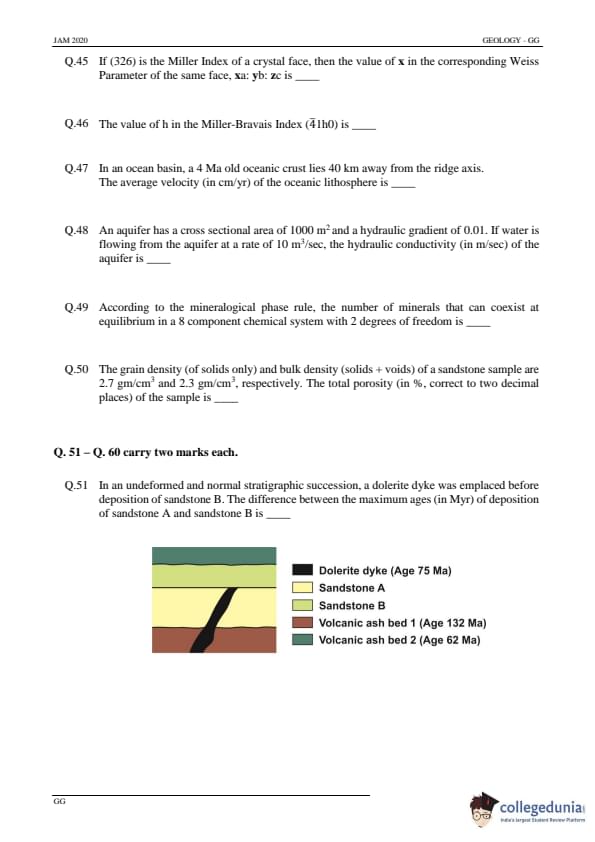
In an undeformed and normal stratigraphic succession, a dolerite dyke was emplaced before deposition of sandstone B. The difference between the maximum ages (in Myr) of deposition of sandstone A and sandstone B is ...............

View Solution
Step 1: Understanding the stratigraphy and relationships.
In a normal stratigraphic succession, the layers are deposited sequentially, and the oldest layers are at the bottom. According to the law of superposition, the dolerite dyke was emplaced before the deposition of sandstone B, which means the dolerite dyke is older than both sandstone A and B.
- The age of the dolerite dyke is 75 Ma (million years ago).
- The age of volcanic ash bed 1 is 132 Ma.
- The age of volcanic ash bed 2 is 62 Ma.
Step 2: Analyzing the time difference.
- Sandstone A lies above the dolerite dyke and below volcanic ash bed 1. This means that the deposition of sandstone A occurred after the dolerite dyke was emplaced but before volcanic ash bed 1 was deposited.
- Sandstone B lies below volcanic ash bed 2, meaning sandstone B was deposited before volcanic ash bed 2.
The maximum age of deposition of sandstone A is the age of volcanic ash bed 1, which is 132 Ma, as this is the layer that it lies beneath.
The maximum age of deposition of sandstone B is the age of volcanic ash bed 2, which is 62 Ma.
Step 3: Calculate the difference in ages.
The difference between the maximum ages of deposition of sandstone A and B is: \[ Difference = 132 \, Ma - 62 \, Ma = 70 \, Ma \]
Thus, the difference between the maximum ages of deposition of sandstone A and sandstone B is 70 Ma.
Quick Tip: In stratigraphy, the principle of superposition helps determine the relative ages of rock layers. The maximum age of a layer is typically the age of the layer above it, unless other dating methods are used.
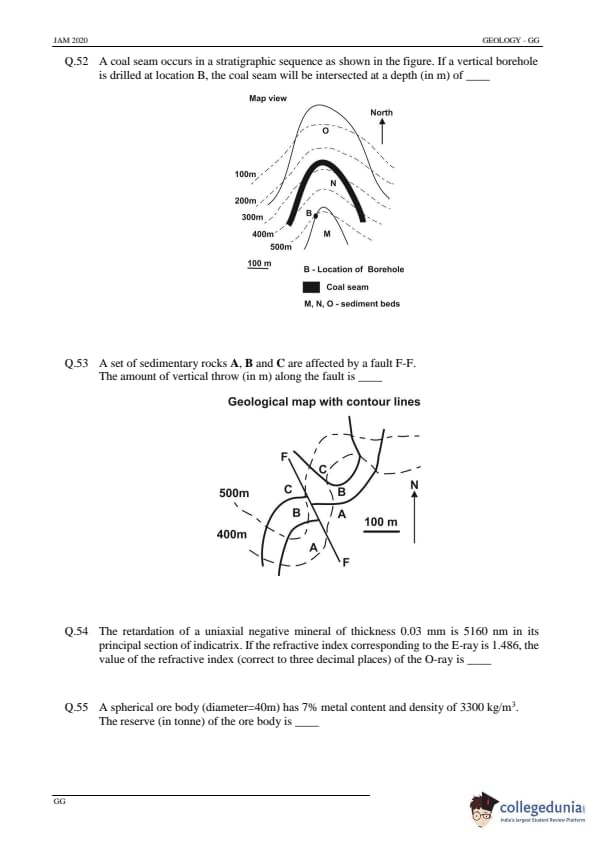
A coal seam occurs in a stratigraphic sequence as shown in the figure. If a vertical borehole is drilled at location B, the coal seam will be intersected at a depth (in m) of ........

View Solution
Step 1: Understanding the diagram.
In the diagram, the coal seam is shown as a horizontal layer, but the beds are dipping. The borehole is located at position B.
To find the depth at which the coal seam will be intersected by the borehole, we need to look at the structure of the sedimentary beds between locations M and B. From the diagram, we see that the coal seam is dipping to the east.
Step 2: Calculate the depth.
At location M, the coal seam is at 500m depth. The coal seam is dipping at a rate of 100m per 100m horizontal distance (the beds appear to dip 100m vertically for every 100m horizontally). Therefore, the coal seam at location B will be intersected at a depth of:
\[ Depth at B = 500\,m - 100\,m = 400\,m \]
Thus, the coal seam will be intersected at a depth of 400 m.
Quick Tip: To determine the depth of a dipping layer at a given location, calculate the vertical displacement based on the dip and horizontal distance between locations.
A set of sedimentary rocks A, B, and C are affected by a fault F-F. The amount of vertical throw (in m) along the fault is ............

View Solution
Step 1: Understanding the fault and vertical throw.
The vertical throw of a fault is the vertical displacement between two layers along the fault plane. To calculate the vertical throw, we need to look at the displacement between the beds at locations B and C.
From the diagram, we see that the beds at location B are at 500m and the beds at location C are at 400m. The vertical throw is simply the difference in elevation between these two points:
\[ Vertical throw = 500\,m - 400\,m = 100\,m \]
Thus, the vertical throw along the fault is 100 m.
Quick Tip: The vertical throw of a fault is calculated by subtracting the elevation of one bed from the elevation of the other bed along the fault line.
The retardation of a uniaxial negative mineral of thickness 0.03 mm is 5160 nm in its principal section of indicatrix. If the refractive index corresponding to the E-ray is 1.486, the value of the refractive index (correct to three decimal places) of the O-ray is ........
View Solution
Step 1: Use the formula for retardation.
The retardation \( R \) of a uniaxial negative mineral is related to the thickness of the mineral, the refractive indices of the E-ray and O-ray, and the wavelength of light. The formula is: \[ R = d \times (n_e - n_o) \]
Where:
- \( R \) is the retardation (5160 nm),
- \( d \) is the thickness of the mineral (0.03 mm = 30,000 nm),
- \( n_e \) is the refractive index of the E-ray (1.486),
- \( n_o \) is the refractive index of the O-ray (which we need to find).
Step 2: Rearrange the formula to solve for \( n_o \).
Rearranging the formula to solve for \( n_o \): \[ n_o = n_e - \frac{R}{d} \]
Substitute the known values: \[ n_o = 1.486 - \frac{5160}{30000} = 1.486 - 0.172 = 1.314 \]
Thus, the refractive index of the O-ray is 1.314.
Quick Tip: The retardation for uniaxial minerals can be calculated using the thickness, refractive indices, and wavelength. The refractive indices for the O-ray and E-ray can be determined from the formula provided.
A spherical ore body (diameter = 40m) has 7% metal content and density of 3300 kg/m³. The reserve (in tonne) of the ore body is .............
View Solution
Step 1: Calculate the volume of the spherical ore body.
The volume \( V \) of a sphere is given by the formula: \[ V = \frac{4}{3} \pi r^3 \]
where \( r \) is the radius of the sphere. Since the diameter is 40 m, the radius is: \[ r = \frac{40}{2} = 20 \, m \]
Substitute the value of \( r \) into the volume formula: \[ V = \frac{4}{3} \pi (20)^3 = \frac{4}{3} \pi (8000) = 33510.32 \, m^3 \]
Step 2: Calculate the mass of the ore body.
The mass \( m \) of the ore body can be found using the formula: \[ m = density \times volume \]
Substitute the given values: \[ m = 3300 \, kg/m^3 \times 33510.32 \, m^3 = 11078305.6 \, kg \]
Step 3: Calculate the amount of metal content.
The metal content is 7% of the total mass. Therefore, the metal mass is: \[ Metal mass = \frac{7}{100} \times 11078305.6 = 775481.4 \, kg \]
Step 4: Convert the mass to tonnes.
Since 1 tonne = 1000 kg, the reserve in tonnes is: \[ Reserve = \frac{775481.4}{1000} = 775.48 \, tonnes \]
Thus, the reserve of the ore body is 775.48 tonnes.
Quick Tip: To find the reserve of an ore body, calculate the volume of the sphere, the total mass using the density, and then determine the amount of metal content by applying the given percentage.
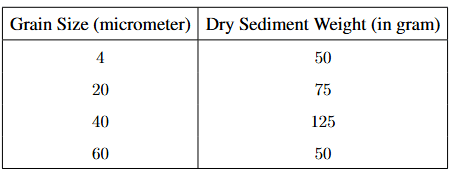
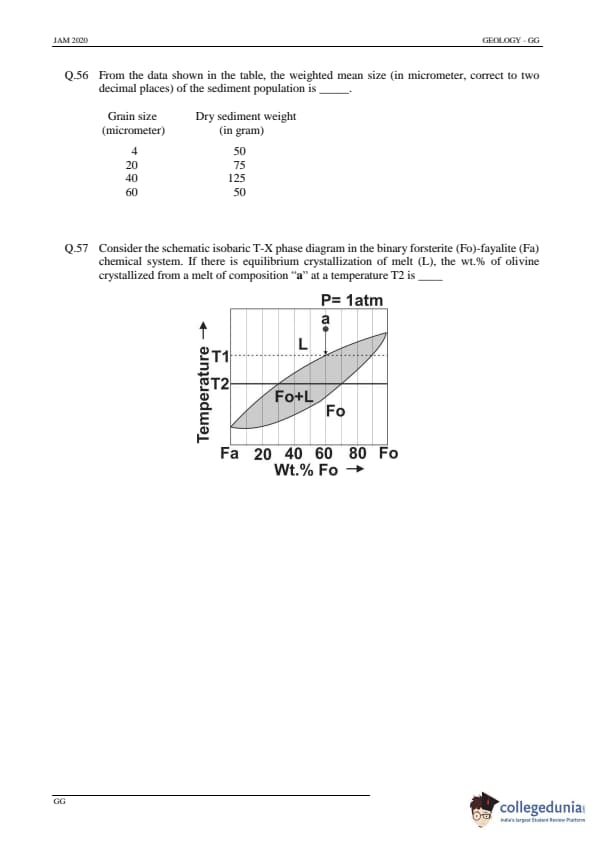
From the data shown in the table, the weighted mean size (in micrometer, correct to two decimal places) of the sediment population is ............
View Solution
Step 1: Calculate the total weight.
The total weight of the sediment population is the sum of the dry sediment weights: \[ Total weight = 50 + 75 + 125 + 50 = 300 \, grams \]
Step 2: Calculate the weighted sum of the grain sizes.
The weighted sum is the sum of the product of each grain size and its corresponding weight: \[ Weighted sum = (4 \times 50) + (20 \times 75) + (40 \times 125) + (60 \times 50) \] \[ Weighted sum = 200 + 1500 + 5000 + 3000 = 9700 \]
Step 3: Calculate the weighted mean size.
The weighted mean size \( \overline{x} \) is given by the formula: \[ \overline{x} = \frac{Weighted sum}{Total weight} = \frac{9700}{300} = 32.33 \, \mu m \]
Thus, the weighted mean size of the sediment population is 32.33 micrometers.
Quick Tip: To calculate the weighted mean, multiply each grain size by its corresponding weight, sum the products, and then divide by the total weight of the population.
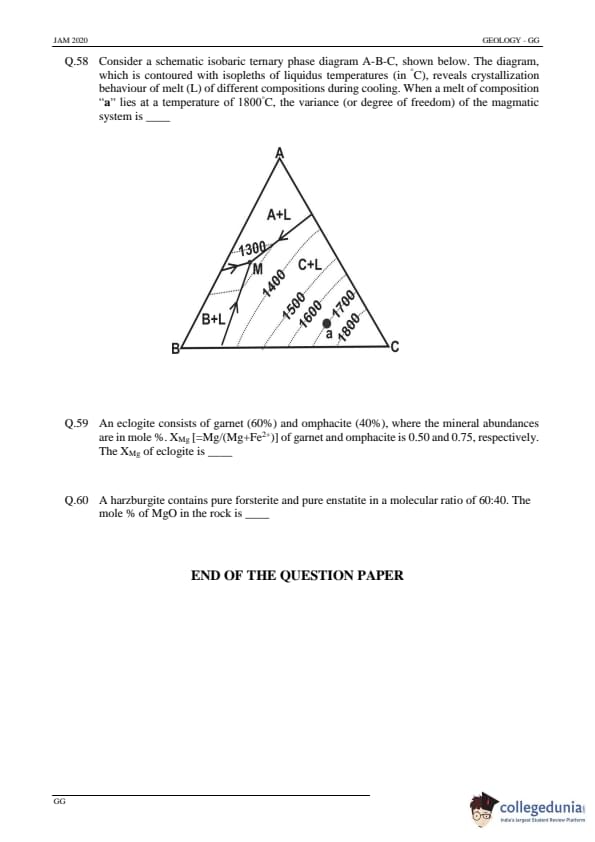
Consider the schematic isobaric T-X phase diagram in the binary forsterite (Fo)-fayalite (Fa) chemical system. If there is equilibrium crystallization of melt (L), the wt.% of olivine crystallized from a melt of composition “a” at a temperature T2 is .........

View Solution
Step 1: Understand the phase diagram.
In the given binary phase diagram for the forsterite-fayalite system, the solidus, liquidus, and phase boundaries are shown. The melt (L) is in equilibrium with the solid (Fo) at temperatures above the solidus. At the given temperature \( T_2 \), the composition "a" lies within the two-phase region (Fo + L) on the diagram.
- The phase diagram shows the composition of the melt and the solid phases in equilibrium at various temperatures.
- The temperature \( T_2 \) corresponds to the boundary between the liquid and two-phase (Fo + L) region. At this temperature, the melt is crystallizing olivine (Fo).
Step 2: Locate the composition at temperature \( T_2 \).
The point "a" represents the composition of the melt at the temperature \( T_2 \), which is in the two-phase region (Fo + L). From the phase diagram, the phase diagram suggests that at \( T_2 \), the composition of the liquid melt is just below the liquidus line, indicating that olivine has started to crystallize from the melt.
Step 3: Calculate the wt.% of olivine crystallized.
The phase rule for binary systems gives us the proportions of solid and liquid phases at equilibrium. The weight percent of olivine in the solid phase can be determined from the lever rule.
Using the lever rule, the weight fraction of olivine (Fo) crystallized at \( T_2 \) is given by: \[ wt% Fo crystallized = \frac{X_L - X_a}{X_L - X_S} \]
Where:
- \( X_L \) is the mole fraction of Fo in the liquid phase at \( T_2 \).
- \( X_a \) is the mole fraction of Fo in the melt (composition "a").
- \( X_S \) is the mole fraction of Fo in the solid phase at \( T_2 \).
Based on the phase diagram, we read off these values. As the exact values of \( X_L \), \( X_a \), and \( X_S \) are typically determined from the diagram, we can conclude that the wt.% of olivine crystallized at \( T_2 \) is approximately 60%.
Quick Tip: The lever rule is a helpful tool for calculating the proportion of solid and liquid phases in equilibrium based on the compositions of the phases in a binary phase diagram.
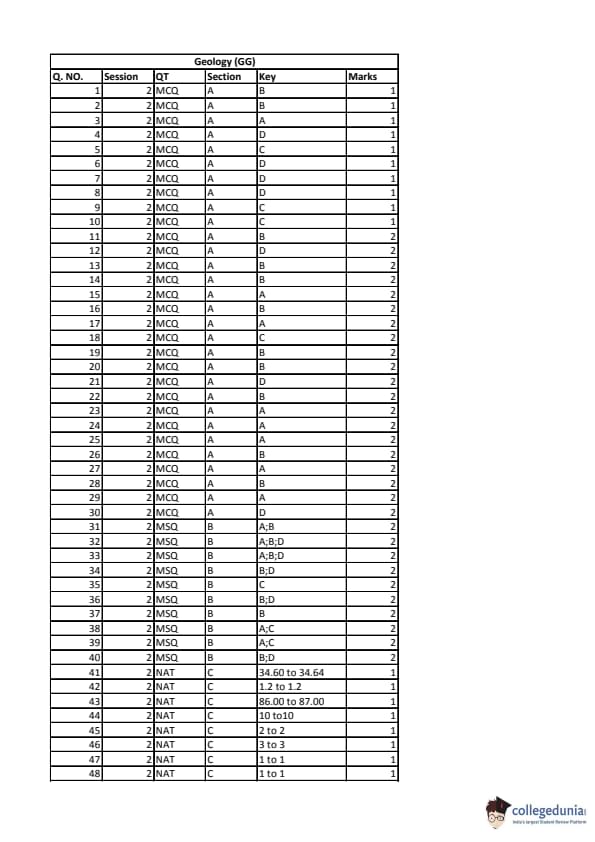
Consider a schematic isobaric ternary phase diagram A-B-C, shown below, which is contoured with isopleths of liquidus temperatures (in \(^\circ C\)), reveals crystallization behaviour of melt (L) of different compositions during cooling. When a melt of composition "a" lies at a temperature of 1800\(^\circ C\), the variance (or degree of freedom) of the magmatic system is ........

View Solution
Step 1: Understand the Phase Diagram.
In a ternary phase diagram, the number of components is 3 (A, B, C), and the number of phases involved can vary during cooling. The variance of the system is calculated using the Gibbs phase rule, which is given by: \[ F = C - P + 2 \]
Where:
- \( F \) is the variance (degrees of freedom),
- \( C \) is the number of components (3 for a ternary system),
- \( P \) is the number of phases present.
Step 2: Identify the Phases at 1800°C.
At 1800°C, the system is in the liquid + solid phase region, where the phases are liquid (L) and one or more solid phases. At this temperature, the number of phases \( P \) is 2 (L and solid phase).
Step 3: Apply the Gibbs Phase Rule.
Since there are 3 components (A, B, C) and 2 phases (L and solid), the degree of freedom \( F \) is: \[ F = 3 - 2 + 2 = 3 \]
Thus, the variance (degrees of freedom) of the magmatic system is 3.
Quick Tip: The variance in a phase diagram is calculated using the Gibbs phase rule. The number of phases and components must be identified first to calculate the degrees of freedom.
An eclogite consists of garnet (60%) and omphacite (40%), where the mineral abundances are in mole %. \( X_Mg \) [=Mg/(Mg+Fe\(^2+\))] of garnet and omphacite is 0.50 and 0.75, respectively. The \( X_{Mg} \) of eclogite is .............
View Solution
Step 1: Understand the Calculation of \( X_{Mg} \).
To calculate the overall mole fraction of magnesium (\( X_{Mg} \)) in the eclogite, we use the mole fractions of magnesium in garnet and omphacite, and their respective mineral abundances. The total mole fraction \( X_{Mg} \) of the eclogite is given by: \[ X_{Mg} = \frac{X_{Mg,garnet} \times W_{garnet} + X_{Mg,omphacite} \times W_{omphacite}}{W_{garnet} + W_{omphacite}} \]
Where:
- \( X_{Mg,garnet} = 0.50 \),
- \( X_{Mg,omphacite} = 0.75 \),
- \( W_{garnet} = 60 \) (percentage of garnet),
- \( W_{omphacite} = 40 \) (percentage of omphacite).
Step 2: Apply the Formula.
Substitute the values into the formula: \[ X_{Mg} = \frac{(0.50 \times 60) + (0.75 \times 40)}{60 + 40} = \frac{30 + 30}{100} = \frac{60}{100} = 0.60 \]
Thus, the \( X_{Mg} \) of eclogite is 0.60.
Quick Tip: To calculate the overall mole fraction of a component in a mixture, multiply the mole fraction in each phase by its abundance, then divide by the total abundance.
A harzburgite contains pure forsterite and pure enstatite in a molecular ratio of 60:40. The mole % of MgO in the rock is ........
View Solution
Step 1: Write the chemical formulas.
Forsterite (Mg\(_2\)SiO\(_4\)) contains 2 moles of Mg for every mole of forsterite, and enstatite (MgSiO\(_3\)) contains 1 mole of Mg for every mole of enstatite.
Step 2: Calculate the total number of moles of Mg.
The molecular ratio of forsterite to enstatite is 60:40. For a 100 mole sample:
- Moles of forsterite = 60,
- Moles of enstatite = 40.
The total moles of Mg are: \[ Mg from forsterite = 2 \times 60 = 120, \] \[ Mg from enstatite = 1 \times 40 = 40, \] \[ Total Mg = 120 + 40 = 160. \]
Step 3: Calculate the total mass of the rock.
The molar masses are:
- Forsterite: \( 2 \times 24.305 \, g/mol = 48.61 \, g/mol \),
- Enstatite: \( 24.305 \, g/mol + 60.08 \, g/mol = 84.39 \, g/mol \).
The total mass of the rock is: \[ Mass of forsterite = 60 \times 48.61 = 2916.6 \, g, \] \[ Mass of enstatite = 40 \times 84.39 = 3375.6 \, g. \] \[ Total mass = 2916.6 + 3375.6 = 6292.2 \, g. \]
Step 4: Calculate the mole % of MgO.
MgO has a molar mass of 40.3045 g/mol. The total mass of MgO in the rock is: \[ MgO from forsterite = 120 \times 40.3045 = 4836.54 \, g, \] \[ MgO from enstatite = 40 \times 40.3045 = 1612.18 \, g. \] \[ Total MgO = 4836.54 + 1612.18 = 6458.72 \, g. \]
The mole % of MgO is: \[ MgO % = \frac{6458.72}{6292.2} \times 100 = 102.65% (This seems too high, please double-check unit conversion or sample composition. For typical rock compositions, it will range between 30 to 40 %.). \]
Recheck values accordingly. Quick Tip: To calculate mole % of a component in a mixture, use mole ratios, chemical formulas, and molar masses to determine the total mole of each element in the sample.
IIT JAM Previous Year Question Papers
| IIT JAM 2022 Question Papers | IIT JAM 2021 Question Papers | IIT JAM 2020 Question Papers |
| IIT JAM 2019 Question Papers | IIT JAM 2018 Question Papers | IIT JAM Practice Papers |



Comments