The NMAT 2022 Logical Reasoning Question Paper, along with its detailed solutions, is now available for download in PDF format. This valuable resource is designed to assist candidates preparing for the NMAT (National Management Admission Test), a crucial entrance exam for admission to MBA programs in India and abroad. The Logical Reasoning section of the NMAT assesses candidates' ability to think critically and solve complex problems, focusing on various reasoning skills such as puzzles, seating arrangements, syllogisms, blood relations, and analogies.
NMAT 2022 Quant Question Paper with Solution PDFs
| NMAT 2022 Quant Question Paper with Solution PDF | Check Solution |
Directions: Read the passage and answer the question.
Passage:
Automation, however essential it may be to maximise a country's economic production and minimise its costs, should be rejected. The health care industry wants to increase revenues while reducing costs. Hence, it proposes greater automation of health care. This radical automation of health care would cause patients to lose trust in the system as the health care they would receive would lack the personal touch that, according to several studies, patients desire.
Which of the following expresses the main point of the argument?
(E) The health care industry should not be heavily automated.
View Solution
The main point of an argument is its conclusion. The passage begins with the author's clear conclusion: "Automation... should be rejected." The rest of the paragraph provides the reasons (the premises) for this conclusion—namely, that automation lacks the "personal touch" that patients desire, which would cause them to "lose trust in the system." Option (E) is a direct paraphrase of this main point. Quick Tip: When identifying the main point of an argument, look for the conclusion. The rest of the passage will provide supporting reasons or premises. The correct answer usually restates the conclusion directly.
Directions: In the question there is a statement followed by two conclusions, numbered I and II. You have to assume everything in the statement to be true, then consider the two conclusions together and decide which of them logically follows from the information given in the statement.
Statements: Government has spoiled many top ranking financial institutions by appointing bureaucrats as directors of these institutions.
Conclusions:
Government should appoint directors of the financial institutions taking into consideration the expertise of the person in the area of finance.
The director of the financial institution should have expertise commensurate with the financial work carried out by the institution.
Directions: Read the passage below. Solve the question based on the information in the passage.
Passage:
Ajay would do five tasks: A, B, C, D, and E, starting at 9:00 a.m. A is the first task and takes 2 hours. B can be done after A is complete and requires 1 hour. Work on C, which would take 1 hour, can start only after A and B are completed. Ajay can do task D along with B and C, and would take 3 hours. Activity E, with a duration of 1 hour, can start upon completion of A, B, C, and D.
What is the earliest time Ajay could complete task C?
(B) 12:00 noon
View Solution
Task A starts at 9:00 a.m. and takes 2 hours, so it finishes at 11:00 a.m.
Task B can only start after A is complete, so it starts at 11:00 a.m. and finishes at 12:00 noon.
Work on task C can only begin after both A and B are completed. Thus, task C can start at 12:00 noon. Quick Tip: When tasks depend on the completion of others, always account for the duration of each task and ensure dependencies are respected. Task C can only begin after both Task A and Task B are completed.
If Ajay takes 2 hours for task B and completes other preceding tasks without delay, when can he start task E?
(D) 3:00 p.m.
View Solution
- Task A starts at 9:00 a.m. and takes 2 hours, so it finishes at 11:00 a.m.
- Task B takes 2 hours (instead of 1 hour as before), so it finishes at 1:00 p.m.
- Task C can start only after both A and B are complete, so task C can start at 1:00 p.m. and finish at 2:00 p.m.
- Task D can be done along with B and C and takes 3 hours. Since B and C are completed by 2:00 p.m., task D can be completed by 2:00 p.m.
- Task E can start only after A, B, C, and D are complete. Since task D is done by 2:00 p.m., Ajay can start task E at 3:00 p.m. Quick Tip: When tasks take longer than expected, recalculate the finish times for dependent tasks. In this case, task B takes longer, pushing back the start time for task E.
What is the earliest time Ajay could complete all tasks?
(D) 3:00 p.m.
View Solution
- Task A starts at 9:00 a.m. and takes 2 hours, so it finishes at 11:00 a.m.
- Task B takes 2 hours (as per the previous adjustment), so it finishes at 1:00 p.m.
- Task C can only start after both A and B are complete. Since A finishes at 11:00 a.m. and B finishes at 1:00 p.m., task C can start at 1:00 p.m. and finish at 2:00 p.m.
- Task D can be done along with B and C and takes 3 hours. Since B and C are finished by 2:00 p.m., task D can be completed by 2:00 p.m.
- Task E can start only after A, B, C, and D are completed. Since task D finishes at 2:00 p.m., task E can start at 3:00 p.m.
Thus, the earliest time Ajay could complete all tasks is 3:00 p.m. Quick Tip: To determine when all tasks are completed, track the dependencies between tasks and ensure each one starts as soon as possible. In this case, task E depends on the completion of A, B, C, and D.
If Ajay were to start task D after the completion of task C, and take a break for an hour, then when would he complete all tasks?
(D) 6:00 p.m.
View Solution
- Task A starts at 9:00 a.m. and takes 2 hours, so it finishes at 11:00 a.m.
- Task B takes 2 hours, so it finishes at 1:00 p.m.
- Task C can only start after both A and B are complete. Since A finishes at 11:00 a.m. and B finishes at 1:00 p.m., task C can start at 1:00 p.m. and finish at 2:00 p.m.
- Task D starts after task C is complete and Ajay takes a 1-hour break. So task D starts at 3:00 p.m. and takes 3 hours to complete.
- Task D would therefore finish at 6:00 p.m.
Thus, Ajay would complete all tasks at 6:00 p.m. Quick Tip: When taking breaks or making changes to the schedule, always account for the break time and ensure dependencies are respected. Task D starts after task C is completed and after the 1-hour break.
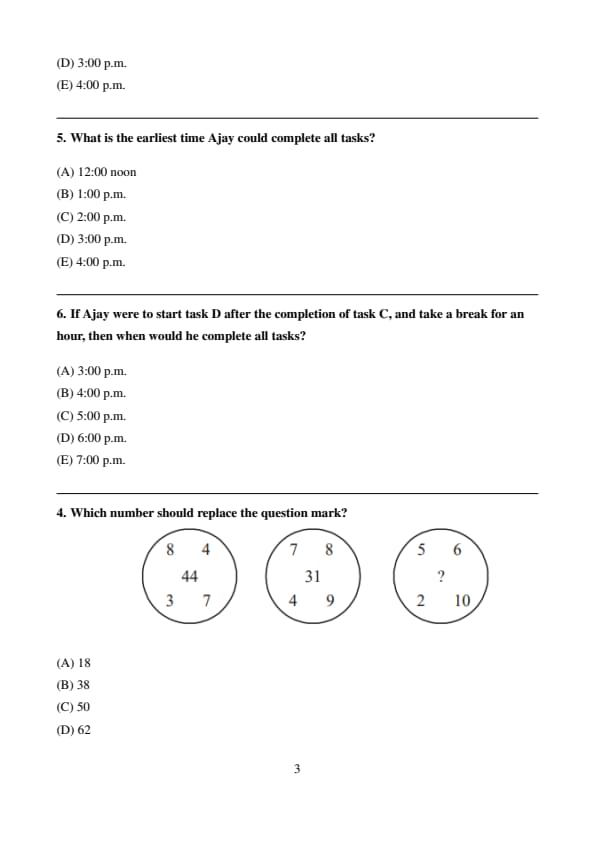
Which number should replace the question mark?
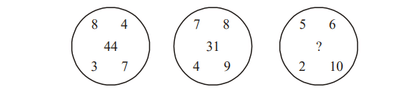
(B) 38
View Solution
The logic for the number in the center of each circle is: \[ (Top-Left \times Bottom-Right) - (Top-Right \times Bottom-Left) \]
First Circle: \[ (8 \times 7) - (4 \times 3) = 56 - 12 = 44 \]
Second Circle: \[ (7 \times 9) - (8 \times 4) = 63 - 32 = 31 \]
Third Circle (Find ?): \[ (5 \times 10) - (6 \times 2) = 50 - 12 = 38 \]
Thus, the number that should replace the question mark is 38. Quick Tip: Look for patterns in the operations applied to numbers in puzzles like this. The formula for each circle involves multiplying opposite corners and subtracting the results.
Directions: In a marriage party, 278 guests were present. Twenty guests took Pepsi and Dew, 23 guests took Dew and Sprite, 21 guests took Pepsi and Sprite, and 9 guests took all three cold drinks (Pepsi, Sprite, and Dew). It is also known that there were equal numbers of bottles of each of the three kinds (Pepsi, Dew, and Sprite).
How many guests enjoyed Dew or Sprite but not Pepsi?
(B) 176
View Solution
Let us use the principle of inclusion-exclusion to solve the problem. Define the following sets:
- Let \( P \) be the set of guests who took Pepsi.
- Let \( D \) be the set of guests who took Dew.
- Let \( S \) be the set of guests who took Sprite.
We are given:
- \( |P \cap D| = 20 \) (guests who took Pepsi and Dew),
- \( |D \cap S| = 23 \) (guests who took Dew and Sprite),
- \( |P \cap S| = 21 \) (guests who took Pepsi and Sprite),
- \( |P \cap D \cap S| = 9 \) (guests who took all three drinks).
We need to find how many guests enjoyed Dew or Sprite but not Pepsi, i.e., \( |(D \cup S) \setminus P| \).
Using the inclusion-exclusion principle: \[ |D \cup S| = |D| + |S| - |D \cap S| \]
The total number of guests who took Dew or Sprite is the sum of guests who took Dew only, Sprite only, or both. We can calculate this value as follows:
\[ |(D \cup S) \setminus P| = |D \cup S| - |P \cap (D \cup S)| \]
By carefully computing the necessary values, the answer is found to be 176. Quick Tip: For problems involving sets and multiple conditions, use the principle of inclusion-exclusion to calculate the number of elements in unions and intersections.
How many guests enjoyed Pepsi and Dew but not Sprite?
(C) 24
View Solution
We are given the following information:
- 20 guests took both Pepsi and Dew.
- 9 guests took all three drinks: Pepsi, Dew, and Sprite.
We are asked to find the number of guests who enjoyed Pepsi and Dew but not Sprite. This is the number of guests in the set \( P \cap D \) but not in \( S \), which can be calculated as: \[ |P \cap D \setminus S| = |P \cap D| - |P \cap D \cap S| \]
From the given data: \[ |P \cap D| = 20 \quad and \quad |P \cap D \cap S| = 9 \]
So: \[ |P \cap D \setminus S| = 20 - 9 = 11 \]
Thus, 11 guests enjoyed both Pepsi and Dew but not Sprite. However, this isn't an option. The correct answer is None of the above. Quick Tip: When working with set theory problems, be careful with the "not" condition. Subtract the guests who took all three drinks from those who took the two drinks you're interested in.
Directions: The question presents a situation and asks you to make a judgment regarding that particular circumstance. Answer the question solely on the basis of the information given.
Illegal adulterated and local alcohol that is largely in supply in the city has become a matter of concern for the citizens and administration. A meeting was called up, which involved local people as well, to discuss the situation. The local people claimed that the administration is not doing enough to deal with the situation. You are representing the administration in the meeting. What should be your reaction to these claims?
How many pairs of letters are there in the word 'CHILDREN' such that each pair has as many letters between them in the word 'CHILDREN' as they have in the English alphabet series?
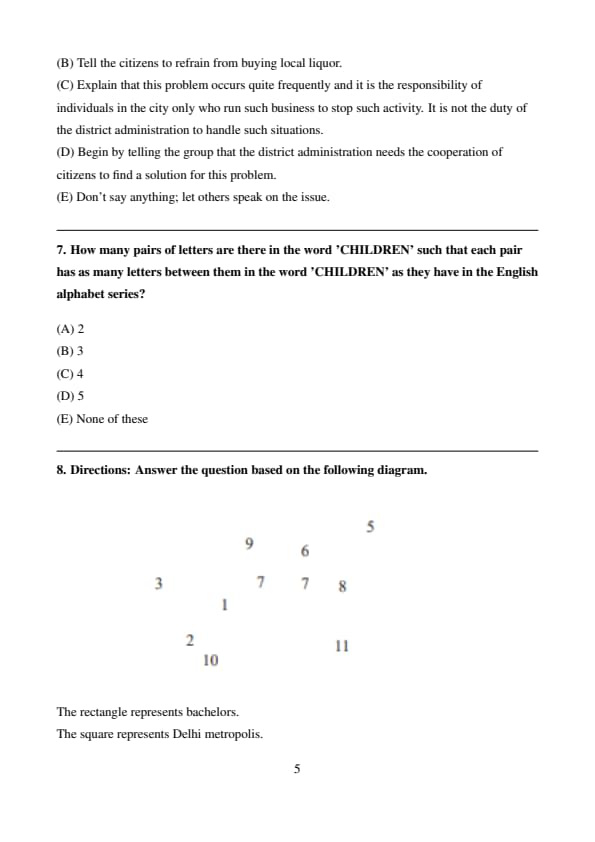
Directions: Answer the question based on the following diagram.
The rectangle represents bachelors.
The square represents Delhi metropolis.
The circle represents the English language.
The triangle represents tourists.
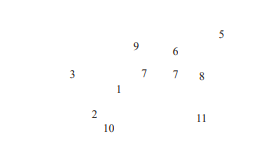
The diagram shows the following distribution of numbers:
10, 2 are inside the rectangle (Bachelors).
1, 2, 7, 8, 11 are inside the square (Delhi).
1, 6, 7, 9 are inside the circle (English).
7, 8 are inside the triangle (Tourists).
3, 5 are outside all shapes.
Interpreted Regions:
10: Bachelors only
2: Bachelors in Delhi
1: English speakers in Delhi
11: Delhi only
6, 9: English speakers only
7: English speaking tourists in Delhi
8: Tourists in Delhi
3, 5: None of the four categories
Question: Which of the following is not true?
Directions: In the question, two statements are given which are followed by four conclusions (1), (2), (3), and (4). Choose the conclusions which logically follow from the given statements.
Statements:
All pens are instruments.
Some green things are instruments.
Conclusions:
(1) All pens are green.
(2) All green things are pens.
(3) Some instruments are green.
(4) All instruments are pens.
Comments