




The NMAT exam pattern 2027 states that the exam is conducted in an online, computer-based mode. The NMAT exam pattern 2027 consists of 108 multiple-choice questions and is conducted for 120 minutes. The NMAT exam is conducted across 70+ cities in India.
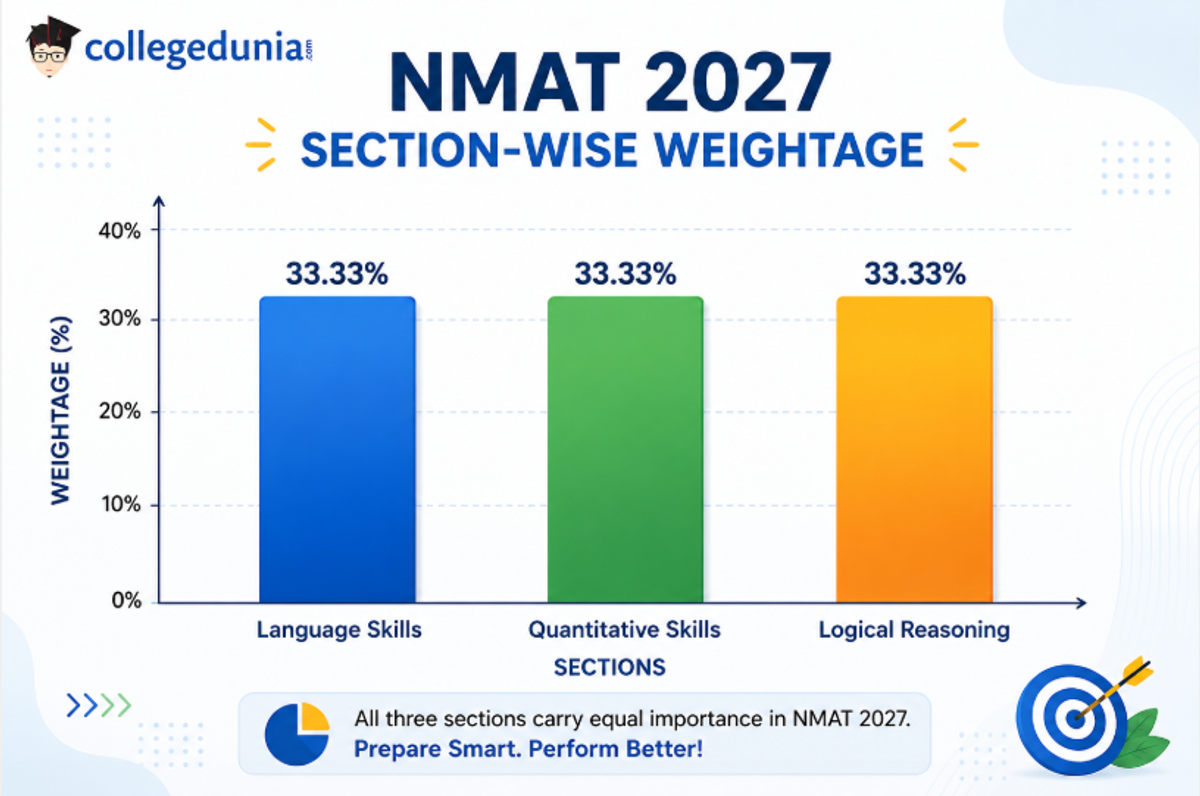
- The NMAT syllabus 2027 is divided into three sections: Language Skills, Quantitative Skills, and Logical Reasoning. The weightage of each section is 33.33%.
- The NMAT exam time limit for Language Skills is 28 minutes; for Quantitative Skills, it is 52 minutes; and for Logical Reasoning, it is 40 minutes.
- As per the NMAT 2027 exam pattern, for each correct answer, +3 marks are given, and there is no negative marking scheme.
- In the NMAT Exam pattern, Language Skills and Reading Comprehension (3 passages) have around 14 questions, and Grammar has around 12 questions.
- In NMAT Quantitative Aptitude, Arithmetic has the highest weightage with 14 questions.
- As per the NMAT exam pattern 2027, students can choose the order of the NMAT exam papers.
Related Links:
- NMAT Language Skills Sample Paper 2027: Check Expected Question Type, Free PDF Link
- NMAT Logical Reasoning Sample Paper 2027: Download Past 5 Years Question Paper PDFs
- NMAT Quantitative Aptitude Sample Paper: Direct Question Paper PDF Download Link
Key Summary
- According to the NMAT exam pattern 2027, each section consists of 36 questions.
- For each question, +3 marks are awarded, and the total marks in the NMAT exam pattern are 360.
- NMAT 2027 exam pattern states that no negative marking policy is followed.
- Students can attempt the NMAT exam up to 3 times with a gap of 15 days.
- As per the NMAT exam pattern 2027, the medium of the question paper is English.
NMAT Exam Pattern 2027: Check Highlights
The NMAT exam pattern 2027 states that the exam is conducted online for 120 minutes. There will be a total of 108 multiple-choice questions. The exam marks vary in ranges; the sectional score range is 12 - 120, and the overall score range is 36 - 360.
| Particular | NMAT 2027 Exam Pattern |
|---|---|
| Exam Name | NMIMS Management Aptitude Test |
| Conducting Body | Graduate Management Admission Council (GMAC) |
| Exam Mode | Computer-Based Test (Online) |
| Number of Sections | 3 (Language Skills, Quantitative Skills, Logical Reasoning) |
| Total Questions | 108 |
| Total Duration | 120 Minutes |
| Question Type | Multiple Choice Questions (MCQs) |
| Language | English |
| Total Score Range | 36 - 360 |
| Sectional Score Range | 12 - 120 |
| Marks for Each Question | +3 |
| Negative Marking | No |
| Sectional Timing | Yes |
| Section Order | The candidate can choose the order |
Ques. How many questions are there in the NMAT exam 2027?
Ans. According to the NMAT exam pattern 2027, there are a total of 108 questions in the NMAT exam for all three sections. Each of the sections consists of 36 questions for 3 marks. The NMAT exam pattern 2027 syllabus covers three sections, namely, Language Skills, Quantitative Skills, and Logical Reasoning.
NMAT 2027 Exam Pattern: Check Details
The NMAT exam pattern 2027 is prepared by the conducting authority. The exam consists of 3 sections, and the questions asked are multiple-choice.
The total marks for the NMAT exam pattern are 360.
| Section | No. of Questions | Marks per Correct Answer | Total Raw Marks | Scaled Score Range | Duration |
|---|---|---|---|---|---|
| Language Skills | 36 | +3 | 108 | 12 - 120 | 28 minutes |
| Quantitative Skills | 36 | +3 | 108 | 12 - 120 | 52 minutes |
| Logical Reasoning | 36 | +3 | 108 | 12 - 120 | 40 minutes |
| Total | 108 | — | 324 (Raw) | 36 - 360 (Scaled) | 120 minutes |
Related Link:
Ques. Is there any negative marking for the NMAT exam 2027?
Ans. No, there is no negative marking in the marks calculation of the NMAT 2027 exam. Thus, students are not directly penalized for wrong attempts. However, students should still avoid proceeding with random answer guesses, as NMAT is adaptive and the questions are presented in a sequence.
NMAT 2027 Exam Pattern: Check Section-Wise Weightage
The NMAT 2027 exam consists of three sections: Language Skills, Quantitative Skills, and Logical Reasoning.
The number of questions in each section is the same, that is, 36. The total number of questions asked is 108.
| Sections | Weightage |
|---|---|
| Language Skills | 33.33% |
| Quantitative Skills | 33.33% |
| Logical Reasoning | 33.33% |
NMAT Language Skills Exam Pattern 2027
Students are given 28 minutes to complete the NMAT Language Skills Paper. The Language Skills include Reading Comprehension, Grammar, Para Jumbles, Analogies, Vocabulary, and Sentence Arrangement.
| Topic | Approx. No. of Questions |
|---|---|
| Reading Comprehension (3 passages) | 12 - 14 |
| Grammar: Error Spotting, Fill in the Blanks, Sentence Correction | 10 - 12 |
| Para Jumbles and Sentence Arrangement | 4 - 6 |
| Analogies and Vocabulary | 4 - 6 |
| Total | 36 |
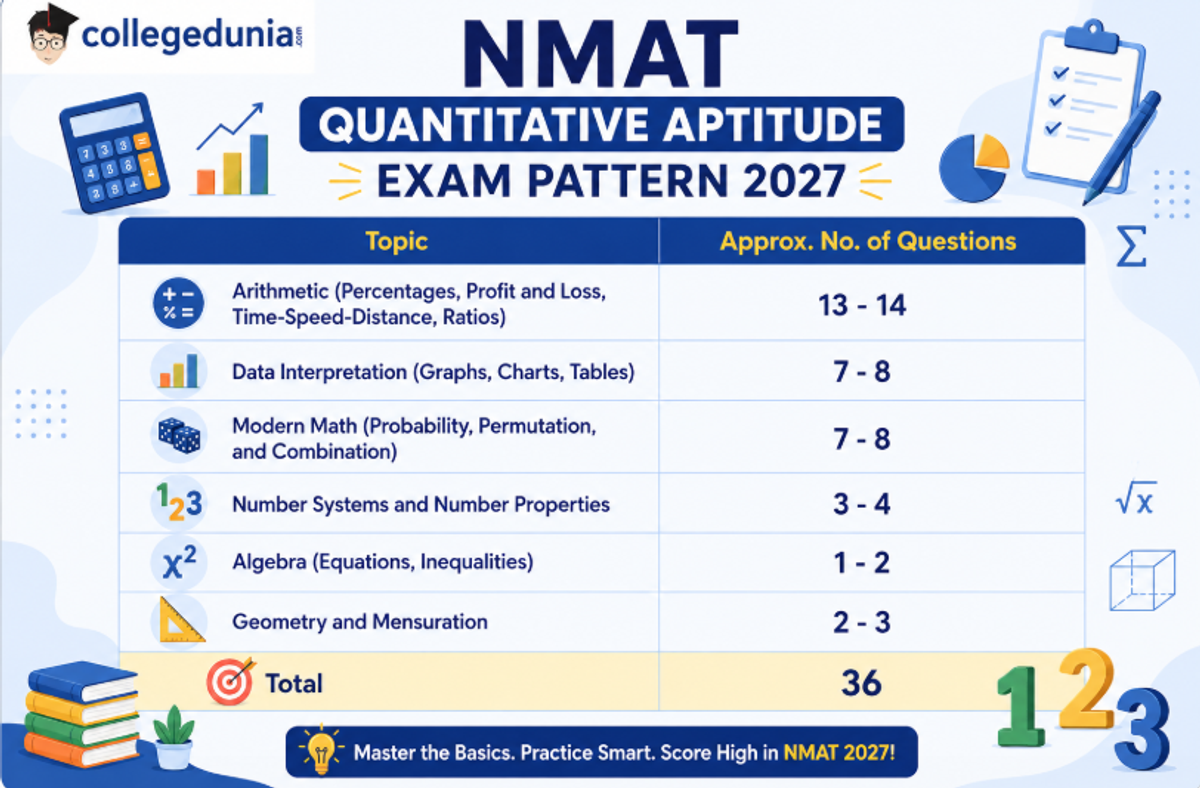
NMAT Quantitative Aptitude Exam Pattern 2027
The overall weightage of the Quantitative Aptitude paper as per the NMAT exam pattern 2027 is 33.33%.
Nearly 52 minutes are allotted to the students for the completion of the paper.
| Topic | Approx. No. of Questions |
|---|---|
| Arithmetic (Percentages, Profit and Loss, Time-Speed-Distance, Ratios) | 13 - 14 |
| Data Interpretation (Graphs, Charts, Tables) | 7 - 8 |
| Modern Math (Probability, Permutation, and Combination) | 7 - 8 |
| Number Systems and Number Properties | 3 - 4 |
| Algebra (Equations, Inequalities) | 1 - 2 |
| Geometry and Mensuration | 2 - 3 |
| Total | 36 |
NMAT Logical Reasoning Exam Pattern 2027
The NMAT exam pattern 2027 for the Logical Reasoning paper is shared below. The weightage of this section is 33.33%.
| Topic | Approx. No. of Questions |
|---|---|
| Critical Reasoning (Strengthen, Weaken, Assumption, Conclusion, Inference) | 8 - 10 |
| Statements and Assumptions / Arguments / Course of Action | 6 - 8 |
| Analytical Puzzles and Arrangements | 6 - 8 |
| Seating Arrangements and Sequences | 4 - 6 |
| Blood Relations and Direction Sense | 3 - 4 |
| Syllogisms and Deductions | 3 - 4 |
| Total | 36 |
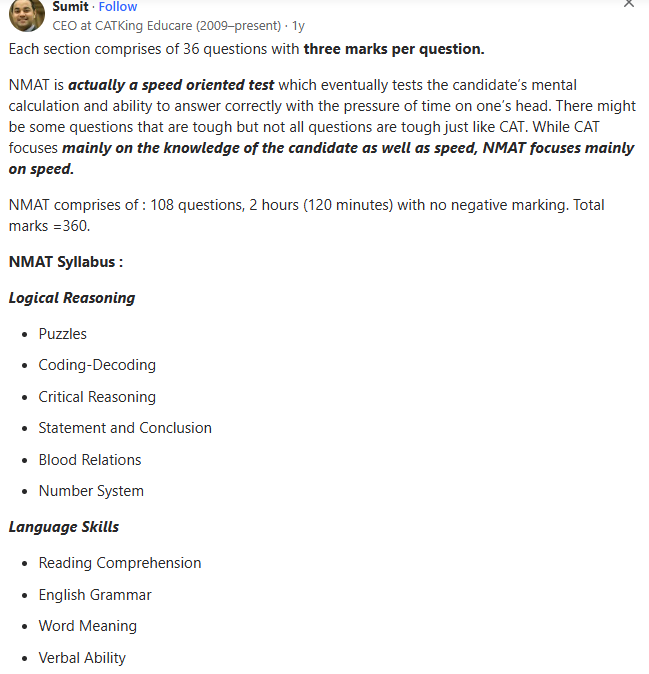
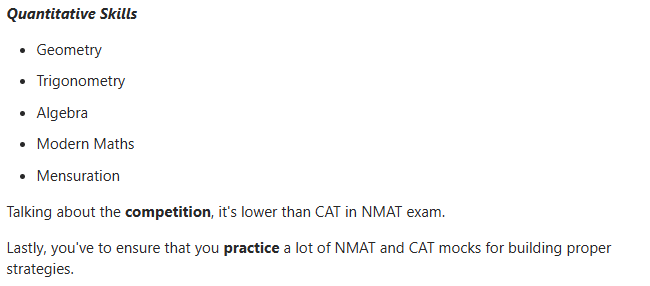
A Quora user asked about the marking scheme of the NMAT exam.
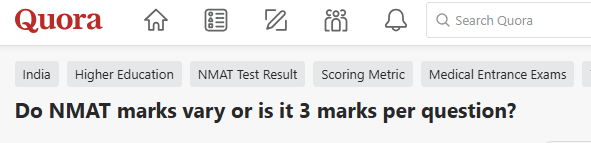
Replying to that, another user shared the detailed marking pattern for the NMAT examination and said that 3 marks are allotted for each question.
Related Links:
- NMAT Book List 2027: Check Section-Wise Books, Topics, Study Materials
- NMAT Coaching Centres 2027: Check Top Coaching Institutions
Ques. What is the marking scheme of the NMAT exam 2027?
Ans. As per the NMAT exam pattern 2027, the NMAT uses an adaptive scaled scoring model. So the marks are not directly calculated based on the total correct answers given by the students. Each of the sections is scored between 12 - 120. And the overall score is evaluated on a range of 36 - 360.
What Type of Questions Are Asked in NMAT Exam 2027?
As per the NMAT exam pattern 2027, a total of 108 questions are asked in the examination from all three sections.
NMAT uses multiple-choice questions, and the exam runs on a computer-adaptive platform, where the difficulty level and performance level of the candidate are evaluated in real time.
| Question Format | Description | Section |
|---|---|---|
| Standard MCQ (Single Correct) | It covers grammar, vocabulary, quantitative topics, and reasoning | All three sections |
| Reading Comprehension MCQ | Passage-based questions testing inference, main idea, vocabulary in context, and authorial tone | Language Skills |
| Data Interpretation MCQ | Chart, table, or graph-based calculation and analysis questions with a single correct MCQ answer | Quantitative Skills |
| Critical Reasoning MCQ | Argument analysis: strengthen, weaken, identify assumption, evaluate conclusion, or draw inference | Logical Reasoning |
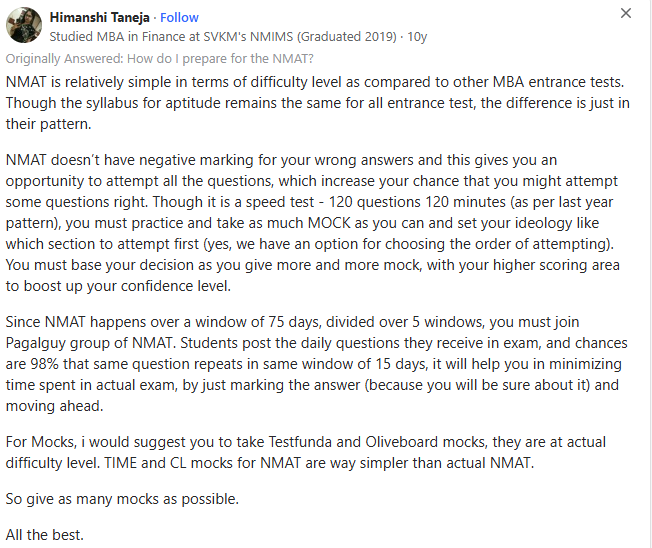
A Quora user asked about a 30-day preparation strategy for NMAT.
In response to that, another user shared the whole 30-day schedule for the exam preparation.
Related Links:
NMAT Exam Preparation Tips 2027
To secure good marks in the NMAT exam 2027, it is essential that students have a strategic approach. The Language Skills paper gives 28 minutes for completion of 36 questions, which makes it a little challenging.
Some of the strategic approach for NMAT preparation 2027 is provided below.
- Learn About the NMAT Exam Pattern & Syllabus: Before starting with the NMAT exam preparation, students must go through the exam pattern and syllabus topics of NMAT 2027 in detail. It is important that they are aware of the question structure, marking scheme, total topics, weightage, etc in detail.
- Build a Strong Hold on Topics: Start by learning the core concepts of the topics in detail. Learning the basics will help applicants understand the topic well and will also help in covering the topic easily. Focus on high-weightage topics and strategise your time division for topics based on the weightage.
- Focus on Quantitative, Arithmetic, and Formula-Driven Topics: The topics that include formulas are generally time-consuming and tricky. Thus, it is advised that students should practice these topics well and learn the formulas and the correct way of applying the formulas in the best way possible.
- Focus on Language Skills Paper: The time allotted for the completion of 36 Language Skills questions for the NMAT exam is 28 minutes. Thus, from the very first day, students must practice the Language Skills paper on a daily basis for a better and stronger hold on it. This will help students manage the time well on the examination day.
- Practice NMAT Previous Year Question Papers: Solving the NMAT previous year papers will help students learn the question format in depth. It will help you understand your preparation level and understanding of the concept or formula. Applicants must practice at least the last 5-years of question papers for a better outcome.
- Appear for NMAT Mock Tests: The NMAT mock test papers are designed based on the actual examination. Thus, appearing for mock tests will boost your confidence, improve your speed and accuracy, help you learn time management, and analyze your performance level well.
Check NMAT Question Paper Links:
NMAT Exam Pattern 2027 FAQs
Ques. What is the NMAT 2027 scoring scale?
Ans. The NMAT exam uses an adaptive scaled scoring model. Based on this, the marks of students are calculated considering the difficulty level and performance level of the applicants. For each section individually, the scale ranges between 12 - 120, and on an overall basis, it ranges from 36 - 360.
Ques. What is a good NMAT 2027 score?
Ans. Securing 230+ out of 360 marks in the NMAT examination 2027 will be considered a good score. Securing 230+ marks makes a student eligible for top NMAT-accepting B-schools such as NMIMS Mumbai. The cutoff range of most of the leading participating colleges is between 200 - 230 marks out of 360.
Ques. Can we appear for the NMAT 2027 session exam in any order?
Ans. Yes, candidates are free to choose their own order of appearing for the NMAT examination. There is no restricted order for the NMAT exam for students. The NMAT syllabus consists of a total of three sections: Language Skills, Quantitative Skills, and Logical Reasoning. Students can proceed based on their choice.
Ques. Can we review and change the answers for the NMAT 2027 exam after submission?
Ans. No, once you choose the answer from the given options and click on the “submit” option, there is no revert option. There is no such provision to edit the chosen answers after submission of the particular question. Thus, it is advised that students must proceed with assured answers first and then look for questions that are unfamiliar or that they are not sure about.
Ques. Is the NMAT exam harder than the CAT or XAT exam?
Ans. Generally, the difficulty level of the NMAT exam is considered to be moderate. However, it completely depends on the preparation level of the applicants. The NMAT exam does not follow the negative marking policy, unlike the CAT and XAT exams.
However, the adaptive marking technique is quite challenging. Thus, students must give their best and prepare instead of comparing the difficulty level with any other examination.



Comments