




GMAC officially does not release the detailed NMAT syllabus PDF. It publishes the exam pattern, marking scheme, exam duration and topics covered. Based on the latest available pattern, NMAT has three sections: Language Skills, Quantitative Skills, and Logical Reasoning. Each section has 36 questions.
- NMAT Language Skills section includes Reading Comprehension, Para Forming, Error Identification, Prepositions, Sentence Completion, and Analogies.
- NMAT syllabus for Quantitative Skills includes Arithmetic, Algebra, Probability, Caselets, Tables, Data Integration and Data Sufficiency.
- The NMAT syllabus for LR covers Critical Reasoning, Analytical Puzzles, Syllogism and Deduction.
- Arithmetic, DI and Data Sufficiency together are the highest-weightage topics in Quantitative skills, contributing approx. 20- 22 questions out of 36.
- Based on trends, Critical Reasoning, Analytical Puzzles and Arrangements have around 20 to 25 questions in the NMAT Logical Reasoning section. These should be the highest-priority topics while preparing.
- RCs and Para jumbles are the most frequently asked and highest-weighted questions, contributing to 20- 24 questions in NMAT Language Skills.
Related Articles:
- NMAT Exam Pattern 2026: Check Marking Scheme and Section Wise Time Limit
- NMAT Paper Analysis: Difficulty Level and Good Attempts
Key Summary for NMAT Syllabus
- The syllabus for NMAT tests candidates' proficiency in English language, mathematical ability, logical reasoning, and analytical skills.
- The syllabus for NMAT is moderately difficult, but you are advised to work on speed and accuracy to score well and manage the sectional time limit.
- According to the NMAT exam pattern, each section contains 36 questions, comprising a total of 108 questions.
- Preparing for the NMAT requires a well-planned strategy focused on conceptual clarity, practice, and time management.
NMAT Syllabus and Exam Pattern 2026
NMAT by GMAC is a national-level MBA entrance exam conducted by GMAC. It is the primary gateway to NMIMS Mumbai and other top B-schools. Learn about the NMAT exam pattern, which will help you prepare well. Since it has no negative marking, do not leave any questions unattempted.
| Sections | Questions | Sectional Time Limit | Mark Range | Key Topics |
|---|---|---|---|---|
| Language Skills Section | 36 | 28 | 12- 120 | Vocabulary, grammar, and reading comprehension skills, sentence correction, fill in the blanks, jumbled sentences, and word analogies |
| Quantitative Skills Section | 36 | 52 | 12- 120 | Arithmetic, Algebra, Modern Math, and Data Interpretation |
| Logical Reasoning Section | 36 | 40 | 12- 120 | Coding-decoding, blood relations, arrangements, and statement-based logical analysis. |
| Total | 108 | 120 | 36- 360 | - |
Related Article: NMAT Question Paper: Download NMAT Previous Year Papers PDFs with Solutions
Ques. What is the syllabus for NMAT Exam conducted by GMAC?
Ans. The NMAT by GMAC exam syllabus covers three main sections: Language Skills, Quantitative Skills, and Logical Reasoning, totalling 108 multiple-choice questions to be completed in 120 minutes. RCs, Parajumbles, Arithmetic, DI and DS, Critical Reasoning, Analytical Reasoning, and Sentence Completion are important topics for GMAT 2026.
NMAT Syllabus 2026: Language Skills
NMAT exam syllabus for Language Skills basically tests your vocabulary, basic grammar, and knowledge of RCs. The syllabus for NMAT Language Skills is tabulated below:
| Topics | Sub Topics |
|---|---|
| Vocabulary | Synonyms, Antonyms, Analogies, Fill in the blanks, Idioms |
| Grammar | Error Spotting, Sentence Completion, Parts of Speech, Tenses and Prepositions |
| Comprehension | RC passages, Para jumbles, Odd one out, Paragraph Summary |
Types of Questions Asked From NMAT Language Skills Syllabus
The types of questions asked from the NMAT language skills syllabus are tabulated below based on trends. It will help you understand the preparation required to crack NMAT exam syllabus for Language Skills.
| Topics | Types of Questions Asked | Expected Number of Questions |
|---|---|---|
| Reading Comprehension | Questions based on Facts, Inferences, Tone, Arguments, Main Idea | 2- 3 passages of 4 questions each |
| Parajumbles | Test Connectors, Pronouns, Chronology | 4- 6/ 4 or 5 sentences |
| Error Spotting | Four words/phrases are underlined, and you need to spot the word/phrase that has grammatical errors. Common grammatical mistakes such as subject-verb agreement, adjectives, adverbs, pronouns | 6- 8 |
| Fill in the Blanks | Single or multiple blanks based on Vocabulary/ Grammar | 6- 8 |
| Preposition | Combination of 3 prepositions from 6 options | 3- 5 |
| Verbal Analogy | Selection of a word based on synonyms, antonyms, collective nouns and general awareness | 5- 6 |
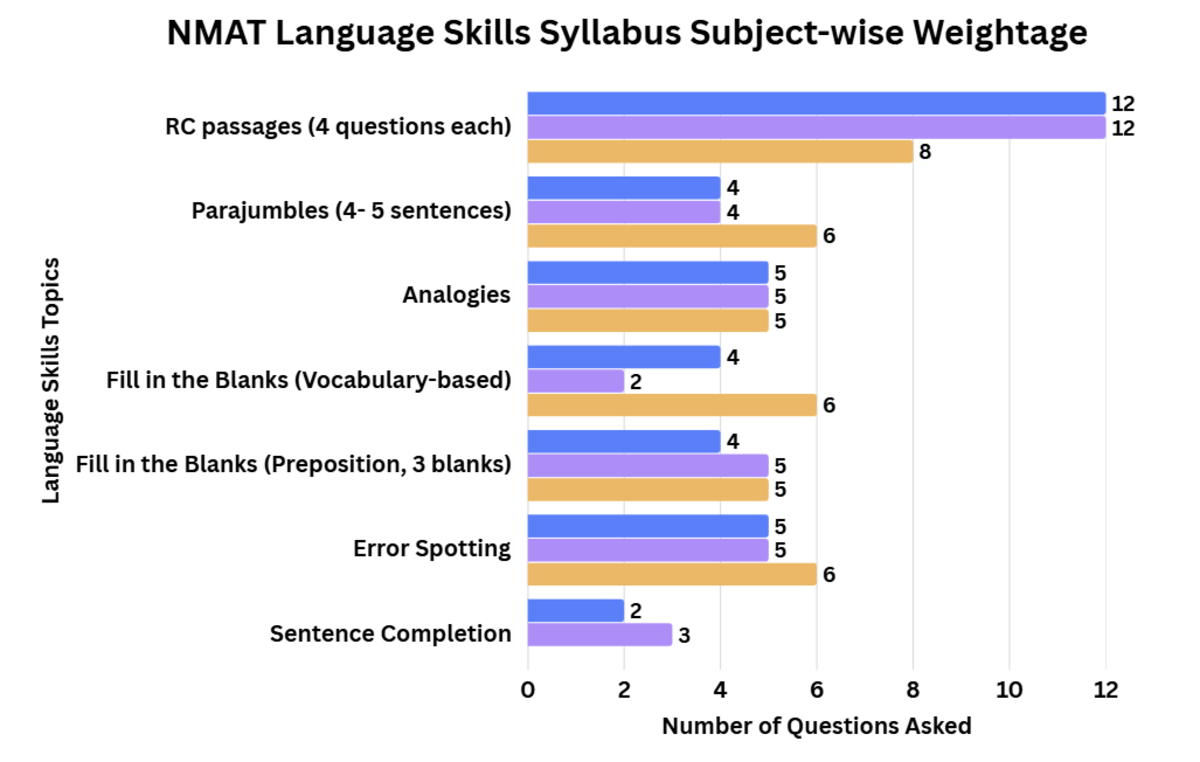
NMAT Language Skills Syllabus: Subject-wise Weightage (Based on Past Years' Trends)
The important Language Skills topics based on the NMAT syllabus are tabulated below. Check out the important topics that you should not skip while preparing for your NMAT 2026. RCs, Analogies, and Parajumbles together account for approx 21 questions in recent years.
| Language Skills Topics | 2025 | 2024 | 2023 |
|---|---|---|---|
| RC passages (4 questions each) | 12 | 12 | 8 |
| Parajumbles (4- 5 sentences) | 4 | 4 | 6 |
| Analogies | 5 | 5 | 5 |
| Fill in the Blanks (Vocabulary-based) | 4 | 2 | 6 |
| Fill in the Blanks (Preposition, 3 blanks) | 4 | 5 | 5 |
| Error Spotting | 5 | 5 | 6 |
| Sentence Completion | 2 | 3 | - |
Related Links:
- NMAT Language Skills Syllabus: Section-wise Topics, Marking Scheme and PDF Download
- NMAT Language Skills Sample Papers: Last 5 Years PYQs PDF Download and Topic Wise Weightage
- NMAT Language Skills Mock Test: Attempt Free Online Mock Test and Topic-wise Tests
Ques. What topics are covered in the NMAT exam?
Ans. The NMAT exam syllabus covers three main sections: Language Skills, Quantitative Skills, and Logical Reasoning, with 36 questions in each section. Percentages, Profit and Loss, Time and Work, Ratio and Proportion, Reading Comprehension, Seating Arrangement, Critical Reasoning, and Data Interpretation are the base of the NMAT Syllabus.
NMAT Syllabus 2026: Logical Reasoning
Logical Reasoning syllabus of NMAT tests candidates' analytical and critical thinking skills to evaluate arguments and conclusions. The syllabus for NMAT Logical Reasoning is tabulated below:
| Topics | Sub Topics |
|---|---|
| Logical Reasoning | Syllogisms, Coding and decoding, Blood relation, Puzzles, Clocks, Calendars, Series and arrangements |
| Verbal Reasoning | Conclusions, inferences, assumptions, strong/weak arguments, Cause and Effect, Abstract Reasoning, Course of Action, and Abstract Reasoning |
Types of Questions Asked From NMAT Logical Reasoning Syllabus
The type of questions asked from NMAT Logical Reasoning syllabus is tabulated below based on trends. It will help you understand the preparation required for NMAT exam syllabus for Logical Reasoning.
| Topics | Types of Questions Asked | Expected Number of Questions |
|---|---|---|
| Critical Reasoning | Paragraph-based questions on Inferences, Arguments, Course of Action, conclusion, and Assumption | 16- 20 |
| Arrangement Puzzles | Linear, Circular, Double row, grid-based | 1-2 puzzles of 4 questions |
| Input Output | Number-based and word-based | 1-2 sets of 4 questions |
| Other miscellaneous | Syllogism, Set Theory, Clocks and Calendars, Blood Relation, Number Series, Venn Diagrams, Number Puzzles | 4- 9 (Varies) |
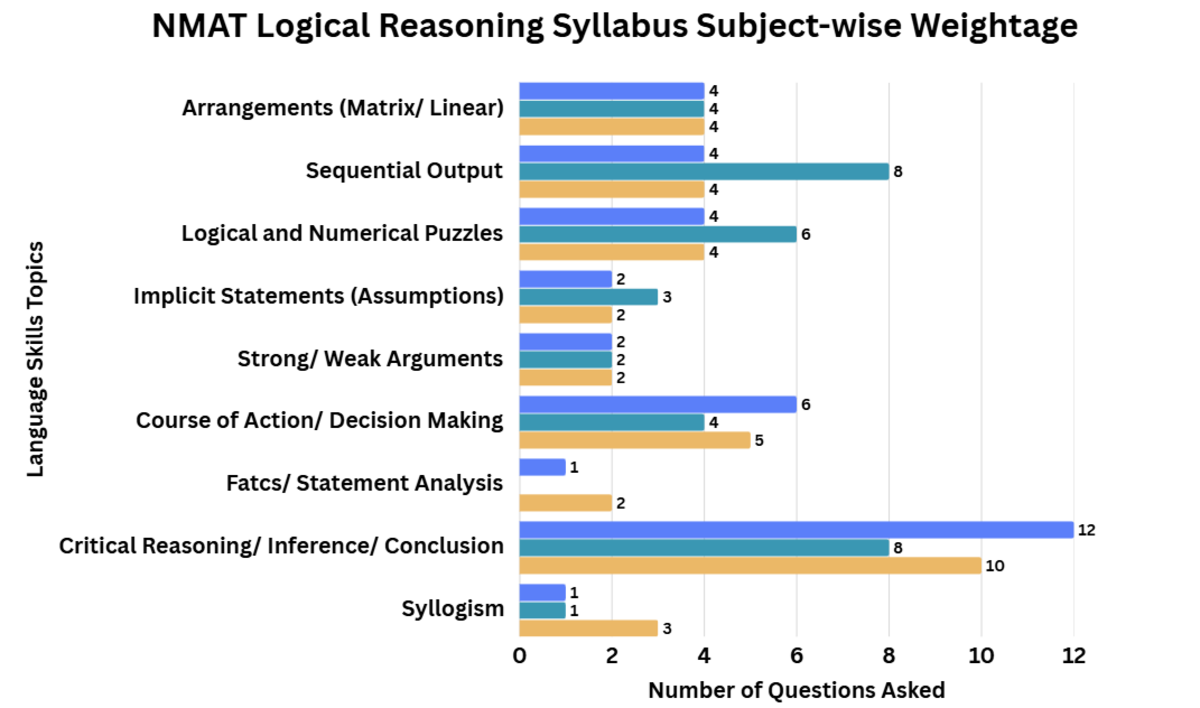
NMAT Logical Reasoning Syllabus: Subject-wise Weightage (Based on Past Years' Trends)
The important Logical Reasoning topics based on the NMAT syllabus are tabulated below. Critical Reasoning, Arrangements, and Analytical Puzzles carry the highest weightage, contributing around 20- 22 questions based on NMAT Logical Reasoning trends.
| Logical Reasoning Topics | 2025 | 2024 | 2023 |
|---|---|---|---|
| Arrangements (Matrix/ Linear) | 4 | 4 | 4 |
| Sequential Output | 4 | 8 | 4 |
| Logical and Numerical Puzzles | 4 | 6 | 4 |
| Implicit Statements (Assumptions) | 2 | 3 | 2 |
| Strong/ Weak Arguments | 2 | 2 | 2 |
| Course of Action/ Decision Making | 6 | 4 | 5 |
| Facts/ Statement Analysis | 1 | - | 2 |
| Critical Reasoning/ Inference/ Conclusion | 12 | 8 | 10 |
| Syllogism | 1 | 1 | 3 |
Related Links:
- NMAT Logical Reasoning Syllabus: Section-Wise Topics, Subject Weightage and PDF Download
- NMAT Logical Reasoning Sample Papers: Last 5 Years PYQs PDF Download and Topic Wise Weightage
- NMAT Logical Reasoning Mock Test: Attempt Free Online Mock Test and Topic-wise Tests
Ques. Is it easy to score 240 in NMAT?
Ans. Scoring 240 in the NMAT is not easy and requires high speed, strict time management, and consistent practice because it is a top-tier score needed for elite colleges like NMIMS Mumbai. The basic concepts tested are of moderate difficulty; the format of the exam creates unique pressure.
NMAT Syllabus 2026: Quantitative Skills
In NMAT, Quantitative Skills assesses candidates ' problem-solving ability, numerical reasoning, and data interpretation skills. The syllabus for NMAT Quantitative Skills is tabulated below:
| Topics | Sub Topics |
|---|---|
| Arithmetic | Percentages, Simple and compound interest, Profit and loss, Ratio, proportion, and averages, Time and work correlation |
| Algebra | Surds and Indices, Inequalities, Logarithms, Linear and Quadratic Equations, AP, GP and Functions, Sequence and Series |
| Modern Maths | Set Theory, Probability, Permutation and Combination |
| Data Interpretation | Line Chart, Pie Chart, Bar Graph, Tabular Graph, Mixed Combinations and Data Sufficiency |
| Number Theory | LCM and HCF, Factors and Multiples, Remainders, Divisibility Rules |
Types of Questions Asked From NMAT Quantitative Skills Syllabus
The type of questions asked from NMAT Quantitative Skills syllabus is tabulated below based on trends. It will help you understand the preparation required for NMAT exam syllabus for Quantitative Skills.
| Topics | Types of Questions Asked | Expected Number of Questions |
|---|---|---|
| Data Interpretation | Calculation-intensive and concept-based questions from Percentages, Ratios, Averages, Tables, Bar and Line graphs, Caselets | 1- 2 sets of 4 questions each |
| Data Sufficiency | Diverse Topics (Arithmetic, Algebra, Numbers, etc.) | 4- 5 |
| Arithmetic | Percentages and their Applications (Profit and Loss, Ratio, Mixtures, Averages, Time and Work) | 10- 12 |
| Algebra | Questions from AP, GP, Logarithms, Linear and Quadratic Equations | 4- 5 |
| Modern Maths | Permutations and Combinations, Set Theory and Probability | 5- 6 |
| Number System | Factors, HCF, LCM, Fractions, Divisibility | 3- 4 |
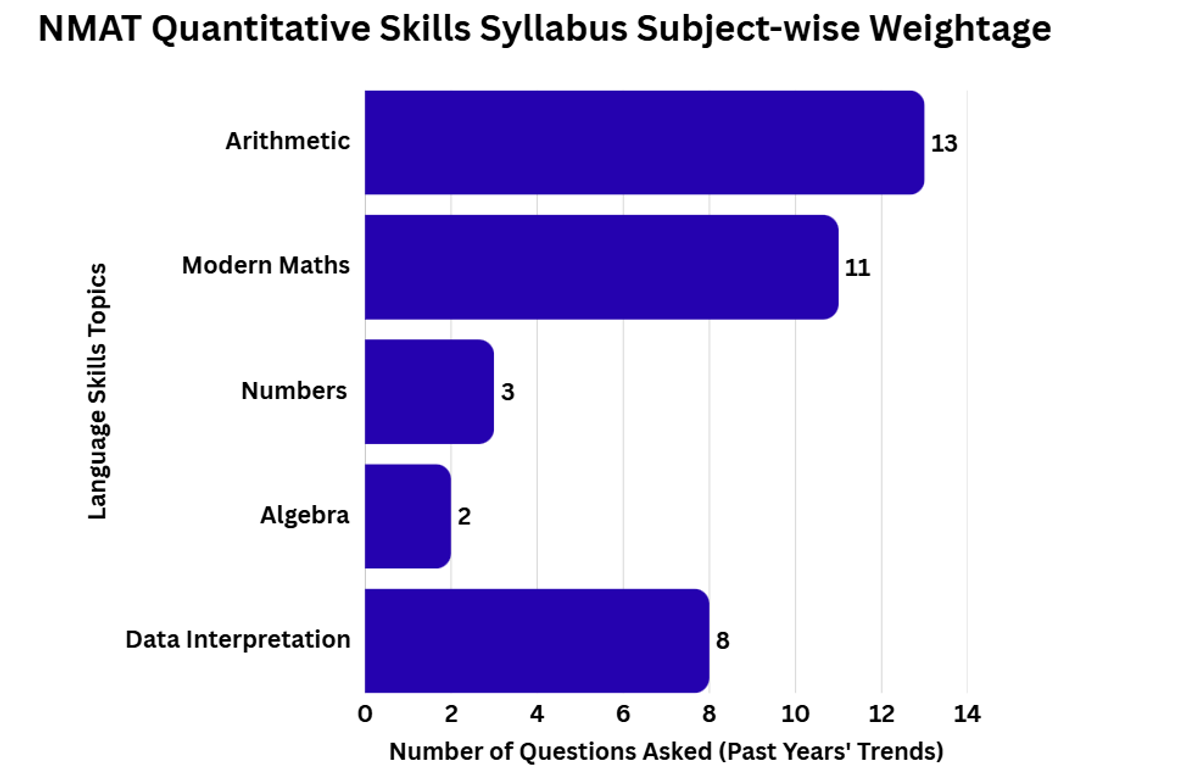
NMAT Quantitative Skills Syllabus: Subject-wise Weightage (Based on Past Years' Trends)
Arithmetic and Modern Maths contribute around 24 questions in past years' papers, making them the highest weightage topics in NMAT Quantitative Skills.
| Quantitative Skills Topics | Number of Questions Asked (Past Years’ Trends) |
|---|---|
| Arithmetic (Percentages, Time and Work, Ratio and Proportion, Simple and Compound Interest) | 9- 13 |
| Modern Maths (Progressions, Probability, Set Theory, Logarithms, P and C) | 8- 11 |
| Numbers | 2- 3 |
| Algebra (Quadratic Equations and Algebraic Formulae) | 2 |
| Data Interpretation (Bar Chart and Table) | 8 |
Related Links:
- NMAT Quantitative Skills Syllabus: Section-Wise Topics, Weightage and PDF Download
- NMAT Quantitative Skills Sample Papers: Last 5 Years PYQs PDF Download and Topic Wise Weightage
- NMAT Quantitative Skills Mock Test: Attempt Free Online Mock Test and Topic-wise Tests
Ques. Can I crack NMAT in 2 months?
Ans. Yes, you can crack the NMAT in 2 months with a dedicated study plan, daily practice, and regular mock tests. Spend 4 to 5 hours daily reviewing basic math, grammar rules, vocabulary, and unique logical reasoning topics like input-output, coding-decoding, and series.
Best Books to Prepare for NMAT 2026
The books recommended by experts and toppers that align well with the NMAT 2026 syllabus are tabulated below.
| Section | Book Name | Author / Publisher | Why This Book |
|---|---|---|---|
| All Sections | NMAT by GMAC Official Guide | GMAC | The only official reference |
| Language Skills | Word Power Made Easy | Norman Lewis | Best vocabulary builder for analogies, synonyms, antonyms, and contextual word usage |
| High School English Grammar and Composition | Wren & Martin | Covers error identification, sentence correction, and grammar rules with structured practice | |
| Quantitative Skills | Quantitative Aptitude for CAT | Arun Sharma | Comprehensive arithmetic, algebra, geometry, and modern maths with graded difficulty levels |
| How to Prepare for Data Interpretation for CAT | Arun Sharma | Strong DI sets at increasing difficulty; mirrors the data-heavy style of NMAT DI questions | |
| Quantitative Aptitude | R.S. Aggarwal | Topic-wise solved examples useful for arithmetic fundamentals and calculation speed | |
| Logical Reasoning | Logical and Analytical Reasoning | Ashok Gupta | Covers seating arrangements, blood relations, coding, and direction sense in one volume |
| A Modern Approach to Logical Reasoning | R.S. Aggarwal | Good for critical reasoning, syllogisms, and statement-conclusion question types |
Related Article: NMAT Books 2026: Section-Wise Best Books for NMAT Prep, Study Material, & Free Mock Tests
Ques. Is NMAT more difficult than CAT?
Ans. No, NMAT is generally considered easier than the CAT in terms of concept difficulty and question complexity. However, NMAT poses a unique challenge because it is heavily speed-based. CAT focuses on deep analytical skills, multi-concept problem-solving, and logical depth. On the other hand, NMAT focus on high speed and decision-making under strict sectional time limits.
NMAT 2026 Syllabus: Section-Wise Preparation Strategy
NMAT rewards both speed and accuracy. The section-wise strategy tips according to the NMAT 2026 syllabus are discussed below.
NMAT Syllabus 2026: Language Skills Preparation Tips
- Read one magazine daily from “The Hindu” or “The Economist” to build RC speed and inference skills.
- Practice RC passages daily as it has the highest weightage. Focus on inference and tone questions.
- Build vocabulary with Word Power Made Easy and learn 10 new words per day.
- Learn grammar rules for error identification questions.
NMAT Syllabus 2026: Quantitative Skills Preparation Tips
- Start with arithmetic (percentages, ratios, and time-speed-distance) account for around 40- 45% of the section.
- Practice sets daily using bar charts and tables, as these are important topics for DI questions.
- Do not skip permutations, combinations, and probability because modern maths contributes 10- 15% of Quantitative Skills.
NMAT Syllabus 2026 Logical Reasoning Preparation Tips
- Analytical puzzles are the highest-weightage topic, so practice 5- 6 seating arrangement and blood relation sets per day.
- For critical reasoning, master assumption and strengthen/weaken question types before moving to other sub-topics.
- Solve syllogisms using Venn diagrams; avoid lengthy verbal analysis during the exam.
Attempt mock tests and practice PYQs under timed conditions to score well in NMAT 2026.
In a Reddit post, a user shared some types of questions that are repetitive. 'If all birds are bees and some bees are butterflies', calendar questions, Inference, Course of action, if only 1 is sufficient, only 2 is sufficient, all are sufficient. These topics are mostly asked in NMAT. Practice attempting mocks, as it helps in analysing questions. Keep a good speed while reading, right from the start.
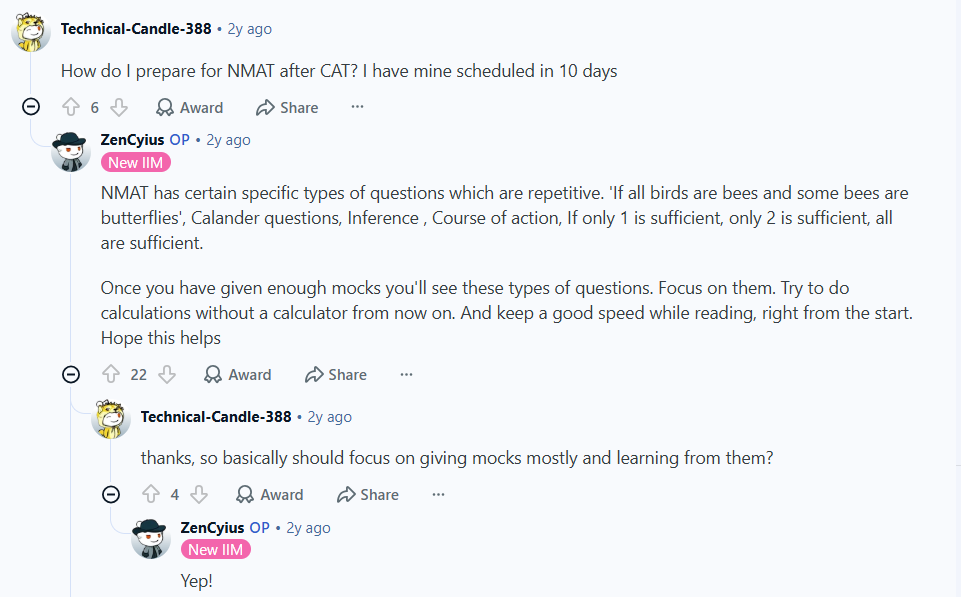
Source: Reddit
Related Links:
- NMAT Quant Preparation Tips: Section-wise Strategy, Study Plan, Books
- NMAT Language Skills Preparation Tips: Section-wise Strategy Plan, High-weightage Topics, Study Plan & Books
- NMAT Logical Reasoning Preparation, Best Books, Sample Questions
- NMAT Mock Test: Attempt Full Test, Chapter-wise Test Online for Free
NMAT Syllabus 2026 FAQs
Ques. Is there an official NMAT syllabus PDF 2026 by GMAC?
Ans. No, GMAC does not release a formal NMAT syllabus PDF. The official reference is the NMAT Official Guide, available on the official website. The section-wise topic list on this page is derived from the Official Guide and five-year paper analysis.
Ques. Which section has the highest weightage in NMAT 2026 syllabus?
Ans. All three sections carry equal weightage in NMAT: 36 questions, and the score range is 12- 120 for each. Quantitative Skills gets the most time (52 minutes). Language Skills gets the least time (28 minutes), making it the section where time pressure is highest.
Ques. What are the most important topics in NMAT Quantitative Skills?
Ans. Arithmetic is the most important area, accounting for 40- 45% of the Quantitative Skills section. Key topics include percentages, profit and loss, ratio and proportion, time-speed-distance, and time and work. Data Interpretation is the second priority, contributing 20- 25% of the section.
Ques. Is NMAT Language Skills difficult?
Ans. Language Skills is considered moderate to difficult mainly because of extreme time pressure. Reading Comprehension and vocabulary analogies are the hardest sub-sections. Daily reading and vocabulary practice significantly improve your speed and accuracy here.
Ques. What are the most important topics in NMAT Logical Reasoning?
Ans. Analytical Puzzles dominate NMAT Logical Reasoning with 33- 40% weightage. Focus on seating arrangements, blood relations, coding-decoding, and input-output. Critical Reasoning and Verbal Reasoning (including syllogisms) together account for another 44- 56% of the section.
Ques. What books should I follow for NMAT Language Skills?
Ans. Word Power Made Easy by Norman Lewis is the best book for NMAT vocabulary preparation. For grammar, use Wren & Martin’s High School English Grammar and Composition. Supplement both with the NMAT Official Guide for authentic RC passage practice at the right difficulty level.
Ques. How many attempts are allowed in NMAT 2026?
Ans. GMAC allows up to 3 attempts per NMAT exam cycle. Your best score across all attempts is used for B-school applications. Use Attempt 1 as a baseline, work on your weak sections, then retake for a stronger score.



Comments