

![Central Institute of Petrochemicals Engineering & Technology - [CIPET]](https://image-static.collegedunia.com/public/college_data/images/logos/1681223690download25.jpg?h=71.7&w=71.7&mode=stretch)
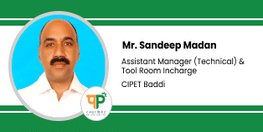
N. Ramesh Babu is the Technical Manager and the Training Incharge at CIPET Baddi. He has over 15 years of experience in the industry. Mr. Babu started his professional career with a Diploma in Tool engineering, followed by a Bachelor of Engineering in Mechanical Engineering. He also has a Master of Technology in Computer Assisted Manufacturing. Furthermore, he is also a Member of Parliament in Himachal Pradesh.

Being a Faculty of the XYZ Department, what are your roles and responsibilities towards the students?
Everyone at CIPET Baddi is dedicated to providing and teaching long-term courses. Our responsibility is to properly conduct our diploma and PG diploma programs. We not only teach these courses but also act as academic coordinators. I need to provide training to faculty to teach the programs better and take care of all technical aspects of the institute.
How do you tend to establish healthy relations with the students and fellow faculty?
Having a healthy atmosphere in the institute is pertinent to success. We always maintain cordial relations with our students from the day they gain admission until they graduate. We are always open to talking and providing support, even when they become our alumni.
How do you try to bring in a practical approach towards subjects and make it industry-oriented?
CIPET’s course curriculum is a combination of theory and practical sessions. Students must master both components to graduate from their programs. There are also occasional industry visits and mandatory internships that help in this regard as well.
How do you strategize the curriculum and how often it gets updated to make it befitting for the students?
The CIPET course curriculum is reviewed every four years. We take the help of our teachers and professionals in the industry to understand what to include in the syllabus. We need to make sure that students are updated and keep abreast with the latest technological developments. We make sure to include the latest skills as well to prepare our students for employment.
Check CIPET Baddi, Solan Courses & Fees
What are your views on the placements and higher education of the students from your department or How does your department prepare students for higher education?
After completing their degrees, students usually opt for higher education or opt for placements. Our diploma course students take admission to full-time degree programs. For instance, a diploma in plastics mold student can take admission to the B.Tech. Plastics Technology degree, which we offer as well. We are also in the process of approaching the Directorate of Higher Education (DHE) to introduce CIPET Diploma equivalency certificate courses and B.E./B.Tech lateral entry admissions.
How do you help your student to cope up with the competition being so high in the outside world?
As far as placements are concerned, the demand for professionals and competition in plastics and allied industries are very high in India and abroad. CIPET prepares students by teaching them soft skills through mock interviews and internships to give them an idea of what is required of them. Students, in the end, have no issues finding a suitable job immediately upon finishing their courses. CIPET alumni are in very good positions in many countries in the plastics industry.
Do you have any extracurricular activities/ programs to enhance the skills of the students or expose them to the real world challenges?
At CIPET, students are engaged in various club activities. We have an entrepreneurship cell, a music club, a debate club, and a health and wellness club. Apart from this, we engage our students in an annual sports day, competitions, industrial visits, Swachta Pakhwara competitions, freshers day, annual day, alumni meet, and other events.
What are the challenges you faced/ are facing to uplift the quality of education of your department?
The major challenge we face in our department is increasing the student population. We need to market ourselves better, show our facilities and infrastructure, and improve our placement record to attract more students. Another issue is retaining students in our college. We want our diploma students to opt for degree programs after graduation.
When you came to the college, what was your vision and how are you trying to achieve the same?
When I first joined CIPET, my goal was to impart quality technical education in the field of plastics and allied industries. I wanted to update our curriculum to include more hands-on training and practical classes. Placements were also an area of focus for me. We are gradually but surely reaching our goals and reassessing ourselves to achieve more.
How does the department/ college/University enhance the skills of the faculty and prepares them according to the industry standards?
We have many annual faculty development programs for our teachers to help them re-skill and upskill. Besides this, CIPET encourages our teachers to participate in industrial exhibitions in Plastics and allied industries in India and abroad. These are excellent opportunities to network and learn the latest trends in the industry.
What are the interventions and approaches you bring in apart from curriculum to train/teach the students?
We encourage students to participate in skill development competitions that are organized by specialized organisations and our institute. They also get opportunities for industrial visits, exhibitions, technical symposiums, seminars, and guest lecturers targeting plastics and allied industries.
What do you see the department’s/ college’s greatest strengths and how it can be enhanced?
I believe our greatest strength is the scope of the courses and opportunities our students are eligible for after graduation. We are also becoming a hub and a top institute for plastics and allied industries education. We are going to continue with our efforts to strengthen our institute and its offerings to continue to be the best institute in the region.
.png?h=132&w=263&mode=stretch)



.png?h=78&w=78&mode=stretch)


![Maharaja Agrasen University - [MAU]](https://image-static.collegedunia.com/public/college_data/images/appImage/_image-5_32.jpg?h=111.44&w=263&mode=stretch)



![Jaypee University of Information Technology - [JUIT]](https://image-static.collegedunia.com/public/college_data/images/appImage/25561_JUIT_NEW.jpg?h=111.44&w=263&mode=stretch)

![Bahra University - [BU]](https://image-static.collegedunia.com/public/college_data/images/appImage/25549_2.png?h=111.44&w=263&mode=stretch)







.png?h=72&w=72&mode=stretch)


![Radiance Academy of Management Studies - [RAMS]](https://image-static.collegedunia.com/public/college_data/images/logos/1685961896download.jpeg?h=72&w=72&mode=stretch)


![Priyadarshini Institute of Technology and Science for Women - [PITW]](https://image-static.collegedunia.com/public/college_data/images/logos/1480060919552503_120404818103689_1019977854_n.jpg?h=72&w=72&mode=stretch)

![Sri Mittapalli Institute of Technology for Women - [SMITW]](https://image-static.collegedunia.com/public/college_data/images/logos/1479981538logo.png?h=72&w=72&mode=stretch)
![Shri J. M. Sabva Institute Of Engineering & Technology - [JIET]](https://image-static.collegedunia.com/public/college_data/images/logos/1504261460logoedt.jpg?h=72&w=72&mode=stretch)
![NRI Institute of Pharmacy - [NIP]](https://image-static.collegedunia.com/public/college_data/images/logos/1689246991Screenshotfrom20230713164620.png?h=72&w=72&mode=stretch)
![Priyadarshini College of Engineering - [PDCE]](https://image-static.collegedunia.com/public/college_data/images/logos/1427347797LOGO1.jpg?h=72&w=72&mode=stretch)

![Advanced College of Technology and Management - [ACTM]](https://image-static.collegedunia.com/public/college_data/images/logos/col12736.jpg?h=72&w=72&mode=stretch)
![Lakshay College of Hotel Management - [LCHM]](https://image-static.collegedunia.com/public/college_data/images/logos/1692170172Untitled.jpg?h=72&w=72&mode=stretch)
![GD Rungta College of Engineering and Technology - [GDRCET]](https://image-static.collegedunia.com/public/college_data/images/logos/1496403817logo.png?h=72&w=72&mode=stretch)



Comments