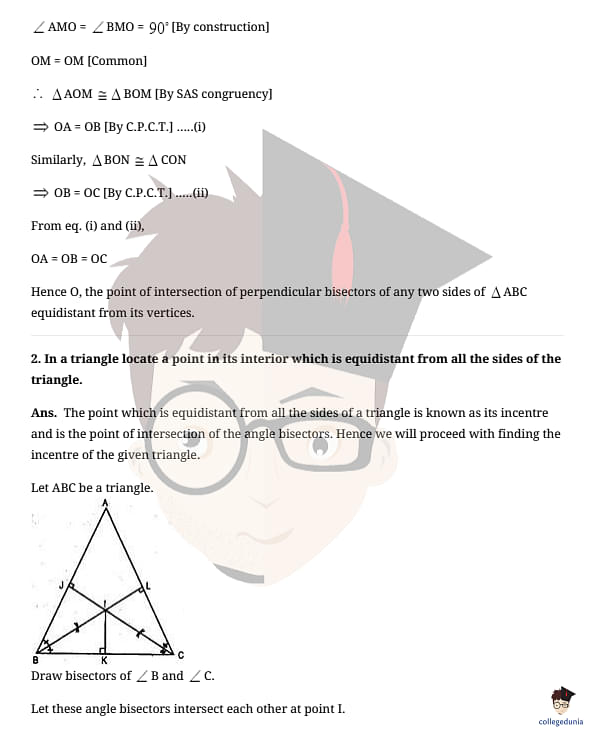
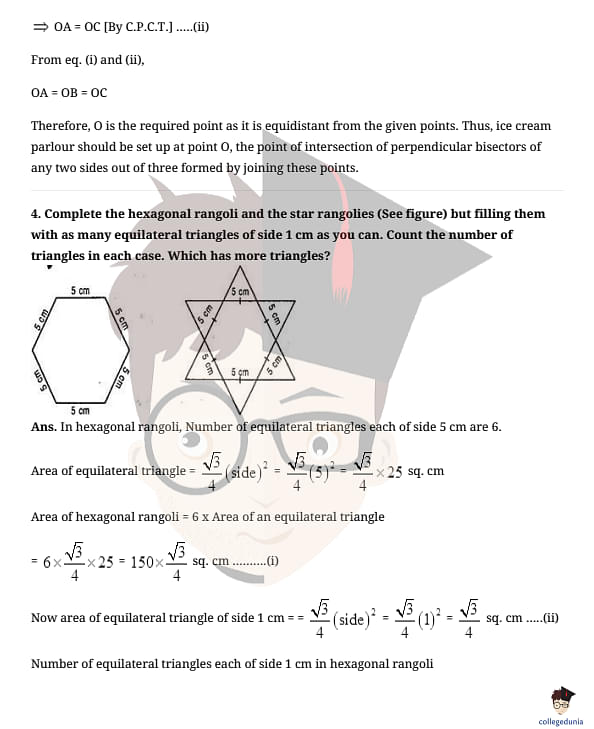
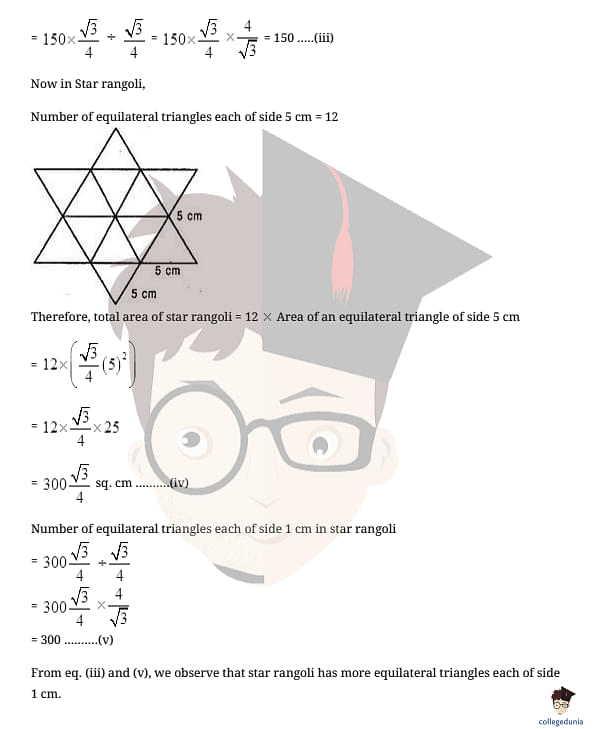
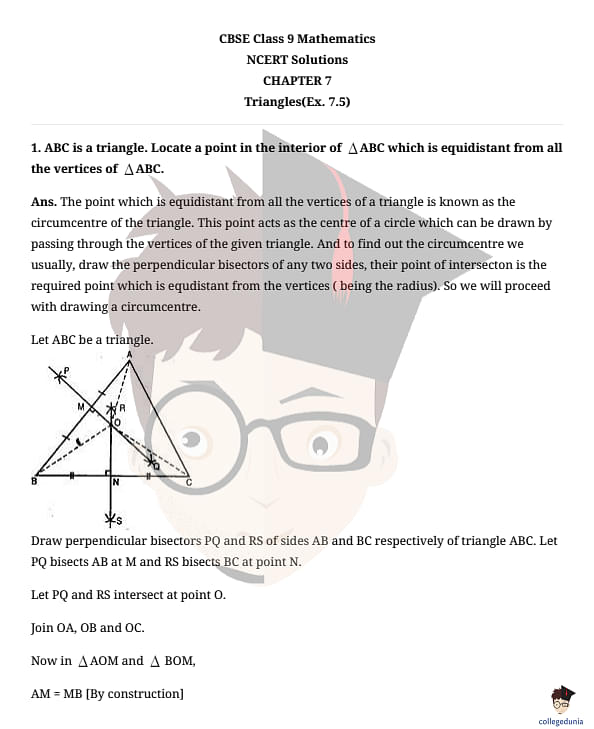
NCERT Solutions for Class 9 Maths Chapter 7 Triangles Exercise 7.5 Solutions

Collegedunia Team logo

Collegedunia Team

Content Curator

NCERT Solutions for Class 9 Maths Chapter 7 Triangles Exercise 7.5 Solutions are based on the summary of previous exercises, like SAS Congruence Rule, ASA Congruence Rule, AAS Congruence Rule, SSS Congruence Rule, RHS Congruence Rule and Properties of Triangle.

Download PDF: NCERT Solutions for Class 9 Maths Chapter 7 Exercise 7.5 Solutions

Check out NCERT Solutions for Class 9 Maths Chapter 7 Exercise 7.5 Solutions
Read More: NCERT Solutions For Class 9 Maths Chapter 7 Triangles

Exercise Solutions of Class 9 Maths Chapter 7 Triangles 

Also check other Exercise Solutions of Class 9 Maths Chapter 7 Triangles

Also Check:

Also check:

CBSE X Related Questions

  • 1.
    The graph of \(y = f(x)\) is given. The number of zeroes of \(f(x)\) is :

      • 0
      • 1
      • 3
      • 2

    • 2.
      PQ and PR are two tangents to a circle with centre O and radius 5 cm. AB is another tangent to the circle at C which lies on OP. If \(OP = 13\) cm, then find the length AB and PA.


        • 3.
          To protect plants from heat, a shed of iron rods covered with green cloth is made. The lower part of the shed is a cuboid mounted by semi-cylinder as shown in the figure. Find the area of the cloth required to make this shed, if dimensions of the cuboid are \(14 \text{ m} \times 25 \text{ m} \times 16 \text{ m}\).


            • 4.
              In the given figure, \( \triangle AHK \sim \triangle ABC \). If \( AK = 10 \text{ cm} \), \( BC = 3.5 \text{ cm} \) and \( HK = 7 \text{ cm} \), find the length of \( AC \).


                • 5.
                  Through the mid-point Q of side CD of a parallelogram ABCD, the line AR is drawn which intersects BD at P and produced BC at R. Prove that \(AQ = QR\).


                    • 6.
                      In the given figure, \(TP\) and \(TQ\) are tangents to a circle with centre \(M\), touching another circle with centre \(N\) at \(A\) and \(B\) respectively. It is given that \(MQ = 13 \text{ cm}\), \(NB = 8 \text{ cm}\), \(BQ = 35 \text{ cm}\) and \(TP = 80 \text{ cm}\).
                      (i) Name the quadrilateral MQBN. (1)
                      (ii) Is MN parallel to PA? Justify your answer. (1)
                      (iii) Find length TB. (1)
                      (iv) Find length MN. (2)

                        Comments


                        No Comments To Show