




The NATA Syllabus 2027 is divided into two separate part-wise structures for the Drawing and Aptitude papers. There are three questions in Part A and 50 questions in Part B. English and Hindi remain the common medium for both parts in the NATA exam.
- NATA Syllabus 2027 Part A covers Composition and Colour, Black and White Sketching, and 3D Composition carrying 25, 25, and 30 marks respectively.
- NATA Drawing Syllabus 2027 gives 3D Composition 30 marks, which is 15% of the paper and the highest weight on any single question in Part A.
- NATA Part B Syllabus 2027 covers six domains through 50 questions split into 42 MCQs and 8 NCQs in the online adaptive test.
- In NATA Visual Reasoning, mental rotation, mirror images, and unfolding figures account for 8 to 12 questions or 15 to 22% of Part B.
- NATA Numerical Ability Syllabus 2027 gives Coordinate Geometry 3 to 5 questions, with Algebra adding 2 to 3 in recent NATA question papers.
- NATA Architecture and Design Syllabus carries 8 to 12 questions on landmark buildings, architectural styles, materials and green building trends.
- For NATA Syllabus 2027, candidates should prioritise 3D Composition, Visual Reasoning and Numerical Ability based on past paper trends.
- Candidates should also cover Design Sensitivity, Language Interpretation and Logical Derivation, which add 13 to 24 questions in NATA Part B.
COA has not issued the 2027 notification yet, so the structure below follows the latest available NATA Syllabus and recent paper trends.
Related Articles:
- Check NATA Previous Year Question Paper with Solution PDF (2024-2017)
- NATA Sample Paper PDF: Direct Link, Solutions, and Its Importance
- NATA Preparation Tips : Know Section-wise Tips and Important Books
Key Summary
- CoA publishes marks only for the three Part A questions so every Part B weightage range comes from analysis of recent NATA question papers.
- The A3 answer is built from a physical kit handed out at the test centre rather than drawn on the answer sheet like A1 and A2.
- NATA exam runs two sessions a year with the better score counted and there is no negative marking in either Part A or Part B.
- Physics and Chemistry are never tested in NATA exam although PCM in Class 12 stays a compulsory eligibility condition for B.Arch admission.
- Preparation should move from daily sketching and an all-in-one B.Arch guide to previous year papers and timed three hour full mocks.
NATA Syllabus 2027 PDF Download
The official NATA syllabus is published through the Information Bulletin which also carries eligibility rules, fees and the centre list.
- The latest information bulletin 2026 is live at nata.in carrying the same NATA syllabus structure needed for 2027.
- COA or the Council of Architecture is expected to release NATA Syllabus 2027 PDF in January-February 2027.
| NATA Syllabus (Information Bulletin) | Download Link |
Ques. When will the NATA Syllabus 2027 PDF be released?
Ans. The NATA syllabus PDF for 2027 is expected in January 2027, following the January–February cycle COA used for the 2026 bulletin at nata.in.
NATA Syllabus 2027 Overview: Part-Wise Structure
NATA Syllabus 2027 Part A covers colour composition, black and white sketching, and 3D modelling, testing visual and spatial skills.
- NATA 2027 gives 25 marks to colour composition and 25 marks to black and white sketching, with a focus on visual appeal, scale, proportion, and shadows.
- NATA Syllabus 2027 includes a 30 mark 3D modelling task using the kit provided at the examination centre.
- NATA Part B Syllabus 2027 covers visual reasoning, logical derivation, architecture awareness, language interpretation, design sensitivity and numerical ability.
- NATA Architecture Awareness includes landmark buildings, architectural history, building materials and recent construction technology developments.
| Component | Part A | Part B |
|---|---|---|
| Name | Drawing and Composition Test | Aptitude Test (MCQ + NCQ) |
| Mode | Offline (Pen & Paper) | Online (Computer-Based Adaptive Test) |
| Duration | 90 minutes | 90 minutes |
| Total Marks | 80 | 120 |
| Number of Questions | 3 | 50 (typically 42 MCQ + 8 NCQ) |
| Question Breakdown | A1 – Composition and Colour (25 marks)A2 – Sketching & Composition – Black & White (25 marks)A3 – 3D Composition (30 marks) | Visual ReasoningLogical DerivationG.K. Architecture & DesignLanguage InterpretationDesign Sensitivity / Design ThinkingNumerical Ability |
| Key Focus Areas | Creativity, visualization, composition, aesthetic sense, scale, proportion, texture, shades & shadows, 3D form | Spatial & visual reasoning, logical analysis, architectural awareness, design sensitivity, basic numerical ability |
| Medium | English and Hindi | English and Hindi |
| Negative Marking | None | None |
Also Read:
- NATA Drawing Sample Paper PDF: Direct Link, Solutions, and Its Importance
- NATA Aptitude Sample Paper PDF: Direct Link, Solutions, and Its Importance
Ques. What is the syllabus for the NATA exam in 2027?
Ans. The NATA syllabus 2027 is yet to be officially released. Based on the latest pattern, candidates can expect Drawing and Composition, Visual Perception, Logical Reasoning, Design Sensitivity, Architectural Awareness, Language Interpretation and Numerical Ability.
You can watch the YouTube video "NATA 2027 Syllabus & Exam Pattern | Complete Guide" to understand how the NATA Syllabus 2027 is divided between the offline Drawing paper and the adaptive Aptitude paper. The video explains why Part B has no fixed mark per question, the 108 second limit on each question, the 30 mark model making task that is photographed and uploaded for evaluation, and the arithmetic topics tested under Numerical Ability.
NATA Drawing Syllabus 2027: Part A Sections
Candidates can check the NATA Drawing Syllabus 2027 given below:
NATA A1 Composition and Colour Syllabus 2027 Topic-Wise Weightage
NATA A1 Composition and Colour Syllabus requires candidates to create theme based compositions using the given shapes and visual elements.
- Colour application covers complementary, analogous and monochromatic colour schemes as part of the NATA A1 syllabus.
- The NATA 2027 A1 section tests how appropriately candidates colour compositions for different situations while maintaining the intended visual effect.
| Topic / Skill Area | Key Focus Areas | Approximate Weightage (out of 25 marks) |
|---|---|---|
| Composition & Spatial Arrangement | Creating balanced compositions for given themes; rearranging shapes with focal point, rhythm, overlap and visual balance | 10–12 marks |
| Colour Harmony & Application | Appropriate use of colour schemes (complementary, analogous, monochromatic, warm/cool); contrast, harmony and overall colour balance | 8–10 marks |
| Aesthetic Appeal & Execution | Creativity in interpreting the situation, neatness, finishing and overall visual impact | 4–5 marks |
Also Read:
- NATA Phase 2 Best Books for Drawing and Aptitude Preparation
- NATA Phase 2 Important Topics: Section-Wise Weightage and High-Scoring Chapters
Ques. What materials are allowed for the A1 question?
Ans. Candidates carry their own poster colours, sketch pens or colour pencils. The NATA drawing syllabus assumes candidates bring their own media, as COA supplies only the booklet and answer sheet.
NATA A2 Sketching and Composition Syllabus 2027: Topic-Wise Weightage
NATA A2 Sketching and Composition Syllabus covers freehand black and white drawings of buildings, people, surroundings and products with proper scale and proportion.
- The NATA A2 syllabus assesses textures, shades and shadows to represent three-dimensional forms in the 25 mark response.
- NATA 2027 A2 Sketching requires candidates to compose everyday architectural and human situations using line quality and tonal variation instead of colour.
| Topic / Skill Area | Key Focus Areas | Approximate Weightage (out of 25 marks) |
|---|---|---|
| Scale & Proportions | Accurate relative sizing of buildings, people, products and environmental elements | 8–10 marks |
| Textures | Realistic representation of surface textures (brick, glass, foliage, fabric, etc.) | 5–7 marks |
| Shades & Shadows | Correct rendering of light, cast shadows, tonal gradation and three-dimensional form | 6–8 marks |
| Visualization & Composition | Ability to draw and depict complete situations involving buildings/components, people, environment or products in a balanced composition | 4–5 marks |
Ques. Is colour allowed in the A2 sketching question?
Ans. No. A2 is black and white in the NATA drawing syllabus. Marks come from line quality, proportion, perspective and tonal shading.
NATA A3 3D Composition Syllabus 2027 Topic-Wise Weightage
NATA A3 3D Composition Syllabus requires candidates to create a three dimensional composition for a given situation using the kit provided at the test centre.
- NATA A3 3D Composition carries 30 marks which is the highest weight assigned to a single question in Part A.
- The NATA 2027 A3 syllabus assesses the use of volume, form and negative space along with the structural stability of the final model.
| Topic / Skill Area | Key Focus Areas | Approximate Weightage (out of 30 marks) |
|---|---|---|
| Spatial Arrangement & Form | Creating balanced, interesting 3D compositions using the provided kit elements; effective use of volume, mass and negative space | 12–14 marks |
| Creativity & Situation Response | Interpreting the given situation inventively and producing a visually engaging three-dimensional solution | 8–10 marks |
| Construction Quality & Stability | Neat assembly, structural stability, clean finishing and proper use of the kit materials | 6–8 marks |
Also Read:
- Best Books for NATA Phase 2: Drawing, Aptitude and Architecture Awareness
- NATA Drawing Section Chapter-Wise Weightage: Topic Types and Mark Distribution
Ques. How many marks is the 3D Composition question?
Ans. Thirty of Part A's 80 marks. It is the largest single question in the NATA drawing syllabus and 15% of the 200-mark total.
NATA Aptitude Syllabus 2027: Part B
NATA Aptitude Syllabus 2027 covers six domains through 50 questions in the adaptive Part B test. The NATA Part B exam uses an adaptive format so the question set can vary from one candidate to another.
NATA Visual Reasoning Syllabus 2027 Topic-Wise Weightage
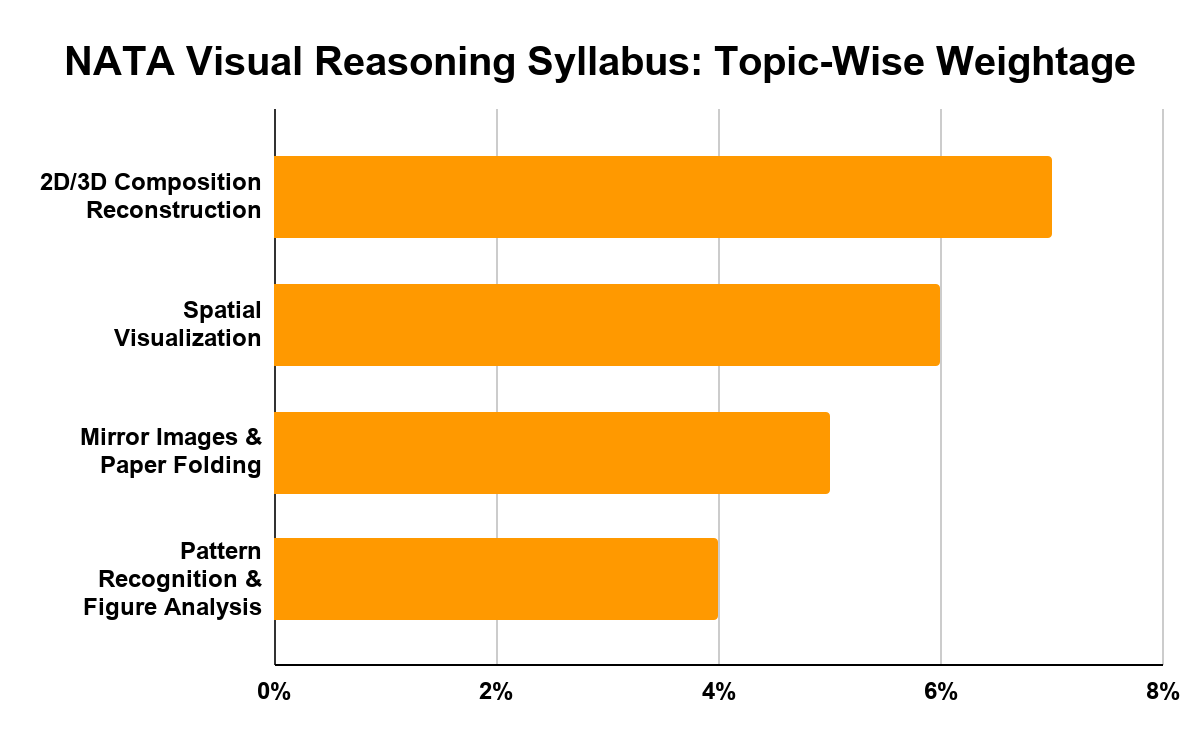
NATA Visual Reasoning Syllabus covers the reconstruction of 2D and 3D compositions along with technical spatial concepts.
- NATA Visual Reasoning includes around 8 to 12 questions in recent papers on mental rotation, mirror images and unfolding figures.
- The NATA 2027 Visual Reasoning section tests quick conversion of 2D figures into 3D forms, along with surface counting and paper folding.
| Chapter / Skill Area | Key Focus Areas | Approximate Weightage | Approximate Questions |
|---|---|---|---|
| 2D/3D Composition Reconstruction | Understanding & reconstructing 2D and 3D forms; technical composition concepts | 5–7% | 3–4 |
| Spatial Visualization | 2D-to-3D conversion, mental rotation, views (top/front/side), unfolding figures | 4–6% | 2–3 |
| Mirror Images & Paper Folding | Mirror/water images, paper folding/punching, figure completion | 3–5% | 2–3 |
| Pattern Recognition & Figure Analysis | Series completion, embedded figures, surface counting, visual patterns | 2–4% | 1–2 |
Ques. Is 75 a good score in NATA?
Ans. 75 marks out of 200 is a moderate score in NATA. Since NATA 2026 has no fixed minimum raw score, admission chances depend on the percentile, college, category and counselling process.
NATA Logical Derivation Syllabus 2027: Topic-Wise Weightage
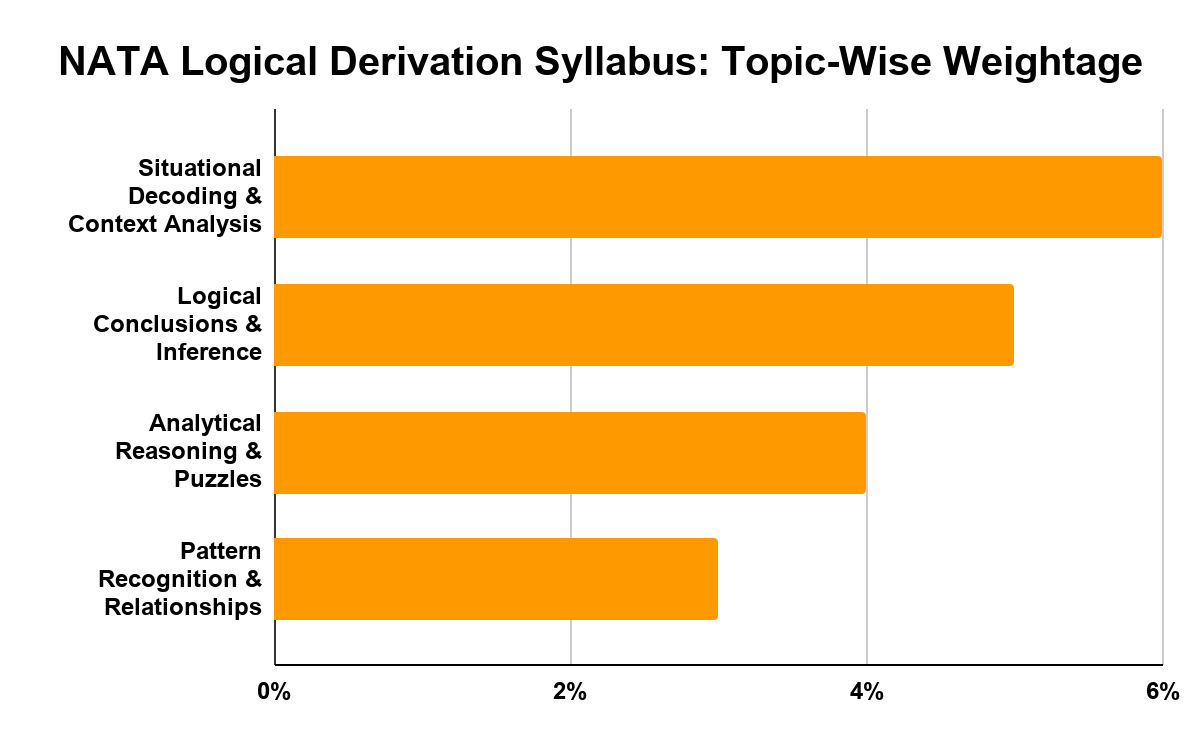
NATA Logical Derivation Syllabus covers situational analysis and inference with candidates required to identify details and draw conclusions.
- NATA Logical Derivation accounts for around 6 to 10 questions in recent papers which makes it a regular analytical area in Part B.
- The NATA 2027 Logical Derivation section tests pattern recognition and multi step reasoning through visual and verbal based problems.
| Chapter / Skill Area | Key Focus Areas | Approximate Weightage | Approximate Questions |
|---|---|---|---|
| Situational Decoding & Context Analysis | Decode given situations/compositions; extract hidden details; generate meaning | 4–6% | 2–3 |
| Logical Conclusions & Inference | Draw conclusions from visual/verbal data; identify subtle cues and patterns | 3–5% | 2–3 |
| Analytical Reasoning & Puzzles | Series, analogies, classification, data sufficiency, critical thinking puzzles | 2–4% | 1–2 |
| Pattern Recognition & Relationships | Verbal/non-verbal relationships, direction sense, logical sequences | 2–3% | 1–2 |
Ques. Is NATA harder than JEE?
Ans. NATA and JEE test different skills. NATA focuses on design aptitude, visualisation, drawing and reasoning, while JEE focuses mainly on Physics, Chemistry and Mathematics. The difficulty depends on the candidate's strengths.
NATA General Knowledge, Architecture & Design Syllabus 2027: Topic-Wise Weightage
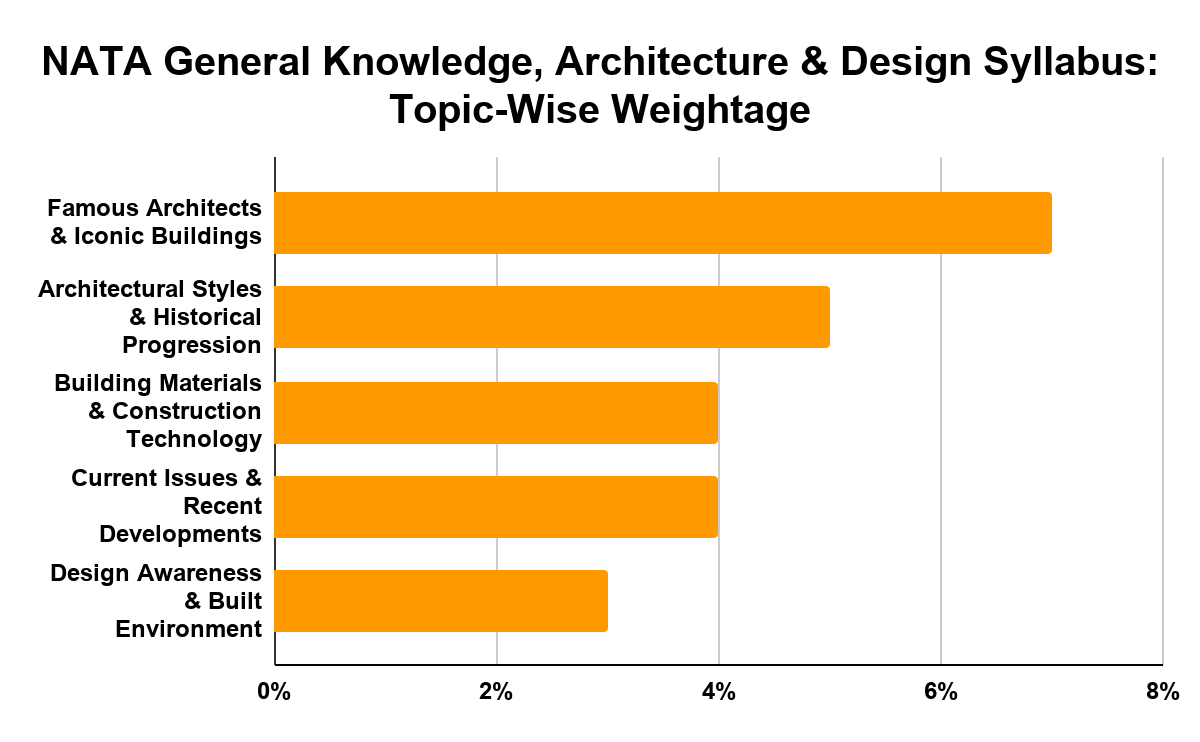
NATA General Knowledge, Architecture and Design Syllabus covers buildings, architectural history and new developments in building materials.
- NATA Part B includes questions on architects, landmarks and recent sustainable architecture projects with recent papers showing around 8 to 12 questions.
- NATA Architecture and Design questions often test factual knowledge of Indian and international landmarks along with green building trends.
| Chapter / Skill Area | Key Focus Areas | Approximate Weightage | Approximate Questions |
|---|---|---|---|
| Famous Architects & Iconic Buildings | Indian & international architects, landmark projects, styles linked to creators | 5–7% | 3–4 |
| Architectural Styles & Historical Progression | Gothic, Modernism, Indo-Islamic, vernacular, timelines of major movements | 3–5% | 2–3 |
| Building Materials & Construction Technology | Materials properties, innovations, construction techniques, terminology | 2–4% | 1–2 |
| Current Issues & Recent Developments | Sustainable design, green buildings, urban projects, recent architectural news | 2–4% | 1–2 |
| Design Awareness & Built Environment | Design principles in architecture, urban planning basics, cultural landmarks | 1–3% | 1–2 |
Ques. Can I crack NATA in 1 month?
Ans. Yes, candidates can prepare for NATA in one month with a structured study plan. Regular drawing practice, aptitude questions, mock tests and revision can help improve performance.
NATA Language Interpretation Syllabus 2027 Topic-Wise Weightage
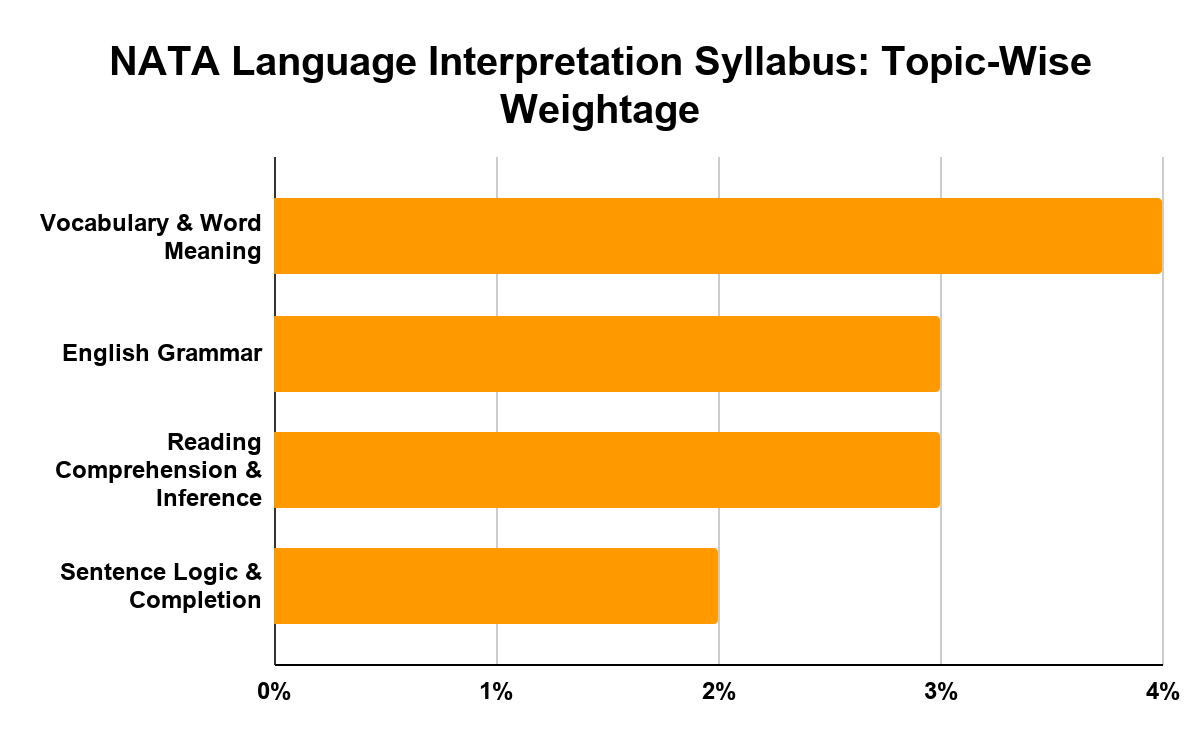
NATA Language Interpretation Syllabus covers word and sentence meaning, English grammar and logical interpretation in Part B.
- NATA Language Interpretation includes around 3 to 6 questions in recent papers on vocabulary, grammar and short comprehension.
- The NATA 2027 Language Interpretation section focuses on context based word meanings and error spotting which makes basic grammar useful for scoring.
| Chapter / Skill Area | Key Focus Areas | Approximate Weightage | Approximate Questions |
|---|---|---|---|
| Vocabulary & Word Meaning | Synonyms, antonyms, contextual meanings, idioms & phrases | 2–4% | 1–2 |
| English Grammar | Tenses, parts of speech, sentence correction, active/passive, error spotting | 1–3% | 1–2 |
| Reading Comprehension & Inference | Short passages, logical meaning generation, inference from sentences/context | 1–3% | 1–2 |
| Sentence Logic & Completion | Sentence completion, logical ordering, generating coherent meaning | 1–2% | 0–1 |
Ques. Is it easy to clear NATA?
Ans. NATA is generally considered moderate in difficulty, but clearing it requires preparation in both drawing and aptitude. Candidates should practise regularly because the exam tests visual perception, reasoning and design sensitivity along with other skills.
NATA Design Sensitivity and Thinking Syllabus 2027: Topic-Wise Weightage
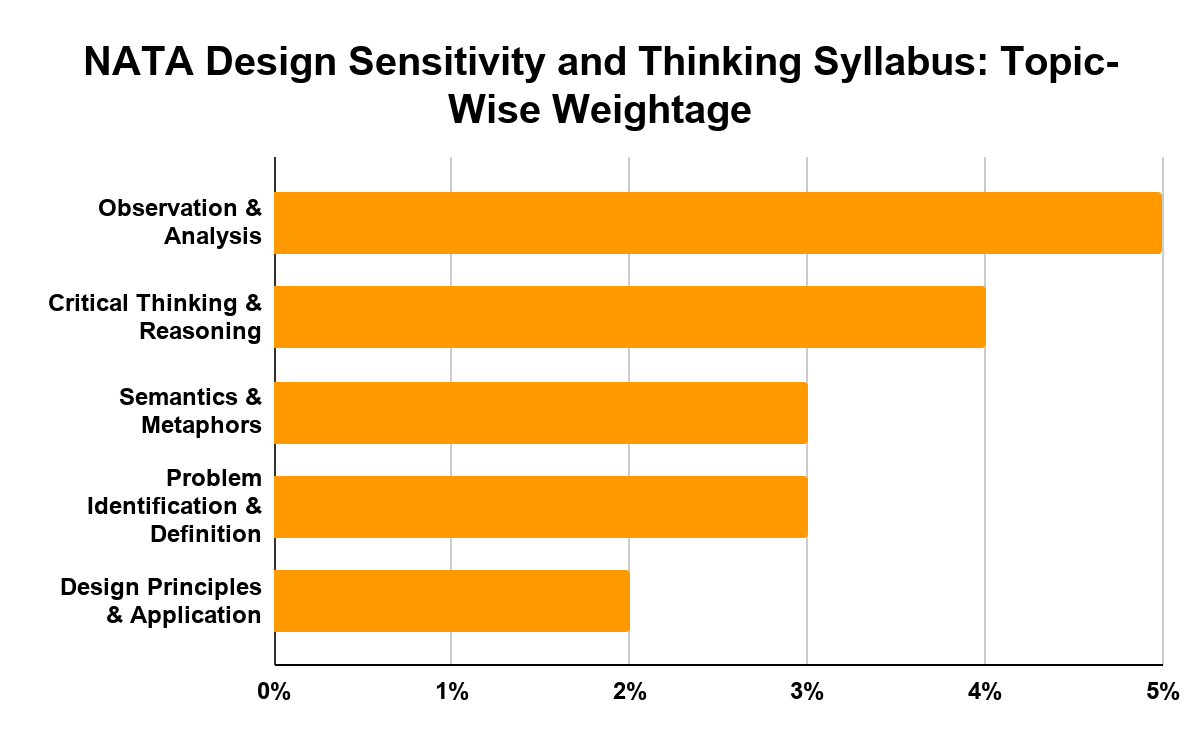
NATA Design Sensitivity and Thinking Syllabus forms part of the six aptitude areas in Part B with no fixed question quota given in the CoA brochure.
- Recent NATA Part B papers show around 4 to 8 questions on subtle cues, logos, metaphors and situational analysis.
- NATA Design Sensitivity and Thinking rewards quick observation of people, spaces and products with attention to small visual details.
- Daily practice with scene differences and product usability can help candidates build the observation skills needed for this section.
| Chapter / Skill Area | Key Focus Areas | Approximate Weightage of Part B | Approximate Questions |
|---|---|---|---|
| Observation & Analysis | Observe, record and analyse people, space, products, and environment | 3–5% | 2–3 |
| Critical Thinking & Reasoning | Critical thinking, reasoning, identifying subtle communications | 2–4% | 1–2 |
| Semantics & Metaphors | Understanding semantics, metaphors, and hidden meanings in design contexts | 1–3% | 1–2 |
| Problem Identification & Definition | Problem identification, definition, and structured analysis of a given situation | 1–3% | 1–2 |
| Design Principles & Application | Elements & principles of design, signs/symbols, graphic design, product usability | 1–2% | 1 |
Ques. Can I crack NATA without coaching?
Ans. Yes, candidates can prepare for NATA without coaching using the official syllabus, study material, previous-year questions and mock tests. Regular sketching and aptitude practice are especially important for self-study.
NATA Maths Syllabus 2027 Topic-Wise Weightage
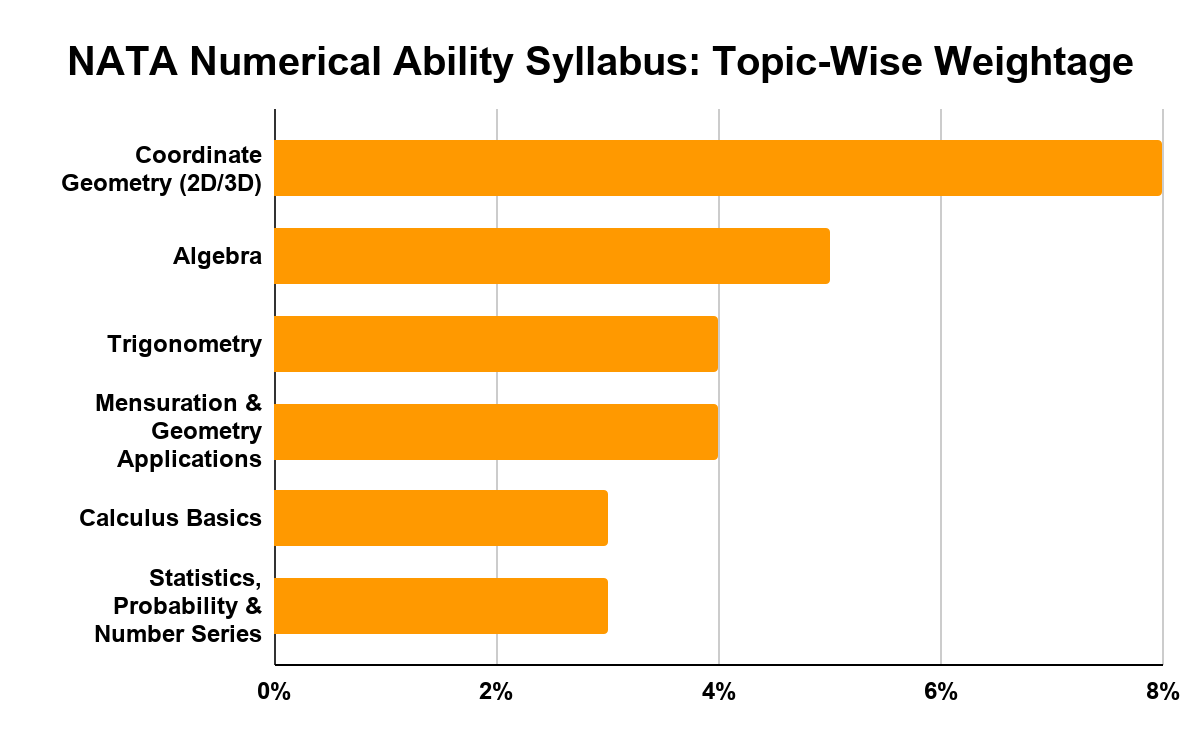
NATA Maths Syllabus is one of the six core areas in Part B, covering basic mathematics linked with creative thinking and geometry based space unfolding.
- NATA Numerical Ability gives strong importance to Coordinate Geometry and Algebra which together account for nearly half of the questions in recent papers.
- NATA Part B numerical answer questions require exact calculations without answer options which makes formula accuracy important for scoring.
| Chapter/Skill | Key Focus Areas | Approx. Weightage | Approx. Questions |
|---|---|---|---|
| Coordinate Geometry (2D/3D) | Straight Lines, circles, conics, distance/section formula, planes, spatial unfolding | 5–8% | 3–5 |
| Algebra | Sequences & series (AP/GP), quadratic equations, progressions, basic functions | 3–5% | 2–3 |
| Trigonometry | Ratios, identities, heights & distances, basic equations | 2–4% | 1–2 |
| Mensuration & Geometry Applications | Area, perimeter, surface area, volume of solids; space unfolding with geometry | 2–4% | 1–2 |
| Calculus Basics | Limits, continuity, differentiation, simple applications | 1–3% | 1–2 |
| Statistics, Probability & Number Series | Mean/variance, basic probability, number patterns & series | 1–3% | 1–2 |
Also Read:
- NATA Aptitude Section Chapter-Wise Weightage: Mathematics, Physics and Logical Reasoning
- NATA Phase 2 Drawing Test Tips: Score High in Part A
Ques. How to get 150 in NATA?
Ans. To target 150/200, candidates should aim for strong performance in both parts of the exam. Regular practice of drawing and composition, visual reasoning, numerical ability, logical reasoning and architectural awareness can help improve the score.
NATA Previous Year Papers:
NATA Syllabus 2027 Section-Wise Weightage
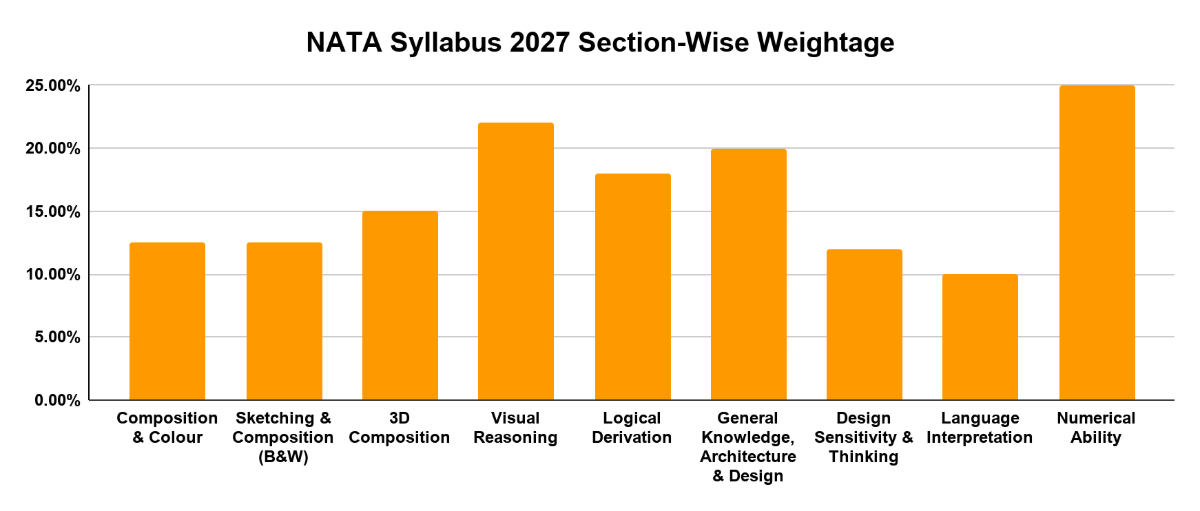
NATA Syllabus 2027 gives 80 marks to offline Drawing and Composition while the online Aptitude section carries 120 marks.
- The NATA Part A consists of 15% of the total marks for 3D Composition while two 2D tasks together account for the remaining 25%.
- 60% of the weightage is in Visual Reasoning and Numerical Ability which is the major share of the NATA Aptitude section which makes them important areas for preparation.
| Section / Part | Sub-Section / Topic Area | No. of Questions | Marks | Approx. Weightage |
|---|---|---|---|---|
| Part A – Drawing & Composition (Offline) | Composition & Colour | 1 | 25 | 12.5% |
| Sketching & Composition (B&W) | 1 | 25 | 12.5% | |
| 3D Composition | 1 | 30 | 15% | |
| Total Part A | - | 3 | 80 | 40% |
| Part B – Aptitude (MCQ + NCQ) (Online Adaptive) | Visual Reasoning | 50 | 120 | ~15–22% of Part B |
| Logical Derivation | ~12–18% of Part B | |||
| General Knowledge, Architecture & Design | ~15–20% of Part B | |||
| Design Sensitivity & Thinking | ~7–12% of Part B | |||
| Language Interpretation | ~5–10% of Part B | |||
| Numerical Ability | ~15–25% of Part B | |||
| Total Part B | 42 MCQ + 8 NCQ | 60% | ||
| Grand Total | - | 53 | 200 | 100% |
Also Read:
- NATA General Aptitude Chapter-Wise Weightage
- NATA Mathematics Chapter-Wise Weightage and Important Topics
Ques. Can I prepare for NATA at home?
Ans. Yes, candidates can prepare for NATA at home with consistent practice. Use the official syllabus, practise drawing daily, solve aptitude questions and take timed mock tests to improve speed and accuracy.
Ques. Has COA changed anything in the NATA syllabus 2027?
Ans. No revision to the NATA syllabus 2027 has been announced as of August 2026. Confirmation comes with the Information Bulletin and NATA syllabus PDF release.
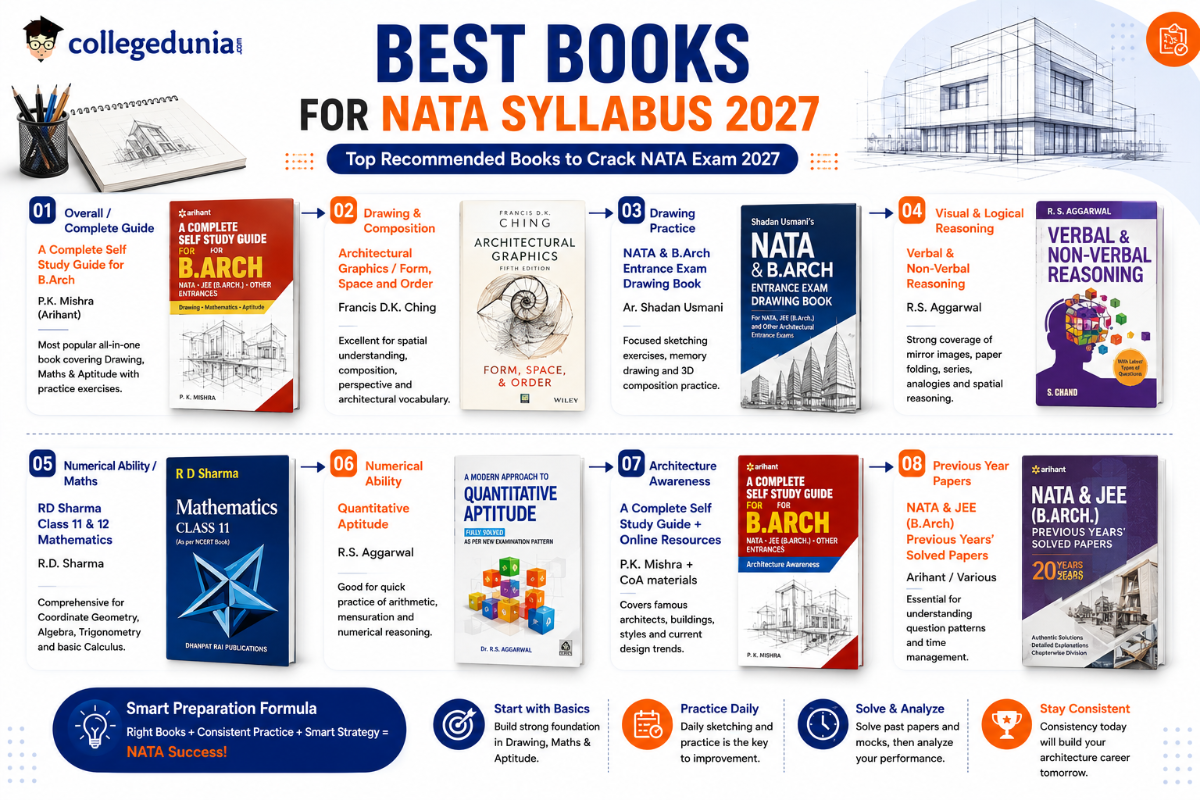
Best Books for NATA Syllabus 2027
NATA Syllabus 2027 preparation can be covered with P.K. Mishra’s Complete Self Study Guide which combines Drawing, Mathematics and Aptitude.
- Francis D.K. Ching’s Architectural Graphics helps develop spatial understanding useful for the Drawing section.
- R.S. Aggarwal and R.D. Sharma can be used for Reasoning and Mathematics practice along with previous year NATA papers.
| Section | Book Title | Author / Publisher | Why Recommended |
|---|---|---|---|
| Overall / Complete Guide | A Complete Self Study Guide for B.Arch | P.K. Mishra (Arihant) | Most popular all-in-one book covering Drawing, Maths & Aptitude with practice exercises |
| Drawing & Composition | Architectural Graphics / Form, Space and Order | Francis D.K. Ching | Excellent for spatial understanding, composition, perspective and architectural vocabulary |
| Drawing Practice | NATA & B.Arch Entrance Exam Drawing Book | Ar. Shadan Usmani | Focused sketching exercises, memory drawing and 3D composition practice |
| Visual & Logical Reasoning | Verbal & Non-Verbal Reasoning | R.S. Aggarwal | Strong coverage of mirror images, paper folding, series, analogies and spatial reasoning |
| Numerical Ability / Maths | RD Sharma Class 11 & 12 Mathematics | R.D. Sharma | Comprehensive for Coordinate Geometry, Algebra, Trigonometry and basic Calculus |
| Numerical Ability | Quantitative Aptitude | R.S. Aggarwal | Good for quick practice of arithmetic, mensuration and numerical reasoning |
| Architecture Awareness | A Complete Self Study Guide + Online Resources | P.K. Mishra + CoA materials | Covers famous architects, buildings, styles and current design trends |
| Previous Year Papers | NATA & JEE (B.Arch) Previous Years’ Solved Papers | Arihant / Various | Essential for understanding question patterns and time management |
Also Read:
- NATA 2023 Question Paper with Answer Key (Phase 2- Shift 1)
- NATA 2023 Question Paper with Answer Key (Phase 1- Shift 2)
Ques. Is it easy to get 120 in NATA?
Ans. 120/200 is an achievable target with consistent preparation, but it is not guaranteed. Candidates should balance Part A drawing practice with Part B aptitude preparation to reach this score.
NATA Preparation Strategy 2027
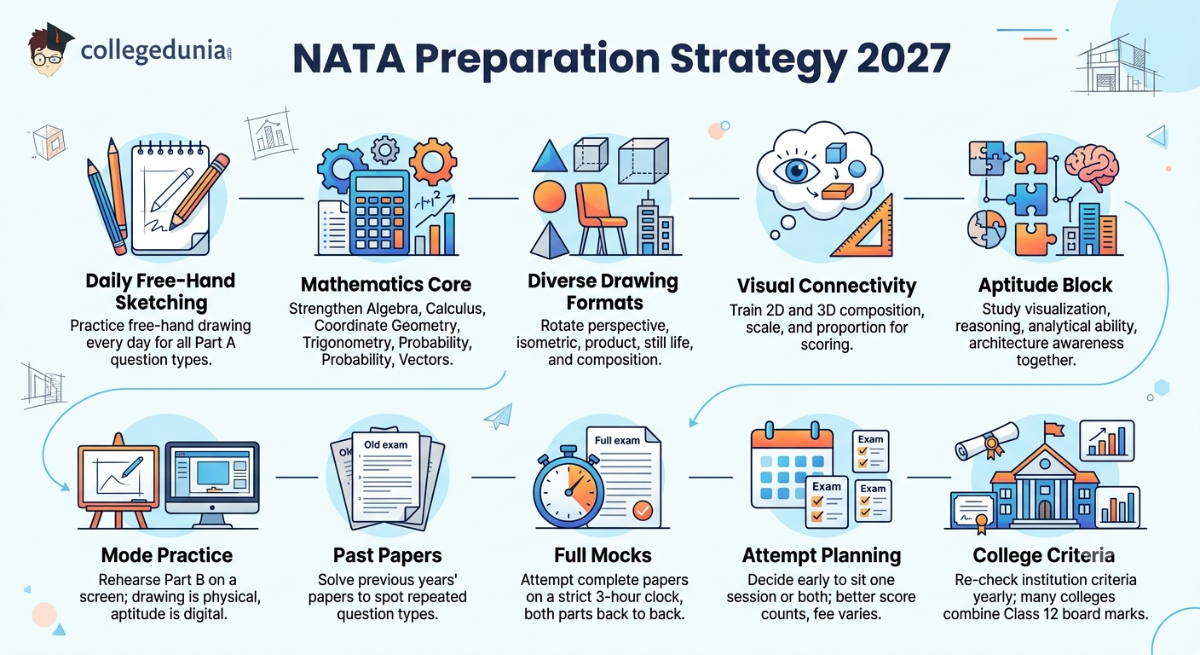
The NATA Preparation Strategy 2027 should begin with daily sketching and core Mathematics before moving to memory drawing, past papers and timed full-length mocks. Candidates should follow the sequence below to cover the NATA Syllabus 2027 in full:
- Free-Hand Sketching: Practise free-hand drawing every day as it carries every question type in Part A of the NATA drawing syllabus.
- Drawing Formats: Rotate through perspective drawing, isometric drawing, product drawing, still life and composition instead of repeating one format.
- Memory Drawing: Give recall-based drawing extra time, since prompts asking candidates to draw objects from memory recur across NATA papers.
- Visual Connectivity: Train 2D and 3D composition alongside scale and proportion as these three decide how Part A answers are scored.
- Mathematics Core: Strengthen Algebra, Calculus, Coordinate Geometry, Trigonometry, Probability and Vectors which together form the NATA maths syllabus.
- Aptitude Block: Study 3D object visualisation, logical reasoning, analytical ability and architecture awareness in one sitting rather than as separate subjects.
- Mode Practice: Rehearse Part B on a screen because the drawing sheet is submitted physically while the aptitude paper is attempted on computer only.
- Past Papers: Solve previous year NATA papers to spot repeated question types across both the drawing and aptitude sections.
- Full Mocks: Attempt complete papers on a strict 3 hour clock so Part A and Part B are practised back to back.
- Attempt Planning: Decide early whether to sit one session or both since the better score is counted and the fee changes with the number of tests.
- College Criteria: Re-check institution criteria each cycle as several colleges combine Class 12 board marks with the NATA rank.
Source: YouTube
Also Read:
- NATA 2021 Question Paper with Answer Key PDF (July 11)
- NATA 2021 Question Paper with Answer Key PDFs (April 10)
Ques. What is the highest NATA score?
Ans. The maximum NATA score is 200 marks. In the 2026 pattern, Part A carries 80 marks and Part B carries 120 marks.
NATA Mock Test Papers:
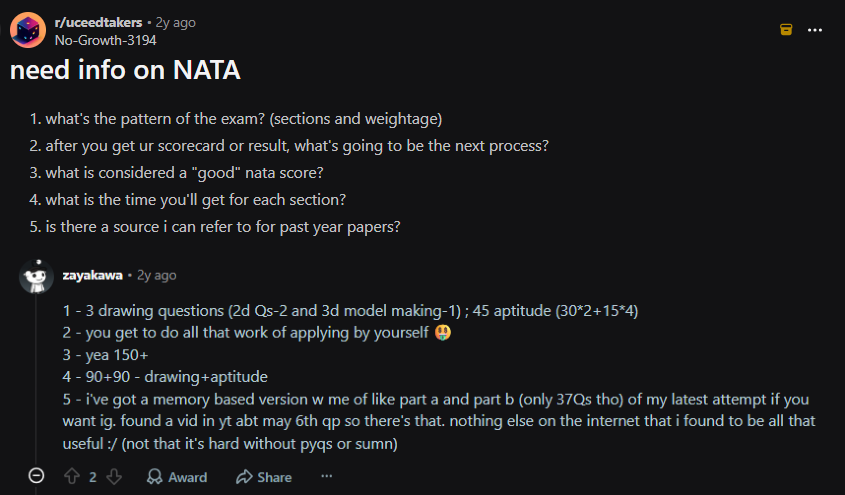
According to a Reddit discussion, candidates asked about the NATA exam pattern, section-wise timing, good scores, results and past-year papers. The discussion mentioned drawing and aptitude sections, with 150+ marks considered a good score, while finding memory-based previous papers useful for practice.
Source: Reddit
NATA Syllabus 2027: Frequently Asked Questions (FAQs)
Ques. Is NATA really hard?
Ans. NATA is moderate in difficulty, but its difficulty depends on the candidate's skills. Candidates comfortable with drawing, visualisation, reasoning and design aptitude may find it more manageable.
Ques. How many times can I attempt NATA?
Ans. Under the NATA 2026 rules, candidates can take up to two attempts in Phase 1 or one attempt in Phase 2, but cannot appear in both phases. The best Phase 1 score is considered for the percentile.
Ques. Can I do B.Arch without NATA?
Ans. Yes, NATA is not the only aptitude test accepted for B.Arch admission. The Council of Architecture permits admission based on NATA or JEE, subject to the eligibility and admission rules of the concerned authority or institution.
Ques. How to self-study for NATA?
Ans. Candidates should divide preparation between drawing and aptitude. Daily sketching, perspective practice, visual reasoning, architectural awareness, numerical ability, PYQs and mock tests can form an effective self-study routine.
Ques. Is NATA easier than JEE B.Arch?
Ans. Neither exam is universally easier because they test different abilities. NATA gives greater emphasis to drawing, visualisation and design aptitude, while JEE Paper 2A also includes Mathematics and aptitude along with drawing.
Ques. What's a good score in NATA?
Ans. A score of around 120–150 out of 200 can be considered a good target for NATA. However, the score required for admission varies by college, state counselling, category and competition.
Ques. How much time is required to prepare for NATA?
Ans. Candidates with a strong foundation may need around 1–2 months, while beginners can benefit from 3–6 months of preparation. Daily drawing and aptitude practice is important for building speed and accuracy.



Comments