




Council of Architecture conducts the National Aptitude Test in Architecture (NATA). The NATA Exam 2027 will consist of Part A and Part B for a total of 200 marks. As per the NATA Exam pattern 2027, the exam is conducted in a Hybrid Mode. Part A consists of a Drawing and Composition Test in offline mode. Part B comprises 50 MCQs and NCQs in a computer-adaptive test.
- NATA Part A carries 3 questions in total, divided into A1, A2 and A3, worth 80 marks.
- Part B contains 50 questions, which are divided into B1: 42 MCQ questions and B2: 8 NCQ questions worth 120 marks.
NATA has sectional time limits for both Parts of the exam. Candidates need to complete Part A within 90 minutes. For Part B, you will get 90 minutes (108 seconds per question) to solve MCQs and NCQs online.
Important topics for NATA 2027 are 2D perspective drawing, 3D spatial reasoning, basic mensuration and geometry, and general architectural awareness. As per the NATA marking scheme, there is no negative marking for incorrect answers.
Related Articles:
- NATA Syllabus 2027: Part A Drawing Test, Part B Aptitude, Subject-Wise Topics and PDF Download
- NATA Drawing Test Tips: How to Attempt and Score High
Key Summary of NATA 2027 Exam Pattern
- The mode of language for the Aptitude test (Part B) will be English and Hindi.
- NATA Drawing and Composition section tests creativity, spatial visualization, composition skills and sketching.
- Part B comprises visual reasoning, language interpretation, numerical ability, GK, design analysis and architectural awareness.
- All 200 questions are compulsory, without any sectional options.
- NATA Exam Syllabus important topics are 2D perspective drawing, 3D spatial reasoning, basic mensuration and geometry, and general architectural awareness.
NATA Exam Pattern 2027: Highlights
COA releases the exam structure and marking scheme at coa.org.in. The key highlights of the NATA 2027 Exam Pattern are tabulated below as per the latest structure:
| Particular | Key Details |
|---|---|
| Exam Mode | Hybrid (Part A: Offline + Part B: Computer Adaptive Test) |
| Duration | 180 minutes (Total)
|
| Question Type |
|
| Total Questions |
|
| Total Marks | 200 |
| Negative Marking | No |
Also Check:
- NATA Exam Dates: Phase Wise Schedule and Shift Timings
- List of top Drawing and Visual Composition Questions asked in NATA
Ques. What is the exam mode for NATA 2026?
Ans. NATA 2026 is a hybrid exam. Part A (Drawing & Composition) is an offline pen-and-paper test held at the exam centre, while Part B (Aptitude) is an online Computer-Based Adaptive Test. Both parts are conducted on the same exam day, each lasting 90 minutes.
NATA Exam Pattern 2027: Subject-wise Pattern
The NATA 2027 exam pattern subject-wise for Parts A and B is discussed below.
NATA Exam Subjects: Part A Drawing and Composition Test (Offline)
You need to complete all three questions of NATA exam subjects Part A in 90 minutes. This section tests your ability to draw, visualise, create interesting 3D compositions and rearrange various shapes in a visually appealing manner. Check out the paper pattern of NATA for 2027 in the table below:
| NATA Paper Pattern Part A | Question Type | Number of Questions | Marks Per Question | Test Duration |
|---|---|---|---|---|
| A1 | Composition and Colour | 1 | 25 Marks | 90 Minutes Combined |
| A2 | Sketching & Composition (Black and White) | 1 | 25 Marks | |
| A3 | 3D Composition | 1 | 30 Marks | |
| Total | - | 3 | 90 |
NATA Exam Subjects: Part B Aptitude Test (Computer Adaptive Test)
NATA exam subject Part B is an online computer-adaptive exam. You need to answer one question within 108 seconds. The question comprises topics from Basic mathematics, logical reasoning, logical derivation, GK, ability to analyse, people, space, product, environment and language interpretation. Check out the paper pattern of NATA for 2027 in the table below:
| NATA Paper Pattern Part B | Question Type | Number of Questions | Total Marks | Test Duration |
|---|---|---|---|---|
| B1 | MCQ | 42 | 120 | 90 Minutes (108 seconds for each question) |
| B2 | NCQ | 8 | ||
| Total | - | 50 | 120 |
NATA Exam Pattern 2027: Combined
The combined NATA 2027 exam pattern is tabulated below:
| NATA Paper Pattern Part | Mode | No. of Questions | Sectional Marks | Duration |
|---|---|---|---|---|
| Part A – Drawing & Composition | Offline | 3 | 80 | 90 minutes |
| Part B – Aptitude Test | Online (Computer Adaptive CBT) | 50 | 120 | 90 minutes (108 seconds for each question) |
| Grand Total | - | 53 | 200 | 180 minutes |
Has the NATA Subject-Wise Question Distribution Changed Over the Years?
Yes, NATA subject-wise question distribution pattern and number of questions have changed over the years.
- Before 2025, NATA exam pattern Part B had MCQ only. However, from 2025, the pattern changed to MCQ + NCQ adaptive test.
| Particular | 2026 | 2025 | 2024 |
|---|---|---|---|
| Total Marks | 200 | 200 | 200 |
| Total Duration | 180 Minutes | 180 Minutes | 180 minutes |
| Part A - Drawing Section | Drawing, composition, 3D modelling and visualization tasks | Drawing, composition, 3D modelling and visualization tasks | Drawing-focused evaluation with composition and visualization |
| Part A: Number of Questions | 3 | 3 | 3 |
| Part A Weightage | 80 | 80 | 80 |
| Part B - Aptitude Section | MCQ + NCQ adaptive test | MCQ + NCQ adaptive test | MCQ-only |
| Part B Weightage | 120 Marks (B1: 42 QuestionsB2: 8 Questions) | 120 Marks (B1: 42 QuestionsB2: 8 Questions) | 120 Marks (B1: 30 Questions of 2 MarksB2: 15 Questions of 4 Marks) |
| Exam Mode | Hybrid (Offline Drawing + CBT Aptitude) | Hybrid Mode | Hybrid Mode |
Related Articles:
- NATA 2026 Drawing Section Chapter-Wise Weightage: Topic Types and Mark Distribution
- NATA Mathematics Chapter-Wise Weightage and Important Topics
- List of top Questions asked in NATA
On discussion forums, such as Reddit, a user asked what technique or practice should be used for drawing questions in NATA. A user suggested starting with the basics with line practice and shapes. Don't directly jump into perspectives. Start with drawing perspective only when you are confident and have an understanding of basic drawing concepts.
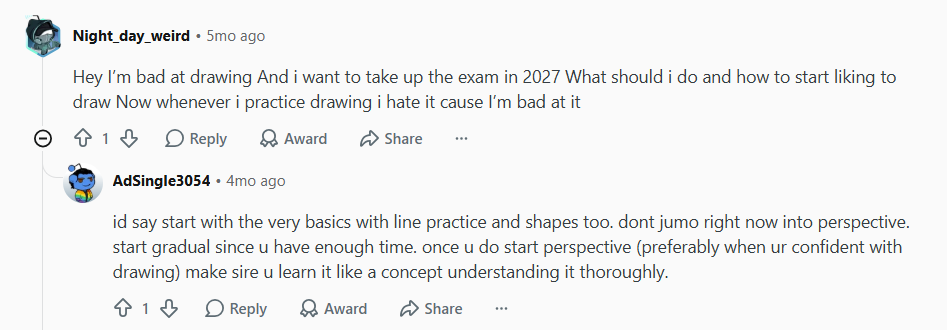
Source: Reddit
Ques. How is Part A (Drawing) scored in NATA 2027?
Ans. NATA Part A drawings assess composition, spatial balance, aesthetic sensitivity, proportion, use of colour (A1), tonal rendering (A2), and 3D accuracy (A3). Scores from multiple evaluators are moderated before the final Part A mark is finalised.
NATA Exam Pattern: Marking Scheme 2027
NATA marking scheme states that Part A is assessed by expert examiners using defined scoring criteria. On the other hand, Part B is a Computer Adaptive Test format, and the difficulty of questions adjusts dynamically based on your previous answers.
| NATA Paper Pattern Question Type | Marks Awarded for Correct Answer | Negative Marking |
|---|---|---|
| A1- Composition & Colour (Drawing) | 25 | None |
| A2- Sketching & Composition B&W (Drawing) | 25 | None |
| A3- 3D Composition (Drawing) | 30 | None |
Note: Correctly answering all 50 questions in Part B will fetch 120 marks. As per the official update, the marks per question in MCQs and NCQs are not yet published.
Does NATA have Negative Marking?
No, NATA does not have negative marking. Candidates are advised to solve questions without leaving any unanswered to score maximum marks in the NATA exam.
Also Check:
NATA Exam Pattern 2027: Total Marks
NATA total marks are 200, combining both Part A and Part B. The NATA Total marks for each section are tabulated below to help you understand the important parts for your examination.
| NATA Paper Pattern Part Tpe | Part-wise Total Marks | NATA Total Marks |
|---|---|---|
| Part A (Offline) | 80 | 200 |
| Part B (CBT) | 120 |
Expert Tips:
As per the NATA total marks, prioritise Part B, which has the highest weightage of 120 marks. Score high by mastering visual reasoning, basic math, and architectural awareness under strict time constraints. Part A tests your creativity and sketching skills, so practice regularly.
Related Link:
- NATA Question Paper: Check NATA Previous Year Question Paper with Solution PDF
- NATA Aptitude Section Chapter-Wise Weightage: Mathematics, Physics and Logical Reasoning
Ques. What are the question types in NATA 2027 Part B?
Ans. NATA Part B has two primary question types: Multiple Choice Questions (MCQ) worth 2 marks and No-Choice Questions (NCQ). The test is delivered as a Computer Adaptive Test, meaning question difficulty adjusts dynamically based on your previous answers.
NATA Exam Pattern 2027: Time Duration
As per the NATA paper pattern, there is a sectional time limit to attempt questions. Practice 3D composition, sketching, architectural awareness, and basic mathematics to complete the paper on time.
| Part | Sectional Time | NATA Time Duration |
|---|---|---|
| Part A (Offline) | 90 minutes | 180 minutes |
| Part B (CBT) | 90 minutes (108 seconds for each question) |
Related Article:
- NATA Important Topics: Section-Wise Weightage and High-Scoring Chapters
- NATA Sample Paper PDF: Direct Link, Solutions, and Its Importance
Ques. Is 75 a good score in NATA?
Ans. No, 75 out of 200 is generally not considered a good score for NATA. While it may clear the basic passing threshold, it is too low to secure admission into reputed government or top-tier private architecture colleges for a Bachelor of Architecture (B.Arch) programme.
NATA Exam Syllabus 2027: Important Topics Based on Past Years' Trends
NATA Exam Syllabus Part A Important topics are 3D composition, spatial visualisation, colour theory, memory and perspective drawing, as these are high-frequency topics.
NATA Exam Syllabus Part B: Questions come from rearranging 2D and 3D composition, understanding the minute information in drawings, and important monuments and buildings in India and the world. Passages, Ability to observe, record and analyse people, space, products, environment, and basic maths (percentage, profit and loss, simple and compound interest) are some important topics.
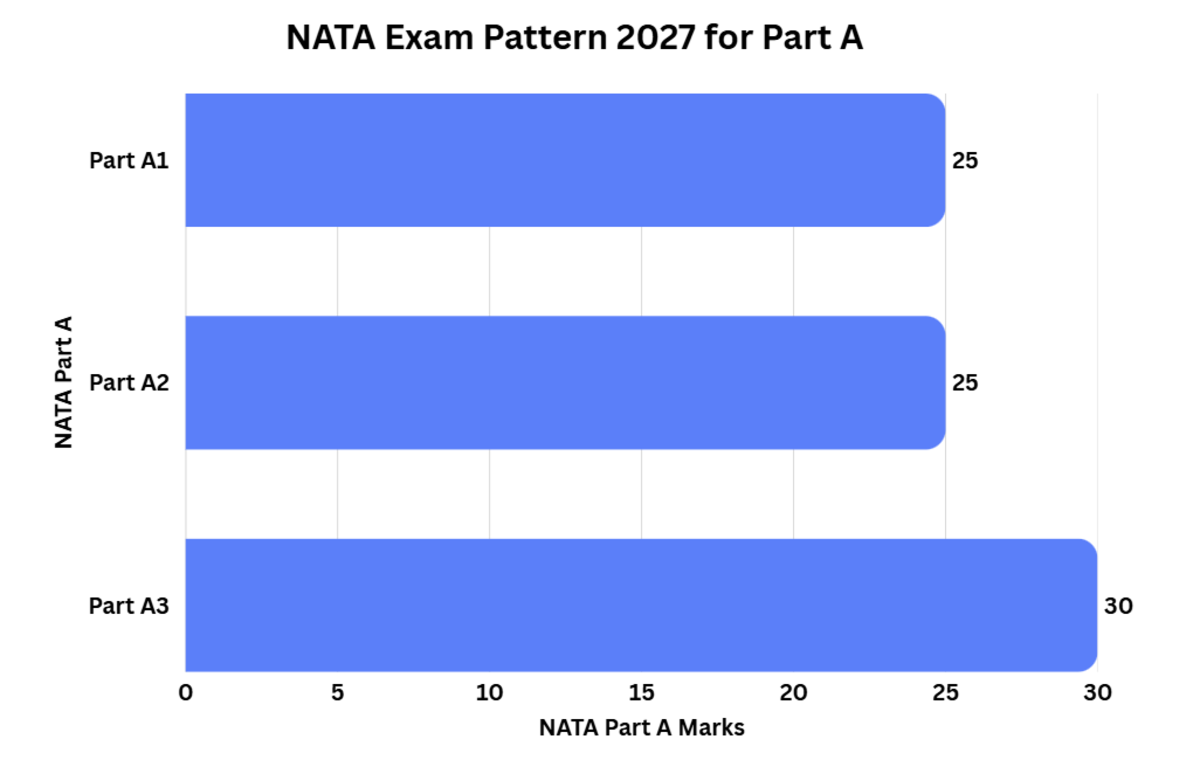
NATA Exam Pattern 2027: Important Topics for Part A (80 Marks)
The paper pattern of NATA for Part A, including important topics, is tabulated below:
| Part | Question | Important Topic | Marks |
|---|---|---|---|
| Part A1 | Composition and Colour | Colour theory, 2D spatial arrangement, aesthetic balance, use of colour media | 25 |
| Part A2 | Sketching & Composition | Freehand sketching, form and proportion, shading and tonal gradation, line quality | 25 |
| Part A3 | 3D Composition | Spatial visualization, 3D form construction, shadow and depth, volume and mass | 30 |
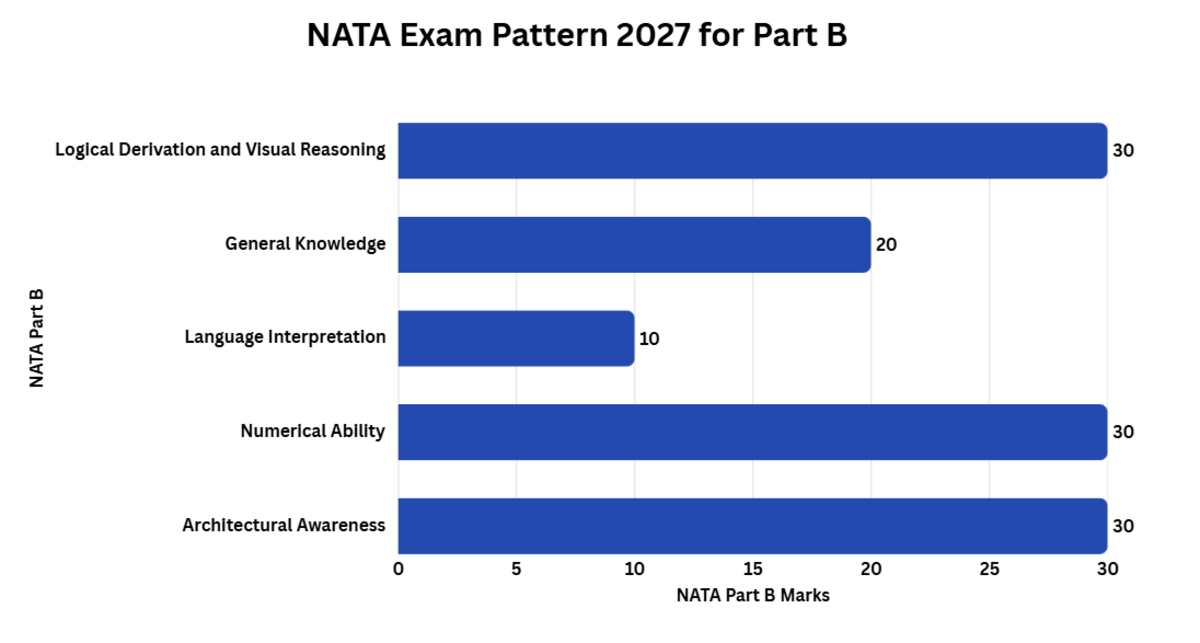
NATA Exam Pattern 2027: Important Topics for Part B (120 Marks)
The paper pattern of NATA for Part B, including important topics, is tabulated below:
| Part B | Topic | Approx Marks |
|---|---|---|
| Logical Derivation and Visual Reasoning | 2D/3D visualisation, mental rotation, paper folding/unfolding, mirror images | 25- 30 |
| General Knowledge, Architecture & Design and Design Sensitivity | Current affairs (art/design/environment), observation/analysis of spaces/products, critical thinking | 15- 20 |
| Language Interpretation | Comprehension, grammar, vocabulary, logical meaning of sentences | 8- 10 |
| Numerical Ability | Coordinate Geometry (2D/3D), Algebra, Arithmetic and Basic Calculus | 25- 30 |
| Architectural Awareness | Famous architects, buildings, architectural history, materials, construction and design | 25- 30 |
You can watch the YouTube video by ”Creative Edge” to learn the complete NATA Exam pattern 2027 and important basics based on past years' analysis.
Also Check:
- NATA Drawing Sample Paper PDF: Direct Link, Solutions, and Its Importance
- NATA Aptitude Sample Paper PDF: Direct Link, Solutions, and Its Importance
- NATA Mock Test: Free online Mock Test, Sectional Tests, Previous Year Tests, Mock Test PDFs
Ques. Is there negative marking in NATA 2027?
Ans. No, NATA has no negative marking for any section or question type. A wrong answer in Part B scores zero, not negative marks. You should attempt every question in Part B, including NCQs where you are uncertain, to avoid missing free mark opportunities.
How to Prepare Based on NATA Exam Pattern 2027
The tips below help you prepare for NATA 2027 well:
- Make A3 (3D Composition, 30 marks) your highest priority in Part A: It is the highest-scoring component in the entire exam. Practice drawing 3D objects and shadow projection for at least 30 minutes every day.
- Time yourself for 25- 30 minutes per Part A drawing task: Practice full mock tests with a timer to build consistent pacing.
- Attempt every question in Part B with zero penalty for wrong answers.
- Focus NCQ preparation on mathematical and spatial problem-solving: Practice numerical accuracy under timed conditions.
- Build speed for the A1 Composition and Colour task: Practice regularly with pencil colours and poster colours to develop both technique and speed
- Study architectural awareness regularly for Part B: Landmark buildings, famous architects (Indian and global), and architectural movements appear consistently in Part B aptitude questions. Fifteen minutes of reading daily builds this knowledge progressively.
- Practice on an adaptive mock test platform for Part B: Practice mock tests that simulate adaptive difficulty so you can build clarity when harder questions appear.
Also Check:
NATA Exam Pattern 2027 FAQs
Ques. Is NATA easier than JEE Main?
Ans. Yes, NATA is generally considered easier than JEE Main (specifically Paper 2 for B.Arch) because it features a focus on creative and drawing skills, with no negative marking, rather than rigorous engineering-level mathematics and physics.
Ques. Can I crack NATA in one month?
Ans. Yes, you can crack NATA in one month if you study for 6 to 8 hours daily, focus heavily on high-weightage sections like general aptitude and visual reasoning, and practice sketching basic shapes and perspectives every day.
Ques. Is it easy to get 120 in NATA?
Ans. Scoring 120 out of 200 in the NATA exam is not easy. It requires steady preparation, good drawing skills, and strong time management. A score of 120 puts you well above average and is good for mid-tier government architecture colleges.
Ques. How many attempts are there for NATA?
Ans. As per the latest update, candidates can take the NATA a maximum of three times in a single academic year. The highest score from all your attempts is considered for college admissions.
Ques. How many marks are good in NATA?
Ans. Out of 200 total marks in the NATA, a score above 120 marks is considered good, while anything over 150 marks is excellent and helps secure seats in top-tier architecture colleges.
Ques. How many questions are there in NATA 2027?
Ans. NATA 2027 has 53 questions in total: 3 drawing and composition tasks in Part A (80 marks) and 50 aptitude questions in Part B. The total is 200 marks across 180 minutes.



Comments
Found 1 Comment
There are 5 subjects in NATA viz General Aptitude, Mathematics, Physics, Chemistry and Drawing. You can check the best books for the respective subjects from NATA 2022.