



Content Writer-SME
Two types of breeding methods are used to determine the functioning of genes and analyze how certain traits and characteristics are inherited from parents to offspring. These two methods are Monohybrid and Dihybrid. The pattern of the number of genes studied is one of the main differences between monohybrid and dihybrid crosses.
Both of these terms first came into existence through Mendel's experiments on the pea plant (Pisum sativum). To understand how genes control the phenotype and genotype of an organism, we first need to understand monohybrid and dihybrid crosses as well as Mendel's inheritance.
Difference between Monohybrid and Dihybrid Cross
[Click Here for Sample Questions]
The primary difference between monohybrid and dihybrid crosses can be underlined by the number of traits examined in an organism. Here are some of the major differences listed below along with their examples:
| Parameters | Monohybrid Cross | Dihybrid Cross |
|---|---|---|
| Definition | Monohybrid cross is the cross between the two individuals having homozygous genotypes which result in the opposite phenotype. | Dihybrid cross is the cross between the two organisms which are identical hybrids for two traits. |
| Significance | Monohybrid cross is used to study the dominance of genes. | Dihybrid cross is used to study the cross of offspring assortment. |
| Phenotypic Ratio | The phenotypic monohybrid ratio in the F2 generation is 3:1. | Its phenotypic dihybrid ratio in F2 generation is 9:3:3:1. |
| Genotypic Ratio | It has a genotypic ratio of 1:2:1 in the F2 generation. | It has a genotypic ratio of 1:2:1:2:4:2:1:2:1 in F2 generation. |
| Alleles | A monohybrid cross involves a pair of alleles. | A dihybrid cross involves four alleles. |
| Test Cross Ratio | 1:1 | 1:1:1:1 |
| Example | Example- cross between tall (T) and dwarf (t) pea plant. | Example: A cross between round yellow seeds (RRYY) and wrinkled green seeds (rryy). |
Explanation of Monohybrid and Dihybrid
[Click Here for Sample Questions]
The cross in which one pair of contrasting characters are used is called a monohybrid cross. The cross happens between F1 generation offspring of parents. The cross in which two pairs of contrasting characters are used is called a dihybrid cross. The cross happens between F1 generation offspring.
The difference between monohybrid and dihybrid crosses can be understood with the help of the experiment conducted by Mendel whose details are given below:
Monohybrid Cross (Inheritance of One Gene)
“The cross in which the hybrid of two individuals having homozygous genotypes produces the opposite phenotype for a certain genetic trait is called Monohybrid Cross.”
Monohybrid cross results in the inheritance of one gene. In order to study the inheritance of one gene, Mendel crossed tall and dwarf pea plants. He then collected the seeds obtained from the cross and grew them to get the plant of the first hybrid generation. This is called First Filial progeny or the F1.
He concluded from the experiment that all F1 progeny possessed the character of one of its parents and were tall. He discovered that F1 always had the character of one of their parents and the trait of another parent was not found in them.
After self-pollinating the tall plants of the F1 generation, Mendel found out that in the F2 generation some of the offspring were ‘dwarf’. 1/4th dwarf plants were from F2 generation and 3/4th was tall. All offspring were either tall or dwarf, there was no blending of the breed. The proportion at the F2 stage was 3:1.

The pair of contrasting traits on genes are known as alleles. For example, if we take the character of height, T denotes the tall trait and t represents the dwarf trait. So, T and t are alleles of each other.
Alleles can be identical in the case of homozygotes TT and tt or different like Tt as in the case of heterozygotes. The genes controlling one character (height) is heterozygous Tt then it is a monohybrid and the cross between TT and tt is called a monohybrid cross.
Dihybrid Cross (Inheritance of Two Genes)
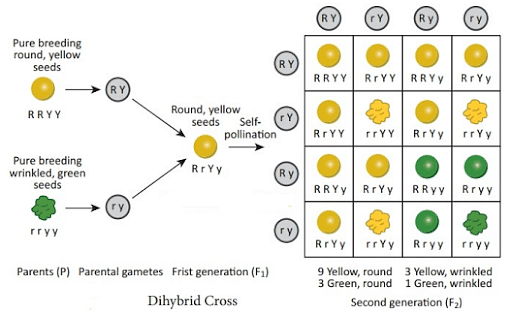
“Two different genes having different traits are called dihybrid and the cross between them is called dihybrid cross.” The dihybrid cross occurs between two organisms that are identical hybrids but have two different traits. Mendel crossed pea plants with two different characters.
One pea plant had a seed with yellow colour (Y) and round shape (R) and the other was green colour (y) with a wrinkled shape (r). In a dihybrid cross, parents have different pairs of alleles for each trait. One parent possesses a homozygous dominant allele YYRR and the other carries homozygous recessive allele yyrr.
The fertilization of RY and ry produce the RrYy F1 hybrid.When F1 plants were self-hybridized, Mendel discovered that the F2 plant had 3/4th yellow seeds and 1/4th green seed. The ratio of which was observed 3:1.
Round and wrinkled also had a 3:1 ratio same as the monohybrid cross. The phenotypic ratio for round, yellow; wrinkled, yellow; round, green and wrinkled, green appeared in the ratio 9:3:3:1.
Similarities between Monohybrid and Dihybrid
[Click Here for Sample Questions]
Just like the differences, it is also important to understand the similarities between monohybrid and dihybrid crosses to understand the basic understanding of genetics and evolution. Here are few major similarities between the two crosses listed below:
- The inheritance patterns of genes or traits of parents and their offspring are studied in both monohybrid and dihybrid crosses.
- Genetic variation and the effect of parents' traits on their offspring are studied in both monohybrid and dihybrid crosses.
- Both are a type of breeding experiment which helps in determining the phenotype and genotype of an organism.
- Monohybrid and dihybrid crosses are the results of Mendel's experiments on pea plants.
- In both crosses, the genotype is determined by the alleles of each parent.
Mendel’s Experiment
[Click Here for Sample Questions]
Gregor Johann Mendel did a hybridization experiment on garden peas and came up with the law of inheritance theory. He selected characters from peas that had two opposing traits: tall or dwarf, yellow or green and smooth and wrinkled using monohybrid and dihybrid methods.
- This helped him in setting up the basic rule of inheritance. Mendel used true-breeding pea lines to conduct artificial pollination.
- A true breeding line has gone through continuous self-pollination.
- He investigated the pair of peas with one contrasting trait and then studied the following seven characteristics with different traits.
- Homozygous carries two identical alleles (RR or rr) and heterozygous have different alleles (Rr).
- Two homozygous individuals were crossed which resulted in heterozygous offspring which is defined as a monohybrid cross.
Things to Remember
- The law of inheritance was given by Gregor Johann Mendel.
- The cross in which one pair of contrasting characters is used is called a monohybrid cross.
- The cross in which two pairs of contrasting characters are used is called a dihybrid cross.
- Monohybrid cross results in the inheritance of one gene.
- Dihybrid cross used to study the cross of offspring assortment.
- In the Monohybrid cross, the phenotypic ratio is 3:1.
- In the Dihybrid cross, the phenotypic ratio is 9:3:3:1.
- Monohybrid cross has a genotypic ratio of 1:2:1 in the F2 generation.
- Dihybrid cross has a genotypic ratio of 1:2:1:2:4:2:1:2:1 in F2 generation.
Read Also: Heredity and Evolution
Sample Questions
Ques: What is a test cross? (2 Marks)
Ans: The breeding of an individual with a recessive character is called test cross. Gregor Mendel introduced this concept. It determines the zygosity of the former by analysing the proportion of offspring phenotypes.
Ques: What are pure gametes? (2 Marks)
Ans: The haploid gametes are known as pure gametes. These gametes do not have homologous chromosomes and are always pure. They carry one chromosome of each type, either dominant or recessive.
Ques: Why did Mendel choose the pea plant for the experiment? (3 Marks)
Ans: Mendel selected the pea plant because of the following reason:
- Peas have many different contrasting characters such as yellow/green, round/wrinkled seeds etc.
- Peas have bisexual flowers and the can themselves perform self-pollination which results in producing offspring with similar traits generation after generation.
- The life span of pea plants is short and produces many seeds in one generation.
Ques: Explain Huntington’s disease concerning monohybrid cross. (3 Marks)
Ans: Huntington’s disease is a deadly genetic disorder. The gene responsible for Huntington’s disease is present in all individuals. The homozygous dominant allele of Huntington’s gene of an individual was paired with the homozygous recessive Huntington’s gene of another individual. It was found out that all the individuals carried the dominant allele of Huntington’s disease. The finding shows that the offspring will have the disease.
Ques: How can you explain the law of dominance? Give a suitable example using a monohybrid cross. (3 Marks)
Ans: Mendel’s law of dominance states that a dominant allele is visible in a monohybrid cross and it suppresses the expression of the recessive allele. But, the character of a recessive allele is not lost but remains invisible in the progenies of the F1 generation and appears in the next generation.
For example: when round pea plants (RR) were crossed with wrinkled pea plants (rr), all seeds in F1 generation appeared to be round (Rr). But, when these round seeds of F1 generation were self-fertilized then both the round and wrinkled seeds appeared in the F2 generation. The ratio for which is 3:1.
This proves the dominant character appeared in the first generation and recessive got suppressed which then appeared in F2 generation.
For Latest Updates on Upcoming Board Exams, Click Here:https://t.me/class_10_12_board_updates
Do Check Out:



Comments