



Education Journalist | Study Abroad Lead
Canada is starting to see a downturn in temporary resident growth, driven largely by falling international student inflows and permit-holder counts. Immigration, Refugees and Citizenship Canada (IRCC) data shows 53% fewer new student and worker arrivals between January–October 2025 compared with the same period in 2024 (down 323,250).
Separately, Statistics Canada’s preliminary demographic estimates show Canada’s population fell in Q3 2025 primarily because the number of non-permanent residents (NPRs) declined by 176,479—with the decrease “mostly attributable to study permit holders.”
The shift comes as the Canadian government continues tightening temporary resident policy under a broader objective to reduce the temporary resident share of the population to below 5% by end-2027.
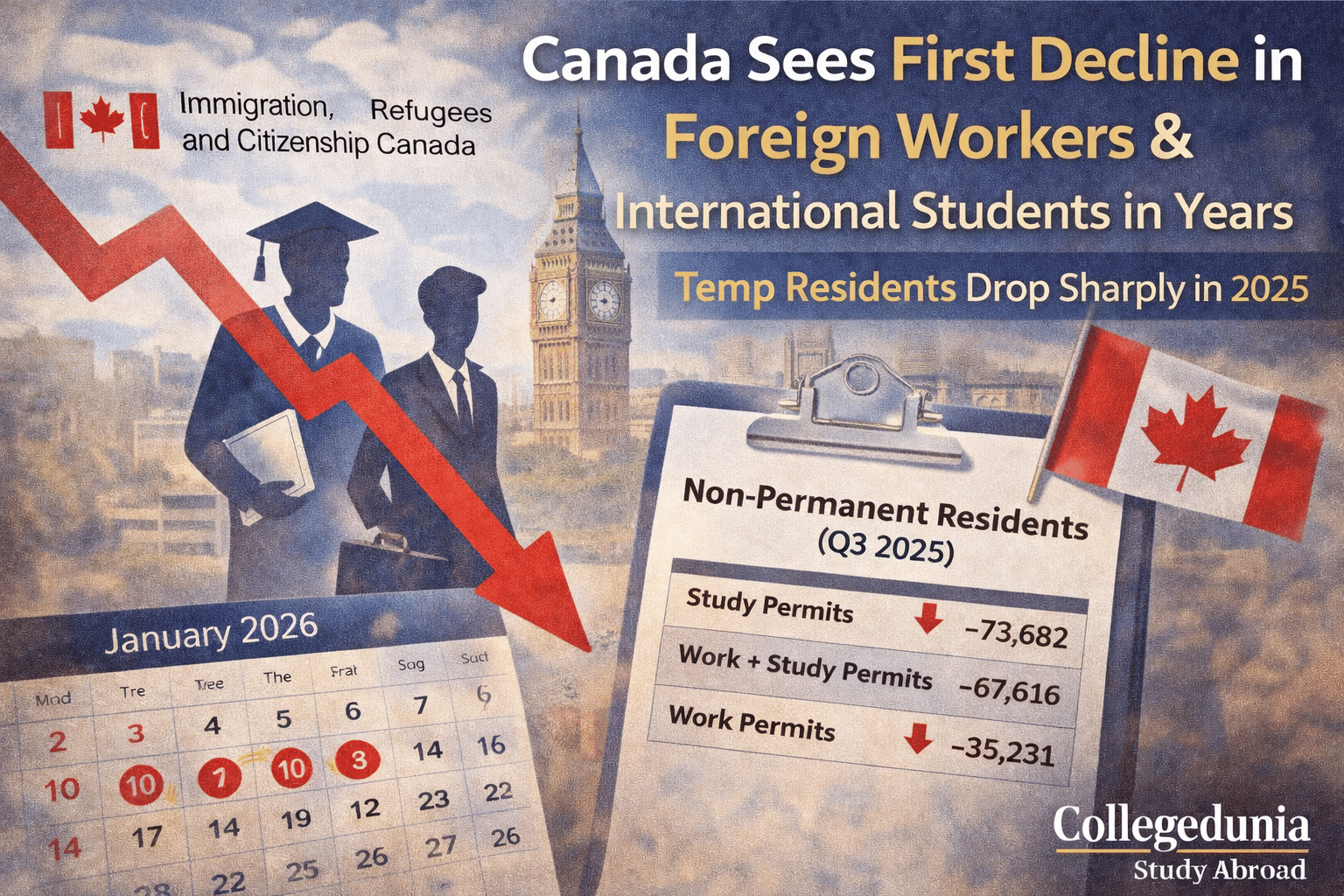
1) New student and worker arrivals are down sharply
IRCC’s “students and workers” dashboard reports 53% fewer arrivals from Jan–Oct 2025 versus the same period in 2024, and includes month-wise counts for newly issued study permits and work permits.
For example, IRCC’s table shows new student arrivals fell to 3,030 in October 2025 (counted as study permits issued that month).
2) Non-permanent residents declined in Q3 2025, led by study permit holders
Statistics Canada estimates Canada’s population fell by 76,068 from July 1 to Oct 1, 2025, and states the main driver was a drop in non-permanent residents.
Key StatCan figures for Q3 2025 include:
- NPRs fell from 3,024,216 (July 1, 2025) to 2,847,737 (Oct 1, 2025).
The decline was “mostly attributable to”:
- Study permit holders only: -73,682
- Work + study permit holders: -67,616
- Work permit holders only: -35,231
StatCan also notes the largest provincial NPR declines were in Ontario (-107,280) and British Columbia (-26,242) during Q3 2025.
Why this matters for Indian students?
For Indian applicants, these trends reinforce that Canada is in a controlled-reduction phase for temporary resident inflows—particularly in student-linked streams. Practically, it means:
- More competition and potentially tighter acceptance/visa scrutiny in high-demand provinces and DLIs.
- Greater importance of selecting compliant programs/institutions and meeting financial/verification requirements, as IRCC continues strengthening integrity measures.
Policy context: Canada’s 2026–2028 targets
IRCC’s supplementary release for the 2026–2028 Immigration Levels Plan states the government’s commitment to reduce the temporary resident share of the population to under 5% by end-2027, and sets targets for new temporary resident arrivals (workers + students) at:
- 385,000 in 2026
- 370,000 in 2027
- 370,000 in 2028
Next steps for students planning 2026–27 intakes
- Track province and institution-level capacity signals (PAL/TAL rules, DLI compliance, and program eligibility requirements) because policy is explicitly oriented toward lower temporary inflows.
- Use official data pages to monitor monthly arrival trends—especially ahead of peak intake windows.

1791978705.png?tr=w-305,h-145,c-force?h=40&w=40&mode=stretch)



Comments