



Education Journalist | Study Abroad Lead
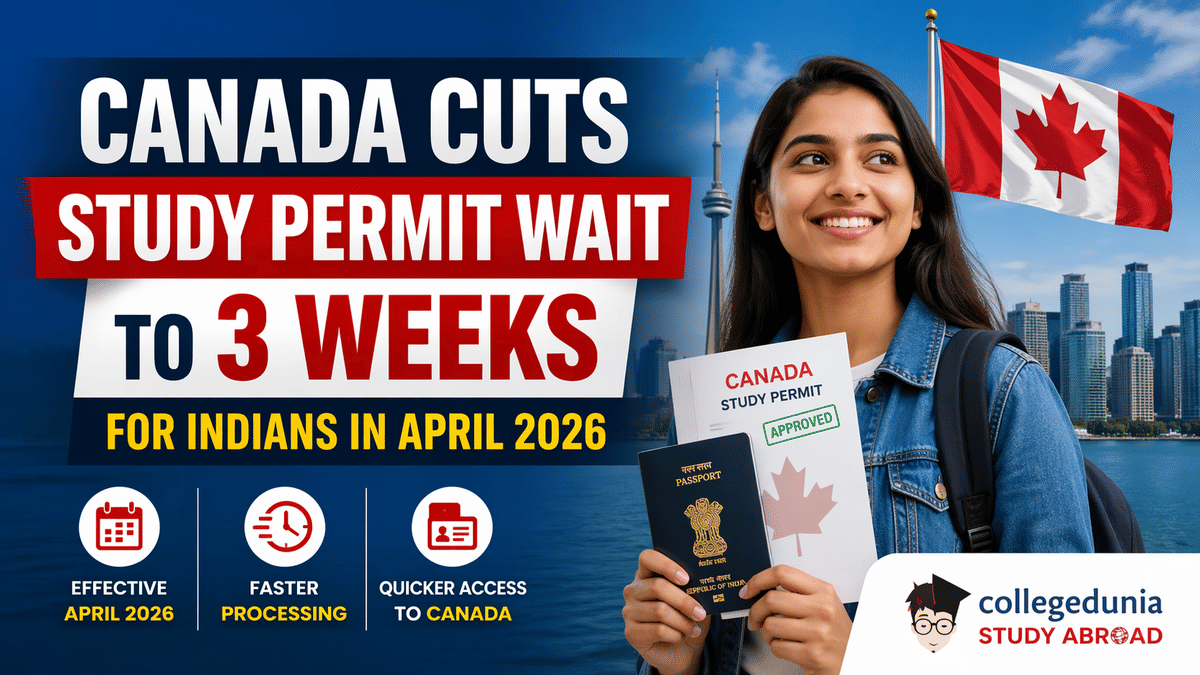
Indian students planning to apply for a Canada study permit this spring now have a shorter wait — IRCC's April 15, 2026 processing time update shows study permits from India dropping from 4 weeks to 3 weeks, the fastest turnaround recorded for Indian applicants in over a year. Visitor visas have seen an even sharper fall: from 37 days to 23 days — a two-week reduction in a single month.
The update, published by Immigration, Refugees and Citizenship Canada (IRCC), covers the period between March 24 and April 15. It affects Indian students, families, and prospective applicants across four visa categories — though the picture is not uniformly positive. Work permit processing for Indian applicants has edged up by one week, from 7 to 8 weeks.
Check: Canada Student Visa Process
What Changed in IRCC's April 15 Update for Indian Applicants
The table below shows the before-and-after shift for Indian applicants across all four temporary residence categories tracked by IRCC.
| Visa Category | March 24, 2026 | April 15, 2026 | Change |
|---|---|---|---|
| Study permit (from India) | 4 weeks | 3 weeks | ↓ 1 week |
| Visitor visa (from India) | 37 days | 23 days | ↓ 14 days |
| Super visa (from India) | 202 days | 182 days | ↓ 20 days |
| Work permit (from India) | 7 weeks | 8 weeks | ↑ 1 week |
Times represent 80% completion benchmark for applications submitted from outside Canada.
For context, India's study permit processing time stood at 8–12 weeks through much of 2025. The current 3-week figure is a significant improvement — though IRCC updates these numbers weekly and they can shift in either direction.
What This Means for Fall 2026 Applicants
The timing matters. Indian students targeting a September 2026 intake at a Canadian university are now in the optimal application window. With a 3-week study permit processing time, the total end-to-end timeline — from gathering documents to receiving a decision — now looks like this:
| Stage | Estimated Time |
|---|---|
| Obtain PAL/TAL from DLI | 1–3 weeks |
| Gather documents, GIC, SOP | 1–2 weeks |
| Medical examination (if required) | 2–4 weeks |
| IRCC processing (India, April 2026) | 3 weeks |
| Total estimated timeline | 7–12 weeks |
Students who apply in May 2026 can realistically expect a decision by late June or early July — well ahead of the September start date. That said, IRCC's published processing time is a benchmark, not a guarantee. Complex applications, background checks, or missing documents can significantly extend individual timelines.
Also read: Canada Student Visa Processing Time 2026: Full Timeline for Indian Students
The Work Permit Caveat Indian Students Must Not Miss
While study permit and visitor visa times have improved, work permit processing for Indian applicants has moved in the opposite direction — up from 7 weeks to 8 weeks as of April 15. This is relevant for two groups:
- Indian graduates on PGWP who are applying for an employer-specific work permit after their Post-Graduation Work Permit expires
- Indian professionals applying for a Canadian work permit from India while their study plans are still in progress
The 8-week figure remains well below Pakistan's current 16-week work permit processing time, but it is a reversal from the recent downward trend. IRCC's service standard for work permits submitted from outside Canada is 60 days — the current 8-week (56-day) figure is just inside that benchmark.
Super Visa: 20-Day Drop Opens a Window for Indian Families
The super visa — which allows parents and grandparents of Canadian permanent residents and citizens to visit for up to 5 years — has seen its processing time fall from 202 days to 182 days for Indian applicants. That is still nearly six months, and well above IRCC's 112-day service standard.
For Indian families planning to visit students in Canada, the super visa application process remains a lengthy one. However, the downward trend — processing times have been falling consistently since late 2025 — suggests further improvement is possible through mid-2026.
Note: Super visa applications cannot be submitted from within Canada. All Indian applicants must apply from India.
What Indian Students Should Do Right Now
1. Apply for your study permit immediately if you have a Fall 2026 offer. The 3-week processing window is the best India has seen in over a year. Do not wait for it to improve further — IRCC times fluctuate weekly and can reverse quickly.
2. Confirm your PAL/TAL before applying. Master's and PhD students at public DLIs are exempt from the Provincial Attestation Letter requirement as of January 2026. Undergraduate and diploma applicants still need one — contact your institution's admissions office to confirm your PAL/TAL status before submitting.
3. Ensure your financial documents meet the CAD 22,895 threshold. IRCC requires Indian applicants to show proof of at least CAD 22,895 (approximately ₹15.73 lakh at the current rate of 1 CAD = ₹68.70, as of April 22, 2026, per XE.com) in living funds per year, in addition to tuition and travel costs. A GIC from a recognised Canadian bank remains the strongest proof of funds.
4. Complete your medical examination early. The medical exam is not included in IRCC's 3-week processing time. If your stay will exceed 6 months — which it will for most degree programmes — book your medical exam with an IRCC-approved panel physician in India as soon as possible. Delays here add weeks to your overall timeline.
5. Check IRCC's processing times page weekly. The IRCC official processing times dashboard is updated every week. The 3-week figure is current as of April 15 — verify it before you apply.
A Narrow Opening in a Still-Difficult Landscape
Faster processing times are welcome news — but they do not change the underlying difficulty of Canada's study permit environment for Indian applicants. Canada's study permit cap remains at 408,000 for 2026, down from 485,000 in 2024. India's visa refusal rate reached 81% in late 2025 and has remained elevated. IRCC's TRIS fraud-screening system continues to route every Indian application through additional scrutiny.
Shorter processing times mean Indian students get a decision faster — but a faster decision on a weak application is still a refusal. The improvement in processing speed is an operational shift, not a policy relaxation. Students who apply now with complete, well-documented applications stand to benefit most from the current window. Those who delay risk the window closing before their September intake.

1791978705.png?tr=w-305,h-145,c-force?h=40&w=40&mode=stretch)



Comments