



.png?h=35&w=35&mode=stretch)
The CEED 2026 Question Paper is available for free download here. The CEED 2026 paper was conducted by Indian Institute of Technology (IIT), Bomabay on January 18, from 9:00 AM to 12:00 PM. This paper consisted of 49 questions divide into two sections – Part A and Part B, that need to be completed within 3 hours. Part A consisted of Numerical Answer Type (NAT) questions, Multiple Select Questions (MSQs) and Multiple Choice Questions (MCQs), and Part B consisted of design-based questions.
CEED 2026 Question Paper with Solutions PDF
| CEED 2026 Question Paper with Solution PDF | Download PDF | Check Solutions |
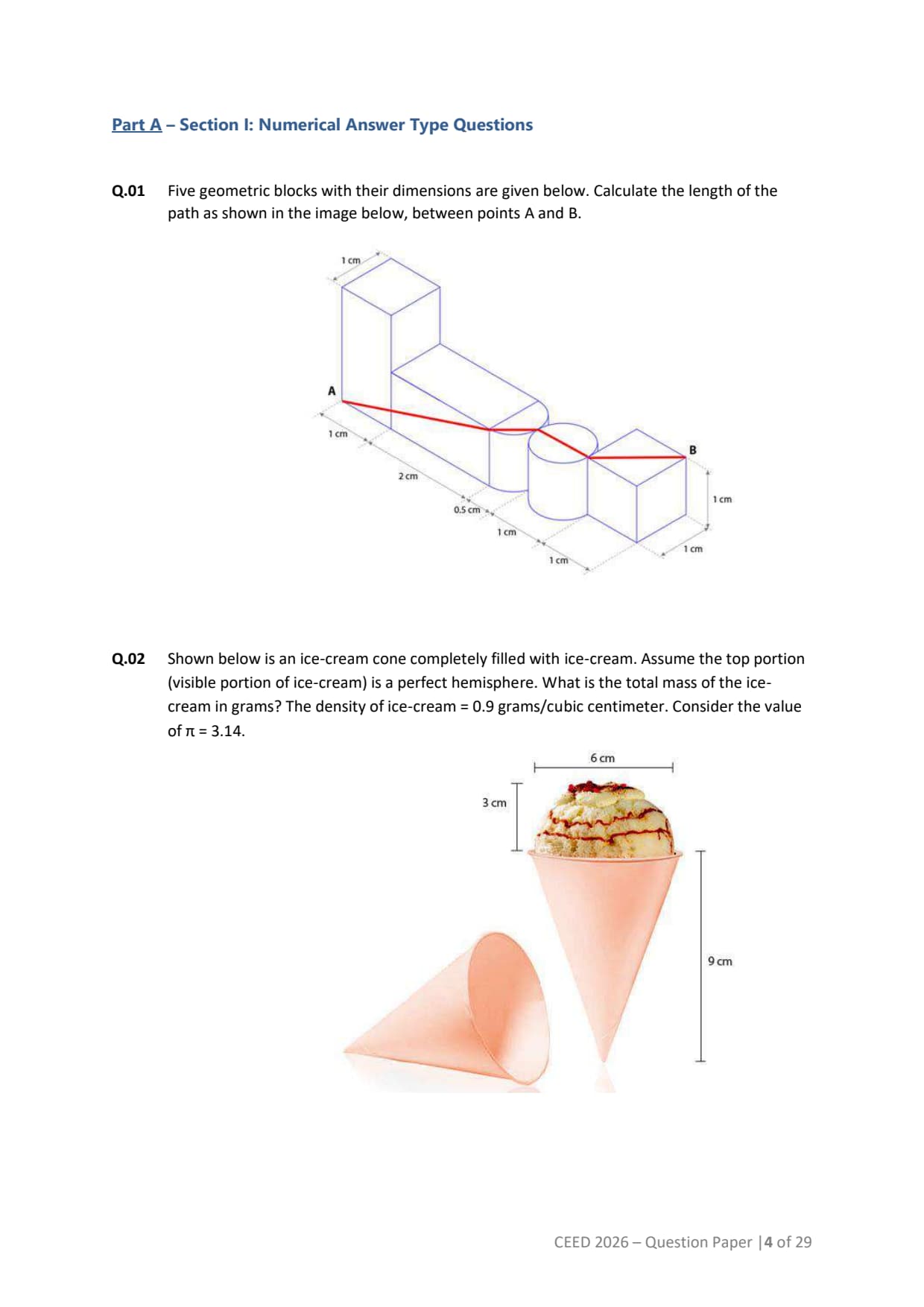
Five geometric blocks with their dimensions are given below. Calculate the length of the path as shown in the image below, between points A and B.

Shown below is an ice-cream cone completely filled with ice-cream. Assume the top portion (visible portion of ice-cream) is a perfect hemisphere. What is the total mass of the ice cream in grams? The density of ice-cream = 0.9 grams/cubic centimeter. Consider the value of \(\pi\) = 3.14.

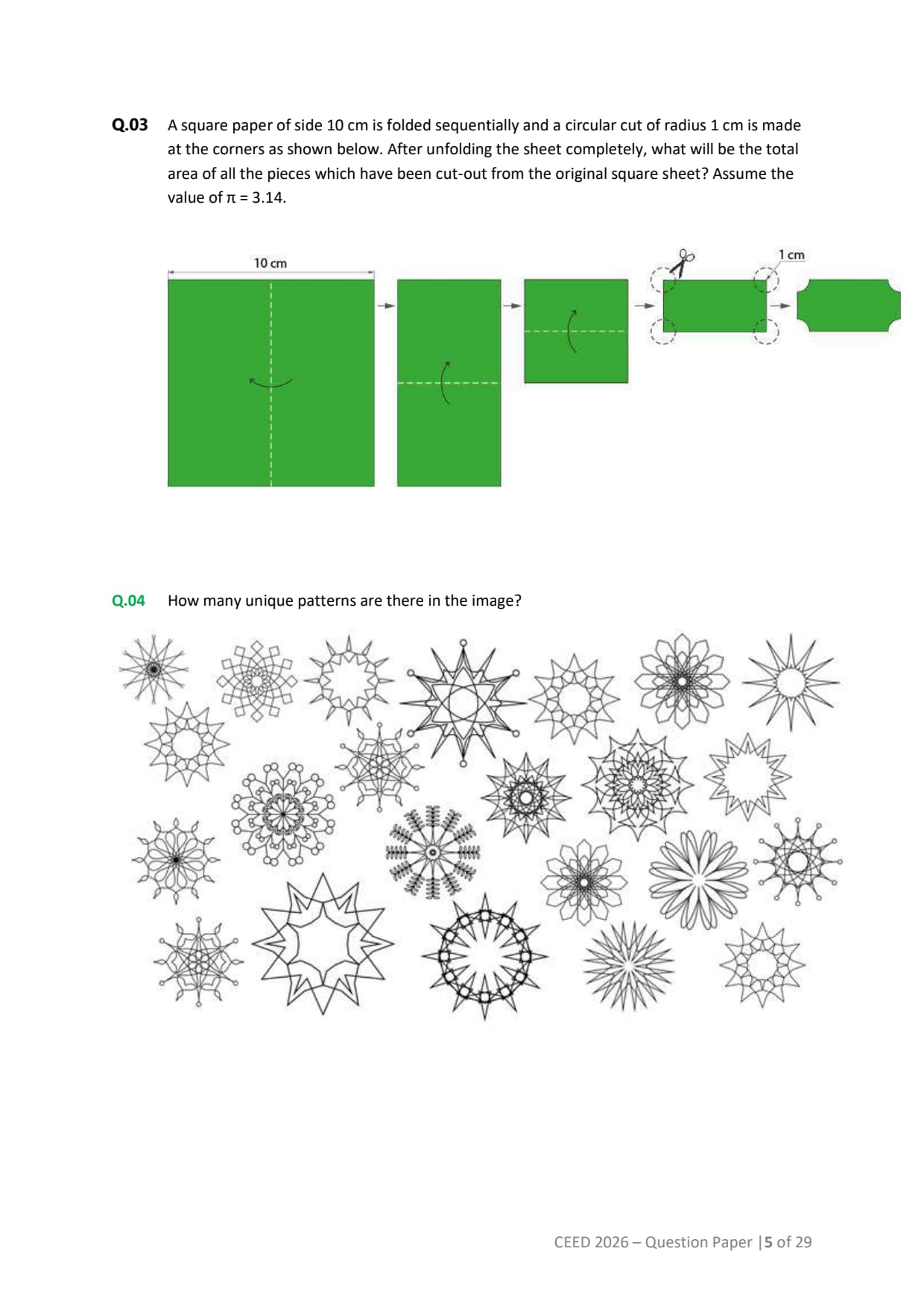
A square paper of side 10 cm is folded sequentially and a circular cut of radius 1 cm is made at the corners as shown below. After unfolding the sheet completely, what will be the total area of all the pieces which have been cut-out from the original square sheet? Assume the value of \(\pi\) = 3.14.

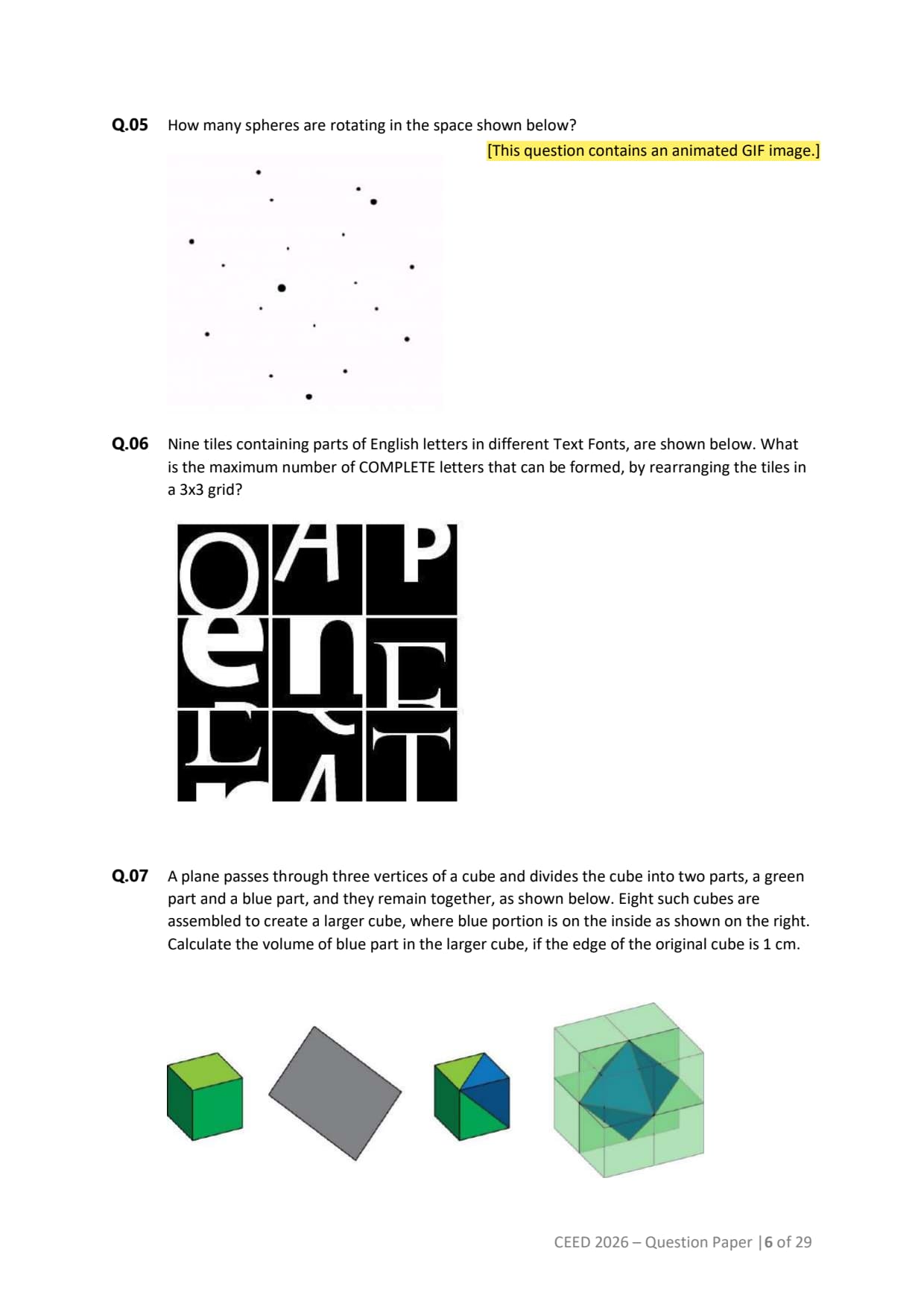
How many unique patterns are there in the image?

How many spheres are rotating in the space shown below?

Nine tiles containing parts of English letters in different Text Fonts, are shown below. What is the maximum number of COMPLETE letters that can be formed, by rearranging the tiles in a 3x3 grid?

A plane passes through three vertices of a cube and divides the cube into two parts, a green part and a blue part, and they remain together, as shown below. Eight such cubes are assembled to create a larger cube, where blue portion is on the inside as shown on the right. Calculate the volume of blue part in the larger cube, if the edge of the original cube is 1 cm.

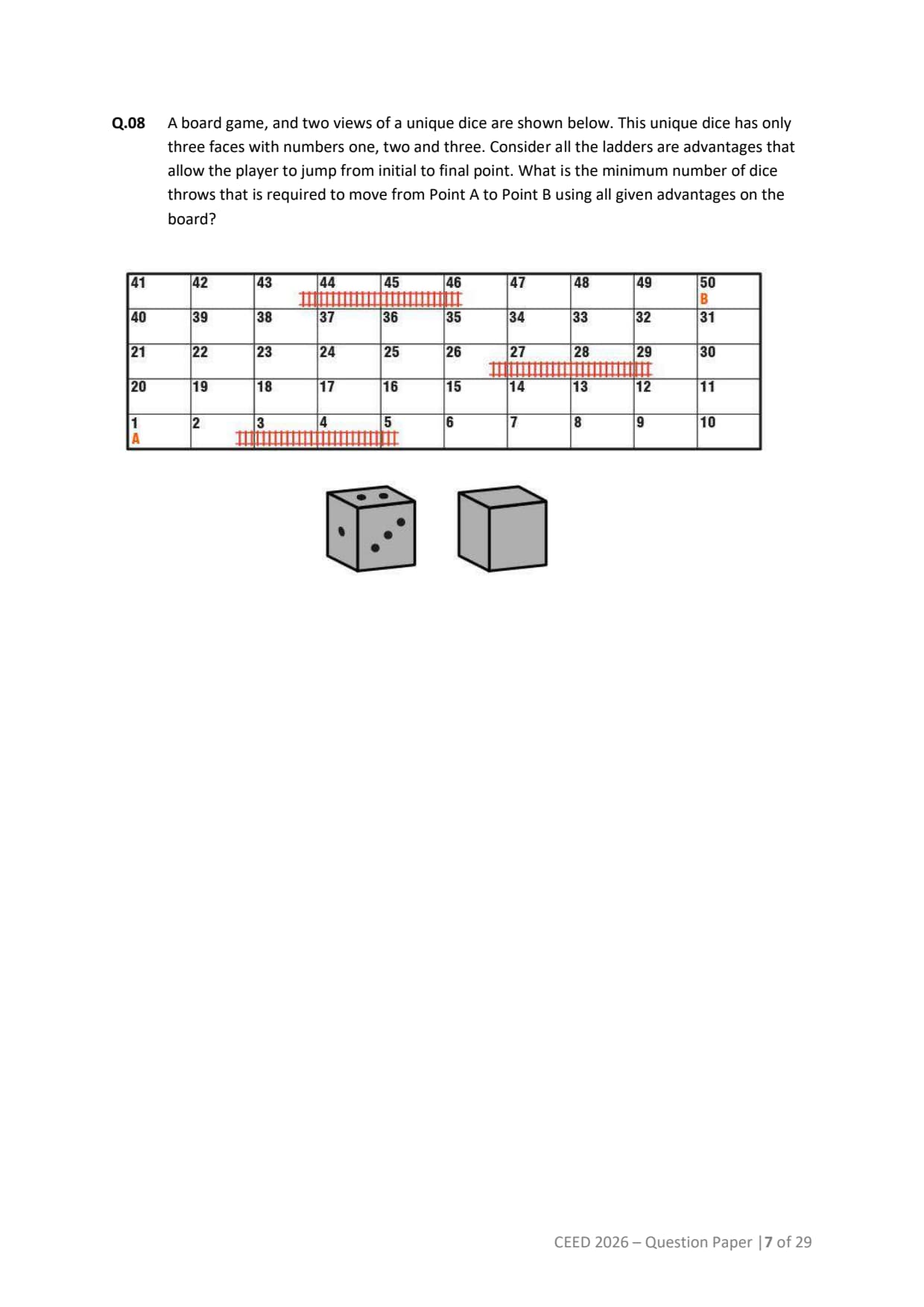
A board game, and two views of a unique dice are shown below. This unique dice has only three faces with numbers one, two and three. Consider all the ladders are advantages that allow the player to jump from initial to final point. What is the minimum number of dice throws that is required to move from Point A to Point B using all given advantages on the board?

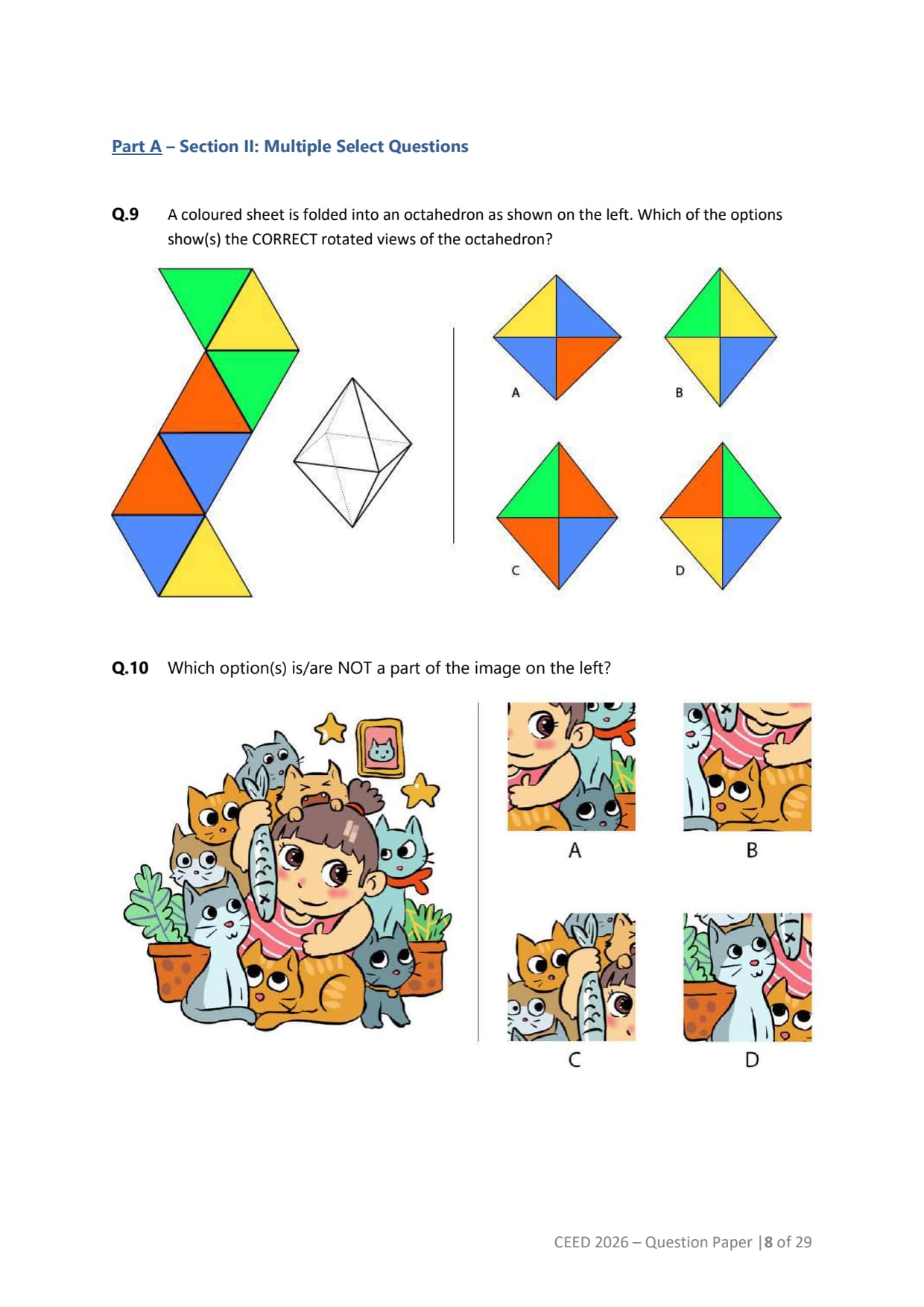
A coloured sheet is folded into an octahedron as shown on the left. Which of the options show(s) the CORRECT rotated views of the octahedron?

Which option(s) is/are NOT a part of the image on the left?

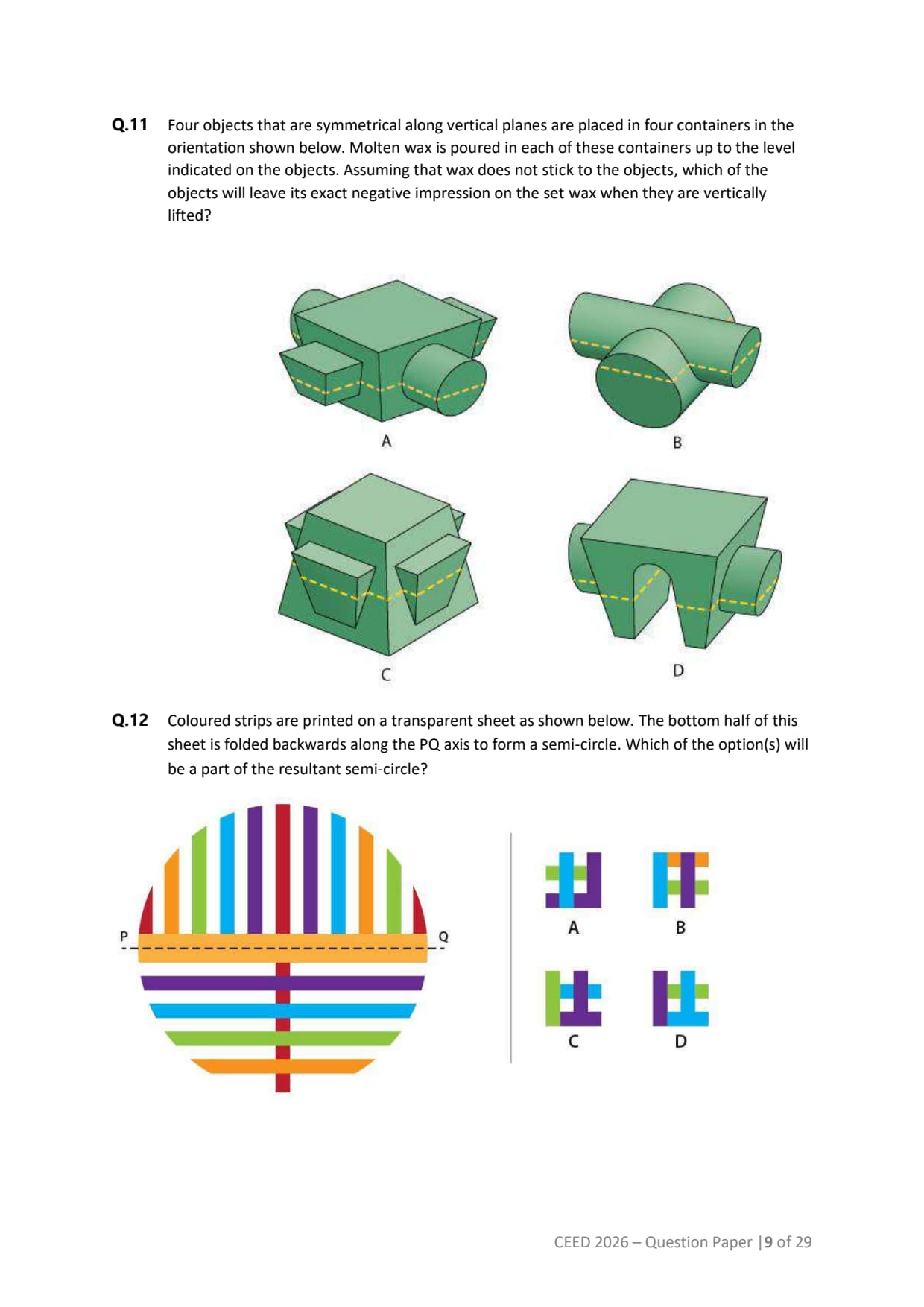
Four objects that are symmetrical along vertical planes are placed in four containers in the orientation shown below. Molten wax is poured in each of these containers up to the level indicated on the objects. Assuming that wax does not stick to the objects, which of the objects will leave its exact negative impression on the set wax when they are vertically lifted?

Coloured strips are printed on a transparent sheet as shown below. The bottom half of this sheet is folded backwards along the PQ axis to form a semi-circle. Which of the option(s) will be a part of the resultant semi-circle?

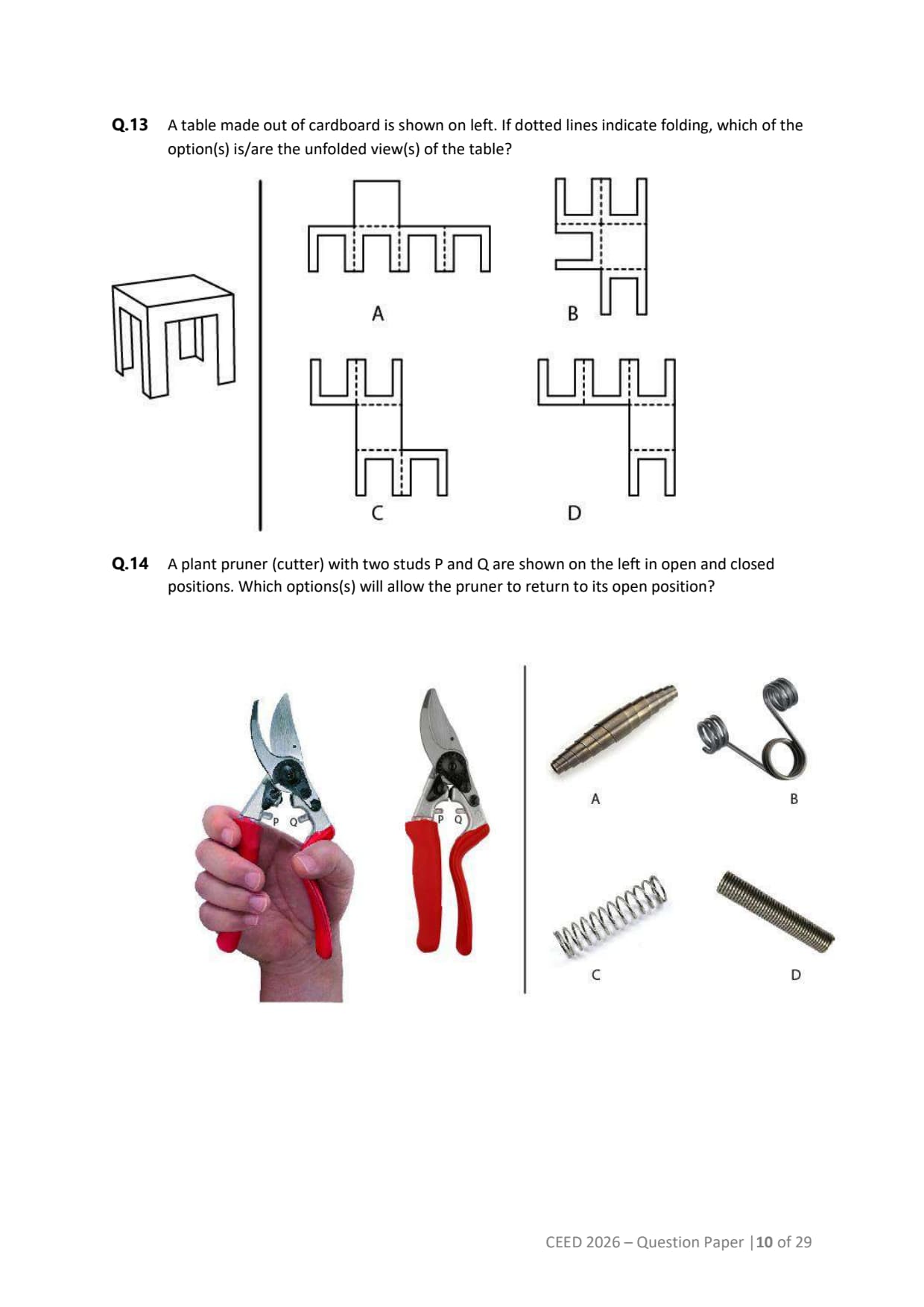
A table made out of cardboard is shown on left. If dotted lines indicate folding, which of the option(s) is/are the unfolded view(s) of the table?

A plant pruner (cutter) with two studs P and Q are shown on the left in open and closed positions. Which options(s) will allow the pruner to return to its open position?

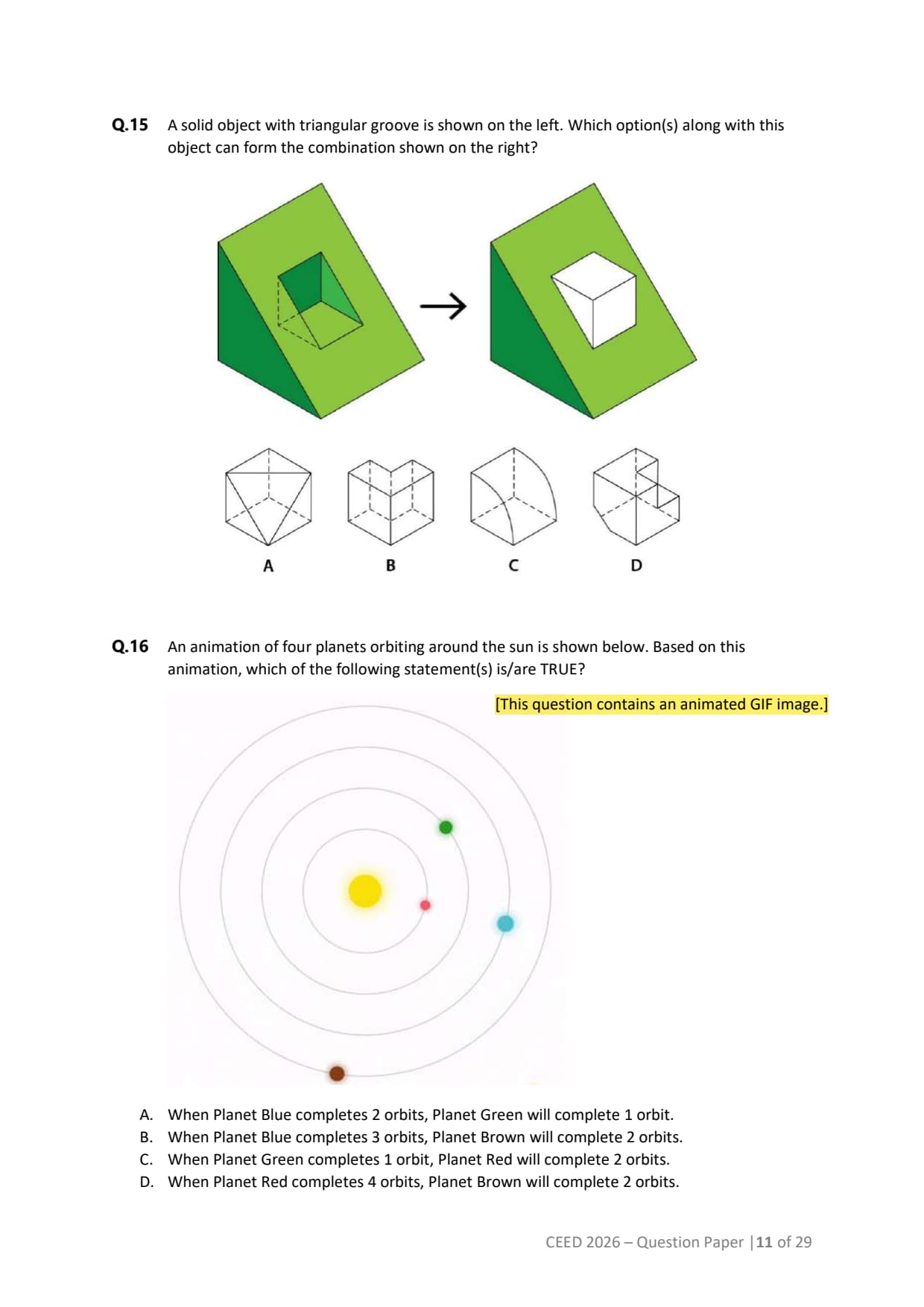
A solid object with triangular groove is shown on the left. Which option(s) along with this object can form the combination shown on the right?

An animation of four planets orbiting around the sun is shown below. Based on this animation, which of the following statement(s) is/are TRUE?

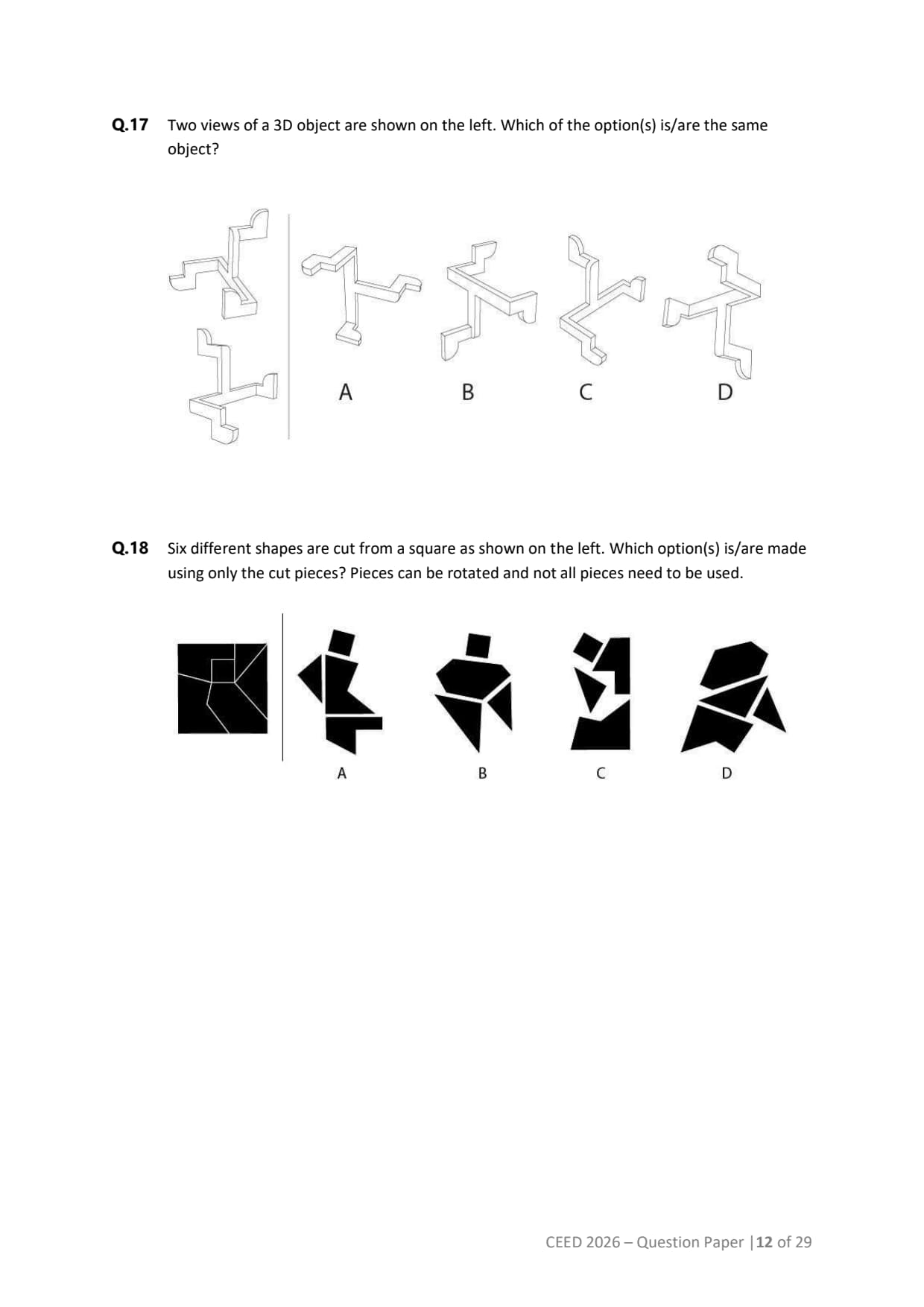
Two views of a 3D object are shown on the left. Which of the option(s) is/are the same object?

Six different shapes are cut from a square as shown on the left. Which option(s) is/are made using only the cut pieces? Pieces can be rotated and not all pieces need to be used.

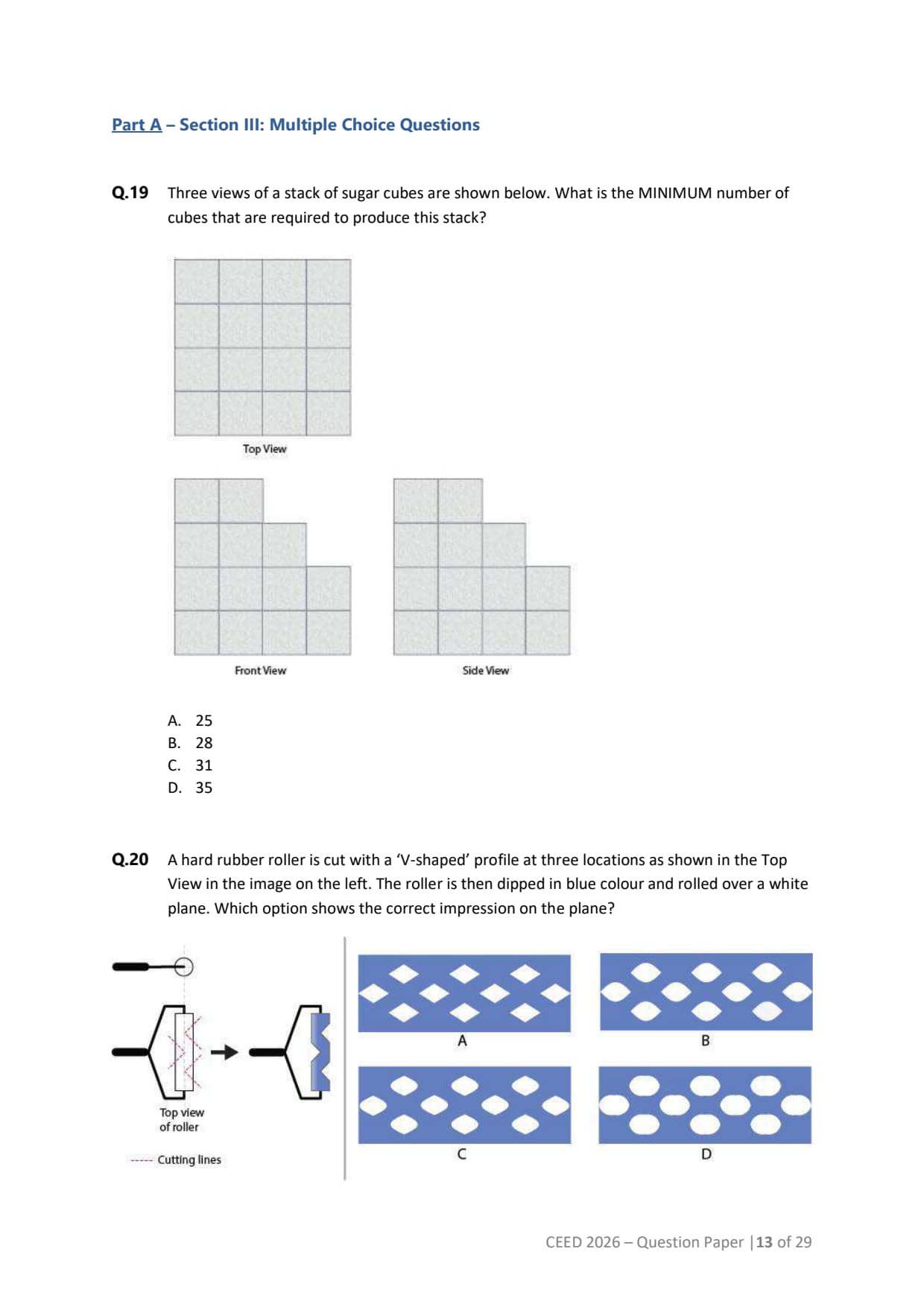
Three views of a stack of sugar cubes are shown below. What is the MINIMUM number of cubes that are required to produce this stack?

A hard rubber roller is cut with a ‘V-shaped’ profile at three locations as shown in the Top View in the image on the left. The roller is then dipped in blue colour and rolled over a white plane. Which option shows the correct impression on the plane?

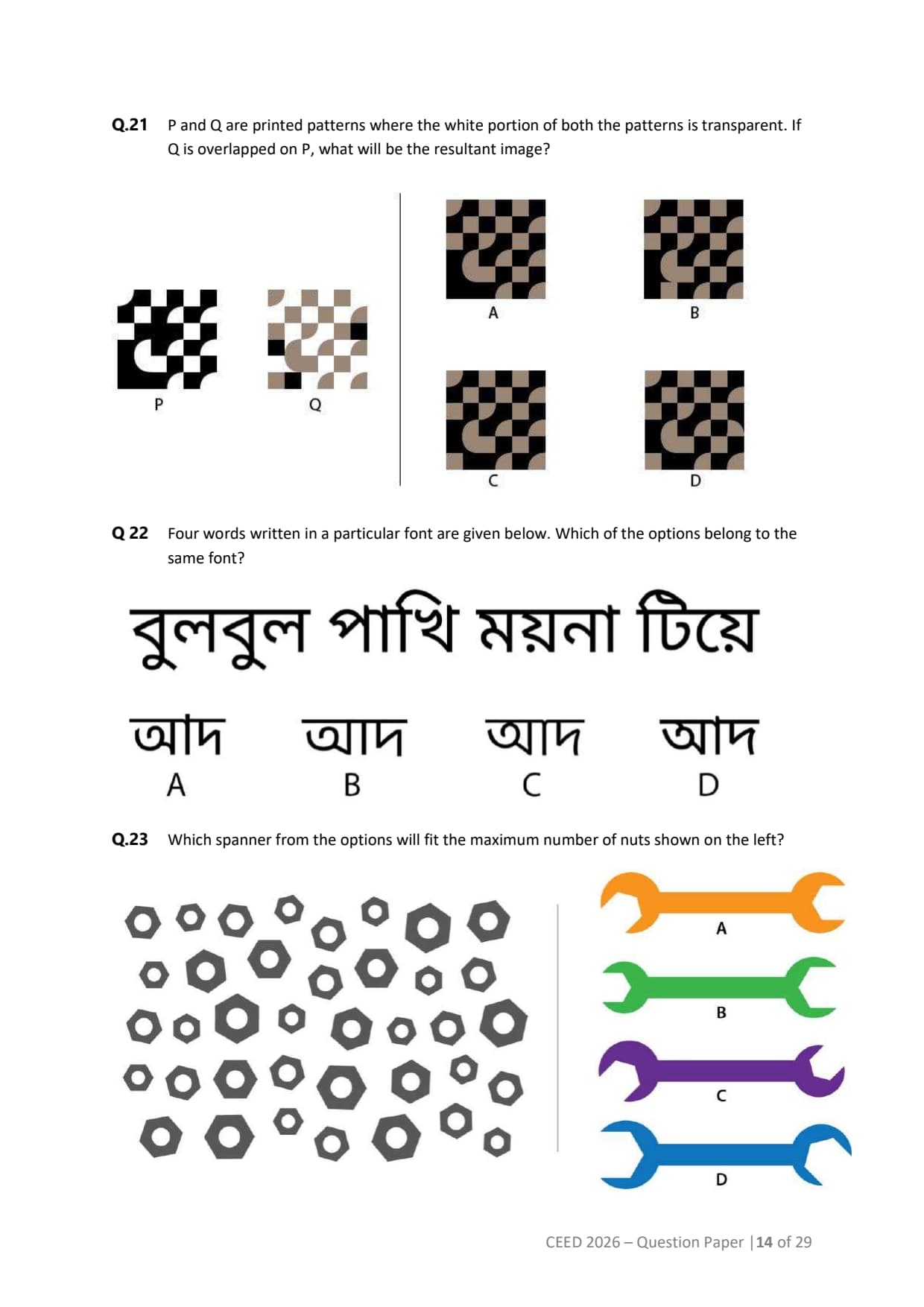
P and Q are printed patterns where the white portion of both the patterns is transparent. If Q is overlapped on P, what will be the resultant image?

Four words written in a particular font are given below. Which of the options belong to the same font?

Which spanner from the options will fit the maximum number of nuts shown on the left?

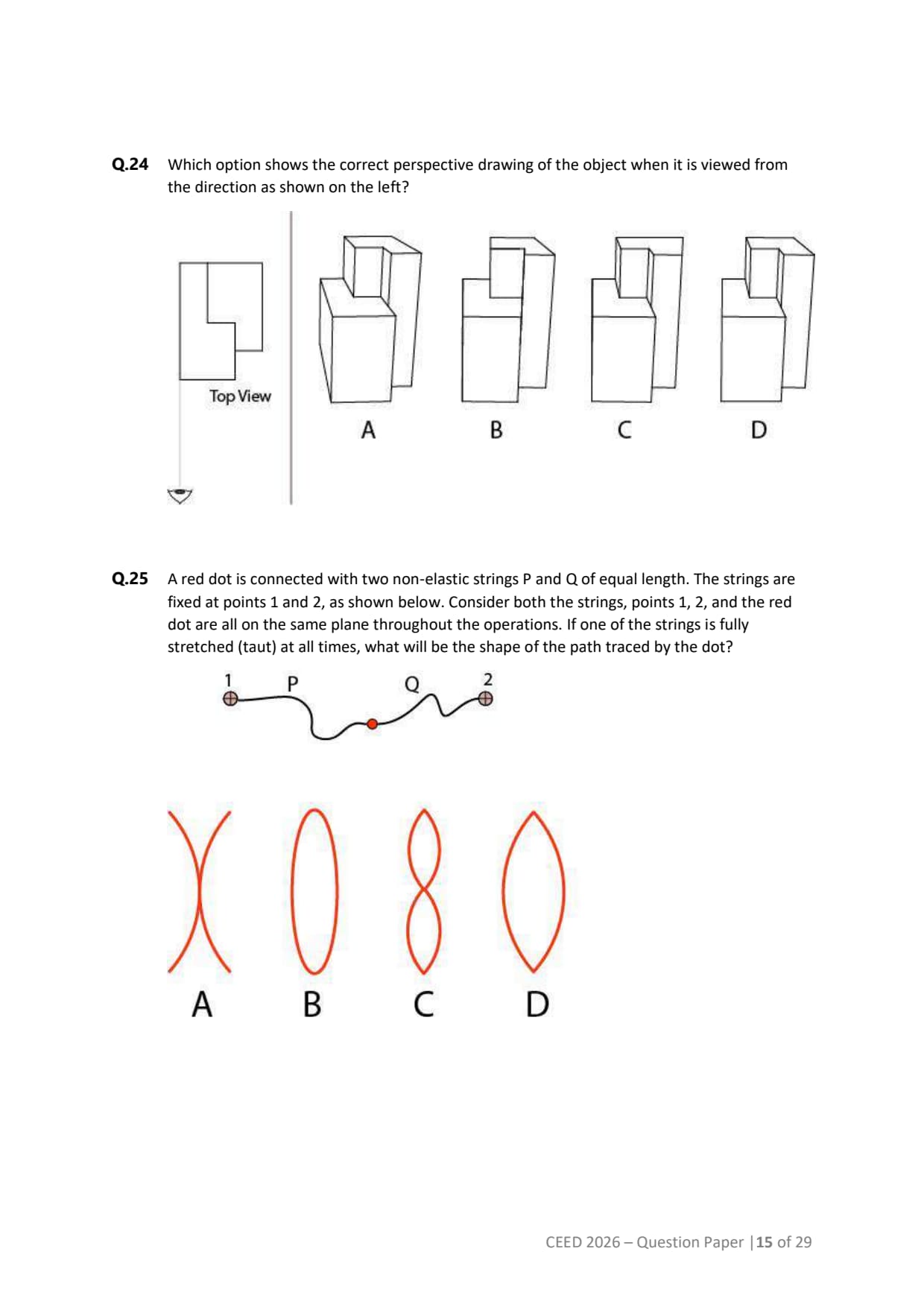
Which option shows the correct perspective drawing of the object when it is viewed from the direction as shown on the left?

A red dot is connected with two non-elastic strings P and Q of equal length. The strings are fixed at points 1 and 2, as shown below. Consider both the strings, points 1, 2, and the red dot are all on the same plane throughout the operations. If one of the strings is fully stretched (taut) at all times, what will be the shape of the path traced by the dot?

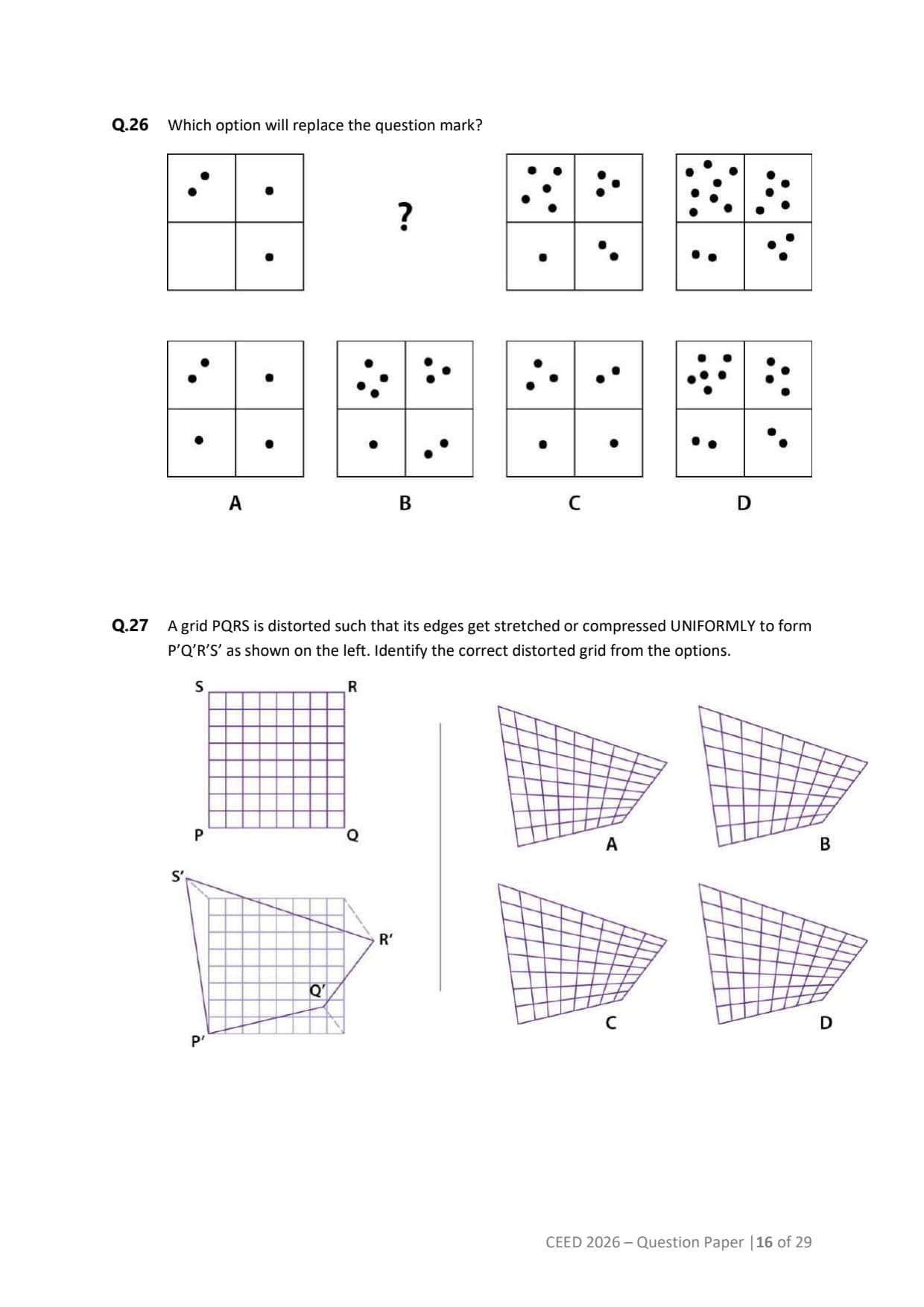
Which option will replace the question mark?

A grid PQRS is distorted such that its edges get stretched or compressed UNIFORMLY to form P’Q’R’S’ as shown on the left. Identify the correct distorted grid from the options.

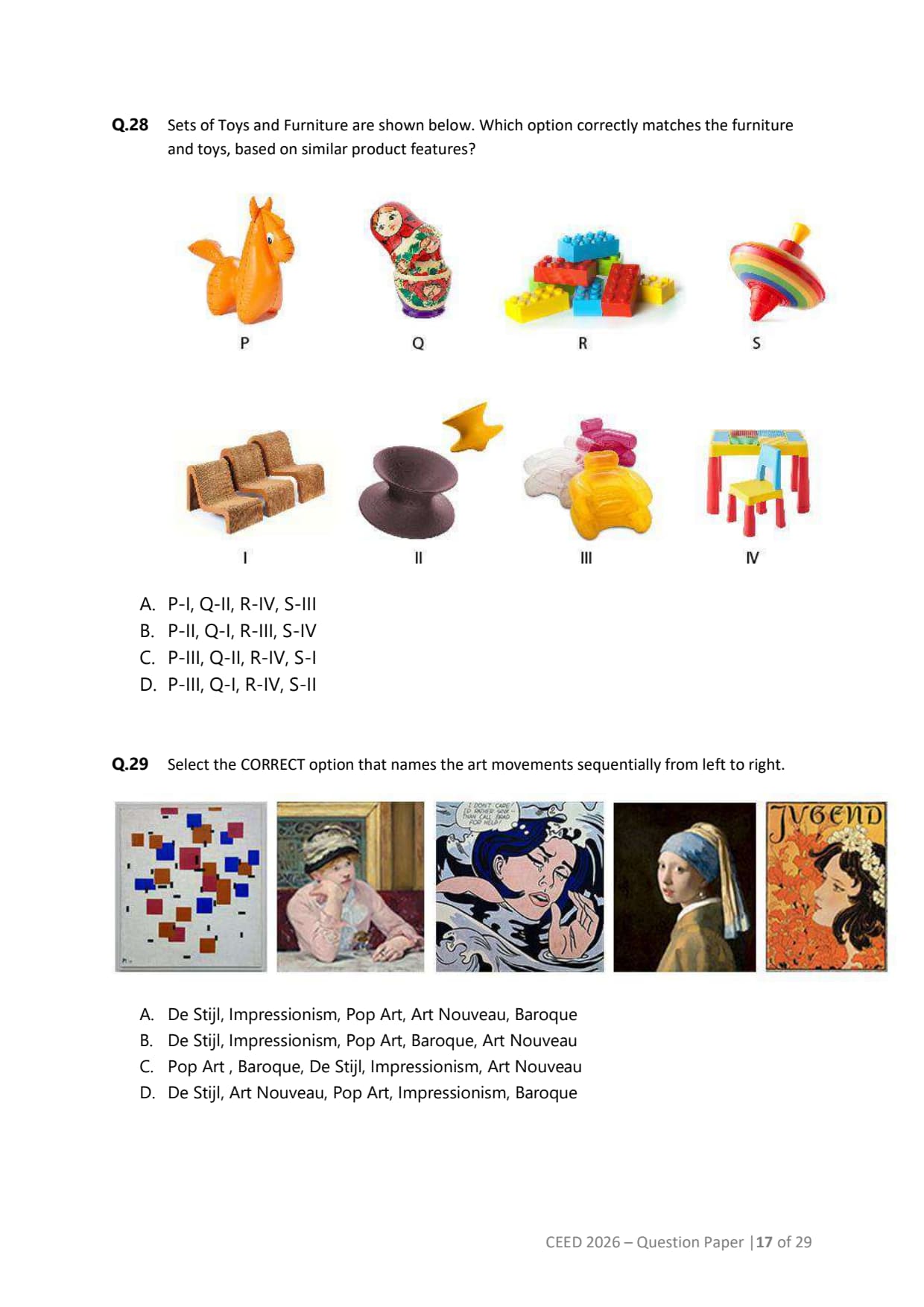
Sets of Toys and Furniture are shown below. Which option correctly matches the furniture and toys, based on similar product features?

Select the CORRECT option that names the art movements sequentially from left to right.

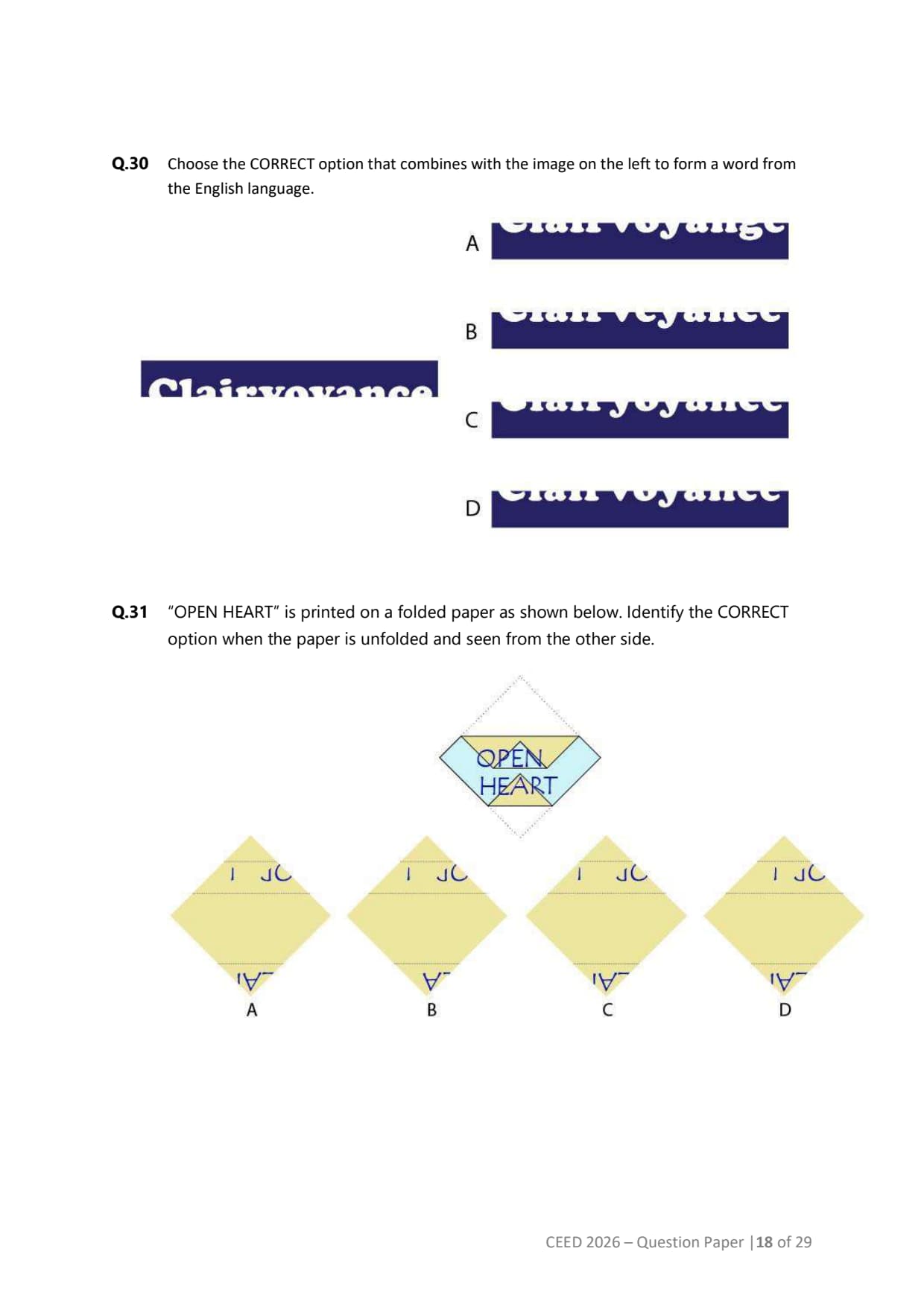
Choose the CORRECT option that combines with the image on the left to form a word from the English language.

“OPEN HEART” is printed on a folded paper as shown below. Identify the CORRECT option when the paper is unfolded and seen from the other side.

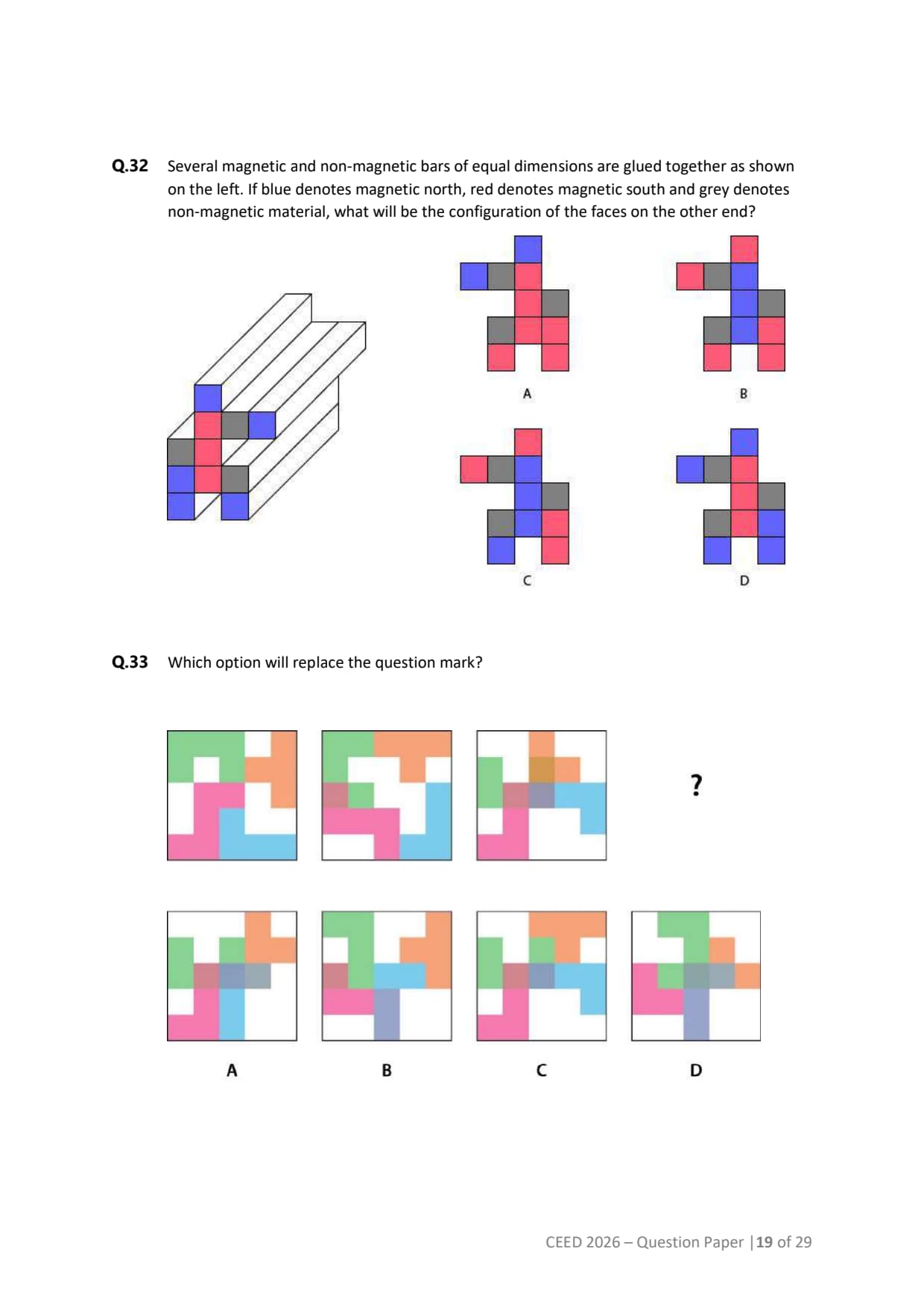
Several magnetic and non-magnetic bars of equal dimensions are glued together as shown on the left. If blue denotes magnetic north, red denotes magnetic south and grey denotes non-magnetic material, what will be the configuration of the faces on the other end?

Which option will replace the question mark?

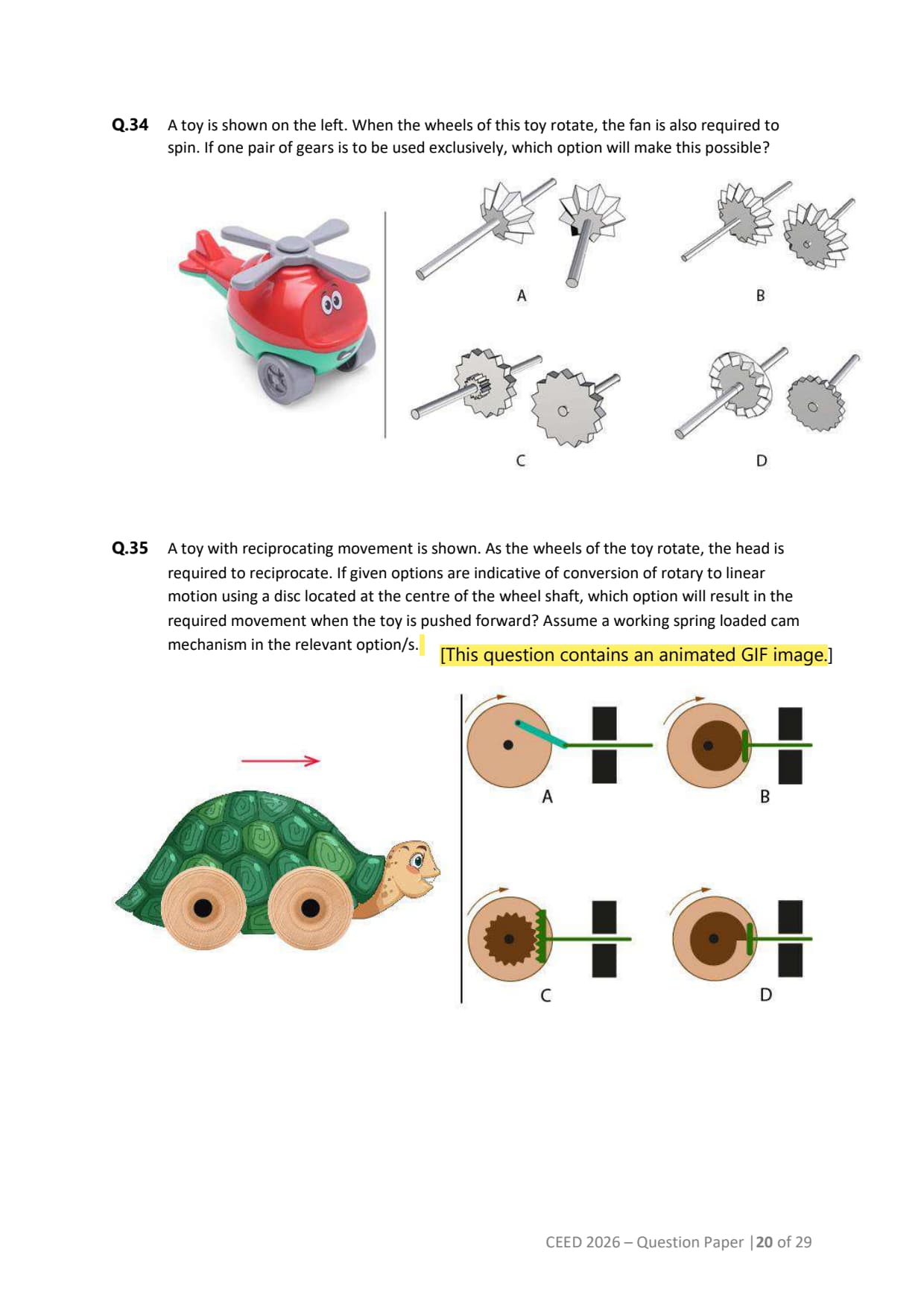
A toy is shown on the left. When the wheels of this toy rotate, the fan is also required to spin. If one pair of gears is to be used exclusively, which option will make this possible?

A toy with reciprocating movement is shown. As the wheels of the toy rotate, the head is required to reciprocate. If given options are indicative of conversion of rotary to linear motion using a disc located at the centre of the wheel shaft, which option will result in the required movement when the toy is pushed forward? Assume a working spring loaded cam mechanism in the relevant option/s.

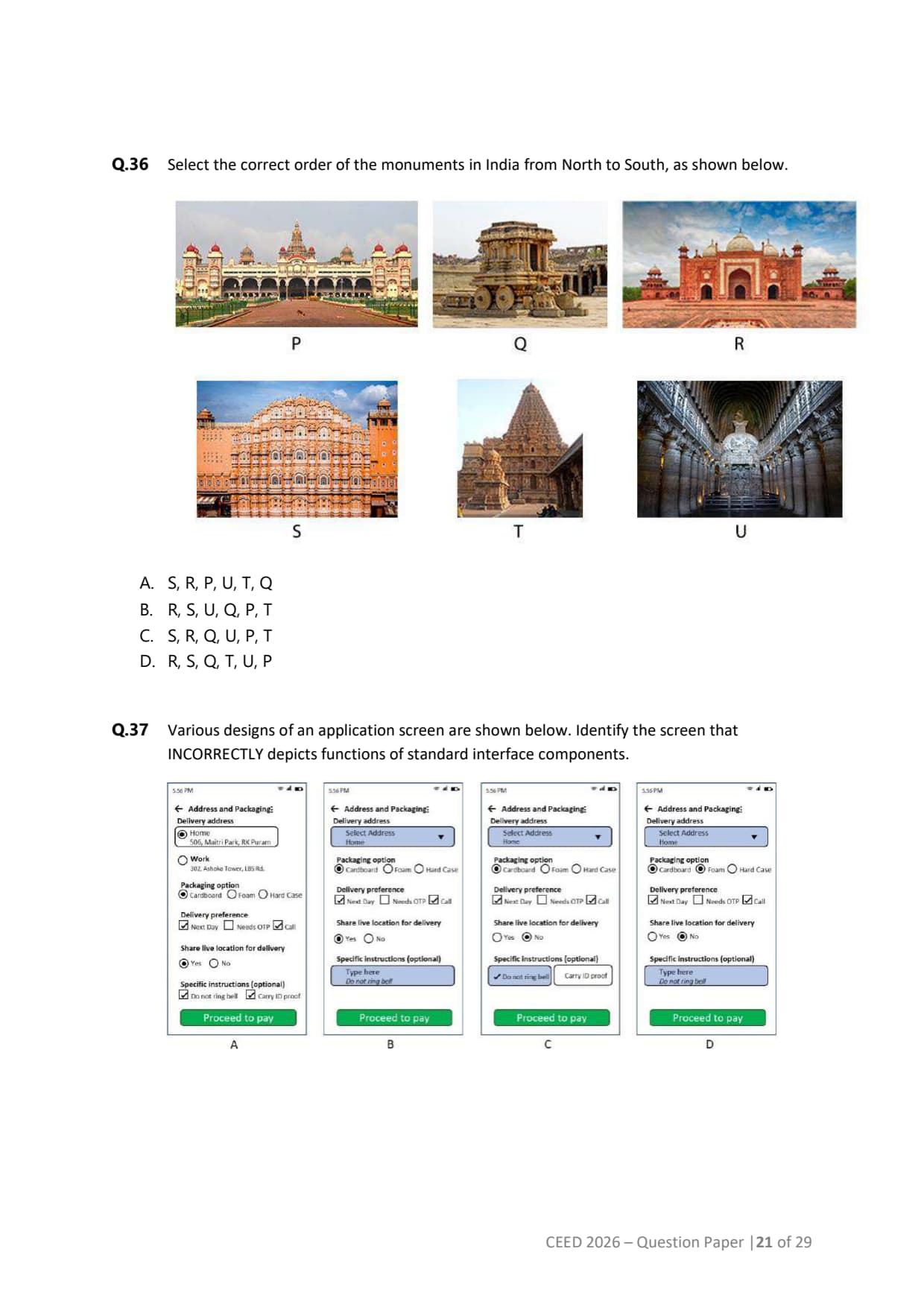
Select the correct order of the monuments in India from North to South, as shown below.

Various designs of an application screen are shown below. Identify the screen that INCORRECTLY depicts functions of standard interface components.

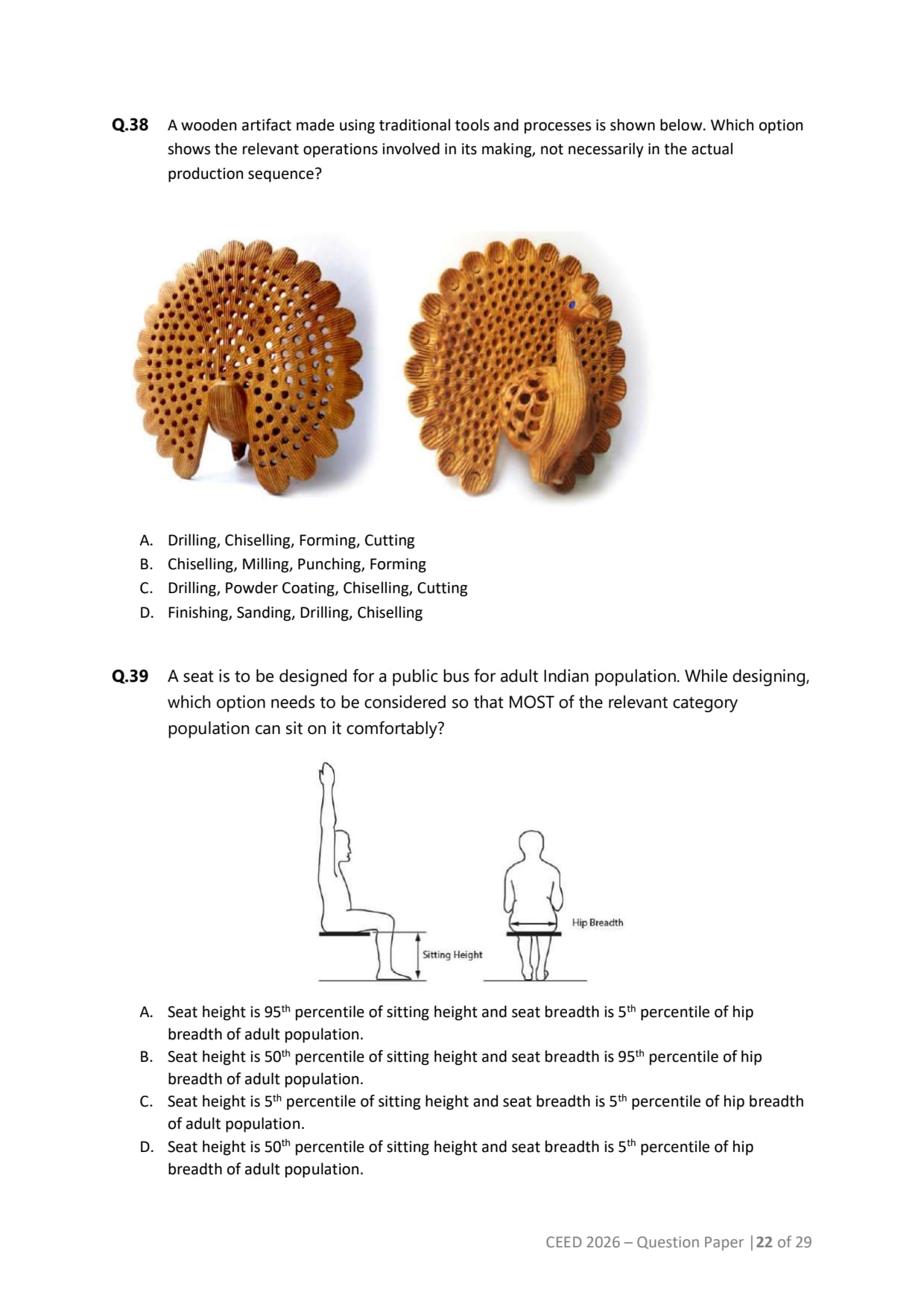
A wooden artifact made using traditional tools and processes is shown below. Which option shows the relevant operations involved in its making, not necessarily in the actual production sequence?

A seat is to be designed for a public bus for adult Indian population. While designing, which option needs to be considered so that MOST of the relevant category population can sit on it comfortably?

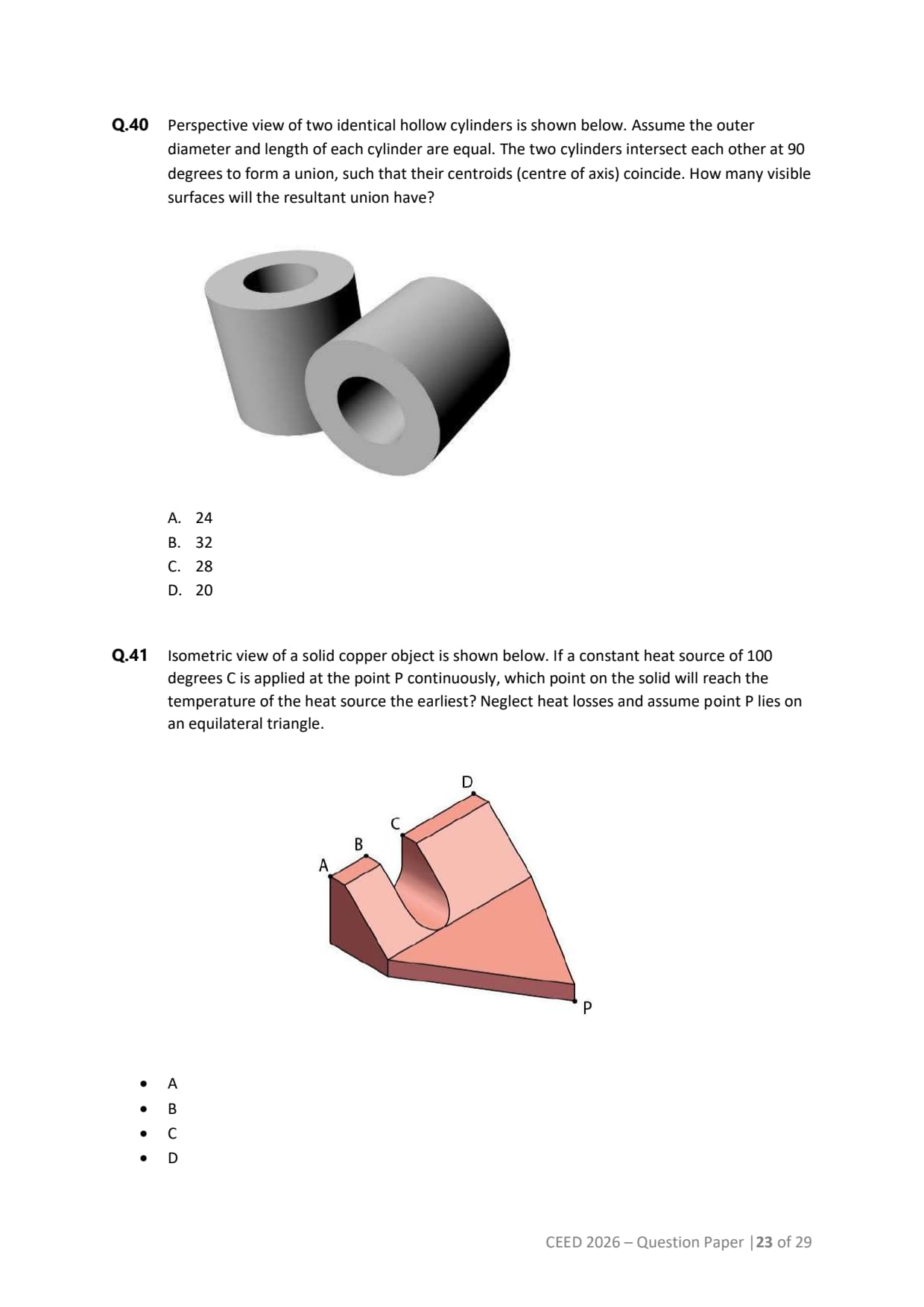
Perspective view of two identical hollow cylinders is shown below. Assume the outer diameter and length of each cylinder are equal. The two cylinders intersect each other at 90 degrees to form a union, such that their centroids (centre of axis) coincide. How many visible surfaces will the resultant union have?

Isometric view of a solid copper object is shown below. If a constant heat source of 100 degrees C is applied at the point P continuously, which point on the solid will reach the temperature of the heat source the earliest? Neglect heat losses and assume point P lies on an equilateral triangle.

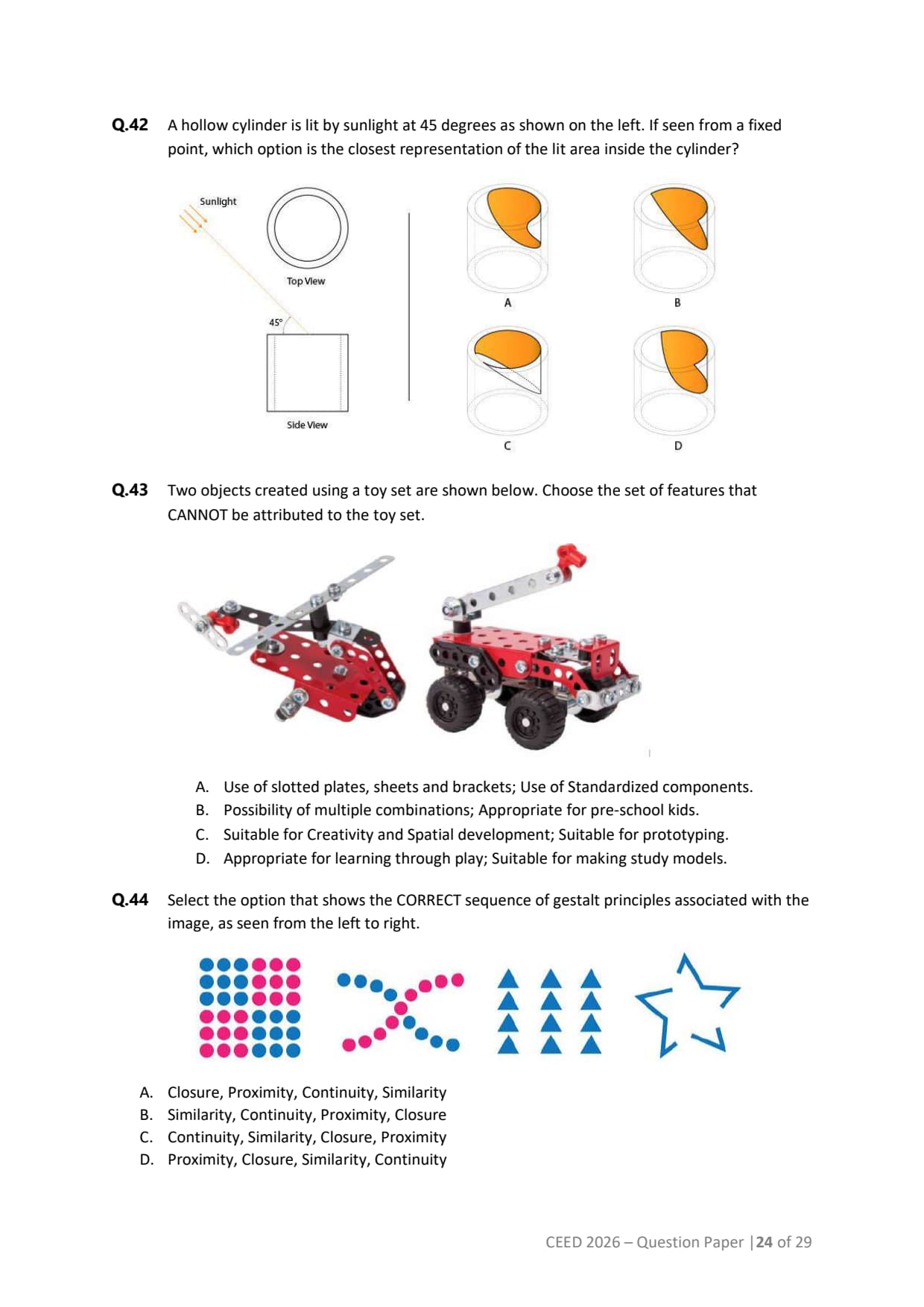
A hollow cylinder is lit by sunlight at 45 degrees as shown on the left. If seen from a fixed point, which option is the closest representation of the lit area inside the cylinder?

Two objects created using a toy set are shown below. Choose the set of features that CANNOT be attributed to the toy set.

Select the option that shows the CORRECT sequence of gestalt principles associated with the image, as seen from the left to right.



Comments