




The CEED cutoff 2027 is expected to be released by February 2027. The cutoff will be released on the official website at ceed.iitb.ac.in. The CEED 2027 cutoff is the minimum Part A marks required for evaluation of Part B.
Based on the CEED exam cutoff 2027, the counselling rounds will be determined. There are no fixed qualifying marks for the CEED examination 2027.
- The CEED Part A cutoff 2027 will be determined using the mean and standard deviation of marks obtained.
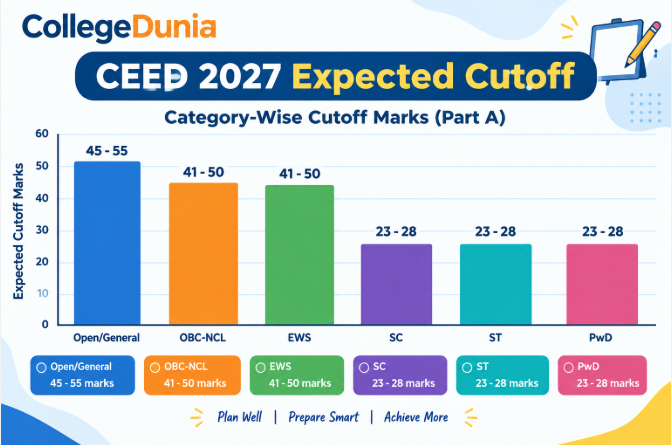
- Based on the previous year’s trends, the expected Part A CEED cutoff 2027 for the Gen category is 45 - 55 marks. For OBC-NCL/EWS, it is 41- 50 marks, and for SC/ST/PwD it is 23 - 28 marks.
- In the 2026 academic year, the mean score for Part A cutoff calculation was 39.35, and the standard deviation was 16.89. Thus, the open cutoff was 47.80.
- In the 2025 academic year, the mean score for Part A cutoff calculation was 45.48, the standard deviation was 16.98, and the open cutoff was 53.97.
- Part B covers 75% of the total marks, based on which the final merit list is prepared for the CEED exam.
- Applicants need to qualify Part A of CEED 2027 to be eligible for Part B score evaluation.
Related Links:
- CEED Result 2027: Check Expected Release Date, Direct Link and Steps to Download
- CEED Answer Key 2027: Download Provisional & Final Answer Key PDF, Raise Objections

Key Summary
- The CEED result 2027 is expected to be released by March 2027.
- The CEED 2027 cutoff is released in form of opening and closing ranks by the participating colleges.
- The expected rank range for 70 and above marks is 1 - 50. The colleges offered are IIT Bombay, IIT Delhi, IIT Hyderabad.
- Securing 60 - 69 CEED marks 2027 will rank between 51 - 200. The offered colleges are IIT Guwahati, IIT Kanpur, IIITDM Jabalpur.
- CEED follows reservation of 27% for OBC-NCL, 15% for SC, 10% for EWS, 7.5% for ST, and 5% for PwD.
What is the CEED Cutoff 2027?
The CEED cutoff 2027 is the minimum qualifying marks to get admission into M.Des and PhD programs in design. The cutoffs are determined based on certain factors, such as the total number of students registered and appeared, the number of students qualified, seat availability, etc.
Based on the CEED Part A cutoff 2027, the Part B score evaluation is done.
- There is no specified minimum mark for the CEED exam 2027.
- The Part A score is calculated dynamically using the overall performance of the student.
- The final CEED marks are calculated using 25% of Part A and 75% of Part B scores of students.
CEED 2027 Expected Cutoff
| Category | CEED 2027 Expected Part A Cutoff |
|---|---|
| Open/General | 45 - 55 marks |
| OBC-NCL | 41 - 50 marks |
| EWS | 41 - 50 marks |
| SC | 23 - 28 marks |
| ST | 23 - 28 marks |
| PwD | 23 - 28 marks |
How is the CEED Cutoff 2027 Calculated?
The CEED cutoff 2027 for Part A is calculated using statistical methods. The formula used to calculate the score is:
δ = μ + (σ/2)
Where:
- μ = Mean of marks obtained by all candidates in Part A
- σ = Standard deviation of Part A marks
- δ = Open-category Part A cutoff
The category-wise score calculation formula is shared below.
| Category | Cutoff Formula |
|---|---|
| Open/General | δ |
| OBC-NCL | 0.9 × δ |
| EWS | 0.9 × δ |
| SC | 0.5 × δ |
| ST | 0.5 × δ |
| PwD | 0.5 × δ |

How Can We Check the CEED Cutoff 2027?
The steps to check the CEED 2027 cutoff online are as follows:
- Step 1: Visit the official website: ceed.iitb.ac.in.
- Step 2: Look for the “CEED Cutoff PDF” in the notification section.
- Step 3: Click on the relevant link.
- Step 4: The round, category, college, and course-based cutoff list will be displayed on the screen.
- Step 5: Click on the particular link you need, and the detailed cutoff will be displayed.
- Step 6: Check the cutoff rank in detail, and if you wish, you can download it as well.
A Reddit user asked about the low score in the CEED exam. “I secured 37 marks in CEED from Gen category and got 254 rank. I am not sure, in which IIT I can get admission”.

Replying to that, another user shared information about the cutoffs of other IITs and told to complete all the procedures carefully and wait for the list to be out.

Source: Reddit
Read More:
CEED Previous Year’s Category-Wise Cutoff
- The CEED 2026 cutoff for the General category was 47.80, and for OBC-NCL it was 43.02.
- The CEED 2026 SC cutoff was 23.90, ST was 23.90, PwD was 23.90, and EWS was 43.02.
- The CEED 2025 cutoff for the Open category was 53.97. The 2025 cutoff for the General category was higher than the 2026.
| Year | Open/General | OBC-NCL | EWS | SC | ST | PwD |
|---|---|---|---|---|---|---|
| 2026 | 47.80 | 43.02 | 43.02 | 23.90 | 23.90 | 23.90 |
| 2025 | 53.97 | 48.57 | 48.57 | 26.99 | 26.99 | 26.99 |
| 2024 | 50.26 | 45.23 | 45.23 | 25.13 | 25.13 | 25.13 |
| 2023 | 28.50 | 25.65 | 25.65 | 14.25 | 14.25 | 14.25 |
| 2022 | 24.58 | 22.12 | 22.12 | 12.29 | 12.29 | 12.29 |
| 2021 | 38.00 | 34.20 | — | 19.00 | 19.00 | 19.00 |
| 2020 | 38.00 | 34.20 | — | 19.00 | 19.00 | 19.00 |

A video by “EricTells” will help you learn the CEED 2026 Part A cutoff.
Factors Determining CEED Cutoff 2027
The following are the factors used to calculate the CEED cutoff 2027.
- Number of Applicants: Based on the number of applicants and overall competition, the cutoff rises.
- Difficulty of the exam: If the exam is tougher, the cut-off can be lower since fewer candidates can pass the minimum standards.
- Seat Availability: More available seats usually result in a lower cut-off, as the demand-supply balance affects the scores.
- Reservation Policies: The availability of reservation quotas for SC, ST, OBC, and PwD impacts cut-off levels differently for categories.
- Trends of Previous Years: Previous year cut-offs provide a standard benchmark to be expected and are usually utilized to gauge the current year's cut-off.
CEED Marks vs Rank 2027
The CEED marks vs rank 2027 range will help students understand what a good score for the exam is. Securing 70+ marks will get students ranks 1 - 50; 60 - 69 marks will get ranks 51- 200, and likewise.
| CEED Score | Indicative Rank Range |
|---|---|
| 70+ | Around top 50 |
| 60–69 | Around 51–200 |
| 50–59 | Around 201–500 |
| 40–49 | Around 501–1,000 |
| 30–39 | Around 1,001–2,000 |
| Below 30 | Above 2,000 |

Ques. What is a good score in CEED 2027?
Ans. Securing 70+ marks in the CEED exam is considered a good score. 70 or above marks will help students get admission into IIT Bombay or IIT Delhi programs. Further, 60 - 69 marks open opportunities for IIT Guwahati, IIT Kanpur, and IIITDM Jabalpur.
CEED Cutoff 2027: Qualifying Cutoff vs Admission Cutoff
The CEED 2027 qualifying and admission cutoff differentiation is shared below.
| Parameter | CEED Qualifying Cutoff | Institute Admission Cutoff |
|---|---|---|
| Purpose | Shortlisting for Part B | Selection for M.Des admission |
| Released by | CEED/IIT Bombay | Individual institutes |
| Based on | Part A mean & standard deviation | Institute's admission process |
| Same for all institutes? | Yes, for CEED qualification | No |
| Guarantees admission? | No | Depends on institute selection |
| Rank considered? | Merit rank follows qualification | Usually important in institute selection |
Colleges Accepting CEED Scores 2027
The following are the colleges accepting the CEED 2027 score for numerous programs.
| Institute | Programs Offered |
|---|---|
| IIT Bombay | M.Des in Industrial Design, Visual Communication, Product Design, etc. |
| IIT Delhi | M.Des in Industrial Design |
| IIT Guwahati | M.Des in Design, Product Design, etc. |
| IIT Hyderabad | M.Des in Interaction Design, Product Design |
| IIT Kanpur | M.Des in Design, Interaction Design |
| IIT Roorkee | M.Des in Industrial Design, Visual Communication |
| IIITDM Jabalpur | M.Des in Design, Engineering Design |
| IIT Varanasi (BHU) | M.Des in Industrial Design |
| NID (National Institute of Design) | Various Design Programs (Primarily in Industrial Design) |
| CEPT University | M.Des in Urban Design, Product Design, etc. |
CEED Cutoff 2027 FAQs
Ques. When will the CEED 2027 cutoff be released?
Ans. The CEED cutoff 2027 is expected to be released by February 2027. The cutoff will be released once the result is declared. The official schedule for the exam has not been shared yet.
Ques. How is the CEED 2027 cutoff calculated?
Ans. The CEED 2027 cutoff for the Open category is calculated as δ = μ + (σ/2). For OBC-NCL and EWS, it is 0.9δ, and for SC/ST/PwD it is 0.5δ. Where μ = Mean of marks obtained by all candidates in Part A, σ = Standard deviation of Part A marks, and δ = Open-category Part A cutoff.
Ques. Is the CEED cutoff the same for all categories?
Ans. No, the CEED cutoff is not the same for all the categories. The qualifying cutoff is determined category-wise. For the OBC-NCL and EWS categories, there is a relaxation of 10% from the Open category, and for the SC/ST/PwD category, it is 50%.
Ques. Is the CEED qualifying cutoff the same as the admission cutoff?
Ans. No, the CEED exam qualifying cutoff and admission cutoff are not the same. The qualifying cutoff is the minimum marks secured by students to qualify for Part A and be eligible for Part B score evaluation. Whereas, the admission cutoff is the final merit list prepared using both Part A and Part B scores for seat allotment.
Ques. Can I get admission after just clearing the CEED cutoff?
Ans. Just clearing the CEED exam cutoff does not secure admission into the M.Des program. It only makes the applicant eligible for the Part B score evaluation. The final merit list is prepared on the basis of 25% of Part A and 75% of Part B scores. Thus, students need to qualify the Part B cutoff as well to get admission.



Comments