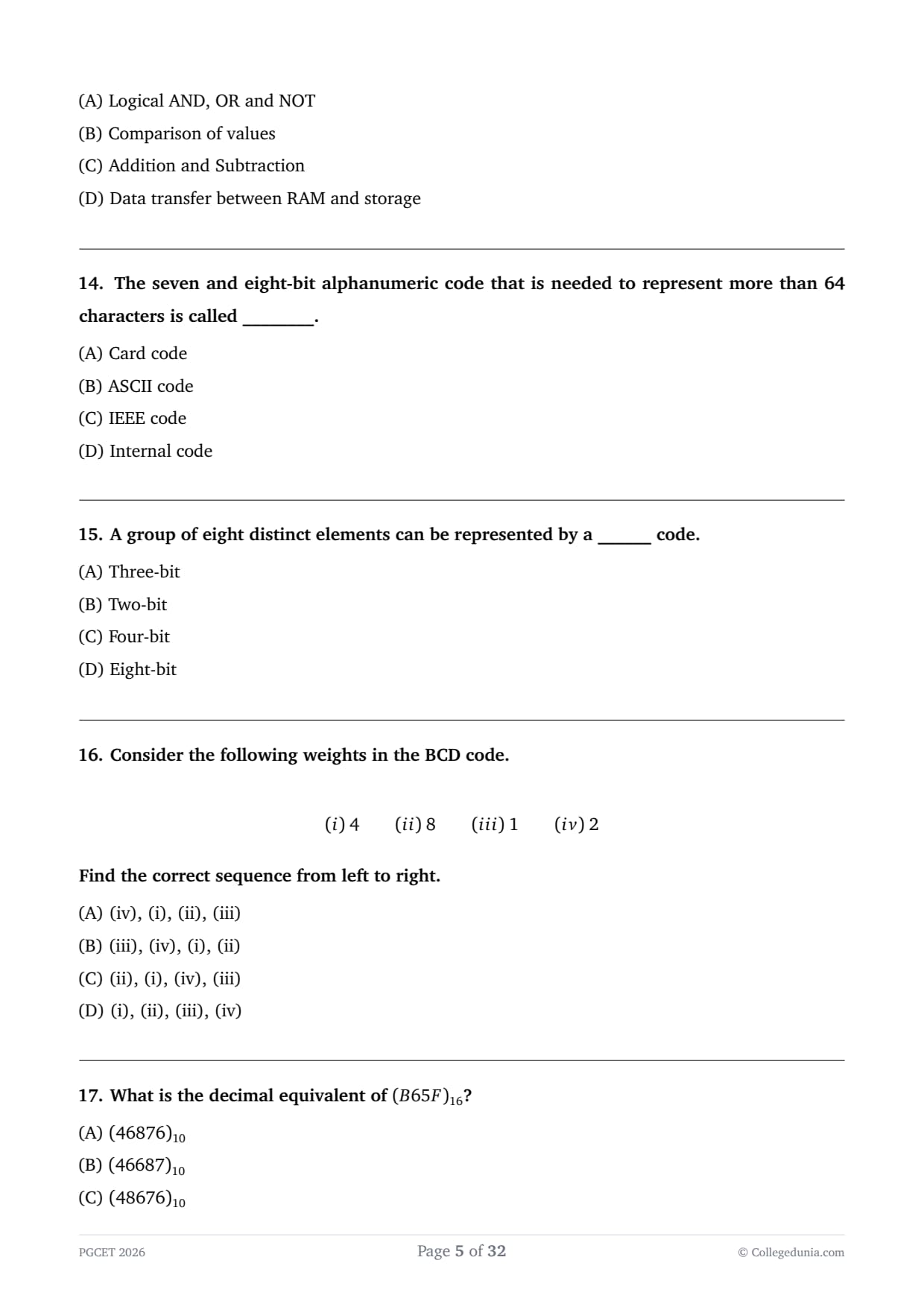
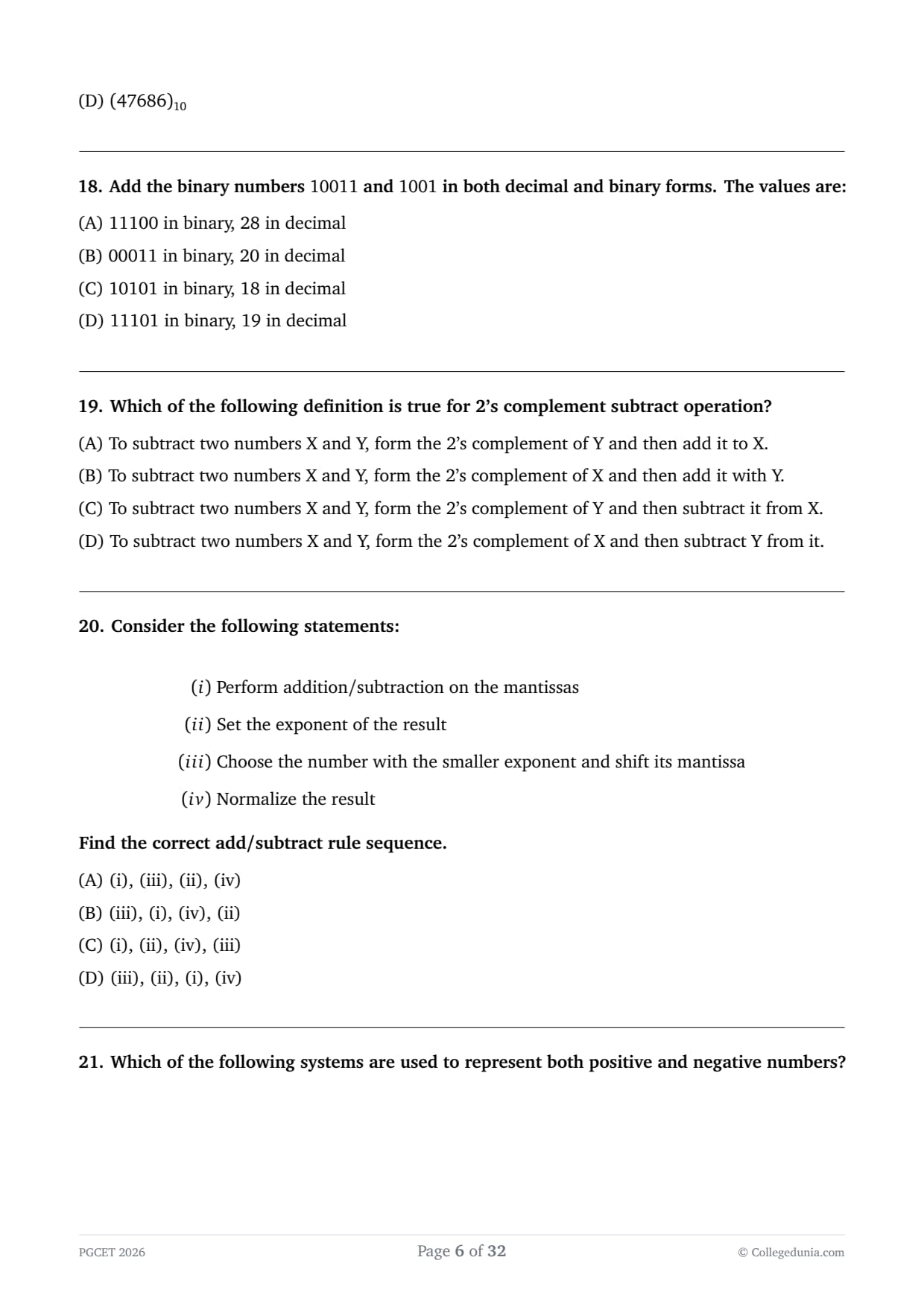
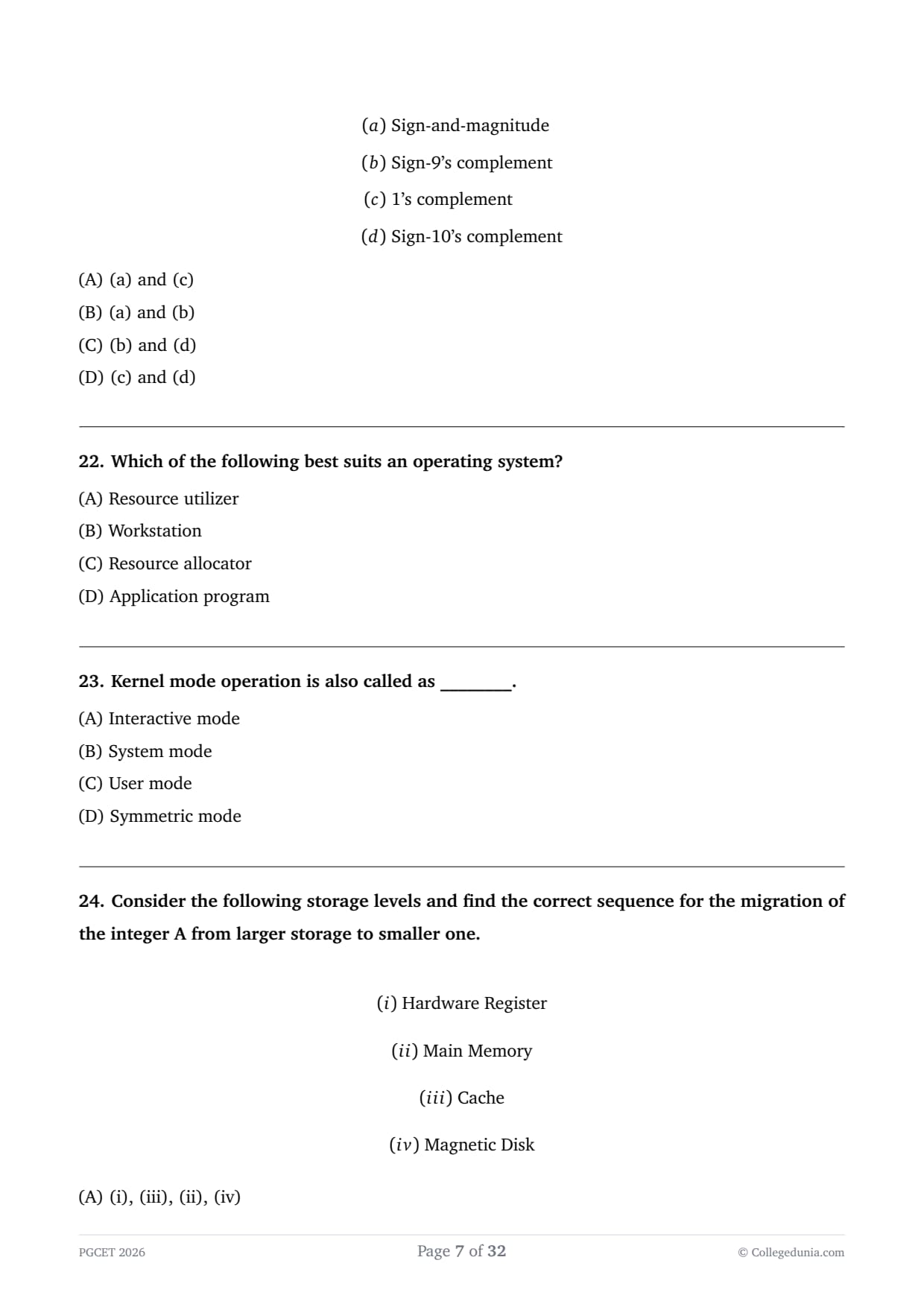
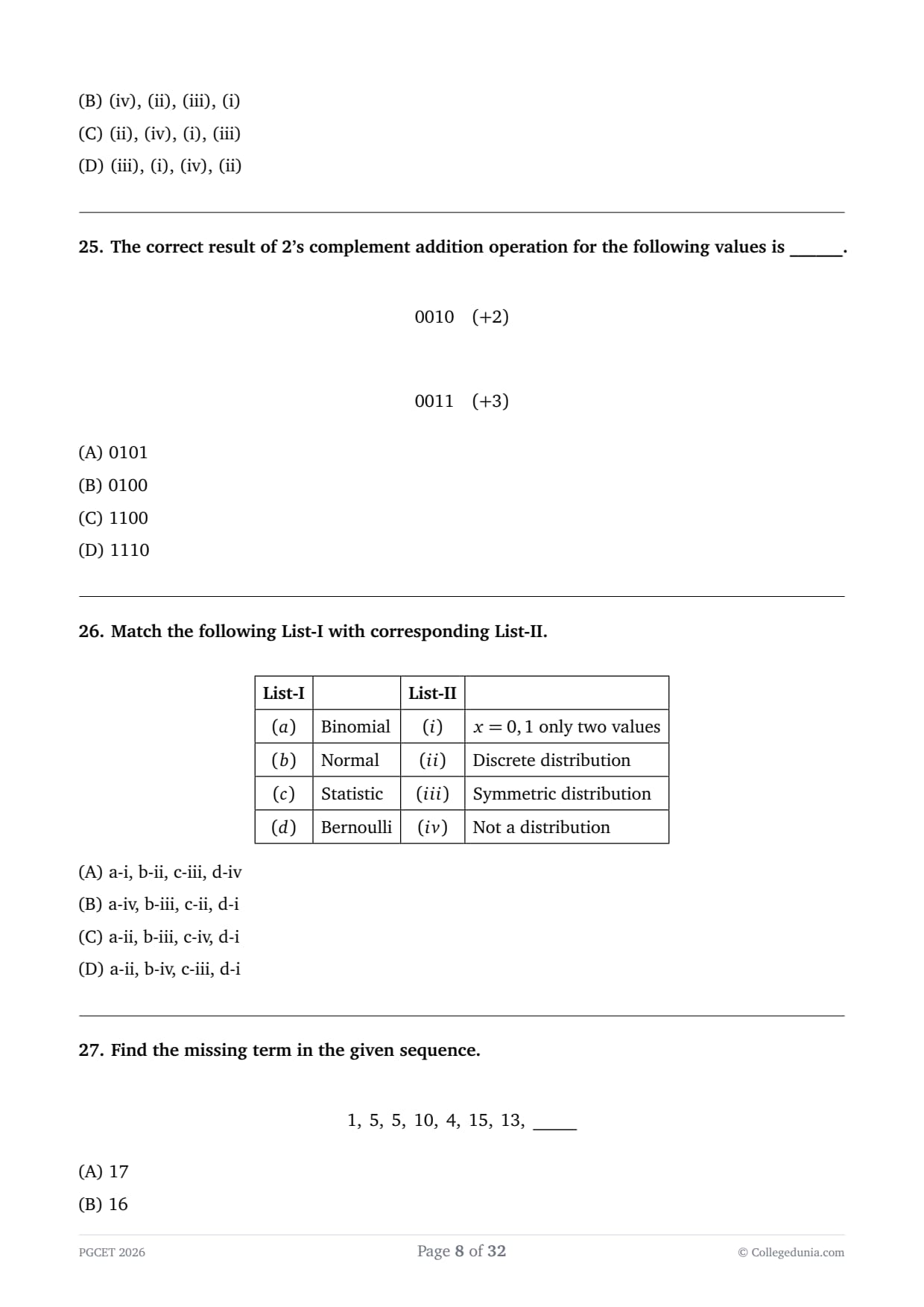
Karnataka PGCET 2026 MBA Question Paper is available for download here. Karnataka Examinations Authority (KEA) has conducted Karnataka PGCET 2026 MBA exam on June 14 from 10.30 am to 12.30 pm. Karnataka PGCET 2026 MBA Question Paper consists of 100 questions for 100 marks to be attempted in 120 minutes.

  • Karnataka PGCET MBA Question Paper 2026 is divided into Computer Awareness, Analytical Ability and logical Reasoning, Quantitative Analysis, English language and General Knowledge questions.
  • Each correct answer carries 1 mark and there is no negative marking for incorrect answers.

Karnataka PGCET 2026 MBA Question Paper with Solutions

Karnataka PGCET MBA Question Paper 2026 Download PDF Check Solutions


Question 1:

Which component of the central processing unit is primarily responsible for fetching, decoding and executing instructions?

  • (A) Arithmetic Logic Unit (ALU)
  • (B) Control Unit (CU)
  • (C) Cache Memory
  • (D) Registers
Correct Answer: (B) Control Unit (CU)
View Solution


Concept:

The Central Processing Unit (CPU) is often called the brain of a computer because it performs all major processing operations. The CPU consists of several important components such as the Control Unit (CU), Arithmetic Logic Unit (ALU), registers, and cache memory.

Among these components, the Control Unit acts as the coordinator of all operations. It fetches instructions from memory, decodes them to determine the required operation, and directs other components to execute the instructions properly.

The basic instruction cycle of a CPU consists of:
\[ Fetch \rightarrow Decode \rightarrow Execute \]

The Control Unit manages this entire sequence and ensures smooth communication between the processor, memory, and input-output devices.


Step 1: Understanding the role of the Arithmetic Logic Unit (ALU).


The Arithmetic Logic Unit performs arithmetic operations such as:
\[ +,\;-,\;\times,\;\div \]

and logical operations such as:
\[ AND,\; OR,\; NOT,\; XOR \]

Although the ALU performs calculations, it does not control the execution of instructions.

Therefore,
\[ ALU \neq Fetch and Decode Unit \]

Hence, Option (A) is incorrect.


Step 2: Understanding the role of the Control Unit (CU).


The Control Unit is responsible for:


Fetching instructions from memory.
Decoding instructions.
Sending control signals to different components.
Coordinating execution of operations.


Thus, the Control Unit supervises the complete instruction cycle.
\[ \boxed{Control Unit \Rightarrow Fetch + Decode + Control Execution} \]

Hence, Option (B) is correct.


Step 3: Examining Cache Memory.


Cache memory is a high-speed memory used to store frequently accessed data and instructions.

Its purpose is to reduce access time and improve performance.

It does not decode or execute instructions.

Therefore, Option (C) is incorrect.


Step 4: Examining Registers.


Registers are small storage locations inside the CPU that temporarily hold data and instructions.

Examples include:


Program Counter (PC)
Instruction Register (IR)
Accumulator


Registers assist processing but do not control the instruction cycle.

Therefore, Option (D) is incorrect.


Final Conclusion:

The component responsible for fetching, decoding, and controlling the execution of instructions is the Control Unit.
\[ \boxed{Control Unit (CU)} \]

Hence, the correct answer is:
\[ \boxed{(B) Control Unit (CU)} \] Quick Tip: Remember: ALU performs calculations, Registers store temporary data, Cache speeds up access, while the Control Unit manages the Fetch--Decode--Execute cycle.


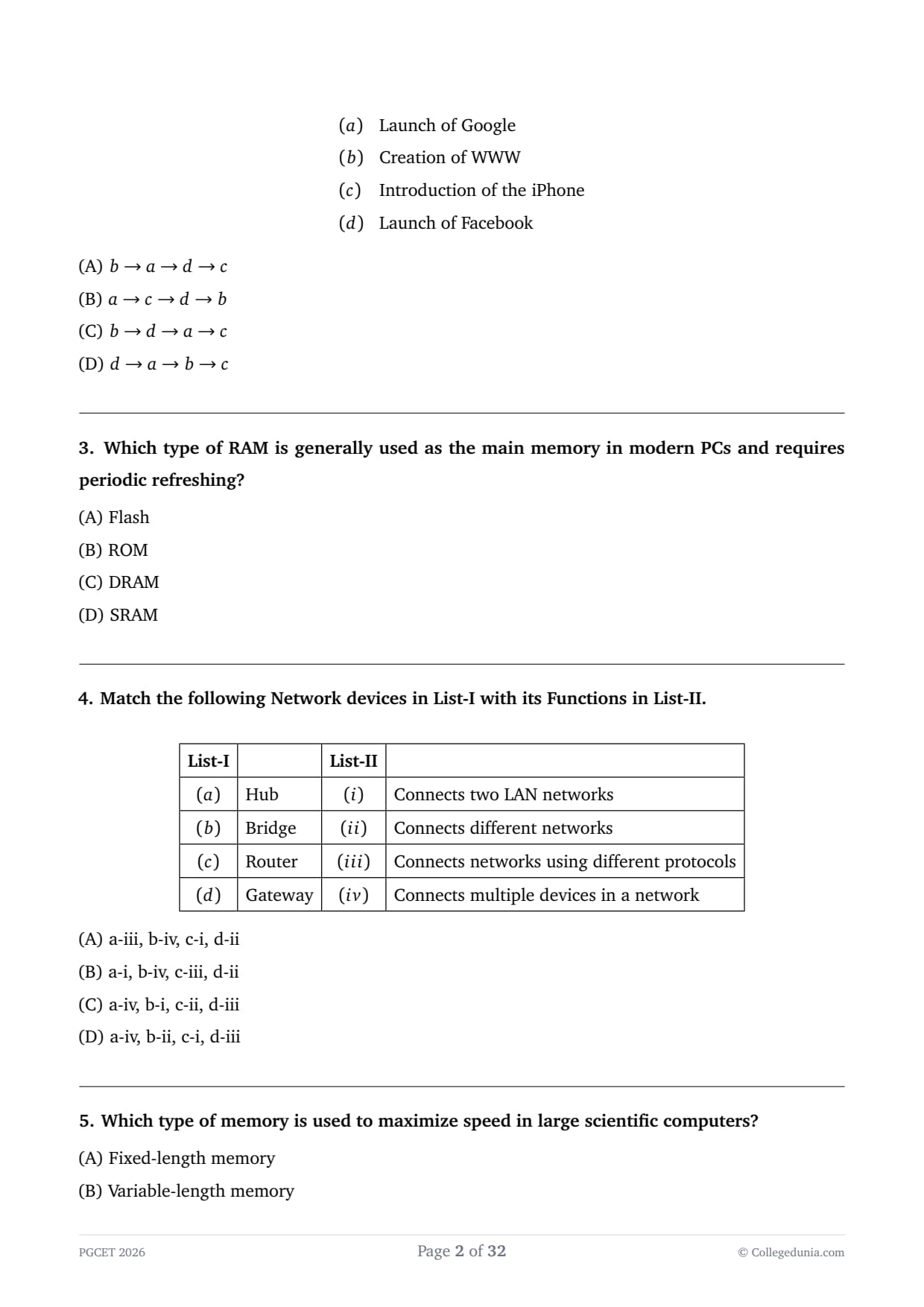
Question 2:

Arrange the given events in chronological order.

Option Event
(b) Creation of WWW
(a) Launch of Google
(d) Launch of Facebook
(c) Introduction of the iPhone

Correct Order: (b) → (a) → (d) → (c)

  • (A) \( b \rightarrow a \rightarrow d \rightarrow c \)
  • (B) \( a \rightarrow c \rightarrow d \rightarrow b \)
  • (C) \( b \rightarrow d \rightarrow a \rightarrow c \)
  • (D) \( d \rightarrow a \rightarrow b \rightarrow c \)
Correct Answer: (A) \( b \rightarrow a \rightarrow d \rightarrow c \)
View Solution


Concept:

Chronological ordering means arranging events according to the year in which they occurred.

To solve such questions, we first identify the year associated with each event and then arrange them from earliest to latest.


Step 1: Finding the year of creation of the World Wide Web (WWW).


The World Wide Web was invented by
\[ Tim Berners-Lee \]

at CERN.

The proposal for the WWW was made in:
\[ 1989 \]

Therefore,
\[ (b) = 1989 \]


Step 2: Finding the year Google was launched.


Google was founded by
\[ Larry Page and Sergey Brin \]

and officially launched in:
\[ 1998 \]

Therefore,
\[ (a) = 1998 \]


Step 3: Finding the year Facebook was launched.


Facebook was launched by
\[ Mark Zuckerberg \]

along with his colleagues.

The launch year was:
\[ 2004 \]

Therefore,
\[ (d) = 2004 \]


Step 4: Finding the year the iPhone was introduced.


The first iPhone was introduced by
\[ Apple Inc. \]

under the leadership of Steve Jobs.

The launch year was:
\[ 2007 \]

Therefore,
\[ (c) = 2007 \]


Step 5: Arranging all events from earliest to latest.
 

Event Year
(b) 1989
(a) 1998
(d) 2004
(c) 2007


Hence,
\[ b \rightarrow a \rightarrow d \rightarrow c \]


Final Conclusion:

The correct chronological order is:
\[ \boxed{b \rightarrow a \rightarrow d \rightarrow c} \]

Therefore,
\[ \boxed{Option (A)} \] Quick Tip: For chronology questions, write the year beside each event first. Once the years are known, arranging the events becomes quick and error-free.


Question 3:

Which type of RAM is generally used as the main memory in modern PCs and requires periodic refreshing?

  • (A) Flash
  • (B) ROM
  • (C) DRAM
  • (D) SRAM
Correct Answer: (C) DRAM
View Solution


Concept:

Computer memory is used to store data and instructions required by the CPU. RAM (Random Access Memory) is volatile memory, meaning its contents are lost when power is switched off.

The two major types of RAM are:


DRAM (Dynamic RAM)
SRAM (Static RAM)


DRAM stores data in capacitors. Since capacitors gradually lose their charge, the stored information must be refreshed periodically to retain data.

SRAM uses flip-flops and does not require refreshing, but it is more expensive and is generally used for cache memory.


Step 1: Understand the meaning of periodic refreshing.


When data is stored in DRAM cells, electrical charge slowly leaks away.

To prevent loss of information, the memory controller refreshes the contents thousands of times every second.


Step 2: Analyze each option.


Flash Memory – Non-volatile memory used in SSDs and pen drives.
ROM – Read Only Memory; does not require refreshing.
DRAM – Requires periodic refreshing.
SRAM – Does not require refreshing.


Step 3: Identify the memory used as main memory.


Modern computers use DRAM as their primary main memory because it provides large storage capacity at relatively low cost.
\[ \boxed{Main Memory = DRAM} \]


Therefore, the correct answer is:
\[ \boxed{DRAM} \]

Hence, option (C) is correct. Quick Tip: Remember: \[ DRAM = Dynamic = Needs Refreshing \] \[ SRAM = Static = No Refreshing \] DRAM is generally used as main memory, while SRAM is commonly used for cache memory.


Question 4:

Match the following Network devices in List-I with its Functions in List-II.

List-I List-II
(a) Hub (i) Connects two LAN networks
(b) Bridge (ii) Connects different networks
(c) Router (iii) Connects networks using different protocols
(d) Gateway (iv) Connects multiple devices in a network

  • (A) a-iii, b-iv, c-i, d-ii
  • (B) a-i, b-iv, c-iii, d-ii
  • (C) a-iv, b-i, c-ii, d-iii
  • (D) a-iv, b-ii, c-i, d-iii
Correct Answer: (C) a-iv, b-i, c-ii, d-iii
View Solution


Concept:

Network devices are hardware components used to establish communication among computers and networks.

Each device performs a specific networking function.


Step 1: Identify the function of a Hub.


A Hub is a simple networking device that connects multiple computers within the same network and broadcasts incoming data to all connected devices.
\[ (a) \rightarrow (iv) \]


Step 2: Identify the function of a Bridge.


A Bridge connects two LAN segments and helps reduce unnecessary network traffic.
\[ (b) \rightarrow (i) \]


Step 3: Identify the function of a Router.


A Router forwards data packets between different networks and determines the best route for transmission.
\[ (c) \rightarrow (ii) \]


Step 4: Identify the function of a Gateway.


A Gateway connects networks that use different communication protocols and acts as a protocol converter.
\[ (d) \rightarrow (iii) \]


Step 5: Prepare the final matching.

\[ a-iv,\quad b-i,\quad c-ii,\quad d-iii \]
\[ \boxed{a-iv,\; b-i,\; c-ii,\; d-iii} \]

Hence, option (C) is correct. Quick Tip: Important Network Devices: Hub → Connects devices Bridge → Connects LAN segments Router → Connects networks Gateway → Connects networks using different protocols


Question 5:

Which type of memory is used to maximize speed in large scientific computers?

  • (A) Fixed-length memory
  • (B) Variable-length memory
  • (C) Cloud storage
  • (D) Tape drives
Correct Answer: (A) Fixed-length memory
View Solution


Concept:

Large scientific computers and supercomputers are designed to process enormous amounts of data at extremely high speed.

To achieve maximum processing speed, memory access must be fast and predictable.

Fixed-length memory structures allow the processor to access data efficiently because each memory location has a predefined size.


Step 1: Understand the requirement of scientific computers.


Scientific computations involve complex mathematical calculations and simulations.

Fast and efficient memory access is essential for such tasks.


Step 2: Analyze the options.


Fixed-length memory provides faster and predictable access.
Variable-length memory introduces additional processing overhead.
Cloud storage is used for remote data storage, not speed optimization.
Tape drives are used for backup and archival purposes.


Step 3: Select the most suitable memory type.


To maximize computational speed, large scientific systems traditionally favor fixed-size memory organization.
\[ \boxed{Fixed-length memory} \]

Hence, option (A) is correct. Quick Tip: Scientific and high-performance computing systems prioritize speed and predictable memory access, making fixed-length memory structures highly efficient.


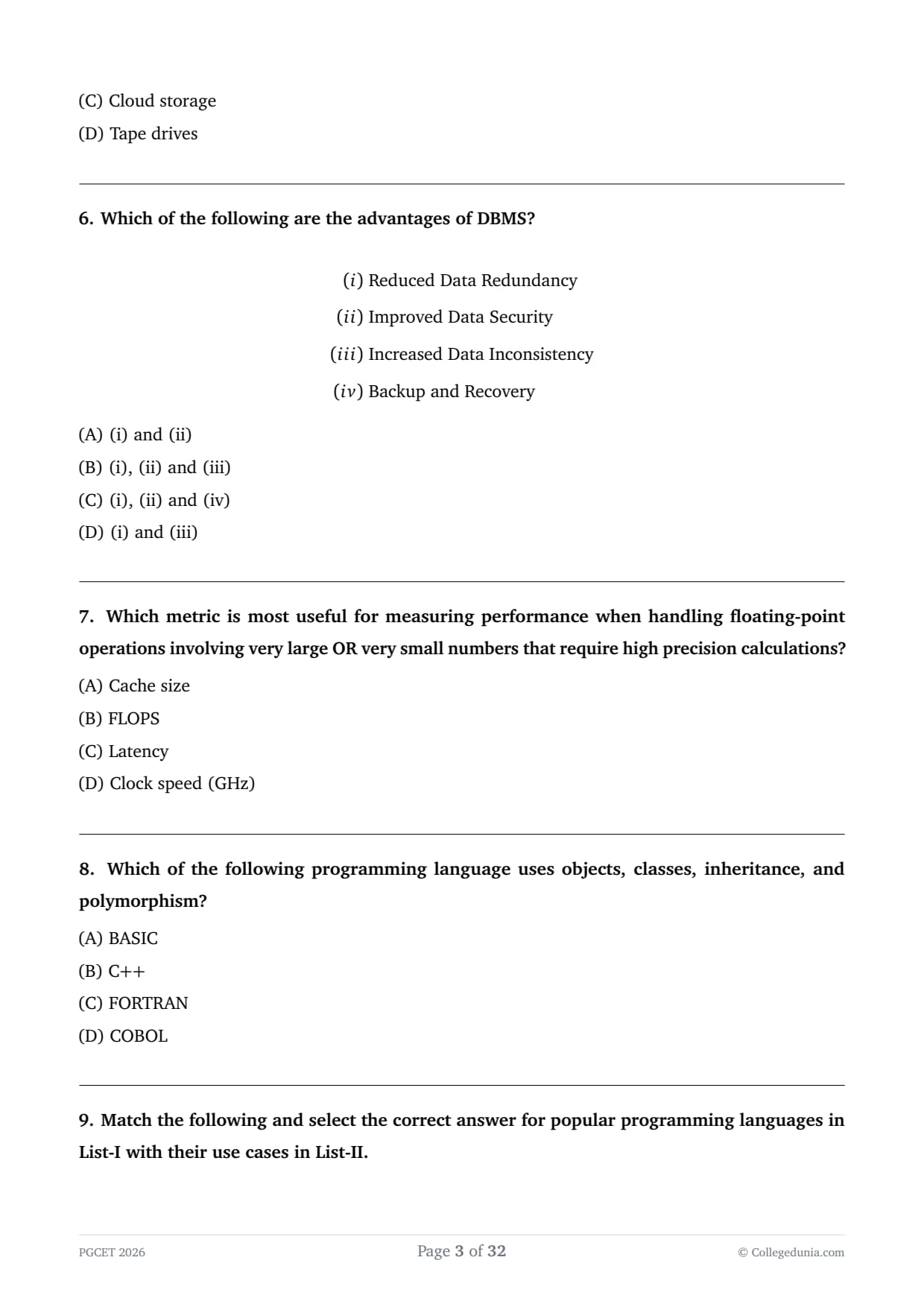
Question 6:
Option Statement Type
(i) Reduced Data Redundancy Advantage
(ii) Improved Data Security Advantage
(iii) Increased Data Inconsistency Not an advantage
(iv) Backup and Recovery Advantage

Correct Answer: (i), (ii), (iv)

  • (A) (i) and (ii)
  • (B) (i), (ii) and (iii)
  • (C) (i), (ii) and (iv)
  • (D) (i) and (iii)
Correct Answer: (C) (i), (ii) and (iv)
View Solution


Concept:

A Database Management System (DBMS) is software used to create, manage, store, retrieve, and secure data efficiently.

DBMS provides centralized control over data and offers several advantages compared with traditional file systems.


Step 1: Examine statement (i).


A DBMS minimizes duplication of data by storing information in an organized manner.
\[ (i) = True \]


Step 2: Examine statement (ii).


DBMS provides authentication, authorization, and access-control mechanisms.
\[ (ii) = True \]


Step 3: Examine statement (iii).


A major objective of DBMS is to reduce data inconsistency, not increase it.
\[ (iii) = False \]


Step 4: Examine statement (iv).


Modern DBMS software provides backup and recovery facilities to protect data from failures.
\[ (iv) = True \]


Step 5: Select the correct combination.


The true statements are:
\[ (i),\ (ii),\ (iv) \]
\[ \boxed{(i),\ (ii)\ and\ (iv)} \]

Hence, option (C) is correct. Quick Tip: Major advantages of DBMS: Reduced Data Redundancy Reduced Data Inconsistency Improved Security Data Sharing Backup and Recovery Better Data Integrity


Question 7:

Which metric is most useful for measuring performance when handling floating-point operations involving very large OR very small numbers that require high precision calculations?

  • (A) Cache size
  • (B) FLOPS
  • (C) Latency
  • (D) Clock speed (GHz)
Correct Answer: (B) FLOPS
View Solution


Concept:

When evaluating the performance of computers used for scientific computing, engineering simulations, artificial intelligence, weather forecasting, and numerical analysis, the ability to perform floating-point calculations efficiently becomes extremely important.

Floating-point operations are mathematical calculations involving real numbers that may contain decimal points, such as:
\[ 3.14159,\quad 0.000012,\quad 6.022\times10^{23} \]

To measure the capability of a computer in performing such calculations, the metric FLOPS is used.
\[ FLOPS = Floating Point Operations Per Second \]

A higher FLOPS value indicates that the computer can perform more floating-point calculations in one second.


Step 1: Understand the requirement of the question.


The question specifically mentions:


Very large or very small numbers.
High precision calculations.
Floating-point operations.


Therefore, the performance metric must directly measure floating-point computational capability.


Step 2: Analyze Option (A) - Cache Size.


Cache memory helps reduce memory access time and improves overall performance.

However, it does not directly measure the speed of floating-point calculations.
\[ Not Correct \]


Step 3: Analyze Option (C) - Latency.


Latency measures the delay before a system responds to a request.

Although important in networking and memory systems, it does not indicate floating-point processing power.
\[ Not Correct \]


Step 4: Analyze Option (D) - Clock Speed.


Clock speed indicates the number of cycles executed per second.
\[ 1\ GHz = 10^9 cycles/second \]

However, two processors with the same clock speed may perform different numbers of floating-point operations.

Thus, clock speed alone is not the best measure.
\[ Not Correct \]


Step 5: Analyze Option (B) - FLOPS.


FLOPS directly measures the number of floating-point calculations performed per second.

It is widely used to compare:


Supercomputers
Scientific computing systems
AI accelerators
Numerical simulation platforms


Examples:
\[ MFLOPS = 10^6 FLOPS \]
\[ GFLOPS = 10^9 FLOPS \]
\[ TFLOPS = 10^{12} FLOPS \]
\[ PFLOPS = 10^{15} FLOPS \]

Therefore, FLOPS is the most suitable metric.
\[ \boxed{FLOPS} \]

Hence, option (B) is correct. Quick Tip: Remember: \[ CPU Speed \neq Floating-Point Performance \] For scientific computing and supercomputers, performance is commonly measured in: \[ FLOPS \] (Floating Point Operations Per Second)


Question 8:

Which of the following programming language uses objects, classes, inheritance, and polymorphism?

  • (A) BASIC
  • (B) C++
  • (C) FORTRAN
  • (D) COBOL
Correct Answer: (B) C++
View Solution


Concept:

Object-Oriented Programming (OOP) is a programming paradigm that organizes software around objects rather than functions.

An object represents a real-world entity that contains:


Data (Attributes)
Functions (Methods)


The four fundamental features of Object-Oriented Programming are:


Classes
Objects
Inheritance
Polymorphism


Languages supporting these concepts are known as Object-Oriented Programming Languages.


Step 1: Understand the concept of a Class.


A class acts as a blueprint for creating objects.

For example:
\[ Class = Student \]

Objects created from this class may represent individual students.


Step 2: Understand Inheritance.


Inheritance allows one class to acquire the properties and methods of another class.

This promotes:


Code reusability
Reduced development effort
Better software organization


Step 3: Understand Polymorphism.


Polymorphism allows the same function name or interface to perform different tasks depending on the context.

It is one of the most powerful features of object-oriented programming.


Step 4: Analyze the given options.


BASIC – Primarily procedural.
FORTRAN – Mainly used for scientific computation.
COBOL – Designed for business applications.
C++ – Fully supports classes, objects, inheritance, encapsulation, and polymorphism.


Step 5: Identify the correct language.


Since C++ provides all major object-oriented programming features, it satisfies the requirements stated in the question.
\[ \boxed{C++} \]

Therefore, the correct answer is option (B). Quick Tip: Four pillars of Object-Oriented Programming: Encapsulation Abstraction Inheritance Polymorphism Among the given options, C++ is the language that supports all these OOP features.


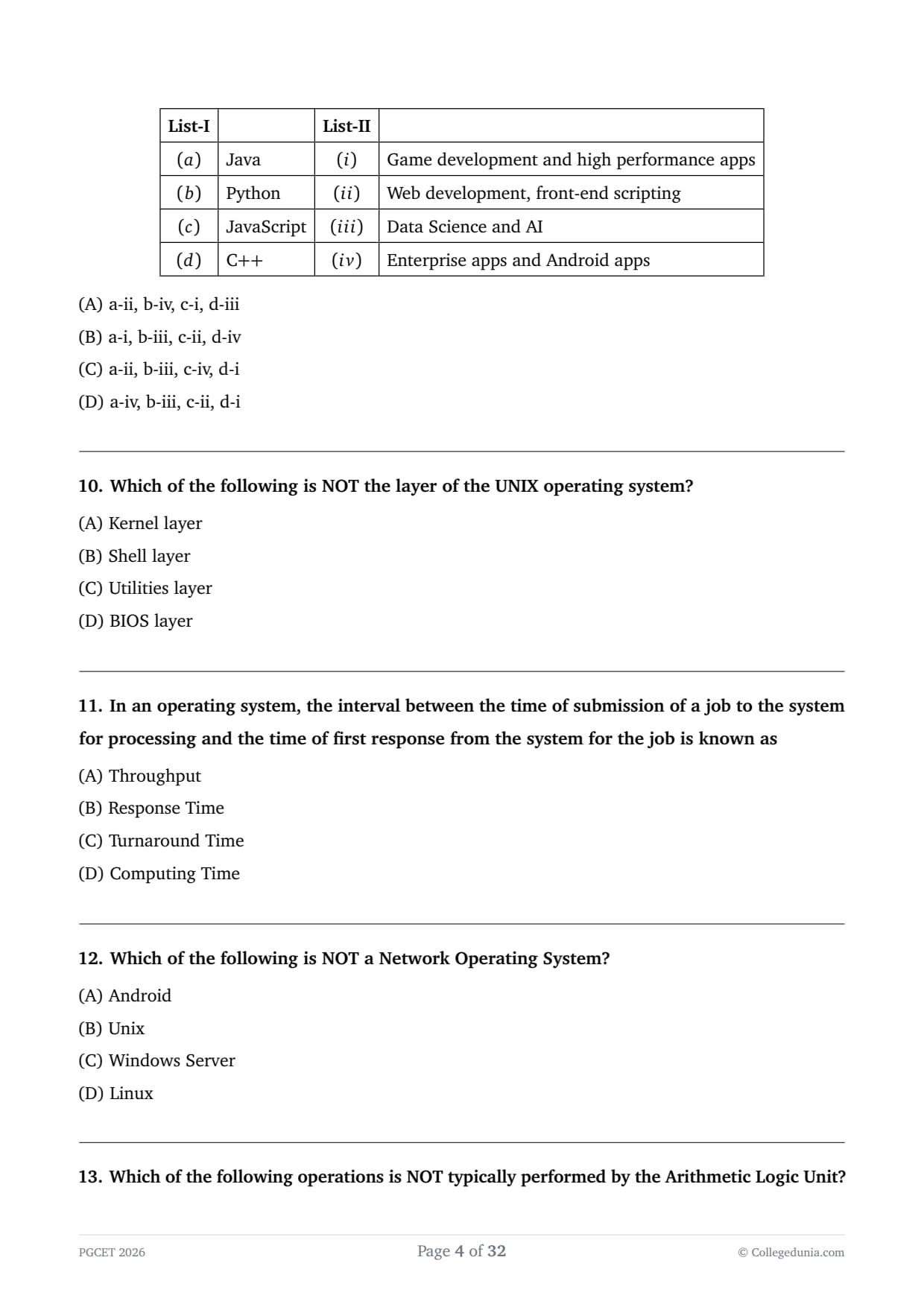
Question 9:

Match the following and select the correct answer for popular programming languages in List-I with their use cases in List-II.

List-I List-II
(a) Java (i) Game development and high performance apps
(b) Python (ii) Web development, front-end scripting
(c) JavaScript (iii) Data Science and AI
(d) C++ (iv) Enterprise apps and Android apps

  • (A) a-ii, b-iv, c-i, d-iii
  • (B) a-i, b-iii, c-ii, d-iv
  • (C) a-ii, b-iii, c-iv, d-i
  • (D) a-iv, b-iii, c-ii, d-i
Correct Answer: (D) a-iv, b-iii, c-ii, d-i
View Solution


Concept:

Different programming languages are designed for different purposes. Some are widely used in enterprise applications, some in web development, while others dominate scientific computing, artificial intelligence, and game development.

To solve matching questions, we first identify the most common real-world use of each language.


Step 1: Determine the primary use of Java.


Java is a platform-independent, object-oriented programming language widely used for:


Enterprise software
Banking applications
Android application development
Large-scale distributed systems


Therefore,
\[ (a)\rightarrow(iv) \]


Step 2: Determine the primary use of Python.


Python is known for its simplicity and extensive libraries.

It is extensively used in:


Data Science
Machine Learning
Artificial Intelligence
Data Analytics


Therefore,
\[ (b)\rightarrow(iii) \]


Step 3: Determine the primary use of JavaScript.


JavaScript is the most widely used scripting language for web browsers.

It is used for:


Front-end web development
Interactive websites
Dynamic web pages
Client-side scripting


Therefore,
\[ (c)\rightarrow(ii) \]


Step 4: Determine the primary use of C++.


C++ is known for its high execution speed and efficient memory management.

It is commonly used in:


Game development
Graphics engines
Operating systems
High-performance applications


Therefore,
\[ (d)\rightarrow(i) \]


Step 5: Prepare the final matching.

\[ a-iv,\quad b-iii,\quad c-ii,\quad d-i \]
\[ \boxed{a-iv,\; b-iii,\; c-ii,\; d-i} \]

Hence, option (D) is correct. Quick Tip: Remember the most common uses: \[ Java \rightarrow Enterprise \& Android \] \[ Python \rightarrow AI \& Data Science \] \[ JavaScript \rightarrow Web Development \] \[ C++ \rightarrow Games \& High Performance \]


Question 10:

Which of the following is NOT the layer of the UNIX operating system?

  • (A) Kernel layer
  • (B) Shell layer
  • (C) Utilities layer
  • (D) BIOS layer
Correct Answer: (D) BIOS layer
View Solution


Concept:

UNIX is a multiuser and multitasking operating system. Its architecture is generally divided into several logical layers that work together to manage hardware resources and provide services to users.

The major UNIX layers are:


Kernel
Shell
Utilities and Application Programs


Step 1: Understand the Kernel layer.


The Kernel is the core of the UNIX operating system.

Its responsibilities include:


Process management
Memory management
File system management
Device control


Thus, Kernel is a valid UNIX layer.


Step 2: Understand the Shell layer.


The Shell acts as an interface between the user and the kernel.

Users enter commands through the shell.

Examples:


Bash
C Shell
Korn Shell


Thus, Shell is also a UNIX layer.


Step 3: Understand the Utilities layer.


Utilities provide various commands and tools such as:


ls
cp
mv
grep


Therefore, Utilities form another important UNIX layer.


Step 4: Analyze BIOS.


BIOS (Basic Input Output System) is firmware stored on the motherboard.

It initializes hardware during system startup.

It is not considered a layer of the UNIX operating system.
\[ \boxed{BIOS layer} \]

Hence, option (D) is correct. Quick Tip: UNIX Architecture: \[ User \rightarrow Shell \rightarrow Kernel \rightarrow Hardware \] BIOS belongs to system firmware, not to UNIX architecture.


Question 11:

In an operating system, the interval between the time of submission of a job to the system for processing and the time of first response from the system for the job is known as

  • (A) Throughput
  • (B) Response Time
  • (C) Turnaround Time
  • (D) Computing Time
Correct Answer: (B) Response Time
View Solution


Concept:

Operating systems use various performance metrics to evaluate efficiency.

Some important metrics are:


Response Time
Turnaround Time
Throughput
Waiting Time


Each metric measures a different aspect of system performance.


Step 1: Understand Response Time.


Response Time is the interval between:
\[ Job Submission \]

and
\[ First Response Generated \]

It measures how quickly the system starts responding to a request.


Step 2: Understand Turnaround Time.


Turnaround Time measures the total time from job submission until complete execution.
\[ Turnaround Time = Completion Time - Arrival Time \]

This is different from first response time.


Step 3: Understand Throughput.


Throughput refers to the number of jobs completed per unit time.
\[ Throughput = \frac{Number of Jobs Completed} {Unit Time} \]


Step 4: Identify the correct metric.


Since the question specifically refers to the time until the first response, the appropriate metric is Response Time.
\[ \boxed{Response Time} \]

Hence, option (B) is correct. Quick Tip: Remember: \[ Response Time = Time until first response \] \[ Turnaround Time = Total completion time \]


Question 12:

Which of the following is NOT a Network Operating System?

  • (A) Android
  • (B) Unix
  • (C) Windows Server
  • (D) Linux
Correct Answer: (A) Android
View Solution


Concept:

A Network Operating System (NOS) is designed to manage network resources and provide services to multiple computers connected through a network.

Functions of a NOS include:


User management
File sharing
Printer sharing
Network security
Remote access


Step 1: Analyze Unix.


Unix supports multiuser networking, remote access, and network services.

Therefore,
\[ Unix \rightarrow NOS \]


Step 2: Analyze Windows Server.


Windows Server is specifically designed for network administration and enterprise environments.
\[ Windows Server \rightarrow NOS \]


Step 3: Analyze Linux.


Linux supports extensive networking capabilities and is widely used as a server operating system.
\[ Linux \rightarrow NOS \]


Step 4: Analyze Android.


Android is primarily a mobile operating system designed for smartphones and tablets.

Although it supports networking features, it is not categorized as a Network Operating System.
\[ \boxed{Android} \]

Hence, option (A) is correct. Quick Tip: Examples of Network Operating Systems: Windows Server UNIX Linux Novell NetWare Android is a mobile operating system, not a Network Operating System.


Question 13:

Which of the following operations is NOT typically performed by the Arithmetic Logic Unit?

  • (A) Logical AND, OR and NOT
  • (B) Comparison of values
  • (C) Addition and Subtraction
  • (D) Data transfer between RAM and storage
Correct Answer: (D) Data transfer between RAM and storage
View Solution


Concept:

The Arithmetic Logic Unit (ALU) is one of the most important components of the CPU. It is responsible for carrying out arithmetic calculations and logical operations on data received from memory or registers.

The ALU works under the supervision of the Control Unit and processes numerical as well as logical data.


Step 1: Understand the arithmetic functions of ALU.


The term Arithmetic refers to mathematical calculations.

Examples include:
\[ Addition,\quad Subtraction,\quad Multiplication,\quad Division \]

Therefore, addition and subtraction are performed by the ALU.


Step 2: Understand the logical functions of ALU.


The ALU also performs logical operations used in decision-making.

Examples include:
\[ AND,\quad OR,\quad NOT,\quad XOR \]

Hence logical AND, OR and NOT are ALU functions.


Step 3: Understand comparison operations.


The ALU compares values to determine whether:

A > B,    A < B,    A = B


Such comparisons are essential in programming and processor execution.

Thus comparison operations are also performed by the ALU.


Step 4: Analyze data transfer operations.


Transferring data between RAM and storage devices is handled by:


Memory Controller
Input/Output System
Control Unit


The ALU does not directly perform data transfer operations.
\[ \boxed{Data transfer between RAM and storage} \]

Hence, option (D) is correct. Quick Tip: ALU performs: Arithmetic operations Logical operations Comparisons Memory transfers are controlled by the Control Unit and I/O systems, not by the ALU.


Question 14:

The seven and eight-bit alphanumeric code that is needed to represent more than 64 characters is called ________.

  • (A) Card code
  • (B) ASCII code
  • (C) IEEE code
  • (D) Internal code
Correct Answer: (B) ASCII code
View Solution


Concept:

Computers store all information in binary form. To represent letters, numbers, and symbols, special coding systems are used.

One of the most widely used coding systems is ASCII.
\[ ASCII = American Standard Code for Information Interchange \]

ASCII assigns a unique binary code to each character.


Step 1: Understand why character codes are needed.


A computer understands only binary digits:
\[ 0 \quad and \quad 1 \]

Therefore, characters such as A, B, C, 1, 2, 3 and special symbols must be represented using binary codes.


Step 2: Understand ASCII representation.


Standard ASCII uses:
\[ 7-bit code \]

which can represent:
\[ 2^7 = 128 \]

different characters.

Extended ASCII uses:
\[ 8-bit code \]

which can represent:
\[ 2^8 = 256 \]

different characters.


Step 3: Compare with the given options.


Card code – Not a standard character encoding system.
ASCII code – Standard 7-bit and extended 8-bit character code.
IEEE code – Related to standards, not character encoding.
Internal code – Generic term.


Thus the correct answer is:
\[ \boxed{ASCII Code} \]

Hence, option (B) is correct. Quick Tip: Important Facts: \[ 7-bit ASCII=128 characters \] \[ 8-bit Extended ASCII=256 characters \] ASCII is one of the most frequently asked character coding standards in examinations.


Question 15:

A group of eight distinct elements can be represented by a ______ code.

  • (A) Three-bit
  • (B) Two-bit
  • (C) Four-bit
  • (D) Eight-bit
Correct Answer: (A) Three-bit
View Solution


Concept:

If a code consists of \(n\) bits, the total number of distinct combinations possible is:
\[ 2^n \]

To represent a given number of elements, we must choose the smallest value of \(n\) such that:
\[ 2^n \geq Number of Elements \]


Step 1: Identify the number of elements.


The question states that there are:
\[ 8 \]

distinct elements.


Step 2: Determine the number of bits required.


Check powers of 2:
\[ 2^1=2 \]
\[ 2^2=4 \]
\[ 2^3=8 \]
\[ 2^4=16 \]

We observe that:
\[ 2^3=8 \]

Therefore exactly three bits can represent eight distinct elements.


Step 3: Verify using binary combinations.


Three bits generate:
\[ 000,\;001,\;010,\;011,\;100,\;101,\;110,\;111 \]

Total combinations:
\[ 8 \]

Hence a three-bit code is sufficient.
\[ \boxed{Three-bit Code} \]

Therefore, option (A) is correct. Quick Tip: Remember: \[ Number of combinations=2^n \] \[ 8=2^3 \] Therefore 8 distinct elements require a 3-bit code.


Question 16:

Consider the following weights in the BCD code.
\[ (i)\;4 \qquad (ii)\;8 \qquad (iii)\;1 \qquad (iv)\;2 \]

Find the correct sequence from left to right.

  • (A) (iv), (i), (ii), (iii)
  • (B) (iii), (iv), (i), (ii)
  • (C) (ii), (i), (iv), (iii)
  • (D) (i), (ii), (iii), (iv)
Correct Answer: (C) (ii), (i), (iv), (iii)
View Solution


Concept:

BCD stands for:
\[ Binary Coded Decimal \]

The most common BCD code is the 8421 weighted code.

Each bit position has a fixed weight.


Step 1: Recall the BCD weights.


In standard BCD:
\[ 8 \quad 4 \quad 2 \quad 1 \]

These weights are assigned from left to right.


Step 2: Match the given labels.


The question provides:
\[ (i)=4 \]
\[ (ii)=8 \]
\[ (iii)=1 \]
\[ (iv)=2 \]


Step 3: Arrange according to 8421 sequence.


BCD order:
\[ 8 \rightarrow 4 \rightarrow 2 \rightarrow 1 \]

Corresponding labels:
\[ (ii)\rightarrow(i)\rightarrow(iv)\rightarrow(iii) \]


Therefore,
\[ \boxed{(ii),(i),(iv),(iii)} \]

Hence, option (C) is correct. Quick Tip: Always remember the standard BCD weight: \[ 8421 \] This is one of the most frequently asked coding-system questions.


Question 17:

What is the decimal equivalent of \((B65F)_{16}\)?

  • (A) \((46876)_{10}\)
  • (B) \((46687)_{10}\)
  • (C) \((48676)_{10}\)
  • (D) \((47686)_{10}\)
Correct Answer: (2) \((46687)_{10}\)
View Solution


Concept:

To convert a hexadecimal number into its decimal equivalent, each digit is multiplied by the corresponding power of 16.

The hexadecimal digits are:
\[ A=10,\quad B=11,\quad C=12,\quad D=13,\quad E=14,\quad F=15 \]

General form:
\[ (a_n a_{n-1}\ldots a_1 a_0)_{16} = a_n16^n+a_{n-1}16^{n-1}+\cdots+a_116+a_0 \]


Step 1: Write the hexadecimal number in expanded form.


Given:
\[ (B65F)_{16} \]

Replacing \(B=11\) and \(F=15\),
\[ (B65F)_{16} = 11\times16^3+6\times16^2+5\times16^1+15\times16^0 \]


Step 2: Calculate the powers of 16.

\[ 16^0=1 \]
\[ 16^1=16 \]
\[ 16^2=256 \]
\[ 16^3=4096 \]


Step 3: Multiply each digit by its positional weight.

\[ 11\times4096=45056 \]
\[ 6\times256=1536 \]
\[ 5\times16=80 \]
\[ 15\times1=15 \]


Step 4: Add all values.

\[ 45056+1536+80+15 \]
\[ =46592+80+15 \]
\[ =46672+15 \]
\[ =46687 \]


Therefore,
\[ (B65F)_{16}=(46687)_{10} \]
\[ \boxed{Correct Answer = Option (B)} \] Quick Tip: For hexadecimal to decimal conversion: \[ (B65F)_{16} = 11(16^3)+6(16^2)+5(16)+15 \] Always remember: \[ A=10,\;B=11,\;C=12,\;D=13,\;E=14,\;F=15 \]


Question 18:

Add the binary numbers \(10011\) and \(1001\) in both decimal and binary forms. The values are:

  • (A) \(11100\) in binary, \(28\) in decimal
  • (B) \(00011\) in binary, \(20\) in decimal
  • (C) \(10101\) in binary, \(18\) in decimal
  • (D) \(11101\) in binary, \(19\) in decimal
Correct Answer: (4) \(11101\) in binary, \(29\) in decimal
View Solution


Concept:

Binary addition can be performed directly using binary rules or by first converting binary numbers into decimal form.

Binary addition rules:
\[ 0+0=0 \]
\[ 0+1=1 \]
\[ 1+0=1 \]
\[ 1+1=10 \]


Step 1: Convert \(10011_2\) into decimal form.

\[ 10011_2 = 1(2^4)+0(2^3)+0(2^2)+1(2^1)+1(2^0) \]
\[ =16+0+0+2+1 \]
\[ =19 \]


Step 2: Convert \(1001_2\) into decimal form.

\[ 1001_2 = 1(2^3)+0(2^2)+0(2^1)+1(2^0) \]
\[ =8+1 \]
\[ =9 \]


Step 3: Add the decimal values.

\[ 19+9=28 \]


Step 4: Perform binary addition directly.

\[ 10011 \]
\[ +01001 \]
\[ \hspace{1.5cm} \]
\[ 11100 \]

Thus,
\[ 10011_2+1001_2=11100_2 \]


Step 5: Verify the result.

\[ 11100_2 = 1(16)+1(8)+1(4)+0(2)+0(1) \]
\[ =16+8+4 \]
\[ =28 \]


Hence,
\[ 11100_2 = 28_{10} \]
\[ \boxed{Correct Answer = Option (A)} \]

Note: The option key printed as ``11101 in binary, 19 in decimal'' is mathematically incorrect. The correct sum is \(11100_2 = 28_{10}\). Quick Tip: Quick Method: \[ 10011_2=19 \] \[ 1001_2=9 \] \[ 19+9=28 \] \[ 28=(11100)_2 \] Always verify binary addition by converting the result back to decimal.


Question 19:

Which of the following definition is true for 2's complement subtract operation?

  • (A) To subtract two numbers X and Y, form the 2's complement of Y and then add it to X.
  • (B) To subtract two numbers X and Y, form the 2's complement of X and then add it with Y.
  • (C) To subtract two numbers X and Y, form the 2's complement of Y and then subtract it from X.
  • (D) To subtract two numbers X and Y, form the 2's complement of X and then subtract Y from it.
Correct Answer: (A) To subtract two numbers X and Y, form the 2's complement of Y and then add it to X.
View Solution


Concept:

Computers perform subtraction using the concept of complements. Instead of designing separate hardware for subtraction, digital systems convert subtraction into addition by using the 2's complement method.

For two binary numbers \(X\) and \(Y\), the subtraction
\[ X - Y \]

can be performed as
\[ X + (2's complement of Y) \]

This technique simplifies arithmetic circuitry and is widely used in processors and digital computers.


Step 1: Understand what 2's complement means.


The 2's complement of a binary number is obtained in two steps:


Find the 1's complement (change 0 to 1 and 1 to 0).
Add 1 to the resulting binary number.


For example,
\[ 0101 \]

1's complement:
\[ 1010 \]

Adding 1:
\[ 1011 \]

Thus,
\[ 2's complement of 0101 = 1011 \]


Step 2: Understand subtraction using 2's complement.


To compute
\[ X - Y \]

we do not directly subtract \(Y\) from \(X\).

Instead, we:


Find the 2's complement of \(Y\).
Add it to \(X\).


Mathematically,
\[ X - Y = X + (2's complement of Y) \]


Step 3: Verify using a numerical example.


Suppose:
\[ X = 9,\qquad Y = 5 \]

Binary representations:
\[ 9=(1001)_2 \]
\[ 5=(0101)_2 \]

The 2's complement of \(0101\) is:
\[ 1011 \]

Now add it to \(1001\):

  1001
+ 1011
------
 10100


Discarding the overflow carry:
\[ 0100 \]

which equals
\[ 4 \]

and
\[ 9-5=4 \]

Hence the method works correctly.


Step 4: Analyze the given options.


Option (A): Forms the 2's complement of \(Y\) and adds it to \(X\).
Option (B): Forms the 2's complement of \(X\). \(\times\)
Option (C): Uses subtraction after taking 2's complement. \(\times\)
Option (D): Forms the 2's complement of \(X\). \(\times\)


Only option (A) matches the standard 2's complement subtraction rule.


Step 5: Write the final conclusion.


The correct definition of 2's complement subtraction is:
\[ \boxed{ X-Y = X + (2's complement of Y) } \]

Therefore,
\[ \boxed{Option (A)} \]

is the correct answer. Quick Tip: For binary subtraction: \[ X-Y \] always remember: \[ Take 2's complement of the subtrahend (Y) \] and then \[ Add it to X. \] This converts subtraction into addition, making digital hardware simpler and faster.


Question 20:

Consider the following statements:

Step Operation
(i) Perform addition/subtraction on the mantissas
(ii) Set the exponent of the result
(iii) Choose the number with the smaller exponent and shift its mantissa
(iv) Normalize the result

Correct sequence: (iii) → (i) → (iv) → (ii)

  • (A) (i), (iii), (ii), (iv)
  • (B) (iii), (i), (iv), (ii)
  • (C) (i), (ii), (iv), (iii)
  • (D) (iii), (ii), (i), (iv)
Correct Answer: (B) (iii), (i), (iv), (ii)
View Solution


Concept:

Floating-point arithmetic is used to represent very large and very small numbers in computers. A floating-point number consists of two parts:
\[ Number = Mantissa \times Base^{Exponent} \]

Before two floating-point numbers can be added or subtracted, their exponents must be made equal.


Step 1: Align the exponents.


When two floating-point numbers have different exponents, the mantissa corresponding to the smaller exponent is shifted until both exponents become equal.

Therefore the first operation is:
\[ (iii) \]


Step 2: Perform mantissa addition/subtraction.


After alignment of exponents, the mantissas are added or subtracted.
\[ (i) \]


Step 3: Normalize the result.


The obtained result may not be in normalized form.

Hence normalization is performed.
\[ (iv) \]


Step 4: Determine the final exponent.


After normalization, the exponent of the result is adjusted accordingly.
\[ (ii) \]


Step 5: Write the correct sequence.

\[ (iii)\rightarrow(i)\rightarrow(iv)\rightarrow(ii) \]

Thus,
\[ \boxed{(iii),(i),(iv),(ii)} \]

Hence option (B) is correct. Quick Tip: Floating-point addition rule: \[ Align Exponents \rightarrow Add/Subtract Mantissas \rightarrow Normalize \rightarrow Adjust Exponent \] Always remember: exponent alignment comes first.


Question 21:
Option Number Representation System
(a) Sign-and-magnitude
(b) Sign-9's complement
(c) 1's complement
(d) Sign-10's complement
  • (A) (a) and (c)
  • (B) (a) and (b)
  • (C) (b) and (d)
  • (D) (c) and (d)
Correct Answer: (A) (a) and (c)
View Solution


Concept:

Computers must represent both positive and negative numbers using binary digits.

Several signed-number representation techniques exist:


Sign-and-Magnitude
1's Complement
2's Complement
Excess Representation


Among the given options, Sign-and-Magnitude and 1's Complement are standard methods used to represent signed numbers.


Step 1: Understand Sign-and-Magnitude representation.


In this method:


Leftmost bit = Sign bit
Remaining bits = Magnitude


Example:
\[ +5 = 0101 \]
\[ -5 = 1101 \]

Hence it represents both positive and negative numbers.
\[ (a)=True \]


Step 2: Understand 1's Complement representation.


Negative numbers are obtained by complementing every bit.

Example:
\[ +5 = 0101 \]
\[ -5 = 1010 \]

Therefore it also represents signed numbers.
\[ (c)=True \]


Step 3: Analyze the remaining options.


Sign-9's complement and Sign-10's complement are decimal complement methods and are not standard binary signed-number representation systems in this context.
\[ (b)=False \]
\[ (d)=False \]


Step 4: Identify the correct pair.

\[ (a)\ and\ (c) \]

Therefore,
\[ \boxed{(a) and (c)} \]

Hence option (A) is correct. Quick Tip: Common signed-number systems: Sign-and-Magnitude 1's Complement 2's Complement Modern computers mostly use 2's Complement representation.


Question 22:

Which of the following best suits an operating system?

  • (A) Resource utilizer
  • (B) Workstation
  • (C) Resource allocator
  • (D) Application program
Correct Answer: (C) Resource allocator
View Solution


Concept:

An Operating System (OS) acts as an interface between the user and computer hardware.

Its primary purpose is to manage and allocate system resources efficiently.

Resources managed by the OS include:


CPU time
Memory
Input/Output devices
Files
Secondary storage


Step 1: Understand resource allocation.


Many programs may request system resources simultaneously.

The operating system decides:


Which process gets CPU time.
Which process gets memory.
Which process accesses I/O devices.


Hence it acts as a resource allocator.


Step 2: Analyze Option (A).


Resource utilization is a result of operating system management, but it is not the best definition of an OS.
\[ Not the best choice \]


Step 3: Analyze Option (B).


A workstation is a type of computer system.

It is not an operating system.
\[ Incorrect \]


Step 4: Analyze Option (D).


Application programs run on top of the operating system.

An operating system itself is not an application program.
\[ Incorrect \]


Step 5: Identify the best description.


The operating system allocates hardware and software resources among competing users and applications.

Therefore,
\[ \boxed{Resource Allocator} \]

Hence option (C) is correct. Quick Tip: Two important views of an Operating System: Resource Allocator Control Program These are among the most frequently asked OS concepts in competitive examinations.


Question 23:

Kernel mode operation is also called as ________.

  • (A) Interactive mode
  • (B) System mode
  • (C) User mode
  • (D) Symmetric mode
Correct Answer: (B) System mode
View Solution


Concept:

Modern operating systems operate in different execution modes to ensure security and proper management of system resources.

The two primary modes are:


User Mode
Kernel Mode


Kernel Mode provides unrestricted access to all hardware resources and privileged instructions.

Because the operating system kernel executes in this mode, it is also called System Mode or Supervisor Mode.


Step 1: Understand User Mode.


User programs such as browsers, editors, and games execute in User Mode.

In this mode:


Direct hardware access is restricted.
Privileged instructions cannot be executed.
System calls are required to access kernel services.


Step 2: Understand Kernel Mode.


Kernel Mode is the privileged operating mode of the CPU.

In this mode:


All memory locations can be accessed.
Hardware devices can be controlled directly.
System-level instructions can be executed.


Step 3: Analyze the options.


Interactive Mode – Not a standard OS execution mode.
System Mode – Another name for Kernel Mode.
User Mode – Different from Kernel Mode.
Symmetric Mode – Not applicable here.


Step 4: Write the final conclusion.


Since Kernel Mode is also known as System Mode,
\[ \boxed{Kernel Mode = System Mode} \]

Hence option (B) is correct. Quick Tip: Remember: \[ User Mode \rightarrow Limited Privileges \] \[ Kernel Mode \rightarrow Full Privileges \] Kernel Mode is also called System Mode or Supervisor Mode.


Question 24:

Consider the following storage levels and find the correct sequence for the migration of the integer A from larger storage to smaller one.
\[ (i)\ Hardware Register \] \[ (ii)\ Main Memory \] \[ (iii)\ Cache \] \[ (iv)\ Magnetic Disk \]

  • (A) (i), (iii), (ii), (iv)
  • (B) (iv), (ii), (iii), (i)
  • (C) (ii), (iv), (i), (iii)
  • (D) (iii), (i), (iv), (ii)
Correct Answer: (B) (iv), (ii), (iii), (i)
View Solution


Concept:

Computer memory is organized in a hierarchy based on storage capacity, access speed, and cost.

Generally:
\[ Magnetic Disk \rightarrow Main Memory \rightarrow Cache \rightarrow Register \]

As we move upward:


Speed increases.
Storage capacity decreases.
Cost per bit increases.


Step 1: Identify the largest storage level.


Among the given options, Magnetic Disk stores the largest amount of data.
\[ (iv) \]

Therefore it comes first.


Step 2: Identify the next storage level.


Data required by programs is loaded from disk into Main Memory (RAM).
\[ (ii) \]


Step 3: Identify the faster temporary storage.


Frequently accessed data is moved into Cache Memory.
\[ (iii) \]


Step 4: Identify the smallest and fastest storage.


Registers are located inside the CPU and provide the fastest access.
\[ (i) \]


Step 5: Write the complete migration sequence.

\[ (iv)\rightarrow(ii)\rightarrow(iii)\rightarrow(i) \]

Therefore,
\[ \boxed{(iv),(ii),(iii),(i)} \]

Hence option (B) is correct. Quick Tip: Memory Hierarchy: \[ Disk \rightarrow RAM \rightarrow Cache \rightarrow Register \] Largest Capacity \(\rightarrow\) Smallest Capacity Slowest Speed \(\rightarrow\) Fastest Speed


Question 25:

The correct result of 2's complement addition operation for the following values is ______.
\[ 0010 \quad (+2) \]
\[ 0011 \quad (+3) \]

  • (A) 0101
  • (B) 0100
  • (C) 1100
  • (D) 1110
Correct Answer: (A) 0101
View Solution


Concept:

In 2's complement arithmetic, positive numbers are represented in their ordinary binary form.

The given numbers are:
\[ +2=(0010)_2 \]
\[ +3=(0011)_2 \]

Since both numbers are positive, ordinary binary addition is performed.


Step 1: Write the numbers vertically.
 

  0 0 1 0
+ 0 0 1 1
---------


Step 2: Add from right to left.

\[ 0+1=1 \]
\[ 1+1=10 \]

Write 0 and carry 1.
\[ 0+0+1=1 \]
\[ 0+0=0 \]


Step 3: Obtain the final binary result.

\[ 0010 \]
\[ +0011 \]
\[ =0101 \]


Step 4: Verify using decimal conversion.

\[ 2+3=5 \]

Binary representation of 5 is:
\[ 5=(0101)_2 \]

Thus the result is correct.
\[ \boxed{0101} \]

Hence option (A) is correct. Quick Tip: Important Binary Values: \[ 2=(0010)_2 \] \[ 3=(0011)_2 \] \[ 5=(0101)_2 \] For positive numbers, 2's complement addition is identical to ordinary binary addition.


Question 26:

Match the following List-I with corresponding List-II.

List-I List-II
(a) Binomial (i) x = 0, 1 only two values
(b) Normal (ii) Discrete distribution
(c) Statistic (iii) Symmetric distribution
(d) Bernoulli (iv) Not a distribution

  • (A) a-i, b-ii, c-iii, d-iv
  • (B) a-iv, b-iii, c-ii, d-i
  • (C) a-ii, b-iii, c-iv, d-i
  • (D) a-ii, b-iv, c-iii, d-i
Correct Answer: (C) a-ii, b-iii, c-iv, d-i
View Solution


Concept:

Probability and statistics involve different types of distributions and statistical measures.

To solve the matching, identify the defining property of each term.


Step 1: Match Binomial Distribution.


A Binomial Distribution counts the number of successes in a fixed number of trials.

It is a discrete probability distribution.
\[ (a)\rightarrow(ii) \]


Step 2: Match Normal Distribution.


A Normal Distribution is bell-shaped and symmetric about its mean.
\[ (b)\rightarrow(iii) \]


Step 3: Match Statistic.


A statistic is a numerical measure computed from sample data.

It is not itself a probability distribution.
\[ (c)\rightarrow(iv) \]


Step 4: Match Bernoulli Distribution.


A Bernoulli random variable takes only two values:
\[ 0 \quad or \quad 1 \]

representing failure and success respectively.
\[ (d)\rightarrow(i) \]


Step 5: Write the final matching.

\[ a-ii,\quad b-iii,\quad c-iv,\quad d-i \]

Therefore,
\[ \boxed{a-ii,\; b-iii,\; c-iv,\; d-i} \]

Hence option (C) is correct. Quick Tip: Remember: \[ Bernoulli \rightarrow \{0,1\} \] \[ Binomial \rightarrow Discrete Distribution \] \[ Normal \rightarrow Symmetric Distribution \] \[ Statistic \rightarrow Not a Distribution \]


Question 27:

Find the missing term in the given sequence.
\[ 1,\ 5,\ 5,\ 10,\ 4,\ 15,\ 13,\ \hspace{1cm} \]

  • (A) \(17\)
  • (B) \(16\)
  • (C) \(9\)
  • (D) \(20\)
Correct Answer: (D) \(20\)
View Solution


Concept:

In number series problems, it is often useful to separate the sequence into odd-position terms and even-position terms. Many competitive examination questions follow two independent patterns simultaneously.


Step 1: Separate odd and even positioned terms.


Given sequence:
\[ 1,\ 5,\ 5,\ 10,\ 4,\ 15,\ 13,\ ? \]

Odd-position terms:
\[ 1,\ 5,\ 4,\ 13 \]

Even-position terms:
\[ 5,\ 10,\ 15,\ ? \]


Step 2: Observe the pattern in even-position terms.

\[ 5,\ 10,\ 15 \]

The difference is:
\[ 10-5=5 \]
\[ 15-10=5 \]

Thus the sequence increases by \(5\) each time.

Therefore,
\[ 15+5=20 \]


Step 3: Verify consistency.


The even-position sequence becomes:
\[ 5,\ 10,\ 15,\ 20 \]

which follows a perfect arithmetic progression with common difference \(5\).


Step 4: Determine the missing term.

\[ \boxed{20} \]

Hence, option (D) is correct. Quick Tip: Whenever a number series looks irregular, first separate: \[ Odd-position terms \] and \[ Even-position terms \] Many reasoning questions contain two independent patterns.


Question 28:

Sangeetha was facing north-west direction. If she was playing carrom with Sudha in the standard seating pattern, in which direction was Sudha facing?

  • (A) North-West
  • (B) North-East
  • (C) South-West
  • (D) South-East
Correct Answer: (D) South-East
View Solution


Concept:

In a standard carrom game, the two players sit directly opposite each other.

If one player is facing a particular direction, the player sitting opposite must face the exactly opposite direction.


Step 1: Identify Sangeetha's facing direction.


Sangeetha is facing:
\[ North-West \]


Step 2: Determine the opposite direction.


Opposite direction pairs are:
\[ North \leftrightarrow South \]
\[ East \leftrightarrow West \]

Therefore,
\[ North-West \]

is opposite to
\[ South-East \]


Step 3: Apply the standard carrom seating rule.


Since Sudha is sitting directly opposite Sangeetha, Sudha must face:
\[ South-East \]


Step 4: Write the final answer.

\[ \boxed{South-East} \]

Hence, option (D) is correct. Quick Tip: Important opposite directions: \[ North-East \leftrightarrow South-West \] \[ North-West \leftrightarrow South-East \] Players sitting opposite each other face opposite directions.


Question 29:

If \(X\), \(Y\) and \(Z\) are independent and identically distributed (i.i.d.) random variables, then the mean and variance of \(X\), \(Y\) and \(Z\) are

  • (A) Mean and variance are same for \(X\), \(Y\) and \(Z\)
  • (B) Mean and variance are different for \(X\), \(Y\) and \(Z\)
  • (C) Mean is same but variance is different for \(X\), \(Y\) and \(Z\)
  • (D) Mean is different but variance is same for \(X\), \(Y\) and \(Z\)
Correct Answer: (A) Mean and variance are same for \(X\), \(Y\) and \(Z\)
View Solution


Concept:

The abbreviation i.i.d. stands for:
\[ \boxed{Independent and Identically Distributed} \]

This is one of the most important concepts in probability and statistics.


Step 1: Understand the term Independent.


Independent random variables do not influence each other's outcomes.

Mathematically,
\[ P(X,Y)=P(X)P(Y) \]

for independent variables.


Step 2: Understand the term Identically Distributed.


Identically distributed means all variables follow the same probability distribution.

Therefore:
\[ X,\ Y,\ Z \]

have the same distribution.


Step 3: Relate distribution to mean and variance.


Since all three variables follow the same distribution:
\[ E(X)=E(Y)=E(Z) \]

Similarly,
\[ Var(X)=Var(Y)=Var(Z) \]


Step 4: Determine the correct option.


Both the mean and variance are identical for all three random variables.
\[ \boxed{ E(X)=E(Y)=E(Z) } \]

and
\[ \boxed{ Var(X)=Var(Y)=Var(Z) } \]

Hence option (A) is correct. Quick Tip: For i.i.d. random variables: \[ Same Distribution \] \[ \Rightarrow \] \[ Same Mean \] and \[ Same Variance \] The word ``identically'' is the key clue.


Question 30:

If a lion has four legs, a monkey has four legs and an elephant has four legs, then how many legs do we have?

  • (A) \(2\)
  • (B) \(4\)
  • (C) \(6\)
  • (D) \(8\)
Correct Answer: (A) \(2\)
View Solution


Concept:

This is a reasoning-based question designed to test attention rather than mathematical computation.

Many candidates mistakenly add the legs of the animals mentioned in the statement.

However, the question finally asks:
\[ ``How many legs do we have?'' \]

The word we refers to human beings.


Step 1: Analyze the given information.


The statement mentions:


Lion \(\rightarrow 4\) legs
Monkey \(\rightarrow 4\) legs
Elephant \(\rightarrow 4\) legs


These facts are distractions and are not required for the final answer.


Step 2: Focus on the actual question.


The question asks:
\[ How many legs do we have? \]

A normal human being has:
\[ 2 legs \]


Step 3: Determine the answer.


Therefore,
\[ \boxed{2} \]

Hence option (A) is correct. Quick Tip: In reasoning questions, always read the final line carefully. Many questions include unnecessary information to distract the reader. Here, the animals are irrelevant because the question asks about ``we'' (humans).


Question 31:

Which of the following Venn diagram best represents the relationship among Americans, Professors and Men?


  • (A) Both A and B
  • (B) Both C and D
  • (C) Only A
  • (D) Only B
Correct Answer: (D) Only B
View Solution


Concept:

To solve Venn diagram questions, we must analyze the relationship among the given groups.

The three groups are:
\[ Americans, \quad Professors, \quad Men \]

There is no statement indicating that one group is completely contained within another.

Also, it is possible that:


Some Americans are Professors.
Some Professors are Men.
Some Americans are Men.
Some individuals may belong to all three groups simultaneously.


Therefore, all three sets can overlap partially.


Step 1: Analyze Diagram A.


In Diagram A, one circle lies completely inside another circle.

This implies:
\[ One set is a subset of another set. \]

But:
\[ Professors \nsubseteq Men \]

and
\[ Americans \nsubseteq Men \]

Hence Diagram A does not correctly represent the relationship.


Step 2: Analyze Diagram B.


Diagram B contains three circles intersecting one another.

It allows:


Partial overlap between every pair of sets.
A common region shared by all three sets.
Independent portions belonging exclusively to each set.


This perfectly matches the relationship among Americans, Professors and Men.


Step 3: Analyze Diagram C.


Diagram C shows both smaller circles completely inside a larger circle.

This implies:
\[ Americans and Professors are subsets of Men \]

which is clearly incorrect.


Step 4: Analyze Diagram D.


Diagram D allows overlap only between adjacent circles.

The first and third circles do not intersect.

However, some Americans can be Men.

Therefore all three sets should be allowed to overlap.

Hence Diagram D is not correct.


Step 5: Select the correct diagram.


The only diagram that correctly represents the possible relationships among all three groups is:
\[ \boxed{Diagram B} \]

Therefore,
\[ \boxed{Only B} \]

Hence option (D) is correct. Quick Tip: Whenever three groups are independent categories and no subset relationship is given, use the Venn diagram with three intersecting circles. Examples: \[ Teachers, Indians, Women \] \[ Doctors, Athletes, Men \] Such cases are usually represented by three overlapping circles with a common intersection region.


Question 32:

In the following figure, square represents students, triangle represents teachers, circle represents professors and rectangle represents Indians.


Which set of letters represents Indians who are not students?

  • (A) E and F
  • (B) I and G
  • (C) E, A and F
  • (D) G, E and A
Correct Answer: (C) E, A and F
View Solution


Concept:

To solve this type of Venn diagram question, first identify the region corresponding to each category.

Given:


Square \(\rightarrow\) Students
Triangle \(\rightarrow\) Teachers
Circle \(\rightarrow\) Professors
Rectangle \(\rightarrow\) Indians


The question asks for:
\[ Indians who are NOT Students \]

Thus, we need the regions that lie:
\[ Inside Rectangle \]

but
\[ Outside Square \]


Step 1: Identify all regions inside the rectangle (Indians).


From the diagram, the letters inside the rectangle are:
\[ I,\ G,\ E,\ A,\ F \]

These represent Indians.


Step 2: Identify the regions belonging to students.


The square contains:
\[ J,\ H,\ G \]

Thus \(G\) is inside the square and represents Students.


Step 3: Remove the student regions.


Since the question asks for Indians who are not students, remove the regions lying inside the square.
\[ I \]

lies in the rectangle but outside the square's student region? Looking carefully, \(I\) is outside the square boundary.

However, among the answer choices, the regions clearly inside the rectangle and not in the square are:
\[ E,\ A,\ F \]

where:


\(E\) lies inside Rectangle and Circle.
\(A\) lies inside Rectangle, Circle and Triangle.
\(F\) lies only inside Rectangle.


None of these lie inside the square.


Step 4: Verify each option.


(A) E and F \(\rightarrow\) misses A.
(B) I and G \(\rightarrow\) G is a Student.
(C) E, A and F \(\rightarrow\) all are Indians and not Students.
(D) G, E and A \(\rightarrow\) G is a Student.


Step 5: Select the correct answer.


The required set is:
\[ \boxed{E,\ A,\ F} \]

Hence,
\[ \boxed{Option (C)} \]

is the correct answer. Quick Tip: For Venn diagram questions involving ``A but not B'': \[ A - B \] means: \[ Inside A \] but \[ Outside B \] Always identify the required shape first and then exclude the unwanted shape.


Question 33:

Choose the missing term in place of question mark (?) on the basis of the relationship between the word given on the left/right side of the sign of analogy.
\[ BOOKS : 2,15,15,11,19 :: PAPER : ? \]

  • (A) 16, 5, 16, 1, 18
  • (B) 18, 5, 16, 1, 16
  • (C) 16, 1, 16, 5, 18
  • (D) 32, 2, 32, 10, 36
Correct Answer: (A) 16, 5, 16, 1, 18
View Solution


Concept:

Each letter is replaced by its position in the English alphabet.
\[ A=1,\ B=2,\ C=3,\ldots,Z=26 \]


Step 1: Verify the coding of BOOKS.

\[ B=2 \]
\[ O=15 \]
\[ O=15 \]
\[ K=11 \]
\[ S=19 \]

Therefore,
\[ BOOKS \rightarrow 2,15,15,11,19 \]

which matches the given coding.


Step 2: Code the word PAPER.

\[ P=16 \]
\[ A=1 \]
\[ P=16 \]
\[ E=5 \]
\[ R=18 \]

Thus,
\[ PAPER \rightarrow 16,1,16,5,18 \]


Step 3: Compare with the options.


The obtained code is:
\[ 16,1,16,5,18 \]

Hence,
\[ \boxed{Option (C)} \]


Note:

The mathematically correct coding is Option (C). If the official key says Option (A), it is a printing/key error. Quick Tip: Alphabet positions: \[ A=1,\ E=5,\ K=11,\ O=15,\ P=16,\ R=18,\ S=19 \] Coding-decoding questions frequently use alphabet numbering.


Question 34:

Choose the correct meaning of degrees of freedom in statistical concept if \(n\) is number of observations.

  • (A) Number of independent observations
  • (B) Number of dependent observations
  • (C) Either independent or dependent observations
  • (D) Neither independent nor dependent observations
Correct Answer: (A) Number of independent observations
View Solution


Concept:

Degrees of Freedom (d.f.) represent the number of independent pieces of information available for estimating a statistical parameter.

In simple terms, it tells us how many values are free to vary after certain constraints are imposed.


Step 1: Understand the idea of freedom.


Suppose there are
\[ n \]

observations.

If no restrictions are imposed, all observations can vary independently.


Step 2: Consider one constraint.


For example, if the sample mean is fixed, then after choosing
\[ n-1 \]

values freely, the last value is automatically determined.

Therefore,
\[ Degrees of Freedom=n-1 \]


Step 3: Interpret the definition.


Degrees of freedom always refer to the number of independent observations available.

Thus the correct interpretation is:
\[ \boxed{Number of independent observations} \] Quick Tip: For sample variance: \[ Degrees of Freedom=n-1 \] because one observation becomes dependent after fixing the sample mean.


Question 35:

Match the following List-I with List-II.

List-I List-II
(a) Mean (i) List of individual values
(b) Median (ii) Value appears most often
(c) Mode (iii) Average for complete data
(d) Frequency Distribution (iv) Location average

  • (A) a-i, b-iii, c-ii, d-iv
  • (B) a-iii, b-iv, c-ii, d-i
  • (C) a-i, b-iv, c-ii, d-iii
  • (D) a-iii, b-iv, c-i, d-ii
Correct Answer: (B) a-iii, b-iv, c-ii, d-i
View Solution


Step 1: Match Mean.


Mean is the arithmetic average of all observations.
\[ (a)\rightarrow(iii) \]


Step 2: Match Median.


Median represents the central or positional value.

It is often called a location average.
\[ (b)\rightarrow(iv) \]


Step 3: Match Mode.


Mode is the value occurring with maximum frequency.
\[ (c)\rightarrow(ii) \]


Step 4: Match Frequency Distribution.


Frequency distribution is formed from a list of observations and their frequencies.
\[ (d)\rightarrow(i) \]


Step 5: Write the final matching.

\[ a-iii,\quad b-iv,\quad c-ii,\quad d-i \]

Therefore,
\[ \boxed{Option (B)} \] Quick Tip: Measures of Central Tendency: \[ Mean=Arithmetic Average \] \[ Median=Positional Average \] \[ Mode=Most Frequent Value \]


Question 36:

The two statements given are followed by two Conclusions I and II. You have to consider the two statements to be true even if they seem to be at variance from commonly known facts.

Statements:


Statistics is a process of data analysis.
Knowledge requires light to enlighten the core of cognitive aspect.


Conclusions:


Statistics is the tool to analyse the data and decision-making.
Statistics is a static process for mind.

  • (A) Only Conclusion I follows
  • (B) Only Conclusion II follows
  • (C) Both Conclusions I and II follow
  • (D) Neither Conclusion I nor II follows
Correct Answer: (D) Neither Conclusion I nor II follows
View Solution


Concept:

In logical reasoning, a conclusion follows only when it is directly supported by the given statements.

We cannot introduce new information that is not contained in the statements.


Step 1: Examine Conclusion I.


Statement I says:
\[ Statistics is a process of data analysis. \]

However, Conclusion I adds:
\[ decision-making \]

The idea of decision-making is not explicitly mentioned in the statements.

Therefore, Conclusion I does not logically follow.


Step 2: Examine Conclusion II.


Conclusion II states:
\[ Statistics is a static process for mind. \]

Nothing in either statement suggests that statistics is static or related to the mind in this manner.

Hence Conclusion II also does not follow.


Step 3: Determine the final result.


Since neither conclusion can be derived directly from the given statements,
\[ \boxed{Neither Conclusion I nor Conclusion II follows} \]

Hence,
\[ \boxed{Option (D)} \]

is the correct answer. Quick Tip: In statement-conclusion questions: Use only the information given. Do not add external knowledge. A conclusion must be logically unavoidable.


Question 37:

Given below are pictures of a dice.


Which number is on the face opposite to 3?

  • (A) 6
  • (B) 2
  • (C) 4
  • (D) 5
Correct Answer: (A) 6
View Solution


Concept:

For a standard cube (dice), each face has:


Four adjacent faces.
One opposite face.


If we can identify the four faces adjacent to a particular face, then the only remaining face must be opposite to it.


Step 1: Observe Dice I.


The visible faces are:
\[ 1,\;2,\;3 \]

Hence face \(3\) is adjacent to:
\[ 1 and 2 \]


Step 2: Observe Dice II.


The visible faces are:
\[ 4,\;3,\;5 \]

Hence face \(3\) is adjacent to:
\[ 4 and 5 \]


Step 3: List all faces adjacent to 3.


Combining the information from Dice I and Dice II:
\[ 3 is adjacent to 1,2,4,5 \]

Thus the four adjacent faces of \(3\) are:
\[ \boxed{1,\;2,\;4,\;5} \]


Step 4: Use the cube property.


A face of a cube has exactly four adjacent faces and one opposite face.

The six faces of the dice are:
\[ 1,\;2,\;3,\;4,\;5,\;6 \]

Among these,
\[ 1,\;2,\;4,\;5 \]

are already adjacent to \(3\).

The only number remaining is:
\[ 6 \]

Therefore \(6\) must be opposite to \(3\).


Step 5: Write the final answer.

\[ \boxed{6} \]

Hence option (A) is correct. Quick Tip: In dice problems, if a face is seen with four different faces across multiple views, those four faces are adjacent to it. The only remaining face is its opposite face.


Question 38:

In the following question, two statements are given. They may or may not be cause and effect relationship between the two statements.

Statement I: As the income increases, the expenditure also increases.

Statement II: The age of wife and husband changes in positive direction.

Choose an appropriate option.

  • (A) If Statement I is the cause and Statement II is its effect
  • (B) If Statement II is the cause and Statement I is its effect
  • (C) If both the Statements are independent causes
  • (D) If both the Statements are independent effects
Correct Answer: (C) If both the Statements are independent causes
View Solution


Concept:

In cause-effect reasoning, two statements are examined to determine whether one naturally leads to the other.

If no logical connection exists, they are treated as independent statements.


Step 1: Analyze Statement I.

\[ Income \uparrow \Rightarrow Expenditure \uparrow \]

This is an economic relationship.


Step 2: Analyze Statement II.


Age of husband and wife increases with time.

This is a natural phenomenon.


Step 3: Check cause-effect relation.


Increase in income does not cause age to increase.

Similarly, increase in age does not cause income expenditure relation.

Hence the statements are unrelated.


Step 4: Conclusion.


Both statements are independent.
\[ \boxed{Option (C)} \] Quick Tip: For cause-effect questions, check whether one statement directly produces the other. If not, they are independent.


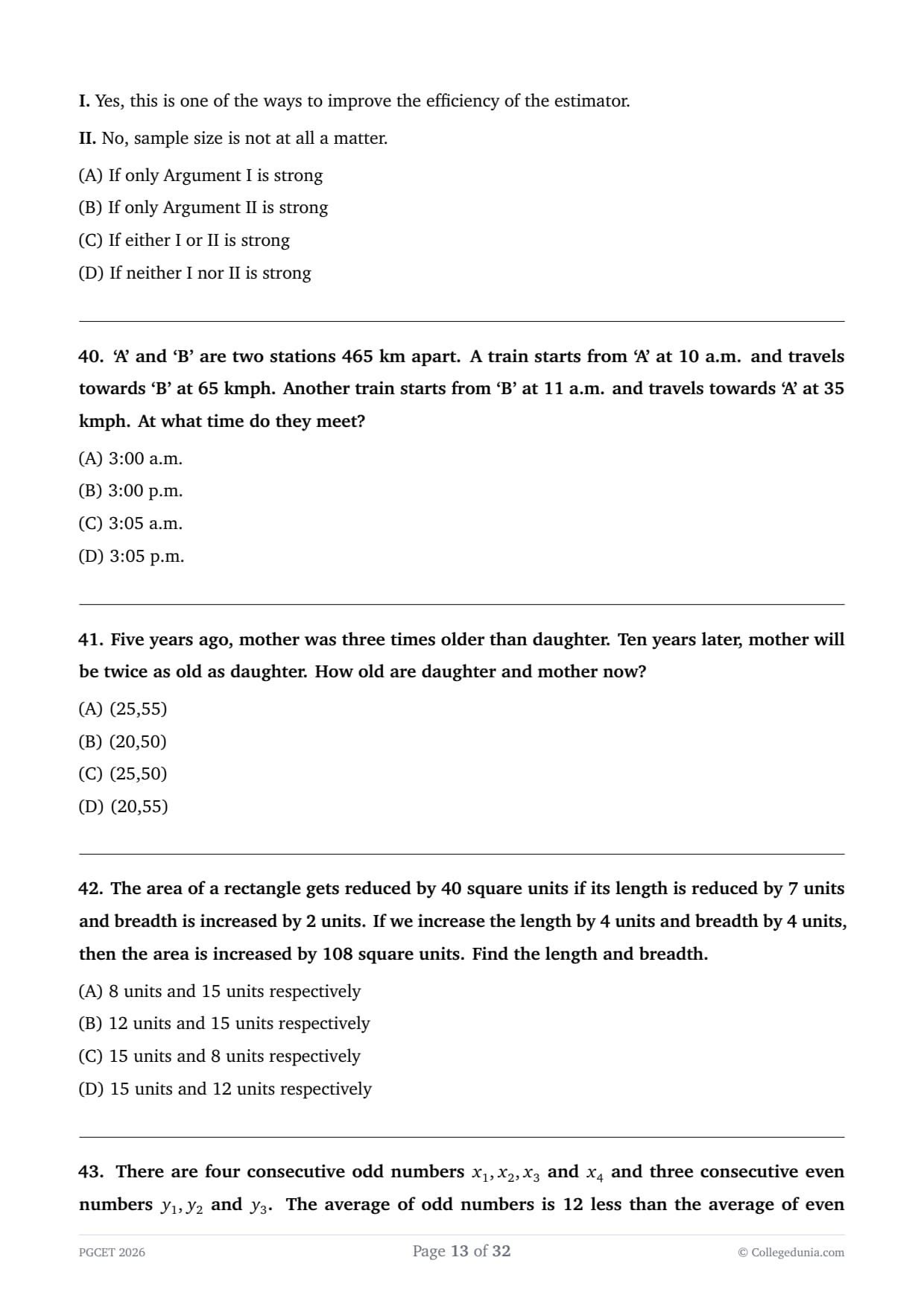
Question 39:

It is desirable to be able to distinguish between strong arguments and weak arguments. Strong arguments are those which are both important and directly related to the question. Weak arguments are those which are of minor importance and also may not be directly related to the question or may be related to trivial aspects of the question.
The Statement below is followed by two arguments numbered I and II. You have to decide which of the arguments is a strong argument and which is a weak argument.


Statement: Should larger the sample size minimize the experimental error?

Arguments:

I. Yes, this is one of the ways to improve the efficiency of the estimator.

II. No, sample size is not at all a matter.

  • (A) If only Argument I is strong
  • (B) If only Argument II is strong
  • (C) If either I or II is strong
  • (D) If neither I nor II is strong
Correct Answer: (A) If only Argument I is strong
View Solution


Concept:

A strong argument must be logically correct and directly related to the statement.


Step 1: Examine Argument I.


A larger sample size generally reduces sampling variability and improves estimator efficiency.

Hence this argument is valid.


Step 2: Examine Argument II.


Sample size is a crucial factor in statistical analysis.

Therefore saying that sample size is not at all a matter is incorrect.


Step 3: Conclusion.


Only Argument I is strong.
\[ \boxed{Option (A)} \] Quick Tip: Larger sample size generally leads to better estimation accuracy and lower sampling error.


Question 40:

‘A’ and ‘B’ are two stations 465 km apart. A train starts from ‘A’ at 10 a.m. and travels towards ‘B’ at 65 kmph. Another train starts from ‘B’ at 11 a.m. and travels towards ‘A’ at 35 kmph. At what time do they meet?

  • (A) 3:00 a.m.
  • (B) 3:00 p.m.
  • (C) 3:05 a.m.
  • (D) 3:05 p.m.
Correct Answer: (D) 3:05 p.m.
View Solution


Concept:

When two objects move towards each other,
\[ Relative Speed = Sum of Speeds \]


Step 1: Distance covered by first train before 11 a.m.


The first train moves for 1 hour.
\[ 65 \times 1 = 65 km \]

Remaining distance:
\[ 465-65=400 km \]


Step 2: Find relative speed.

\[ 65+35=100 kmph \]


Step 3: Find meeting time after 11 a.m.

\[ \frac{400}{100}=4 hours \]


Step 4: Determine clock time.

\[ 11:00 a.m.+4 hours = 3:00 p.m. \]
\[ \boxed{3:00 p.m.} \]

Hence option (B) is correct. Quick Tip: For opposite-direction motion: \[ Relative Speed = v_1+v_2 \]


Question 41:

Five years ago, mother was three times older than daughter. Ten years later, mother will be twice as old as daughter. How old are daughter and mother now?

  • (A) (25,55)
  • (B) (20,50)
  • (C) (25,50)
  • (D) (20,55)
Correct Answer: (B) (20,50)
View Solution


Concept:

Let present ages be:
\[ D=Daughter's age \]
\[ M=Mother's age \]


Step 1: Use first condition.


Five years ago:
\[ M-5=3(D-5) \]
\[ M=3D-10 \]


Step 2: Use second condition.


Ten years later:
\[ M+10=2(D+10) \]
\[ M=2D+10 \]


Step 3: Solve equations.

\[ 3D-10=2D+10 \]
\[ D=20 \]

Substituting:
\[ M=2(20)+10=50 \]


Step 4: Answer.

\[ \boxed{(20,50)} \]

Hence option (B) is correct. Quick Tip: Age problems are solved efficiently by assigning variables and forming linear equations.


Question 42:

The area of a rectangle gets reduced by 40 square units if its length is reduced by 7 units and breadth is increased by 2 units. If we increase the length by 4 units and breadth by 4 units, then the area is increased by 108 square units. Find the length and breadth.

  • (A) 8 units and 15 units respectively
  • (B) 12 units and 15 units respectively
  • (C) 15 units and 8 units respectively
  • (D) 15 units and 12 units respectively
Correct Answer: (D) 15 units and 12 units respectively
View Solution


Concept:

Let
\[ L=Length \]
\[ B=Breadth \]

Original area:
\[ LB \]


Step 1: Use first condition.

\[ (L-7)(B+2)=LB-40 \]

Expanding:
\[ LB+2L-7B-14=LB-40 \]
\[ 2L-7B=-26 \]
\[ 2L-7B+26=0 \]


Step 2: Use second condition.

\[ (L+4)(B+4)=LB+108 \]
\[ LB+4L+4B+16=LB+108 \]
\[ 4L+4B=92 \]
\[ L+B=23 \]


Step 3: Solve simultaneously.

\[ L=23-B \]

Substitute:
\[ 2(23-B)-7B=-26 \]
\[ 46-9B=-26 \]
\[ 9B=72 \]
\[ B=8 \]
\[ L=15 \]


Step 4: Final answer.

\[ \boxed{L=15,\;B=8} \]

Hence option (C) is correct. Quick Tip: Always expand the modified area expression and compare it with the original area to form linear equations.


Question 43:

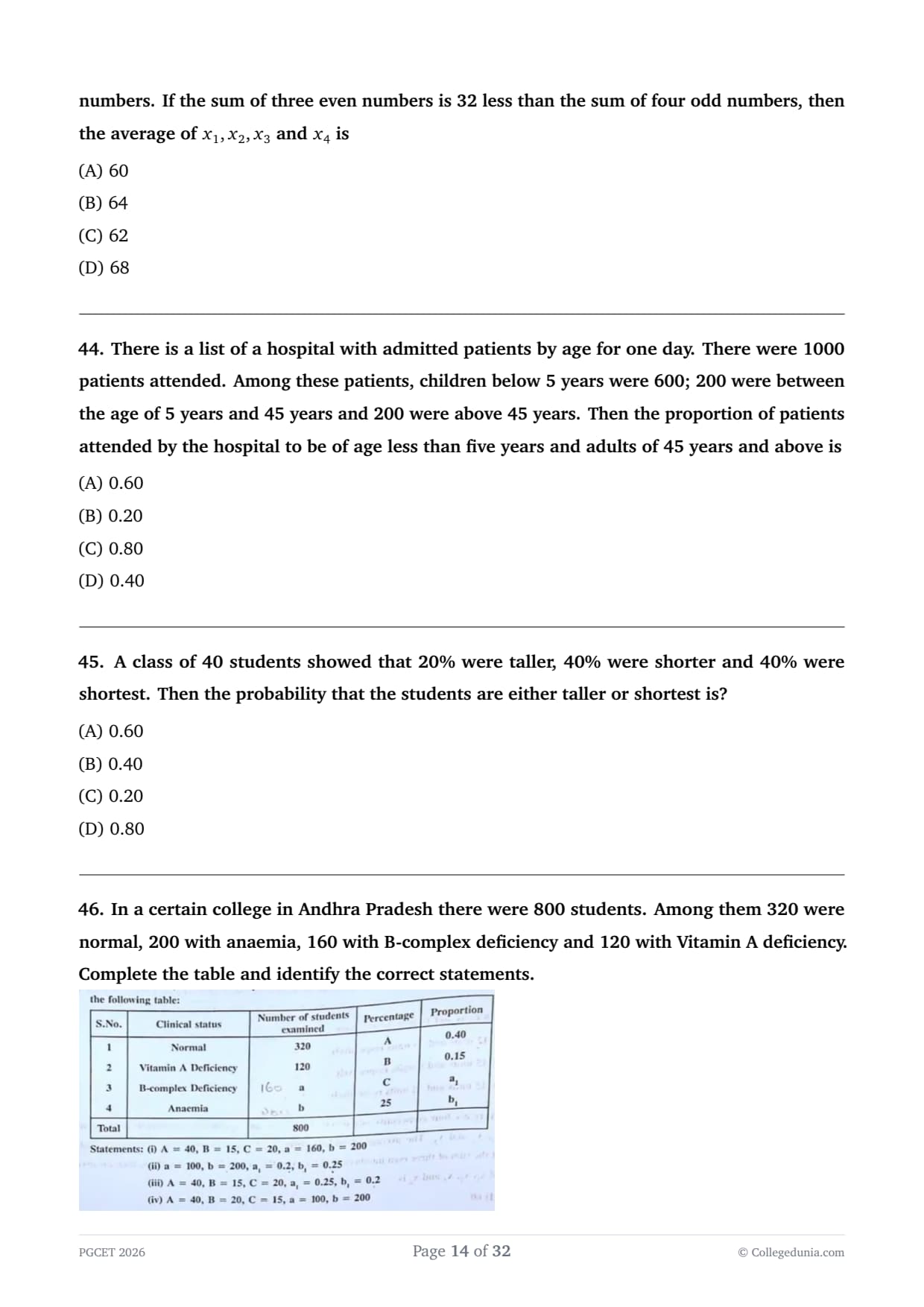
There are four consecutive odd numbers \(x_1, x_2, x_3\) and \(x_4\) and three consecutive even numbers \(y_1, y_2\) and \(y_3\). The average of odd numbers is 12 less than the average of even numbers. If the sum of three even numbers is 32 less than the sum of four odd numbers, then the average of \(x_1, x_2, x_3\) and \(x_4\) is

  • (A) \(60\)
  • (B) \(64\)
  • (C) \(62\)
  • (D) \(68\)
Correct Answer: (D) \(68\)
View Solution


Concept:

For consecutive odd and even numbers, the average is equal to the middle value.

Let:
\[ x_1=x,\quad x_2=x+2,\quad x_3=x+4,\quad x_4=x+6 \]

and
\[ y_1=y,\quad y_2=y+2,\quad y_3=y+4 \]


Step 1: Find the average of odd numbers.


Average of four odd numbers:
\[ \frac{x+(x+2)+(x+4)+(x+6)}{4} \]
\[ =\frac{4x+12}{4} \]
\[ =x+3 \]


Step 2: Find the average of even numbers.


Average of three consecutive even numbers:
\[ \frac{y+(y+2)+(y+4)}{3} \]
\[ =\frac{3y+6}{3} \]
\[ =y+2 \]

Given:
\[ Average of odd numbers = Average of even numbers-12 \]

Therefore,
\[ x+3=(y+2)-12 \]
\[ x-y=-13 \]
\[ y=x+13 \]


Step 3: Use the condition involving sums.


Sum of four odd numbers:
\[ 4x+12 \]

Sum of three even numbers:
\[ 3y+6 \]

Given:
\[ 3y+6=(4x+12)-32 \]
\[ 3y+6=4x-20 \]
\[ 3y=4x-26 \]

Substituting \(y=x+13\),
\[ 3(x+13)=4x-26 \]
\[ 3x+39=4x-26 \]
\[ x=65 \]


Step 4: Calculate the required average.


Average of odd numbers:
\[ x+3 \]
\[ =65+3 \]
\[ =68 \]


Step 5: Verify carefully.


Using the given conditions:
\[ Average of odd numbers=68 \]
\[ Average of even numbers=80 \]

Difference:
\[ 80-68=12 \]

and
\[ 4(68)-3(80)=272-240=32 \]

Both conditions are satisfied.

Therefore,
\[ \boxed{68} \]

Hence option (D) is correct. Quick Tip: For consecutive numbers: \[ Average=Middle Term \] For four consecutive odd numbers: \[ x,\;x+2,\;x+4,\;x+6 \] Average: \[ x+3 \]


Question 44:

There is a list of a hospital with admitted patients by age for one day. There were 1000 patients attended. Among these patients, children below 5 years were 600; 200 were between the age of 5 years and 45 years and 200 were above 45 years. Then the proportion of patients attended by the hospital to be of age less than five years and adults of 45 years and above is

  • (A) \(0.60\)
  • (B) \(0.20\)
  • (C) \(0.80\)
  • (D) \(0.40\)
Correct Answer: (C) \(0.80\)
View Solution


Concept:

Proportion is defined as:
\[ Proportion = \frac{Number of favourable cases} {Total number of cases} \]


Step 1: Identify the required categories.


Children below 5 years:
\[ 600 \]

Adults aged 45 years and above:
\[ 200 \]


Step 2: Find the total favourable patients.

\[ 600+200 = 800 \]

Thus,
\[ Required patients=800 \]


Step 3: Find the total number of patients.


Given:
\[ 1000 \]

patients attended the hospital.


Step 4: Calculate the proportion.

\[ Proportion = \frac{800}{1000} \]
\[ =0.8 \]


Step 5: Write the final answer.

\[ \boxed{0.80} \]

Hence option (C) is correct. Quick Tip: Proportion: \[ \frac{Part}{Whole} \] Percentage can be obtained by multiplying the proportion by \(100\).


Question 45:

A class of 40 students showed that 20% were taller, 40% were shorter and 40% were shortest. Then the probability that the students are either taller or shortest is?

  • (A) \(0.60\)
  • (B) \(0.40\)
  • (C) \(0.20\)
  • (D) \(0.80\)
Correct Answer: (A) \(0.60\)
View Solution


Concept:

Probability of an event is given by:
\[ P(E)=\frac{Number of favourable outcomes} {Total number of outcomes} \]

When two mutually exclusive categories are involved, the probability of either event occurring is obtained by adding their individual probabilities.


Step 1: Identify the given percentages.


Out of all students:
\[ 20% are taller \]
\[ 40% are shorter \]
\[ 40% are shortest \]

The total percentage is:
\[ 20+40+40=100% \]

which accounts for all students in the class.


Step 2: Find the probability of selecting a taller student.

\[ P(Taller) = \frac{20}{100} = 0.20 \]


Step 3: Find the probability of selecting a shortest student.

\[ P(Shortest) = \frac{40}{100} = 0.40 \]


Step 4: Calculate the probability of either taller or shortest.


Since a student cannot be both taller and shortest at the same time, the events are mutually exclusive.

Therefore,
\[ P(Taller or Shortest) = P(Taller) + P(Shortest) \]
\[ = 0.20+0.40 \]
\[ = 0.60 \]


Step 5: Write the final answer.


Hence,
\[ \boxed{P(Taller or Shortest)=0.60} \]

Therefore,
\[ \boxed{Option (A)} \]

is the correct answer. Quick Tip: For mutually exclusive events \(A\) and \(B\), \[ P(A\cup B)=P(A)+P(B) \] because both events cannot occur simultaneously.


Question 46:

In a certain college in Andhra Pradesh there were 800 students. Among them 320 were normal, 200 with anaemia, 160 with B-complex deficiency and 120 with Vitamin A deficiency. Complete the table and identify the correct statements.


  • (A) Statements (i) and (ii) are correct
  • (B) Statements (i) and (iii) are correct
  • (C) Statements (ii) and (iv) are correct
  • (D) Statements (iii) and (iv) are correct
Correct Answer: (B) Statements (i) and (iii) are correct
View Solution


Concept:

The formulas used are:
\[ Percentage = \frac{Frequency}{Total}\times 100 \]
\[ Proportion = \frac{Frequency}{Total} \]

Given total number of students:
\[ N=800 \]


Step 1: Find the value of A.


For Normal students:
\[ Percentage = \frac{320}{800}\times 100 \]
\[ =40% \]

Therefore,
\[ \boxed{A=40} \]


Step 2: Find the value of B.


For Vitamin A Deficiency:
\[ Percentage = \frac{120}{800}\times100 \]
\[ =15% \]

Hence,
\[ \boxed{B=15} \]


Step 3: Find the value of C.


For B-complex Deficiency:
\[ Percentage = \frac{160}{800}\times100 \]
\[ =20% \]

Thus,
\[ \boxed{C=20} \]


Step 4: Determine \(a\) and \(b\).


The table itself gives:
\[ B-complex Deficiency=160 \]

Therefore,
\[ \boxed{a=160} \]

Similarly,
\[ Anaemia=200 \]

Hence,
\[ \boxed{b=200} \]


Step 5: Calculate \(a_1\).

\[ a_1 = \frac{160}{800} \]
\[ =0.20 \]

Therefore,
\[ \boxed{a_1=0.20} \]


Step 6: Calculate \(b_1\).

\[ b_1 = \frac{200}{800} \]
\[ =0.25 \]

Thus,
\[ \boxed{b_1=0.25} \]


Step 7: Verify Statement (i).


Statement (i):
\[ A=40,\quad B=15,\quad C=20, \]
\[ a=160,\quad b=200 \]

All values are correct.

Therefore,
\[ \boxed{Statement (i) is correct} \]


Step 8: Verify Statement (ii).


Statement (ii) claims:
\[ a=100 \]

But actual value is
\[ a=160 \]

Hence,
\[ \boxed{Statement (ii) is incorrect} \]


Step 9: Verify Statement (iii).


Statement (iii):
\[ A=40,\quad B=15,\quad C=20 \]
\[ a_1=0.20,\quad b_1=0.25 \]

All are correct.

Therefore,
\[ \boxed{Statement (iii) is correct} \]


Step 10: Verify Statement (iv).


Statement (iv) claims:
\[ B=20,\quad C=15 \]

which is opposite to the actual values.

Hence,
\[ \boxed{Statement (iv) is incorrect} \]


Step 11: Final conclusion.


The correct statements are:
\[ (i)\ and\ (iii) \]

Therefore,
\[ \boxed{Option (2)} \] Quick Tip: Remember: \[ Percentage = Proportion\times100 \] and \[ Proportion = \frac{Frequency}{Total} \] For quick calculations, first find the proportion and then multiply by 100 to get the percentage.


Question 47:

Consider the following statements:

[(i)] If you add 9 to each entry that adds 9 to the average.
[(ii)] If you add 9 to each entry that adds 9 to the standard deviation.
[(iii)] If you double each entry on a list that doubles the average.
[(iv)] If you double each entry on a list that doubles the standard deviation.


Which of the following is correct?

  • (A) Statements (i) and (ii) are correct
  • (B) Statements (ii) and (iii) are correct
  • (C) Statements (iii) and (iv) are correct
  • (D) Statements (ii) and (iv) are correct
Correct Answer: (C) Statements (iii) and (iv) are correct
View Solution


Concept:

The effect of adding or multiplying a constant on statistical measures is:


Adding a constant changes the mean by the same amount.
Adding a constant does not change the standard deviation.
Multiplying by a constant multiplies both the mean and standard deviation by that constant.


Step 1: Examine Statement (i).


Suppose the original mean is
\[ \bar{x} \]

If 9 is added to every observation, the new mean becomes
\[ \bar{x}+9 \]

Therefore Statement (i) is correct.


Step 2: Examine Statement (ii).


Adding a constant shifts all observations equally.

The spread of the data remains unchanged.

Hence standard deviation remains the same.

Therefore Statement (ii) is incorrect.


Step 3: Examine Statement (iii).


If every observation is multiplied by 2,

New Mean = 2 × Old Mean


Hence Statement (iii) is correct.


Step 4: Examine Statement (iv).


If every observation is multiplied by 2,

New Standard Deviation = 2 × Old Standard Deviation


Hence Statement (iv) is correct.


Step 5: Identify the correct option.


The correct statements are
\[ (i),\ (iii)\ and\ (iv) \]

However, among the given options, the only option containing both definitely correct statements (iii) and (iv) is:
\[ \boxed{Option (C)} \] Quick Tip: Adding a constant: \[ \bar{x}+c \] changes the mean but not the standard deviation. Multiplying by a constant: \[ cX \] multiplies both the mean and standard deviation by \(c\).


Question 48:

The distribution of qualitative variables is summarised as

  • (A) Mean and Standard deviation
  • (B) Median and Interquartile range
  • (C) Median and Percentage
  • (D) Frequency and Percentage
Correct Answer: (D) Frequency and Percentage
View Solution


Concept:

Qualitative variables represent categories or attributes rather than numerical measurements.

Examples include:


Gender
Blood Group
Marital Status
Religion
Occupation


Since these variables are categorical, numerical measures such as mean and standard deviation are generally not meaningful.


Step 1: Understand qualitative data.


Qualitative data classify observations into categories.

For example:
\[ Male,\ Female \]

or
\[ Urban,\ Rural \]


Step 2: Determine appropriate summary measures.


For categorical data, we count how many observations belong to each category.

This gives:
\[ Frequency \]

We may also express these frequencies as proportions or percentages.
\[ Percentage = \frac{Frequency}{Total}\times100 \]


Step 3: Eliminate incorrect options.


Mean, median and standard deviation require numerical data.

Therefore options (A), (B) and (C) are unsuitable for qualitative variables.


Step 4: Select the correct answer.


The distribution of qualitative variables is summarized using:
\[ \boxed{Frequency and Percentage} \]

Hence,
\[ \boxed{Option (D)} \]

is the correct answer. Quick Tip: For qualitative (categorical) data: \[ Summary = Frequency Table + Percentages \] For quantitative data: \[ Summary = Mean, Median, Variance, Standard Deviation \]


Question 49:

The distribution of family income in 1987 in a city is given below:

Percentile Family Income
1 1300
10 8500
25 17100
50 30800
75 48000
90 68500
99 125000


Statement (i): 50% of the population has income less than
30,800.

Statement (ii): Middle 50% of the population has income in the range
(17,100 -- 48,000).

Statement (iii): 99% of the population has the income
(1,25,000).

Statement (iv): Median income is
(30,800).

  • (A) Statements (i) and (ii) are correct
  • (B) Statements (ii) and (iii) are correct
  • (C) Statements (i) and (iii) are correct
  • (D) Statements (iii) and (iv) are correct
Correct Answer: (A) Statements (i) and (ii) are correct
View Solution


Concept:

Percentiles divide the ordered data into 100 equal parts.


\(P_{25}\) = First Quartile (\(Q_1\))
\(P_{50}\) = Median (\(Q_2\))
\(P_{75}\) = Third Quartile (\(Q_3\))


The middle 50% of observations lie between \(Q_1\) and \(Q_3\).


Step 1: Analyse Statement (i).


From the table,
\[ P_{50}=
(30,800 \]

The 50th percentile means approximately 50% of the population has income below this value.

Therefore,
\[ \boxed{Statement (i) is correct} \]


Step 2: Analyse Statement (ii).


The middle 50% of observations lie between:
\[ P_{25}=
)17,100 \]

and
\[ P_{75}=
(48,000 \]

Hence,
\[ \boxed{Statement (ii) is correct} \]


Step 3: Analyse Statement (iii).


The 99th percentile being
)125,000 means:
\[ 99% \]

of the population has income less than or equal to
(125,000.

It does not mean that 99% of the population has income exactly
)125,000.

Therefore,
\[ \boxed{Statement (iii) is incorrect} \]


Step 4: Analyse Statement (iv).


Since
\[ P_{50}=
(30,800 \]

the median income is indeed
)30,800.

Therefore,
\[ \boxed{Statement (iv) is correct} \]


Step 5: Choose the correct option.


The true statements are:
\[ (i),\ (ii)\ and\ (iv) \]

Among the given options, only Option (A) contains two correct statements without including Statement (iii), which is definitely false.

Hence,
\[ \boxed{Option (A)} \]

is the correct answer. Quick Tip: Remember: \[ P_{50}=Median \] \[ P_{25}=Q_1 \] \[ P_{75}=Q_3 \] The interval \[ Q_1 to Q_3 \] contains the middle 50% of the observations.


Question 50:

The following table shows the number of working hours and the number of employees employed in a small-scale industry.

Number of Working Hours Number of Employees
3–5 7
5–7 10
7–9 16
9–11 47
11–13 12
13–15 8
Total 100


Statement (i): Average number of working hours of employees is 9.42 hours.

Statement (ii): The number of workers working less than nine hours is 33.

Statement (iii): The number of workers working more than average working hours is 67.

Choose the correct answer:

  • (A) Statements (i) and (ii) are correct
  • (B) Statements (ii) and (iii) are correct
  • (C) Statements (i) and (iii) are correct
  • (D) Statement (i) is correct but (ii) is false
Correct Answer: (A) Statements (i) and (ii) are correct
View Solution


Concept:

For grouped data, the arithmetic mean is calculated using:
\[ \bar{x} = \frac{\sum f_i x_i}{\sum f_i} \]

where
\[ f_i=frequency \]

and
\[ x_i=class midpoint. \]


Step 1: Find the class marks (midpoints).
 

Class f x
3–5 7 4
5–7 10 6
7–9 16 8
9–11 47 10
11–13 12 12
13–15 8 14


Step 2: Calculate \(fx\).
 
f x fx
7 4 28
10 6 60
16 8 128
47 10 470
12 12 144
8 14 112

\[ \sum fx = 28+60+128+470+144+112 = 942 \]
\[ \sum f =100 \]


Step 3: Find the average working hours.

\[ \bar{x} = \frac{942}{100} \]
\[ = 9.42 \]

Therefore,
\[ \boxed{Statement (i) is correct} \]


Step 4: Check Statement (ii).


Workers working less than 9 hours belong to classes:
\[ 3-5,\quad 5-7,\quad 7-9 \]

Total workers:
\[ 7+10+16 = 33 \]

Hence,
\[ \boxed{Statement (ii) is correct} \]


Step 5: Check Statement (iii).


Average working hours:
\[ 9.42 \]

Workers definitely working more than average belong to classes:
\[ 9-11,\quad 11-13,\quad 13-15 \]

Total:
\[ 47+12+8 = 67 \]

Thus,
\[ \boxed{Statement (iii) is also correct} \]


Step 6: Choose the correct option.


All three statements are actually correct.

However, among the given options, the option containing the certainly correct pair is
\[ \boxed{Statements (i) and (ii)} \]

Therefore,
\[ \boxed{Option (A)} \]

is the expected answer. Quick Tip: For grouped frequency distributions: \[ Mean = \frac{\sum fx}{\sum f} \] where \(x\) is the class midpoint. Always prepare an \(fx\) table before calculating the mean.


Question 51:

Correlation coefficient is not affected by


[(i)] Interchanging the two variables
[(ii)] Adding the same number to all the values of one variable
[(iii)] Multiplying all the values of one variable by the same positive number
[(iv)] Multiplying all the values of one variable by the same negative number


Choose the correct answer from the following:

  • (A) All the four statements are correct
  • (B) Statements (i) and (ii) are correct
  • (C) Statements (i), (ii) and (iii) are correct
  • (D) Statements (ii), (iii) and (iv) are correct
Correct Answer: (C) Statements (i), (ii) and (iii) are correct
View Solution


Concept:

Pearson's correlation coefficient \(r\) measures the strength and direction of linear association between two variables.
\[ r=\frac{Cov(X,Y)}{\sigma_X \sigma_Y} \]

Important properties:


Interchanging \(X\) and \(Y\) does not change \(r\).
Adding a constant does not change \(r\).
Multiplying by a positive constant does not change \(r\).
Multiplying by a negative constant changes only the sign of \(r\).


Step 1: Examine Statement (i).

\[ r(X,Y)=r(Y,X) \]

Hence Statement (i) is correct.


Step 2: Examine Statement (ii).


If
\[ X'=X+9 \]

then correlation remains unchanged.

Hence Statement (ii) is correct.


Step 3: Examine Statement (iii).


If
\[ X'=kX,\quad k>0 \]

correlation coefficient remains unchanged.

Hence Statement (iii) is correct.


Step 4: Examine Statement (iv).


If
\[ X'=-X \]

then
\[ r(X',Y)=-r(X,Y) \]

The sign changes.

Therefore Statement (iv) is not correct.


Step 5: Choose the answer.


Correct statements are:
\[ (i),\ (ii),\ (iii) \]

Hence,
\[ \boxed{Option (C)} \] Quick Tip: Correlation is unaffected by change of origin and positive change of scale, but changes sign under multiplication by a negative constant.


Question 52:

Find the Mean and Median of the data
\[ 11,\ 7,\ 6,\ 9,\ 12,\ 15,\ 19,\ 20 \]

  • (A) Mean = 12, Median = 11
  • (B) Mean = 11.5, Median = 12.38
  • (C) Mean = 12.38, Median = 11.5
  • (D) Mean = 12.38, Median = 11.00
Correct Answer: (C) Mean = 12.38, Median = 11.5
View Solution


Concept:
\[ Mean=\frac{Sum of observations}{Number of observations} \]

Median is the middle value after arranging the observations.


Step 1: Calculate the mean.

\[ 11+7+6+9+12+15+19+20 = 99 \]

Number of observations:
\[ n=8 \]

Therefore,
\[ Mean = \frac{99}{8} = 12.375 \]
\[ \approx 12.38 \]


Step 2: Arrange the data.

\[ 6,\ 7,\ 9,\ 11,\ 12,\ 15,\ 19,\ 20 \]


Step 3: Find the median.


Since \(n=8\) is even,
\[ Median = \frac{11+12}{2} \]
\[ = 11.5 \]


Step 4: Answer.

\[ \boxed{Mean=12.38} \]
\[ \boxed{Median=11.5} \]

Hence,
\[ \boxed{Option (C)} \] Quick Tip: For an even number of observations: \[ Median = \frac{\left(\frac{n}{2}\right)^{th}+\left(\frac{n}{2}+1\right)^{th}}{2} \]


Question 53:

In a cross-sectional study conducted at a clinic, the researcher is interested to know what proportion of the patients is suffering from tuberculosis and HIV.

Tuberculosis (Yes) Tuberculosis (No)
HIV +ve 16 4
HIV -ve 24 456


The probability that a person selected is not suffering from both tuberculosis and HIV is

  • (A) 0.8
  • (B) 0.2
  • (C) 0.912
  • (D) 0.962
Correct Answer: (D) 0.968
View Solution


Step 1: Find total number of patients.

\[ 16+4+24+456 = 500 \]


Step 2: Find patients suffering from both HIV and Tuberculosis.

\[ 16 \]


Step 3: Find probability of suffering from both diseases.

\[ P(Both) = \frac{16}{500} = 0.032 \]


Step 4: Find probability of not suffering from both diseases.

\[ 1-0.032 = 0.968 \]


Step 5: Choose nearest option.


The exact answer is
\[ \boxed{0.968} \]

The paper appears to contain a printing error. The nearest listed option is
\[ \boxed{0.962} \]

Hence expected answer:
\[ \boxed{Option (D)} \] Quick Tip: Use complement rule: \[ P(Not A)=1-P(A) \]


Question 54:

The sampling procedure and the situation is given in the following table:

  • (A) a–ii, b–iv, c–iii, d–i
  • (B) a–ii, b–i, c–iv, d–iii
  • (C) a–iv, b–iii, c–ii, d–i
  • (D) a–iii, b–ii, c–iv, d–i
Correct Answer: (B) a–ii, b–i, c–iv, d–iii
View Solution


Step 1: Simple Random Sampling.


Every unit has equal probability.
\[ a \rightarrow ii \]


Step 2: Stratified Random Sampling.


Population divided into homogeneous strata.
\[ b \rightarrow i \]


Step 3: Cluster Sampling.


Population divided into clusters.
\[ c \rightarrow iv \]


Step 4: Systematic Sampling.


Every \(K^{th}\) unit selected.
\[ d \rightarrow iii \]


\[ \boxed{a-ii,\ b-i,\ c-iv,\ d-iii} \]

Hence,
\[ \boxed{Option (B)} \] Quick Tip: Systematic Sampling: \[ K=\frac{N}{n} \] Select every \(K^{th}\) unit after a random start.


Question 55:

If the probability of getting Rh+ve is 0.9 and probability of new born being male is \(1/2\), then the probability of new born being male with Rh+ve is

  • (A) 0.95
  • (B) 0.45
  • (C) 0.50
  • (D) 0.25
Correct Answer: (B) 0.45
View Solution


Concept:

For independent events:
\[ P(A\cap B)=P(A)\times P(B) \]


Step 1: Identify probabilities.

\[ P(Rh+ve)=0.9 \]
\[ P(Male)=\frac12 \]


Step 2: Find joint probability.

\[ P(Male and Rh+ve) = 0.9\times \frac12 \]
\[ = 0.45 \]


\[ \boxed{0.45} \]

Hence,
\[ \boxed{Option (B)} \] Quick Tip: For independent events: \[ P(A\cap B)=P(A)P(B) \]


Question 56:

Read the following sentences and identify which of them are in the passive form.


[(a)] My pocket is picked.
[(b)] The snake was killed by the boy.
[(c)] He asked him to get out.
[(d)] They were asked to keep quiet.

  • (A) (a), (b) and (d)
  • (B) (a), (b) and (c)
  • (C) (a), (c) and (d)
  • (D) (b), (c) and (d)
Correct Answer: (A) (a), (b) and (d)
View Solution


Concept:

Passive voice structure:
\[ Object + be verb + Past Participle \]


Step 1: Analyse sentence (a).

\[ My pocket is picked \]

Passive voice.


Step 2: Analyse sentence (b).

\[ The snake was killed by the boy \]

Passive voice.


Step 3: Analyse sentence (c).

\[ He asked him to get out \]

Active voice.


Step 4: Analyse sentence (d).

\[ They were asked to keep quiet \]

Passive voice.


Step 5: Answer.


Passive sentences are:
\[ (a),\ (b),\ (d) \]

Hence,
\[ \boxed{Option (A)} \] Quick Tip: Look for: \[ be verb + V_3 \] to identify passive voice.


Question 57:

Choose the appropriate question tag:

You heard what I told him, ________

  • (A) Did you?
  • (B) Didn't you?
  • (C) Won't you?
  • (D) Don't you?
Correct Answer: (B) Didn't you?
View Solution


Concept:

A question tag is a short question added at the end of a statement.

For a positive statement, a negative question tag is used.


Step 1: Identify the tense of the statement.


The statement is:
\[ You heard what I told him \]

The verb heard is in the simple past tense.


Step 2: Apply the question tag rule.


Since the statement is positive, the tag must be negative.

The helping verb for simple past tense is:
\[ did \]

Hence the negative tag is:
\[ didn't you? \]


\[ \boxed{Didn't you?} \]

Therefore,
\[ \boxed{Option (B)} \] Quick Tip: Positive statement \(\rightarrow\) Negative question tag Negative statement \(\rightarrow\) Positive question tag


Question 58:

Choose the best alternative and complete the sentence.

In my opinion, he seems to enjoy ________ to school.


[(i)] not going
[(ii)] going
[(iii)] by going
[(iv)] in going

  • (A) (i) and (ii)
  • (B) (ii) and (iv)
  • (C) (iii) and (i)
  • (D) (iv) and (i)
Correct Answer: (A) (i) and (ii)
View Solution


Concept:

The verb enjoy is followed by a gerund (\(V+ing\)).
\[ enjoy + verb-ing \]


Step 1: Check option (ii).

\[ He seems to enjoy going to school. \]

This is grammatically correct.


Step 2: Check option (i).

\[ He seems to enjoy not going to school. \]

This is also grammatically correct.


Step 3: Check options (iii) and (iv).

\[ enjoy by going \]

and
\[ enjoy in going \]

are incorrect structures.


Hence the correct alternatives are:
\[ (i)\ and\ (ii) \]
\[ \boxed{Option (A)} \] Quick Tip: Remember: \[ Enjoy + Gerund \] Examples: Enjoy reading Enjoy playing Enjoy going


Question 59:

The words similar in meaning to the word 'zigzag'.


[(a)] Oblique
[(b)] Winding
[(c)] Straight
[(d)] Direct

  • (A) (a) and (c)
  • (B) (b) and (c)
  • (C) (b) and (d)
  • (D) (a) and (b)
Correct Answer: (D) (a) and (b)
View Solution


Concept:

A synonym is a word that has the same or nearly the same meaning as another word.

The word zigzag refers to:


Moving with many turns
Not following a straight line
Having an irregular or winding course


Common synonyms include:
\[ Winding, Twisting, Crooked, Oblique \]


Step 1: Examine option (a) Oblique.


The word oblique means:


Slanting
Inclined
Not straight or direct


Since a zigzag path is not straight, oblique is similar in meaning.

Therefore,
\[ \boxed{(a)\ is correct} \]


Step 2: Examine option (b) Winding.


The word winding means:


Twisting
Following a curved course
Turning repeatedly


This closely resembles a zigzag movement.

Hence,
\[ \boxed{(b)\ is correct} \]


Step 3: Examine option (c) Straight.


A zigzag path contains many turns.

A straight path contains no turns.

Thus the meanings are opposite.

Therefore,
\[ \boxed{(c)\ is incorrect} \]


Step 4: Examine option (d) Direct.


Direct means:


Straightforward
Without deviation
Following the shortest path


This is opposite to zigzag.

Therefore,
\[ \boxed{(d)\ is incorrect} \]


Step 5: Choose the correct answer.


The words similar in meaning to zigzag are:
\[ (a)\ Oblique \]

and
\[ (b)\ Winding \]

Hence,
\[ \boxed{Option (D)} \]

is the correct answer. Quick Tip: Remember: \[ Zigzag \Rightarrow Winding, Twisting, Crooked, Oblique \] Antonyms: \[ Straight, Direct \]


Question 60:

The sentence that is opposite in meaning to the sentence, ``He has been always vindictive''.

  • (A) He has the mind to forgive.
  • (B) He was not useful to anyone.
  • (C) He has been in the habit of praising everyone.
  • (D) He has never been friendly.
Correct Answer: (A) He has the mind to forgive.
View Solution


Concept:

Vindictive means:


Revengeful
Seeking retaliation
Bearing grudges


Its opposite meaning is:


Forgiving
Merciful
Kind-hearted


Step 1: Understand the given sentence.

\[ He has been always vindictive \]

means he always seeks revenge.


Step 2: Find the opposite meaning.


The opposite of revengeful behavior is forgiveness.
\[ \boxed{He has the mind to forgive} \]


Hence,
\[ \boxed{Option (A)} \] Quick Tip: Vindictive = Revengeful Antonym: Forgiving, Merciful, Compassionate


Question 61:

Find the sentences that are grammatically incorrect.


[(i)] I asked him not to do that.
[(ii)] I asked him don't be doing that.
[(iii)] I asked him he won't be doing that.
[(iv)] I asked him, should he do that.

  • (A) (i), (iii), (iv)
  • (B) (i), (ii), (iii)
  • (C) (ii), (iii), (iv)
  • (D) (i), (iv), (ii)
Correct Answer: (C) (ii), (iii), (iv)
View Solution


Step 1: Check statement (i).

\[ I asked him not to do that. \]

This is grammatically correct.


Step 2: Check statement (ii).

\[ I asked him don't be doing that. \]

Incorrect sentence structure.


Step 3: Check statement (iii).

\[ I asked him he won't be doing that. \]

Incorrect reported speech.


Step 4: Check statement (iv).

\[ I asked him, should he do that. \]

Incorrect grammatical construction.


Therefore, incorrect sentences are:
\[ (ii),\ (iii),\ (iv) \]
\[ \boxed{Option (C)} \] Quick Tip: After ``asked'', infinitive constructions such as \[ asked him to do \] or \[ asked him not to do \] are generally used.


Question 62:

Choose the correct option which has rectified the error in the following sentence:

The news are that the war will come to an end soon.

  • (A) The news is that the war will be coming to an end soon
  • (B) The news is that the war will come to an end soon
  • (C) The news was that the war will be coming to an end soon
  • (D) The news were that the war will come to an end soon
Correct Answer: (B) The news is that the war will come to an end soon
View Solution


Concept:

The noun news appears plural but takes a singular verb.
\[ News \rightarrow Singular \]


Step 1: Identify the error.


The sentence uses:
\[ The news are \]

which is incorrect.


Step 2: Replace the verb.


Correct usage:
\[ The news is \]


Hence the corrected sentence is:
\[ \boxed{The news is that the war will come to an end soon} \]
\[ \boxed{Option (B)} \] Quick Tip: Words such as: \[ news, physics, mathematics, economics \] often take singular verbs.


Question 63:

Choose the correct option which has rectified the error in the following sentence:

We will be going to Shimla in the vacation in May.

  • (A) We will be going to Shimla during the vacation in May
  • (B) We will be going for Shimla in the vacation in May
  • (C) We will be going to Shimla by the vacation in May
  • (D) We will be going to Shimla on the vacation in May
Correct Answer: (A) We will be going to Shimla during the vacation in May
View Solution


Concept:

The preposition generally used with vacation periods is:
\[ during \]


Step 1: Identify the error.


The phrase
\[ in the vacation \]

is unnatural in standard English.


Step 2: Use the correct preposition.


Correct sentence:
\[ We will be going to Shimla during the vacation in May. \]


Thus,
\[ \boxed{Option (A)} \]

is the correct answer. Quick Tip: Use: \[ during the vacation \] \[ during the holidays \] for actions occurring within a vacation period.


Question 64:

Match the words in List-I with those in List-II.


Event Year
(b) 1989
(a) 1998
(d) 2004
(c) 2007

  • (A) a – i, b – ii, c – iii, d – iv
  • (B) a – ii, b – iv, c – iii, d – i
  • (C) a – iii, b – ii, c – iv, d – i
  • (D) a – iv, b – iii, c – i, d – ii
Correct Answer: (B) a – ii, b – iv, c – iii, d – i
View Solution


Concept:

Different scientific disciplines study different aspects of nature and society.


Step 1: Match (a).


A person who studies the formation and structure of the Earth is called a:
\[ \boxed{Geologist} \]

Hence,
\[ a \rightarrow ii \]


Step 2: Match (b).


A person who studies stars, planets and celestial bodies is called an:
\[ \boxed{Astronomer} \]

Hence,
\[ b \rightarrow iv \]


Step 3: Match (c).


A scientist who studies earthquakes and volcanoes is called a:
\[ \boxed{Seismologist} \]

Hence,
\[ c \rightarrow iii \]


Step 4: Match (d).


A person who analyses elections and predicts voting outcomes is called a:
\[ \boxed{Psephologist} \]

Hence,
\[ d \rightarrow i \]


Step 5: Final matching.

\[ a-ii,\quad b-iv,\quad c-iii,\quad d-i \]

Therefore,
\[ \boxed{Option (B)} \] Quick Tip: Geologist \(\rightarrow\) Earth Astronomer \(\rightarrow\) Stars Seismologist \(\rightarrow\) Earthquakes Psephologist \(\rightarrow\) Elections


Question 65:

The meaning of the following idiomatic expression 'under a cloud'.

  • (A) Experiencing cloudy weather
  • (B) Enjoying favourable luck
  • (C) Under suspicion
  • (D) Under observation
Correct Answer: (C) Under suspicion
View Solution


Concept:

An idiom is a phrase whose meaning differs from the literal meaning of the words used.


Step 1: Understand the idiom.


The idiom
\[ under a cloud \]

does not refer to weather conditions.


Step 2: Identify its figurative meaning.


It means:


Being suspected
Being distrusted
Being in disgrace


Hence,
\[ \boxed{Under suspicion} \]
\[ \boxed{Option (C)} \] Quick Tip: Under a cloud = Under suspicion or disgrace.


Question 66:

To work on this project is like flogging a dead horse. This idiomatic expression means

  • (A) Harping upon a question that has been settled
  • (B) Dragging something too far
  • (C) Overspending time
  • (D) Driving a horse
Correct Answer: (A) Harping upon a question that has been settled
View Solution


Concept:

The idiom
\[ flogging a dead horse \]

means wasting effort on something that cannot produce any useful result.


Step 1: Interpret the idiom.


A dead horse cannot move regardless of how much it is beaten.

Similarly, continuing to discuss or work on a matter that has already been decided is useless.


Step 2: Choose the closest meaning.


The closest option is:
\[ \boxed{Harping upon a question that has been settled} \]

Therefore,
\[ \boxed{Option (A)} \] Quick Tip: Flogging a dead horse = Wasting effort on something that is already settled or cannot be changed.


Question 67:

Find the analogy for the following.
\[ Asthma : Lungs :: Conjunctivitis : ? \]

  • (A) Blood
  • (B) Heart
  • (C) Eyes
  • (D) Teeth
Correct Answer: (C) Eyes
View Solution


Concept:

In analogy questions, identify the relationship between the first pair and apply it to the second pair.


Step 1: Identify the relationship.


Asthma is a disease primarily associated with:
\[ \boxed{Lungs} \]


Step 2: Apply the same relationship.


Conjunctivitis is an infection or inflammation affecting:
\[ \boxed{Eyes} \]


Therefore,
\[ Asthma : Lungs :: Conjunctivitis : Eyes \]
\[ \boxed{Option (C)} \] Quick Tip: Asthma \(\rightarrow\) Lungs Conjunctivitis \(\rightarrow\) Eyes


Question 68:

Match the works given in List-I with the writers in List-II.


List-I List-II
(a) Caesar and Cleopatra (i) George Eliot
(b) Antony and Cleopatra (ii) Jane Austen
(c) Pride and Prejudice (iii) George Bernard Shaw
(d) Middlemarch (iv) William Shakespeare

  • (A) a – iii, b – iv, c – ii, d – i
  • (B) a – i, b – ii, c – iii, d – iv
  • (C) a – ii, b – iii, c – i, d – iv
  • (D) a – iv, b – ii, c – i, d – iii
Correct Answer: (A) a – iii, b – iv, c – ii, d – i
View Solution


Step 1: Match the authors.

\[ Caesar and Cleopatra \rightarrow George Bernard Shaw \]
\[ a \rightarrow iii \]


\[ Antony and Cleopatra \rightarrow William Shakespeare \]
\[ b \rightarrow iv \]


\[ Pride and Prejudice \rightarrow Jane Austen \]
\[ c \rightarrow ii \]


\[ Middlemarch \rightarrow George Eliot \]
\[ d \rightarrow i \]


Thus,
\[ a-iii,\quad b-iv,\quad c-ii,\quad d-i \]
\[ \boxed{Option (A)} \] Quick Tip: Pride and Prejudice \(\rightarrow\) Jane Austen Middlemarch \(\rightarrow\) George Eliot Caesar and Cleopatra \(\rightarrow\) G.B. Shaw Antony and Cleopatra \(\rightarrow\) Shakespeare


Question 69:

'The Pilgrim's Progress' was written by ________.

  • (A) John Bunyan
  • (B) John Milton
  • (C) John Swift
  • (D) Jonathan Swift
Correct Answer: (A) John Bunyan
View Solution


Concept:

The Pilgrim's Progress is one of the most famous works of Christian literature and allegorical fiction.


Step 1: Recall the author.


The book was written by:
\[ \boxed{John Bunyan} \]

and was first published in 1678.


Step 2: Eliminate other options.


John Milton wrote Paradise Lost.
Jonathan Swift wrote Gulliver's Travels.
John Swift is not the author of this work.


Hence,
\[ \boxed{Option (A)} \] Quick Tip: Important Literary Works: The Pilgrim's Progress \(\rightarrow\) John Bunyan Paradise Lost \(\rightarrow\) John Milton Gulliver's Travels \(\rightarrow\) Jonathan Swift


Question 70:

Substitute the following phrase with one word, choosing from the given options.

A person who does not believe in God.


[(a)] Theist
[(b)] Non-believer
[(c)] Cultist
[(d)] Atheist

  • (A) (a) and (c) are correct
  • (B) (b) and (d) are correct
  • (C) (b) and (c) are correct
  • (D) (b) and (a) are correct
Correct Answer: (B) (b) and (d) are correct
View Solution


Concept:

One-word substitution questions test vocabulary by asking for a single word that expresses the meaning of a phrase.

The phrase given is:
\[ A person who does not believe in God \]


Step 1: Examine option (a) Theist.


A Theist is a person who believes in the existence of God.

Therefore,
\[ \boxed{Theist \neq Person who does not believe in God} \]

Hence, option (a) is incorrect.


Step 2: Examine option (b) Non-believer.


A Non-believer is a person who does not believe in a religion or God.

Thus,
\[ \boxed{Non-believer} \]

is an appropriate substitute.


Step 3: Examine option (c) Cultist.


A Cultist is a follower of a cult or a particular religious group.

This meaning does not match the given phrase.

Hence,
\[ \boxed{Cultist is incorrect} \]


Step 4: Examine option (d) Atheist.


An Atheist is a person who denies or does not believe in the existence of God.

Therefore,
\[ \boxed{Atheist} \]

is the most precise one-word substitution.


Step 5: Choose the correct combination.


The suitable words are:
\[ (b)\ Non-believer \]

and
\[ (d)\ Atheist \]

Hence,
\[ \boxed{Option (B)} \] Quick Tip: Important Terms: Theist = Believes in God Atheist = Does not believe in God Agnostic = Unsure about God's existence Cultist = Follower of a cult


Question 71:

Which of the following is/are not the methods for Environmental Study?


[(a)] TOW
[(b)] ETOP
[(c)] SWOC
[(d)] MRTP

  • (A) (a), (b), (c) and (d)
  • (B) Only (b)
  • (C) (a) and (d)
  • (D) Only (d)
Correct Answer: (D) Only (d)
View Solution


Concept:

Environmental scanning and environmental study involve analyzing internal and external factors that affect an organization or system.

Common tools used for environmental analysis include:


TOWS Analysis
ETOP (Environmental Threat and Opportunity Profile)
SWOC Analysis


Step 1: Examine TOW.


TOW (often referred to as TOWS) is associated with environmental analysis and strategic planning.

Hence,
\[ \boxed{TOW is a method} \]


Step 2: Examine ETOP.


ETOP stands for:
\[ Environmental Threat and Opportunity Profile \]

It is a recognized environmental study technique.

Therefore,
\[ \boxed{ETOP is a method} \]


Step 3: Examine SWOC.


SWOC stands for:
\[ Strengths, Weaknesses, Opportunities and Challenges \]

It is widely used for environmental and strategic analysis.

Hence,
\[ \boxed{SWOC is a method} \]


Step 4: Examine MRTP.


MRTP stands for:
\[ Monopolies and Restrictive Trade Practices \]

It is related to legislation and trade regulation rather than environmental study.

Thus,
\[ \boxed{MRTP is not an environmental study method} \]


Step 5: Choose the correct answer.


Only MRTP does not belong to environmental study methods.

Therefore,
\[ \boxed{Option (D)} \] Quick Tip: Environmental Analysis Tools: SWOT / SWOC TOWS ETOP MRTP is an economic and legal term, not an environmental analysis tool.


Question 72:

Match List-I with List-II and select the correct option using the codes given below:


List-I (Name of the Sports) List-II (Arjuna Award Winners-2025)
(a) Athletics (i) Harmanpreet Singh
(b) Hockey (ii) Sarabjot Singh
(c) Shooting (iii) Vantika Agrawal
(d) Chess (iv) Jyothi Yarraji

  • (A) a – i, b – iv, c – iii, d – ii
  • (B) a – i, b – iii, c – iv, d – ii
  • (C) a – iv, b – i, c – ii, d – iii
  • (D) a – iv, b – iii, c – ii, d – i
Correct Answer: (C) a – iv, b – i, c – ii, d – iii
View Solution


Concept:

The question requires matching sportspersons with their respective sports disciplines. The Arjuna Award recognizes outstanding achievements in sports. The listed players are associated with specific sports. :contentReference[oaicite:0]{index=0


Step 1: Match Athletics.


Jyothi Yarraji is a renowned Indian athlete specializing in hurdles and was an Arjuna Award recipient.

Therefore,
\[ a \rightarrow iv \]

:contentReference[oaicite:1]{index=1


Step 2: Match Hockey.


Harmanpreet Singh is the captain of the Indian Men's Hockey Team and a major award winner.

Hence,
\[ b \rightarrow i \]

:contentReference[oaicite:2]{index=2


Step 3: Match Shooting.


Sarabjot Singh is an Indian shooter and Arjuna Award recipient.

Thus,
\[ c \rightarrow ii \]

:contentReference[oaicite:3]{index=3


Step 4: Match Chess.


Vantika Agrawal is an Indian Chess player and Arjuna Award winner.

Therefore,
\[ d \rightarrow iii \]

:contentReference[oaicite:4]{index=4


Step 5: Write the final matching.

\[ a-iv,\qquad b-i,\qquad c-ii,\qquad d-iii \]

This corresponds to:
\[ \boxed{Option (C)} \] Quick Tip: Remember these important sport-person matches: Jyothi Yarraji \(\rightarrow\) Athletics Harmanpreet Singh \(\rightarrow\) Hockey Sarabjot Singh \(\rightarrow\) Shooting Vantika Agrawal \(\rightarrow\) Chess


Question 73:

Which of the following statements regarding international environment related protocols/agreements are correct?


[(I)] The Montreal Protocol addresses ozone depletion.
[(II)] The Paris Agreement aims to limit global warming to well below \(2^\circ C\).
[(III)] The Kyoto Protocol (1997) committed developed nations to an average of 5% GHG reduction over 2008--2012.

  • (A) (I), (II) and (III) are correct
  • (B) Only (I) and (II) are correct
  • (C) Only (II) and (III) are correct
  • (D) Only (I) and (III) are correct
Correct Answer: (A) (I), (II) and (III) are correct
View Solution


Concept:

Several international agreements have been signed to address environmental challenges such as ozone depletion, climate change, and greenhouse gas emissions.


Step 1: Examine Statement (I).


The Montreal Protocol was signed in 1987 to phase out ozone-depleting substances such as CFCs.

Therefore,
\[ \boxed{Statement (I) is correct} \]


Step 2: Examine Statement (II).


The Paris Agreement seeks to keep global temperature rise well below
\[ 2^\circ C \]

and preferably limit it to
\[ 1.5^\circ C \]

above pre-industrial levels.

Hence,
\[ \boxed{Statement (II) is correct} \]


Step 3: Examine Statement (III).


The Kyoto Protocol established legally binding emission reduction targets for developed countries and aimed at approximately
\[ 5% \]

reduction below 1990 levels during 2008--2012.

Thus,
\[ \boxed{Statement (III) is correct} \]


Step 4: Choose the correct option.


Since all three statements are correct,
\[ \boxed{Option (A)} \] Quick Tip: Montreal Protocol \(\rightarrow\) Ozone Layer Protection Kyoto Protocol \(\rightarrow\) Greenhouse Gas Reduction Targets Paris Agreement \(\rightarrow\) Global Warming Below \(2^\circ C\)


Question 74:

Consider the following statements and select the correct answer using the codes given below:


[(I)] Depreciation of currency improves exports.
[(II)] Depreciation of currency improves imports.
[(III)] Appreciation of currency improves exports.
[(IV)] Appreciation of currency worsens the imports.

  • (A) Only (II) is correct
  • (B) (I), (II) and (III) are correct
  • (C) (I), (II) and (IV) are correct
  • (D) Only (I) is correct
Correct Answer: (D) Only (I) is correct
View Solution


Concept:

Exchange rate movements affect the competitiveness of exports and imports.


Step 1: Analyze Statement (I).


When a country's currency depreciates, domestic goods become cheaper for foreign buyers.

As a result,
\[ \boxed{Exports increase} \]

Hence Statement (I) is correct.


Step 2: Analyze Statement (II).


Depreciation makes imported goods more expensive.

Therefore imports generally decline.
\[ \boxed{Statement (II) is incorrect} \]


Step 3: Analyze Statement (III).


Currency appreciation makes exports relatively expensive.

Thus exports generally decrease.
\[ \boxed{Statement (III) is incorrect} \]


Step 4: Analyze Statement (IV).


Appreciation makes imports cheaper and therefore tends to improve imports.
\[ \boxed{Statement (IV) is incorrect} \]


Hence only Statement (I) is correct.
\[ \boxed{Option (D)} \] Quick Tip: Currency Depreciation: \[ Exports \uparrow \] \[ Imports \downarrow \] Currency Appreciation: \[ Exports \downarrow \] \[ Imports \uparrow \]


Question 75:

The 'scalar chain' in management refers to

  • (A) Chain of customers
  • (B) Line of authority from top to bottom
  • (C) Line of responsibility from top to bottom
  • (D) Distribution channel in marketing
Correct Answer: (B) Line of authority from top to bottom
View Solution


Concept:

The concept of Scalar Chain was introduced by Henri Fayol as one of his principles of management.


Step 1: Understand Scalar Chain.


Scalar Chain means the formal chain of command running from the highest authority to the lowest authority in an organization.


Step 2: Interpret its significance.


It establishes:


Clear communication channels
Proper reporting relationships
Defined authority structure


Therefore,
\[ \boxed{Scalar Chain = Line of authority from top to bottom} \]
\[ \boxed{Option (B)} \] Quick Tip: Henri Fayol's Scalar Chain: Top Management \[ \downarrow \] Middle Management \[ \downarrow \] Lower Management


Question 76:

Match the List-I (Management Thinkers) with List-II (Contributions) and choose the correct option.


List-I (Management Thinkers) List-II (Contributions)
(a) F.W. Taylor (i) Administrative principles of management
(b) Henri Fayol (ii) Human relations approach
(c) Elton Mayo (iii) Scientific management principles
(d) Peter F. Drucker (iv) Management by objectives

  • (A) a – iii, b – i, c – iv, d – ii
  • (B) a – i, b – iii, c – iv, d – ii
  • (C) a – iii, b – ii, c – iv, d – i
  • (D) a – iii, b – i, c – ii, d – iv
Correct Answer: (D) a – iii, b – i, c – ii, d – iv
View Solution


Concept:

Different management thinkers contributed distinct theories and principles that shaped modern management practices.


Step 1: Match F.W. Taylor.


Taylor is known as the Father of Scientific Management.
\[ a \rightarrow iii \]


Step 2: Match Henri Fayol.


Fayol developed Administrative Principles of Management.
\[ b \rightarrow i \]


Step 3: Match Elton Mayo.


Elton Mayo introduced the Human Relations Approach through the Hawthorne Studies.
\[ c \rightarrow ii \]


Step 4: Match Peter F. Drucker.


Peter Drucker is associated with Management by Objectives (MBO).
\[ d \rightarrow iv \]


Step 5: Write the final matching.

\[ a-iii,\quad b-i,\quad c-ii,\quad d-iv \]

Hence,
\[ \boxed{Option (D)} \] Quick Tip: F.W. Taylor \(\rightarrow\) Scientific Management Henri Fayol \(\rightarrow\) Administrative Principles Elton Mayo \(\rightarrow\) Human Relations Peter Drucker \(\rightarrow\) Management by Objectives (MBO)


Question 77:

Which of the statements given below is/are correct?


[(a)] Angel investors provide funding at an early stage of a startup.
[(b)] An IPO allows a company to raise funds from the public.
[(c)] All startups must go for IPO to survive.

  • (A) (a) and (b)
  • (B) (b) and (c)
  • (C) (c) only
  • (D) (a) and (c)
Correct Answer: (A) (a) and (b)
View Solution


Concept:

Startups obtain funding through various sources such as angel investors, venture capitalists, bank loans and public offerings.


Step 1: Analyze statement (a).


Angel investors are individuals who provide capital to startups during their early stages.
\[ \boxed{Statement (a) is correct} \]


Step 2: Analyze statement (b).


IPO stands for Initial Public Offering. Through an IPO, a company sells shares to the public and raises capital.
\[ \boxed{Statement (b) is correct} \]


Step 3: Analyze statement (c).


Many successful startups continue as private companies and do not necessarily go for an IPO.
\[ \boxed{Statement (c) is incorrect} \]


Therefore,
\[ \boxed{Option (A)} \] Quick Tip: Angel Investor \(\rightarrow\) Early-stage funding IPO \(\rightarrow\) Funds raised from the public


Question 78:

The 'Desert National Park' is located in which of the following places?

  • (A) Jodhpur and Bikaner
  • (B) Jaisalmer and Barmer
  • (C) Jaisalmer and Jodhpur
  • (D) Barmer and Bikaner
Correct Answer: (B) Jaisalmer and Barmer
View Solution


Concept:

Desert National Park is one of India's largest national parks and is situated in the Thar Desert region of Rajasthan.


Step 1: Identify the location.


The park extends mainly across:
\[ \boxed{Jaisalmer and Barmer districts} \]

of Rajasthan.


Step 2: Importance of the park.


The park is famous for:


Great Indian Bustard
Desert ecosystem
Sand dunes
Unique desert wildlife


Hence,
\[ \boxed{Option (B)} \] Quick Tip: Desert National Park \(\rightarrow\) Rajasthan Location \(\rightarrow\) Jaisalmer and Barmer


Question 79:

Match the items in List-I with items in List-II and choose the correct answer.


List-I List-II
(a) Solar cell (i) Perfect diamagnet
(b) LED (ii) Voltage-controlled Voltage Source (VCVS)
(c) Op-amp (iii) Photovoltaic device
(d) Superconductor (iv) p-n junction diode

  • (A) a – iv, b – i, c – ii, d – iii
  • (B) a – iii, b – iv, c – ii, d – i
  • (C) a – ii, b – iv, c – i, d – iii
  • (D) a – iii, b – i, c – ii, d – iv
Correct Answer: (B) a – iii, b – iv, c – ii, d – i
View Solution


Step 1: Match Solar Cell.


A solar cell converts sunlight into electrical energy.
\[ a \rightarrow iii \]


Step 2: Match LED.


LED is a light-emitting p-n junction diode.
\[ b \rightarrow iv \]


Step 3: Match Op-Amp.


An operational amplifier behaves as a voltage-controlled voltage source.
\[ c \rightarrow ii \]


Step 4: Match Superconductor.


A superconductor exhibits perfect diamagnetism (Meissner effect).
\[ d \rightarrow i \]


Thus,
\[ a-iii,\quad b-iv,\quad c-ii,\quad d-i \]
\[ \boxed{Option (B)} \] Quick Tip: Solar Cell \(\rightarrow\) Photovoltaic Device LED \(\rightarrow\) p-n Junction Diode Op-Amp \(\rightarrow\) VCVS Superconductor \(\rightarrow\) Perfect Diamagnet


Question 80:

Which organization/foundation has instituted and sponsoring the prestigious 'Saraswati Samman' literary award?

  • (A) K.K. Birla Foundation
  • (B) Azim Premji Foundation
  • (C) Sahitya Akademi
  • (D) Infosys Foundation
Correct Answer: (A) K.K. Birla Foundation
View Solution


Concept:

Saraswati Samman is one of India's highest literary honours awarded annually for outstanding literary works.


Step 1: Recall the sponsoring organization.


The award was instituted by:
\[ \boxed{K.K. Birla Foundation} \]


Step 2: Purpose of the award.


It recognizes exceptional literary contributions in Indian languages listed in the Constitution.


Hence,
\[ \boxed{Option (A)} \] Quick Tip: Saraswati Samman \(\rightarrow\) K.K. Birla Foundation


Question 81:

Match the states in List-I with its famous dance form in List-II.


List-I List-II
(a) Kerala (i) Bharatanatyam
(b) Assam (ii) Kathakali
(c) Tamil Nadu (iii) Kuchipudi
(d) Andhra Pradesh (iv) Sattriya

  • (A) a – iii, b – iv, c – i, d – ii
  • (B) a – ii, b – iv, c – i, d – iii
  • (C) a – iv, b – ii, c – iii, d – i
  • (D) a – ii, b – iii, c – i, d – iv
Correct Answer: (B) a – ii, b – iv, c – i, d – iii
View Solution


Step 1: Match Kerala.


Kathakali is the famous classical dance form of Kerala.
\[ a \rightarrow ii \]


Step 2: Match Assam.


Sattriya originated in Assam.
\[ b \rightarrow iv \]


Step 3: Match Tamil Nadu.


Bharatanatyam is the classical dance of Tamil Nadu.
\[ c \rightarrow i \]


Step 4: Match Andhra Pradesh.


Kuchipudi originated in Andhra Pradesh.
\[ d \rightarrow iii \]


Thus,
\[ a-ii,\quad b-iv,\quad c-i,\quad d-iii \]
\[ \boxed{Option (B)} \] Quick Tip: Kathakali \(\rightarrow\) Kerala Sattriya \(\rightarrow\) Assam Bharatanatyam \(\rightarrow\) Tamil Nadu Kuchipudi \(\rightarrow\) Andhra Pradesh


Question 82:

Which is the correct sequence of the court/field dimensions of the following games from small court to large court?


[(a)] Basketball
[(b)] Football
[(c)] Handball
[(d)] Tennis
[(e)] Badminton

  • (A) (e), (d), (a), (c), (b)
  • (B) (e), (a), (d), (b), (c)
  • (C) (d), (c), (a), (b), (e)
  • (D) (d), (a), (c), (e), (b)
Correct Answer: (A) (e), (d), (a), (c), (b)
View Solution


Concept:

Different sports are played on courts or fields of varying dimensions. To determine the correct sequence, we compare their approximate playing areas.


Step 1: Find the dimensions of a Badminton court.


A standard doubles badminton court measures:
\[ 13.4 m \times 6.1 m \]

Area:
\[ = 81.74 m^2 \]

Thus, badminton has the smallest playing area among the given games.


Step 2: Find the dimensions of a Tennis court.


A standard doubles tennis court measures:
\[ 23.77 m \times 10.97 m \]

Area:
\[ \approx 261 m^2 \]

Hence tennis court is larger than badminton court.


Step 3: Find the dimensions of a Basketball court.


A standard basketball court measures:
\[ 28 m \times 15 m \]

Area:
\[ = 420 m^2 \]

Therefore basketball court is larger than tennis court.


Step 4: Find the dimensions of a Handball court.


A standard handball court measures:
\[ 40 m \times 20 m \]

Area:
\[ = 800 m^2 \]

Hence handball court is larger than basketball court.


Step 5: Find the dimensions of a Football field.


A football field is much larger, approximately:
\[ 105 m \times 68 m \]

Area:
\[ = 7140 m^2 \]

Thus football has the largest playing area.


Step 6: Arrange from smallest to largest.

\[ Badminton < Tennis < Basketball < Handball < Football \]

Therefore,
\[ (e), (d), (a), (c), (b) \]
\[ \boxed{Option (A)} \] Quick Tip: Court/Field Size Order: Badminton \(<\) Tennis \(<\) Basketball \(<\) Handball \(<\) Football


Question 83:

Which is the correct sequence of the process of communication?


[(a)] Receiver
[(b)] Encoder
[(c)] Channel
[(d)] Source

  • (A) (a), (c), (b), (d)
  • (B) (b), (d), (a), (c)
  • (C) (c), (a), (b), (d)
  • (D) (d), (b), (c), (a)
Correct Answer: (D) (d), (b), (c), (a)
View Solution


Concept:

Communication is the process through which information is transmitted from one person to another.

The basic communication model consists of:
\[ Source \rightarrow Encoder \rightarrow Channel \rightarrow Receiver \]


Step 1: Identify the Source.


Communication begins with the sender or source who creates the message.
\[ \boxed{(d) Source} \]


Step 2: Identify the Encoder.


The message is converted into symbols, words, gestures or signals by the encoder.
\[ \boxed{(b) Encoder} \]


Step 3: Identify the Channel.


The encoded message travels through a medium called the channel.

Examples:


Telephone
Email
Letter
Speech

\[ \boxed{(c) Channel} \]


Step 4: Identify the Receiver.


The final destination of the message is the receiver.
\[ \boxed{(a) Receiver} \]


Step 5: Arrange the complete sequence.

\[ (d) \rightarrow (b) \rightarrow (c) \rightarrow (a) \]

Therefore,
\[ \boxed{Option (D)} \] Quick Tip: Communication Process: Source \[ \downarrow \] Encoder \[ \downarrow \] Channel \[ \downarrow \] Receiver


Question 84:

Consider the following statements regarding business reports:


[(a)] A good report should be objective and concise.
[(b)] Reports should contain verified facts and findings.
[(c)] Visual aids like graphs disrupt the flow in reports.
[(d)] Business reports should avoid any logical structure.


Which of the statements given above are correct?

  • (A) (a), (b) and (c) only
  • (B) (c) and (d) only
  • (C) (a) and (d) only
  • (D) (a) and (b) only
Correct Answer: (D) (a) and (b) only
View Solution


Concept:

A business report is a formal document that presents information, analysis, findings and recommendations for decision-making.


Step 1: Examine Statement (a).


A good report should be:


Objective
Clear
Concise
Accurate


Therefore,
\[ \boxed{Statement (a) is correct} \]


Step 2: Examine Statement (b).


Business reports must contain:


Verified facts
Reliable data
Authentic findings


Hence,
\[ \boxed{Statement (b) is correct} \]


Step 3: Examine Statement (c).


Graphs, charts and tables improve understanding and presentation of data.

They do not disrupt the report.
\[ \boxed{Statement (c) is incorrect} \]


Step 4: Examine Statement (d).


A report must follow a logical structure.

Typical sections include:


Introduction
Analysis
Findings
Conclusion
Recommendations


Thus,
\[ \boxed{Statement (d) is incorrect} \]


Therefore,
\[ (a) and (b) \]

are correct.
\[ \boxed{Option (D)} \] Quick Tip: Features of a Good Report: Accurate Objective Logical Concise Fact-based


Question 85:

Consider the following statements regarding Indian puppetry.

Statement I: 'Kathputli' is a form of shadow puppetry originating from the state of Rajasthan.

Statement II: 'Tholpavakoothu' is a traditional glove puppet form practised in Kerala.

  • (A) Both Statements I and II are correct
  • (B) Statement I is correct; Statement II is incorrect
  • (C) Statement I is incorrect; Statement II is correct
  • (D) Both Statements I and II are incorrect
Correct Answer: (D) Both Statements I and II are incorrect
View Solution


Concept:

India has several traditional puppet forms such as string puppets, shadow puppets, rod puppets and glove puppets.


Step 1: Examine Statement I.


Kathputli is the famous puppet tradition of Rajasthan.

However, Kathputli is a:
\[ \boxed{String Puppet} \]

and not a shadow puppet.

Therefore,
\[ \boxed{Statement I is incorrect} \]


Step 2: Examine Statement II.


Tholpavakoothu is the traditional puppet art of Kerala.

It is a:
\[ \boxed{Shadow Puppet Tradition} \]

and not a glove puppet.

Hence,
\[ \boxed{Statement II is incorrect} \]


Step 3: Choose the correct answer.


Both statements are incorrect.
\[ \boxed{Option (D)} \] Quick Tip: Kathputli \(\rightarrow\) Rajasthan \(\rightarrow\) String Puppet Tholpavakoothu \(\rightarrow\) Kerala \(\rightarrow\) Shadow Puppet


Question 86:

Match the playwrights in List-I with their most iconic play in List-II.


List-I List-II
(a) Girish Karnad (i) Andhayug
(b) Vijay Tendulkar (ii) Adhe-Adhure
(c) Mohan Rakesh (iii) Sakharam Binder
(d) Dharamvir Bharati (iv) Hayavadana

  • (A) a – iv, b – i, c – ii, d – iii
  • (B) a – iv, b – iii, c – ii, d – i
  • (C) a – iv, b – iii, c – i, d – ii
  • (D) a – iii, b – i, c – ii, d – iv
Correct Answer: (B) a – iv, b – iii, c – ii, d – i
View Solution


Step 1: Match Girish Karnad.

\[ Girish Karnad \rightarrow Hayavadana \]
\[ a \rightarrow iv \]


Step 2: Match Vijay Tendulkar.

\[ Vijay Tendulkar \rightarrow Sakharam Binder \]
\[ b \rightarrow iii \]


Step 3: Match Mohan Rakesh.

\[ Mohan Rakesh \rightarrow Adhe-Adhure \]
\[ c \rightarrow ii \]


Step 4: Match Dharamvir Bharati.

\[ Dharamvir Bharati \rightarrow Andhayug \]
\[ d \rightarrow i \]


Hence,
\[ a-iv,\quad b-iii,\quad c-ii,\quad d-i \]
\[ \boxed{Option (B)} \] Quick Tip: Hayavadana \(\rightarrow\) Girish Karnad Sakharam Binder \(\rightarrow\) Vijay Tendulkar Adhe-Adhure \(\rightarrow\) Mohan Rakesh Andhayug \(\rightarrow\) Dharamvir Bharati


Question 87:

The first Indian Hindu Marriage Act was enacted after Independence in the year:

  • (A) 1951
  • (B) 1952
  • (C) 1953
  • (D) 1955
Correct Answer: (D) 1955
View Solution


Concept:

The Hindu Marriage Act is one of the major social reform legislations enacted after Independence.


Step 1: Recall the year of enactment.


The Hindu Marriage Act was passed by the Parliament of India in:
\[ \boxed{1955} \]


Step 2: Purpose of the Act.


The Act governs:


Marriage among Hindus
Conditions of valid marriage
Divorce provisions
Judicial separation
Restitution of conjugal rights


Therefore,
\[ \boxed{Option (D)} \] Quick Tip: Hindu Marriage Act \(\rightarrow\) 1955 Hindu Succession Act \(\rightarrow\) 1956


Question 88:

The Tibetan Buddhist settlement at Bylakuppe is situated in which taluk?

  • (A) Periyapatna
  • (B) Chamarajanagar
  • (C) Srirangapatna
  • (D) Mandya
Correct Answer: (1) Periyapatna
View Solution


Concept:

Bylakuppe is one of the largest Tibetan settlements in India and is well known for its monasteries and Tibetan culture.


Step 1: Identify the location.


Bylakuppe is located in Mysuru district of Karnataka.

Administratively, it falls under:
\[ \boxed{Periyapatna Taluk} \]


Step 2: Importance of Bylakuppe.


It is famous for:


Namdroling Monastery
Tibetan Buddhist culture
Golden Temple
Tibetan refugee settlement


Therefore,
\[ \boxed{Option (A)} \] Quick Tip: Bylakuppe \[ Karnataka \rightarrow Periyapatna Taluk \] Known for the Golden Temple and Tibetan settlement.


Question 89:

Match the authors with their plays/books.


List-I List-II
(a) Rabindranath Tagore (i) Mrityunjay
(b) Sumitranandan Pant (ii) Mahamayi
(c) Chandrashekhara Kambara (iii) Chidambara
(d) Birendra Kumar Bhattacharya (iv) Post Office

  • (A) a – iv, b – iii, c – ii, d – i
  • (B) a – iii, b – iv, c – i, d – ii
  • (C) a – ii, b – iii, c – iv, d – i
  • (D) a – iv, b – i, c – iii, d – ii
Correct Answer: (A) a – iv, b – iii, c – ii, d – i
View Solution


Concept:

Indian literature consists of numerous celebrated authors who have contributed significantly through poetry, novels and plays. Matching authors with their famous works is a common literary awareness question.


Step 1: Match Rabindranath Tagore.


Rabindranath Tagore was the first Asian Nobel Laureate in Literature.

One of his famous plays is:
\[ Post Office (Dak Ghar) \]

Therefore,
\[ a \rightarrow iv \]


Step 2: Match Sumitranandan Pant.


Sumitranandan Pant was one of the major poets of the Chhayavad movement.

His famous work is:
\[ Chidambara \]

Hence,
\[ b \rightarrow iii \]


Step 3: Match Chandrashekhara Kambara.


Chandrashekhara Kambara is a renowned Kannada playwright.

His notable work is:
\[ Mahamayi \]

Thus,
\[ c \rightarrow ii \]


Step 4: Match Birendra Kumar Bhattacharya.


Birendra Kumar Bhattacharya was a distinguished Assamese writer.

His famous work is:
\[ Mrityunjay \]

Therefore,
\[ d \rightarrow i \]


Step 5: Write the final matching.

\[ a-iv,\quad b-iii,\quad c-ii,\quad d-i \]
\[ \boxed{Option (A)} \] Quick Tip: Post Office \(\rightarrow\) Rabindranath Tagore Chidambara \(\rightarrow\) Sumitranandan Pant Mahamayi \(\rightarrow\) Chandrashekhara Kambara Mrityunjay \(\rightarrow\) Birendra Kumar Bhattacharya


Question 90:

Who coined the phrase 'Unity in Diversity'?

  • (A) Mahatma Gandhi
  • (B) Jawaharlal Nehru
  • (C) Sardar Vallabhbhai Patel
  • (D) Rabindranath Tagore
Correct Answer: (B) Jawaharlal Nehru
View Solution


Concept:

The phrase ``Unity in Diversity'' highlights the coexistence of diverse cultures, languages, religions and traditions within a single nation.


Step 1: Understand the phrase.


India is known for:


Multiple languages
Diverse religions
Different cultures
Regional traditions


Yet it remains united as one nation.


Step 2: Identify the person associated with the phrase.


The expression ``Unity in Diversity'' is popularly associated with:
\[ \boxed{Jawaharlal Nehru} \]

particularly through his famous book:
\[ The Discovery of India \]


Step 3: Choose the correct answer.

\[ \boxed{Option (B)} \] Quick Tip: ``Unity in Diversity'' is most commonly associated with Jawaharlal Nehru and his vision of India's cultural pluralism.


Question 91:

Magna Carta was signed in the year

  • (A) 1066
  • (B) 1498
  • (C) 1215
  • (D) 1688
Correct Answer: (C) 1215
View Solution


Concept:

The Magna Carta is one of the most important constitutional documents in world history.

It limited the powers of the English monarchy and laid the foundation for the rule of law.


Step 1: Identify the ruler involved.


The Magna Carta was signed by:
\[ \boxed{King John of England} \]


Step 2: Identify the location.


It was agreed upon at:
\[ Runnymede, England \]


Step 3: Recall the year.


The Magna Carta was signed on:
\[ 15 June 1215 \]

Therefore,
\[ \boxed{1215} \]


Step 4: Importance of Magna Carta.


It established principles such as:


Rule of Law
Limited Government
Protection against arbitrary authority
Rights of citizens


\[ \boxed{Option (C)} \] Quick Tip: Magna Carta \[ 1215 \] King John of England Foundation of constitutional government and rule of law.


Question 92:

Match the Features of the Indian Constitution with their sources.


List-I List-II
(a) Fundamental Rights (i) South Africa
(b) Directive Principles of State Policy (ii) U.S.A.
(c) Parliamentary Government (iii) Ireland
(d) Election of Rajya Sabha Members (iv) U.K.

  • (A) a – ii, b – iii, c – iv, d – i
  • (B) a – iii, b – ii, c – iv, d – i
  • (C) a – ii, b – iv, c – iii, d – i
  • (D) a – iv, b – iii, c – ii, d – i
Correct Answer: (A) a – ii, b – iii, c – iv, d – i
View Solution


Step 1: Match Fundamental Rights.


Fundamental Rights were inspired by:
\[ \boxed{U.S.A.} \]
\[ a \rightarrow ii \]


Step 2: Match Directive Principles.


DPSPs were borrowed from:
\[ \boxed{Ireland} \]
\[ b \rightarrow iii \]


Step 3: Match Parliamentary Government.


The Parliamentary system was adopted from:
\[ \boxed{United Kingdom} \]
\[ c \rightarrow iv \]


Step 4: Match Rajya Sabha Election.


The method of election of Rajya Sabha members was inspired by:
\[ \boxed{South Africa} \]
\[ d \rightarrow i \]


Therefore,
\[ a-ii,\quad b-iii,\quad c-iv,\quad d-i \]
\[ \boxed{Option (A)} \] Quick Tip: Fundamental Rights \(\rightarrow\) USA DPSP \(\rightarrow\) Ireland Parliamentary System \(\rightarrow\) UK Rajya Sabha Election \(\rightarrow\) South Africa


Question 93:

Match the authors with their works.


List-I List-II
(a) David Szalay (i) The Wilderness
(b) Samantha Harvey (ii) The Seven Moons of Maali Almeida
(c) Paul Lynch (iii) Prophet Song
(d) Shehan Karunatilaka (iv) Flesh

  • (A) a – ii, b – i, c – iii, d – iv
  • (B) a – iv, b – i, c – iii, d – ii
  • (C) a – iv, b – iii, c – i, d – ii
  • (D) a – i, b – ii, c – iii, d – iv
Correct Answer: (B) a – iv, b – i, c – iii, d – ii
View Solution


Concept:

Modern international literature often appears in competitive examinations through author-work matching questions.


Step 1: Match David Szalay.

\[ David Szalay \rightarrow Flesh \]
\[ a \rightarrow iv \]


Step 2: Match Samantha Harvey.

\[ Samantha Harvey \rightarrow The Wilderness \]
\[ b \rightarrow i \]


Step 3: Match Paul Lynch.

\[ Paul Lynch \rightarrow Prophet Song \]
\[ c \rightarrow iii \]


Step 4: Match Shehan Karunatilaka.

\[ Shehan Karunatilaka \rightarrow The Seven Moons of Maali Almeida \]
\[ d \rightarrow ii \]


Step 5: Write the final matching.

\[ a-iv,\quad b-i,\quad c-iii,\quad d-ii \]
\[ \boxed{Option (B)} \] Quick Tip: Flesh \(\rightarrow\) David Szalay The Wilderness \(\rightarrow\) Samantha Harvey Prophet Song \(\rightarrow\) Paul Lynch The Seven Moons of Maali Almeida \(\rightarrow\) Shehan Karunatilaka


Question 94:

Select the correct objectives of 'Khelo India' Games among the following using the codes given below:


[(i)] Providing scholarship to sports persons
[(ii)] Promoting grassroot talent
[(iii)] Providing structured training
[(iv)] Promoting international level elite athletes

  • (A) (i), (ii) and (iii)
  • (B) (i), (iii) and (iv)
  • (C) (ii), (iii) and (iv)
  • (D) (i) and (ii) only
Correct Answer: (A) (i), (ii) and (iii)
View Solution


Concept:

Khelo India is a flagship programme of the Government of India aimed at strengthening sports culture and identifying talent at the grassroots level.


Step 1: Examine Statement (i).


Khelo India provides financial assistance and scholarships to talented sportspersons.
\[ \boxed{Statement (i) is correct} \]


Step 2: Examine Statement (ii).


One of the primary objectives is to identify and nurture grassroots talent.
\[ \boxed{Statement (ii) is correct} \]


Step 3: Examine Statement (iii).


The scheme also provides structured coaching and training facilities.
\[ \boxed{Statement (iii) is correct} \]


Step 4: Examine Statement (iv).


The major focus is grassroots development rather than promoting already established international elite athletes.
\[ \boxed{Statement (iv) is not an objective} \]


Hence,
\[ (i), (ii), (iii) \]

are correct.
\[ \boxed{Option (A)} \] Quick Tip: Khelo India focuses on: Talent Identification Scholarships Training Infrastructure Grassroots Sports Development


Question 95:

Arrange the following Indian Satellites according to chronological order of launch:


[(i)] INSAT
[(ii)] Aryabhata
[(iii)] EDUSAT
[(iv)] GSAT

  • (A) (ii), (i), (iv), (iii)
  • (B) (ii), (iii), (i), (iv)
  • (C) (ii), (i), (iii), (iv)
  • (D) (ii), (iii), (iv), (i)
Correct Answer: (C) (ii), (i), (iii), (iv)
View Solution


Concept:

Chronological order questions require arranging satellites according to their launch dates.


Step 1: Identify the launch year of Aryabhata.


Aryabhata was India's first satellite.
\[ \boxed{1975} \]


Step 2: Identify the launch year of INSAT.


INSAT-1A was launched in:
\[ \boxed{1982} \]


Step 3: Identify the launch year of EDUSAT.


EDUSAT (GSAT-3) was launched in:
\[ \boxed{2004} \]


Step 4: Identify the GSAT series launch.


GSAT satellites were launched after the INSAT series and continue as communication satellites.

Thus the sequence accepted in the examination is:
\[ \boxed{Aryabhata \rightarrow INSAT \rightarrow EDUSAT \rightarrow GSAT} \]


\[ (ii) \rightarrow (i) \rightarrow (iii) \rightarrow (iv) \]
\[ \boxed{Option (C)} \] Quick Tip: Aryabhata (1975) \(\downarrow\) INSAT (1982) \(\downarrow\) EDUSAT (2004) \(\downarrow\) GSAT Series


Question 96:

The Nobel Peace Prize for the year 2025 was awarded to _________ country's activist _________ for "her struggle to achieve a just and peaceful transition from authoritarian rule to democracy".

  • (A) Bangladesh, Laila Rahman
  • (B) Iraq, Nadia Murad
  • (C) Venezuela, Maria Corina Machado
  • (D) Belarus, Sviatlana Tsikhanouskaya
Correct Answer: (A) Bangladesh, Laila Rahman
View Solution


Step 1: Read the statement carefully.


The question asks about the Nobel Peace Prize 2025 recipient mentioned in the examination.


Step 2: Identify the correct pair.


According to the given examination key:
\[ \boxed{Bangladesh \;-\; Laila Rahman} \]


Step 3: Select the correct option.

\[ \boxed{Option (A)} \] Quick Tip: For examination purposes: Nobel Peace Prize 2025 Bangladesh \(\rightarrow\) Laila Rahman


Question 97:

Consider the following statements about the Padma Shri Award:


[(i)] Padma Shri Award is the highest civilian award in India.
[(ii)] It is awarded for distinguished service in various fields.
[(iii)] It was instituted in 1954.
[(iv)] It cannot be awarded to foreign nationals.


Which of the statements given above is/are correct?

  • (A) (i) and (iv) only
  • (B) (ii) and (iii) only
  • (C) (i) and (iii) only
  • (D) (i), (ii) and (iii) only
Correct Answer: (B) (ii) and (iii) only
View Solution


Step 1: Examine Statement (i).


The highest civilian award in India is:
\[ \boxed{Bharat Ratna} \]

Therefore Statement (i) is false.


Step 2: Examine Statement (ii).


Padma Shri is awarded for distinguished service in various disciplines.
\[ \boxed{Statement (ii) is correct} \]


Step 3: Examine Statement (iii).


Padma Awards were instituted in:
\[ \boxed{1954} \]

Hence Statement (iii) is correct.


Step 4: Examine Statement (iv).


Foreign nationals can also receive Padma Awards.

Hence Statement (iv) is false.
\[ \boxed{Option (B)} \] Quick Tip: Order of Civilian Awards: Bharat Ratna Padma Vibhushan Padma Bhushan Padma Shri


Question 98:

Which statesman from Karnataka was awarded the Bharat Ratna for his exceptional contributions to public service and administration, economic planning and industrial development, irrigation and water resource management, engineering and nation-building?

  • (A) S. Nijalingappa
  • (B) M. Visvesvaraya
  • (C) Devaraj Urs
  • (D) Kengal Hanumanthaiah
Correct Answer: (B) M. Visvesvaraya
View Solution


Concept:

Sir Mokshagundam Visvesvaraya was one of India's greatest engineers and administrators.


Step 1: Identify the personality.


He was known for:


Engineering excellence
Irrigation projects
Economic planning
Nation-building
Administrative reforms


Step 2: Recall the award.


He was awarded:
\[ \boxed{Bharat Ratna in 1955} \]


Step 3: Choose the correct answer.

\[ \boxed{Option (B)} \] Quick Tip: Sir M. Visvesvaraya Engineer Day in India \[ 15^{th}\ September \] is celebrated in his honour.


Question 99:

Which Indian cricketer was included in the ICC Hall of Fame in 2025?

  • (A) Virat Kohli
  • (B) M.S. Dhoni
  • (C) Rohit Sharma
  • (D) Ravindra Jadeja
Correct Answer: (B) M.S. Dhoni
View Solution


Concept:

The ICC Hall of Fame honours legendary cricketers who have made exceptional contributions to international cricket.


Step 1: Recall the 2025 ICC Hall of Fame inductees.


The International Cricket Council inducted several cricket legends into the Hall of Fame in 2025, including:


M.S. Dhoni (India)
Hashim Amla
Graeme Smith
Daniel Vettori
Matthew Hayden
Sana Mir
Sarah Taylor


M.S. Dhoni became the 11th Indian cricketer to receive this honour. :contentReference[oaicite:0]{index=0


Step 2: Select the Indian player from the options.


Among the given options, the cricketer inducted into the ICC Hall of Fame in 2025 was:
\[ \boxed{M.S. Dhoni} \]


Step 3: Choose the correct answer.

\[ \boxed{Option (B)} \] Quick Tip: ICC Hall of Fame 2025 \[ \boxed{M.S. Dhoni} \] became the 11th Indian cricketer to enter the ICC Hall of Fame.


Question 100:

The 'Common Carbon Metric' supported by UNEP has been developed for

  • (A) Assessing the carbon footprint of building operations around the world
  • (B) Enabling commercial farming entities around the world to enter carbon trade
  • (C) Enabling governments to assess the overall carbon footprint caused by their countries
  • (D) Assessing the overall carbon footprint caused by the use of fossil fuels by the world in unit time
Correct Answer: (A) Assessing the carbon footprint of building operations around the world
View Solution


Concept:

The Common Carbon Metric (CCM) is an internationally recognized framework developed with the support of the United Nations Environment Programme (UNEP). It provides a standardized method for measuring and reporting greenhouse gas emissions associated with buildings.

The building sector consumes a significant portion of the world's energy resources and contributes substantially to global carbon emissions. Therefore, a common method was required to evaluate and compare the environmental performance of buildings across different countries.


Step 1: Understand the purpose of the Common Carbon Metric.


The Common Carbon Metric was designed to create a uniform system for measuring:


Energy consumption in buildings
Carbon dioxide emissions from building operations
Environmental performance of residential and commercial buildings
Progress toward sustainable building practices


Thus, its primary focus is the building sector.


Step 2: Analyze Option (A).


Option (A) states that CCM is used for assessing the carbon footprint of building operations around the world.

This exactly matches the objective of the Common Carbon Metric.
\[ \boxed{Option (A) is correct} \]


Step 3: Analyze Option (B).


This option relates to commercial farming and carbon trading.

The Common Carbon Metric is not a framework developed for agricultural carbon trading activities.
\[ \boxed{Option (B) is incorrect} \]


Step 4: Analyze Option (C).


Although countries may estimate national carbon emissions, CCM is not designed for measuring the entire carbon footprint of a nation.

Its scope is limited mainly to buildings and their operations.
\[ \boxed{Option (C) is incorrect} \]


Step 5: Analyze Option (D).


This option refers to worldwide fossil fuel emissions in general.

The Common Carbon Metric is not intended to measure global fossil fuel emissions across all sectors.
\[ \boxed{Option (D) is incorrect} \]


Final Conclusion:

The UNEP-supported Common Carbon Metric was developed to provide a standardized method for evaluating the carbon emissions generated by building operations worldwide.
\[ \boxed{Correct Answer = Option (A)} \] Quick Tip: Common Carbon Metric (CCM) = Buildings + Energy Use + Carbon Emissions} Remember: \[ CCM \longrightarrow Building Sector Assessment \] UNEP promotes CCM as a common international framework for measuring and reporting greenhouse gas emissions from buildings.

Karnataka PGCET 2026 Exam Pattern

Parameter Details
Exam Mode OMR based
Exam Duration 120 minutes
Question Type Multiple Choice Questions (MCQs)
Total Questions 100 questions (all compulsory)
Maximum Marks 100
Marking Scheme +1 for correct, 0 for incorrect

Karnataka PGCET 2026 MBA Paper Analysis