




The difficulty level of NMAT 2026 is expected to be of a moderate to difficult, based on last year's paper analysis.
- The NMAT 2026 exam pattern is a computer-adaptive test, which means the question level gets adjusted according to your previous responses.
- Among all the sections, the Quantitative section tends to be difficult, as it focuses on calculations and data interpretation.
- Based on last year's analysis, NMAT Language skills were considered easy to moderate but require proficiency in time management, as 38 questions need to be completed within 28 minutes.
- The LR section is moderate as it covers both Verbal Reasoning and Analytical/Non-Verbal Reasoning.
You can score well in NMAT 2026 only if you have mastered time management skills and have a good preparation strategy.
Related Articles:
- NMAT 2026 Exam Pattern: Marking Scheme, Section-Wise Weightage, Duration
- NMAT Syllabus: Check Latest Section-Wise Key topics, Download Syllabus PDF, Books & Preparation Tips
Key Summary
- Candidates should attempt all questions as there is no negative marking.
- It comprises a total of 108 questions and each sections has 36 questions.
- The adaptive, scaled format keeps NMAT overall difficulty consistent across slots and years.
NMAT 2025 Last Year Analysis: How Tough Was It?
NMAT 2025 conducted from November 5 to December 19, 2025, with no negative marking. The NMAT 2025 exam was rated moderate overall, with speed and accuracy as the deciding factors.
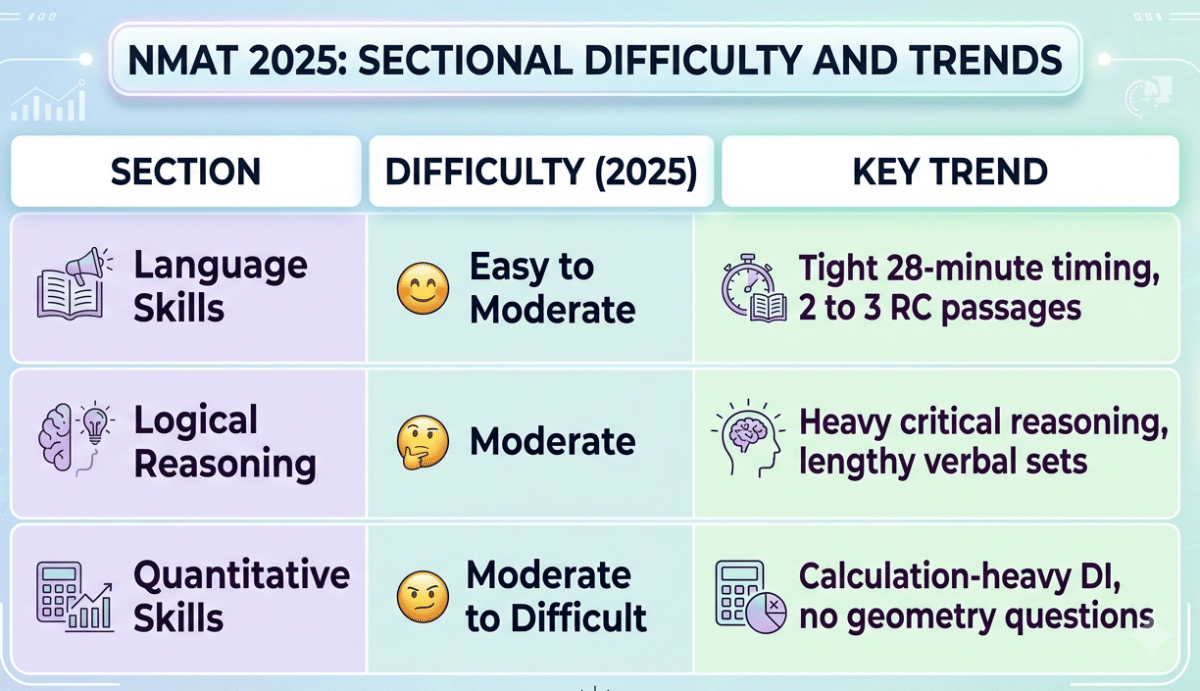
The table below shows the section-wise difficulty of NMAT 2025.
| Section | Difficulty (2025) | Key Trend |
|---|---|---|
| Language Skills | Easy to Moderate | Tight 28-minute timing, 2 to 3 RC passages |
| Logical Reasoning | Moderate | Heavy critical reasoning, lengthy verbal sets |
| Quantitative Skills | Moderate to Difficult | Calculation-heavy DI, no geometry questions |
Note: Quantitative Skills remained the most time-consuming section, mainly due to dense data interpretation.
Related Article: NMAT Exam Analysis 2025 (OUT): Check Overall & Section-wise Difficulty Level Analysis
NMAT 2025 Question Paper with Solutions PDF
| Paper/ Subject | Question Paper PDF | Solution PDF |
|---|---|---|
| NMAT 2025 Question Paper | Download PDF | Check Solutions |
Ques. Will NMAT 2026 be tougher than NMAT 2025?
Ans. NMAT 2026 is expected to stay at a moderate overall difficulty, similar to 2025. The adaptive, scaled format keeps the effective difficulty stable across years.
Will NMAT 2026 Be Tougher? What to Expect
NMAT uses a computer-adaptive, scaled scoring model. This design keeps the effective difficulty stable across slots and years, even when topic mixes change.
You should expect NMAT 2026 to be of a moderate overall difficulty level, similar to recent years.
The table below shows the expected difficulty for NMAT 2026, based on 2025 trends.
| Aspect | NMAT 2025 | NMAT 2026 (Expected) |
|---|---|---|
| Overall Difficulty | Moderate | Moderate, stable |
| Toughest Section | Quantitative Skills | Quantitative Skills, likely calculation-heavy |
| Reasoning Trend | Critical reasoning rising | Critical reasoning likely to stay high |
| Easiest Section | Language Skills | Language Skills, time-pressured |
| Pattern Change | None | None expected |
Note: NMAT 2026 may feel tougher in Quant and reasoning even if the overall scaled level stays the same.
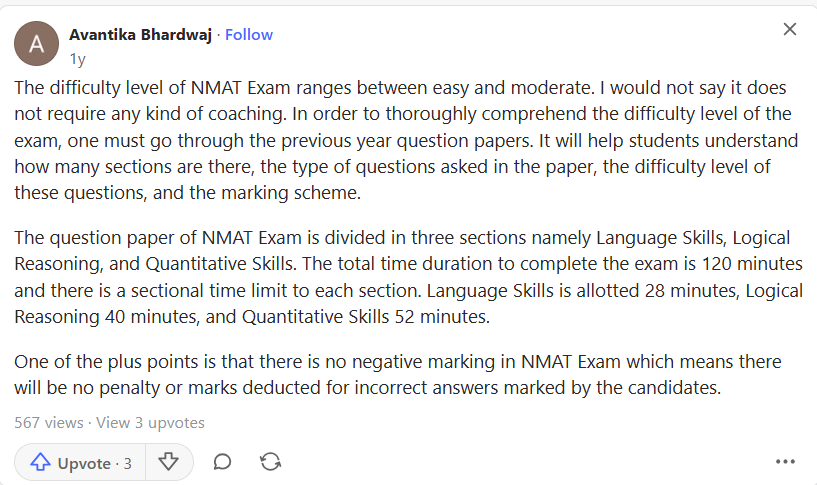
According to a Quora post, a user wanted to know the difficulty level of NMAT exam. As per the discussion, it was said that the difficulty level of the NMAT exam ranges from easy to moderate. There is no negative marking in the NMAT Exam which is a plus point for candidates.
Source: Quora
Related Article: NMAT Preparation: Study Plan, Books, Preparation Guide
NMAT 2026 Section-Wise Difficulty Level
The section-wise NMAT 2026 difficulty level is based on the latest analysis.
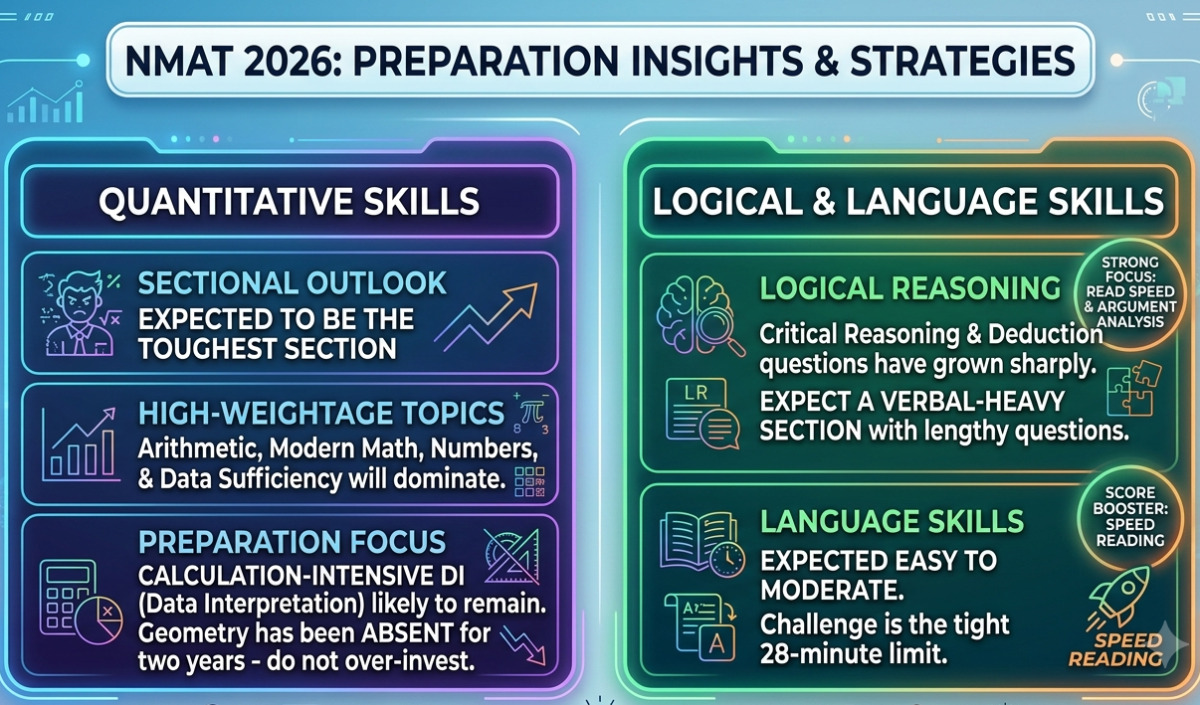
- Quantitative Skills: Expect this to stay the toughest section. Data interpretation is likely to remain calculation-intensive. Arithmetic, modern math, numbers, and data sufficiency should dominate. Geometry has been absent for two years, so do not over-invest there.
- Logical Reasoning: Critical reasoning and deduction questions have grown sharply. Expect a verbal-heavy reasoning section with lengthy questions. Strong reading speed and argument analysis will help you most here.
- Language Skills: This should stay easy to moderate, with reading comprehension, grammar, and vocabulary. The 28-minute limit is the real challenge. Speed reading is the biggest score booster in this section.
Related Articles:
- NMAT Mock Test 2026: Attempt Full Test, Chapter-wise Test Online for Free
- NMAT Coaching: Online and Offline City Wise Best Coaching Centres
Ques. Which is the toughest section in NMAT?
Ans. Quantitative Skills is the toughest section. It is calculation-heavy and time-consuming, mainly due to dense data interpretation sets.
How to Prepare for a Possibly Tougher NMAT 2026
Even with stable difficulty, smart preparation helps you score well in the NMAT 2026 exam, as discussed below:
- Master Quant calculation speed: Practice data interpretation under tight timing.
- Build critical reasoning skills: Solve argument, assumption, and deduction sets daily.
- Improve reading speed: It helps in both Language and verbal reasoning.
- Attempt every question: There is no negative marking, so attempt all questions
- Take adaptive mocks: Take the demo test at mba.com/exams/nmat
Note: Around 85 to 90 good attempts with high accuracy can push your score above 230, enough for top colleges like NMIMS Mumbai.
Related Articles:
- NMAT 2025 Quantitative Skills Preparation Tips, Questions, Syllabus, Books
- NMAT 2025 Language Skills Preparation: Syllabus, Best Books, Sample Questions
- NMAT 2025 Logical Reasoning Preparation, Best Books, Sample Questions
NMAT 2026 Expected to Be Tougher FAQs
Ques. Did NMAT 2025 have any pattern changes?
Ans. No, NMAT 2025 had no pattern change. It kept three sections of 36 questions each, 108 questions in total, with no negative marking.
Ques. Why does NMAT feel harder for strong students?
Ans. NMAT is adaptive, so a strong start raises your question difficulty. This makes the test feel harder for high performers, but it is by design.
Ques. What is changing in the NMAT Logical Reasoning section?
Ans. Critical reasoning and deduction questions have grown sharply. In 2025, there were 22 to 23 such questions, up from around 16 in 2024.
Ques. What score should I target for NMAT 2026?
Ans. A score of 230 or above is competitive for top colleges. Around 85 to 90 good attempts with high accuracy can help you reach this range.



Comments