




The NMAT 2024 question paper with solutions is available here for free download. NMAT is conducted by GMAC (Graduate Management Admission Council), and the paper carries 108 questions across three sections - Language Skills, Quantitative Skills, and Logical Reasoning - to be attempted in 120 minutes. These are memory-based questions, as GMAC does not release the official paper.
| NMAT 2024 Question Paper with Solutions | Download PDF | Check Solutions |
NMAT 2024 Questions with Solutions
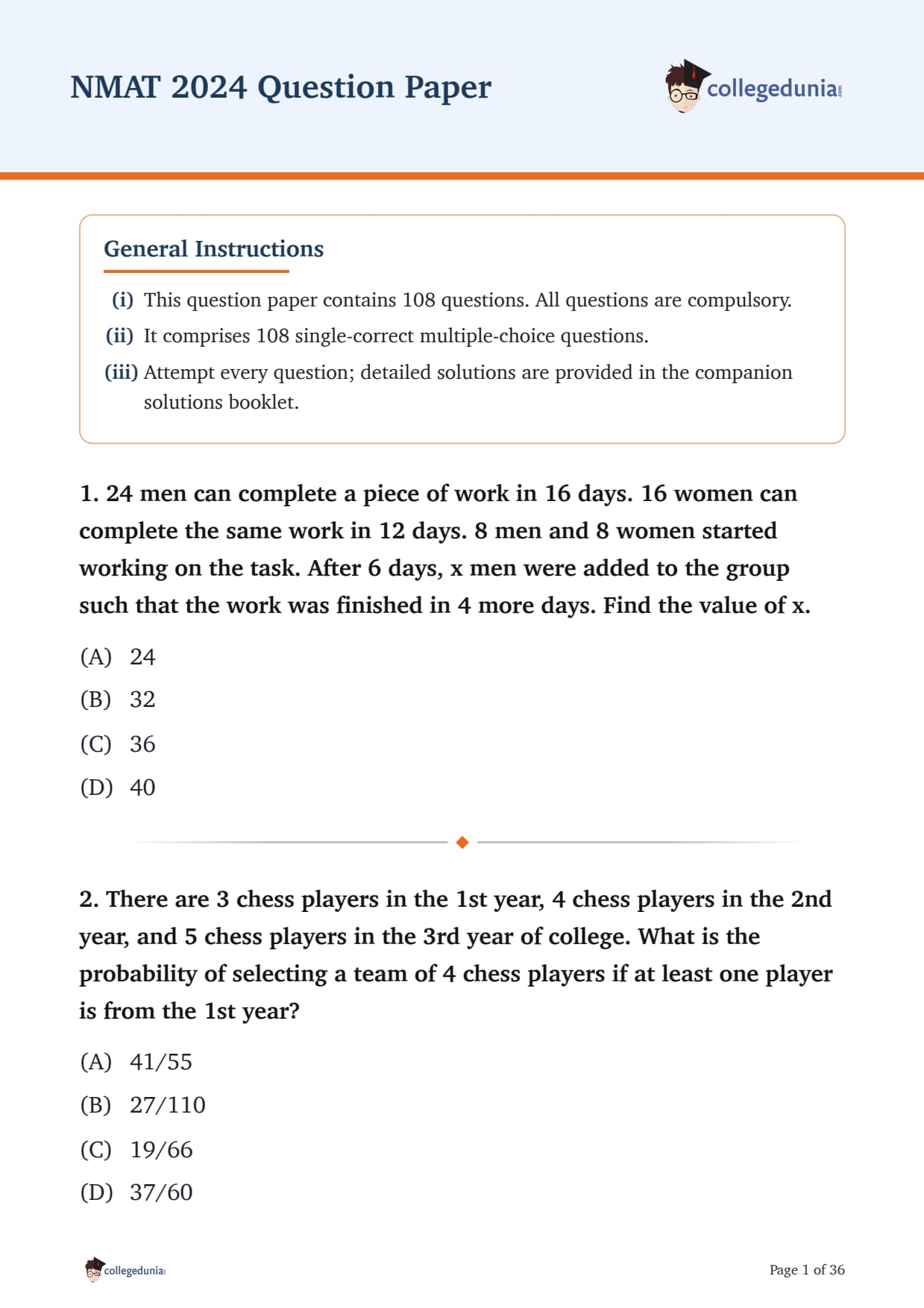
24 men can complete a piece of work in 16 days. 16 women can complete the same work in 12 days. 8 men and 8 women started working on the task. After 6 days, x men were added to the group such that the work was finished in 4 more days. Find the value of x.
There are 3 chess players in the 1st year, 4 chess players in the 2nd year, and 5 chess players in the 3rd year of college. What is the probability of selecting a team of 4 chess players if at least one player is from the 1st year?
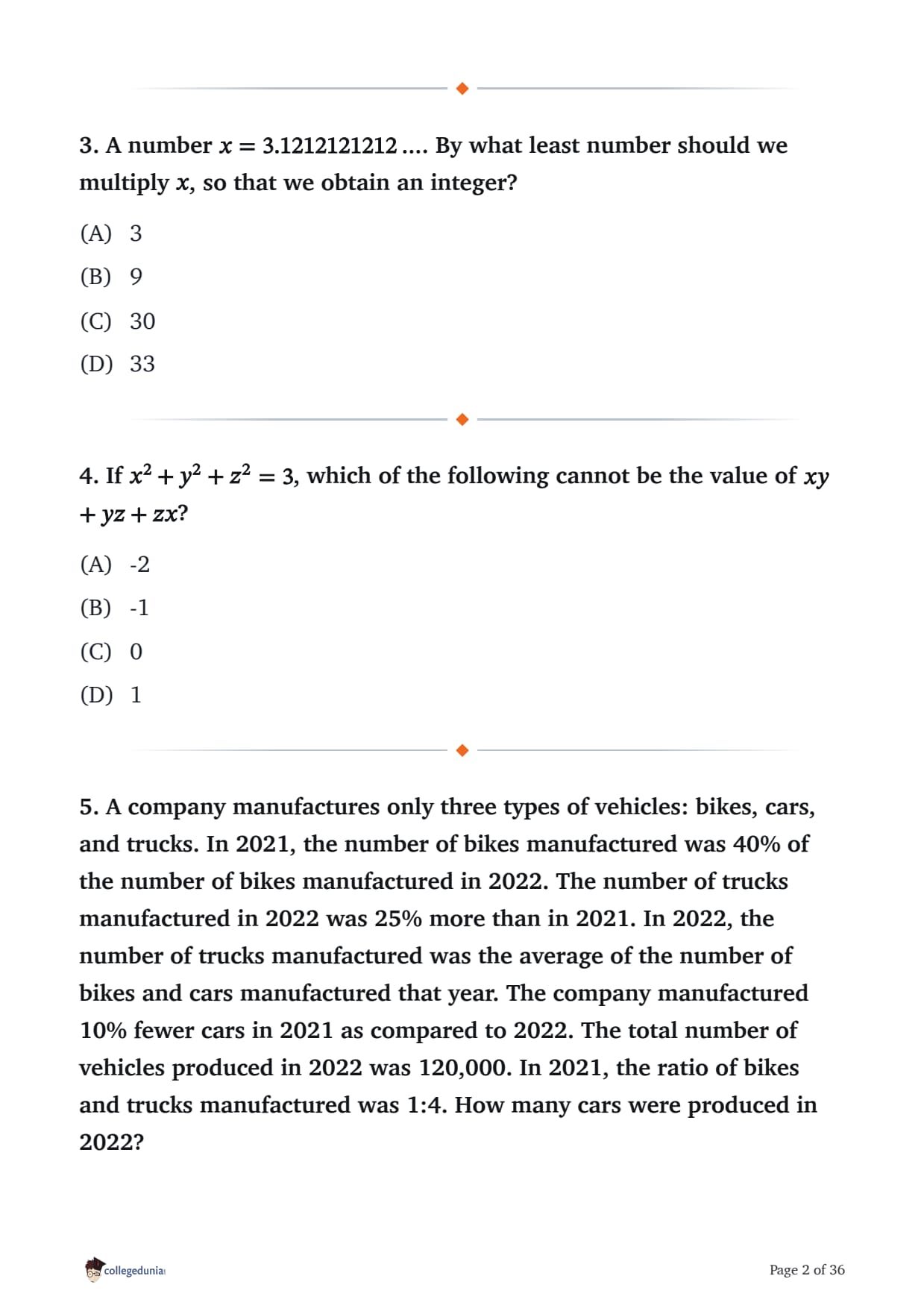
A number \( x = 3.1212121212\ldots \). By what least number should we multiply \( x \), so that we obtain an integer?
If \( x^2 + y^2 + z^2 = 3 \), which of the following cannot be the value of \( xy + yz + zx \)?
A company manufactures only three types of vehicles: bikes, cars, and trucks. In 2021, the number of bikes manufactured was 40% of the number of bikes manufactured in 2022. The number of trucks manufactured in 2022 was 25% more than in 2021. In 2022, the number of trucks manufactured was the average of the number of bikes and cars manufactured that year. The company manufactured 10% fewer cars in 2021 as compared to 2022. The total number of vehicles produced in 2022 was 120,000. In 2021, the ratio of bikes and trucks manufactured was 1:4. How many cars were produced in 2022?
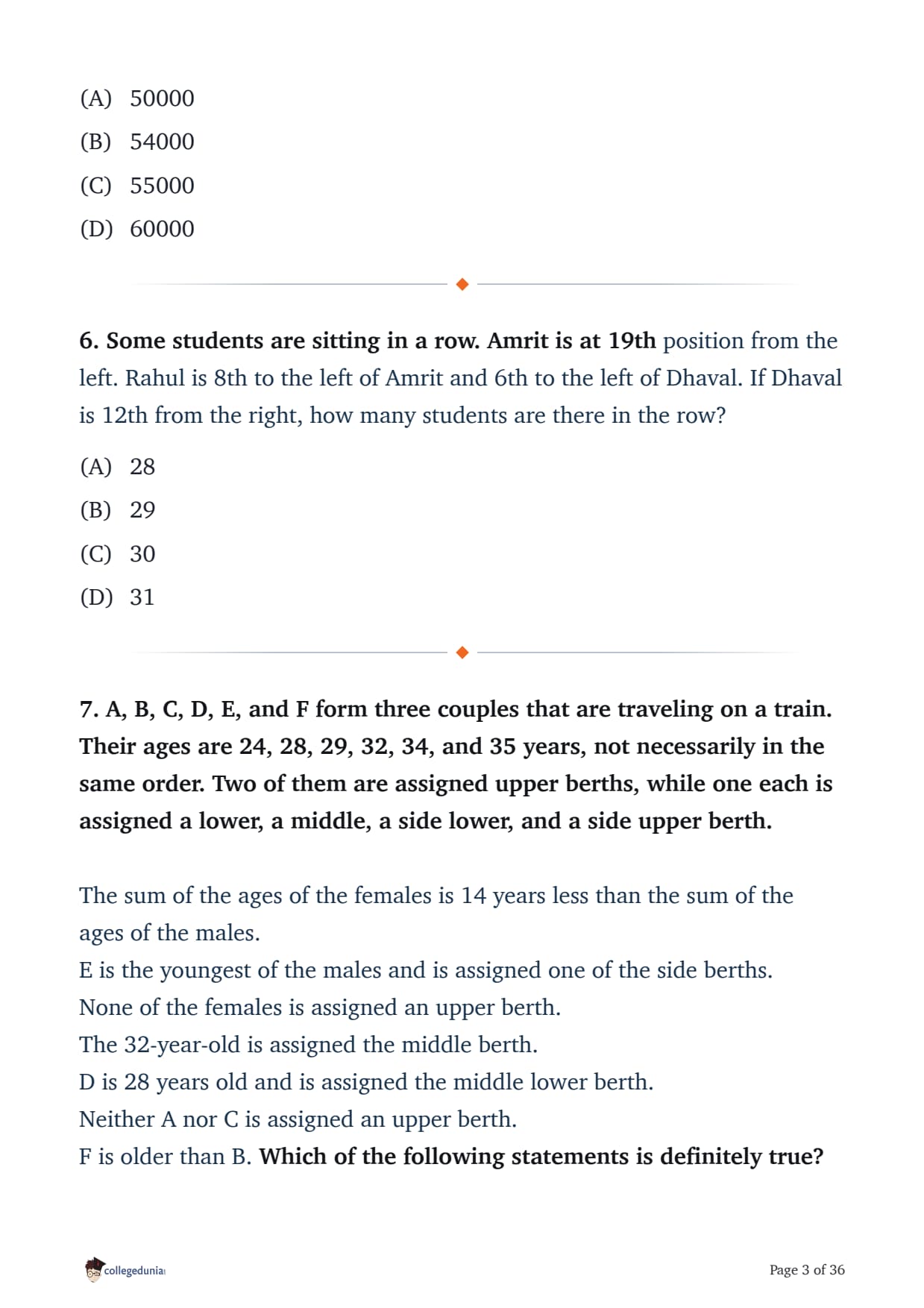
Some students are sitting in a row. Amrit is at 19th position from the left. Rahul is 8th to the left of Amrit and 6th to the left of Dhaval. If Dhaval is 12th from the right, how many students are there in the row?
A, B, C, D, E, and F form three couples that are traveling on a train. Their ages are 24, 28, 29, 32, 34, and 35 years, not necessarily in the same order. Two of them are assigned upper berths, while one each is assigned a lower, a middle, a side lower, and a side upper berth.
The sum of the ages of the females is 14 years less than the sum of the ages of the males.
E is the youngest of the males and is assigned one of the side berths.
None of the females is assigned an upper berth.
The 32-year-old is assigned the middle berth.
D is 28 years old and is assigned the middle lower berth.
Neither A nor C is assigned an upper berth.
F is older than B.
Which of the following statements is definitely true?
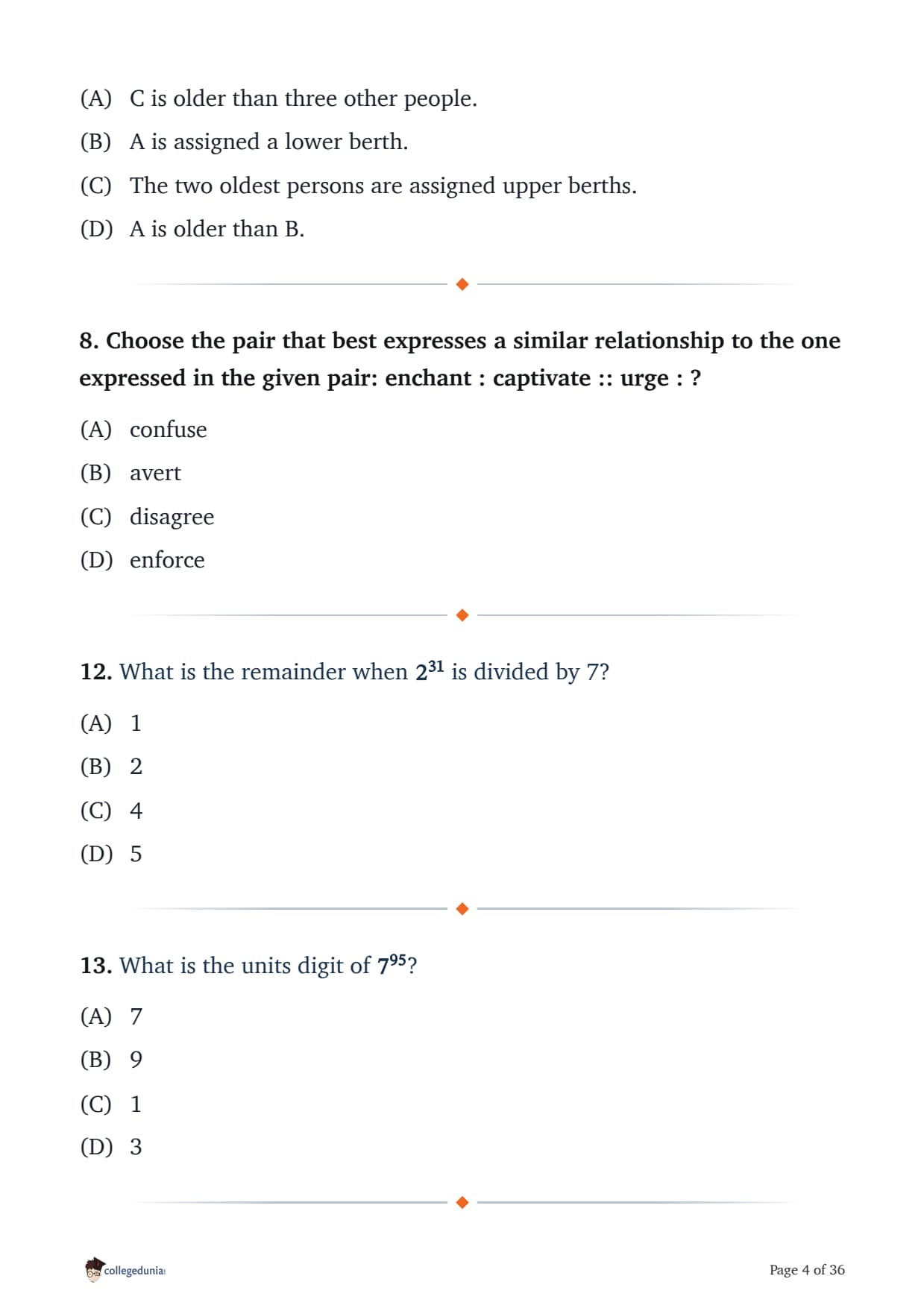
Choose the pair that best expresses a similar relationship to the one expressed in the given pair:
enchant : captivate :: urge : ?
What is the remainder when \(2^{31}\) is divided by 7?
What is the units digit of \(7^{95}\)?
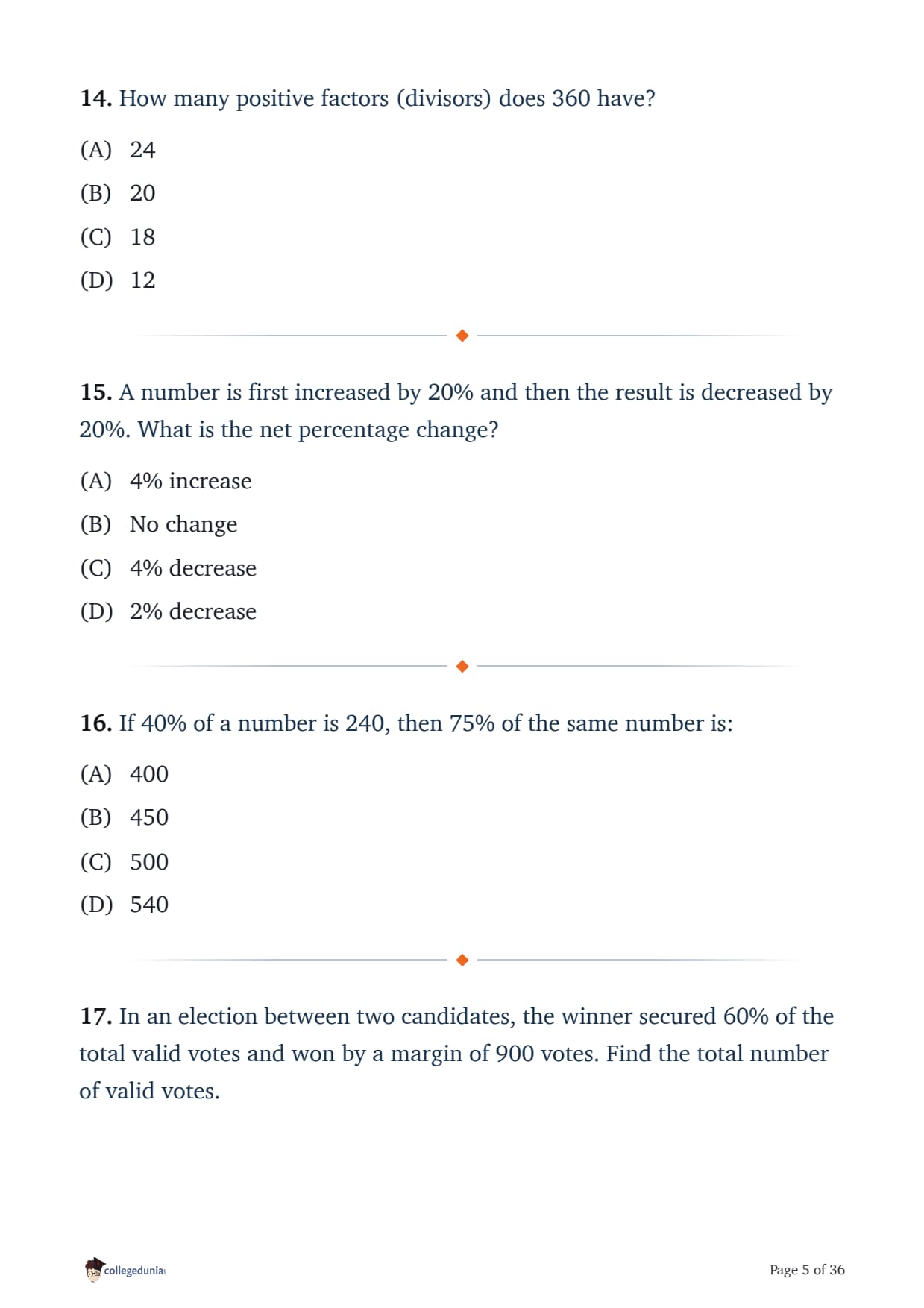
How many positive factors (divisors) does 360 have?
A number is first increased by 20% and then the result is decreased by 20%. What is the net percentage change?
If 40% of a number is 240, then 75% of the same number is:
In an election between two candidates, the winner secured 60% of the total valid votes and won by a margin of 900 votes. Find the total number of valid votes.
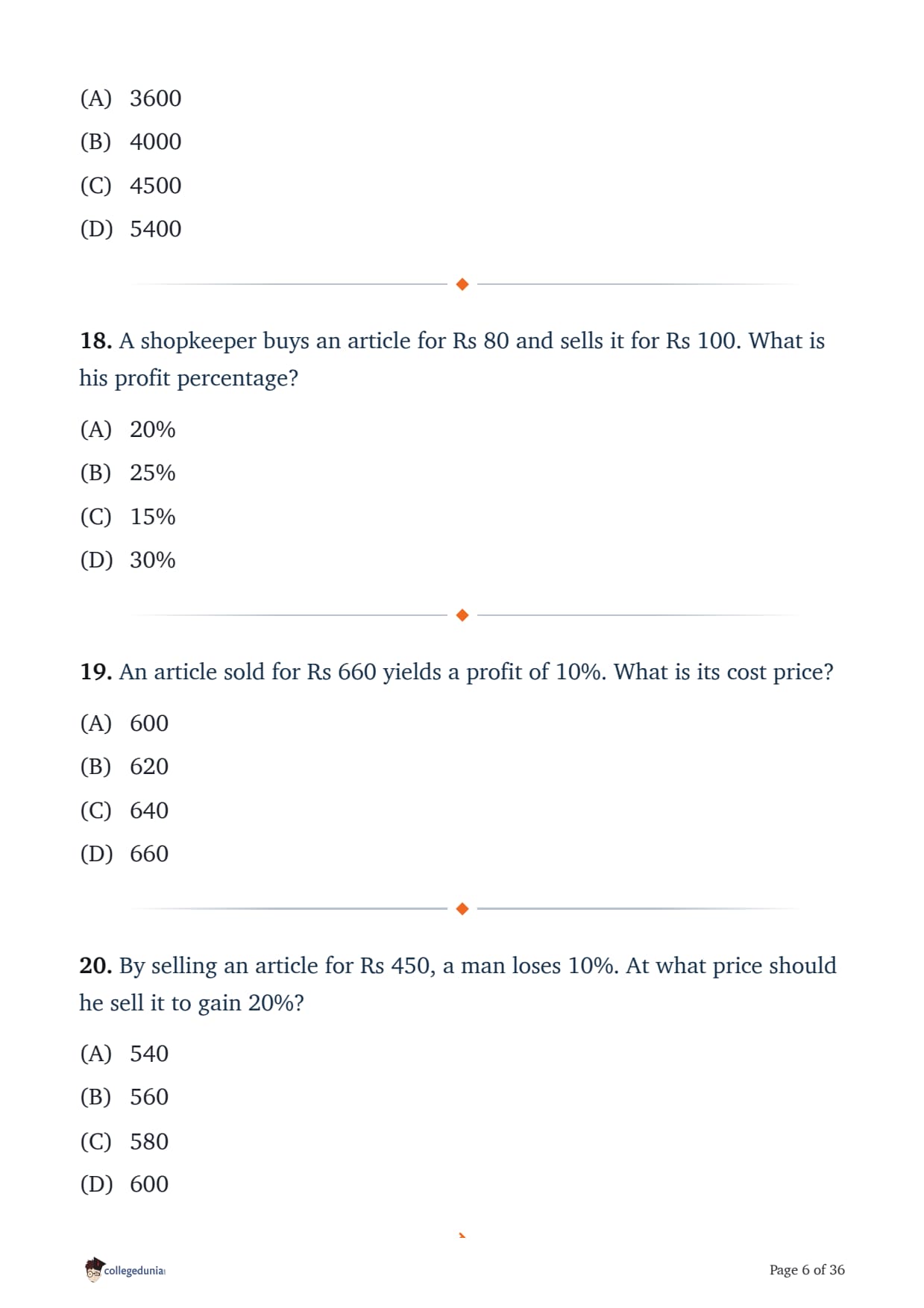
A shopkeeper buys an article for Rs 80 and sells it for Rs 100. What is his profit percentage?
An article sold for Rs 660 yields a profit of 10%. What is its cost price?
By selling an article for Rs 450, a man loses 10%. At what price should he sell it to gain 20%?
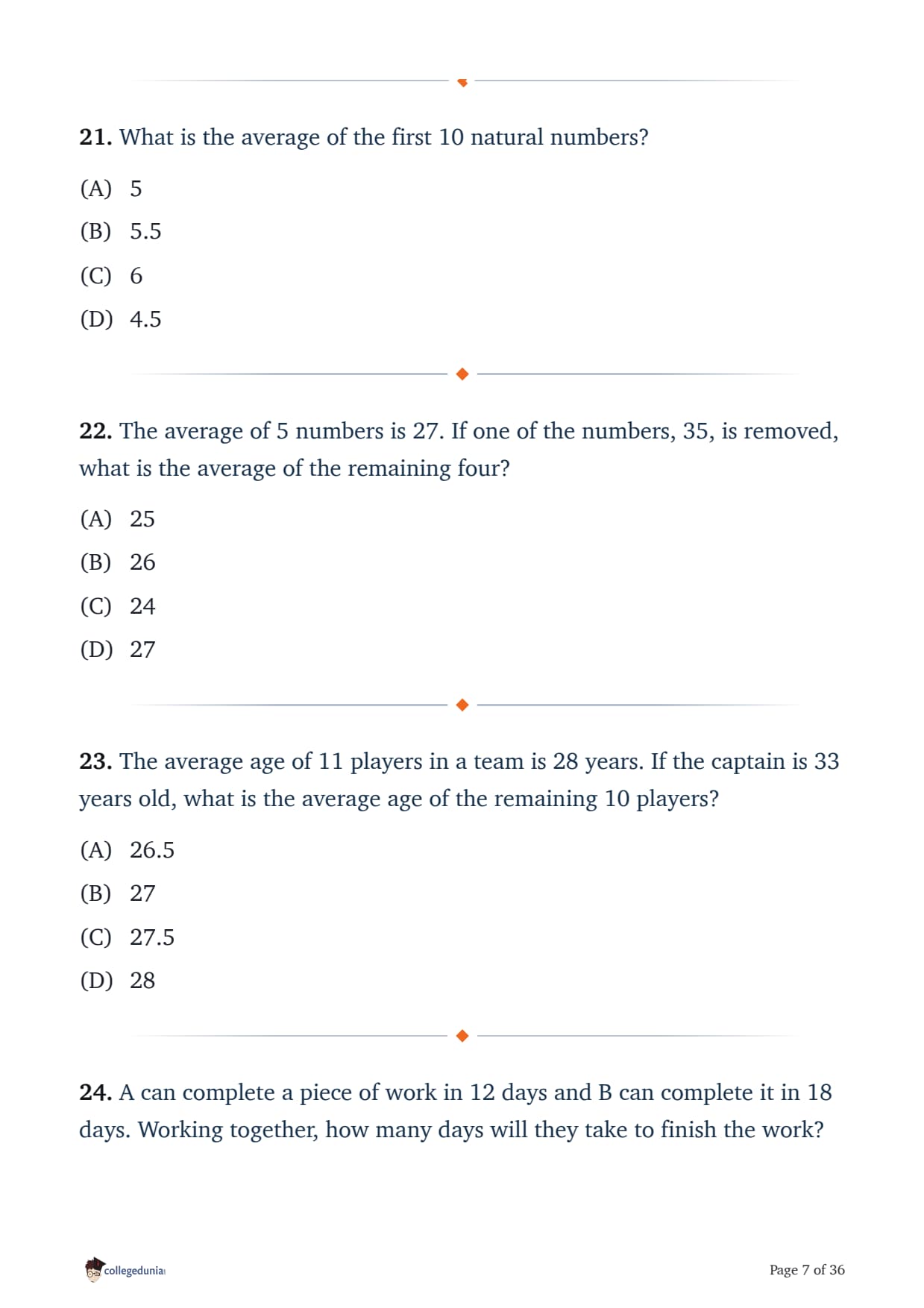
What is the average of the first 10 natural numbers?
The average of 5 numbers is 27. If one of the numbers, 35, is removed, what is the average of the remaining four?
The average age of 11 players in a team is 28 years. If the captain is 33 years old, what is the average age of the remaining 10 players?
A can complete a piece of work in 12 days and B can complete it in 18 days. Working together, how many days will they take to finish the work?
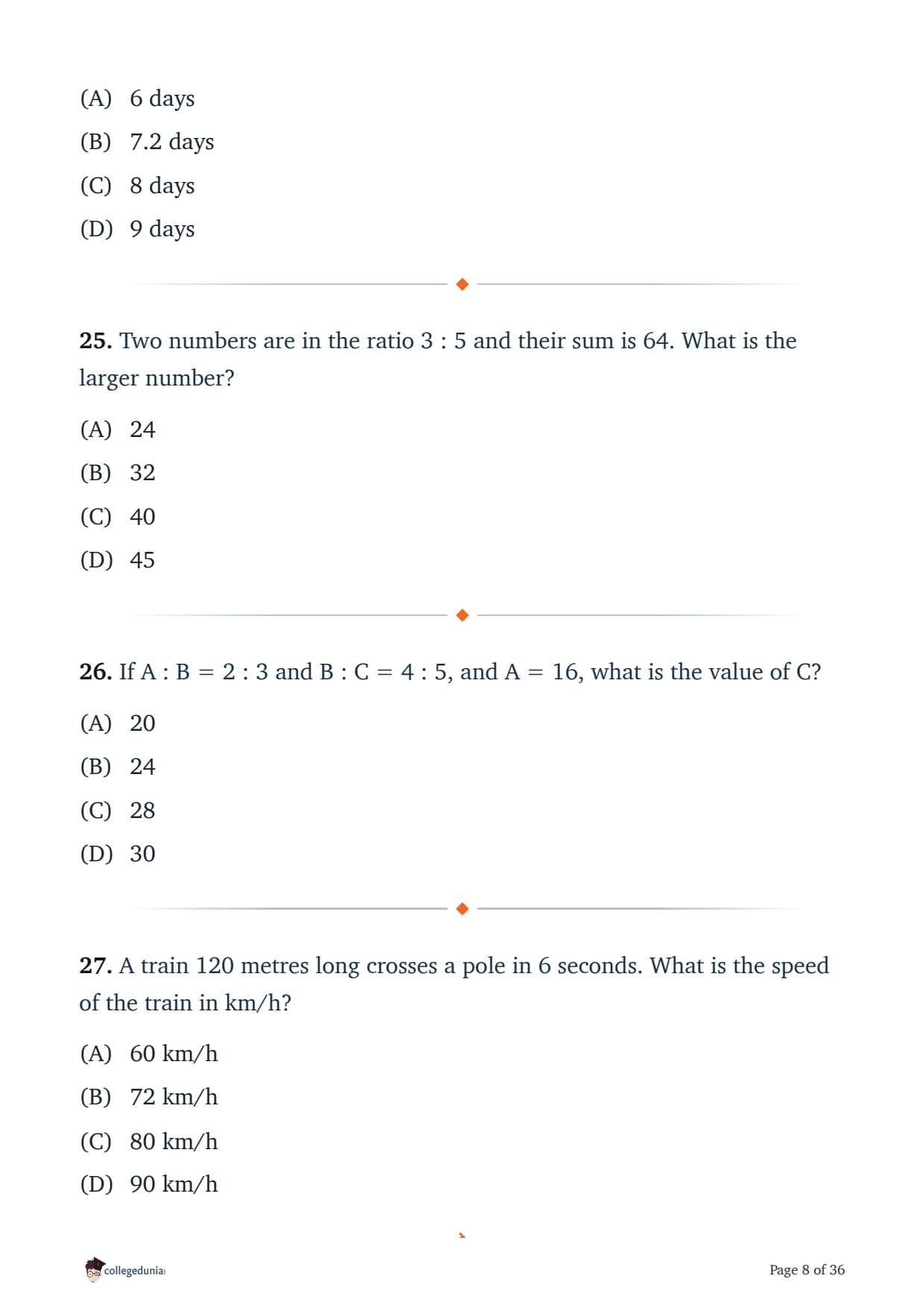
Two numbers are in the ratio 3 : 5 and their sum is 64. What is the larger number?
If A : B = 2 : 3 and B : C = 4 : 5, and A = 16, what is the value of C?
A train 120 metres long crosses a pole in 6 seconds. What is the speed of the train in km/h?
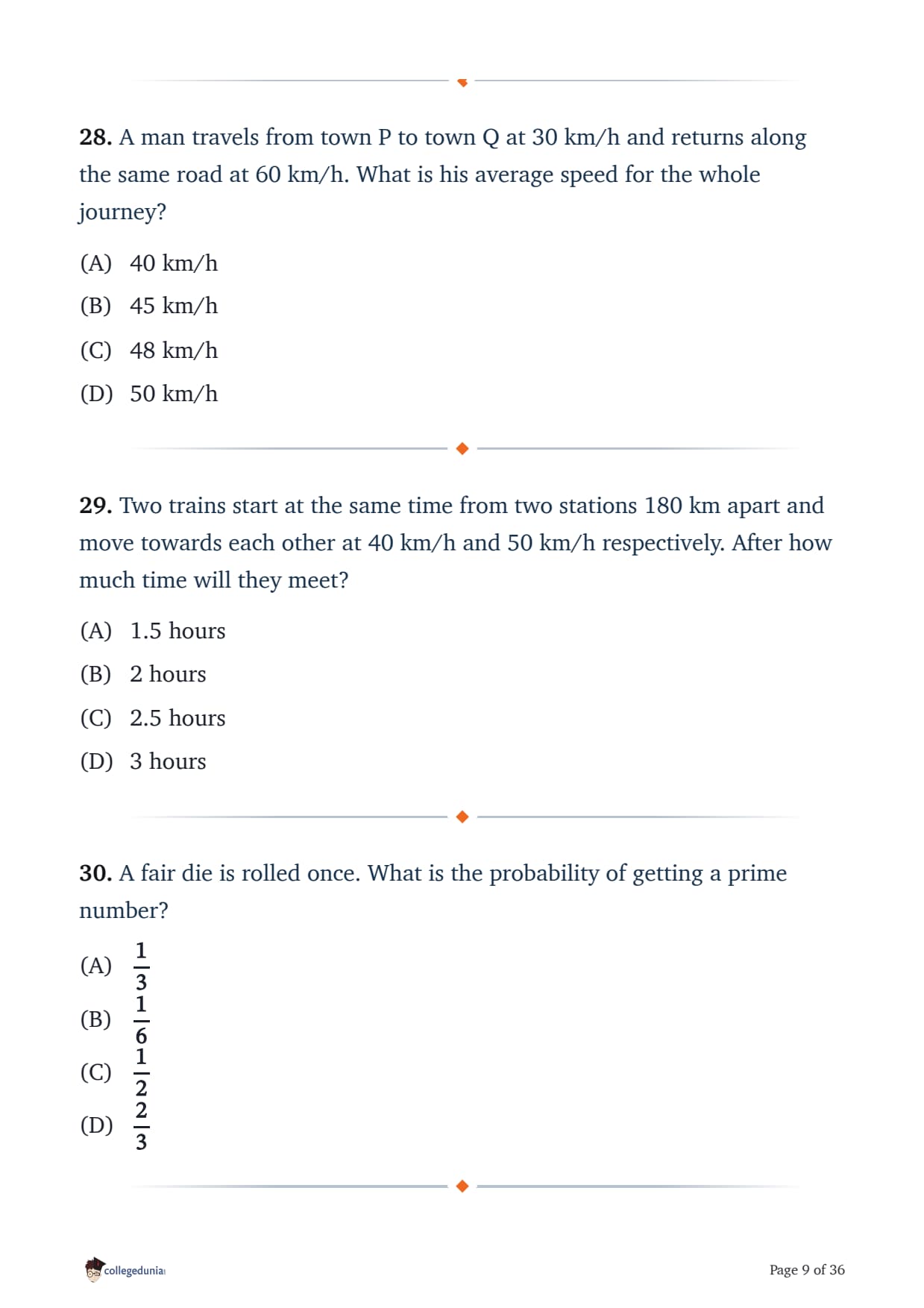
A man travels from town P to town Q at 30 km/h and returns along the same road at 60 km/h. What is his average speed for the whole journey?
Two trains start at the same time from two stations 180 km apart and move towards each other at 40 km/h and 50 km/h respectively. After how much time will they meet?
A fair die is rolled once. What is the probability of getting a prime number?
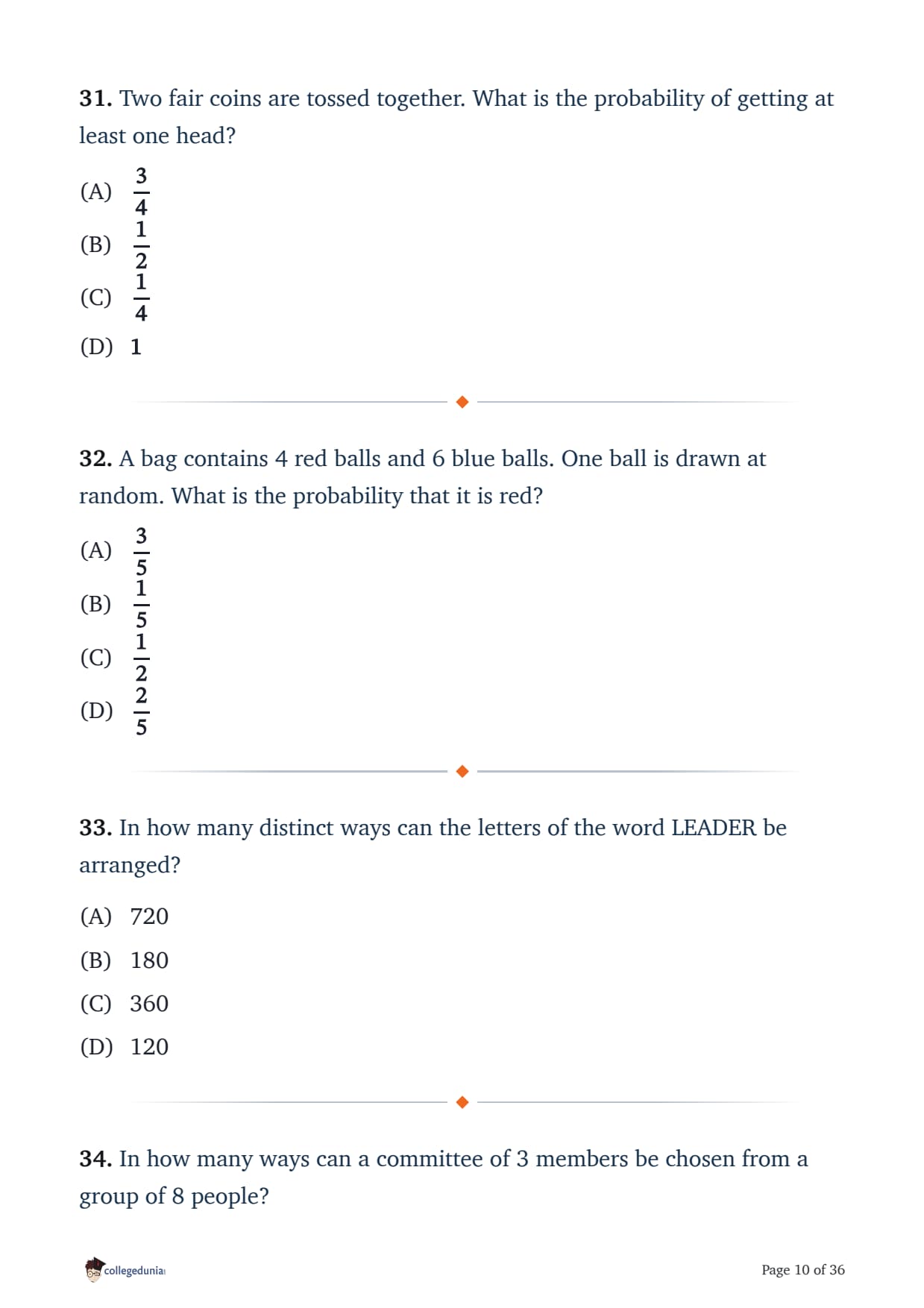
Two fair coins are tossed together. What is the probability of getting at least one head?
A bag contains 4 red balls and 6 blue balls. One ball is drawn at random. What is the probability that it is red?
In how many distinct ways can the letters of the word LEADER be arranged?
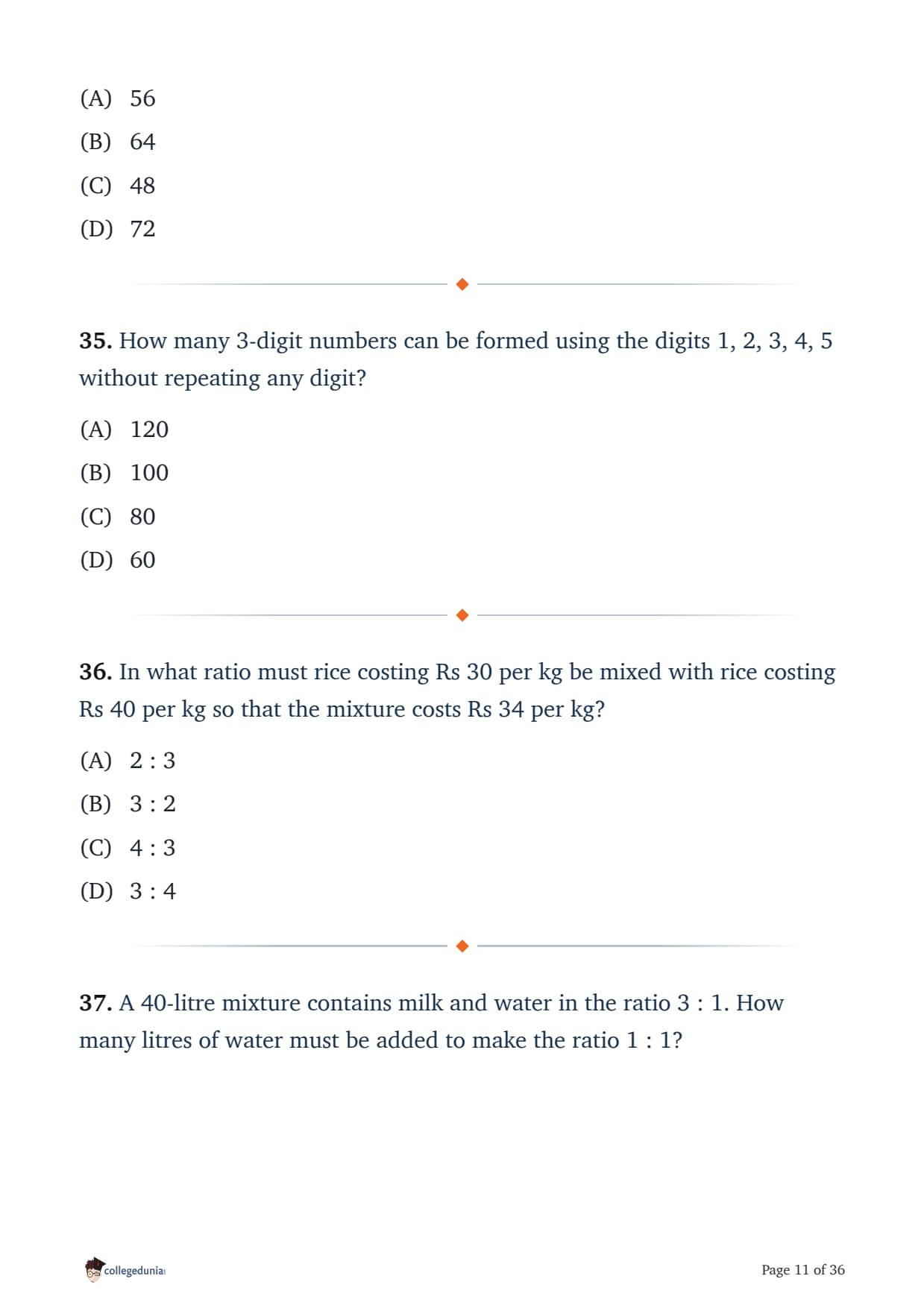
In how many ways can a committee of 3 members be chosen from a group of 8 people?
How many 3-digit numbers can be formed using the digits 1, 2, 3, 4, 5 without repeating any digit?
In what ratio must rice costing Rs 30 per kg be mixed with rice costing Rs 40 per kg so that the mixture costs Rs 34 per kg?
A 40-litre mixture contains milk and water in the ratio 3 : 1. How many litres of water must be added to make the ratio 1 : 1?
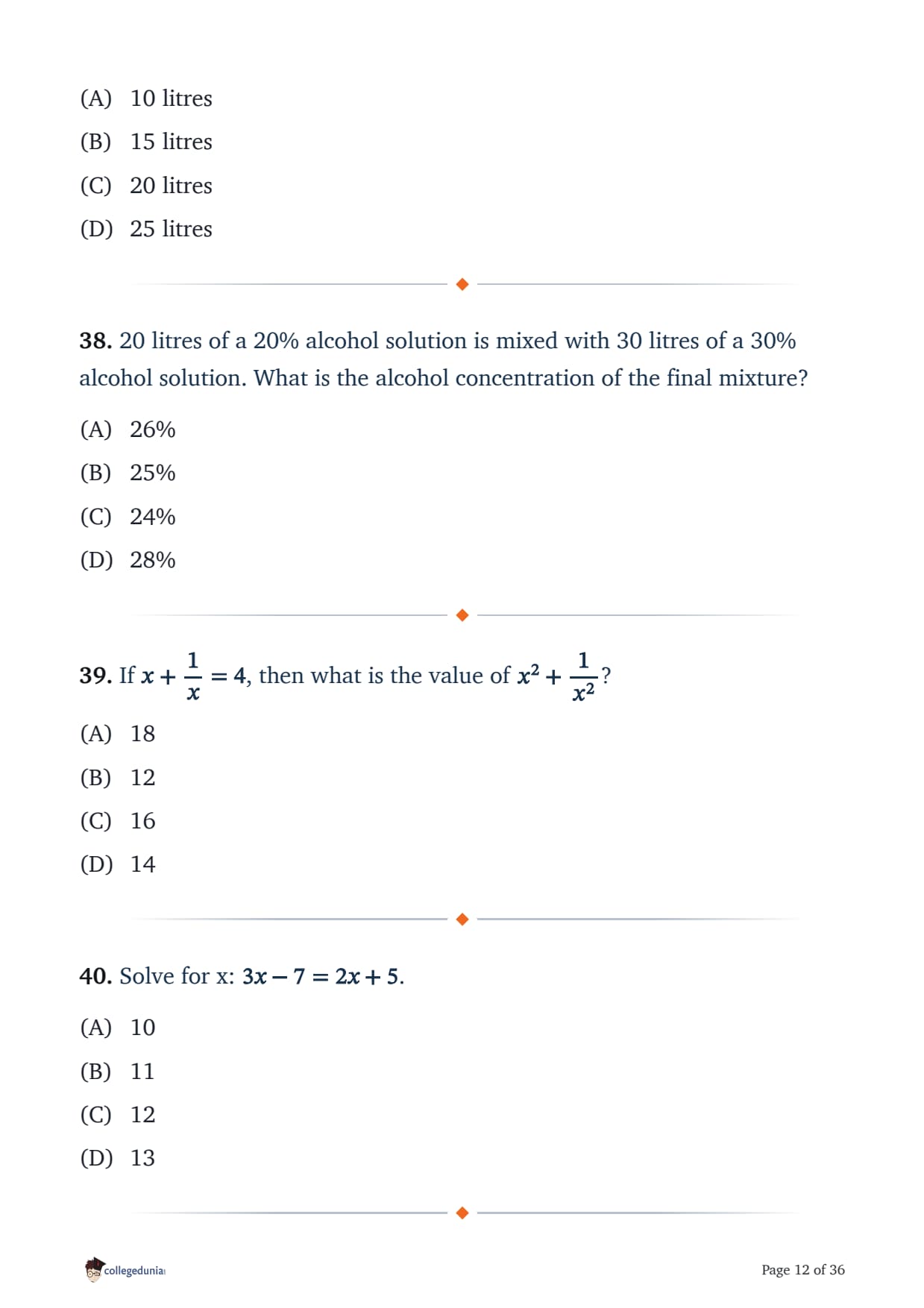
20 litres of a 20% alcohol solution is mixed with 30 litres of a 30% alcohol solution. What is the alcohol concentration of the final mixture?
If \(x + \dfrac{1}{x} = 4\), then what is the value of \(x^2 + \dfrac{1}{x^2}\)?
Solve for x: \(3x - 7 = 2x + 5\).
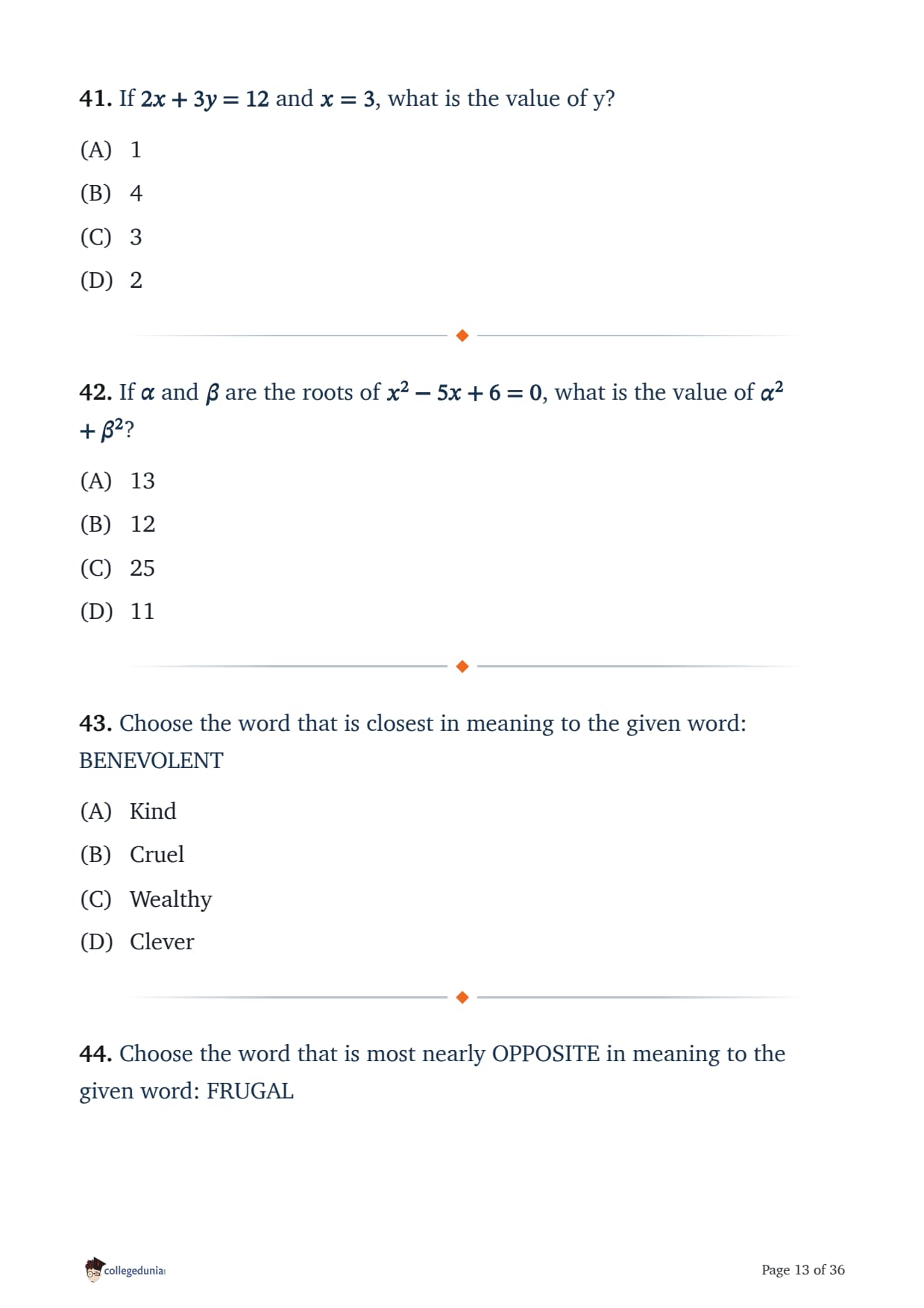
If \(2x + 3y = 12\) and \(x = 3\), what is the value of y?
If \(\alpha\) and \(\beta\) are the roots of \(x^2 - 5x + 6 = 0\), what is the value of \(\alpha^2 + \beta^2\)?
Choose the word that is closest in meaning to the given word: BENEVOLENT
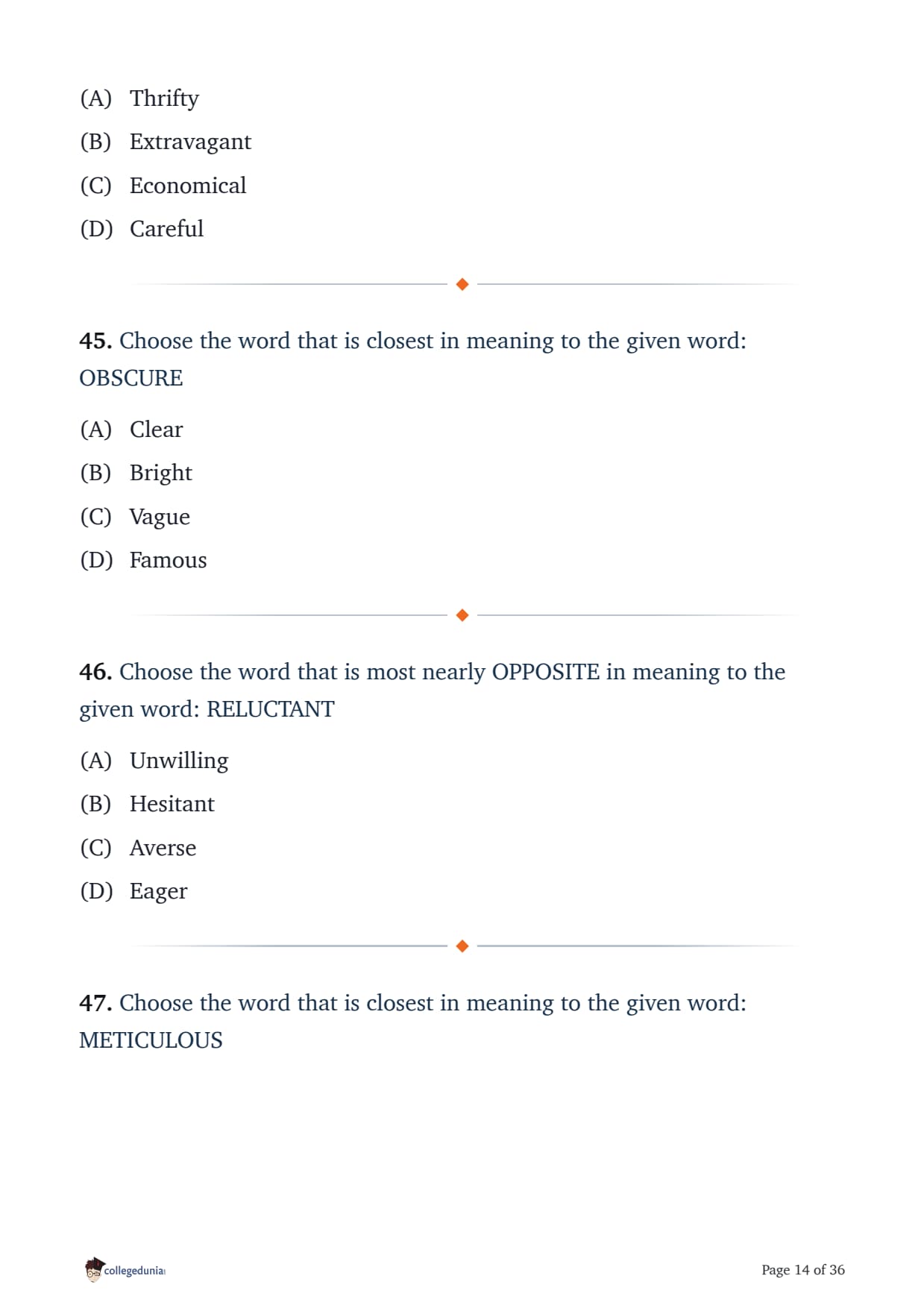
Choose the word that is most nearly OPPOSITE in meaning to the given word: FRUGAL
Choose the word that is closest in meaning to the given word: OBSCURE
Choose the word that is most nearly OPPOSITE in meaning to the given word: RELUCTANT
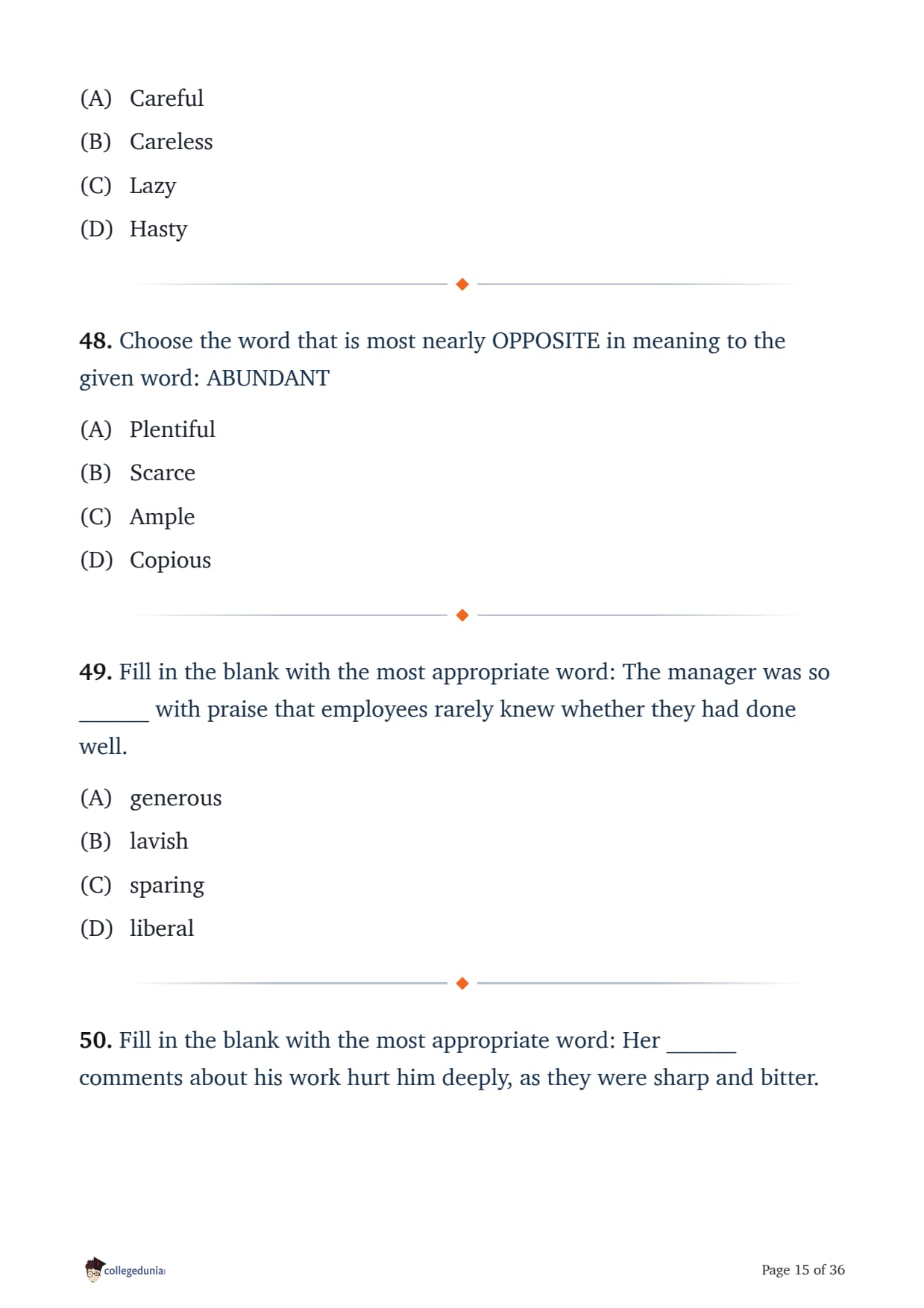
Choose the word that is closest in meaning to the given word: METICULOUS
Choose the word that is most nearly OPPOSITE in meaning to the given word: ABUNDANT
Fill in the blank with the most appropriate word: The manager was so ______ with praise that employees rarely knew whether they had done well.
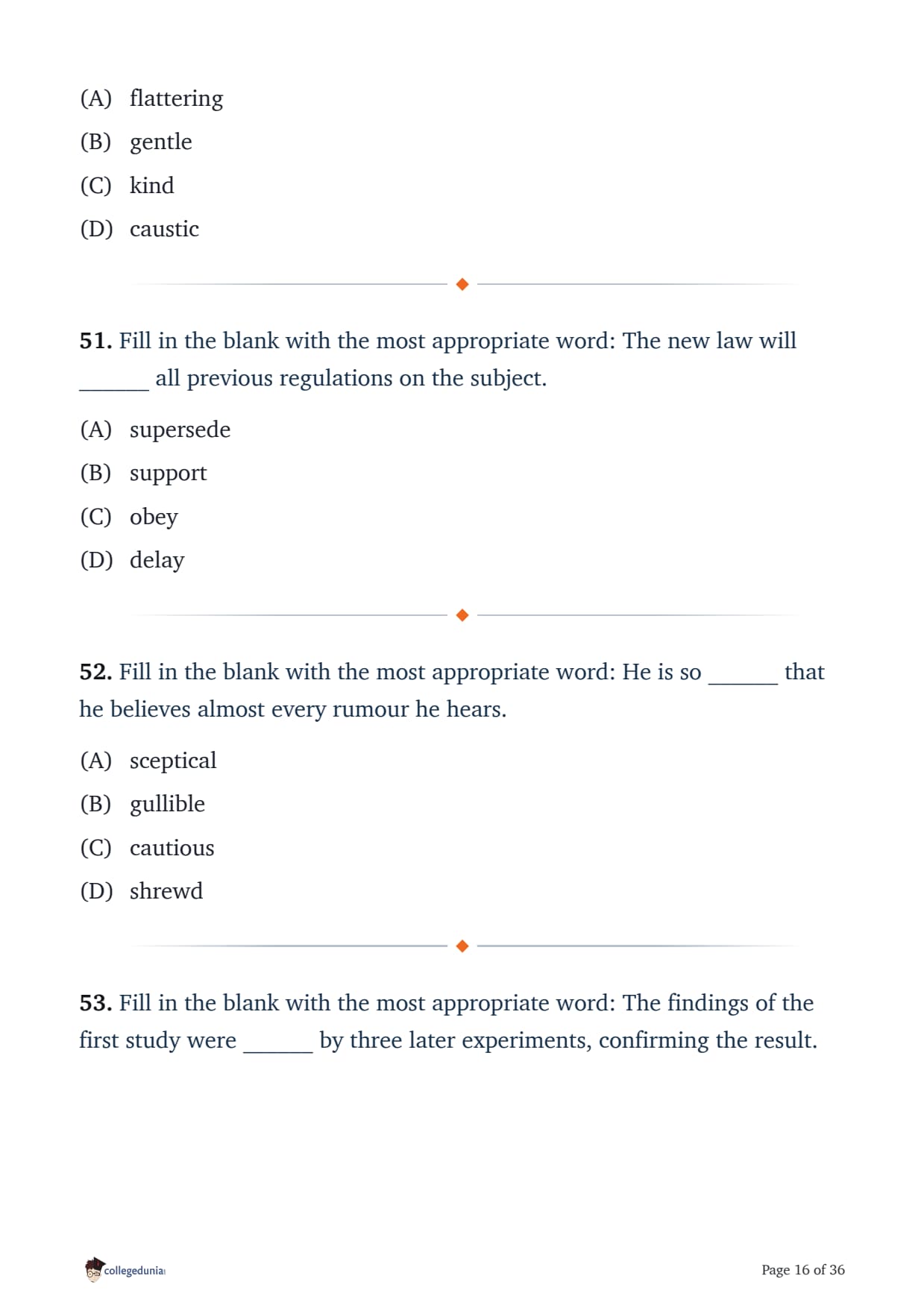
Fill in the blank with the most appropriate word: Her ______ comments about his work hurt him deeply, as they were sharp and bitter.
Fill in the blank with the most appropriate word: The new law will ______ all previous regulations on the subject.
Fill in the blank with the most appropriate word: He is so ______ that he believes almost every rumour he hears.
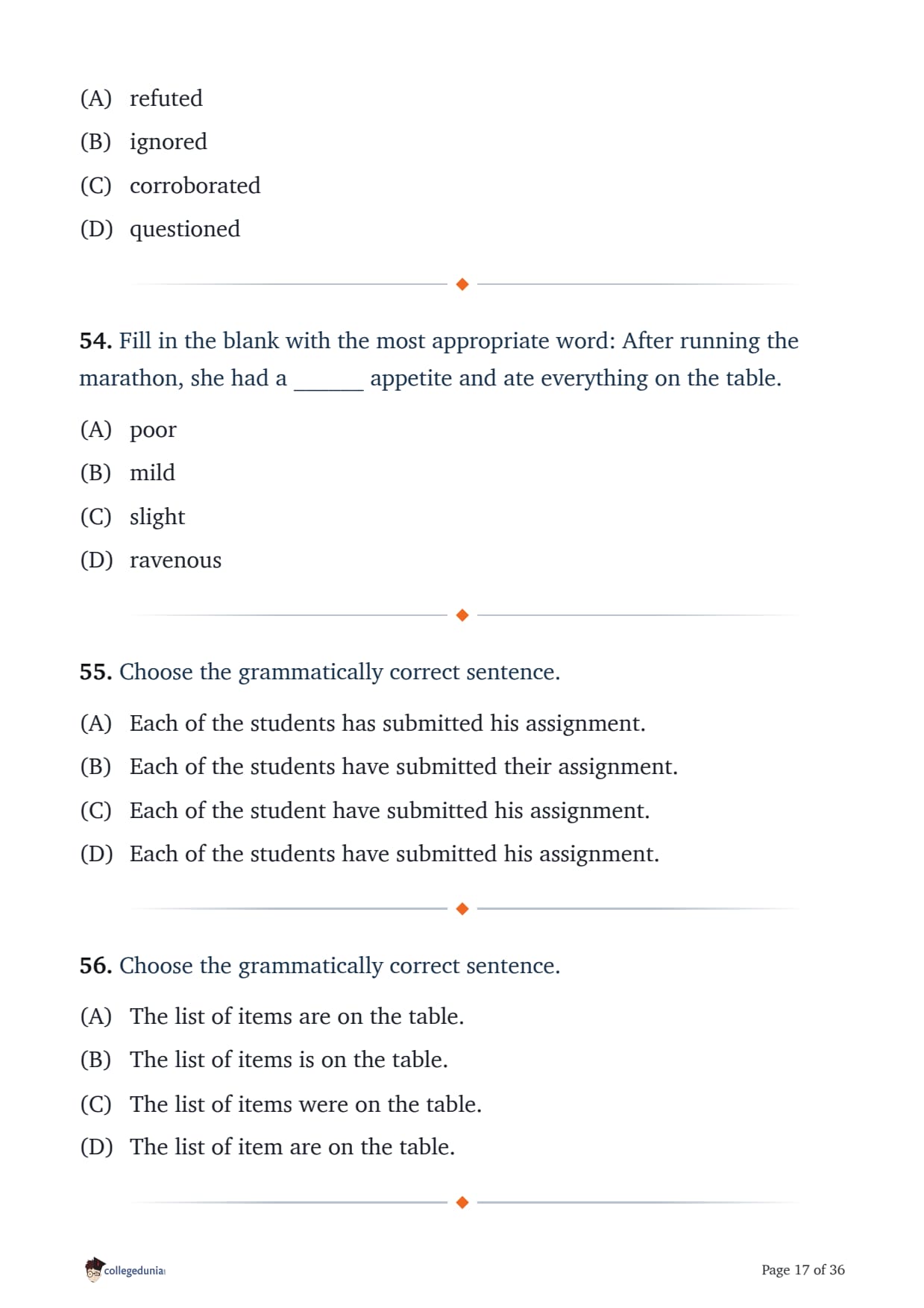
Fill in the blank with the most appropriate word: The findings of the first study were ______ by three later experiments, confirming the result.
Fill in the blank with the most appropriate word: After running the marathon, she had a ______ appetite and ate everything on the table.
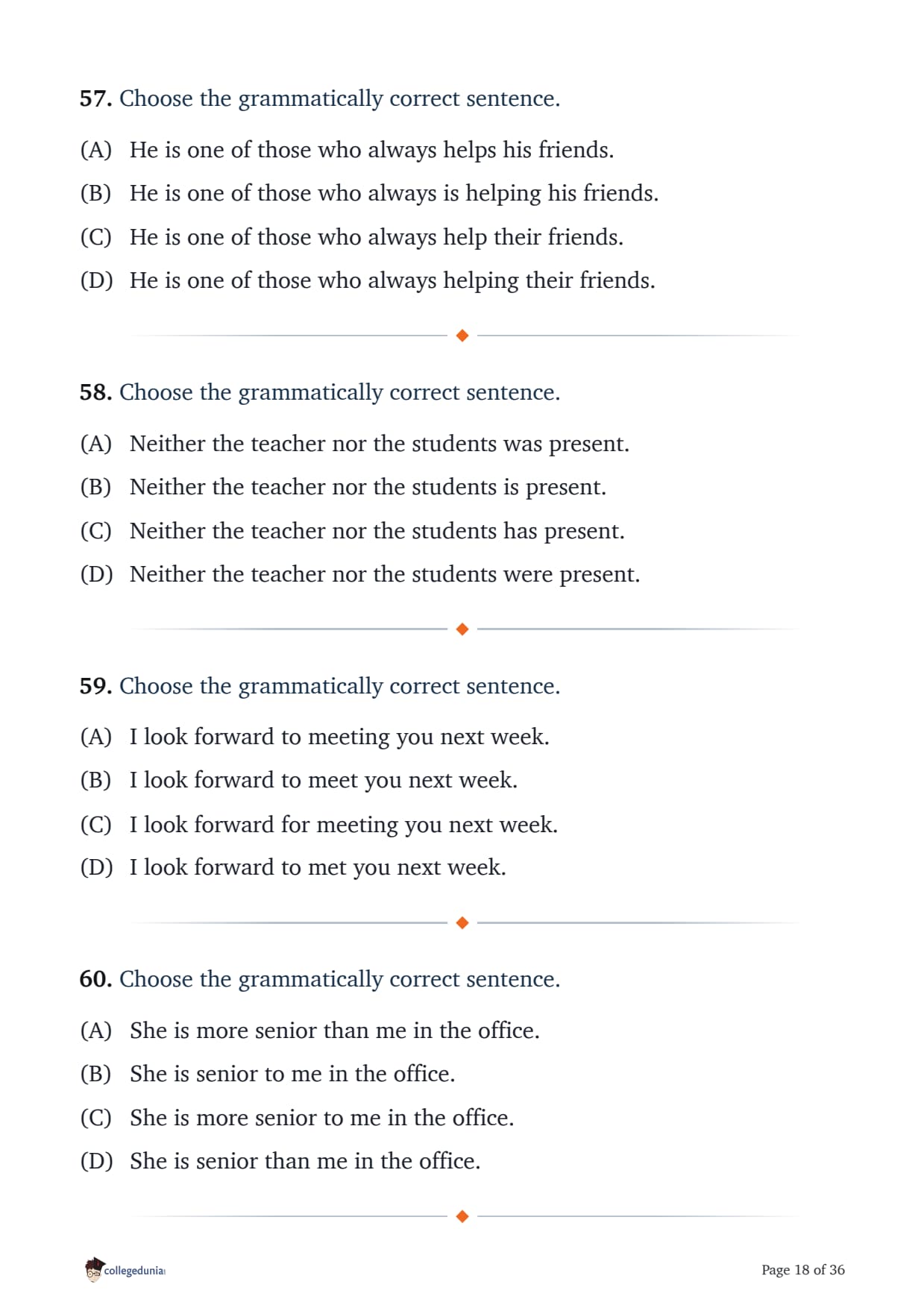
Choose the grammatically correct sentence.
Choose the grammatically correct sentence.
Choose the grammatically correct sentence.
Choose the grammatically correct sentence.
Choose the grammatically correct sentence.
Choose the grammatically correct sentence.
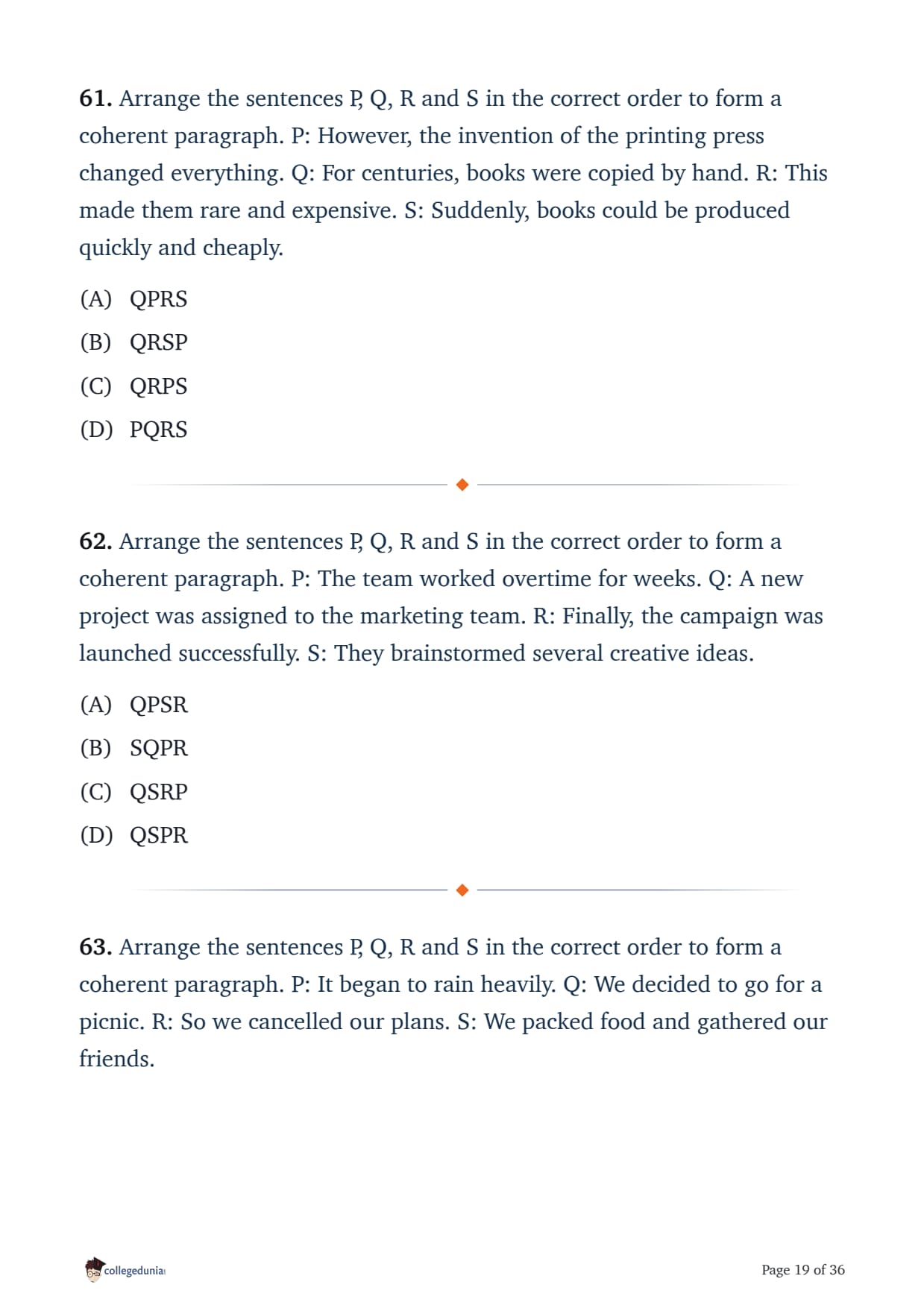
Arrange the sentences P, Q, R and S in the correct order to form a coherent paragraph. P: However, the invention of the printing press changed everything. Q: For centuries, books were copied by hand. R: This made them rare and expensive. S: Suddenly, books could be produced quickly and cheaply.
Arrange the sentences P, Q, R and S in the correct order to form a coherent paragraph. P: The team worked overtime for weeks. Q: A new project was assigned to the marketing team. R: Finally, the campaign was launched successfully. S: They brainstormed several creative ideas.
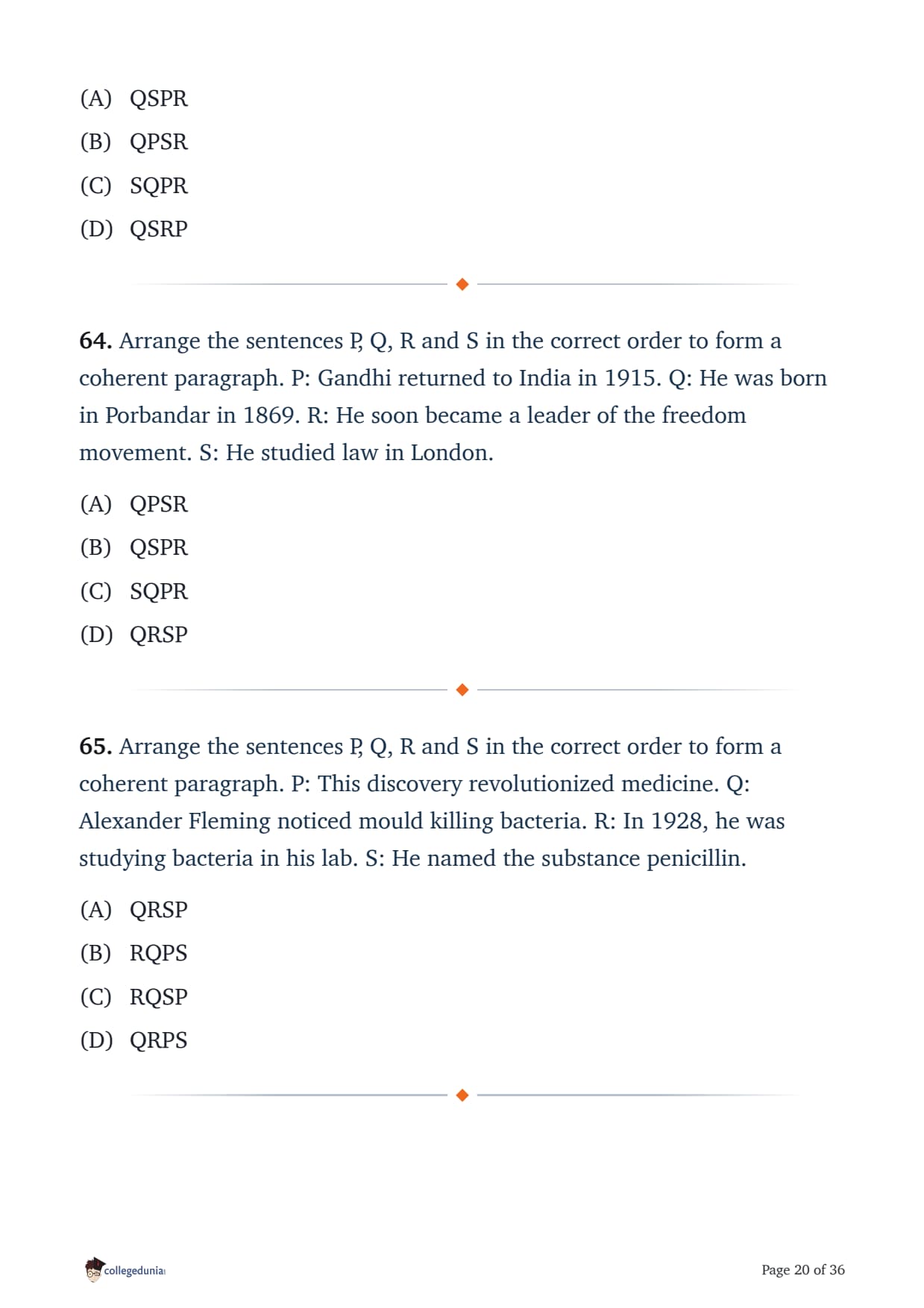
Arrange the sentences P, Q, R and S in the correct order to form a coherent paragraph. P: It began to rain heavily. Q: We decided to go for a picnic. R: So we cancelled our plans. S: We packed food and gathered our friends.
Arrange the sentences P, Q, R and S in the correct order to form a coherent paragraph. P: Gandhi returned to India in 1915. Q: He was born in Porbandar in 1869. R: He soon became a leader of the freedom movement. S: He studied law in London.
Arrange the sentences P, Q, R and S in the correct order to form a coherent paragraph. P: This discovery revolutionized medicine. Q: Alexander Fleming noticed mould killing bacteria. R: In 1928, he was studying bacteria in his lab. S: He named the substance penicillin.
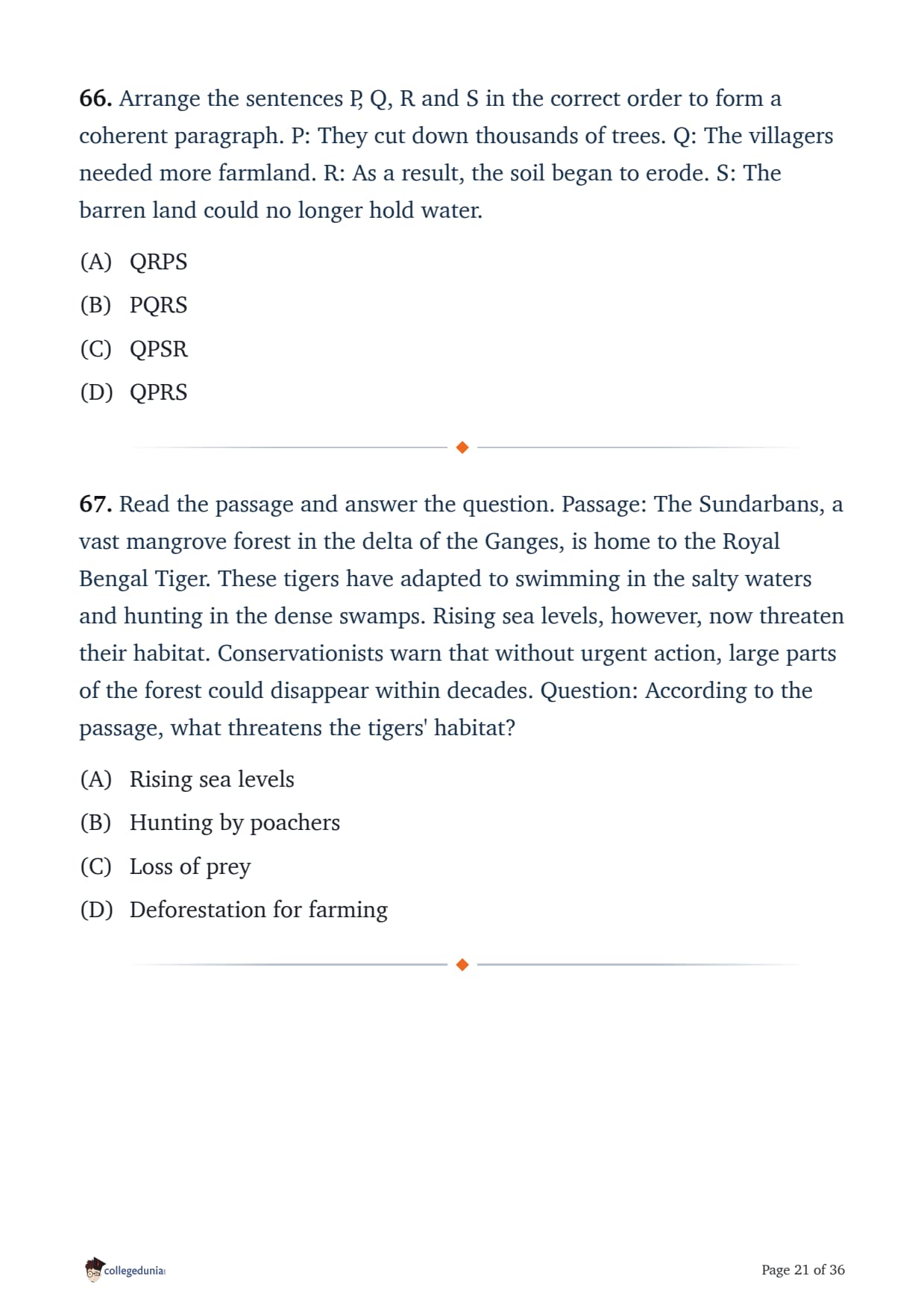
Arrange the sentences P, Q, R and S in the correct order to form a coherent paragraph. P: They cut down thousands of trees. Q: The villagers needed more farmland. R: As a result, the soil began to erode. S: The barren land could no longer hold water.
Read the passage and answer the question. Passage: The Sundarbans, a vast mangrove forest in the delta of the Ganges, is home to the Royal Bengal Tiger. These tigers have adapted to swimming in the salty waters and hunting in the dense swamps. Rising sea levels, however, now threaten their habitat. Conservationists warn that without urgent action, large parts of the forest could disappear within decades. Question: According to the passage, what threatens the tigers' habitat?
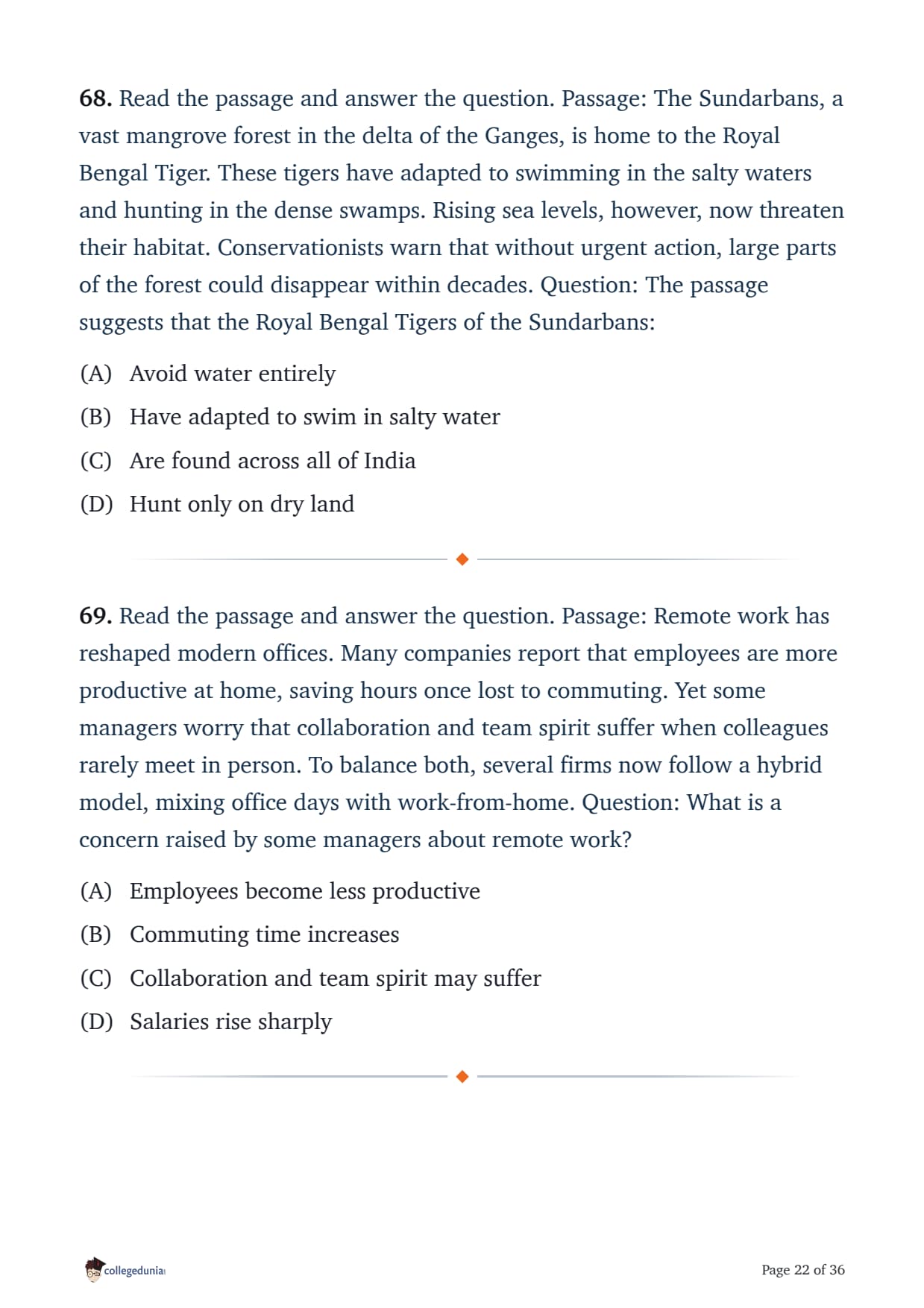
Read the passage and answer the question. Passage: The Sundarbans, a vast mangrove forest in the delta of the Ganges, is home to the Royal Bengal Tiger. These tigers have adapted to swimming in the salty waters and hunting in the dense swamps. Rising sea levels, however, now threaten their habitat. Conservationists warn that without urgent action, large parts of the forest could disappear within decades. Question: The passage suggests that the Royal Bengal Tigers of the Sundarbans:
Read the passage and answer the question. Passage: Remote work has reshaped modern offices. Many companies report that employees are more productive at home, saving hours once lost to commuting. Yet some managers worry that collaboration and team spirit suffer when colleagues rarely meet in person. To balance both, several firms now follow a hybrid model, mixing office days with work-from-home. Question: What is a concern raised by some managers about remote work?
Read the passage and answer the question. Passage: Remote work has reshaped modern offices. Many companies report that employees are more productive at home, saving hours once lost to commuting. Yet some managers worry that collaboration and team spirit suffer when colleagues rarely meet in person. To balance both, several firms now follow a hybrid model, mixing office days with work-from-home. Question: The hybrid model mentioned in the passage refers to:
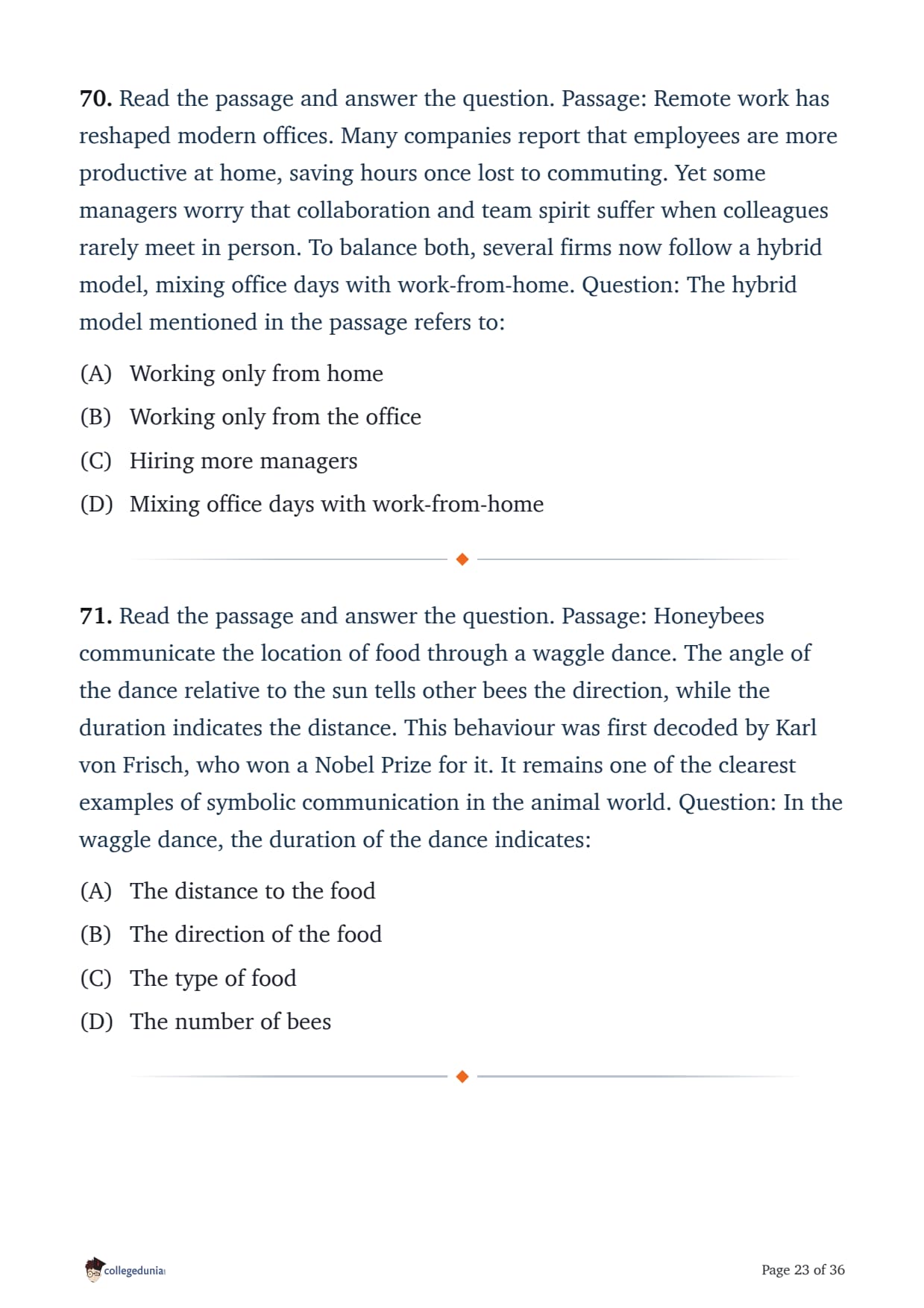
Read the passage and answer the question. Passage: Honeybees communicate the location of food through a waggle dance. The angle of the dance relative to the sun tells other bees the direction, while the duration indicates the distance. This behaviour was first decoded by Karl von Frisch, who won a Nobel Prize for it. It remains one of the clearest examples of symbolic communication in the animal world. Question: In the waggle dance, the duration of the dance indicates:
Read the passage and answer the question. Passage: Honeybees communicate the location of food through a waggle dance. The angle of the dance relative to the sun tells other bees the direction, while the duration indicates the distance. This behaviour was first decoded by Karl von Frisch, who won a Nobel Prize for it. It remains one of the clearest examples of symbolic communication in the animal world. Question: Karl von Frisch is mentioned in the passage as the person who:
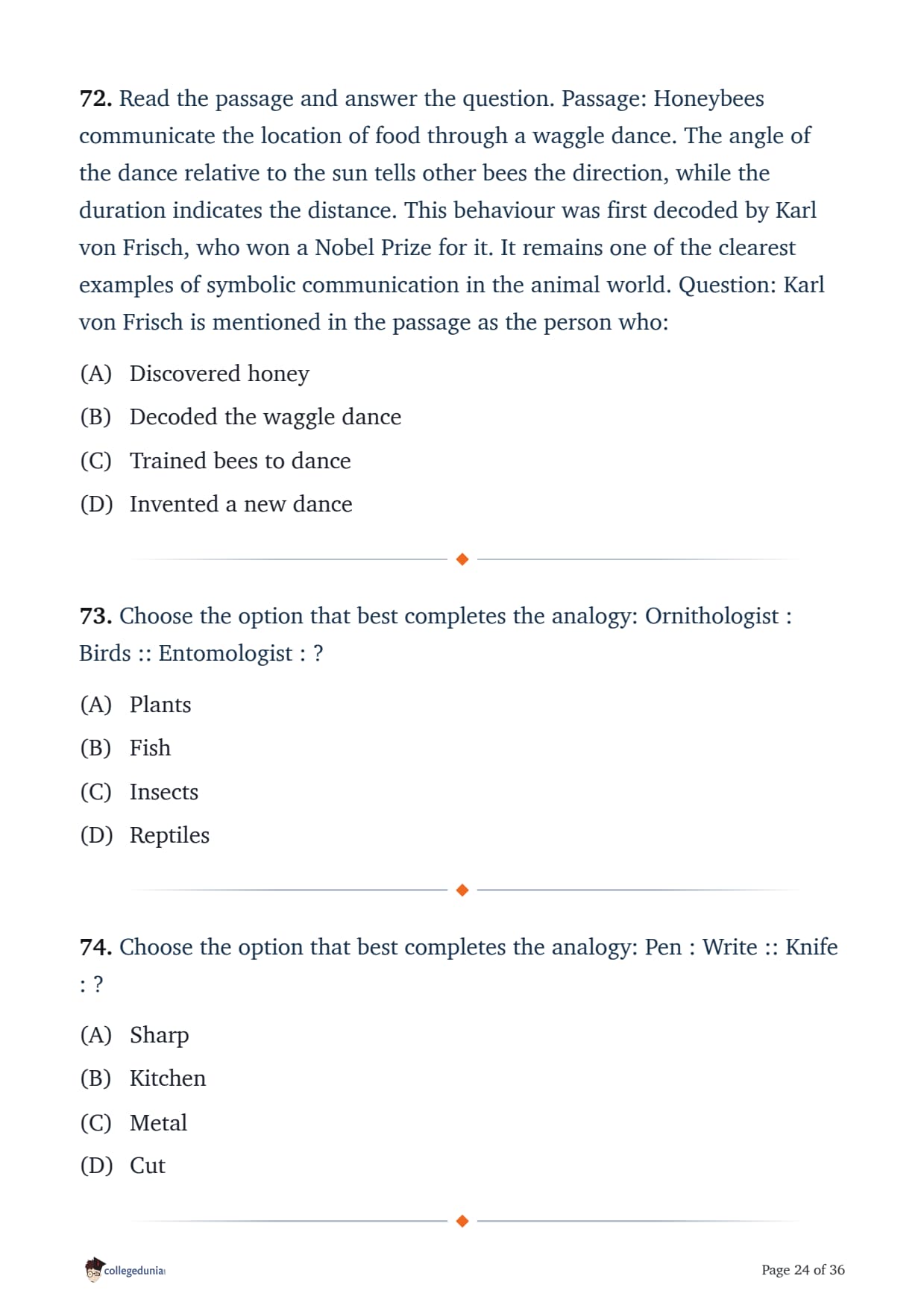
Choose the option that best completes the analogy: Ornithologist : Birds :: Entomologist : ?
Choose the option that best completes the analogy: Pen : Write :: Knife : ?
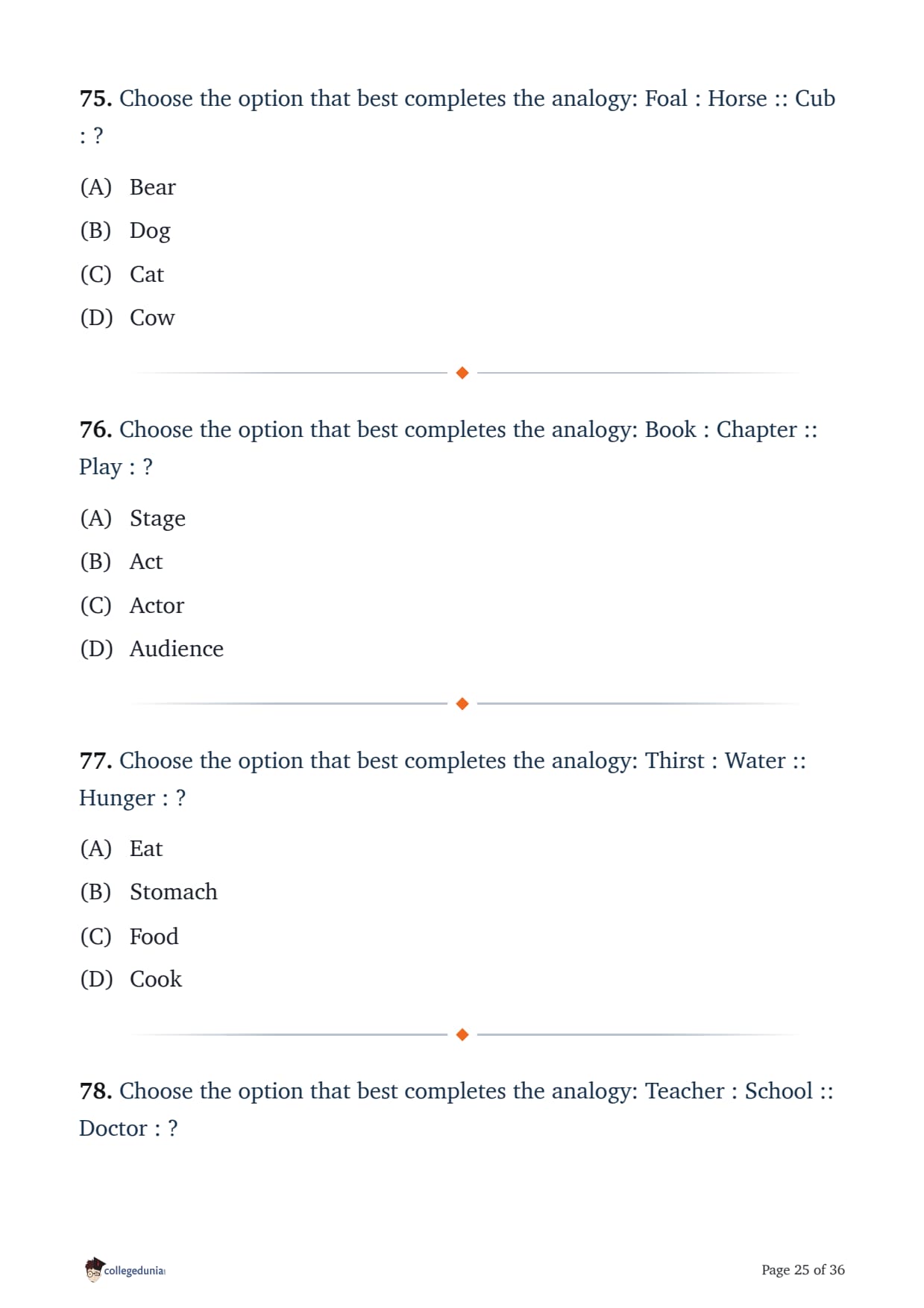
Choose the option that best completes the analogy: Foal : Horse :: Cub : ?
Choose the option that best completes the analogy: Book : Chapter :: Play : ?
Choose the option that best completes the analogy: Thirst : Water :: Hunger : ?
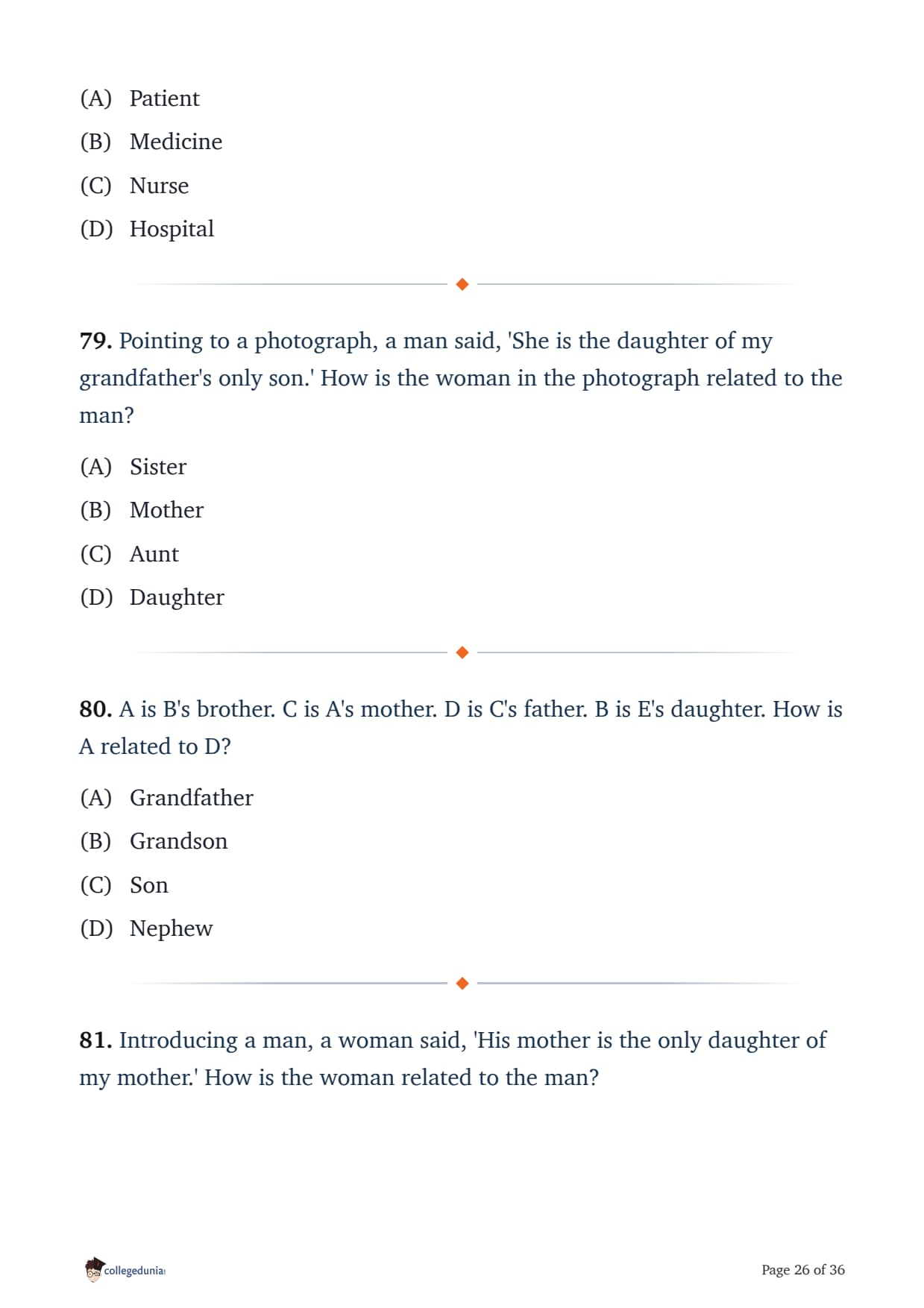
Choose the option that best completes the analogy: Teacher : School :: Doctor : ?
Pointing to a photograph, a man said, 'She is the daughter of my grandfather's only son.' How is the woman in the photograph related to the man?
A is B's brother. C is A's mother. D is C's father. B is E's daughter. How is A related to D?
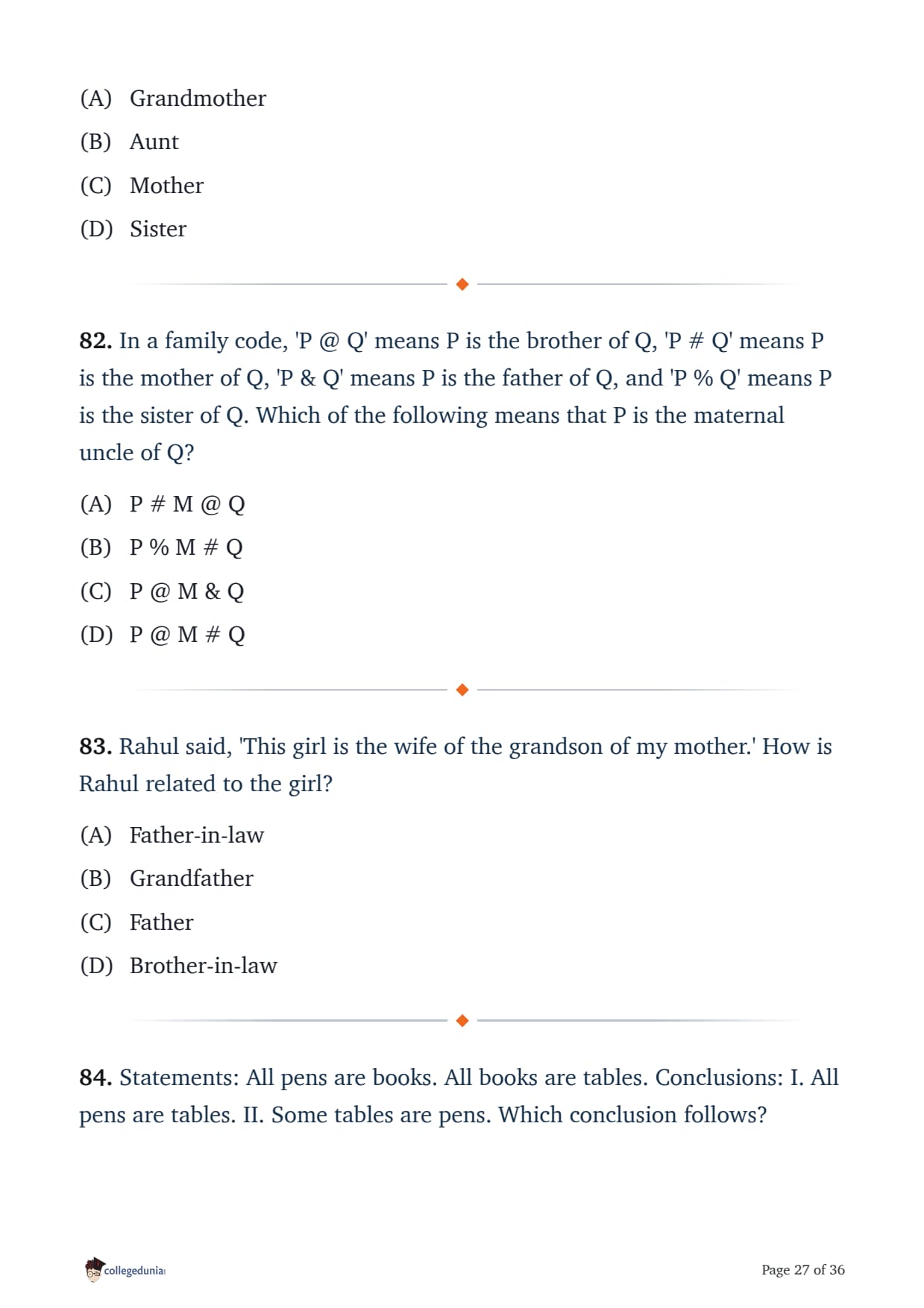
Introducing a man, a woman said, 'His mother is the only daughter of my mother.' How is the woman related to the man?
In a family code, 'P @ Q' means P is the brother of Q, 'P # Q' means P is the mother of Q, 'P & Q' means P is the father of Q, and 'P % Q' means P is the sister of Q. Which of the following means that P is the maternal uncle of Q?
Rahul said, 'This girl is the wife of the grandson of my mother.' How is Rahul related to the girl?
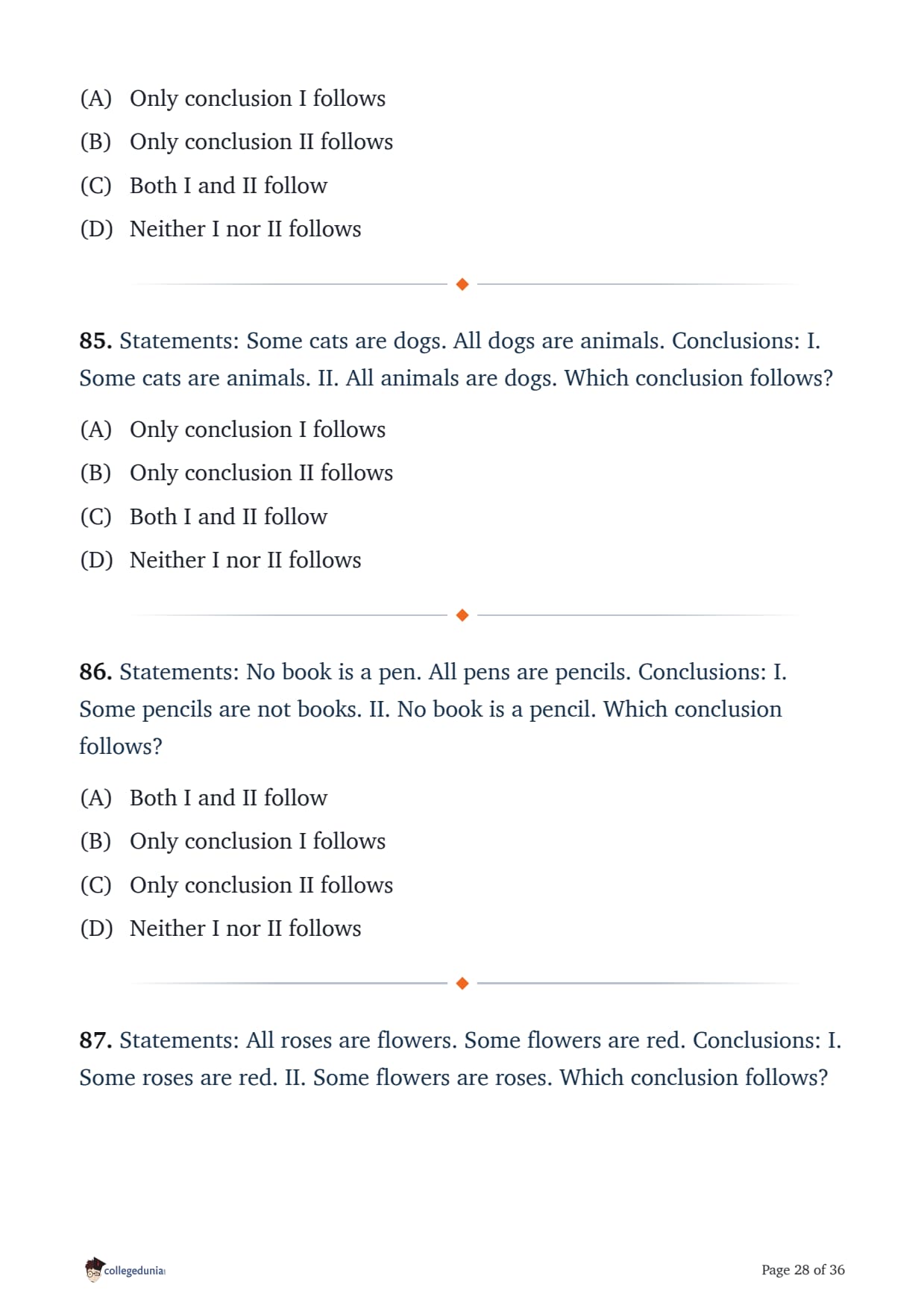
Statements: All pens are books. All books are tables. Conclusions: I. All pens are tables. II. Some tables are pens. Which conclusion follows?
Statements: Some cats are dogs. All dogs are animals. Conclusions: I. Some cats are animals. II. All animals are dogs. Which conclusion follows?
Statements: No book is a pen. All pens are pencils. Conclusions: I. Some pencils are not books. II. No book is a pencil. Which conclusion follows?
Statements: All roses are flowers. Some flowers are red. Conclusions: I. Some roses are red. II. Some flowers are roses. Which conclusion follows?
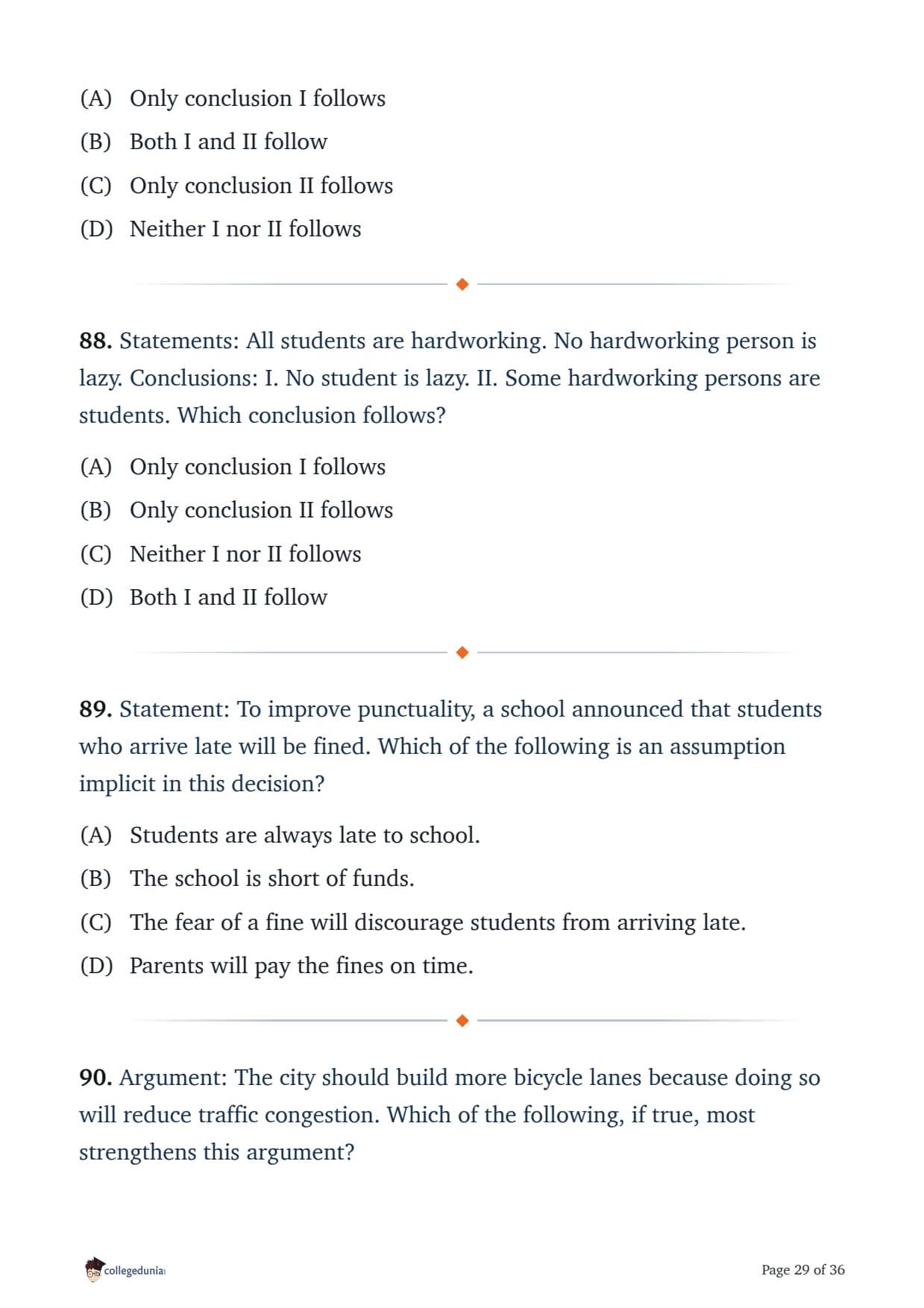
Statements: All students are hardworking. No hardworking person is lazy. Conclusions: I. No student is lazy. II. Some hardworking persons are students. Which conclusion follows?
Statement: To improve punctuality, a school announced that students who arrive late will be fined. Which of the following is an assumption implicit in this decision?
Argument: The city should build more bicycle lanes because doing so will reduce traffic congestion. Which of the following, if true, most strengthens this argument?
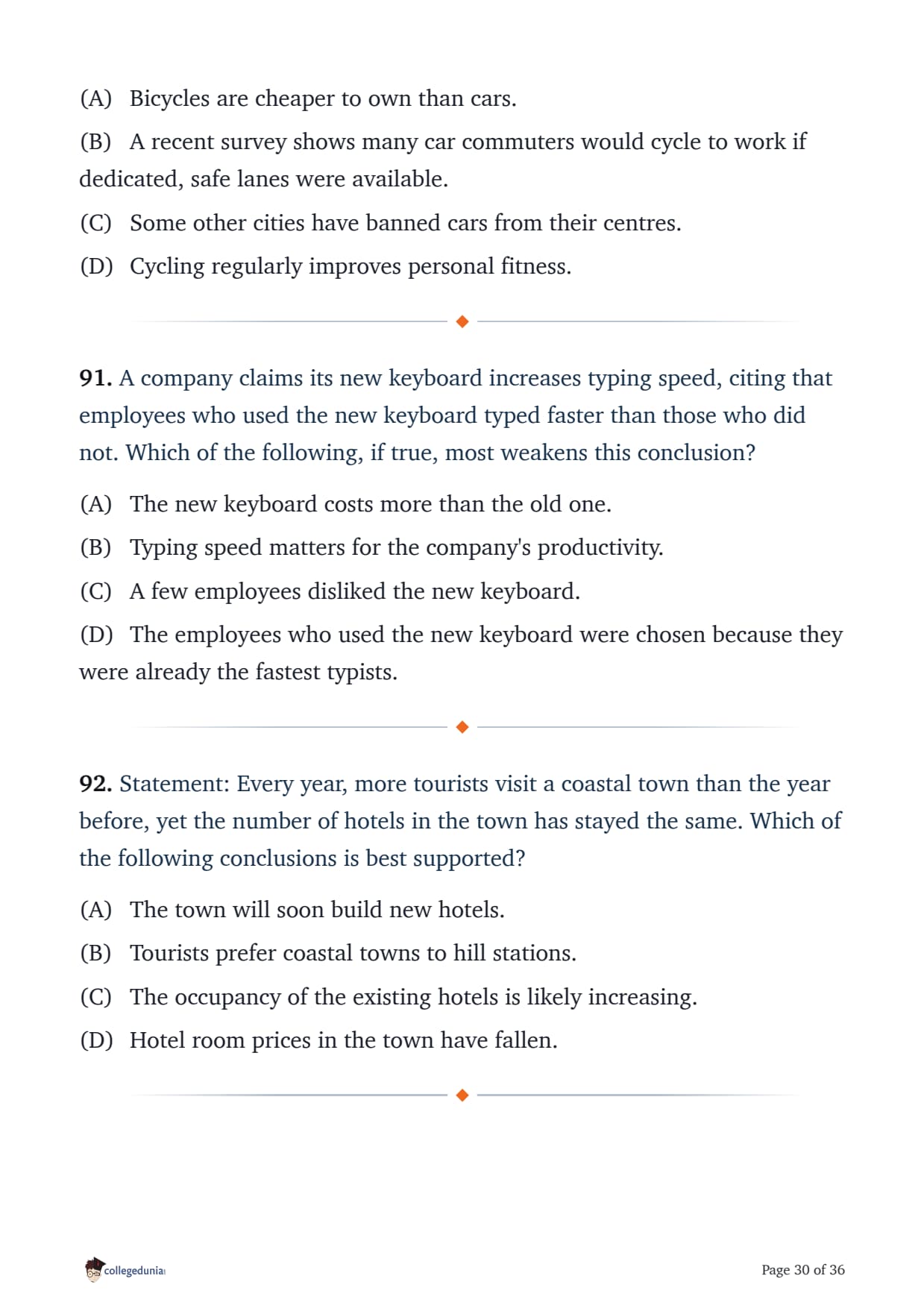
A company claims its new keyboard increases typing speed, citing that employees who used the new keyboard typed faster than those who did not. Which of the following, if true, most weakens this conclusion?
Statement: Every year, more tourists visit a coastal town than the year before, yet the number of hotels in the town has stayed the same. Which of the following conclusions is best supported?
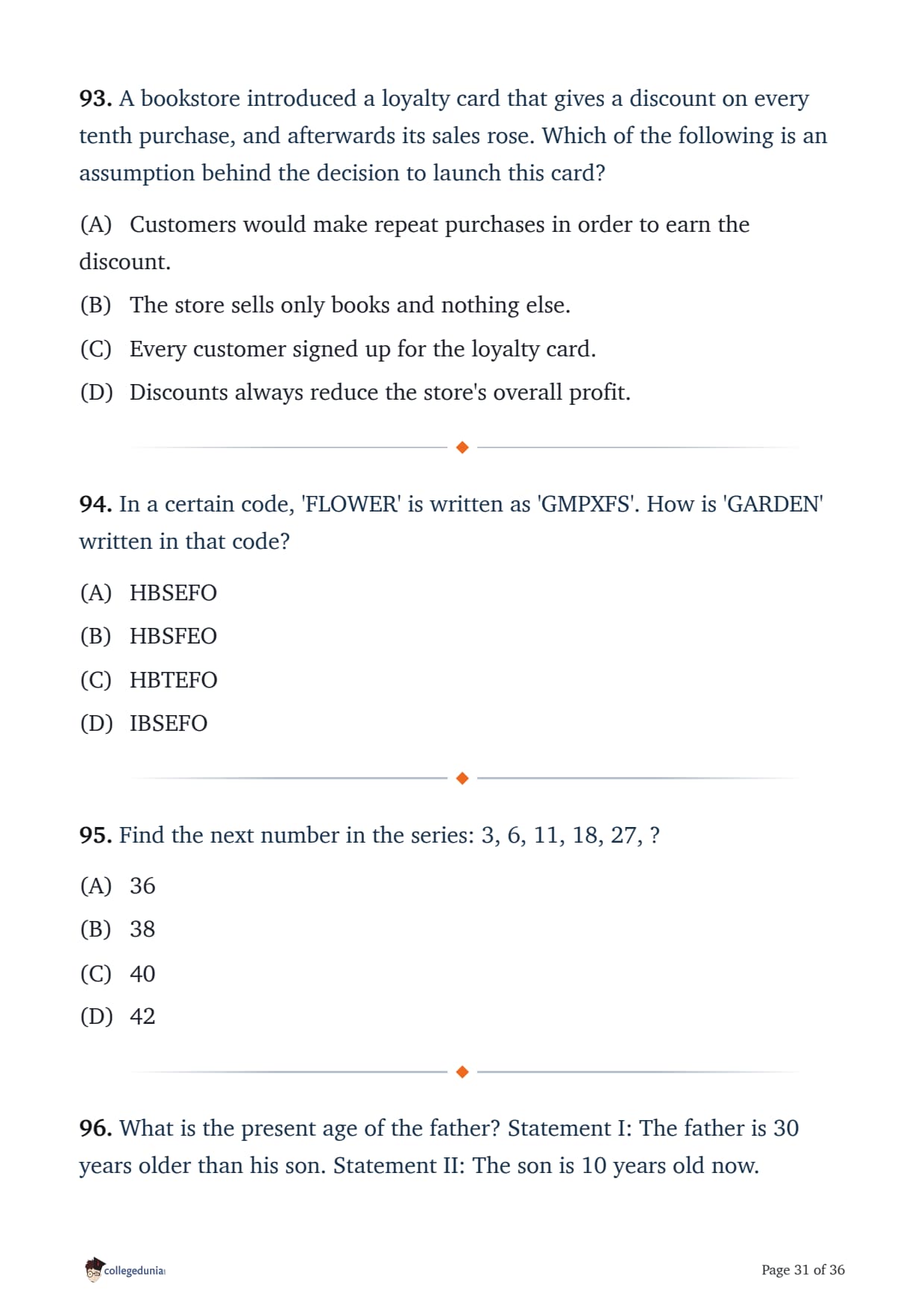
A bookstore introduced a loyalty card that gives a discount on every tenth purchase, and afterwards its sales rose. Which of the following is an assumption behind the decision to launch this card?
In a certain code, 'FLOWER' is written as 'GMPXFS'. How is 'GARDEN' written in that code?
Find the next number in the series: 3, 6, 11, 18, 27, ?
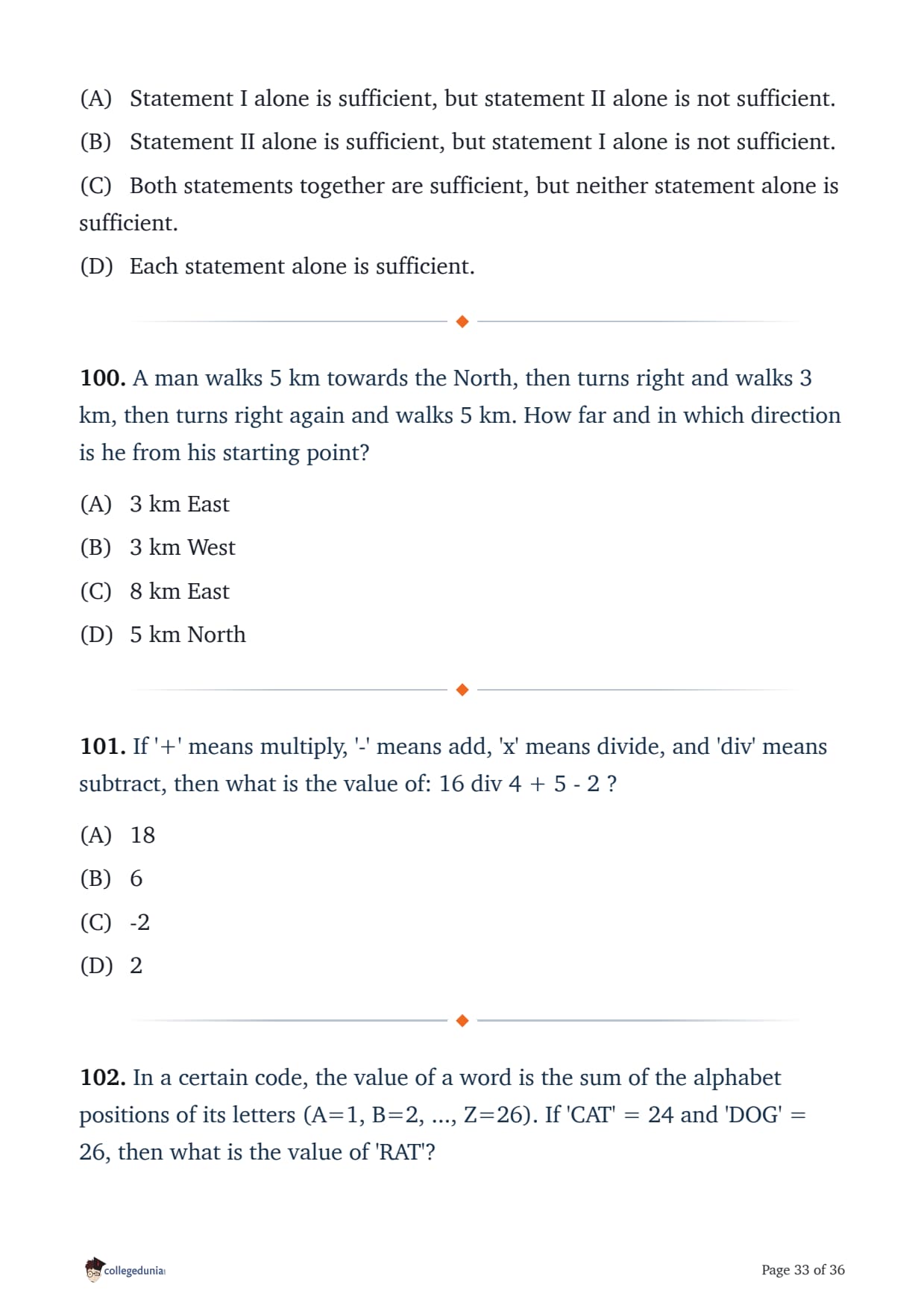
What is the present age of the father? Statement I: The father is 30 years older than his son. Statement II: The son is 10 years old now.
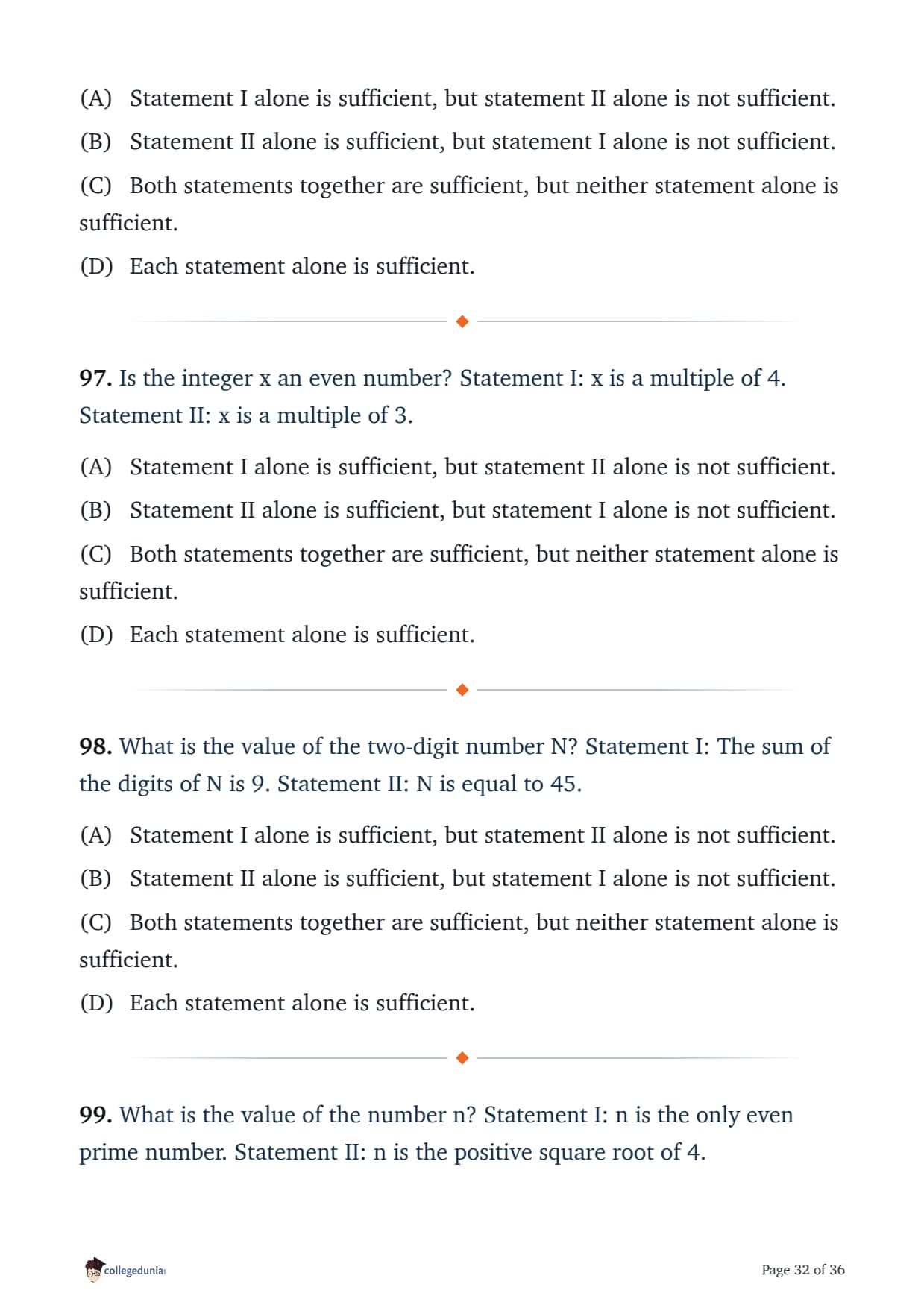
Is the integer x an even number? Statement I: x is a multiple of 4. Statement II: x is a multiple of 3.
What is the value of the two-digit number N? Statement I: The sum of the digits of N is 9. Statement II: N is equal to 45.
What is the value of the number n? Statement I: n is the only even prime number. Statement II: n is the positive square root of 4.
A man walks 5 km towards the North, then turns right and walks 3 km, then turns right again and walks 5 km. How far and in which direction is he from his starting point?
If '+' means multiply, '-' means add, 'x' means divide, and 'div' means subtract, then what is the value of: 16 div 4 + 5 - 2 ?
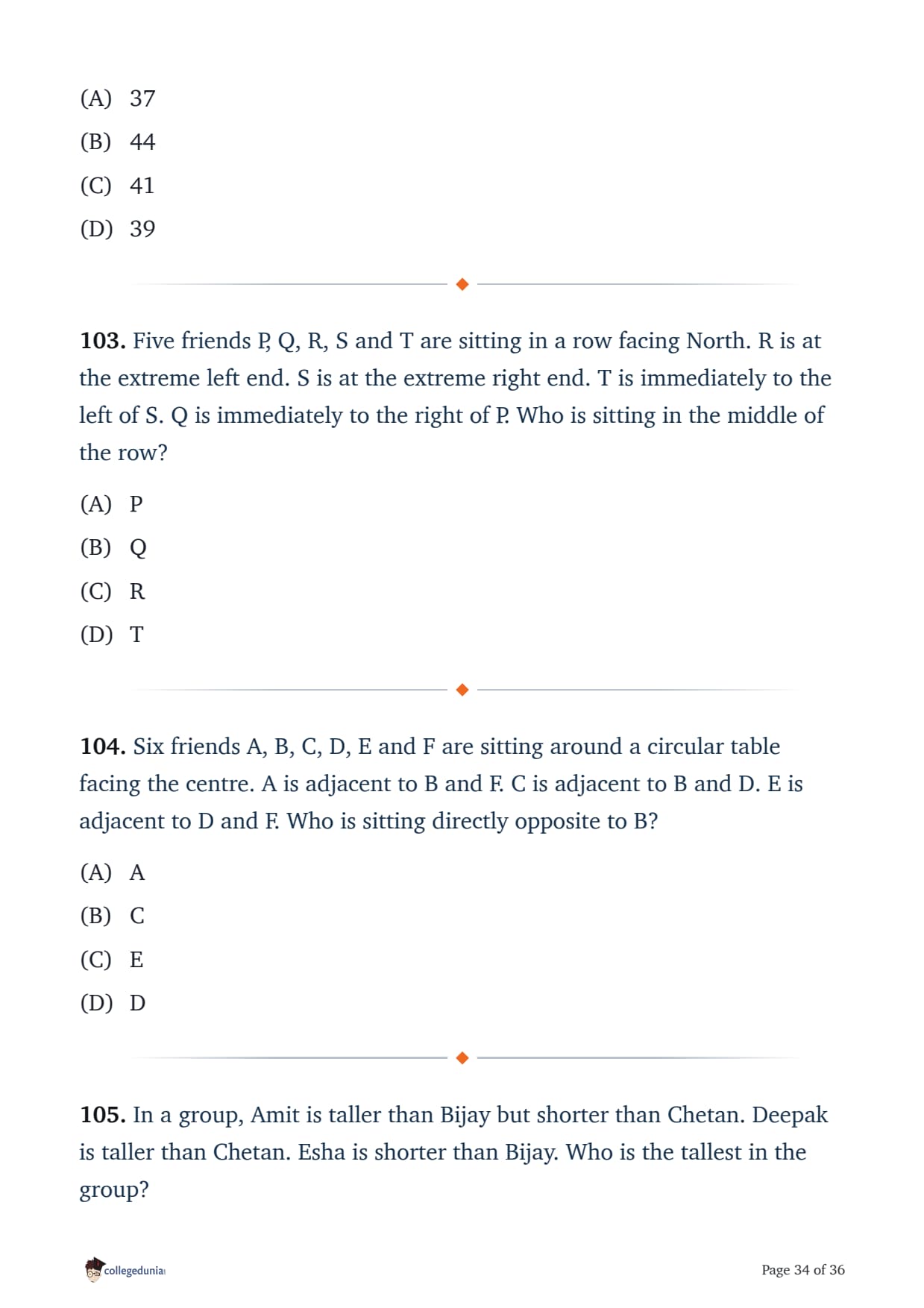
In a certain code, the value of a word is the sum of the alphabet positions of its letters (A=1, B=2, ..., Z=26). If 'CAT' = 24 and 'DOG' = 26, then what is the value of 'RAT'?
Five friends P, Q, R, S and T are sitting in a row facing North. R is at the extreme left end. S is at the extreme right end. T is immediately to the left of S. Q is immediately to the right of P. Who is sitting in the middle of the row?
Six friends A, B, C, D, E and F are sitting around a circular table facing the centre. A is adjacent to B and F. C is adjacent to B and D. E is adjacent to D and F. Who is sitting directly opposite to B?
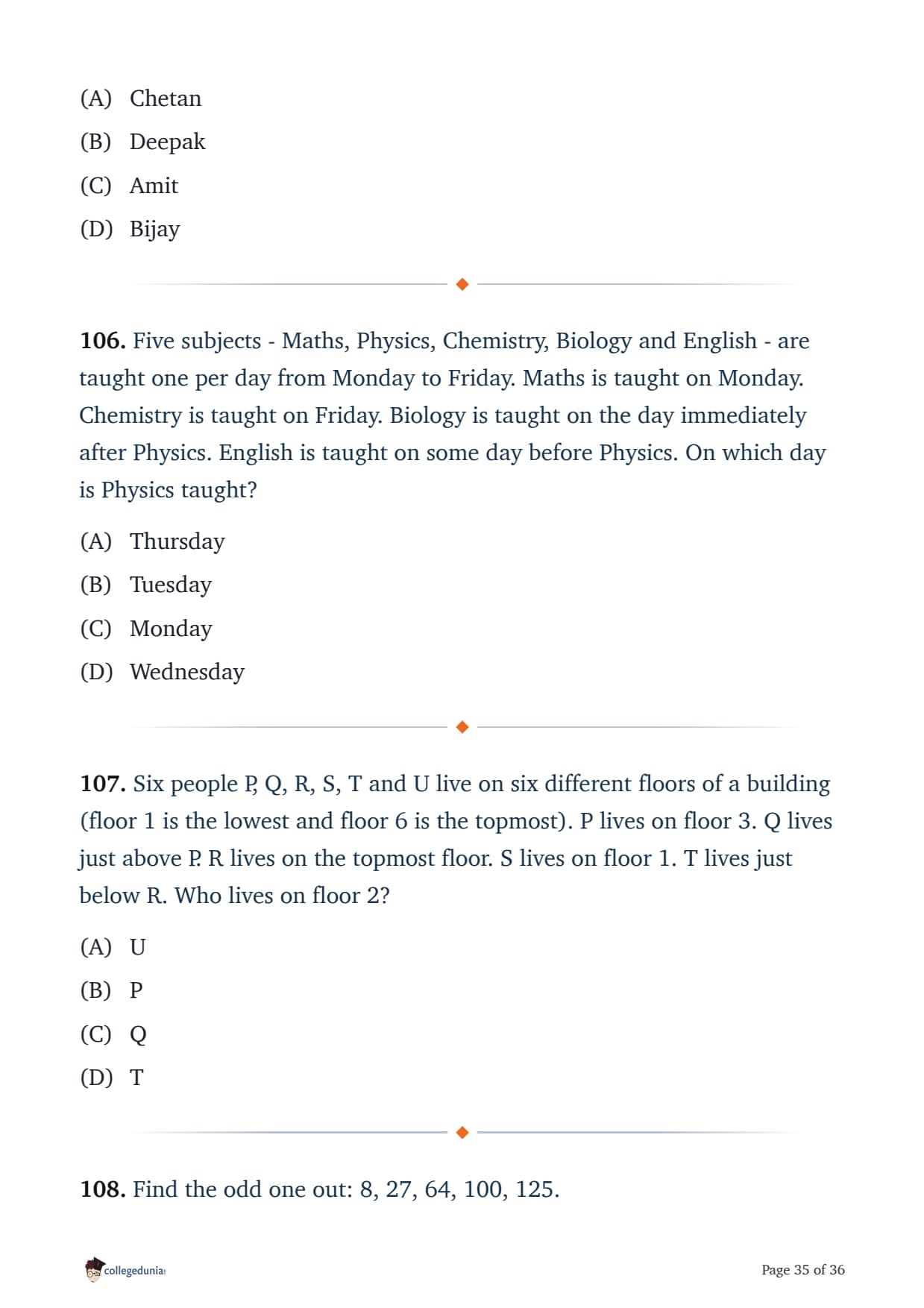
In a group, Amit is taller than Bijay but shorter than Chetan. Deepak is taller than Chetan. Esha is shorter than Bijay. Who is the tallest in the group?
Five subjects - Maths, Physics, Chemistry, Biology and English - are taught one per day from Monday to Friday. Maths is taught on Monday. Chemistry is taught on Friday. Biology is taught on the day immediately after Physics. English is taught on some day before Physics. On which day is Physics taught?
Six people P, Q, R, S, T and U live on six different floors of a building (floor 1 is the lowest and floor 6 is the topmost). P lives on floor 3. Q lives just above P. R lives on the topmost floor. S lives on floor 1. T lives just below R. Who lives on floor 2?
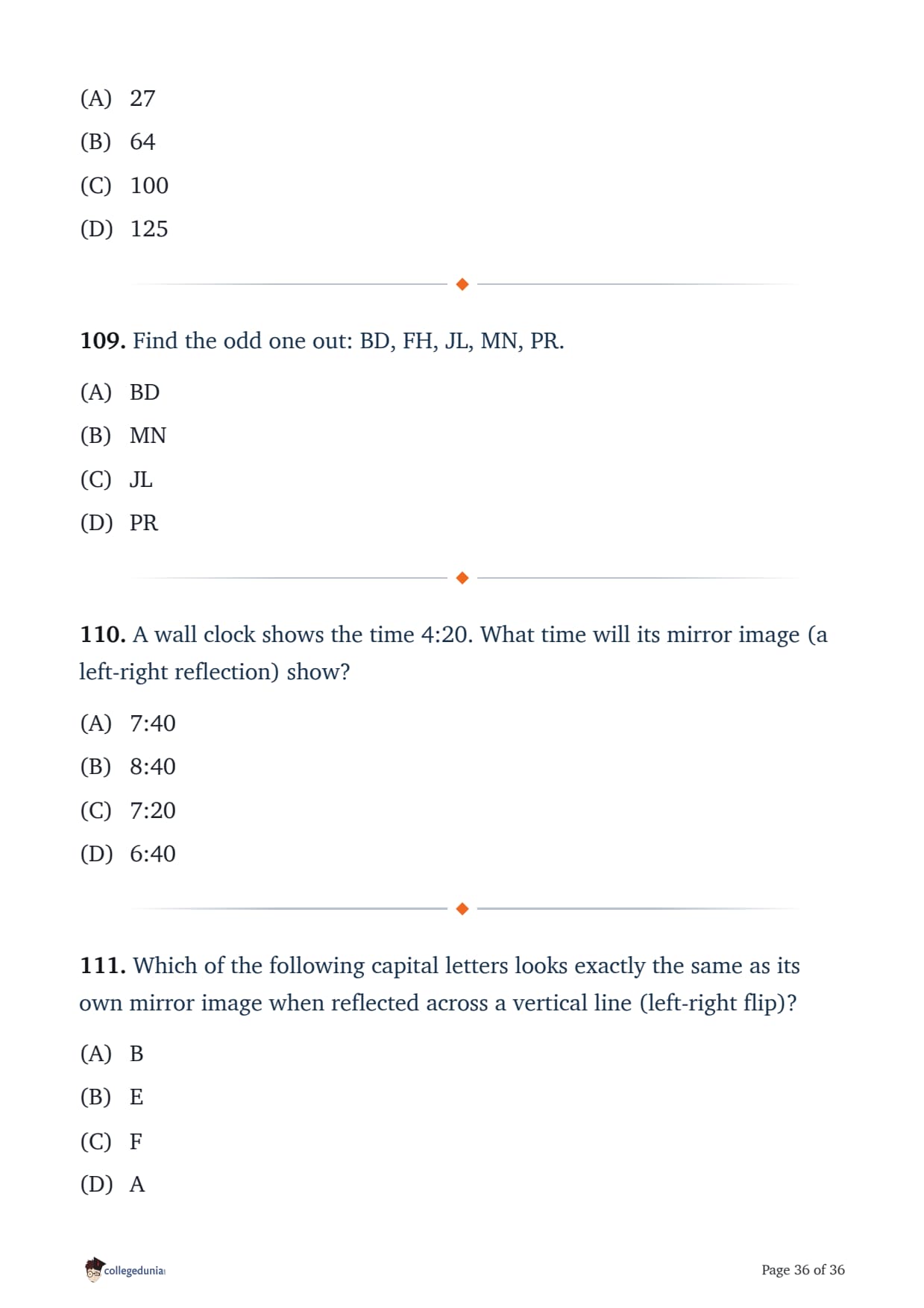
Find the odd one out: 8, 27, 64, 100, 125.
Find the odd one out: BD, FH, JL, MN, PR.
A wall clock shows the time 4:20. What time will its mirror image (a left-right reflection) show?
Which of the following capital letters looks exactly the same as its own mirror image when reflected across a vertical line (left-right flip)?
NMAT 2024 Exam Pattern and Marking Scheme Explained
NMAT 2024 is a computer-based test of single-best-answer MCQs, with each of the three sections individually timed.
- Total questions: 108 MCQs, 36 in each of the three sections
- Sections: Language Skills (36), Quantitative Skills (36), Logical Reasoning (36)
- Duration: 120 minutes, with sectional limits of 28, 52, and 40 minutes
- Total marks: 324, with 3 marks for every correct answer
- Marking scheme: +3 for a correct answer and no negative marking
High-Weightage Areas in NMAT 2024 to Focus On First
All three sections carry equal weight at 36 questions each, so balance your prep, but a few topics recur heavily in the memory-based paper.
- Quantitative Skills: arithmetic (percentages, ratio, time and work, averages) dominates, with number systems and probability
- Language Skills: fill in the blanks, para jumbles, and synonyms-antonyms lead, with a reading comprehension set
- Logical Reasoning: blood relations, syllogisms, and coding-decoding appear most, plus arrangement puzzles
- Speed matters: Quantitative Skills gets 52 minutes for 36 questions, so pace is as important as accuracy
How to Use the NMAT 2024 Question Paper for Practice
Treat this paper as a timed mock first, then review every question with its detailed solution.
- Attempt all 108 questions in 120 minutes under exam-like conditions before checking answers
- Since there is no negative marking, attempt every question and never leave one blank
- Review each solution using the Detailed Solution link on every question below
- Redo the sections where you lost the most time, especially Quantitative Skills
NMAT 2024 Question Paper FAQs
Ques. How many questions are there in the NMAT 2024 question paper?
Ans. The NMAT paper has 108 questions in total, split equally into three sections of 36 each - Language Skills, Quantitative Skills, and Logical Reasoning - to be solved in 120 minutes.
Ques. Is there negative marking in NMAT 2024?
Ans. No. NMAT has no negative marking. Every correct answer gives 3 marks and there is no penalty for a wrong answer, so you should attempt all 108 questions.
Ques. Does GMAC release the official NMAT 2024 question paper?
Ans. No, GMAC does not release the official NMAT question paper. The questions here are memory-based, reconstructed to match the actual exam pattern, topics, and difficulty for practice.
Ques. Where can I download the NMAT 2024 question paper with solutions PDF for free?
Ans. You can download the NMAT 2024 question paper and solutions as free PDFs from the download table at the top of this page, and practise all 108 questions with detailed solutions below.



Comments