




The NMAT 2023 question paper with solutions is available here for free download. NMAT 2023 was conducted by GMAC (Graduate Management Admission Council), and the paper carried 108 questions across three sections - Language Skills, Quantitative Skills, and Logical Reasoning - to be attempted in 120 minutes. These are memory-based questions, as GMAC does not release the official paper.
| NMAT 2023 Question Paper with Solutions | Download PDF | Check Solutions |
NMAT 2023 Questions with Solutions
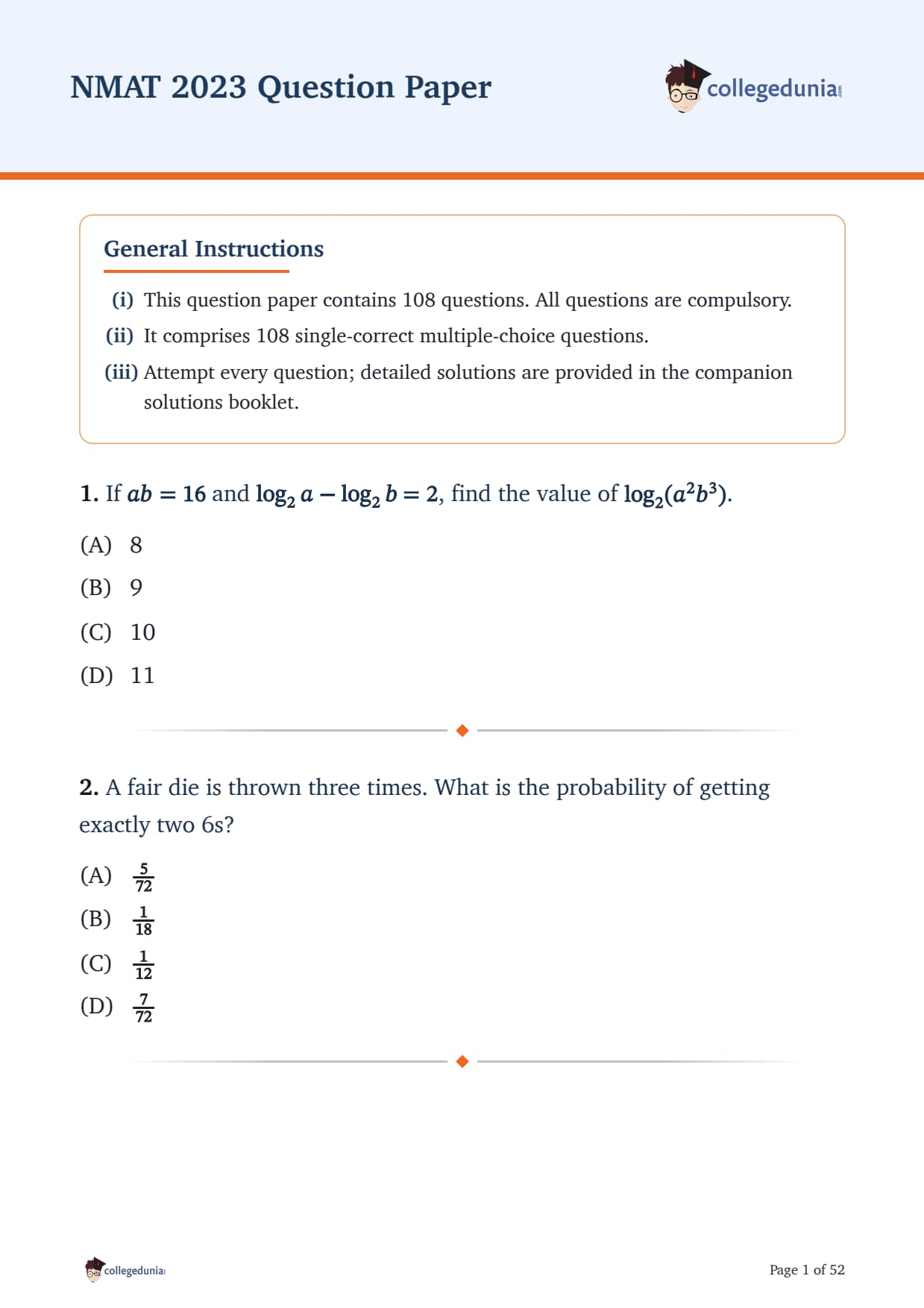
If \(ab = 16\) and \(\log_2 a - \log_2 b = 2\), find the value of \(\log_2(a^2 b^3)\).
A fair die is thrown three times. What is the probability of getting exactly two 6s?
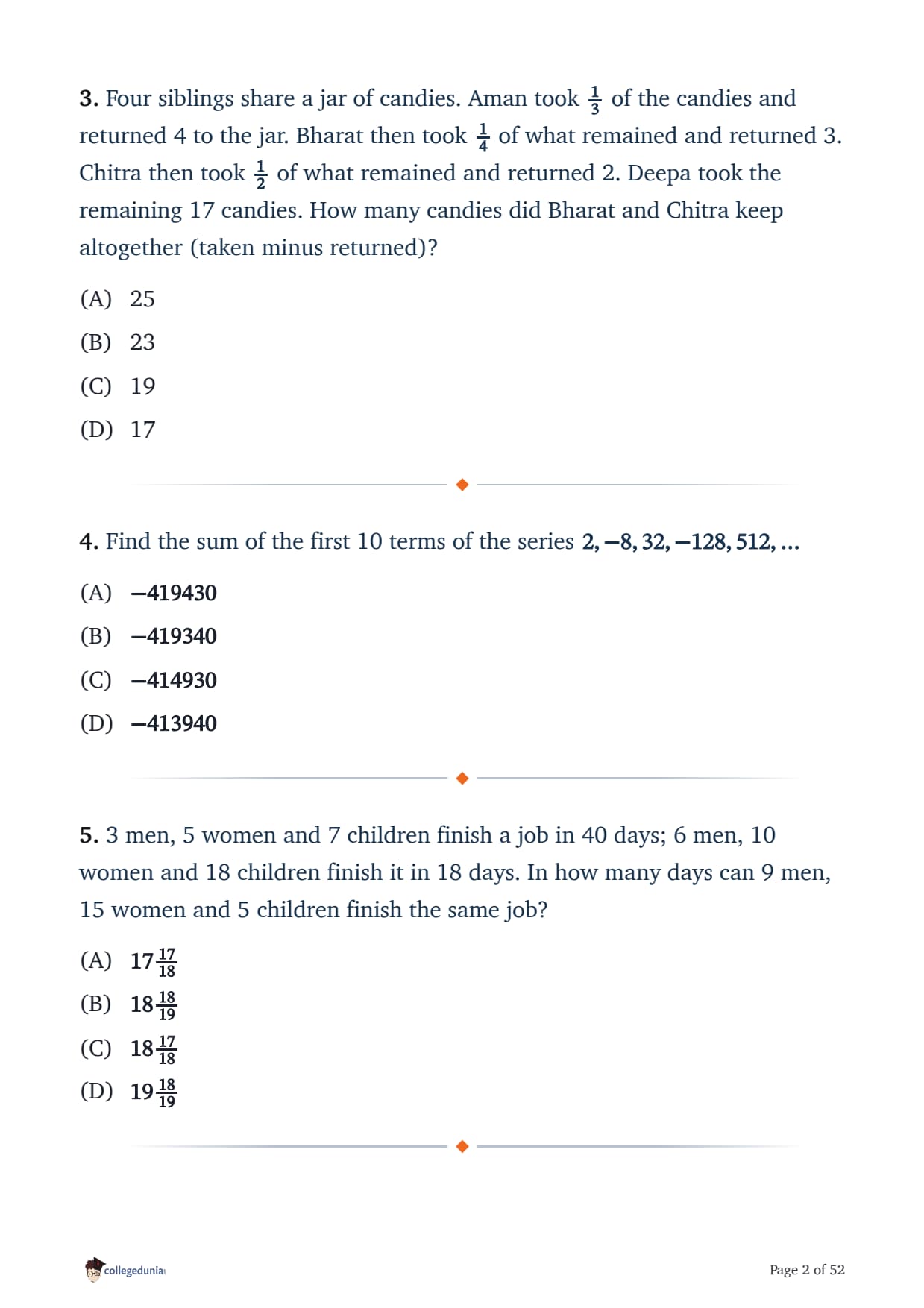
Four siblings share a jar of candies. Aman took \(\frac{1}{3}\) of the candies and returned 4 to the jar. Bharat then took \(\frac{1}{4}\) of what remained and returned 3. Chitra then took \(\frac{1}{2}\) of what remained and returned 2. Deepa took the remaining 17 candies. How many candies did Bharat and Chitra keep altogether (taken minus returned)?
Find the sum of the first 10 terms of the series \(2, -8, 32, -128, 512, \ldots\)
3 men, 5 women and 7 children finish a job in 40 days; 6 men, 10 women and 18 children finish it in 18 days. In how many days can 9 men, 15 women and 5 children finish the same job?
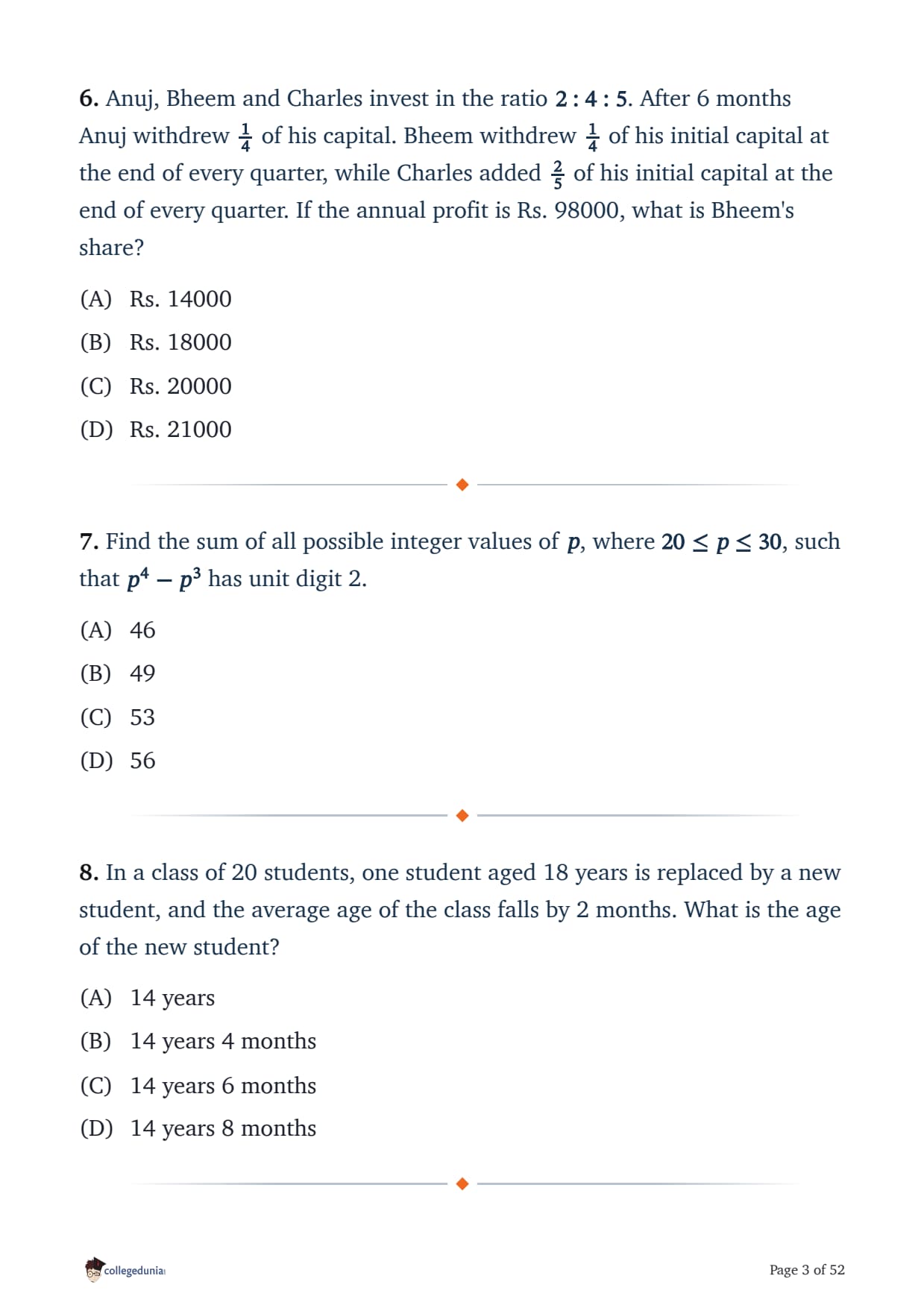
Anuj, Bheem and Charles invest in the ratio \(2:4:5\). After 6 months Anuj withdrew \(\frac{1}{4}\) of his capital. Bheem withdrew \(\frac{1}{4}\) of his initial capital at the end of every quarter, while Charles added \(\frac{2}{5}\) of his initial capital at the end of every quarter. If the annual profit is Rs. 98000, what is Bheem's share?
Find the sum of all possible integer values of \(p\), where \(20 \le p \le 30\), such that \(p^4 - p^3\) has unit digit 2.
In a class of 20 students, one student aged 18 years is replaced by a new student, and the average age of the class falls by 2 months. What is the age of the new student?
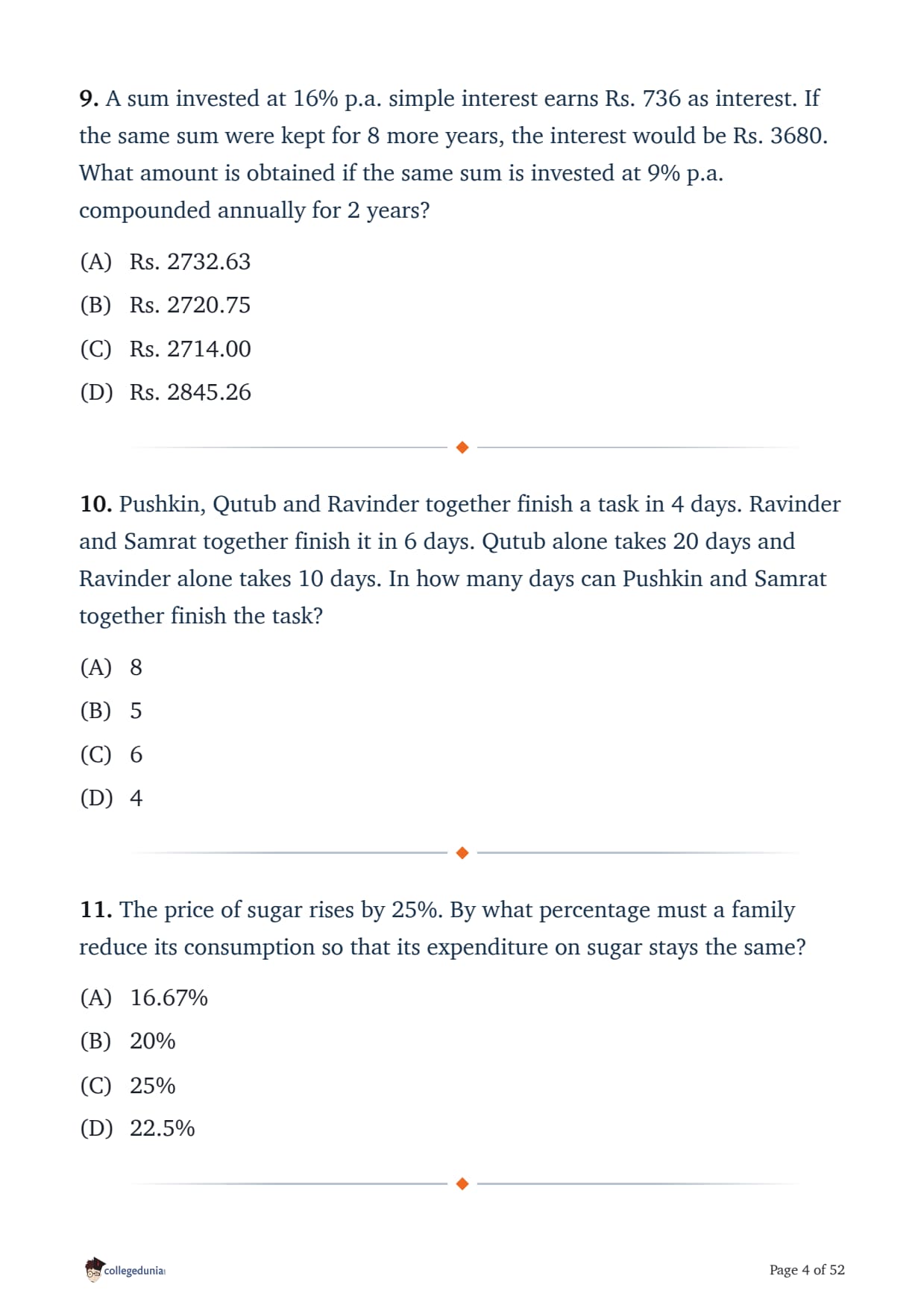
A sum invested at 16% p.a. simple interest earns Rs. 736 as interest. If the same sum were kept for 8 more years, the interest would be Rs. 3680. What amount is obtained if the same sum is invested at 9% p.a. compounded annually for 2 years?
Pushkin, Qutub and Ravinder together finish a task in 4 days. Ravinder and Samrat together finish it in 6 days. Qutub alone takes 20 days and Ravinder alone takes 10 days. In how many days can Pushkin and Samrat together finish the task?
The price of sugar rises by 25%. By what percentage must a family reduce its consumption so that its expenditure on sugar stays the same?
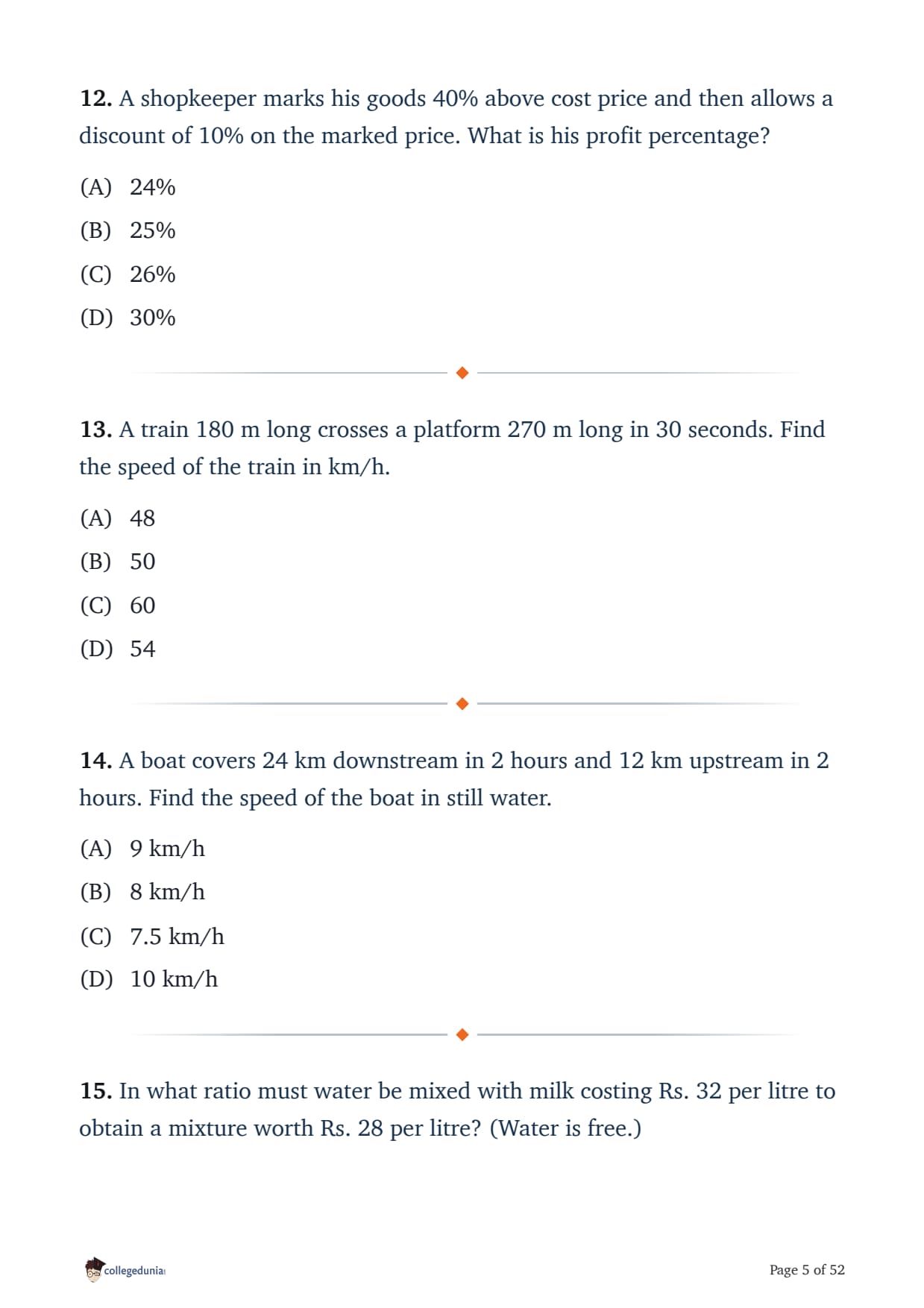
A shopkeeper marks his goods 40% above cost price and then allows a discount of 10% on the marked price. What is his profit percentage?
A train 180 m long crosses a platform 270 m long in 30 seconds. Find the speed of the train in km/h.
A boat covers 24 km downstream in 2 hours and 12 km upstream in 2 hours. Find the speed of the boat in still water.
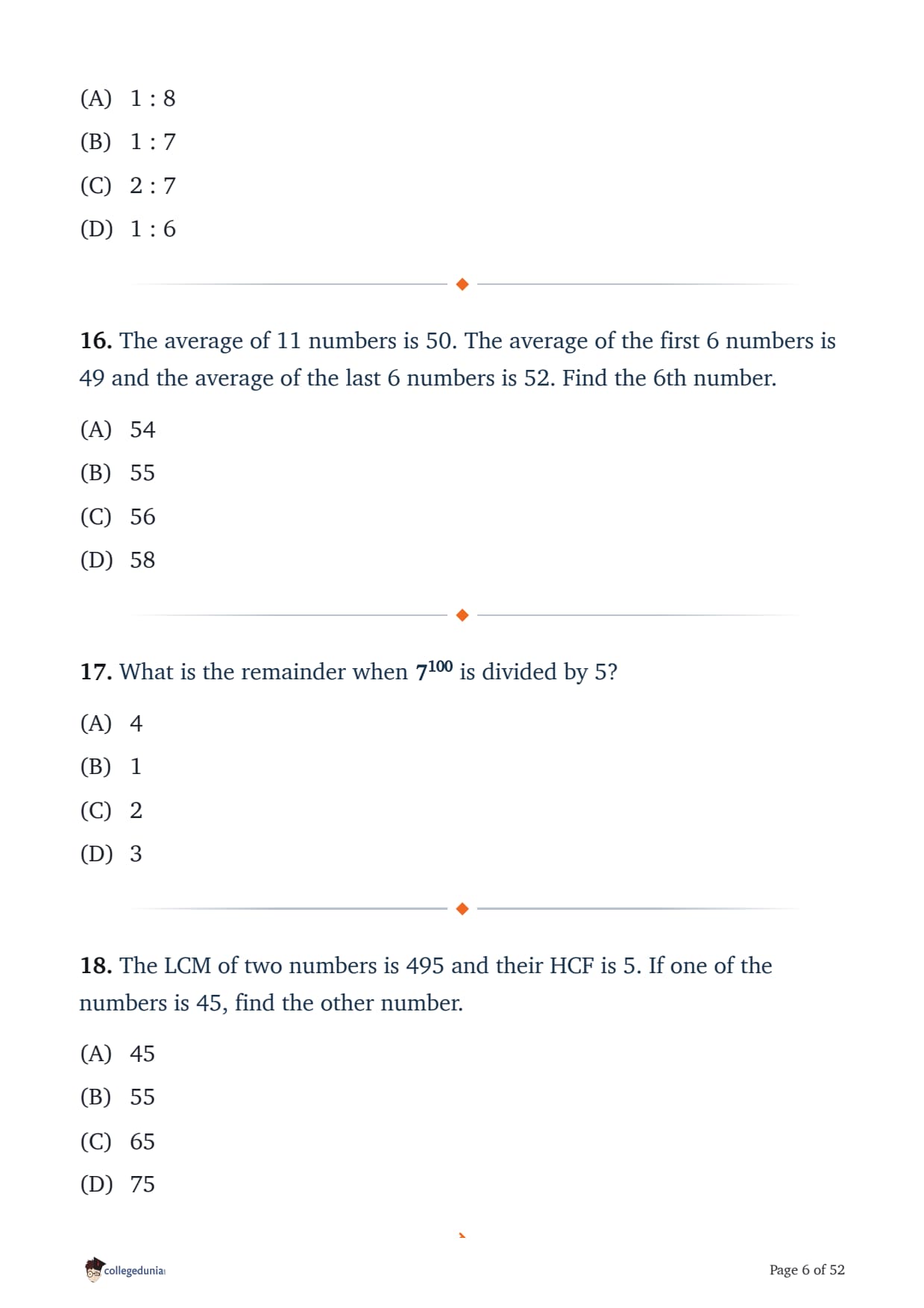
In what ratio must water be mixed with milk costing Rs. 32 per litre to obtain a mixture worth Rs. 28 per litre? (Water is free.)
The average of 11 numbers is 50. The average of the first 6 numbers is 49 and the average of the last 6 numbers is 52. Find the 6th number.
What is the remainder when \(7^{100}\) is divided by 5?
The LCM of two numbers is 495 and their HCF is 5. If one of the numbers is 45, find the other number.
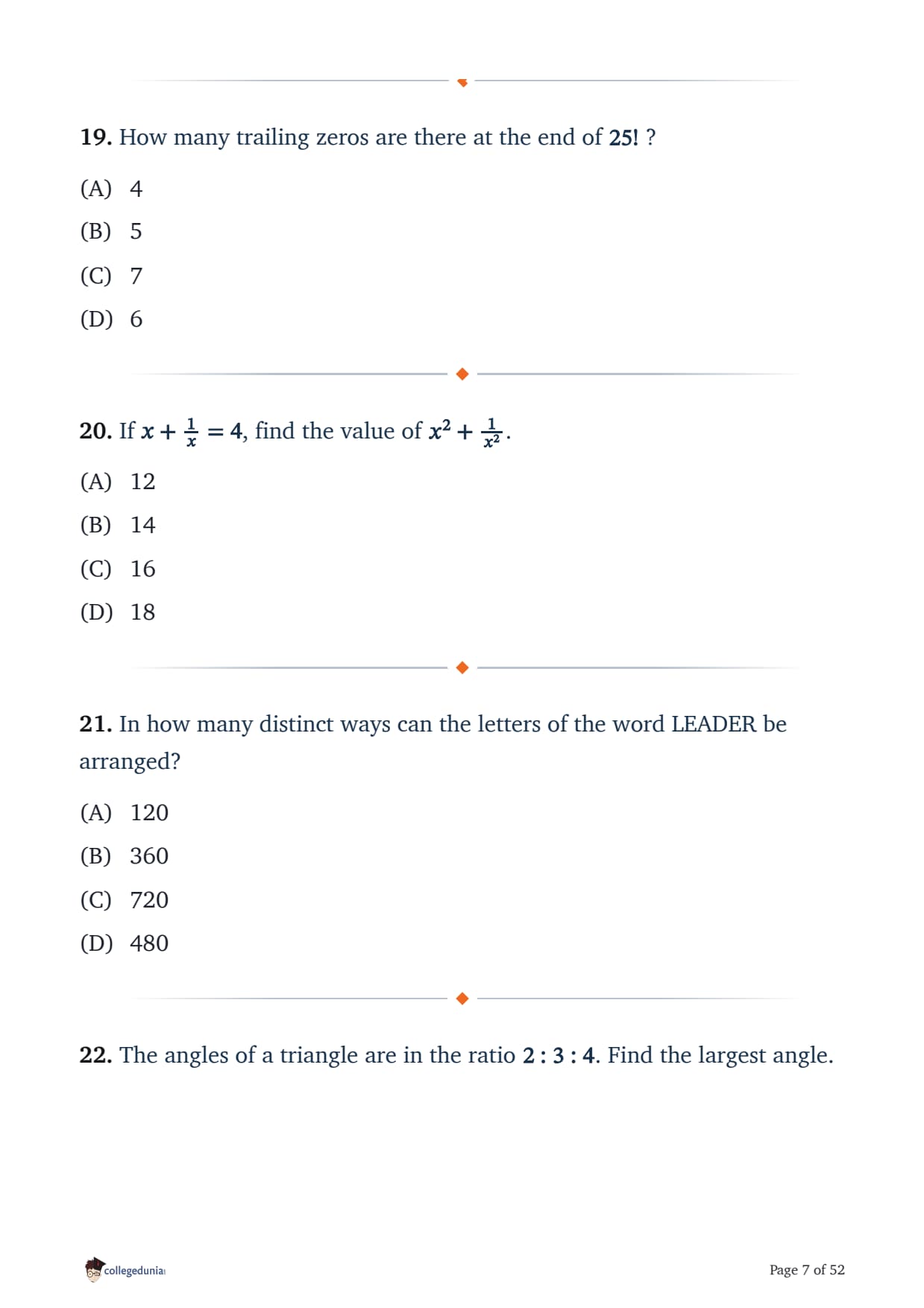
How many trailing zeros are there at the end of \(25!\) ?
If \(x+\frac{1}{x}=4\), find the value of \(x^2+\frac{1}{x^2}\).
In how many distinct ways can the letters of the word LEADER be arranged?
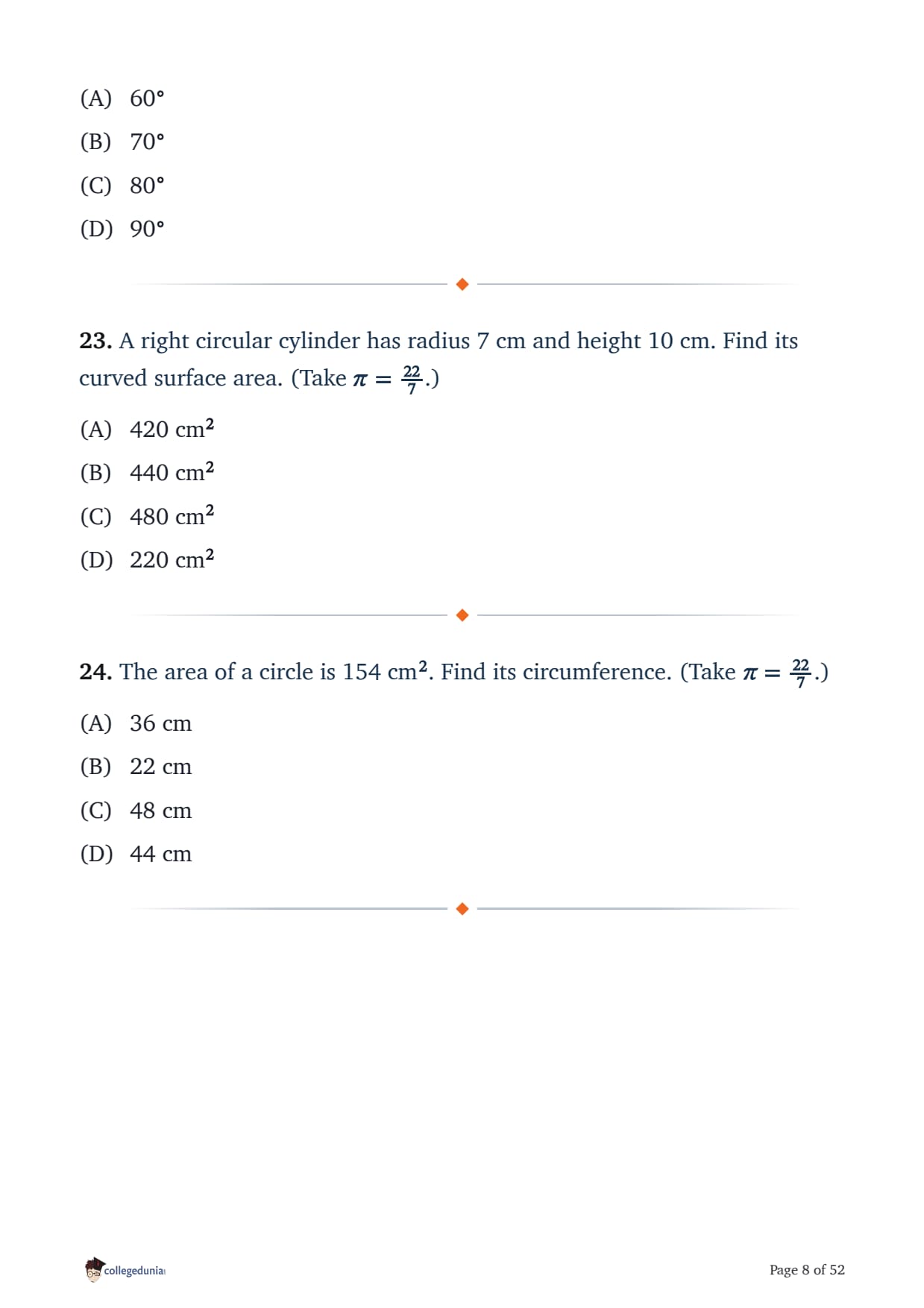
The angles of a triangle are in the ratio \(2:3:4\). Find the largest angle.
A right circular cylinder has radius 7 cm and height 10 cm. Find its curved surface area. (Take \(\pi=\frac{22}{7}\).)
The area of a circle is 154 cm\(^2\). Find its circumference. (Take \(\pi=\frac{22}{7}\).)
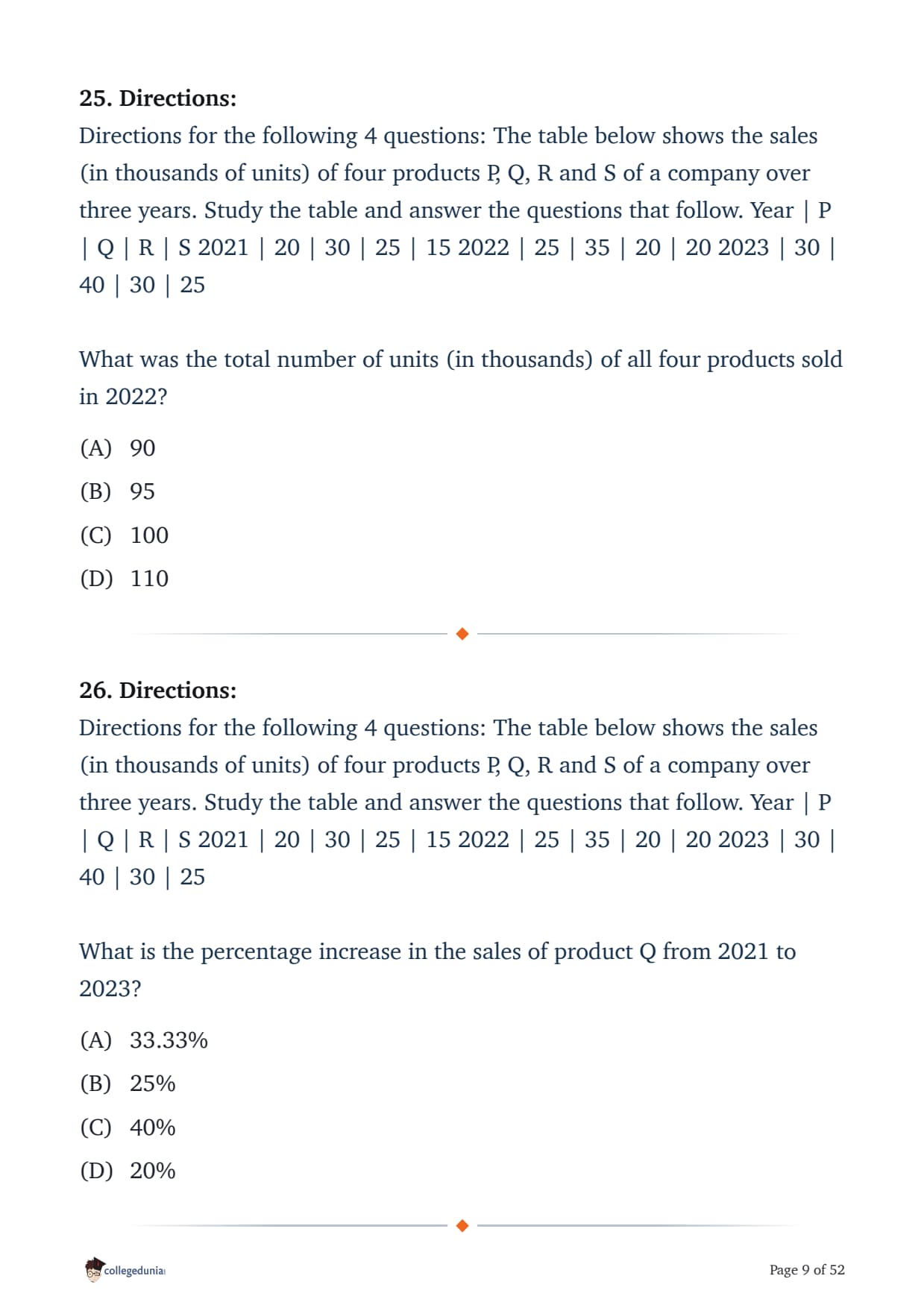
Directions:
Directions for the following 4 questions: The table below shows the sales (in thousands of units) of four products P, Q, R and S of a company over three years. Study the table and answer the questions that follow.
Year | P | Q | R | S
2021 | 20 | 30 | 25 | 15
2022 | 25 | 35 | 20 | 20
2023 | 30 | 40 | 30 | 25
What was the total number of units (in thousands) of all four products sold in 2022?
Directions:
Directions for the following 4 questions: The table below shows the sales (in thousands of units) of four products P, Q, R and S of a company over three years. Study the table and answer the questions that follow.
Year | P | Q | R | S
2021 | 20 | 30 | 25 | 15
2022 | 25 | 35 | 20 | 20
2023 | 30 | 40 | 30 | 25
What is the percentage increase in the sales of product Q from 2021 to 2023?
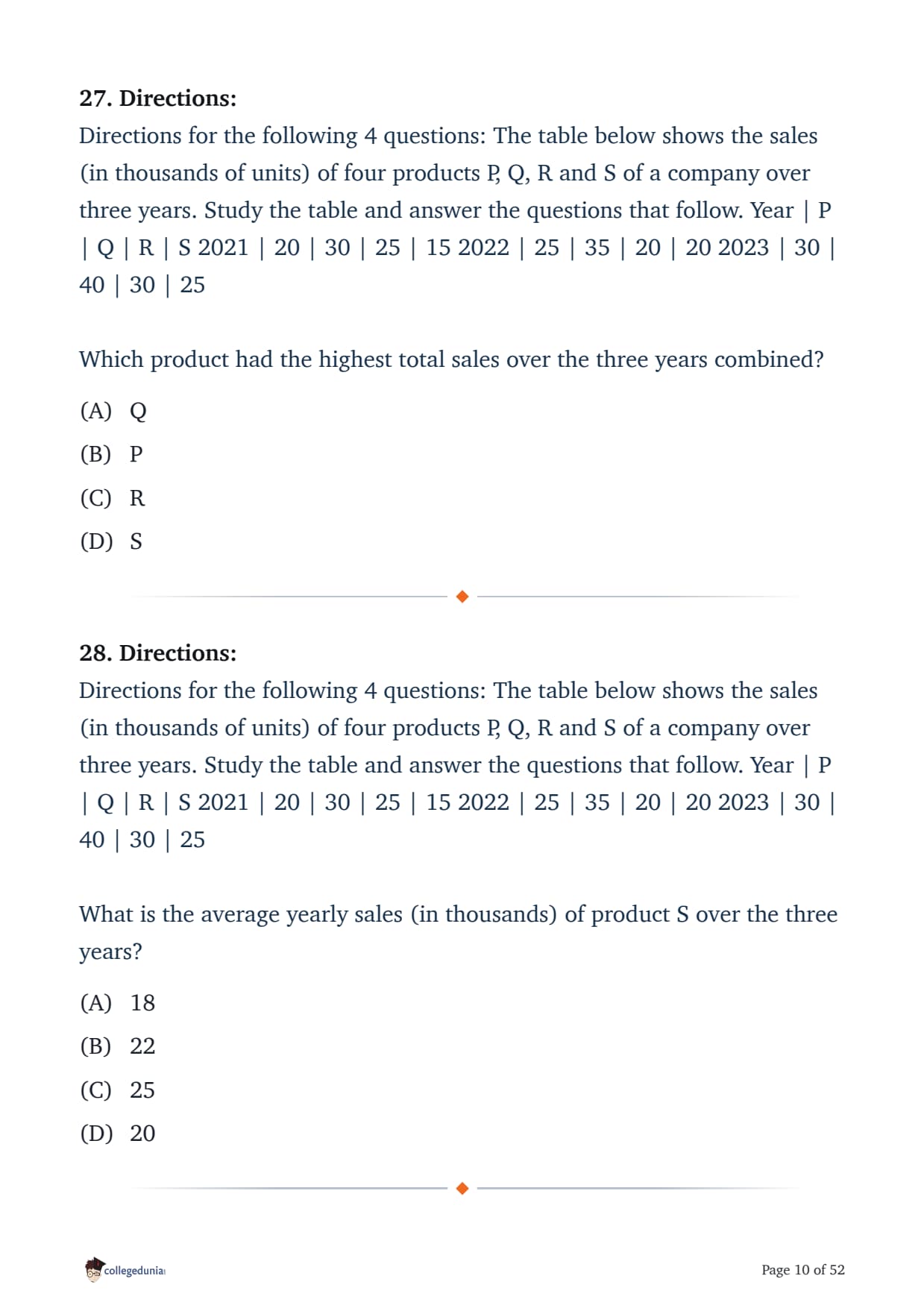
Directions:
Directions for the following 4 questions: The table below shows the sales (in thousands of units) of four products P, Q, R and S of a company over three years. Study the table and answer the questions that follow.
Year | P | Q | R | S
2021 | 20 | 30 | 25 | 15
2022 | 25 | 35 | 20 | 20
2023 | 30 | 40 | 30 | 25
Which product had the highest total sales over the three years combined?
Directions:
Directions for the following 4 questions: The table below shows the sales (in thousands of units) of four products P, Q, R and S of a company over three years. Study the table and answer the questions that follow.
Year | P | Q | R | S
2021 | 20 | 30 | 25 | 15
2022 | 25 | 35 | 20 | 20
2023 | 30 | 40 | 30 | 25
What is the average yearly sales (in thousands) of product S over the three years?
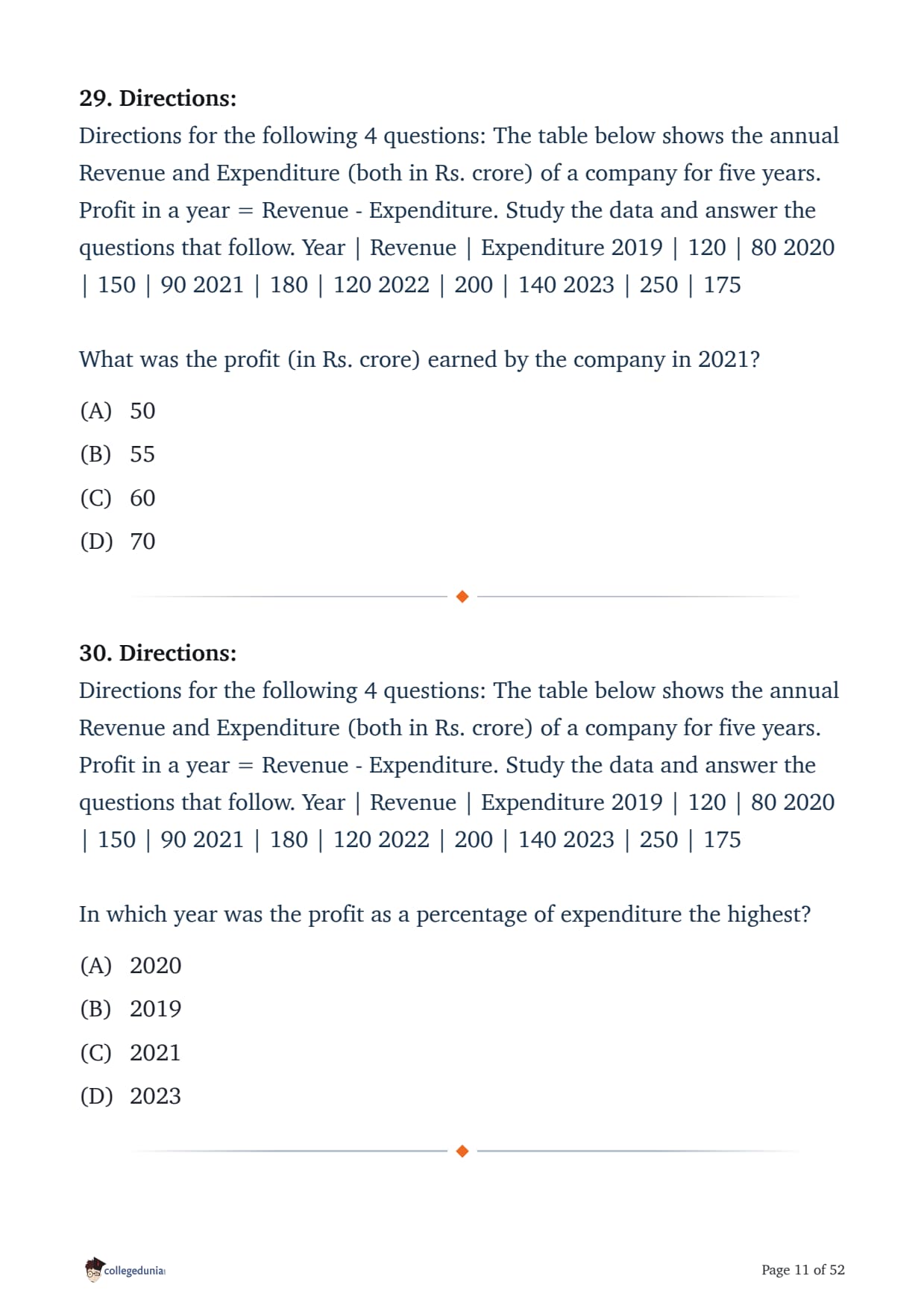
Directions:
Directions for the following 4 questions: The table below shows the annual Revenue and Expenditure (both in Rs. crore) of a company for five years. Profit in a year = Revenue - Expenditure. Study the data and answer the questions that follow.
Year | Revenue | Expenditure
2019 | 120 | 80
2020 | 150 | 90
2021 | 180 | 120
2022 | 200 | 140
2023 | 250 | 175
What was the profit (in Rs. crore) earned by the company in 2021?
Directions:
Directions for the following 4 questions: The table below shows the annual Revenue and Expenditure (both in Rs. crore) of a company for five years. Profit in a year = Revenue - Expenditure. Study the data and answer the questions that follow.
Year | Revenue | Expenditure
2019 | 120 | 80
2020 | 150 | 90
2021 | 180 | 120
2022 | 200 | 140
2023 | 250 | 175
In which year was the profit as a percentage of expenditure the highest?
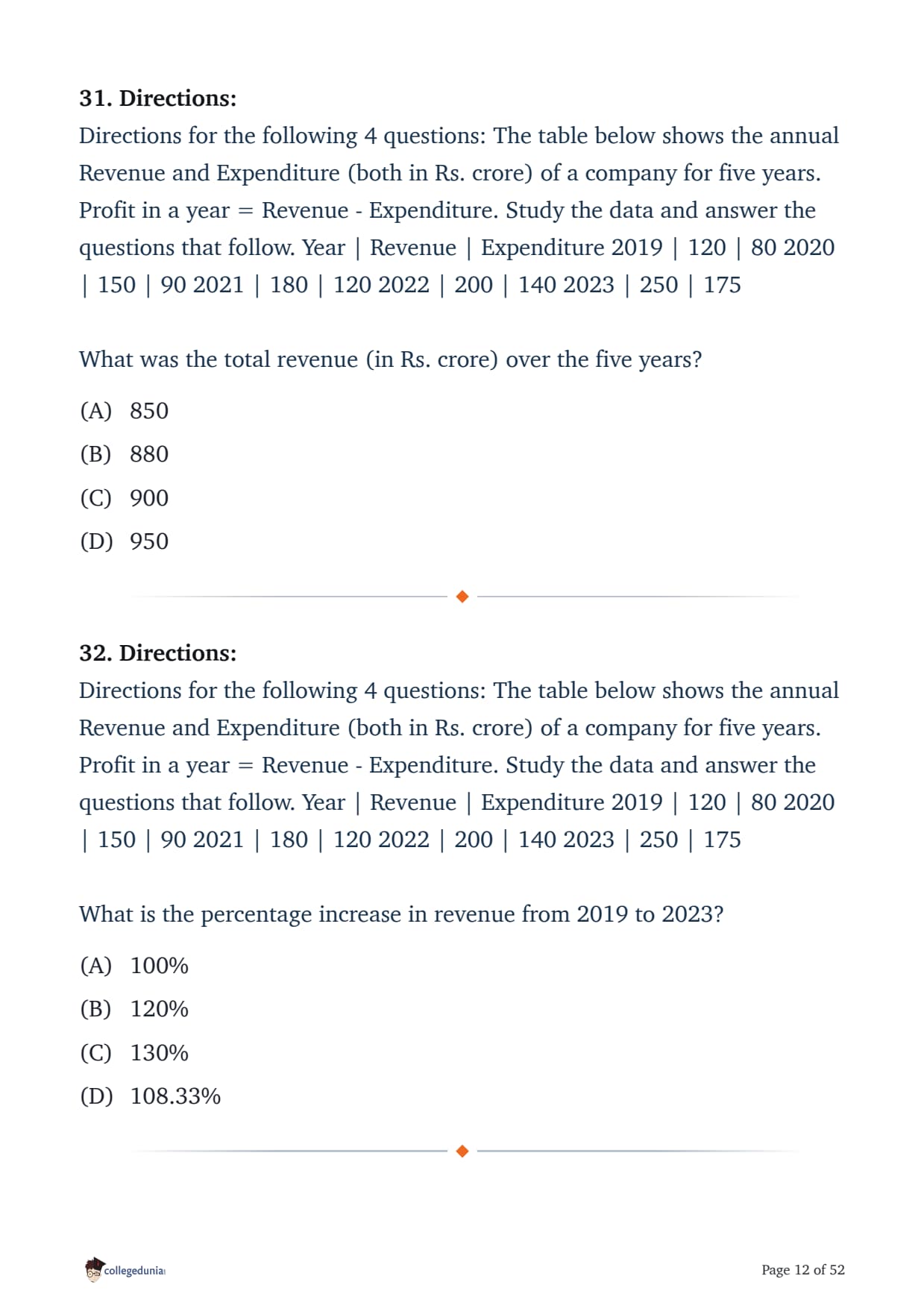
Directions:
Directions for the following 4 questions: The table below shows the annual Revenue and Expenditure (both in Rs. crore) of a company for five years. Profit in a year = Revenue - Expenditure. Study the data and answer the questions that follow.
Year | Revenue | Expenditure
2019 | 120 | 80
2020 | 150 | 90
2021 | 180 | 120
2022 | 200 | 140
2023 | 250 | 175
What was the total revenue (in Rs. crore) over the five years?
Directions:
Directions for the following 4 questions: The table below shows the annual Revenue and Expenditure (both in Rs. crore) of a company for five years. Profit in a year = Revenue - Expenditure. Study the data and answer the questions that follow.
Year | Revenue | Expenditure
2019 | 120 | 80
2020 | 150 | 90
2021 | 180 | 120
2022 | 200 | 140
2023 | 250 | 175
What is the percentage increase in revenue from 2019 to 2023?
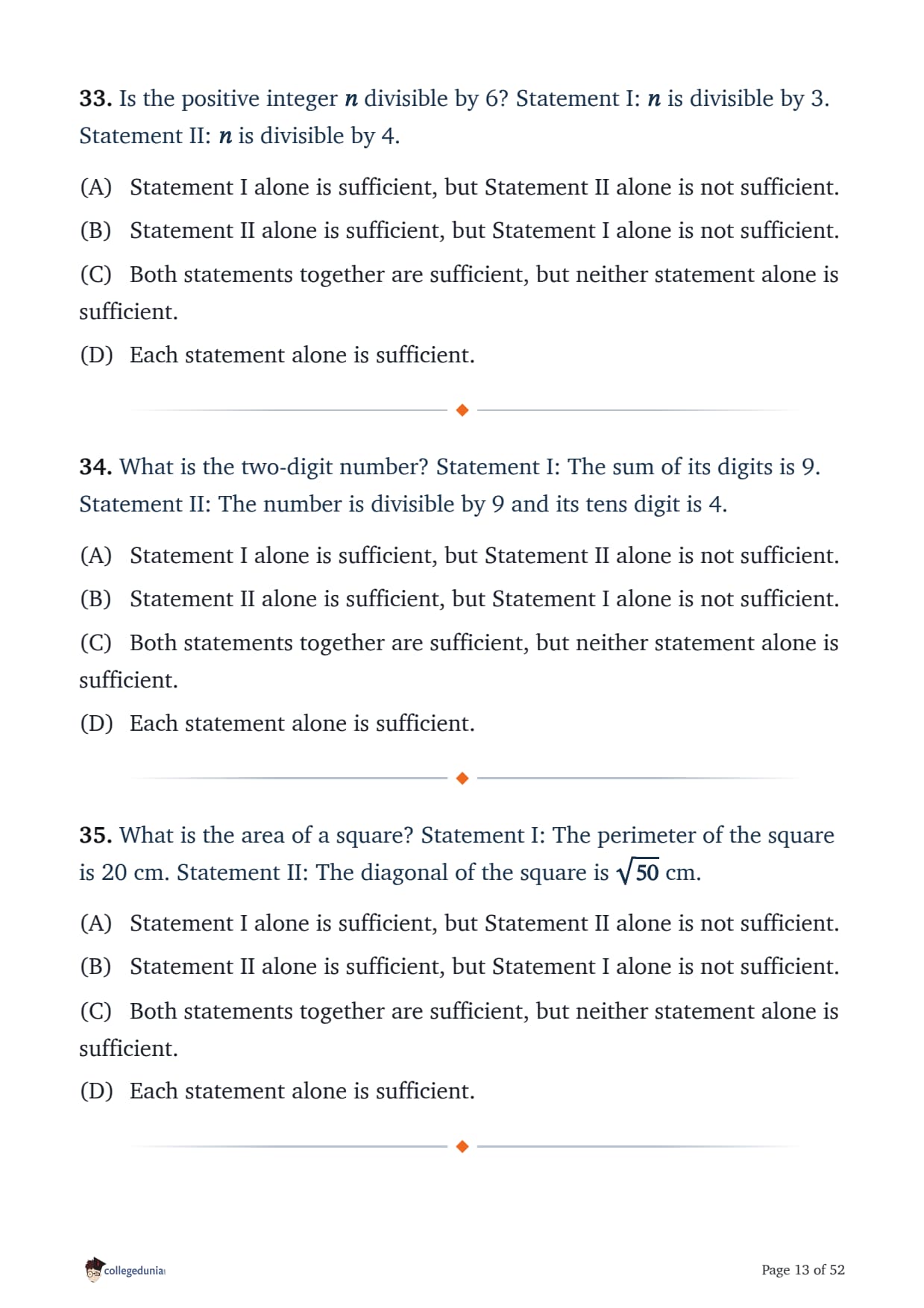
Is the positive integer \(n\) divisible by 6? Statement I: \(n\) is divisible by 3. Statement II: \(n\) is divisible by 4.
What is the two-digit number? Statement I: The sum of its digits is 9. Statement II: The number is divisible by 9 and its tens digit is 4.
What is the area of a square? Statement I: The perimeter of the square is 20 cm. Statement II: The diagonal of the square is \(\sqrt{50}\) cm.
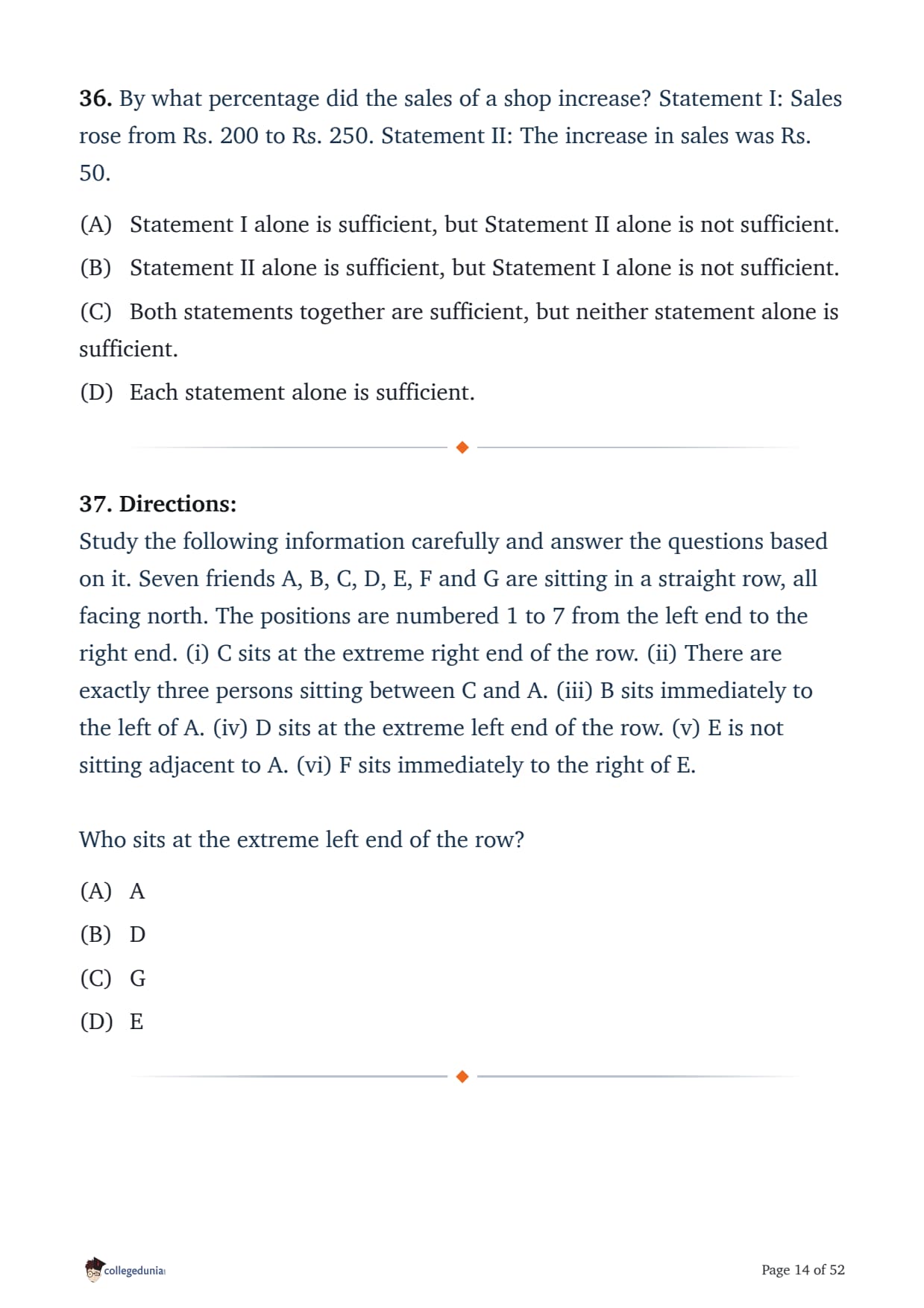
By what percentage did the sales of a shop increase? Statement I: Sales rose from Rs. 200 to Rs. 250. Statement II: The increase in sales was Rs. 50.
Directions:
Study the following information carefully and answer the questions based on it. Seven friends A, B, C, D, E, F and G are sitting in a straight row, all facing north. The positions are numbered 1 to 7 from the left end to the right end. (i) C sits at the extreme right end of the row. (ii) There are exactly three persons sitting between C and A. (iii) B sits immediately to the left of A. (iv) D sits at the extreme left end of the row. (v) E is not sitting adjacent to A. (vi) F sits immediately to the right of E.
Who sits at the extreme left end of the row?
Directions:
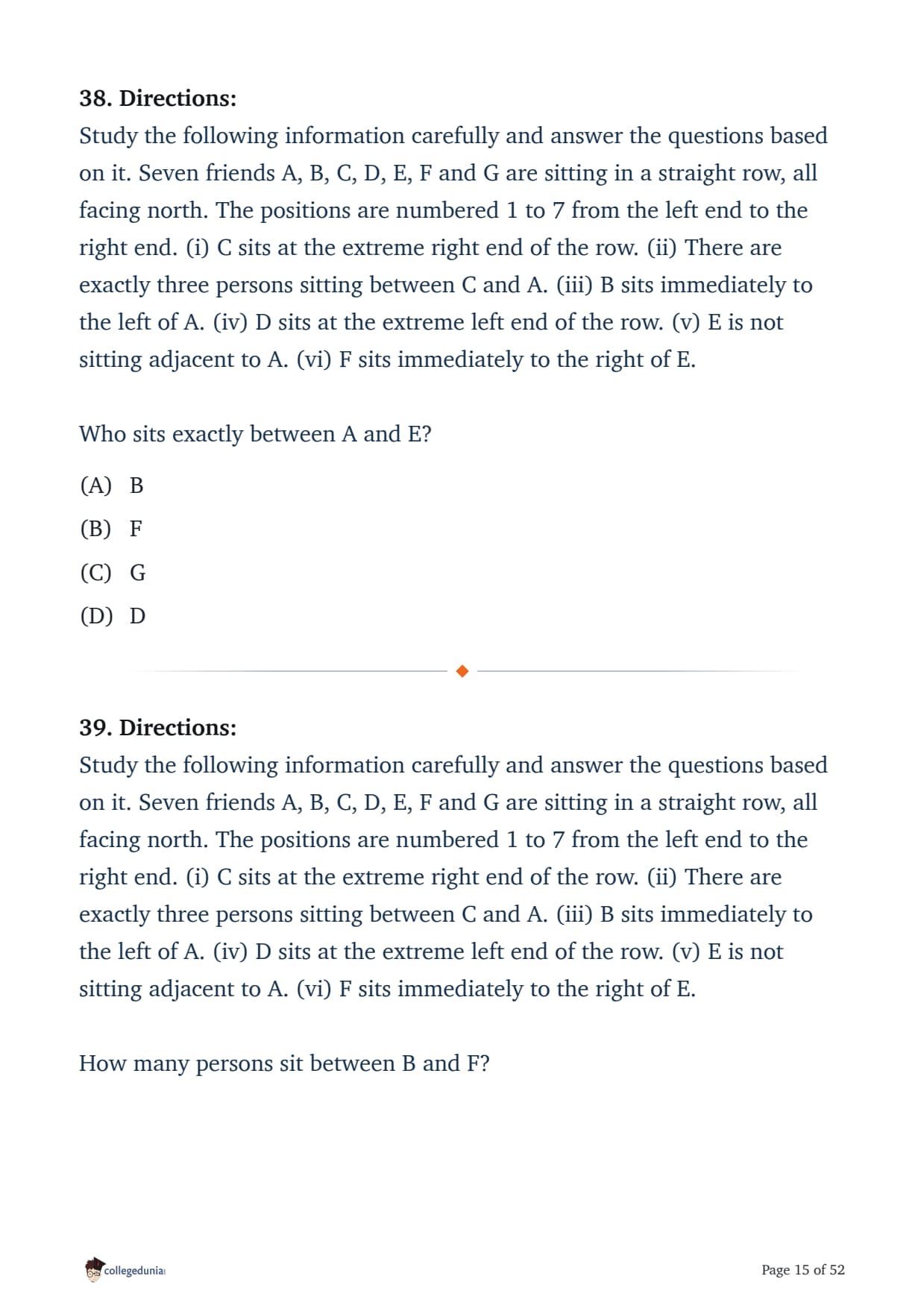
Study the following information carefully and answer the questions based on it. Seven friends A, B, C, D, E, F and G are sitting in a straight row, all facing north. The positions are numbered 1 to 7 from the left end to the right end. (i) C sits at the extreme right end of the row. (ii) There are exactly three persons sitting between C and A. (iii) B sits immediately to the left of A. (iv) D sits at the extreme left end of the row. (v) E is not sitting adjacent to A. (vi) F sits immediately to the right of E.
Who sits exactly between A and E?
Directions:
Study the following information carefully and answer the questions based on it. Seven friends A, B, C, D, E, F and G are sitting in a straight row, all facing north. The positions are numbered 1 to 7 from the left end to the right end. (i) C sits at the extreme right end of the row. (ii) There are exactly three persons sitting between C and A. (iii) B sits immediately to the left of A. (iv) D sits at the extreme left end of the row. (v) E is not sitting adjacent to A. (vi) F sits immediately to the right of E.
How many persons sit between B and F?
Directions:
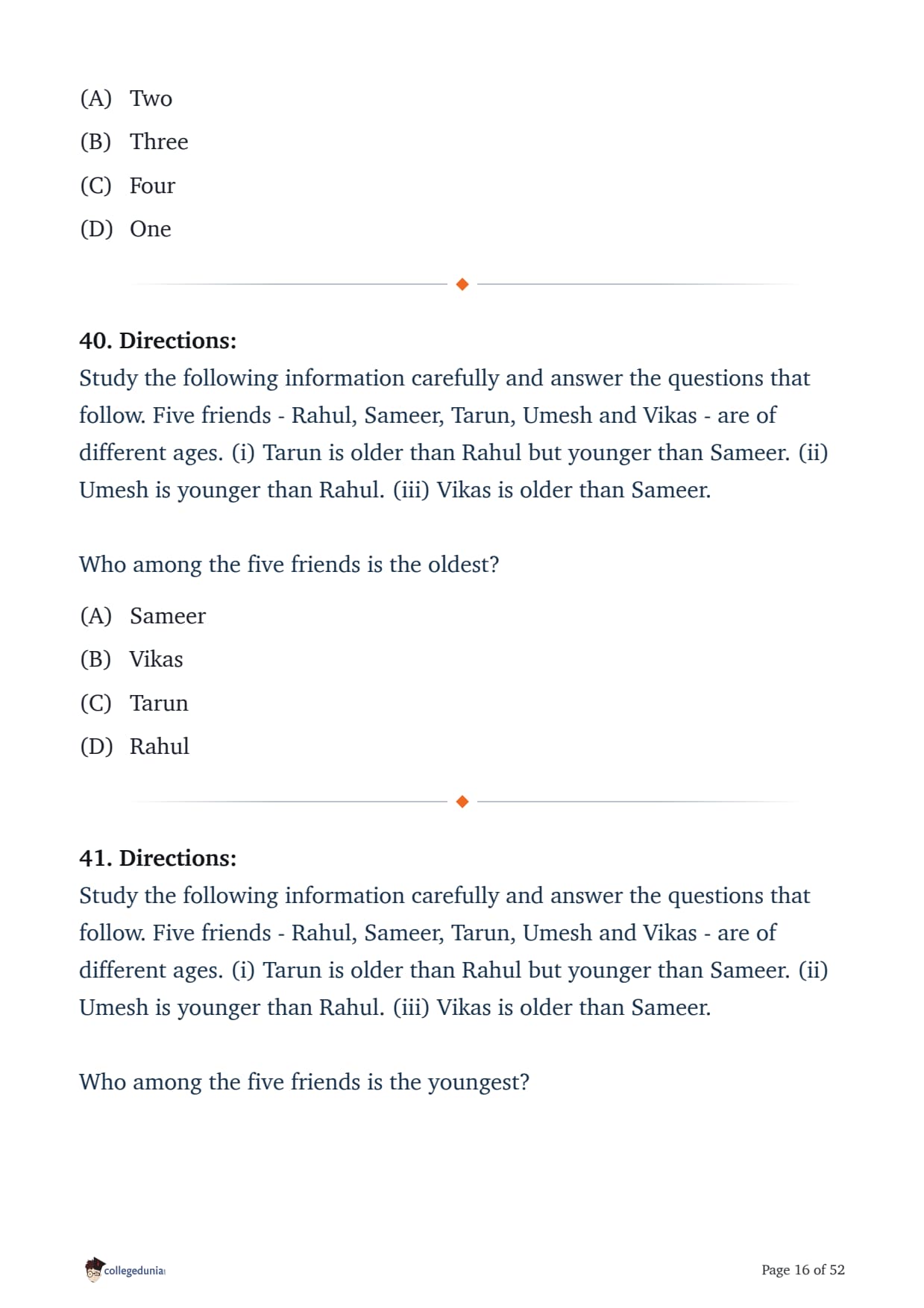
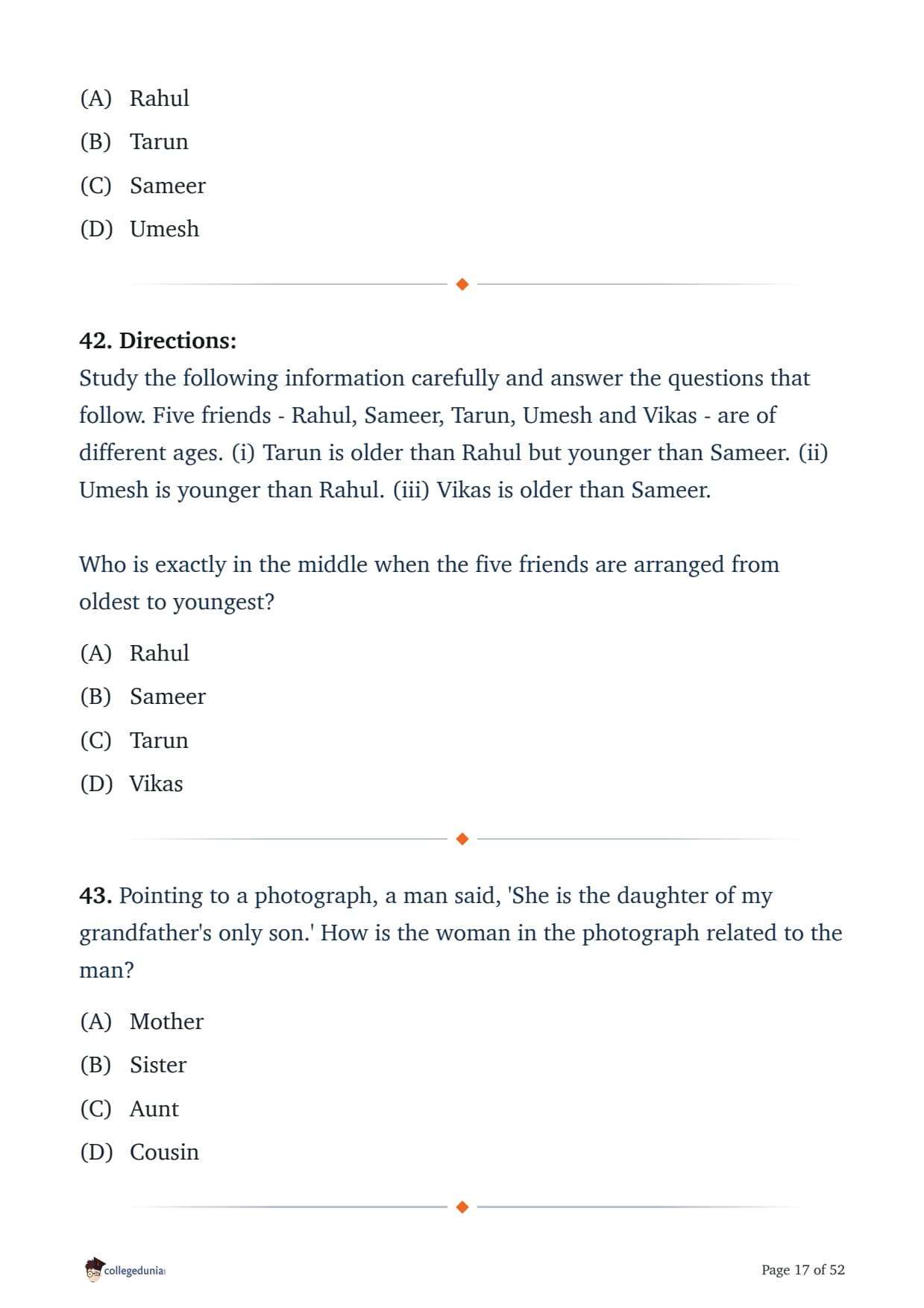
Study the following information carefully and answer the questions that follow. Five friends - Rahul, Sameer, Tarun, Umesh and Vikas - are of different ages. (i) Tarun is older than Rahul but younger than Sameer. (ii) Umesh is younger than Rahul. (iii) Vikas is older than Sameer.
Who among the five friends is the oldest?
Directions:
Study the following information carefully and answer the questions that follow. Five friends - Rahul, Sameer, Tarun, Umesh and Vikas - are of different ages. (i) Tarun is older than Rahul but younger than Sameer. (ii) Umesh is younger than Rahul. (iii) Vikas is older than Sameer.
Who among the five friends is the youngest?
Directions:
Study the following information carefully and answer the questions that follow. Five friends - Rahul, Sameer, Tarun, Umesh and Vikas - are of different ages. (i) Tarun is older than Rahul but younger than Sameer. (ii) Umesh is younger than Rahul. (iii) Vikas is older than Sameer.
Who is exactly in the middle when the five friends are arranged from oldest to youngest?
Pointing to a photograph, a man said, 'She is the daughter of my grandfather's only son.' How is the woman in the photograph related to the man?
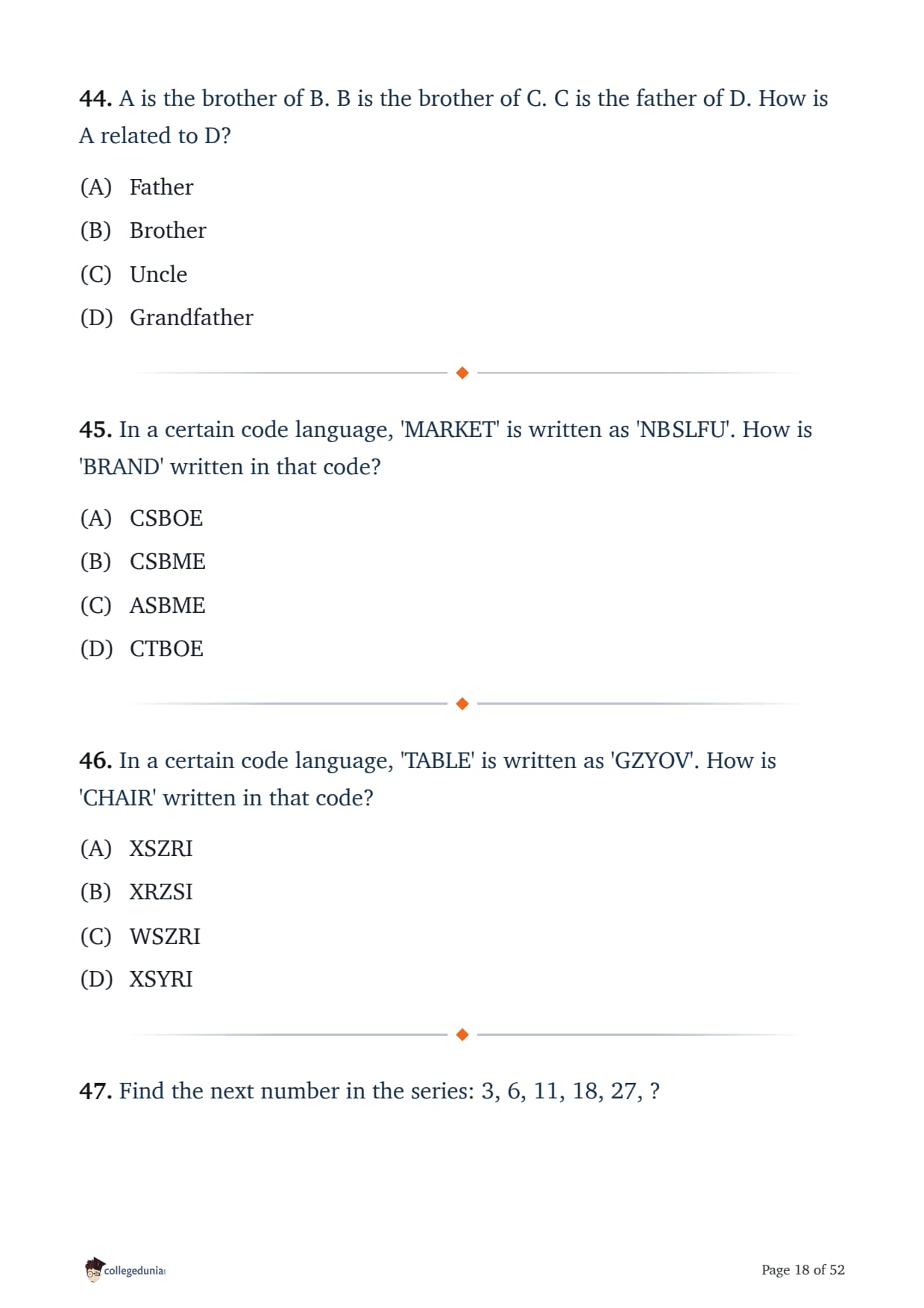
A is the brother of B. B is the brother of C. C is the father of D. How is A related to D?
In a certain code language, 'MARKET' is written as 'NBSLFU'. How is 'BRAND' written in that code?
In a certain code language, 'TABLE' is written as 'GZYOV'. How is 'CHAIR' written in that code?
Find the next number in the series: 3, 6, 11, 18, 27, ?
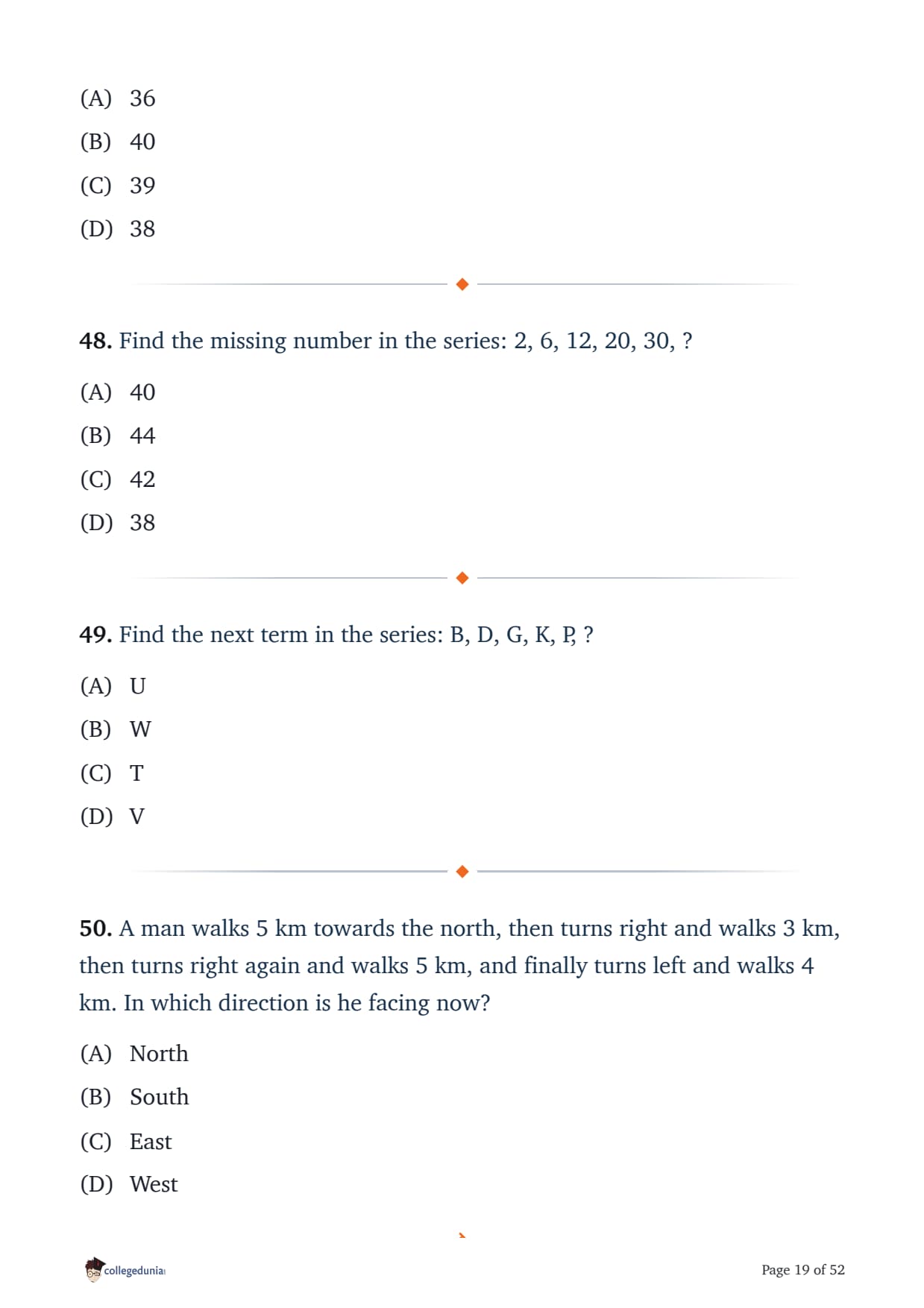
Find the missing number in the series: 2, 6, 12, 20, 30, ?
Find the next term in the series: B, D, G, K, P, ?
A man walks 5 km towards the north, then turns right and walks 3 km, then turns right again and walks 5 km, and finally turns left and walks 4 km. In which direction is he facing now?
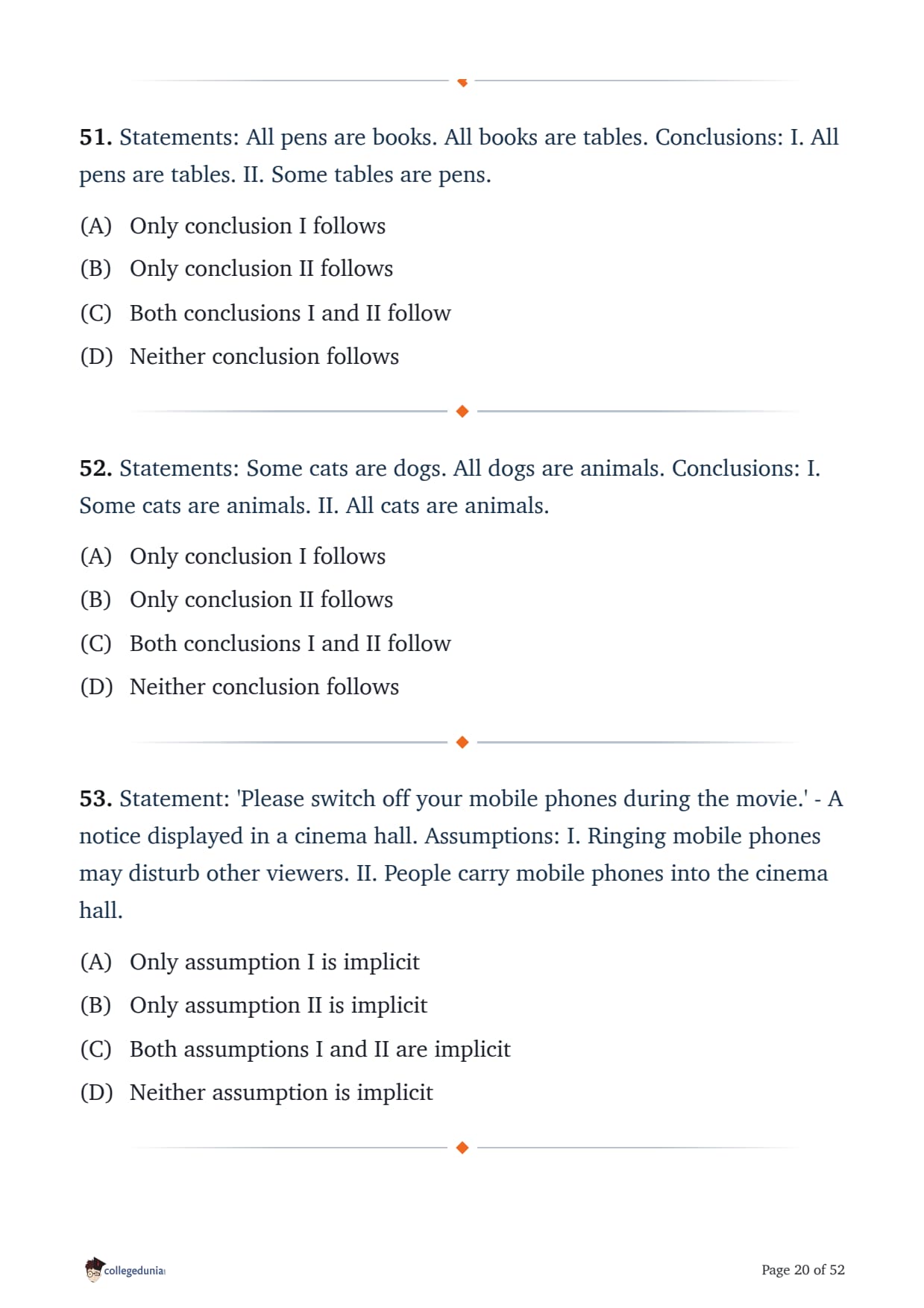
Statements: All pens are books. All books are tables. Conclusions: I. All pens are tables. II. Some tables are pens.
Statements: Some cats are dogs. All dogs are animals. Conclusions: I. Some cats are animals. II. All cats are animals.
Statement: 'Please switch off your mobile phones during the movie.' - A notice displayed in a cinema hall. Assumptions: I. Ringing mobile phones may disturb other viewers. II. People carry mobile phones into the cinema hall.
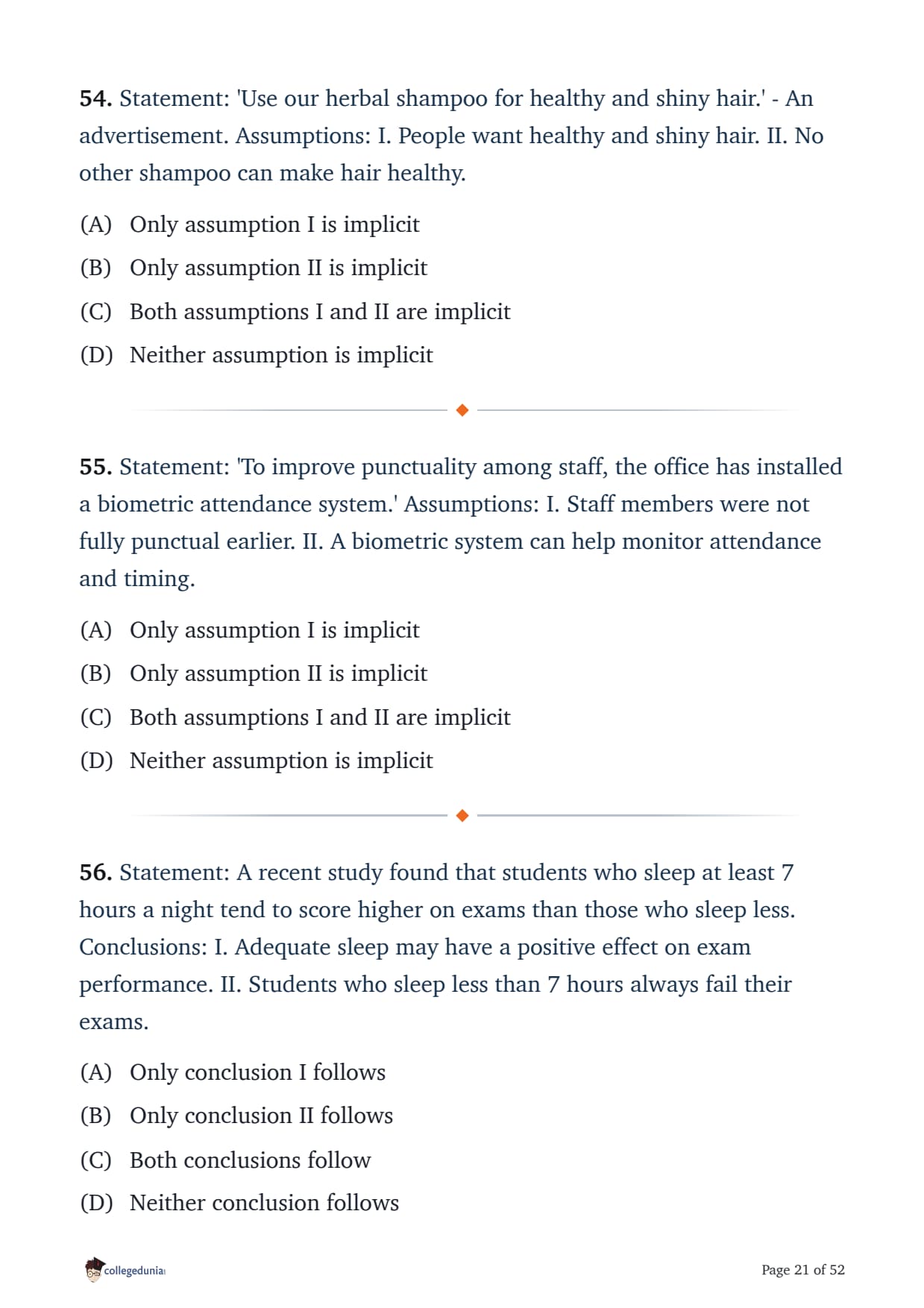
Statement: 'Use our herbal shampoo for healthy and shiny hair.' - An advertisement. Assumptions: I. People want healthy and shiny hair. II. No other shampoo can make hair healthy.
Statement: 'To improve punctuality among staff, the office has installed a biometric attendance system.' Assumptions: I. Staff members were not fully punctual earlier. II. A biometric system can help monitor attendance and timing.
Statement: A recent study found that students who sleep at least 7 hours a night tend to score higher on exams than those who sleep less. Conclusions: I. Adequate sleep may have a positive effect on exam performance. II. Students who sleep less than 7 hours always fail their exams.
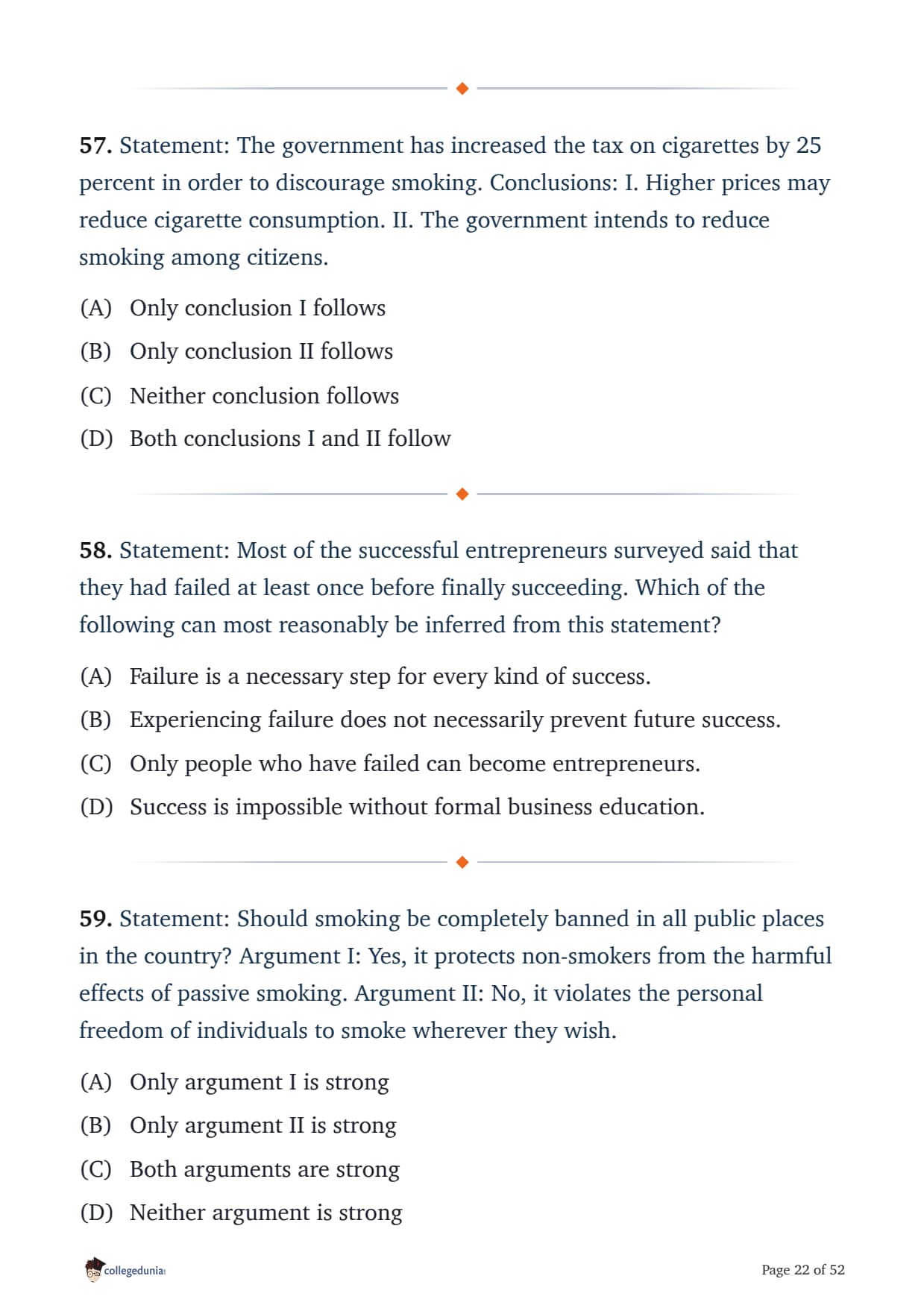
Statement: The government has increased the tax on cigarettes by 25 percent in order to discourage smoking. Conclusions: I. Higher prices may reduce cigarette consumption. II. The government intends to reduce smoking among citizens.
Statement: Most of the successful entrepreneurs surveyed said that they had failed at least once before finally succeeding. Which of the following can most reasonably be inferred from this statement?
Statement: Should smoking be completely banned in all public places in the country? Argument I: Yes, it protects non-smokers from the harmful effects of passive smoking. Argument II: No, it violates the personal freedom of individuals to smoke wherever they wish.
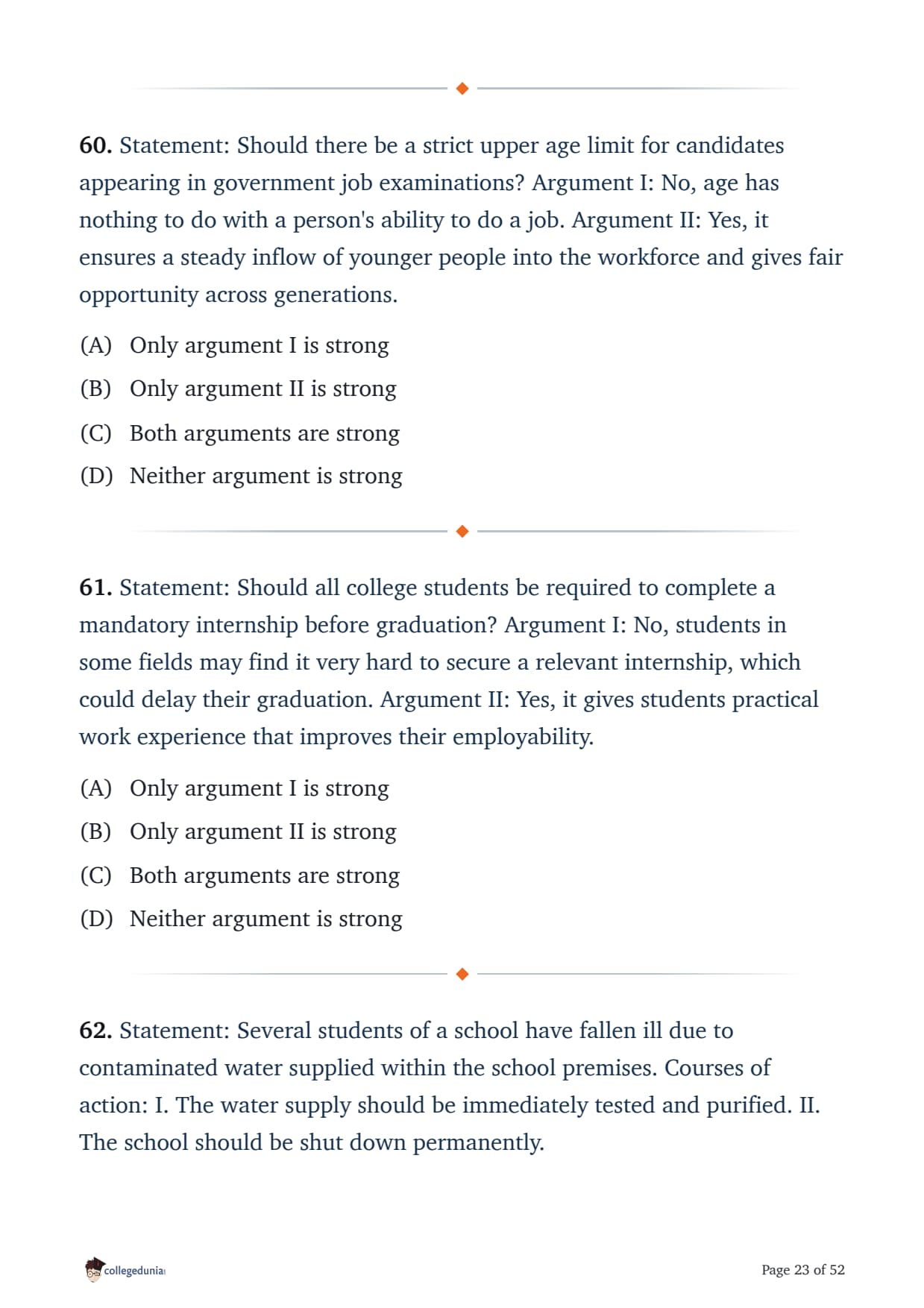
Statement: Should there be a strict upper age limit for candidates appearing in government job examinations? Argument I: No, age has nothing to do with a person's ability to do a job. Argument II: Yes, it ensures a steady inflow of younger people into the workforce and gives fair opportunity across generations.
Statement: Should all college students be required to complete a mandatory internship before graduation? Argument I: No, students in some fields may find it very hard to secure a relevant internship, which could delay their graduation. Argument II: Yes, it gives students practical work experience that improves their employability.
Statement: Several students of a school have fallen ill due to contaminated water supplied within the school premises. Courses of action: I. The water supply should be immediately tested and purified. II. The school should be shut down permanently.
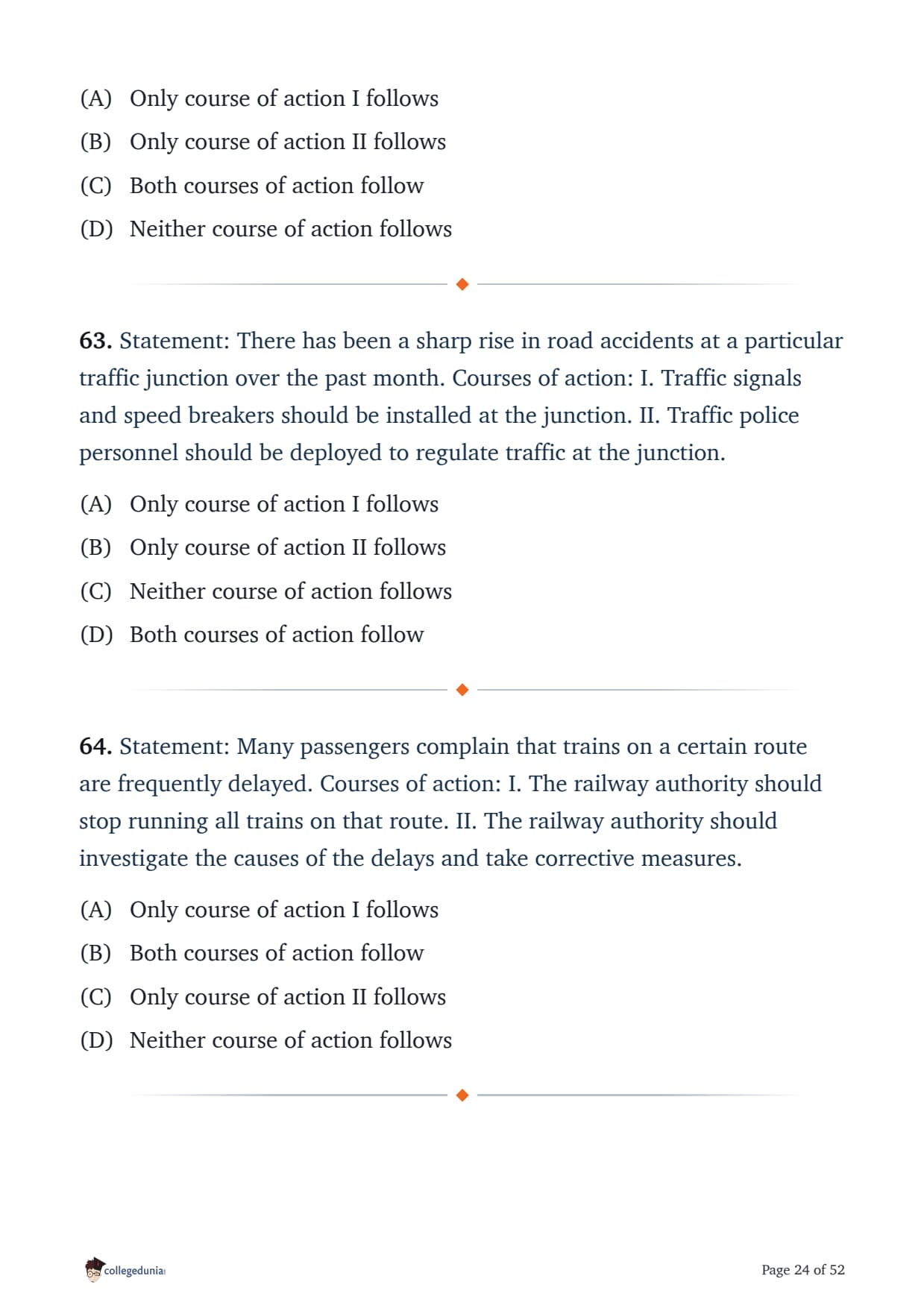
Statement: There has been a sharp rise in road accidents at a particular traffic junction over the past month. Courses of action: I. Traffic signals and speed breakers should be installed at the junction. II. Traffic police personnel should be deployed to regulate traffic at the junction.
Statement: Many passengers complain that trains on a certain route are frequently delayed. Courses of action: I. The railway authority should stop running all trains on that route. II. The railway authority should investigate the causes of the delays and take corrective measures.
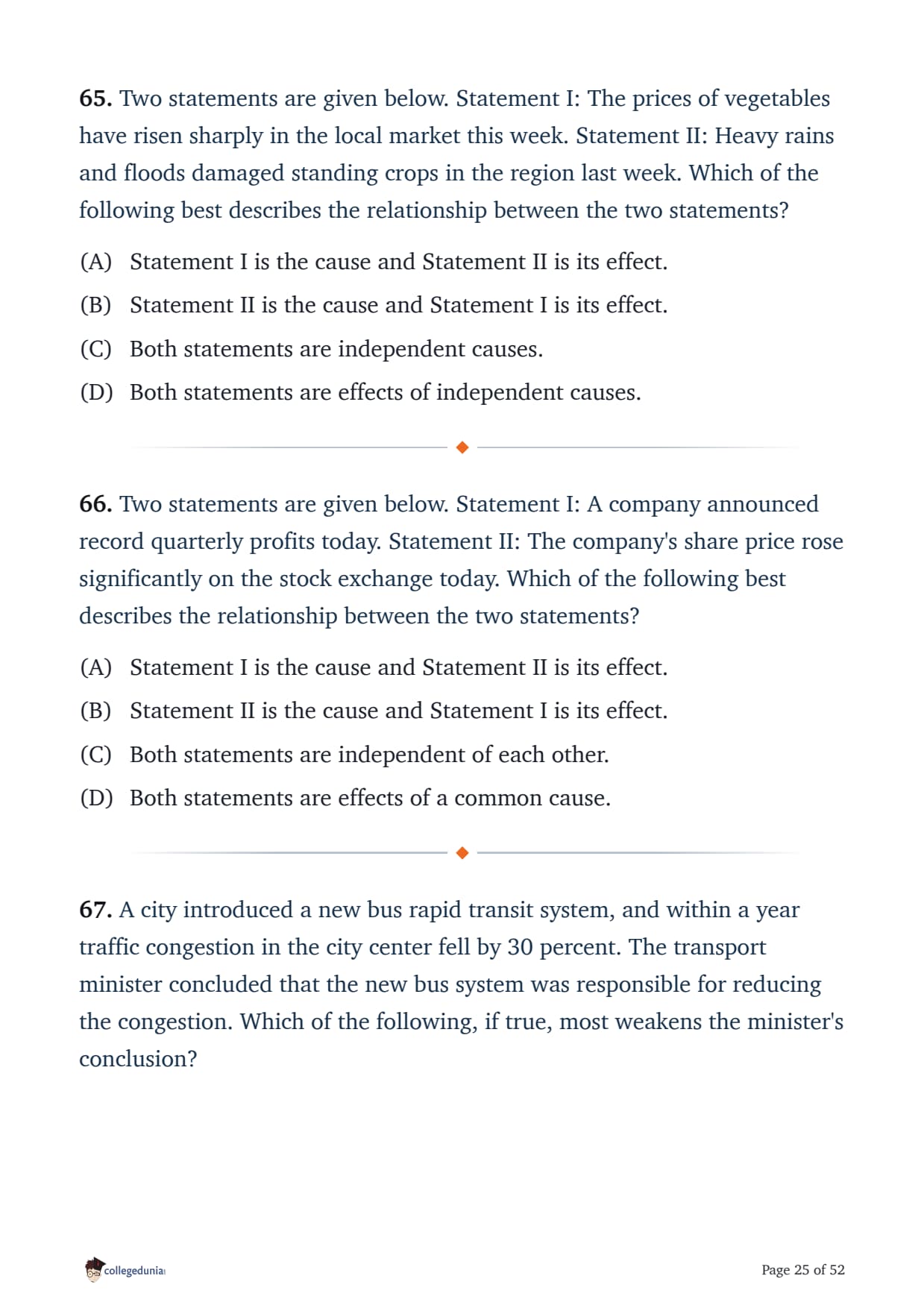
Two statements are given below. Statement I: The prices of vegetables have risen sharply in the local market this week. Statement II: Heavy rains and floods damaged standing crops in the region last week. Which of the following best describes the relationship between the two statements?
Two statements are given below. Statement I: A company announced record quarterly profits today. Statement II: The company's share price rose significantly on the stock exchange today. Which of the following best describes the relationship between the two statements?
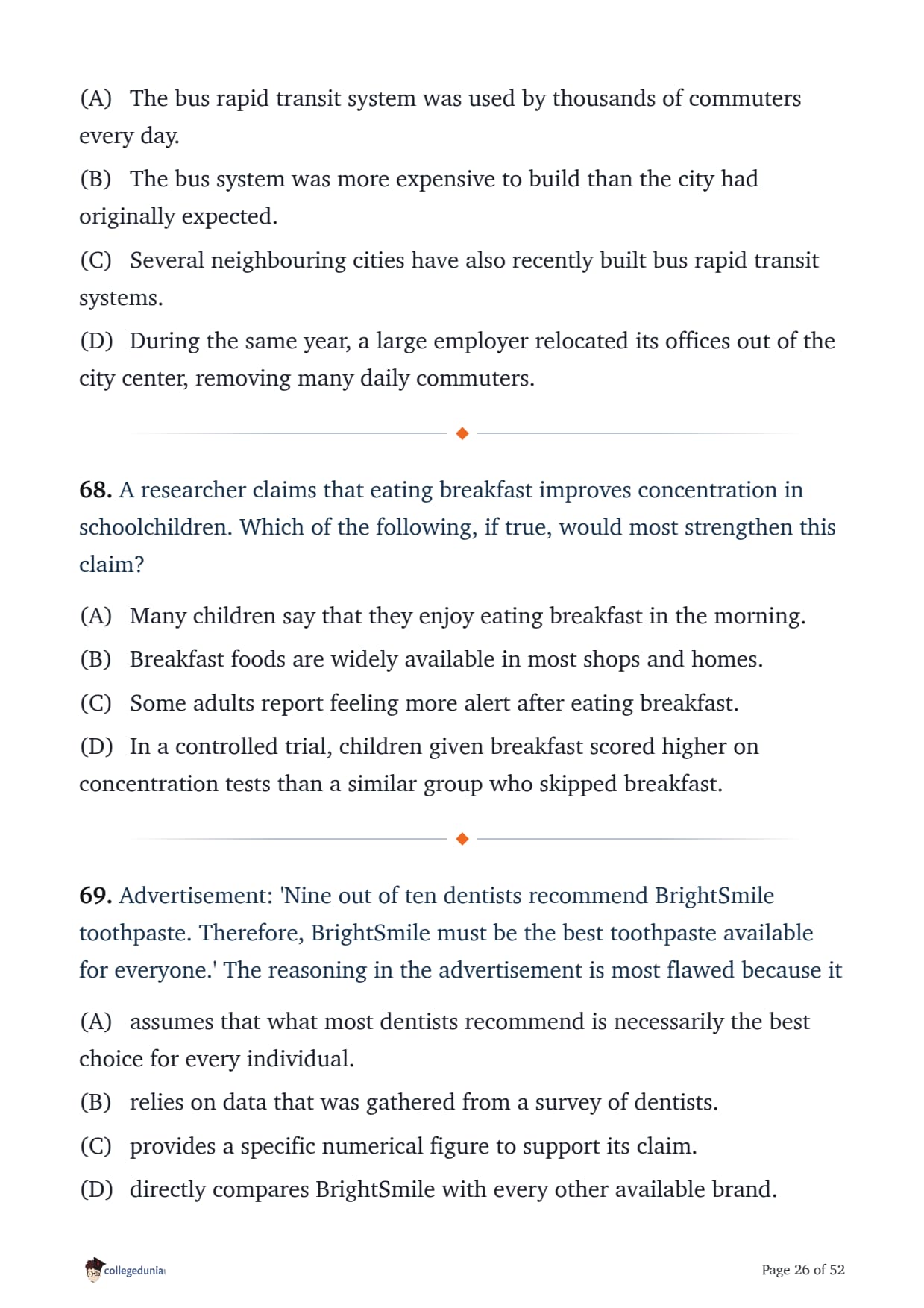
A city introduced a new bus rapid transit system, and within a year traffic congestion in the city center fell by 30 percent. The transport minister concluded that the new bus system was responsible for reducing the congestion. Which of the following, if true, most weakens the minister's conclusion?
A researcher claims that eating breakfast improves concentration in schoolchildren. Which of the following, if true, would most strengthen this claim?
Advertisement: 'Nine out of ten dentists recommend BrightSmile toothpaste. Therefore, BrightSmile must be the best toothpaste available for everyone.' The reasoning in the advertisement is most flawed because it
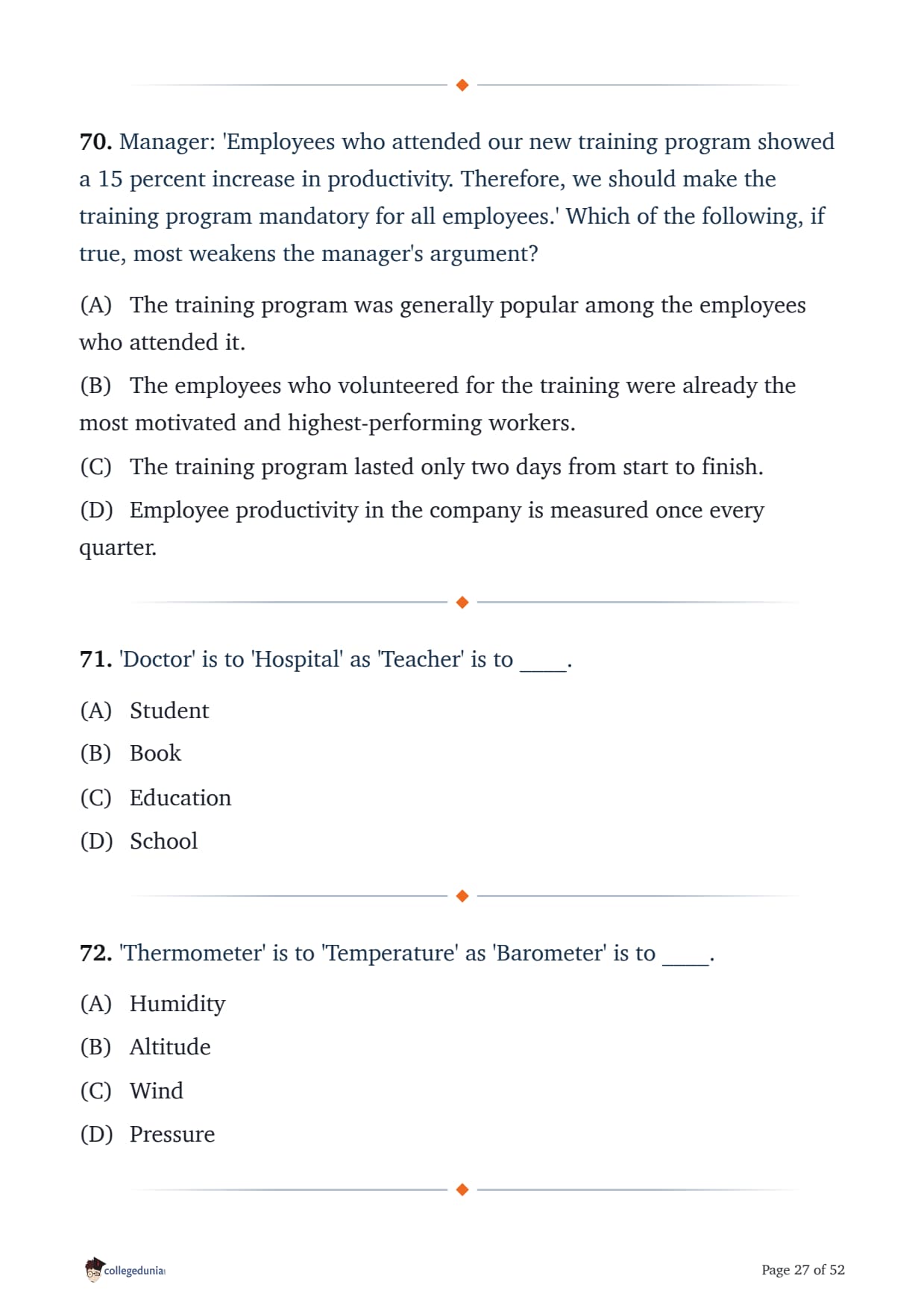
Manager: 'Employees who attended our new training program showed a 15 percent increase in productivity. Therefore, we should make the training program mandatory for all employees.' Which of the following, if true, most weakens the manager's argument?
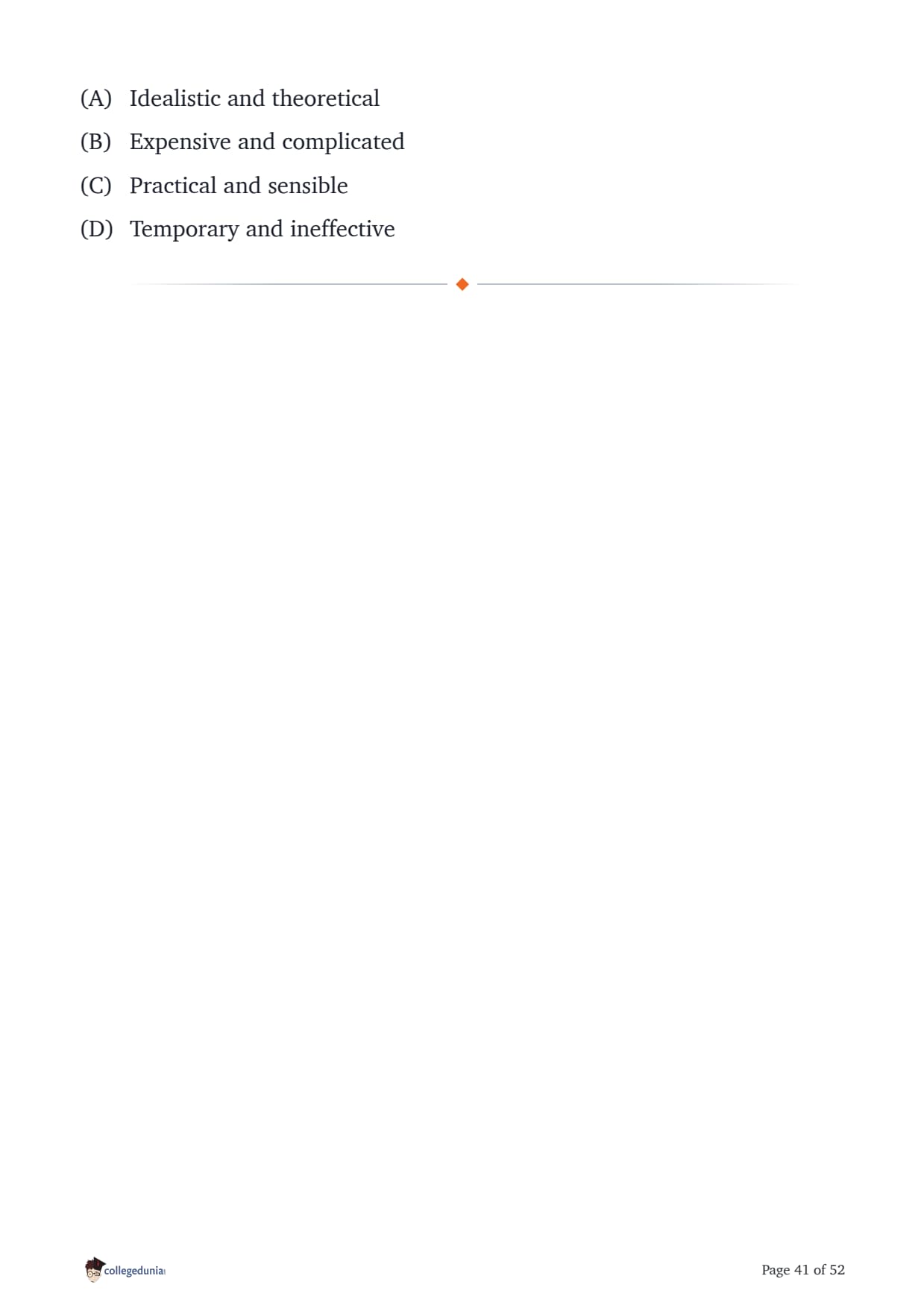
'Doctor' is to 'Hospital' as 'Teacher' is to ____.
'Thermometer' is to 'Temperature' as 'Barometer' is to ____.
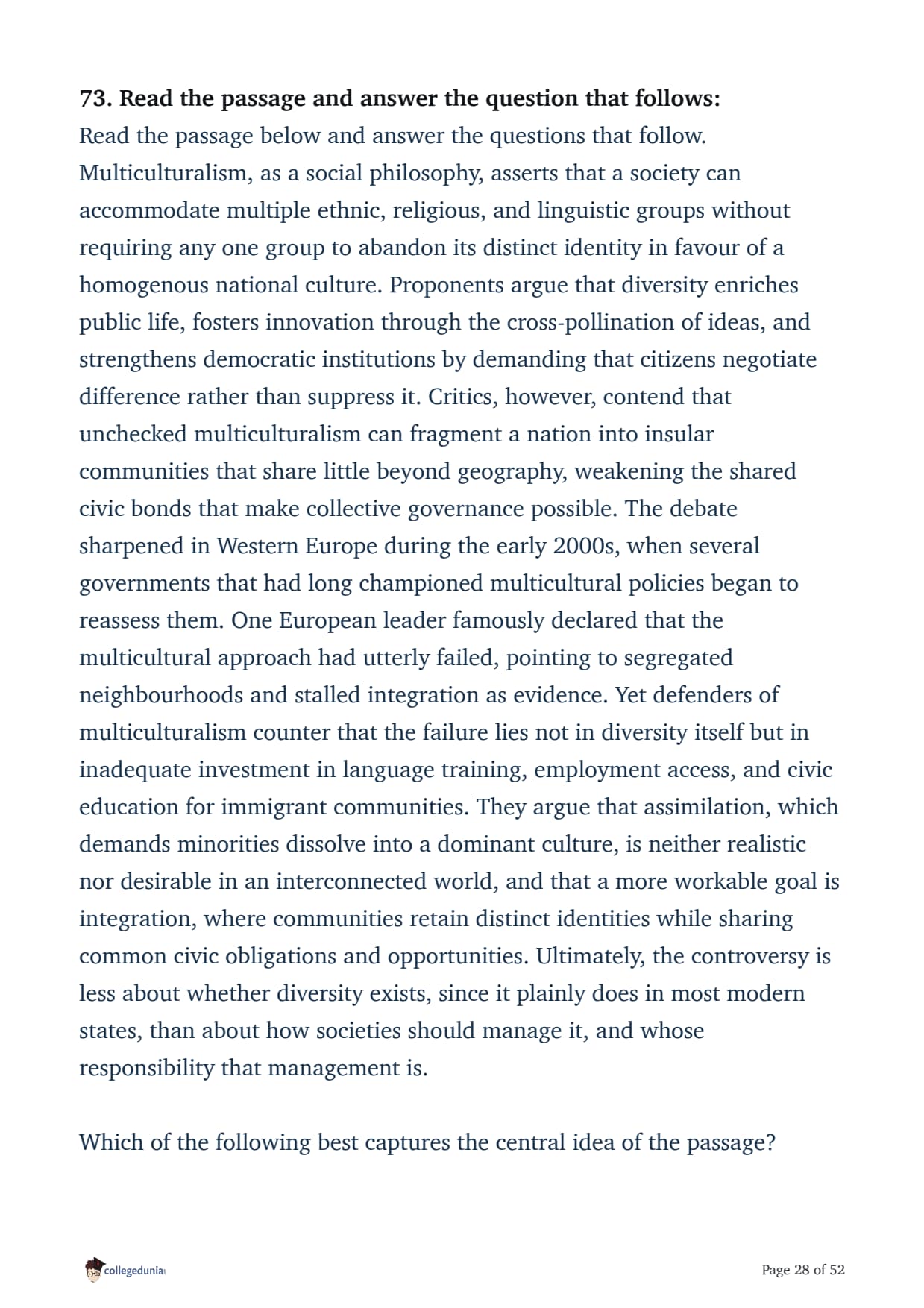
Read the passage and answer the question that follows:
Read the passage below and answer the questions that follow.
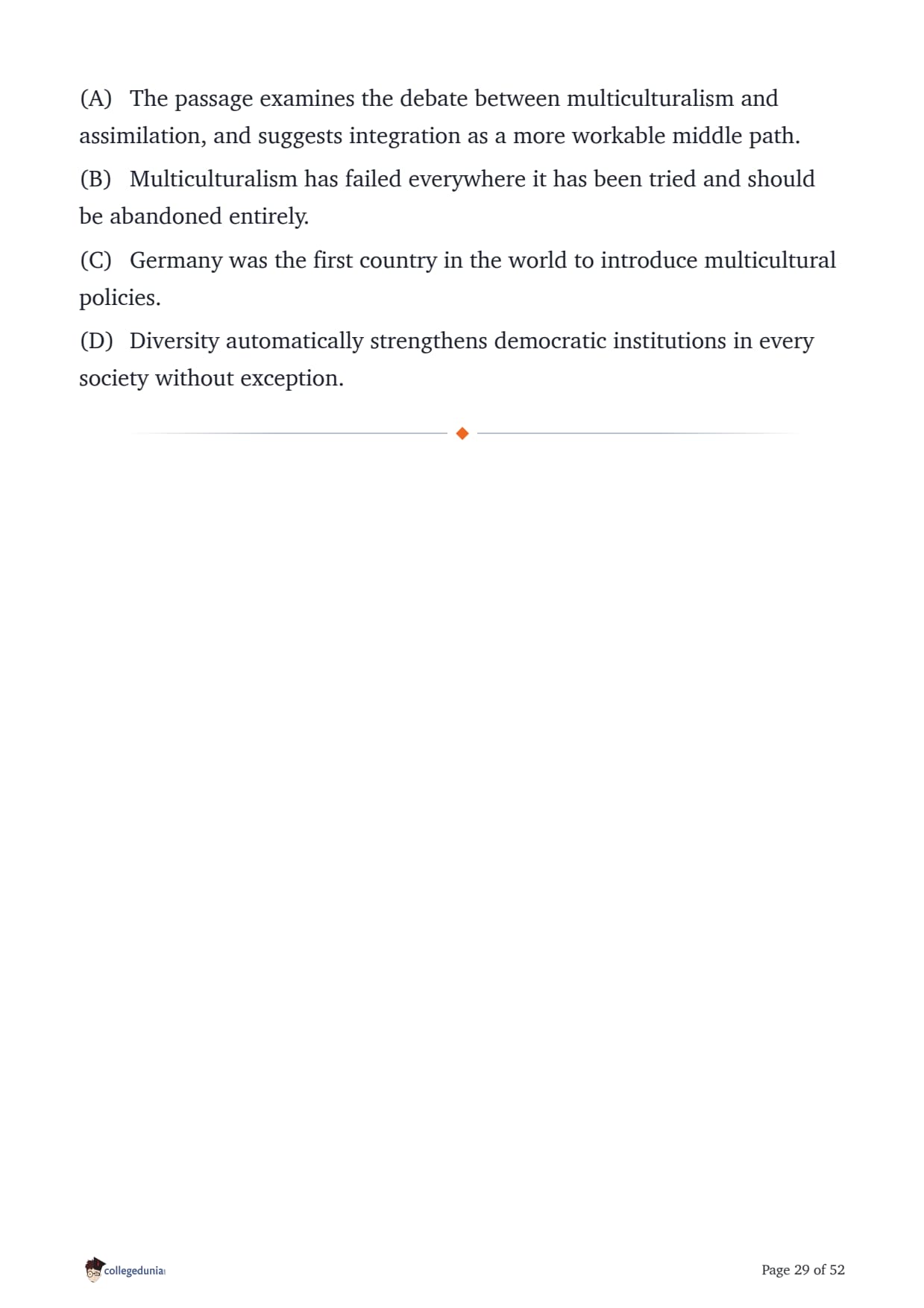
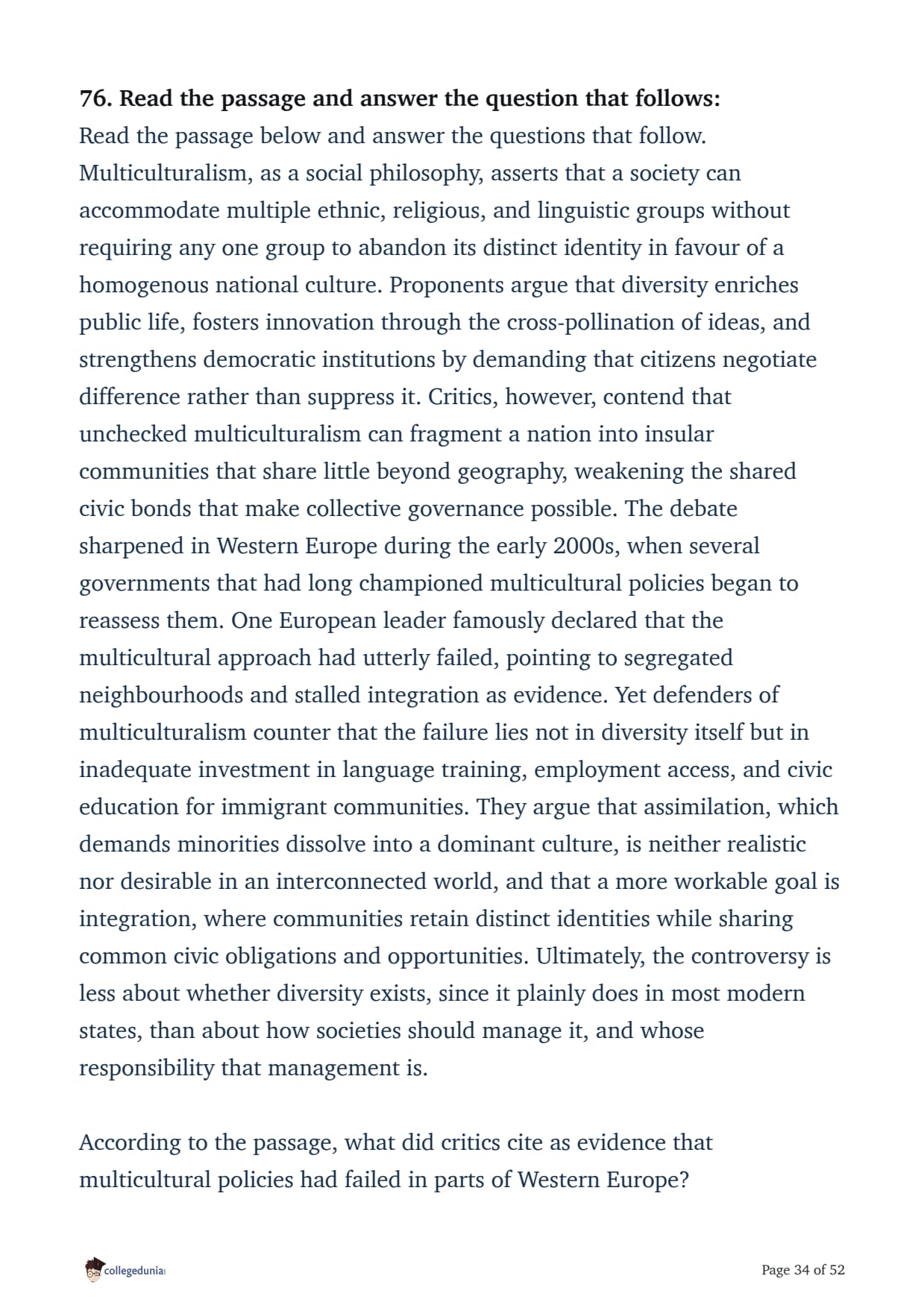
Multiculturalism, as a social philosophy, asserts that a society can accommodate multiple ethnic, religious, and linguistic groups without requiring any one group to abandon its distinct identity in favour of a homogenous national culture. Proponents argue that diversity enriches public life, fosters innovation through the cross-pollination of ideas, and strengthens democratic institutions by demanding that citizens negotiate difference rather than suppress it. Critics, however, contend that unchecked multiculturalism can fragment a nation into insular communities that share little beyond geography, weakening the shared civic bonds that make collective governance possible.
The debate sharpened in Western Europe during the early 2000s, when several governments that had long championed multicultural policies began to reassess them. One European leader famously declared that the multicultural approach had utterly failed, pointing to segregated neighbourhoods and stalled integration as evidence. Yet defenders of multiculturalism counter that the failure lies not in diversity itself but in inadequate investment in language training, employment access, and civic education for immigrant communities. They argue that assimilation, which demands minorities dissolve into a dominant culture, is neither realistic nor desirable in an interconnected world, and that a more workable goal is integration, where communities retain distinct identities while sharing common civic obligations and opportunities.
Ultimately, the controversy is less about whether diversity exists, since it plainly does in most modern states, than about how societies should manage it, and whose responsibility that management is.
Which of the following best captures the central idea of the passage?
Read the passage and answer the question that follows:
Read the passage below and answer the questions that follow.
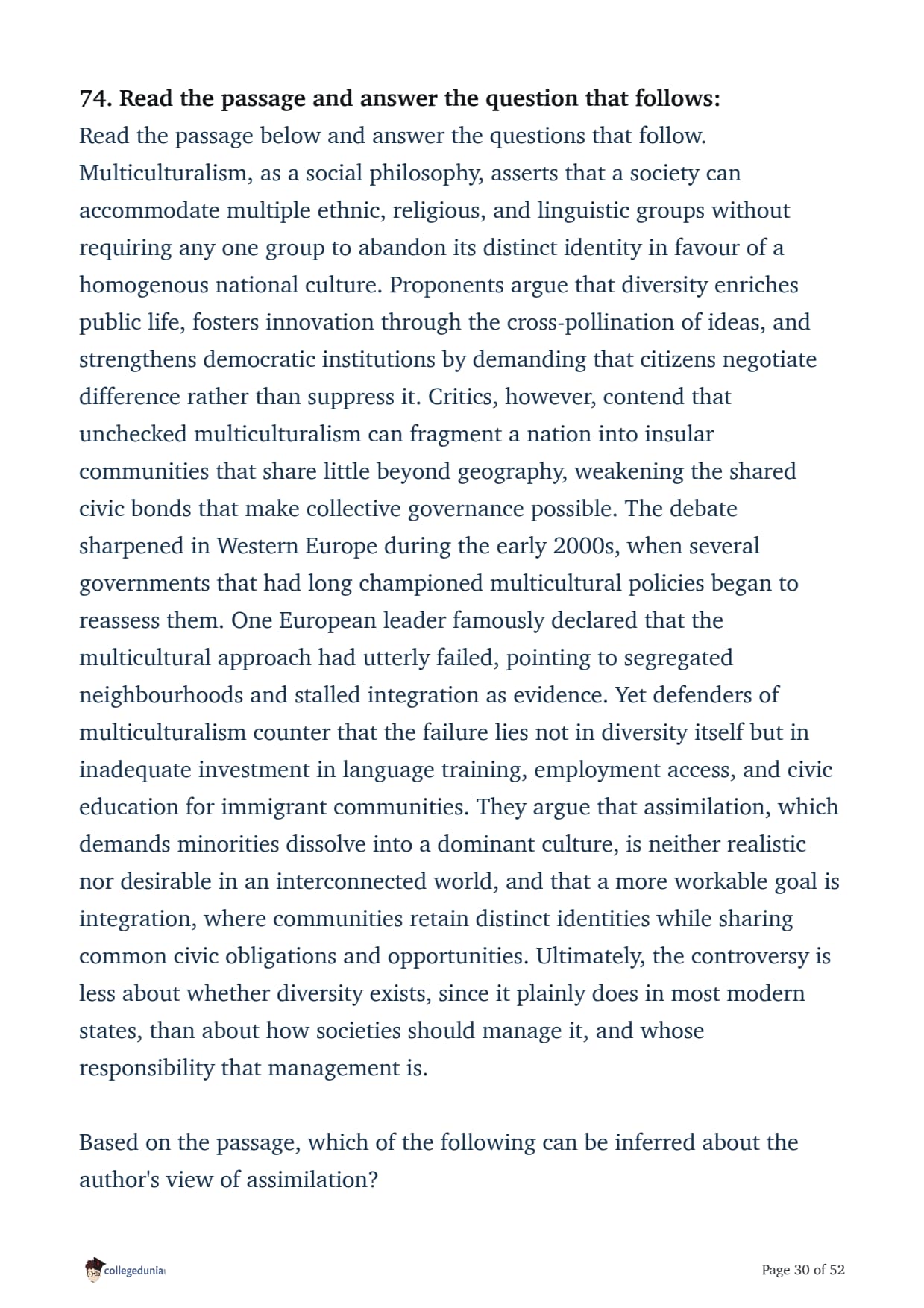
Multiculturalism, as a social philosophy, asserts that a society can accommodate multiple ethnic, religious, and linguistic groups without requiring any one group to abandon its distinct identity in favour of a homogenous national culture. Proponents argue that diversity enriches public life, fosters innovation through the cross-pollination of ideas, and strengthens democratic institutions by demanding that citizens negotiate difference rather than suppress it. Critics, however, contend that unchecked multiculturalism can fragment a nation into insular communities that share little beyond geography, weakening the shared civic bonds that make collective governance possible.
The debate sharpened in Western Europe during the early 2000s, when several governments that had long championed multicultural policies began to reassess them. One European leader famously declared that the multicultural approach had utterly failed, pointing to segregated neighbourhoods and stalled integration as evidence. Yet defenders of multiculturalism counter that the failure lies not in diversity itself but in inadequate investment in language training, employment access, and civic education for immigrant communities. They argue that assimilation, which demands minorities dissolve into a dominant culture, is neither realistic nor desirable in an interconnected world, and that a more workable goal is integration, where communities retain distinct identities while sharing common civic obligations and opportunities.
Ultimately, the controversy is less about whether diversity exists, since it plainly does in most modern states, than about how societies should manage it, and whose responsibility that management is.
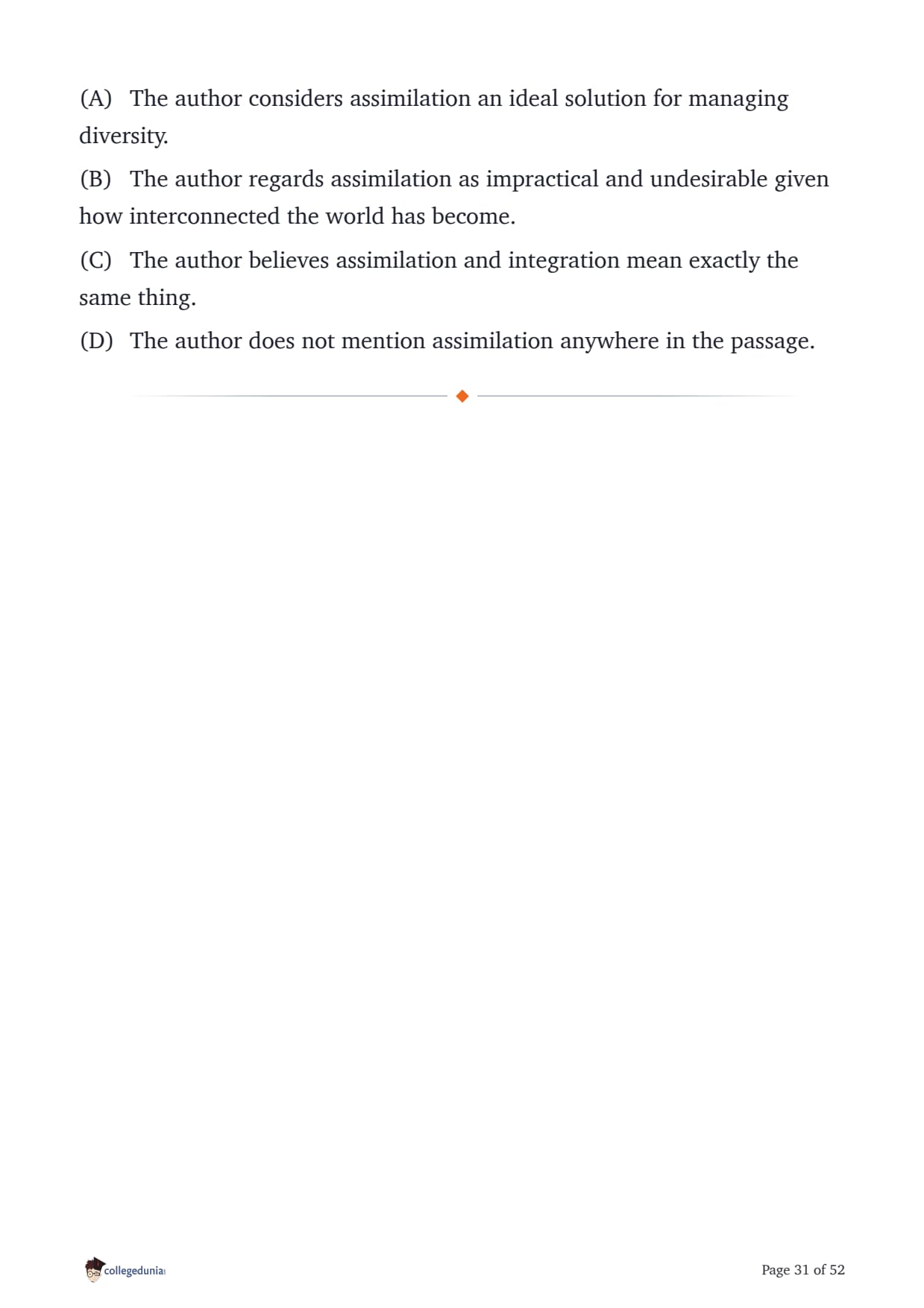
Based on the passage, which of the following can be inferred about the author's view of assimilation?
Read the passage and answer the question that follows:
Read the passage below and answer the questions that follow.
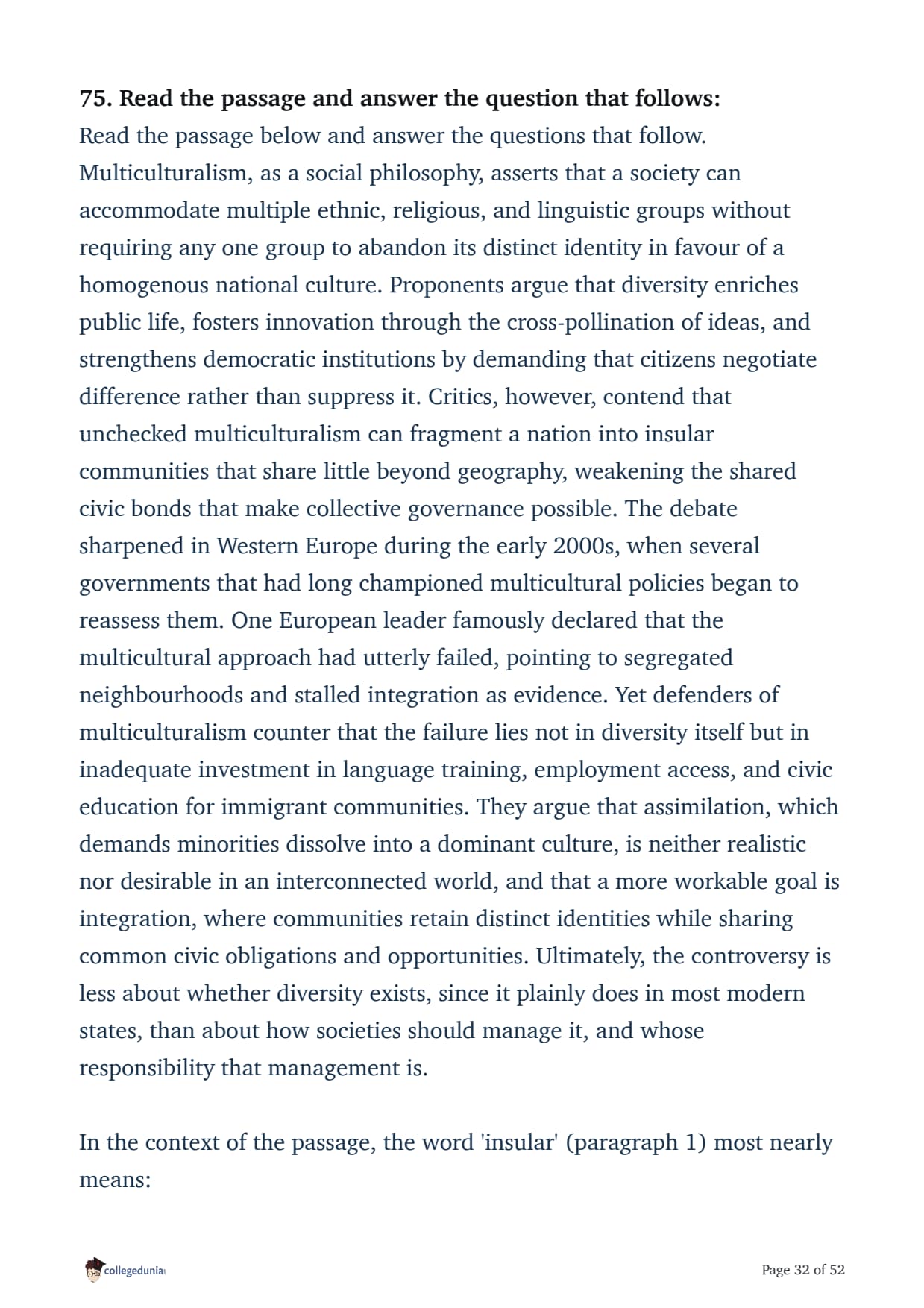
Multiculturalism, as a social philosophy, asserts that a society can accommodate multiple ethnic, religious, and linguistic groups without requiring any one group to abandon its distinct identity in favour of a homogenous national culture. Proponents argue that diversity enriches public life, fosters innovation through the cross-pollination of ideas, and strengthens democratic institutions by demanding that citizens negotiate difference rather than suppress it. Critics, however, contend that unchecked multiculturalism can fragment a nation into insular communities that share little beyond geography, weakening the shared civic bonds that make collective governance possible.
The debate sharpened in Western Europe during the early 2000s, when several governments that had long championed multicultural policies began to reassess them. One European leader famously declared that the multicultural approach had utterly failed, pointing to segregated neighbourhoods and stalled integration as evidence. Yet defenders of multiculturalism counter that the failure lies not in diversity itself but in inadequate investment in language training, employment access, and civic education for immigrant communities. They argue that assimilation, which demands minorities dissolve into a dominant culture, is neither realistic nor desirable in an interconnected world, and that a more workable goal is integration, where communities retain distinct identities while sharing common civic obligations and opportunities.
Ultimately, the controversy is less about whether diversity exists, since it plainly does in most modern states, than about how societies should manage it, and whose responsibility that management is.
In the context of the passage, the word 'insular' (paragraph 1) most nearly means:
Read the passage and answer the question that follows:
Read the passage below and answer the questions that follow.
Multiculturalism, as a social philosophy, asserts that a society can accommodate multiple ethnic, religious, and linguistic groups without requiring any one group to abandon its distinct identity in favour of a homogenous national culture. Proponents argue that diversity enriches public life, fosters innovation through the cross-pollination of ideas, and strengthens democratic institutions by demanding that citizens negotiate difference rather than suppress it. Critics, however, contend that unchecked multiculturalism can fragment a nation into insular communities that share little beyond geography, weakening the shared civic bonds that make collective governance possible.
The debate sharpened in Western Europe during the early 2000s, when several governments that had long championed multicultural policies began to reassess them. One European leader famously declared that the multicultural approach had utterly failed, pointing to segregated neighbourhoods and stalled integration as evidence. Yet defenders of multiculturalism counter that the failure lies not in diversity itself but in inadequate investment in language training, employment access, and civic education for immigrant communities. They argue that assimilation, which demands minorities dissolve into a dominant culture, is neither realistic nor desirable in an interconnected world, and that a more workable goal is integration, where communities retain distinct identities while sharing common civic obligations and opportunities.
Ultimately, the controversy is less about whether diversity exists, since it plainly does in most modern states, than about how societies should manage it, and whose responsibility that management is.
According to the passage, what did critics cite as evidence that multicultural policies had failed in parts of Western Europe?
Read the passage and answer the question that follows:
Read the passage below and answer the questions that follow.
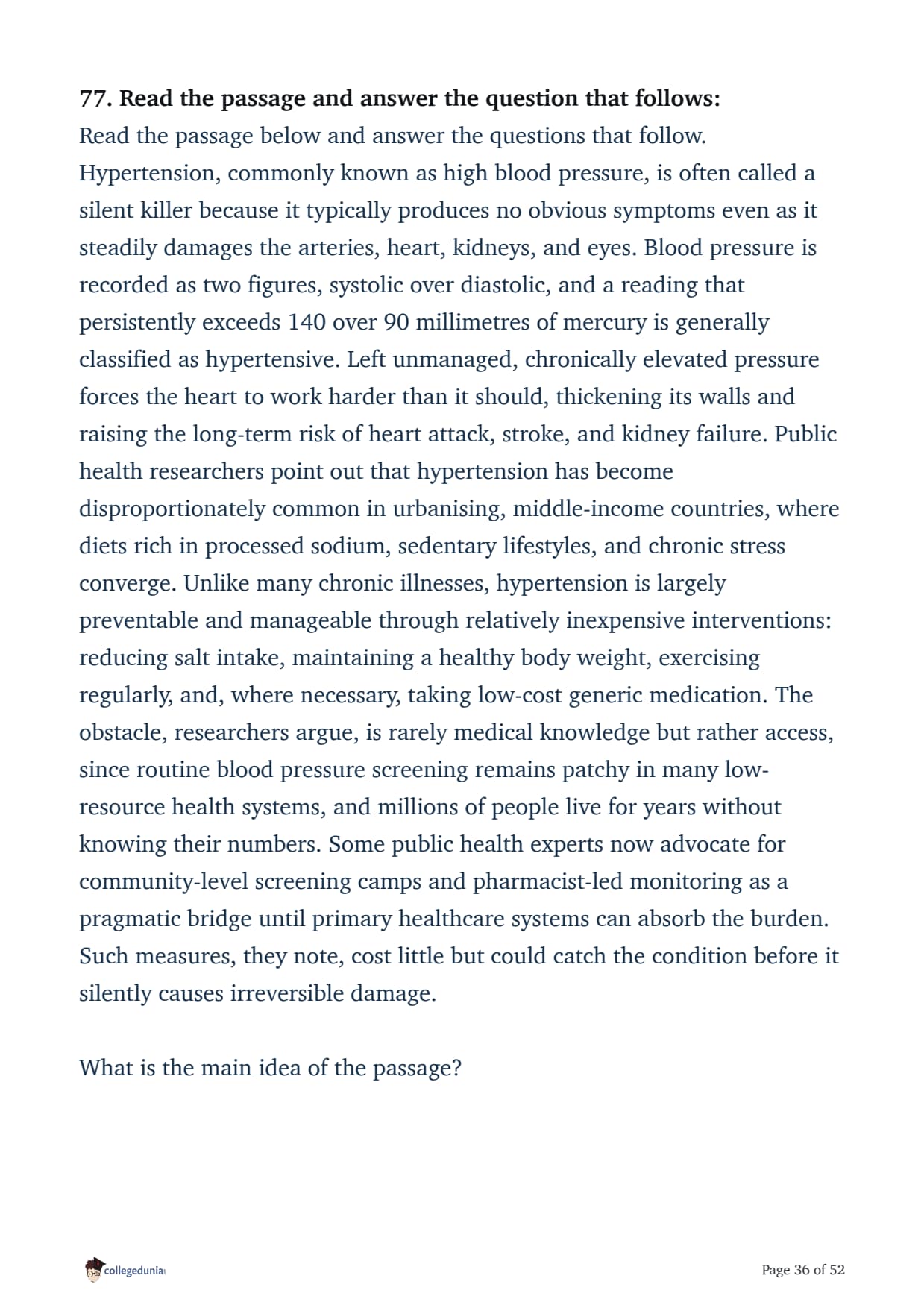
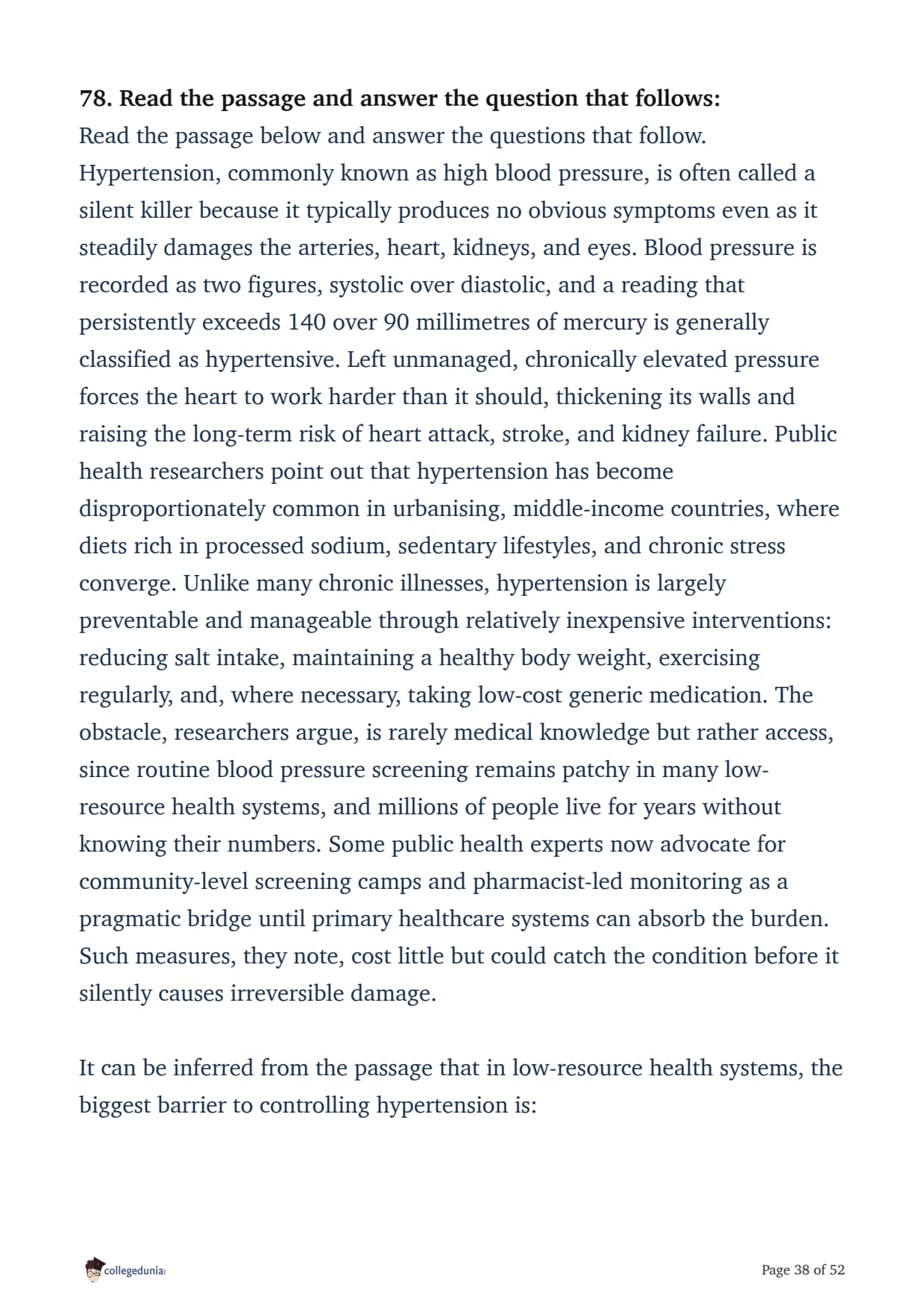
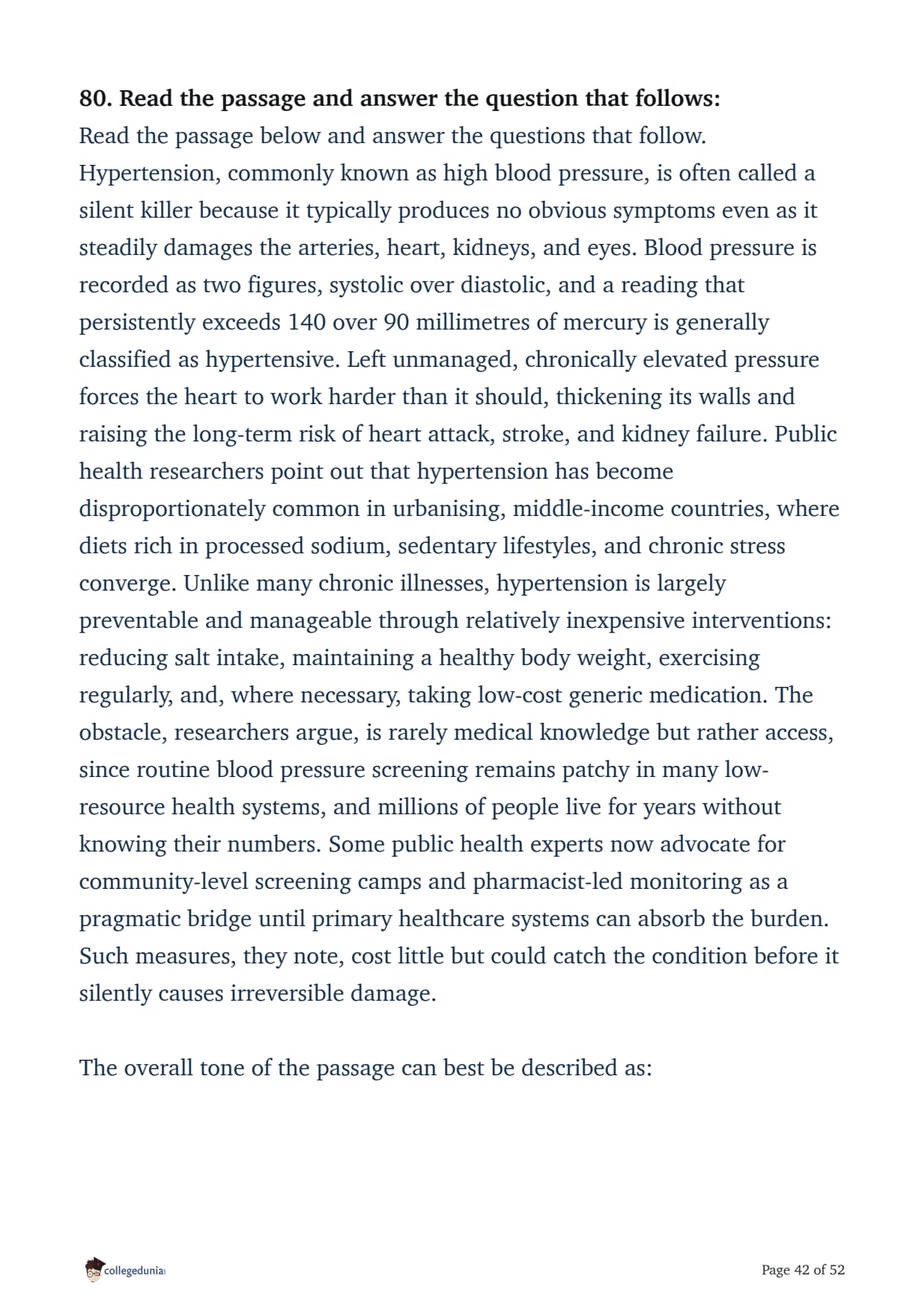
Hypertension, commonly known as high blood pressure, is often called a silent killer because it typically produces no obvious symptoms even as it steadily damages the arteries, heart, kidneys, and eyes. Blood pressure is recorded as two figures, systolic over diastolic, and a reading that persistently exceeds 140 over 90 millimetres of mercury is generally classified as hypertensive. Left unmanaged, chronically elevated pressure forces the heart to work harder than it should, thickening its walls and raising the long-term risk of heart attack, stroke, and kidney failure.
Public health researchers point out that hypertension has become disproportionately common in urbanising, middle-income countries, where diets rich in processed sodium, sedentary lifestyles, and chronic stress converge. Unlike many chronic illnesses, hypertension is largely preventable and manageable through relatively inexpensive interventions: reducing salt intake, maintaining a healthy body weight, exercising regularly, and, where necessary, taking low-cost generic medication. The obstacle, researchers argue, is rarely medical knowledge but rather access, since routine blood pressure screening remains patchy in many low-resource health systems, and millions of people live for years without knowing their numbers.
Some public health experts now advocate for community-level screening camps and pharmacist-led monitoring as a pragmatic bridge until primary healthcare systems can absorb the burden. Such measures, they note, cost little but could catch the condition before it silently causes irreversible damage.
What is the main idea of the passage?
Read the passage and answer the question that follows:
Read the passage below and answer the questions that follow.
Hypertension, commonly known as high blood pressure, is often called a silent killer because it typically produces no obvious symptoms even as it steadily damages the arteries, heart, kidneys, and eyes. Blood pressure is recorded as two figures, systolic over diastolic, and a reading that persistently exceeds 140 over 90 millimetres of mercury is generally classified as hypertensive. Left unmanaged, chronically elevated pressure forces the heart to work harder than it should, thickening its walls and raising the long-term risk of heart attack, stroke, and kidney failure.
Public health researchers point out that hypertension has become disproportionately common in urbanising, middle-income countries, where diets rich in processed sodium, sedentary lifestyles, and chronic stress converge. Unlike many chronic illnesses, hypertension is largely preventable and manageable through relatively inexpensive interventions: reducing salt intake, maintaining a healthy body weight, exercising regularly, and, where necessary, taking low-cost generic medication. The obstacle, researchers argue, is rarely medical knowledge but rather access, since routine blood pressure screening remains patchy in many low-resource health systems, and millions of people live for years without knowing their numbers.
Some public health experts now advocate for community-level screening camps and pharmacist-led monitoring as a pragmatic bridge until primary healthcare systems can absorb the burden. Such measures, they note, cost little but could catch the condition before it silently causes irreversible damage.
It can be inferred from the passage that in low-resource health systems, the biggest barrier to controlling hypertension is:
Read the passage and answer the question that follows:
Read the passage below and answer the questions that follow.
Hypertension, commonly known as high blood pressure, is often called a silent killer because it typically produces no obvious symptoms even as it steadily damages the arteries, heart, kidneys, and eyes. Blood pressure is recorded as two figures, systolic over diastolic, and a reading that persistently exceeds 140 over 90 millimetres of mercury is generally classified as hypertensive. Left unmanaged, chronically elevated pressure forces the heart to work harder than it should, thickening its walls and raising the long-term risk of heart attack, stroke, and kidney failure.
Public health researchers point out that hypertension has become disproportionately common in urbanising, middle-income countries, where diets rich in processed sodium, sedentary lifestyles, and chronic stress converge. Unlike many chronic illnesses, hypertension is largely preventable and manageable through relatively inexpensive interventions: reducing salt intake, maintaining a healthy body weight, exercising regularly, and, where necessary, taking low-cost generic medication. The obstacle, researchers argue, is rarely medical knowledge but rather access, since routine blood pressure screening remains patchy in many low-resource health systems, and millions of people live for years without knowing their numbers.
Some public health experts now advocate for community-level screening camps and pharmacist-led monitoring as a pragmatic bridge until primary healthcare systems can absorb the burden. Such measures, they note, cost little but could catch the condition before it silently causes irreversible damage.
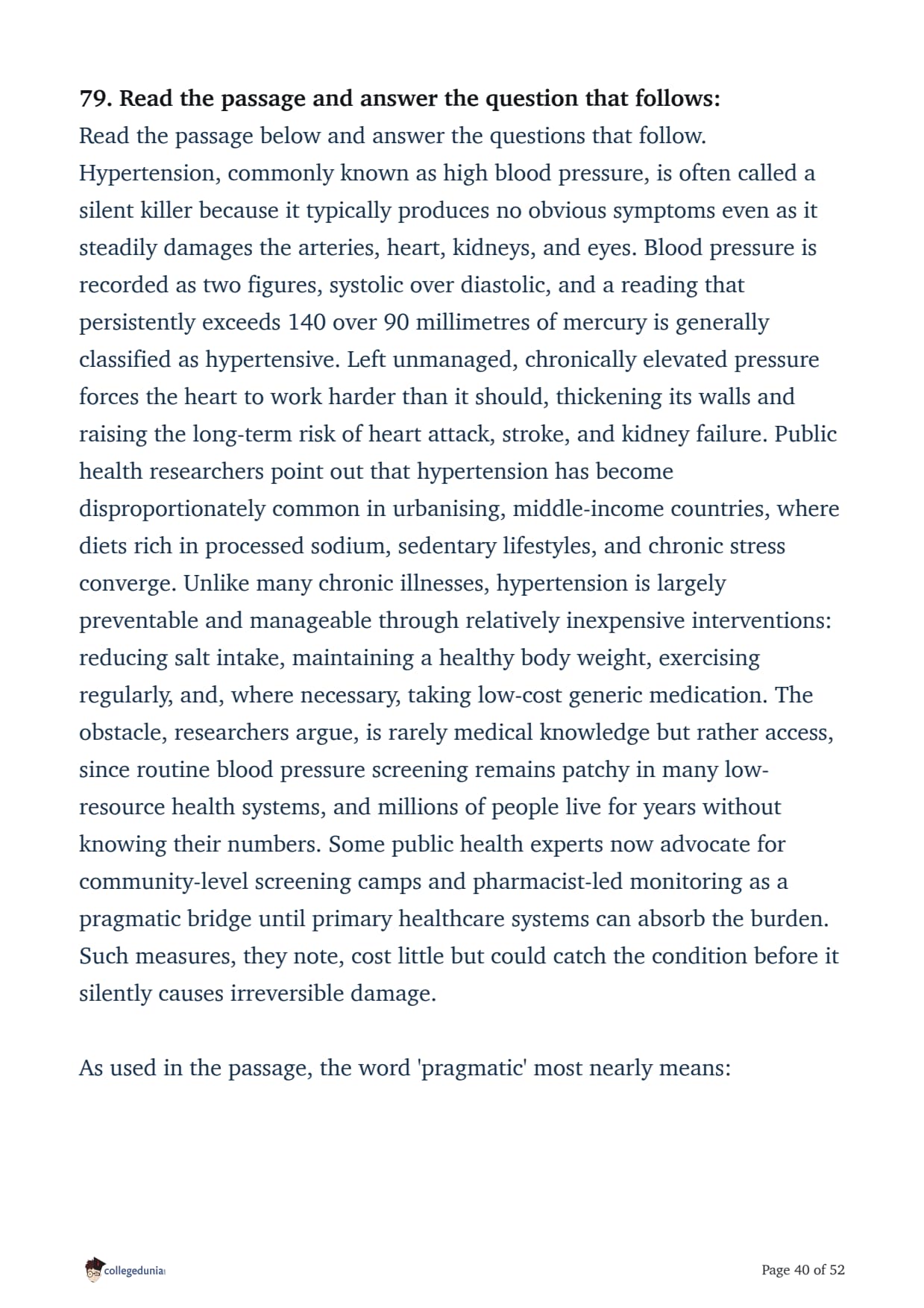
As used in the passage, the word 'pragmatic' most nearly means:
Read the passage and answer the question that follows:
Read the passage below and answer the questions that follow.
Hypertension, commonly known as high blood pressure, is often called a silent killer because it typically produces no obvious symptoms even as it steadily damages the arteries, heart, kidneys, and eyes. Blood pressure is recorded as two figures, systolic over diastolic, and a reading that persistently exceeds 140 over 90 millimetres of mercury is generally classified as hypertensive. Left unmanaged, chronically elevated pressure forces the heart to work harder than it should, thickening its walls and raising the long-term risk of heart attack, stroke, and kidney failure.
Public health researchers point out that hypertension has become disproportionately common in urbanising, middle-income countries, where diets rich in processed sodium, sedentary lifestyles, and chronic stress converge. Unlike many chronic illnesses, hypertension is largely preventable and manageable through relatively inexpensive interventions: reducing salt intake, maintaining a healthy body weight, exercising regularly, and, where necessary, taking low-cost generic medication. The obstacle, researchers argue, is rarely medical knowledge but rather access, since routine blood pressure screening remains patchy in many low-resource health systems, and millions of people live for years without knowing their numbers.
Some public health experts now advocate for community-level screening camps and pharmacist-led monitoring as a pragmatic bridge until primary healthcare systems can absorb the burden. Such measures, they note, cost little but could catch the condition before it silently causes irreversible damage.
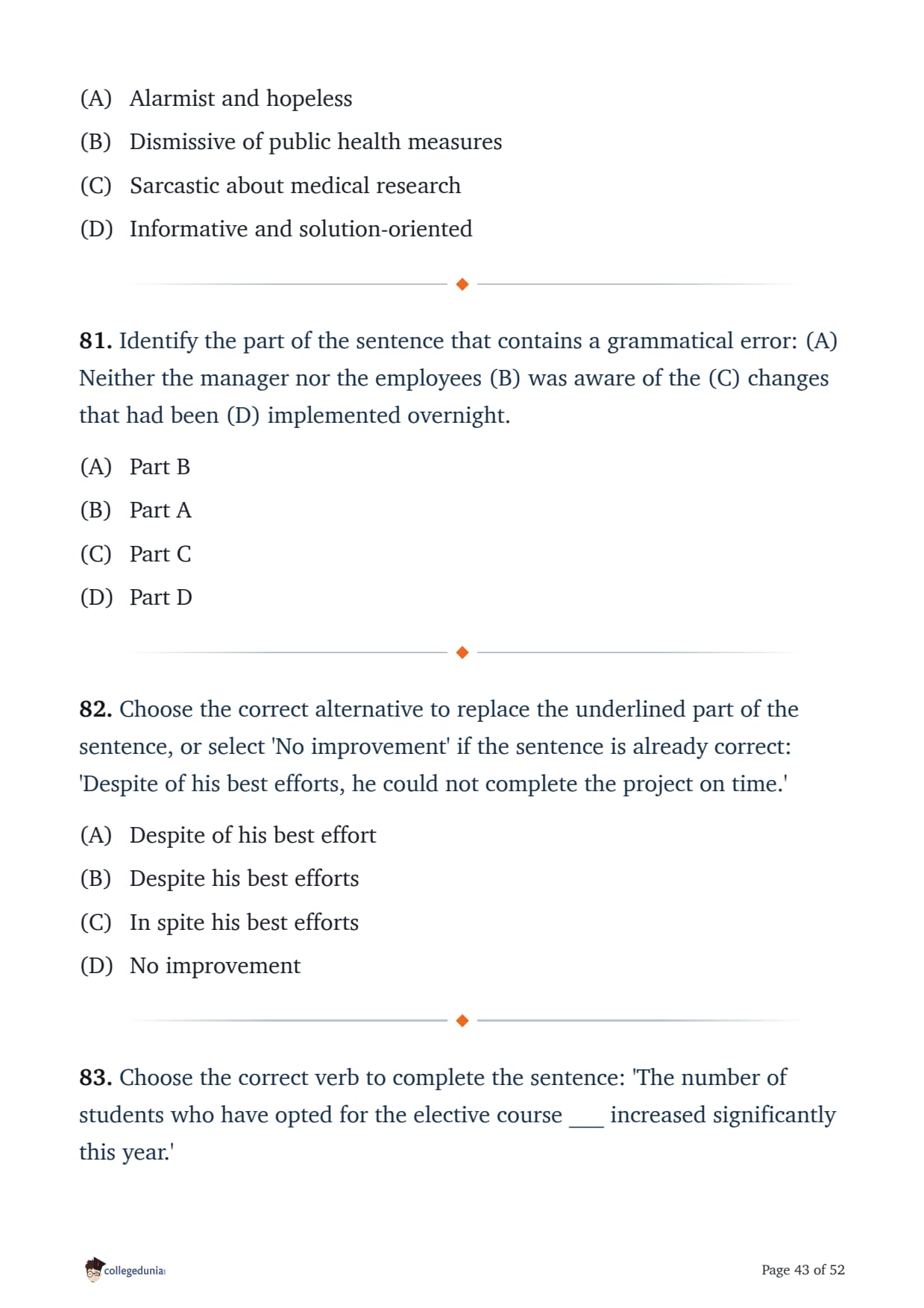
The overall tone of the passage can best be described as:
Identify the part of the sentence that contains a grammatical error: (A) Neither the manager nor the employees (B) was aware of the (C) changes that had been (D) implemented overnight.
Choose the correct alternative to replace the underlined part of the sentence, or select 'No improvement' if the sentence is already correct: 'Despite of his best efforts, he could not complete the project on time.'
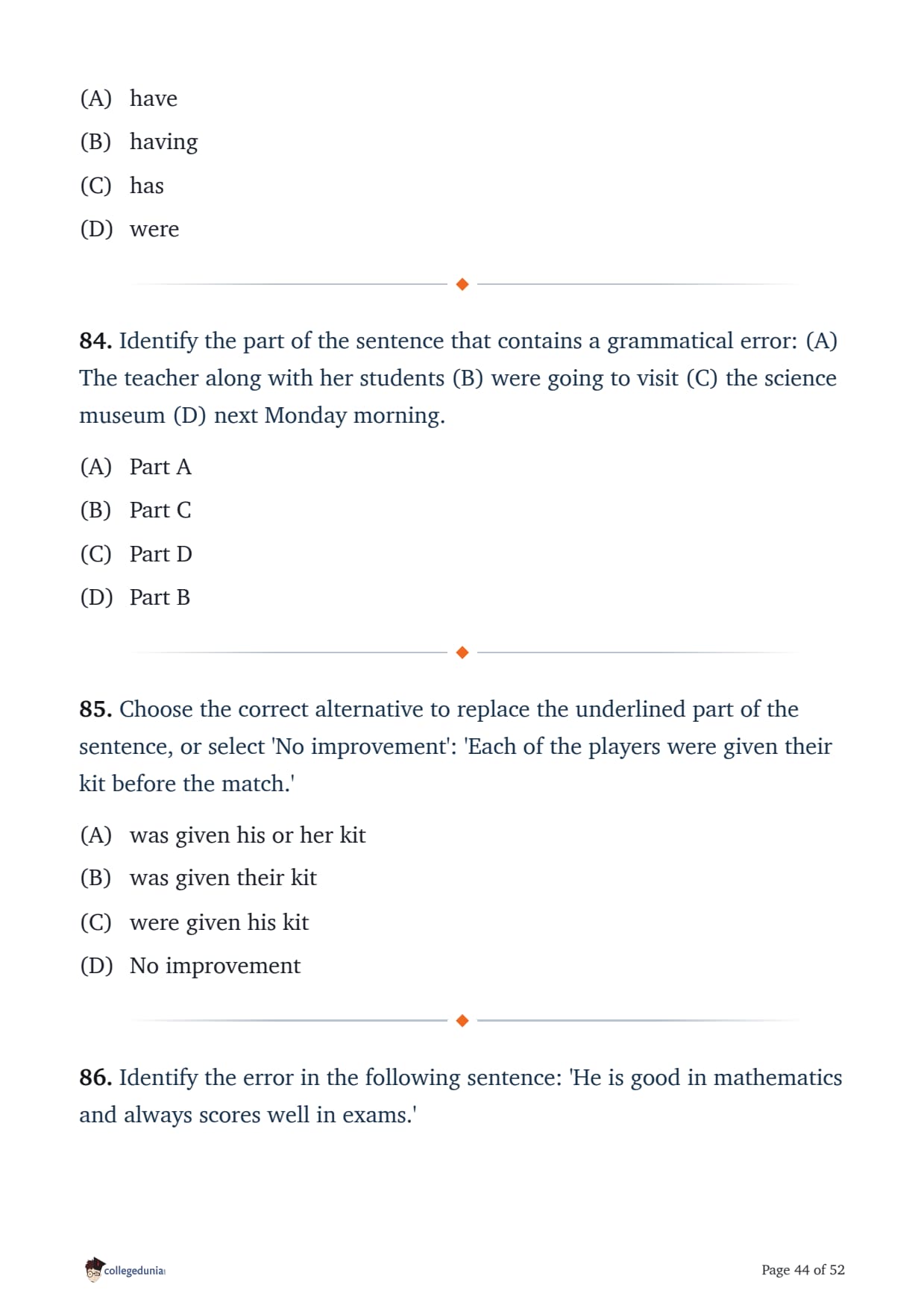
Choose the correct verb to complete the sentence: 'The number of students who have opted for the elective course ___ increased significantly this year.'
Identify the part of the sentence that contains a grammatical error: (A) The teacher along with her students (B) were going to visit (C) the science museum (D) next Monday morning.
Choose the correct alternative to replace the underlined part of the sentence, or select 'No improvement': 'Each of the players were given their kit before the match.'
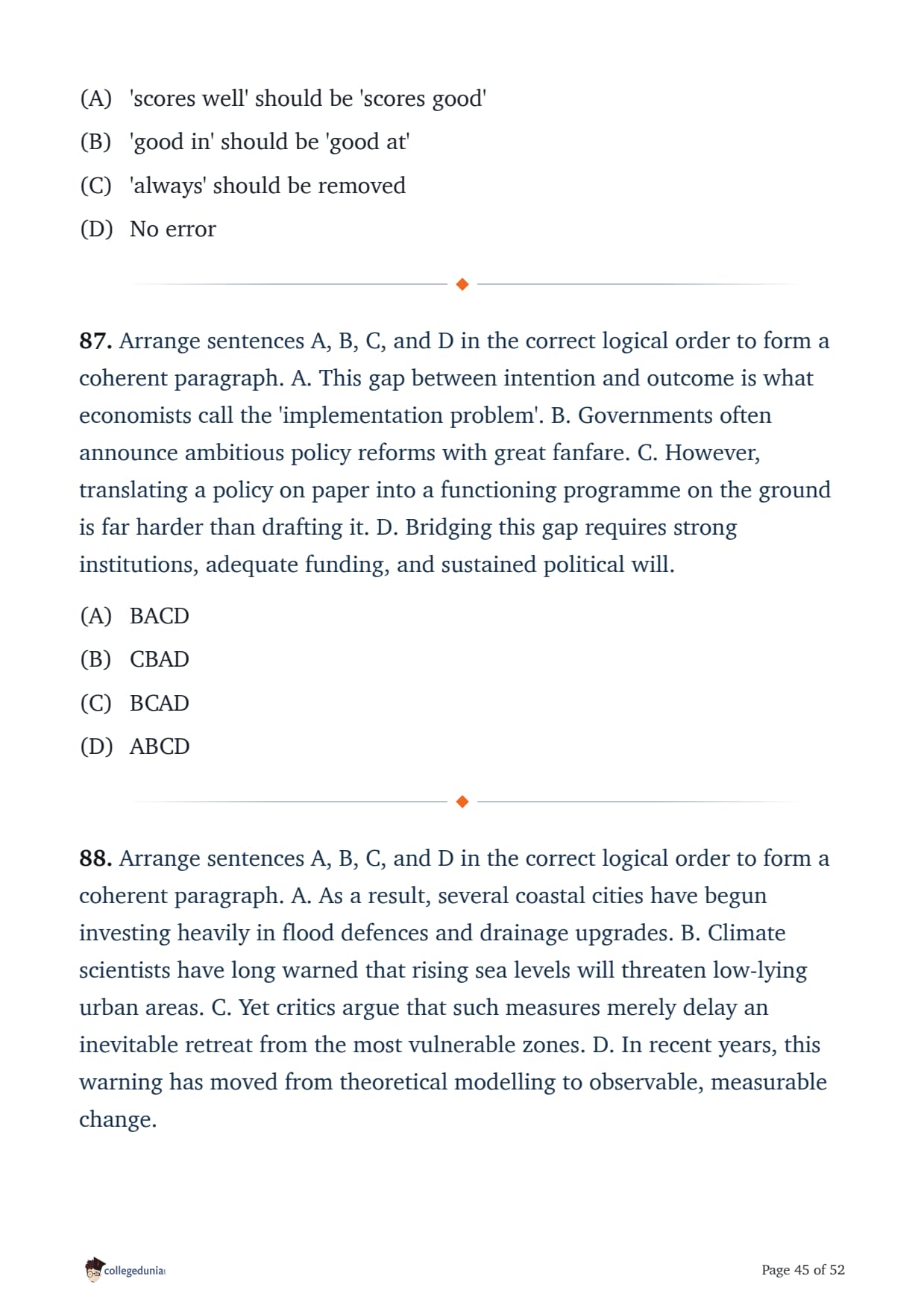
Identify the error in the following sentence: 'He is good in mathematics and always scores well in exams.'
Arrange sentences A, B, C, and D in the correct logical order to form a coherent paragraph. A. This gap between intention and outcome is what economists call the 'implementation problem'. B. Governments often announce ambitious policy reforms with great fanfare. C. However, translating a policy on paper into a functioning programme on the ground is far harder than drafting it. D. Bridging this gap requires strong institutions, adequate funding, and sustained political will.
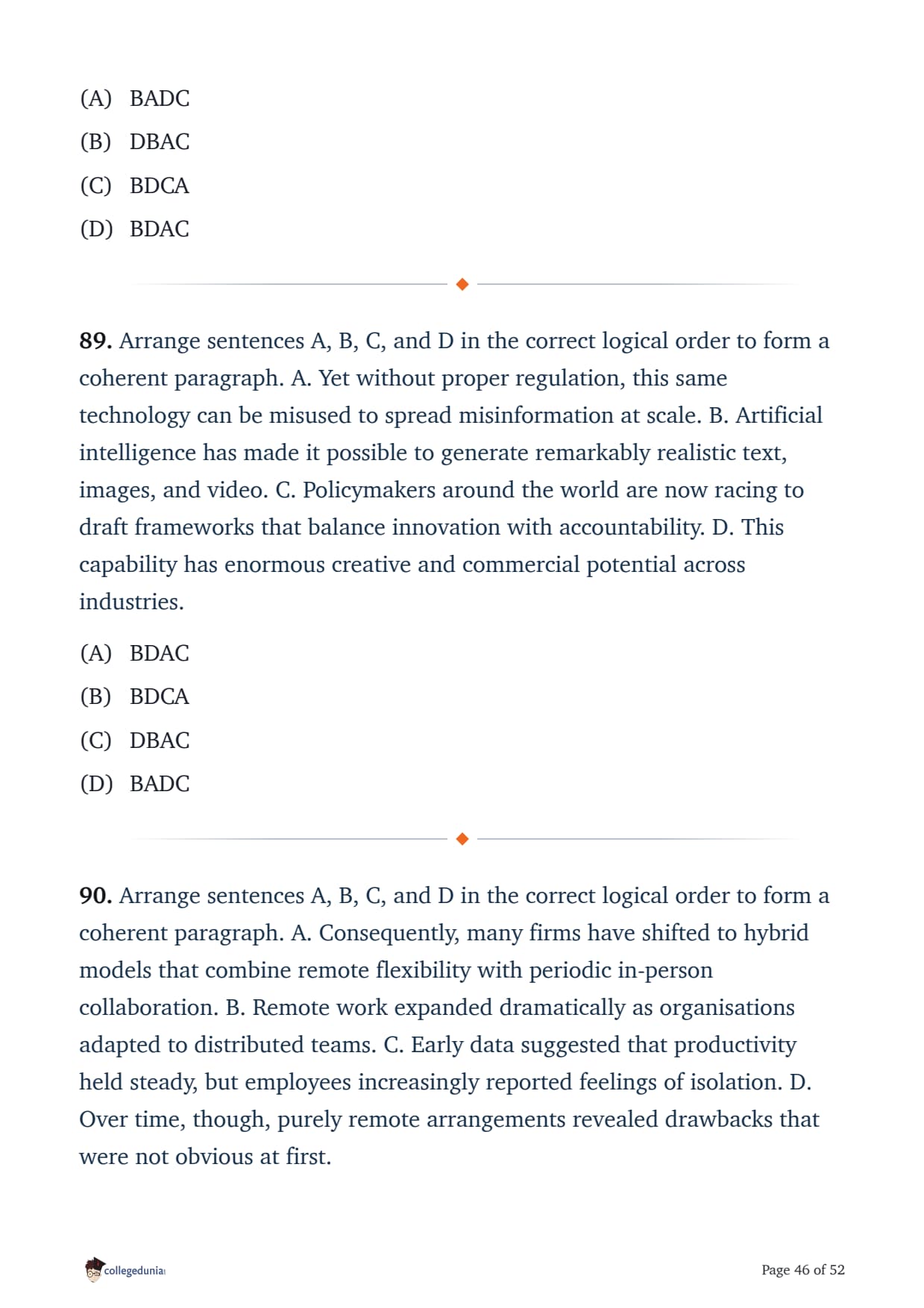
Arrange sentences A, B, C, and D in the correct logical order to form a coherent paragraph. A. As a result, several coastal cities have begun investing heavily in flood defences and drainage upgrades. B. Climate scientists have long warned that rising sea levels will threaten low-lying urban areas. C. Yet critics argue that such measures merely delay an inevitable retreat from the most vulnerable zones. D. In recent years, this warning has moved from theoretical modelling to observable, measurable change.
Arrange sentences A, B, C, and D in the correct logical order to form a coherent paragraph. A. Yet without proper regulation, this same technology can be misused to spread misinformation at scale. B. Artificial intelligence has made it possible to generate remarkably realistic text, images, and video. C. Policymakers around the world are now racing to draft frameworks that balance innovation with accountability. D. This capability has enormous creative and commercial potential across industries.
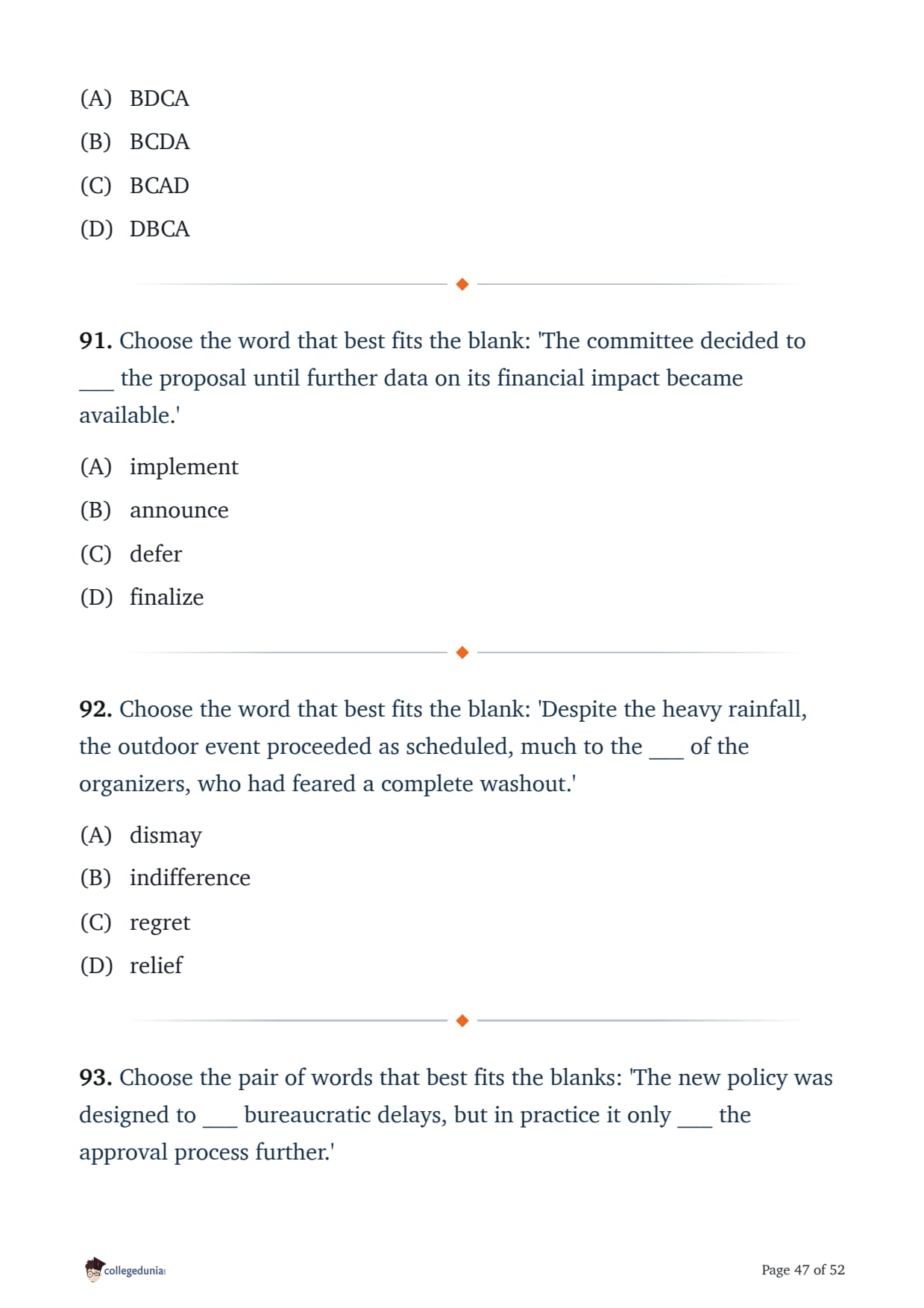
Arrange sentences A, B, C, and D in the correct logical order to form a coherent paragraph. A. Consequently, many firms have shifted to hybrid models that combine remote flexibility with periodic in-person collaboration. B. Remote work expanded dramatically as organisations adapted to distributed teams. C. Early data suggested that productivity held steady, but employees increasingly reported feelings of isolation. D. Over time, though, purely remote arrangements revealed drawbacks that were not obvious at first.
Choose the word that best fits the blank: 'The committee decided to ___ the proposal until further data on its financial impact became available.'
Choose the word that best fits the blank: 'Despite the heavy rainfall, the outdoor event proceeded as scheduled, much to the ___ of the organizers, who had feared a complete washout.'
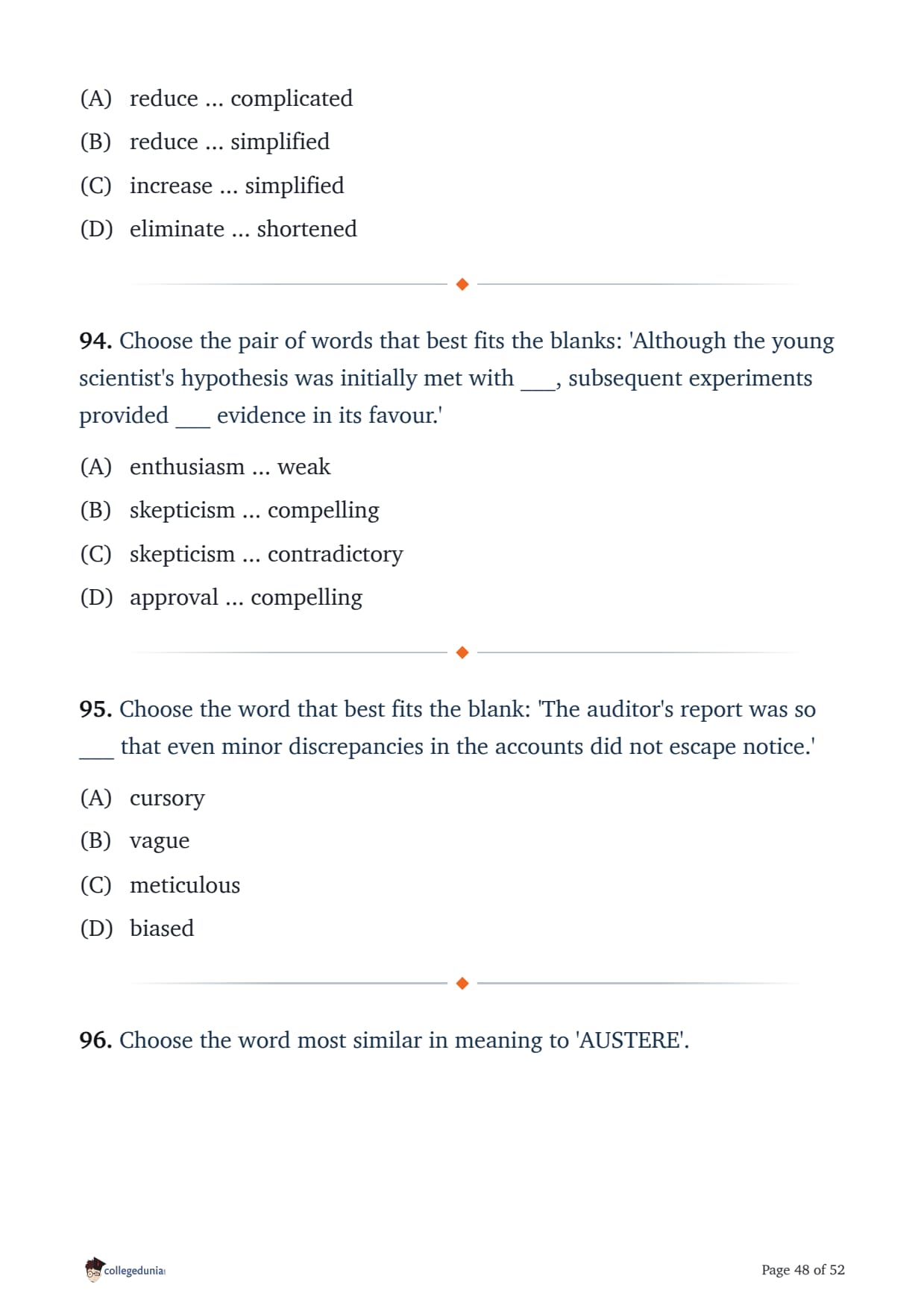
Choose the pair of words that best fits the blanks: 'The new policy was designed to ___ bureaucratic delays, but in practice it only ___ the approval process further.'
Choose the pair of words that best fits the blanks: 'Although the young scientist's hypothesis was initially met with ___, subsequent experiments provided ___ evidence in its favour.'
Choose the word that best fits the blank: 'The auditor's report was so ___ that even minor discrepancies in the accounts did not escape notice.'
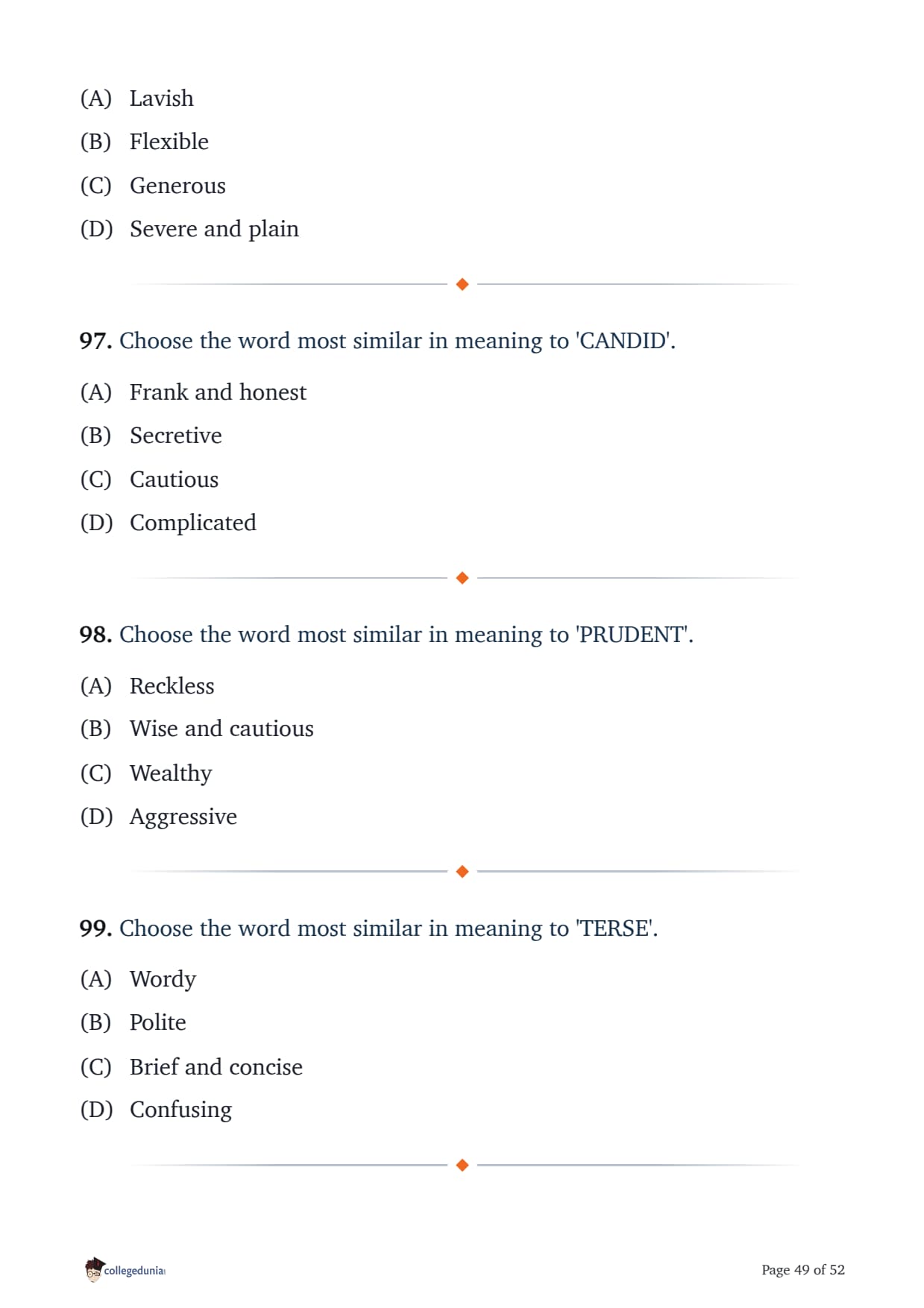
Choose the word most similar in meaning to 'AUSTERE'.
Choose the word most similar in meaning to 'CANDID'.
Choose the word most similar in meaning to 'PRUDENT'.
Choose the word most similar in meaning to 'TERSE'.
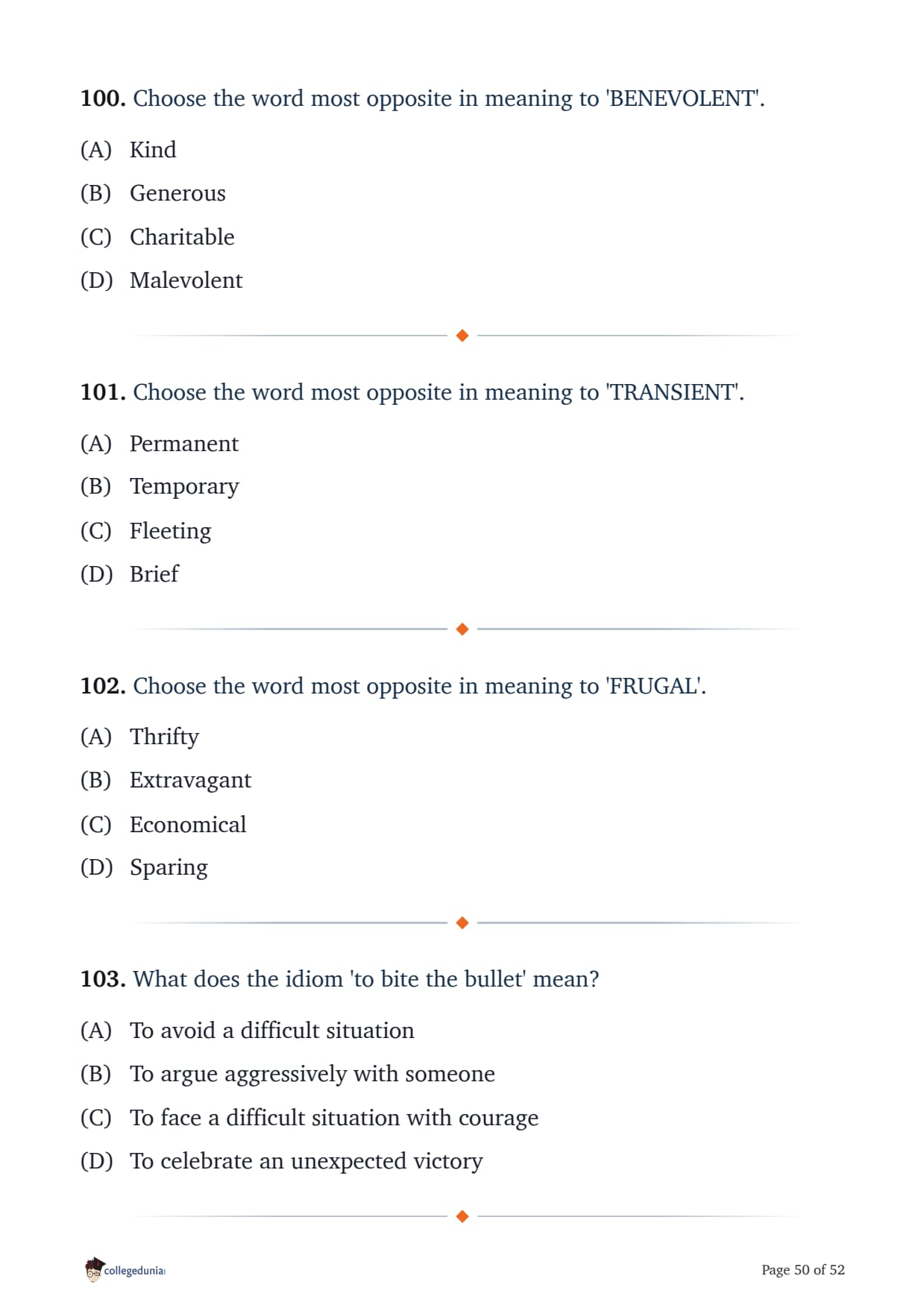
Choose the word most opposite in meaning to 'BENEVOLENT'.
Choose the word most opposite in meaning to 'TRANSIENT'.
Choose the word most opposite in meaning to 'FRUGAL'.
What does the idiom 'to bite the bullet' mean?
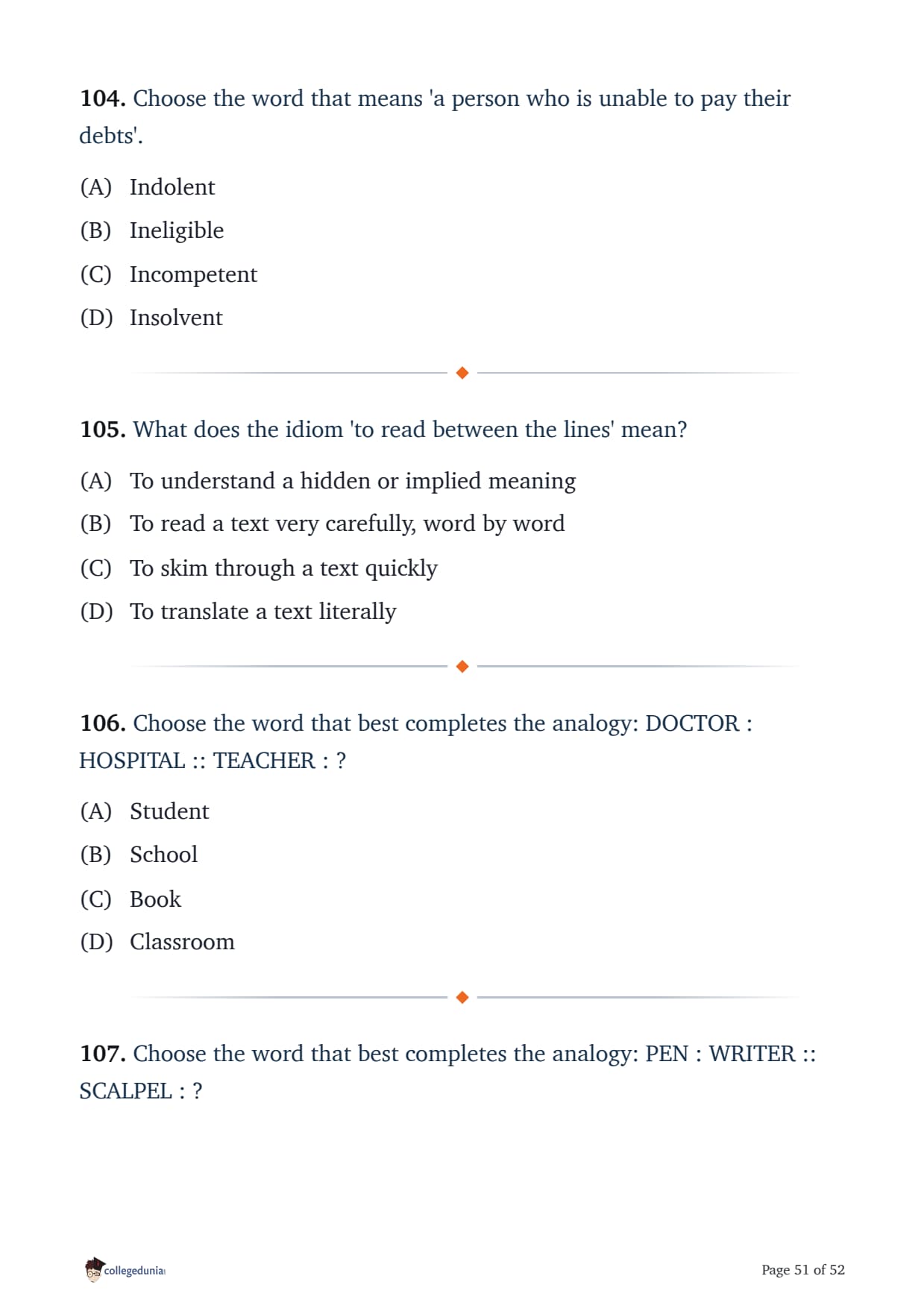
Choose the word that means 'a person who is unable to pay their debts'.
What does the idiom 'to read between the lines' mean?
Choose the word that best completes the analogy: DOCTOR : HOSPITAL :: TEACHER : ?
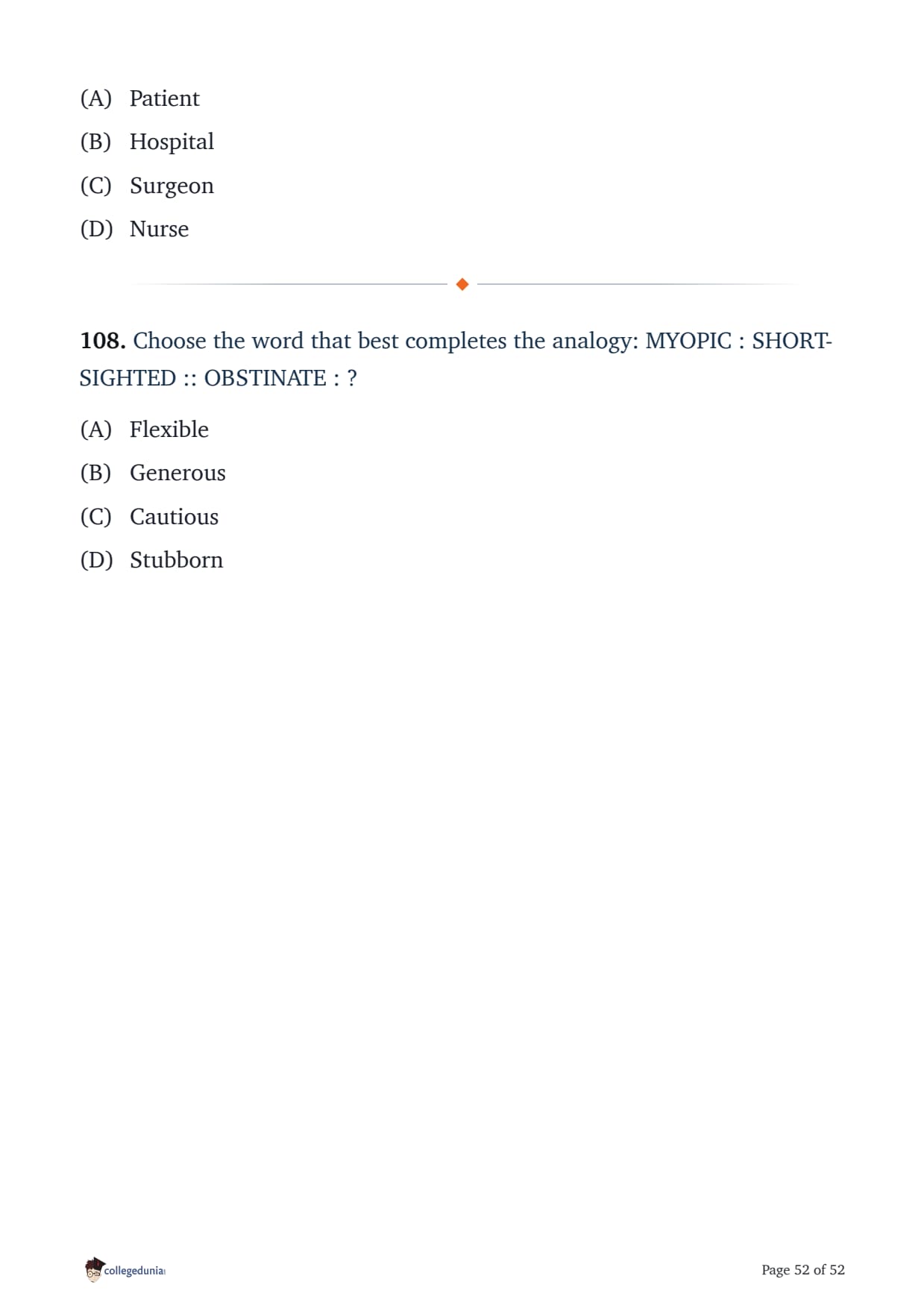
Choose the word that best completes the analogy: PEN : WRITER :: SCALPEL : ?
Choose the word that best completes the analogy: MYOPIC : SHORT-SIGHTED :: OBSTINATE : ?
NMAT 2023 Exam Pattern and Marking Scheme Explained
NMAT 2023 was a computer-based test of single-best-answer MCQs, with each of the three sections individually timed and no going back once a section was closed.
- Total questions: 108 MCQs, 36 in each of the three sections
- Sections: Language Skills (36), Quantitative Skills (36), Logical Reasoning (36)
- Duration: 120 minutes, with sectional limits of 28, 52, and 40 minutes
- Total marks: 324, with 3 marks for every correct answer
- Marking scheme: +3 for a correct answer, no negative marking for wrong or unattempted questions
High-Weightage Topics in NMAT 2023 Quantitative and Logical Reasoning
Quantitative Skills was the section students found toughest in NMAT 2023, mostly because of how many arithmetic and data-heavy questions it packed in.
- Quantitative Skills: arithmetic led with about 11 of the 24 pure maths questions, plus 8 Data Interpretation and 4 Data Sufficiency questions
- Modern Maths: permutation, combination, and probability alone made up roughly 8 questions in Quantitative Skills
- Logical Reasoning: Verbal Reasoning crossed half the section at 18+ of the 36 questions, with Analytical Reasoning's 16 questions ranging easy to moderate
- Language Skills: two Reading Comprehension passages carried 4 questions each, alongside grammar, vocabulary, and para-jumbles
NMAT 2023 Question Paper Analysis Video
Source: MBA Karo
How to Use the NMAT 2023 Question Paper for Practice
Treat this paper as a timed mock first, then go back and review every question with its detailed solution.
- Attempt all 108 questions in 120 minutes under exam-like conditions before checking answers
- Since there is no negative marking, attempt every question and never leave one blank
- Review each solution using the Detailed Solution link on every question below
- Redo Quantitative Skills first since it was the most time-consuming section in NMAT 2023
NMAT Good Attempts and 99 Percentile Score Benchmark
- Around 70-80 of the 108 questions were solvable in 120 minutes with a steady approach across sections
- A score of 230-240 generally lands the 99th percentile, and 235+ is the benchmark students target for NMIMS Mumbai
- Use these as your weekly targets when you redo this paper section by section
NMAT 2023 Question Paper FAQs
Ques. How many questions are there in the NMAT 2023 question paper?
Ans. The NMAT 2023 paper had 108 questions in total, split equally into three sections of 36 each - Language Skills, Quantitative Skills, and Logical Reasoning - to be solved in 120 minutes.
Ques. Which was the toughest section in NMAT 2023?
Ans. Quantitative Skills was rated the toughest of the three sections in NMAT 2023. It was not extremely hard, but the mix of Data Interpretation, Data Sufficiency, and arithmetic-heavy questions made it the most time-consuming.
Ques. How many questions should I attempt for a 99 percentile in NMAT 2023?
Ans. Since there is no negative marking, most 99 percentile scorers attempted close to all 108 questions with good accuracy. A total score of 230-240 was enough to cross the 99th percentile.
Ques. Which topics had the highest weightage in NMAT 2023 Quantitative Skills?
Ans. Arithmetic dominated with about 11 of the 24 pure maths questions, followed by Modern Maths topics like permutation, combination, and probability at roughly 8 questions, alongside 8 Data Interpretation and 4 Data Sufficiency questions.
Ques. Does GMAC release the official NMAT 2023 question paper?
Ans. No, GMAC does not release the official NMAT question paper or answer key. The questions here are memory-based, reconstructed to match the actual exam pattern, topics, and difficulty for practice.
Ques. Where can I download the NMAT 2023 question paper with solutions PDF for free?
Ans. You can download the NMAT 2023 question paper and solutions as free PDFs from the download table at the top of this page, and practise all 108 questions with detailed solutions below.



Comments