




The NCERT Solutions for Class 9 Science Chapter 4 Describing Motion Around Us solve all 16 questions from the Revise, Reflect, Refine exercise of the 2026-27 Exploration textbook. Every answer shows the full working, from distance and displacement to the three equations of motion and velocity-time graphs. Use them to build a strong base for school exams and for later CBSE, JEE, and NEET preparation.
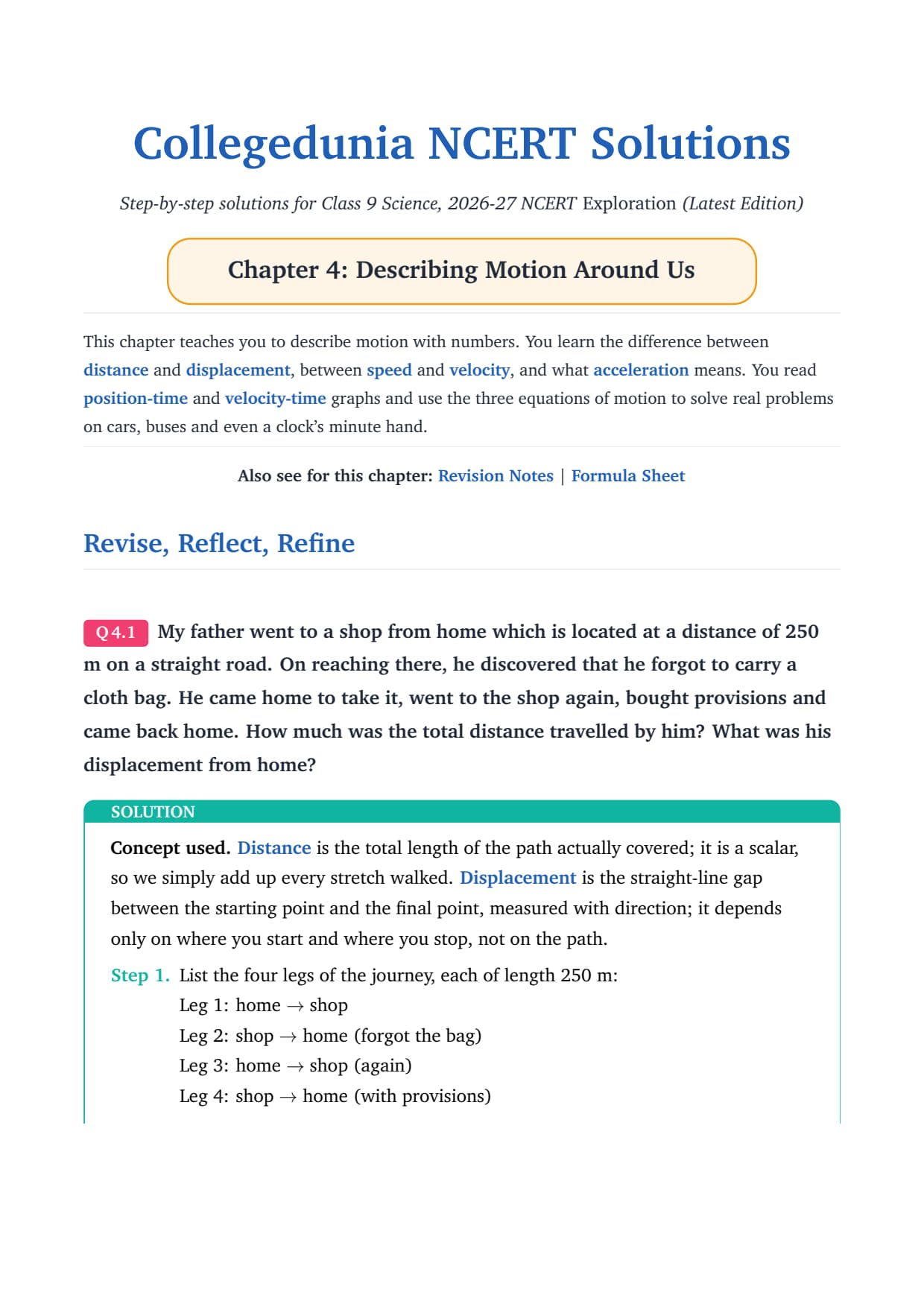
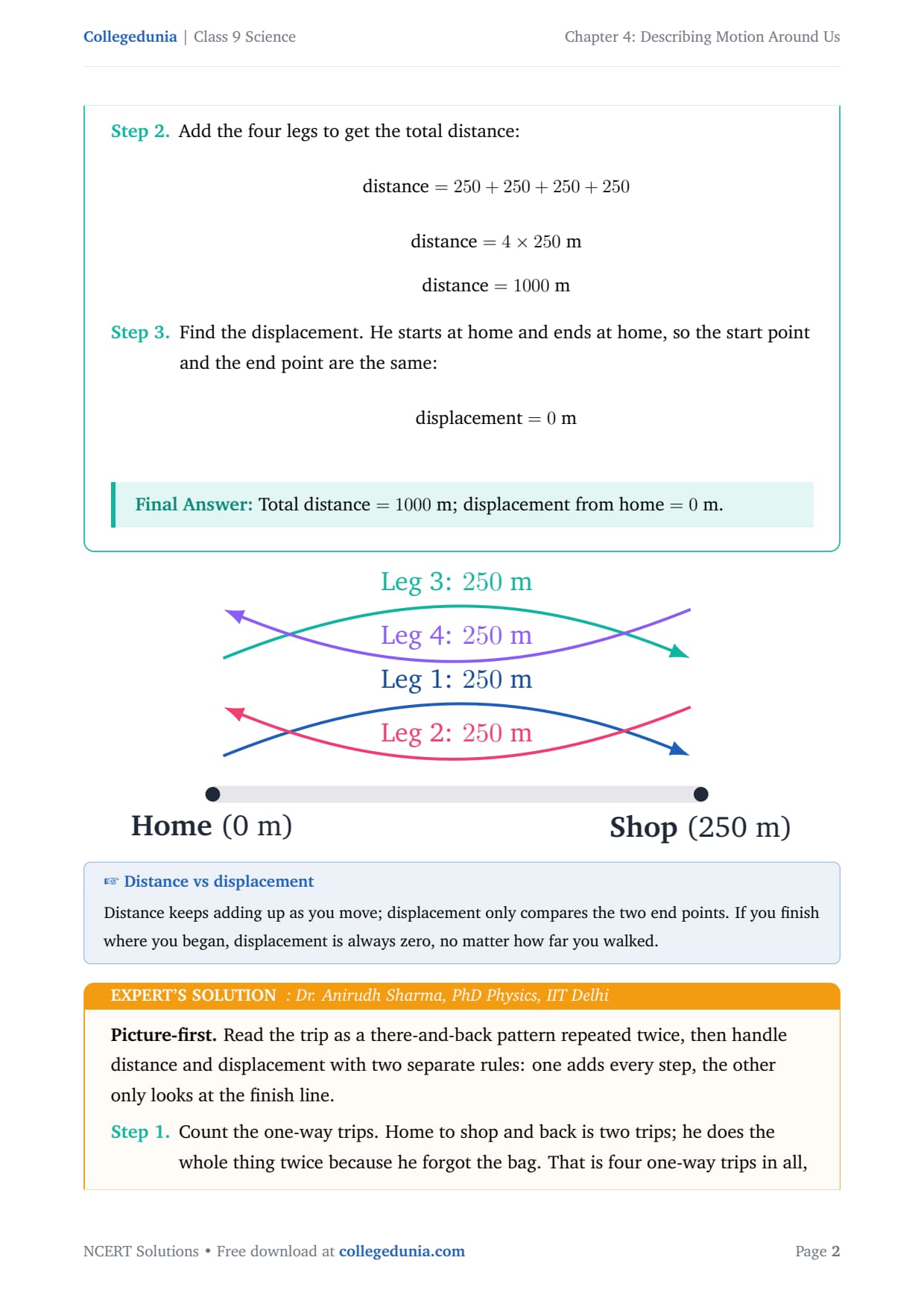
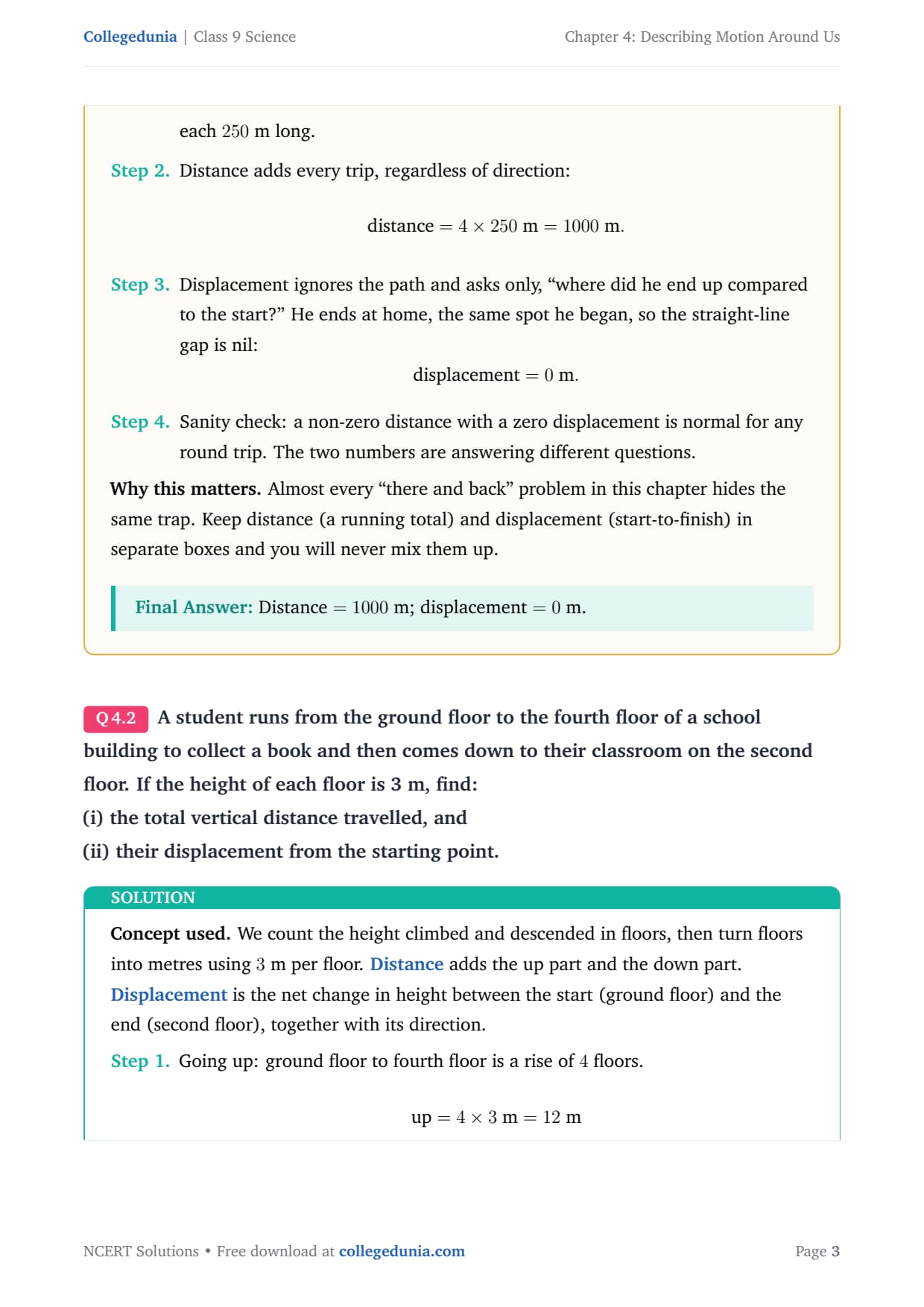
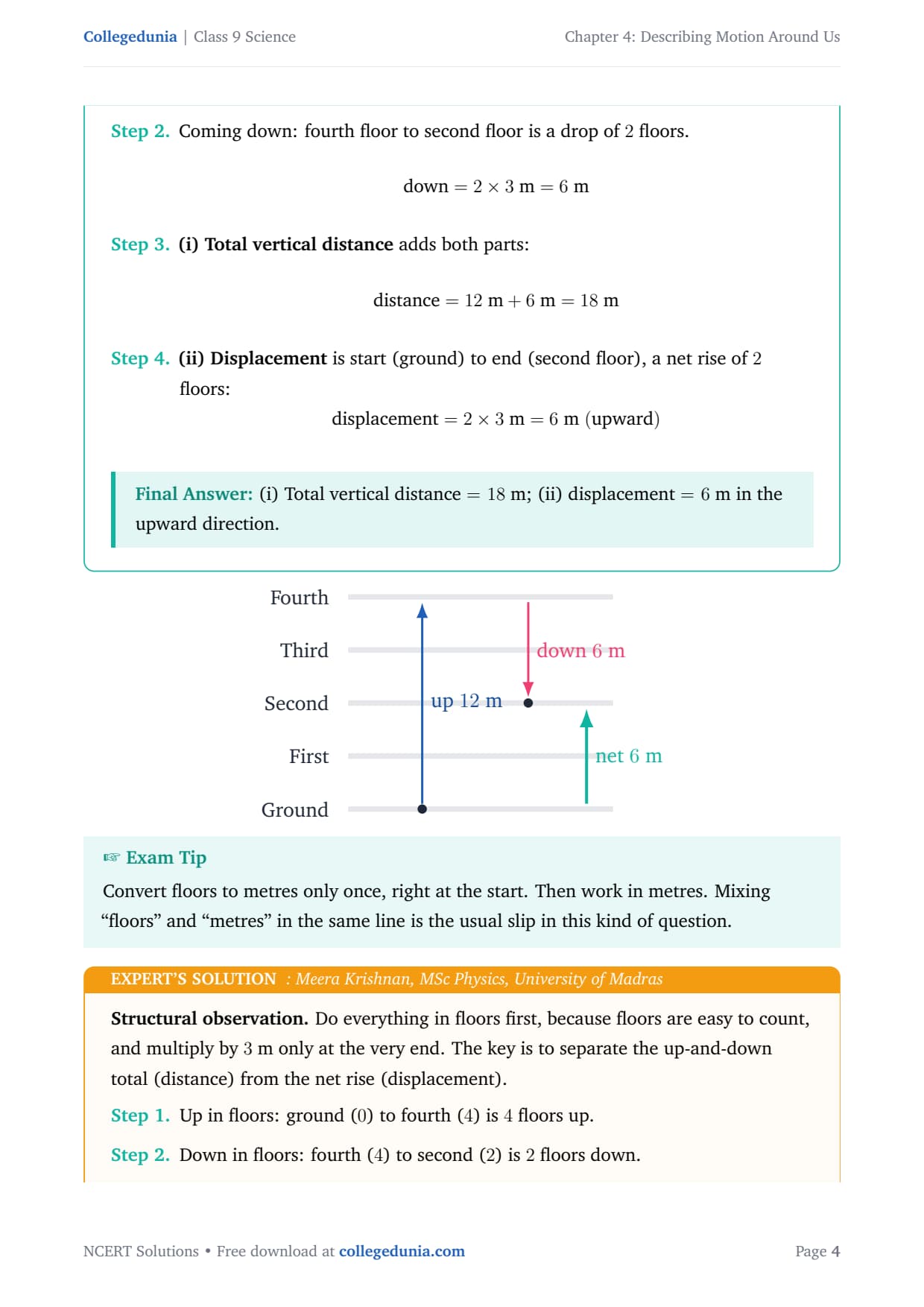
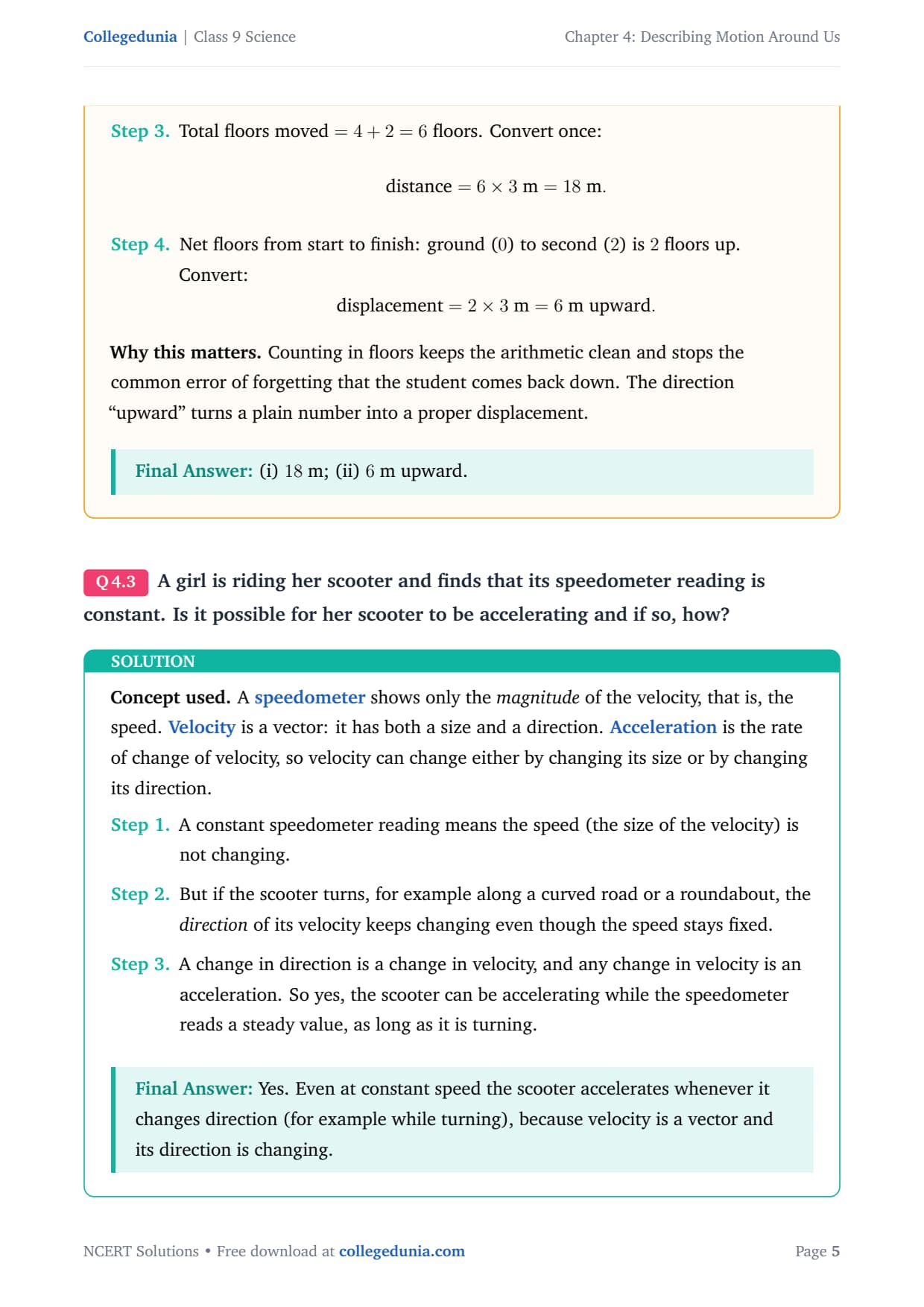
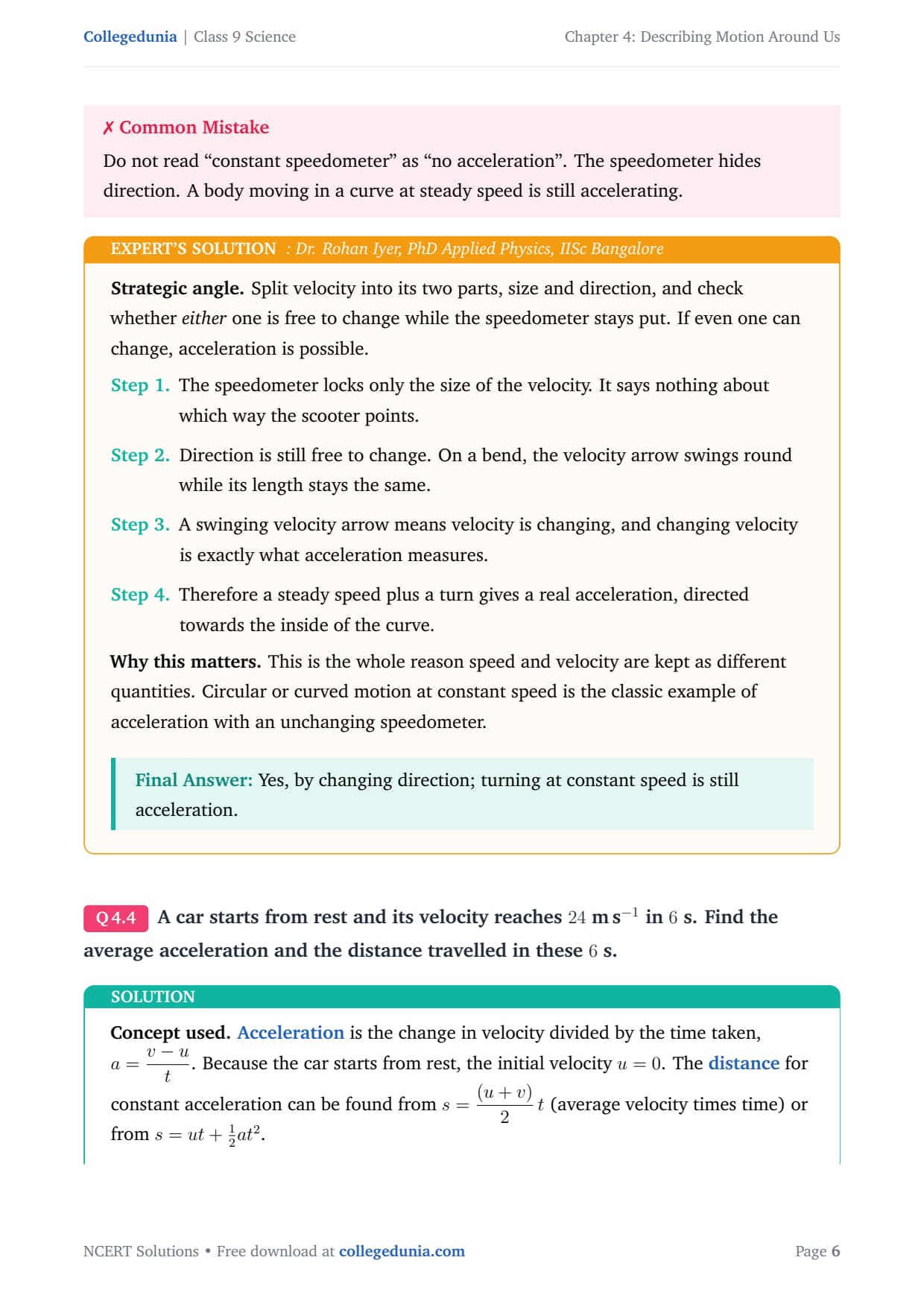
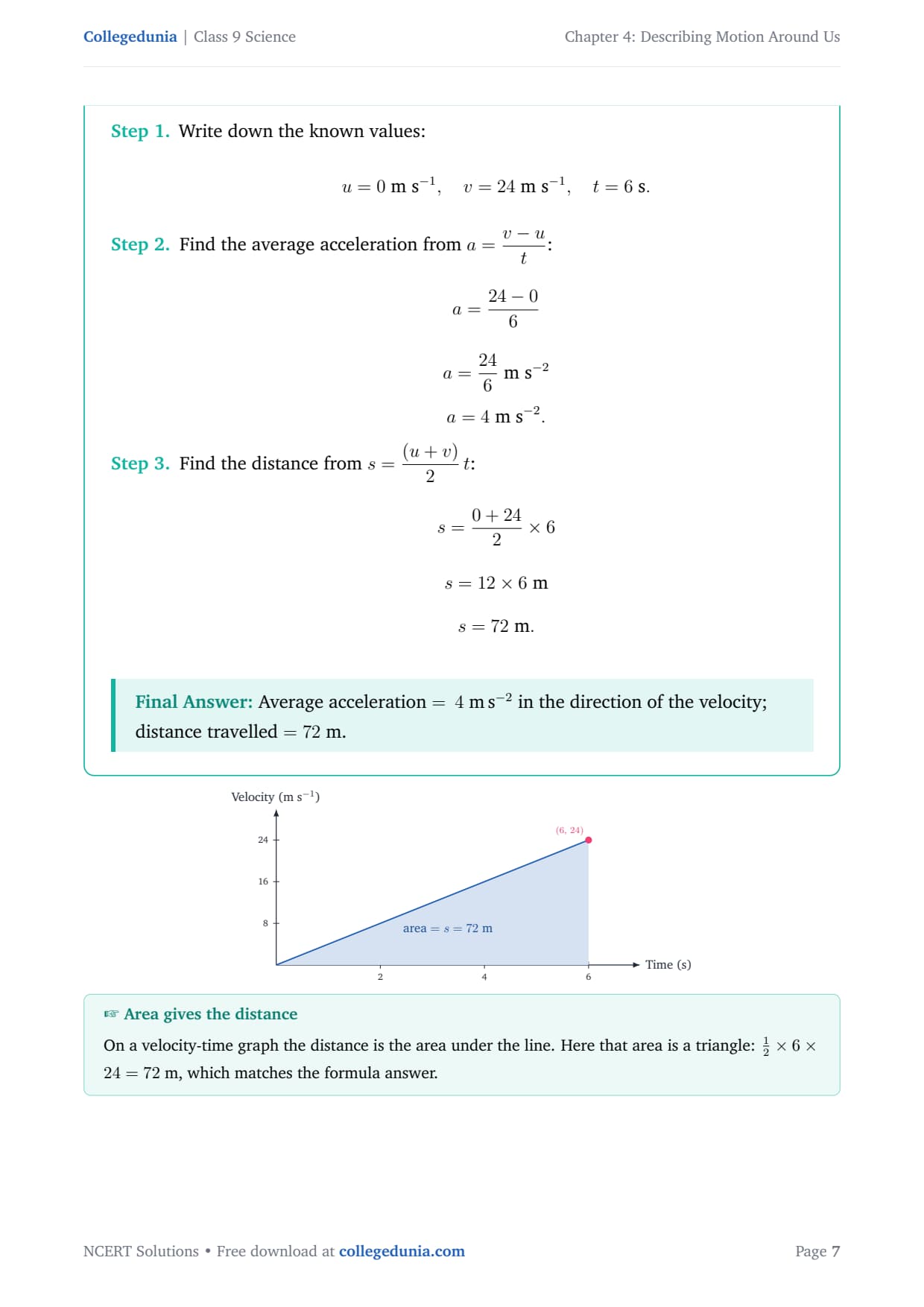
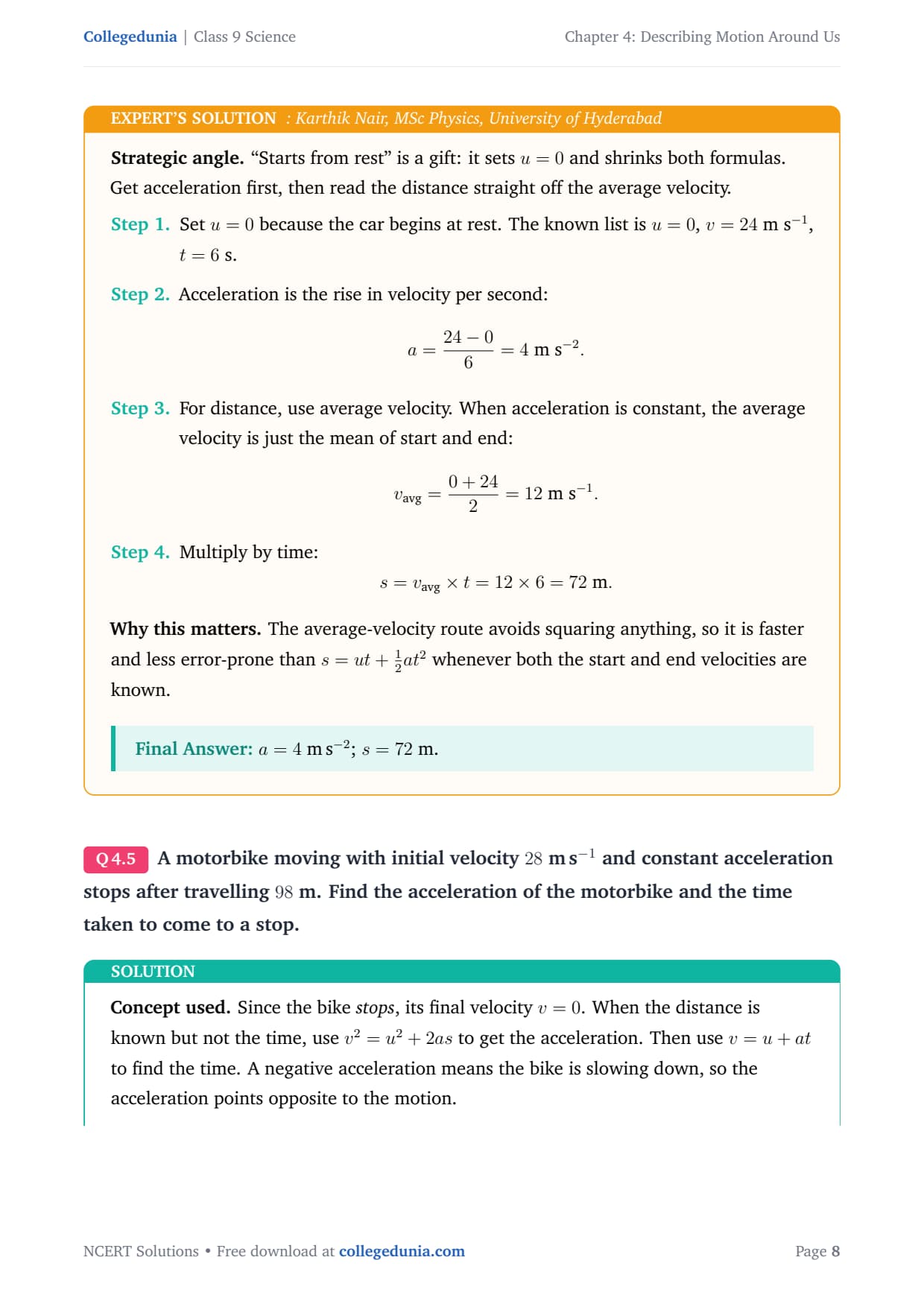
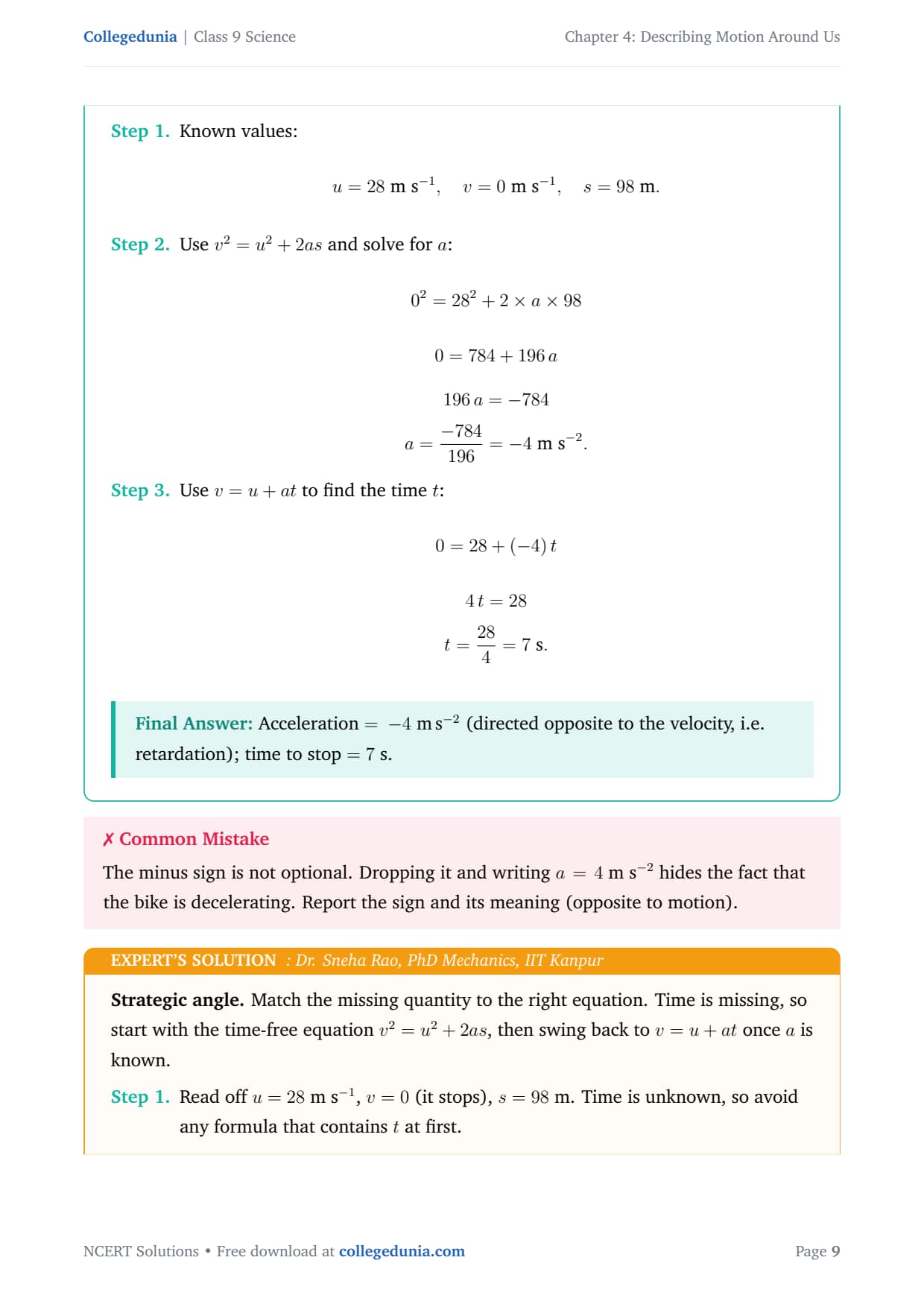
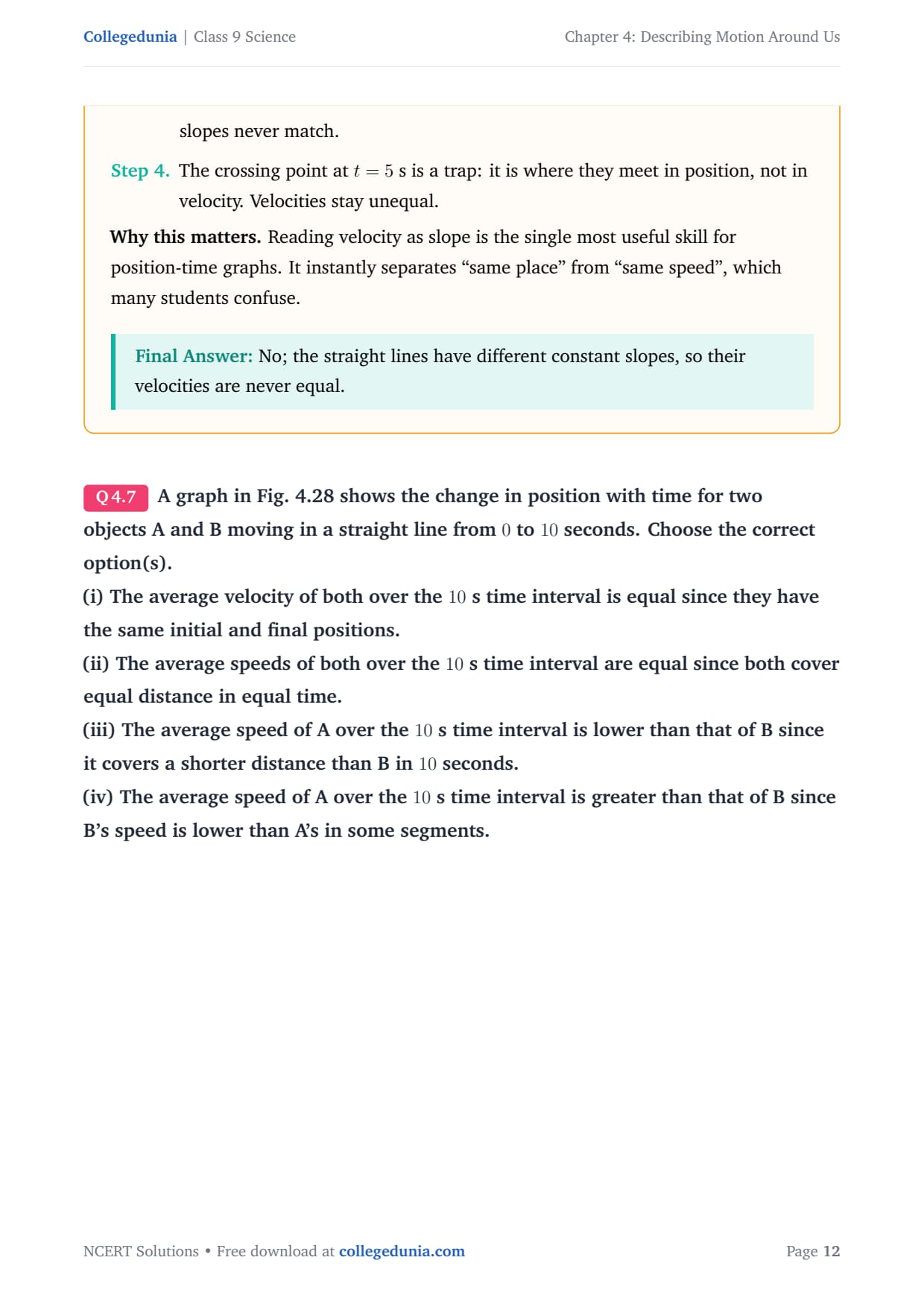
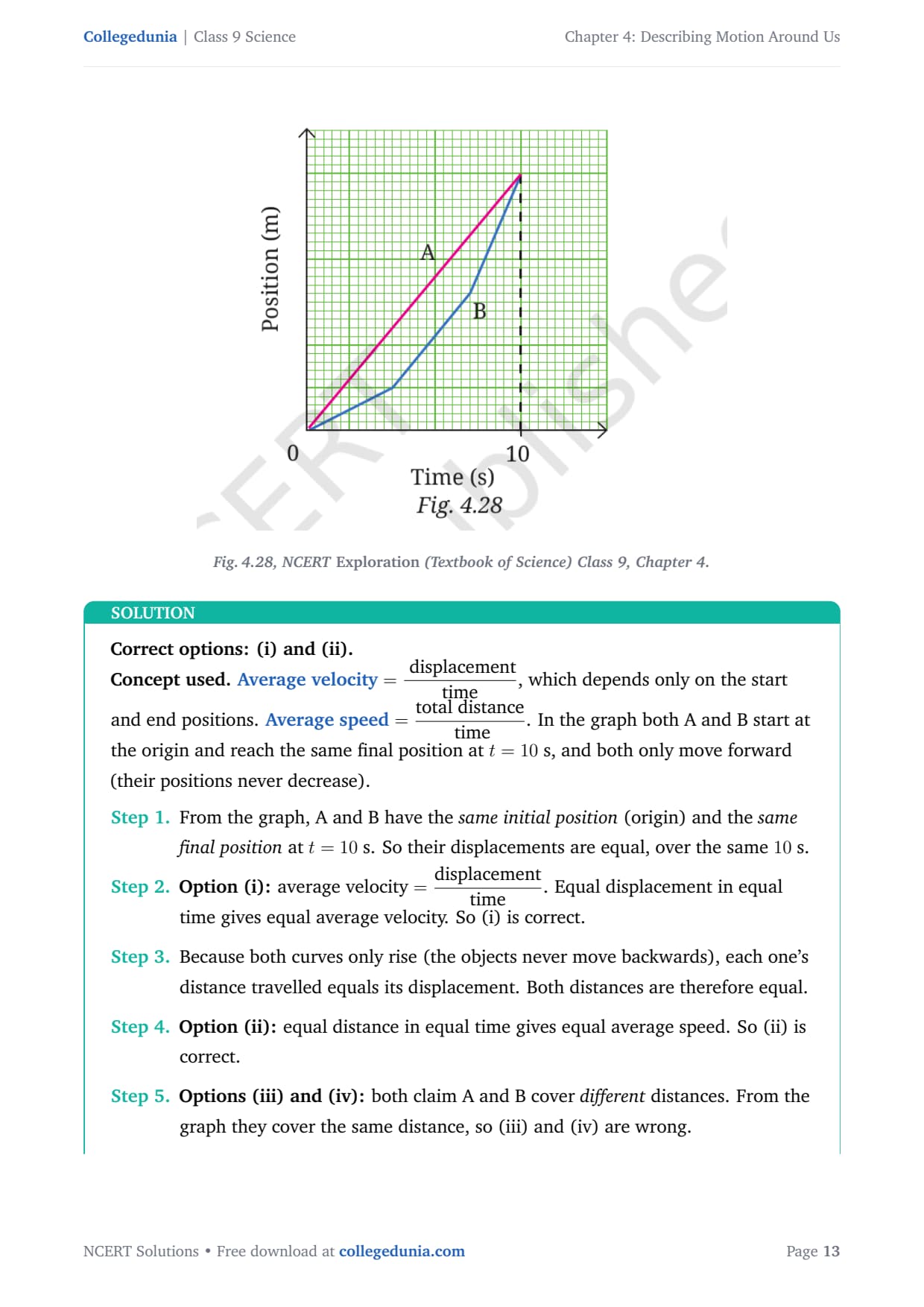
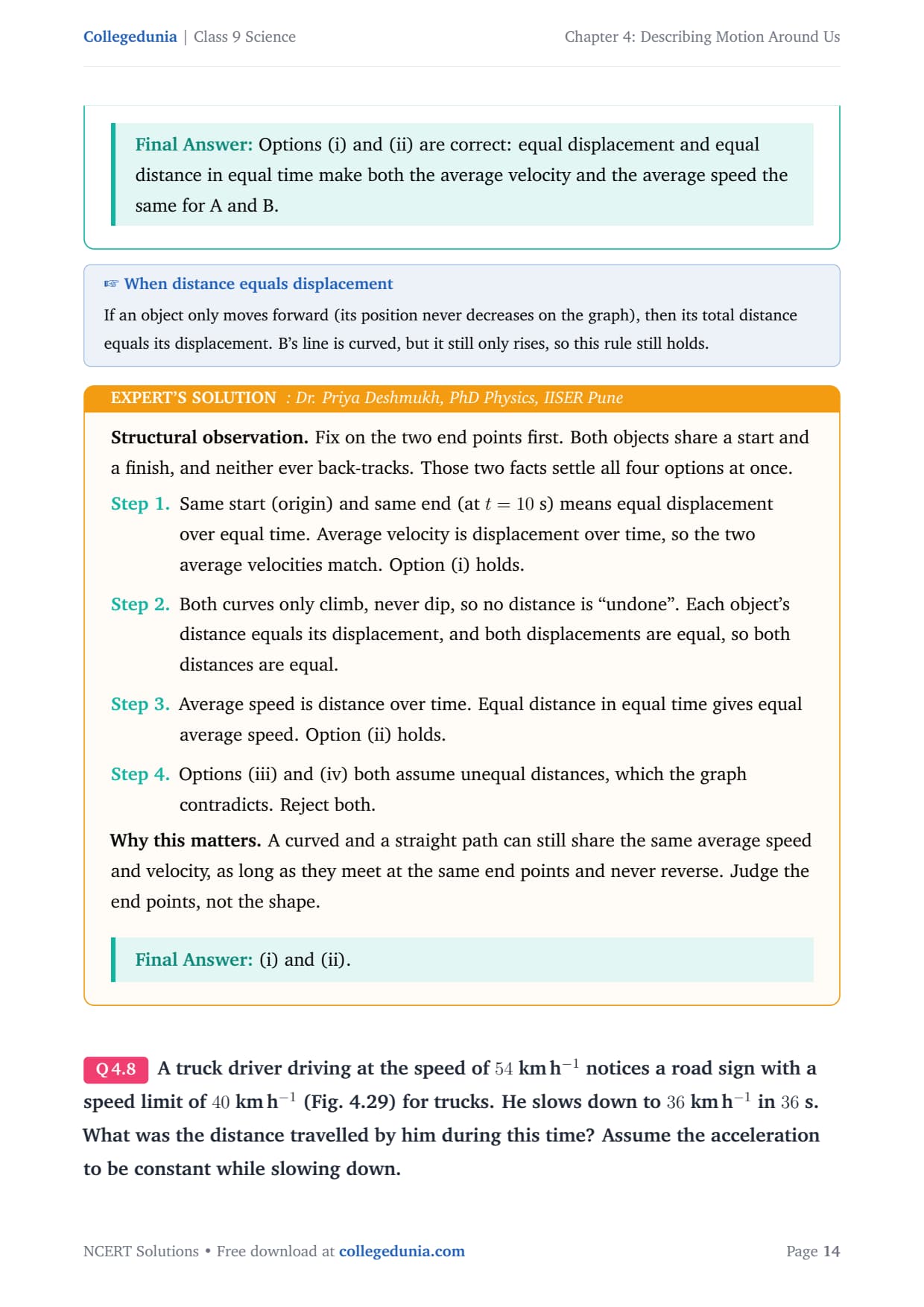
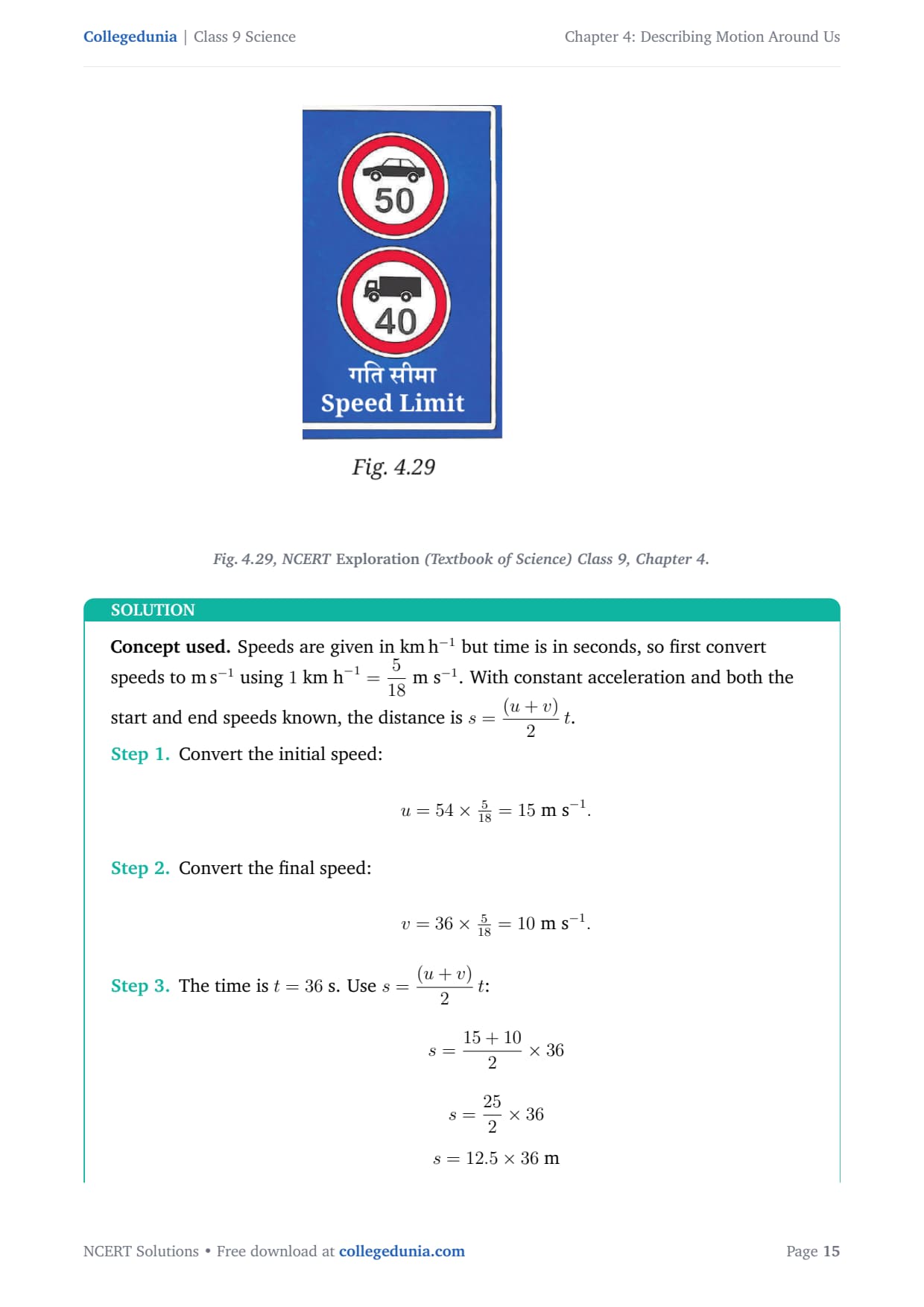
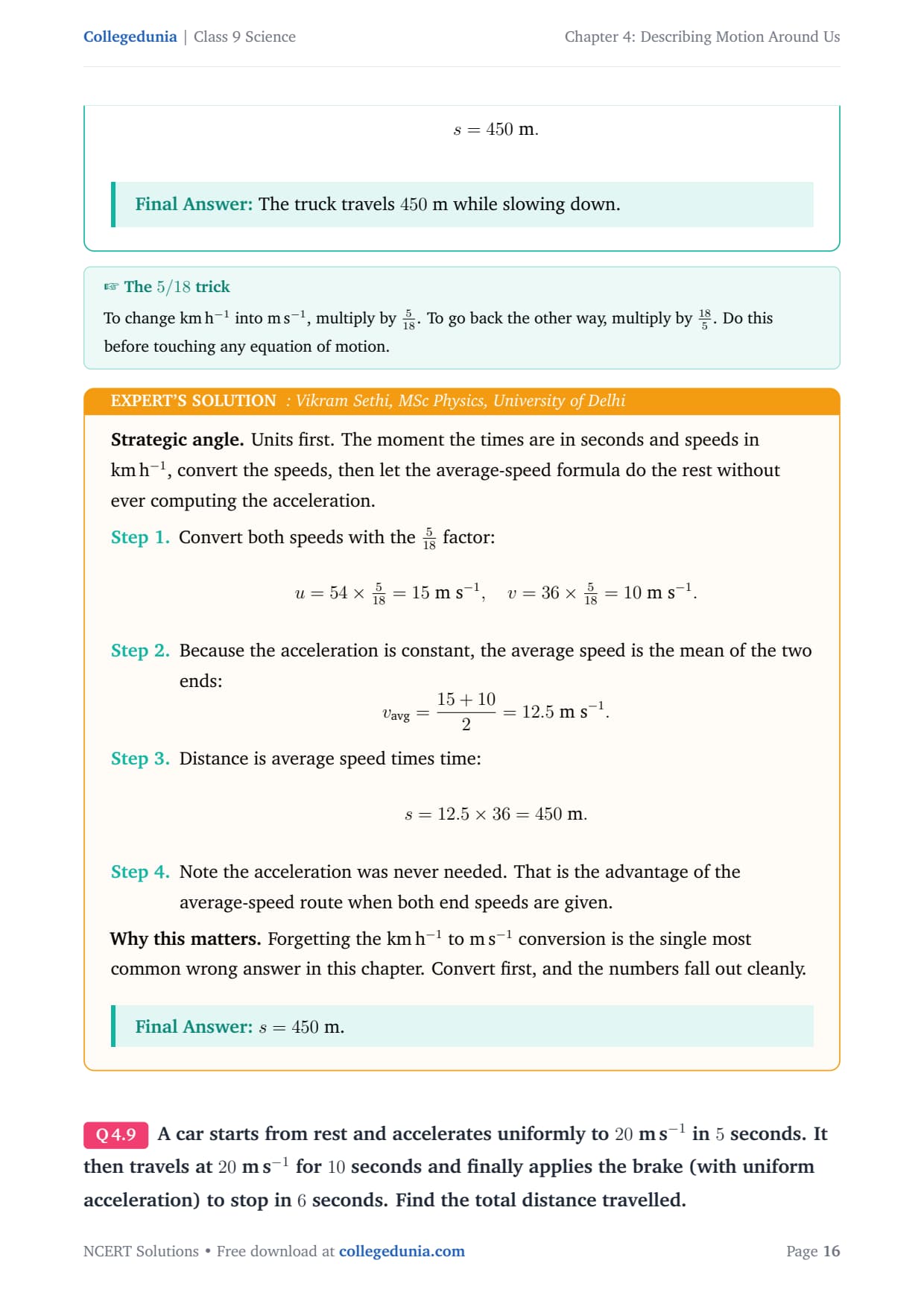
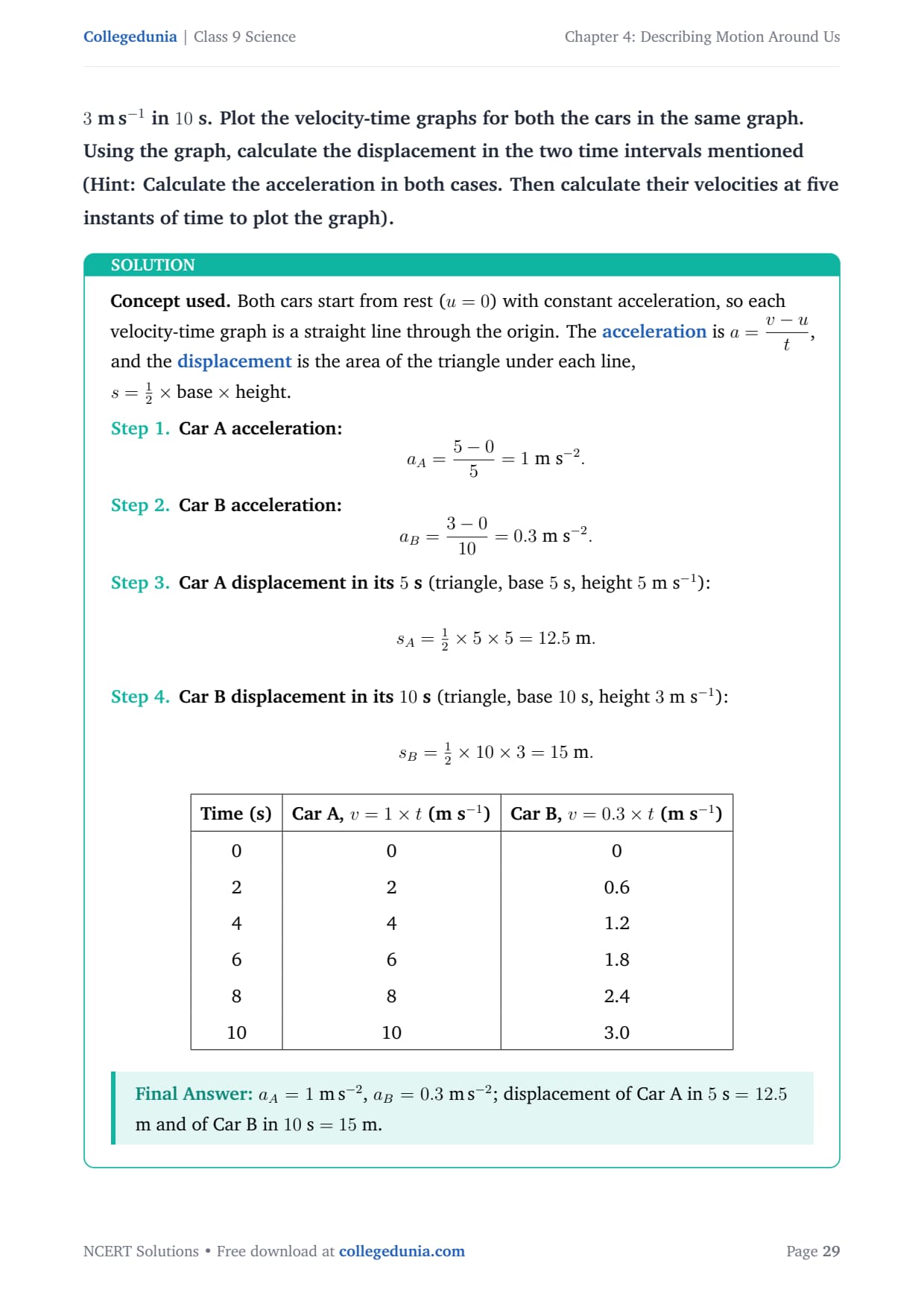
Each solution for Class 9 Science Chapter 4 Describing Motion Around Us is solved by Collegedunia subject experts, matched to the 2026-27 Exploration textbook, and written the way you should present it in the exam.
- 16 solved questions: full step-by-step working for every Revise, Reflect, Refine question, plus an expert method for each one.
- Core skills: distance versus displacement, speed versus velocity, acceleration, and reading position-time and velocity-time graphs.
- Formula practice: all three equations of motion applied to cars, buses, a cyclist, and a clock's minute hand.
Student Feedback
In a Collegedunia poll of 11,540 Class 9 students taken before the 2026 exams, 68% said the graph questions (position-time and velocity-time) were the hardest part of the chapter. Most-repeated slip: forgetting to change km/h into m/s before using a formula. Students who practised the 16 solved questions here reported the graph questions felt much easier the second time.
Source: 2026-27 Class 9 Science student poll. Sample of 11,540 students from CBSE schools across 14 states.
Exercise Coverage in the Describing Motion Around Us Class 9 Solutions
The Revise, Reflect, Refine exercise has 16 questions. The NCERT Solutions for Class 9 Science Chapter 4 Describing Motion Around Us group them by skill, so you can plan which type to practise first. The table below shows how the 16 questions split.
| Question type | Questions | What it tests |
|---|---|---|
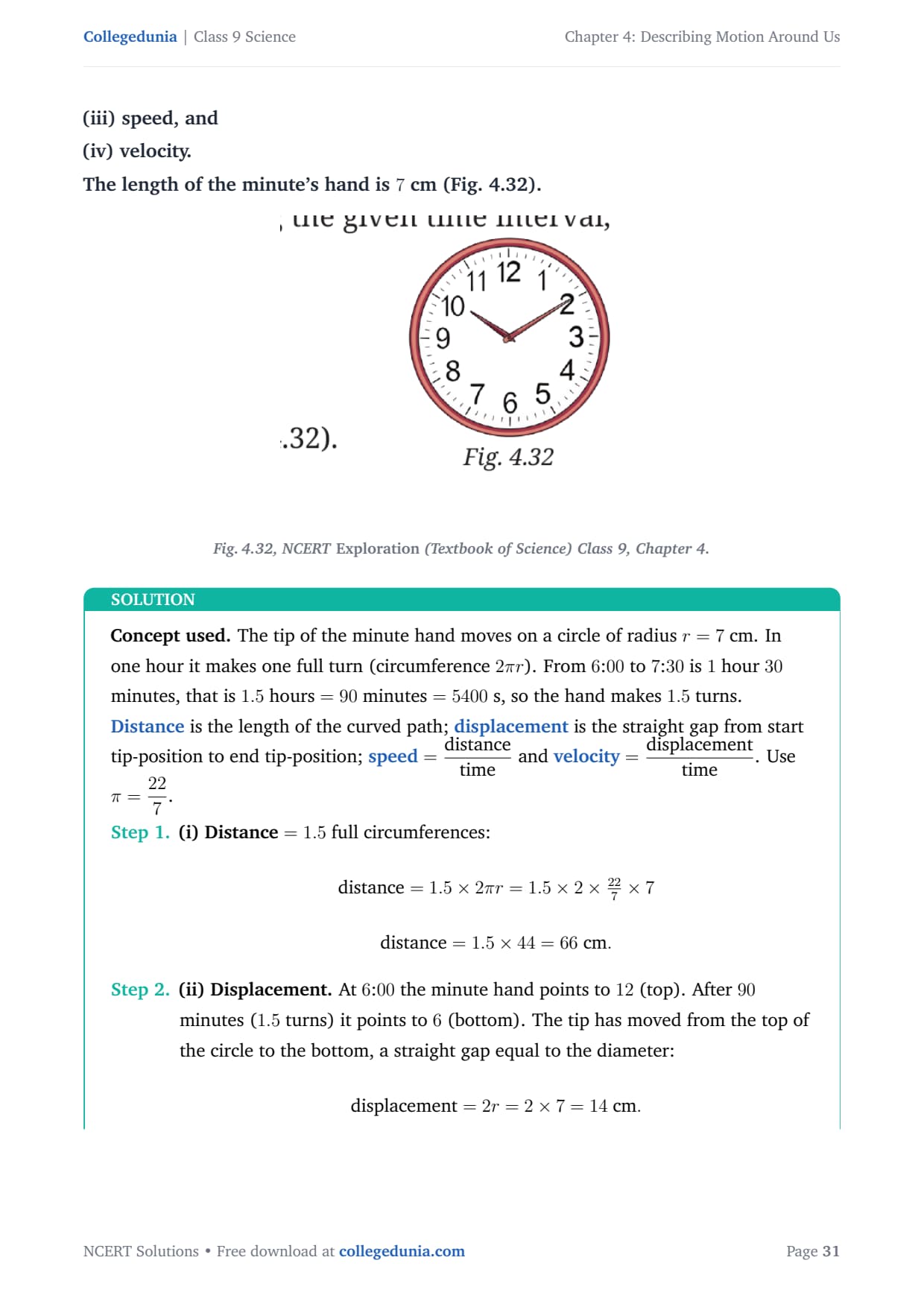
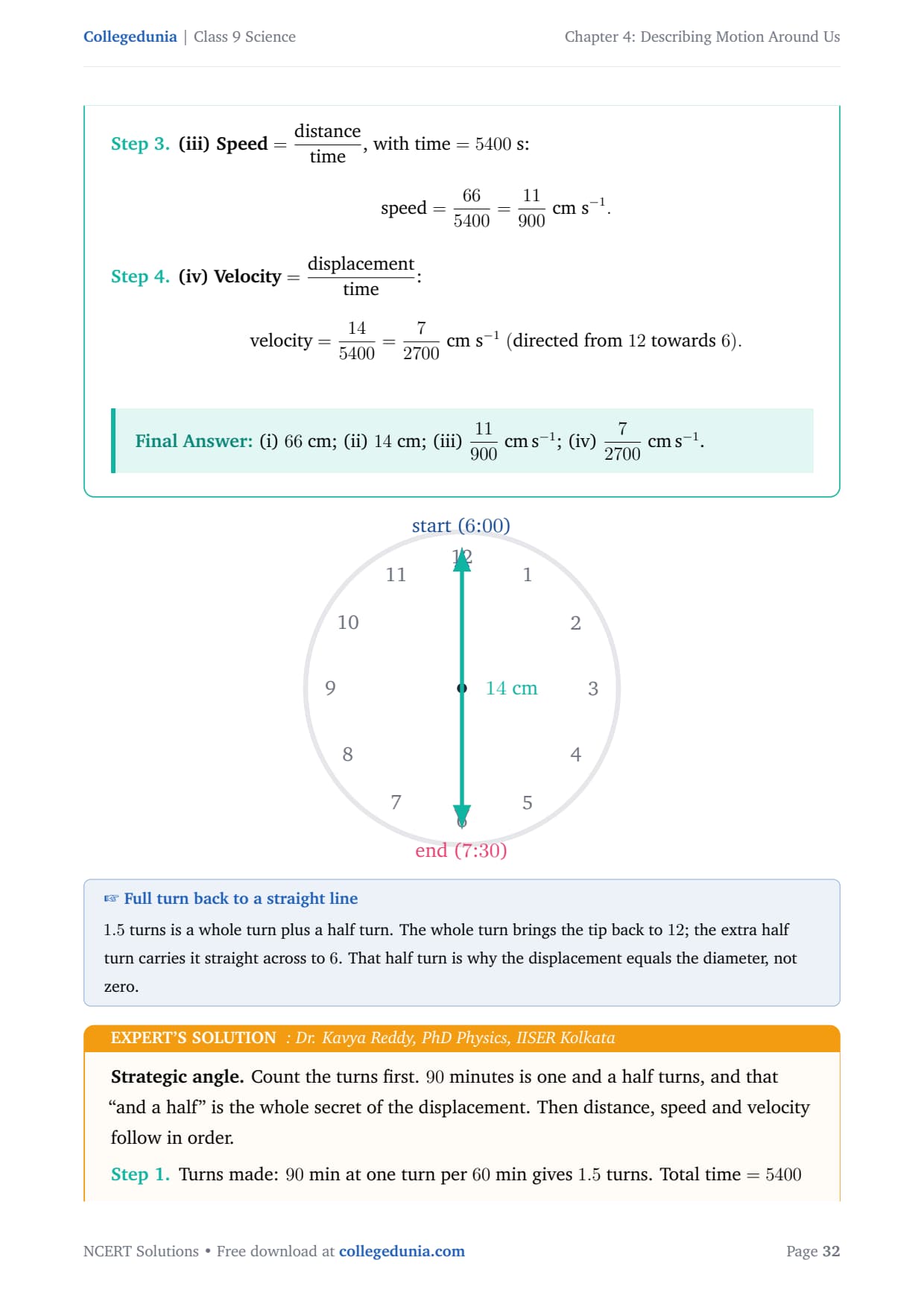
| Distance and displacement | 3 | Adding path length versus straight-line gap from start to finish |
| Speed, velocity and acceleration | 3 | Constant speed with a turn, and finding acceleration from a change in velocity |
| Equations of motion (numericals) | 4 | Using v = u + at, s = ut + ½at², and v² = u² + 2as |
| Position-time and velocity-time graphs | 5 | Reading slope as velocity and area as displacement |
| Reference point and open-ended | 1 | Why rest and motion depend on the point you compare against |
Start with the distance and displacement questions, then move to the equation numericals, and finish with the graph questions. That order matches how the chapter builds up each idea.
Distance versus displacement.
Describing Motion Around Us Weightage for Class 9 Science Exams
Motion is one of the most tested physics topics in Class 9. It also sets the base for Force and Motion chapters later. Here is where the chapter sits among the physics-side chapters of the 2026-27 Exploration book.
| Chapter | Topic | Typical exam focus |
|---|---|---|
| Chapter 4 | Describing Motion Around Us | Graphs and equation-of-motion numericals |
| Chapter 6 | How Forces Affect Motion | Newton's laws, force numericals |
| Chapter 7 | Work, Energy, and Simple Machines | Work and energy calculations |
| Chapter 10 | Sound Waves Characteristics and Applications | Wave speed and properties |
Motion carries strong marks because it mixes short reasoning questions with numericals and graph reading. Master it once and the marks come back every exam.
How to Solve Describing Motion Around Us Numericals Step by Step
Most marks in this chapter come from numericals. The same method works for almost every one. Follow these steps and you will rarely lose a mark on the working.
- Write down what you know. List u, v, a, s, and t. Mark the one you have to find.
- Convert units first. Change km/h into m/s by multiplying by 5/18 before touching any formula.
- Pick the formula by the missing quantity. No time given? Use v² = u² + 2as. Otherwise use v = u + at or s = ut + ½at².
- Keep the sign. A body slowing down has a negative acceleration. Report the minus sign and say it means the object is decelerating.
- State the unit and direction. Finish every answer with the number, the SI unit, and the direction where it applies.
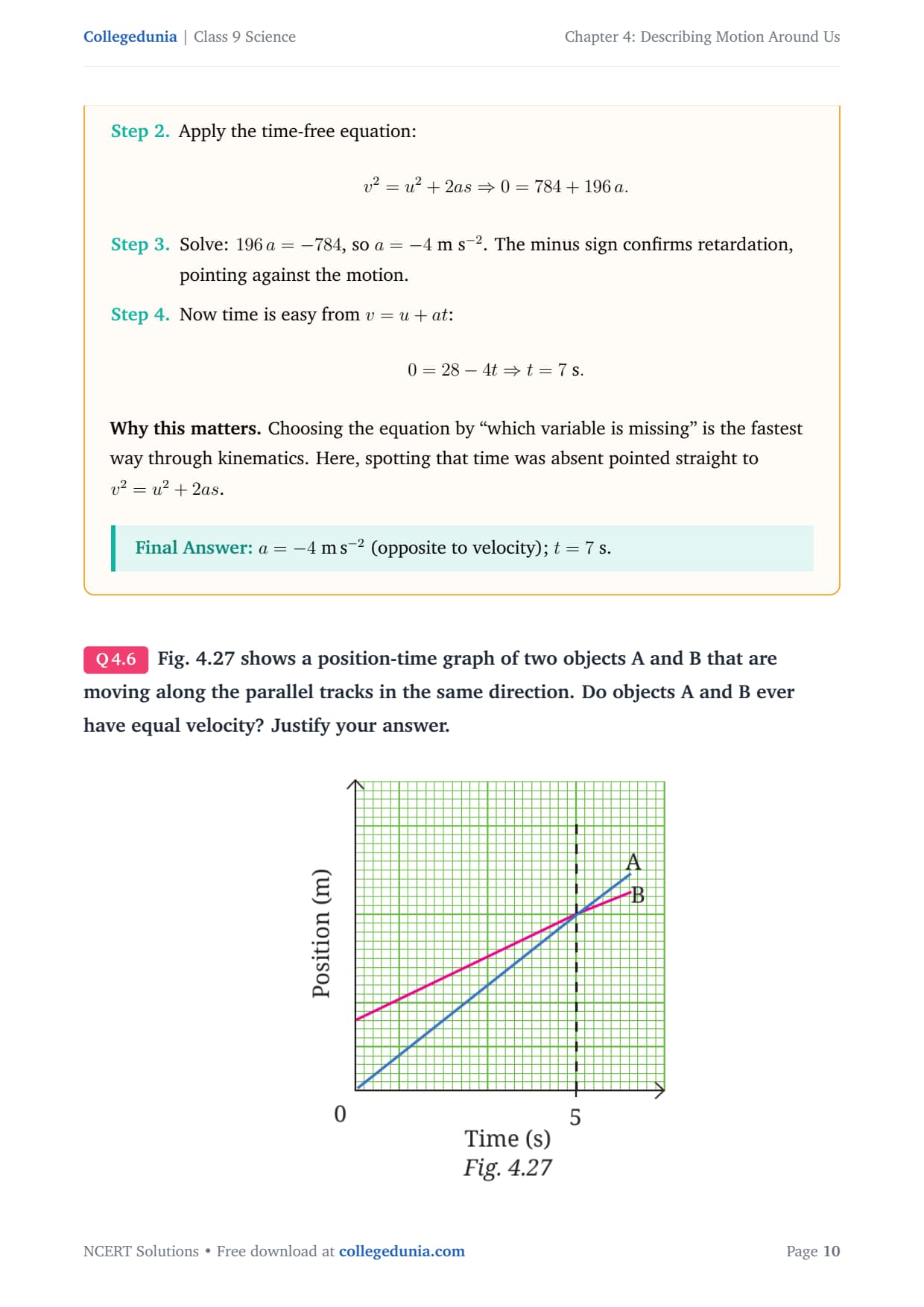
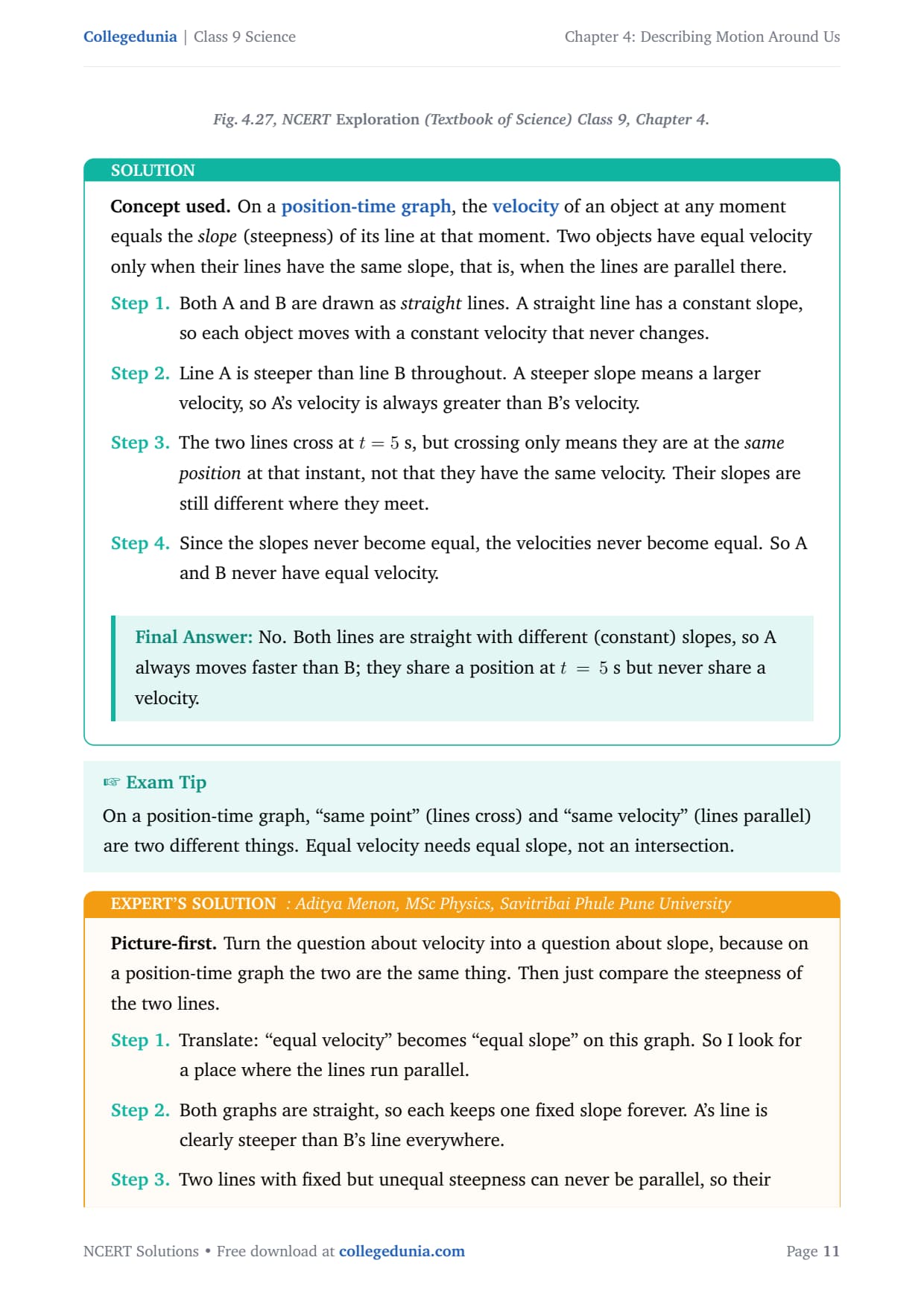
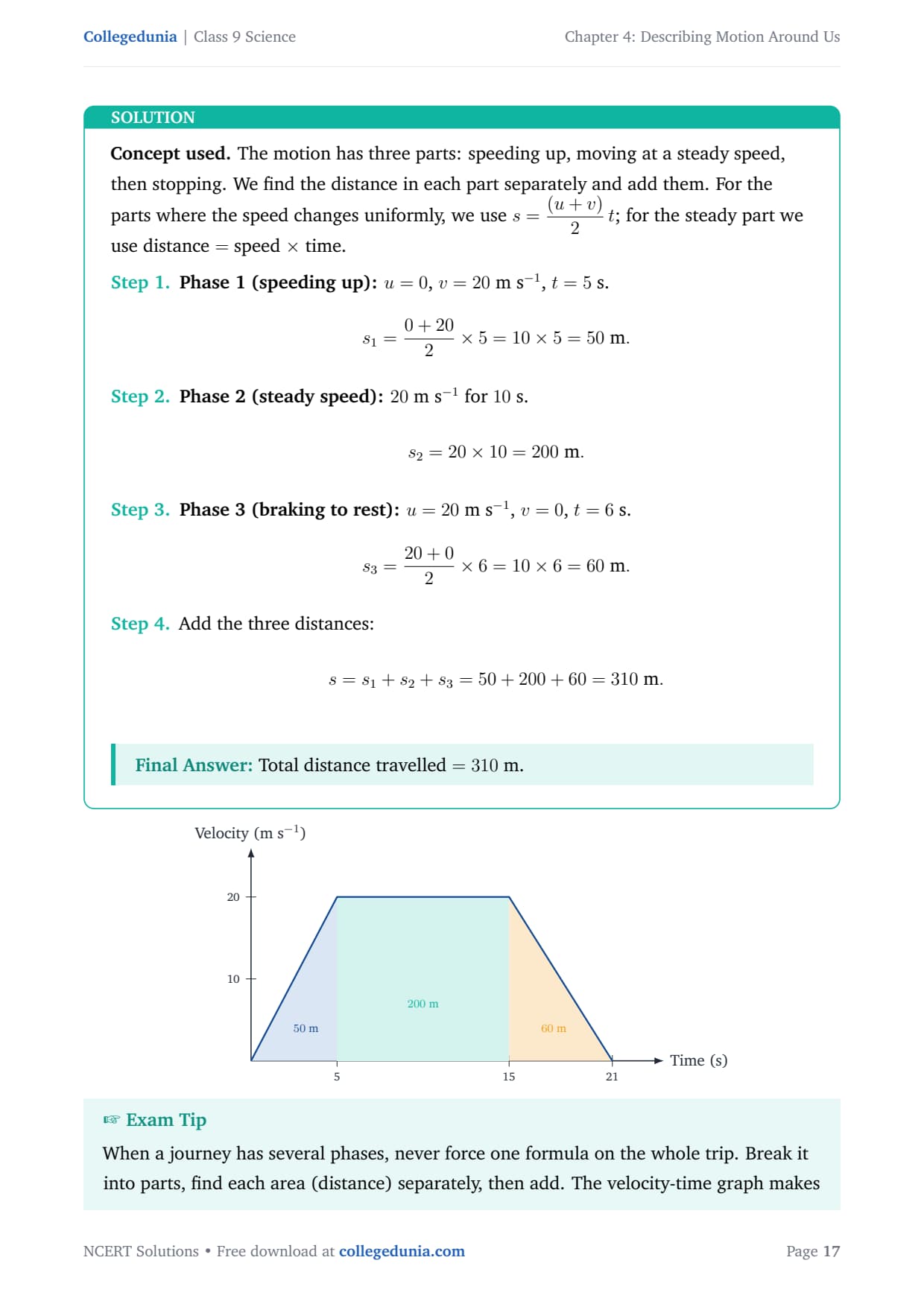
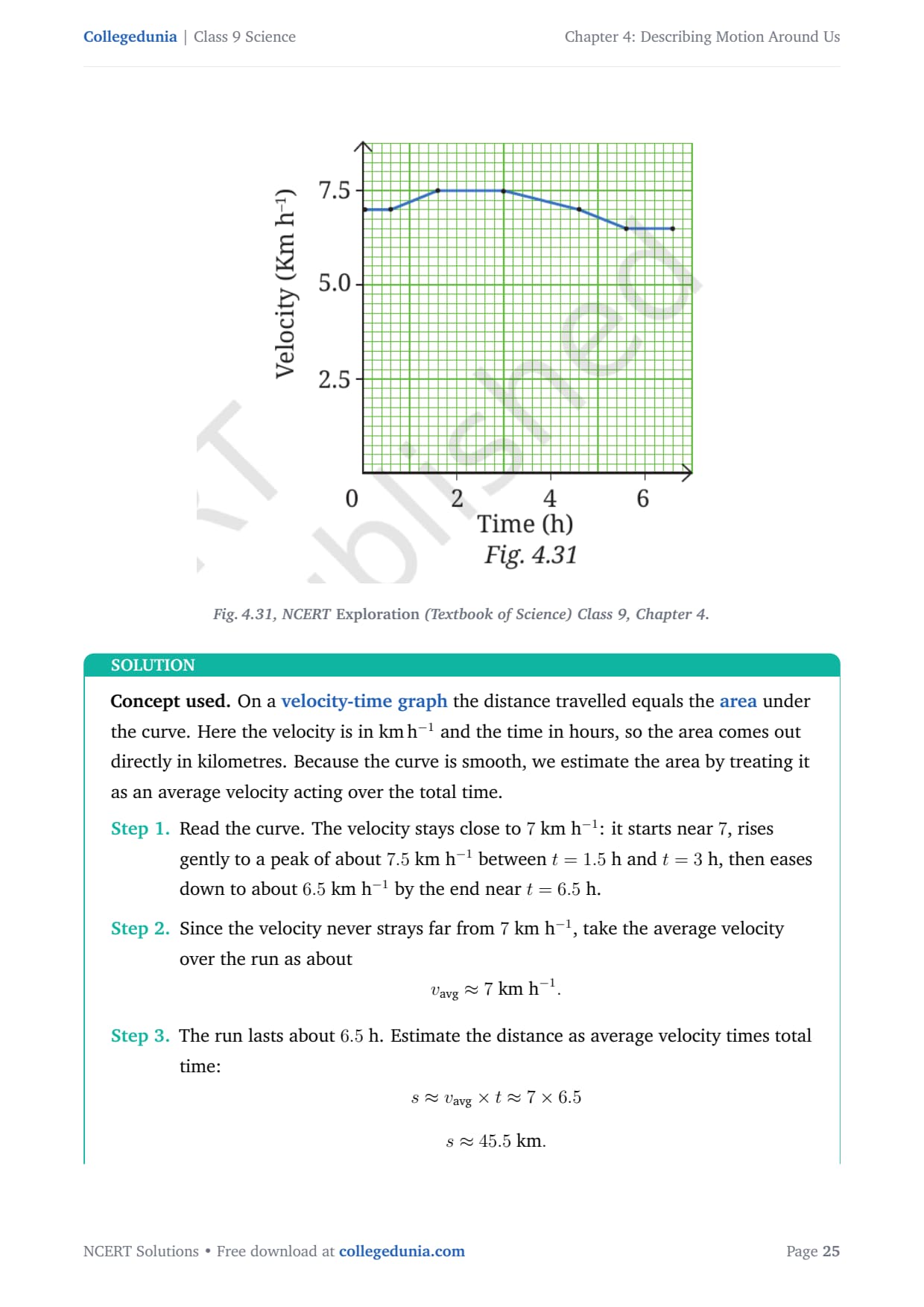
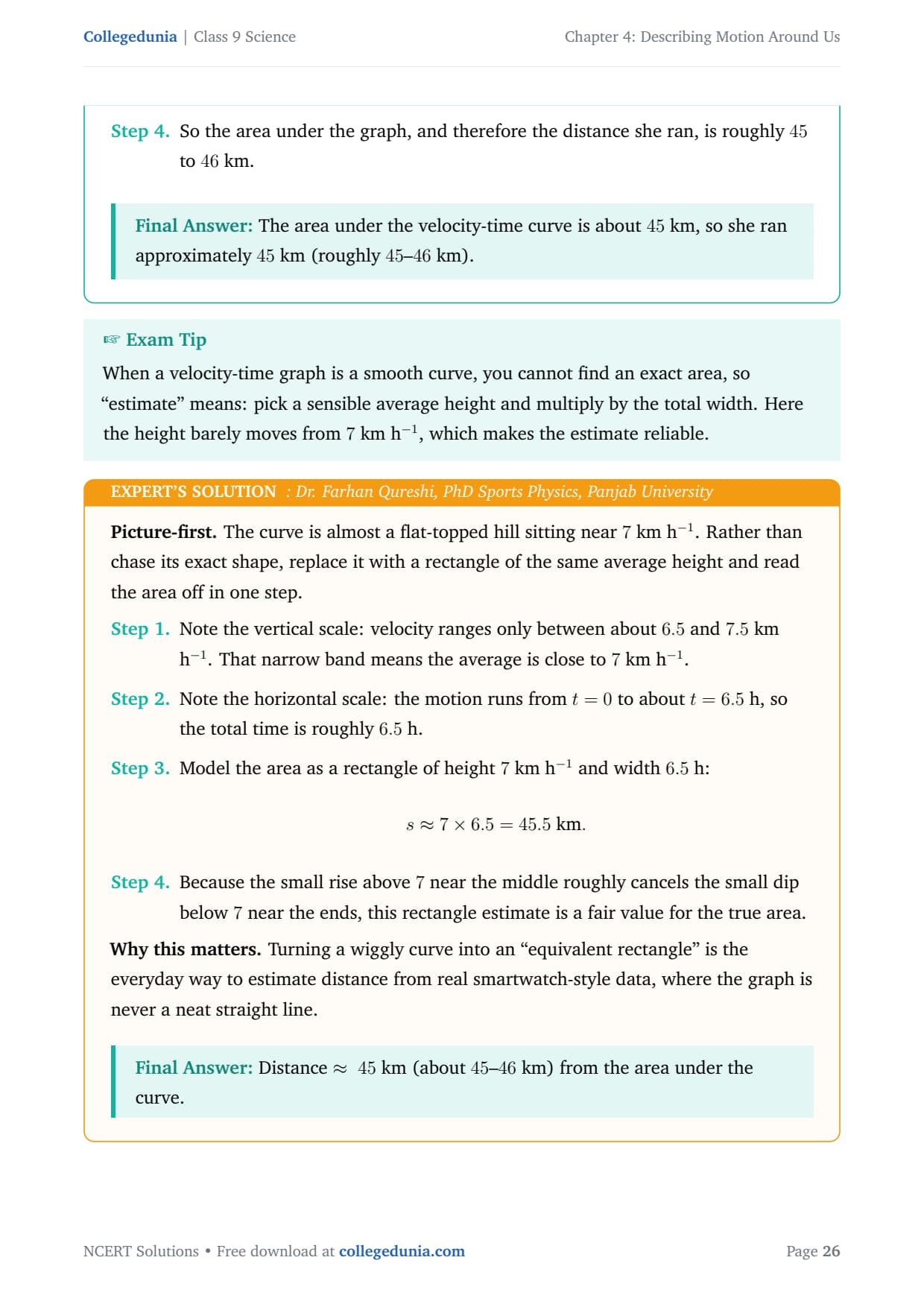
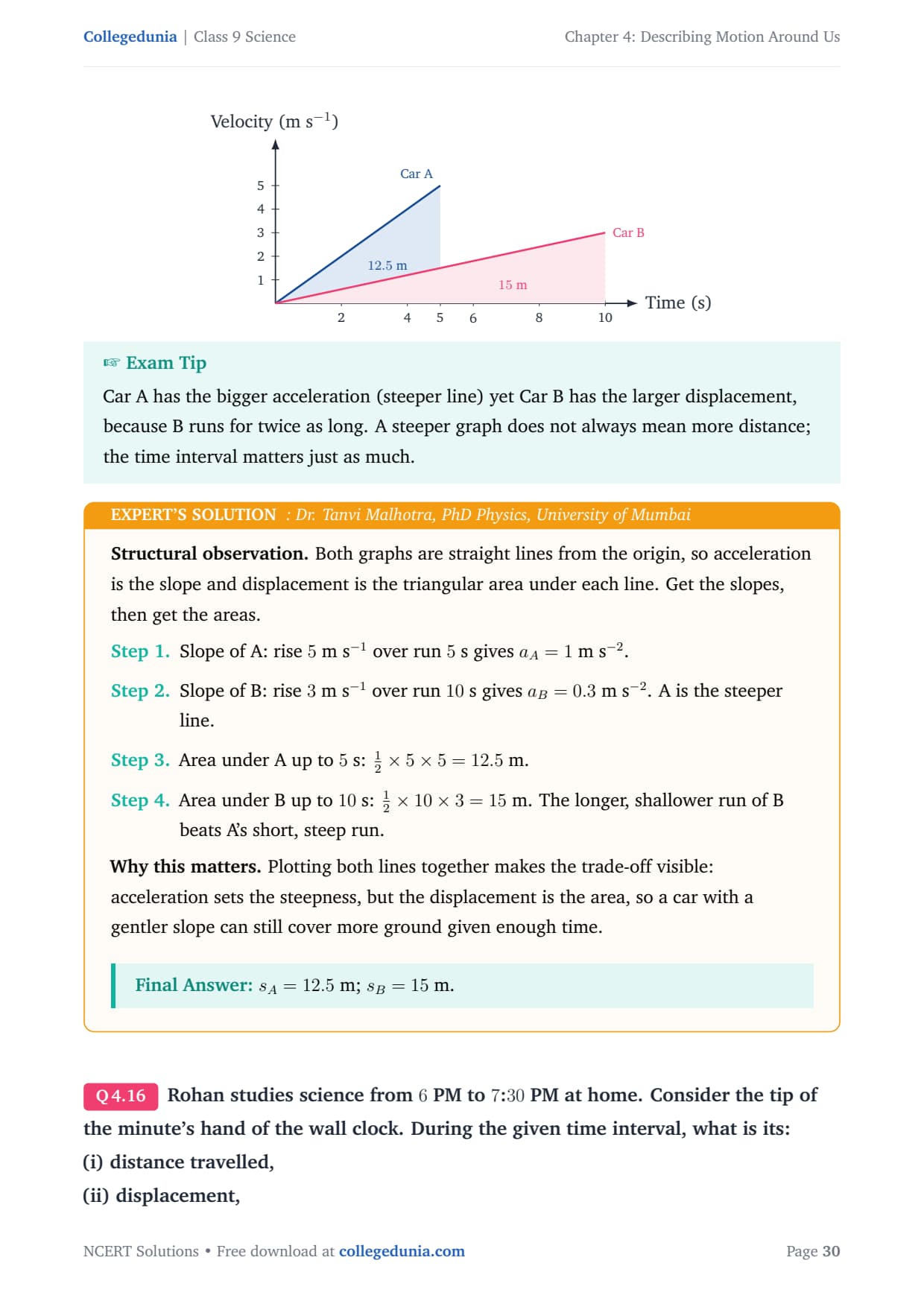
For graph questions, remember two rules: on a position-time graph the slope is the velocity, and on a velocity-time graph the area under the line is the displacement. These two ideas solve every graph question in the exercise.
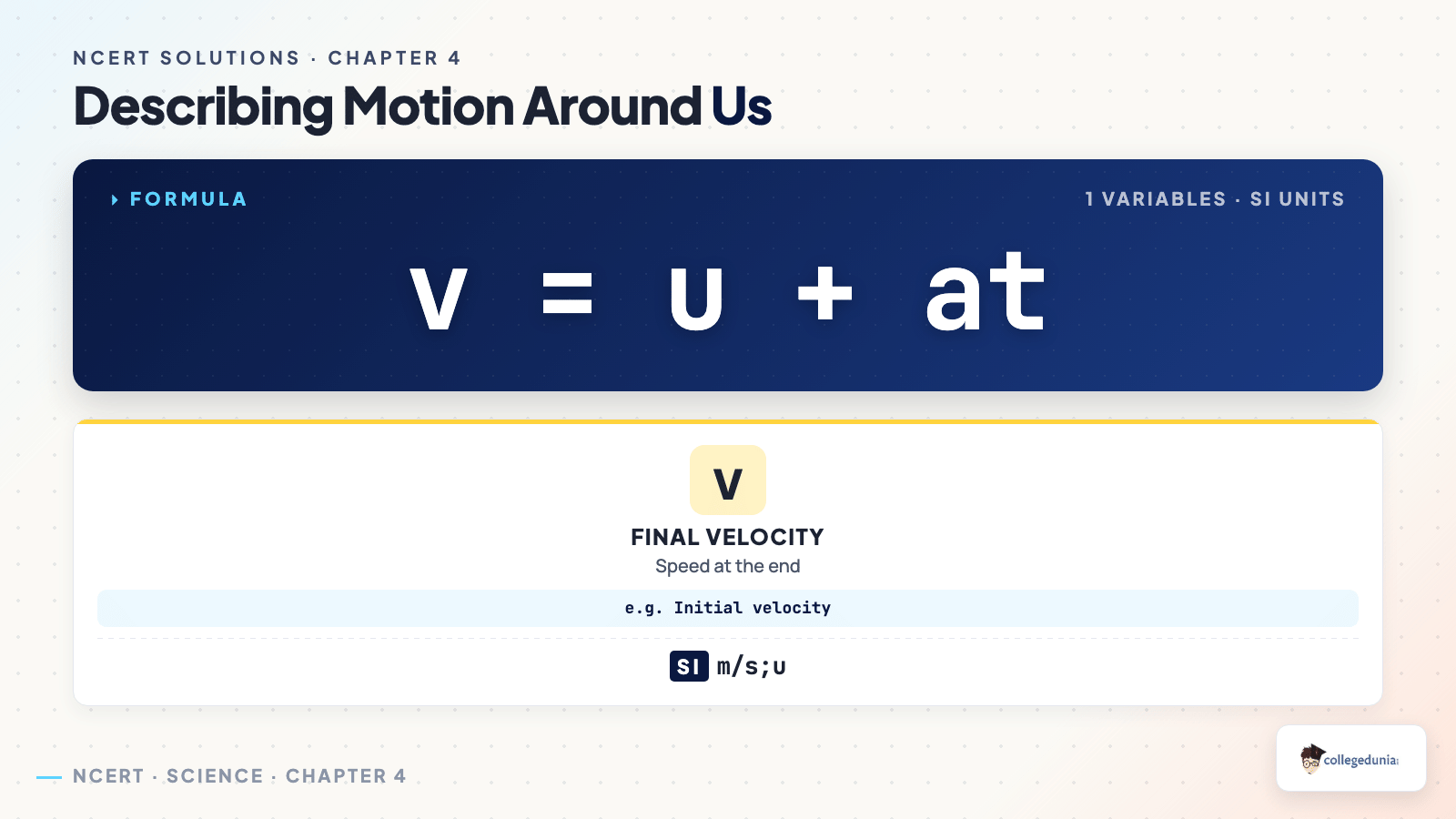
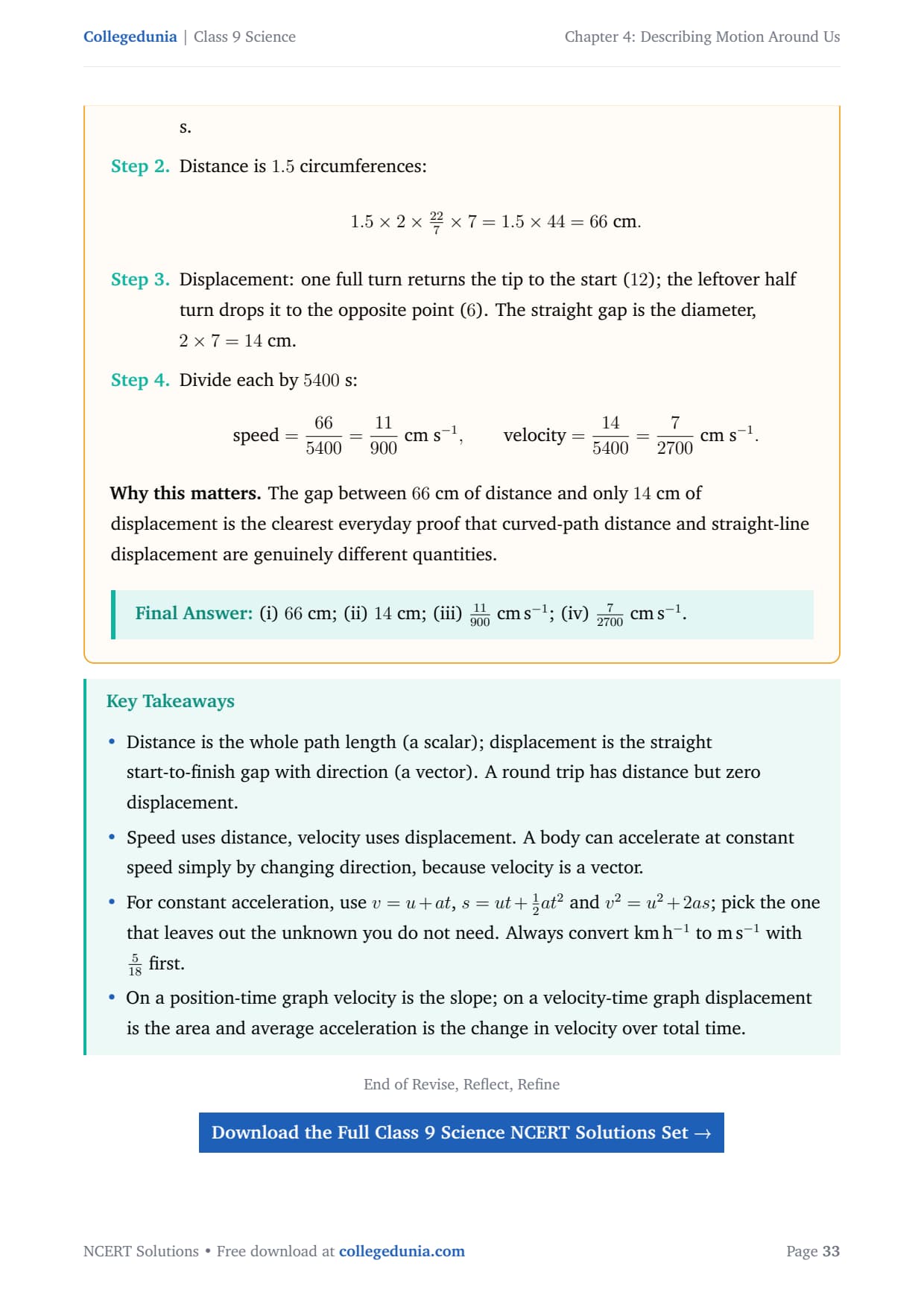
The first equation of motion.
Common Mistakes Students Make in Describing Motion Around Us
Most lost marks in this chapter are simple slips, not gaps in concept. Watch for the four below when you write your answer.
Mistake 1: Reading a constant speedometer as no acceleration. A body turning at steady speed is still accelerating, because its direction, and so its velocity, is changing.
Mistake 2: Skipping the km/h to m/s change. If the time is in seconds, the speed must be in m/s first. Multiply by 5/18.
Mistake 3: Dropping the minus sign on a slowing object. Writing a = 4 instead of a = -4 hides that the object is decelerating.
Mistake 4: Mixing up "same position" and "same velocity" on a graph. Two lines crossing means same position, not equal velocity. Equal velocity needs equal slope.
Also Check: the full step-by-step working for every one of these traps is in the solved questions lower on this page.
Describing Motion Around Us Important Questions and Exam Trends
Exams from this chapter follow a clear pattern. One short reasoning question plus one or two numericals or a graph question is the usual mix. The list below shows the question types you should be ready for.
- Round-trip distance and displacement: a there-and-back journey where displacement often comes out zero.
- Acceleration from a change in velocity: a car starting from rest or a vehicle braking to a stop.
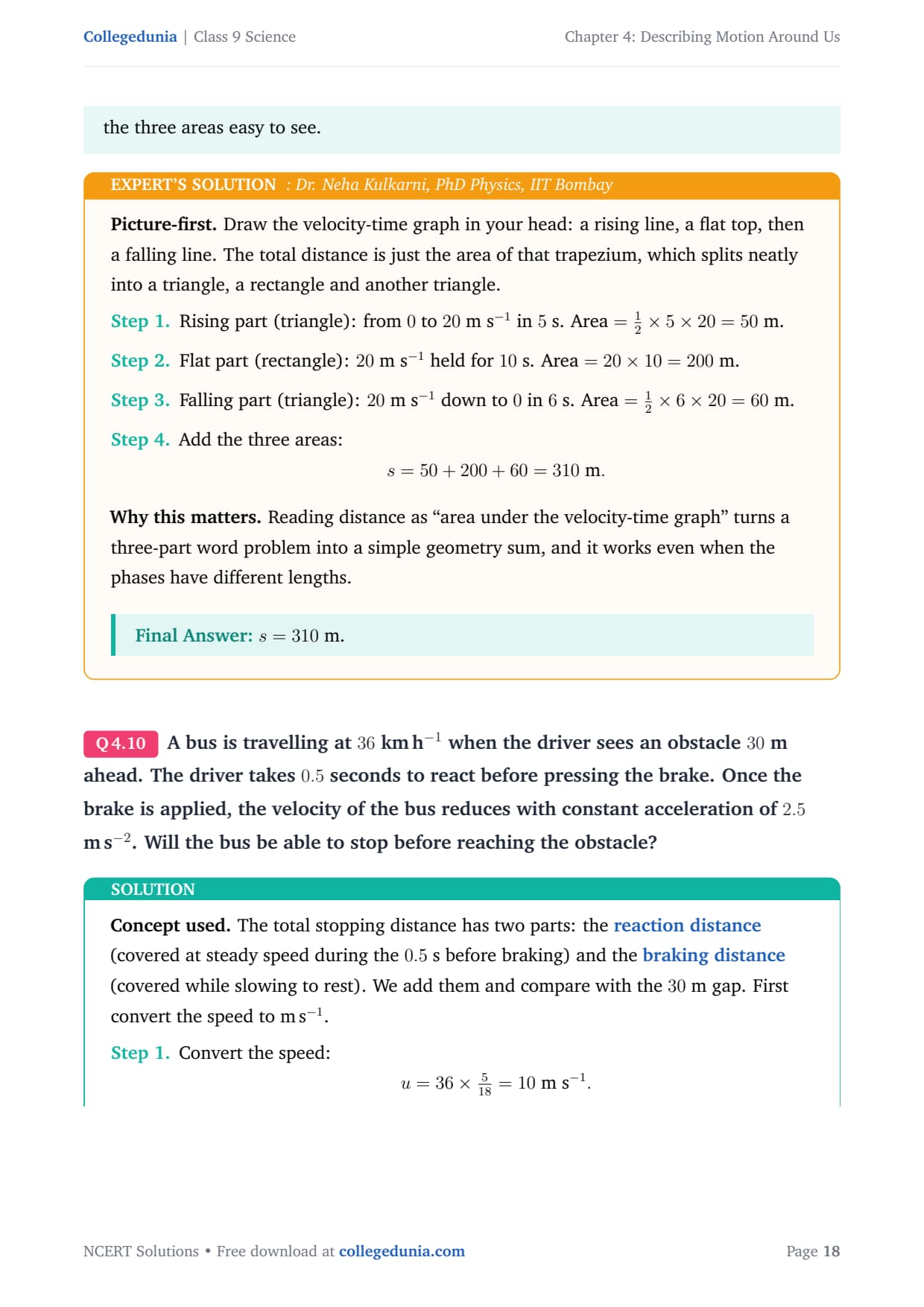
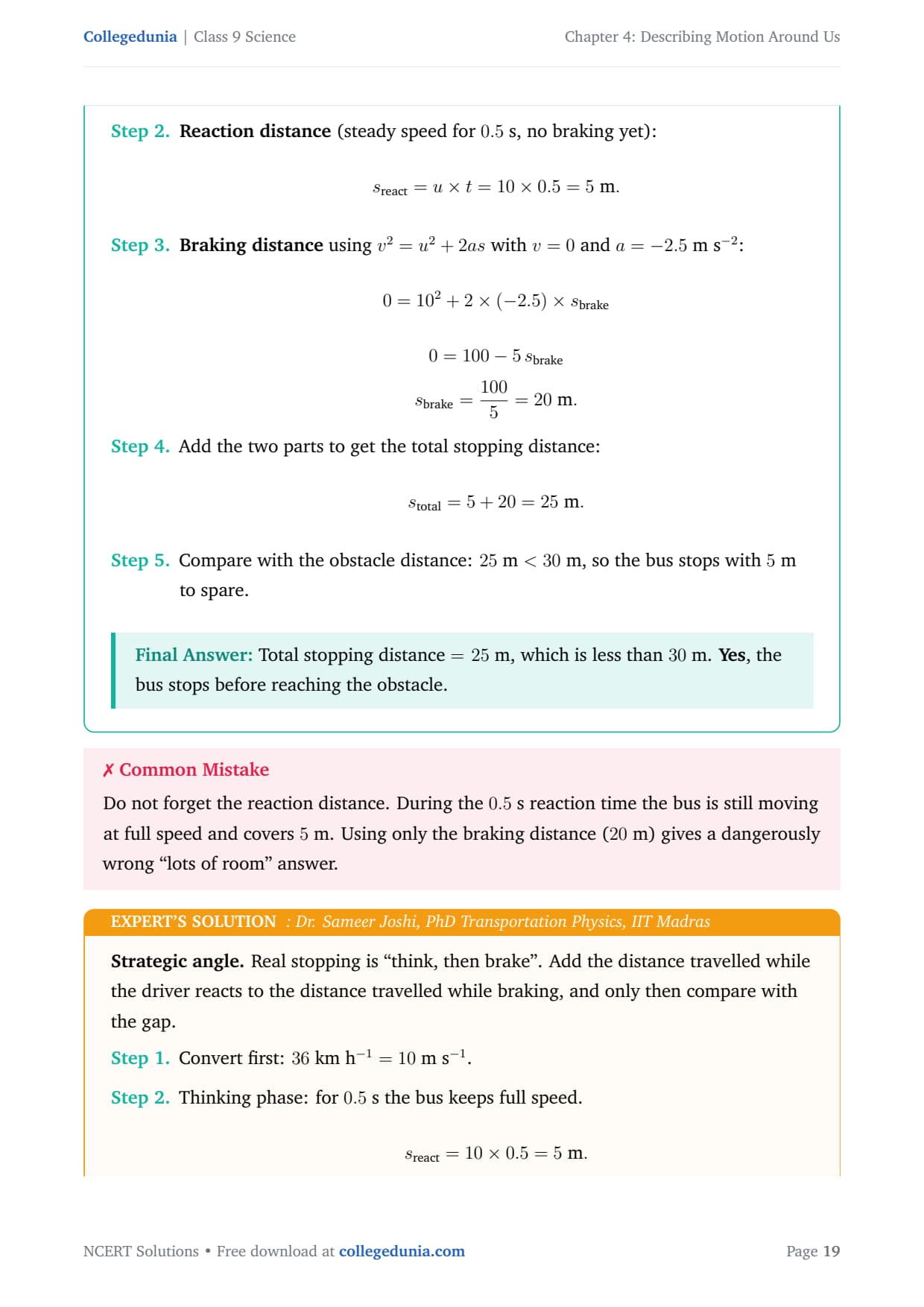
- Stopping distance: reaction distance plus braking distance, then a comparison with the gap ahead.
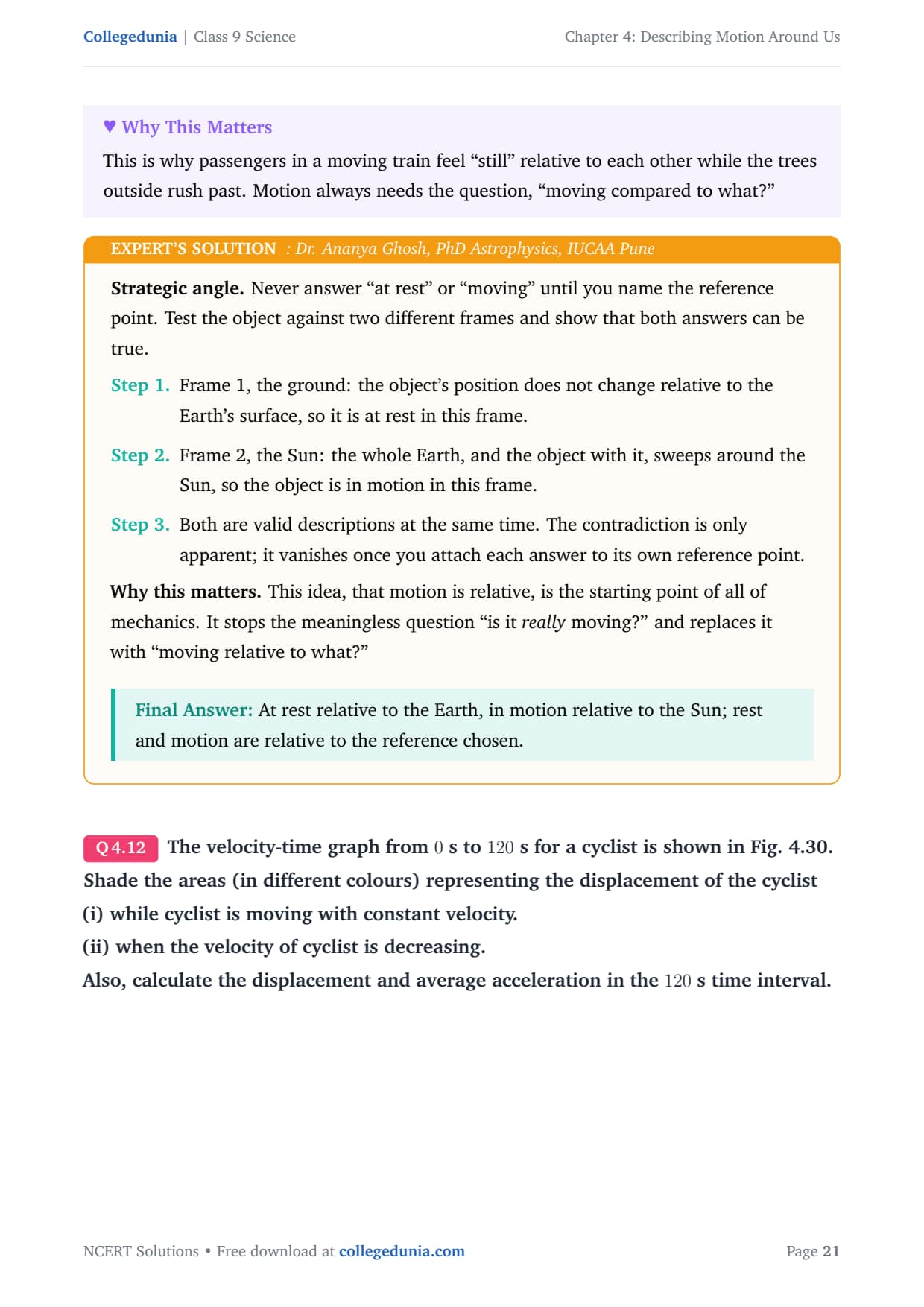
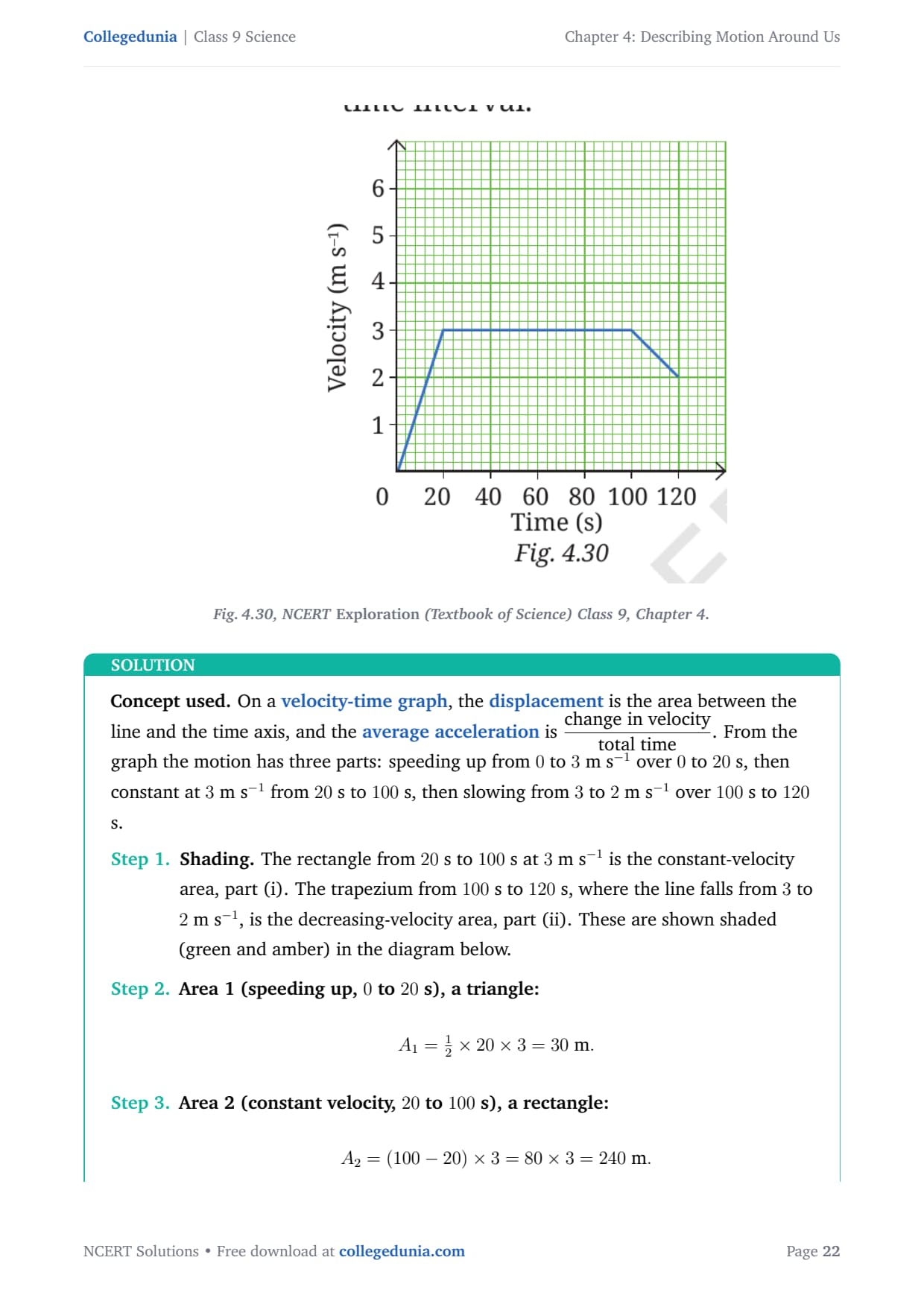
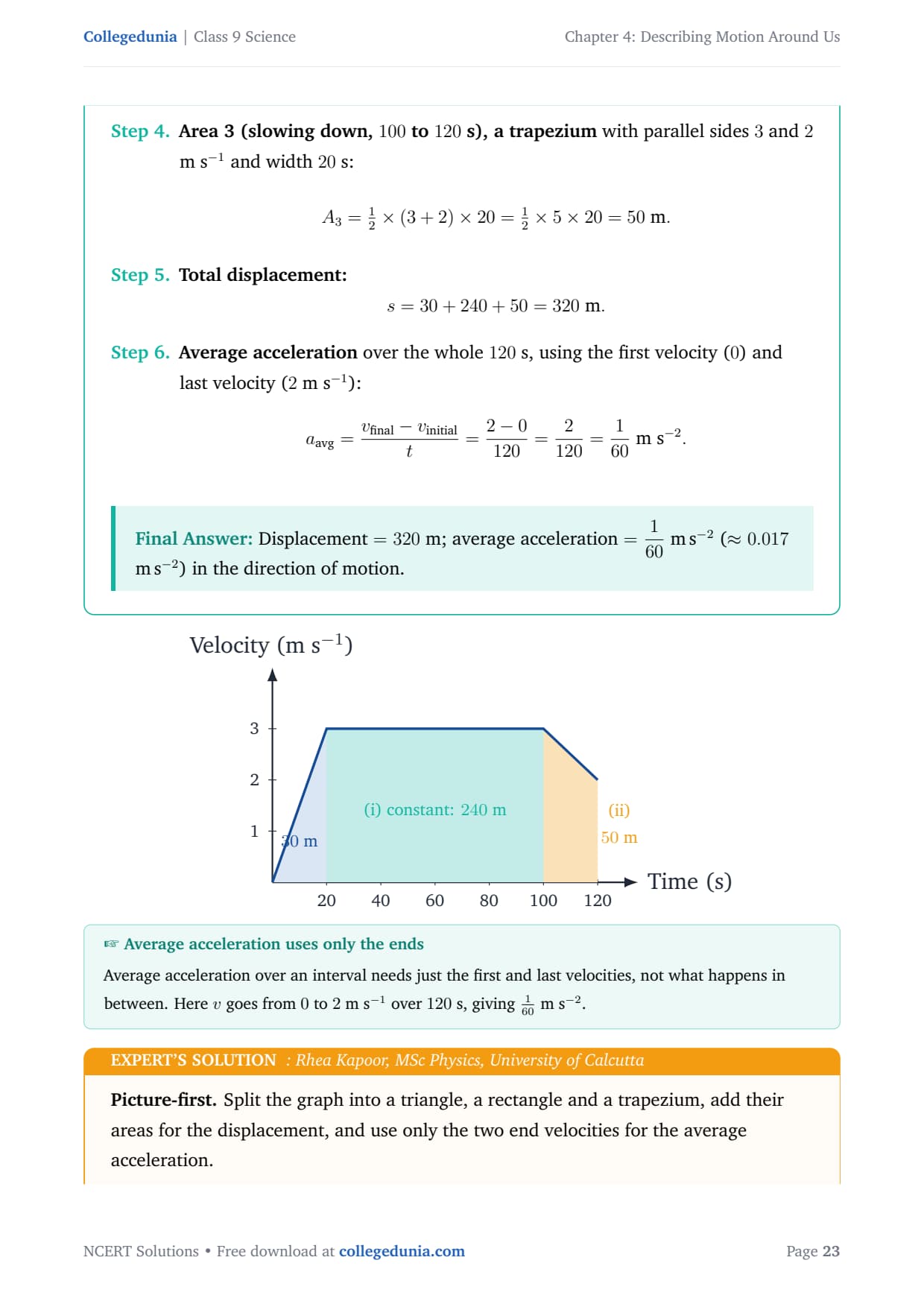
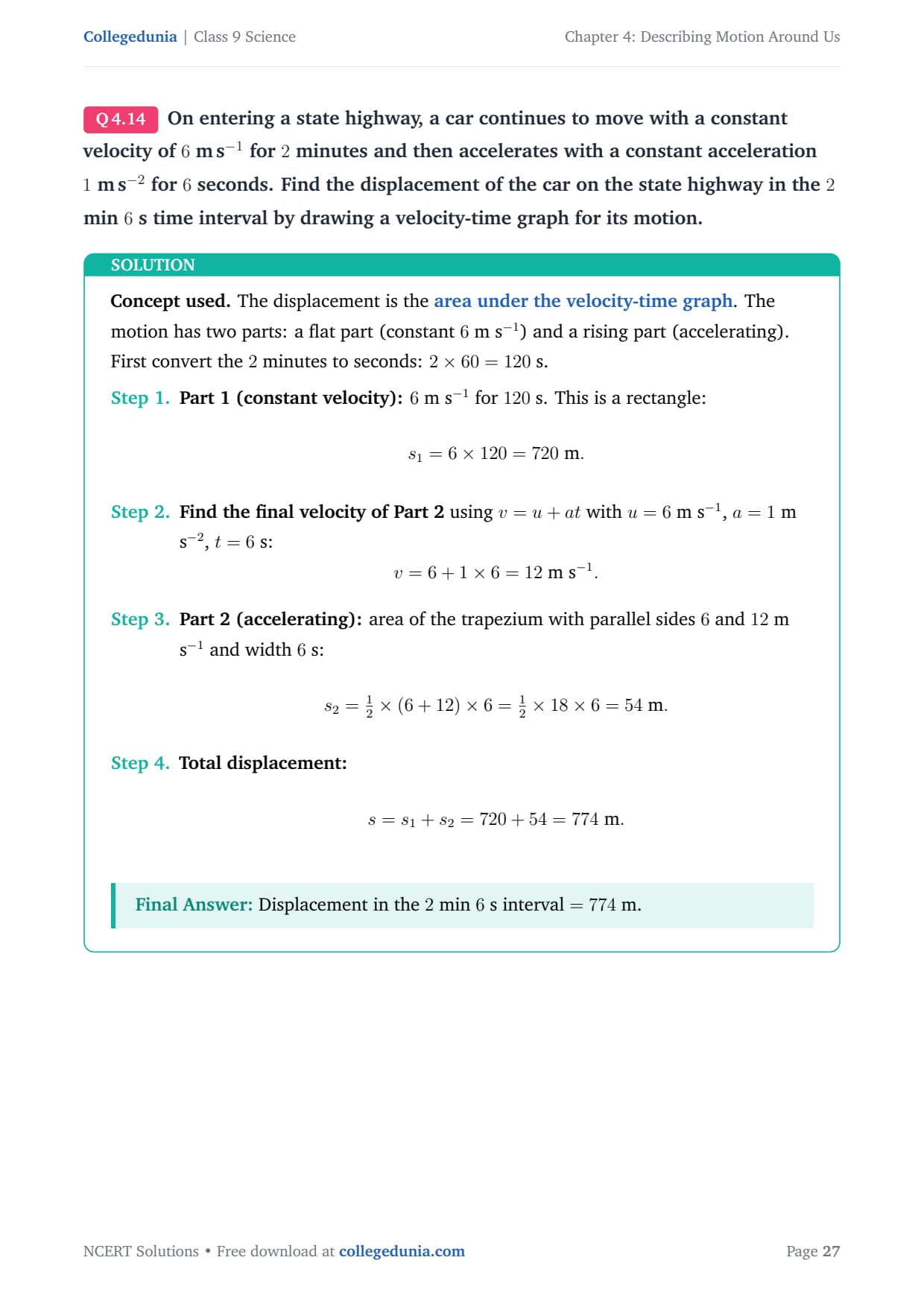
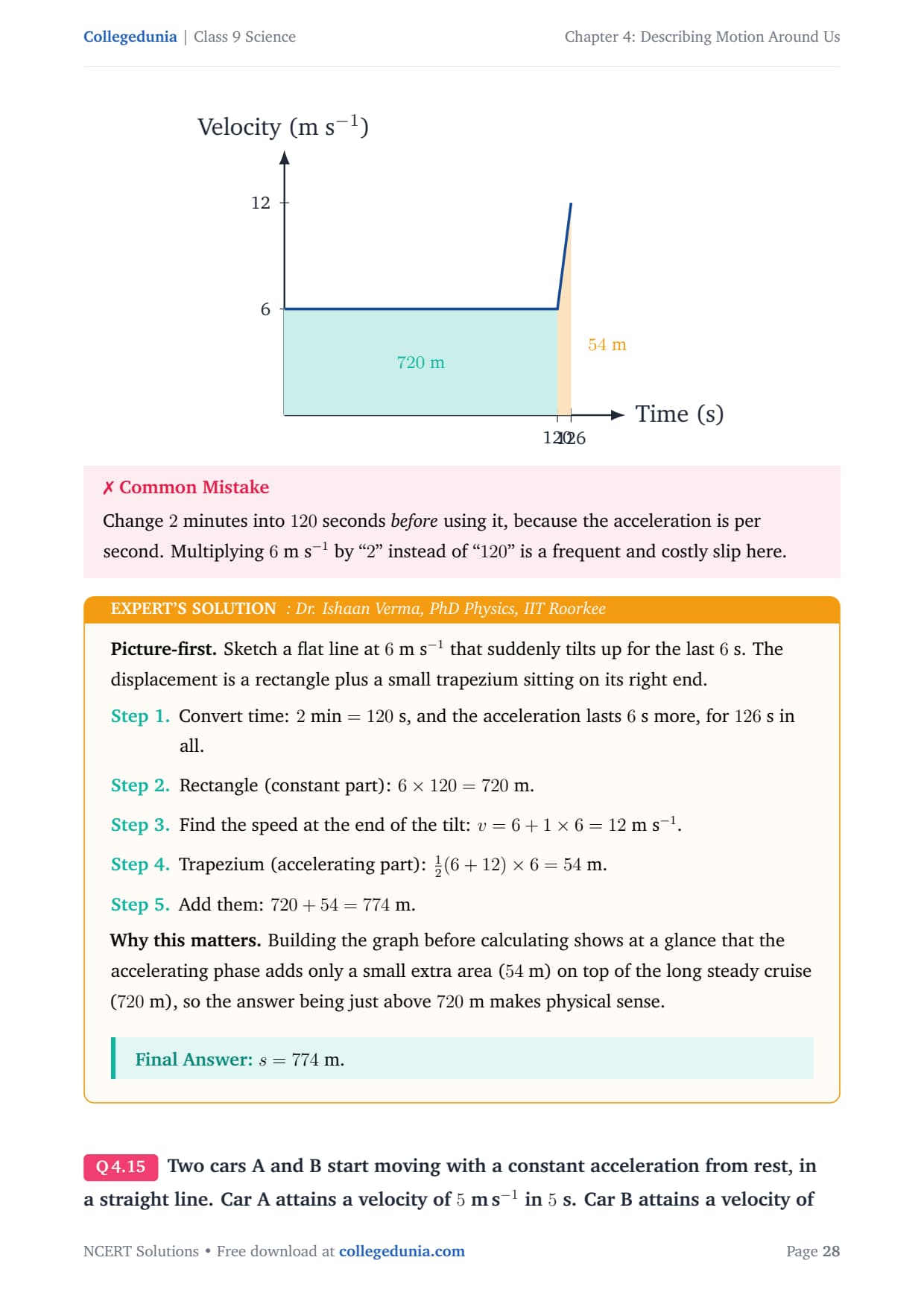
- Graph reading: find displacement as the area under a velocity-time graph, split into triangle, rectangle, and trapezium.
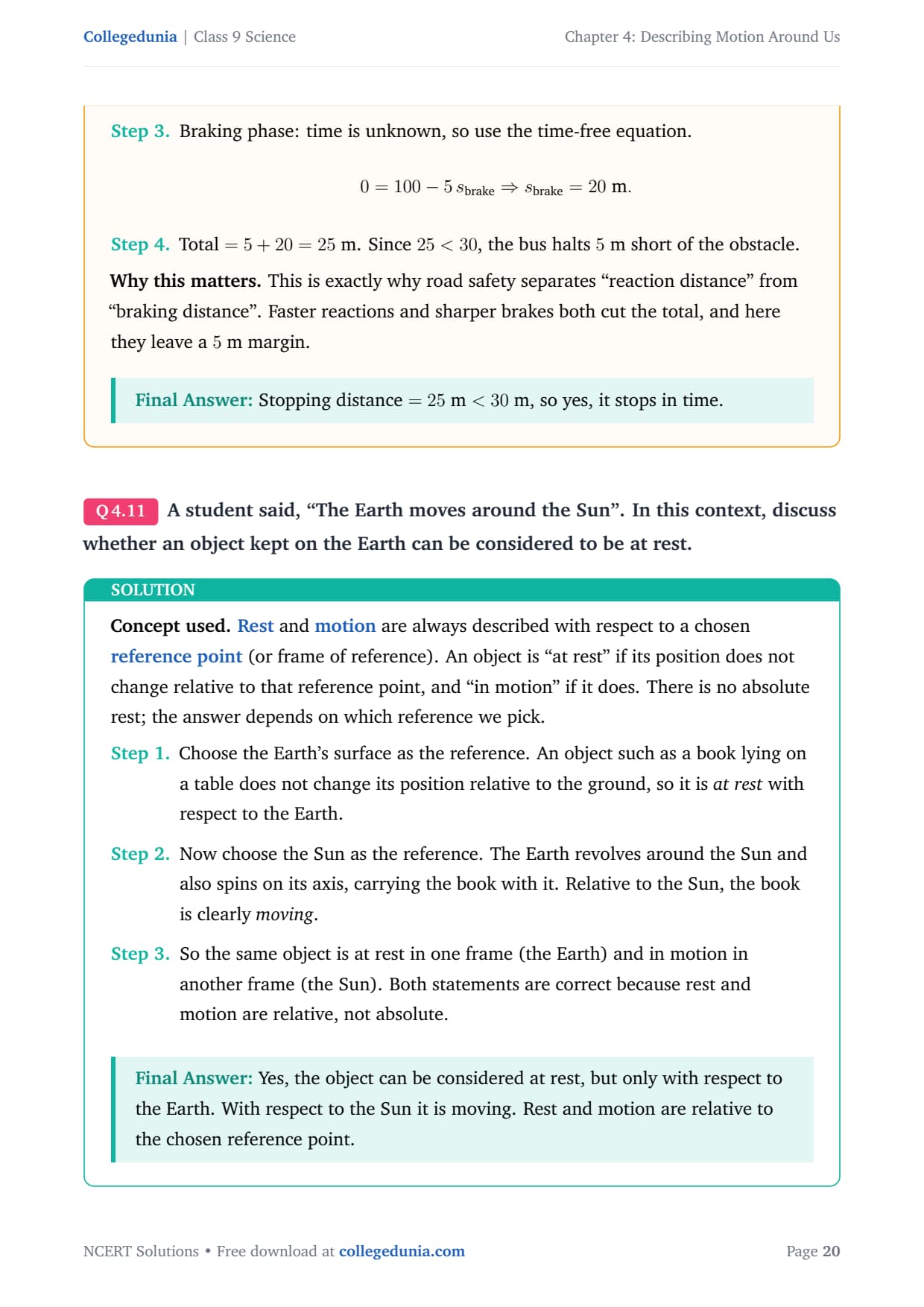
- Reference point reasoning: explain why the same object can be at rest and in motion at the same time.
Practising the 16 solved questions on this page covers every one of these types in full.
Other Describing Motion Around Us Class 9 Science Resources
Pair these solutions with the notes and formula sheet for the same chapter to revise faster.
| Resource | Link |
|---|---|
| NCERT Solutions | Describing Motion Around Us Class 9 Solutions |
| Notes | Describing Motion Around Us Class 9 Notes |
| Handwritten Notes | Describing Motion Around Us Handwritten Notes |
| Formula Sheet | Describing Motion Around Us Formula Sheet |
| NCERT Book PDF | Describing Motion Around Us Book PDF |
NCERT Solutions for Class 9 Science: All Chapters
Jump to the NCERT Solutions for any other Class 9 Science chapter below.
| Chapter | NCERT Solutions |
|---|---|
| Chapter 2 | Cell The Building Block of Life |
| Chapter 3 | Tissues in Action |
| Chapter 5 | Exploring Mixtures and their Separation |
| Chapter 6 | How Forces Affect Motion |
| Chapter 7 | Work, Energy, and Simple Machines |
| Chapter 8 | Journey Inside the Atom |
| Chapter 9 | Atomic Foundations of Matter |
| Chapter 10 | Sound Waves Characteristics and Applications |
| Chapter 11 | Reproduction How Life Continues |
| Chapter 12 | Patterns in Life Diversity and Classification |
| Chapter 13 | Earth as a System Energy, Matter, and Life |
Describing Motion Around Us Explained for Class 9 Students
Source: Magnet Brains on YouTube
NCERT Solutions Class 9 Science Chapter 4 Describing Motion Around Us FAQs
Ques. How many questions are solved in the Class 9 Science Chapter 4 Describing Motion Around Us NCERT Solutions?
Ans. This page solves all 16 questions from the Revise, Reflect, Refine exercise of Chapter 4. Each question has a full step-by-step Solution and a faster Expert Solution in collapsible tabs, matched to the 2026-27 Exploration textbook.
Ques. What is the difference between distance and displacement in Chapter 4?
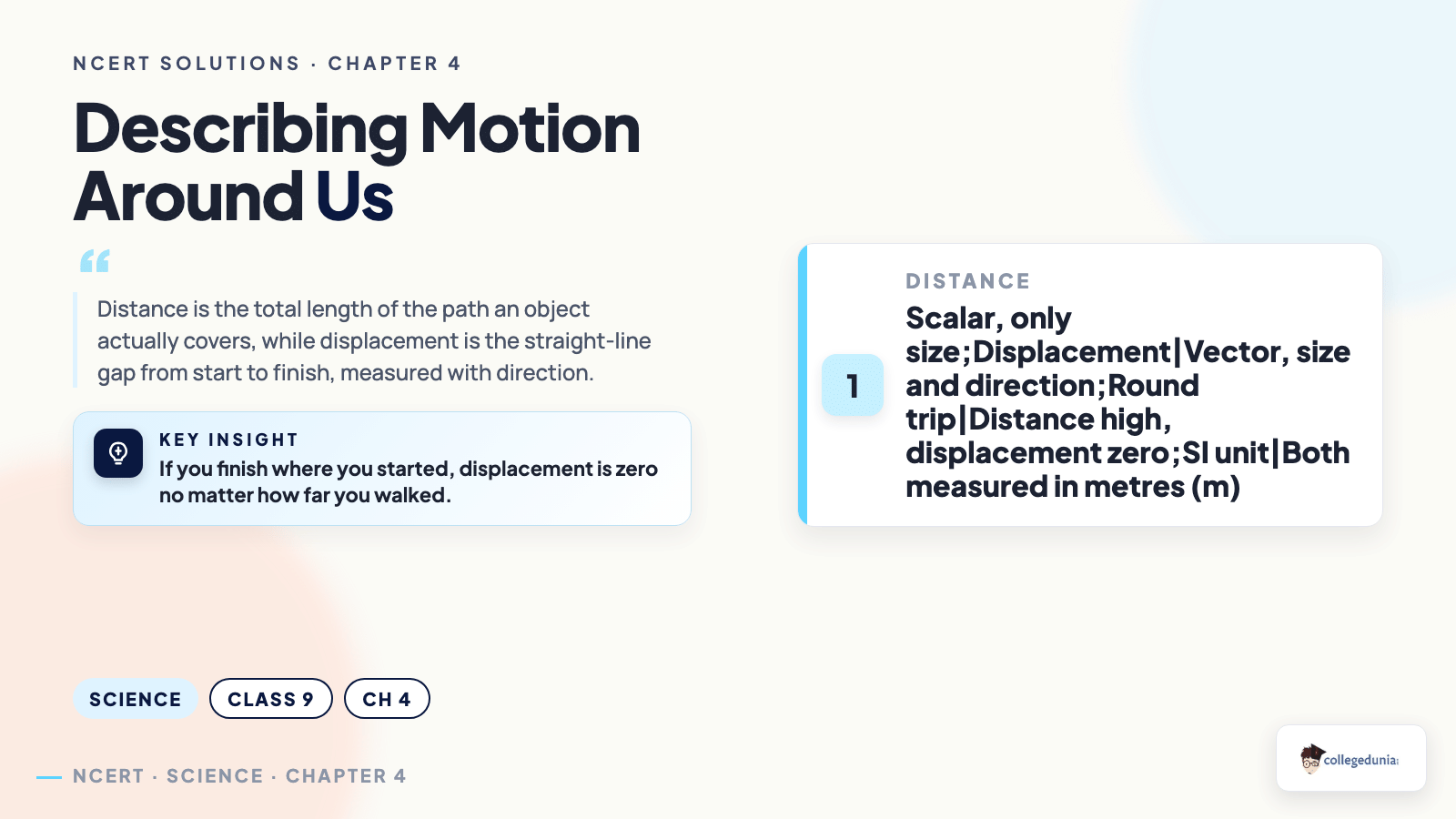
Ans. Distance is the total length of the path an object actually covers, and it is always positive. Displacement is the straight-line gap from the start point to the end point, measured with direction. On a round trip the distance is large but the displacement is zero.
Ques. Can an object accelerate at constant speed in Describing Motion Around Us?
Ans. Yes. Velocity has both size and direction, so a body turning at a steady speed is still accelerating because its direction keeps changing. This is why a scooter on a bend accelerates even when the speedometer reading stays the same.
Ques. What are the three equations of motion used in Class 9 Chapter 4?
Ans. The three equations for constant acceleration are v = u + at, s = ut + ½at², and v² = u² + 2as. Here u is the initial velocity, v is the final velocity, a is the acceleration, s is the distance, and t is the time. Choose the equation by which quantity is missing.
Ques. How do I find displacement from a velocity-time graph?
Ans. The displacement equals the area between the line and the time axis. Split the shape into a triangle, a rectangle, and a trapezium, find each area, and add them. The solved graph questions on this page show this method in full.
Ques. How do I change km/h into m/s for these numericals?
Ans. Multiply the speed in km/h by 5/18 to get m/s. For example, 36 km/h becomes 10 m/s. Always convert before you use any equation of motion, because time in these questions is measured in seconds.
Ques. Why can the same object be both at rest and in motion?
Ans. Rest and motion are always measured against a reference point. A book on a table is at rest compared to the ground but moving compared to the Sun, because the Earth carries it around the Sun. There is no absolute rest.
Ques. Are these Class 9 Science Chapter 4 solutions based on the new Exploration textbook?
Ans. Yes. All 16 solutions follow the 2026-27 Exploration textbook of Science for Grade 9, where the end-of-chapter exercise is called Revise, Reflect, Refine. The working, figures, and answers match the latest edition.
Ques. What is acceleration in Describing Motion Around Us?
Ans. Acceleration is the rate of change of velocity, written as a = (v - u) / t. It is measured in metres per second squared. A positive value means speeding up, and a negative value means slowing down.
Ques. How is velocity different from speed?
Ans. Speed is only the size of how fast an object moves, so it is a scalar. Velocity is speed together with a direction, so it is a vector. A speedometer shows speed, not velocity, which is why a turning vehicle can accelerate at constant speed.



Comments