




The NCERT Solutions for Class 9 Science Chapter 13 Earth as a System Energy, Matter, and Life cover every question from the Revise, Reflect, Refine exercise, according to the latest 2026-27 syllabus. This page solves all 15 questions in plain, step-by-step language. Each answer is based on the idea that the Earth is one connected system of five spheres, held together by biogeochemical cycles and the greenhouse effect. You get albedo, winds, ocean currents, the water, carbon, nitrogen and oxygen cycles, and climate change in one place.
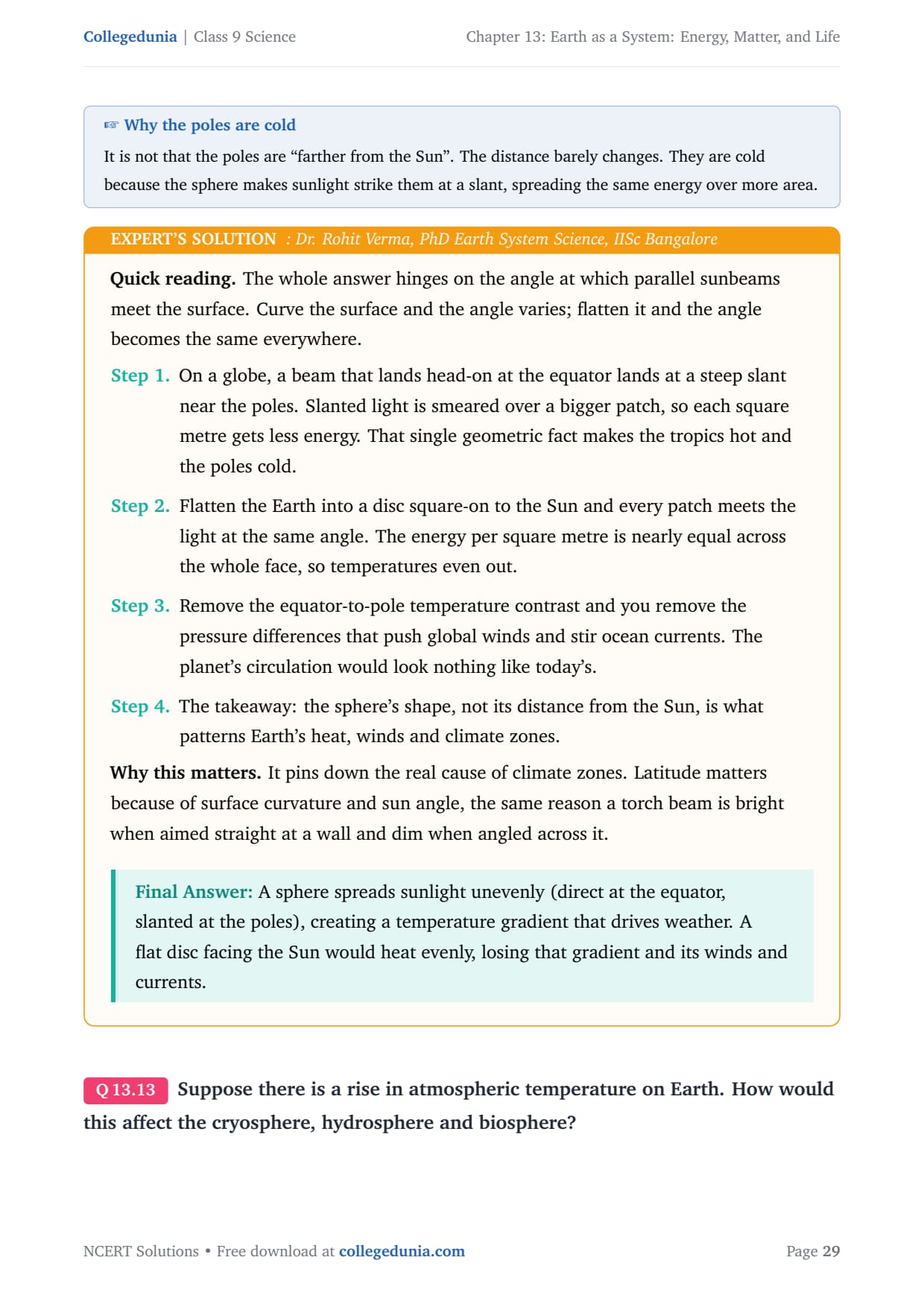
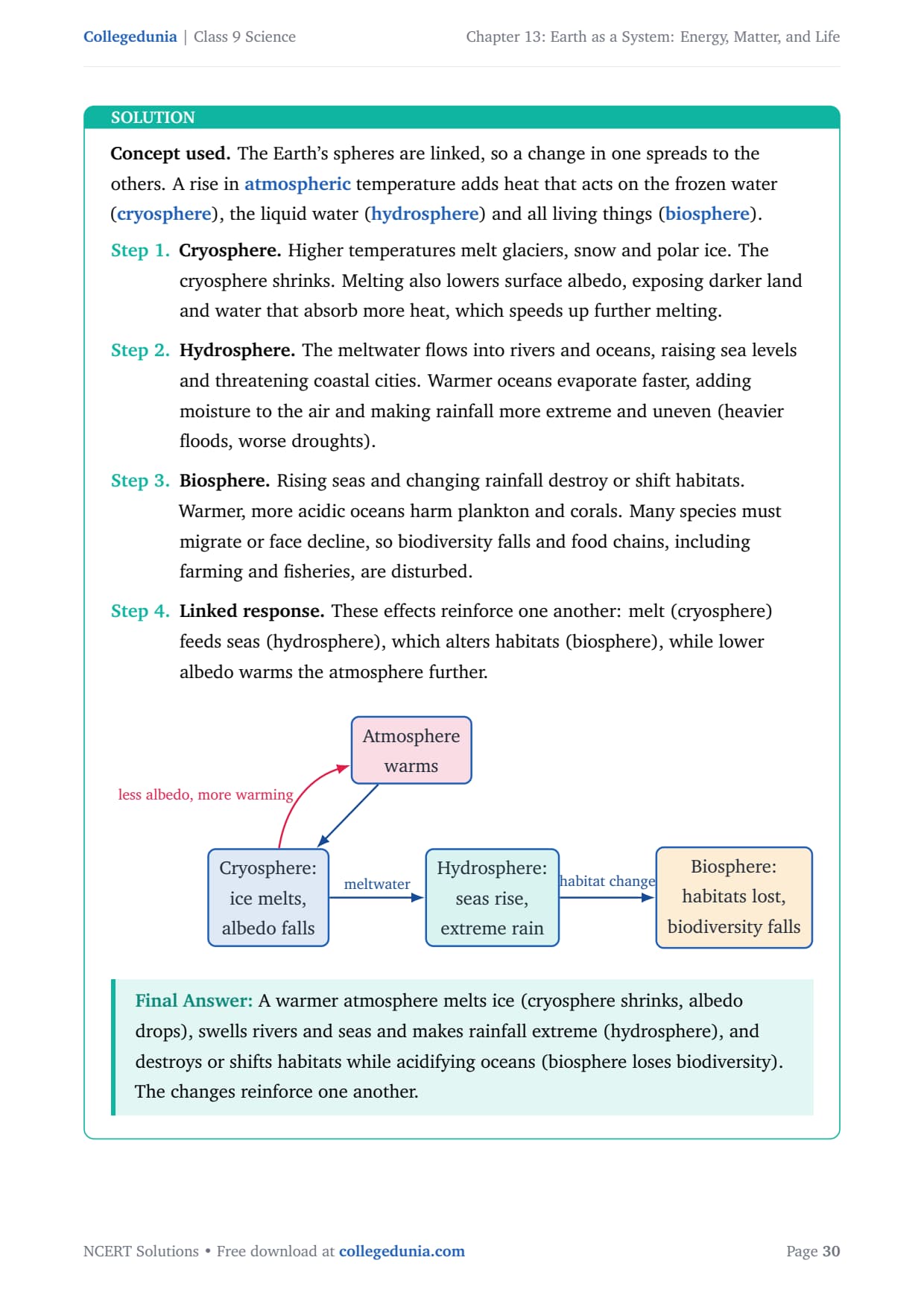
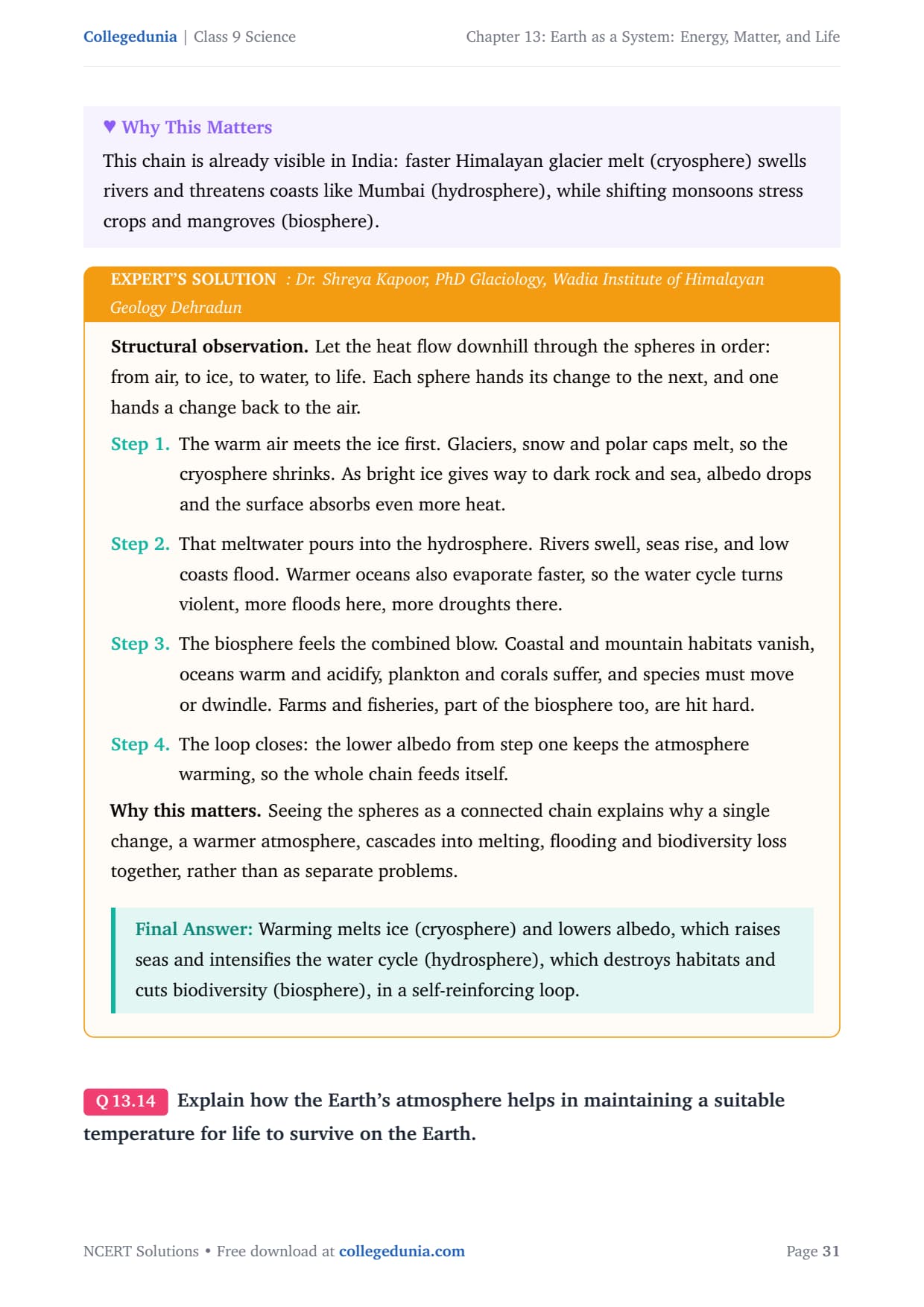
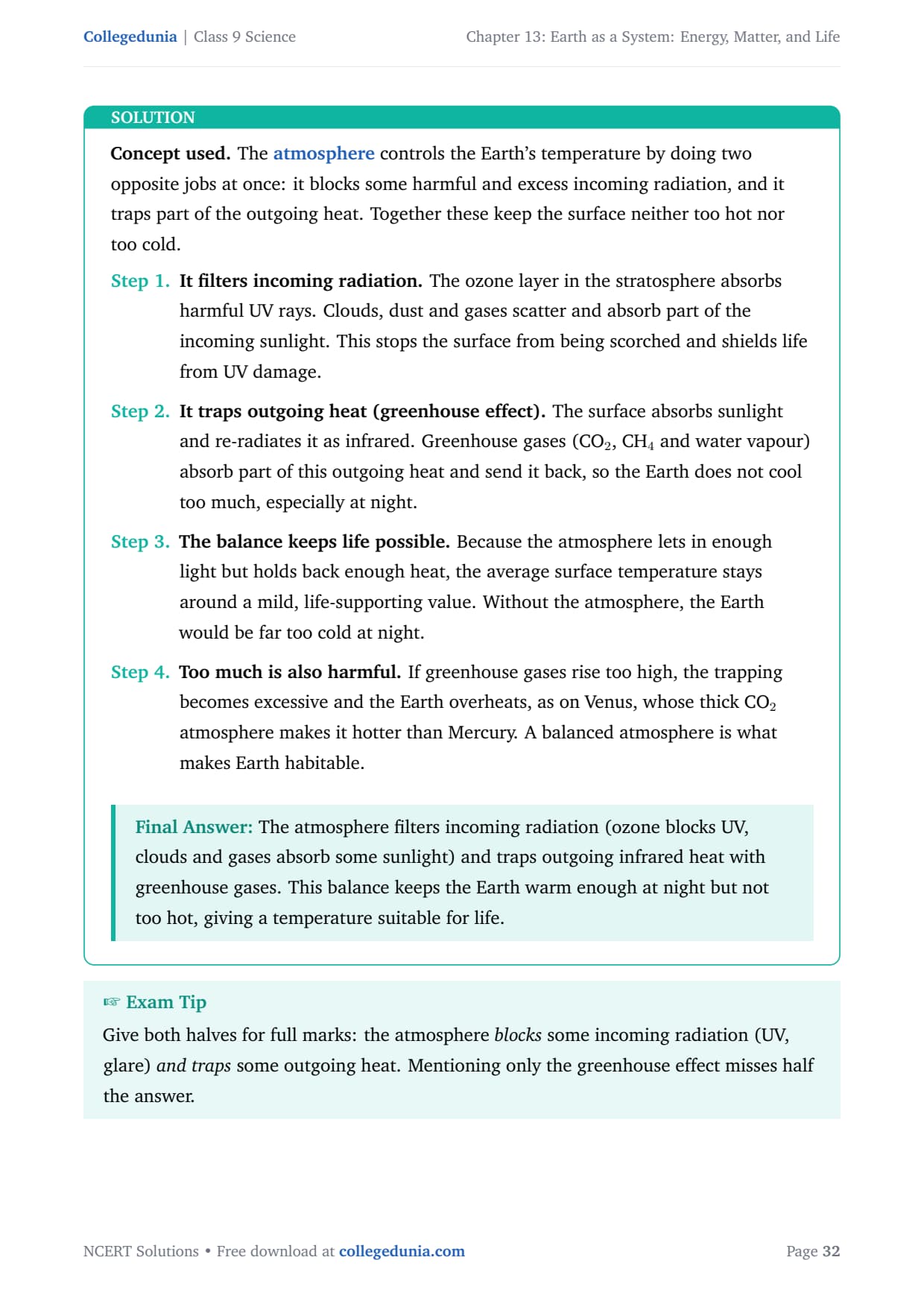
These NCERT Solutions for Class 9 Science Chapter 13 are prepared by subject experts, based on the 2026-27 NCERT Exploration textbook, and checked against the official NCERT answer key.
- 15 solved questions from the Revise, Reflect, Refine exercise, covering Earth's spheres, the four biogeochemical cycles, and the greenhouse effect.
- Every answer names the concept used first, then explains the reasoning in short steps, so nothing is skipped.
- Based on the new 2026-27 NCERT Exploration textbook, with an expert method added to each question.
Student Feedback
In a Collegedunia poll of 13,180 Class 9 students taken before the 2026 exams, 68% said they most often mixed up the carbon cycle with the nitrogen cycle in this chapter. Most students rated the reasoning questions on albedo and the greenhouse effect as the hardest part. Students who solved all 15 Revise, Reflect, Refine questions said they felt the most confident on exam day.
Source: 2026-27 Class 9 Science student poll. Sample of 13,180 students from CBSE schools across 14 states.
Earth as a System Class 9 Explained in Simple Language
Source: Magnet Brains on YouTube
This video explains the biogeochemical cycles and the Earth system before you start the exercise. Watch it once, then use the step-by-step solutions below to practise each question. The video and these solutions together cover Earth's five spheres, the water, carbon, nitrogen and oxygen cycles, and the greenhouse effect.
How Collegedunia's Class 9 Earth as a System NCERT Solutions Help You
Chapter 13 is more about clear ideas than about numbers. Most questions ask you to reason, not to calculate. These solutions make each question easy to understand and easy to score.
- 2026-27 NCERT alignment: Every answer is based on the new Exploration textbook and the official NCERT answer key.
- Concept first: Each solution begins by naming the exact idea it uses, such as albedo, a biogeochemical cycle, or the greenhouse effect.
- Reasoning shown in steps: Long-answer questions are broken into short steps, so you never lose method marks.
- Expert method added: A second, simpler way to think about each question is given below the main solution.
Earth's Five Spheres and How They Interact in Class 9 Science
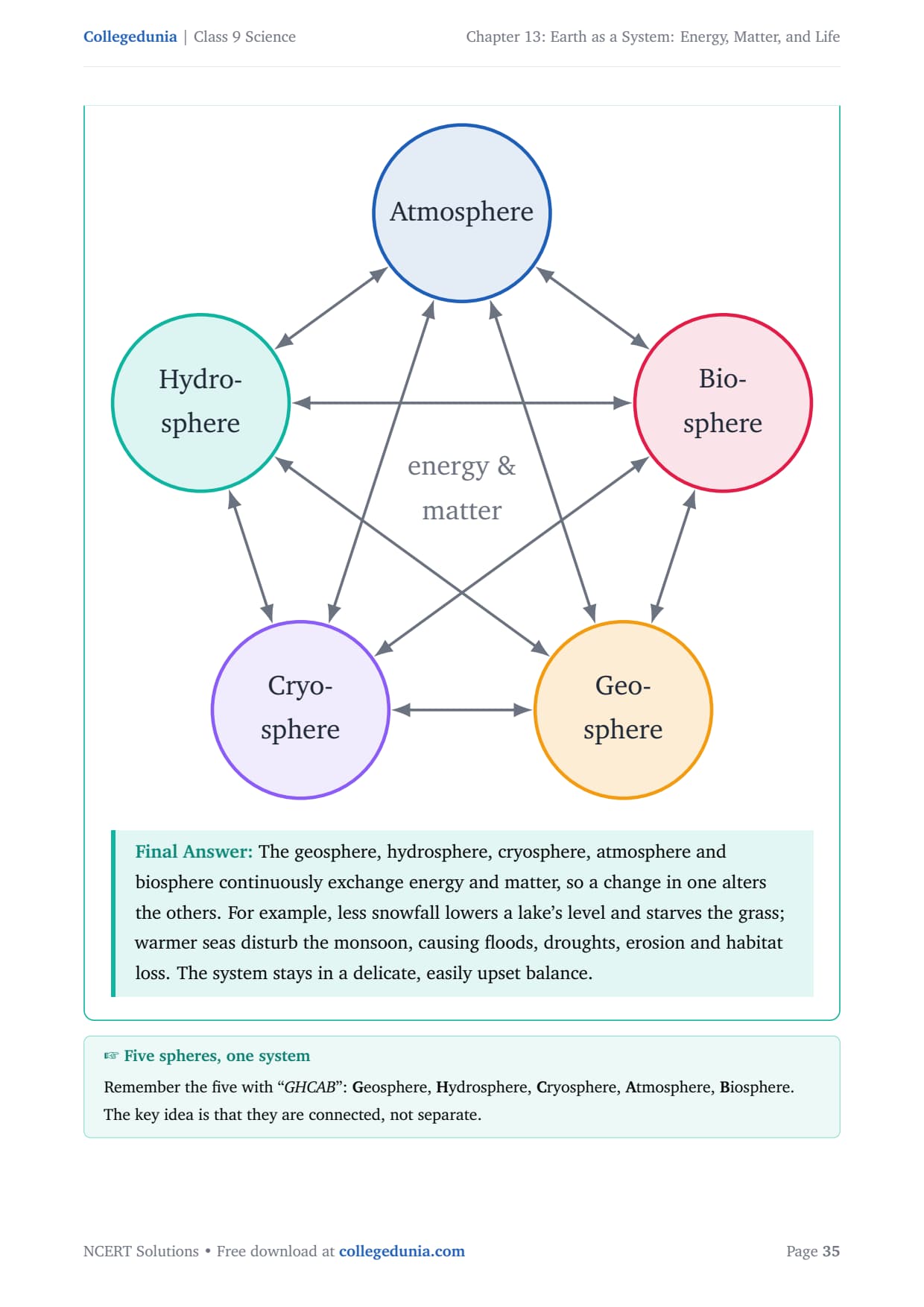
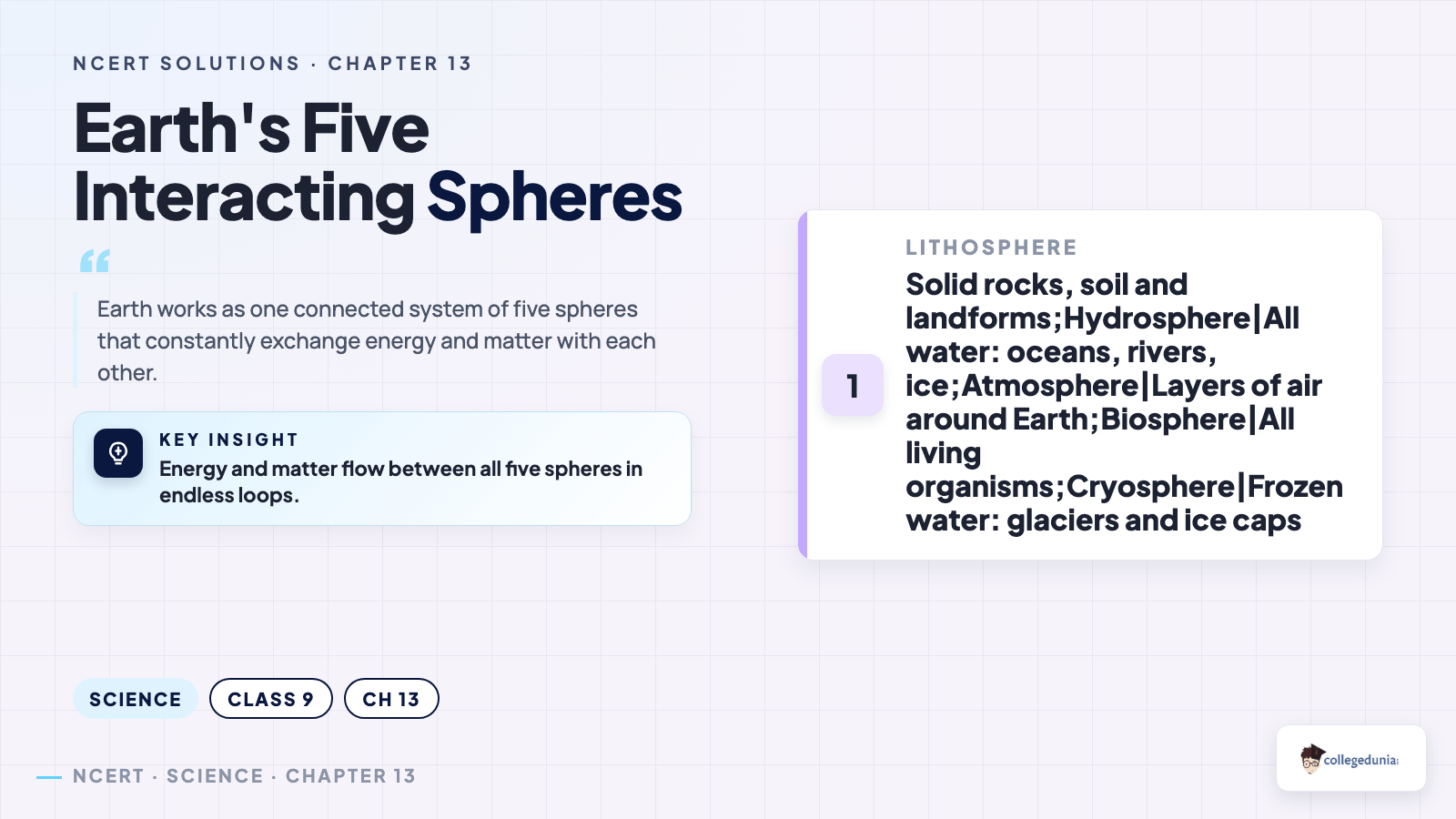
The chapter treats the whole Earth as one connected system. It has five parts, called spheres, that constantly swap energy and matter. Knowing these five spheres makes the rest of the chapter easy.
| Sphere | What it is | Example |
|---|---|---|
| Lithosphere | The solid outer Earth | Rocks, soil, mountains. |
| Hydrosphere | All the water on Earth | Oceans, rivers, groundwater. |
| Atmosphere | The layers of air around Earth | Oxygen, carbon dioxide, water vapour. |
| Biosphere | All living organisms | Plants, animals, microbes. |
| Cryosphere | The frozen water on Earth | Glaciers, ice caps, snow. |
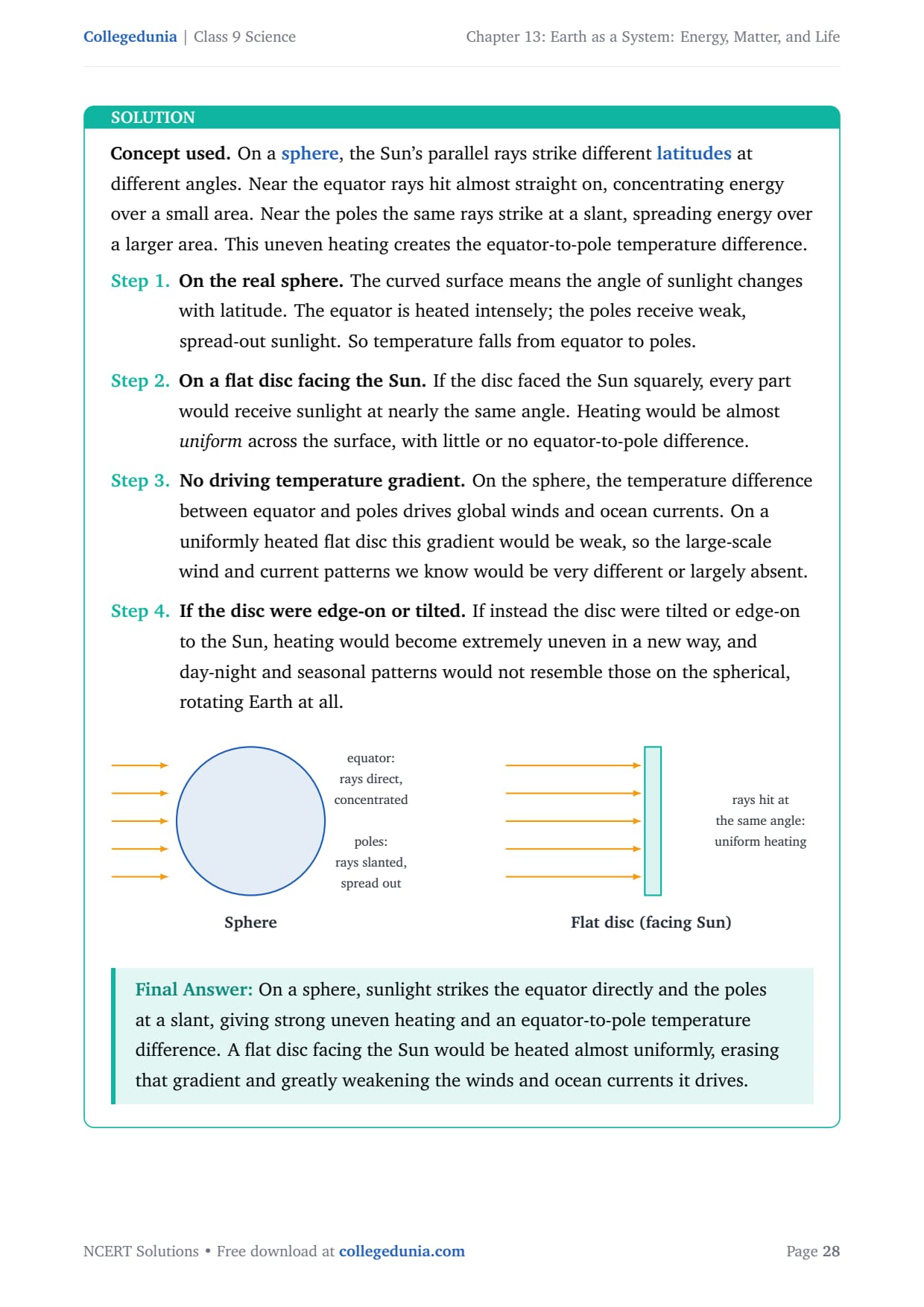
Energy from the Sun drives the whole system. Uneven heating of the Earth, measured by albedo, sets up the winds and ocean currents that move heat around the planet.
Revise, Reflect, Refine Exercise Breakdown for Class 9 Science Chapter 13
The Chapter 13 exercise is called Revise, Reflect, Refine and has 15 questions. The table shows what each question tests, so you can plan your practice.
| Questions | Type | What it tests |
|---|---|---|
| 1 to 3 | MCQ and reasoning | Role of biogeochemical cycles, albedo, and Earth's spheres. |
| 4 to 6 | Short answer | Atmospheric layers, uneven heating, and local winds. |
| 7 to 9 | Diagram based | Ocean currents, valley and mountain breezes, the water cycle. |
| 10 to 12 | Long answer | Carbon, nitrogen and oxygen cycles and how they link. |
| 13 to 15 | Graph and reasoning | Greenhouse effect, the Keeling curve, and human impact. |
Start with the definition and MCQ questions, then move to the cycle diagrams. All 15 fully solved answers, with an expert method for each, are given lower down this page.
Biogeochemical Cycles in Class 9 Science: Water, Carbon, Nitrogen and Oxygen
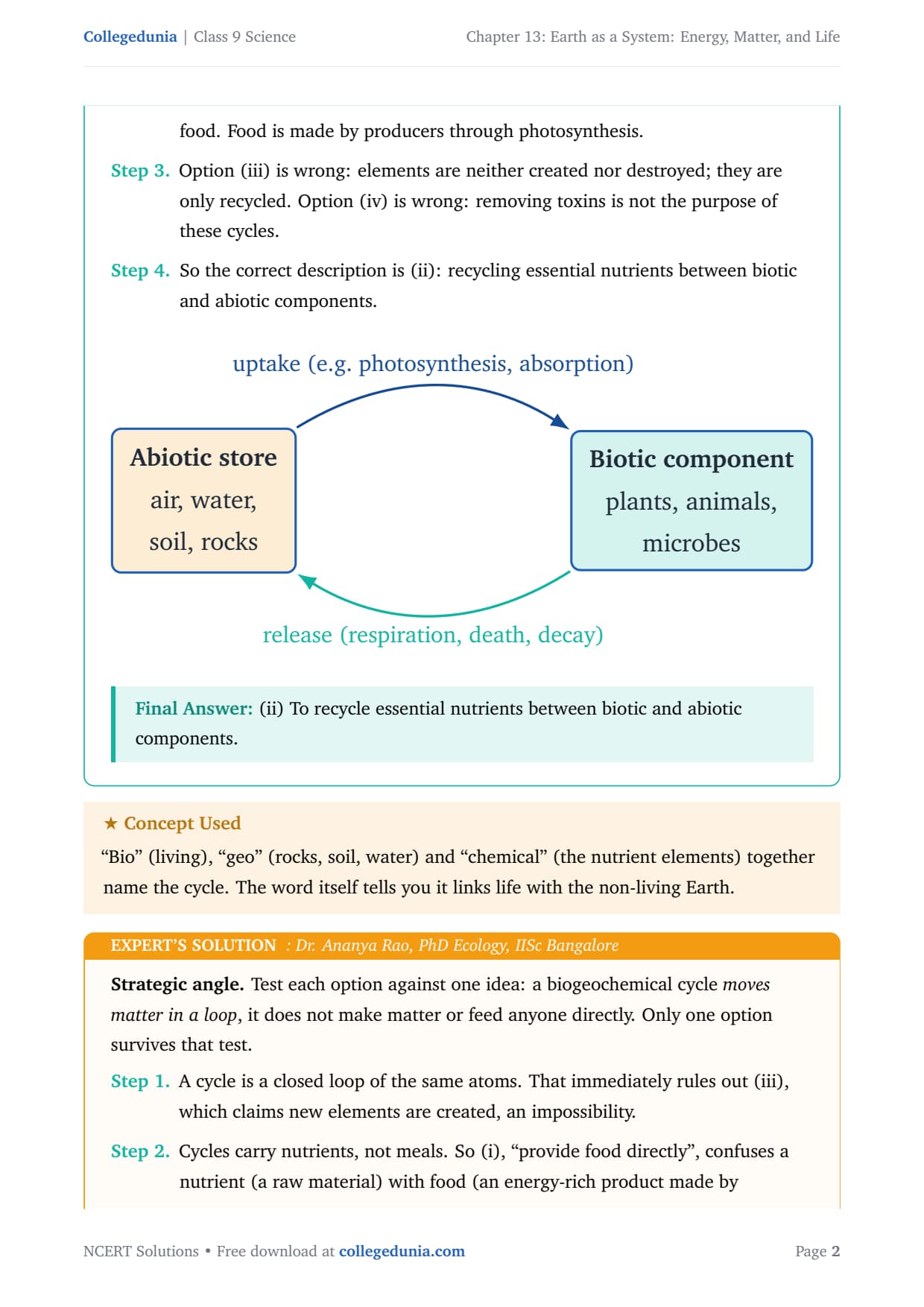
A biogeochemical cycle is the movement of a nutrient in a loop between the living (biotic) and non-living (abiotic) parts of the Earth. The same atoms are used again and again, so nothing runs out. Four cycles are tested in this chapter.
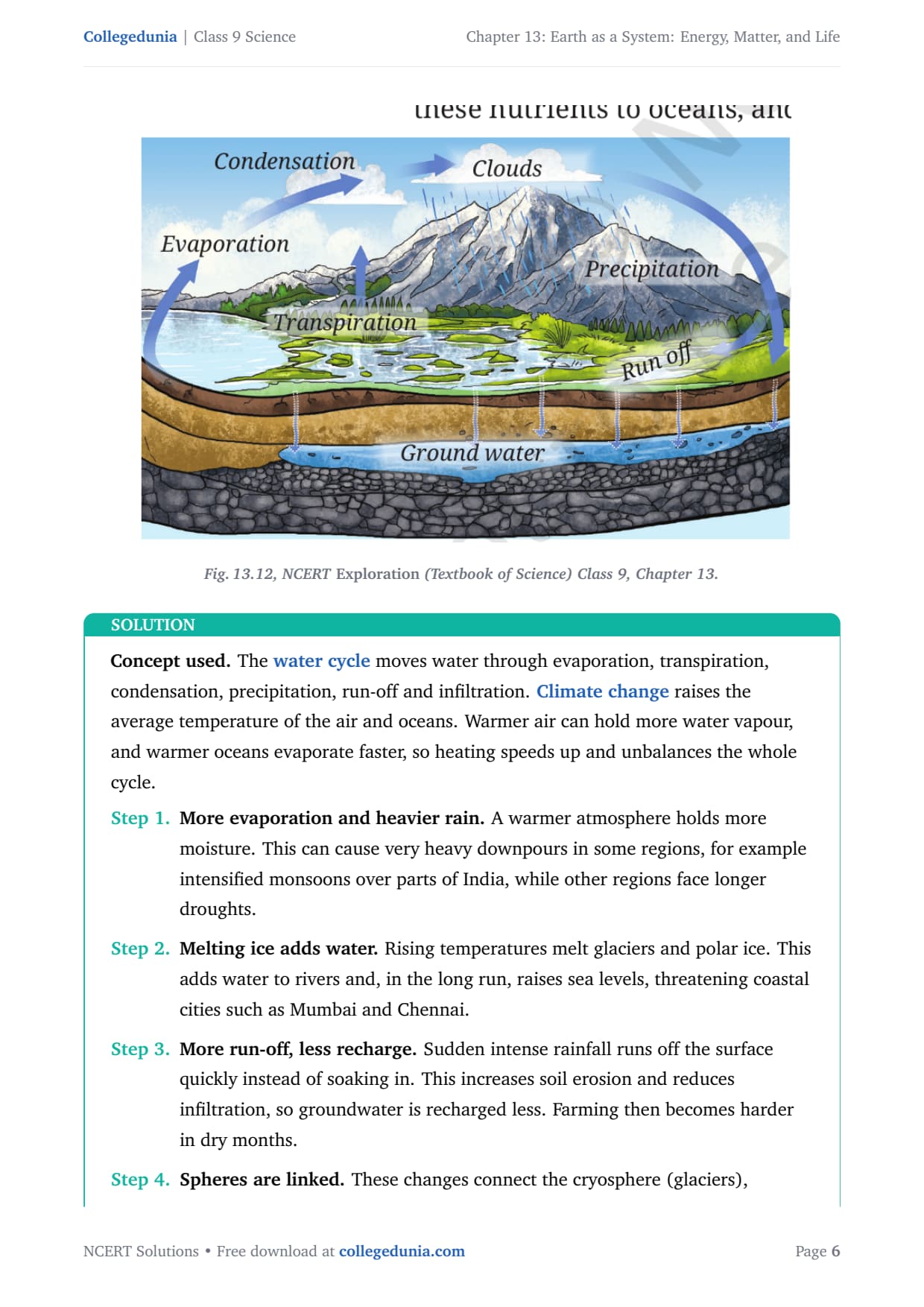
- Water cycle: water moves through evaporation, condensation, rain, and flow back to the sea.
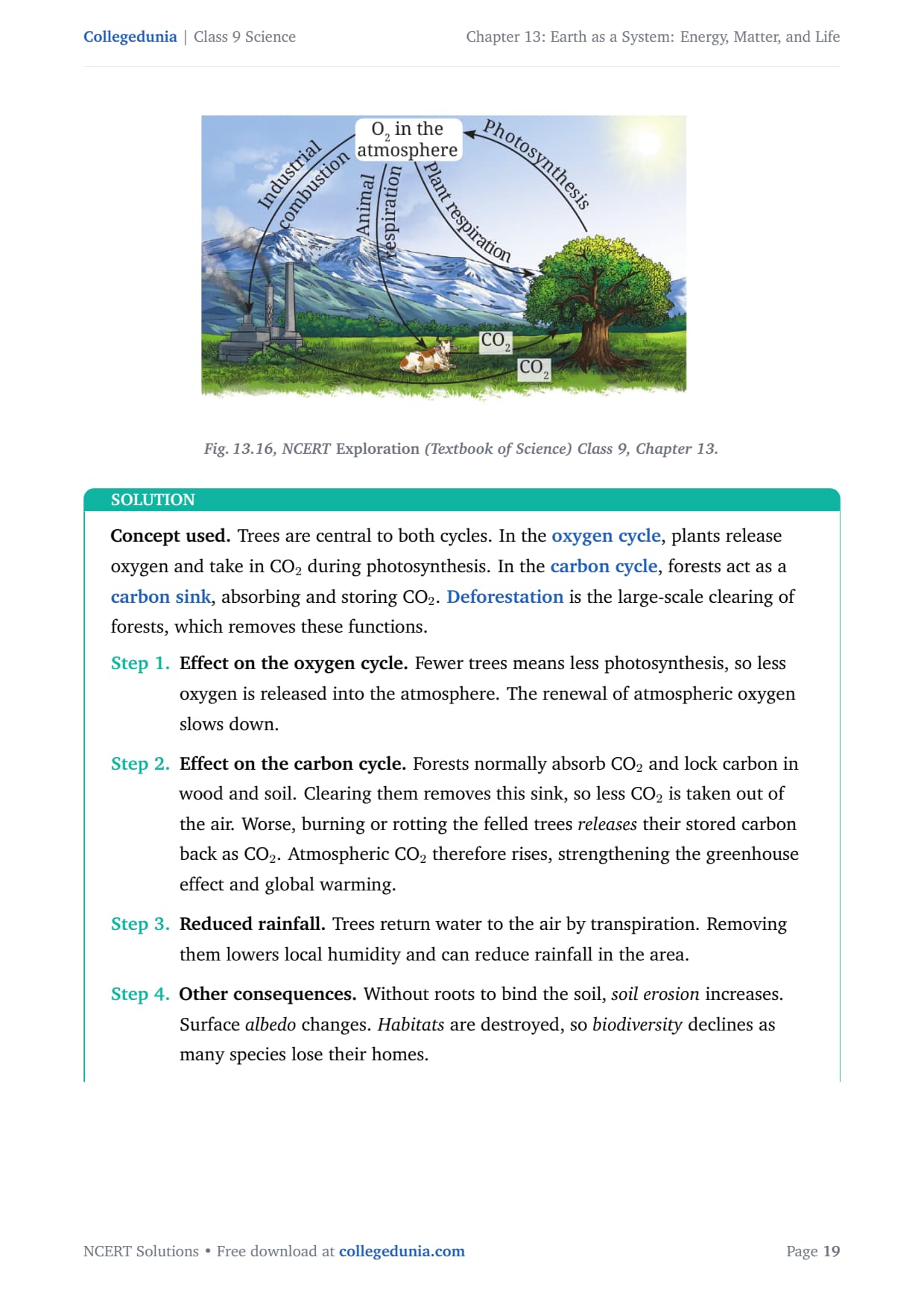
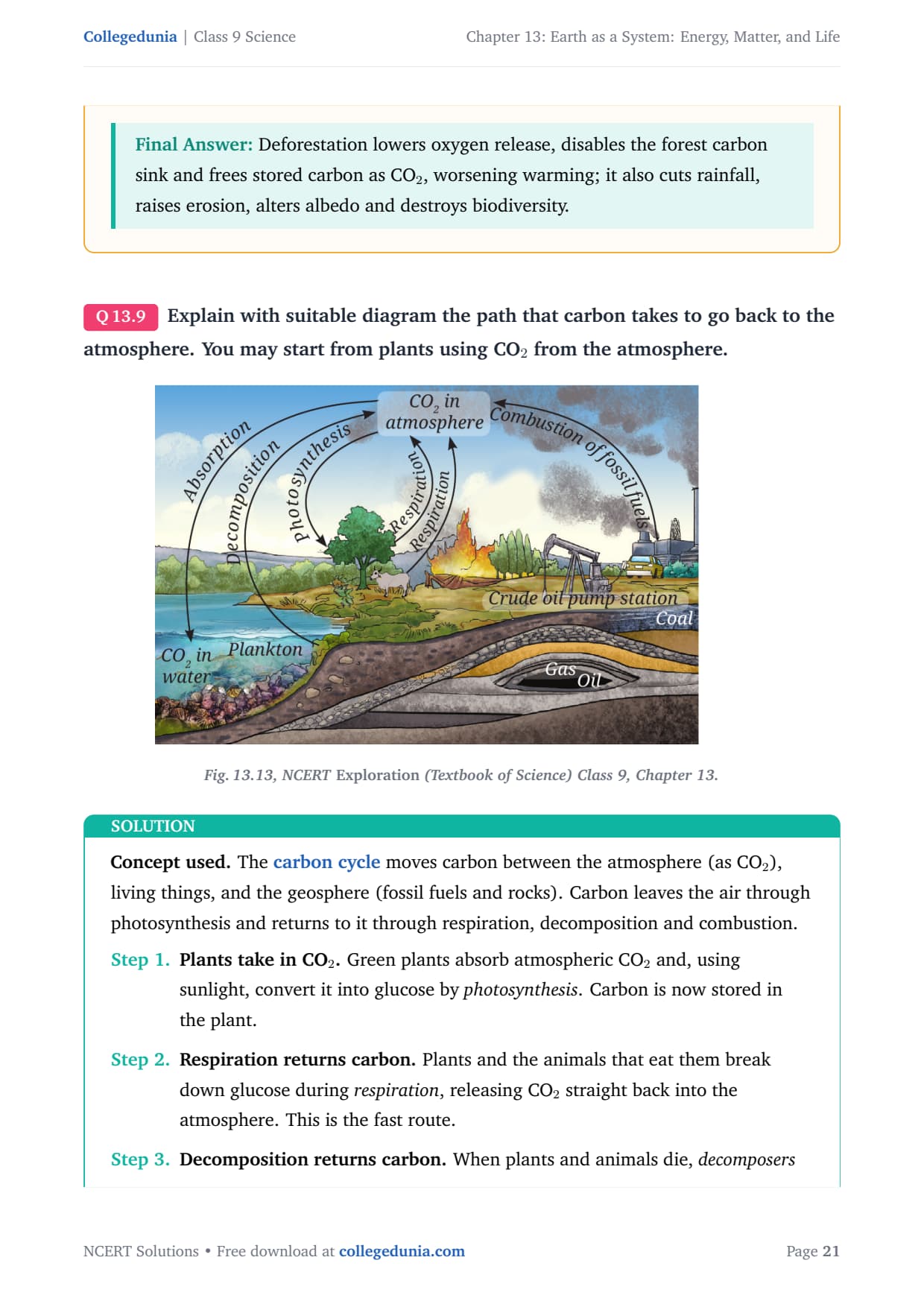
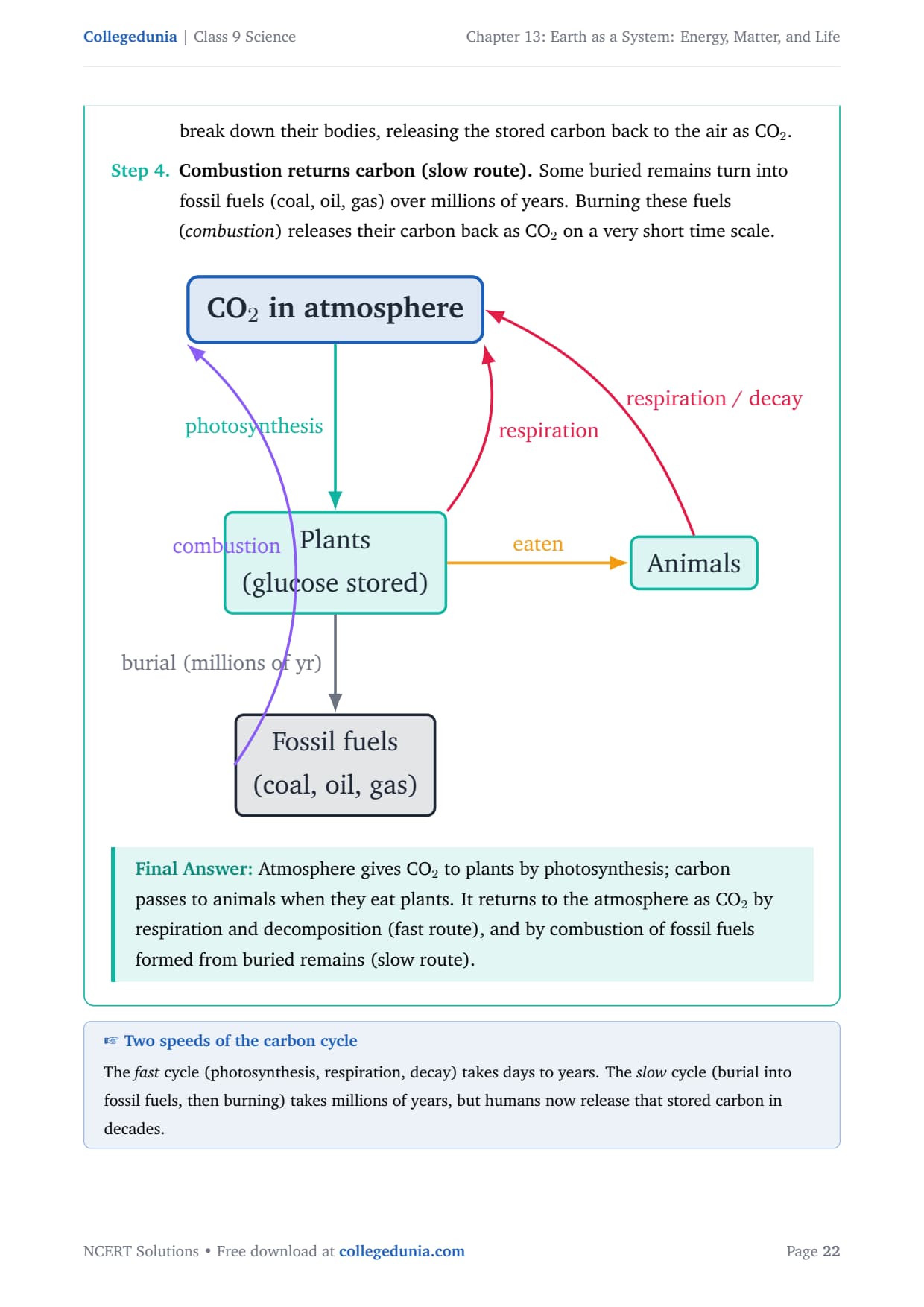
- Carbon cycle: carbon moves between air, plants, animals and fuels through photosynthesis, respiration and burning.
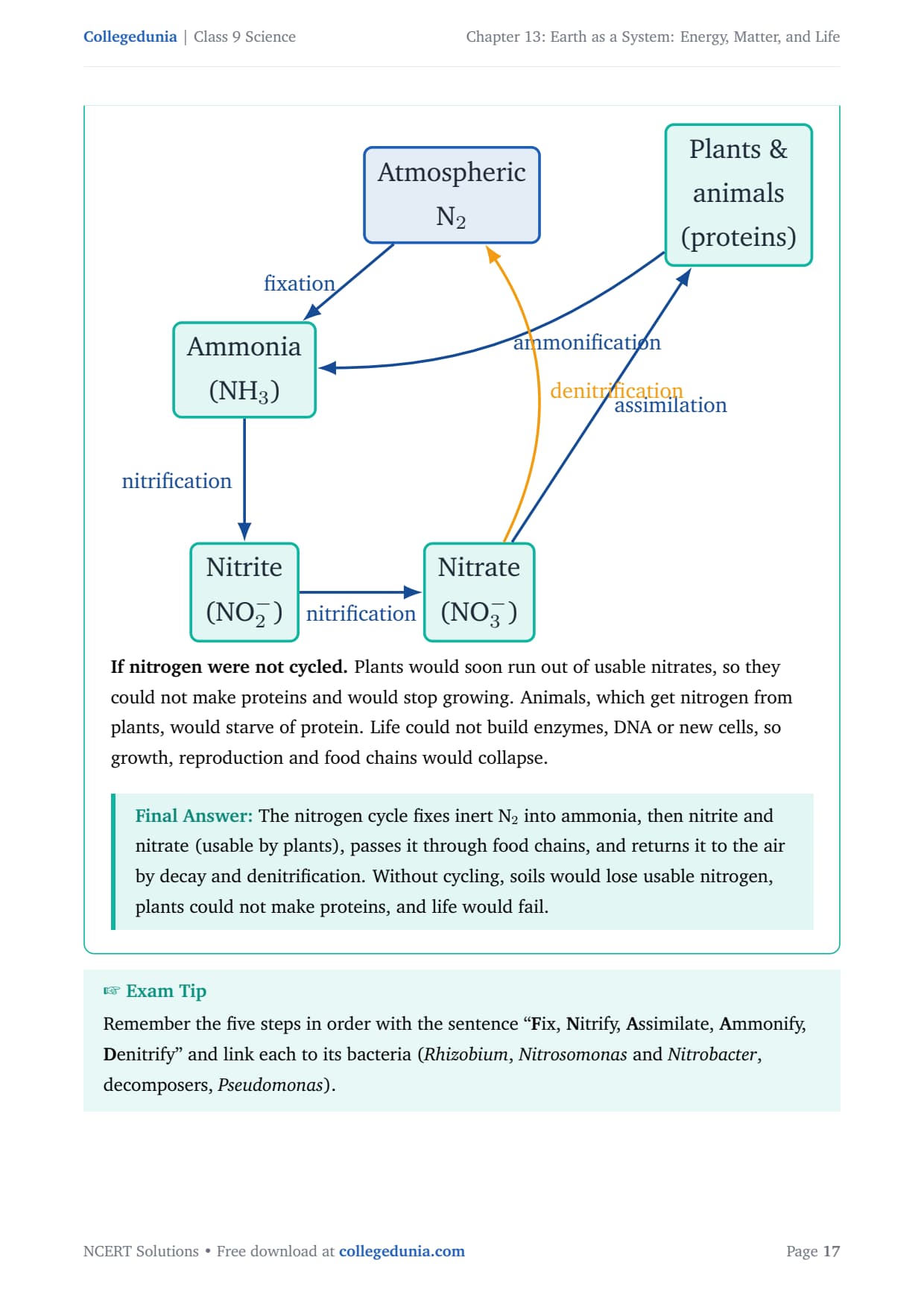
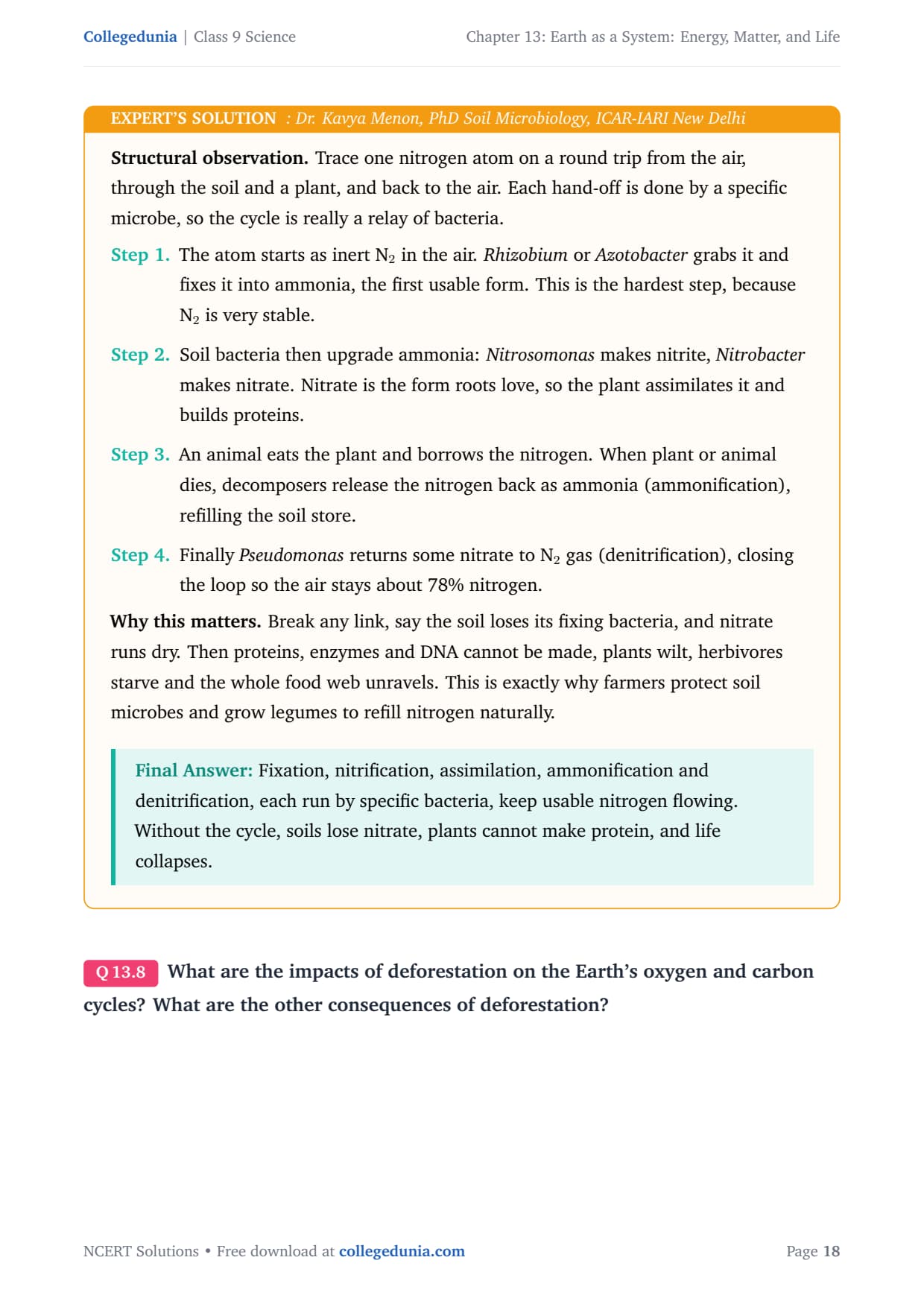
- Nitrogen cycle: nitrogen gas is fixed into the soil, used by plants, and returned to the air by bacteria.
- Oxygen cycle: oxygen is released by photosynthesis and used up in respiration and burning.
These cycles are the heart of the chapter. No new atoms are ever made; the cycles only move the same matter around, keeping ecosystems running.
The Greenhouse Effect and Climate Change in Class 9 Science
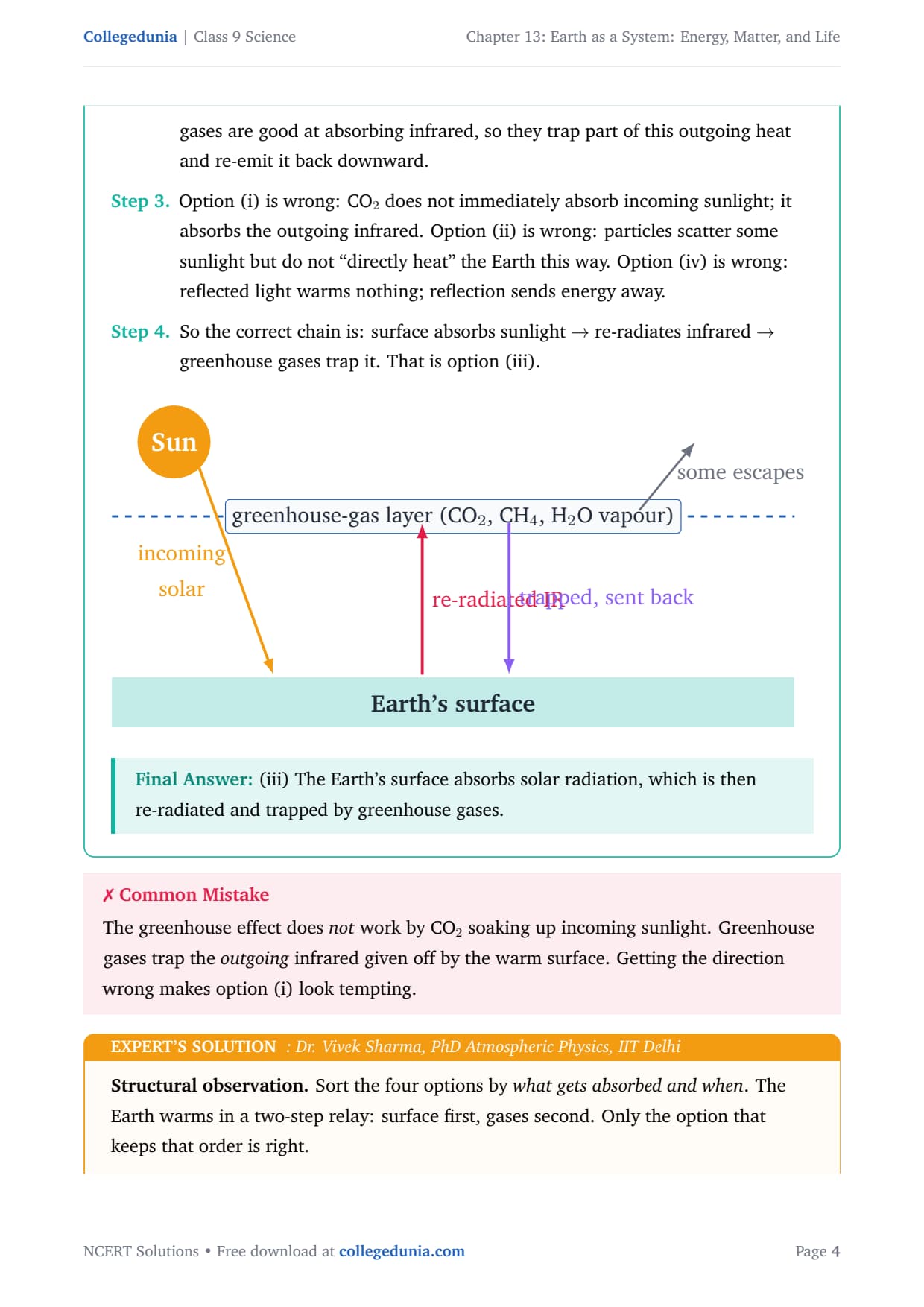
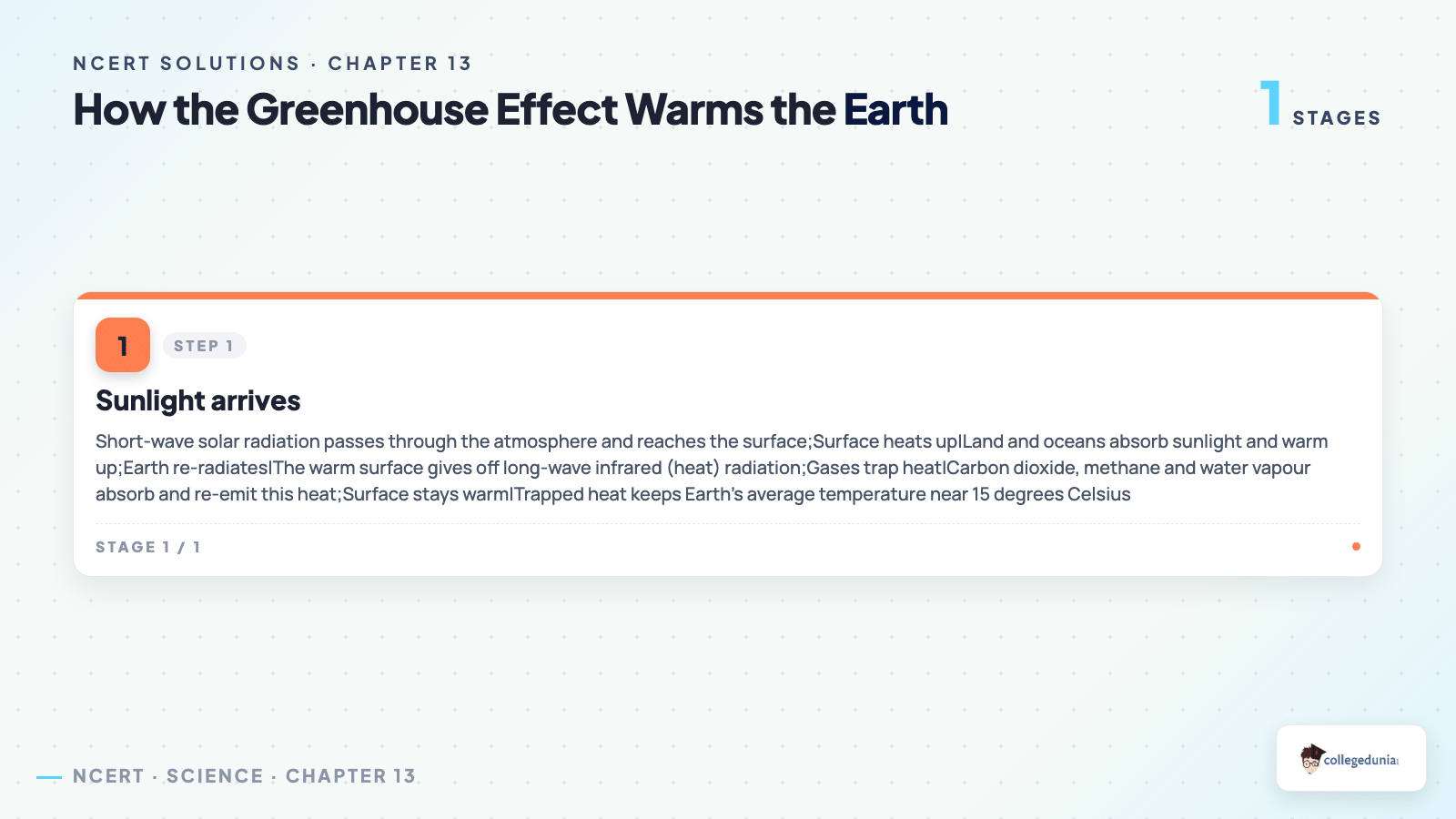
The greenhouse effect is what keeps the Earth warm enough for life. Without it, the planet would be far too cold. Questions 13 to 15 are all built on this idea.
- Sunlight passes through the air and warms the land and oceans.
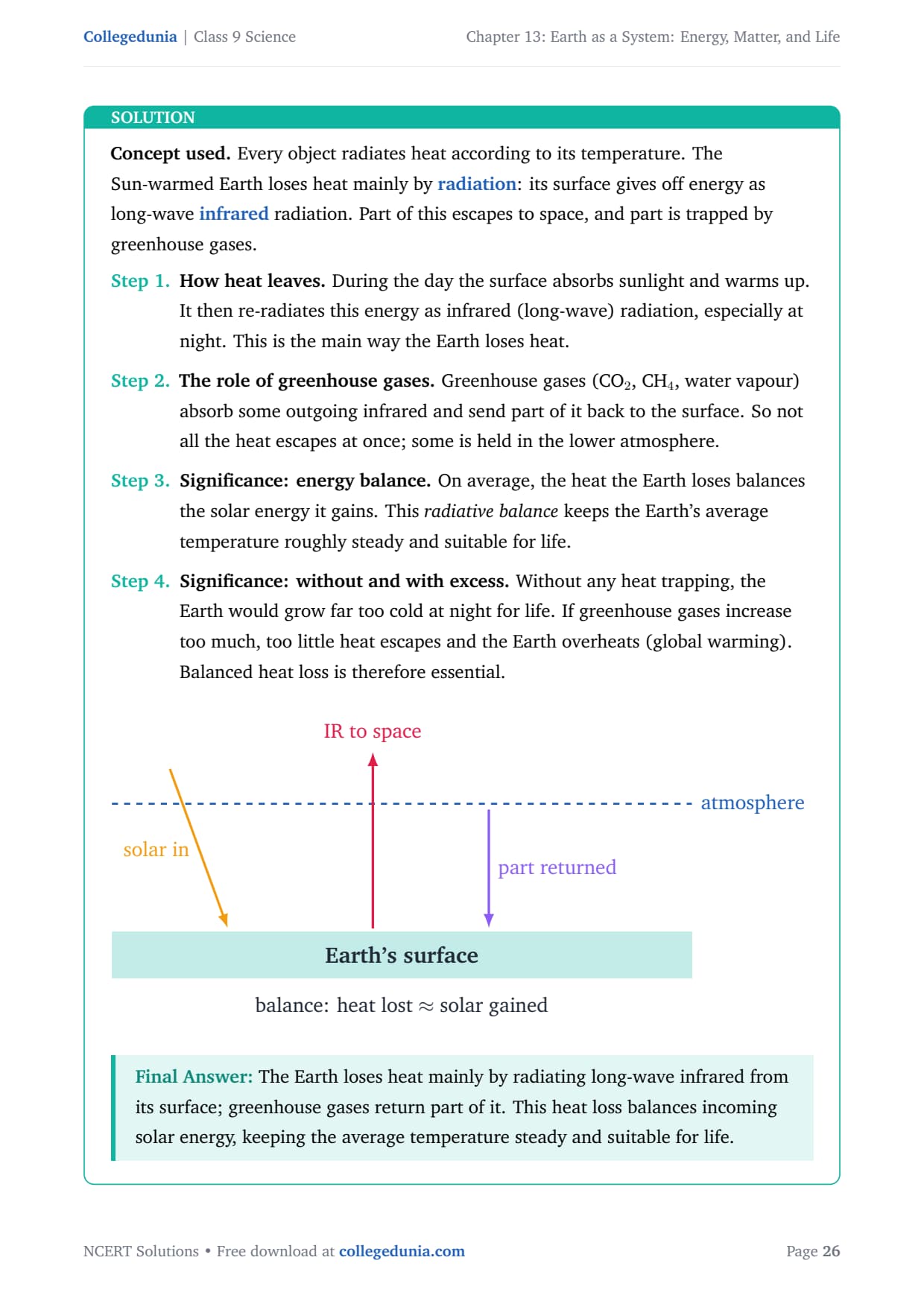
- The warm surface gives off heat as infrared radiation.
- Greenhouse gases like carbon dioxide, methane and water vapour trap part of this heat.
- Burning fuels adds extra carbon dioxide, which traps more heat and drives climate change.
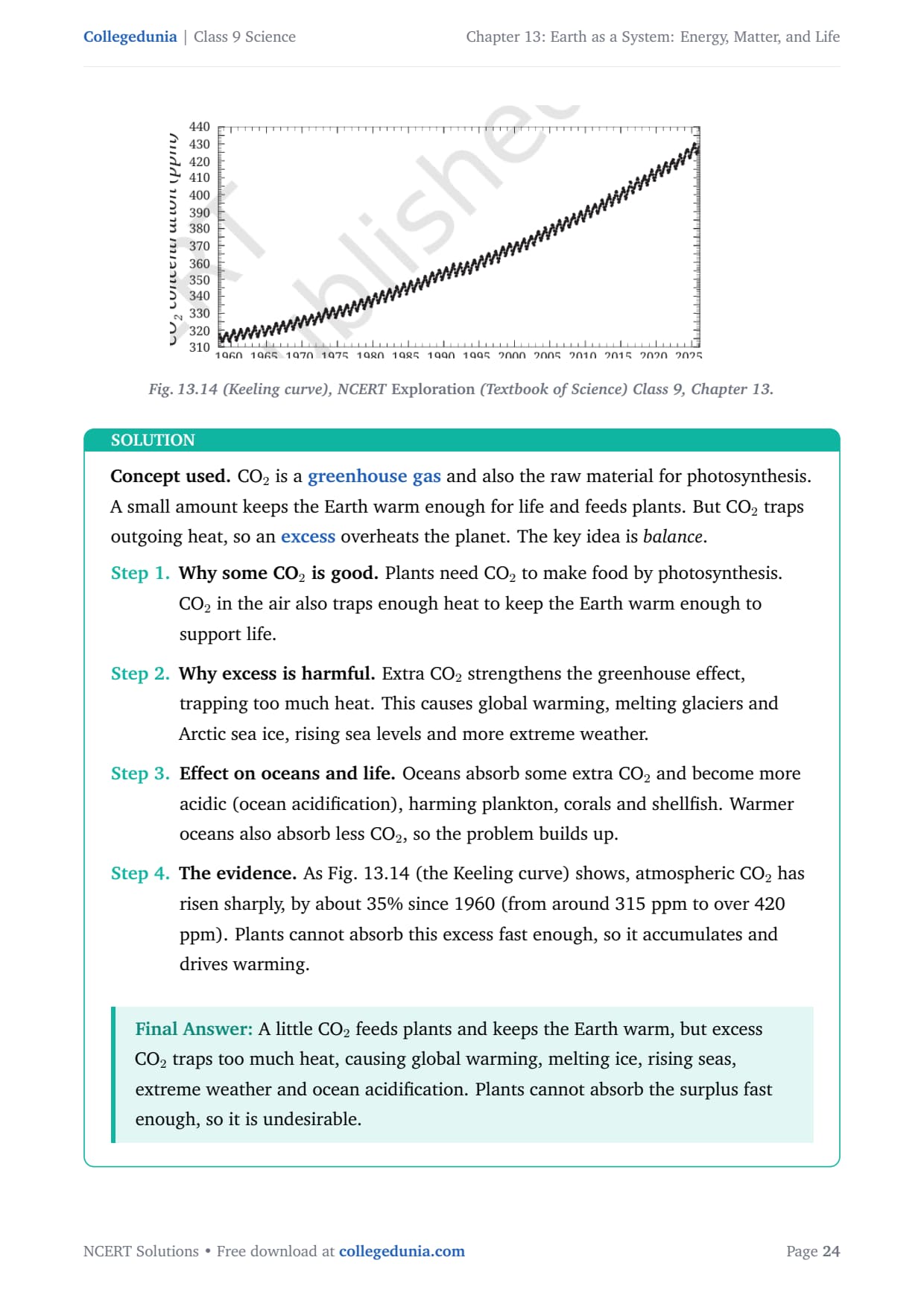
The Keeling curve in Figure 13.14 shows carbon dioxide rising year after year. This rise is the main human impact on the Earth system that the chapter asks you to explain.
Earth as a System Weightage for the Class 9 Science Exam
Chapter 13 sits in the biology and environment part of Class 9 Science. It carries steady marks each year, mostly through reasoning and diagram questions. The table compares it with nearby chapters.
| Chapter | Topic | Typical marks |
|---|---|---|
| Chapter 11 | Reproduction: How Life Continues | 4 to 6 marks |
| Chapter 12 | Patterns in Life: Diversity and Classification | 5 to 6 marks |
| Chapter 13 | Earth as a System: Energy, Matter, and Life | 5 to 7 marks |
Because the diagrams and cycles repeat every year, this chapter is one of the safest places to score full marks with a little practice.
Common Mistakes Students Make in the Earth as a System Chapter
Watch out for these slips:
- Saying a biogeochemical cycle makes new elements. Cycles only move the same atoms; they never create matter.
- Mixing up the carbon and nitrogen cycles. Carbon rides on photosynthesis and respiration; nitrogen depends on bacteria.
- Confusing weather with climate. Weather is day to day, while climate is the long-term average.
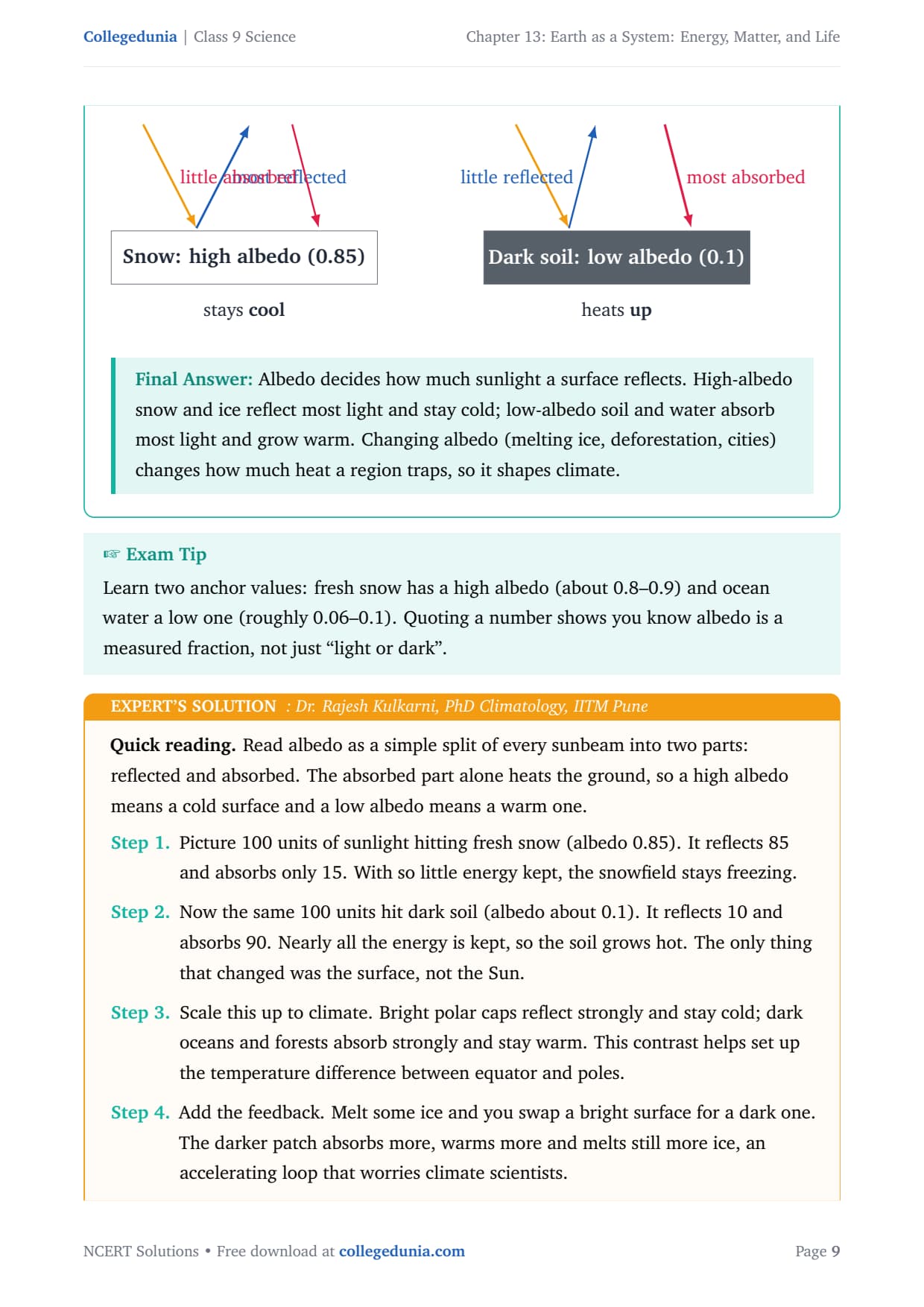
- Thinking high albedo means more heating. High albedo, like snow, reflects sunlight and stays cool.
Solved Example: Naming the Energy and Matter Flow in a Biogeochemical Cycle
Explain how carbon moves from the air into an animal and back again. This follows the same reasoning pattern used in Questions 10 to 12 of the exercise.
- Carbon enters plants: green plants take in carbon dioxide from the air and fix it into food during photosynthesis.
- Carbon moves to animals: animals eat the plants, so the carbon passes into their bodies.
- Carbon returns to the air: animals and plants release carbon dioxide during respiration, and decay returns the rest.
- The loop closes: the same carbon atoms are used again, which is why it is called a cycle.
Every cycle question in this chapter follows this same pattern: name the store, name the process that moves the matter, and show how it returns.
How to Use the Class 9 Earth as a System Solutions Most Effectively
Use a simple three-step routine so the cycles and diagrams stay in your memory until the exam.
- Learn the five spheres and four cycles first, and draw each cycle once from memory.
- Attempt each question yourself, then compare with the step-by-step solution below.
- Redo the reasoning questions you got wrong two days later, without looking at the answer.
Pair this page with the chapter notes and handwritten notes for quick revision before the exam.
NCERT Class 9 Science Chapter 13 Other Study Resources
Use the other free resources for the same chapter alongside these solutions.
| Resource | Link |
|---|---|
| Revision Notes | Earth as a System Class 9 Notes |
| Handwritten Notes | Earth as a System Class 9 Handwritten Notes |
| NCERT Book PDF | Earth as a System Class 9 NCERT Book PDF |
NCERT Solutions for Class 9 Science: All Chapters
Find the step-by-step NCERT Solutions for the other Class 9 Science chapters below.
| Chapter | Resource |
|---|---|
| Chapter 8 | Journey Inside the Atom NCERT Solutions |
| Chapter 9 | Atomic Foundations of Matter NCERT Solutions |
| Chapter 10 | Sound Waves Characteristics and Applications NCERT Solutions |
| Chapter 11 | Reproduction How Life Continues NCERT Solutions |
| Chapter 12 | Patterns in Life Diversity and Classification NCERT Solutions |
| Chapter 13 | Earth as a System Energy, Matter, and Life NCERT Solutions |
Earth as a System Energy, Matter, and Life Class 9 Science NCERT Solutions FAQs
Ques. Where can I download the Earth as a System Class 9 Science NCERT Solutions PDF?
Ans. You can download the Earth as a System Energy, Matter, and Life Class 9 Science NCERT Solutions PDF free from this page. Both a normal and an HD version are available.
Ques. How many questions are solved in Class 9 Science Chapter 13?
Ans. All 15 questions from the Revise, Reflect, Refine exercise are solved, each with a step-by-step method and an expert method.
Ques. Are these solutions aligned with the 2026-27 NCERT?
Ans. Yes. Every answer is based on the new 2026-27 NCERT Exploration textbook for Class 9 Science and the official NCERT answer key.
Ques. What is a biogeochemical cycle in Class 9 Science?
Ans. A biogeochemical cycle is the movement of a nutrient in a loop between living and non-living parts of the Earth. The same atoms are reused, so nutrients like carbon and nitrogen never run out.
Ques. What are the five spheres of the Earth system?
Ans. The five spheres are the lithosphere (rocks and soil), the hydrosphere (water), the atmosphere (air), the biosphere (living things), and the cryosphere (ice). They constantly exchange energy and matter.
Ques. How does the greenhouse effect work?
Ans. Sunlight warms the Earth's surface, which then gives off heat. Greenhouse gases like carbon dioxide and water vapour trap part of this heat, keeping the Earth warm enough for life.



Comments