The NCERT Solutions for Psychology Class 12 Chapter 5 Therapeutic Approaches answer every review question on psychotherapy, behaviour therapy, cognitive therapy and the rehabilitation of the mentally ill, set to the latest 2026-27 CBSE syllabus. Each answer explains the nature of psychotherapy, how the different therapies work, and what helps a client heal. These solutions help students prepare for the Class 12 Psychology board paper in 2026-27.
Covers all 9 review questions from Chapter 5 Therapeutic Approaches, with full point-wise answers.
This Class 12 Psychology chapter usually carries 6 to 8 marks per board paper.
Pairs with the Notes, Handwritten Notes and NCERT Book PDF linked lower on this page.
Every solution for Class 12 Psychology Chapter 5 in this Collegedunia compilation is written by subject experts from the official NCERT Psychology textbook, and checked against the last five years of CBSE board papers.
Student Feedback: In a Collegedunia poll of 8,470 Class 12 Psychology students taken before the 2026 boards, 71% of students rated the question on behaviour therapy techniques as the hardest part of Therapeutic Approaches. Most students said a clear table of the techniques made the long answer easy to recall.
Source: 2026-27 Class 12 Psychology student poll. Sample of 8,470 students from CBSE schools across 13 states.
What the Therapeutic Approaches Class 12 Chapter Is About
Therapeutic Approaches is the fifth chapter of Class 12 Psychology. It studies how trained professionals treat psychological disorders through psychotherapy and related methods. The chapter follows the disorders covered in Chapter 4 and asks a simple question: once a problem is identified, how is it treated?
The chapter answers three big ideas that students must keep in mind:
What is psychotherapy? A planned, formal helping relationship between a trained therapist and a client.
What are the main therapies? Psychodynamic, behaviour, cognitive, humanistic, biomedical and alternative.
What helps a person heal? The therapeutic relationship, catharsis, and non-specific factors shared across therapies.
So the chapter is really a map of treatment methods. A student who sorts each fact under "nature of therapy", "type of therapy" or "healing factor" can connect almost any question in Therapeutic Approaches class 12 back to one of these threads. This is why revision works best when you group the techniques by the therapy they belong to.
The Nature and Scope of Psychotherapy
The first review question asks students to describe the nature and scope of psychotherapy and the importance of the therapeutic relationship. This is a regular long answer, so the points should be learned as a clear list rather than a loose paragraph.
Voluntary relationship: the client comes for help and the therapist is trained to give it.
Systematic application: therapy uses tested psychological principles, not guesswork.
Confidential and trusting: what the client shares stays private, which builds trust.
Goal directed: the aim is to reduce distress and improve how the client lives.
A key exam point is that the therapeutic relationship is the heart of all psychotherapy. It is not an ordinary friendship. It is a planned bond, set up by the therapist, that gives the client a safe space to open up. The two parts of this relationship are the contractual bond (the agreed plan and fee) and the special rapport built on trust, warmth and acceptance. Marks come from naming both parts and explaining why trust drives the whole process.
Types of Psychotherapy and How They Are Classified
The second review question asks for the different types of psychotherapy and the basis of their classification. Students should answer in two layers: first the basis, then the types. The table below sorts the main therapies for fast revision.
Therapy
Core idea to recall
Psychodynamic
Distress comes from unconscious conflicts; therapy brings them to awareness.
Behaviour
Faulty behaviour is learned, so it can be unlearned through conditioning.
Cognitive
Distorted thoughts cause distress; therapy corrects them.
Humanistic-existential
People can grow and self-actualise when given the right support.
Biomedical
Uses drugs, ECT and medical methods to treat the disorder.
Alternative
Yoga, meditation and other holistic methods that aid healing.
The basis of classification is the most-missed part. Therapies differ on three points: the cause they assume, the goal they set, and the method they use. A psychodynamic therapist hunts for hidden conflicts, a behaviour therapist changes habits, and a cognitive therapist corrects faulty thinking. Stating these three bases first, then giving examples, is what earns full marks.
Behaviour Therapy and Its Techniques
The question on behaviour therapy techniques is one of the most-asked long answers in the chapter. The answer needs a short definition and then a clear list of techniques, each with a one-line use. The table keeps them exam-ready.
Technique
What it does
Negative reinforcement
Removes an unpleasant stimulus to encourage the wanted behaviour.
Aversive conditioning
Pairs the unwanted habit with a mildly unpleasant stimulus to stop it.
Token economy
Gives tokens for good behaviour that can be exchanged for rewards.
Systematic desensitisation
Slowly exposes the client to a feared object while relaxed, to remove anxiety.
Modelling
The client learns by watching the therapist handle the feared situation.
The honest exam point is that behaviour therapy treats the symptom, not a hidden cause. It assumes faulty behaviour was learned and can be replaced. Systematic desensitisation, built on Wolpe's idea of reciprocal inhibition, is the technique most often asked, so keep its three steps ready: build an anxiety hierarchy, train deep relaxation, then pair the two.
Cognitive Therapy and Cognitive Distortions
Another review question asks students to explain, with an example, how cognitive distortions take place. This needs a definition plus a worked example, so practise telling it as a short story rather than listing terms.
Cognitive distortions: faulty, negative ways of thinking that twist how a person sees events.
Beck's view: early bad experiences build negative core beliefs about the self, the world and the future.
The example: a student who fails one test thinks "I always fail", then feels low and stops trying.
Ellis's RET: an activating event leads to a belief, which leads to the emotional consequence (the A-B-C model).
The point that earns marks is that the event itself does not cause distress, the faulty belief about it does. Cognitive behaviour therapy (CBT) works by spotting these distortions and replacing them with realistic thoughts. Because it combines cognitive and behavioural methods, CBT is short, broad and effective, which is why it is the most widely used therapy today.
Humanistic Therapy and Personal Growth
One review question asks which therapy encourages the client to seek personal growth and actualise their potential, and which therapies follow this principle. The answer is the humanistic-existential approach, so students should learn its two main forms.
Client-centred therapy (Rogers): the therapist gives unconditional positive regard, empathy and genuineness so the client can grow.
Existential therapy (Frankl): helps the client find meaning and take charge of their own life.
Gestalt therapy (Perls): helps the client become aware of feelings and accept the whole self.
The shared belief: people are basically good and capable of self-direction when freed from blocks.
The clear exam line is that humanistic therapies treat the client as the expert on their own life. The therapist does not direct; instead, they create a warm, accepting space so the client can move towards self-actualisation. Naming Rogers and his three conditions is the fastest route to full marks here.
Healing Factors and Rehabilitation of the Mentally Ill
Two review questions sit together here: the factors that help healing, plus the techniques used to rehabilitate the mentally ill. This links therapy to recovery, so it is a frequent short and long answer. The table keeps the two ideas side by side.
Theme
Key points to recall
Healing factors
Therapeutic relationship, catharsis, non-specific factors like hope and the therapist's warmth.
Alternative therapies
Yoga, meditation, acupuncture and herbal remedies that support recovery.
Rehabilitation
Occupational therapy, social skills training, vocational training and cognitive retraining.
One sharp point for the rehabilitation question: the aim is to make the patient self-reliant and able to live in society again. Occupational therapy teaches simple work like candle-making, social skills training rebuilds confidence, and vocational training prepares the person for a job. These steps move the patient from the hospital back to a normal life.
Therapeutic Approaches Class 12 Exercise-wise Coverage
The chapter exercise has 9 review questions. The table maps each one to its topic so students can plan revision and find the right NCERT answer fast. The full point-wise solution for each sits in the question set lower on this page.
Question
Topic it tests
Q 1
Nature and scope of psychotherapy; the therapeutic relationship
Q 2
Types of psychotherapy and their basis of classification
Q 3
Techniques used in behaviour therapy
Q 4
How cognitive distortions take place, with an example
Q 5
Therapy for personal growth (humanistic) and its forms
Q 6
Factors that aid healing; alternative therapies
Q 7
Techniques used in the rehabilitation of the mentally ill
Q 8
Phobia explained by a social learning theorist vs a psychoanalyst
Q 9
Problems for which CBT is best suited
Questions 1, 3 and 4 are the most-asked long answers, so students preparing Therapeutic Approaches class 12 important questions should learn those three first. Questions 8 and 9 are short, comparison-style answers, so keep the two viewpoints and the CBT uses ready in your own words.
Students who want the offline copy can save the class 12 psychology chapter 5 pdf from the download card above and tick off each question as they finish it.
Therapeutic Approaches Important Questions and Previous Year Trends
CBSE sets a steady mix of short and long answers from this chapter. Knowing the pattern helps students decide how much to write. The chapter is a regular source of one 4-mark or 6-mark question, which is why a focused list of Therapeutic Approaches important questions saves a lot of revision time.
Long answer (6 marks): behaviour therapy techniques, or the nature and scope of psychotherapy.
Short answer (4 marks): cognitive distortions, or the healing factors in psychotherapy.
Case-based: a short scenario on a phobia, asking for two therapy viewpoints.
Objective: matching therapy to its founder, or naming a technique from a description.
For quick recall before the exam, students often practise the class 12 psychology chapter 5 important questions and a list of techniques grouped by therapy. The most repeated items are the behaviour therapy techniques and the CBT explanation, so keep those answer points ready in your own words.
Working through the ncert solutions class 12 psychology chapter 5 set twice, once open-book and once from memory, fixes the therapy names and techniques well before the board exam.
Common Mistakes Students Make in This Chapter
A few errors cost marks every year in this chapter. Most come from mixing up the therapies or naming the wrong founder. Avoiding them is the fastest way to lift a score.
Confusing behaviour therapy with cognitive therapy - one changes habits, the other changes thoughts.
Linking client-centred therapy to the wrong name - it is Carl Rogers, not Freud.
Calling free association a behaviour technique - it belongs to psychoanalysis.
Forgetting the three conditions Rogers gives: unconditional positive regard, empathy and genuineness.
Treating systematic desensitisation and modelling as the same thing - they are separate techniques.
Students who fix these five points usually move from average to high marks on the long answers. The exam rewards a clear link between each therapy, its founder and its method, so always pair the three before you write.
Therapeutic Approaches PDF Download Formats and Languages
The solutions are free to download in more than one format, so students can pick what suits their device and revision style. The download card at the top of the page carries each option for this chapter.
Normal and HD PDF: the class 12 psychology chapter 5 pdf comes in a normal size for quick downloads and an HD version for clear printing.
English medium: all 9 answers are written in simple English for the CBSE board paper.
Question-only set: a print-and-practise sheet of Therapeutic Approaches extra questions for self-testing.
Whole-book pack: the solutions sit in one set that runs through every Class 12 Psychology chapter, so you can revise from Chapter 1 onwards in one place.
Many students search for class 12 psychology chapter 5 answers on their phone the night before a test, so a saved PDF means you can revise even without internet. Keep both the question set and the solved version handy for a full self-check.
How the Therapeutic Approaches Solutions Pair with Notes and the Book PDF
These NCERT Solutions answer the back-exercise review questions. To revise the full chapter, students should use them alongside the other resources for the same chapter, all linked in the table below.
Reading the original NCERT chapter text and case examples
Tip: read the Notes first, then attempt these solutions on your own, and only then check the model answers here. That order builds memory faster than copying answers straight away.
All NCERT Solutions for Class 12 Psychology
The table links the NCERT Solutions for every chapter in Class 12 Psychology, so students can move across the course in one click. Therapeutic Approaches is highlighted.
All NCERT Solutions for Therapeutic Approaches with Step-by-Step Solutions
Below are all 9 NCERT exercise questions for this chapter, exactly as they appear in the textbook. Tap Check Solution for the model answer or Expert Solution for the topper-style approach.
Q 5.1
Describe the nature and scope of psychotherapy. Highlight the importance of therapeutic relationship in psychotherapy.
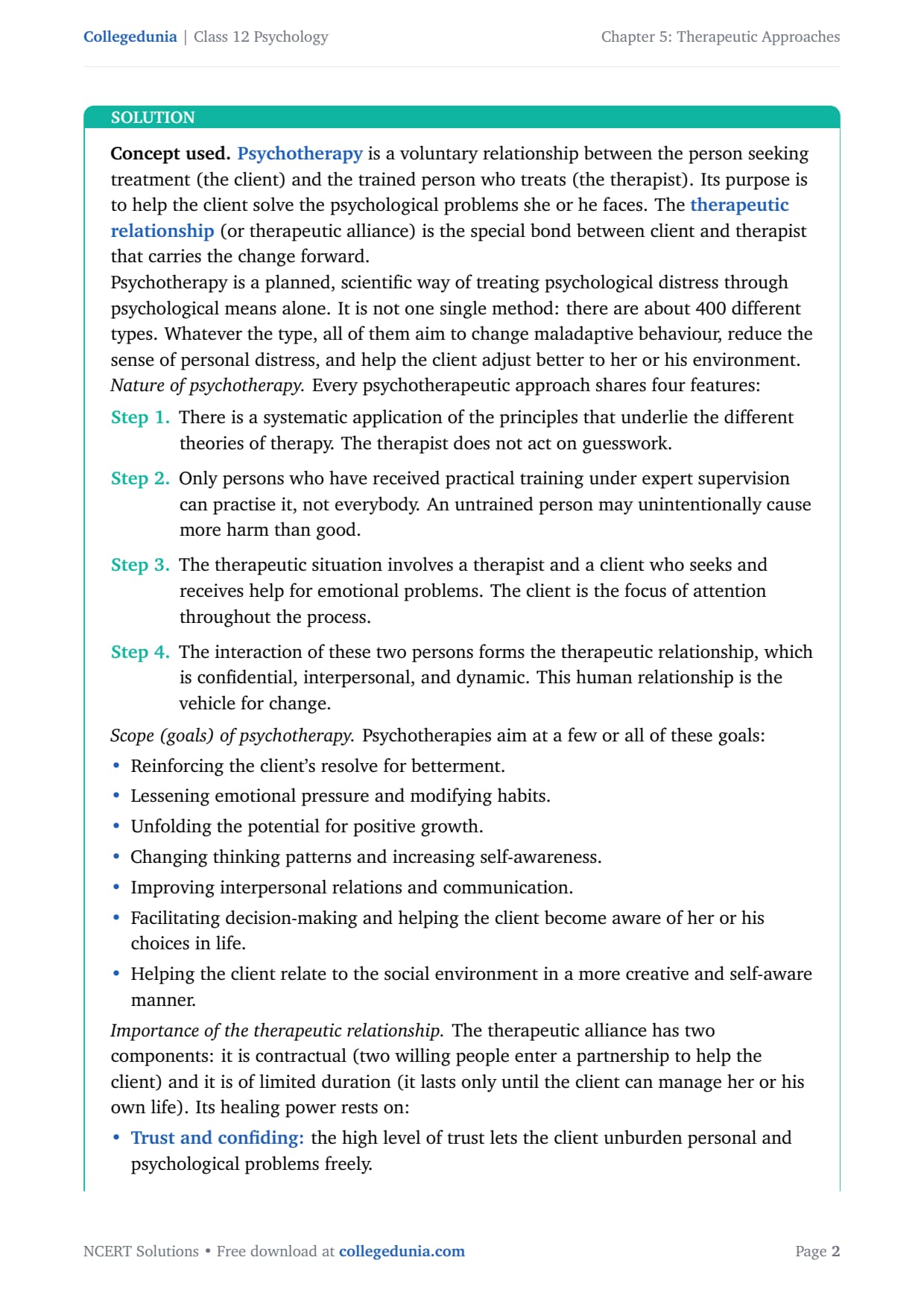
Concept used.Psychotherapy is a voluntary relationship
between the person seeking treatment (the client) and the trained person who
treats (the therapist). Its purpose is to help the client solve the
psychological problems she or he faces. The therapeutic relationship
(or therapeutic alliance) is the special bond between client and therapist
that carries the change forward.
Psychotherapy is a planned, scientific way of treating psychological distress
through psychological means alone. It is not one single method: there are
about 400 different types. Whatever the type, all of them aim to change
maladaptive behaviour, reduce the sense of personal distress, and help the
client adjust better to her or his environment.
Nature of psychotherapy. Every psychotherapeutic approach shares
four features:
There is a systematic application of the principles that underlie the
different theories of therapy. The therapist does not act on guesswork.
Only persons who have received practical training under expert
supervision can practise it, not everybody. An untrained person may
unintentionally cause more harm than good.
The therapeutic situation involves a therapist and a client who seeks
and receives help for emotional problems. The client is the focus of
attention throughout the process.
The interaction of these two persons forms the therapeutic
relationship, which is confidential, interpersonal, and dynamic. This
human relationship is the vehicle for change.
Scope (goals) of psychotherapy. Psychotherapies aim at a few or all
of these goals:
Reinforcing the client's resolve for betterment.
Lessening emotional pressure and modifying habits.
Unfolding the potential for positive growth.
Changing thinking patterns and increasing self-awareness.
Improving interpersonal relations and communication.
Facilitating decision-making and helping the client become aware of
her or his choices in life.
Helping the client relate to the social environment in a more
creative and self-aware manner.
Importance of the therapeutic relationship. The therapeutic alliance
has two components: it is contractual (two willing people enter a partnership
to help the client) and it is of limited duration (it lasts only until the
client can manage her or his own life). Its healing power rests on:
Trust and confiding: the high level of trust lets the client
unburden personal and psychological problems freely.
Unconditional positive regard: the therapist accepts the
client fully and keeps the same warm, non-judging attitude even if the
client is rude or confides ``wrong'' things.
Empathy: the therapist understands the client's plight and
feels with her or him, that is, puts herself or himself in the
client's shoes. Empathy is different from sympathy (pity without
feeling like the other) and from cold intellectual understanding.
Confidentiality: the therapist keeps strict secrecy and
never exploits the client's trust. It stays a professional
relationship throughout.
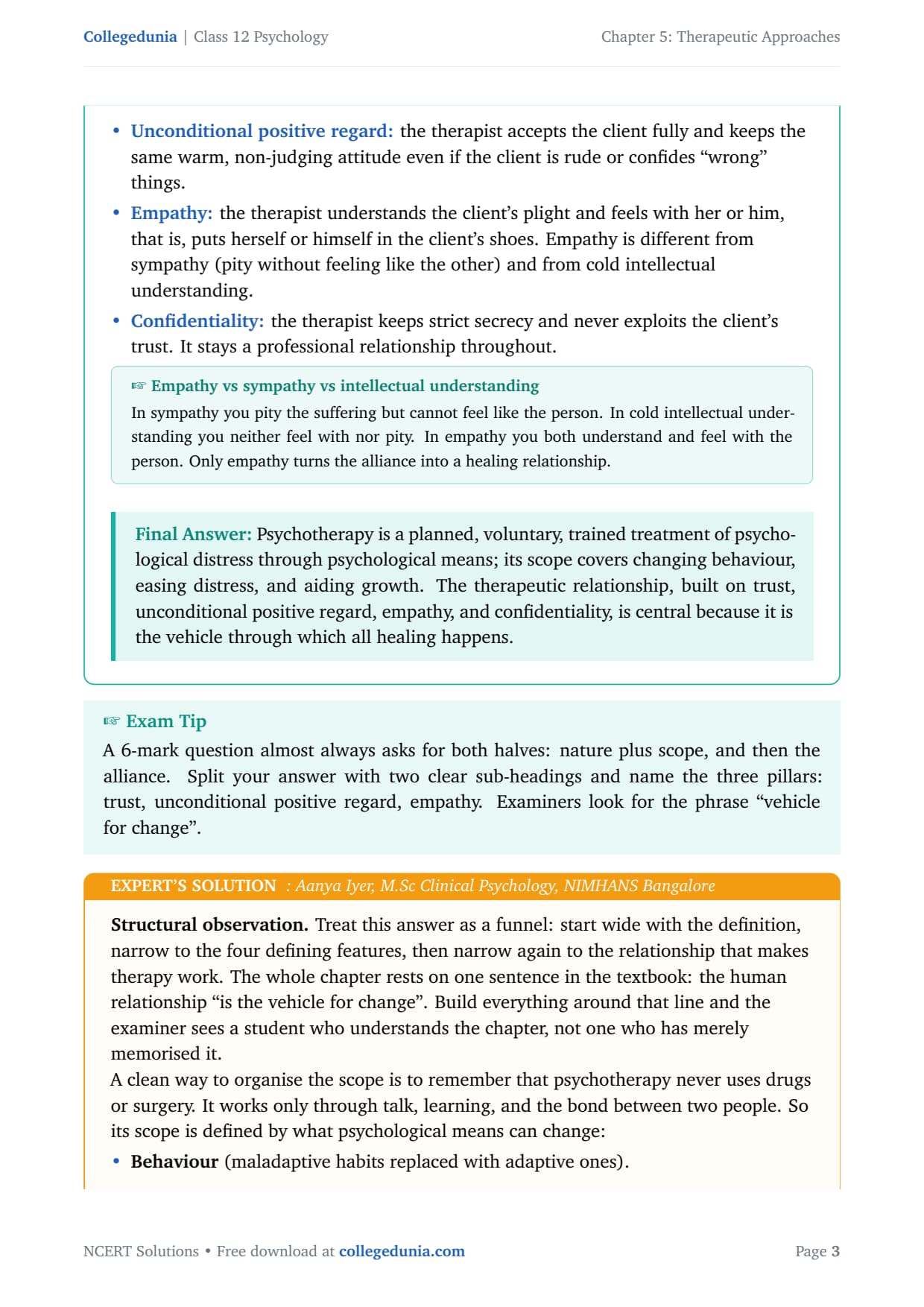
Empathy vs sympathy vs intellectual understanding
In sympathy you pity the suffering but cannot feel like the person. In cold
intellectual understanding you neither feel with nor pity. In empathy you
both understand and feel with the person. Only empathy turns the alliance
into a healing relationship.
Psychotherapy is a planned, voluntary, trained treatment of
psychological distress through psychological means; its scope covers changing
behaviour, easing distress, and aiding growth. The therapeutic relationship,
built on trust, unconditional positive regard, empathy, and confidentiality,
is central because it is the vehicle through which all healing happens.
AI
Aanya Iyer
M.Sc Clinical Psychology, NIMHANS Bangalore
Verified Expert
Structural observation. Treat this answer as a funnel: start wide
with the definition, narrow to the four defining features, then narrow again
to the relationship that makes therapy work. The whole chapter rests on one
sentence in the textbook: the human relationship ``is the vehicle for
change''. Build everything around that line and the examiner sees a student
who understands the chapter, not one who has merely memorised it.
A clean way to organise the scope is to remember that psychotherapy never
uses drugs or surgery. It works only through talk, learning, and the bond
between two people. So its scope is defined by what psychological means can
change:
Behaviour (maladaptive habits replaced with adaptive ones).
Feelings (distress and emotional pressure reduced).
Thinking (faulty thought patterns and low self-awareness).
Relationships (communication and adjustment improved).
Self-direction (better decision-making and awareness of one's
choices in life).
It also helps to state the four defining features of any psychotherapy
in one breath, because they appear again and again in this chapter: it is
systematic (rule-governed), it is practised only by trained experts, the
client is the focus, and the two-person interaction forms a confidential,
dynamic relationship. An untrained helper, however well-meaning, can cause
more harm than good, which is exactly why training is a defining feature and
not an optional extra.
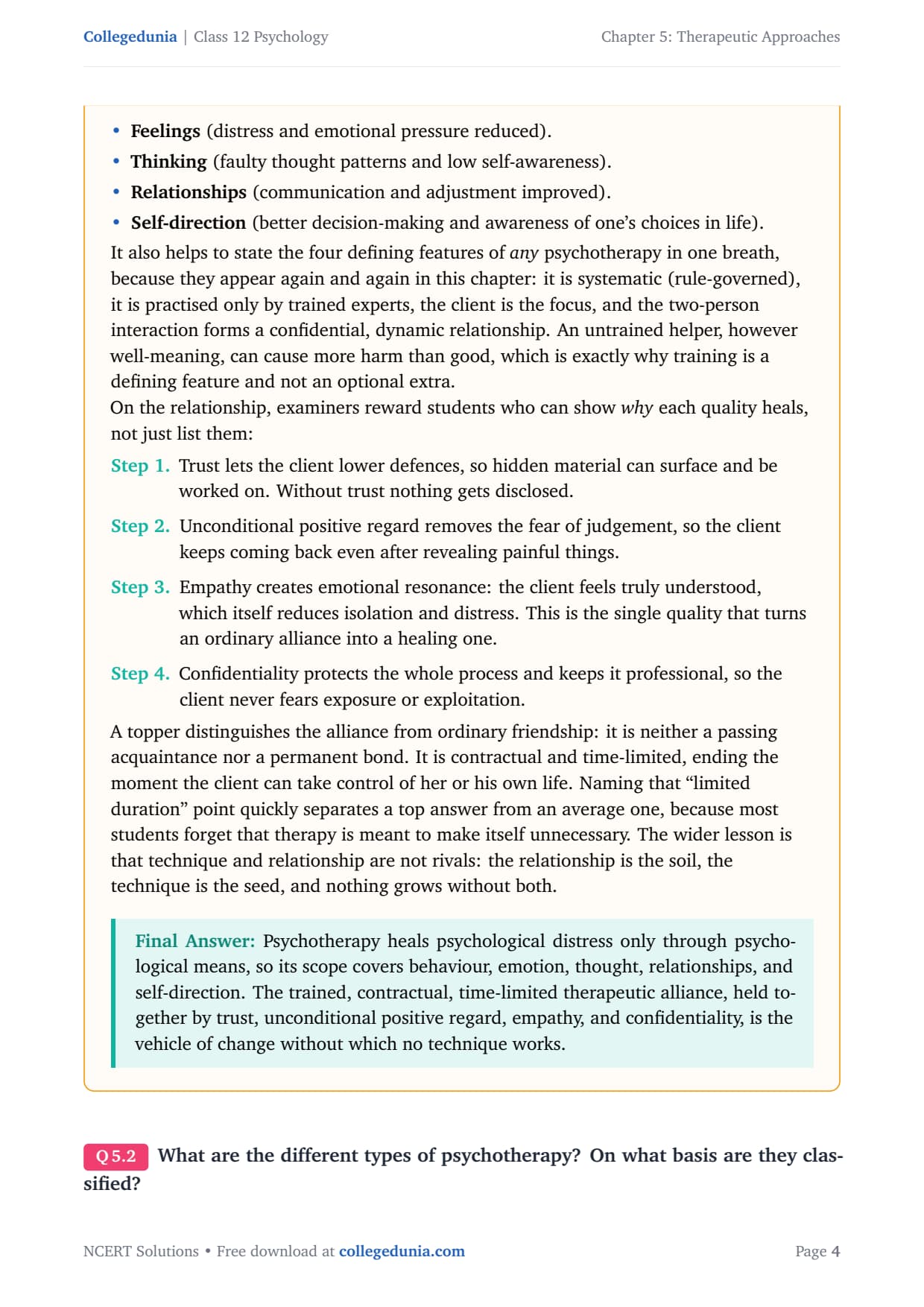
On the relationship, examiners reward students who can show why each
quality heals, not just list them:
Trust lets the client lower defences, so hidden material can surface
and be worked on. Without trust nothing gets disclosed.
Unconditional positive regard removes the fear of judgement, so the
client keeps coming back even after revealing painful things.
Empathy creates emotional resonance: the client feels truly
understood, which itself reduces isolation and distress. This is the
single quality that turns an ordinary alliance into a healing one.
Confidentiality protects the whole process and keeps it professional,
so the client never fears exposure or exploitation.
A topper distinguishes the alliance from ordinary friendship: it is neither a
passing acquaintance nor a permanent bond. It is contractual and time-limited,
ending the moment the client can take control of her or his own life. Naming
that ``limited duration'' point quickly separates a top answer from an average
one, because most students forget that therapy is meant to make itself
unnecessary. The wider lesson is that technique and relationship are not
rivals: the relationship is the soil, the technique is the seed, and nothing
grows without both.
Psychotherapy heals psychological distress only through
psychological means, so its scope covers behaviour, emotion, thought,
relationships, and self-direction. The trained, contractual, time-limited
therapeutic alliance, held together by trust, unconditional positive regard,
empathy, and confidentiality, is the vehicle of change without which no
technique works.
Q 5.2
What are the different types of psychotherapy? On what basis are they classified?
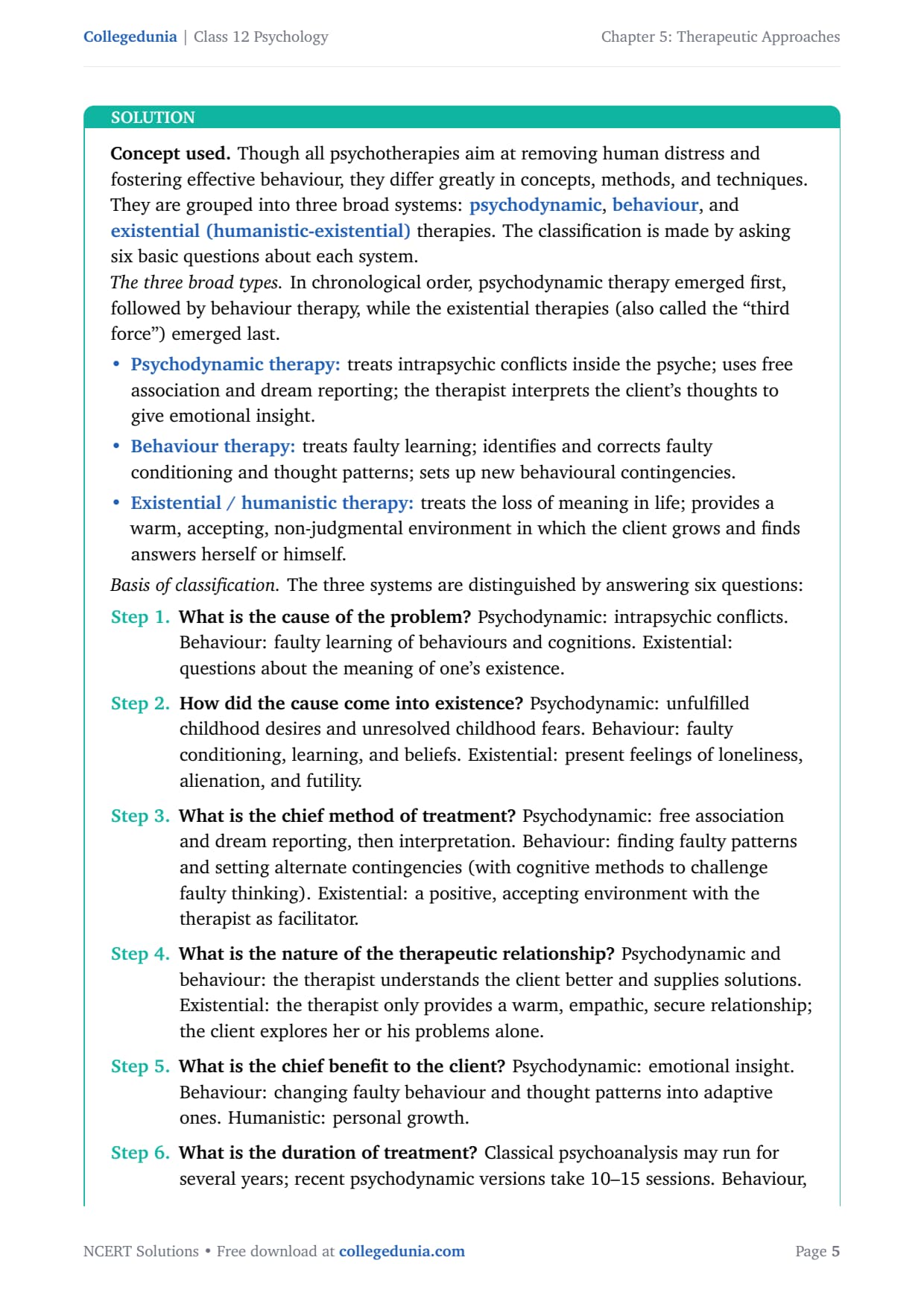
Concept used. Though all psychotherapies aim at removing human
distress and fostering effective behaviour, they differ greatly in concepts,
methods, and techniques. They are grouped into three broad systems:
psychodynamic, behaviour, and existential
(humanistic-existential) therapies. The classification is made by asking six
basic questions about each system.
The three broad types. In chronological order, psychodynamic therapy
emerged first, followed by behaviour therapy, while the existential therapies
(also called the ``third force'') emerged last.
Psychodynamic therapy: treats intrapsychic conflicts inside
the psyche; uses free association and dream reporting; the therapist
interprets the client's thoughts to give emotional insight.
Behaviour therapy: treats faulty learning; identifies and
corrects faulty conditioning and thought patterns; sets up new
behavioural contingencies.
Existential / humanistic therapy: treats the loss of meaning
in life; provides a warm, accepting, non-judgmental environment in
which the client grows and finds answers herself or himself.
Basis of classification. The three systems are distinguished by
answering six questions:
What is the cause of the problem? Psychodynamic: intrapsychic
conflicts. Behaviour: faulty learning of behaviours and cognitions.
Existential: questions about the meaning of one's existence.
How did the cause come into existence? Psychodynamic:
unfulfilled childhood desires and unresolved childhood fears. Behaviour:
faulty conditioning, learning, and beliefs. Existential: present
feelings of loneliness, alienation, and futility.
What is the chief method of treatment? Psychodynamic: free
association and dream reporting, then interpretation. Behaviour:
finding faulty patterns and setting alternate contingencies (with
cognitive methods to challenge faulty thinking). Existential: a
positive, accepting environment with the therapist as facilitator.
What is the nature of the therapeutic relationship?
Psychodynamic and behaviour: the therapist understands the client
better and supplies solutions. Existential: the therapist only
provides a warm, empathic, secure relationship; the client explores
her or his problems alone.
What is the chief benefit to the client? Psychodynamic:
emotional insight. Behaviour: changing faulty behaviour and thought
patterns into adaptive ones. Humanistic: personal growth.
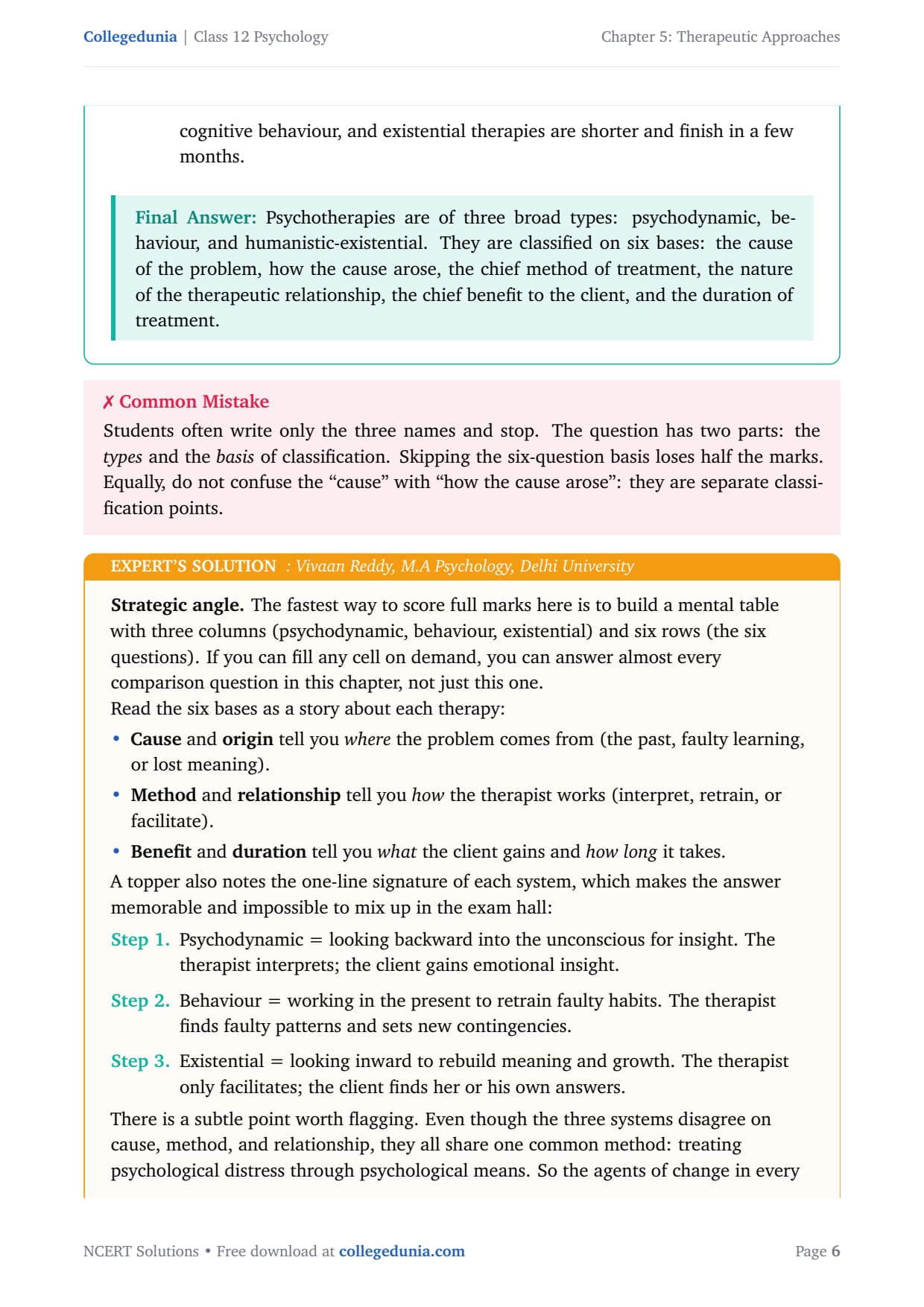
What is the duration of treatment? Classical psychoanalysis
may run for several years; recent psychodynamic versions take 10–15
sessions. Behaviour, cognitive behaviour, and existential therapies
are shorter and finish in a few months.
Psychotherapies are of three broad types: psychodynamic, behaviour,
and humanistic-existential. They are classified on six bases: the cause of
the problem, how the cause arose, the chief method of treatment, the nature
of the therapeutic relationship, the chief benefit to the client, and the
duration of treatment.
VR
Vivaan Reddy
M.A Psychology, Delhi University
Verified Expert
Strategic angle. The fastest way to score full marks here is to
build a mental table with three columns (psychodynamic, behaviour,
existential) and six rows (the six questions). If you can fill any cell on
demand, you can answer almost every comparison question in this chapter, not
just this one.
Read the six bases as a story about each therapy:
Cause and origin tell you where the problem
comes from (the past, faulty learning, or lost meaning).
Method and relationship tell you how the
therapist works (interpret, retrain, or facilitate).
Benefit and duration tell you what the client
gains and how long it takes.
A topper also notes the one-line signature of each system, which makes the
answer memorable and impossible to mix up in the exam hall:
Psychodynamic = looking backward into the unconscious for insight. The
therapist interprets; the client gains emotional insight.
Behaviour = working in the present to retrain faulty habits. The
therapist finds faulty patterns and sets new contingencies.
Existential = looking inward to rebuild meaning and growth. The
therapist only facilitates; the client finds her or his own answers.
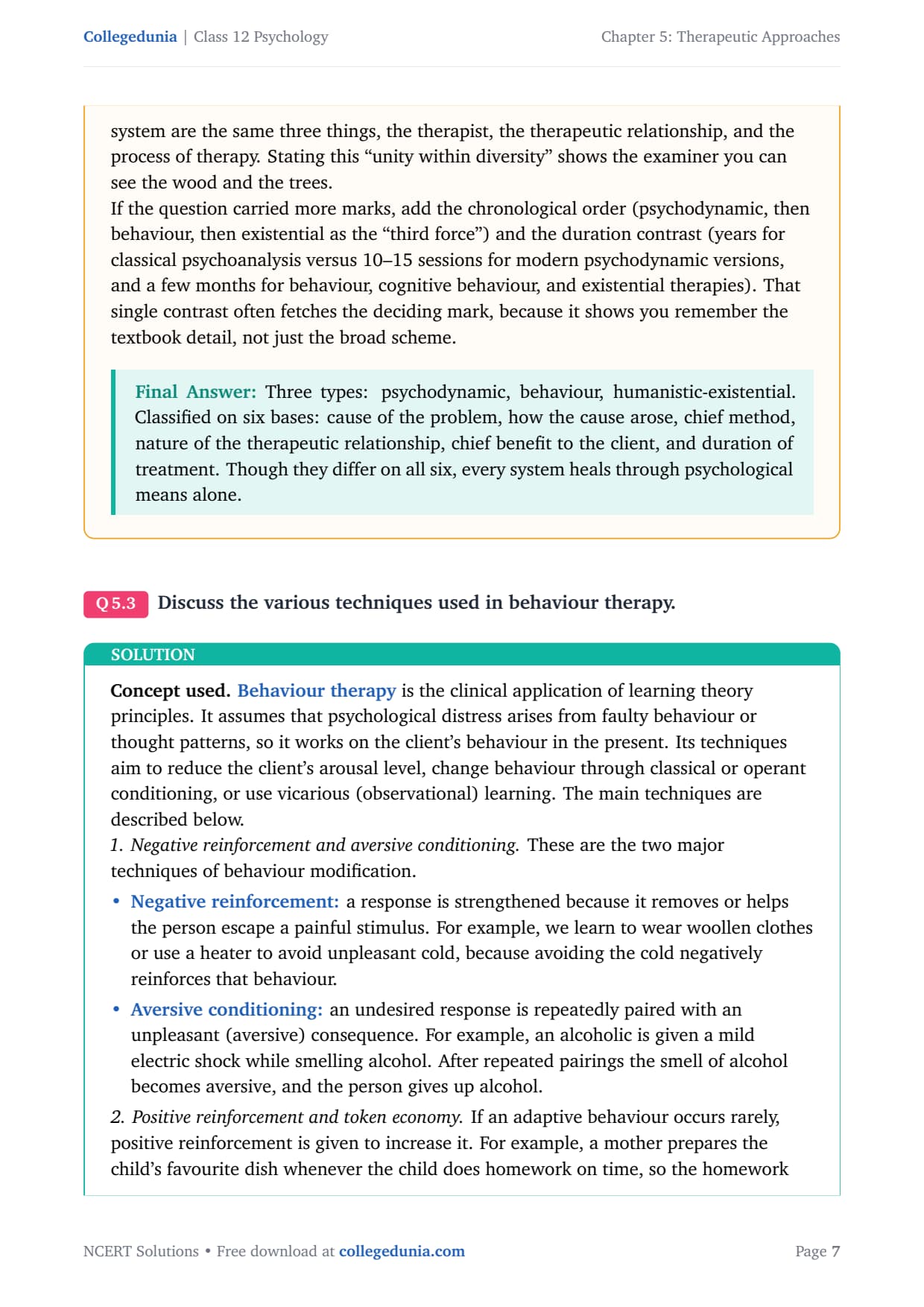
There is a subtle point worth flagging. Even though the three systems disagree
on cause, method, and relationship, they all share one common method: treating
psychological distress through psychological means. So the agents of change in
every system are the same three things, the therapist, the therapeutic
relationship, and the process of therapy. Stating this ``unity within
diversity'' shows the examiner you can see the wood and the trees.
If the question carried more marks, add the chronological order
(psychodynamic, then behaviour, then existential as the ``third force'') and
the duration contrast (years for classical psychoanalysis versus 10–15
sessions for modern psychodynamic versions, and a few months for behaviour,
cognitive behaviour, and existential therapies). That single contrast often
fetches the deciding mark, because it shows you remember the textbook detail,
not just the broad scheme.
Three types: psychodynamic, behaviour, humanistic-existential.
Classified on six bases: cause of the problem, how the cause arose, chief
method, nature of the therapeutic relationship, chief benefit to the client,
and duration of treatment. Though they differ on all six, every system heals
through psychological means alone.
Q 5.3
Discuss the various techniques used in behaviour therapy.
Concept used.Behaviour therapy is the clinical
application of learning theory principles. It assumes that psychological
distress arises from faulty behaviour or thought patterns, so it works on the
client's behaviour in the present. Its techniques aim to reduce the client's
arousal level, change behaviour through classical or operant conditioning, or
use vicarious (observational) learning. The main techniques are described
below.
1. Negative reinforcement and aversive conditioning. These are the
two major techniques of behaviour modification.
Negative reinforcement: a response is strengthened because
it removes or helps the person escape a painful stimulus. For example,
we learn to wear woollen clothes or use a heater to avoid unpleasant
cold, because avoiding the cold negatively reinforces that behaviour.
Aversive conditioning: an undesired response is repeatedly
paired with an unpleasant (aversive) consequence. For example, an
alcoholic is given a mild electric shock while smelling alcohol. After
repeated pairings the smell of alcohol becomes aversive, and the
person gives up alcohol.
2. Positive reinforcement and token economy. If an adaptive
behaviour occurs rarely, positive reinforcement is given to increase it. For
example, a mother prepares the child's favourite dish whenever the child does
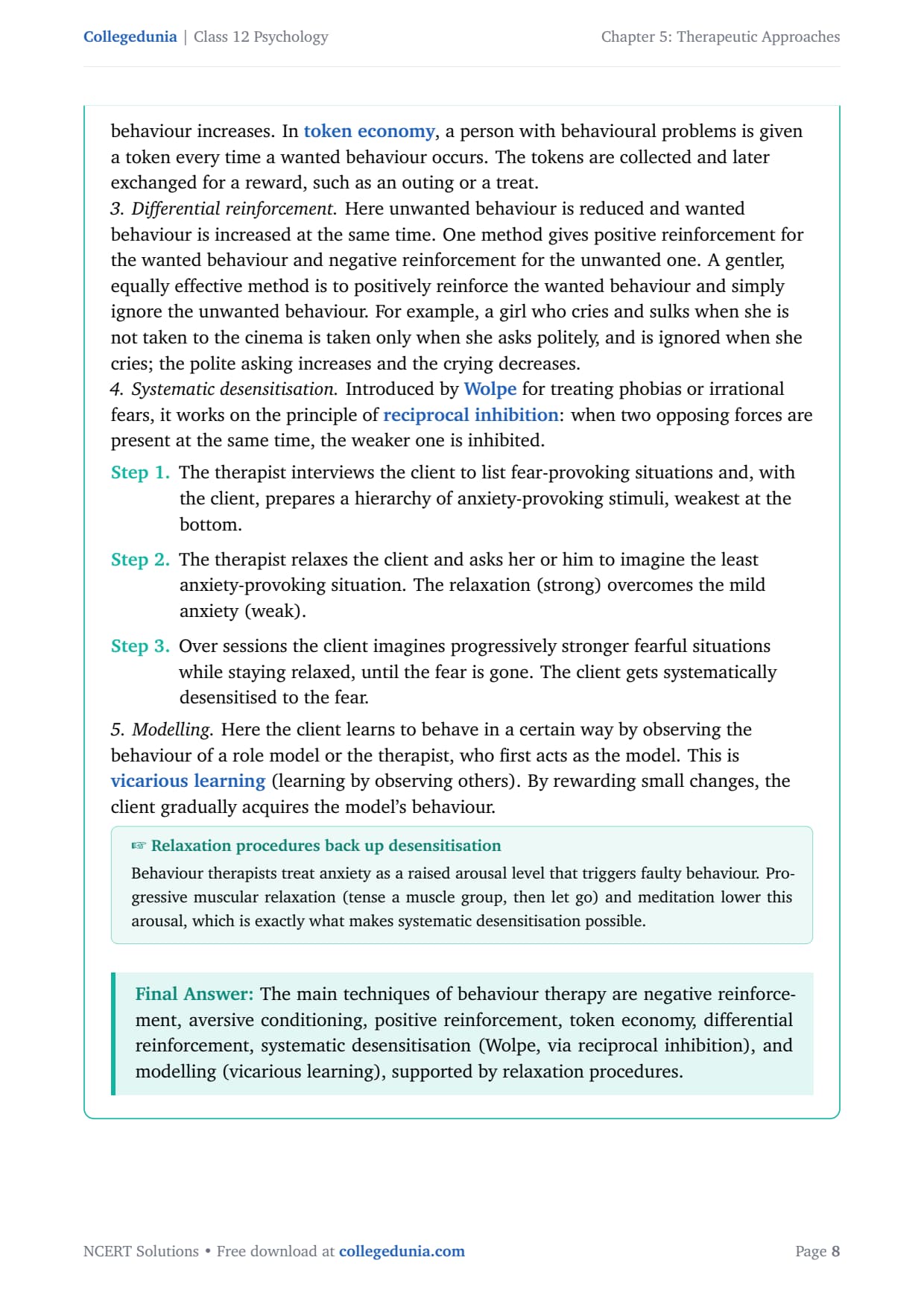
homework on time, so the homework behaviour increases. In token
economy, a person with behavioural problems is given a token every time a
wanted behaviour occurs. The tokens are collected and later exchanged for a
reward, such as an outing or a treat.
3. Differential reinforcement. Here unwanted behaviour is reduced
and wanted behaviour is increased at the same time. One method gives positive
reinforcement for the wanted behaviour and negative reinforcement for the
unwanted one. A gentler, equally effective method is to positively reinforce
the wanted behaviour and simply ignore the unwanted behaviour. For example, a
girl who cries and sulks when she is not taken to the cinema is taken only
when she asks politely, and is ignored when she cries; the polite asking
increases and the crying decreases.
4. Systematic desensitisation. Introduced by Wolpe for
treating phobias or irrational fears, it works on the principle of
reciprocal inhibition: when two opposing forces are present at the
same time, the weaker one is inhibited.
The therapist interviews the client to list fear-provoking situations
and, with the client, prepares a hierarchy of anxiety-provoking
stimuli, weakest at the bottom.
The therapist relaxes the client and asks her or him to imagine the
least anxiety-provoking situation. The relaxation (strong) overcomes
the mild anxiety (weak).
Over sessions the client imagines progressively stronger fearful
situations while staying relaxed, until the fear is gone. The client
gets systematically desensitised to the fear.
5. Modelling. Here the client learns to behave in a certain way by
observing the behaviour of a role model or the therapist, who first acts as
the model. This is vicarious learning (learning by observing
others). By rewarding small changes, the client gradually acquires the
model's behaviour.
Relaxation procedures back up desensitisation
Behaviour therapists treat anxiety as a raised arousal level that triggers
faulty behaviour. Progressive muscular relaxation (tense a muscle group, then
let go) and meditation lower this arousal, which is exactly what makes
systematic desensitisation possible.
The main techniques of behaviour therapy are negative reinforcement,
aversive conditioning, positive reinforcement, token economy, differential
reinforcement, systematic desensitisation (Wolpe, via reciprocal inhibition),
and modelling (vicarious learning), supported by relaxation procedures.
AN
Arjun Nair
M.Phil Clinical Psychology, Christ University Bangalore
Verified Expert
Structural observation. Group the techniques by the kind of learning
they use, and the long list suddenly becomes easy to recall. Behaviour therapy
has only three engines: classical conditioning, operant conditioning, and
observational learning. Every technique is one of these in action, so if you
can name the engine you can never forget the technique.
Classical (pairing two stimuli): aversive conditioning,
systematic desensitisation.
Observational (watching a model): modelling and vicarious
learning.
Before listing techniques, a top answer states the foundation in one line: the
therapist first does a behavioural analysis to find the malfunctioning
behaviour, its antecedents (what triggers it), and its maintaining factors
(what keeps it going). Only then is a treatment package chosen. Mentioning
antecedent and maintaining factors signals that you understand why a
technique is picked, not just what it is.
A topper handles systematic desensitisation carefully, because it is the most
asked technique in this chapter. The key is the logic of reciprocal
inhibition:
Two opposing states, relaxation and anxiety, cannot both be strong at
once. The stronger one inhibits the weaker.
Build relaxation first (through progressive muscular relaxation or
meditation) so it becomes the stronger force.
Prepare a hierarchy of fears, weakest at the bottom.
Pair deep relaxation with the weakest fear; relaxation inhibits it.
Step up the hierarchy gradually, always keeping relaxation on top,
until even the strongest fear is extinguished.
Keep the textbook examples ready, because they are the surest source of marks:
the alcoholic given a shock while smelling alcohol (aversive conditioning),
the child rewarded with a favourite dish for doing homework (positive
reinforcement), tokens swapped for an outing (token economy), and the cinema
girl reinforced for asking politely and ignored for sulking (differential
reinforcement). The wider lesson is that behaviour therapy never digs into the
past for its own sake. It changes the antecedents (what comes before a
behaviour) and the consequences (what follows it). Naming that
antecedent-consequence logic shows the examiner you understand the mechanism,
not just the labels.
One last distinction protects easy marks: negative reinforcement is not
punishment. Negative reinforcement strengthens a response by removing
something unpleasant (wearing a sweater removes the cold), whereas aversive
conditioning weakens a response by adding something unpleasant (a shock
paired with alcohol). Students who confuse the two lose marks they could have
kept, so state the difference clearly.
Behaviour therapy techniques are best grouped by learning type:
operant (positive and negative reinforcement, token economy, differential
reinforcement), classical (aversive conditioning, systematic desensitisation
via reciprocal inhibition), and observational (modelling, vicarious learning),
all supported by relaxation procedures and a prior behavioural analysis.
Q 5.4
Explain with the help of an example how cognitive distortions take place.
Concept used.Cognitive distortions are ways of thinking
that are general in nature but distort reality in a negative manner. They lead
to errors of thinking about social reality. The explanation comes from
Aaron Beck's cognitive therapy, which says that childhood
experiences build core schemas (deep beliefs and action patterns),
and that a later critical incident triggers these schemas to produce negative
automatic thoughts and then distortions.
How a cognitive distortion forms. Beck explains it as a chain:
Core schema in childhood. Experiences given by the family and
society build deep core schemas. For example, a child who is neglected
by the parents develops the core schema ``I am not wanted''.
A critical incident. Later in life a critical incident
occurs. For example, the same person is publicly ridiculed by a
teacher in school.
The schema is triggered. This incident triggers the old core
schema ``I am not wanted'', which now switches on.
Negative automatic thoughts appear. The triggered schema
produces persistent, irrational negative automatic thoughts such as
``nobody loves me'', ``I am ugly'', ``I am stupid'', ``I will not
succeed''.
Cognitive distortions and dysfunctional structures. These
negative automatic thoughts are marked by cognitive distortions:
general ways of thinking that twist reality negatively. The patterns
are called dysfunctional cognitive structures, and they cause errors
of cognition about social reality.
Anxiety and depression. Repeated occurrence of these thoughts
leads to feelings of anxiety and depression.
Worked example. A girl neglected by her parents carries the hidden
schema ``I am not wanted''. Years later, a teacher scolds her in front of the
whole class. This critical incident triggers the schema. She begins to think,
automatically and repeatedly, ``nobody loves me'' and ``I will never
succeed''. These distorted thoughts no longer match reality (one scolding does
not mean nobody loves her), but they feel true to her, and over time they
produce anxiety and depression.
How the therapist undoes the distortion
Beck's therapist uses gentle, non-threatening questioning, such as ``Why
should everyone love you?'' or ``What does it mean to you to succeed?''. These
questions push the client to think against the negative automatic thoughts, so
she gains insight into the faulty schema and can restructure it. This is
called cognitive restructuring.
A cognitive distortion forms when a childhood experience builds a
core schema (such as ``I am not wanted''), a later critical incident (being
publicly ridiculed) triggers that schema, and the schema produces persistent
negative automatic thoughts (``nobody loves me'') that twist reality
negatively. Repeated, these distortions lead to anxiety and depression.
PB
Priya Banerjee
M.A Applied Psychology, Banaras Hindu University
Verified Expert
Picture-first. Imagine a sleeping landmine and a trigger wire. The
landmine is the core schema laid down in childhood (``I am not wanted''). It
stays buried and silent for years. The trigger wire is the critical incident
(public ridicule). The moment the wire is touched, the mine goes off, and the
explosion is the storm of negative automatic thoughts.
This image keeps the sequence in order:
Buried mine = core schema, built by family and society in
childhood.
Smoke that lingers = cognitive distortions and dysfunctional
cognitive structures, leading to anxiety and depression.
It is worth keeping the three layers separate, because students often blur
them: the core schema is the deep belief, the negative automatic thoughts are
the surface stream it produces, and the cognitive distortions are the
recurring style of those thoughts (over-generalising, all-or-nothing
thinking). Separating them makes the chain easy to reproduce in the exam.
A topper then connects this to treatment, because the question's parent topic
is therapy:
The therapist cannot remove the buried schema by force.
Instead, gentle, non-threatening questioning (``Why should everyone
love you?'') makes the client examine the thought and see it is not
supported by evidence in the environment.
Repeated questioning lets the client gain insight into the
dysfunctional schema and restructure it. That is the goal: cognitive
restructuring, which in turn reduces anxiety and depression.
The wider lesson is Beck's central claim: it is not the event itself but the
interpretation of the event, filtered through an old schema, that
causes distress. Two people scolded by the same teacher react differently;
only the one carrying the ``I am not wanted'' schema spirals into ``nobody
loves me''. Naming that point lifts the answer from description to explanation,
which is exactly what a long-answer question rewards.
Cognitive distortions arise when a childhood core schema (``I am not
wanted'') lies dormant until a critical incident (public ridicule) triggers
it, releasing persistent negative automatic thoughts that twist reality
negatively. Because the distress comes from the interpretation rather than the
event, repeated occurrence breeds anxiety and depression.
Q 5.5
Which therapy encourages the client to seek personal growth and actualise their potential? Write about the therapies which are based on this principle.
Concept used. The therapy that encourages personal growth and the
actualisation of one's potential is humanistic-existential therapy.
Self-actualisation is an innate or inborn force that moves a person
to become more complex, balanced, and integrated. These therapies hold that
psychological distress arises from loneliness, alienation, and an inability to
find meaning and genuine fulfilment in life, and that healing comes when the
client removes the obstacles to self-actualisation.
The core principle. Human beings are motivated by a desire for
personal growth and self-actualisation and an innate need to grow
emotionally. When family and society curb these needs (for example, by
curbing free emotional expression), the person experiences distress.
Therefore the therapy creates a permissive, non-judgmental, accepting
atmosphere in which emotions can be freely expressed and the client can grow.
The client, not the therapist, is responsible for the success of therapy; the
therapist is only a facilitator and guide. The therapies built on this
principle are described below.
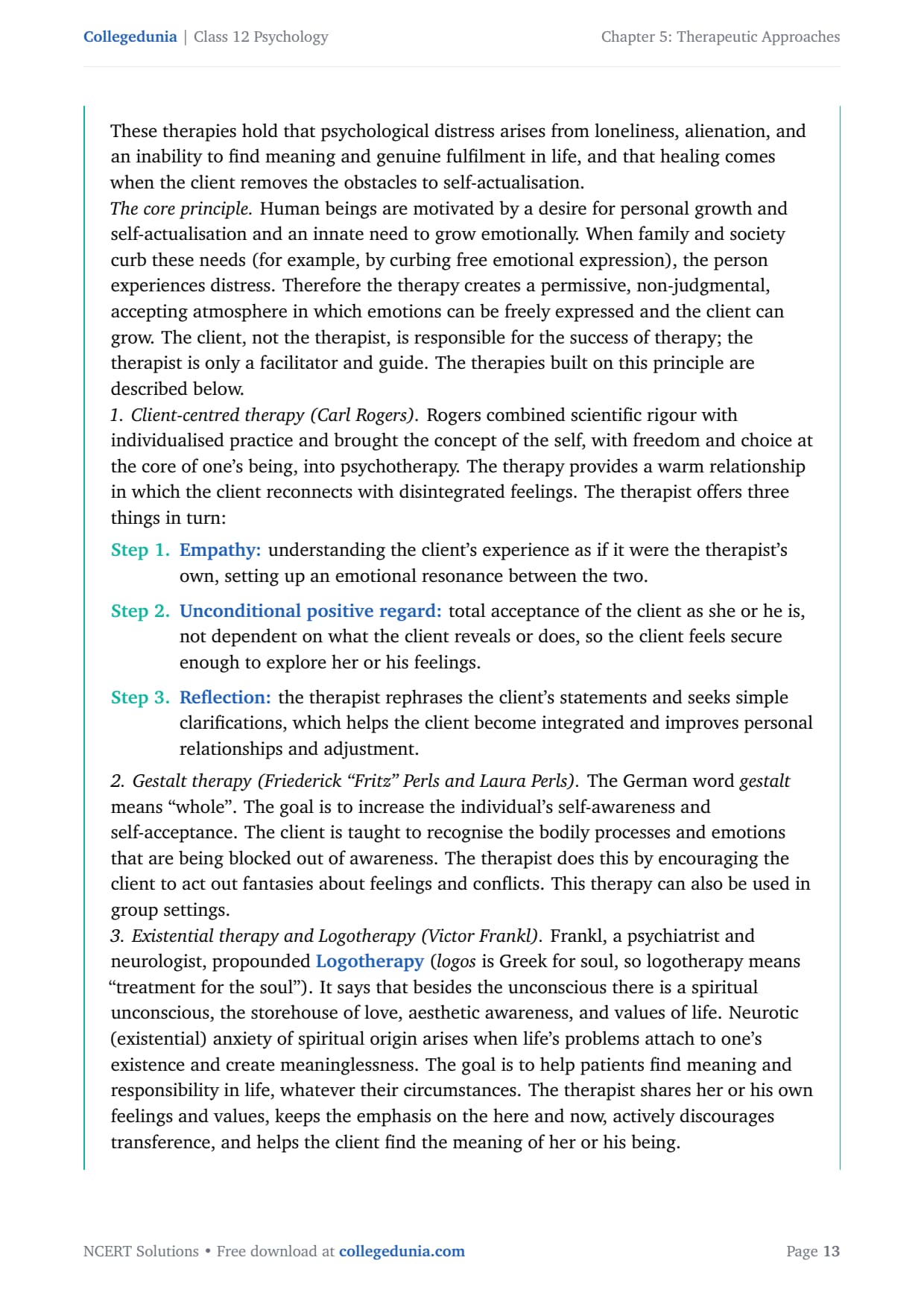
1. Client-centred therapy (Carl Rogers). Rogers combined scientific
rigour with individualised practice and brought the concept of the self, with
freedom and choice at the core of one's being, into psychotherapy. The
therapy provides a warm relationship in which the client reconnects with
disintegrated feelings. The therapist offers three things in turn:
Empathy: understanding the client's experience as if it were
the therapist's own, setting up an emotional resonance between the two.
Unconditional positive regard: total acceptance of the
client as she or he is, not dependent on what the client reveals or
does, so the client feels secure enough to explore her or his feelings.
Reflection: the therapist rephrases the client's statements
and seeks simple clarifications, which helps the client become
integrated and improves personal relationships and adjustment.
2. Gestalt therapy (Friederick ``Fritz'' Perls and Laura Perls). The
German word gestalt means ``whole''. The goal is to increase the
individual's self-awareness and self-acceptance. The client is taught to
recognise the bodily processes and emotions that are being blocked out of
awareness. The therapist does this by encouraging the client to act out
fantasies about feelings and conflicts. This therapy can also be used in
group settings.
3. Existential therapy and Logotherapy (Victor Frankl). Frankl, a
psychiatrist and neurologist, propounded Logotherapy (logos
is Greek for soul, so logotherapy means ``treatment for the soul''). It says
that besides the unconscious there is a spiritual unconscious, the storehouse
of love, aesthetic awareness, and values of life. Neurotic (existential)
anxiety of spiritual origin arises when life's problems attach to one's
existence and create meaninglessness. The goal is to help patients find
meaning and responsibility in life, whatever their circumstances. The
therapist shares her or his own feelings and values, keeps the emphasis on
the here and now, actively discourages transference, and helps the client
find the meaning of her or his being.
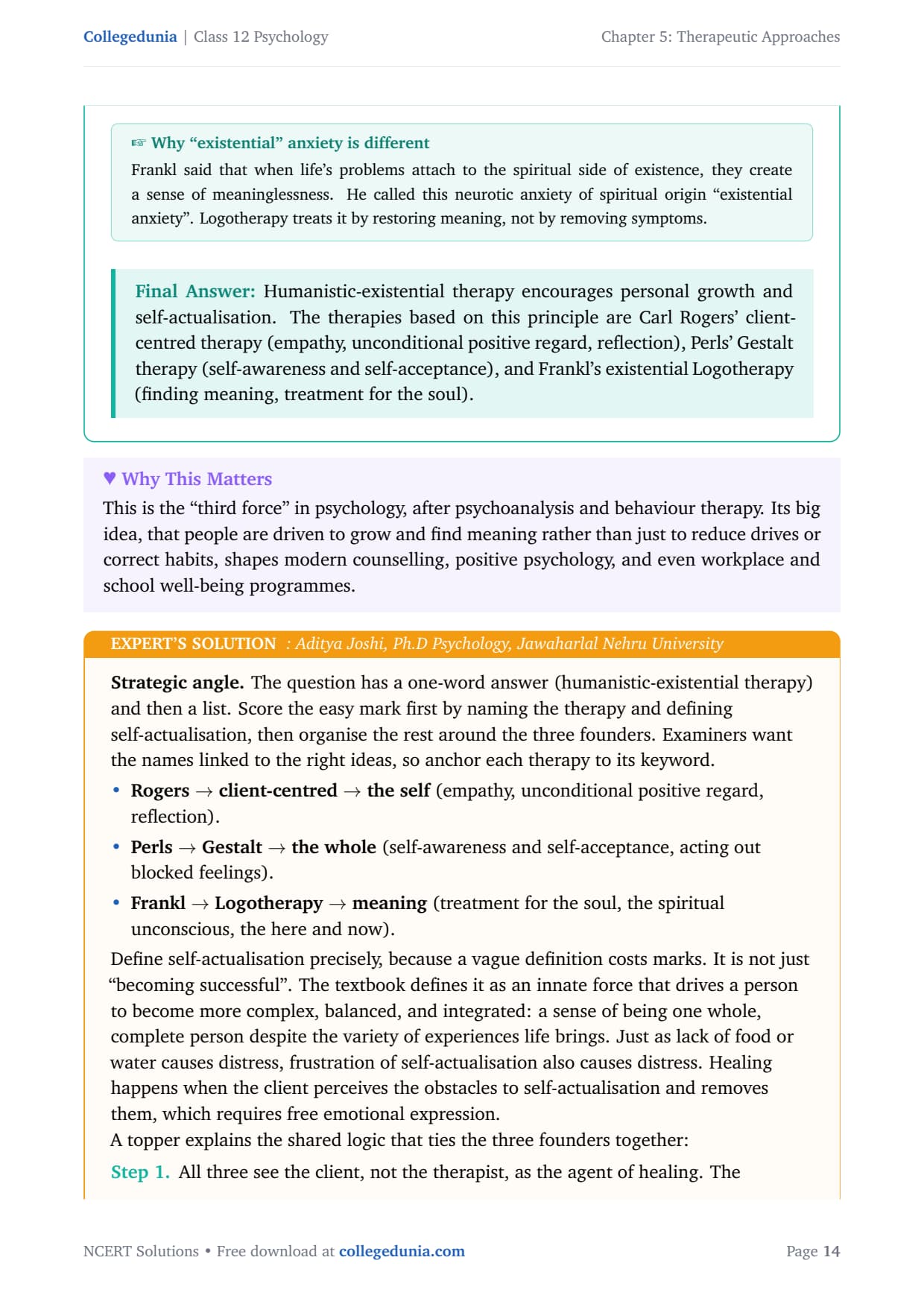
Why ``existential'' anxiety is different
Frankl said that when life's problems attach to the spiritual side of
existence, they create a sense of meaninglessness. He called this neurotic
anxiety of spiritual origin ``existential anxiety''. Logotherapy treats it by
restoring meaning, not by removing symptoms.
Humanistic-existential therapy encourages personal growth and
self-actualisation. The therapies based on this principle are Carl Rogers'
client-centred therapy (empathy, unconditional positive regard, reflection),
Perls' Gestalt therapy (self-awareness and self-acceptance), and Frankl's
existential Logotherapy (finding meaning, treatment for the soul).
AJ
Aditya Joshi
Ph.D Psychology, Jawaharlal Nehru University
Verified Expert
Strategic angle. The question has a one-word answer
(humanistic-existential therapy) and then a list. Score the easy mark first by
naming the therapy and defining self-actualisation, then organise the rest
around the three founders. Examiners want the names linked to the right ideas,
so anchor each therapy to its keyword.
Perls → Gestalt → the whole (self-awareness and
self-acceptance, acting out blocked feelings).
Frankl → Logotherapy → meaning (treatment for the
soul, the spiritual unconscious, the here and now).
Define self-actualisation precisely, because a vague definition costs marks.
It is not just ``becoming successful''. The textbook defines it as an innate
force that drives a person to become more complex, balanced, and integrated:
a sense of being one whole, complete person despite the variety of experiences
life brings. Just as lack of food or water causes distress, frustration of
self-actualisation also causes distress. Healing happens when the client
perceives the obstacles to self-actualisation and removes them, which requires
free emotional expression.
A topper explains the shared logic that ties the three founders together:
All three see the client, not the therapist, as the agent of healing.
The therapist is only a facilitator and guide, and it is the client who
is responsible for the success of therapy.
All three create a permissive, accepting, non-judgmental space so the
feelings that family and society curb can be freely expressed.
All three aim at growth (integration, self-acceptance, or meaning)
rather than merely removing symptoms.
Add the two founder-specific hooks that examiners love: for Rogers, the
process of reflection (rephrasing the client's words to deepen their
meaning) and the emotional resonance empathy creates; for Frankl, the
idea that transference is actively discouraged and the focus stays on the
here and now. The wider lesson is the contrast with the earlier systems:
psychodynamic therapy interprets the past for the client, behaviour therapy
retrains the client, but humanistic-existential therapy trusts the client to
heal herself or himself once given the right conditions. Stating that contrast
shows you understand why this is called the ``third force''.
Humanistic-existential therapy promotes personal growth and
self-actualisation, treating the client as the agent of healing. Its three
strands are Rogers' client-centred therapy (the self), Perls' Gestalt therapy
(the whole), and Frankl's Logotherapy (meaning), all using a warm, accepting,
non-judgmental space with the therapist only as facilitator.
Q 5.6
What are the factors that contribute to healing in psychotherapy? Enumerate some of the alternative therapies.
Concept used.Healing factors are the elements of
psychotherapy that actually bring relief to the client. They include the
specific techniques used and several non-specific factors shared across all
therapies. Alternative therapies are treatment options other than
conventional drug treatment or psychotherapy, such as yoga and meditation.
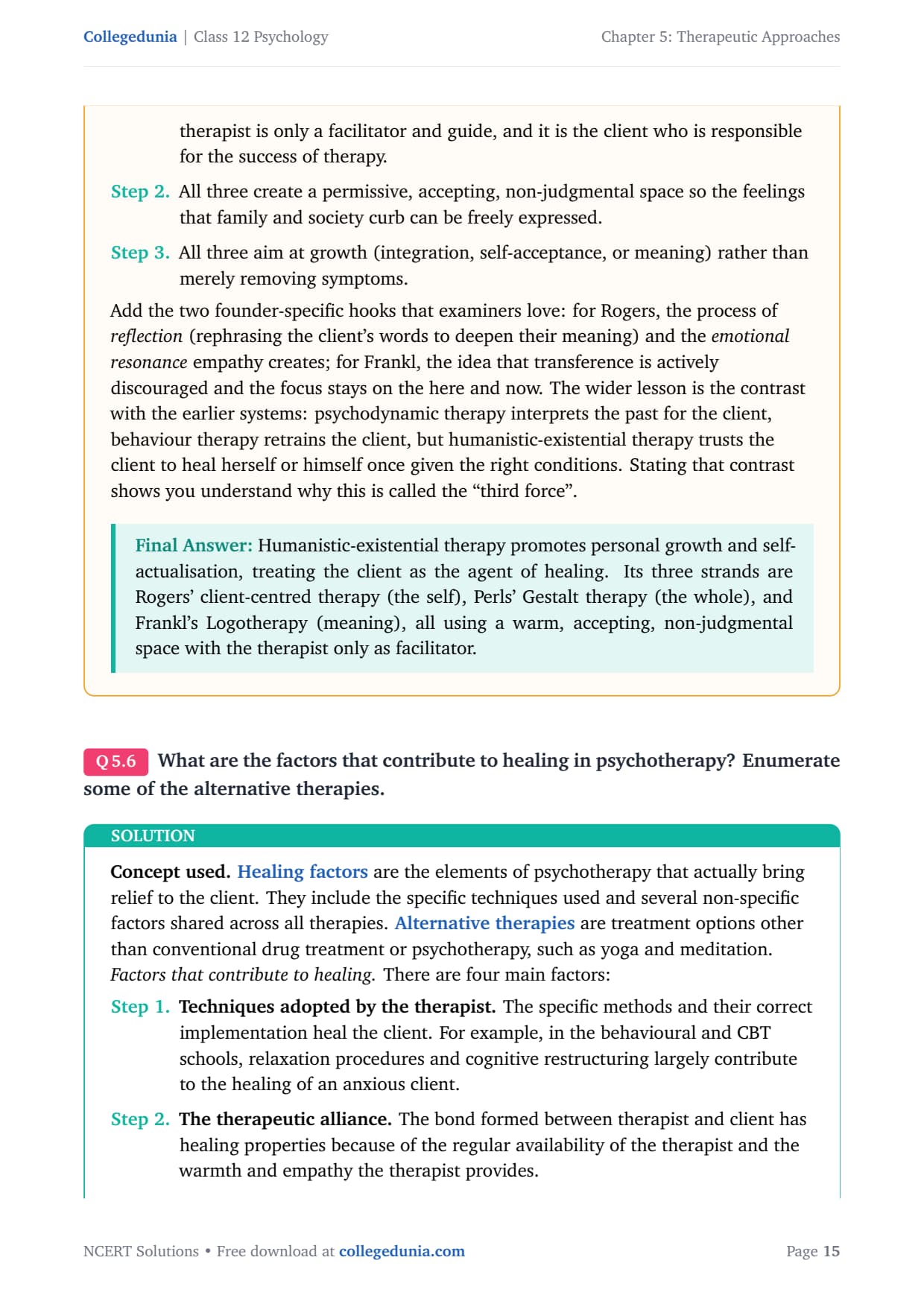
Factors that contribute to healing. There are four main factors:
Techniques adopted by the therapist. The specific methods and
their correct implementation heal the client. For example, in the
behavioural and CBT schools, relaxation procedures and cognitive
restructuring largely contribute to the healing of an anxious client.
The therapeutic alliance. The bond formed between therapist
and client has healing properties because of the regular availability
of the therapist and the warmth and empathy the therapist provides.
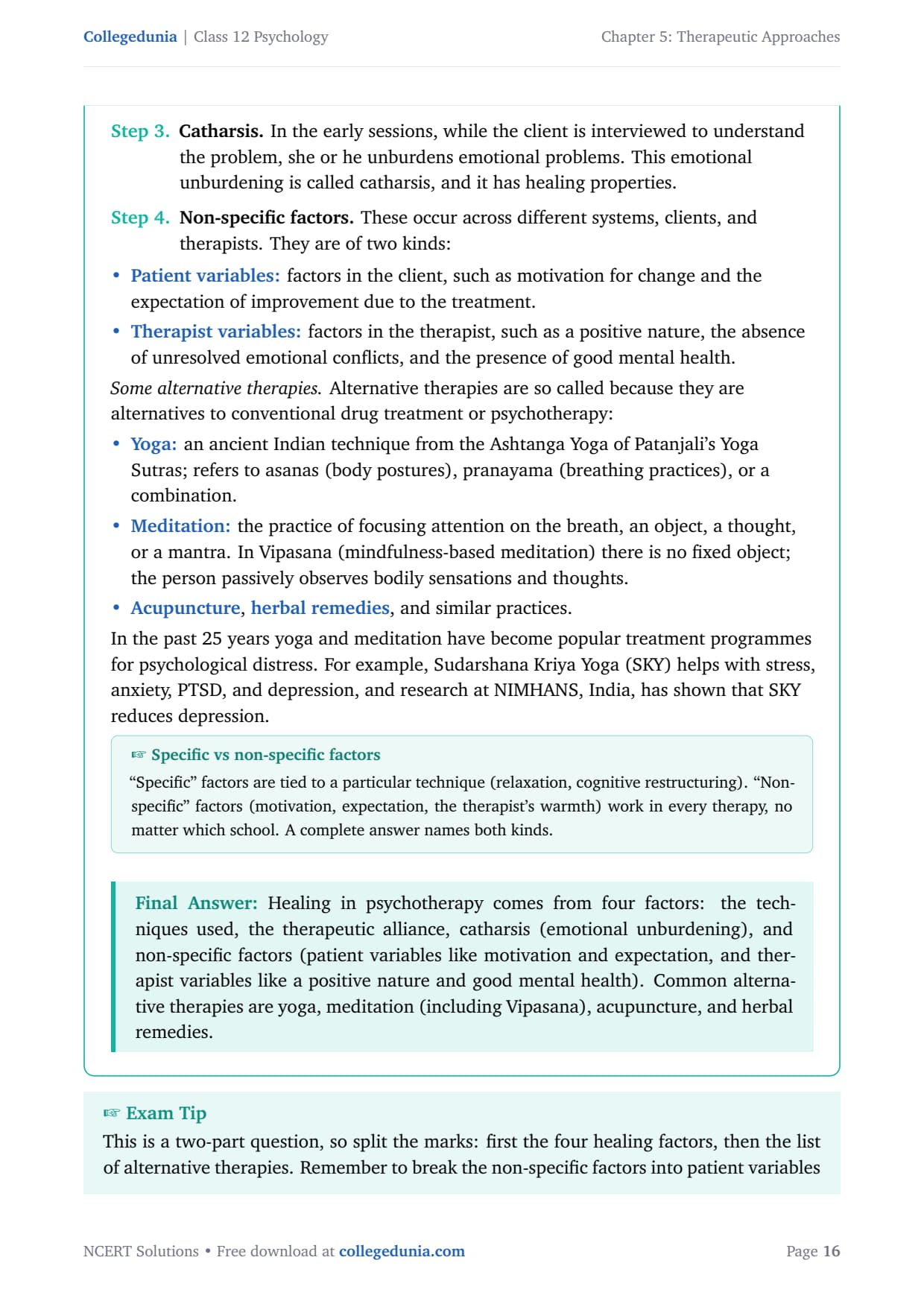
Catharsis. In the early sessions, while the client is
interviewed to understand the problem, she or he unburdens emotional
problems. This emotional unburdening is called catharsis, and it has
healing properties.
Non-specific factors. These occur across different systems,
clients, and therapists. They are of two kinds:
Patient variables: factors in the client, such as motivation
for change and the expectation of improvement due to the treatment.
Therapist variables: factors in the therapist, such as a
positive nature, the absence of unresolved emotional conflicts, and
the presence of good mental health.
Some alternative therapies. Alternative therapies are so called
because they are alternatives to conventional drug treatment or psychotherapy:
Yoga: an ancient Indian technique from the Ashtanga Yoga of
Patanjali's Yoga Sutras; refers to asanas (body postures), pranayama
(breathing practices), or a combination.
Meditation: the practice of focusing attention on the
breath, an object, a thought, or a mantra. In Vipasana
(mindfulness-based meditation) there is no fixed object; the person
passively observes bodily sensations and thoughts.
Acupuncture, herbal remedies, and similar
practices.
In the past 25 years yoga and meditation have become popular treatment
programmes for psychological distress. For example, Sudarshana Kriya Yoga
(SKY) helps with stress, anxiety, PTSD, and depression, and research at
NIMHANS, India, has shown that SKY reduces depression.
Specific vs non-specific factors
``Specific'' factors are tied to a particular technique (relaxation, cognitive
restructuring). ``Non-specific'' factors (motivation, expectation, the
therapist's warmth) work in every therapy, no matter which school. A complete
answer names both kinds.
Healing in psychotherapy comes from four factors: the techniques
used, the therapeutic alliance, catharsis (emotional unburdening), and
non-specific factors (patient variables like motivation and expectation, and
therapist variables like a positive nature and good mental health). Common
alternative therapies are yoga, meditation (including Vipasana), acupuncture,
and herbal remedies.
RK
Riya Kapoor
M.Sc Counselling Psychology, Christ University Bangalore
Verified Expert
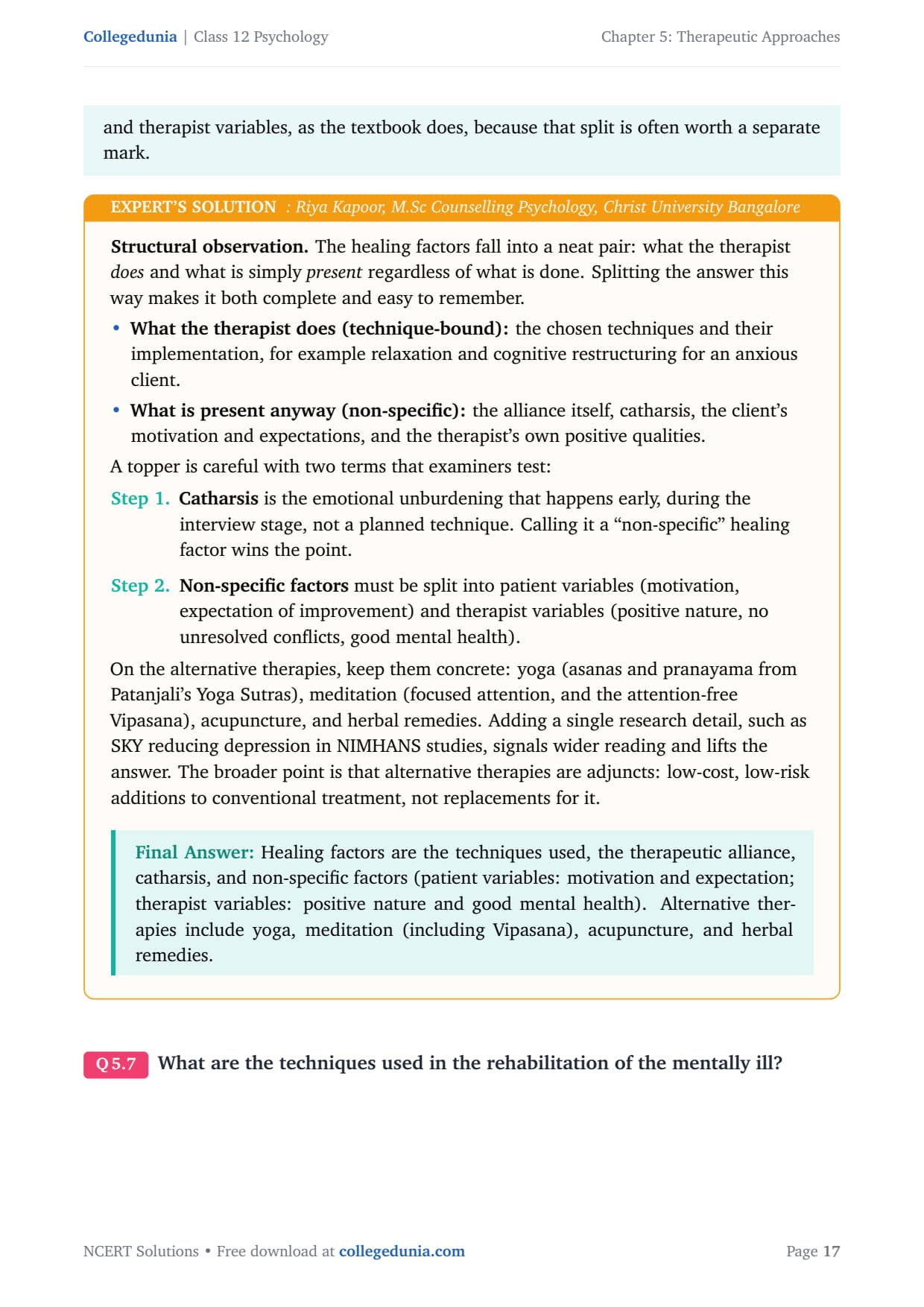
Structural observation. The healing factors fall into a neat pair:
what the therapist does and what is simply present regardless of
what is done. Splitting the answer this way makes it both complete and easy to
remember.
What the therapist does (technique-bound): the chosen
techniques and their implementation, for example relaxation and
cognitive restructuring for an anxious client.
What is present anyway (non-specific): the alliance itself,
catharsis, the client's motivation and expectations, and the
therapist's own positive qualities.
A topper is careful with two terms that examiners test:
Catharsis is the emotional unburdening that happens early,
during the interview stage, not a planned technique. Calling it a
``non-specific'' healing factor wins the point.
Non-specific factors must be split into patient variables
(motivation, expectation of improvement) and therapist variables
(positive nature, no unresolved conflicts, good mental health).
On the alternative therapies, keep them concrete and well-defined, because
loose listing loses marks:
Yoga: asanas (postures) and pranayama (breathing) from
Patanjali's Yoga Sutras, used as a treatment programme for distress.
Meditation: focusing attention on the breath, an object, or a
mantra; in Vipasana (mindfulness-based) there is no fixed object and
the person passively observes sensations and thoughts.
Acupuncture and herbal remedies: the other commonly
named alternatives.
Adding a single research detail, such as SKY reducing depression in NIMHANS
studies, signals wider reading and lifts the answer. The broader point is that
alternative therapies are adjuncts: low-cost, low-risk additions to
conventional treatment, not replacements for it. Saying that clearly shows the
examiner you understand the word ``alternative'' in its proper, complementary
sense rather than treating these practices as stand-alone cures.
Healing factors are the techniques used, the therapeutic alliance,
catharsis, and non-specific factors (patient variables: motivation and
expectation; therapist variables: positive nature and good mental health).
Alternative therapies include yoga, meditation (including Vipasana),
acupuncture, and herbal remedies.
Q 5.7
What are the techniques used in the rehabilitation of the mentally ill?
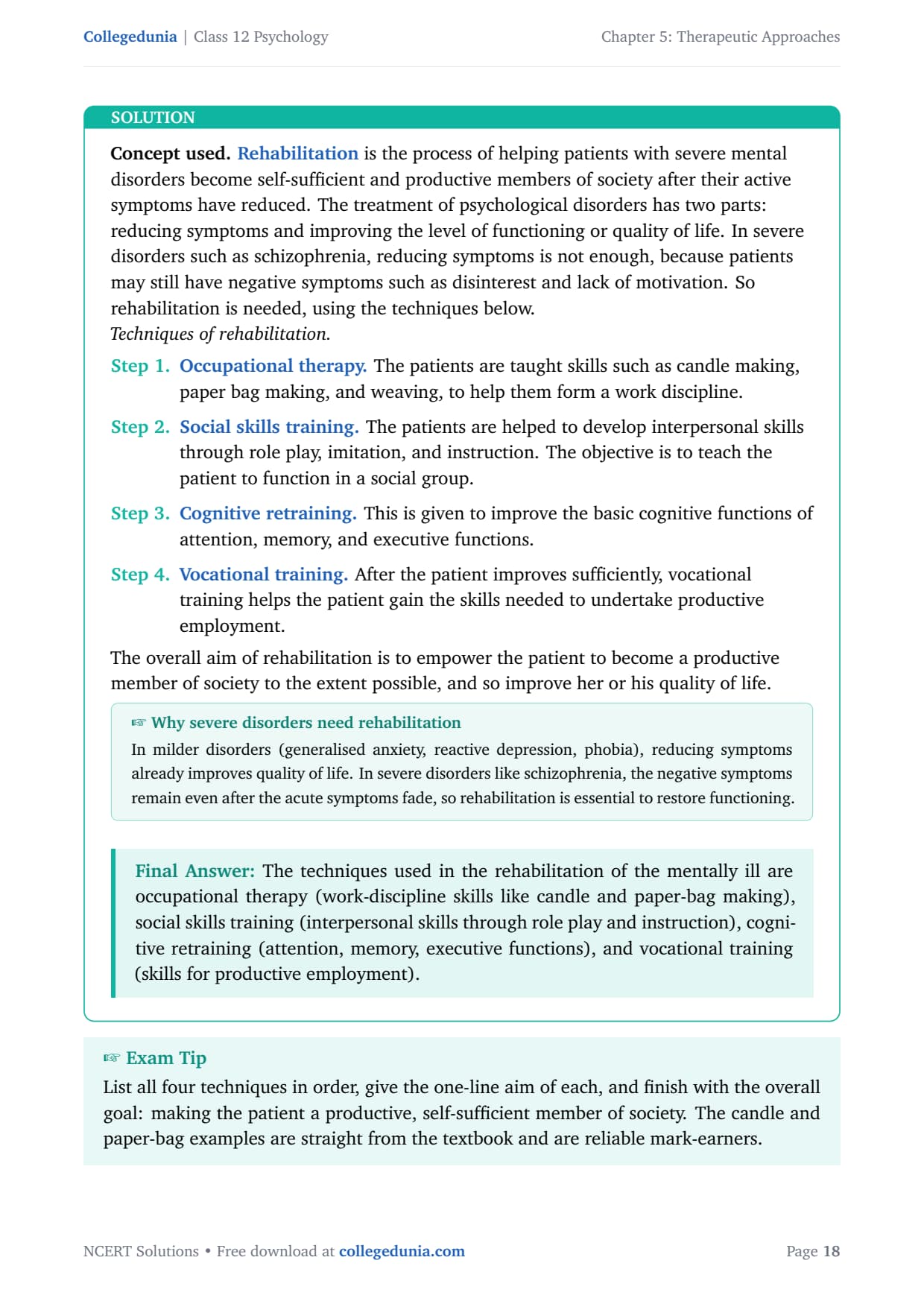
Concept used.Rehabilitation is the process of helping
patients with severe mental disorders become self-sufficient and productive
members of society after their active symptoms have reduced. The treatment of
psychological disorders has two parts: reducing symptoms and improving the
level of functioning or quality of life. In severe disorders such as
schizophrenia, reducing symptoms is not enough, because patients may still
have negative symptoms such as disinterest and lack of motivation. So
rehabilitation is needed, using the techniques below.
Techniques of rehabilitation.
Occupational therapy. The patients are taught skills such as
candle making, paper bag making, and weaving, to help them form a work
discipline.
Social skills training. The patients are helped to develop
interpersonal skills through role play, imitation, and instruction.
The objective is to teach the patient to function in a social group.
Cognitive retraining. This is given to improve the basic
cognitive functions of attention, memory, and executive functions.
Vocational training. After the patient improves
sufficiently, vocational training helps the patient gain the skills
needed to undertake productive employment.
The overall aim of rehabilitation is to empower the patient to become a
productive member of society to the extent possible, and so improve her or his
quality of life.
Why severe disorders need rehabilitation
In milder disorders (generalised anxiety, reactive depression, phobia),
reducing symptoms already improves quality of life. In severe disorders like
schizophrenia, the negative symptoms remain even after the acute symptoms
fade, so rehabilitation is essential to restore functioning.
The techniques used in the rehabilitation of the mentally ill are
occupational therapy (work-discipline skills like candle and paper-bag
making), social skills training (interpersonal skills through role play and
instruction), cognitive retraining (attention, memory, executive functions),
and vocational training (skills for productive employment).
KV
Karan Verma
M.Phil Psychiatric Social Work, NIMHANS Bangalore
Verified Expert
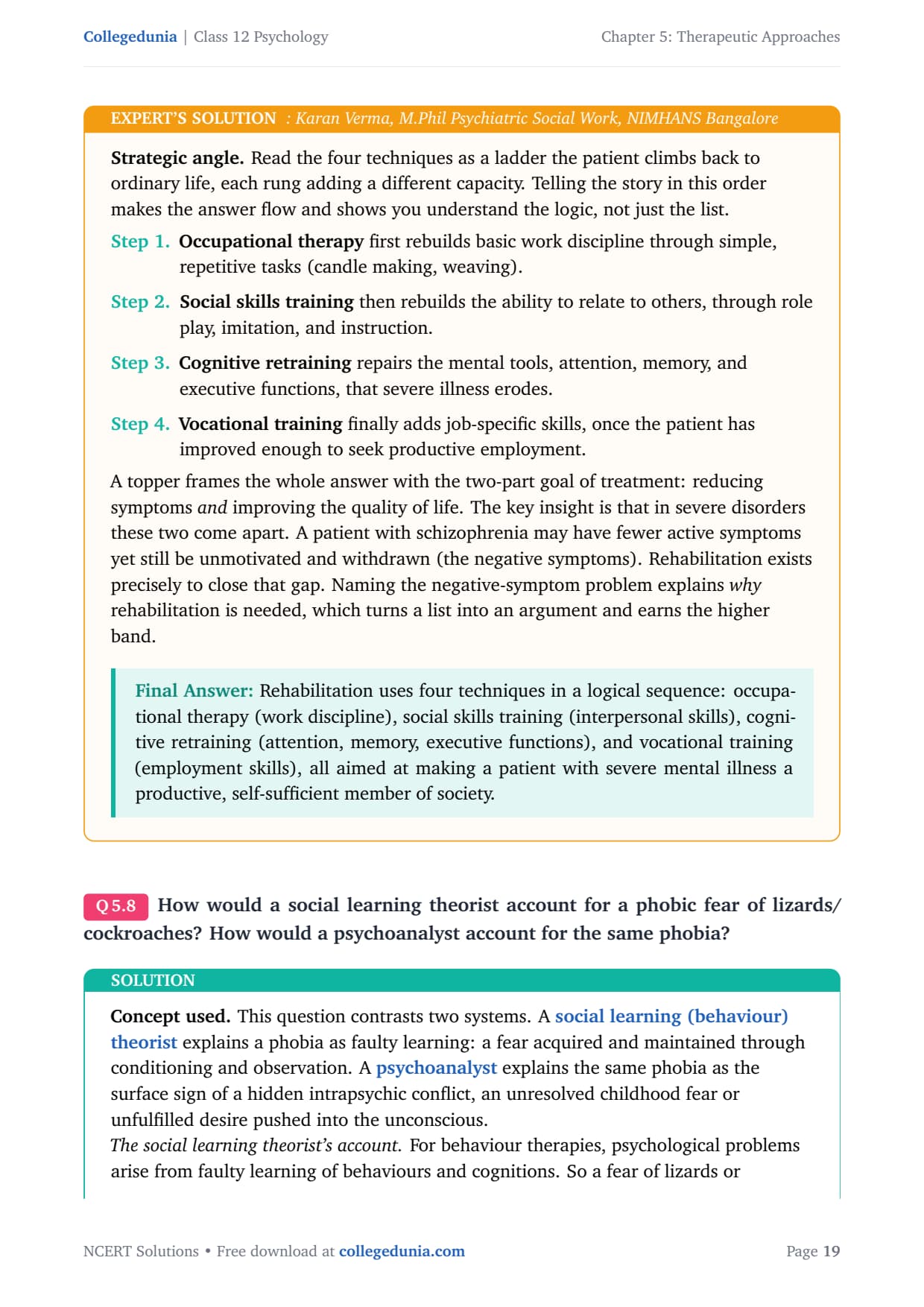
Strategic angle. Read the four techniques as a ladder the patient
climbs back to ordinary life, each rung adding a different capacity. Telling
the story in this order makes the answer flow and shows you understand the
logic, not just the list.
Occupational therapy first rebuilds basic work discipline
through simple, repetitive tasks (candle making, weaving).
Social skills training then rebuilds the ability to relate to
others, through role play, imitation, and instruction.
Cognitive retraining repairs the mental tools, attention,
memory, and executive functions, that severe illness erodes.
Vocational training finally adds job-specific skills, once the
patient has improved enough to seek productive employment.
A topper frames the whole answer with the two-part goal of treatment: reducing
symptoms and improving the quality of life. The key insight is that in
severe disorders these two come apart. A patient with schizophrenia may have
fewer active symptoms yet still be unmotivated and withdrawn (the negative
symptoms). Rehabilitation exists precisely to close that gap. Naming the
negative-symptom problem explains why rehabilitation is needed, which
turns a list into an argument and earns the higher band.
Rehabilitation uses four techniques in a logical sequence:
occupational therapy (work discipline), social skills training (interpersonal
skills), cognitive retraining (attention, memory, executive functions), and
vocational training (employment skills), all aimed at making a patient with
severe mental illness a productive, self-sufficient member of society.
Q 5.8
How would a social learning theorist account for a phobic fear of lizards/ cockroaches? How would a psychoanalyst account for the same phobia?
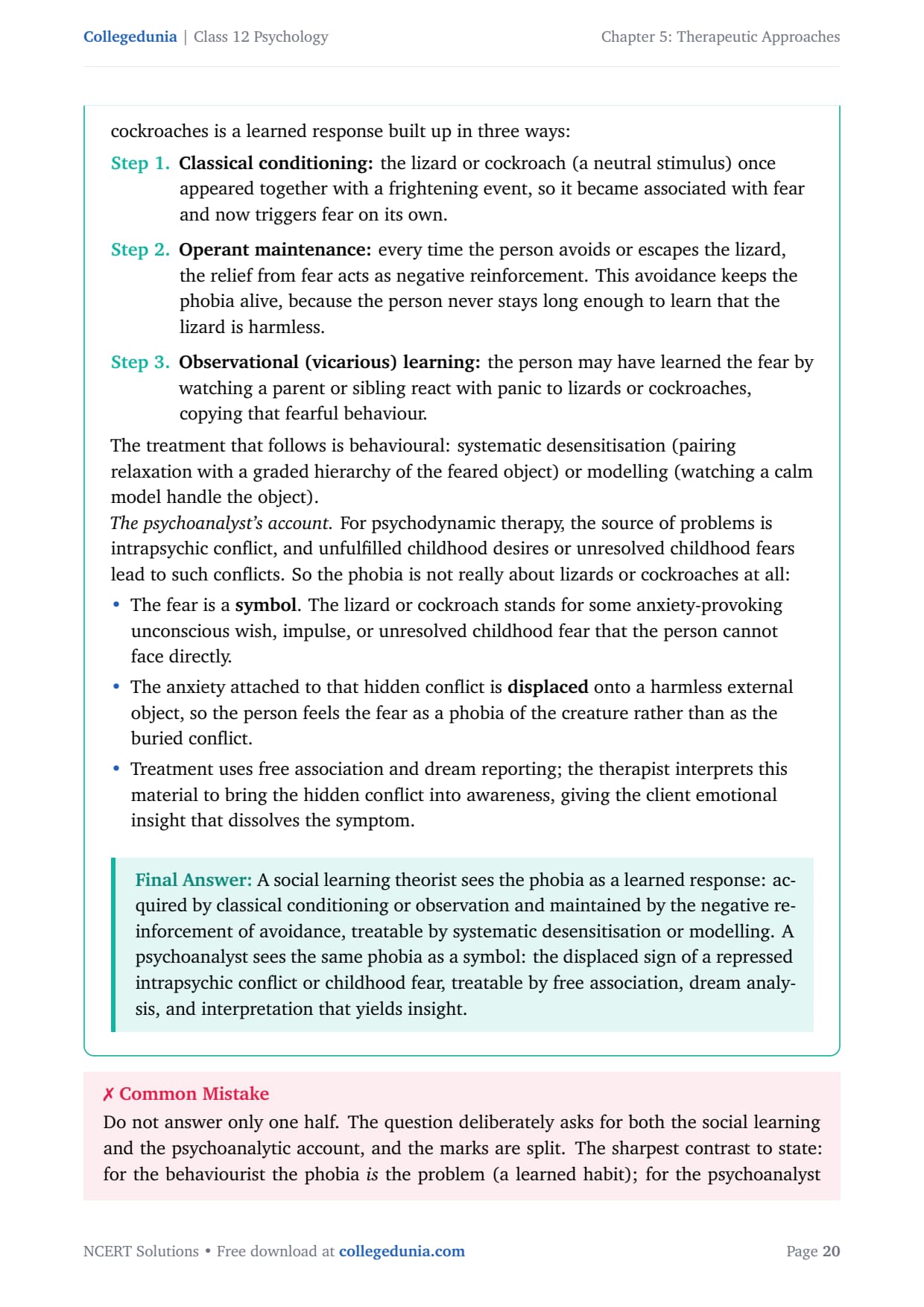
Concept used. This question contrasts two systems. A social
learning (behaviour) theorist explains a phobia as faulty learning: a fear
acquired and maintained through conditioning and observation. A
psychoanalyst explains the same phobia as the surface sign of a
hidden intrapsychic conflict, an unresolved childhood fear or unfulfilled
desire pushed into the unconscious.
The social learning theorist's account. For behaviour therapies,
psychological problems arise from faulty learning of behaviours and
cognitions. So a fear of lizards or cockroaches is a learned response built up
in three ways:
Classical conditioning: the lizard or cockroach (a neutral
stimulus) once appeared together with a frightening event, so it became
associated with fear and now triggers fear on its own.
Operant maintenance: every time the person avoids or escapes
the lizard, the relief from fear acts as negative reinforcement. This
avoidance keeps the phobia alive, because the person never stays long
enough to learn that the lizard is harmless.
Observational (vicarious) learning: the person may have
learned the fear by watching a parent or sibling react with panic to
lizards or cockroaches, copying that fearful behaviour.
The treatment that follows is behavioural: systematic desensitisation (pairing
relaxation with a graded hierarchy of the feared object) or modelling
(watching a calm model handle the object).
The psychoanalyst's account. For psychodynamic therapy, the source of
problems is intrapsychic conflict, and unfulfilled childhood desires or
unresolved childhood fears lead to such conflicts. So the phobia is not really
about lizards or cockroaches at all:
The fear is a symbol. The lizard or cockroach stands for some
anxiety-provoking unconscious wish, impulse, or unresolved childhood
fear that the person cannot face directly.
The anxiety attached to that hidden conflict is displaced onto
a harmless external object, so the person feels the fear as a phobia of
the creature rather than as the buried conflict.
Treatment uses free association and dream reporting; the therapist
interprets this material to bring the hidden conflict into awareness,
giving the client emotional insight that dissolves the symptom.
A social learning theorist sees the phobia as a learned response:
acquired by classical conditioning or observation and maintained by the
negative reinforcement of avoidance, treatable by systematic desensitisation
or modelling. A psychoanalyst sees the same phobia as a symbol: the displaced
sign of a repressed intrapsychic conflict or childhood fear, treatable by free
association, dream analysis, and interpretation that yields insight.
AD
Ananya Desai
M.A Clinical Psychology, Tata Institute of Social Sciences
Verified Expert
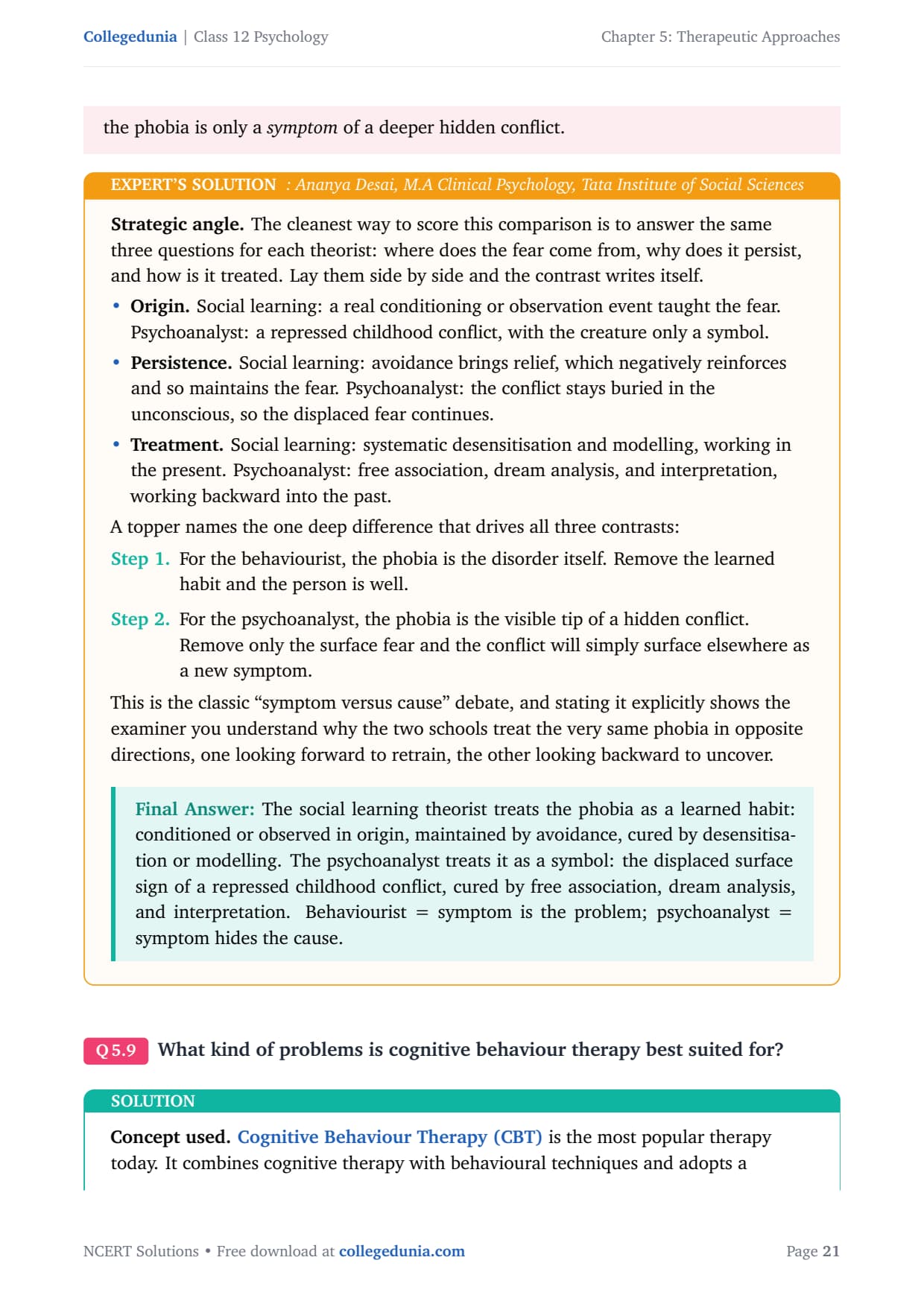
Strategic angle. The cleanest way to score this comparison is to
answer the same three questions for each theorist: where does the fear come
from, why does it persist, and how is it treated. Lay them side by side and
the contrast writes itself.
Origin. Social learning: a real conditioning or observation
event taught the fear. Psychoanalyst: a repressed childhood conflict,
with the creature only a symbol.
Persistence. Social learning: avoidance brings relief, which
negatively reinforces and so maintains the fear. Psychoanalyst: the
conflict stays buried in the unconscious, so the displaced fear
continues.
Treatment. Social learning: systematic desensitisation and
modelling, working in the present. Psychoanalyst: free association,
dream analysis, and interpretation, working backward into the past.
A topper names the one deep difference that drives all three contrasts:
For the behaviourist, the phobia is the disorder itself. Remove the
learned habit and the person is well.
For the psychoanalyst, the phobia is the visible tip of a hidden
conflict. Remove only the surface fear and the conflict will simply
surface elsewhere as a new symptom.
This is the classic ``symptom versus cause'' debate, and stating it explicitly
shows the examiner you understand why the two schools treat the very same
phobia in opposite directions, one looking forward to retrain, the other
looking backward to uncover.
The social learning theorist treats the phobia as a learned habit:
conditioned or observed in origin, maintained by avoidance, cured by
desensitisation or modelling. The psychoanalyst treats it as a symbol: the
displaced surface sign of a repressed childhood conflict, cured by free
association, dream analysis, and interpretation. Behaviourist = symptom is the
problem; psychoanalyst = symptom hides the cause.
Q 5.9
What kind of problems is cognitive behaviour therapy best suited for?
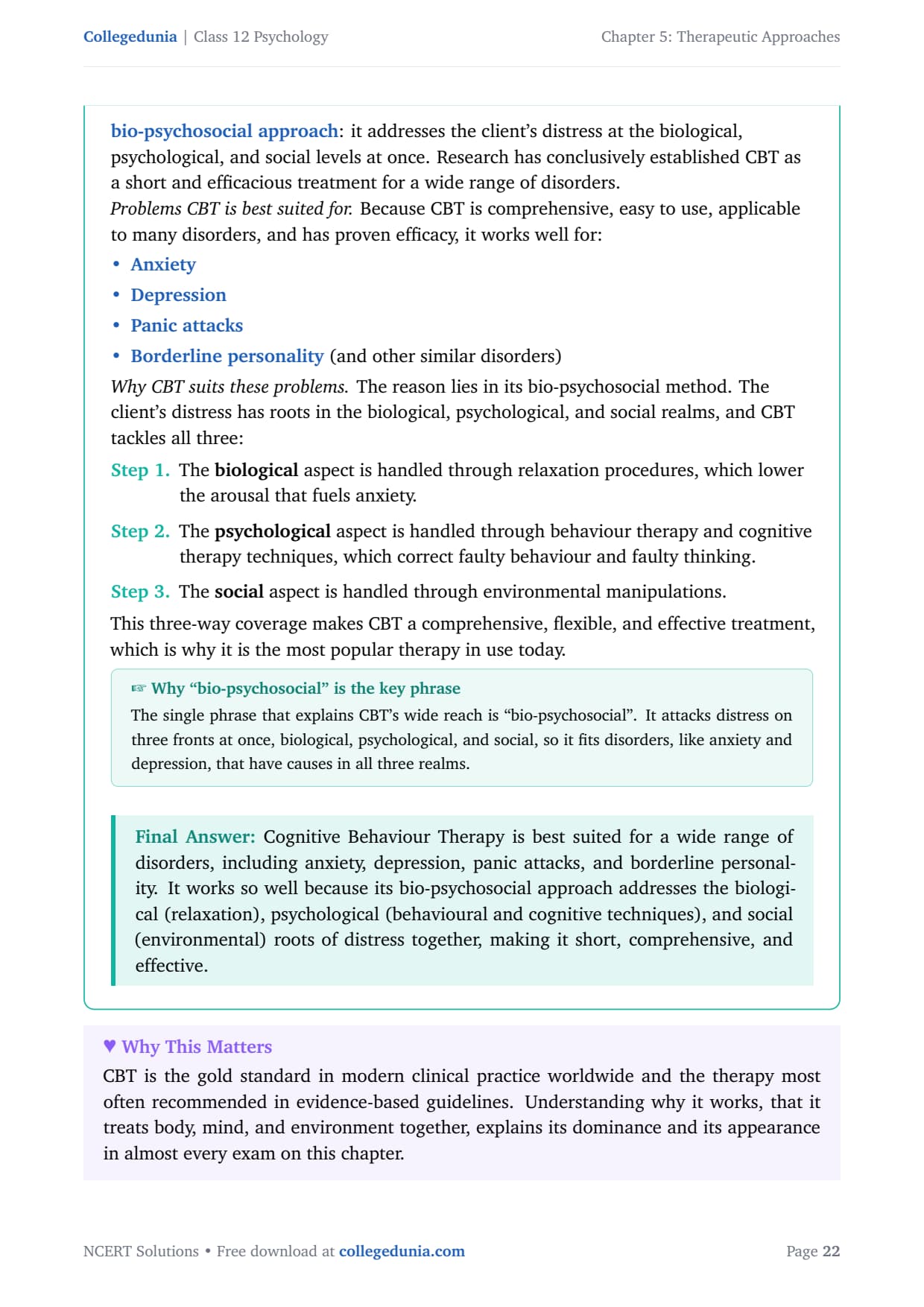
Concept used.Cognitive Behaviour Therapy (CBT) is the most
popular therapy today. It combines cognitive therapy with behavioural
techniques and adopts a bio-psychosocial approach: it addresses the
client's distress at the biological, psychological, and social levels at once.
Research has conclusively established CBT as a short and efficacious treatment
for a wide range of disorders.
Problems CBT is best suited for. Because CBT is comprehensive, easy
to use, applicable to many disorders, and has proven efficacy, it works well
for:
Anxiety
Depression
Panic attacks
Borderline personality (and other similar disorders)
Why CBT suits these problems. The reason lies in its
bio-psychosocial method. The client's distress has roots in the biological,
psychological, and social realms, and CBT tackles all three:
The biological aspect is handled through relaxation
procedures, which lower the arousal that fuels anxiety.
The psychological aspect is handled through behaviour therapy
and cognitive therapy techniques, which correct faulty behaviour and
faulty thinking.
The social aspect is handled through environmental
manipulations.
This three-way coverage makes CBT a comprehensive, flexible, and effective
treatment, which is why it is the most popular therapy in use today.
Why ``bio-psychosocial'' is the key phrase
The single phrase that explains CBT's wide reach is ``bio-psychosocial''. It
attacks distress on three fronts at once, biological, psychological, and
social, so it fits disorders, like anxiety and depression, that have causes in
all three realms.
Cognitive Behaviour Therapy is best suited for a wide range of
disorders, including anxiety, depression, panic attacks, and borderline
personality. It works so well because its bio-psychosocial approach addresses
the biological (relaxation), psychological (behavioural and cognitive
techniques), and social (environmental) roots of distress together, making it
short, comprehensive, and effective.
IM
Ishaan Mehta
M.Phil Clinical Psychology, NIMHANS Bangalore
Verified Expert
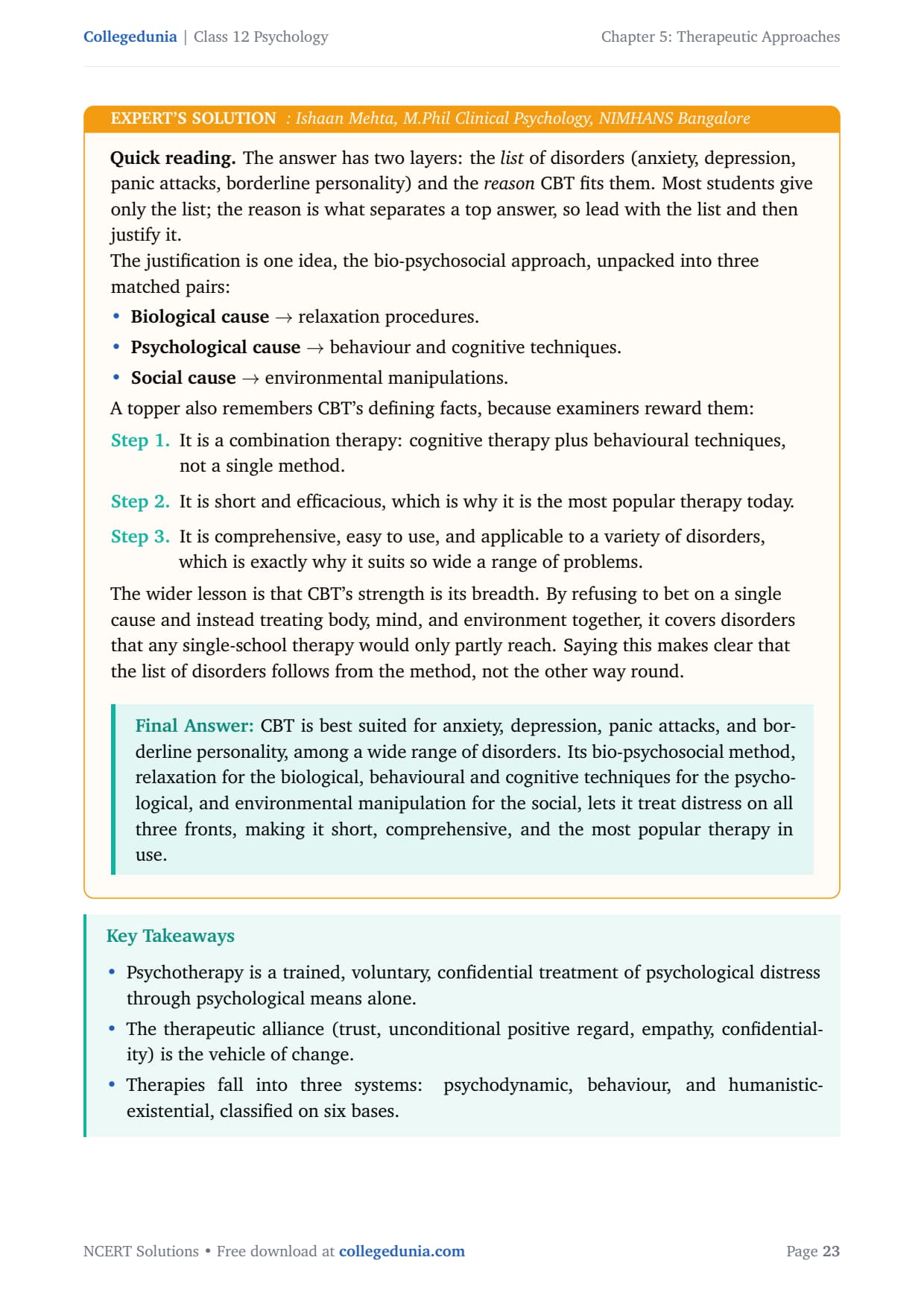
Quick reading. The answer has two layers: the list of
disorders (anxiety, depression, panic attacks, borderline personality) and the
reason CBT fits them. Most students give only the list; the reason is
what separates a top answer, so lead with the list and then justify it.
The justification is one idea, the bio-psychosocial approach, unpacked into
three matched pairs:
Biological cause → relaxation procedures.
Psychological cause → behaviour and cognitive techniques.
Social cause → environmental manipulations.
A topper also remembers CBT's defining facts, because examiners reward them:
It is a combination therapy: cognitive therapy plus behavioural
techniques, not a single method.
It is short and efficacious, which is why it is the most popular
therapy today.
It is comprehensive, easy to use, and applicable to a variety of
disorders, which is exactly why it suits so wide a range of problems.
The wider lesson is that CBT's strength is its breadth. By refusing to bet on a
single cause and instead treating body, mind, and environment together, it
covers disorders that any single-school therapy would only partly reach.
Saying this makes clear that the list of disorders follows from the method, not
the other way round.
CBT is best suited for anxiety, depression, panic attacks, and
borderline personality, among a wide range of disorders. Its bio-psychosocial
method, relaxation for the biological, behavioural and cognitive techniques for
the psychological, and environmental manipulation for the social, lets it
treat distress on all three fronts, making it short, comprehensive, and the
most popular therapy in use.
FAQs on Therapeutic Approaches Class 12 NCERT Solutions
Therapeutic Approaches Class 12 Psychology Common Questions
Ques. Where can I get the class 12 psychology chapter 5 NCERT Solutions PDF?
Ans. You can download the Therapeutic Approaches Class 12 Psychology NCERT Solutions PDF directly from this page. It is free, follows the 2026-27 NCERT, and answers all 9 review questions point by point.
Ques. How many questions are there in Therapeutic Approaches class 12 questions and answers?
Ans. The chapter has 9 review questions. They cover the nature of psychotherapy, the types of therapy, behaviour and cognitive techniques, humanistic therapy, healing factors, rehabilitation, a phobia comparison, and the uses of CBT.
Ques. What is psychotherapy in Therapeutic Approaches Class 12?
Ans. Psychotherapy is a planned, voluntary and confidential helping relationship between a trained therapist and a client. It uses tested psychological principles to reduce distress and help the client live better, and its core is the therapeutic relationship built on trust.
Ques. What are the techniques used in behaviour therapy?
Ans. The main techniques are negative reinforcement, aversive conditioning, token economy, systematic desensitisation and modelling. Each replaces a faulty, learned behaviour with a healthier one, since behaviour therapy assumes problem behaviour is learned and can be unlearned.
Ques. What problems is cognitive behaviour therapy best suited for?
Ans. CBT works well for anxiety disorders, depression, phobias, obsessive-compulsive disorder and stress-related problems. It is short, broad and effective because it tackles both faulty thoughts and faulty behaviour together.
Ques. Is class 12 psychology chapter 5 easy to score in the board exam?
Ans. Yes. It is one of the easier scoring chapters if you keep each therapy linked to its founder and method. Practise the behaviour therapy techniques and the CBT explanation, and keep the phobia comparison ready for the case-based question.








Comments