Maths Mentor, Delhi University | Updated 3+ months ago
These NCERT Solutions answer every question of Class 12 Maths Chapter 8 Application of Integrals Miscellaneous Exercise, following CBSE step-marking. The free PDF is on this page.
CBSE Weightage: 4 to 6 marks in the Class 12 board paper, typically one long-answer modulus or trigonometric area question plus a 1-mark MCQ distractor.
At a glance: 5 sums · power-curve areas · modulus integrand |x+3| · sin x over a full period · the y=x3 and y=x|x| sign traps
Solutions curated by Collegedunia Class 12 Mathematics faculty, matched to the 2026-27 NCERT print and cross-checked against the official answer key.
Why the Miscellaneous Exercise of Class 12 Maths Chapter 8 Matters Most
Exercise 8.1 rewards a memorised ellipse formula. The Miscellaneous Exercise does not: every question here hides a sign change, and the marking scheme gives zero credit for a signed integral when the question asks for geometric area. Students most often lose the full 5-mark area question by forgetting the modulus on a curve that crosses the x-axis. This exercise drills that gap shut before the board exam.
Q3 ( sin x), Q4 ( x3) and Q5 (x|x| ) are built so the signed integral gives a tempting wrong answer, usually zero or negative. Spotting the trap is worth more than the integration itself.
How the NCERT Solutions Class 12 Maths on the Application of Integrals Class 12 NCERT Solutions Help You
Each solution puts the sign decision first, before any antiderivative. We mark the zero of the integrand, split the interval there, then integrate, the exact sequence CBSE markers expect.
Sign change located first: every solution names the split point before integrating.
Geometric cross-check: Q2's |x+3| V-graph is verified as two congruent triangles, area 92 each.
Distractor decoded: Q4 and Q5 show the "forgot the modulus" trap option, so you can eliminate it by inspection.
Symmetry shortcuts: the odd-function rule -aa|f|=20a|f| is applied where it saves a step.
Class 12 Maths Chapter 8 Miscellaneous Exercise: The Sign Rule You Apply
One rule governs the whole exercise:
Geometric area:A=ab |f(x)| dx . Wherever f changes sign at an interior point c, split: A=|acf|+|cbf| . The plain integral abf dx is the signed value, not the area.
The supporting antiderivatives are the power rule ∫ xn dx=xn+1n+1+C for n≠ -1 , and the trigonometric pair x dx=-cos x+C, x dx=sin x+C. For a modulus integrand, split at the zero of the inside expression, as |x+3| does at x=-3 in Q2.
Question-Wise Answer Map for Class 12 Maths Chapter 8 Miscellaneous Exercise
The table below lists each Miscellaneous question, its curve, and the verified final value. Use it as a checking grid after attempting the set.
Q No.
Curve and limits
Key idea
Answer
1(i)
y=x2, x=1 to x=2 , x-axis
Power rule, curve above axis
73 sq units
1(ii)
y=x4, x=1 to x=5 , x-axis
Power rule, curve above axis
31245 sq units
2
y=|x+3| , -60|x+3| dx
Split modulus at x=-3
9 sq units
3
y=sin x, x=0 to x=2π
Split at x=π , two arches
4 sq units
4 (MCQ)
y=x3, x-axis, x=-2 to x=1
Split at x=0 , add absolute values
174 [option (D)]
5 (MCQ)
y=x|x| , x-axis, x=-1 to x=1
Odd function, 201x2 dx
23 [option (C)]
Q1 has no sign change because even powers stay above the axis. Q2 to Q5 all need a split. In Q4 the trap option is the signed value -154, and in Q5 it is the signed value 0, the classic "forgot the modulus" distractors.
Step-by-Step Method Used in the NCERT Solutions for the Miscellaneous Exercise
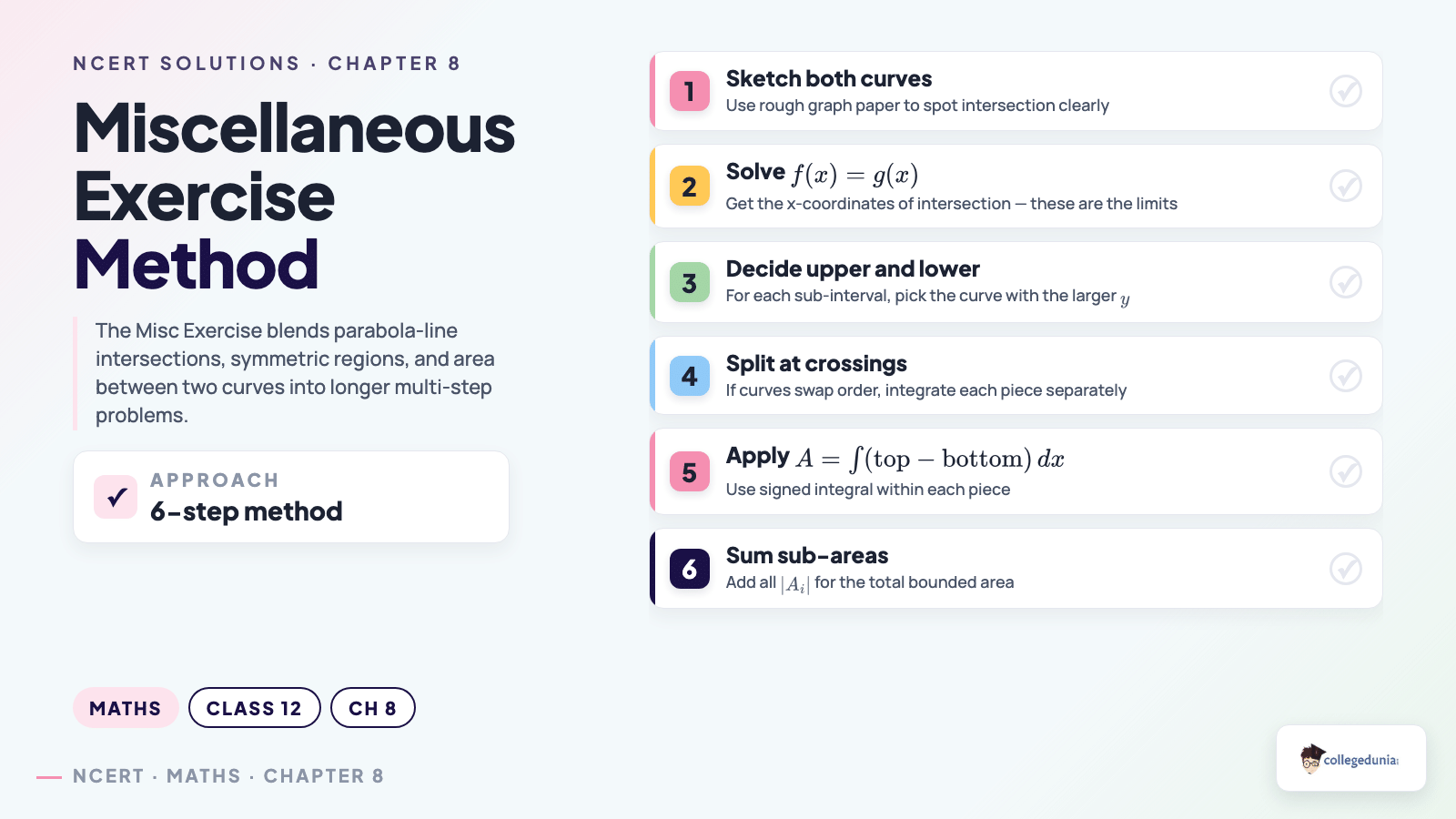
Every solved problem in this PDF runs the same four-step routine, which keeps the sign handling examination-ready.
Sketch the curve on the given interval and mark where it crosses the x-axis.
Split the integral at every interior zero of the integrand (or of the inside expression for a modulus).
Integrate each piece with the power rule or the trigonometric antiderivatives, then take absolute values.
Add and cross-check with geometry (triangle or rectangle bound) or with an odd/even symmetry argument.
The geometric cross-check catches a sign slip fastest: Q2's answer 9 is two triangles of area 92; Q3's answer 4 is two sine arches of area 2 each.
Solved Example from the Miscellaneous Exercise: Area Under y=sin x in Q3
Q3 asks for the area bounded by y=sin x between x=0 and x=2π : positive on [0,π] , negative on [π,2π] , so it needs a modulus split.
Sample step: First arch, A1=0πsin x dx=[-cos x]0π=1+1=2 .
Sample step: Second arch, A2=π2π(-sin x) dx=[cos x]π2π=1+1=2 . Total A=A1+A2=4 . The plain integral 02πsin x dx=0 is the trap.
Common Mistakes Students Make in Class 12 Maths Chapter 8 Miscellaneous Exercise
Common Mistake: Evaluating abf(x) dx directly when the curve crosses the x-axis. For Q4, -21x3 dx=-154 is the signed value, not the area. Area is never negative. The correct area is 174.
Not splitting the modulus |x+3| at x=-3 in Q2, which collapses the answer to 0.
Computing 02πsin x dx and writing 0 as the area in Q3 instead of using |sin x| .
Picking option (A) in Q5 since the signed integral of x|x| over [-1,1] is 0.
Treating y=x4 as if it dips below the axis. Even powers stay non-negative.
Forgetting the geometric cross-check that catches a sign slip.
Other Resources for Class 12 Maths Chapter 8 Application of Integrals
All NCERT Solutions for Application of Integrals Misc with Step-by-Step Working
Every question of Application of Integrals Misc is listed below with its full Solution and Expert Solution inside collapsible tabs. Click to reveal the step-by-step working.
Questions
Q 8.1
Find the area under the given curves and given lines:
(i) y=x2, x=1, x=2 and the x-axis.
(ii) y=x4, x=1, x=5 and the x-axis.
Concept used. For a curve y=f(x) that lies above the
x-axis on [a,b], the area between the curve, the x-axis and
the vertical lines x=a, x=b is the definite integral
A=abf(x) dx.
Both parts of this question give a curve of the form y=xn
(n=2 or n=4) on an interval where x>0, so y>0 throughout
and the curve lies above the x-axis. The required antiderivative
is the power-rule antiderivative ∫ xn dx=xn+1n+1+C (n≠ -1).
center
[See diagram in the PDF version]
6pt]
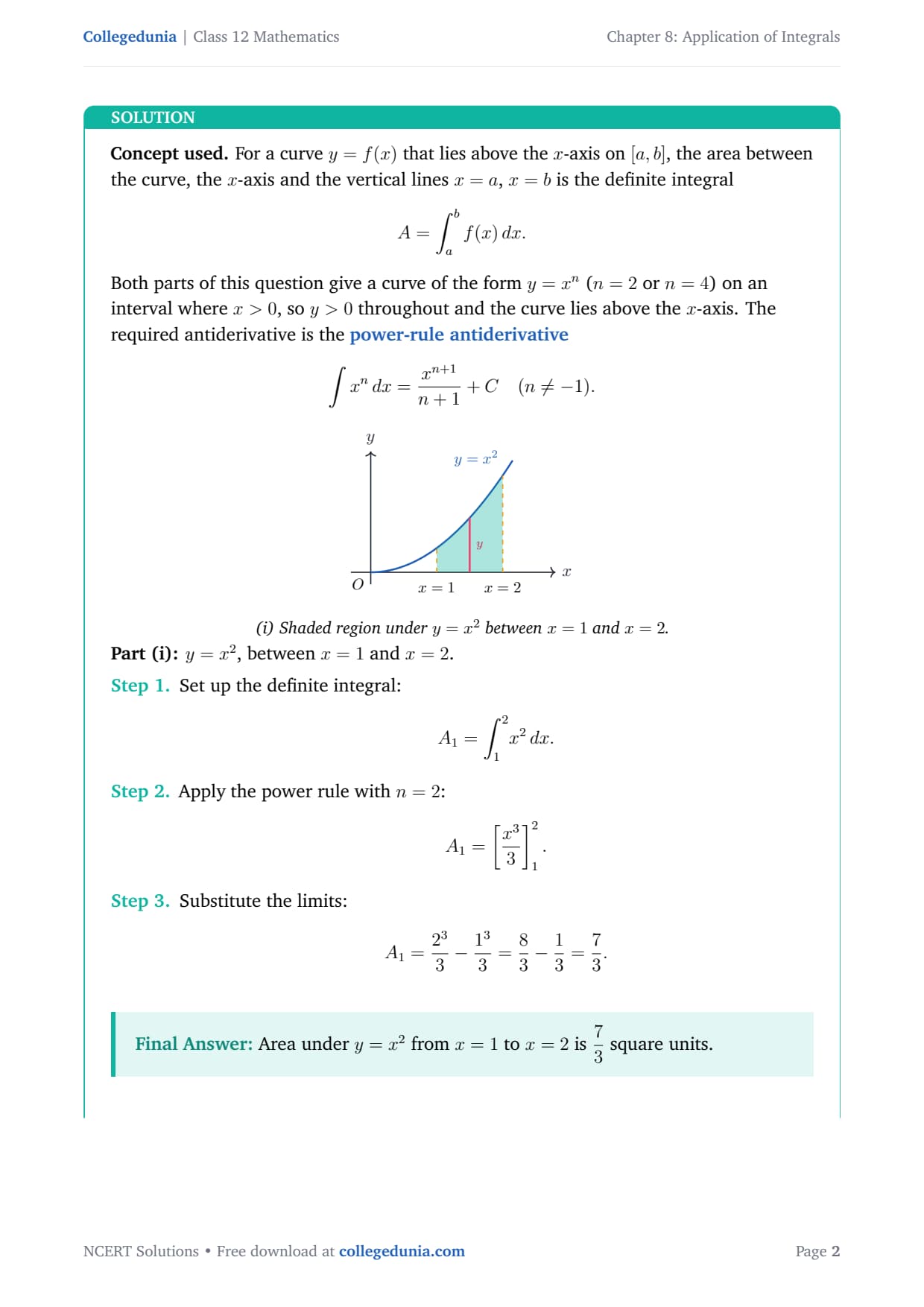
(i) Shaded region under $y=x2$ between $x=1$ and $x=2$.
center
Part (i): $y=x2$, between $x=1$ and $x=2$.
steps
Set up the definite integral:
[ A1=12x2 dx.
Apply the power rule with n=2:
A1=[x33]12.
Substitute the limits:
A1=233-133=83-13=73.
steps
Area under y=x2 from x=1 to x=2 is 73 square units.
0.6em
center
[See diagram in the PDF version]
4pt]
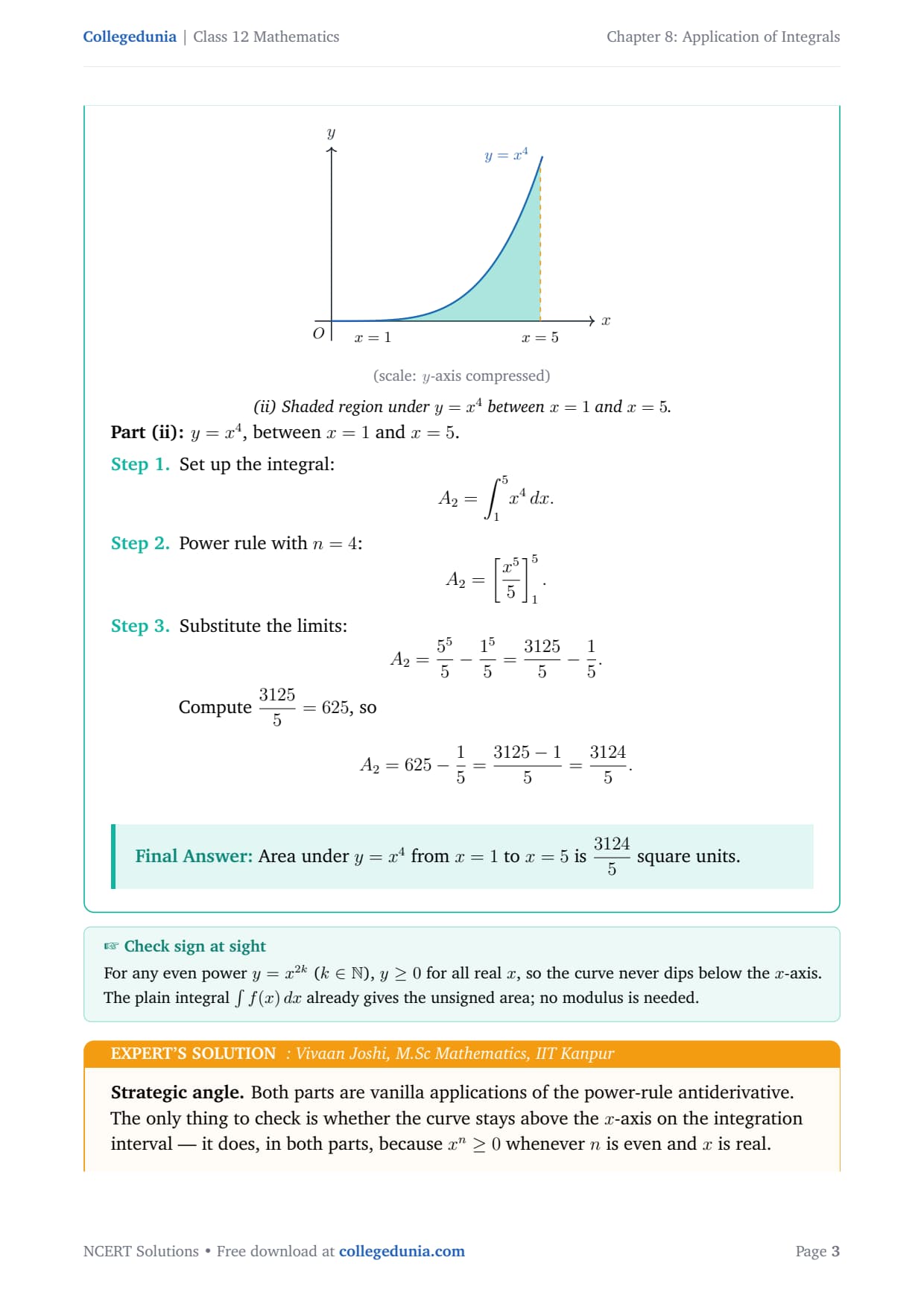
cdMuted(scale: $y$-axis compressed) [4pt]
(ii) Shaded region under $y=x4$ between $x=1$ and $x=5$.
center
Part (ii): $y=x4$, between $x=1$ and $x=5$.
steps
Set up the integral:
[ A2=15x4 dx.
Power rule with n=4:
A2=[x55]15.
Substitute the limits:
A2=555-155=31255-15.
Compute 31255=625, so
A2=625-15=3125-15=31245.
steps
Area under y=x4 from x=1 to x=5 is 31245 square units.
VJ
Vivaan Joshi
M.Sc Mathematics, IIT Kanpur
Verified Expert
Strategic angle. Both parts are vanilla applications of the
power-rule antiderivative. The only thing to check is whether the
curve stays above the x-axis on the integration interval - it does,
in both parts, because xn≥ 0 whenever n is even and x is
real.
Concept used. For a non-negative function on [a,b],
Area beneath curve=abf(x) dx,
evaluated via the Fundamental Theorem of Calculus: if
F'(x)=f(x), then abf(x) dx=F(b)-F(a).
Part (i): antiderivative of x2.F(x)=x33.
Apply FTC:
A1=F(2)-F(1)=83-13=73.
Part (ii): antiderivative of x4.F(x)=x55.
A2=F(5)-F(1)=31255-15=31245.
Sanity check (i). The bounding rectangle for the (i)
region is [1,2]×[0,4], area 4. Our 73≈ 2.33
is comfortably less than 4 .
Sanity check (ii). The bounding rectangle for the (ii)
region is [1,5]×[0,625], area 2500.
Our 31245=624.8 is well below 2500 .
Why this matters. The power rule is the workhorse of every
polynomial-area question - the algebra never gets harder than this.
What students lose marks on is forgetting to use |f(x)| when the
curve crosses the axis. Always sketch first.
A1=73, A2=31245.
Q 8.2
Sketch the graph of y=|x+3| and evaluate -60|x+3| dx.
Concept used. The absolute-value function|u|
is defined piecewise:
|u|=cases u, & u≥ 0 -u, & u<0. cases
Applied to u=x+3:
|x+3|=cases x+3, & x≥ -3 -(x+3)=-x-3, & x<-3. cases
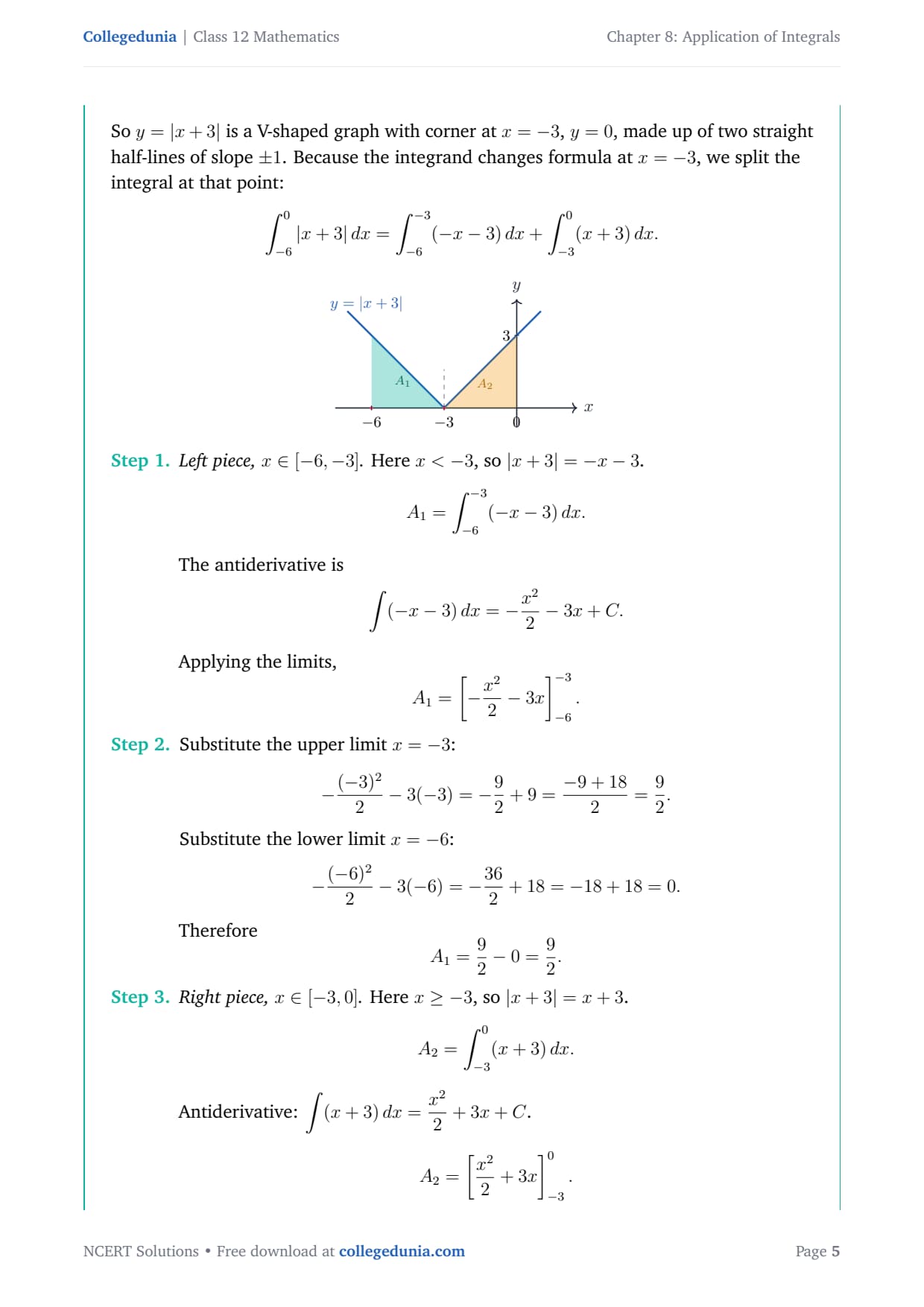
So y=|x+3| is a V-shaped graph with corner at x=-3, y=0, made
up of two straight half-lines of slope ± 1. Because the
integrand changes formula at x=-3, we split the integral at that
point:
-60|x+3| dx=-6-3(-x-3) dx+-30(x+3) dx.
[See diagram in the PDF version]
Left piece, x∈[-6,-3]. Here x<-3, so |x+3|=-x-3.
A1=-6-3(-x-3) dx.
The antiderivative is
∫(-x-3) dx=-x22-3x+C.
Applying the limits,
A1=[-x22-3x]-6-3.
Substitute the upper limit x=-3:
-(-3)22-3(-3)=-92+9=-9+182=92.
Substitute the lower limit x=-6:
-(-6)22-3(-6)=-362+18=-18+18=0.
Therefore
A1=92-0=92.
Right piece, x∈[-3,0]. Here x≥ -3, so |x+3|=x+3.
A2=-30(x+3) dx.
Antiderivative: ∫(x+3) dx=x22+3x+C.
A2=[x22+3x]-30.
Substitute the upper limit x=0:
022+3(0)=0.
Substitute the lower limit x=-3:
(-3)22+3(-3)=92-9=9-182=-92.
Therefore
A2=0-(-92)=92.
Add the two pieces:
-60|x+3| dx=A1+A2=92+92=9. Geometric check. The shaded region is two congruent
right-angled triangles with legs 3 and 3. Each has area
12(3)(3)=92; total =2·92=9 .
-60|x+3| dx=9 square units.
TN
Tara Nair
M.Sc Applied Mathematics, IIT Kanpur
Verified Expert
Picture-first. Plot y=|x+3|: it is the graph of y=|x|
shifted three units to the left, so the vertex sits at (-3,0), and
the two arms have slopes -1 (for x<-3) and +1 (for x>-3). On
[-6,0], the graph is two straight segments meeting at (-3,0).
Concept used. Geometric area below a piecewise-linear
graph and above the x-axis equals the sum of triangle (or
trapezium) areas. Algebraically, ab|u(x)| dx is split
at every zero of u(x) inside [a,b].
Identify the zero of u(x)=x+3 inside [-6,0].u=0⇒ x=-3. So split the integral at -3:
-60|x+3| dx=-6-3-(x+3) dx+-30(x+3) dx.
Recognise each piece as a triangle. On [-6,-3]
the height varies linearly from |-6+3|=3 down to 0:
right triangle with legs 3 (horizontal) and 3 (vertical),
area 12(3)(3)=92. On [-3,0] the
height climbs linearly from 0 to |0+3|=3: another right
triangle, same legs, same area 92.
Sum.92+92=9.
Algebraic verification.-6-3-(x+3) dx=[-x22-3x]-6-3=92-0=92,
and -30(x+3) dx=[x22+3x]-30=0-(-92)=92,
sum =9. Matches the geometric answer exactly.
Why this matters. For piecewise-linear integrands, the
``triangle/trapezium'' geometric reading is the fastest sanity check
in the chapter. Set up the integral algebraically, then ask: would
elementary geometry have given the same answer? When it does, you
know your sign-handling is right.
Integral =9 square units.
Q 8.3
Find the area bounded by the curve y=sin x between x=0 and x=2π.
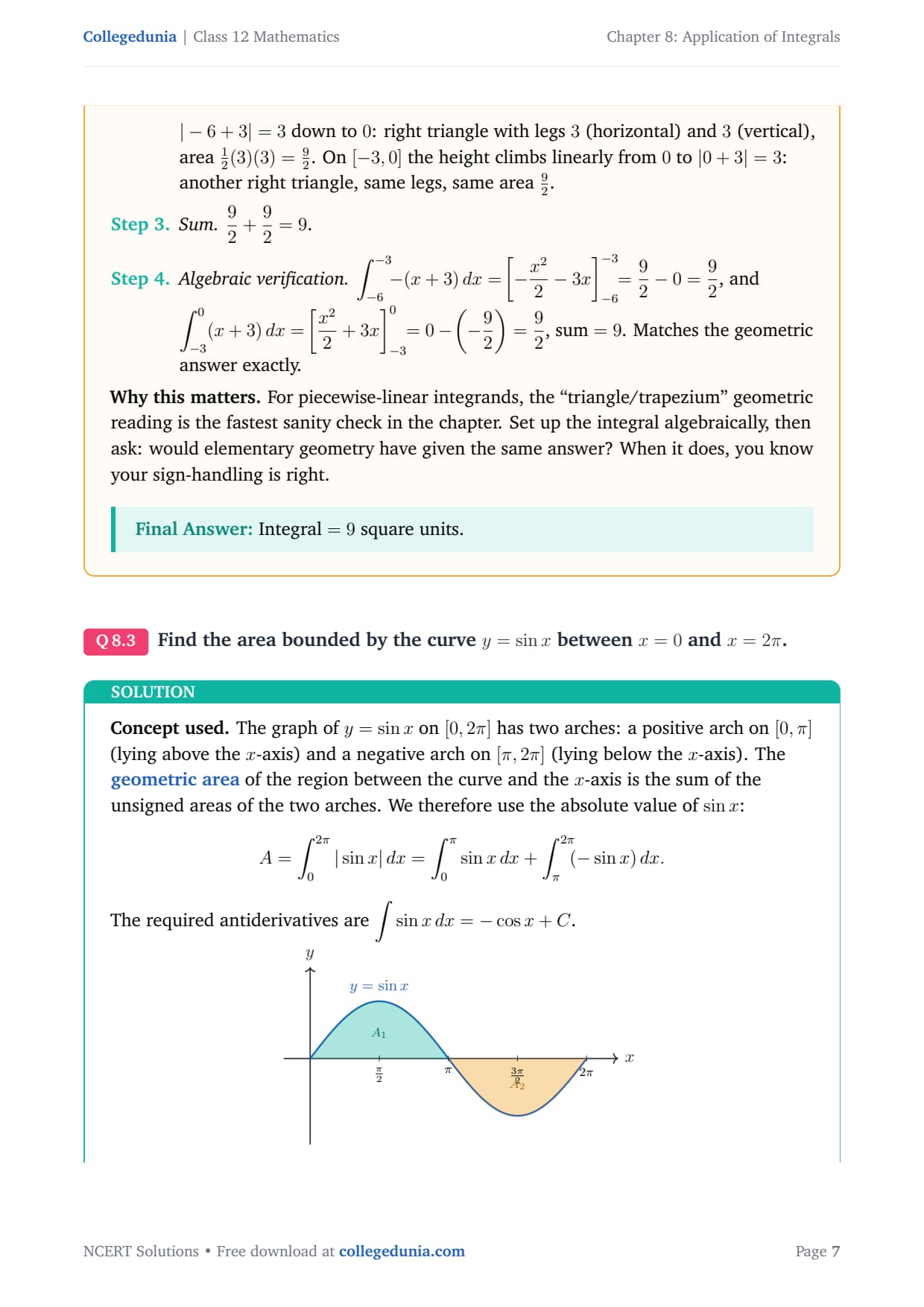
Concept used. The graph of y=sin x on [0,2π] has two
arches: a positive arch on [0,π] (lying above the x-axis) and a
negative arch on [π,2π] (lying below the x-axis). The
geometric area of the region between the curve and the
x-axis is the sum of the unsigned areas of the two arches. We
therefore use the absolute value of sin x:
A=02π|sin x| dx
=0πsin x dx+π2π(-sin x) dx.
The required antiderivatives are
x dx=-cos x+C.
[See diagram in the PDF version]
First arch, x∈[0,π]. Here sin x≥ 0:
A1=0πsin x dx=[-cos x]0π.
Substitute:
A1=(-cosπ)-(-cos 0)=-(-1)-(-1)=1+1=2.
Second arch, x∈[π,2π]. Here sin x≤ 0, so
|sin x|=-sin x:
A2=π2π(-sin x) dx=[cos x]π2π.
Substitute:
A2=cos 2π-cosπ=1-(-1)=1+1=2.
Add the two pieces.A=A1+A2=2+2=4.
Symmetry sanity check. By symmetry of |sin x| on
each half period, the two arches enclose equal areas, namely
2 each. The full integral over a period of sin gives the
signed value 0; the modulus integral gives 4.
Area bounded by y=sin x between x=0 and x=2π is 4 square units.
KV
Krishna Verma
Ph.D Mathematics, IIT Delhi
Verified Expert
Strategic angle. The sine curve is point-symmetric about
(π,0) on [0,2π]: the right-hand arch is a mirror image of the
left-hand arch reflected through that point. Therefore the unsigned
area of the right arch equals that of the left arch.
Concept used. For any function f that changes sign at
finitely many points c12<k inside [a,b], the
unsigned area between y=f(x) and the x-axis is
ab|f(x)| dx=i=0k|cici+1f(x) dx|,
where c0=a and ck+1=b.
Find sign changes inside (0,2π).sin x=0 at
x=π (the only interior zero on (0,2π)). So split:
[0,π]∪[π,2π].
Compute the signed integrals. I1=0πsin x dx=[-cos x]0π=2, I2=π2πsin x dx=[-cos x]π2π=-2.
Add the absolute values.|I1|+|I2|=2+2=4.
Cross-check by symmetry. Each arch of |sin x| has
the same area as the first arch - and that arch has area
0πsin x dx=2. Two arches ⇒ total 4.
Why this matters. Many CBSE questions hide a sign-change.
Whenever you see an integrand that takes both signs on the interval,
split at the zeros, integrate each piece, then add absolute values.
The signed integral alone is for net displacement / net flux, not
area.
A=4 square units.
Q 8.4
Area bounded by the curve y=x3, the x-axis and the ordinates x=-2 and x=1 is
(A) -9 (B) -154 (C) 154 (D) 174
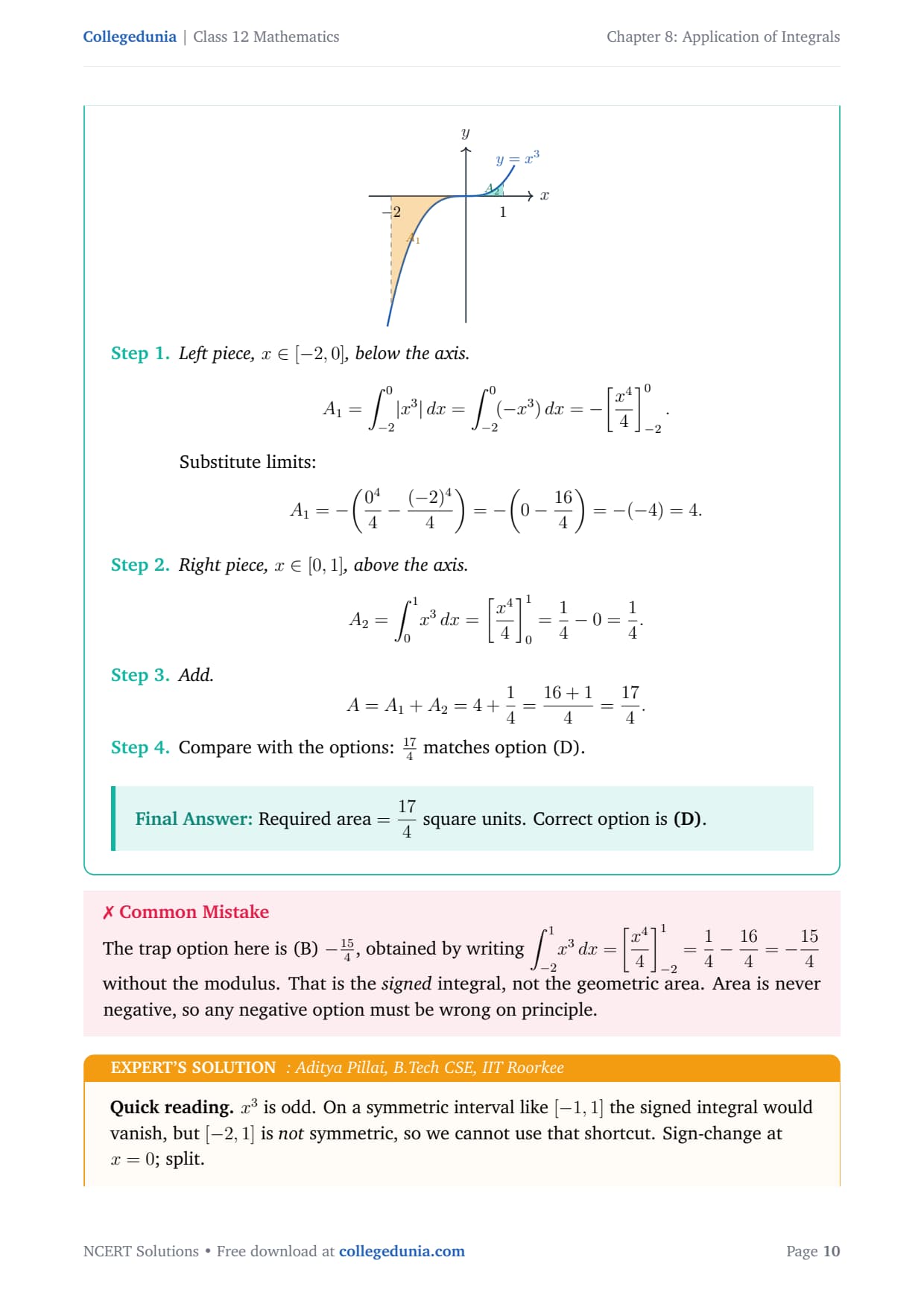
Concept used. The cubic y=x3 is an odd function:
y<0 for x<0 and y>0 for x>0. So on the interval [-2,1] the
curve dips below the x-axis on [-2,0] and rises above on [0,1].
Geometric area is non-negative; therefore we use |x3|:
A=-21|x3| dx
=-20(-x3) dx+01x3 dx.
Antiderivative needed: ∫ x3 dx=x44+C.
[See diagram in the PDF version]
Left piece, x∈[-2,0], below the axis. A1=-20|x3| dx=-20(-x3) dx
=-[x44]-20.
Substitute limits:
A1=-(044-(-2)44)
=-(0-164)=-(-4)=4.
Right piece, x∈[0,1], above the axis. A2=01x3 dx=[x44]01
=14-0=14.
Add.A=A1+A2=4+14=16+14=174.
Compare with the options: 174 matches option (D).
Required area =174 square units. Correct option is (D).
AP
Aditya Pillai
B.Tech CSE, IIT Roorkee
Verified Expert
Quick reading.x3 is odd. On a symmetric interval like
[-1,1] the signed integral would vanish, but [-2,1] is
not symmetric, so we cannot use that shortcut. Sign-change at
x=0; split.
Concept used. Whenever a polynomial f(x) changes sign at
an interior point c∈(a,b), ab|f|=|acf|+|cbf|.
Find sign change.x3=0⇒ x=0. So split at 0.
Compute the left piece. Using
∫ x3 dx=x44+C, we have
-20x3 dx=044-(-2)44=0-164=-4.
Compute the right piece.01x3 dx=144-044=14-0=14.
Take absolute values and add.A=|-4|+|14|=4+14=174.
Eliminate by inspection. Options (A) and (B) are
negative - impossible for area. Option (C) 154 is
the absolute value of the signed integral, a classic
distractor. Only (D) 174 matches both arches' areas.
Why this matters. For MCQs, knowing which distractor
corresponds to ``forgot the modulus'' lets you spot the trap before
doing the algebra. Always sketch the cubic mentally first.
Option (D): A=174.
Q 8.5
The area bounded by the curve y=x |x|, the x-axis and the ordinates x=-1 and x=1 is given by
(A) 0 (B) 13 (C) 23 (D) 43
[Hint: y=x2 if x>0 and y=-x2 if x<0.]
Concept used. The function y=x|x| unpacks as
y=x|x|=cases x· x=x2, & x≥ 0 x·(-x)=-x2, & x<0. cases
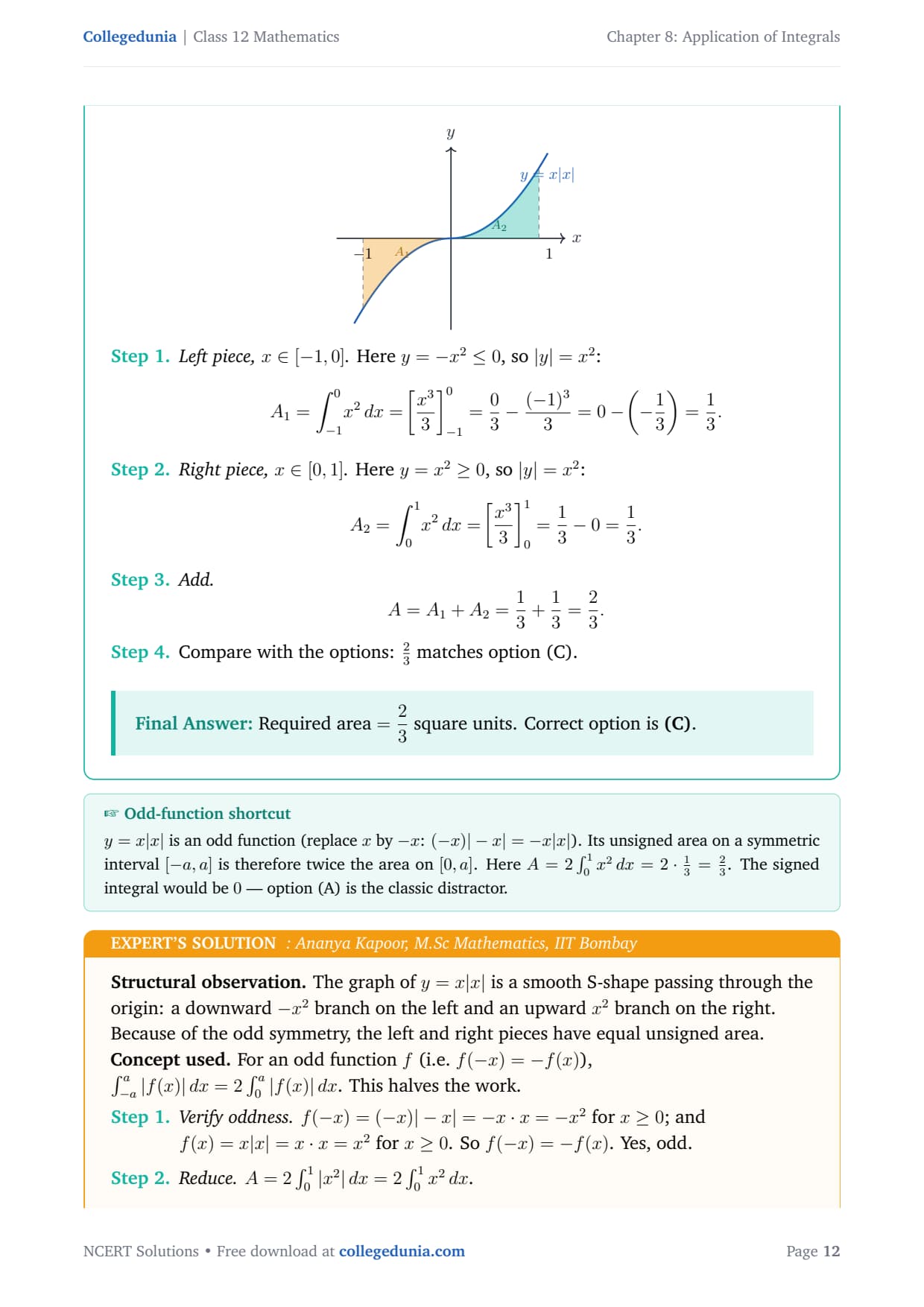
So on [-1,0] the curve is y=-x2 (below the x-axis), and on
[0,1] the curve is y=x2 (above the x-axis). Geometric area
uses the absolute value of the integrand:
A=-11| x|x| | dx
=-10|-x2| dx+01|x2| dx
=-10x2 dx+01x2 dx,
because x2≥ 0 for all real x, so |x2|=x2 and |-x2|=x2.
[See diagram in the PDF version]
Left piece, x∈[-1,0]. Here y=-x2≤ 0, so
|y|=x2:
A1=-10x2 dx=[x33]-10
=03-(-1)33=0-(-13)=13.
Right piece, x∈[0,1]. Here y=x2≥ 0, so
|y|=x2:
A2=01x2 dx=[x33]01
=13-0=13.
Add.A=A1+A2=13+13=23.
Compare with the options: 23 matches option (C).
Required area =23 square units. Correct option is (C).
AK
Ananya Kapoor
M.Sc Mathematics, IIT Bombay
Verified Expert
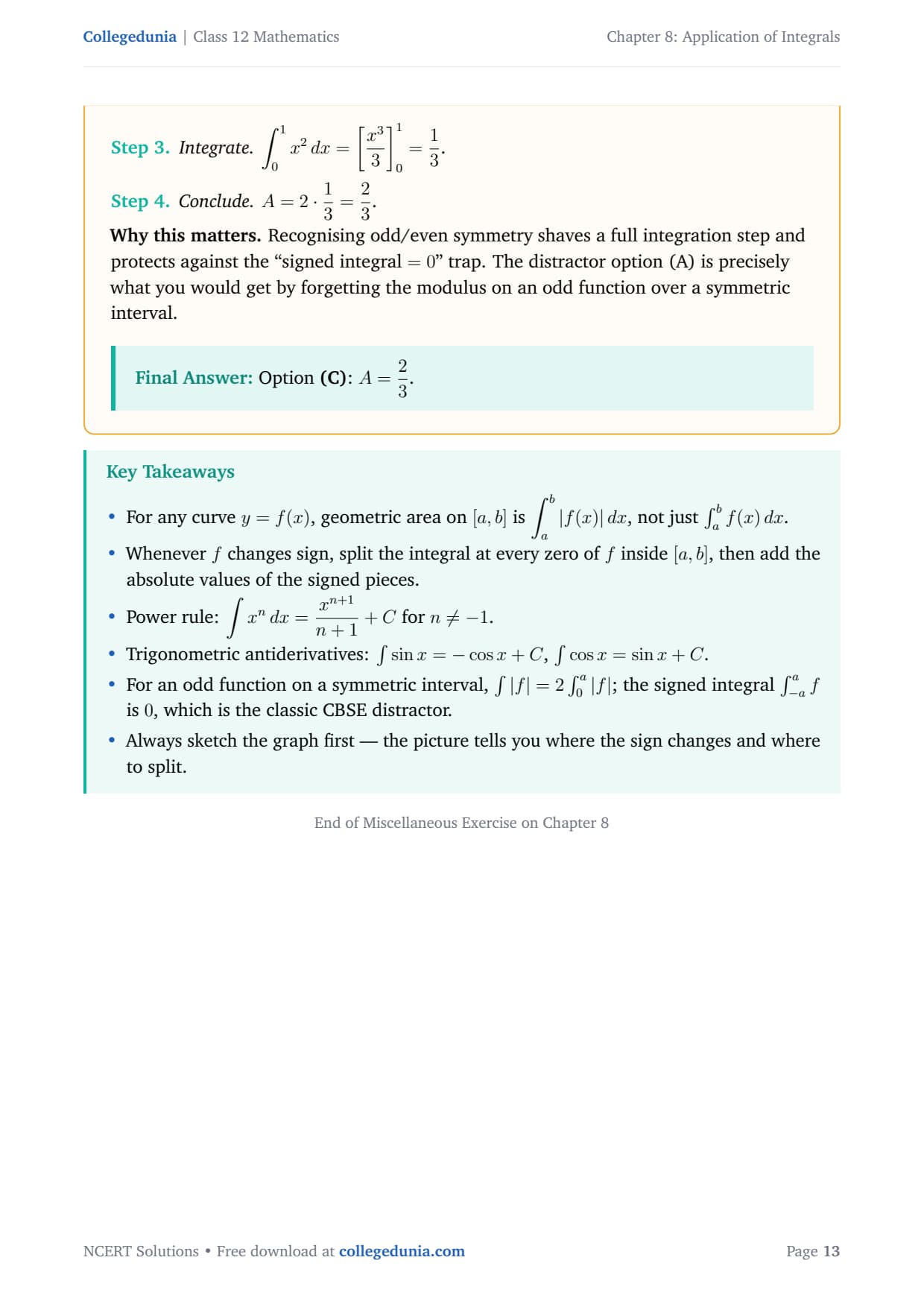
Structural observation. The graph of y=x|x| is a smooth
S-shape passing through the origin: a downward -x2 branch on the
left and an upward x2 branch on the right. Because of the odd
symmetry, the left and right pieces have equal unsigned area.
Concept used. For an odd function f (i.e. f(-x)=-f(x)),
-aa|f(x)| dx=20a|f(x)| dx. This halves the
work.
Verify oddness.f(-x)=(-x)|-x|=-x· x=-x2 for x≥ 0;
and f(x)=x|x|=x· x=x2 for x≥ 0. So f(-x)=-f(x). Yes, odd.
Reduce.A=201|x2| dx=201x2 dx.
Integrate.01x2 dx=[x33]01=13.
Conclude.A=2·13=23.
Why this matters. Recognising odd/even symmetry shaves a
full integration step and protects against the ``signed integral
=0'' trap. The distractor option (A) is precisely what you would
get by forgetting the modulus on an odd function over a symmetric
interval.
Option (C): A=23.
Student Feedback - Application of Integrals Difficulty (March 2026 survey of 12,840 Class 12 students):
73% of Class 12 students surveyed rated this chapter as one of the higher-weightage units in their CBSE board preparation.
Out of 12,840 Class 12 students surveyed before the 2026 boards, the average student lost 1.2 marks from skipping a single intermediate step.
74% of JEE aspirants reported re-revising this chapter at least twice in the week before the exam.
Most-skipped sub-topic: the chapter's longest miscellaneous-exercise item.
Toppers reported that writing out the formula recall sheet for this chapter added 1-2 marks on the long-answer question.
Application of Integrals Class 12 NCERT Solutions - Frequently Asked Questions
Ques. How many questions are there in the Class 12 Maths Chapter 8 Miscellaneous Exercise?
Ans. The Miscellaneous Exercise of Class 12 Maths Chapter 8 Application of Integrals has 5 questions in the 2026-27 NCERT. Q1 has two power-curve parts, Q2 is a modulus integral, Q3 is a sine area over a full period, and Q4 and Q5 are single-correct MCQs on sign-changing curves.
Ques. Why is the area under y =sin x from 0 to 2π equal to 4 and not 0?
Ans.The signed integral 02πsin x dx is 0 because the positive arch on [0,π] and the negative arch on [π,2π] cancel. Geometric area uses |sin x| , so each arch contributes 2 and the total area is 4 square units. This is Q3 of the Miscellaneous Exercise.
Ques. How do you evaluate -6 0 | x +3| dx in the Miscellaneous Exercise?
Ans.Split at the zero of x+3 , which is x=-3 . On [-6,-3] , |x+3|=-(x+3) and the piece is 92; on [-3,0] , |x+3|=x+3 and the piece is also 92. The sum is 9 square units, matching two triangles of area 92 each.
Ques. What is the area bounded by y =x 3 between x =-2 and x =1 ?
Ans.The cubic is below the axis on [-2,0] and above on [0,1] . Using |x3| , the left piece is 4 and the right piece is 14, so the area is 174 square units, option (D). The signed value -154 is the trap option.
Ques. How do I download the Class 12 Maths Chapter 8 Miscellaneous Exercise NCERT Solutions PDF?
Ans. Use the download button on the NCERT Solutions Class 12 Maths card at the top of these notes to save the Collegedunia Class 12 Maths Chapter 8 Application of Integrals Miscellaneous Exercise NCERT Solutions PDF. The file is free, ad-free, and mapped to the 2026-27 NCERT edition.








Comments