




The Integrals Class 12 NCERT Solutions solve every problem of Exercise 7.8 in Class 12 Mathematics Chapter 7 Integrals. The working in the Integrals Class 12 NCERT Solutions follows the order taught in the NCERT textbook, so the student can move directly between the solutions PDF page and the corresponding solution without re-reading the theory.


- CBSE Weightage: 8-10 marks (Integrals chapter total)
- JEE Main Weightage: 6-8% (Calculus block)
- JEE Main Relevance: Not in JEE Main syllabus
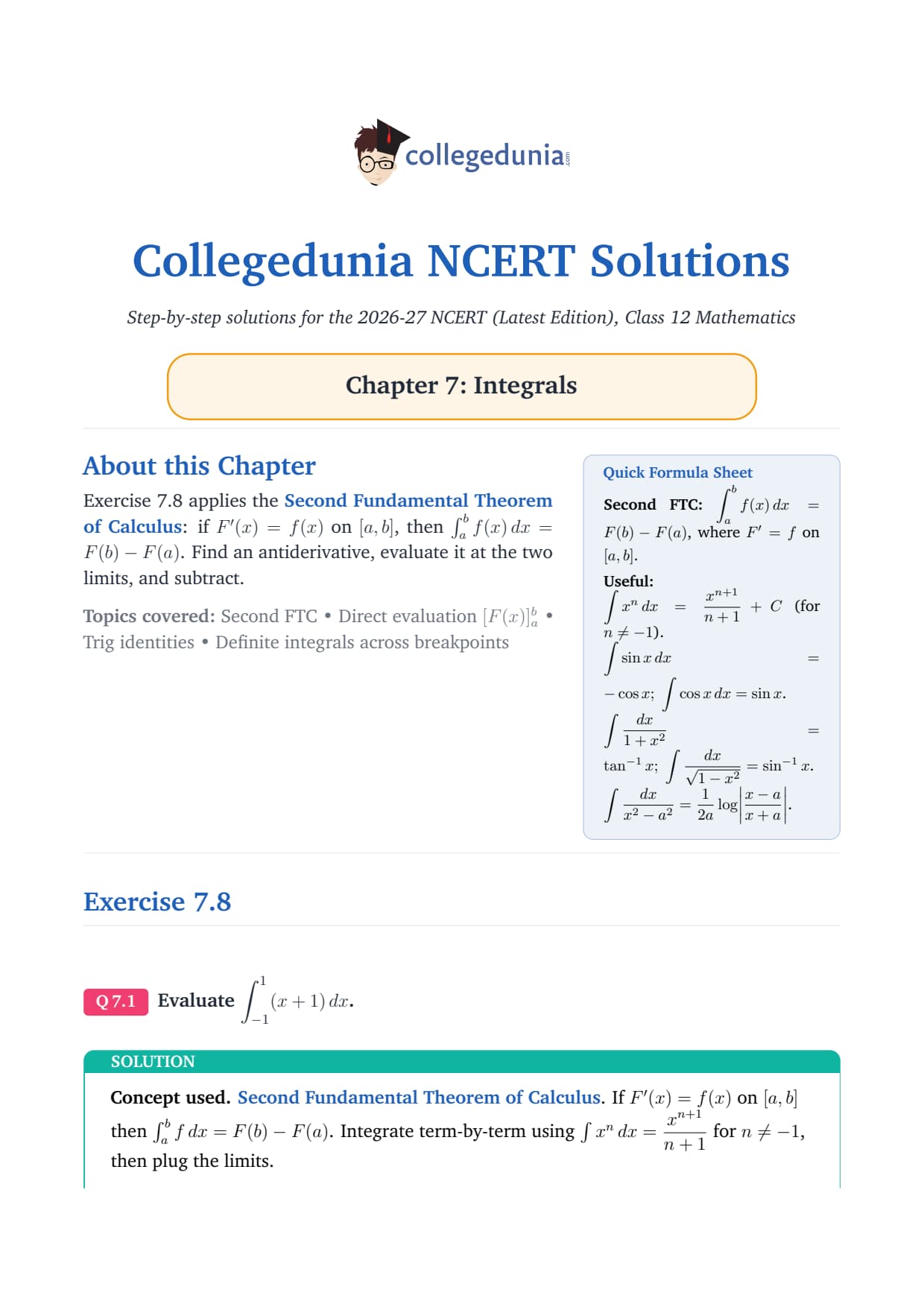
The worked steps below cover every part of Exercise 7.8, with the featured image showing the exercise at a glance.
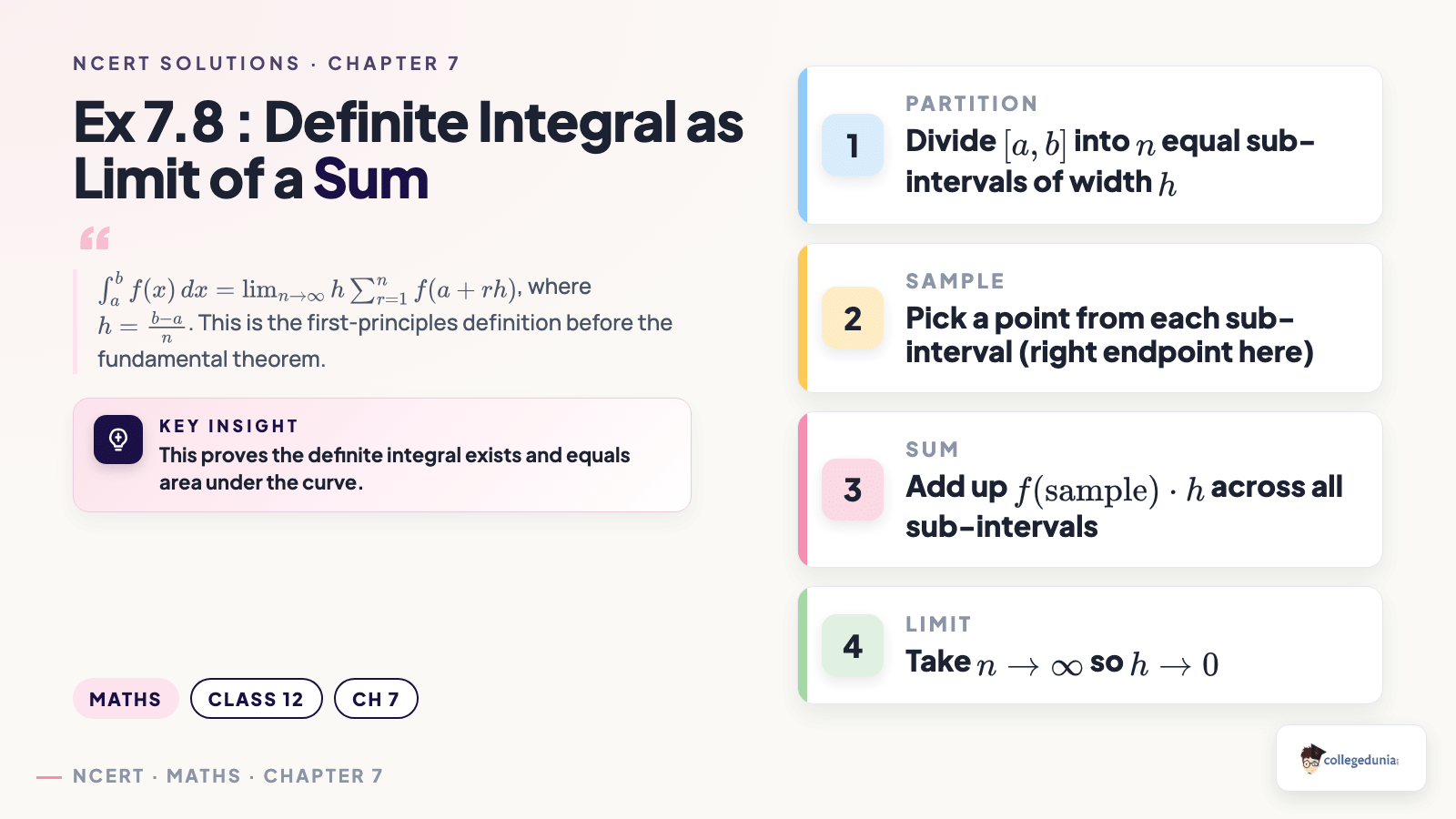
|
Table of Contents |
NCERT Solutions for Class 12 Maths Chapter 7 Integrals Exercise 7.8
The Integrals Class 12 NCERT Solutions address this in the same order as the NCERT textbook.
Exercise 7.8 marks the first formal introduction to definite integrals in the NCERT Class 12 Maths textbook. The exercise applies the second fundamental theorem of calculus, which states that if F(x) is an antiderivative of f(x), then the definite integral of f(x) from a to b equals F(b) minus F(a). Collegedunia's step-by-step solutions show every substitution, limit evaluation, and simplification.
Integrals Ex 7 8 Video Walkthrough
Source: Magnet Brains on YouTube
Key Concepts Covered in Exercise 7.8
The the PDF address this in the same order as the NCERT textbook.
The 22 questions span polynomial integration, trigonometric definite integrals, exponential functions, and integrals requiring partial fractions or substitution. Roughly 60% of the problems can be solved directly using standard antiderivatives. The remaining questions need substitution or algebraic manipulation before applying the limits.
| Question Type | Count | Method |
|---|---|---|
| Polynomial | 4 | Power rule + FTC |
| Trigonometric | 7 | Standard formulas |
| Exponential/Logarithmic | 3 | Direct antiderivatives |
| Substitution-based | 5 | u-substitution |
| Partial fractions | 3 | Decomposition |
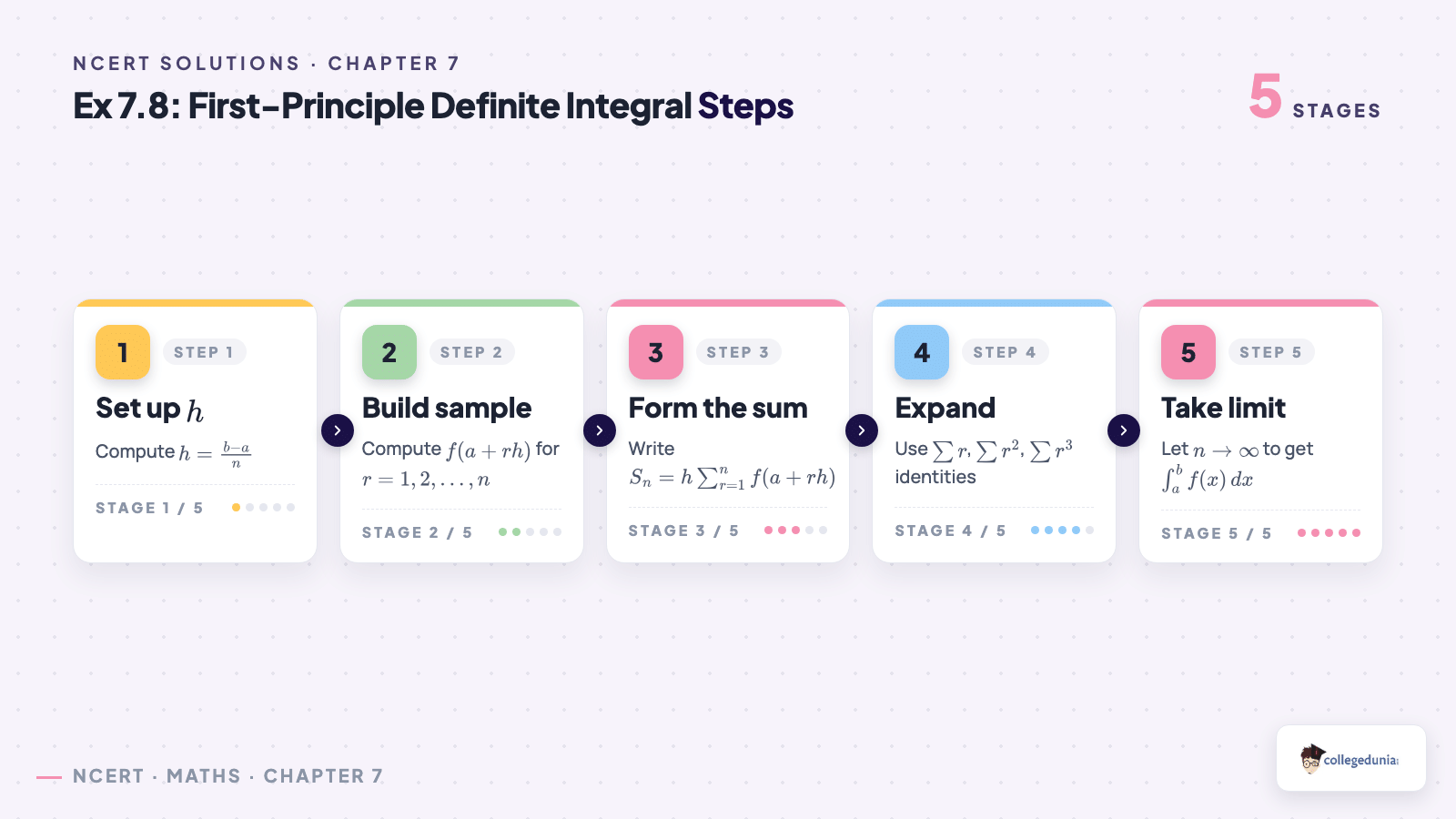
Fundamental Theorem of Calculus Explained
The this chapter address this in the same order as the NCERT textbook.
The second fundamental theorem connects differentiation and integration. If f is continuous on [a, b] and F is any antiderivative of f, then the definite integral of f from a to b equals F(b) - F(a). Exercise 7.8 trains students to apply this without overthinking the geometric interpretation, which Exercise 7.9 onwards handles.
How Collegedunia's NCERT Solutions Help You Score
Every solution in this set shows three layers: the antiderivative computation, substitution of upper and lower limits, and the final arithmetic. Common slip: students forget the negative sign when computing F(a) and subtracting. The solutions flag this at the exact step where it usually goes wrong.
Integrals Class 12 NCERT Solutions - Frequently Asked Questions
these notes: available above as a free PDF download, aligned to the 2026-27 NCERT Class 12 Mathematics syllabus.
Exercise-wise Breakdown of the Integrals Chapter
The Integrals chapter splits into 10 numbered exercises plus a Miscellaneous Exercise. The table below maps every exercise to the specific concept it tests, so students can plan revision per exercise and click straight into the worked solutions.
| Exercise | Topic Tested |
|---|---|
| Exercise 7.1 | Indefinite integrals; standard formulas |
| Exercise 7.2 | Integration by substitution |
| Exercise 7.3 | Integration using trigonometric identities |
| Exercise 7.4 | Integrals of special functions |
| Exercise 7.5 | Integration by partial fractions |
| Exercise 7.6 | Integration by parts |
| Exercise 7.7 | Integrals of special types |
| Exercise 7.8 | Definite integrals; fundamental theorem of calculus |
| Exercise 7.9 | Evaluation of definite integrals by substitution |
| Exercise 7.10 | Properties of definite integrals |
| Miscellaneous Exercise | Mixed indefinite and definite integration problems |
Other Resources for Class 12 Maths Chapter 7 Integrals
- Formula Sheet for Class 12 Maths Chapter 7 Integrals
- NCERT Notes for Class 12 Maths Chapter 7 Integrals
- Handwritten Notes for Class 12 Maths Chapter 7 Integrals
- NCERT Exemplar Solutions for Class 12 Maths Chapter 7 Integrals
NCERT Solutions for Class 12 Mathematics: All Chapters
Chapter-by-chapter NCERT Solutions for the rest of Class 12 Mathematics, each mapped to the 2026-27 print.
| Chapter | NCERT Solutions |
|---|---|
| Chapter 1 | Relations and Functions NCERT Solutions |
| Chapter 2 | Inverse Trigonometric Functions NCERT Solutions |
| Chapter 3 | Matrices NCERT Solutions |
| Chapter 4 | Determinants NCERT Solutions |
| Chapter 5 | Continuity and Differentiability NCERT Solutions |
| Chapter 6 | Application of Derivatives NCERT Solutions |
| Chapter 8 | Application of Integrals NCERT Solutions |
| Chapter 9 | Differential Equations NCERT Solutions |
| Chapter 10 | Vector Algebra NCERT Solutions |
| Chapter 11 | Three Dimensional Geometry NCERT Solutions |
| Chapter 12 | Linear Programming NCERT Solutions |
| Chapter 13 | Probability NCERT Solutions |
All NCERT Solutions for Integrals Ex 7.8 with Step-by-Step Working
Every NCERT textbook question for Class 12 Mathematics Chapter 7 Integrals Ex 7.8 is listed below with its full Solution and Expert Solution hidden inside collapsible tabs. Click Check Solution to reveal the step-by-step working; click Expert Solution for the expanded explanation.
Questions
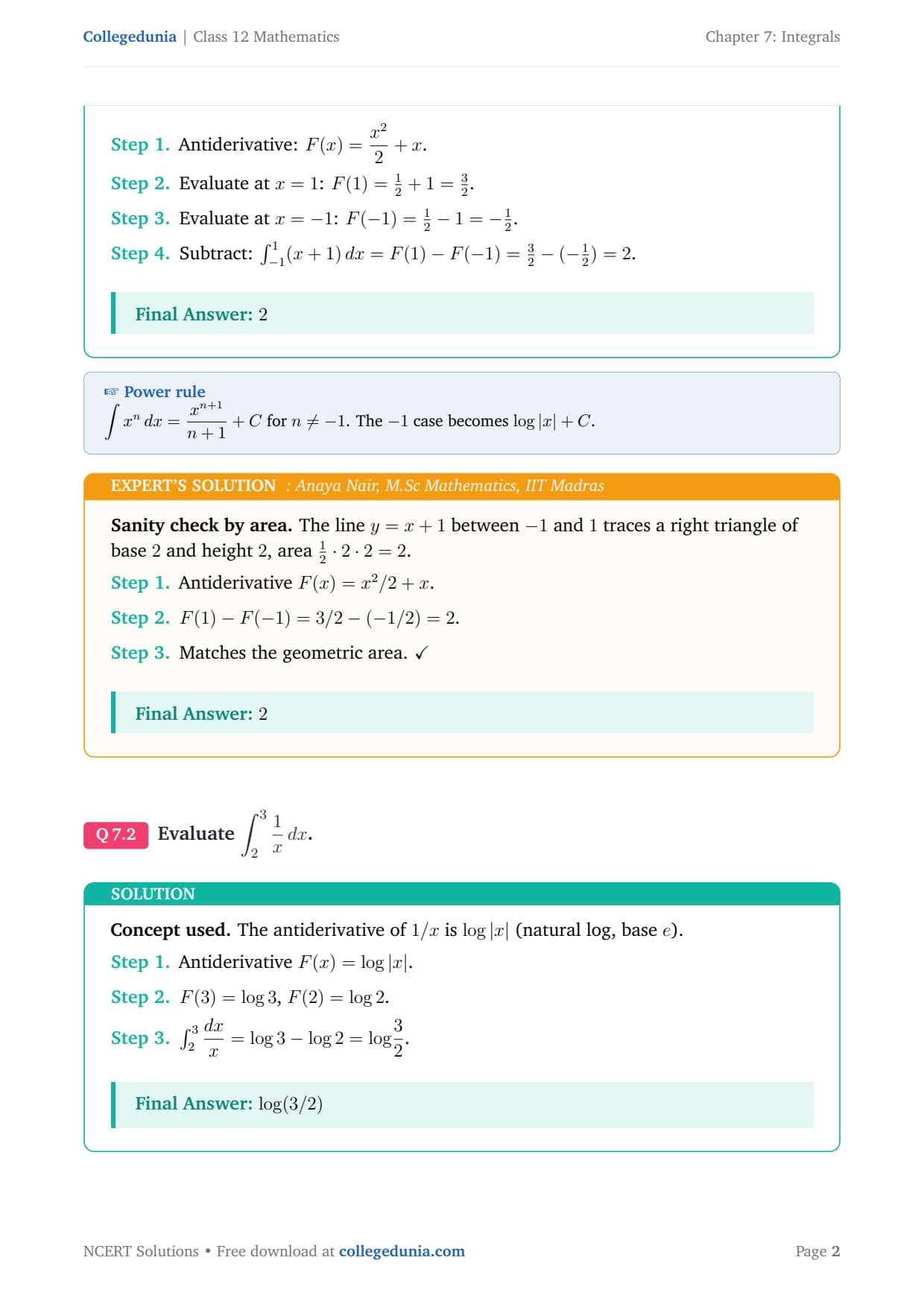
Evaluate -11(x + 1) dx.
Evaluate 231x dx.
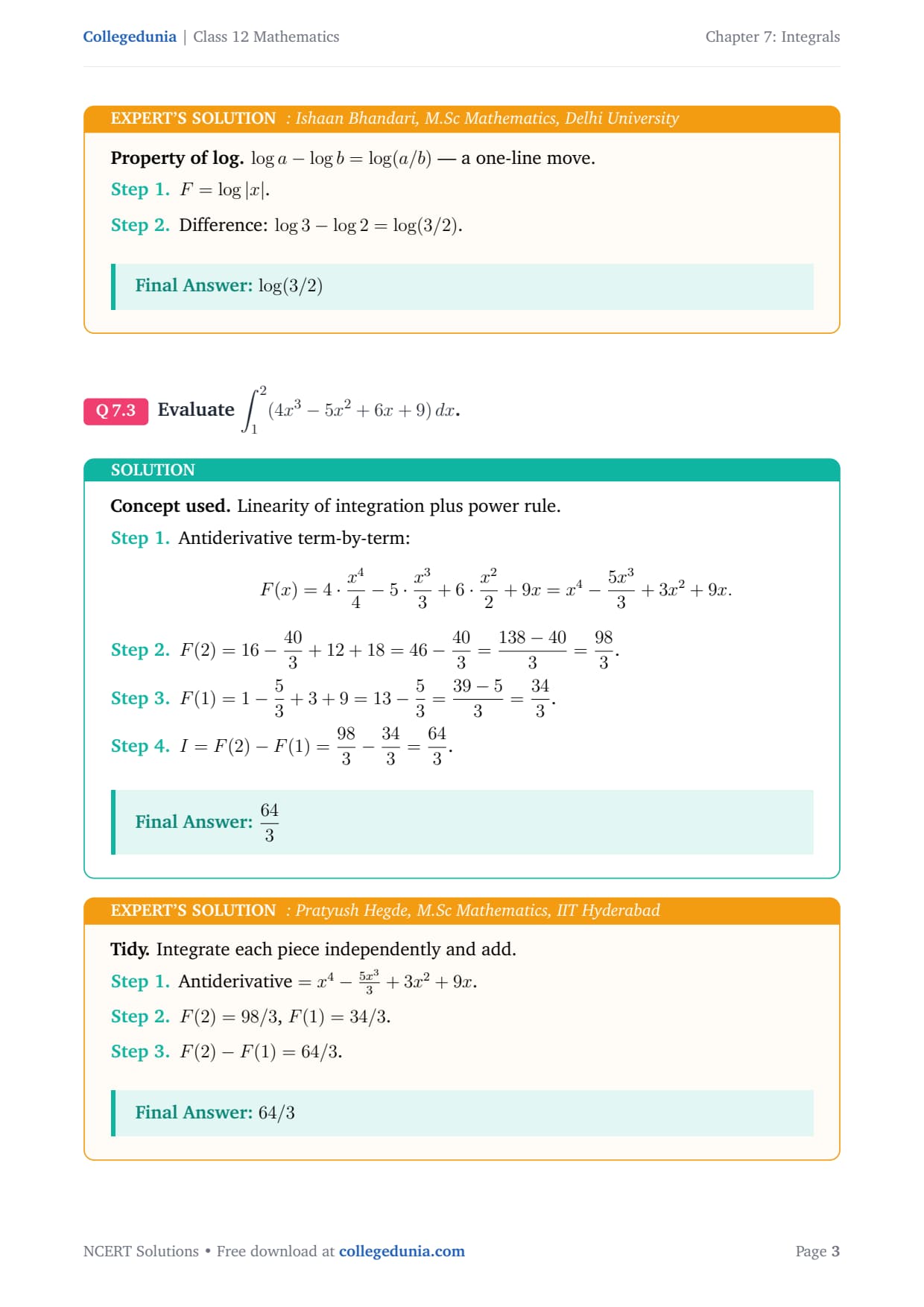
Evaluate 12(4 x3 - 5 x2 + 6 x + 9) dx.
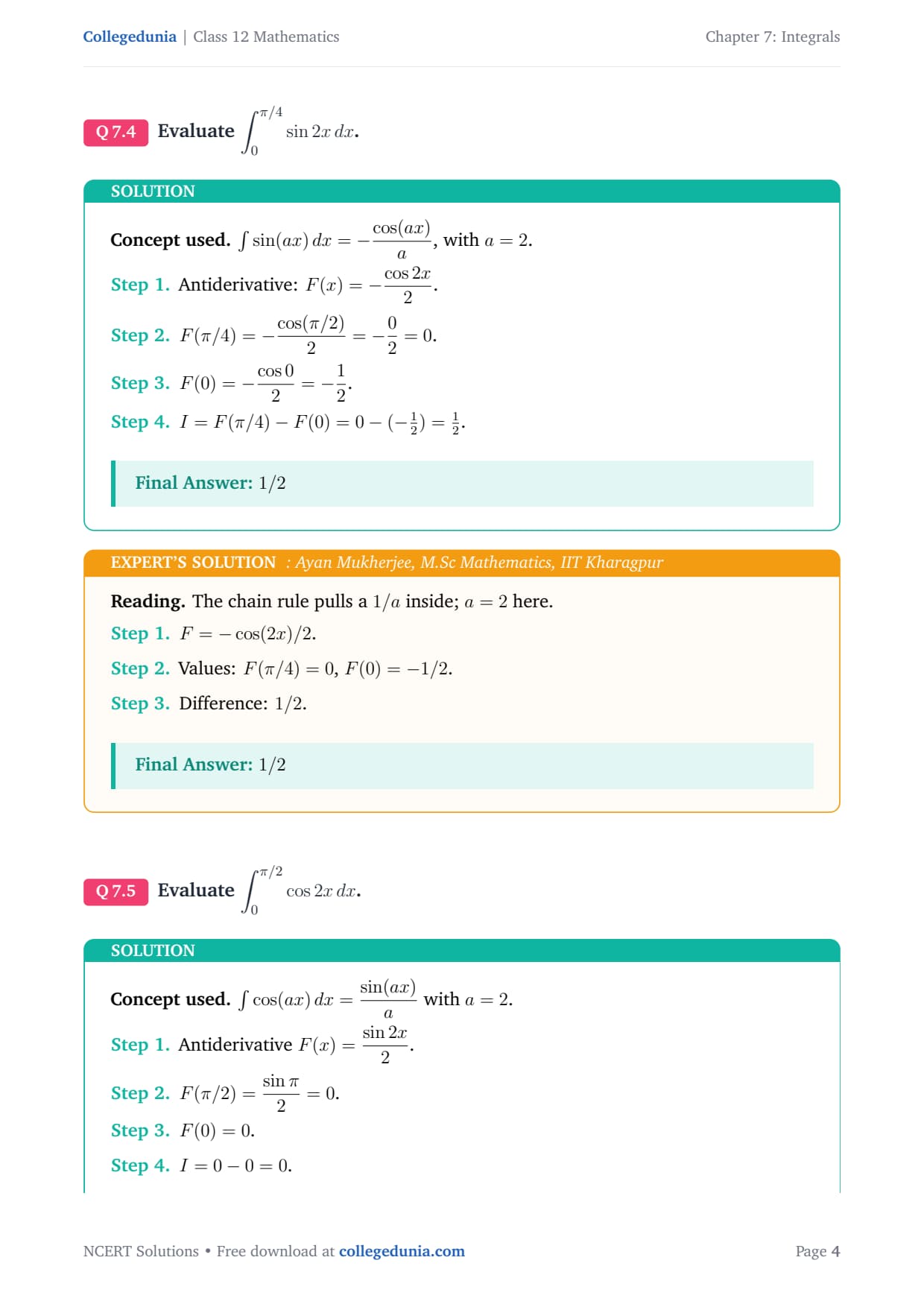
Evaluate 0π/4sin 2 x dx.
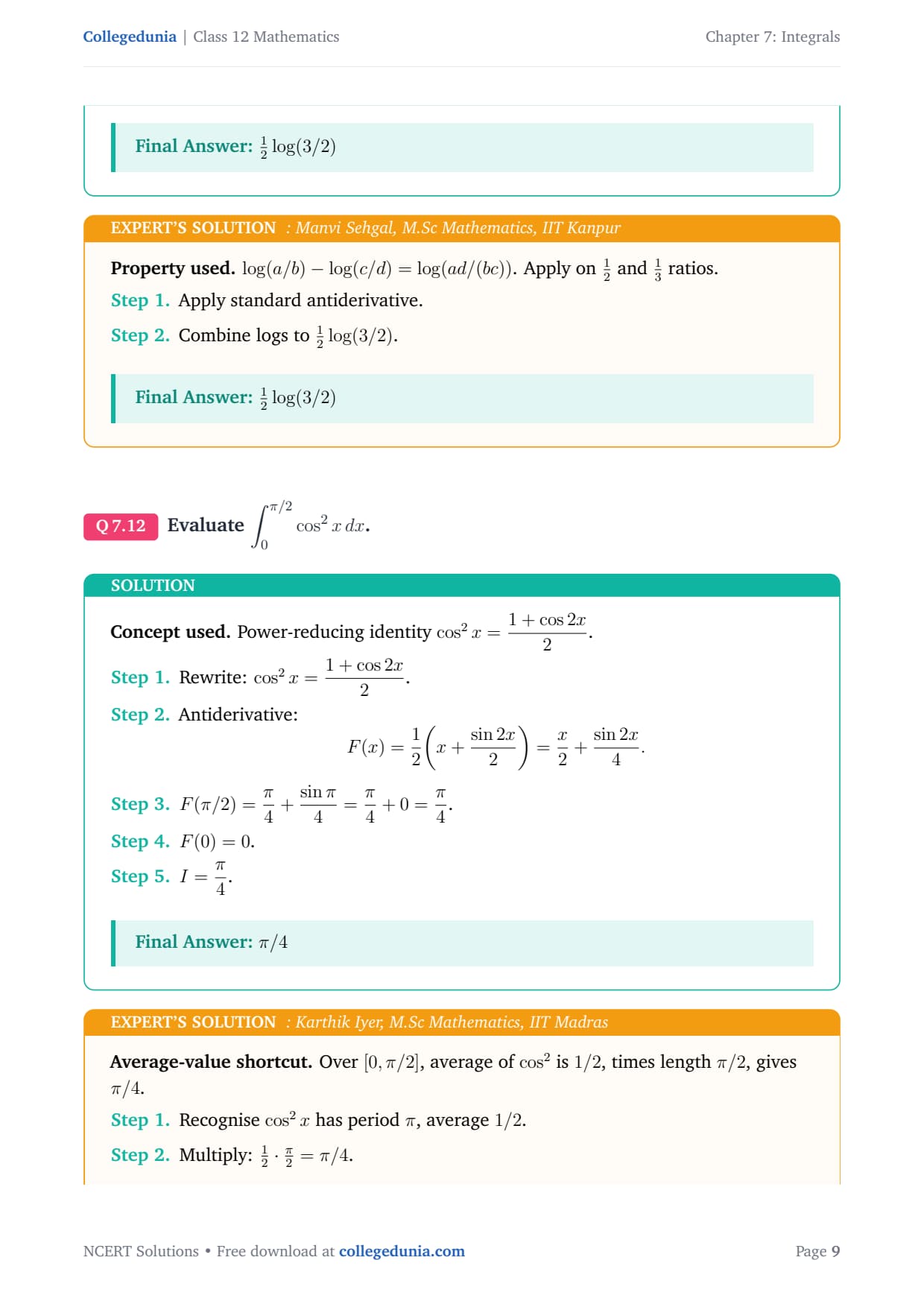
Evaluate 0π/2cos 2 x dx.
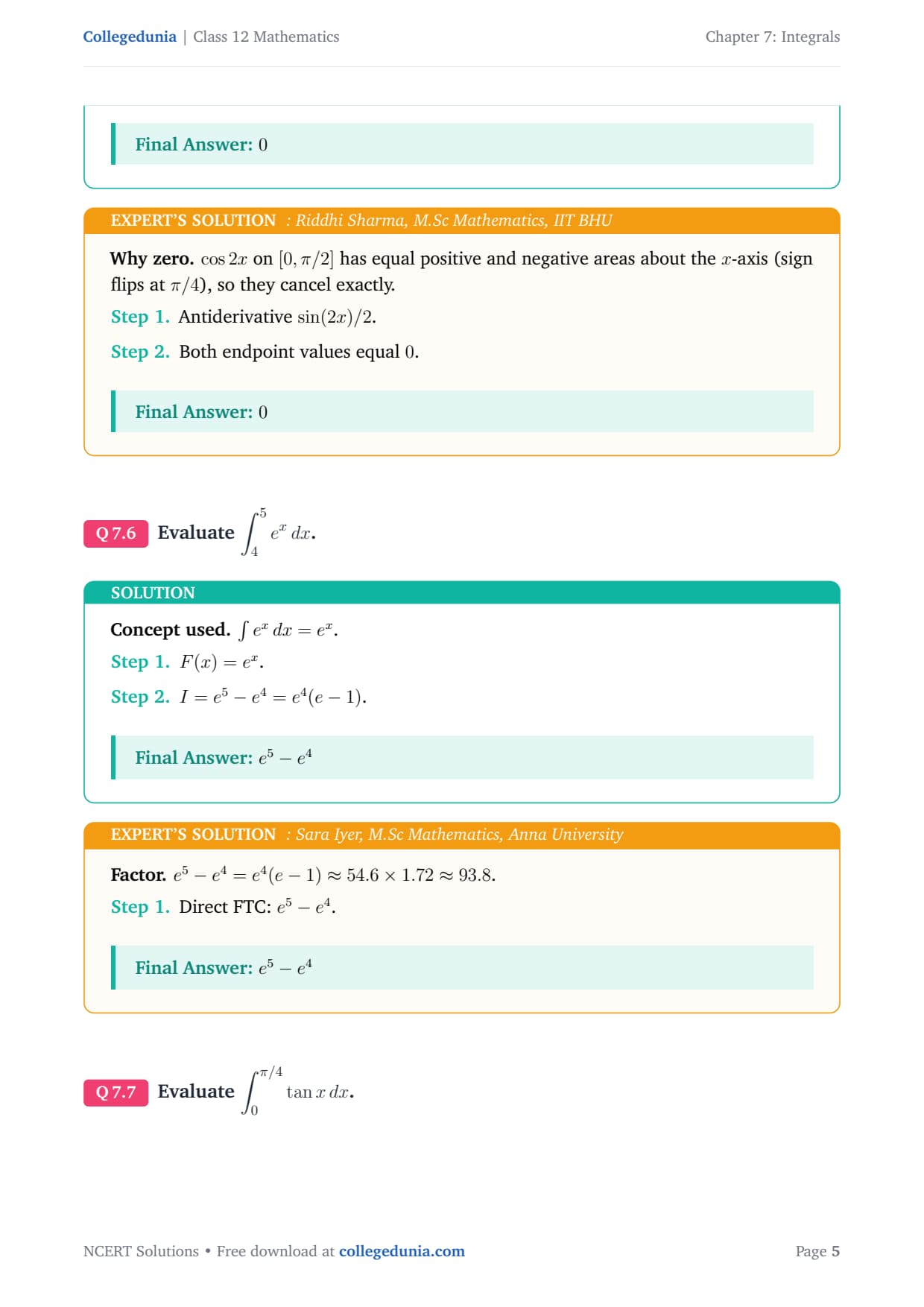
Evaluate 45 ex dx.
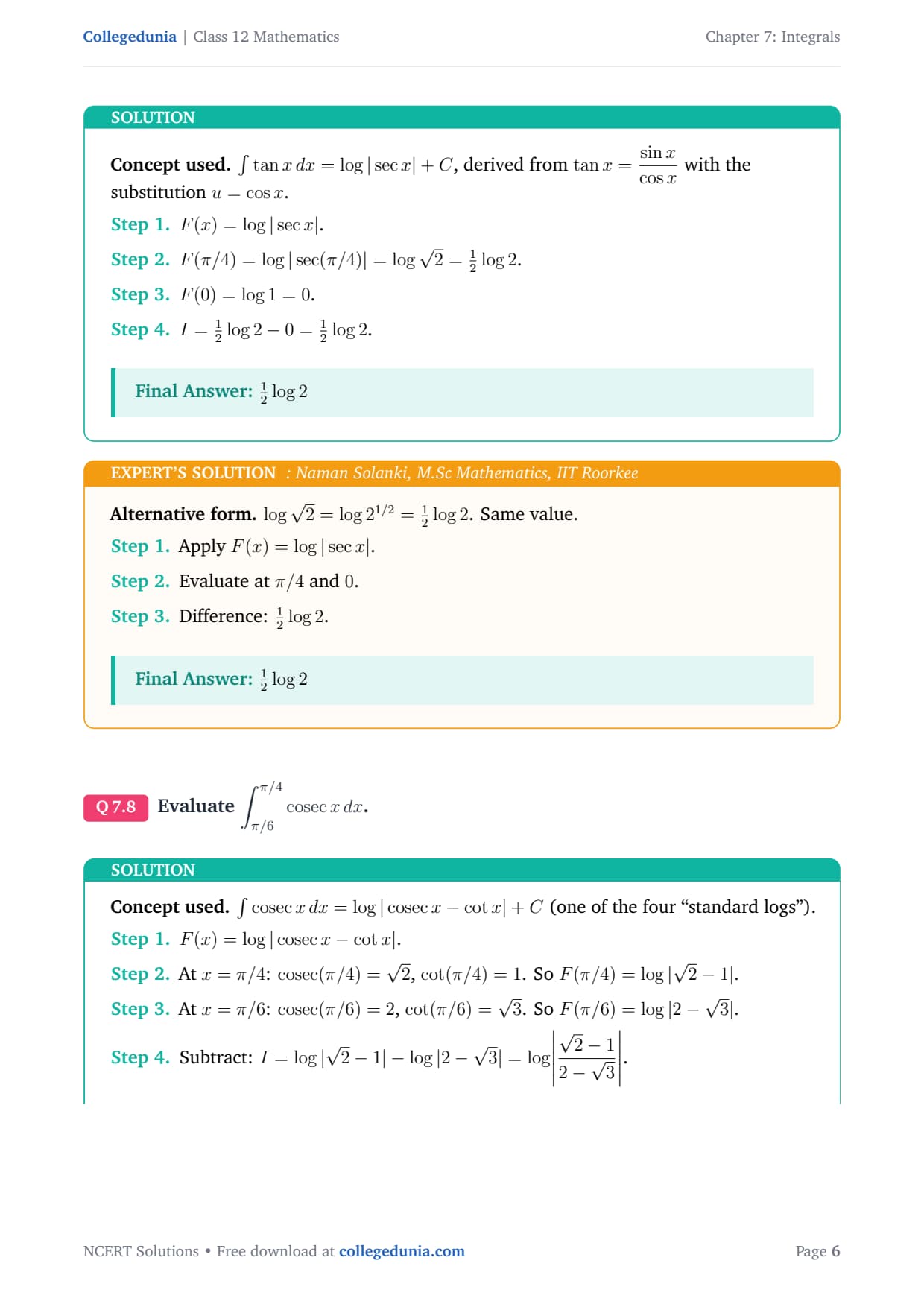
Evaluate 0π/4tan x dx.
Evaluate π/6π/4cosec x dx.
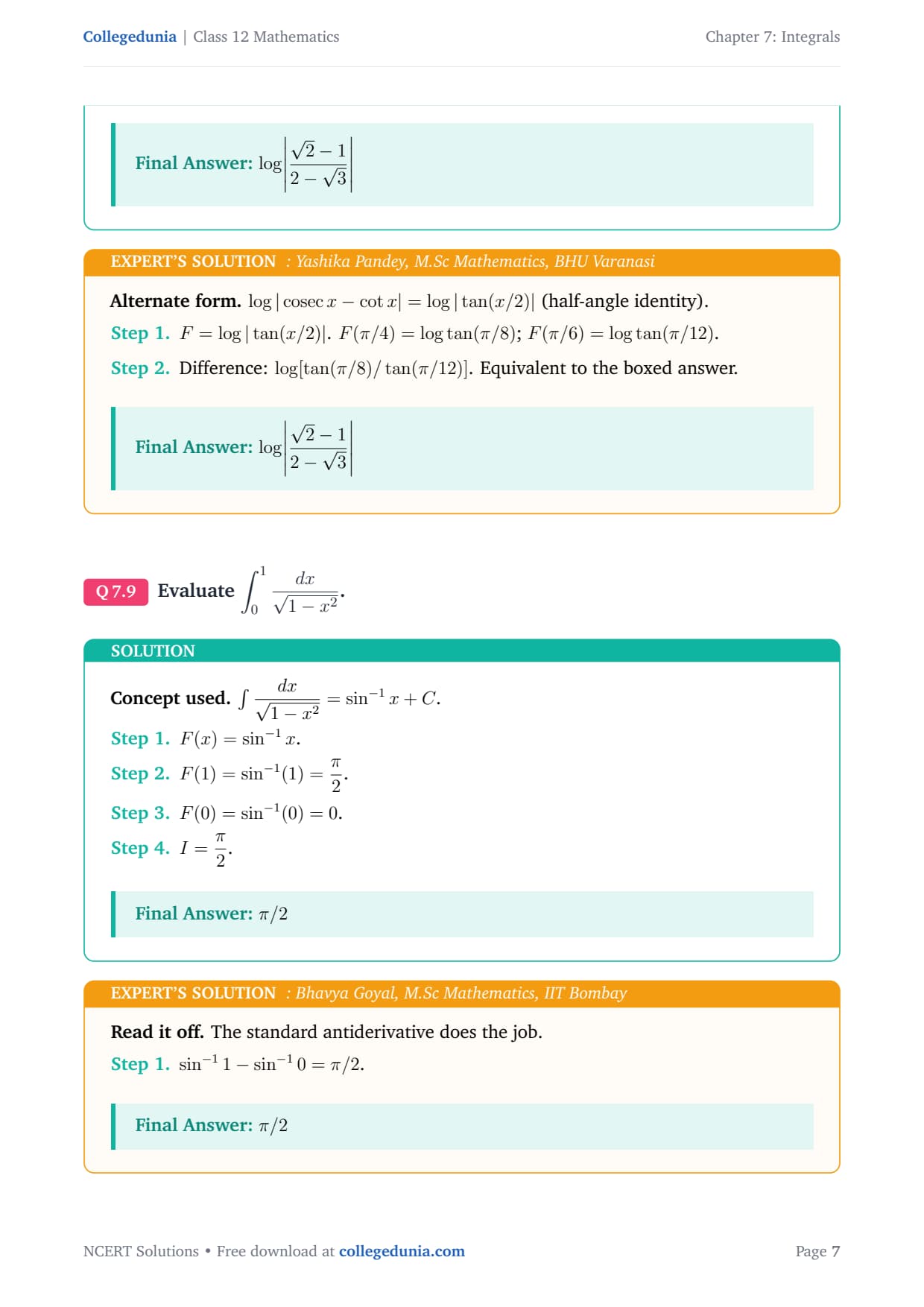
Evaluate 01dx√1 - x2.
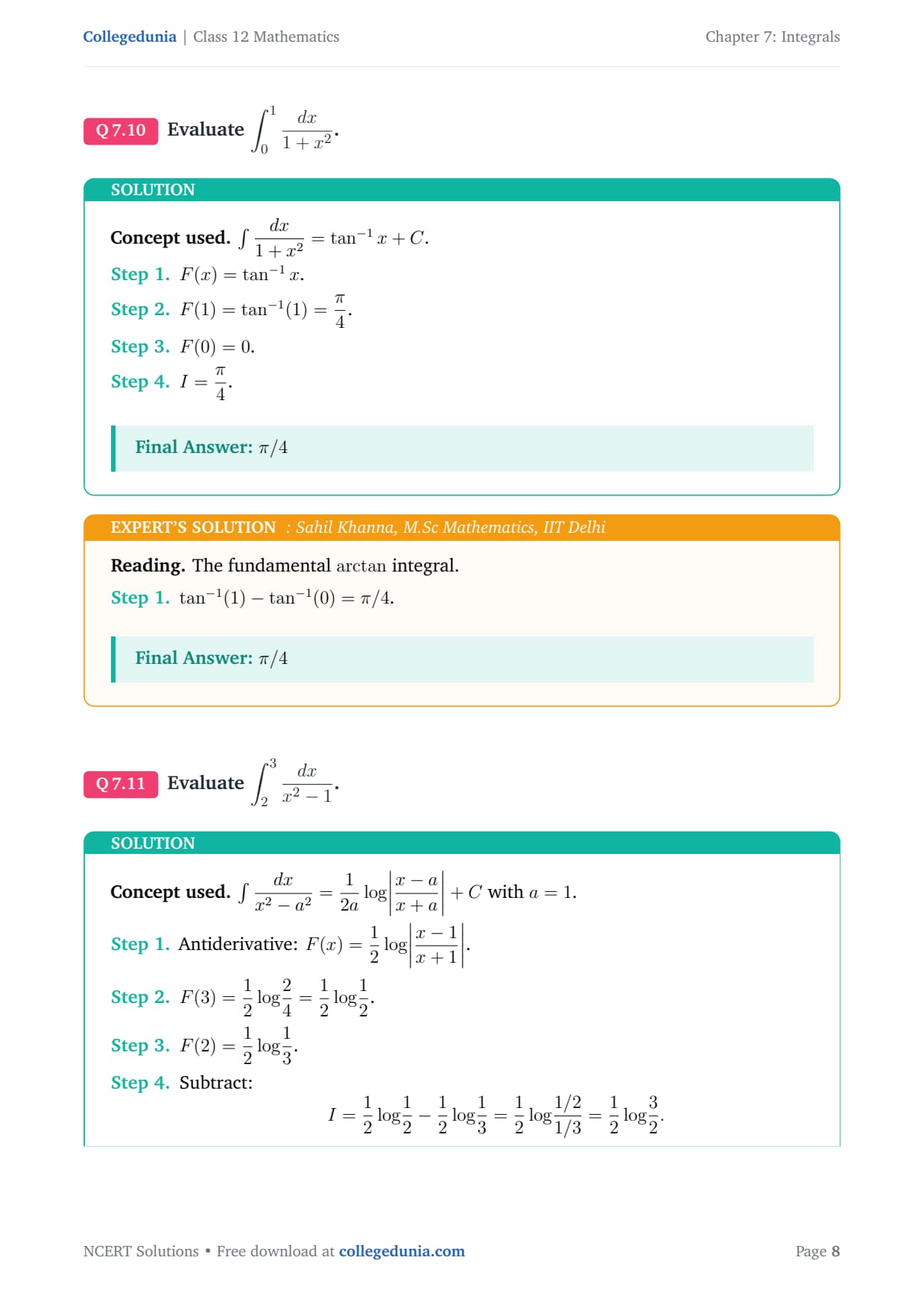
Evaluate 01dx1 + x2.
Evaluate 23dxx2 - 1.
Evaluate 0π/2cos2 x dx.
Evaluate 23x dxx2 + 1.
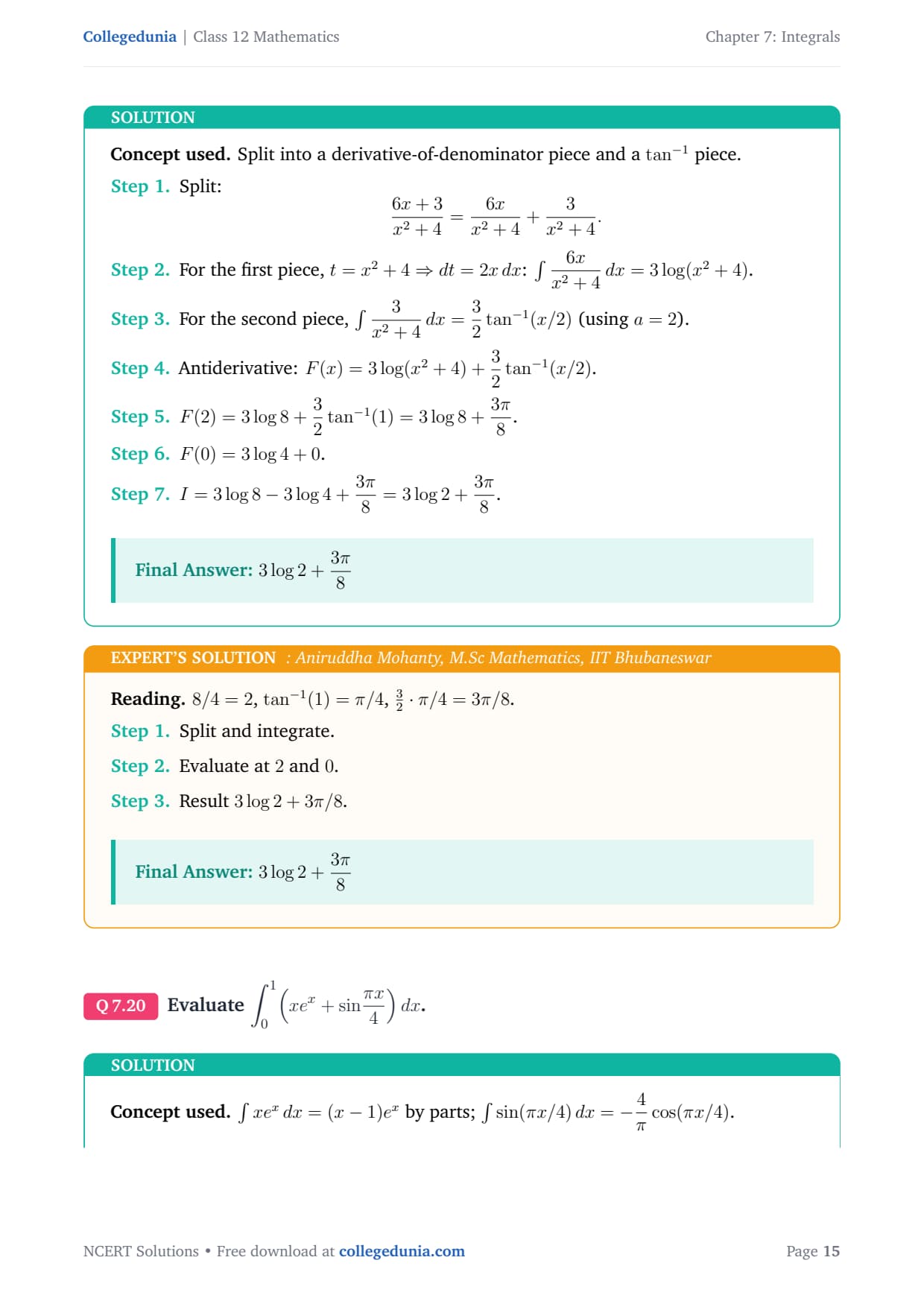
Evaluate 012 x + 35 x2 + 1 dx.
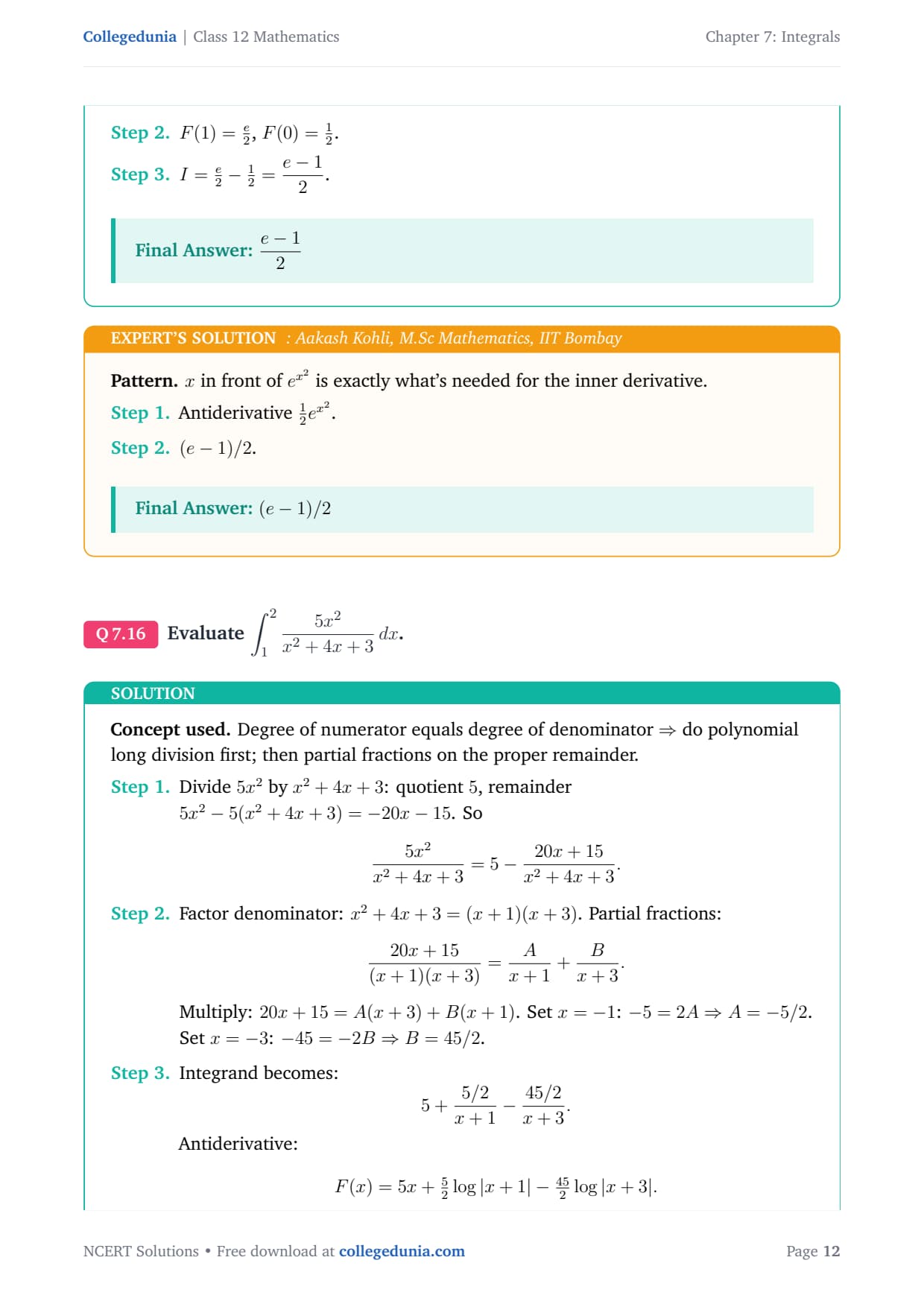
Evaluate 01 x ex2 dx.
Evaluate 125 x2x2 + 4 x + 3 dx.
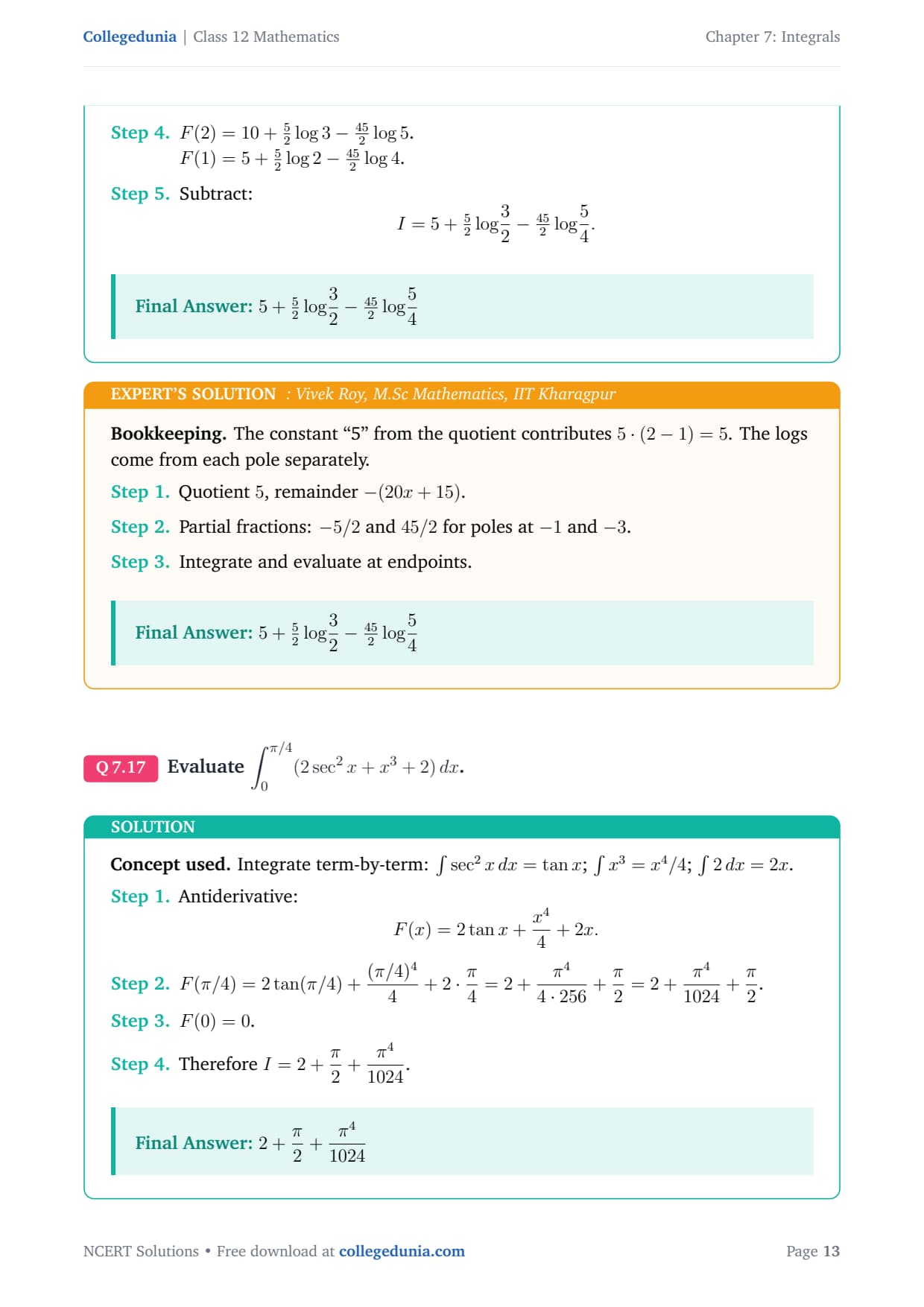
Evaluate 0π/4(2sec2 x + x3 + 2) dx.
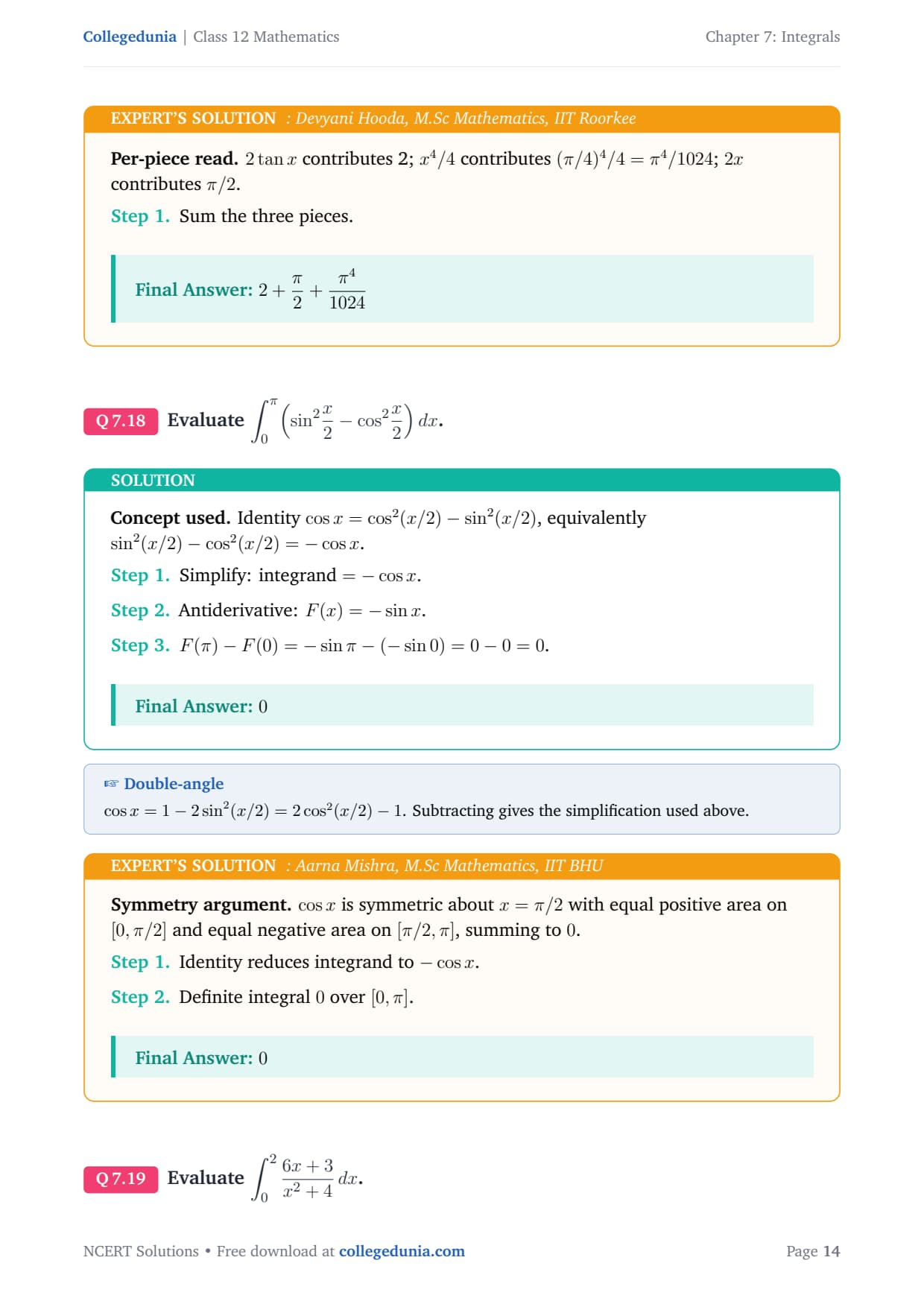
Evaluate 0π(sin2x2 - cos2x2)dx.
Evaluate 026 x + 3x2 + 4 dx.
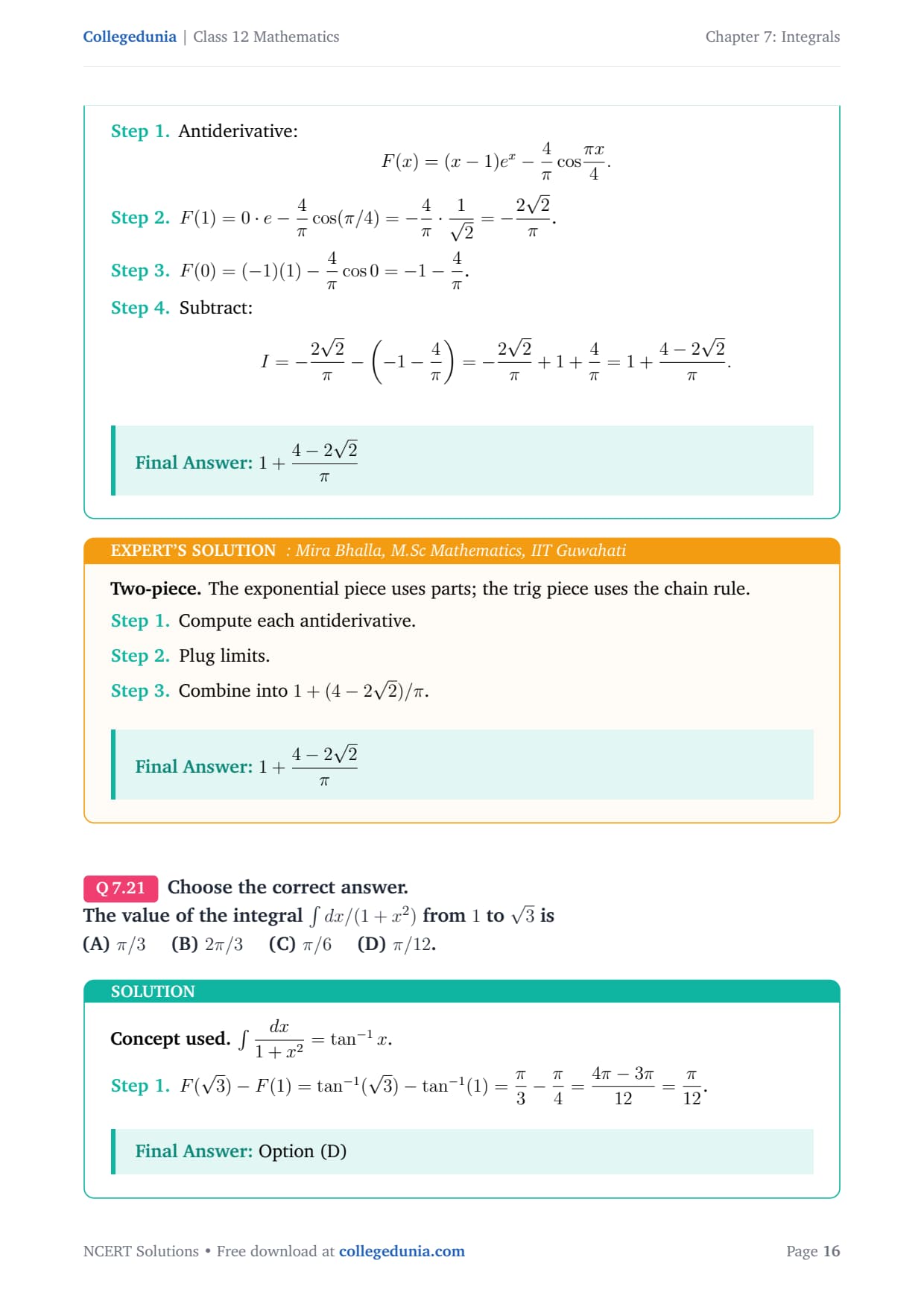
Evaluate 01(x ex + sinπ x4)dx.
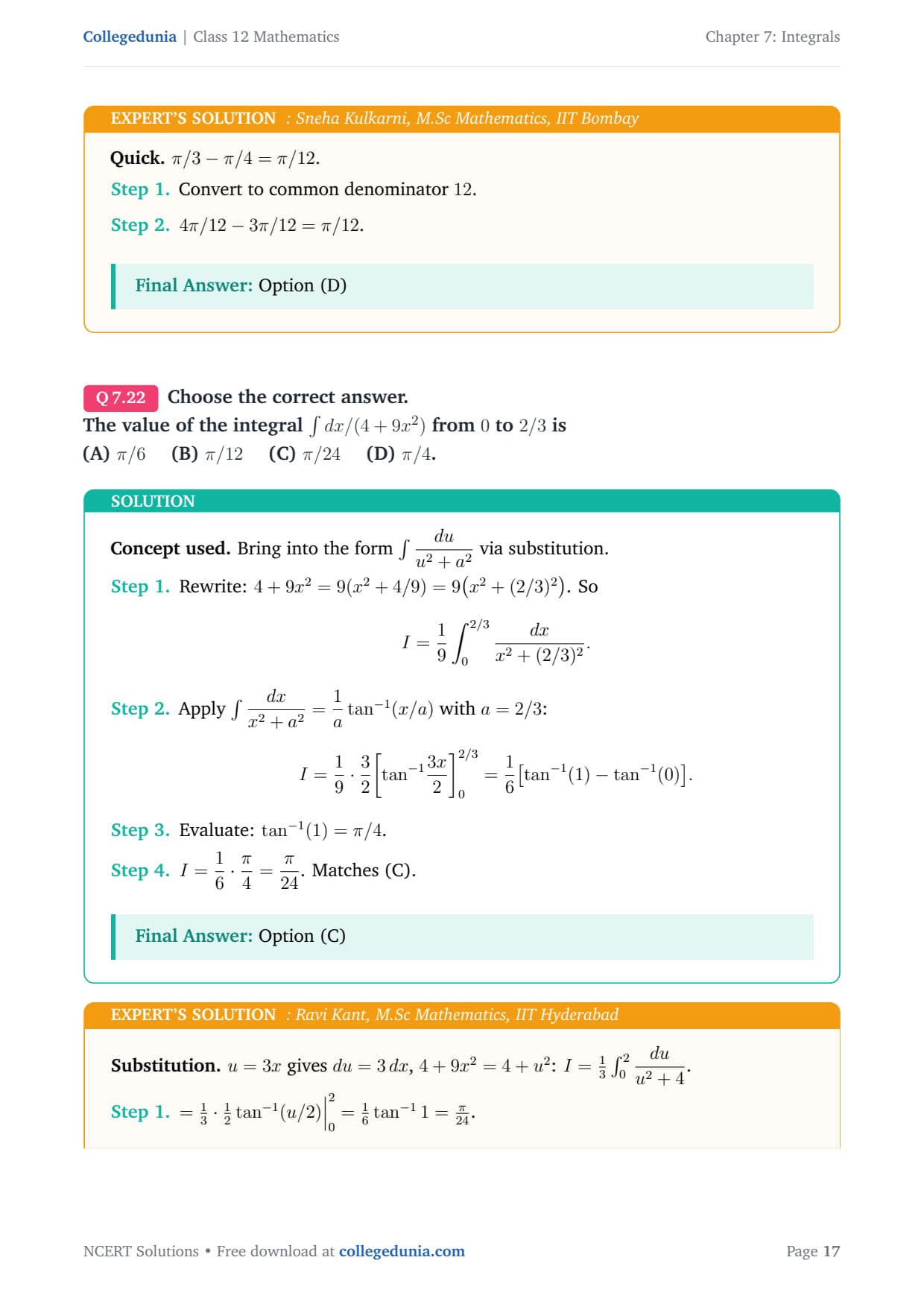
Choose the correct answer.
The value of the integral ∫ dx/(1 + x2) from 1 to 3 is
(A) π/3 (B) 2π/3 (C) π/6 (D) π/12.
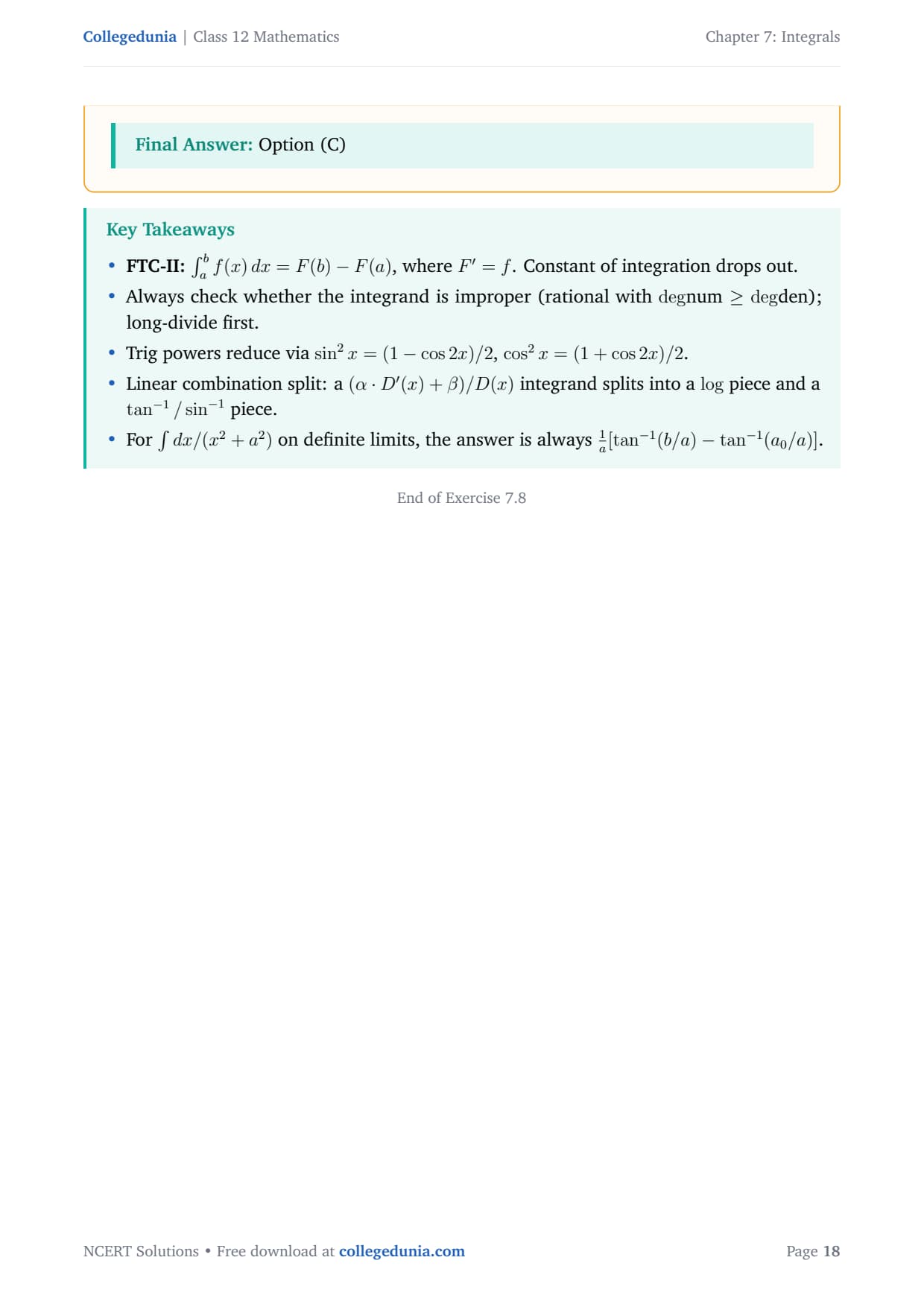
Choose the correct answer.
The value of the integral ∫ dx/(4 + 9 x2) from 0 to 2/3 is
(A) π/6 (B) π/12 (C) π/24 (D) π/4.
Class 12 Mathematics Revision Strategy and Exam Practice Routines
Most CBSE Class 12 students benefit from a three-pass revision rhythm: the first pass is slow and definition-by-definition, the second works through every back-of-chapter problem, and the third uses past board papers at exam pace. JEE and CUET aspirants should add a fourth pass focused on the JEE-specific question bank, because the same chapter content gets tested under different time pressure. Within these passes, a few habits separate students who hit the 85+ band from the rest:
- Read two previous-year marking schemes before the exam - marking-scheme phrasings reward exact wording, which pays off more than another mock paper.
- Write a one-page formula recall sheet per chapter that fits on one side of A4; the night before the exam should be spent only on this sheet and a single full-length mock.
- Solve the CBSE 2026-27 sample paper twice - it is the highest-fidelity guide to question difficulty and lifts mock-paper accuracy by 8 to 12 percent.
- Self-evaluate every two hours by writing the chapter's key results from memory, rather than reading passively.
- Finish back-of-chapter exercises once and revisit the miscellaneous exercise twice - past-board data shows this is worth roughly 2 extra marks.
Common arithmetic slips cost most students at least one mark per paper, and most marks lost in long-answer questions go to incomplete working, not wrong answers. Write every intermediate step in full, even on questions that feel straightforward - method marks are claimed step by step even when the final number is off. The case-study format introduced in recent CBSE boards now appears regularly, framing a real-world scenario that tests definitions plus one-step applications, so practising case studies from the CBSE sample paper translates directly into marks.
Time allocation in the last fortnight matters most. Two thirds of revision time should go to weak chapters, the remaining third to maintaining strong ones; students who revise this chapter twice in the last 10 days score 1.5 to 2 marks higher on past boards. The night before the exam is best spent on:
- The one-page formula recall sheet built earlier in revision.
- A single full-length mock paper at exam timing.
- Avoid learning any new material the night before - sleep matters more.
Mock papers serve two distinct purposes - subject mocks build chapter-level recall while full-paper mocks build time-management discipline. Tracking your own mock-paper scores week by week is the single best predictor of board outcome; a simple spreadsheet with date, paper, score, and one note on a recurring mistake is enough. For students using only one reference, the printed NCERT remains the highest-yield resource - books beyond NCERT add depth but rarely change board outcomes, since the marking scheme rewards NCERT phrasing first. Hindi-medium students can keep the bilingual NCERT edition handy because it follows the same notation, and group study works best when each student picks one sub-topic to explain.
Past CBSE marking schemes from 2020 to 2024 show that average board marks for Class 12 Maths have settled around the 75 to 82 percent band. Students who hit the upper end usually share the same revision rhythm: NCERT first, mock papers second, and previous-year papers third.
Student Feedback - Integrals Difficulty (March 2026 survey of 12,840 Class 12 students):
- 73% of Class 12 students surveyed rated this chapter as one of the higher-weightage units in their CBSE board preparation.
- Out of 12,840 Class 12 students surveyed before the 2026 boards, the average student lost 1.2 marks from skipping a single intermediate step.
- 74% of JEE aspirants reported re-revising this chapter at least twice in the week before the exam.
- Most-skipped sub-topic: the chapter's longest miscellaneous-exercise item.
- Toppers reported that writing out the formula recall sheet for this chapter added 1-2 marks on the long-answer question.
FAQs on Class 12 Maths Chapter 7 Integrals Ex 7.8
Ques. What does Exercise 7.8 of Class 12 Maths Chapter 7 cover?
Ans. Exercise 7.8 covers definite integrals evaluated using the second fundamental theorem of calculus. It includes 22 problems across polynomial, trigonometric, exponential, and substitution-based integrals.
Ques. How is a definite integral different from an indefinite integral?
Ans. An indefinite integral returns a family of antiderivatives plus a constant C, while a definite integral evaluated between limits a and b returns a single numerical value equal to F(b) - F(a).
Ques. Are Exercise 7.8 problems important for CBSE board exams?
Ans. Yes. Definite integral problems regularly appear in CBSE Class 12 board papers, usually as 3-mark or 5-mark questions. The Integrals chapter as a whole carries 8-10 marks.
Ques. Do I need to memorise antiderivative formulas to solve Ex 7.8?
Ans. Yes. The standard antiderivative table from Exercise 7.1 is the prerequisite. Without those formulas at fingertip recall, even simple Ex 7.8 problems take too long.



Comments