Maths Mentor, Delhi University | Updated 3+ months ago
These are the NCERT Solutions for Exercise 6.2 of Class 12 Maths Chapter 6, Application of Derivatives. Every answer names the rule used, then works step by step to the final value. The free PDF is on this page, aligned to the 2026-27 NCERT syllabus.
CBSE Weightage: 5-7 marks from Application of Derivatives
JEE Main Coverage: 3-5% of the calculus segment
Exercise 6.2 Problems: 19 questions (mix of long, short and MCQ)
NCERT Solutions for Class 12 Maths Chapter 6 Exercise 6.2 - Topics Covered
Exercise 6.2 focuses on a single high-yield idea: classifying a function as increasing, decreasing, strictly increasing, or strictly decreasing using the sign of its first derivative. The table below maps the problem types in the exercise to the underlying concept tested.
Problem Type
Concept Tested
Question Numbers
Show f(x) is strictly increasing/decreasing on R
Sign of f'(x) on the entire real line
Q1, Q2, Q3
Find intervals of monotonicity
Critical points + sign chart of f'(x)
Q5, Q6, Q7, Q8
Trigonometric monotonicity
Periodic behaviour of sin x, cos x derivatives
Q9, Q10, Q11
Logarithmic and polynomial
Derivatives of log, exponential and powers
Q12, Q13, Q14
MCQ on monotonic intervals
Quick critical-point identification
Q18, Q19
Application of Derivatives Ex 6 2 Video Walkthrough
How Collegedunia's Solutions for Class 12 Maths Ch 6 Ex 6.2 Help You
The increasing-decreasing test trips up students who mix up f'(x) > 0 implies strictly increasing with the weaker monotonic version. Our solutions distinguish these clearly. Each problem opens with the derivative, works through the sign analysis, and closes with the interval declaration. You also get:
Sign charts drawn for every critical-point split
Domain checks before applying the derivative test
Common pitfalls flagged where boundary points need special handling
Quick verification using sample values inside each candidate interval
Key Formulae Used in Exercise 6.2
Exercise 6.2 leans on a small but powerful set of derivative rules. Memorise the table below; every problem in the exercise reduces to applying one or two of these.
Solved Example from Ex 6.2 - Strictly Increasing Function
Show that the function f(x) = 3x + 17 is strictly increasing on R.
Step 1. Compute the derivative: f'(x) = 3 .
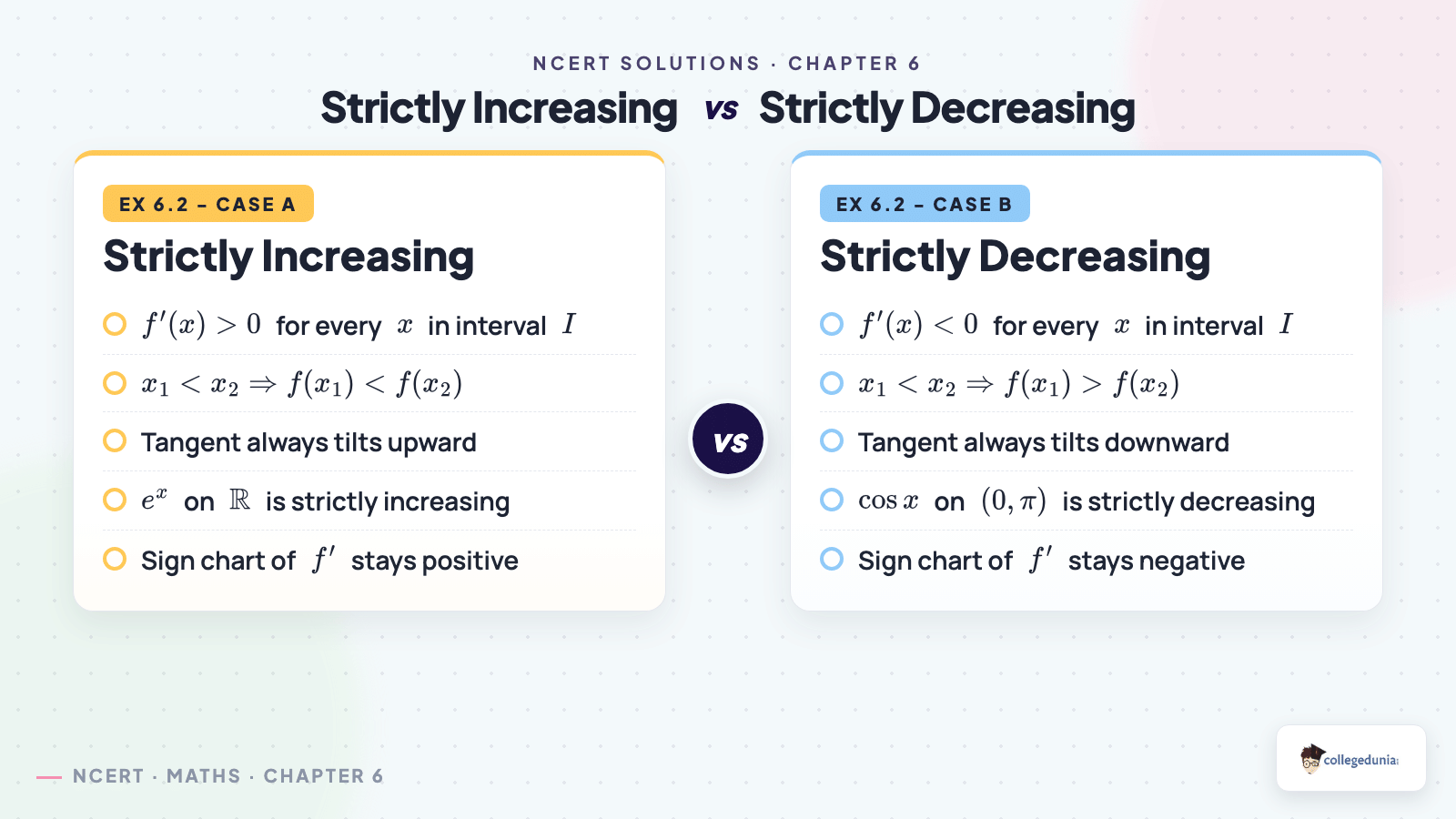
Step 2. Since f'(x) = 3 > 0 for every real number x, the function is strictly increasing on the entire real line R. Strictly positive derivative on an interval implies strictly increasing on that interval.
Common Mistakes in Class 12 Maths Exercise 6.2
Many students lose marks on monotonicity questions because of avoidable algebraic slips, not because they misunderstand the concept. Here are the most frequent errors observed in CBSE Board answer scripts.
Forgetting to check the domain of the function before computing f'(x)
Confusing "non-decreasing" with "strictly increasing"
Missing the boundary points when an interval is closed at one end
Not testing a sample point inside each candidate interval to confirm the sign
this chapter: available above as a free PDF download, aligned to the 2026-27 NCERT Class 12 Mathematics syllabus.
Exercise-wise Breakdown of the Application of Derivatives Chapter
The Application of Derivatives chapter splits into 3 numbered exercises plus a Miscellaneous Exercise. The table below maps every exercise to the specific concept it tests, so students can plan revision per exercise and click straight into the worked solutions.
All NCERT Solutions for Application of Derivatives Ex 6.2 with Step-by-Step Working
Every NCERT textbook question for Class 12 Mathematics Chapter 6 Application of Derivatives Ex 6.2 is listed below with its full Solution and Expert Solution hidden inside collapsible tabs. Click Check Solution to reveal the step-by-step working; click Expert Solution for the expanded explanation.
Questions
Q 6.1
Show that the function given by f(x) = 3x + 17 is
increasing on R.
Concept used. A real-valued, differentiable function f is
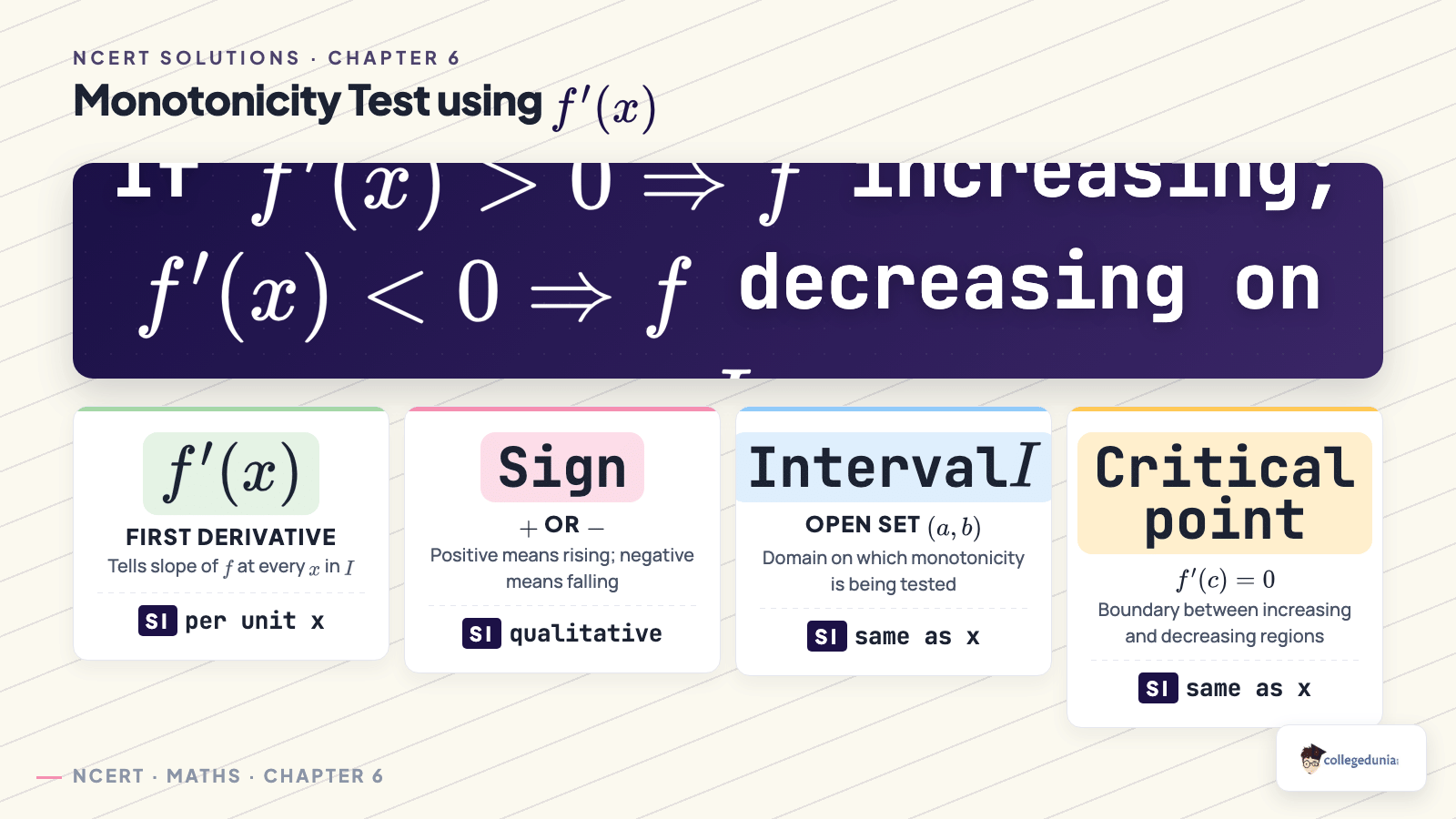
strictly increasing on an interval I if f'(x) > 0 for
every x ∈ I. To prove monotonicity on R, it is enough
to show that f'(x) > 0 for all real x.
Differentiate f(x) = 3x + 17:
f'(x) = 3.
Observe that f'(x) = 3 > 0 for every x ∈ R.
Therefore f is strictly increasing throughout R.
f'(x) = 3 > 0 on R, so f is strictly increasing on R.
AM
Arjun Mehta
M.Sc Mathematics, IIT Bombay
Verified Expert
Quick reading. A non-constant linear function with positive
slope is increasing everywhere. The slope is 3, so done.
Slope = 3 > 0 ⇒ strictly increasing on R.
Why this matters. For any linear f(x) = mx + c, the sign of
m alone determines whether f is increasing or decreasing.
f is strictly increasing on R.
Q 6.2
Show that the function given by f(x) = e2x is increasing
on R.
Concept used. For an exponential eu(x), the chain rule
gives ddx(eu(x)) = u'(x) eu(x). If f'(x) > 0
everywhere, then f is increasing everywhere.
Differentiate f(x) = e2x:
f'(x) = 2 e2x.
Since e2x > 0 for every real x (the exponential function
is always positive) and 2 > 0, the product 2e2x > 0 for
every real x.
Therefore f'(x) > 0 on R and so f is strictly
increasing on R.
f'(x) = 2 e2x > 0 on R, hence f is strictly increasing on R.
KG
Krishna Gupta
M.Sc Mathematics, IIT Bombay
Verified Expert
Quick reading.e2x is always positive and its derivative
2 e2x is also always positive. So e2x is strictly increasing.
f' = 2e2x > 0 for all x.
Hence f is strictly increasing on R.
Why this matters. For any a > 0, eax is strictly
increasing on R, while e-ax is strictly decreasing.
f is strictly increasing on R.
Q 6.3
Show that the function given by f(x) = sin x is
(a) increasing in (0, π2)
(b) decreasing in (π2, π)
(c) neither increasing nor decreasing in (0, π).
Concept used.f is increasing on I iff f'(x) > 0 on I
and decreasing iff f'(x) < 0 on I. For f(x) = sin x,
f'(x) = cos x.
Part (a). On (0, π2), the
cosine is positive: cos x > 0. Therefore
f'(x) > 0 on (0, π2), so sin x is
strictly increasing on this interval.
Part (b). On (π2, π), the
cosine is negative: cos x < 0. Therefore f'(x) < 0 on
(π2, π), so sin x is strictly
decreasing on this interval.
Part (c). On (0, π), cos x takes both positive
values (on (0, π2)) and negative
values (on (π2, π)). Hence f'
does not have a constant sign on (0, π), so f is
neither increasing nor decreasing on the whole interval.
sin x is increasing on (0, π2), decreasing on (π2, π), and neither on (0, π).
AK
Aanya Kumar
M.Sc Applied Mathematics, IIT Kanpur
Verified Expert
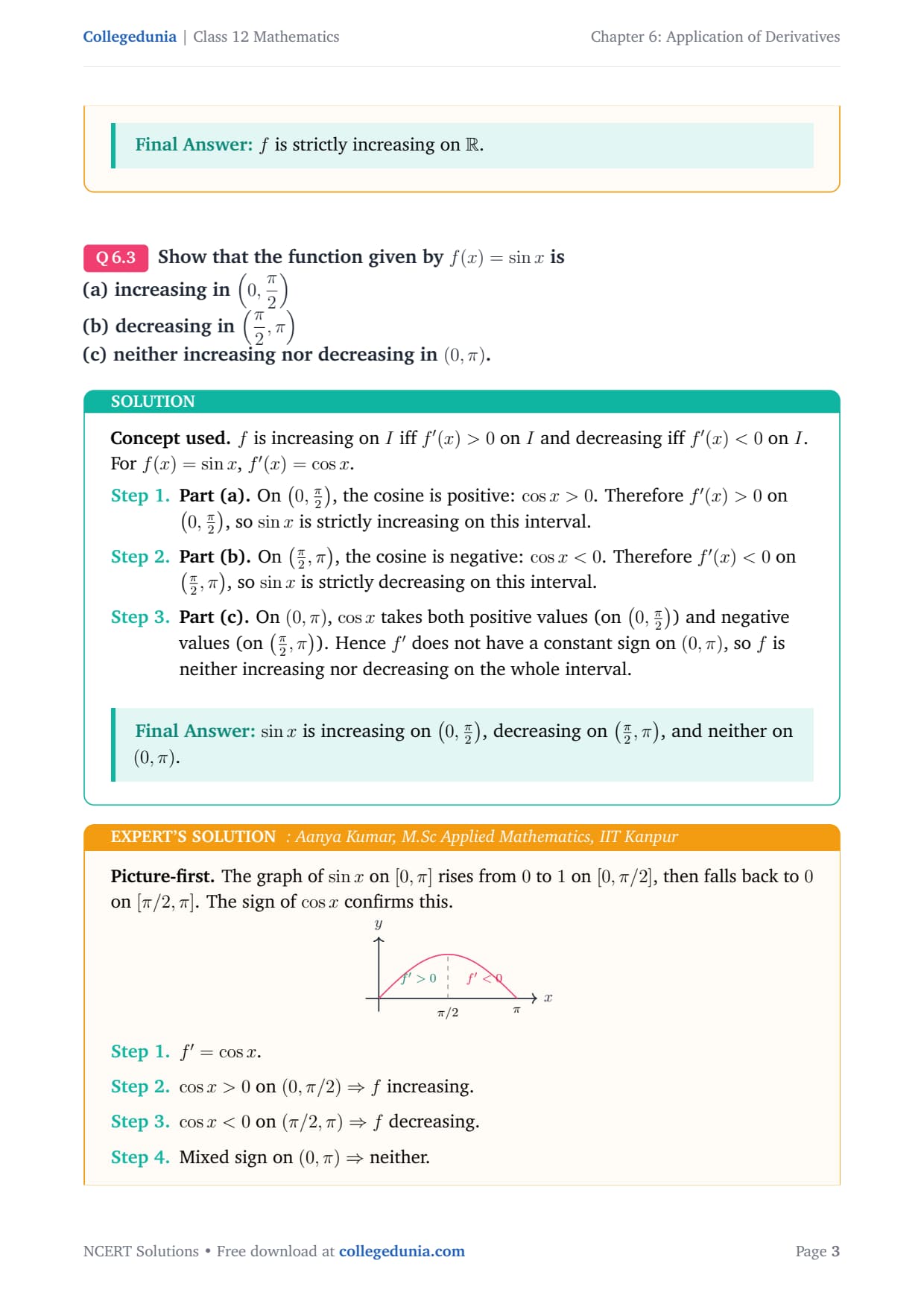
Picture-first. The graph of sin x on [0,π] rises from
0 to 1 on [0,π/2], then falls back to 0 on [π/2,π].
The sign of cos x confirms this.
[See diagram in the PDF version]
f' = cos x.
cos x > 0 on (0, π/2)⇒f increasing.
cos x < 0 on (π/2, π)⇒f decreasing.
Mixed sign on (0, π)⇒ neither.
Why this matters. Any change in the sign of f' on an
interval is enough to break monotonicity. Detecting the sign-change
point is therefore the central skill.
Increasing on (0,π/2), decreasing on (π/2,π), neither on (0,π).
Q 6.4
Find the intervals in which the function f given by
f(x) = 2x2 - 3x is
(a) increasing (b) decreasing.
Concept used. Differentiate, find where f'(x) = 0, and use
sign analysis on the resulting intervals.
Differentiate f(x) = 2x2 - 3x:
f'(x) = 4x - 3.
Set f'(x) = 0:
4x - 3 = 0 ⇒ x = 34.
Sign of f':
If x < 3/4, then 4x < 3 so f'(x) < 0: f is
strictly decreasing.
If x > 3/4, then 4x > 3 so f'(x) > 0: f is
strictly increasing.
f is decreasing on (-∞, 34) and increasing on (34, ∞).
SJ
Sneha Joshi
M.Sc Mathematics, ISI Kolkata
Verified Expert
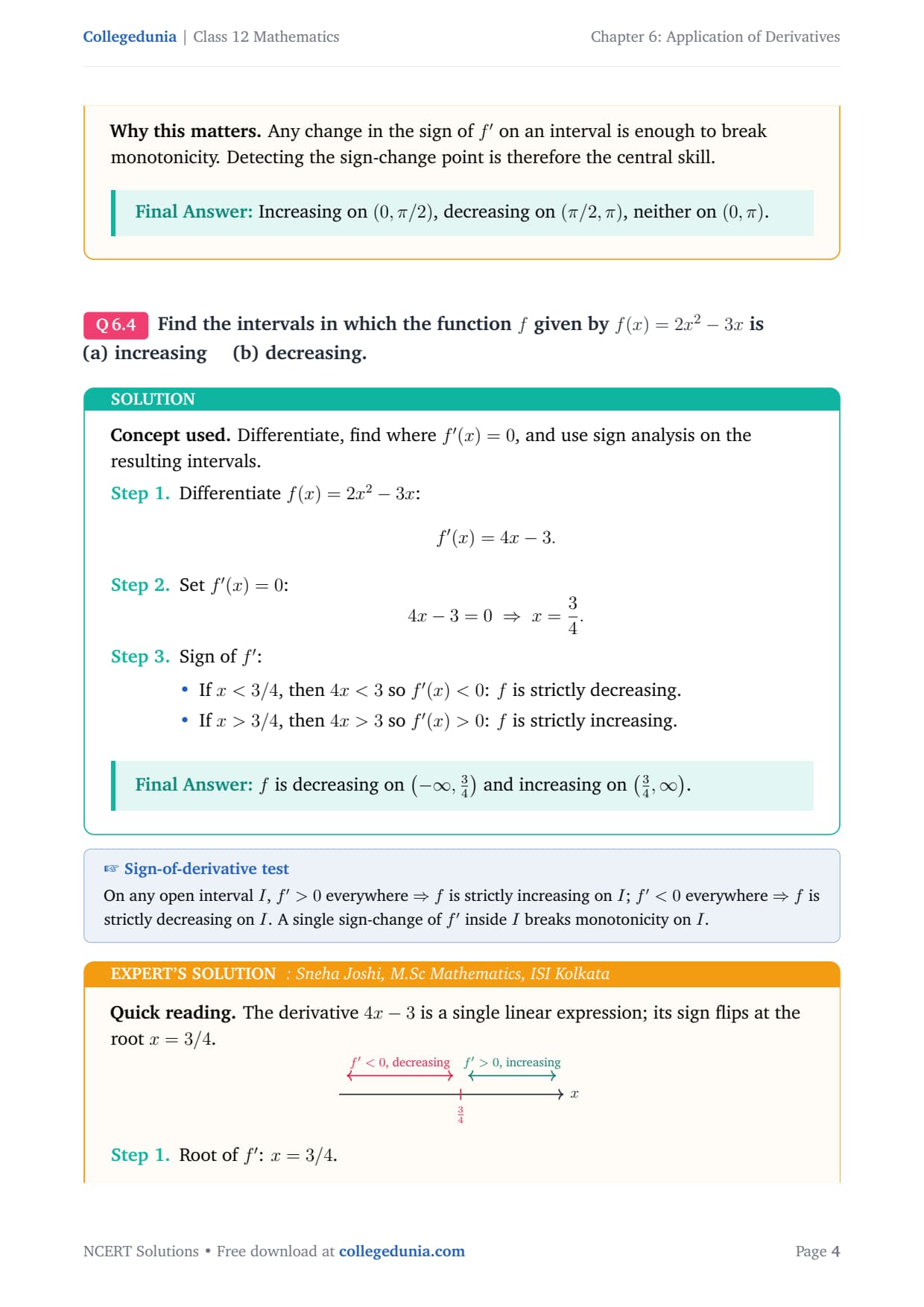
Quick reading. The derivative 4x-3 is a single linear
expression; its sign flips at the root x = 3/4.
[See diagram in the PDF version]
Root of f': x = 3/4.
Left of 3/4: f' < 0, decreasing. Right: f' > 0, increasing.
Why this matters. For a quadratic f, the vertex x = -b/(2a)
separates the decreasing and increasing branches.
Decreasing on (-∞, 3/4); increasing on (3/4, ∞).
Q 6.5
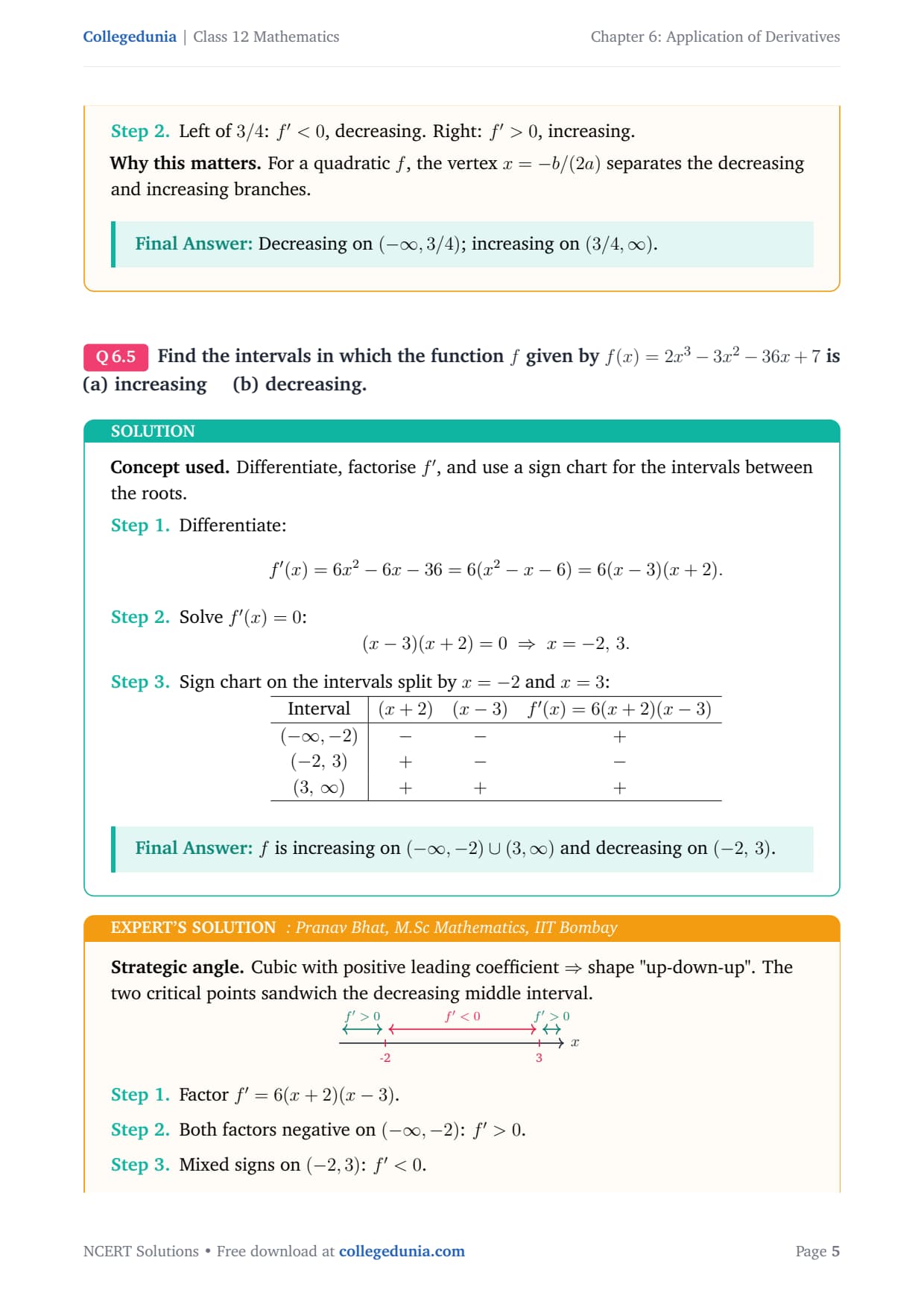
Find the intervals in which the function f given by
f(x) = 2x3 - 3x2 - 36x + 7 is
(a) increasing (b) decreasing.
Concept used. Differentiate, factorise f', and use a sign
chart for the intervals between the roots.
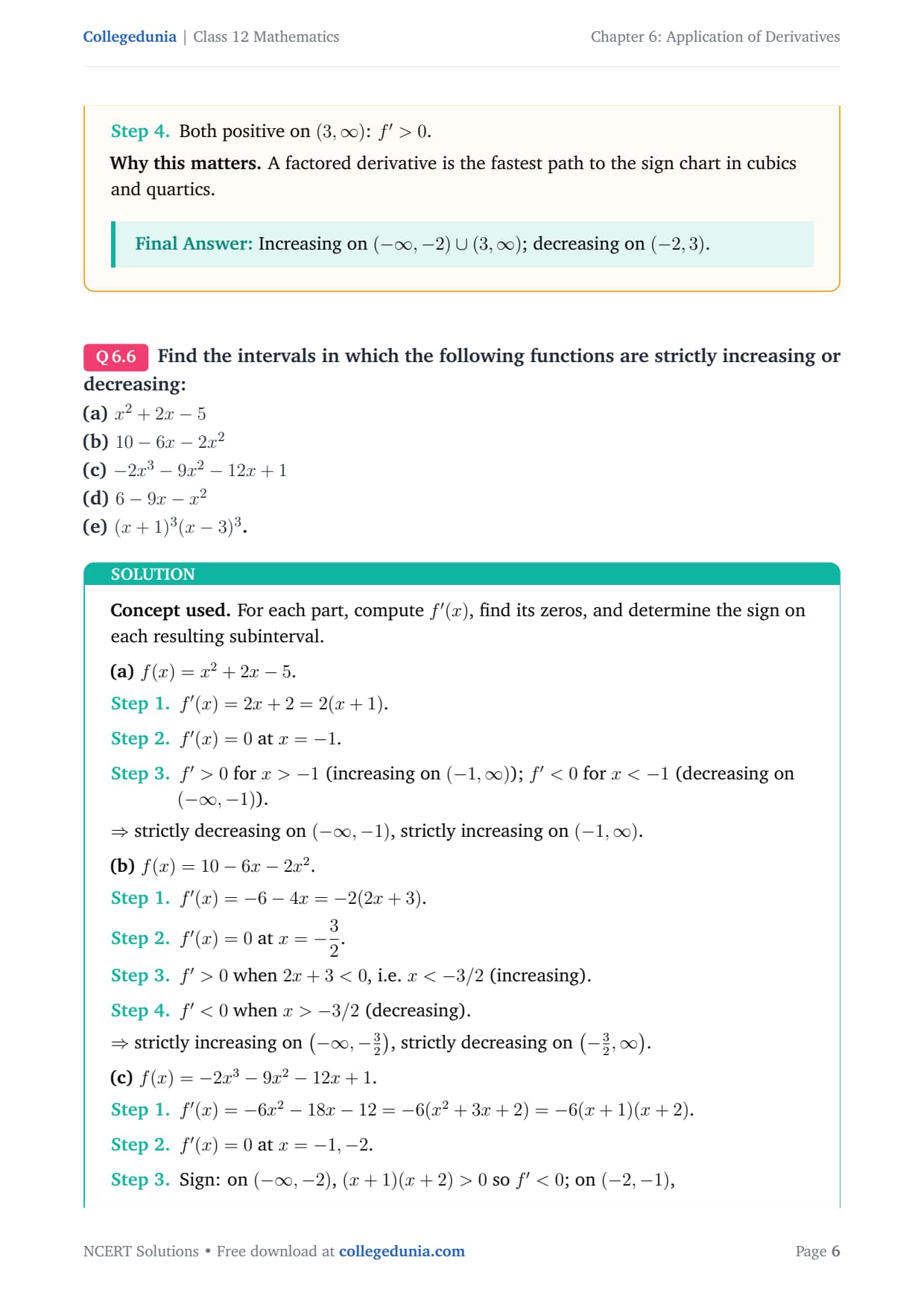
Sign: on (-∞,-2), (x+1)(x+2) > 0 so f' < 0; on
(-2,-1), (x+1)(x+2) < 0 so f' > 0; on (-1, ∞),
(x+1)(x+2) > 0 so f' < 0.
⇒ strictly decreasing on (-∞,-2)∪(-1,∞), strictly increasing on (-2,-1).
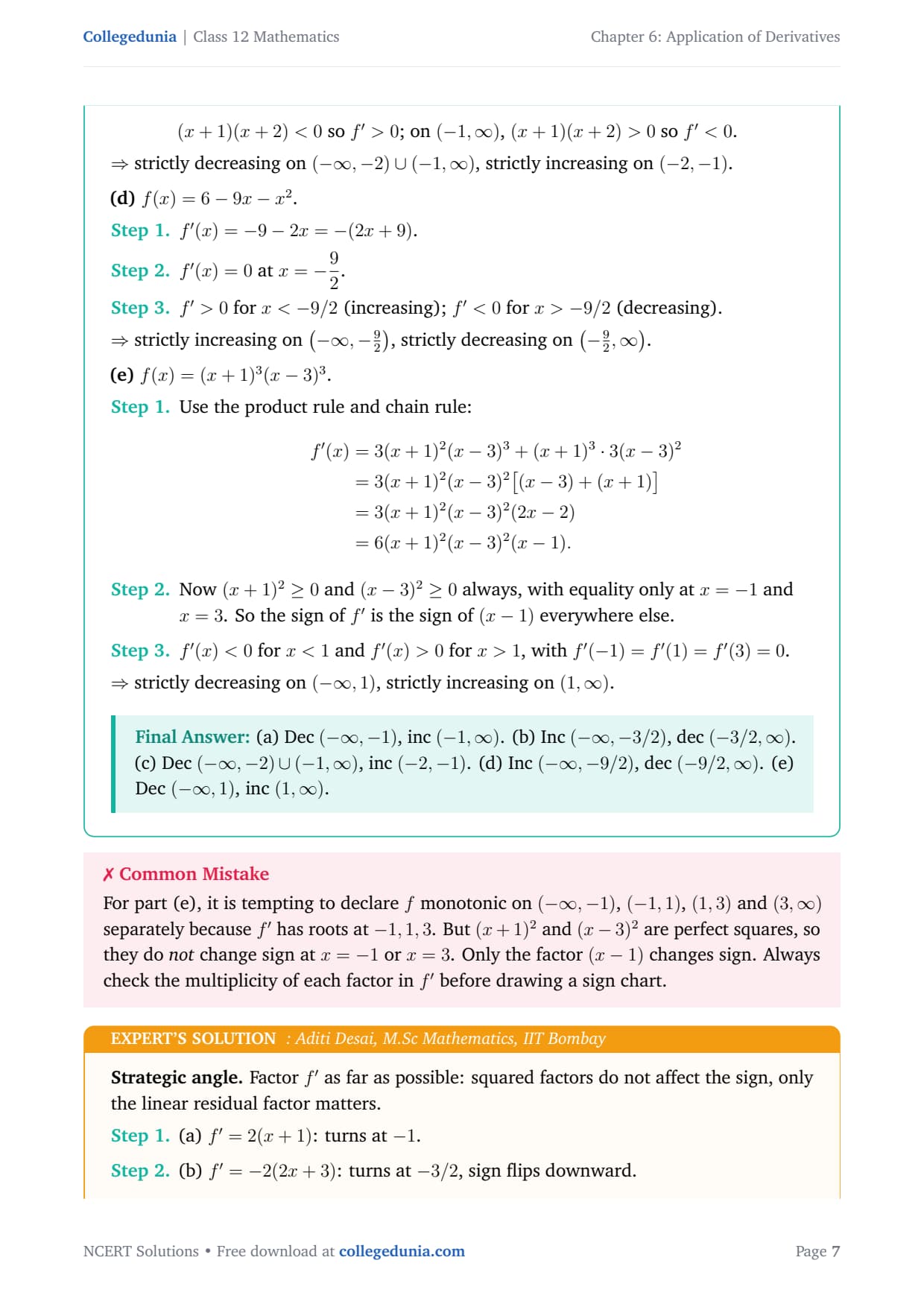
(d)f(x) = 6 - 9x - x2.
f'(x) = -9 - 2x = -(2x + 9).
f'(x) = 0 at x = -92.
f' > 0 for x < -9/2 (increasing); f' < 0 for x > -9/2 (decreasing).
⇒ strictly increasing on (-∞, -92), strictly decreasing on (-92, ∞).
(e)f(x) = (x+1)3(x-3)3.
Use the product rule and chain rule:
aligned
f'(x) &= 3(x+1)2(x-3)3 + (x+1)3· 3(x-3)2
&= 3(x+1)2(x-3)2[(x-3) + (x+1)]
&= 3(x+1)2(x-3)2(2x - 2)
&= 6(x+1)2(x-3)2(x-1).
aligned
Now (x+1)2≥ 0 and (x-3)2≥ 0 always, with equality
only at x=-1 and x=3. So the sign of f' is the sign of
(x-1) everywhere else.
f'(x) < 0 for x < 1 and f'(x) > 0 for x > 1, with
f'(-1) = f'(1) = f'(3) = 0.
⇒ strictly decreasing on (-∞, 1), strictly increasing on (1, ∞).
(a) Dec (-∞,-1), inc (-1,∞). (b) Inc (-∞,-3/2), dec (-3/2,∞). (c) Dec (-∞,-2)∪(-1,∞), inc (-2,-1). (d) Inc (-∞,-9/2), dec (-9/2,∞). (e) Dec (-∞,1), inc (1,∞).
AD
Aditi Desai
M.Sc Mathematics, IIT Bombay
Verified Expert
Strategic angle. Factor f' as far as possible: squared
factors do not affect the sign, only the linear residual factor matters.
(a) f' = 2(x+1): turns at -1.
(b) f' = -2(2x+3): turns at -3/2, sign flips downward.
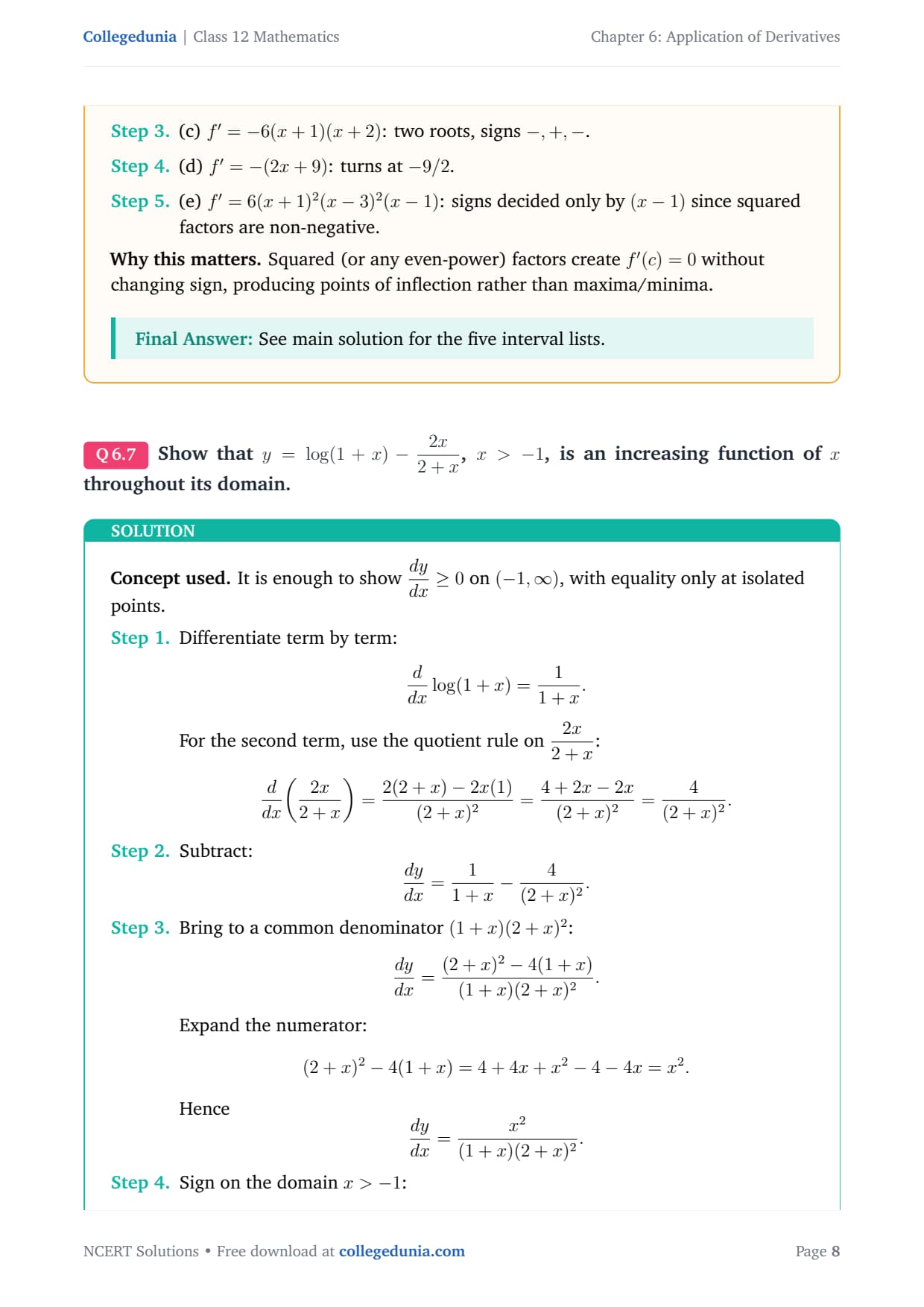
(c) f' = -6(x+1)(x+2): two roots, signs -,+,-.
(d) f' = -(2x+9): turns at -9/2.
(e) f' = 6(x+1)2(x-3)2(x-1): signs decided only by
(x-1) since squared factors are non-negative.
Why this matters. Squared (or any even-power) factors create
f'(c) = 0 without changing sign, producing points of inflection
rather than maxima/minima.
See main solution for the five interval lists.
Q 6.7
Show that y = log(1+x) - 2x2+x, x > -1, is an
increasing function of x throughout its domain.
Concept used. It is enough to show dydx ≥ 0 on
(-1, ∞), with equality only at isolated points.
Differentiate term by term:
ddxlog(1+x) = 11+x.
For the second term, use the quotient rule on 2x2+x:
ddx(2x2+x)
= 2(2+x) - 2x(1)(2+x)2
= 4 + 2x - 2x(2+x)2
= 4(2+x)2.
Subtract:
dydx
= 11+x - 4(2+x)2.
Bring to a common denominator (1+x)(2+x)2:
dydx
= (2+x)2 - 4(1+x)(1+x)(2+x)2.
Expand the numerator:
(2+x)2 - 4(1+x) = 4 + 4x + x2 - 4 - 4x = x2.
Hence
dydx = x2(1+x)(2+x)2.
Sign on the domain x > -1:
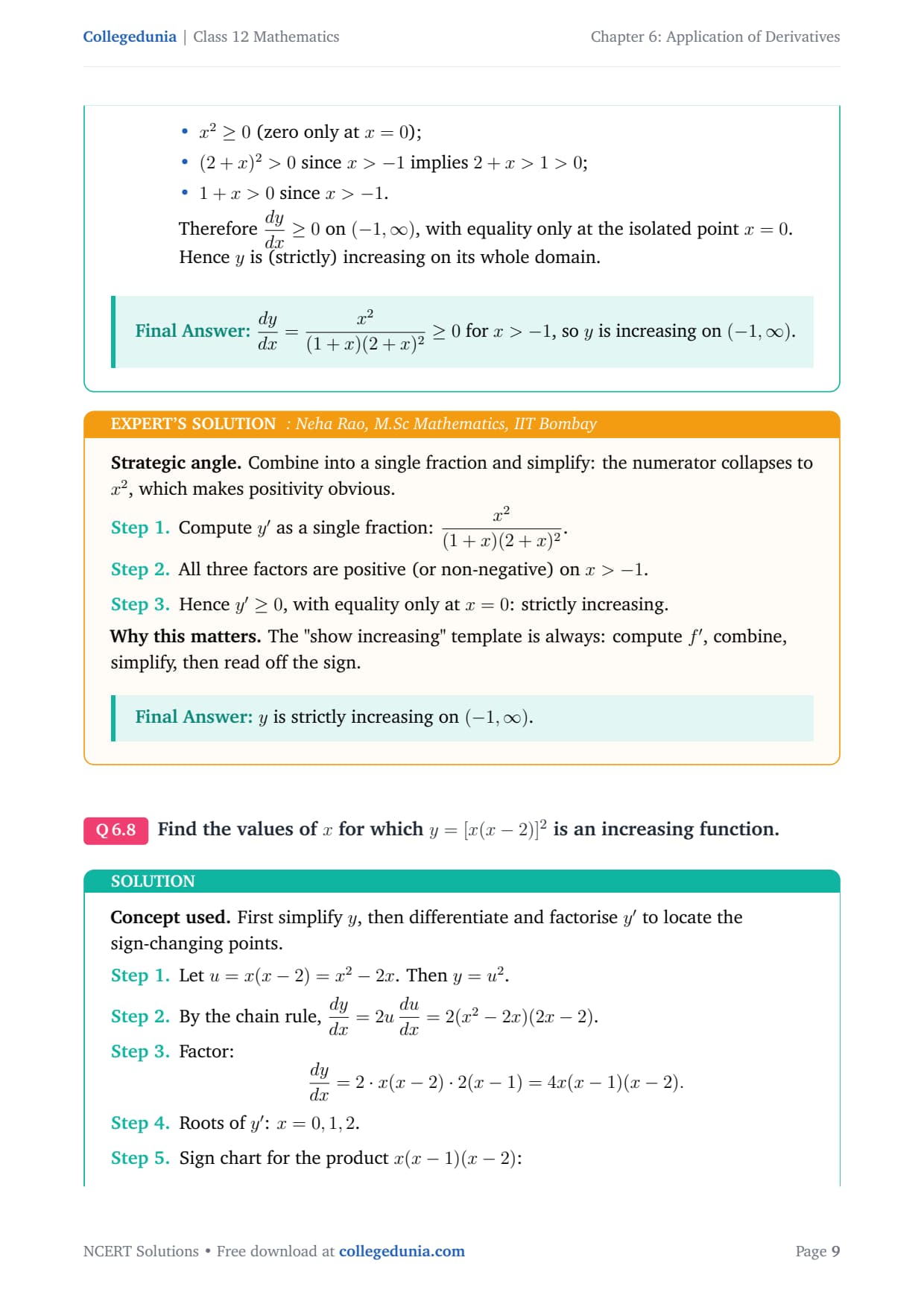
x2 ≥ 0 (zero only at x=0);
(2+x)2 > 0 since x > -1 implies 2+x > 1 > 0;
1+x > 0 since x > -1.
Therefore dydx ≥ 0 on (-1, ∞), with
equality only at the isolated point x=0. Hence y is
(strictly) increasing on its whole domain.
dydx = x2(1+x)(2+x)2 ≥ 0 for x>-1, so y is increasing on (-1, ∞).
NR
Neha Rao
M.Sc Mathematics, IIT Bombay
Verified Expert
Strategic angle. Combine into a single fraction and simplify:
the numerator collapses to x2, which makes positivity obvious.
Compute y' as a single fraction: x2(1+x)(2+x)2.
All three factors are positive (or non-negative) on x > -1.
Hence y' ≥ 0, with equality only at x = 0: strictly
increasing.
Why this matters. The "show increasing" template is always:
compute f', combine, simplify, then read off the sign.
y is strictly increasing on (-1, ∞).
Q 6.8
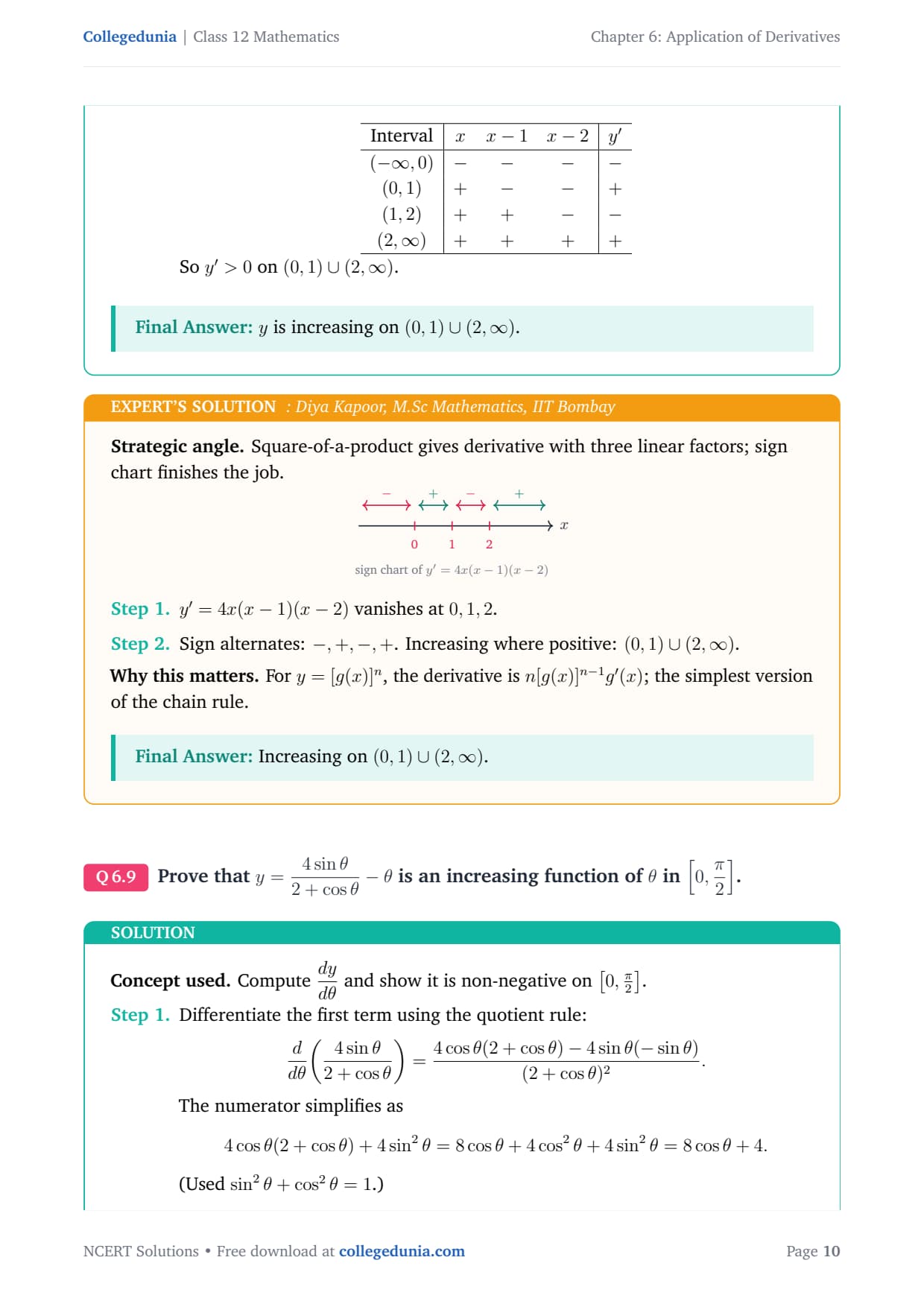
Find the values of x for which y = [x(x-2)]2 is an
increasing function.
Concept used. First simplify y, then differentiate and
factorise y' to locate the sign-changing points.
Let u = x(x-2) = x2 - 2x. Then y = u2.
By the chain rule, dydx = 2u dudx
= 2(x2-2x)(2x - 2).
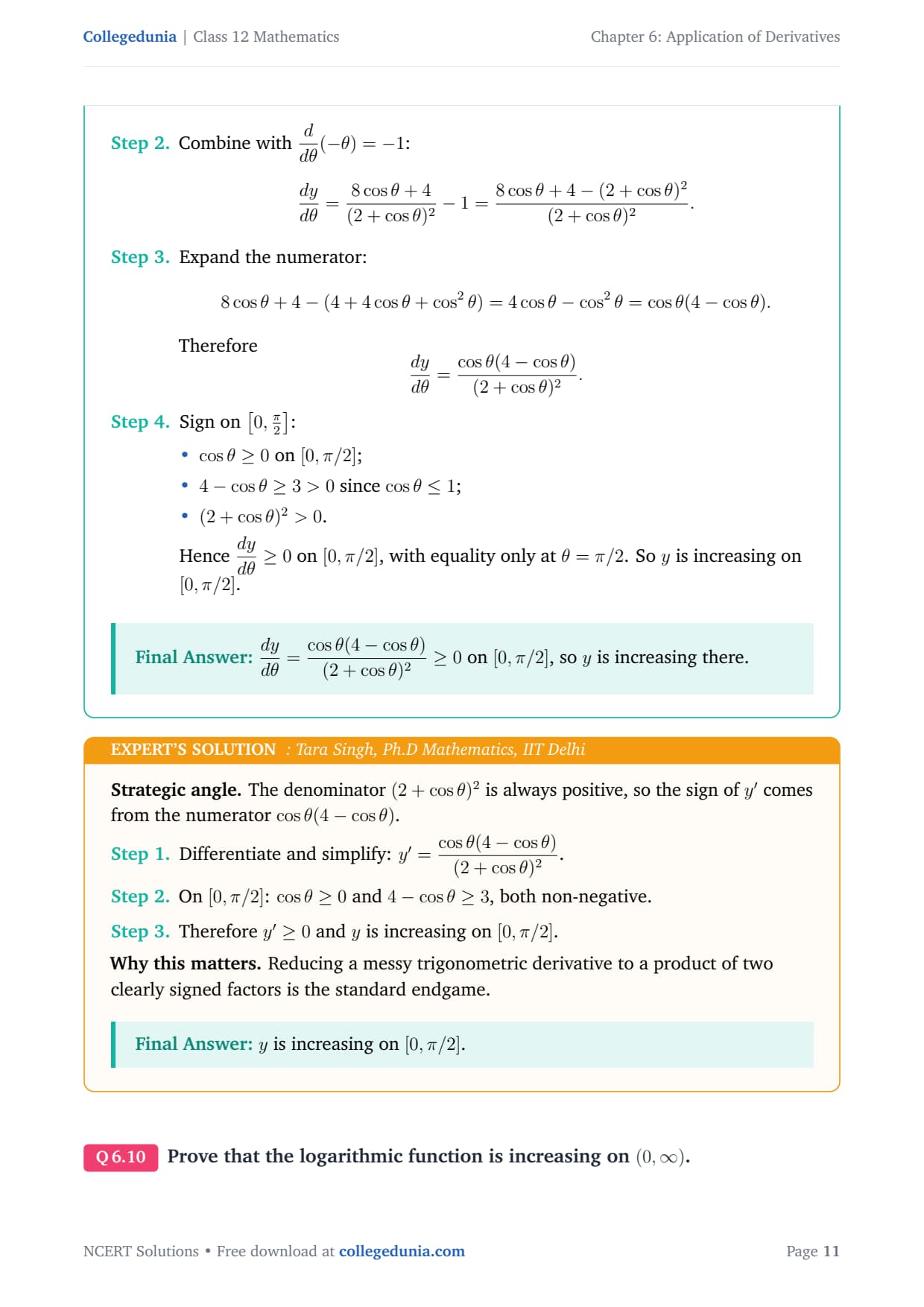
Hence dydθ ≥ 0 on [0, π/2], with
equality only at θ = π/2. So y is increasing on
[0, π/2].
dydθ = cosθ(4-cosθ)(2+cosθ)2 ≥ 0 on [0,π/2], so y is increasing there.
TS
Tara Singh
Ph.D Mathematics, IIT Delhi
Verified Expert
Strategic angle. The denominator (2+cosθ)2 is
always positive, so the sign of y' comes from the numerator
cosθ(4-cosθ).
Differentiate and simplify: y' = cosθ(4-cosθ)(2+cosθ)2.
On [0, π/2]: cosθ≥ 0 and 4-cosθ ≥ 3,
both non-negative.
Therefore y' ≥ 0 and y is increasing on [0, π/2].
Why this matters. Reducing a messy trigonometric derivative
to a product of two clearly signed factors is the standard endgame.
y is increasing on [0, π/2].
Q 6.10
Prove that the logarithmic function is increasing on
(0, ∞).
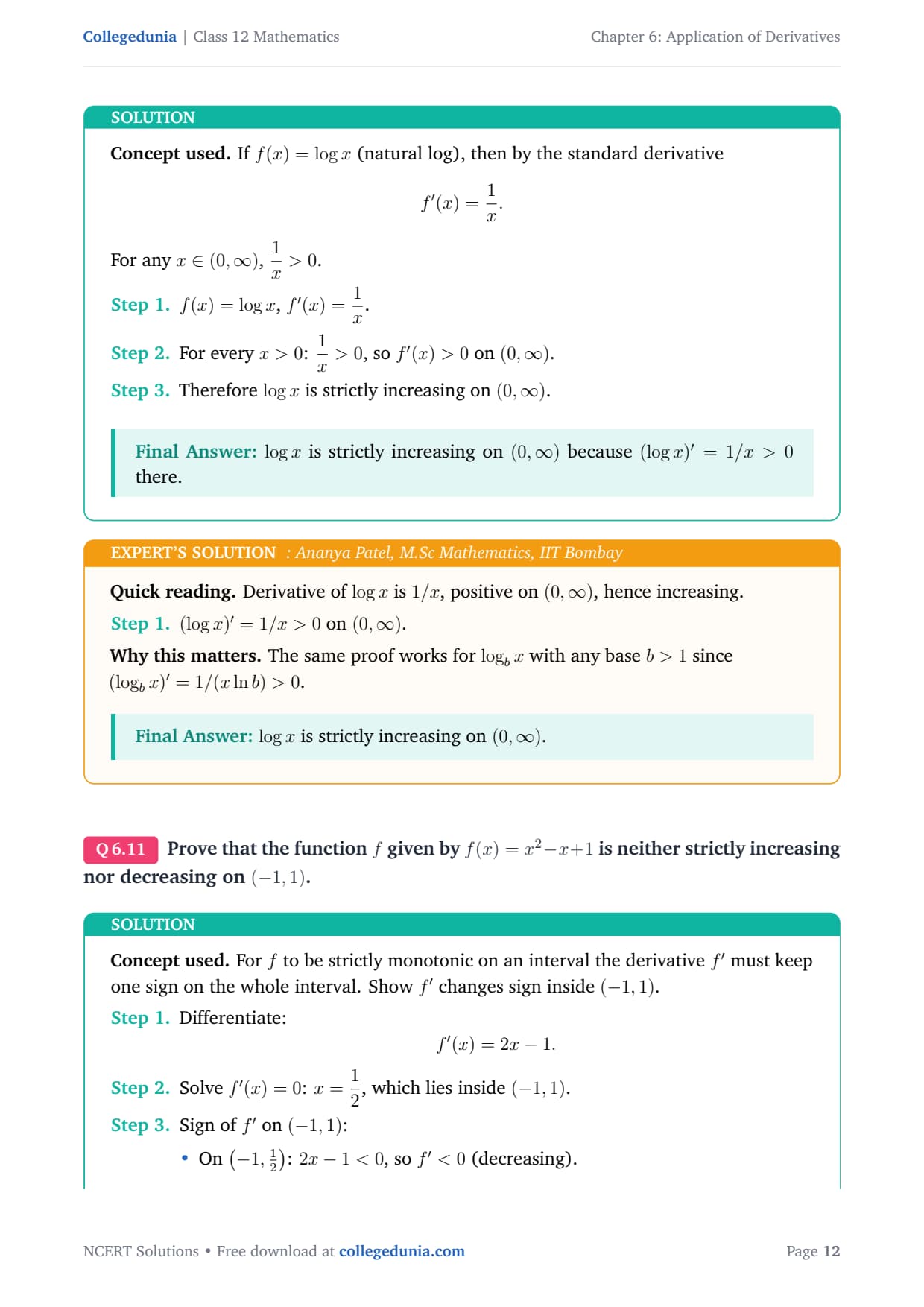
Concept used. If f(x) = log x (natural log), then by the
standard derivative
f'(x) = 1x.
For any x ∈ (0, ∞), 1x > 0.
f(x) = log x, f'(x) = 1x.
For every x > 0: 1x > 0, so f'(x) > 0 on (0, ∞).
Therefore log x is strictly increasing on (0, ∞).
log x is strictly increasing on (0, ∞) because (log x)' = 1/x > 0 there.
AP
Ananya Patel
M.Sc Mathematics, IIT Bombay
Verified Expert
Quick reading. Derivative of log x is 1/x, positive on
(0,∞), hence increasing.
(log x)' = 1/x > 0 on (0,∞).
Why this matters. The same proof works for bx with
any base b > 1 since (bx)' = 1/(x ln b) > 0.
log x is strictly increasing on (0, ∞).
Q 6.11
Prove that the function f given by f(x) = x2 - x + 1
is neither strictly increasing nor decreasing on (-1, 1).
Concept used. For f to be strictly monotonic on an interval
the derivative f' must keep one sign on the whole interval. Show
f' changes sign inside (-1, 1).
Differentiate:
f'(x) = 2x - 1.
Solve f'(x) = 0: x = 12, which lies inside
(-1, 1).
Sign of f' on (-1, 1):
On (-1, 12): 2x - 1 < 0, so
f' < 0 (decreasing).
On (12, 1): 2x - 1 > 0, so
f' > 0 (increasing).
Since f' changes sign in (-1, 1), f is neither strictly
increasing nor strictly decreasing on (-1, 1).
f decreases on (-1, 12) and increases on (12, 1), so it is neither strictly increasing nor strictly decreasing on (-1, 1).
IN
Ishaan Nair
M.Sc Mathematics, IIT Bombay
Verified Expert
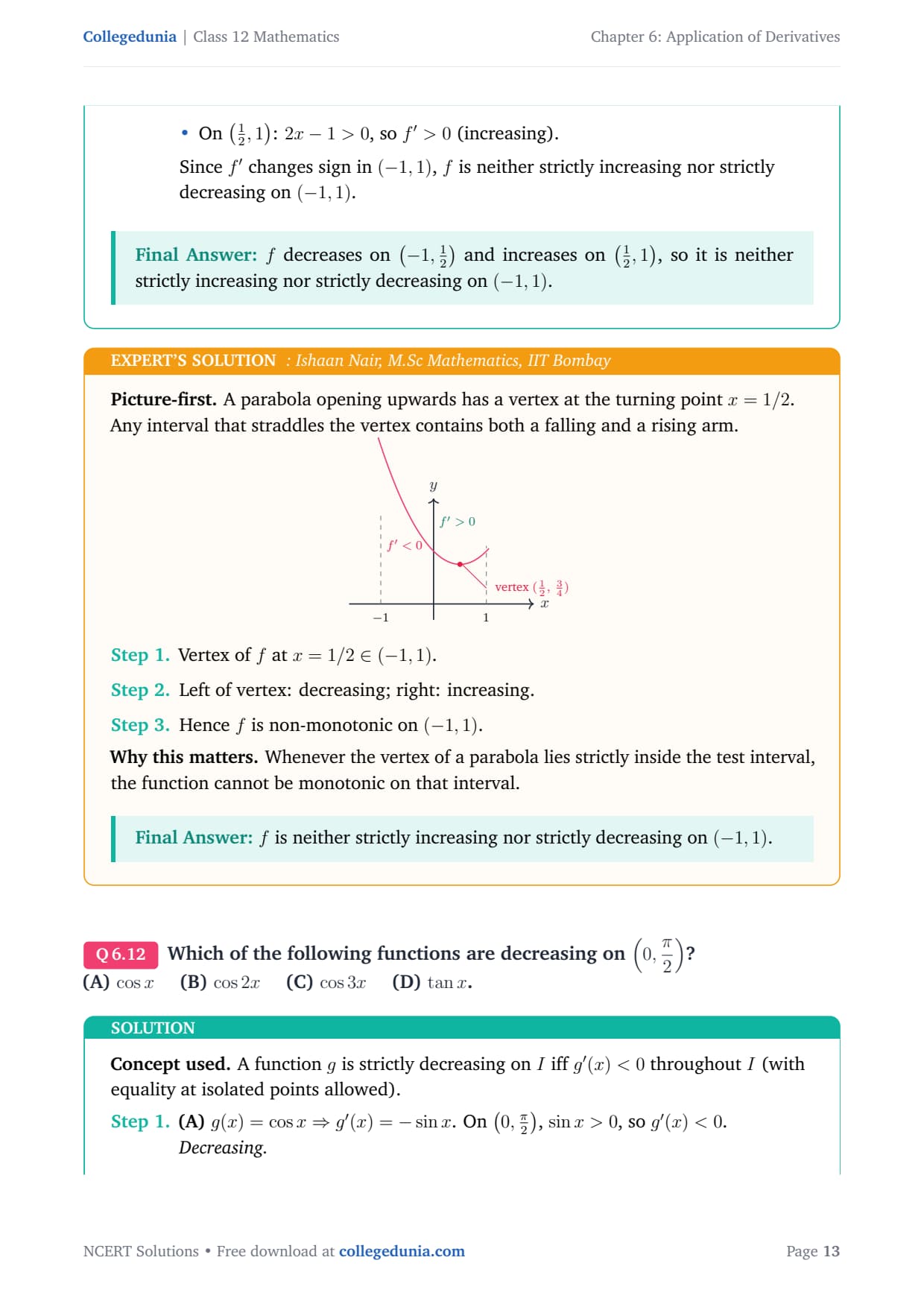
Picture-first. A parabola opening upwards has a vertex at the
turning point x = 1/2. Any interval that straddles the vertex
contains both a falling and a rising arm.
[See diagram in the PDF version]
Vertex of f at x = 1/2 ∈ (-1, 1).
Left of vertex: decreasing; right: increasing.
Hence f is non-monotonic on (-1, 1).
Why this matters. Whenever the vertex of a parabola lies
strictly inside the test interval, the function cannot be monotonic
on that interval.
f is neither strictly increasing nor strictly decreasing on (-1, 1).
Q 6.12
Which of the following functions are decreasing on (0,
π2)?
(A) cos x (B) cos 2x (C) cos 3x (D) tan x.
Concept used. A function g is strictly decreasing on I
iff g'(x) < 0 throughout I (with equality at isolated points
allowed).
(A)g(x) = cos x ⇒ g'(x) = -sin x. On
(0, π2), sin x > 0, so g'(x) < 0.
Decreasing.
(B)g(x) = cos 2x ⇒ g'(x) = -2sin 2x. As
x varies over (0, π2), 2x varies
over (0, π), where sin 2x > 0. So g' < 0 throughout.
Decreasing.
(C)g(x) = cos 3x ⇒ g'(x) = -3sin 3x.
As x varies over (0, π2), 3x
varies over (0, 3π2). On
(0, π), sin 3x > 0; on (π,
3π2), sin 3x < 0. Hence the sign of
g' changes, so g is not monotonic. Not decreasing.
(D)g(x) = tan x ⇒ g'(x) = sec2x > 0
on (0, π2). Strictly increasing,
not decreasing.
Only options (A) and (B) are decreasing on (0, π2).
RM
Riya Mehta
M.Sc Mathematics, IIT Bombay
Verified Expert
Quick reading. Track the argument range: x ∈ (0, π/2)
sends 2x into (0,π), 3x into (0, 3π/2). The first stays
inside the "sin > 0" zone, the second leaves it.
cos x: g' = -sin x < 0 ⇒ decreasing.
cos 2x: g' = -2sin 2x < 0 throughout.
cos 3x: sign changes ×
tan x: sec2x > 0 ⇒ increasing ×
Why this matters. For cos kx, monotonicity over an
interval depends on whether kx stays inside a single half-period.
(A) and (B).
Q 6.13
On which of the following intervals is the function f
given by f(x) = x100 + sin x - 1 decreasing?
(A) (0, 1) (B) (π2, π)
(C) (0, π2) (D) None of these.
Concept used.f is decreasing on an interval iff
f'(x) < 0 throughout.
Differentiate:
f'(x) = 100 x99 + cos x.
(A) (0,1): For x ∈ (0, 1), x99 > 0 so
100x99 > 0; also cos x > 0 since x < 1 < π/2.
Hence f'(x) > 0 on (0,1): increasing, not decreasing.
(B) (π/2, π): For x > π/2 > 1, 100 x99
> 100, while cos x ∈ (-1, 0). Thus f'(x) ≥ 100 + (-1)
= 99 > 0: increasing, not decreasing.
(C) (0, π/2): For x > 0, 100 x99 > 0 and
cos x > 0, so f' > 0: increasing, not decreasing.
Therefore none of (A), (B), (C) gives a decreasing interval.
Option (D), None of these.
KV
Karan Verma
M.Sc Mathematics, IIT Bombay
Verified Expert
Quick reading.100x99 grows extremely fast; for |x| ≥ 1
it dwarfs |cos x|. So f' stays positive on the listed intervals.
f'(x) = 100x99 + cos x.
All listed intervals lie in x ≥ 0, where 100x99 ≥ 0
and |cos x| ≤ 1; for x ≥ 1 the polynomial part dominates.
Hence f' > 0 on all three intervals, and f is not decreasing
on any of them.
Why this matters. Inequality estimates ("the big term beats
the bounded term") often prove monotonicity faster than solving
f' = 0 exactly.
Option (D).
Q 6.14
For what values of a the function f given by f(x) = x2
+ ax + 1 is increasing on [1, 2]?
Concept used.f is increasing on [1, 2] iff f'(x) ≥ 0
for all x ∈ [1, 2].
Differentiate:
f'(x) = 2x + a.
Demand f'(x) ≥ 0 on [1, 2]:
2x + a ≥ 0 ⇒ a ≥ -2x for all x∈[1,2].
The right-hand side -2x is largest (least negative) when
x is smallest, i.e. at x = 1: maximum value is -2. So
a ≥ -2xmin = -2(1) = -2.
Hence a ≥ -2.
f is increasing on [1, 2] for a ≥ -2.
PG
Pooja Gupta
M.Sc Mathematics, ISI Kolkata
Verified Expert
Strategic angle. Translate "f' ≥ 0 on [1,2]" into a
single inequality at the worst case (x = 1).
f'(x) = 2x + a.
On [1, 2], 2x ≥ 2, so f' ≥ 2 + a.
Hence 2 + a ≥ 0 ⇒ a ≥ -2.
Why this matters. For linear-in-x derivatives, the minimum
on an interval is at one endpoint; that single value drives the
parameter constraint.
a ≥ -2.
Q 6.15
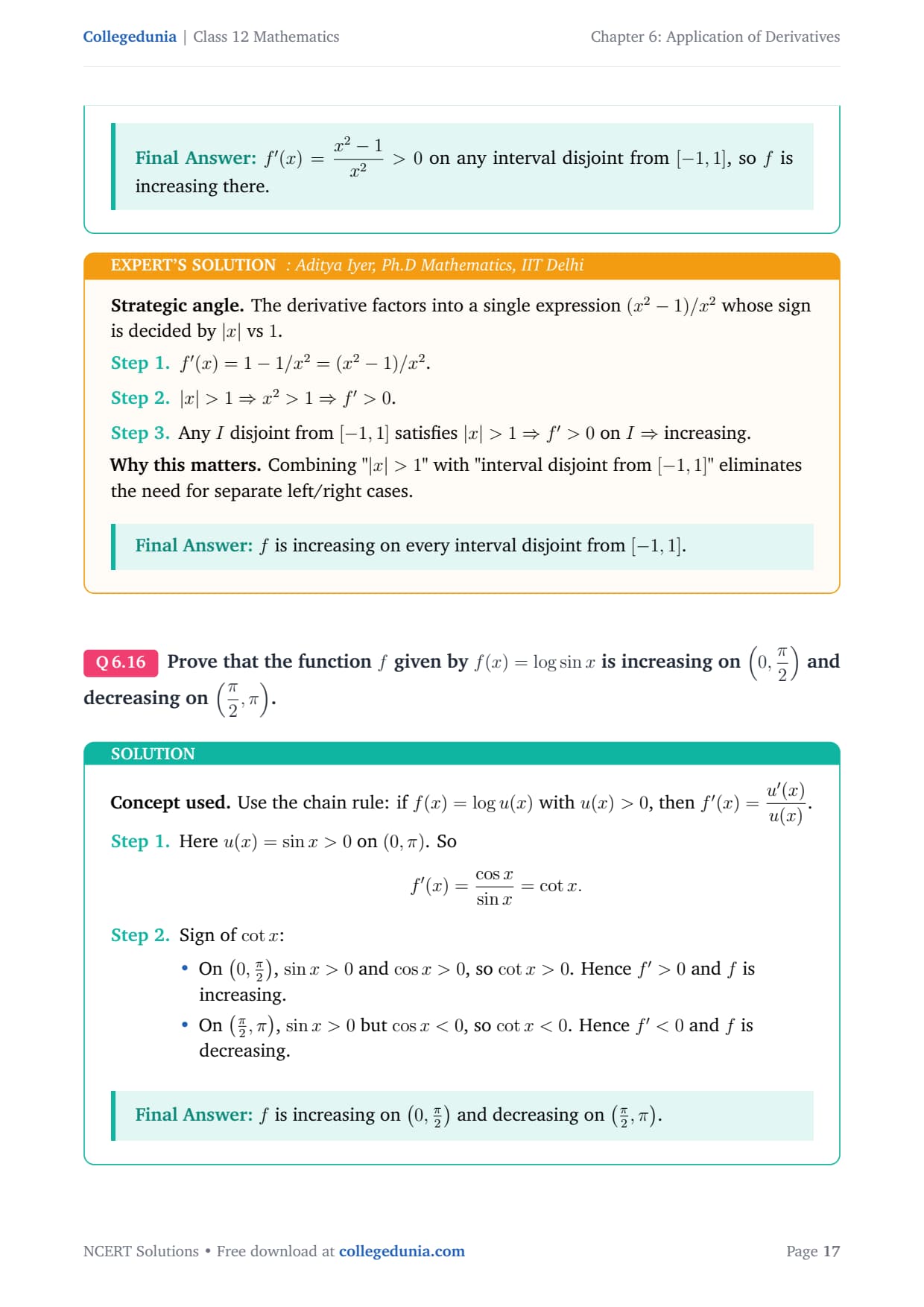
Let I be any interval disjoint from [-1, 1]. Prove that
the function f given by f(x) = x + 1x is increasing on I.
Concept used. If f'(x) > 0 on I, then f is increasing on I.
Differentiate:
f'(x) = 1 - 1x2 = x2 - 1x2.
Sign of f':
x2 > 0 always (where f is defined, x ≠ 0).
Sign of f' matches sign of x2 - 1 = (x-1)(x+1).
x2 - 1 > 0 |x| > 1 x ∈ (-∞, -1)∪(1, ∞).
If I is any interval disjoint from [-1, 1], then I lies
entirely in (-∞, -1) or entirely in (1, ∞). In
either case x2 - 1 > 0 on I, so f'(x) > 0 on I.
Therefore f is strictly increasing on I.
f'(x) = x2-1x2 > 0 on any interval disjoint from [-1,1], so f is increasing there.
AI
Aditya Iyer
Ph.D Mathematics, IIT Delhi
Verified Expert
Strategic angle. The derivative factors into a single
expression (x2-1)/x2 whose sign is decided by |x| vs 1.
f'(x) = 1 - 1/x2 = (x2-1)/x2.
|x| > 1 ⇒ x2 > 1 ⇒ f' > 0.
Any I disjoint from [-1,1] satisfies |x| > 1⇒f' > 0 on I⇒ increasing.
Why this matters. Combining "|x| > 1" with "interval disjoint
from [-1, 1]" eliminates the need for separate left/right cases.
f is increasing on every interval disjoint from [-1, 1].
Q 6.16
Prove that the function f given by f(x) = log sin x is
increasing on (0, π2) and decreasing on
(π2, π).
Concept used. Use the chain rule: if f(x) = log u(x) with
u(x) > 0, then f'(x) = u'(x)u(x).
Here u(x) = sin x > 0 on (0, π). So
f'(x) = cos xsin x = cot x.
Sign of cot x:
On (0, π2), sin x > 0 and
cos x > 0, so cot x > 0. Hence f' > 0 and f
is increasing.
On (π2, π), sin x > 0 but
cos x < 0, so cot x < 0. Hence f' < 0 and f
is decreasing.
f is increasing on (0, π2) and decreasing on (π2, π).
SR
Sanya Reddy
M.Sc Applied Mathematics, IIT Kanpur
Verified Expert
Quick reading. The derivative is simply cot x, which is
positive in Q1 and negative in Q2.
f'(x) = cot x.
cot x > 0 on (0, π/2), cot x < 0 on (π/2, π).
Why this matters. Logarithmic differentiation collapses
x → cot x, a single trigonometric function whose sign
chart is well-known.
Increasing on (0,π/2), decreasing on (π/2, π).
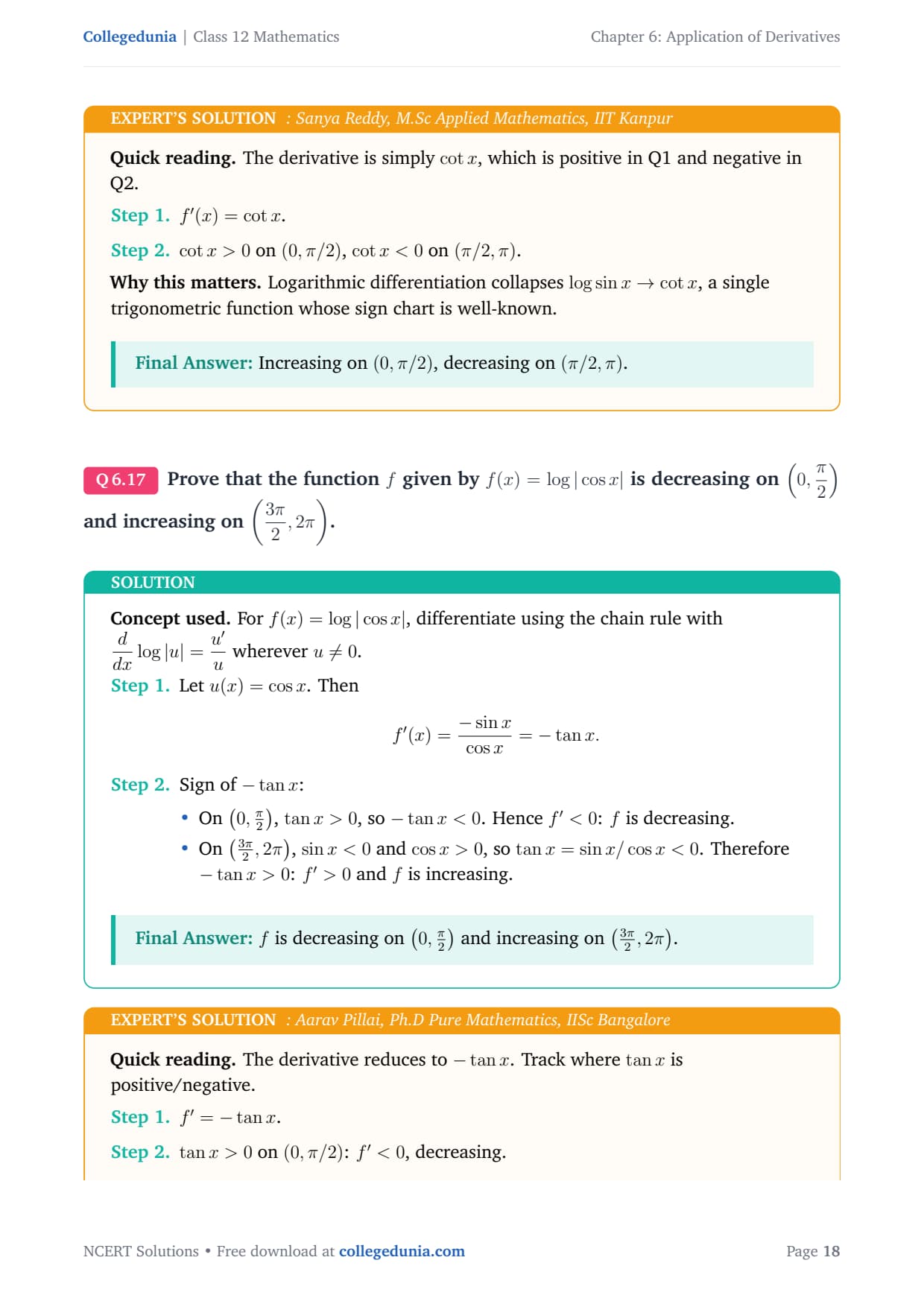
Q 6.17
Prove that the function f given by f(x) = log|cos x|
is decreasing on (0, π2) and increasing on
(3π2, 2π).
Concept used. For f(x) = log|cos x|, differentiate using
the chain rule with ddxlog|u| = u'u wherever
u ≠ 0.
Let u(x) = cos x. Then
f'(x) = -sin xcos x = -tan x.
Sign of -tan x:
On (0, π2), tan x > 0, so
-tan x < 0. Hence f' < 0: f is decreasing.
On (3π2, 2π), sin x < 0
and cos x > 0, so tan x = sin x/cos x < 0.
Therefore -tan x > 0: f' > 0 and f is increasing.
f is decreasing on (0, π2) and increasing on (3π2, 2π).
AP
Aarav Pillai
Ph.D Pure Mathematics, IISc Bangalore
Verified Expert
Quick reading. The derivative reduces to -tan x. Track
where tan x is positive/negative.
f' = -tan x.
tan x > 0 on (0, π/2): f' < 0, decreasing.
tan x < 0 on (3π/2, 2π): f' > 0, increasing.
Why this matters.log|cos x| behaves the same way on
each π-period: monotonic in opposite directions on the two halves.
Decreasing on (0, π/2) and increasing on (3π/2, 2π).
Q 6.18
Prove that the function given by f(x) = x3 - 3x2 + 3x
- 100 is increasing in R.
Concept used. If f'(x) ≥ 0 on R (with equality
at only isolated points), f is monotonically increasing on R.
Differentiate:
f'(x) = 3x2 - 6x + 3.
Factor: pull out 3 and complete the square:
f'(x) = 3(x2 - 2x + 1) = 3(x - 1)2.
Since (x-1)2 ≥ 0 for every real x, we have f'(x) ≥ 0
on R, with f'(1) = 0 being the only zero. Therefore
f is monotonically increasing on R.
f'(x) = 3(x-1)2 ≥ 0 on R, so f is monotonically increasing.
YC
Yash Chatterjee
M.Sc Mathematics, IIT Bombay
Verified Expert
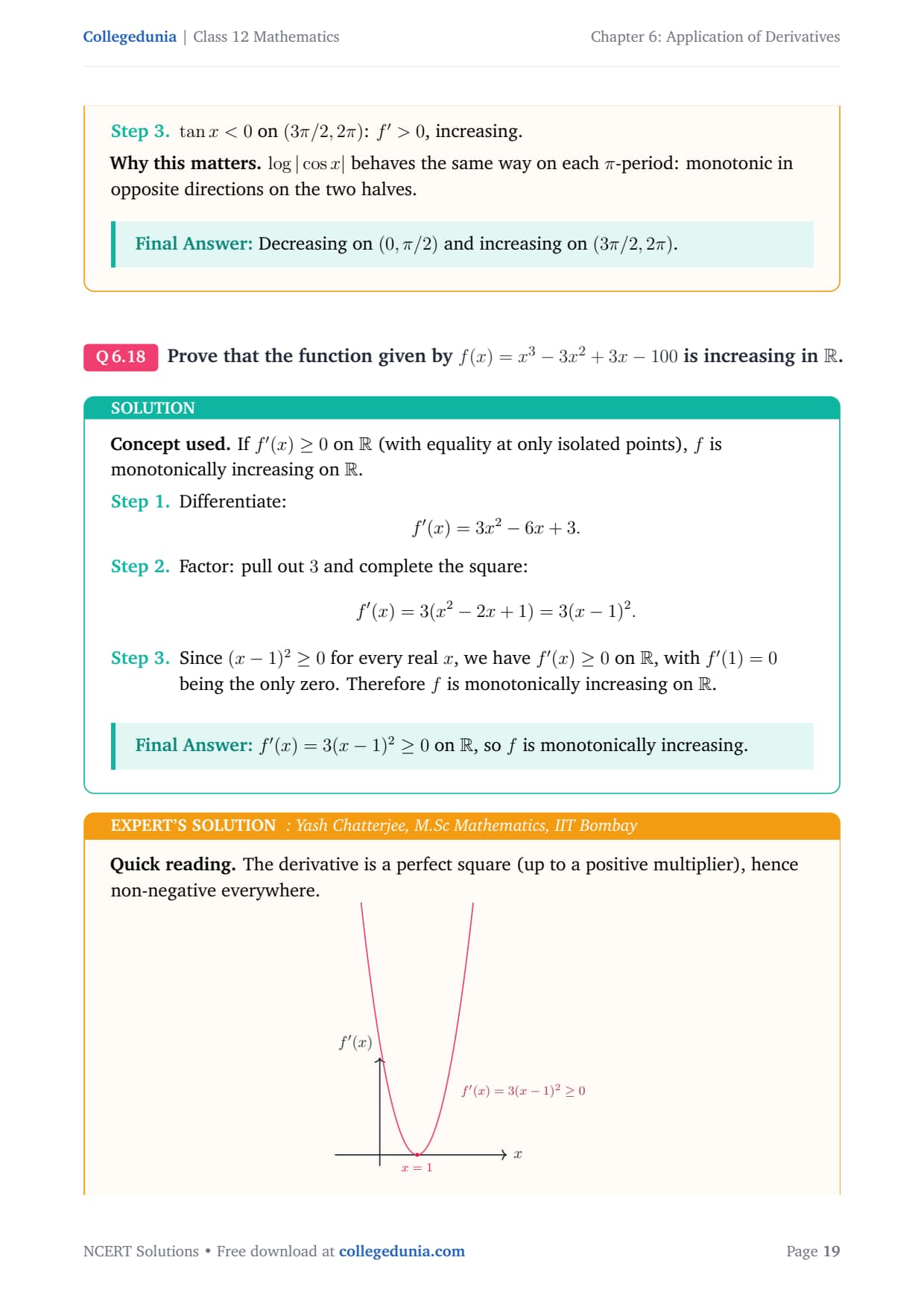
Quick reading. The derivative is a perfect square (up to a
positive multiplier), hence non-negative everywhere.
[See diagram in the PDF version]
f'(x) = 3x2 - 6x + 3 = 3(x-1)2.
(x-1)2 ≥ 0 for all real x.
Therefore f is increasing on R (with horizontal
tangent only at x = 1).
Why this matters. A cubic with b2 - 3ac ≤ 0 (discriminant
of f') is monotonic on R, because its derivative cannot
change sign.
f is increasing on R.
Q 6.19
The interval in which y = x2 e-x is increasing is
(A) (-∞, ∞) (B) (-2, 0) (C) (2, ∞)
(D) (0, 2).
Concept used. Product rule on y = x2 e-x then sign
analysis.
Differentiate using the product rule:
dydx
= 2x e-x + x2(-e-x)
= e-x(2x - x2)
= -x(x-2) e-x.
Since e-x > 0 for every real x, the sign of y' is the
sign of -x(x-2) = x(2-x).
Solve -x(x-2) > 0, i.e. x(x-2) < 0, i.e. 0 < x < 2.
Option (D), y is increasing on (0, 2).
VS
Vivaan Sharma
M.Sc Mathematics, IIT Bombay
Verified Expert
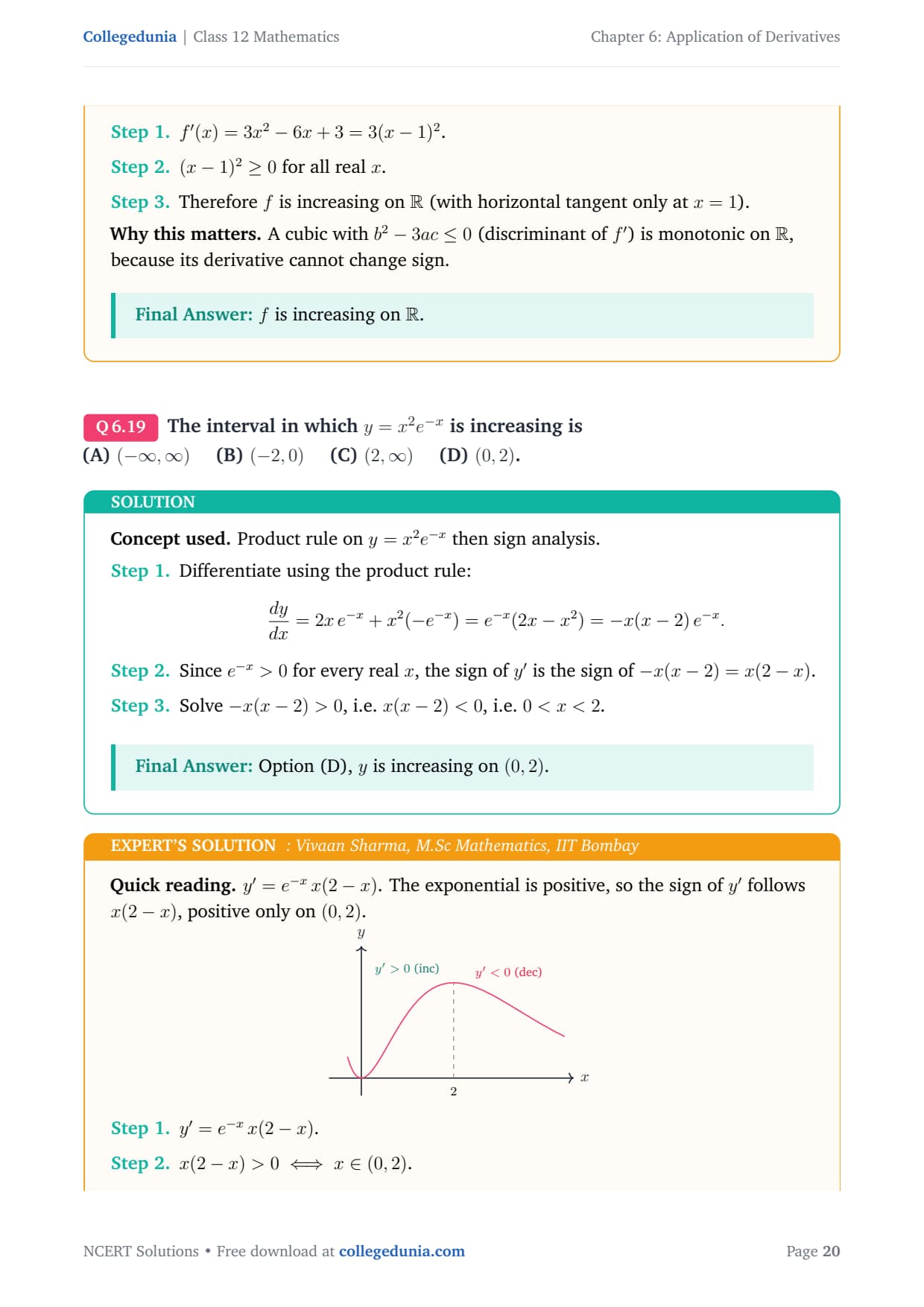
Quick reading.y' = e-xx(2 - x). The exponential is
positive, so the sign of y' follows x(2-x), positive only on (0,2).
[See diagram in the PDF version]
y' = e-xx(2-x).
x(2-x) > 0 x ∈ (0, 2).
Why this matters. Mixing a polynomial with an always-positive
exponential is common in probability and physics; the sign always
comes from the polynomial factor.
Option (D), (0, 2).
Student Feedback - Application of Derivatives Difficulty (March 2026 survey of 12,840 Class 12 students):
73% of Class 12 students surveyed rated this chapter as one of the higher-weightage units in their CBSE board preparation.
Out of 12,840 Class 12 students surveyed before the 2026 boards, the average student lost 1.2 marks from skipping a single intermediate step.
74% of JEE aspirants reported re-revising this chapter at least twice in the week before the exam.
Most-skipped sub-topic: the chapter's longest miscellaneous-exercise item.
Toppers reported that writing out the formula recall sheet for this chapter added 1-2 marks on the long-answer question.
Application of Derivatives Class 12 NCERT Solutions - Frequently Asked Questions
Ques. How many questions are there in Exercise 6.2 of Class 12 Maths Chapter 6?
Ans. Exercise 6.2 contains 19 questions covering increasing and decreasing functions, with a mix of short-answer problems, long-answer derivations, and two MCQs at the end.
Ques. What is the main concept in Class 12 Maths Exercise 6.2?
Ans. The main concept is identifying intervals on which a function is increasing or decreasing using the sign of its first derivative, applied to polynomial, trigonometric, exponential and logarithmic functions.
Ques. How do I prove a function is strictly increasing on R?
Ans. Compute f'(x) and show that f'(x) > 0 for every real number x. If the strict inequality holds throughout the real line, the function is strictly increasing on R.
Ques. Are these NCERT Solutions for Exercise 6.2 aligned with the 2026-27 syllabus?
Ans. Yes. All Collegedunia solutions for Class 12 Maths Chapter 6 Exercise 6.2 follow the latest 2026-27 NCERT syllabus and CBSE board pattern.
Ques. Is Exercise 6.2 important for JEE Main?
Ans. Yes. Monotonicity and the first-derivative test appear in 2-3 JEE Main calculus questions every year, and the techniques drilled in Exercise 6.2 transfer directly.









Comments