




The NCERT Book PDF for Class 11 Political Science Chapter 1 Political Theory brings together the full official chapter that opens the Political Theory textbook for 2026-27. It introduces the twin human capacities of reason and communication that the subject is built on, and previews the questions the book will spend the rest of the year exploring.
- Chapter: Chapter 1, Political Theory, the opening chapter of the Political Theory NCERT textbook
- File: 16 pages, the complete official chapter with all six exercise questions
- Also useful: handwritten notes for this same chapter are already live on Collegedunia
This is the official NCERT chapter file for the 2026-27 session, hosted by Collegedunia with no pages removed.
How the Political Theory Chapter Is Laid Out
The chapter opens by naming the two human traits, reason and the capacity to communicate, that make political theory possible. It then works through four numbered sections before closing with six exercise questions.
| Section | What it covers |
|---|---|
| 1.1 What is Politics? | The conflicting everyday images of politics, from public service to scams, and why government is only one part of political life |
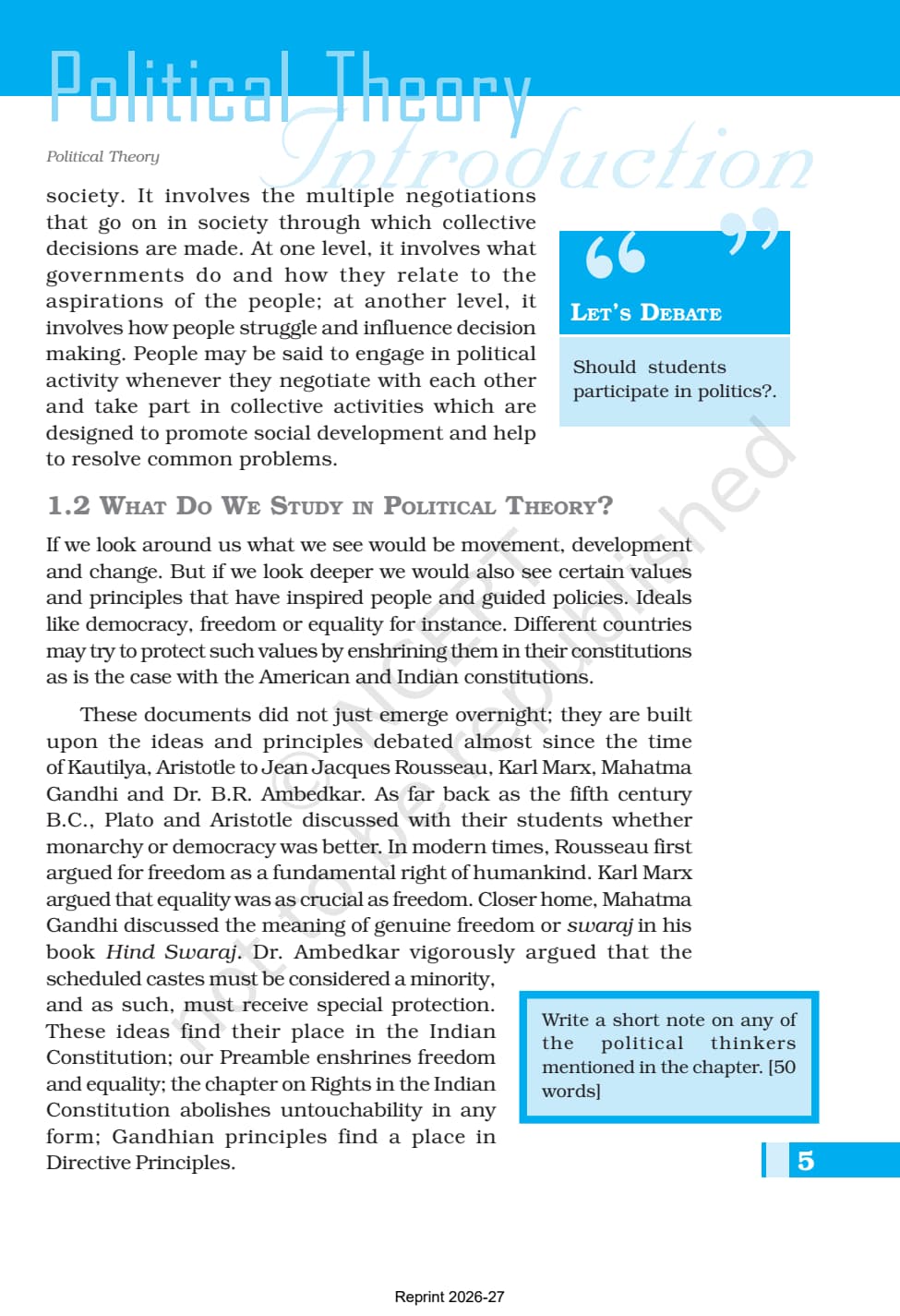
| 1.2 What Do We Study in Political Theory? | How Constitutions encode values such as freedom and equality, tracing the ideas back to Kautilya, Aristotle, Rousseau, Marx, Gandhi and Ambedkar |
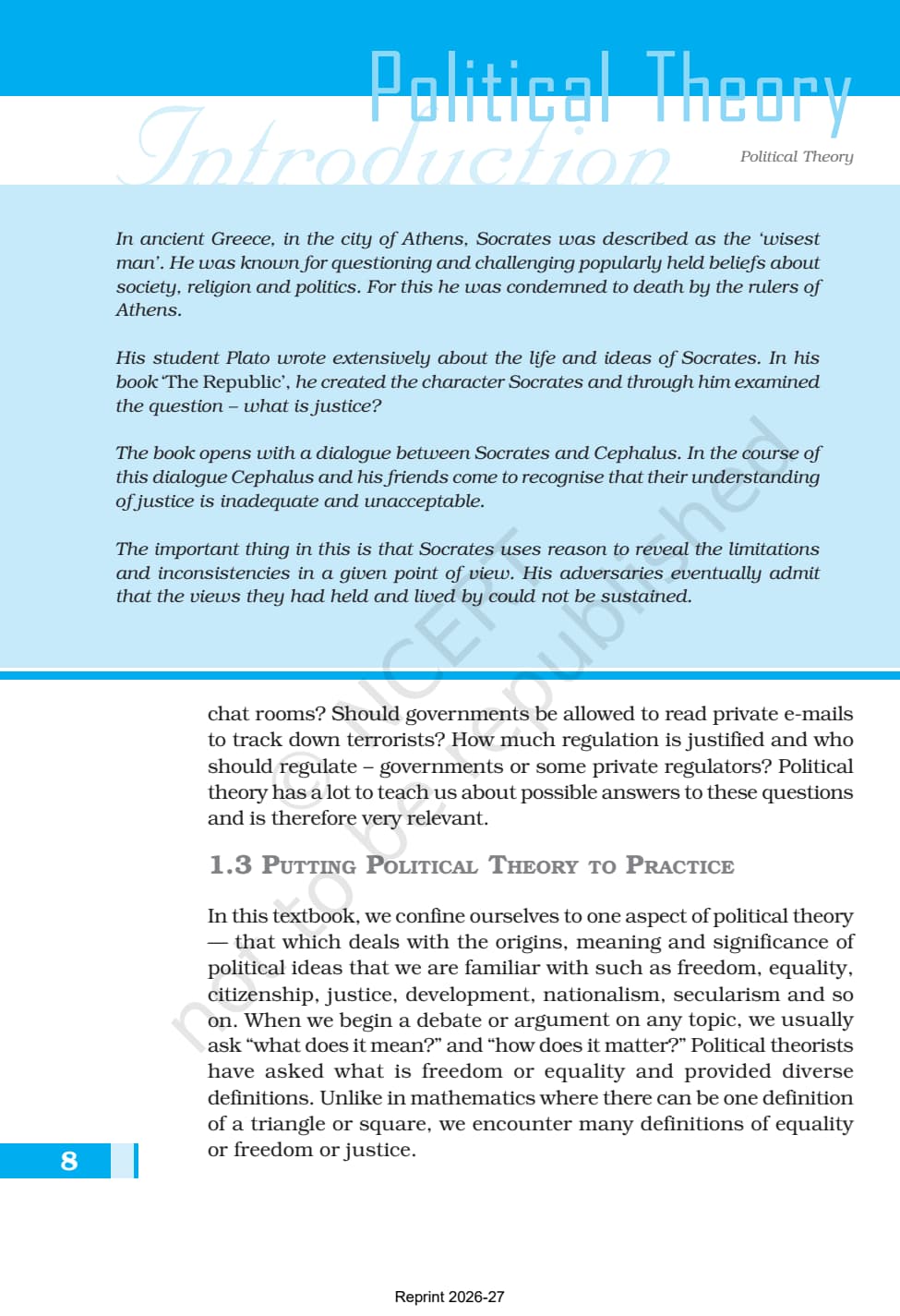
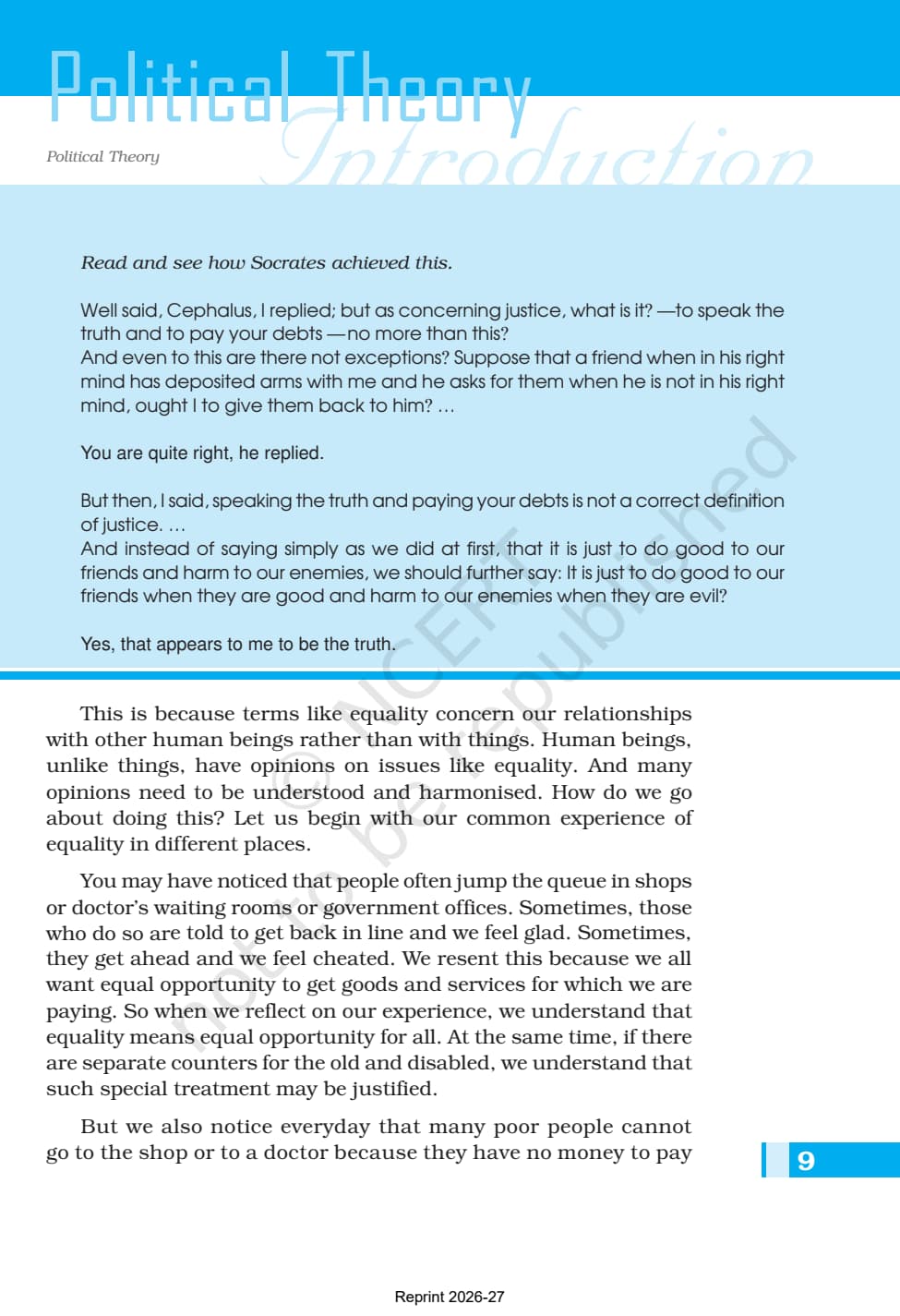
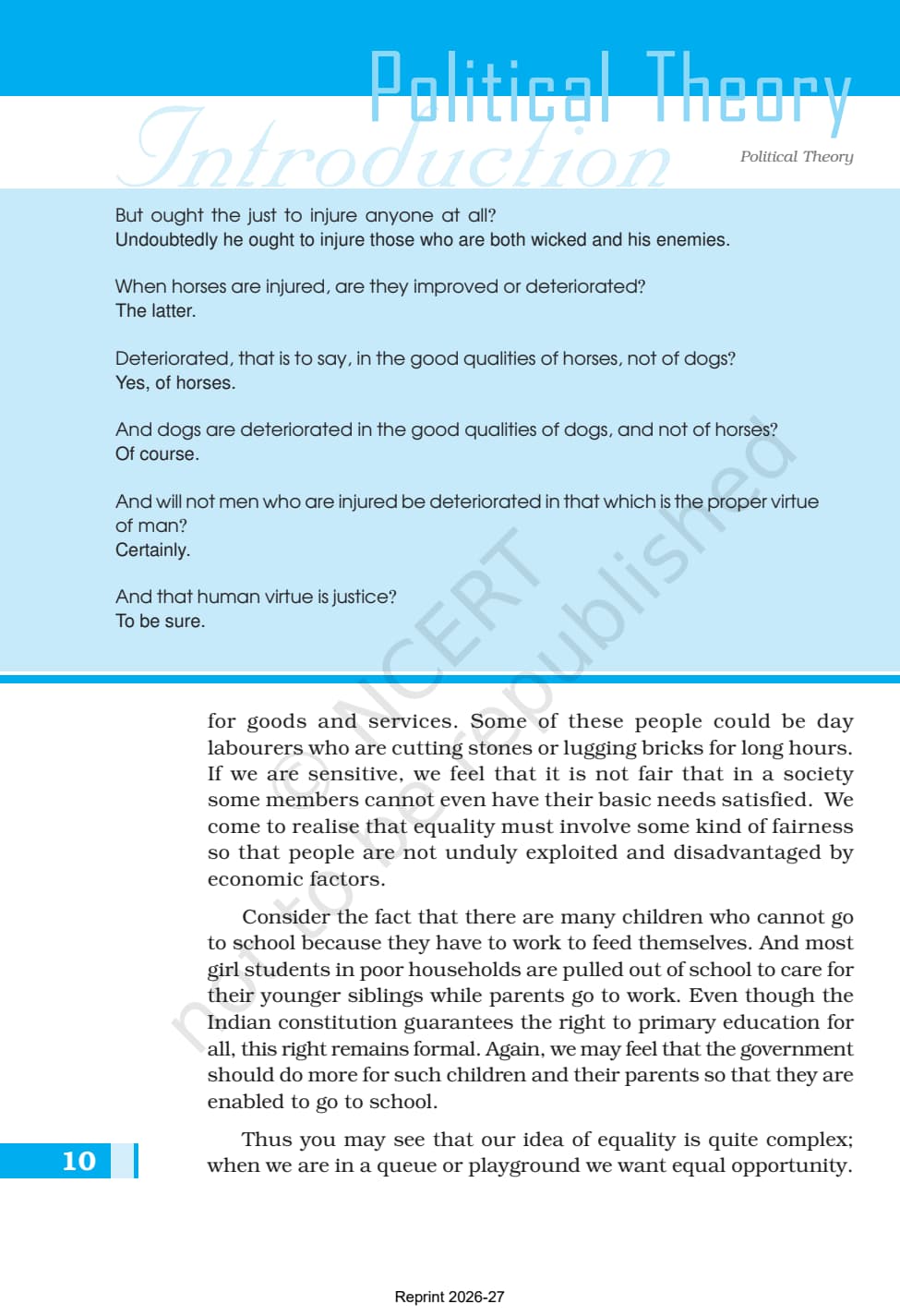
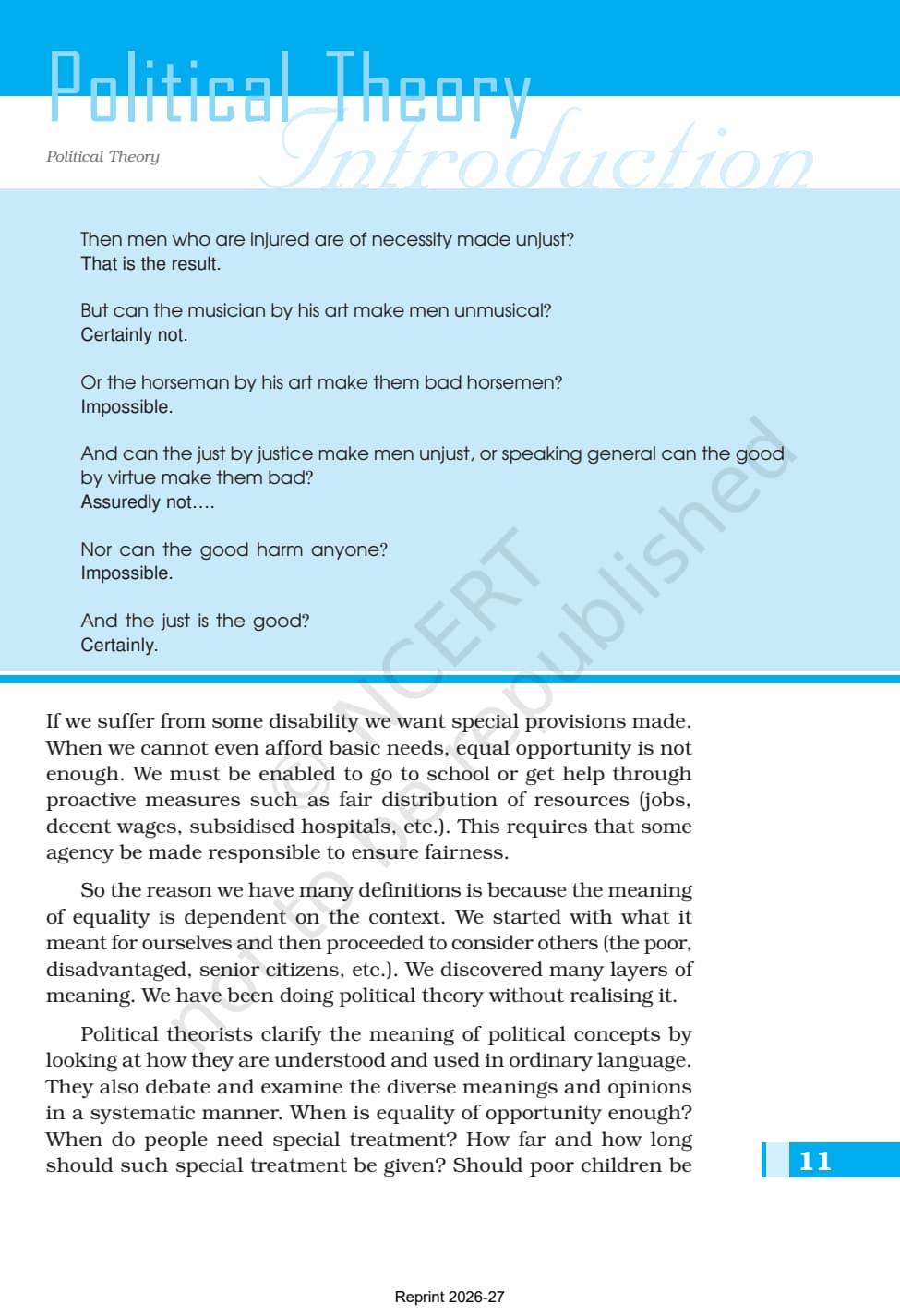
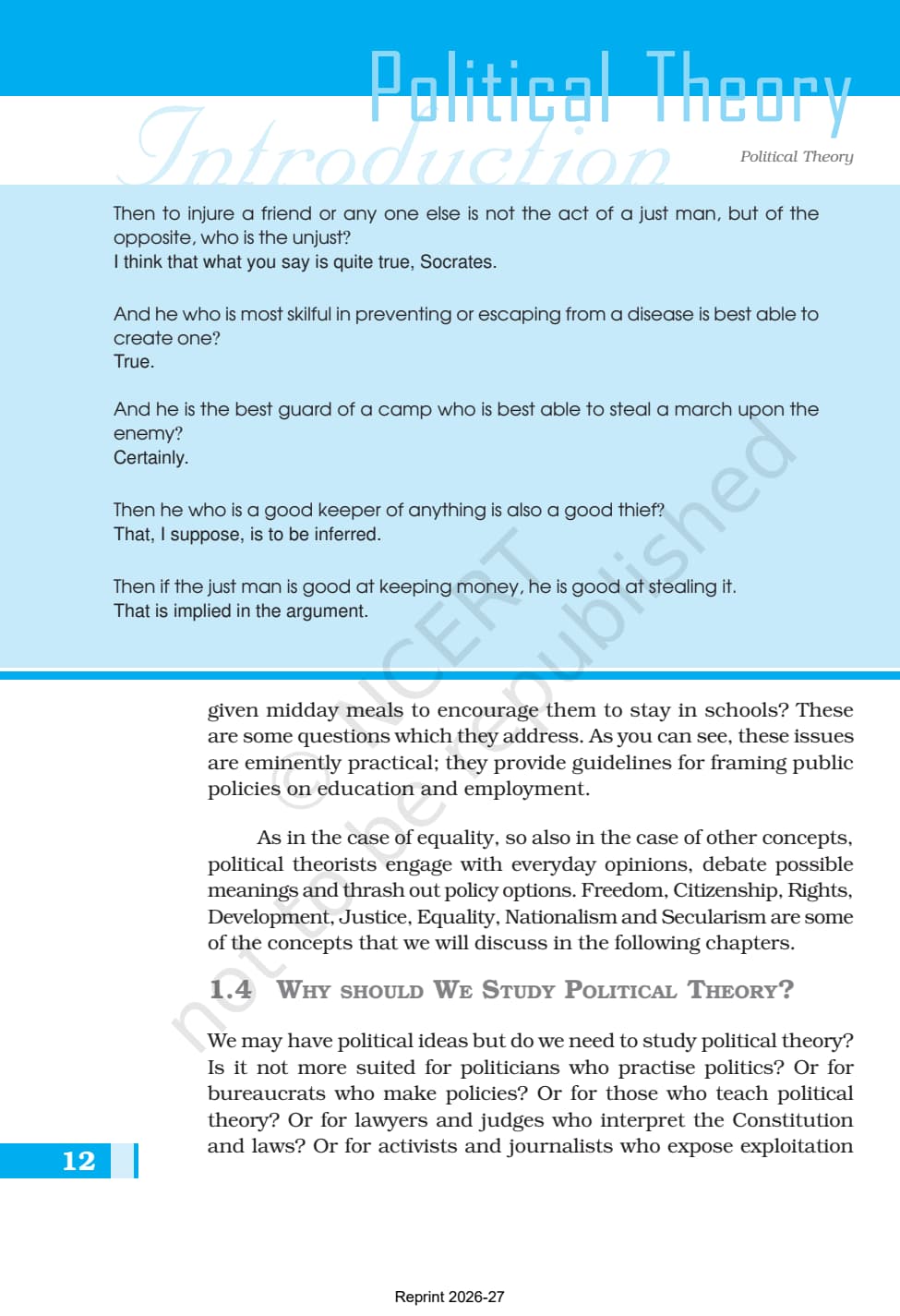
| 1.3 Putting Political Theory to Practice | The Socrates and Plato dialogue on justice from The Republic, plus the queue example that unpacks the layers of meaning inside equality |
| 1.4 Why Should We Study Political Theory? | Why political theory matters for future citizens and professionals, and how it sharpens debate and argument |
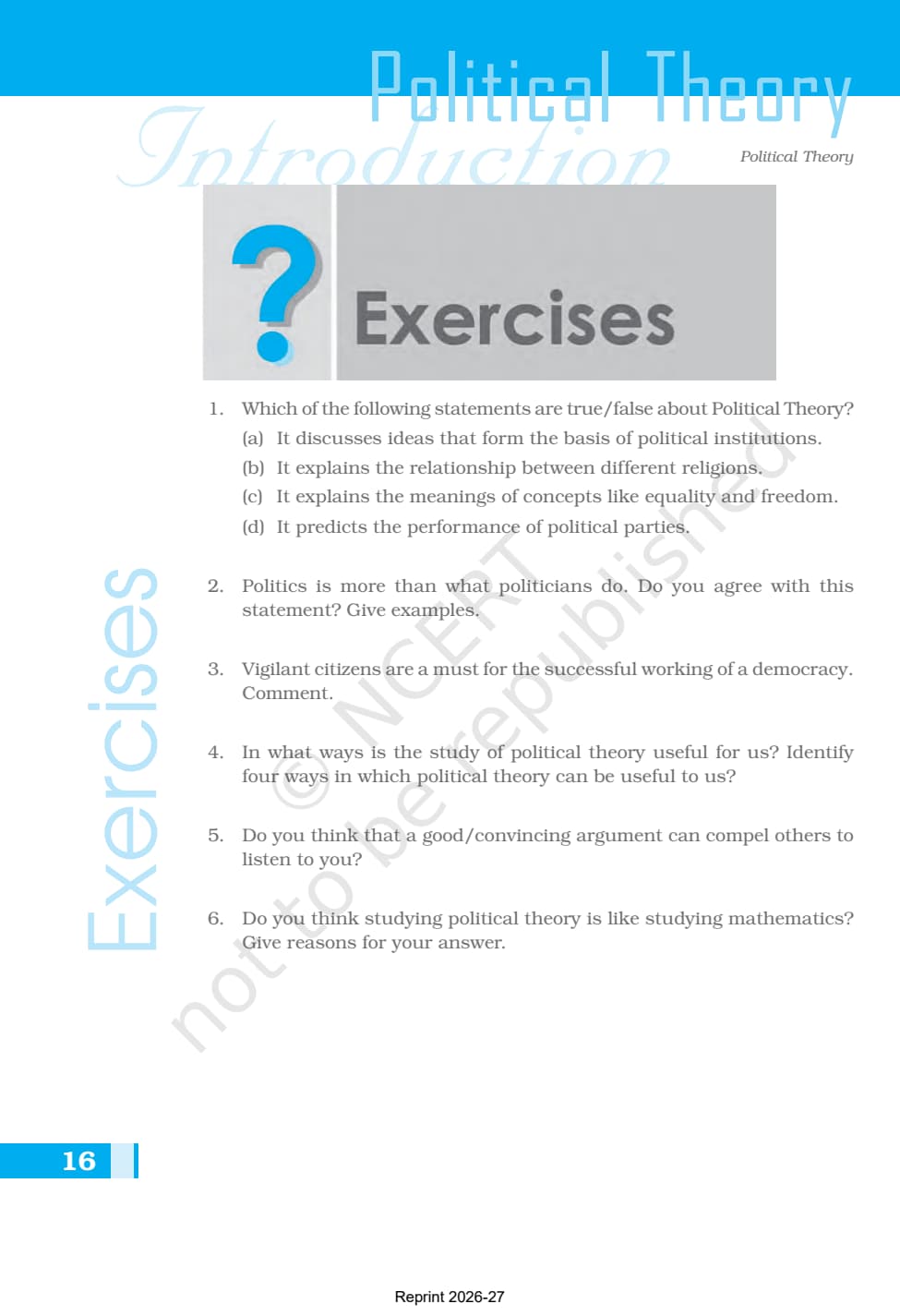
| Exercises | Six questions on the nature of politics, vigilant citizenship, and the value of studying political theory |
What the Political Theory Chapter PDF Contains
The PDF holds the whole chapter exactly as NCERT printed it, from the opening page on reason and communication to the closing exercise set.
- All four numbered sections, from What is Politics to Why Should We Study Political Theory
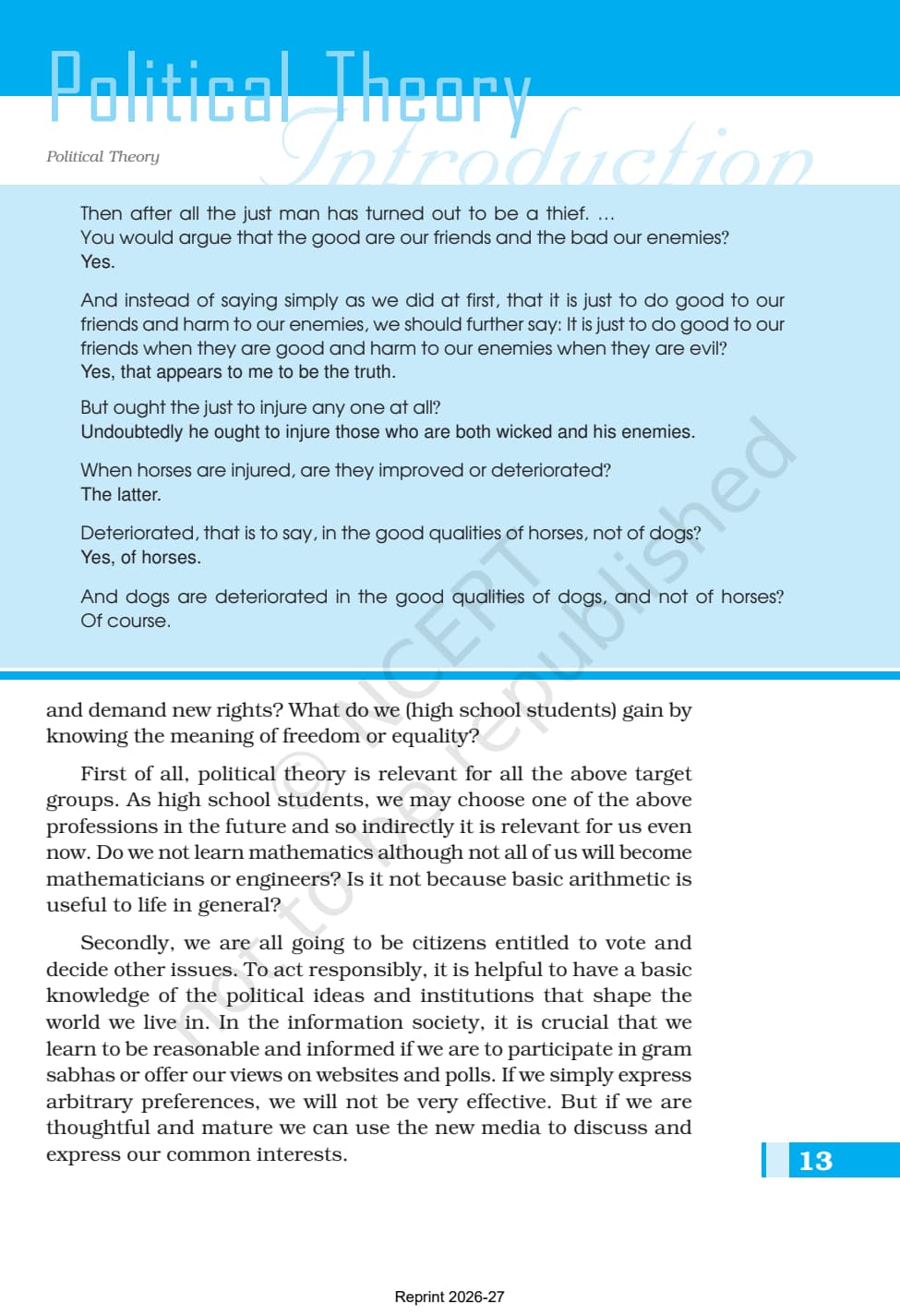
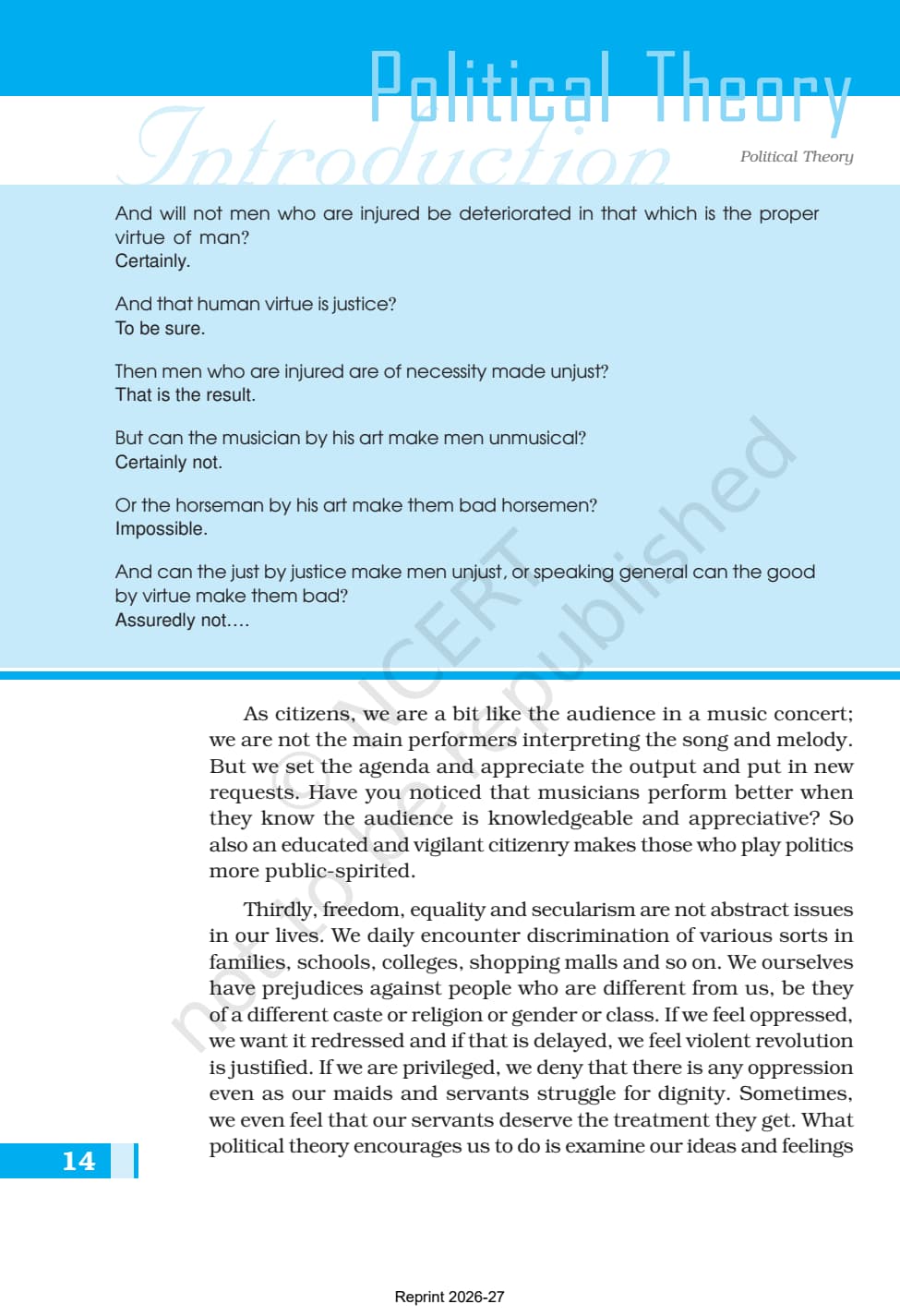
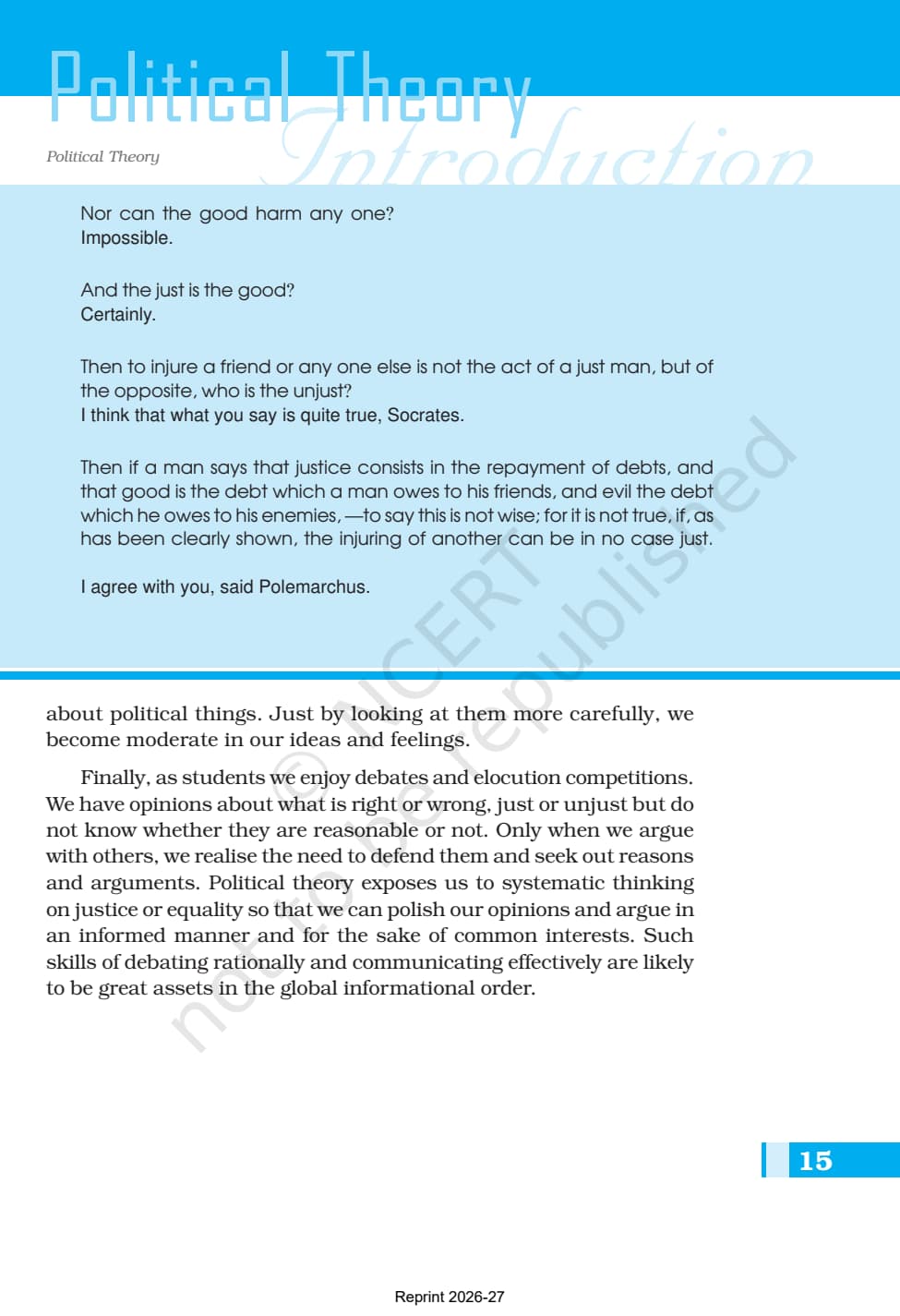
- The full Socrates and Plato dialogue on justice from The Republic, printed as a boxed excerpt across several pages
- Every Let's Debate and Let's Do It activity box that appears through the chapter
- The complete exercise set of six questions that closes the chapter
Political Theory Class 11 Explained in Simple Language
Source: Magnet Brains on YouTube
Reason and Communication: The Twin Foundations of Political Theory
The chapter's very first lines make a claim that everything else builds on. Human beings are unique in two respects: they possess reason and the ability to reflect on their own actions, and they can use language to communicate with each other. Unlike other species, people can share their inner thoughts, argue about what is good, and disagree openly.
Political theory has its roots in exactly these two traits. Because people can reason, they can ask whether an existing law or institution is fair. Because they can communicate, they can debate that question with others instead of settling it by force. The chapter's objective is to train citizens to think rationally about political questions and judge the political events of their own time, not just memorise a list of terms.
The Core Questions Political Theory Asks
Before naming a single thinker, the chapter lists the basic questions that political theory keeps returning to. These six questions frame every chapter that follows in the book.

- How should society be organised?
- Why do we need government?
- What is the best form of government?
- Does law limit our freedom?
- What does the state owe its citizens?
- What do we owe each other as citizens?
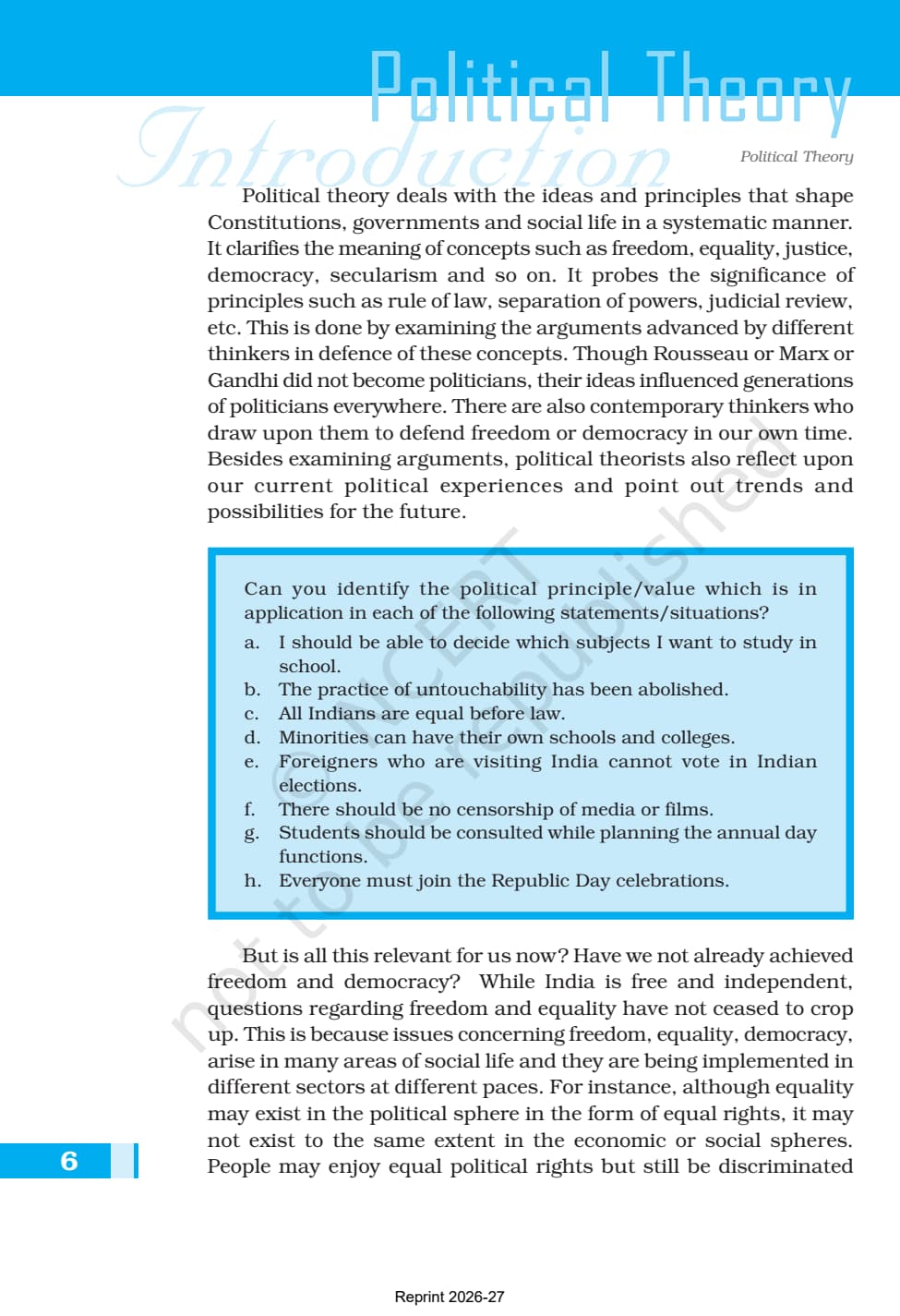
The chapter is honest that there is no single correct answer to any of these. Instead, political theory clarifies the meaning of concepts such as freedom, equality, justice, democracy and secularism by looking at how different thinkers, past and present, have argued about them.
Politics Beyond Government: What Political Activity Really Means
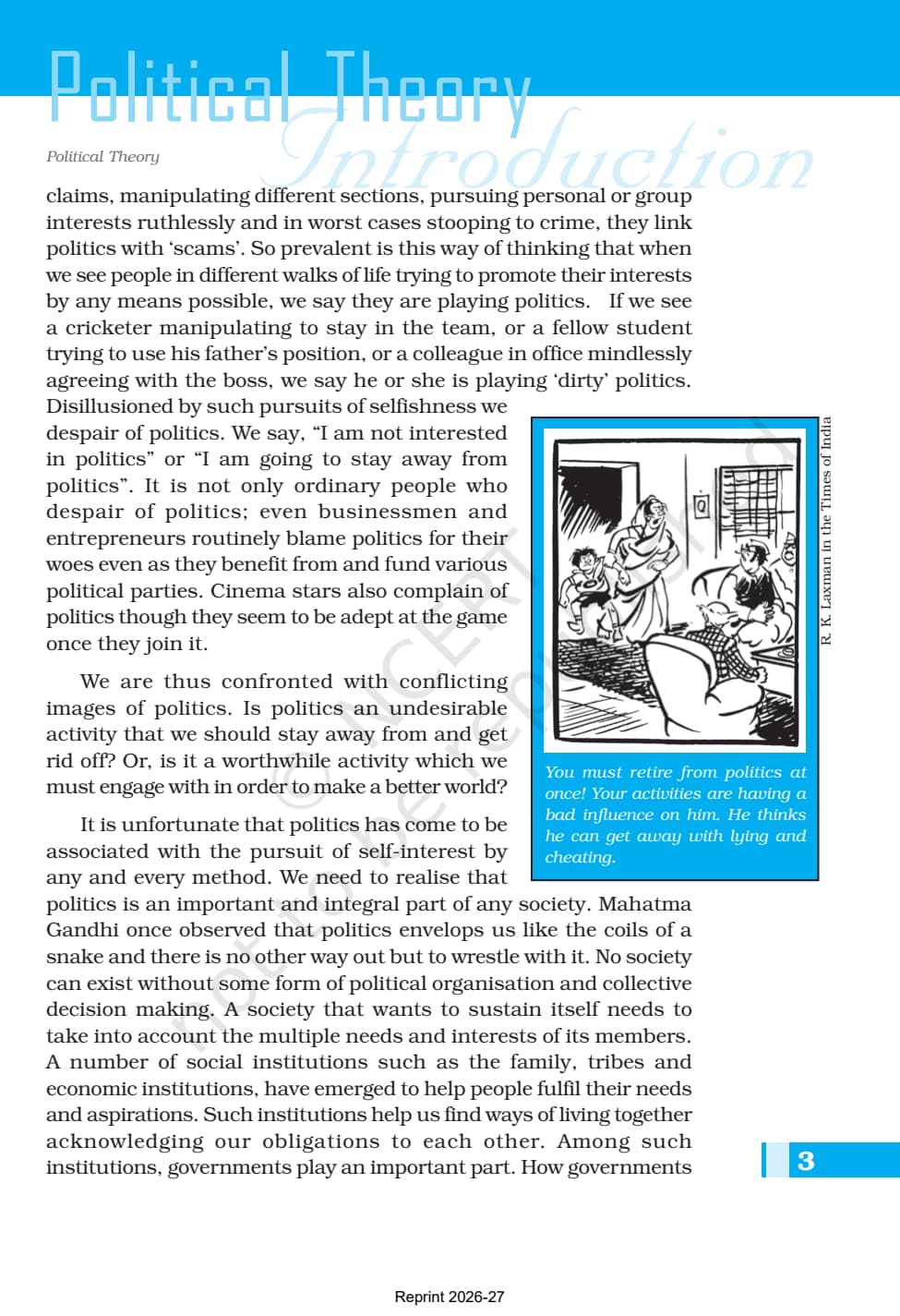
Section 1.1 spends time on a problem most students already sense: politics has a bad name. Some people call it a form of public service, others link it with manipulation, and a popular cartoon by R. K. Laxman in the chapter shows a father blaming politics for his son's dishonesty. The chapter uses this to make a sharper point.
Mahatma Gandhi is quoted saying that politics envelops us like the coils of a snake, and the only option is to engage with it rather than avoid it. No society can exist without some form of collective decision making, and government is only one part of that process. Family, tribes and economic institutions also help people negotiate their needs. Political activity, the chapter argues, happens whenever people negotiate with each other to resolve common problems, not only when politicians are involved.
How Political Theory Differs from Political Science
The chapter is explicit that it covers only one part of the wider discipline. It says the book confines itself to the origins, meaning and significance of political ideas already familiar to students, such as freedom, equality, citizenship, justice, nationalism and secularism.
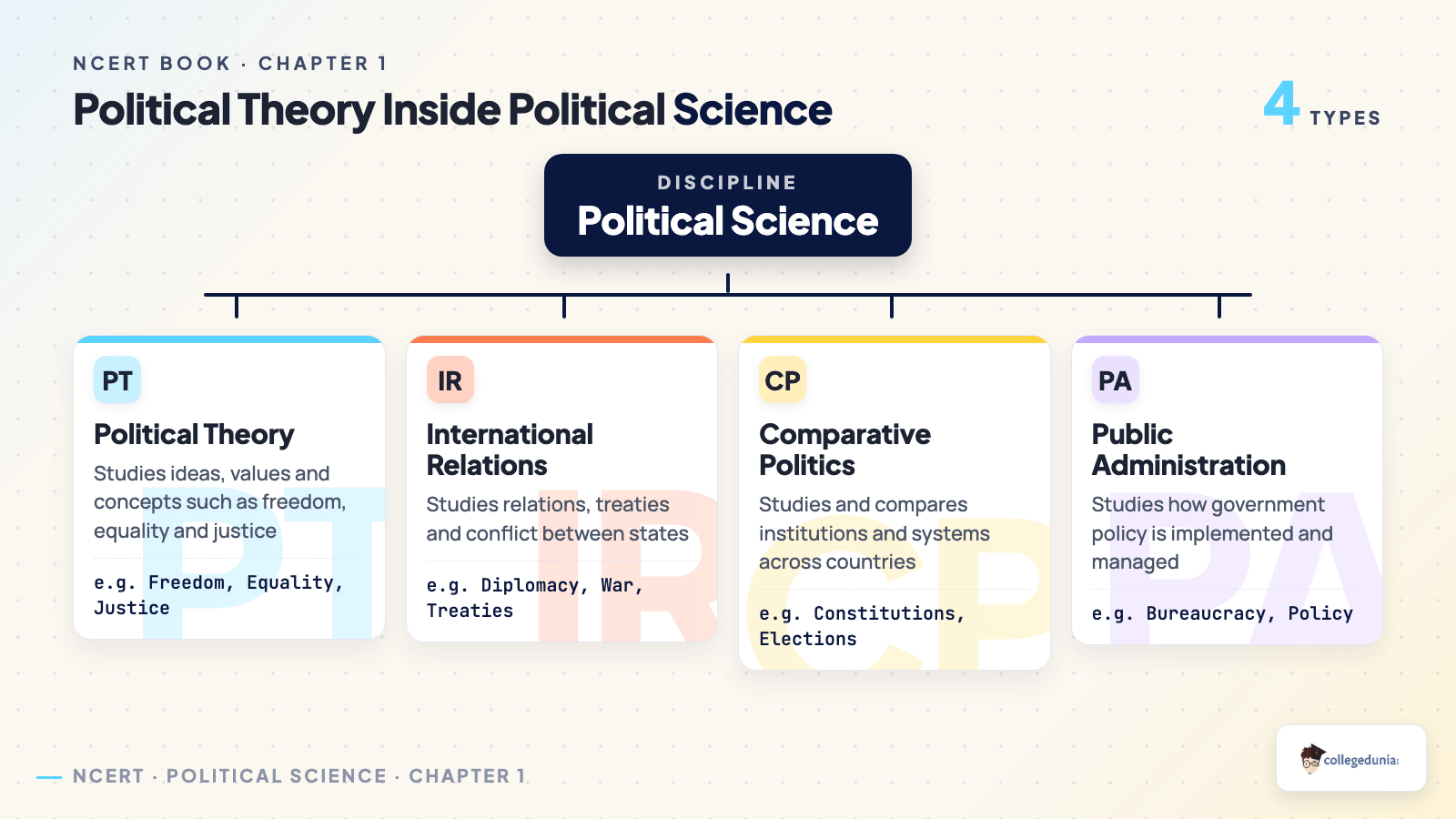
Political science as a broader discipline also studies how institutions such as parliaments and courts actually function, how countries compare with one another, and how states relate internationally. Political theory instead asks what concepts like freedom, equality and justice actually mean, using arguments from thinkers such as Plato, Rousseau, Marx, Gandhi and Ambedkar to test and sharpen the definitions.
| Branch of Political Science | What it focuses on |
|---|---|
| Political Theory | Ideas, values and concepts such as freedom, equality and justice |
| Comparative Politics | Institutions and systems of government across different countries |
| International Relations | Relations, treaties and conflict between states |
| Public Administration | How government policy is actually implemented and managed |
Freedom, Equality and Justice: The Concepts the Book Builds On
Section 1.3 uses the Socrates and Plato dialogue on justice, and a simple queue example on equality, to show how one word can carry many layers of meaning. Wanting equal opportunity in a queue is different from wanting special provision for someone with a disability, and the chapter argues both can be forms of fairness at once.
These same concepts return, one at a time, across the rest of the Political Theory book. Chapter 1 is the introduction; the next seven chapters each take one concept and examine it in depth.
| Concept | Chapter in this book |
|---|---|
| Freedom | Chapter 2 |
| Equality | Chapter 3 |
| Social Justice | Chapter 4 |
| Rights | Chapter 5 |
| Citizenship | Chapter 6 |
| Nationalism | Chapter 7 |
| Secularism | Chapter 8 |
What Collegedunia Adds to This Chapter PDF
Collegedunia gives students the file plus a way into it. The chapter PDF itself is the official NCERT file, untouched.
- Official file: the exact NCERT chapter PDF, no pages removed
- Read in the browser: page through all 16 pages before downloading
- Cross-resource links: jump to the handwritten notes for the same chapter
Also Check: the other Class 11 Political Science resources for this chapter.
| Resource | Link |
|---|---|
| Handwritten notes | Political Theory Class 11 Handwritten Notes |
| Chapter notes | Political Theory Class 11 Notes (coming soon) |
| Chapter solutions | Political Theory Class 11 NCERT Solutions (coming soon) |
| Next chapter book PDF | Freedom Class 11 NCERT Book PDF (coming soon) |
Political Science NCERT Book PDF: All Chapters
Every chapter of the Class 11 Political Science book gets its own page. The 2026-27 syllabus spans two textbooks combined into 18 chapters: the Political Theory book runs chapters 1 to 8, and Indian Constitution at Work runs chapters 9 to 18.
| Chapter | Download |
|---|---|
| Chapter 1 | Political Theory NCERT Book PDF |
| Chapter 2 | Freedom NCERT Book PDF (coming soon) |
| Chapter 3 | Equality NCERT Book PDF (coming soon) |
| Chapter 4 | Social Justice NCERT Book PDF (coming soon) |
| Chapter 5 | Rights NCERT Book PDF (coming soon) |
| Chapter 6 | Citizenship NCERT Book PDF (coming soon) |
| Chapter 7 | Nationalism NCERT Book PDF (coming soon) |
| Chapter 8 | Secularism NCERT Book PDF (coming soon) |
| Chapter 9 | Constitution Why and How NCERT Book PDF (coming soon) |
| Chapter 10 | Rights in the Indian Constitution NCERT Book PDF (coming soon) |
| Chapter 11 | Election and Representation NCERT Book PDF (coming soon) |
| Chapter 12 | Executive NCERT Book PDF (coming soon) |
| Chapter 13 | Legislature NCERT Book PDF (coming soon) |
| Chapter 14 | Judiciary NCERT Book PDF (coming soon) |
| Chapter 15 | Federalism NCERT Book PDF (coming soon) |
| Chapter 16 | Local Governments NCERT Book PDF (coming soon) |
| Chapter 17 | Constitution as a Living Document NCERT Book PDF (coming soon) |
| Chapter 18 | The Philosophy of the Constitution NCERT Book PDF (coming soon) |
Political Theory Class 11 NCERT Book PDF FAQs
Common Student Questions on the Political Theory Chapter File
Ques. Where can I download the Class 11 Political Science Chapter 1 NCERT Book PDF?
Ans. The official 16-page chapter file is on this page, free to download.
Ques. How many pages is the Political Theory chapter?
Ans. 16 pages in the 2026-27 book, and this PDF is the complete chapter.
Ques. What is political theory?
Ans. Political theory is the part of political science that studies the ideas and principles behind Constitutions, governments and social life. It clarifies concepts such as freedom, equality, justice, democracy and secularism by examining how different thinkers have defined them.
Ques. What are the two human capacities that political theory is based on?
Ans. Reason, the ability to reflect on one's own actions, and the capacity to use language to communicate with others. The chapter opens by saying these two traits make political theory possible.
Ques. How is political theory different from political science?
Ans. Political theory is one branch inside the larger discipline of political science. It focuses on the meaning of political ideas and values, while other branches such as comparative politics, international relations and public administration study institutions, state relations and policy implementation.
Ques. What is the difference between politics and political theory?
Ans. Politics refers to the actual activity of negotiating and taking collective decisions in society, whether inside or outside government. Political theory studies and systematically thinks about the values, such as freedom and equality, that inform that activity.
Ques. Which thinkers are mentioned in the Political Theory chapter?
Ans. The chapter refers to Kautilya, Plato, Aristotle, Jean Jacques Rousseau, Karl Marx, Mahatma Gandhi and Dr. B. R. Ambedkar, along with the Socrates and Plato dialogue on justice from The Republic.
Ques. What concepts does the rest of the Political Theory book cover?
Ans. Freedom in Chapter 2, Equality in Chapter 3, Social Justice in Chapter 4, Rights in Chapter 5, Citizenship in Chapter 6, Nationalism in Chapter 7, and Secularism in Chapter 8.
Ques. Is this the official NCERT file?
Ans. Yes. It is the NCERT chapter PDF for 2026-27 hosted as published, with no pages removed or added.



Comments