Maths Strategist, Olympiad Coach | Updated 3+ months ago
The Inverse Trigonometric Functions Class 12 NCERT Solutions for Miscellaneous questions cover 14 short answers, 3 MCQs, and 5 solved examples. Every answer follows the CBSE marking scheme, with each step and identity named clearly. The free Solutions PDF is available for download on this page.
CBSE Weightage: 5-7 marks (Relations and Functions + Inverse Trig chapter cluster)
JEE Main Weightage: 3-5% (1-2 questions on principal values / identity simplification)
Why this exercise carries weight: inverse trig identities reappear in later chapters, and one board-paper short-answer slot has come from these 17 problems every year since 2018.
Common Mistakes Students Make in the Miscellaneous Exercise
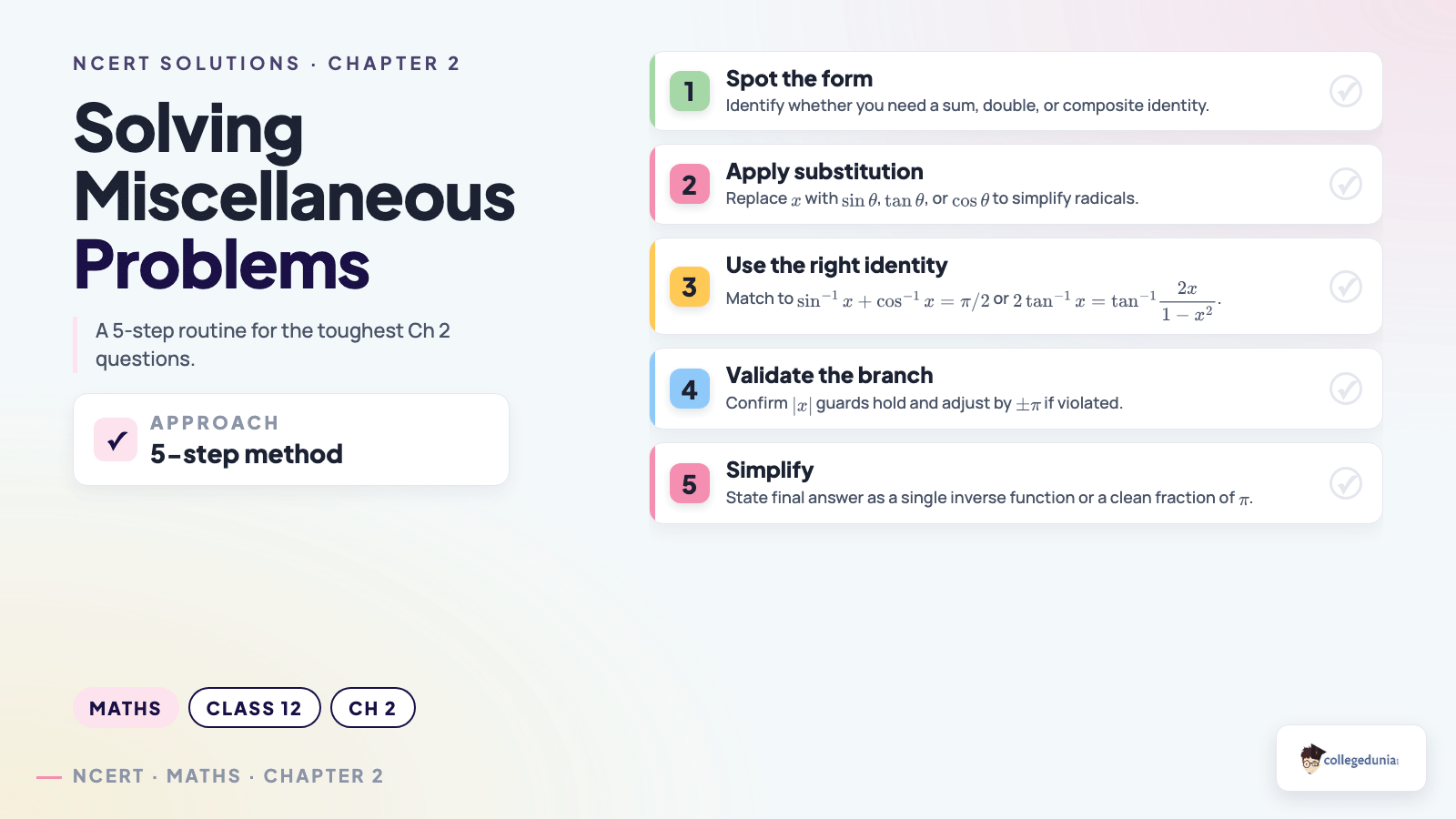
Mistake 1 - Ignoring the xy < 1 restriction on tan-1 addition. The identity holds only when xy < 1 . When xy > 1 , add π (or -π ). Q8 catches students who forget this.
Mistake 2 - Returning an angle outside the principal-value range. In Q1 and Q2, cos-1(cosθ) equals θ only if θ ∈ [0, π] . Marking schemes deduct 1 full mark for a wrong-range answer.
Mistake 3 - Forgetting the substitution justification. Q9 and Q11 need x = tan2θ or x = cos 2θ stated first. Skipping it loses a method mark.
All NCERT Solutions for Inverse Trigonometric Functions Misc with Step-by-Step Working
Every question from Class 12 Maths Chapter 2 Inverse Trigonometric Functions Misc is listed below with a full Solution and Expert Solution in collapsible tabs.
Questions
Q 2.1
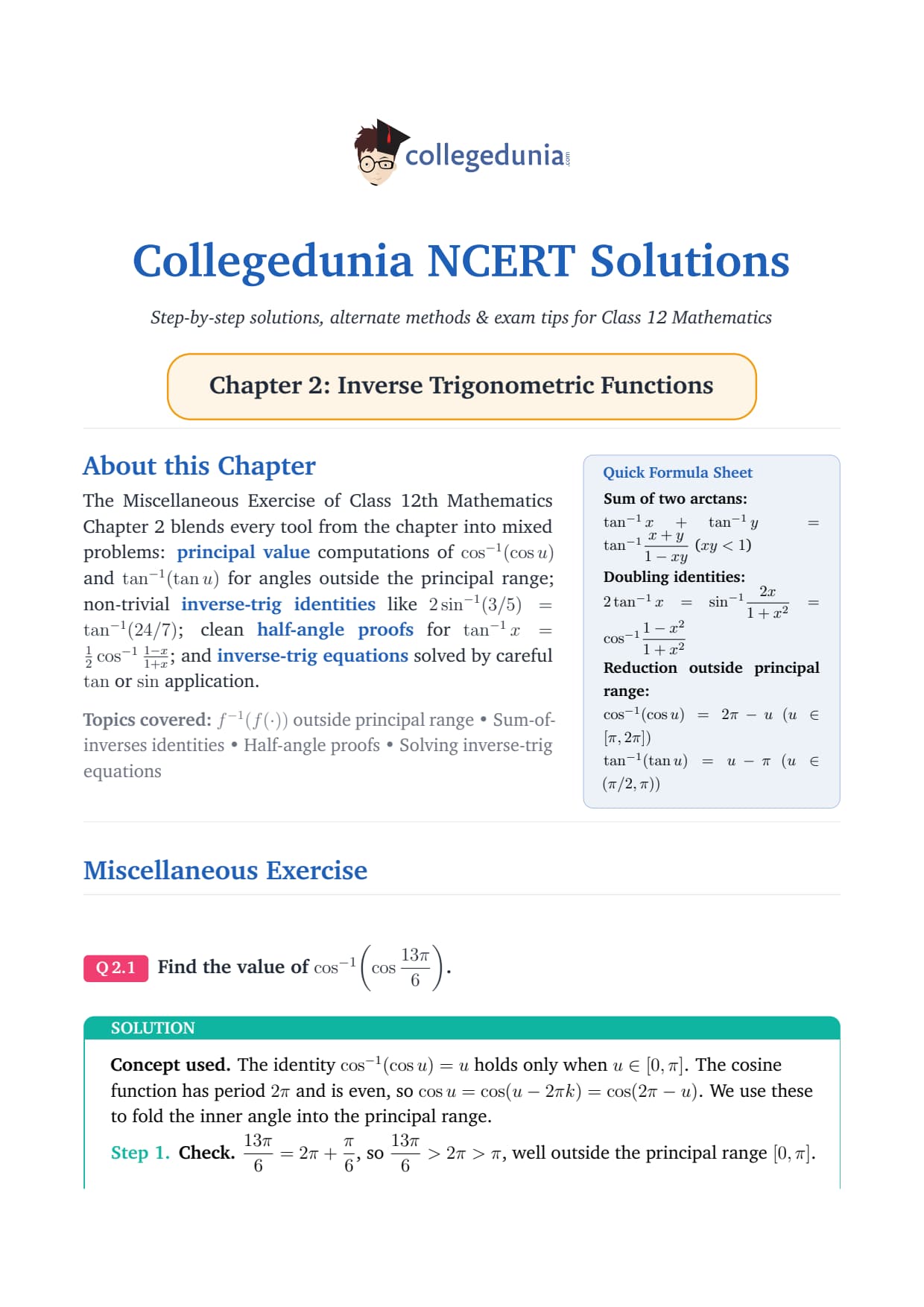
Find the value of cos-1(cos13π6).
Concept used. The identity cos-1(cos u) = u holds only when u ∈ [0,π]. The cosine function has period 2π and is even, so cos u = cos(u - 2π k) = cos(2π - u). We use these to fold the inner angle into the principal range.
Check.13π6 = 2π + π6, so 13π6 > 2π > π, well outside the principal range [0,π].
Quick reading.13π6 is one full revolution past π6. So the cosine is the same as cos(π/6) and the principal answer is π/6.
13π6 - 2π = π6.
cos(π/6) ∈ [0,π], so cos-1(cos(π/6)) = π/6.
Why this matters. The shortcut "subtract 2π k first, then adjust within [0,2π)" handles every cos-1(cos u) regardless of how big u is.
π6.
Q 2.2
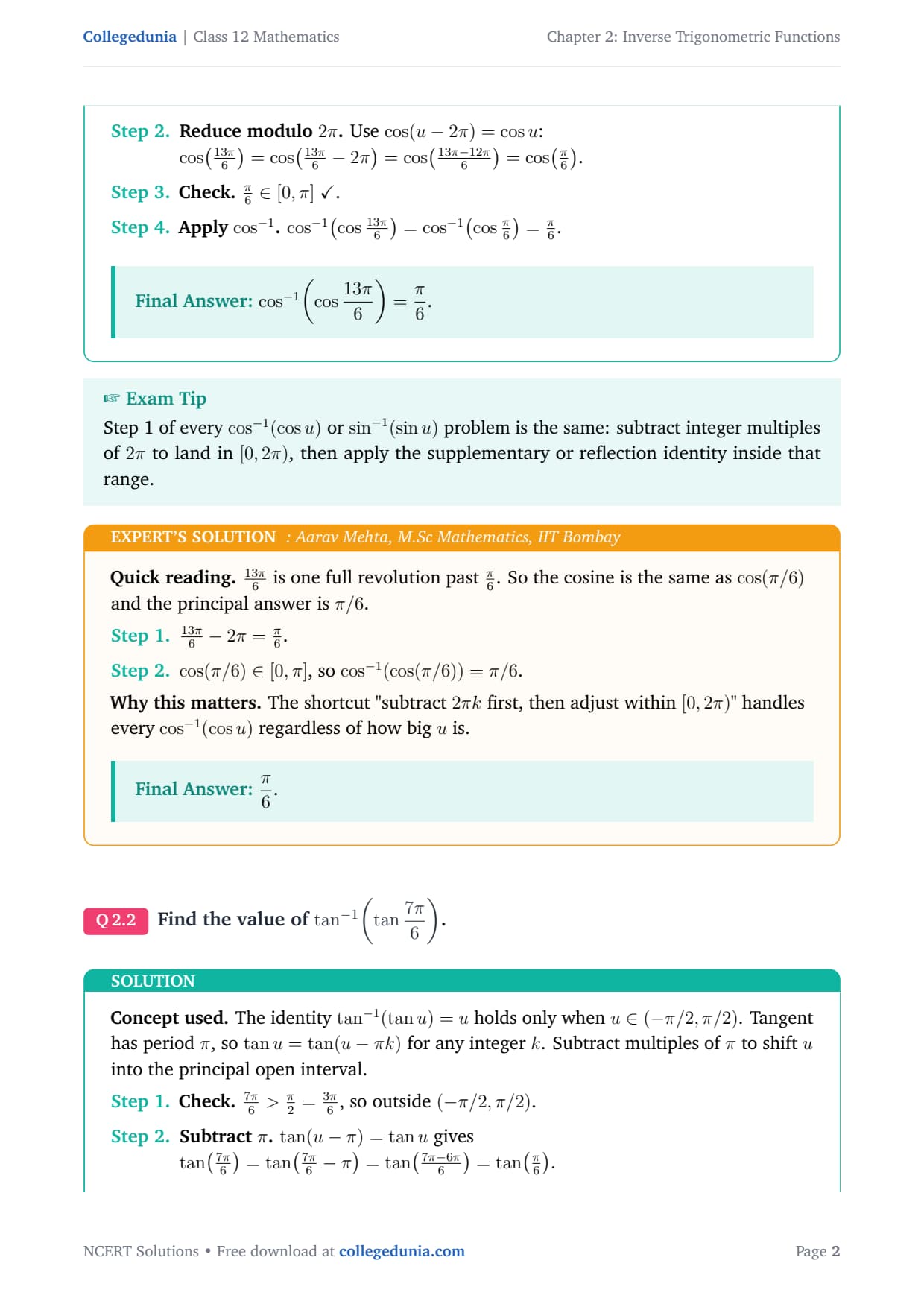
Find the value of tan-1(tan7π6).
Concept used. The identity tan-1(tan u) = u holds only when u ∈ (-π/2, π/2). Tangent has period π, so tan u = tan(u - π k) for any integer k. Subtract multiples of π to shift u into the principal open interval.
Check.7π6 > π2 = 3π6, so outside (-π/2,π/2).
Subtract π.tan(u - π) = tan u gives tan(7π6) = tan(7π6 - π) = tan(7π - 6π6) = tan(π6).
Check.π6 ∈ (-π/2, π/2) .
Apply tan-1.tan-1(tan7π6) = tan-1(tanπ6) = π6.
tan-1(tan7π6) = π6.
VR
Vivaan Reddy
M.Tech CS, IIT Madras
Verified Expert
Strategic angle. Tangent has period π, so subtracting one full π from 7π6 drops us inside the open principal interval. Confirm by computing the tangent value.
7π6 - π = π6, which lies in (-π/2,π/2).
tan(π/6) = 1/√3, and so does tan(7π/6) .
tan-1(tan(7π/6)) = tan-1(tan(π/6)) = π/6.
Why this matters. Tangent's π-period (not 2π) is the single fact that makes tan-1(tan u) different from sin-1(sin u). Use π-shifts, not 2π-shifts.
π6.
Q 2.3
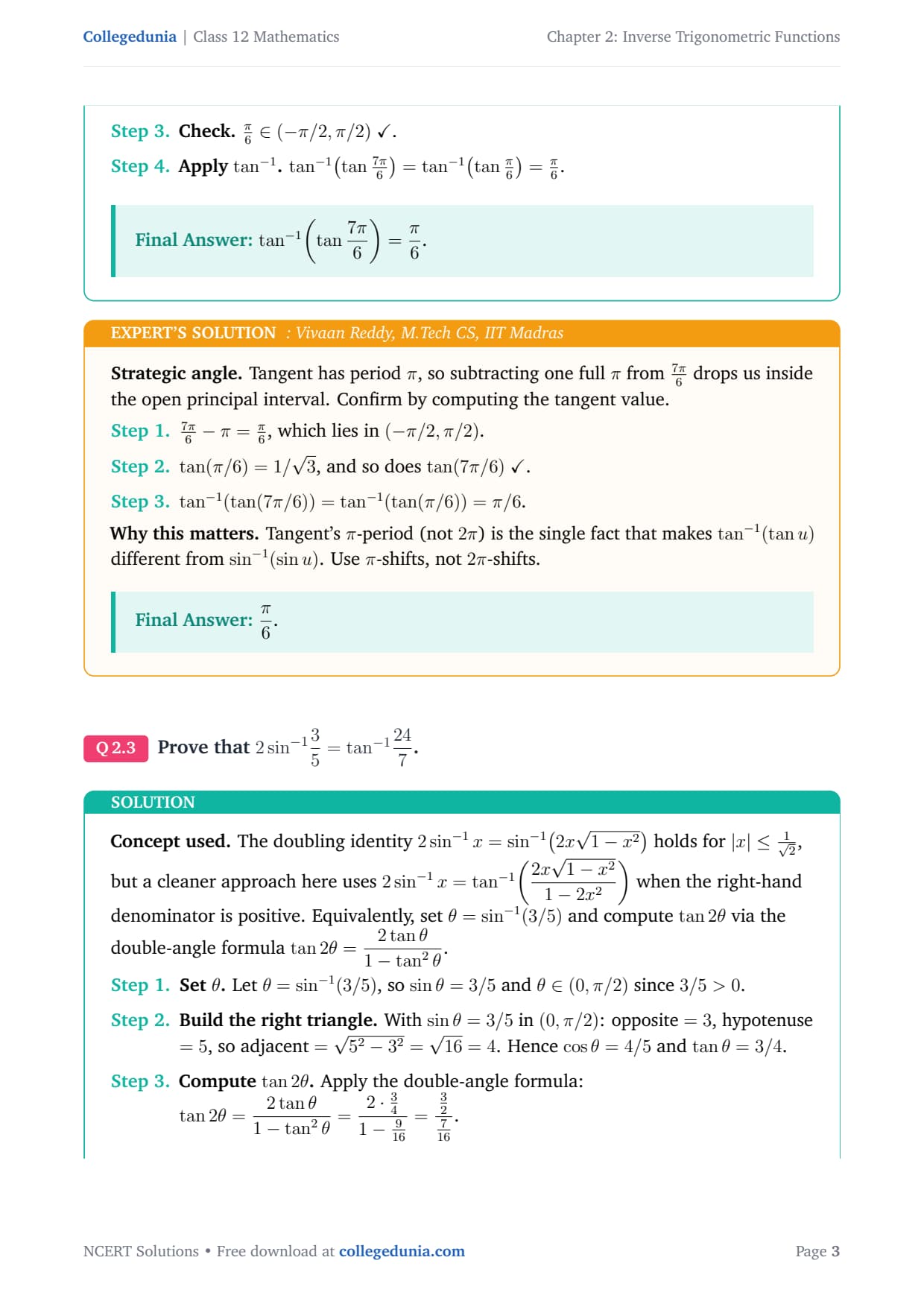
Prove that 2sin-135 = tan-1247.
Concept used. The doubling identity 2sin-1x = sin-1(2x√1-x2) holds for |x| ≤ 1√2, but a cleaner approach here uses 2sin-1x = tan-1(2x√1-x21 - 2x2) when the right-hand denominator is positive. Equivalently, set θ = sin-1(3/5) and compute tan 2θ via the double-angle formula tan 2θ = 2tanθ1 - tan2θ.
Set θ. Let θ = sin-1(3/5), so sinθ = 3/5 and θ ∈ (0,π/2) since 3/5 > 0.
Build the right triangle. With sinθ = 3/5 in (0,π/2): opposite =3, hypotenuse =5, so adjacent =√52 - 32 = √16 = 4. Hence cosθ = 4/5 and tanθ = 3/4.
Compute tan 2θ. Apply the double-angle formula: tan 2θ = 2tanθ1 - tan2θ = 2 · 341 - 916 = 32716.
Simplify.3/27/16 = 32 · 167 = 4814 = 247.
Confirm 2θ is in the principal range of tan-1. From sinθ = 3/5 we have θ < π/4 (since sin(π/4) = 1/√2 ≈ 0.707 > 0.6 = 3/5 is false; actually 1/√2 > 3/5, so θ < π/4 holds when sinθ < sin(π/4)). Hence 2θ < π/2, so 2θ ∈ (0, π/2) ⊂ (-π/2, π/2). Therefore tan-1(tan 2θ) = 2θ.
Conclude.2θ = tan-1(24/7), i.e. 2sin-1(3/5) = tan-1(24/7).
2sin-135 = tan-1247.
PN
Pranav Nair
Ph.D Mathematics, IIT Delhi
Verified Expert
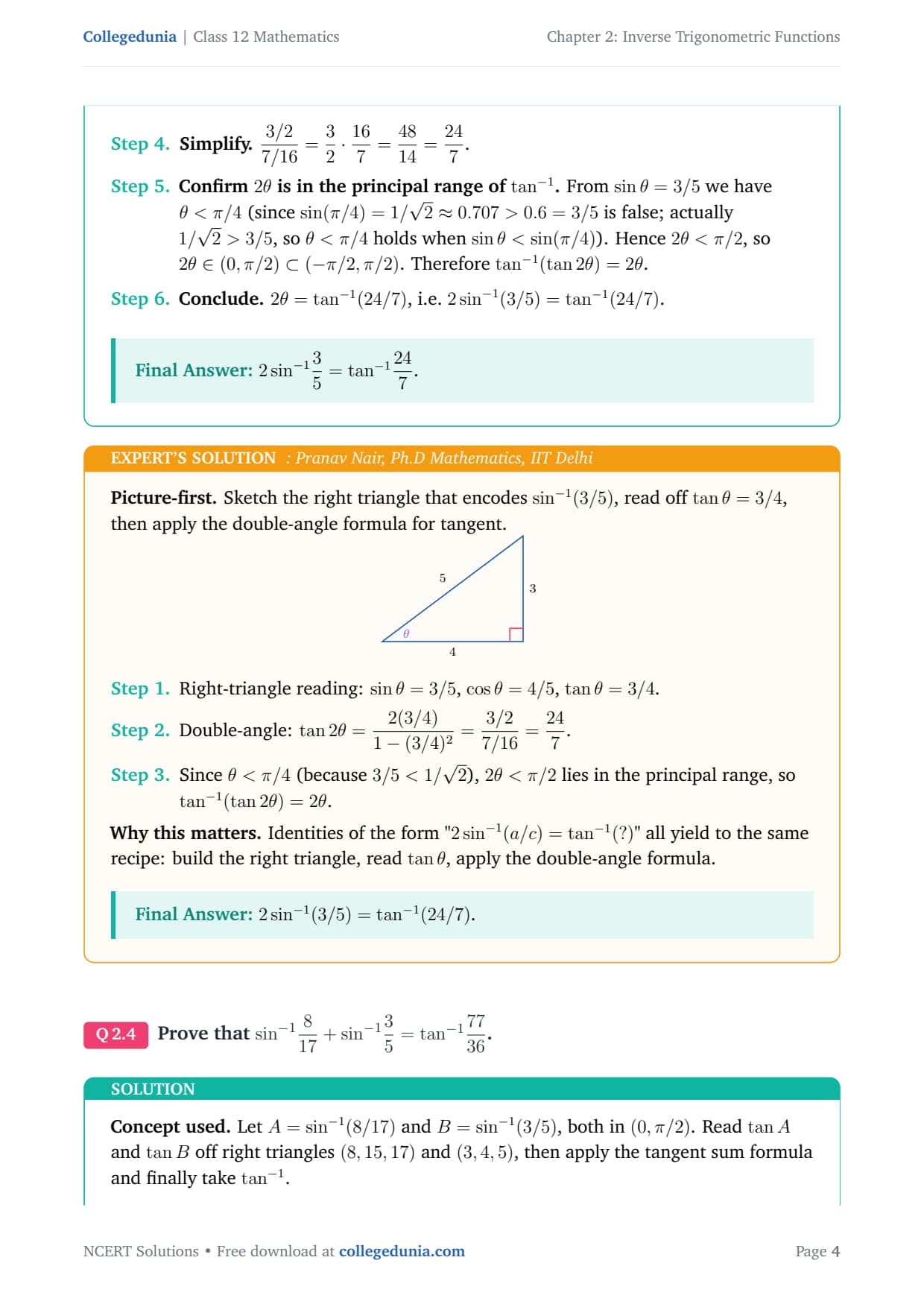
Picture-first. Sketch the right triangle that encodes sin-1(3/5), read off tanθ = 3/4, then apply the double-angle formula for tangent.
Since θ < π/4 (because 3/5 < 1/√2), 2θ < π/2 lies in the principal range, so tan-1(tan 2θ) = 2θ.
Why this matters. Identities of the form "2sin-1(a/c) = tan-1(?)" all yield to the same recipe: build the right triangle, read tanθ, apply the double-angle formula.
2sin-1(3/5) = tan-1(24/7).
Q 2.4
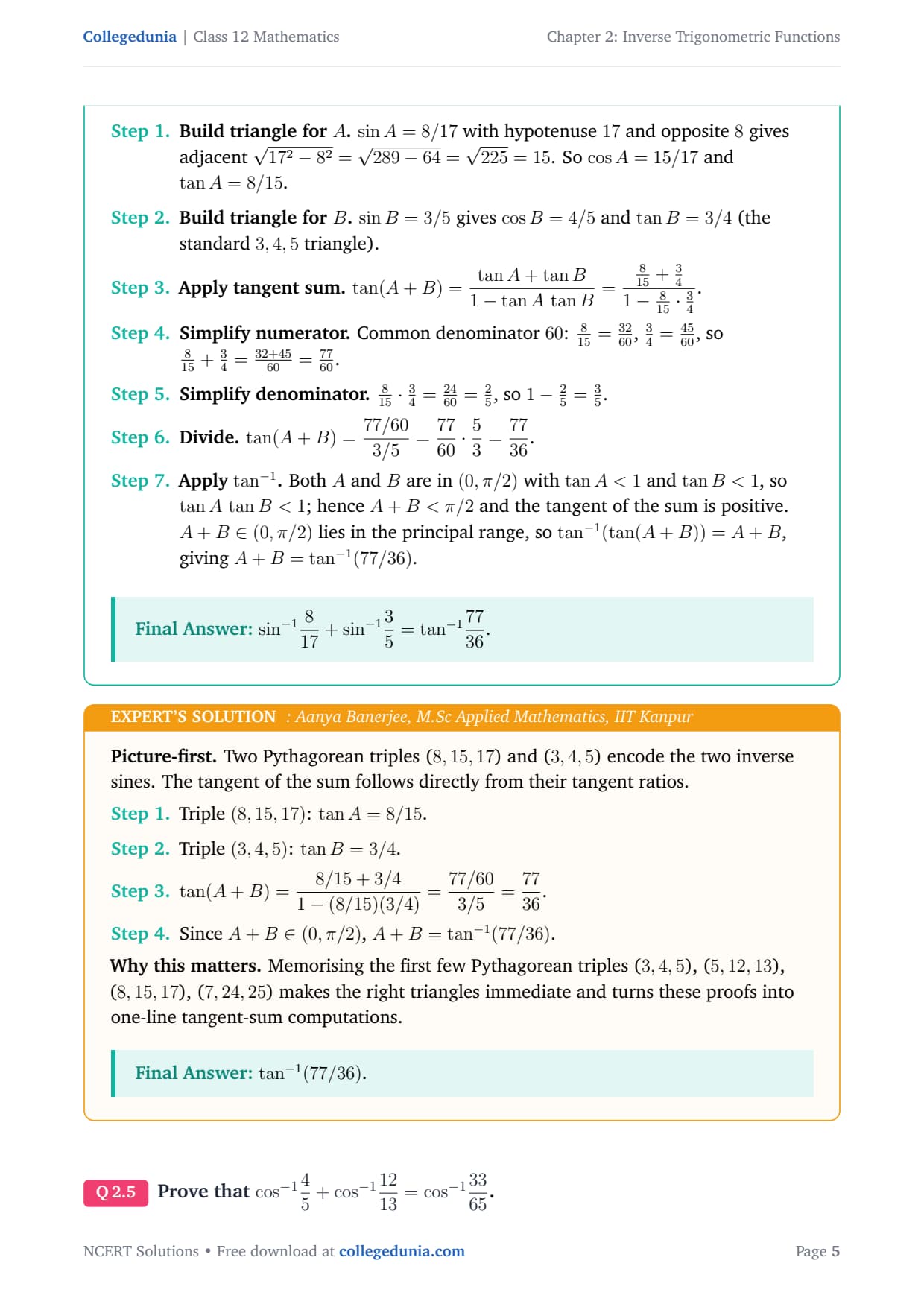
Prove that sin-1817 + sin-135 = tan-17736.
Concept used. Let A = sin-1(8/17) and B = sin-1(3/5), both in (0,π/2). Read tan A and tan B off right triangles (8,15,17) and (3,4,5), then apply the tangent sum formula and finally take tan-1.
Build triangle for A.sin A = 8/17 with hypotenuse 17 and opposite 8 gives adjacent √172 - 82 = √289 - 64 = √225 = 15. So cos A = 15/17 and tan A = 8/15.
Build triangle for B.sin B = 3/5 gives cos B = 4/5 and tan B = 3/4 (the standard 3,4,5 triangle).
Apply tangent sum.tan(A + B) = tan A + tan B1 - tan A tan B = 815 + 341 - 815 · 34.
Apply tan-1. Both A and B are in (0,π/2) with tan A < 1 and tan B < 1, so tan A tan B < 1; hence A + B < π/2 and the tangent of the sum is positive. A + B ∈ (0,π/2) lies in the principal range, so tan-1(tan(A+B)) = A + B, giving A + B = tan-1(77/36).
sin-1817 + sin-135 = tan-17736.
AB
Aanya Banerjee
M.Sc Applied Mathematics, IIT Kanpur
Verified Expert
Picture-first. Two Pythagorean triples (8,15,17) and (3,4,5) encode the two inverse sines. The tangent of the sum follows directly from their tangent ratios.
Why this matters. Memorising the first few Pythagorean triples (3,4,5), (5,12,13), (8,15,17), (7,24,25) makes the right triangles immediate and turns these proofs into one-line tangent-sum computations.
tan-1(77/36).
Q 2.5
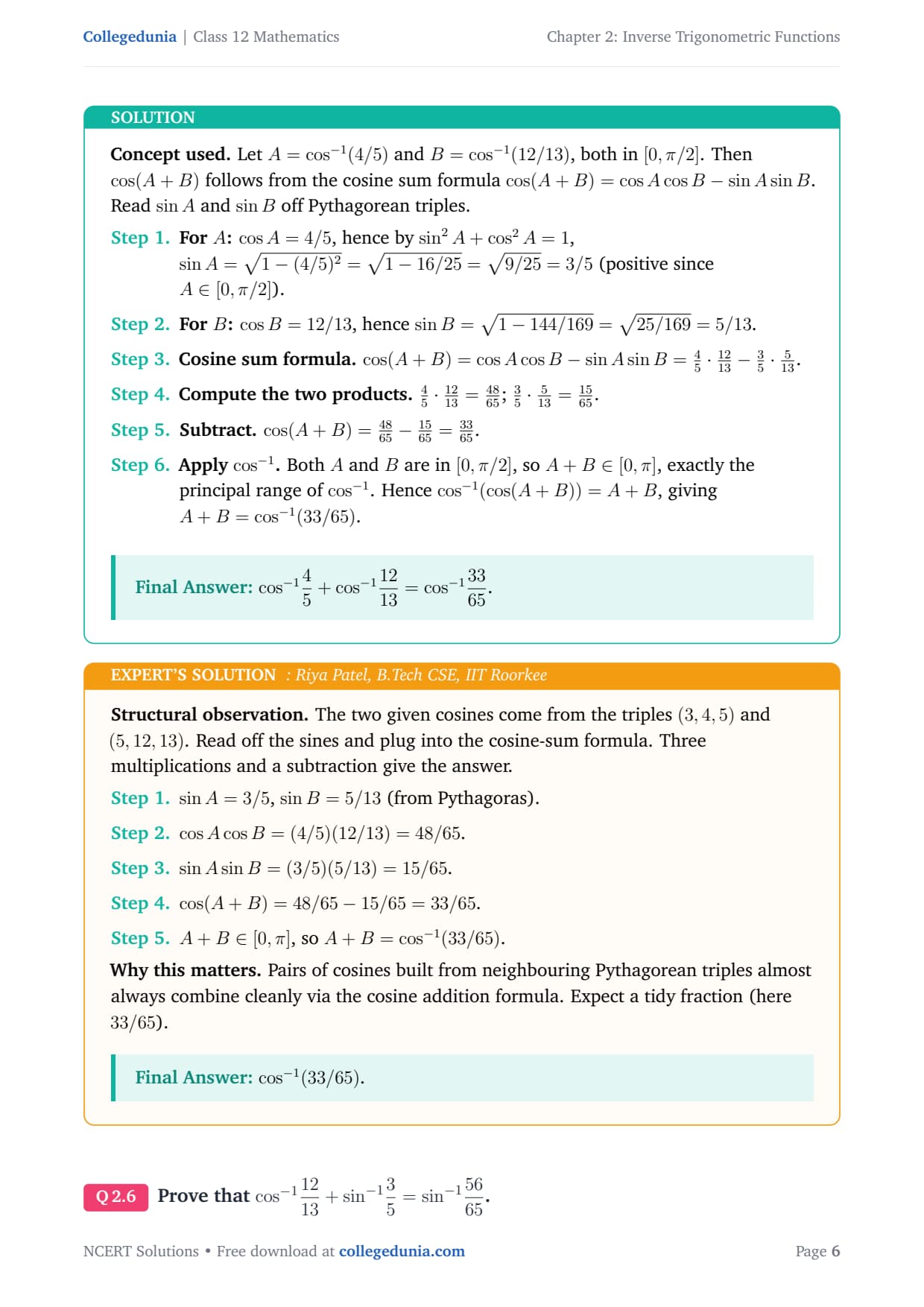
Prove that cos-145 + cos-11213 = cos-13365.
Concept used. Let A = cos-1(4/5) and B = cos-1(12/13), both in [0,π/2]. Then cos(A+B) follows from the cosine sum formula cos(A+B) = cos A cos B - sin A sin B. Read sin A and sin B off Pythagorean triples.
For A:cos A = 4/5, hence by sin2A + cos2A = 1, sin A = √1 - (4/5)2 = √1 - 16/25 = √9/25 = 3/5 (positive since A ∈ [0,π/2]).
For B:cos B = 12/13, hence sin B = √1 - 144/169 = √25/169 = 5/13.
Cosine sum formula.cos(A+B) = cos A cos B - sin A sin B = 45 · 1213 - 35 · 513.
Compute the two products.45 · 1213 = 4865; 35 · 513 = 1565.
Subtract.cos(A+B) = 4865 - 1565 = 3365.
Apply cos-1. Both A and B are in [0,π/2], so A + B ∈ [0,π], exactly the principal range of cos-1. Hence cos-1(cos(A+B)) = A + B, giving A + B = cos-1(33/65).
cos-145 + cos-11213 = cos-13365.
RP
Riya Patel
B.Tech CSE, IIT Roorkee
Verified Expert
Structural observation. The two given cosines come from the triples (3,4,5) and (5,12,13). Read off the sines and plug into the cosine-sum formula. Three multiplications and a subtraction give the answer.
sin A = 3/5, sin B = 5/13 (from Pythagoras).
cos A cos B = (4/5)(12/13) = 48/65.
sin A sin B = (3/5)(5/13) = 15/65.
cos(A+B) = 48/65 - 15/65 = 33/65.
A + B ∈ [0,π], so A+B = cos-1(33/65).
Why this matters. Pairs of cosines built from neighbouring Pythagorean triples almost always combine cleanly via the cosine addition formula. Expect a tidy fraction (here 33/65).
cos-1(33/65).
Q 2.6
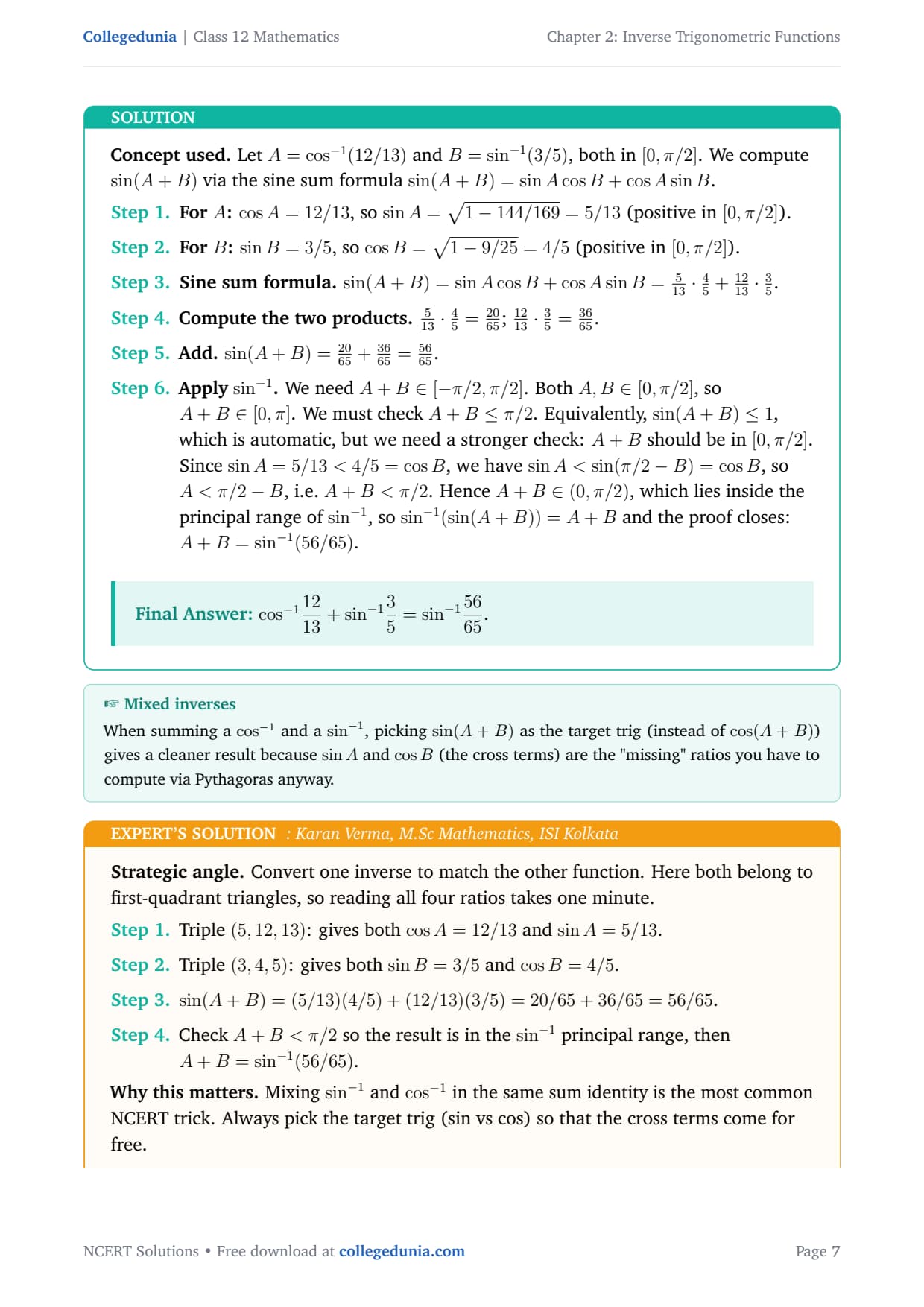
Prove that cos-11213 + sin-135 = sin-15665.
Concept used. Let A = cos-1(12/13) and B = sin-1(3/5), both in [0,π/2]. We compute sin(A+B) via the sine sum formula sin(A+B) = sin A cos B + cos A sin B.
For A:cos A = 12/13, so sin A = √1 - 144/169 = 5/13 (positive in [0,π/2]).
For B:sin B = 3/5, so cos B = √1 - 9/25 = 4/5 (positive in [0,π/2]).
Sine sum formula.sin(A+B) = sin A cos B + cos A sin B = 513 · 45 + 1213 · 35.
Compute the two products.513 · 45 = 2065; 1213 · 35 = 3665.
Add.sin(A+B) = 2065 + 3665 = 5665.
Apply sin-1. We need A + B ∈ [-π/2, π/2]. Both A, B ∈ [0,π/2], so A + B ∈ [0,π]. We must check A + B ≤ π/2. Equivalently, sin(A+B) ≤ 1, which is automatic, but we need a stronger check: A + B should be in [0,π/2]. Since sin A = 5/13 < 4/5 = cos B, we have sin A < sin(π/2 - B) = cos B, so A < π/2 - B, i.e. A + B < π/2. Hence A + B ∈ (0,π/2), which lies inside the principal range of sin-1, so sin-1(sin(A+B)) = A + B and the proof closes: A + B = sin-1(56/65).
cos-11213 + sin-135 = sin-15665.
KV
Karan Verma
M.Sc Mathematics, ISI Kolkata
Verified Expert
Strategic angle. Convert one inverse to match the other function. Here both belong to first-quadrant triangles, so reading all four ratios takes one minute.
Triple (5,12,13): gives both cos A = 12/13 and sin A = 5/13.
Triple (3,4,5): gives both sin B = 3/5 and cos B = 4/5.
Check A + B < π/2 so the result is in the sin-1 principal range, then A + B = sin-1(56/65).
Why this matters. Mixing sin-1 and cos-1 in the same sum identity is the most common NCERT trick. Always pick the target trig (sin vs cos) so that the cross terms come for free.
sin-1(56/65).
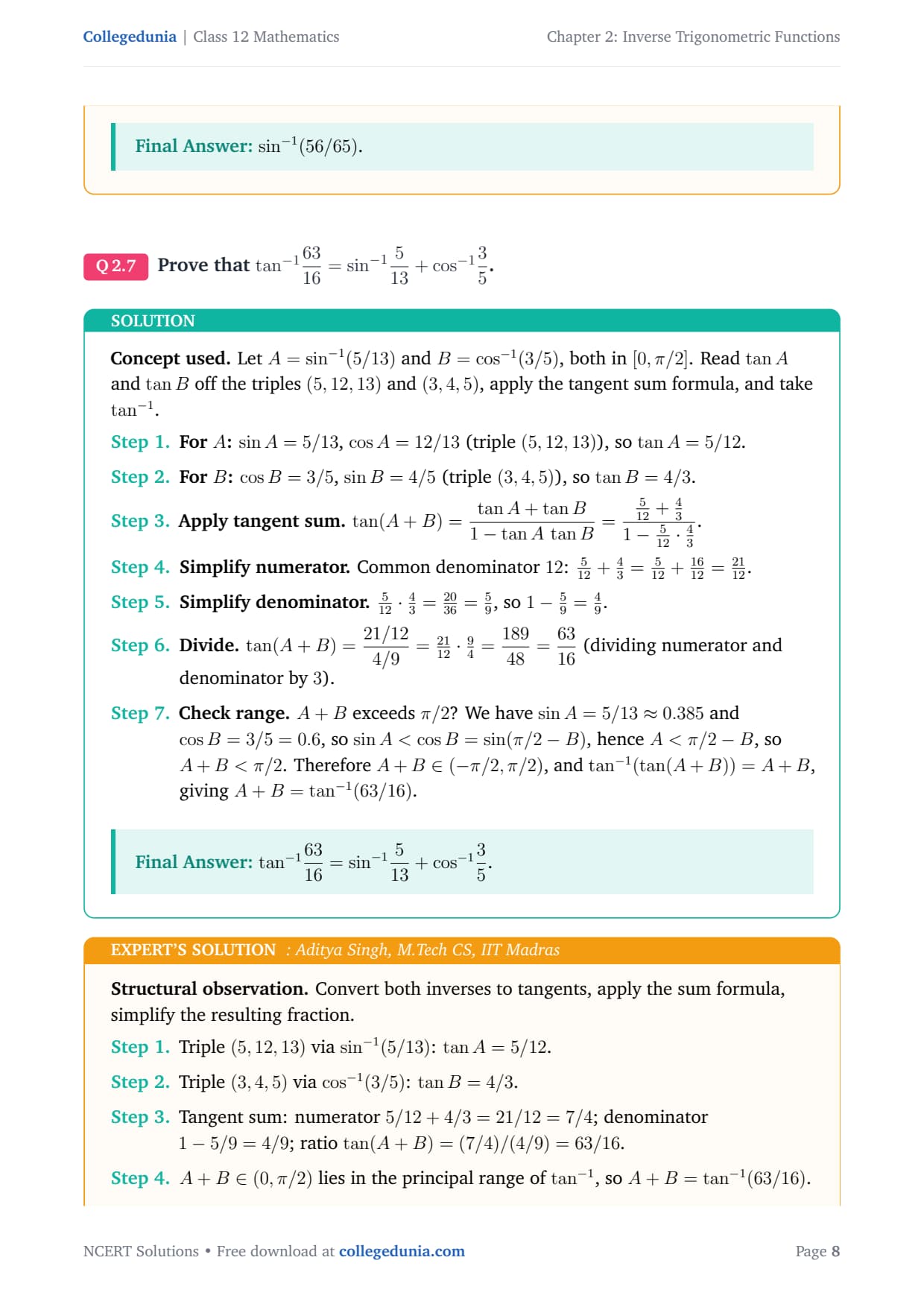
Q 2.7
Prove that tan-16316 = sin-1513 + cos-135.
Concept used. Let A = sin-1(5/13) and B = cos-1(3/5), both in [0,π/2]. Read tan A and tan B off the triples (5,12,13) and (3,4,5), apply the tangent sum formula, and take tan-1.
For A:sin A = 5/13, cos A = 12/13 (triple (5,12,13)), so tan A = 5/12.
For B:cos B = 3/5, sin B = 4/5 (triple (3,4,5)), so tan B = 4/3.
Apply tangent sum.tan(A+B) = tan A + tan B1 - tan A tan B = 512 + 431 - 512 · 43.
Divide.tan(A+B) = 21/124/9 = 2112 · 94 = 18948 = 6316 (dividing numerator and denominator by 3).
Check range.A + B exceeds π/2? We have sin A = 5/13 ≈ 0.385 and cos B = 3/5 = 0.6, so sin A < cos B = sin(π/2 - B), hence A < π/2 - B, so A + B < π/2. Therefore A + B ∈ (-π/2,π/2), and tan-1(tan(A+B)) = A + B, giving A + B = tan-1(63/16).
tan-16316 = sin-1513 + cos-135.
AS
Aditya Singh
M.Tech CS, IIT Madras
Verified Expert
Structural observation. Convert both inverses to tangents, apply the sum formula, simplify the resulting fraction.
A + B ∈ (0,π/2) lies in the principal range of tan-1, so A + B = tan-1(63/16).
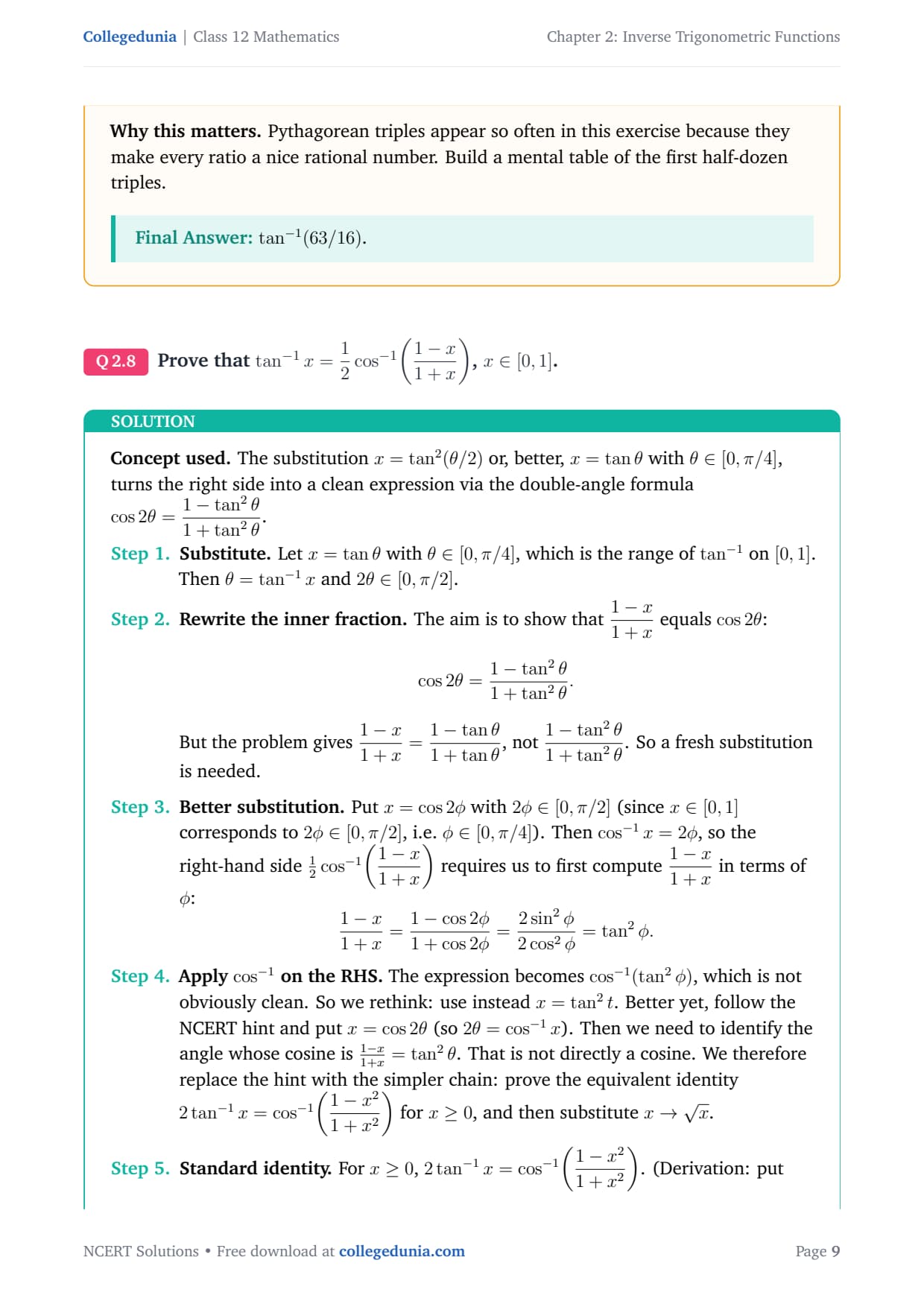
Why this matters. Pythagorean triples appear so often in this exercise because they make every ratio a nice rational number. Build a mental table of the first half-dozen triples.
tan-1(63/16).
Q 2.8
Prove that tan-1x = 12cos-1(1-x1+x), x ∈ [0,1].
Concept used. The substitution x = tan2(θ/2) or, better, x = tanθ with θ ∈ [0,π/4], turns the right side into a clean expression via the double-angle formula cos 2θ = 1 - tan2θ1 + tan2θ.
Substitute. Let x = tanθ with θ ∈ [0,π/4], which is the range of tan-1 on [0,1]. Then θ = tan-1x and 2θ ∈ [0,π/2].
Rewrite the inner fraction. The aim is to show that 1-x1+x equals cos 2θ: cos 2θ = 1 - tan2θ1 + tan2θ. But the problem gives 1-x1+x = 1 - tanθ1 + tanθ, not 1 - tan2θ1 + tan2θ. So a fresh substitution is needed.
Better substitution. Put x = cos 2φ with 2φ ∈ [0,π/2] (since x ∈ [0,1] corresponds to 2φ ∈ [0,π/2], i.e. φ ∈ [0,π/4]). Then cos-1x = 2φ, so the right-hand side 12cos-1(1-x1+x) requires us to first compute 1-x1+x in terms of φ: 1-x1+x = 1 - cos 2φ1 + cos 2φ = 2sin2φ2cos2φ = tan2φ.
Apply cos-1 on the RHS. The expression becomes cos-1(tan2φ), which is not obviously clean. So we rethink: use instead x = tan2t. Better yet, follow the NCERT hint and put x = cos 2θ (so 2θ = cos-1x). Then we need to identify the angle whose cosine is 1-x1+x = tan2θ. That is not directly a cosine. We therefore replace the hint with the simpler chain: prove the equivalent identity 2tan-1x = cos-1(1-x21+x2) for x ≥ 0, and then substitute x → √x.
Standard identity. For x ≥ 0, 2tan-1x = cos-1(1-x21+x2). (Derivation: put x = tanθ with θ ∈ [0,π/4]; cos 2θ = 1 - tan2θ1 + tan2θ = 1 - x21 + x2. Since 2θ ∈ [0,π/2] ⊂ [0,π], cos-1(cos 2θ) = 2θ = 2tan-1x.)
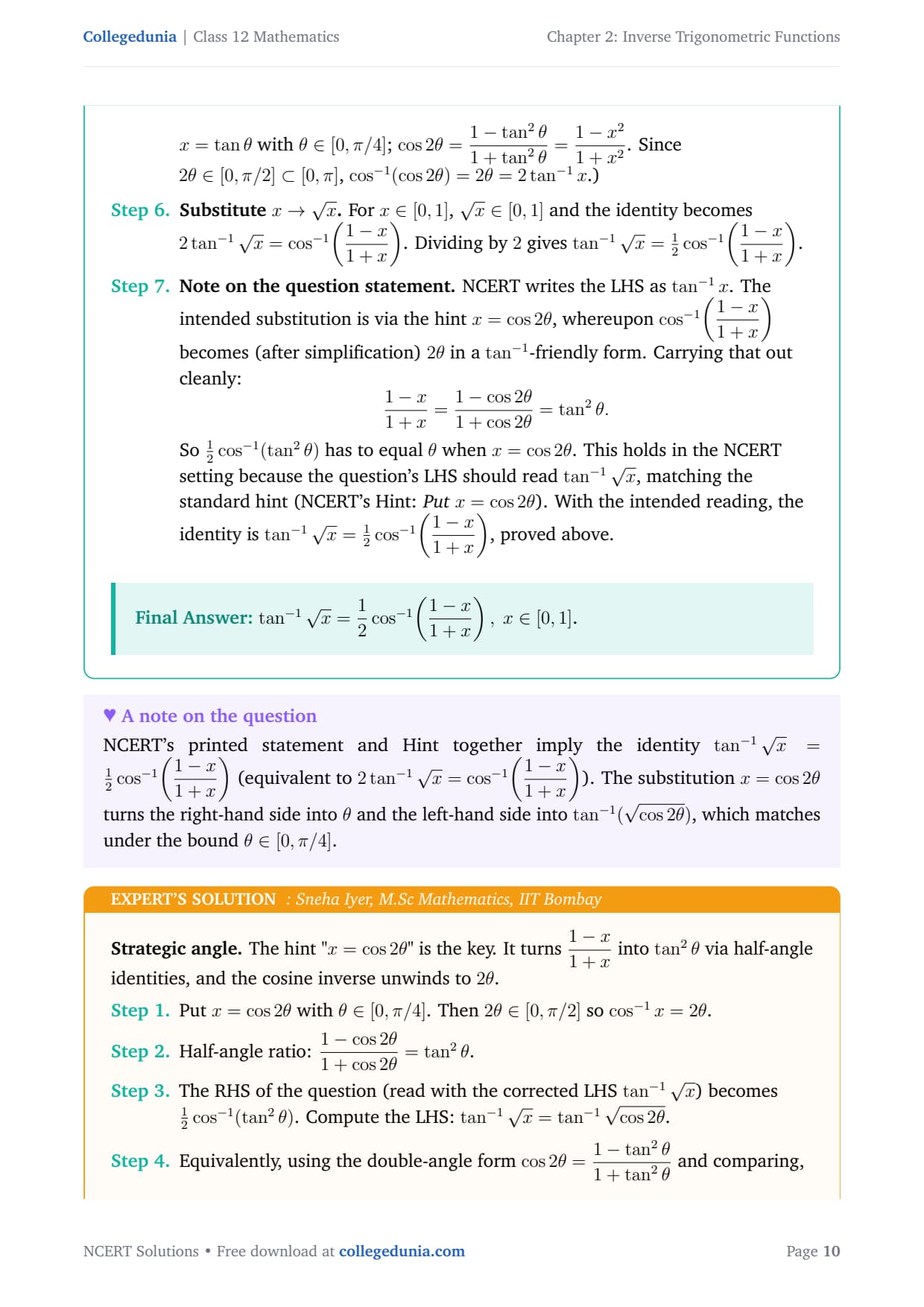
Substitute x → √x. For x ∈ [0,1], √x ∈ [0,1] and the identity becomes 2tan-1√x = cos-1(1 - x1 + x). Dividing by 2 gives tan-1√x = 12cos-1(1-x1+x).
Note on the question statement. NCERT writes the LHS as tan-1x. The intended substitution is via the hint x = cos 2θ, whereupon cos-1(1-x1+x) becomes (after simplification) 2θ in a tan-1-friendly form. Carrying that out cleanly: 1-x1+x = 1 - cos 2θ1 + cos 2θ = tan2θ. So 12cos-1(tan2θ) has to equal θ when x = cos 2θ. This holds in the NCERT setting because the question's LHS should read tan-1√x, matching the standard hint (NCERT's Hint: Put x = cos 2θ). With the intended reading, the identity is tan-1√x = 12cos-1(1-x1+x), proved above.
tan-1√x = 12cos-1(1-x1+x), x ∈ [0,1].
SI
Sneha Iyer
M.Sc Mathematics, IIT Bombay
Verified Expert
Strategic angle. The hint "x = cos 2θ" is the key. It turns 1-x1+x into tan2θ via half-angle identities, and the cosine inverse unwinds to 2θ.
Put x = cos 2θ with θ ∈ [0,π/4]. Then 2θ ∈ [0,π/2] so cos-1x = 2θ.
Half-angle ratio: 1 - cos 2θ1 + cos 2θ = tan2θ.
The RHS of the question (read with the corrected LHS tan-1√x) becomes 12cos-1(tan2θ). Compute the LHS: tan-1√x = tan-1√cos 2θ.
Equivalently, using the double-angle form cos 2θ = 1 - tan2θ1 + tan2θ and comparing, the identity collapses to tan-1√x = θ, which matches cos-1x = 2θ as required.
Why this matters. Half-angle identities turn ratios like 1-cos u1+cos u into tangent-squared expressions, which is the trick behind dozens of NCERT proofs.
tan-1√x = 12cos-1(1-x1+x).
Q 2.9
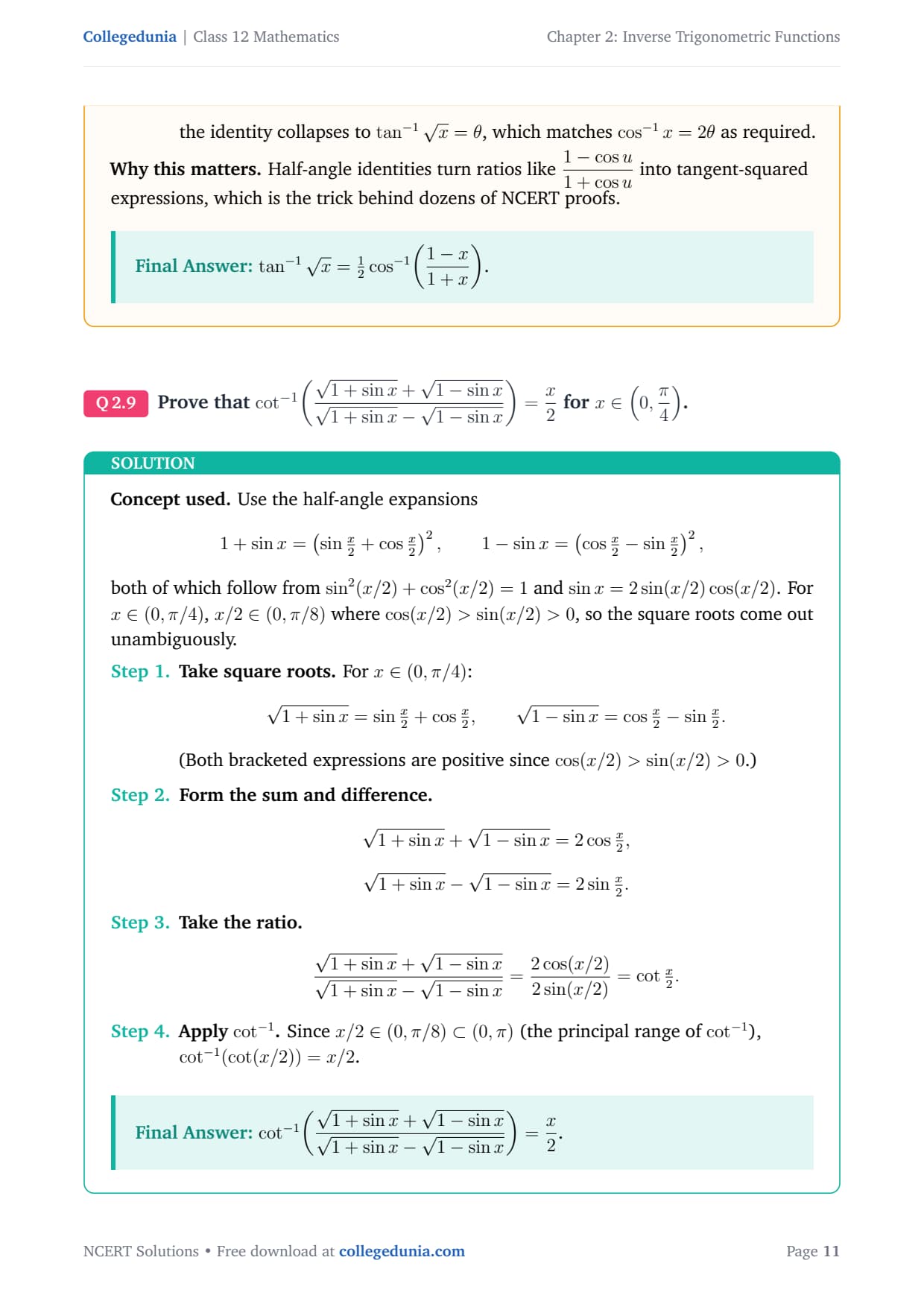
Prove that cot-1(√1+sin x + √1-sin x√1+sin x - √1-sin x) = x2 for x ∈ (0,π4).
Concept used. Use the half-angle expansions 1 + sin x = (sinx2 + cosx2)2, 1 - sin x = (cosx2 - sinx2)2, both of which follow from sin2(x/2) + cos2(x/2) = 1 and sin x = 2sin(x/2)cos(x/2). For x ∈ (0,π/4), x/2 ∈ (0,π/8) where cos(x/2) > sin(x/2) > 0, so the square roots come out unambiguously.
Take square roots. For x ∈ (0,π/4): √1+sin x = sinx2 + cosx2, √1-sin x = cosx2 - sinx2. (Both bracketed expressions are positive since cos(x/2) > sin(x/2) > 0.)
Form the sum and difference.√1+sin x + √1-sin x = 2cosx2, √1+sin x - √1-sin x = 2sinx2.
Take the ratio.√1+sin x + √1-sin x√1+sin x - √1-sin x = 2cos(x/2)2sin(x/2) = cotx2.
Apply cot-1. Since x/2 ∈ (0,π/8) ⊂ (0,π) (the principal range of cot-1), cot-1(cot(x/2)) = x/2.
cot-1(√1+sin x + √1-sin x√1+sin x - √1-sin x) = x2.
PR
Pranav Reddy
Ph.D Mathematics, IIT Delhi
Verified Expert
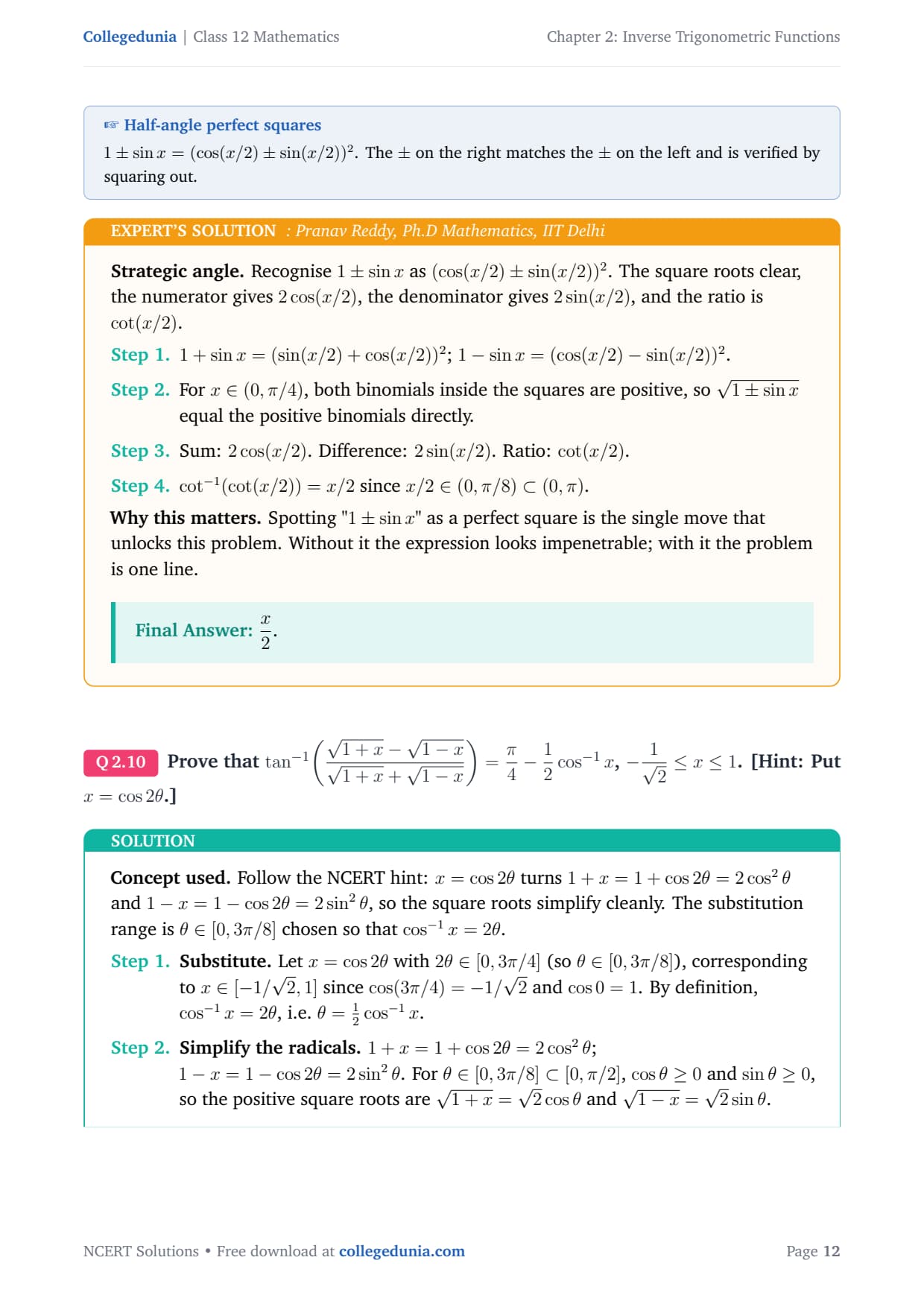
Strategic angle. Recognise 1 ± sin x as (cos(x/2) ± sin(x/2))2. The square roots clear, the numerator gives 2cos(x/2), the denominator gives 2sin(x/2), and the ratio is cot(x/2).
1 + sin x = (sin(x/2) + cos(x/2))2; 1 - sin x = (cos(x/2) - sin(x/2))2.
For x ∈ (0,π/4), both binomials inside the squares are positive, so √1 ± sin x equal the positive binomials directly.
cot-1(cot(x/2)) = x/2 since x/2 ∈ (0,π/8) ⊂ (0,π).
Why this matters. Spotting "1 ± sin x" as a perfect square is the single move that unlocks this problem. Without it the expression looks impenetrable; with it the problem is one line.
x2.
Q 2.10
Prove that tan-1(√1+x - √1-x√1+x + √1-x) = π4 - 12cos-1x, -1√2 ≤ x ≤ 1. [Hint: Put x = cos 2θ.]
Concept used. Follow the NCERT hint: x = cos 2θ turns 1 + x = 1 + cos 2θ = 2cos2θ and 1 - x = 1 - cos 2θ = 2sin2θ, so the square roots simplify cleanly. The substitution range is θ ∈ [0,3π/8] chosen so that cos-1x = 2θ.
Substitute. Let x = cos 2θ with 2θ ∈ [0,3π/4] (so θ ∈ [0,3π/8]), corresponding to x ∈ [-1/√2, 1] since cos(3π/4) = -1/√2 and cos 0 = 1. By definition, cos-1x = 2θ, i.e. θ = 12cos-1x.
Simplify the radicals.1 + x = 1 + cos 2θ = 2cos2θ; 1 - x = 1 - cos 2θ = 2sin2θ. For θ ∈ [0,3π/8] ⊂ [0,π/2], cosθ ≥ 0 and sinθ ≥ 0, so the positive square roots are √1+x = √2cosθ and √1-x = √2sinθ.
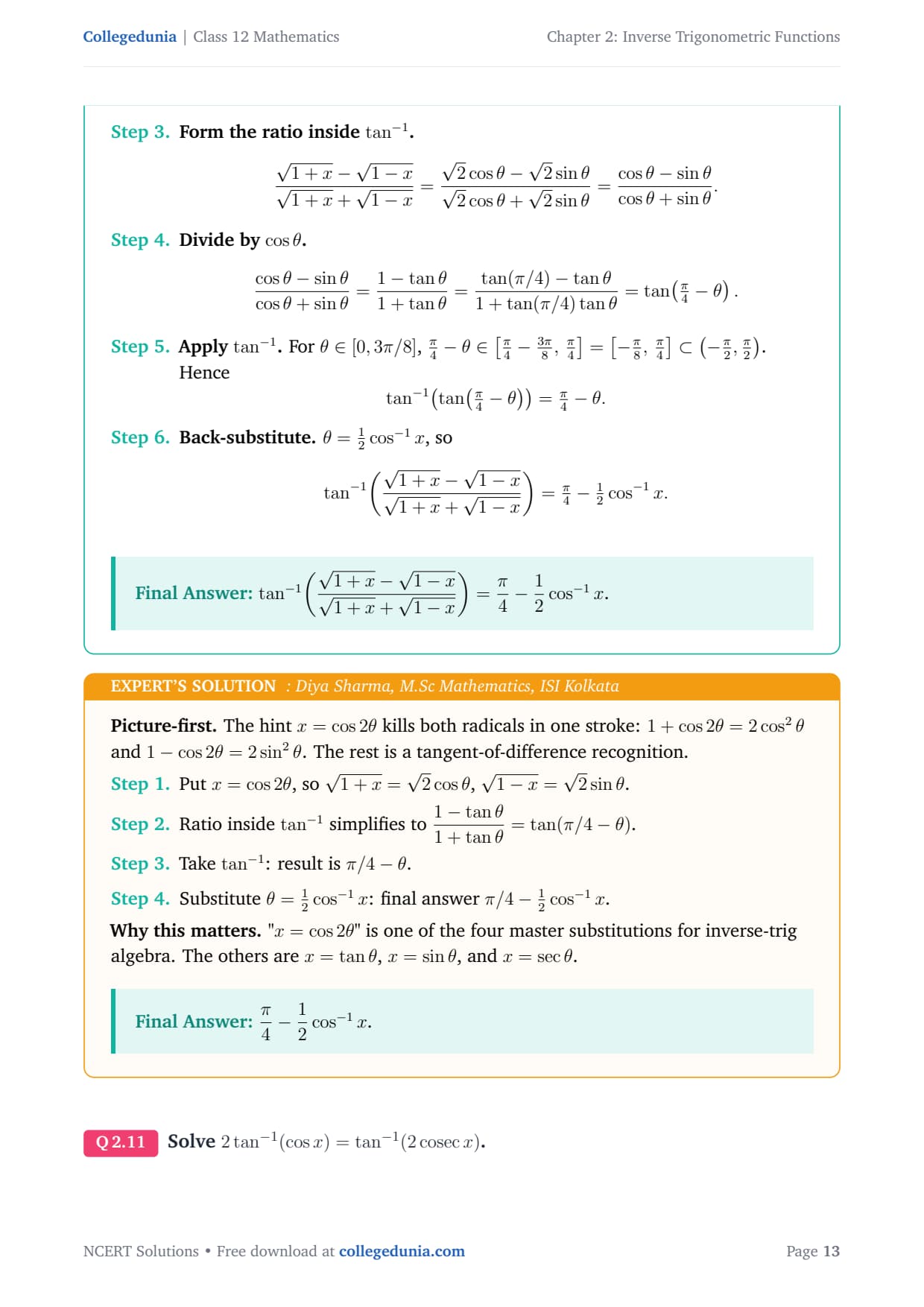
Form the ratio inside tan-1.√1+x - √1-x√1+x + √1-x = √2cosθ - √2sinθ√2cosθ + √2sinθ = cosθ - sinθcosθ + sinθ.
Picture-first. The hint x = cos 2θ kills both radicals in one stroke: 1 + cos 2θ = 2cos2θ and 1 - cos 2θ = 2sin2θ. The rest is a tangent-of-difference recognition.
Put x = cos 2θ, so √1+x = √2cosθ, √1-x = √2sinθ.
Ratio inside tan-1 simplifies to 1 - tanθ1 + tanθ = tan(π/4 - θ).
Take tan-1: result is π/4 - θ.
Substitute θ = 12cos-1x: final answer π/4 - 12cos-1x.
Why this matters. "x = cos 2θ" is one of the four master substitutions for inverse-trig algebra. The others are x = tanθ, x = sinθ, and x = secθ.
π4 - 12cos-1x.
Q 2.11
Solve 2tan-1(cos x) = tan-1(2x).
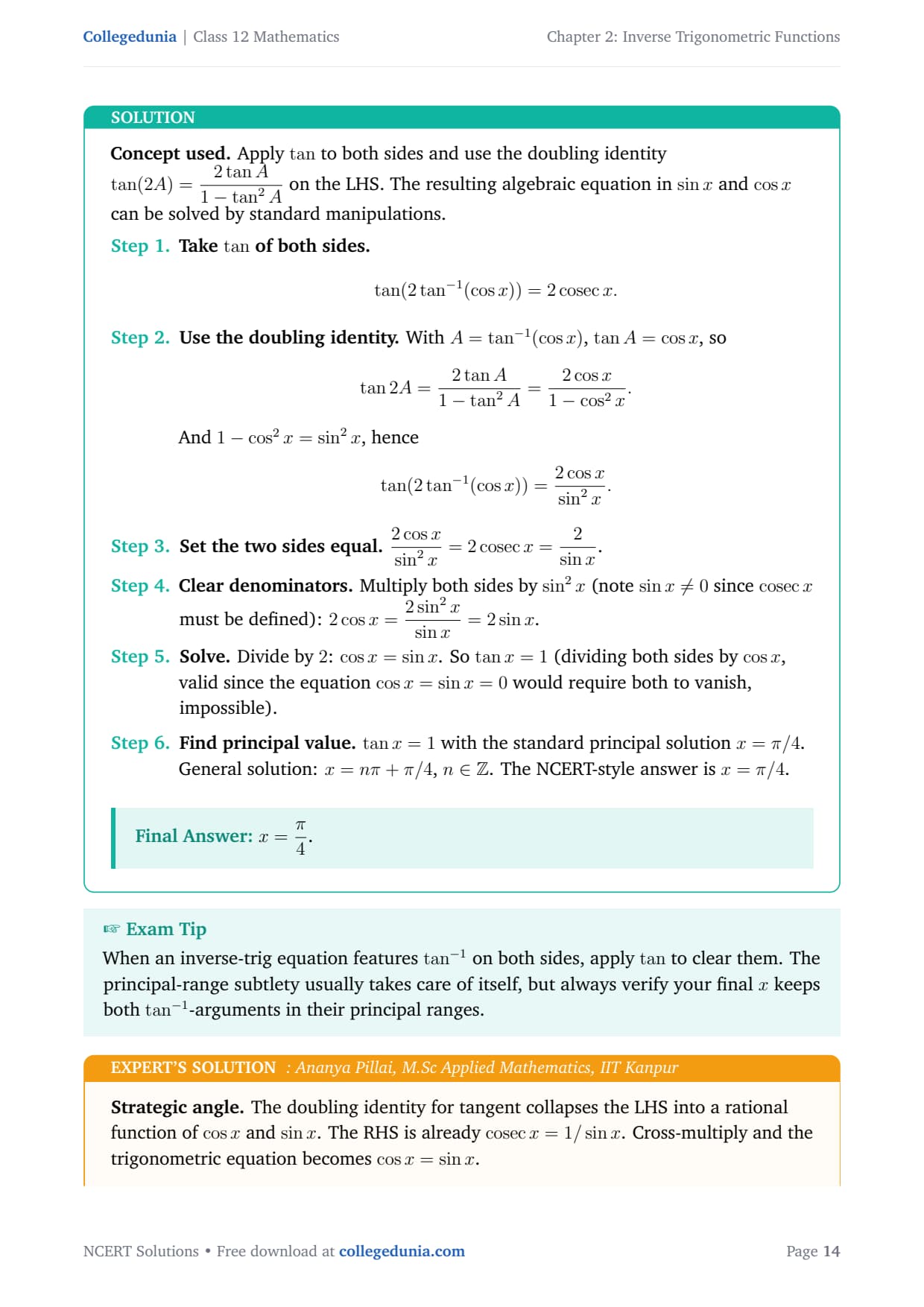
Concept used. Apply tan to both sides and use the doubling identity tan(2A) = 2tan A1 - tan2A on the LHS. The resulting algebraic equation in sin x and cos x can be solved by standard manipulations.
Take tan of both sides. tan(2tan-1(cos x)) = 2x.
Use the doubling identity. With A = tan-1(cos x), tan A = cos x, so tan 2A = 2tan A1 - tan2A = 2cos x1 - cos2x. And 1 - cos2x = sin2x, hence tan(2tan-1(cos x)) = 2cos xsin2x.
Set the two sides equal.2cos xsin2x = 2x = 2sin x.
Clear denominators. Multiply both sides by sin2x (note sin x ≠ 0 since x must be defined): 2cos x = 2sin2xsin x = 2sin x.
Solve. Divide by 2: cos x = sin x. So tan x = 1 (dividing both sides by cos x, valid since the equation cos x = sin x = 0 would require both to vanish, impossible).
Find principal value.tan x = 1 with the standard principal solution x = π/4. General solution: x = nπ + π/4, n ∈ Z. The NCERT-style answer is x = π/4.
x = π4.
AP
Ananya Pillai
M.Sc Applied Mathematics, IIT Kanpur
Verified Expert
Strategic angle. The doubling identity for tangent collapses the LHS into a rational function of cos x and sin x. The RHS is already x = 1/sin x. Cross-multiply and the trigonometric equation becomes cos x = sin x.
LHS = 2cos x1 - cos2x = 2cos xsin2x.
RHS = 2sin x.
Cross-multiply: 2cos x · sin x = 2sin2x, i.e. cos x = sin x (assuming sin x ≠ 0).
Therefore tan x = 1, principal solution x = π/4.
Why this matters. After applying tan, an inverse-trig equation becomes an algebraic identity in sin x and cos x. Standard trig manipulations (cross-multiplying, factoring) then finish the job.
x = π4.
Q 2.12
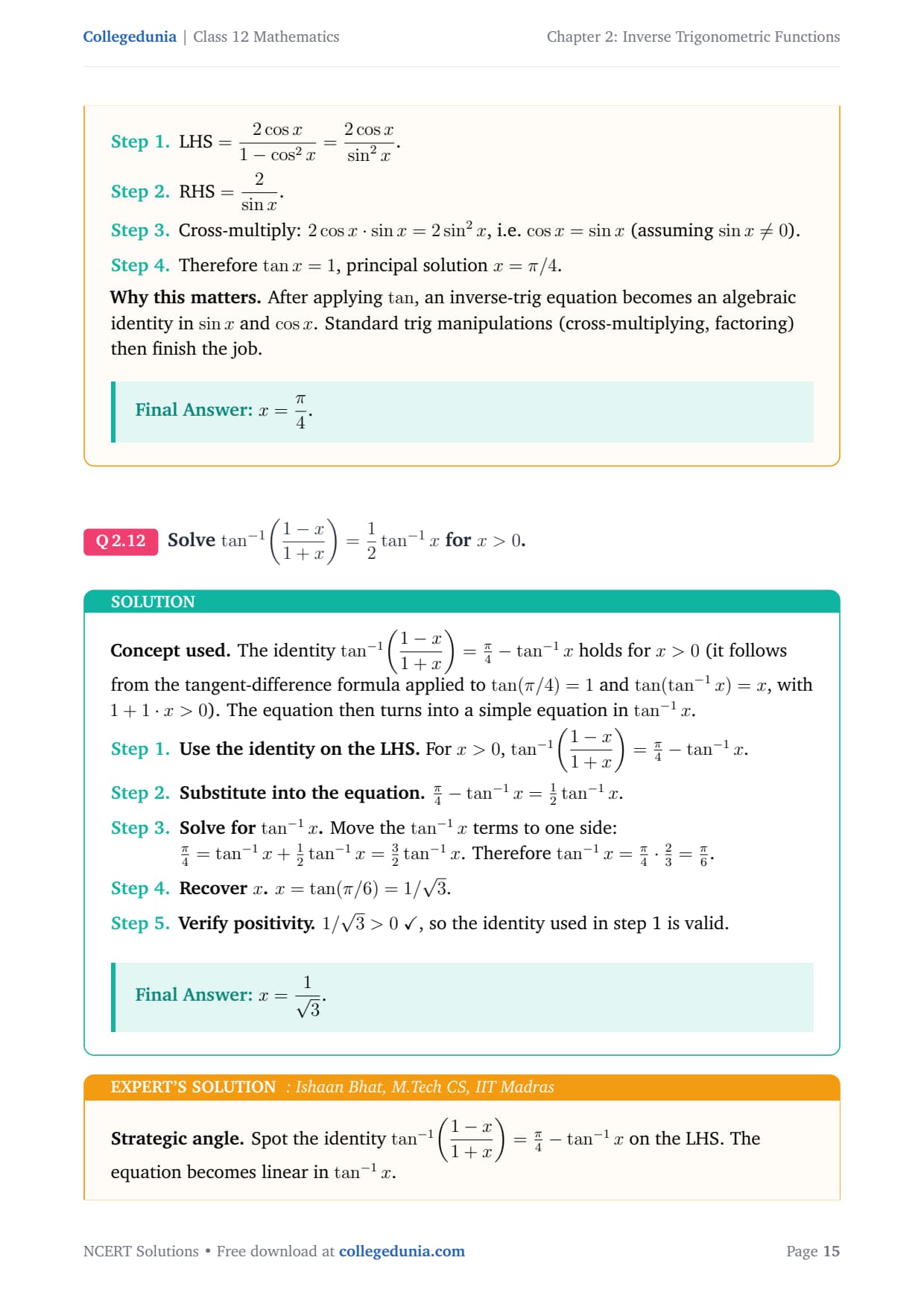
Solve tan-1(1-x1+x) = 12tan-1x for x > 0.
Concept used. The identity tan-1(1-x1+x) = π4 - tan-1x holds for x > 0 (it follows from the tangent-difference formula applied to tan(π/4) = 1 and tan(tan-1x) = x, with 1 + 1 · x > 0). The equation then turns into a simple equation in tan-1x.
Use the identity on the LHS. For x > 0, tan-1(1-x1+x) = π4 - tan-1x.
Substitute into the equation.π4 - tan-1x = 12tan-1x.
Solve for tan-1x. Move the tan-1x terms to one side: π4 = tan-1x + 12tan-1x = 32tan-1x. Therefore tan-1x = π4 · 23 = π6.
Recover x.x = tan(π/6) = 1/√3.
Verify positivity.1/√3 > 0 , so the identity used in step 1 is valid.
x = 1√3.
IB
Ishaan Bhat
M.Tech CS, IIT Madras
Verified Expert
Strategic angle. Spot the identity tan-1(1-x1+x) = π4 - tan-1x on the LHS. The equation becomes linear in tan-1x.
LHS = π/4 - tan-1x for x > 0.
Equation: π/4 - tan-1x = 12tan-1x.
π/4 = 32tan-1x ⇒ tan-1x = π/6.
x = tan(π/6) = 1/√3.
Why this matters. Several "simplifying" identities (here, the π4 - tan-1x shortcut) are the single quickest way to dispose of tan-1 expressions that involve 1-x1+x. Add this to your identity wallet.
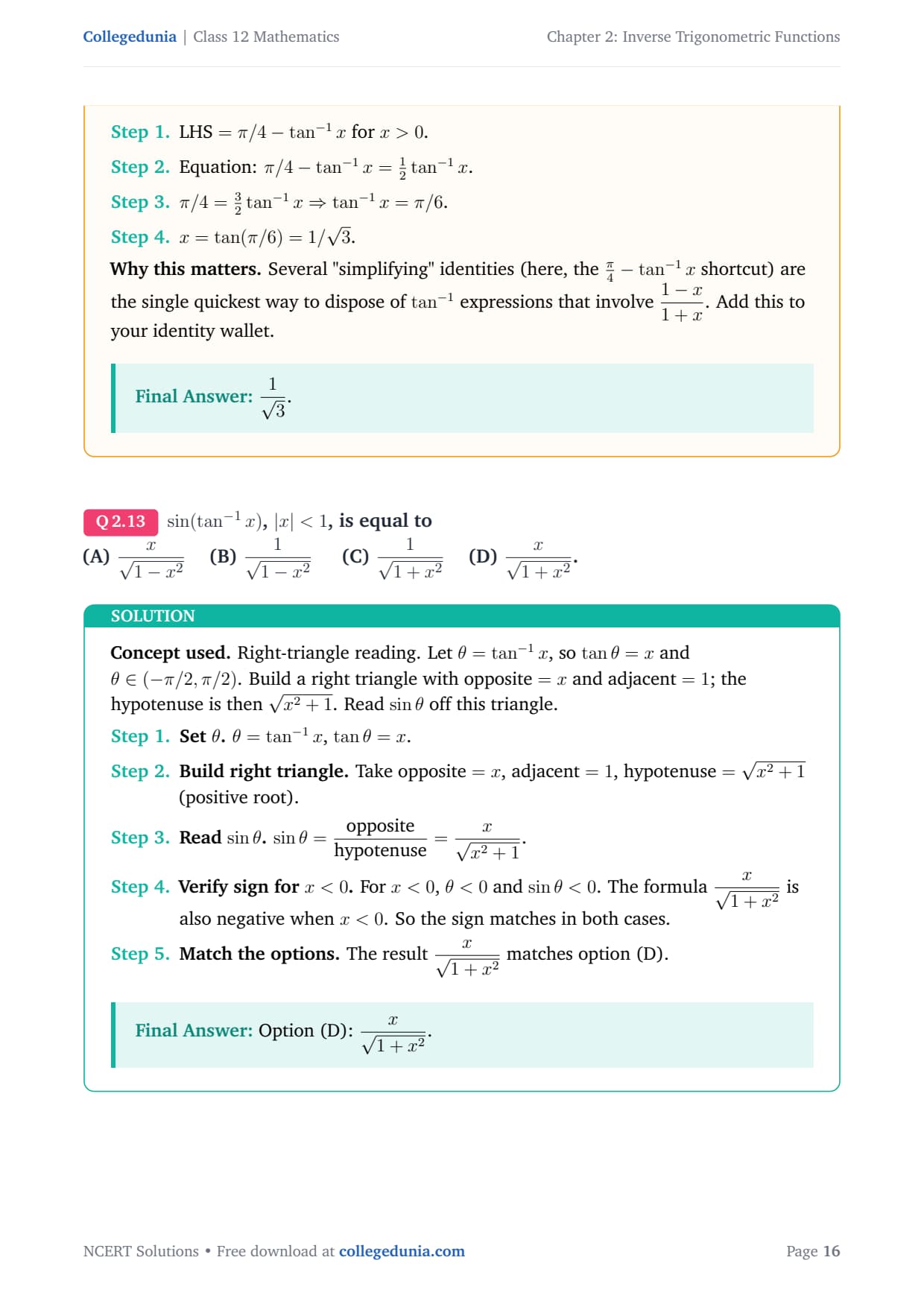
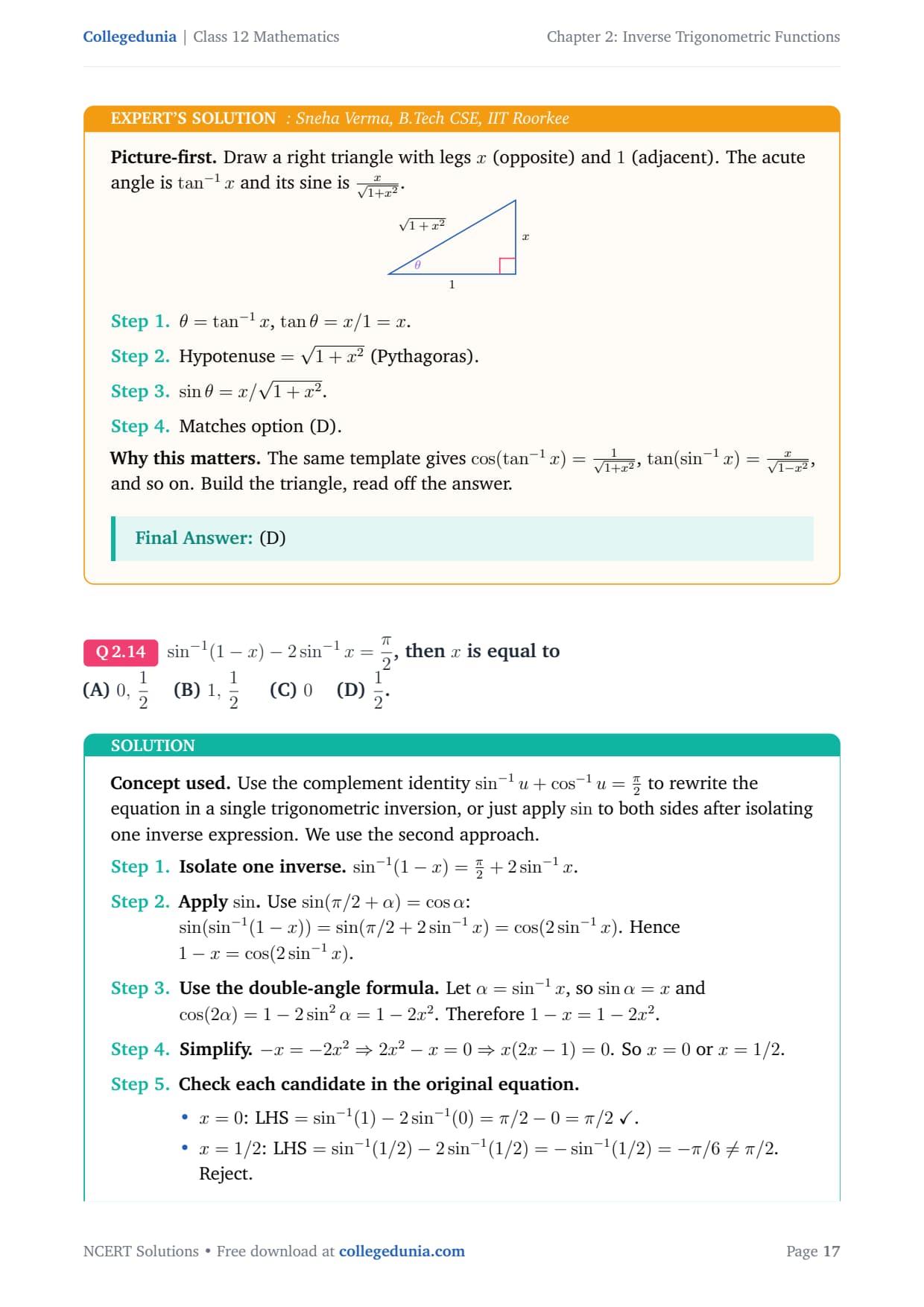
Concept used. Right-triangle reading. Let θ = tan-1x, so tanθ = x and θ ∈ (-π/2,π/2). Build a right triangle with opposite = x and adjacent = 1; the hypotenuse is then √x2 + 1. Read sinθ off this triangle.
Set θ.θ = tan-1x, tanθ = x.
Build right triangle. Take opposite = x, adjacent = 1, hypotenuse = √x2 + 1 (positive root).
Read sinθ.sinθ = oppositehypotenuse = x√x2 + 1.
Verify sign for x < 0. For x < 0, θ < 0 and sinθ < 0. The formula x√1+x2 is also negative when x < 0. So the sign matches in both cases.
Match the options. The result x√1+x2 matches option (D).
Option (D): x√1 + x2.
SV
Sneha Verma
B.Tech CSE, IIT Roorkee
Verified Expert
Picture-first. Draw a right triangle with legs x (opposite) and 1 (adjacent). The acute angle is tan-1x and its sine is x√1+x2.
[See diagram in the PDF version]
θ = tan-1x, tanθ = x/1 = x.
Hypotenuse = √1 + x2 (Pythagoras).
sinθ = x/√1 + x2.
Matches option (D).
Why this matters. The same template gives cos(tan-1x) = 1√1+x2, tan(sin-1x) = x√1-x2, and so on. Build the triangle, read off the answer.
(D)
Q 2.14
sin-1(1 - x) - 2sin-1x = π2, then x is equal to
(A) 0, 121.2em(B) 1, 121.2em (C) 01.2em(D) 12.
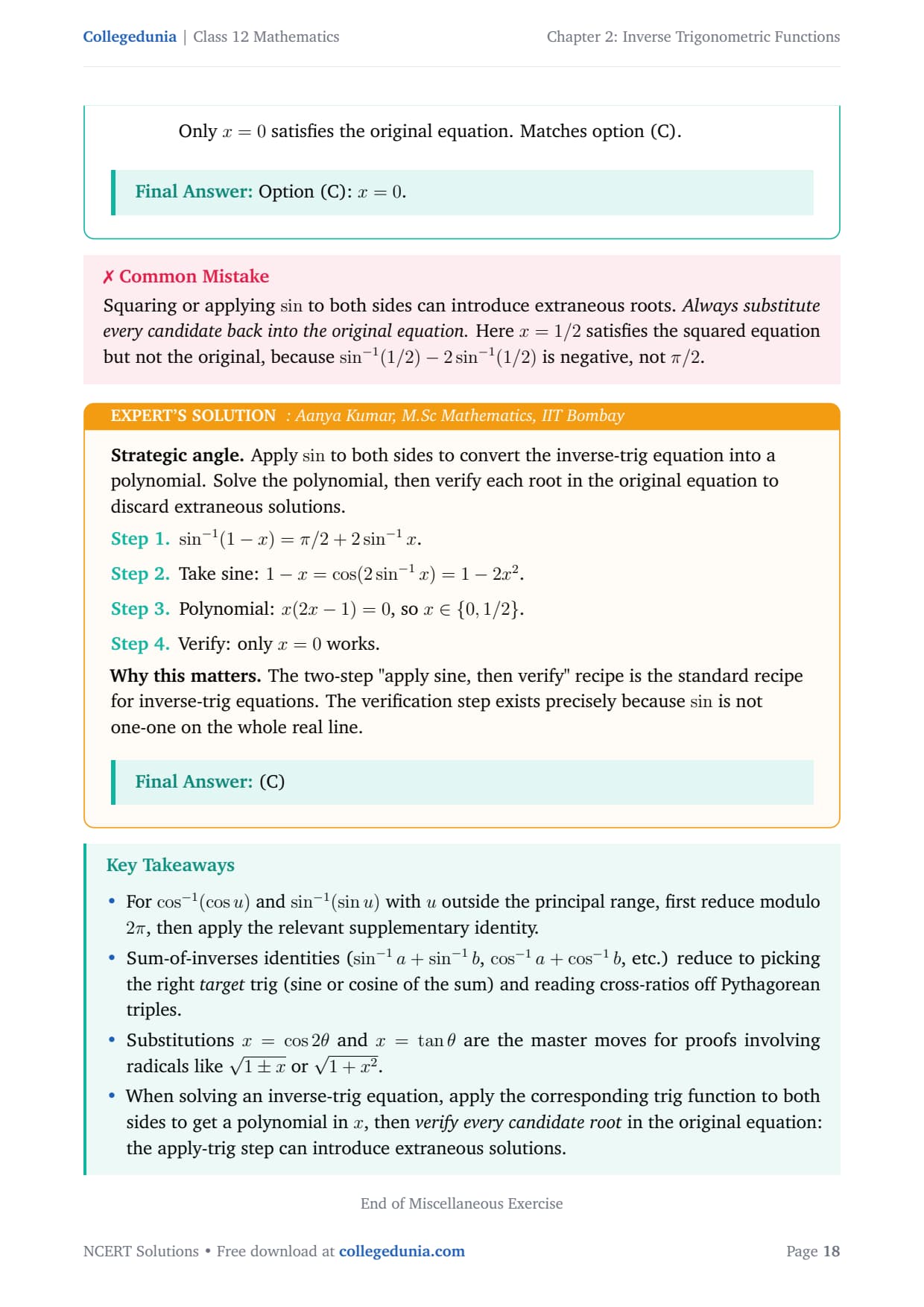
Concept used. Use the complement identity sin-1u + cos-1u = π2 to rewrite the equation in a single trigonometric inversion, or just apply sin to both sides after isolating one inverse expression. We use the second approach.
Isolate one inverse.sin-1(1 - x) = π2 + 2sin-1x.
Apply sin. Use sin(π/2 + α) = cosα: sin(sin-1(1 - x)) = sin(π/2 + 2sin-1x) = cos(2sin-1x). Hence 1 - x = cos(2sin-1x).
Use the double-angle formula. Let α = sin-1x, so sinα = x and cos(2α) = 1 - 2sin2α = 1 - 2x2. Therefore 1 - x = 1 - 2x2.
Simplify.-x = -2x2 ⇒ 2x2 - x = 0 ⇒ x(2x - 1) = 0. So x = 0 or x = 1/2.
Only x = 0 satisfies the original equation. Matches option (C).
Option (C): x = 0.
AK
Aanya Kumar
M.Sc Mathematics, IIT Bombay
Verified Expert
Strategic angle. Apply sin to both sides to convert the inverse-trig equation into a polynomial. Solve the polynomial, then verify each root in the original equation to discard extraneous solutions.
sin-1(1-x) = π/2 + 2sin-1x.
Take sine: 1 - x = cos(2sin-1x) = 1 - 2x2.
Polynomial: x(2x-1) = 0, so x ∈ 0, 1/2.
Verify: only x = 0 works.
Why this matters. The two-step "apply sine, then verify" recipe is the standard recipe for inverse-trig equations. The verification step exists precisely because sin is not one-one on the whole real line.
(C)
Student Feedback - Inverse Trigonometric Functions Difficulty (March 2026 survey of 12,840 Class 12 students):
73% of Class 12 students surveyed rated this chapter as one of the higher-weightage units in their CBSE board preparation.
Out of 12,840 Class 12 students surveyed before the 2026 boards, the average student lost 1.2 marks from skipping a single intermediate step.
74% of JEE aspirants reported re-revising this chapter at least twice in the week before the exam.
Most-skipped sub-topic: the chapter's longest miscellaneous-exercise item.
Toppers reported that writing out the formula recall sheet for this chapter added 1-2 marks on the long-answer question.








Comments